Tag: digital marketing

  • #FreelanceFriday: Finding More Time in Your Schedule to Freelance

    This blog is part of our Freelance Friday series, where we discuss everything and anything related to freelancers. For more freelance information, tips, and trends, follow us on Twitter.

    Image Of Michael Scott Saying No Time - Search Influence

    “I don’t have time…”

    As writers, we have all said it at one time or another, most likely as an excuse for not writing more. And let’s not kid ourselves here, it is most certainly an excuse. There are 24-hours in the day for everyone. So, why can only some people pull off a freelancing side gig?

    Deciding to add freelancing to your daily schedule probably didn’t seem like that big of a deal at first. You can make your own schedule and work from anywhere at anytime. That all sounds great (and it really is!), but you still have to find the actual time to do it. It can certainly be tempting to let freelancing take a back seat to other tasks and priorities in your life—but don’t let it happen!

    For those who truly want to do it, they find the time. Freelancing (and writing in general) are choices. Likewise, you have to choose to find the time. Time management techniques and organizational skills can be developed and utilized easily. In the end, freelancing is all about scheduling and prioritization, especially when you are still working full-time at another job. Make those and other strategies for time management work for you and you will discover the time.

    Of course, this is all easier said than done. Here are a few tips that will help you fit your freelance business into your schedule.

    Image Of Parks And Recreation Saying Jammin On My Plane - Search Influence

    Assess and Make A Schedule

    We have talked about time management tips a lot—and for good reason. It is the key to freelancing. Start by evaluating your daily schedule. When do you wake up? Eat lunch? Work at other jobs? Go to bed? Fill in the intervening times with potential availability to freelance. Not all of it; just when it works well for you. There are tons of time management tools to help you with this.

    When you are getting started or overhauling your time management, try timing how long it takes you to complete this work. Work on improving that time, as well as adjusting your schedule as you need or see fit.

    Strengthen Time Management Skills

    Even if you are able to find the time, it is equally important to use that time well. Because this time is so valuable, you need to have a clearly defined time management schedule—prioritize, avoid distractions, stay organized, etc.

    Try working in small pockets of time in between bigger tasks. While you are waiting for the water to boil while cooking, on breaks at your normal job, during your commute, etc. The start and stop nature of this doesn’t work for everyone, but all of these small increments can add up quickly for those who can make it work.

    Image Of John Candy Saying No - Search Influence

    Don’t Be Afraid to Say No

    Such an easy word to say, but one that most people are so hesitant to utter. Learning to say no can help your freelance life in more ways than one.

    First, it allows you to decline jobs that you are not fully interested or invested in. Why waste precious time on something you don’t want to do in the first place? Doing this could prevent you from working on an assignment or project that is more aligned with your thoughts and aspirations.

    Second, saying no can also be employed in order to free up more time to do the actual work. If you made previous plans for multiple nights of the week, think about canceling or turning one of them down beforehand. A lot of work can be accomplished in a single extra evening.

    For best performance, you also need to learn how to say no to TV, social media, and other time-consuming forms of entertainment as often as possible.

    Find Your Peak Hours

    Most people already know if they are night owls, early birds, or in-betweeners. Whatever time of day, it’s all about finding that time period where your drive and mental capacity are at their highest and you are able to do your best work (speed and quality-wise).

    That is not to say that your peak hours have to be consecutive. Maybe you can work well at multiple points throughout the day. In fact, you can probably train yourself to work better at one time or another. Try to get as much done as you can in those times—as long as you keep things consistent and don’t waste time figuring out where you left off before.

    By finding and using these hours effectively, you will be able to get more done faster without the common plague of interruptions. Whether you like working into the wee hours of the morning or you are an early riser who can get things done with a hot cup of coffee, there exists a time especially for you.

    Image Of Dog Doing Chores - Search Influence

    Outsource Your Work

    Admittedly, this tip may not be for everyone. But, if you are capable, it can be a huge timesaver to help you budget time. By subcontracting out lesser, but still necessary, chores, you can free up time to perform your freelance work.

    So many things (some obvious, others not so much) can be outsourced, including house cleaning, bookkeeping, laundry, cooking, lawn maintenance, house repairs, child care, pet care, and grocery delivery. Not all of these are needed, of course. But find one that fits your budget and schedule, then get to work—this isn’t new found free time, it’s extra time.

    In the end, to find more time for freelancing is a gradual process. Find what works for you and allow for adjustments and new routines along the way. Freelancing is still a job, no matter how much time you devote. The changes may not be easy at first, but they are more than doable if you want your freelance career to succeed.

    Image Sources:

    No Time

    John Candy—No

    Dog Doing Chores

  • Top 5 Ways to Bounce Back from a High Bounce Rate

    Growing up in New Orleans, hearing the word “bounce” means something completely different to most people. I hear the word “bounce” and immediately think of the music! After starting at Search Influence at the end of 2014, I learned that “bounce” also had a meaning in the digital marketing world.

    Artist Big Freedia at a parade - Search Influence

    Bounce rate is a value given to hits on a website from users that don’t stay on the site after viewing a page. This value indicates to Google that you might have uninteresting content or spammy content that users aren’t interested in.

    Though I’d like to take this blog in my usual direction (Beyoncé-themed), I will be paying homage to bounce music, the only bounce reference in my life until I was 29 years old. With the help of some local talent, here are the top five ways to help decrease bounce rate on your site.

    1: Interesting Content Updates

    Image of Rapper Juvenile at a basketball court in New Orleans - Search Influence

    Updating your website content to get Google to crawl your site is a great way to decrease your bounce rate. If you find yourself with a high bounce rate, try updating your content with industry news or new services you are providing. The best way to show Google, and your potential customers, that you are an expert in your field is to use fresh, up-to-date, informative content on your site.

    The way your content is displayed is also a part of this. Bulleted lists and paragraphs that are broken up into smaller “chunks” to display your information in a reader-friendly way are helpful in getting clients engaged and staying on your site.

    2: Navigation Updates

    Your navigation should be incredibly user-friendly so that users will be able to learn about you and your business. There should be a clear path a client can follow with your top level navigation, but not too packed where the user is overwhelmed. If there are too many options, then your user experience might need some work.

    This is also true for sidebars. If you have a sidebar on your site that is embedded in the template (i.e. it shows up on every page) make sure the links here are relevant for all the pages on your site. This  is usually a call to action button (learn more, get a quote, etc.) Having an attractive sidebar can help lead people further into your site and decrease bounce rate.

    3: Become a Google Analytics Wizard

    Image of Birdman rubbing his hands together - Search Influence

    Bounce rate is something that is documented in Google Analytics. Understanding where these numbers come from, what pages they are occurring on, what referral sites they are from, and almost 100 other factors are keys to decreasing your bounce rate. This step could be the trickiest, but that’s OK!

    Hiring a company like Search Influence is the easiest way to accomplish this step. Google has special training and certifications for their products so that people like me (and my fellow co-workers) can be masters at reading all of this amazing data so that you don’t have to.

    4: Enhance the User Experience

    There are a few things that you can add or take away from your site to enhance the user experience. If you currently have multiple pop-ups or widgets on your site to help push for sales, this may be an indicator of why your bounce rate is high. Users are less likely to click on these if they aren’t engaged in your site. Make sure that these aren’t bombarding the client during their natural reading of your content.

    Inversely, if you have a high bounce rate but no particular ad experience on your site, add some! Just be thoughtful about it. Adding catchy call-to-actions to get people to click further through your site is helpful in decreasing bounce rate.

    5: Update Metadata

    Image of Rapper Lil Wayne adjusting his glasses - Search Influence

    Making your site reader friendly for SERPs will not only decrease your bounce rate but also increase your organic ranking for Google. It’s a two-fer! If your landing pages have descriptive, catchy titles along with meta descriptions to entice the reader, you will be guiding Google and its users to the page they are looking for. Bounce rate commonly occurs when someone has landed on a page that they aren’t looking for. They quickly click off of the page because it’s not the information they need. If you have strong metadata, Google will know exactly which user you should be targeting and bring them to you.

    Bounce rate can affect your site’s performance as well as your business goals. Knowing what could be the culprit for your high bounce rate or preemptively updating your site to keep a low bounce rate is a marketing must for your strategy. It’s something that is manageable with the help of an expert digital marketing guru who also knows a thing or two about “bounce.”

    Images:

    Big Freedia

    Juvenile

    Mannie Fresh

    Birdman

    Lil Wayne

  • Put a Ring on It: Turning Inquiries Into Lasting Patient Relationships

    Let’s envision an ideal scenario. Your private practice has a dynamic social media campaign, your website is optimized for all the right keywords, your blog showcases helpful and engaging posts, and maybe you’re even showing up on page one of Google’s search results. Basically, you’re an online marketing all-star. Well, to be honest, the real payoff relies on what you do next.

    Image Of Character Ron Burgundy - Search Influence

    How do you respond when all of this great marketing generates a lead? After all, you put a lot of hard work into building new patient relationships. But while all of this marketing could be seen as the courtship, handling the inquiry is the proposal. You better time it right and create an experience worth remembering.

    At this point, the prospective patient is taking the initiative to make contact, which means they are serious about taking action—they’re ready for a commitment. Even if you’re just posting your first Facebook status or still need some SEO guidance, every inquiry is the potential for a new patient to make the jump from interested to committed.

    Responding to inquiries is your first real engagement with a prospective client. They responded to your presence online, but how does it stack up to your presence IRL? In the healthcare industry, competition is high, and patients may be willing to travel great distances for the right provider—but that prospective patient may just move on to the next option if they don’t hear from you quickly or get the right answer.

    So, what’s the best way to ensure a “yes” to your proposal? Here are three tips to turn inquiries into actual patients.

    Image of Beyonce - Search Influence

    Respond Quickly

    Quickly can’t be overemphasized. In fact, according to The Lead Response Management Study conducted by Dr. James Oldroyd of MIT, the odds of qualifying a lead are 21 times less likely when comparing a response rate of 5 minutes vs. 30 minutes. Similarly, according to research from Harvard Business Review, companies that follow up on leads within an hour are 7 times more likely to have a meaningful conversation with the decision maker. This isn’t all that surprising when you consider our fast-paced culture of instant gratification. That same person who reaches out to your practice is likely contacting your competition, scouring through Google results and online directories to weigh the best healthcare options. They may already have their appointment scheduled at the office next door if you don’t respond quickly.

    You can increase your response speed by creating a short cheat sheet or script for answers to common questions, especially pertaining to pricing. This will empower an administrative team to handle inquiries confidently and quickly without consulting with the doctor or dentist before every response. Don’t forget that inquiries on social media, like questions through Facebook messaging, should be treated with the same level of professionalism and timeliness. Other features like online chat and online appointment scheduling make the conversion happen even more quickly. Many users are opting for digital communication, and it’s important to talk to your prospective patients in the format that they prefer.

    Track Your Leads…and Your Successes

    So how do you know what your patients prefer? You can start by collecting valuable information about the behaviors of your current and prospective patients to meet their needs better and make communication as seamless as possible. Online and call lead tracking will allow you not only to understand which communication methods work best, but also what led interested parties to your practice in the first place. Are they interested in a specific treatment page? Are they looking for plastic surgeons close to a particular location? Tracking this behavior can help tailor your response and deliver the right information.

    A tracking system also allows you to keep a detailed record of your correspondences and successful conversions. Use these metrics to determine what’s working and where to focus your energy. Maybe you see the biggest conversions through your online appointment scheduling feature, or maybe most of your new patients are searching on mobile and calling the office—use the data to build on your successes. For example, if you see a lot of phone call conversions, you can tailor your online marketing campaign to feature your phone number more prominently in your ads and website copy. Either way, you can’t make improvements if you don’t have the data. Learn more about the value of lead tracking and analytics.

    Listen to Their Needs and Make It Personal

    Now that you have systems in place for generating prompt replies and tracking your successes, you can focus on the actual response. This part might seem obvious, but it’s the most important aspect—especially in the healthcare industry where your customers are trusting you with, well, their health. Make sure your response includes questions, and spend more time listening to the inquiry than dishing out information. While phone scripts or automated email responses are great timesavers, be sure you consider multiple lead types and create responses that can fit different common inquiries like procedure costs or consultation requests.

    Remember that your response should show that your office is competent, knowledgeable, and compassionate. This extends beyond the healthcare professionals to the caring and attentive administrative staff answering the phones and making the appointments. Each employee is a representative of your brand and can create a memorable first interaction—whether it’s a phone call, email, or social media post. Your staff or a marketing agency should be equipped and ready to handle responses appropriately through multiple channels.

    Essentially, your response should be crafted to potential patients’ needs from the very start. While it may seem simple, ensuring that these steps are built into your systems and training will result in consistent and successful conversions. When it comes to healthcare, patients are looking for the gold standard in quality. So if you’re popping the question (you know, the “do you want to schedule an appointment?” question), be sure to time it right and execute a thoughtful, personalized message. Of course, if you’re still working on your online marketing all-star status, we’re always here to help.

    Images:

    Ron Burgundy

    Beyonce

  • Google Paid Search vs. Facebook Paid Social: Team Players or Adversaries?

    When it comes to choosing between Facebook and Google advertising, it’s important to note what your business’s goals are. Both platforms are beneficial to business in their own ways and often work in conjunction to help businesses achieve maximum online visibility, gain more customers, and increase leads and sales. In order to best understand the opportunities with these two advertising channels, it’s important to know what each has to offer.

    Google Paid Search and Facebook Paid Social

    No one can deny that as far as search engines go, Google takes the cake. With more than 3.5 billion searches being conducted every day, Google is by far the world’s most popular and widely used search engine. Because of this, advertisers are able to reach a broad potential audience who may be seeking their products or services. Google AdWords, the PPC advertising platform for Google, allows advertisers to utilize the Search Network and the Display Network. Through the Search Network, advertisers can bid on keywords and phrases to trigger certain Google searches. The Display Network offers visual ads and can reach those who are not just searching on Google, but on other sites as well (i.e. a banner displaying your business’s logo on YouTube).

    Image Of Don Draper Discussing The Future Of Advertising - Search Influence

    Considered the pioneer of paid social advertising, Facebook has refined its process and has become an important part of many businesses’ marketing strategies. Like Google, Facebook is an extremely prominent website, with more than one-fifth of the entire world’s population active on the site monthly. Because Facebook users tend to share a lot of personal information—interests, relationship status, political views to name a few—Facebook advertising can target very specific demographics, showing Facebook users what they want to see.

    What Types of Ads Does Each Channel Offer?

    Both Facebook and Google include a variety of ad formats to appeal to a variety of audiences.

    Google Ads:

    • Text – These ads are only words, and can immediately reach customers as they search on Google.
    • Responsive – Size, appearance, and format can be adjusted depending on the ad spaces.
    • Image – Graphics that are static or interactive, and can be animated in .gif and Flash format. These can show on websites that partner with Google through the Display Network.
    • App Promotion Ads – As the name states, these ads can drive app downloads and engagement for your business. These will only show on devices that can support the app.
    • Video – These can stand alone or show in streaming video content on websites that partner with Google.
    • Product Shopping Ads – These show a photo, title, price, store name, and other details about a product you are selling.
    • Showcase Shopping Ads – This type of ad shows a product but expands when it’s clicked on to show related products and store information.
    • Call-only Ads – Ads that include your business’s phone number to drive phone calls. These types of ads only show on devices that support phone calls.

    Facebook Ads:

    • Domain Ads – With a simple format, this ad displays on the right column. This type of ad does not display on mobile.
    • Page Post Link – The most common of all Facebook ad types, this type of ad links to your external website and includes a large image for grabbing the attention of Facebook users.
    • Carousel Ads – A relatively recent development in Facebook advertising, these ads allow e-commerce advertisers to showcase up to five of their products, each with its own picture, link, and title.
    • Dynamic Product Ads – These ads target based on past actions on your website, also known as remarketing.
    • Lead Ads – Allows Facebook users to fill out a form on either desktop or mobile directly from Facebook.
    • Canvas – Only available on mobile, customers can interact with the ad by swiping through the carousel, zooming in and out or even tilting the images.
    • Page Like – This allows users to immediately like a Facebook page.
    • Page Post Photo and Video – Showcases pictures and videos from your business. Video advertising is especially engaging as Facebook video receives up to 8 billion video views per day!
    • Mobile and Desktop Apps – Similar to Google’s app promotion ads, these drive installs of a business’s app to mobile and desktop.
    • Event – Allows a business to promote their event to visitors.
    • Offer – This type of ad can only be created on a page with at least 50 likes, and it allows a user who clicks on the ad to redeem a special promotion.

    Google and Facebook: Friends or Foes?

    As previously stated, it’s highly common for Facebook and Google to be utilized together in a marketing campaign for their different advantages. Many marketers are drawn to Google because of the search volume and opportunity for exposure there. Google allows for targeting based on location, keywords, demographics, devices, and languages, as well as re-marketing, which can target users based on searches that have previously been conducted. While PPC ads are text-based, advertising opportunities are versatile. Extensions, user reviews, map data, and shopping ads are just a few examples of how Google advertising can be further optimized.

    Facebook advertising is not only extremely targeted but also highly visual, which many see as an advantage over Google. Facebook ads are essentially unavoidable, appearing in your target audience’s News Feed or the right column of their page. Because advertising on Facebook is based on specific insights and interests, chances are that the ad will be more engaging to the user.

    Image Of the Internet Being Friends - Search Influence

    Perhaps the biggest difference between each platform is the behavior of the users. When searching on Google for products or services, users have an idea of what they are looking for. Facebook, on the other hand, is not typically used to seek a product or service. However, the likelihood of a Facebook user to be exposed to a product or service that appeals to them is very high.

    While Google and Facebook are often seen as adversaries in the marketing world, the possibilities with each vary greatly. Try this team together for utmost potential in maximizing any campaign’s performance.

    Image Sources:

    Don Draper & The Future Of Advertising

    The Internet Shaking Hands

  • Grow Your LinkedIn Network With These 3 Optimizing Tips

    With over 400 million users, LinkedIn has become a social networking must for companies large and small. While other platforms like Facebook and Twitter are commonly used in marketing and SEO campaigns, LinkedIn can have a significant impact on online visibility and SEO opportunities. Instead of neglecting your LinkedIn account, utilize it to grow your business’ traffic and network.

    1. Be Consistent

    The Devil Wears Prada Who Are You - Search Influence

    For your traffic to increase, customers have to know it’s you. One of the biggest mistakes a company can make is not maintaining brand consistency across all marketing platforms. LinkedIn provides you with the opportunity to upload banners, background images, videos, and photos. Utilize all of these to tie back into your brand, logo, tagline, and color scheme.

    This also applies to the written content on your LinkedIn profile. If your business’ website uses a formal tone, don’t be overly casual on your social media. This creates brand confusion and can lead to customers not connecting with you because they think you’re someone else. Don’t lose out on growing roots with a client because someone can’t figure out if your profile is the right one.

    2. Engage Your Network

    Parks And Recreation Aziz Ansari On Social Media - Search Influence

    While you may have a lush profile, if it’s not active, no one is looking at it. It’s important to create, share, and like fresh and relevant content to your industry. Shower your followers with content at least twice a day and watch your network grow. This keeps your profile engaging as well as current. When creating or sharing content, make sure to add variety. For example, it can be good to post an interesting article in the morning and then ask an engaging question in the evening. This allows for different types of client interaction and can make a profile look more personable.

    As I’m sure you’re aware, blog posts are great when it comes to a site’s SEO. By posting your company’s blog posts on LinkedIn, you not only help your profile, but you also improve your website’s ratings, which can lead to more business.

    3. Let Your Keywords Shine

    SEO Friendly - Search Influence

    While your company can be searched on LinkedIn by name, it can also be found by keywords. The keywords used in your SEO campaign are the same words you should be using on your social media platforms. Your keywords should shine through your content from your posts, to your description, and to your headline. While it’s still important to stay natural, try to fit in a keyword or two in the first 156 characters of content on your profile. Google previews these first characters, and with the help of keywords, your profile can be more easily found.

    LinkedIn Superman - Search Influence

    By not growing your LinkedIn network, you’re leaving opportunities like referrals and website traffic in the dust. Social media platforms are crucial to interacting with current and potential clients. As LinkedIn’s numbers grow, so can yours. Make sure your profile is the cream of the crop and optimize.


    Image Sources:

    Devil Wears Prada Image

    Aziz Ansari On Social Media

    LinkedIn Superman


  • Grow Your Business With These 7 Digital Marketing Tactics

    Members of the Search Influence team gave their insight on tried and true digital marketing strategies. These strategies apply to every industry, from plastic surgeons to attorneys, and many can be implemented across different channels of marketing. Using a mix of or all of the 7 tactics below is a sure-fire way to optimize your business’ online potential.

    1. Mobile

    Before updating the aesthetics or adding content to your site, it’s of the utmost importance that you make sure your site is responsive and functions properly on both desktop and mobile. More than half of users say they wouldn’t recommend a business if they encountered a poorly designed mobile site.

    “To me, the biggest trend (and this is as much a wish as it is a prediction) is that small businesses begin to take mobile optimization more seriously. I’m still surprised by the number of businesses I see in my day-to-day life that haven’t reacted to the continuous uptick in mobile search by having their site optimized for mobile users.

    My main focus, in terms of a trend, is the expansion of mobile search as a primary source of information. The trend will be more companies utilizing tools like Google AMP in order to improve the mobile user experience. Currently, far too many don’t take the number of leads they can get from a mobile-optimized site.” – Cory Agular

    Later in this post, I’ll go over AMPs and some more specific mobile moves, but I really want to emphasize that mobile should be incorporated in every aspect of your online marketing campaign. Google has stated that not only are 60% of users unlikely to revisit a mobile site they had difficulty visiting, but also 40% will then go on to visit a competitor’s site. You’re not supposed to judge a book by its cover, but if you can’t open the book, you’re not even going to try reading it.

    Image Of A Cell Phone Searching - Search Influence

    2. Schema Markup

    Schema markup, coding that can be added to a page on your site, makes information more easily readable to search engines like Google. This code labels pieces of important information on the page. Search engines not only understand the information better but they can also provide richer search results to users.

    “As far as I’ve noticed, Schema’s been underutilized… however I’m seeing a lot more talk acknowledging it for its on-site SEO value and correlation with rich snippets and Google’s knowledge graph. And as we’ve seen, Google’s been working to improve its algorithm and knowledge graph to really ‘understand’ content to better predict user trends.” – Kiersten Kampschroeder

    “It’s been increasingly popular to integrate schema into your content. I think that providing meta information using schema markup not only helps SEO, but it also aids the programmer and contributes to making better semantic websites. 2017 will be the year where instead of thinking how we can ADD schema to existing sites, we instead shift toward creating websites with schema markup baked into their design and writing content with schema markup in mind. I’d compare thiscoming year with what happened with responsive design 3–4 years ago. That was the shift where everything became mobile first. 2017 will be the year schema is integrated into the general development workflow.” – Member of Web Development Team

    A search for “breast augmentation new orleans” shows how review schema implemented on Dr. Kinsley’s site appears in results:
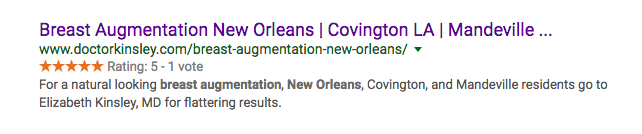
    Image Of Dr. Kinsley's Search Results - Search Influence

    3. GIFs

    While 2016 saw a rise in GIFs, an acronym for Graphics Interchange Format, they were first debuted by Steve Wilhite of Compuserve in 1987. They are the epitome of #thirtyflirtyandthriving. These dynamic, digestible pieces of content are easy to create and share and provide a more engaging user experience than a single static image.

    “GIFs are important to any brand aesthetic, be it personal or public, because they offer a truncated version of the desktop’s fluid experience (i.e. video).

    GIFs are a better option now since they’re more pervasive and different social media platforms accept them or give you a way to use them easily. Instagram, Twitter, Facebook, and Facebook Messenger are all compatible with GIFs now.

    Twitter actually integrated, similarly to Facebook, a GIF search within the post tool. [It has] allowed for a closer relationship between Facebook and Twitter, as well. You’ve always been able to link the two accounts, … [but] now, it looks like Twitter, when auto-posted to Facebook, is fully integrated into Facebook’s platform and presents the post as it would be presented on Twitter.” – Member of Graphics Team

    There are so many reasons you should incorporate GIFs into your marketing strategy this year. As mentioned, the fluidity of GIFs can make the creation of cross-platform content so much easier. They’re easy to create and even easier to share. Most of all, it’s a fun and unique way to reach your consumers!

    So, why not shake things up a bit?

    4. Social and Mobile Paid Advertising

    In 2016, we saw a rise in mobile advertising, but this year, with more than half of searches on mobile devices, it will be an essential component of an effective and well-rounded search engine marketing campaign. Expanded ads are now easily translatable between desktop and mobile, but it’s almost important to mobile users’ needs when determining the content, location, and timing of your paid ads.

    Social advertising like Facebook Paid Ads are showing increased popularity and effectiveness. The level of granularity continues to rise with Facebook audience targeting, and we have seen an increase in conversions even as CPCs remain low.

    “With the introduction of ‘new’ campaign objectives, such as lead generation and local awareness, Facebook really does seem to be a place for lots of growth. With Facebook trying to essentially phase out Fan Building campaigns, local awareness campaigns present an interesting opportunity for smaller budget clients who want to focus on a local market.” – London Fougerousse

    While Facebook ads are more cost-effective than traditional paid ads, that’s not a reason to rely on them solely. The decision to use Facebook vs. Google Adwords or a mixture of the two is truly dependent on a variety of factors, such as your location, industry, and goals. I recommend hopping on the mobile train sooner rather than later. Forecasters are predicting that by 2019, 72% of digital ad spend will be on mobile advertising!
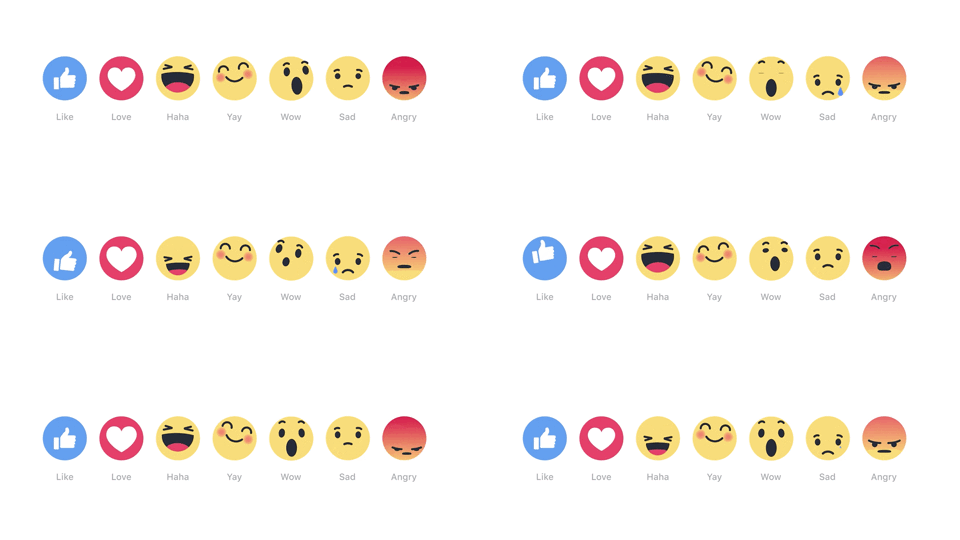
    Image Of Smiley Face Emojis - Search Influence

    5. Google’s Accelerated Mobile Pages

    As I mentioned at the beginning of this post, mobile should be a consideration for all of your online marketing efforts. Google’s Accelerated Mobile Pages (AMPs) are a way to take that focus even further. AMPs are not a ranking factor in Google (for now) but they can positively impact impressions, clicks, and user experience.

    “Since the rollout of AMPs in mobile SERPs this past spring, pages have typically only been found at the top of the results page in a carousel—which is still prime real estate—however, Google recently announced that AMPs will soon also begin showing in the organic results and supporting more content types. We’ve all heard the mobile-friendliness search stats, and adopting AMPs is another way to bring content to your consumers instantly and on the go.

    “Historically, AMPs have been utilized mainly by news publishers, but with the expansion to the organic results, I can see a future for almost every type of industry. Shopify, eBay, and Fandango recently announced their integration of AMPs, so this is a good trend for e-commerce clients especially to be conscious of. And Google also hinted that they will begin supporting more content types like live videos, galleries, etc., which can also open more doors for clients to take advantage of.” – Member of Account Management Team

    Image Of Google Search Of Presidential Debate - Search Influence

    The increased speed of Accelerated Mobile Pages leads to a better user engagement, and those (potential) customers/clients are more likely to return to your site if it was able to quickly provide them the information they were looking for. A recent study shows that with AMPs, The Washington Post saw a 23% increase in mobile search users who return in 7 days. If you’re a business receiving the majority of your site traffic from mobile devices, AMPs could be a strategic way to boost your online presence above and beyond your competitors.

    6. Video

    Video is not just for YouTube. It should be incorporated into as many of your online marketing efforts as possible: product/procedure pages on your site, email marketing, display ads, social platforms, and everything in between!

    “For online marketing rich content could include native video content and paid video ads on both YouTube and Facebook Video Display ads. Also, I think brands will begin to utilize Facebook Live more for events and branded content to engage their fans.

    “I believe these videos will be prominent cross-device! Today, people are constantly moving between devices throughout the day and advertisers need to be innovative and streamline their message to engage users across all devices.

    “For Facebook Live, I would recommend this for brands and businesses that have a strong Facebook following. Facebook Live is a tool to engage your audience, not necessarily build an audience. These videos are best for events, conferences, speaking engagements, big company announcements, etc. There are so many options to deliver creative, curated content!” – Sophie Kirk

    Rich video content is content that keeps on giving. One video can apply organic, paid, and social campaigns across devices, and can be broken down and repurposed to create a number of assets. Videos are not only attention-grabbing, but are also a great way to establish your brand’s message and have lasting effects in terms of brand recall.

    7. Links

    Links might not be the most exciting item on this list, but they’re certainly one of the most important. Link building is an essential aspect of a well-rounded SEO strategy! When the search engines crawl pages on your site, links are used to identify how it relates to other internal pages and other sites. Links connecting one site to another can indicate that a particular page/site is the authority on a given topic. But, as you should know, not all links are created equal!

    Google first launched its Penguin Update in spring of 2012 and rolled out its final update, Penguin 4.0, this past fall. Penguin is Google’s effort to catch sites that are using “black-hat SEO” techniques like spammy link acquisition to affect search rankings.

    “In 2017, ‘link’ will no longer be a dirty 4-letter word. For far too long, bad link building has been lumped in with quality link earning. Everyone got freaked out by Penguin and the industries either shied away from “linkbuilding,” or, if they were doing it, were hush-hush about it.

    “Google’s initial differentiator was to focus on links as votes, which is at the core of PageRank. Google has, in the past, described their foundational algorithm by stating: PageRank works by counting the number and quality of links to a page to determine a rough estimate of how important the website is. The underlying assumption is that more important websites are likely to receive more links from other websites.” – Paula French

    Google truly is looking for quality over quantity when it comes to link building, but that’s just part of the SEO puzzle. If your site is suffering from technical issues or lacking rich, natural content, links will not save you. Make sure your online marketing strategy includes both on and off-site efforts.

    Image Depicting Online Marketing Tactics - Search Influence

    These 7 online marketing tactics are an inexpensive way to boost awareness of your practice and bring in new, revenue-generating patients. With a little strategy and effort, you can have a comprehensive SEO campaign that brings your practice’s website up to speed!

    Image Resources:

    Cell Phone Image

    Facebook Emojis Image

    Social Network Image

  • Site Audits and Your Business: An Introduction

    Just like any portion of your business, your website requires constant maintenance to ensure that it is running as optimal as it should. It’s very well known that Google loves to constantly change their algorithm, forcing websites to adapt quite frequently or else their search engine rankings will suffer. Whenever a video game patches in a major update, they release a list of patch notes so that players can stay abreast of changes. Google, however, does not afford webmasters that same luxury. The massive changelog initially has to be discovered, and then Google (most times) will decide to give some insight on how they just changed the internet. So, what does a site audit have to do with this? A site audit doesn’t just look at one aspect of a website; it looks at the entire thing. By inspecting every nook and cranny of a website, it’s tough to miss anything.

    What is a site audit?

    In essence, a site audit is exactly what it sounds like—an audit of your website in its entirety. A slew of benchmarks are measured to determine the overall “health” of your website and suggestions are made on how to improve any issue that may arise (and they will arise). The factors covered in site audits are technical, content, and off-site. These three topics also contain an array of subcategories that are necessary to cover.

    Endless Knowledge Image Of A Man With His Brain Open - Search Influence

    It is also important to know that a comprehensive site audit is no easy or simple task. They require a few days of dedicated brain power to aggregate all of the information that is necessary to give you an in-depth view of your site. These reports generally end up over 30–40 pages long and are full of pertinent information and screenshots. If they aren’t, you may have been fleeced.

    The Technical

    Technical factors on the website are simultaneously the most important and least important impacting parts of a website. For example, every website should have a robots.txt file on the root directory of their website. If you happen to disallow search engines from crawling your site with this file for whatever reason, it will never show up in any search engine. Ever. Never ever. The flipside of this is that having a good robots file also doesn’t guarantee that your website will ever reach high search engine results, even though a bad robots file will guarantee that you won’t reach them. Server configuration is also another large part of the technical aspect of site audits. Many people use sites like Godaddy to host their website, but these often have default settings that your site will be set to until you change them.

    Image Of Dog Moving Joysticks - Search Influence
    There is far too much to go over in the course of a standard blog post, but Search Influence does offer Comprehensive SEO site audits and can go over every nook and cranny of a website to measure its health.

    The Content

    As Bill Gates oh so famously quoted, “content is king,” and that still continues to ring true. While images and videos are definitely a plus for any website, the content is the real hero of this story. To make things even more confusing, quality is better than quantity but quantity is still a necessity or your content will be determined to have low quality. But, if your quality is too high, your content will be considered low quality.

    Content on your website should be a certain length —300 words per page is the gold standard, but more definitely doesn’t hurt. Your content must also be relevant to your business and to the page itself. In addition to this, the only way Google will be able to relate your content to your topic is if you add in relevant keywords. If you add too many keywords, however, Google gets very angry and stops liking your website. This makes content writing a sort of a magic area to ensure the best message is being sent to search engines crawling your site.

    After the main content is created, the next step is to set up the metadata for each page. Metadata is coding on the backend that gets read by search engines and can also be displayed in search engine results.

    Image Of SI Title Page In Search - Search Influence
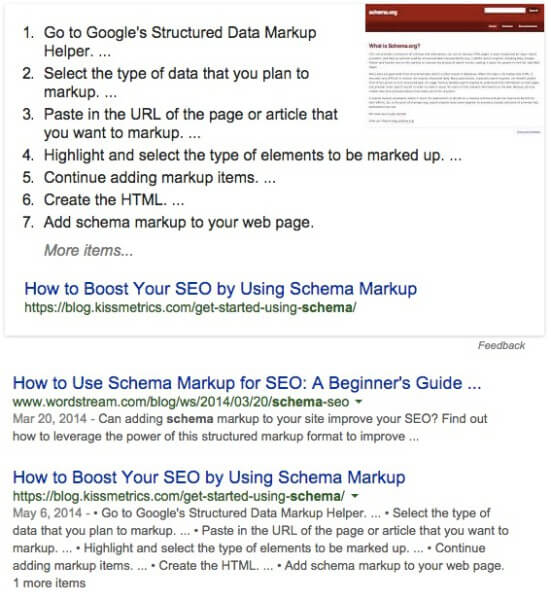

    Image Of SI Meta Description - Search Influence

    The screenshots above show the metadata for our own site. Without having this code in place, search engines that encounter your website have no idea what it’s about. When a search is performed, the search engine will produce a snippet to show in their results.

    Image Of SI SERP - Search Influence

    This screenshot is the preview snippet for our company as displayed in Google. Notice how that title tag and meta description both populate into the search engine results page. This not only helps Google recognize your website and relate it to the topics you would like to rank for, it also provides users with a preview of the web page.

    The Off-Site

    Off-Site factors are probably the toughest part about increasing how favorably search engines see your site— it is also the most important. This section is overwhelmingly dominated by websites that are linking to your website. Having plenty of websites link to you helps to add authority to your site, but if one site links to your site too much, it will appear spammy and both websites can see punishment. A good start to increasing the number of unique domains that link to you, or your backlink profile, is to start with social profiles and high-ranking local profiles such as Yelp!

    After some time of making your business presence known online (and offline), you’ll find that news sites and blogs will link to your site as well. The more this happens, the more authoritative your website becomes, and the more search engines will prefer it to others.

    If this all seems overwhelming, contact our Sales Team. They are happy to go over the logistics of this process and see if it’s a fit for your company’s budget. The SEO Experts at Search Influence are always willing to help a website in need.

    Image Sources:

    Brain of Knowledge Image

    Shiba Image

  • A Day in the Life of a Sales Executive at Search Influence

    Meet Bailey Colomb! Here’s a glimpse into what an average day looks like for Bailey as a Sales Executive working at Search Influence. From her favorite breakfast food (hint: think Ron Swanson) to some of her favorite perks of the job, you’ll get an insider glimpse into what it’s like to join the SI sales team.

    Bailey Colomb, Sales Executive at Search Influence

    Where did you grow up? Where did you go to school?

    I’m from New Orleans. I was born and raised in Lakeview and went to Mount Carmel for high school. I went to college at the University of Southern Mississippi in Hattiesburg, MS. I graduated in Hospitality and Tourism. I wasn’t interested in working at a job that was behind a desk with no social interaction.

    When you’re not working, what are some of your favorite things to do around New Orleans?

    I’m very close with my family. Almost my entire family lives in New Orleans. Every Sunday we’ll do lunch or dinner at my mom’s and my family will all come over. I also have a lot of friends here from college and high school, so we like to do a lot of happy hours. A lot of us after work will go out for happy hour, too. Anywhere that has live music, alcohol, and fries—I’m interested!

    What is your ideal breakfast to get you through a busy workday?

    Anything that includes bacon. I’m not a huge breakfast person before work, but my ideal breakfast would definitely be bacon oriented.

    What led you to this position at Search Influence?

    I was an account manager for almost a year and a half. I’ve been in sales a month, so it’s a very recent transition. I think as an account manager (AM), there are a lot of great things about it, and everybody on the AM team really enjoys being creative and thinking of out of the box ways to help clients, but sometimes the day-to-day responsibilities cloud that. That was an area of opportunity that I wanted to pursue. Being in sales lets you focus on this fresh canvas. These new potential clients have never been approached by anyone, and I get to create this really broad creative strategy to help them.

    What was the craziest job you had before you started at SI? Did you learn anything from that experience that you apply to your sales position today?

    I worked at the Royal Sonesta, which is in the 300 block of Bourbon. My shift that I normally worked was 7 a.m. to 3 p.m. I would get to work when people were going to bed.

    I think that everyone should work in some sort of customer service job because it teaches you about literally everything. It taught me to listen first and hear what people really needed, and then figure out how to help them instead of just assuming. Sometimes you’re so quick to get to the solution that you’re not actually listening to the problem.

    If I talked to your co-workers, what are some adjectives you think they’d use to describe you?

    I would say outgoing and definitely chatty. People always make fun of me because I have a story for everything. I would hope that they would say knowledgeable because I feel like I really have learned so much since being here. It’s cool to be in a position where people are asking you the questions, instead of you asking the questions.

    What is the first thing you do when you arrive at the office?

    The first thing I do is make my coffee. And then I check my email, I check my calendar and get my whole day forecasted. At 8:45 we have our sales meeting, which is great. It’s a touchpoint at the beginning of the morning to see where we are, if there are any updates, check our metrics and any deals we’re working on. Then, we share our daily priority. That is the most important thing we think needs to get done. A lot of the priorities will be making calls if there are prospects to reach out and call. Or, if you have a call that’s in the presentation stage, then preparing the presentation to have ready for the next call.

    Describe an average day at work.

    Right now we are working through our cadences. The cadence is setup to have different touch points throughout the week to try to make that connection with someone who could use our help. After the initial conversation, if they are interested in learning more, then we set up a discovery call so we can get to know their business and get as much information as we can to put together a broad strategy. If all goes well, the next step would be to send a contract and have a kickoff call with an AM who gets into the nitty gritty details of the deliverables.

    What are some big milestones your team is currently working toward?

    We just rolled out our sales playbook, which has been really great. It’s a huge resource for all of us to turn to with tips and tricks for the best ways to leave a voicemail, best ways to send an email, or how to handle pushback when we’re on the phone. It’s been a really good resource for all of our new team members to use. The cadence is also something we recently rolled out that has been really successful. Since the cadence, we’ve had about five outbound calls that have turned into sales presentations.

    What is the most challenging aspect of your job?

    The most challenging is, coming from an AM perspective, you have a lot of platforms that tell you exactly what you need to do, so you know what your day looks like. I’ve had to adjust how I come in and organize since there’s less structure. It’s made me change the way I stay productive and organized throughout the day.

    What is the most fulfilling part of your job?

    The most fulfilling part of the job, for me personally, is that everything is a trial and error right now because it’s so new. We’re all learning together to figure out what works and what doesn’t. I get to be one of the people who is helping to get the department up and running. It’s all the more fulfilling to be able to build new relationships with people here who have so much knowledge.

    What skills do you utilize from previous positions in your career to succeed in sales?

    Definitely customer service, and with that, having no shame. The worst they can do is hang up on me or tell me no, so I might as well just call them. Being in the service industry for so long has helped me be a good communicator and make people comfortable. That’s important in sales because you want to be as conversational as possible and the least sales-y as possible.

    What are some of the perks of a sales job?

    Happy hours! Getting out of the office to mingle more. The second week I joined the sales team was New Orleans Entrepreneur Week, and we got to go out and network and hear speeches. That’s definitely been fun to meet new people.

    What stands out about the culture at Search Influence that makes your job more enjoyable?

    The people. I feel like everybody says that, but it really is what keeps people motivated, keeps morale up, and keeps people here as long as they’ve been here. I remember when I interviewed here, seeing the people coming in and out of the office, I knew I wanted to work here because everyone looked so cool and laid back. Everyone is so easy to work with and collaborative. I think that is one of our strongest competitive advantages.

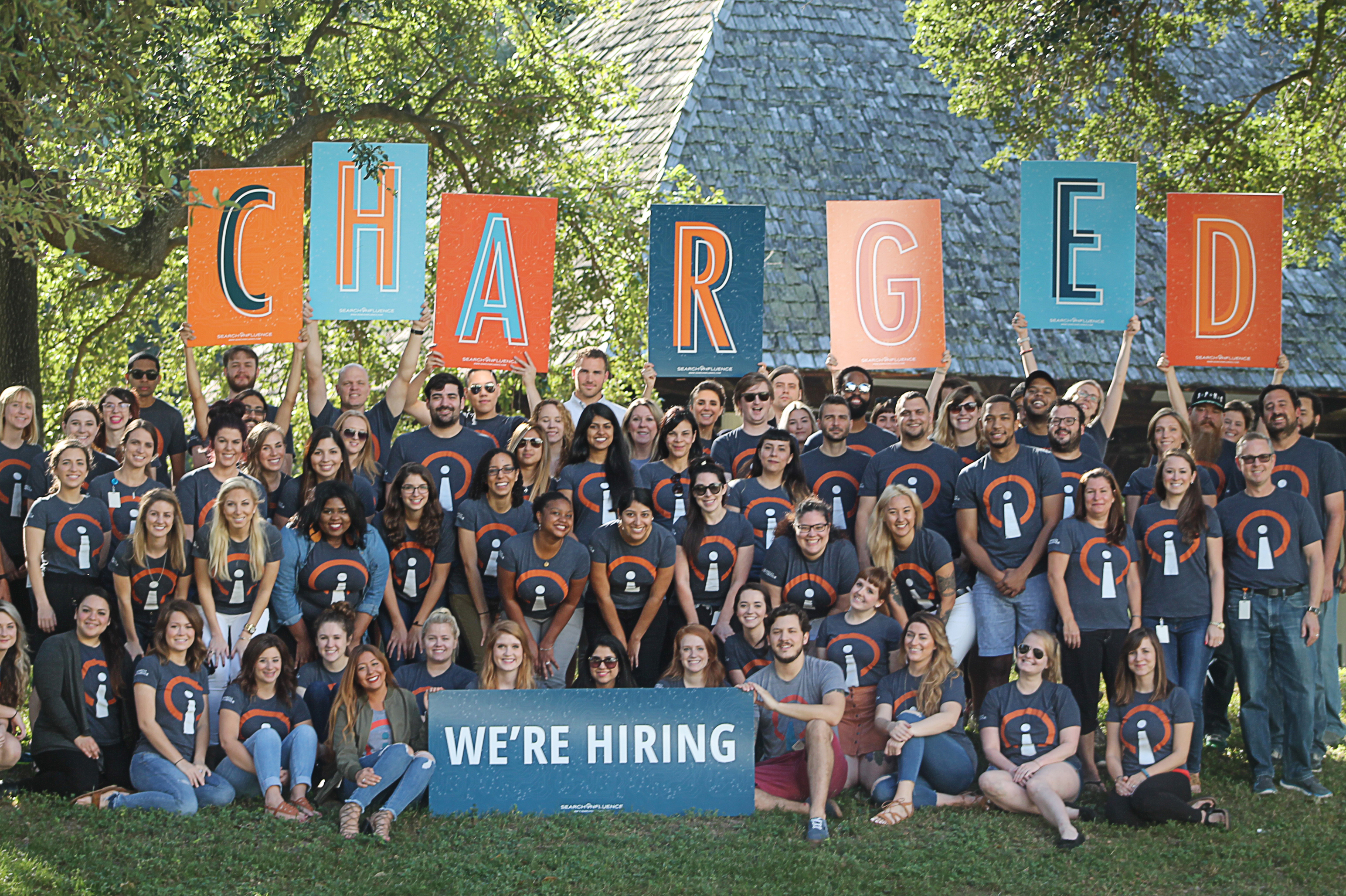
    Charged Employees of Search Influence

    What’s your favorite work memory at SI?

    Me and my friends at SI have a “Ladies who…” group, which is just an event once a week where we do something different. Like ladies who lunch, who happy hour, etc. It is super fun to not only build those relationships in the office but also build those friendships out of the office, too.

    What would you like others to know about your job that they may not expect?

    I think, for me, it was hard switching my AM brain to a sales brain. But, it was interesting to see how much in common the positions had—sales encompasses a lot of the things that each department does each day. Also, it’s just not that scary. I thought it would be really intimidating to pick up the phone and talk to a doctor, but we don’t know what they know, and they also don’t know the things that we know.

    What are your biggest goals for your career in the next 5 years? Beyond?

    My biggest goal in the next few years is just not to get too comfortable and to always stay challenged and learn something new every day. It’s easy to get in a rut and just do what you do because it’s a routine and not because it’s challenging.

    Looking ahead, what are you most excited to achieve and take part in at SI?

    Some big sales! I’m excited now that we are really focusing in on the direct side; it’s exciting to be part of the team that is supporting and growing that. I think we have great clients now who have supported us for a long time, and it’s cool to be a part of the team that’s going to help contribute to that.

    Sometimes it can be hard to explain what we do in the SEO world. What are some successful tactics you’ve used to inform new clients about our industry?

    The way I always describe it is that I help local businesses rank on Google. Obviously, there are a lot of little technical things that go into it. But at the end of the day, our main goal is that when a user searches for something and types in a keyword related to one of our local businesses, it’s our client that shows up in the first five rankings. That’s who the user clicks on and engages with. Everyone Googles things, so it’s easy to relate to that.

    In your opinion, why does online marketing matter for small business? What role does it play in the local economy?

    I think it’s important for small business because people might not know that you’re there unless you tell them. You do that through online marketing. That’s how you make your brand known in this day and age; not doing it is not an option.

    What are prospective clients most surprised to learn when you talk to them about the benefits of online marketing?

    I think that a lot of people obviously know about Google and know how it works, but I don’t think they know how or why those businesses are ranking. They are surprised by all the things you can do to improve your rankings. I don’t think that they understand the actual manpower it takes to manage all these things so that when you do type something into Google, it’s your business that shows up.

    What were you most surprised to learn about this industry when you started working at SI?

    I literally knew nothing. I straight up Googled, “What is SEO?” Every day was different; it was an uphill battle because it’s such a vast level of knowledge. My surprises were very similar to our clients’ surprises.

    What advice would you offer to someone considering a sales position in this industry?

    I would say go for it! I definitely do not regret trying something new. I had never done sales before. There’s an aspect of selling in everything you do, but I had never picked up the phone and tried to sell something. It’s changed the way I think about my work. It’s helped me build on the character traits I already had, and also build new ones as I get more comfortable and gain more experience.


    If you’re interested in learning more about a sales position at Search Influence, please visit our careers page to view our current positions available. We look forward to meeting you and discussing a potential career at Search Influence!

  • Follow the Numbers: Trends to Guide Your 2017 Plastic Surgery Marketing Plan

    With 17.1 million surgical and minimally invasive cosmetic procedures performed in the United States in 2016, a few key trends stand out as opportunities. According to a report released by the American Society of Plastic Surgeons, patients are trending toward fat grafting, non-invasive fat reduction, and facial enhancements. These trends present areas of potential growth for plastic surgeons by focusing their annual marketing plans on the procedures that patients are most interested in learning about. After all, the first step to any great marketing campaign is to understand how to appeal to your target demographic.

    What Do the Numbers Show?

    The first and most notable pattern is that patients are using their fat to enhance other areas of their body. Using liposuction, plastic surgeons remove unwanted fat from the abdomen and inject it into other areas, including the face, buttock, and breasts, to enhance and sculpt the desired look. This process of fat grafting showed a 26 percent increase for the use of buttock augmentation and a 72 percent increase for use in breast augmentation in 2016.

    Patients love the longevity of the results achieved using this method, and that’s certainly a potential benefit to highlight in a marketing campaign. Plus, patients often mention the added benefit of two surgeries in one, as they are especially happy to remove unwanted fat while also enhancing desired body parts. In addition to the cosmetic benefits, this surgery is also a popular option for breast reconstruction patients for many of the same reasons.

    Do Patients Know All Their Options?

    Audrey Hepburn getting a closer look - Search Influence

    While these innovative procedures are gaining popularity, doctors might not realize that many potential clients don’t even realize that this is an option for them. In fact, recent studies show that only 23 percent of women understand the full range of breast reconstruction options available. This indicates that marketing campaigns targeting new customers should focus on disseminating the facts and shining a spotlight on industry advances. By presenting the full range of innovative options available, like fat grafting, patients are more inclined to take the first step to schedule a consultation.

    Paid search and Facebook advertising campaigns may be especially effective in this instance, as both are often great avenues for reaching highly specific demographics. For example, Facebook’s targeting options include new people who have moved into your office’s geographic area or even specifications like salary, industry, and age. You probably already have an idea of the ideal customer for your medical practice, and using these targeting features, you are not only more able to reach them, but you can also present them with the information that they actually want to learn about.

    The same applies to Google searches. After all, if someone is searching on Google to learn about new augmentation options available, don’t you want your practice to show up in the top results as a trusted source for their desired information? Your campaigns should focus on the keywords that match the data trends, and your content should focus on informative, highly-curated landing pages that prove you’re a reputable source. All of these elements combined can lead to big conversion results.

    What About Non-Invasive Trends?

    Another major trend shown in the data from 2016 indicates a move toward non-invasive techniques for skin tightening, rejuvenation, and fat reduction. Injection procedures, like Kybella, that target areas of fat in areas under the chin or along the bra line increased 18 percent in 2016. Additionally, procedures like cryolipolysis (to “freeze” away fat cells) also showed an upward trend with a 5 percent increase. Other non-invasive skin tightening procedures saw a similar 5 percent increase.

    Broadband light and laser treatments are among these popular options for non-invasive skin tightening and offer versatile results with little to no downtime for the patient. While these procedures do not require surgery, patients still want to know that they are receiving services from a reputable, board-certified physician. This is a major area of opportunity for plastic surgeons to focus on in marketing campaigns. An emphasis on innovative technology to achieve long-lasting results shows patients that your office is ahead of the curve and committed to new advances in the field.

    How Do Trends Look Year Over Year?

    Looking at the changes and trends from 2015 to 2016, we can also note which types of procedures show an increase or decrease in popularity. With nearly 1.8 million cosmetic surgical procedures performed, liposuction showed a noticeable jump, up 6 percent from 2015, which may reflect our earlier trend toward fat grafting. Additionally, breast augmentation remained a popular choice for patients, filling the top slot and showing a 4 percent rise from 2015. Finally, as a fairly new procedure to gain in popularity over the last few years, the labiaplasty procedure increased by 36 percent in 2016.

    Another notable movement is the focus on the face, with an increase in facelifts by 4 percent from 2015. In conjunction with the surgical focus on face enhancements, non-invasive procedures, among the 15.5 million performed in 2016, showed a similar trend. Filling the number one slot, Botox procedures increase by 4 percent, with a total of 7 million procedures performed annually. Soft tissue fillers and chemical peels also showed steady inclines in usage from 2015 to 2016.

    How Do You Build Relationships with Patients?

    One possible pattern indicated in these trends is the frequency in which patients are meeting with their plastic surgeons. Patients feel more comfortable discussing all areas of their body with their surgeon, and a long-term relationship can develop between patient and physician. This indicates that a person may be interested in learning about multiple procedures, including both non-invasive and surgical options. A dynamic marketing campaign should reach new target demographics while also building on the loyalty of current patients.

    Emoji Gif - Search Influence

    Email newsletters and Facebook campaigns are great ways to stay in contact with your audience and keep them engaged in your services. Share patient testimonials, highlight employee profiles, and add personal elements that showcase the people-centric side of your business. Encourage happy customers to share their results with Facebook reviews and always make time to answer questions and comments that arise from your posted content. By creating multiple platforms for engagement online, you’re opening a line of communication with clients that can build trust, keep them informed, and ultimately create long-term success for your medical practice.

    If you’re ready to create a dynamic marketing campaign that draws on current trends and builds your plastic surgery practice as an industry leader, the first step might be less invasive than you think. Focus on your audience, deliver relevant information, and stay true to your brand.

  • How a Debate About Onions Showed Google Might Not Be Infallible

    A couple of weeks ago, I was driving to meet a friend for dinner when I heard a segment on NPR’s Marketplace that featured Tom Scocca talking about his article on Gizmodo about caramelized onions. At first, it seemed like many a segment on NPR we’ve come to expect—interesting and mildly entertaining. It wasn’t until the segment got to the point of the matter that I was hooked. When people were searching on Google for “how long does it take to caramelize onions?” they were getting misinformation. How could such a simple question turn up a false response from the world’s largest, and arguably smartest, search engine? I wondered, are there other moments like this that have happened between users and Google?

    How Did Google Misinterpret What Is Common Knowledge to Most Chefs?

    To be fair to Google, this wasn’t entirely their fault. The initial blame goes back to the thousands of recipes that live on the internet telling readers how to caramelize onions, from an at-home amateur cook’s blog to the New York Times. For whatever reason, instead of telling home cooks to patiently take their time to cook the onions on a low to medium heat for upwards of 30-45 minutes, a lot of recipes listed the expected cooking time as 5-10 minutes. If you’ve ever attempted to caramelize onions in this amount of time, I’ll go ahead and break it to you—it’s impossible. To save you from a bunch of food chemistry, I’ll just say that it has to do with the sugar content in onions.

    Purple Onion Cut In Half - Search Influence

    So, why is there so much content online that gives users, and in turn Google, misinformation? The simplest answer is that writers of recipes were trying to simplify a process that would turn an ordinarily easy recipe for a weeknight meal, like French Onion Soup, into a 1 ½ –2-hour ordeal. In Scocca’s Slate article written in 2012, he gave many different examples of well-known chef’s attempts and failures at trying to achieve caramelization in less than 20 minutes. The article is littered with keywords Google would love and came from a highly reputable source. At its beginning, he references the 5-10 minute myth, and for a while, this had a positive response—The New York Times changed their language when talking about caramelization in their recipes, and even the Wikipedia page was updated as a result.

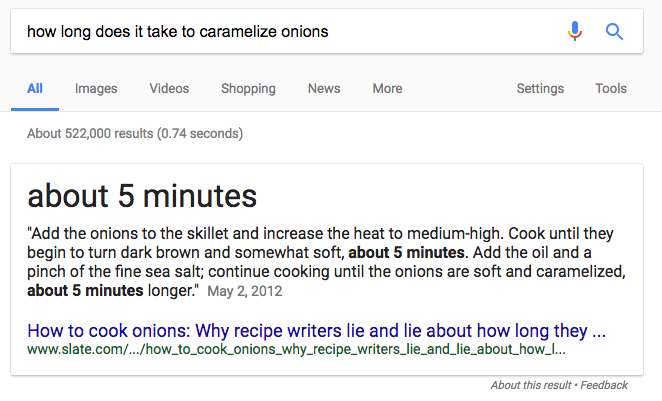
    But, when people typed “how long does it take to caramelize onions” into Google, they continued to see the false expected cooking times appear in Google’s search result box that is supposed to give users “one true answer,” a term coined by Danny Sullivan, founder of SearchEngineLand.

    How Long Does It Take To Caramelize Onions Google Search - Search Influence

    It turns out, Google was looking at Scocca’s Slate article, with all of its high word count and keyword-laden, well-written text, as the authoritative source. The only problem was that its algorithm focused on and crawled the first paragraph that referenced the 5-minute cooking time. The myth Scocca was trying to debunk ended up getting “bunking,” to use his inverse take on the word.

    Users Push for Quick Answers

    Google hasn’t always answered questions. Users typed in what they were looking for, and they got a list of web pages that may help them find it. But Google realized people wanted short, quick answers to questions, so they developed the short answer box. It’s virtually set apart from the search results and has a slight drop shadow.

    This also isn’t the first time Google has had issues with its short answer box. About a month ago, if you were to ask “Is Obama planning a coup d’etat against the U.S. government?” the response was that he indeed was planning a communist coup at the end of his term. Ask why a fire truck is red and you got a Monty Python joke. While the latter could lead to some harmless John Cleese quotes passed around the office, the former could actually misinform the public in a harmful way.

    Why Are Firetrucks Red Google Search - Search Influence

    Google’s Response and Their Plan to Fight False Information and Fake News

    Google has been dealing with this for a couple of years now. In 2015, they announced that they were using RankBrain, an artificial intelligence algorithm, in combination with Knowledge Graph, which pulls information for short queries from sources like Freebase, Wikipedia, and the CIA World Factbook—very reputable sources. It currently contains 3.5 billion facts. And, with all of these instances of inaccurate snippet responses, Google was quick to fix the issues. Searching for the cooking time for caramelizing onions now brings up the correct answer. Also, along with Facebook, Google also upped their fight against fake news by using fact check systems in their searches and feeds. So the big question is, how does all of this relate to your small business, practice, firm, bakery, brewery, insurance agency, etc.?

    The Importance of Rich, Accurate Content

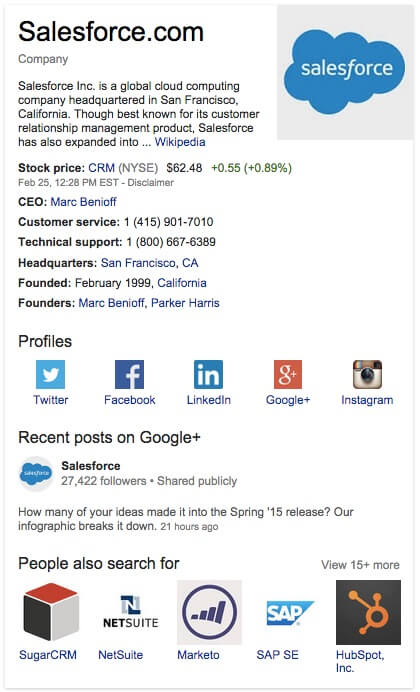
    Whether you’re working on new content or need on-site or local search optimization, the importance of producing educational, on-point, authoritative content is key. The Knowledge Graph’s “panels” pull information from your “about us” page, including contact information. These show up in the sidebar of searches and can include photos from your Google+ page as well as any reviews of your business. So, it should be a no-brainer that your Google+ page should be up to date and any reviews of your company are responded to promptly. Above all, make absolutely sure that your NAPs are consistent and current; an incorrect address showing up in a panel is not the quick answer that potential customers want.

    Salesforce Google Plus Account Screenshot - Search Influence

    There’s also the chance that your longer content could be pulled into a short answer box. At first, Google’s Knowledge Graph was pulling just short answers to questions, but it has since gotten smarter at pulling answers from longer content, like how-to guides with 20-point checklists or in-depth, 1,000+ word content that gives users lots of useful information to peruse. As always, make certain your content is not only accurate but also engaging enough to pull viewers deeper into your site and actually convert.

    Does This Completely Change SEO?

    In short, no. As this article from SearchEngineLand points out, in most cases, “the source getting pulled into the Knowledge Graph is already in the first few organic search results anyway.”

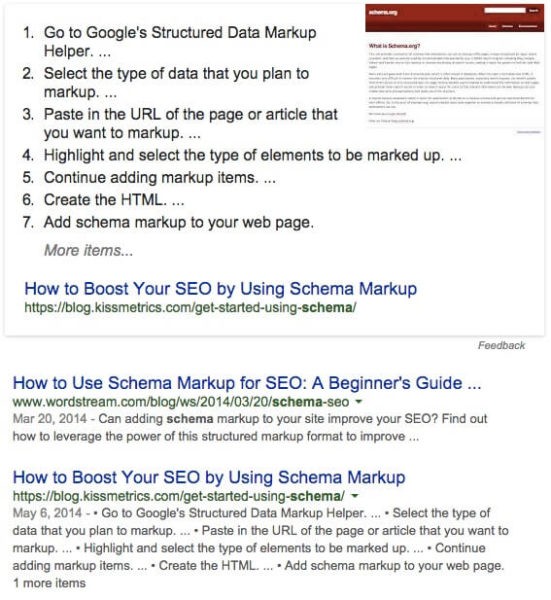
    How To Boost Your SEO Using Schema Markup Screenshot - Search Influence

    Good SEO will improve your ranking regardless and will, in turn, improve your chances of showing up in a short answer box. But even if your business never shows up there, your target audience is still searching for more than just a quick answer. They’ll want to dive into your site for in-depth, relative information. Similar to previous algorithm updates with Hummingbird and Panda, there may be some minor ups and downs in organic search numbers. But if your content is consumer-focused, educational, expertly written, and optimized, then your SEO plan will help out Google’s Knowledge Graph as well.

    If anything, these inaccuracies in Google’s AI have taught us that the search begins and ends (ideally in conversion) with the user. Keep in mind the unique relationship between your business and your potential client.

    Make It Easier for Google

    So, what are some additional steps you can take to make sure your site is up to current SEO best practices? Check out our recent white paper on things to avoid when building or optimizing your website. It includes valuable information, like configuring your URLs and making sure you’re mobile-friendly. Have any more questions on how to increase website traffic? Reach out to us at any time.

    Images

    Onions

    Short Answer Box via Gizmodo

    Fire Truck via TheOutline.com

    Knowledge Graph Panel via SearchEngineLand

    Short Answer Box via SearchEngineLand