Tag: digital advertising

  • Paid Search vs. Paid Social in an AI-Driven Funnel

    Paid Search vs. Paid Social in an AI-Driven Funnel graphic

    Key Insights

    • Paid search and paid social do not compete. They complement each other. Paid social creates demand and brand awareness, while paid search captures high-intent users actively searching for solutions.
    • AI has compressed the marketing funnel. Users now move fluidly between social media feeds, AI Overviews, and search engine results pages, making an integrated strategy more important than ever.
    • Paid search is now a validation channel as much as a conversion channel. In AI-influenced SERPs where organic visibility is shrinking, paid placements reinforce credibility and brand trust.
    • Paid social drives measurable downstream search demand. Strong social campaigns increase branded search queries and high-intent traffic that paid search can convert efficiently.
    • Full-funnel orchestration drives stronger performance than channel silos. When paid social and paid search share messaging, data, and optimization insights, brands achieve greater efficiency, higher ROAS, and sustained growth.

    Search Influence approaches paid search vs. paid social as a unified strategy designed to connect demand creation, intent validation, and conversion across the modern marketing funnel.

    The traditional marketing funnel hasn’t just shifted. It has compressed. AI accelerates the speed at which users move from discovery to decision, collapsing awareness, consideration, and conversion into overlapping, nonlinear moments.

    Today, influence happens across algorithmic social feeds, AI Overviews in search engine results pages, short-form video content, conversational search experiences, and branded search queries. A user may first encounter a brand through paid social ads, validate it in search results, scan an AI-generated summary, and then click a paid search ad, all within a single session.

    One of the biggest misconceptions in digital marketing is that paid search and paid social compete. They don’t.

    Paid social creates awareness and demand among targeted audiences. Paid search captures that intent when users actively search for solutions. When aligned, they amplify each other.

    This isn’t a search vs paid social debate. It’s a guide to orchestrating both channels together for measurable growth in an AI-influenced world.

    AI’s Impact on Digital Advertising

    AI compresses the marketing funnel into overlapping micro-moments. Users no longer move predictably from awareness to research to purchase. Instead, they:

    • Discover brands in social media feeds
    • Validate through AI-generated summaries
    • Compare via search engines
    • Click paid search ads when immediate intent peaks

    AI Overviews reduce organic search visibility, pushing organic search results further down search engine results pages. Paid search ads often remain one of the most stable and visible placements.

    At the same time, conversational discovery changes when intent forms. Users don’t always start with specific keywords. We’ve shifted from keyword-first journeys to influence-first journeys.

    In this environment, channel silos fail. Users move seamlessly between platforms. A digital marketing strategy that isolates paid search advertising from paid social advertising misses the interconnected behavior of modern consumers.

    Search and paid social must be planned together to capture qualified traffic at every stage of the entire marketing funnel. Learn more about how AI search affects paid ads.

    What Is Paid Search?
    A close up of a smartphone screen

    Paid search involves paying for ad placement in search engine results pages when users actively search for answers, comparisons, or solutions. Through platforms like Google Ads, advertisers bid on specific keywords and search queries to appear in front of high-intent prospects.

    Unlike paid social, paid search captures existing demand. It doesn’t create awareness; it intercepts it at decision moments.

    In an AI-powered search environment, the role of paid search has shifted from early discovery to validation and confirmation.

    AI feels authoritative but abstract. Users understand that AI aggregates sources, but they can’t always see nuance, depth, or accountability. Paid search ads, by contrast, are explicit and brand-backed. When a recognizable company appears consistently in paid search results, it signals investment and legitimacy.

    Repetition builds credibility. Seeing a brand appear in AI summaries, organic search results, and paid search ads reinforces familiarity. And familiarity increases trust.

    In AI-influenced SERPs where organic visibility is shrinking, paid search is essential for:

    • Brand protection
    • Competitive defense
    • Capturing demand at the moment of immediate intent
    • Maintaining immediate visibility in high-competition spaces

    Pros of Paid Search

    • Captures users actively searching with immediate intent
    • Performs strongly for branded, transactional, and solution-aware search queries
    • Benefits from AI-enhanced bidding, automation, and cost per click optimization
    • Provides clear attribution through Google Analytics and conversion tracking
    • Delivers immediate visibility in competitive search engine results
    • Functions as a reliable pay-per-click conversion engine when demand already exists

    Cons of Paid Search

    • Limited ability to create demand or introduce new audiences
    • Dependent on existing awareness and search volume
    • Rising CPCs as advertisers bid more aggressively using AI automation
    • Vulnerable to diminishing returns without upper-funnel support
    • Less effective for shaping early-stage perception

    You’re competing over a fixed pool of in-market users. Without channels that increase brand awareness and consideration, you limit audience expansion and eventually cap conversion volume and efficiency.

    For some industries, particularly those classified as Your Money or Your Life (YMYL), such as healthcare, finance, and legal, additional compliance layers apply. Without accreditation or verification (like LegitScript), paid search ads may be rejected. These sectors face stricter advertising policies and higher E-E-A-T expectations.

    What Is Paid Social?

    Paid social is algorithm-driven advertising designed to reach users before intent is fully formed.

    Unlike paid search, paid social does not rely on users actively searching specific keywords. Instead, AI-powered social media platforms analyze behaviors, engagement patterns, and demographic signals to place social ads in front of highly targeted audiences.

    Paid social shapes perception. It frames problems. It introduces solutions.

    Social exposure often plants the initial seed of awareness. Users then conduct branded or category searches later for validation, comparison, and confirmation before converting.

    Importantly, social media posts are increasingly included in AI Overviews, further blurring the lines between social and search visibility. This phenomenon, along with the increased number of users searching directly on social channels, is called social search.

    Paid social operates earlier in the funnel, but its impact often shows up later in paid search performance.

    Pros of Paid Social

    • Powerful at generating awareness and introducing new brands
    • Reaches highly targeted audiences without relying on search intent
    • Leverages AI algorithms to expand reach efficiently
    • Enables visual storytelling through engaging ads and video ads
    • Strong performance in early and mid-funnel stages
    • Influences future search behavior and branded search volume

    Cons of Paid Social

    • Lower immediate conversion intent compared to paid search
    • Longer path from first touch to measurable conversion
    • Attribution complexity across devices and platforms
    • Requires continuous creative testing to stay efficient
    • Performance can fluctuate as platform AI algorithms evolve

    Strategies for Integrating Paid Search and Social

    • Social-to-Search Funnel: Use highly visual, engaging paid social ads (Meta, TikTok) to create demand and introduce your brand. Users often turn to search engines to learn more after seeing a social ad, which you can capture with branded paid search campaigns.
    • Search-to-Social Retargeting: Capture high-intent traffic through search, then use platform pixels (like the Meta Pixel) to retarget those visitors on social media with nurturing content, testimonials, or special offers.
    • Synchronized Messaging: Ensure that ad copy, visuals, and offers are consistent across both platforms to create a seamless, trustworthy user experience.
    • Data Sharing for Audience Targeting: Use search query data to create targeted interest groups in social campaigns. Conversely, use social data (like Page Insights) to understand the demographics and interests of your audience to refine keyword targeting.
    • Remarketing Lists for Search Ads (RLSAs): Use social media interaction data to build custom audiences in Google Ads. This allows you to bid higher for users who have already engaged with your brand on social.
    • Leverage Social for Keyword Insights: Monitor the language, questions, and comments in your paid social ads to identify new high-performing search keywords.

    Real-World Example: Hospitality Client Synergy in an AI Environment

    One of our hospitality clients provides a clear example of how paid social and paid search work together to drive measurable results in an AI-driven landscape.

    Meta Performance: Demand Generation & Efficiency

    In January 2026, Meta delivered exceptional efficiency without increasing budget:

    • Revenue: $152,020.58 (29.1% increase month-over-month)
    • Spend: $34,197.79 (essentially flat)
    • ROAS: 4.45 (29% improvement)
    • CPC dropped 51% to $0.39
    • Reels-only promoted ads drove higher engagement at lower costs

    This performance wasn’t accidental. Highly visual, engaging ads in Reels created awareness among the right audience. AI-driven delivery expanded reach to highly targeted audiences most likely to engage.

    Meta served as the demand generator, increasing brand exposure and consideration.

    Google Paid Search: Demand Capture & High-Intent Revenue

    At the same time, paid search delivered:

    • Revenue: $80,550.26
    • Spend: $20,162.22
    • ROAS: 4.00
    • CTR: 20.81%
    • $59,734.49 driven by the “Locals In Market” campaign
    • 173% year-over-year growth in conversions and revenue

    As Meta increased brand awareness, branded search queries and high-intent searches increased. Users who first encountered the brand in social media feeds later searched for tickets and local offerings.

    Paid search captured that demand when users were ready to book.

    Channel Synergy in Action

    This is what full-funnel orchestration looks like:

    • Paid social increased awareness and engagement.
    • Increased awareness led to measurable increases in high-intent search queries.
    • Paid search captured those users when they were actively searching.
    • Consistent messaging across platforms reinforced trust and reliability.
    • AI-driven optimization improved efficiency on both platforms simultaneously.

    In an AI world where users validate across multiple touchpoints, this synergy becomes even more important.

    A person using a laptop

    Paid Search vs. Paid Social FAQs

    Is paid search the same as paid social?

    Paid search and paid social are not the same. Paid search captures existing intent while paid social creates demand before intent exists.

    Paid search ads appear when users are actively searching for specific keywords in search engines. Through platforms like Google Ads, advertisers bid on search queries to show up in search engine results pages at the moment of immediate intent. These users are already evaluating solutions.

    Paid social advertising works differently. Social ads appear in social media feeds based on user behavior, interests, and engagement patterns, not specific search terms. Instead of responding to explicit queries, paid social shapes perception earlier in the marketing funnel.

    Which is better: SEO or SMO?

    SEO and SMO are complementary strategies that work best together by reinforcing visibility, authority, and demand across AI-driven discovery.

    Search engine optimization builds long-term organic search visibility by aligning content with user intent and search engine algorithms. It drives organic search traffic and strengthens brand authority in search engine results.

    Social media optimization amplifies reach and engagement on social media platforms, helping brands connect with highly targeted audiences before intent is fully formed.

    As AI-powered search engines blend signals from multiple sources, including website content and social media posts, visibility across organic search and social media increasingly reinforces credibility. Brands that invest in traditional SEO, AI SEO, and social media create multiple touchpoints, increasing familiarity and perceived trust.

    How is AI affecting paid search?

    AI is reshaping paid search by reducing organic clicks and making paid placements more critical for visibility, validation, and competitive defense.

    AI Overviews now answer many search queries directly within search engine results pages. This reduces clicks to organic search results and compresses visible real estate. Paid search ads often remain one of the most prominent placements on the page.

    At the same time, AI-driven bidding systems optimize pay-per-click campaigns dynamically based on the predicted likelihood of conversion. Advertisers bid more efficiently, but competition increases, raising cost per click in many industries.

    AI also changes user psychology. When users see a brand appear consistently in AI summaries, organic search results, and paid search ads, familiarity increases. That repetition reinforces credibility.

    How is AI affecting paid social?

    AI is transforming paid social into a primary discovery engine by using algorithms to surface content before users actively search.

    Social media platforms rely heavily on artificial intelligence to determine ad placement. Instead of relying on specific keywords, algorithms predict which highly targeted audiences are most likely to engage with particular ad formats, video ads, or messaging.

    This means paid social advertising plays a growing role in creating demand. Engaging ads in social media feeds often influence what users search for later in traditional search engines. Social exposure increases brand recall and branded search queries.

    AI also introduces volatility. Platforms frequently auto-enable new AI features related to copy generation, image optimization, and targeting. Advertisers must adapt quickly to maintain performance.

    In an AI-influenced journey, paid social shapes the early narrative. Paid search captures the resulting intent. When aligned strategically, both channels strengthen performance across the entire marketing funnel.

    Talk to Us About a Full-Funnel Paid Media Strategy

    At Search Influence, we don’t execute isolated channels. We design integrated digital advertising strategies aligned with real user behavior.

    Our AI-enabled digital marketing approach:

    • Increases campaign efficiency by allocating ad spend where performance is strongest
    • Reaches the right audience with precision targeting across search engines and social media platforms
    • Delivers qualified traffic from high-intent prospects
    • Uses AI to analyze performance in real time and continuously refine campaigns

    We combine paid search advertising, paid social advertising, SEO, analytics, and data insights into a unified strategy designed for how users search, scroll, and decide today.

    If you’re ready to move beyond search vs paid social and build a performance-driven marketing strategy across the entire marketing funnel, meet with our Director, Paula French.

    Images:
    Unsplash
    Unsplash

  • 15 Questions Every University Should Ask Their PPC Agency About Their Campaigns

    Key Insights

    • Many universities rely on a PPC agency, but most campaigns aren’t built to connect ad spend directly to student enrollment outcomes.
    • A strong Google Ads agency should track meaningful conversions, such as inquiries, applications, and campus visits — not just clicks.
    • Ongoing PPC management, post-launch optimizations, and negative keyword strategies are essential to avoid wasted ad spend.
    • Transparent reporting, real-time dashboards, and CRM integration should be standard for any higher ed paid advertising campaign.
    • Search Influence combines PPC advertising with search engine optimization (SEO), delivering a full-funnel strategy tailored to higher education institutions.

    Universities invest heavily in paid search and display advertising to reach prospective students. Still, not every PPC agency delivers the transparency and strategy required to connect those campaigns to enrollment outcomes. Too often, agencies measure success in clicks or impressions, failing to show how those digital marketing efforts translate into inquiries, applications, and enrolled students.

    This blog provides 15 questions higher education leaders can use to evaluate their current Google Ads agency or PPC marketing company. These questions go beyond surface-level performance metrics and focus on alignment with institutional goals, proper campaign management, and integrating PPC with broader digital marketing strategies.

    By setting the right expectations, you’ll quickly see whether your PPC advertising campaigns are optimized for today’s competitive, AI-driven search environment or your budget is stretched thin without producing results.

    Questions to Ask Your PPC Agency

    1. How do you align PPC campaigns with our enrollment goals?

    A PPC agency should align campaigns with university enrollment goals by connecting paid search strategies to inquiries, applications, and enrollments.

    In higher education marketing, this means campaigns must be tied directly to the admissions funnel, not just surface-level metrics like clicks or impressions. Campaign management should include keyword research, ad placement, and bid strategy that align with institutional objectives and admissions cycles.

    One of the most important measures of this alignment is higher education cost per inquiry (CPI). In our 2024 study created in collaboration with UPCEA, Higher Ed Marketing Metrics Research Report: What Gets Measured Gets Managed, we established the first industry-wide CPI benchmark for professional, continuing, and online (PCO) education, finding an average CPI of about $140. This benchmark gives universities a precise reference point for evaluating whether their campaigns are efficient compared to peers.

    We design PPC campaigns around your enrollment goals, prioritizing CPI and cost per enrollment. This ensures that your ad spend drives measurable student recruitment outcomes and aligns with industry best practices.

    2. What conversion actions are you tracking?

    An effective PPC agency should track conversions tied to student recruitment, including form fills, calls, campus tour sign-ups, and event RSVPs.

    Tracking these actions provides actionable insights into whether PPC ads produce conversions that matter. Without accurate conversion tracking, PPC campaigns can’t show how ad spend supports enrollment objectives.

    We connect conversion actions directly into CRM systems, tying campaign management to the admissions funnel. By aligning pay-per-click advertising with key performance indicators (KPIs), we help universities measure ROI in ways most PPC agencies overlook.

    3. How do you optimize campaigns post-launch?

    Strong PPC agencies optimize campaigns after launch by running ongoing A/B tests, refining negative keywords, and adjusting bid strategies to improve performance.

    Post-launch optimization includes keyword research, ad copywriting, and monitoring ad groups across platforms like Google Ads, Microsoft Ads, and the Google Display Network. Without continuous updates, PPC costs rise, and wasted ad spend becomes unavoidable.

    At Search Influence, we use Google Analytics and other performance tracking tools to refine PPC management services weekly. By monitoring ad placement, web traffic trends, and audience targeting, we keep campaigns efficient and focused on producing qualified student inquiries.

    4. What role does AI play in our paid ads strategy?

    Modern PPC agencies should use AI to enhance paid search campaigns through smarter bidding, predictive audience targeting, and automated ad creation.

    AI can improve bid management and ad placement, but without human oversight, it risks inflating PPC costs and generating irrelevant traffic.

    Our approach combines AI-powered campaign management tools with human expertise in higher education marketing. By balancing automation with strategy development, we maximize ad spend efficiency, reduce wasted ad spend, and ensure PPC ads produce conversions tied to business goals.

    5. How do you integrate SEO and paid ads?

    A strong PPC agency should integrate paid ads with SEO to maximize visibility on search engines and strengthen digital marketing strategies.

    Paid search campaigns and search engine optimization work best when combined, creating a consistent presence that supports both immediate conversions and long-term visibility.

    At Search Influence, we unify PPC marketing with SEO services to deliver a comprehensive digital marketing plan. By aligning paid and organic strategies, universities gain a competitive advantage, capture more web traffic, and improve online success across online platforms.

    6. Can you show us real-time performance dashboards?

    A transparent PPC agency should provide real-time dashboards integrating Google Ads, GA4, and CRM data.

    These dashboards allow higher ed leaders to monitor campaign management without waiting for monthly reports, ensuring ad management aligns with enrollment goals.

    We create custom dashboards highlighting cost per inquiry, campaign performance, and other key performance indicators. These tools give universities immediate visibility into PPC performance and help them quickly adjust their digital marketing efforts.

    7. How do you feed PPC data into our CRM?

    Effective PPC agencies should integrate PPC data into CRM systems to connect clicks with inquiries, applications, and enrollments.

    Without CRM integration, pay-per-click advertising cannot be tied to real ROI, making campaign management incomplete.

    We connect PPC advertising directly into admissions CRMs, enabling universities to attribute web traffic and inquiries to specific ad groups, platforms, and campaign strategies. This level of integration provides actionable insights for optimizing PPC budget allocations.

    8. What certifications does your team hold?

    Certified PPC experts should manage higher education campaigns with credentials in Google Ads, Google Analytics, and Meta platforms.

    Certifications prove technical expertise, but higher ed experience ensures that knowledge translates to enrollment outcomes.

    Our PPC experts hold platform certifications and apply them directly to higher education campaigns. We deliver PPC management services that outperform generalist marketing agencies by combining industry expertise with advanced platform knowledge.

    9. How do you ensure our budget is spent efficiently?

    A reliable PPC agency should maximize budget efficiency through negative keyword strategies, pacing adjustments, and cross-channel ROI tracking.

    Inefficient campaign management leads to wasted ad spend, inflated management fees, and poor alignment with business objectives.

    Our team focuses on reducing PPC costs by lowering the cost per qualified inquiry. We monitor bid strategy across Google Ads and programmatic advertising to ensure ad spend is optimized across online platforms. This approach helps universities avoid wasted ad spend while boosting enrollment ROI.

    10. What reporting cadence and metrics do you provide?

    A PPC agency should report on enrollment-focused metrics such as inquiries, applications, cost per lead (CPL), and cost per enrollment (CPA).

    Reporting should include actionable insights, not just clicks and impressions, to show how PPC advertising supports student recruitment.

    We provide monthly and quarterly reporting built around the KPIs that matter most in higher education. Our reporting connects paid search and paid media performance directly to student recruitment goals, ensuring transparent and accountable campaign management.

    11. How do you handle audience targeting for higher ed?

    Higher education PPC agencies should use precise audience targeting strategies, including geo-targeting, demographic segmentation, and program-specific ad groups.

    Effective ad management also requires compliance with platform policies while reaching students most likely to apply.

    Our campaign management uses advanced audience targeting techniques across social media marketing, search engine marketing, and remarketing campaigns. With years of higher ed experience, we ensure ad placement reaches qualified students while staying compliant with advertising regulations.

    12. What’s your approach to ad creative and testing?

    A strong PPC agency should continually test ad creative to improve engagement and drive conversions.

    This includes responsive search ads, video ads, ad copywriting, and programmatic advertising designed to boost inquiries. Campaigns should evolve with student behavior to maintain a competitive advantage.

    We run ongoing ad creation and testing cycles, using actionable insights from ad platforms like Google Ads, YouTube ads, and social media advertising. This process ensures PPC ads produce conversions and align with student search intent.

    13. How do you stay ahead of AI and platform updates?

    PPC agencies should proactively adapt to AI advancements and ad platform updates to maintain effective campaign management.

    Search engines and online platforms frequently roll out updates that affect ad placement, bid strategy, and audience targeting.

    Search Influence monitors how AI affects paid ads in real time, adjusting strategy development across Google Ads, search, and social media platforms. This proactive approach keeps universities ahead of competitors and prevents wasted ad spend.

    14. How do you prove campaign ROI to university leadership?

    A PPC agency should prove ROI by tying PPC campaigns to student enrollment outcomes through clear attribution.

    Reporting must connect ad spend to inquiries, applications, and seats filled, providing leaders with actionable insights.

    We create enrollment-focused ROI reports highlighting cost per inquiry and enrollment. By connecting PPC performance to business goals, we make it easy for university leadership to see the value of their paid advertising campaigns.

    15. What’s your experience with higher education institutions?

    PPC agencies with higher education experience can better manage enrollment seasonality, compliance, and admissions cycles than generalist agencies.

    Higher ed campaigns are complex and require specialized knowledge in paid advertising, remarketing campaigns, and digital marketing strategies.

    Search Influence is a higher ed marketing agency with years of experience managing PPC campaigns for universities. Our industry expertise helps institutions boost sales of their academic programs, allocate PPC budgets strategically, and achieve online success through comprehensive digital marketing.

    Solve Your Higher Ed Marketing Puzzle With SEO and Paid Digital Ads

    SEO and paid ads together improve student recruitment results. Universities that integrate search engine optimization with PPC advertising maximize their limited budgets and create a consistent presence across online platforms.

    Our white paper demonstrates how SEO and paid ads work hand-in-hand to:

    • Capture students actively searching for programs
    • Maximize limited budgets through smarter campaign management
    • Deliver real-time outcomes that can be optimized mid-campaign
    • Drive action at every stage of the admissions funnel
    • Attribute the source of your most valuable prospects
    • Prove ROI with measurable results tied to enrollment

    Ready to See If Your PPC Agency Measures Up?

    If these 15 questions leave you uncertain about your current campaigns, you may not be getting the most from your ad budget. Most PPC agencies focus narrowly on clicks or impressions, but universities need a partner that understands how digital marketing strategies drive enrollment.

    Search Influence blends AI-driven paid search with proven SEO strategies, offering universities a strategic partner for campaign management that reduces wasted ad spend and increases inquiries.

    Download the white paper today to see how SEO and paid ads work hand-in-hand to drive measurable impact for universities.

    Images:
    Unsplash
    Unsplash

  • Boost Paid Search Results With Demand Gen + Performance Max – October Client Insider

    Boost Paid Search Results With Demand Gen + Performance Max – October Client Insider

    Unlock the Power of Demand Gen + Performance Max

    The Upgrade Your Paid Search Strategy Needs

    Different kinds of paid advertising

    Paid Search captures intent. When someone types in a query, your ads put your business front and center. But what about reaching people before they search?

    Google’s Demand Gen and Performance Max campaigns are built to do just that:expand your visibility, build your awareness, and move your prospects toward conversion.

    How Demand Gen Works

    Demand Gen campaigns act like a premium version of Display, placing your ads in social-style feeds where discovery happens. These campaigns help you spark interest early by reaching audiences across:

    • YouTube Shorts and in-feed video for immersive, mobile-first experiences
    • Discover feeds to connect with users scrolling curated content
    • Gmail placements where ads appear natively within inboxes
    • Google Display Network with high-quality, visually engaging inventory

    By building awareness in these environments, Demand Gen presents your brand before customers even begin searching.

    How Performance Max Drives Conversions

    Performance Max extends your reach across all of Google’s properties while using AI to optimize performance. With this campaign type, you benefit from:

    • Cross-channel reach across Search, YouTube, Display, Discover, Gmail, and Maps
    • Predictive audiences powered by Google AI and your first-party data
    • Creative optimization that tailors ad combinations from your assets
    • Real-time bidding and budget pacing to maximize conversions against your goals

    The result is a campaign that complements Paid Search, capturing high-intent traffic while driving new conversions efficiently.

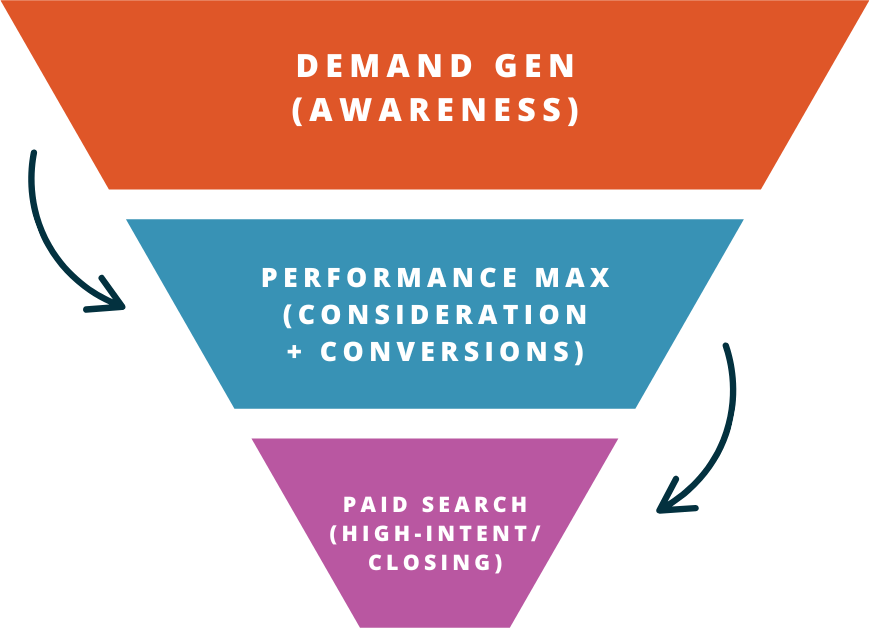
    Paid search funnel

    Why Add Both to Your Strategy

    Together, these campaigns build a full-funnel approach: Demand Gen fuels awareness, Performance Max converts interest, and Search closes the loop. Adding them ensures your ads reach customers at every stage of the decision journey.

    Looking to take your Paid Search strategy to the next level? Talk to your Account Manager about adding Demand Gen and Performance Max to your campaigns today.

  • From Cold to Gold: How to Measure Lead Quality

    Note: This post was updated by Gi Levet on 10/7/2025 to reflect current best practices. It was originally published on 12/8/2023.

    Key Insights

    • Quality of digital marketing leads always trumps quantity of leads.
    • Knowing the differences between high-quality and low-quality leads helps you determine the quality of your own leads.
    • Ongoing measurement is a multi-step process that gives you a consistent pulse on the quality of your sales leads.
    • Several tools can help you with DIY lead tracking and scoring, such as Google Analytics and CallRail.

    Leads are the lifeblood of digital marketing, offering valuable insights and opportunities to connect with potential customers.

    However, to actually see the impact of these leads, you need to understand that not all leads are created equal. Having leads doesn’t necessarily mean you’re dominating your industry.

    The idea “The more the merrier!” works well for click-through rates and conversions. When it comes to leads, quality trumps quantity. Having a funnel of incoming leads might look good on paper, but it’s the high-quality leads that drive business growth.

    That’s exactly why 79% of marketers identified generating quality leads as their main goal, according to Semrush research.

    But how do you know the quality of your sales leads?

    Two words: ongoing measurement.

    When you keep a steady pulse on the quality of your leads, you can:

    • Better optimize your marketing strategies.
    • Ensure efficient resource allocation.
    • Boost your conversion rates.

    In this post, we’ll discuss how to measure lead quality, why it’s so important, and what it can mean for the success of your marketing campaigns.

    What Is Lead Quality?

    In digital marketing, a lead is an individual or entity that has expressed interest in a product or service, typically through an action or engagement online. This could be through activities such as filling out a contact form or downloading key content on your site. Lead quality refers to the potential of a lead to convert into a customer.

    Categories of Lead Quality

    There’s a spectrum of lead quality, akin to the classic temperature scale (from cold to hot). These lead quality categories include:

    Unqualified leads

    Unqualified leads are those who have shown some level of interest in your products or services but have not been vetted to determine if they are a good fit for what is being offered. These leads may lack the necessary budget, authority, need, or timeline to make a purchase. Unqualified leads require more time and resources to nurture and qualify, and there is a higher likelihood that they may not convert into customers.

    Qualified leads

    Qualified leads have passed a certain evaluation threshold, indicating they are more likely to be interested in and capable of purchasing the product or service. This evaluation might include verifying that the lead has the budget, authority, need, and a specific timeline — ensuring a higher chance of conversion. Qualified leads are generally more informed about your product or service and have shown genuine interest, making them easier to convert into customers than unqualified leads.

    Ideal qualified leads

    Ideal qualified leads represent the best potential customers, meeting all the criteria that define an ideal buyer for the product or service. These leads have the budget, authority, need, and timeline to partner with you. They also align with your target market and buyer persona. They are highly likely to convert and have a strong potential to become long-term, valuable customers. Nurturing and closing deals with ideal qualified leads tends to require less effort and resources, providing a higher return on investment.

    Assessing High-Quality and Low-Quality Leads

    We recommend starting your lead assessment as a manual process at first. This will help you familiarize yourself with your leads and define what quality looks like for your brand. Ideally, you can automate your lead ratings from then on.

    Let’s put this into perspective with an example.

    Say you’re a higher education marketer responsible for ensuring your institution’s undergraduate programs attract and enroll the most qualified and interested students.

    To effectively do so, you take a look at three main qualifiers/differences:

    Behavioral differences

    • High-Quality Leads: Engage actively with content, often returning to your university’s website multiple times. A high-quality lead interacts more with calls-to-action and may spend longer durations on key pages. They frequently participate in admission/open house webinars, download course catalogs, or engage in live chats with admissions counselors.
    • Low-Quality Leads: Display passive or erratic behavior, like bouncing quickly from the website. These leads have limited interactions with the site’s main features or content. They rarely engage in deeper interactions, such as signing up for campus events or accessing gated content, such as program requirements.

    Level of purchase intent or interest differences

    • High-Quality Leads: Display a clear interest in specific courses or programs, often inquiring about curriculum details, faculty, or research opportunities.
    • Low-Quality Leads: Express a vague or general interest, like “I’m thinking about studying business somewhere.” Low-quality leads rarely ask detailed or specific questions that indicate a deeper interest.

    Demographic and target audience differences

    • High-Quality Leads: Often fit the typical age range and academic prerequisites of the intended program. These leads may hail from regions or schools that frequently send students to your institution. They possess a strong academic or extracurricular background aligning with your program’s focus.
    • Low-Quality Leads: Might fall outside the typical age or academic background suitable for the program. They may have educational aspirations that don’t match the institution’s offerings.

    Once you’ve assessed the criteria of your leads, you have a blueprint to apply to future measurements.

    Importance of Lead Quality in Digital Marketing

    Lead quality is the secret sauce of online advertising success. But it’s not just because better leads = higher probability of more conversions.

    Measuring lead quality is an involved, insightful, and impactful process. When you take the time to measure it, you can benefit from:

    • Efficient use of marketing budget and resources: Optimizing toward lead quality allows for a targeted approach, maximizing the impact of every marketing dollar spent. This reduces wasted budget on unqualified leads, ensuring more resources are directed toward potential conversions.
    • Direct influence on sales efforts and productivity: High-quality leads increase the efficiency of your sales team, enabling them to close deals more effectively. This reduces time spent chasing leads with low conversion potential, increasing overall sales productivity.
    • The link between lead quality and customer lifetime value: High-quality leads are more likely to become loyal customers, leading to repeated sales over time. This increases overall revenue for your company, as these leads not only convert but can also advocate for your brand, bringing in more potential customers.

    How does lead quality impact conversion rates?

    Lead quality plays a pivotal role in conversion rates, as it directly influences a potential customer’s likelihood to purchase or engage with a product or service.

    High-quality leads align with the target demographic and have demonstrated a clear interest in a company’s offerings, both of which set the stage for a smoother conversion process. These high-quality leads tend to move more quickly and efficiently through the sales funnel because their intent to purchase is clear and strong from the outset.

    As a result, there’s a reduced chance of these leads dropping out or losing interest mid-funnel, ensuring that your sales team’s efforts are concentrated on prospects with the highest likelihood of converting.

    How to Measure and Monitor Lead Quality

    Measuring the quality of your leads can be a tough nut to crack, especially if you’re a first-timer. But it doesn’t have to be.

    To help you get started, we’ve developed a set of best practices for assessing the quality of a lead:

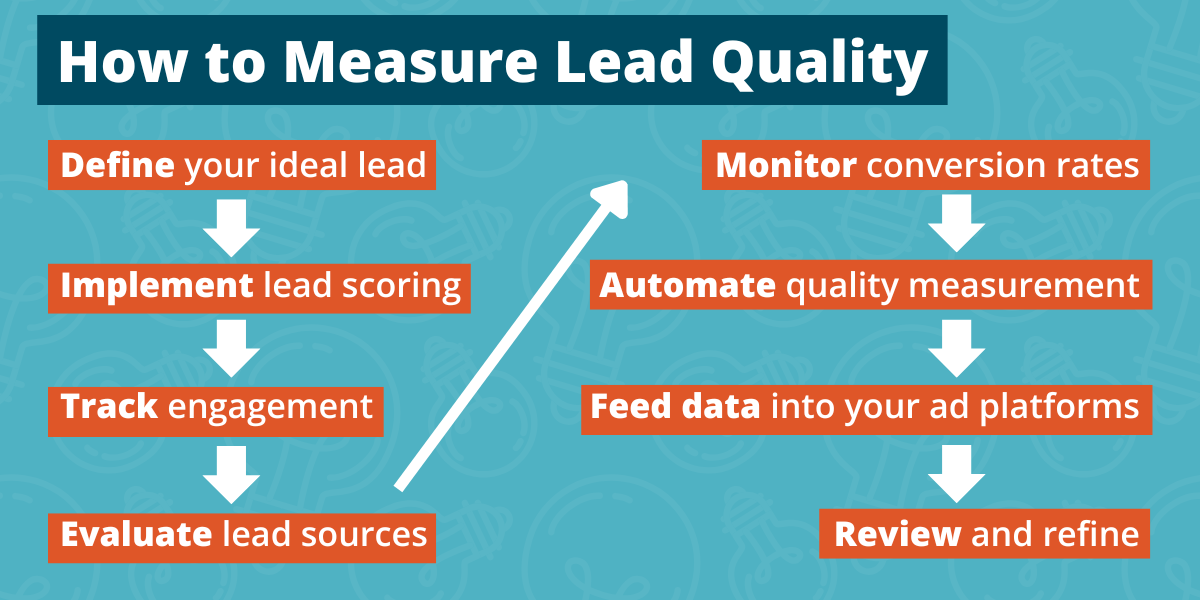
    Step 1: Define your ideal lead

    Create a profile of your ideal lead, considering factors like demographics, location, interests, and behaviors that align with your product or service. It’s important to be as precise as possible in this phase since this profile serves as the cornerstone for your lead quality assessment.

    Think of it as sketching out a detailed buyer persona that embodies the characteristics of someone who would not just be interested in, but most likely to benefit from and purchase, your product or service.

    Step 2: Implement lead scoring

    After you’ve crafted your ideal quality lead, implement a lead scoring system that assigns points to various lead attributes and behaviors.

    For example, a lead visiting a pricing page might get more points than one just reading a blog post. A lead that matches your ideal customer profile in terms of demographics might also receive higher points.

    This scoring system acts as a quantitative method to gauge lead quality, enabling your teams to prioritize their efforts on the most promising leads and, thereby, optimize the overall efficiency of your sales process.

    Step 3: Track engagement metrics

    Monitoring engagement is one of the clearest ways to understand lead quality. Look at signals such as time on site, return visits, or downloads of gated resources. These actions tell you how invested a prospect is in learning more.

    Many analytics platforms now integrate AI to surface deeper engagement insights automatically, reducing the time it takes to spot patterns. With automation, you don’t just see the raw metrics. You see which behaviors consistently correlate with higher-quality leads.

    Step 4: Evaluate the lead source

    Not all traffic sources are created equal. Some channels reliably deliver prospects that align with your buyer persona, while others flood your funnel with unqualified leads. By evaluating lead sources, you can see which campaigns and platforms produce the highest-value opportunities.

    Advanced tools can also automate source attribution, helping you see at a glance which channels drive the highest-quality leads. With accurate attribution, you can confidently invest in the platforms that consistently deliver ideal leads.

    Step 5: Monitor conversion rates

    Conversion rates are one of the most reliable indicators of lead quality. If leads from a specific source convert into paying customers more often, that source is worth prioritizing.

    With automated tracking, you can quickly identify which leads move through the funnel faster and use that data to refine your scoring models. Instead of waiting weeks to spot trends, you can optimize in near real time.

    Step 6: Automate your lead quality measurement

    Manual lead scoring can be inconsistent and time-consuming. Automation makes the process scalable. AI-driven tools like CallRail’s AI-powered automated scoring remove guesswork by assigning scores based on real behaviors and outcomes, not assumptions.

    Automation allows you to:

    • Capture real-time insights without manual effort.
    • Eliminate bias in how leads are evaluated.
    • Scale your measurement process as lead volume grows.

    By shifting to automated scoring, you create a consistent, always-on system that improves accuracy and frees up your team for higher-value strategy.

    Step 7: Feed lead data into your ad platforms

    Your CRM data doesn’t just help your sales team. It can make your ad campaigns smarter, too. Feeding qualified lead data into platforms like Google Ads and Facebook ensures those platforms optimize for quality, not just volume.

    Here’s how it works:

    • A prospect fills out a form.
    • Their info flows into your CRM.
    • The CRM verifies and scores the lead over time.
    • Qualified lead data is synced back to your ad platforms.

    This workflow bypasses cookie-tracking issues and creates a feedback loop where campaigns automatically improve. Many CRMs already support automated qualification, which reduces manual effort and ensures reporting accuracy.

    Step 8: Regularly review and refine

    Automation and CRM integrations give you accurate, real-time data, but they don’t replace the value of human oversight. Your team still needs to regularly review results, refine scoring criteria, and re-evaluate lead sources to ensure they reflect changing audience behavior and market conditions.

    With automation handling the heavy lifting, you can focus on strategic improvements, making adjustments that strengthen the overall process while staying confident that the data guiding those refinements is current and reliable.

    Tools and Software for Evaluating Lead Quality

    Evaluating lead quality doesn’t have to feel overwhelming. The right tools can take the guesswork out of measurement and give you a clearer picture of which prospects are worth your team’s time.

    At Search Influence, we often recommend a combination of software and frameworks that cover different points of the funnel:

    • CallRail: Track inbound calls and attribute them to the right marketing source, so you know which campaigns are driving real conversations.
    • CRM systems (HubSpot, Salesforce, etc.): Manage leads as they move through the pipeline, apply scoring models, and feed quality data back into your ad platforms.
    • Google Analytics: Understand website behavior and map out the conversion paths that indicate strong purchase intent.

    Together, these platforms create a practical foundation for measuring lead quality, from the first interaction through to conversion.

    CPI Worksheet for higher ed marketers

    In higher ed? Search Influence’s CPI Worksheet is a practical tool for connecting lead quality back to enrollment outcomes. It helps you calculate:

    • Overall CPI across all programs
    • CPI by program type (undergraduate, graduate, non-credit)
    • Cost per enrolled student to see the true return on your marketing efforts

    Using this worksheet alongside lead quality measurement shows whether optimizing for better-qualified leads lowers costs and helps you allocate budget to the campaigns most likely to drive enrollment growth.

    Measuring Lead Quality FAQs

    How to measure lead quality from organic search leads?

    You can measure lead quality from organic search by tracking engagement signals like time on site, pages viewed, and conversion actions completed. Leads that interact with high-value content, such as service pages, pricing, or gated resources, show stronger intent than those who bounce quickly. Pairing this behavioral data with lead scoring in your CRM helps confirm whether your SEO is attracting prospects likely to convert.

    How to measure the quality of leads coming from different channels?

    The quality of leads from different channels is measured by comparing conversion rates, cost per qualified lead, and long-term customer value across sources. For example, leads from paid search may convert faster, while leads from organic or referral traffic may have higher lifetime value. Attribution tools and CRM integrations make it easier to see which channels consistently deliver the best-fit prospects.

    What is the key indicator of a high-quality lead?

    The key indicator of a high-quality lead is purchase intent that aligns with your target customer profile. This often shows up in behaviors like filling out detailed forms, requesting demos, or asking specific questions that demonstrate readiness to convert. When paired with demographic or firmographic alignment, these intent signals give sales teams confidence that the lead is worth pursuing.

    What makes a lead unqualified?

    A lead is considered unqualified if they lack the budget, authority, need, or timeline to purchase your product or service. For instance, they might engage with your content but fall outside your target audience, or they may express only casual interest without the means to act. Unqualified leads often require more nurturing and have a much lower likelihood of conversion.

    How to increase the quality of leads?

    You can increase lead quality by targeting campaigns toward your ideal customer profile and using filters like geography, demographics, or job role to narrow your reach. Optimizing landing pages for clarity, offering valuable gated content, and feeding qualified lead data back into ad platforms also improves lead quality over time. Combining precise targeting with automation ensures your pipeline attracts prospects more likely to convert.

    Lead Tracking With Search Influence

    According to Hubspot, over 50% of marketers across the globe find generating leads and traffic their most challenging task. Is it yours?

    Search Influence offers expert analytics and lead tracking services to help you make more informed decisions about targeting your ideal leads. When you work with us, we’ll help you know the impact of your marketing efforts with everything from website form and call tracking to coprehensive reporting and ROI analysis. We’ll identify your target audience, track all interactions, and pinpoint the best opportunities to improve lead quality.

    Don’t let the complexity of your leads leave you in the dark.

    Contact us today to explore the depth of our lead tracking services and tap into our industry-leading expertise.

  • Search Influence Honored as One of 2025’s Best Women-Owned Businesses by New Orleans CityBusiness

    Search Influence is proud to announce that New Orleans CityBusiness has named us one of the 2025 In the Lead: Best Women-Owned Businesses honorees.

    The special section, profiling recognized companies, will appear in the September 19, 2025, issue of New Orleans CityBusiness.

    This honor comes alongside our recognition as an honoree in the 2025 CityBusiness Empowering Women Award and adds to our ongoing distinction of being named five times to the publication’s Best Places to Work list.

    Together, these awards highlight our growth as a digital marketing agency and our commitment to creating a workplace where women lead, innovate, and thrive.

    What the Award Represents

    CityBusiness selects honorees based on business performance, innovation, workplace culture, and community impact.

    To qualify, companies must be owned in whole or majority by women and based in the Greater New Orleans area. Honorees are chosen for achievements such as:

    • Demonstrating strong growth in revenue or employees
    • Trailblazing in industries traditionally dominated by male-owned firms
    • Building a workplace that supports employees with programs that foster morale and growth
    • Showing consistent community engagement and mentorship

    At Search Influence, these values align directly with our mission. 75% of our leadership and 79% of our team are women, and our culture emphasizes mentorship, inclusion, and opportunity.

    A Women-Owned Digital Marketing Agency Making an Impact

    From our beginnings in a spare bedroom to becoming a nationally recognized digital marketing agency, our growth has always been rooted in people. Being a women-owned company means leading with empathy and strength while ensuring every team member has the tools to succeed. Flexible schedules, paid parental leave, and clear paths for professional development are just a few ways we support our team.

    We also give back by hosting YouthForce interns each year, helping mentor the next generation of women interested in business, technology, and marketing.

    Driving Innovation Through AI SEO and Digital Advertising

    This award also celebrates how we’ve helped clients succeed through innovation.

    Search Influence has been an early adopter of AI SEO strategies, ensuring our clients appear in AI-powered search results like Google’s AI Overviews and conversational assistants.

    Our dual approach, optimizing client visibility in AI search while using AI tools to improve SEO workflows, keeps our partners ahead of rapid industry changes.

    In addition to SEO, our expertise spans digital advertising and data-driven email marketing.

    For nearly 20 years, we’ve delivered measurable results through strategies that blend human creativity with advanced analytics.

    Looking Ahead

    Recognition as one of the Best Women-Owned Businesses underscores what we’ve always believed: When women lead, companies and communities grow stronger.

    We’re grateful to New Orleans CityBusiness for this honor and proud to stand alongside other local businesses that are making an impact.

    As AI, search, and digital advertising continue to evolve, Search Influence remains dedicated to helping our clients thrive in a competitive environment. Our story proves that innovation, inclusion, and community commitment are the foundation of lasting growth.

    Ready to maximize your success with a proven women-owned digital marketing agency?

    Contact Search Influence today to discuss how AI SEO and digital advertising can drive your next stage of growth.

  • Higher Education Advertising Strategies for Centralized vs. Decentralized Teams

    Higher Education Advertising Strategies for Centralized vs. Decentralized Teams

    Key Insights

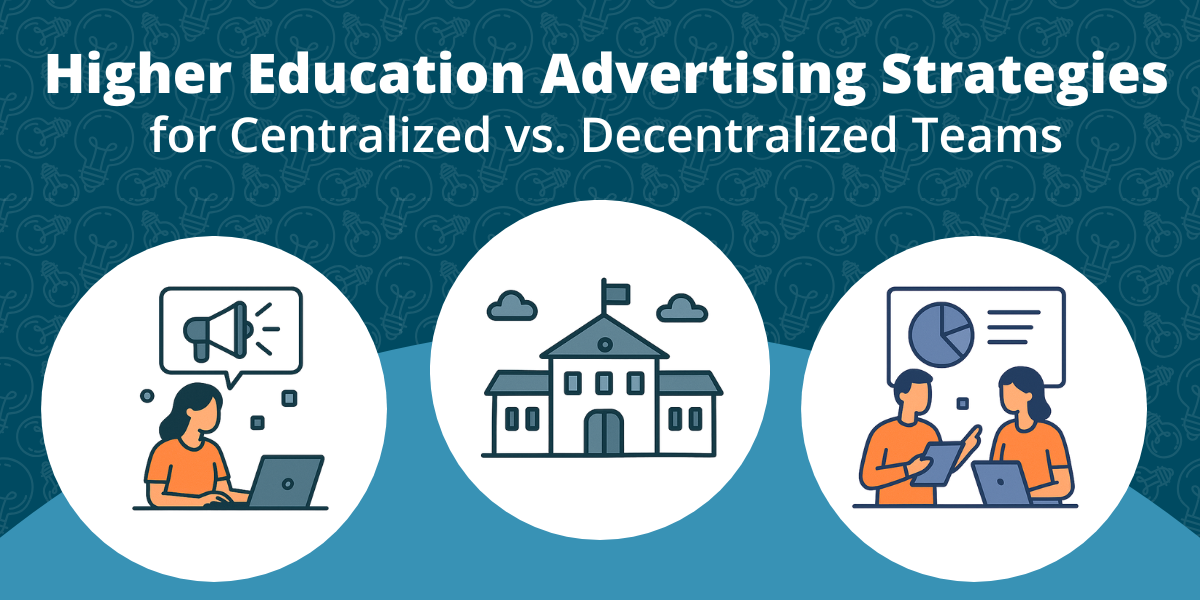
    • Team structure drives advertising performance. A centralized marketing team delivers efficiency and consistency, while decentralized teams excel in agility and program-level targeting.
    • Most universities operate in hybrid models. Few are purely centralized or decentralized. Hub-and-spoke and collaborative networks are common, and each impacts paid advertising differently.
    • Aligning strategy with structure prevents wasted spend. The right setup helps higher education marketers avoid overlapping ads, mixed messages, and underperforming budgets.
    • Paid advertising success comes from clarity. Institutions that match their organizational model to their media strategy see stronger ROI, better audience targeting, and more meaningful enrollment outcomes.

    If you’re responsible for higher education advertising at an institution, you already know the challenge.

    Every school, program, and department wants visibility, and they all want it yesterday.

    Meanwhile, leadership expects a unified brand that builds credibility and delivers enrollment results.

    That tension comes to a head in paid campaigns, where budgets are closely watched and wasted spend is difficult to justify.

    Should all campaigns be managed by one centralized marketing team to ensure control and consistency? Or should departments run their own ads to tailor messages for specific programs and audiences?

    Most institutions operate somewhere in between. Knowing where your structure falls (e.g, centralized, decentralized, or hybrid) is the first step toward building a digital advertising strategy that makes every dollar work harder.

    Variations in Centralized and Decentralized Higher Education Advertising

    Not all universities fit neatly into “fully centralized” or “fully decentralized.” Recognizing your model is key to avoiding wasted budget and reaching the right students.

    Centralized Variations

    Centralized structures are common when leadership wants control, efficiency, and a unified voice. Within this approach, there are two main models institutions typically follow:

    Fully centralized

    In this model, one marketing office controls all budgets, creative, targeting, and reporting. Paid campaigns for undergraduate admissions, graduate programs, and brand-building all flow through the same team. This creates consistency and accountability, but campaigns often move more slowly, and programs with niche audiences may feel underserved.

    Hub-and-spoke

    With a “hub-and-spoke” setup, the central office sets strategy and creative standards, and likely also provides already-approved ad templates. The departments then execute campaigns within those guidelines.

    For example, a nursing school might adapt central paid search templates to highlight clinical outcomes, while the business school uses the same framework to promote MBA career paths. This model gives programs flexibility without losing alignment, but it requires clear governance to work well.

    Decentralized Variations

    Decentralized structures give schools more autonomy and agility. Instead of waiting for central approval, departments can quickly tailor campaigns to their audiences. Two common models fall under this approach:

    Fully independent

    In a fully independent model, each school or department manages its own advertising, from budgets to creative to targeting. For example, the business school might run a Meta campaign to boost MBA enrollment, while engineering launches LinkedIn ads for prospective undergraduates.

    This setup gives programs agility and control over their own messaging, but it often leads to inconsistent brand voice, overlapping campaigns, and higher costs when departments compete for the same prospective students.

    Collaborative network

    In a collaborative network, departments run their own campaigns but share certain resources, such as analytics platforms, vendor contracts, or a CRM. For example, multiple schools may use a shared DSP to buy media while still creating their own ads.

    This structure lowers costs and improves visibility across programs, but it depends on adoption. Without consistent use of shared tools, you can still end up with inefficiencies and fragmented audience targeting.

    Pros and Cons of Each Structure

    Centralized Structure

    A centralized marketing team shines when leadership prioritizes consistency and efficiency. But in practice, it can also create friction when programs need specialized campaigns.

    Pros

    • Cohesive brand identity: Every ad, across search, social media, and display, reinforces a unified message for prospective students.
    • Economies of scale: Media dollars go further when a centralized marketing team buys in bulk, lowering CPCs and CPMs.
    • Clear reporting: Centralized audience data makes it easier to connect campaigns to enrollment outcomes.
    • Policy alignment: There’s easier institute-wide compliance with accessibility, privacy, and government regulations.

    Cons

    • Slower response times: Campaigns for specific academic programs or niche demographics may lag.
    • Creative bottlenecks: One team reviewing all assets can delay launches.
    • Departmental disconnect: Faculty and program chairs may feel their priorities aren’t represented.

    Decentralized Structure

    Decentralized models work best when agility matters most, but that same autonomy often leads to inefficiency and fragmentation in higher education campaigns.

    Pros

    • Agility: Departments can launch or pivot enrollment marketing campaigns quickly.
    • Tailored messaging: Schools can highlight unique career outcomes, campus life, and student success stories.
    • Encourages innovation: Independent teams are often able to test new tools, channels, or creative approaches.

    Cons

    • Brand inconsistency: Prospective students may see conflicting messages across multiple channels.
    • Budget inefficiency: Overlapping campaigns may compete for the same target audience.
    • Limited ROI visibility: Multiple CRMs or landing pages can make performance tracking difficult.

    Paid Ad Strategies for Each Structure in Higher Education

    Understanding your structure is only useful if it translates into smarter campaigns. Each model requires a different approach to ensure your ad dollars are invested wisely and drive enrollment.

    For Fully Centralized Teams

    When one marketing office owns all advertising, scale and consistency are your biggest advantages. The challenge is making sure campaigns still connect with prospective students across different programs.

    • Plan around the calendar: Create a campaign roadmap that aligns with enrollment cycles, campus events, and application deadlines. This ensures steady awareness throughout the year.
    • Leverage remarketing: Use centralized retargeting to reach visitors across all university web pages, reinforcing brand visibility and creating a unified experience for potential students.
    • Allocate budgets strategically: Prioritize spend where it aligns with enrollment goals, career outcomes, and high-demand academic programs, not just where the loudest requests come from.

    For Hub-and-Spoke Models

    This hybrid structure allows departments to highlight their strengths while the central office maintains control of strategy. It works best when there’s clear communication and shared insights.

    • Distribute audience research: Share data on audience behaviors and search insights to help schools tailor campaigns to the right demographics.
    • Provide creative frameworks: Branded ad templates and pre-approved copy blocks let departments develop authentic content that still feels consistent.
    • Centralize reporting: A shared dashboard helps leaders and departments monitor engagement, compare performance, and refine higher education marketing strategies.

    For Fully Independent Departments

    When every college runs its own campaigns, speed and specialization come naturally. The risk to avoid, however, is waste, including duplicate targeting, inconsistent messaging, and missed opportunities for collaboration.

    • Hold quarterly ad reviews: Bring departments together to compare results, share key strategies, and reduce overlap.
    • Encourage light-touch brand guidelines: Even voluntary frameworks help create a more unified experience for prospective students.
    • Pool funds for high-cost media: Channels like YouTube, CTV, or sponsored content often deliver deeper connections with specific demographics but may be out of reach for one department’s budget alone.

    For Collaborative Networks

    A collaborative network provides autonomy but relies on shared resources to cut costs and increase efficiency. The success of this model depends on adoption across departments.

    • Invest in shared platforms: A common CRM or analytics system makes it easier to track engagement and communications across the institution.
    • Coordinate retargeting pixels: Prevent schools from competing for the same audiences online by unifying tracking.
    • Offer training: Equip decentralized teams with the skills to interpret insights and use digital marketing tools effectively.

    How to Decide Which Model Works for Your Institution

    Choosing between centralized vs decentralized marketing structures isn’t about which one is “better.” It’s about which one matches your institution’s size, resources, and enrollment goals.

    A small liberal arts college with a handful of academic programs may thrive under a centralized marketing team, while a large research university with multiple colleges often needs hybrid structures to balance control and autonomy.

    Key factors to consider include:

    • Number of schools and programs: The more academic programs you offer, the harder it becomes for one office to manage every campaign.
    • Central marketing staff size: If your team is lean, decentralized departments may need more responsibility.
    • Technology and infrastructure: Institutions with robust CRMs, shared analytics, and advanced digital marketing tools can unify campaigns more easily.
    • Leadership priorities: Some universities value a unified experience and brand voice above all. Others prefer program-level autonomy to reach specific demographics.
    • Hybrid effectiveness: Many higher education institutions succeed with hub-and-spoke or collaborative models, where central offices provide guidance and resources while departments tailor ads for their own prospective students.

    The right fit comes down to aligning your organizational design with your advertising goals.

    Common Challenges in Higher Ed Paid Ad Management

    Even with a well-chosen model, challenges are inevitable. Higher education advertising is complex, with multiple audiences, competing priorities, and budget pressures. Some of the most common issues include:

    • Budget allocation disputes: Programs often compete for limited funds, leading to tension over who gets priority.
    • Duplicated targeting: Without coordination, two departments may spend against the same prospective student audience in major search engines or social media platforms.
    • Fragmented tracking: Multiple CRMs, landing pages, or disconnected web pages make it difficult to attribute campaigns back to enrollment outcomes.
    • Compliance requirements: Accessibility standards, privacy regulations, and institutional diversity goals must all be reflected in campaigns.
    • Balancing consistency with flexibility: Universities need cohesive brand visibility, but also space for departments to highlight authentic content such as student success stories, career outcomes, and campus life.

    Addressing these challenges requires more than good intentions. It takes shared governance, modern tools, and clear reporting structures.

    How an Advertising Agency Can Bridge the Gap

    Many institutions find that bringing in an external partner helps them balance competing needs. An experienced higher education advertising agency acts as both strategist and coordinator, offering:

    • Cross-department coordination: Ensuring enrollment marketing campaigns complement, rather than compete with, each other.
    • Centralized analytics: A unified view of performance across digital marketing channels, from paid search to sponsored content.
    • Audience research: Fresh insights into audience behaviors, college options, and what drives potential students to engage.
    • Budget optimization: Redirecting spend toward the channels and creative that attract more students and deliver ROI.
    • Neutral facilitation: Acting as a “traffic controller” to balance requests from different colleges and departments.

    The right partner doesn’t take control away from internal teams. It creates alignment, so every program benefits from a smarter strategy and cleaner execution.

    FAQs About Centralized vs. Decentralized Marketing Strategies

    How does team structure impact higher education advertising strategies?

    Structure determines who controls budgets, creative, and targeting. Centralized teams create consistent messaging, while decentralized teams allow program-level customization. Hybrid structures aim to capture the benefits of both.

    What KPIs should universities prioritize in paid ad campaigns, regardless of structure?

    Metrics like cost per inquiry, cost per enrollment, website engagement, and conversion rates from landing pages tie directly to marketing goals. These help link advertising dollars to measurable enrollment outcomes.

    How do you measure ROI across multiple departments?

    Shared CRMs, attribution models, and centralized dashboards allow institutions to consolidate insights. Without these, it’s nearly impossible to connect spending with results across multiple academic programs.

    How can universities prevent brand inconsistency in decentralized campaigns?

    Use creative frameworks like branded templates, approved copy blocks, and optional reviews. This allows departments to create authentic content while maintaining a consistent look and feel.

    Is it better to manage university paid media internally or with an external agency?

    It depends on your resources. Internal teams know the culture and campus life deeply, while agencies bring advanced tools, digital marketing expertise, and broader insights. Many educational institutions benefit from a hybrid approach (internal vision with external execution support).

    Digital Advertising for Higher Education: Smarter Ad Spending Starts With Structure

    The structure of your marketing team is one of the biggest factors in the success of your higher education advertising.

    No model is “right” or “wrong” on its own. The key is aligning your digital advertising strategy with how your institution actually operates. When structure and strategy match, you avoid wasted budget, reduce audience overlap, and deliver a unified experience for prospective students.

    Download the ROI White Paper

    At Search Influence, we’ve seen firsthand how much team structure impacts campaign performance. That’s why we developed “3 ROI Models to Prove the Value of Your Education Marketing,” a practical guide to help higher education institutions measure and improve the impact of their digital advertising.

    In the white paper, we share:

    • Three proven models for evaluating higher education marketing campaigns
    • How to turn data and insights into smarter, faster decision-making
    • Tips for preparing confident conversations with leadership and stakeholders
    • Strategies to refine campaigns in real time to attract more students and strengthen ROI

    Don’t wait until the next enrollment cycle to maximize your ad spend. Download our ROI white paper today and start building a more measurable, effective advertising strategy tailored to your institution.

    Images:
    Unsplash
    Unsplash

  • Digital Advertising Strategy Checklist: What to Do Before You Spend $1

    Digital Advertising Strategy Checklist: What to Do Before You Spend $1

    Key Insights

    • A paid ad campaign is only as effective as the strategy behind it. Even great creative will underperform without a defined goal, audience, and conversion path.
    • Digital ads can increase brand awareness by up to 80%, but only if execution is precise. Relevance, targeting, and optimization unlock that potential.
    • Success happens before launch. From audience research to tracking setup, what you do before you spend determines whether your budget drives impact or disappears.
    • Landing pages, follow-up, and lead handling are make-or-break moments. Campaigns don’t just need clicks. They need infrastructure that turns attention into results.
    • Partnering with the right agency brings structure, expertise, and performance insight. Like a choreographer guiding a performance, an agency keeps every element moving in sync.

    A paid ad campaign isn’t just a collection of assets. It’s a well-orchestrated system. Each part, from targeting to tracking, must function in sync to drive measurable outcomes.

    Before your campaign ever goes live, your digital advertising strategy should already be working behind the scenes: identifying the right audience, crafting the right message, selecting the right platforms, and preparing your brand to handle the response.

    Unsure where to start? This step-by-step digital ad campaign checklist outlines everything you need to lay the groundwork.

    What Is a Digital Ad Campaign Plan?

    A digital ad campaign plan is a tactical blueprint that maps every part of your campaign to a specific business goal.

    It connects your audience targeting, messaging, platforms, and creative assets to a single, measurable outcome, whether that’s generating leads, increasing sales, or raising brand awareness.

    Without a campaign plan, brands often end up with scattered targeting, mismatched creative, and disappointing results.

    Think of it like entering a dance competition without rehearsing a routine. You might have great moves, but without choreography, you’ll lose the rhythm, the audience, and the scorecard.

    Ad campaign planning gives your strategy structure and flow.

    Digital Ad Campaign Checklist

    Digital Ad Campaign Checklist

    Step 1: Define the goal and conversion action

    Every campaign should start with one question: What action do you want your audience to take?

    Whether you’re aiming to generate leads, drive purchases, or boost brand visibility, choose one primary goal. Then define the conversion that reflects success. This could be a form submission, a phone call, a sale, or a demo request. Make sure your analytics tools are set up to track this action from day one.

    Without a clear goal and measurement in place, you’ll have no way to judge success.

    Step 2: Conduct market and audience research

    Knowing your audience is the foundation of any effective digital strategy.

    Collect demographic data like age, location, income, and education, but also go further. Explore psychographics such as values, interests, and buying behaviors. Analyze your competitors to find gaps in their targeting or messaging. Build detailed buyer personas so you can create ads that resonate.

    The more you understand your audience, the more relevant and persuasive your campaign will be.

    Step 3: Choose the right paid digital channels

    Each digital platform offers different strengths. Choose the channels that match your audience and campaign goal.

    If your audience is actively searching for your product, Google Ads may be the best choice. If you’re building awareness or retargeting existing prospects, social media platforms like Facebook, Instagram, or LinkedIn offer valuable reach and targeting tools. Consider where your audience spends time, how they consume content, and how different digital marketing channels handle tracking, budget, and creative.

    A successful campaign starts by meeting people where they are.

    Step 4: Build a targeted keyword strategy (for search campaigns)

    For search campaigns, your keyword strategy controls who sees your ads and when.

    Group keywords based on user intent, separating awareness-stage searches from ready-to-buy queries. Prioritize keywords with strong search volume and an acceptable cost-per-click (CPC). Use long-tail variations to attract higher-quality traffic. And build a negative keyword list to prevent your ads from showing up in irrelevant searches.

    The right keyword strategy filters out noise and brings in people ready to act.

    Step 5: Define audience segments (for social and interest-based campaigns)

    When targeting users on platforms like Meta or LinkedIn, segmentation matters.

    Break your target audience into clear, testable segments based on behaviors, interests, demographics, or past site activity. Create custom audiences from your CRM or website traffic. Use lookalike audiences to expand reach while maintaining relevance. Plan to test multiple segments to see what performs best.

    The more precisely you segment, the more efficiently you’ll spend and the more likely you’ll convert.

    Step 6: Develop landing pages built to convert

    Your ad’s job is to spark interest. Your landing page’s job is to close the loop.

    Avoid sending paid traffic to your generic homepage. Instead, create campaign-specific landing pages that reflect the ad message and guide users toward your CTA. Keep it simple: fast load time, mobile optimization, and one clear call to action.

    For one of our clients, launching dedicated landing pages (without changing the ad creative or increasing spend) resulted in 42% more qualified leads and a significantly lower cost per lead. The only campaign difference was the destination.

    Step 7: Set up tracking and conversion measurement

    Before you launch, your tracking setup needs to be airtight.

    Install all necessary tags and pixels, such as Google Tag Manager, Meta Pixel, LinkedIn Insight Tag, and others. Define conversion goals inside your analytics platform. Use consistent UTM parameters to trace traffic sources and campaign performance. Test your tracking setup thoroughly before launch.

    If the campaign data is wrong, your decisions will be, too.

    Step 8: Write clear, compelling ad copy

    Your copy should hook attention, communicate value, and prompt action, all in just a few lines.

    Write with your audience’s mindset in mind. What do they want? What do they need? Use plain language that reflects their voice and avoids fluff. Your content strategy should always prioritize strong CTAs and include testing multiple versions for performance.

    The best ad copy doesn’t just sound good. It earns clicks and drives conversions.

    Step 9: Design ads that match your audience and platform

    Your ad creative should feel native to the platform while standing out in the feed.

    Use the right format (carousel, static image, or video) and ensure consistency between your ad visuals and landing page. Adapt your aesthetic to meet audience expectations, but always stay true to your brand.

    Excellent design reinforces your message and keeps users engaged all the way through the funnel.

    Step 10: Plan A/B tests from the beginning

    Testing isn’t something you tack on later. It’s part of the plan.

    Decide what to test (copy, creative, CTA, landing page, or audience) and establish the metrics and sample sizes needed for valid results. Run structured tests and analyze outcomes at regular intervals. Then use what you learn to refine the campaign mid-flight.

    A/B testing turns good campaigns into great ones.

    Step 11: Align internal lead handling processes

    What happens after a lead converts is just as important as getting the click.

    Make sure leads are routed to the right place, like your CRM, inbox, or sales team, immediately. Train staff to follow up quickly and consistently. If you’re qualifying leads, define scoring criteria so your team knows who to prioritize.

    A well-oiled lead handling process ensures your marketing efforts turn into measurable pipeline growth.

    What Happens After Campaign Launch?

    Going live is not the finish line. It’s the start of real optimization.

    Once your campaign is in motion, ongoing performance monitoring is critical. Data from your ads, landing pages, and audience segments will show what’s working and what’s not. Use those insights to adapt early and often.

    Post-launch digital advertising tips include:

    • Monitoring keyword and audience engagement regularly
    • Reviewing click-through and conversion rates on each
    • Adjusting bids and budgets based on cost-per-result
    • Promoting high-performing variants, pausing underperformers
    • Iterating landing pages to improve conversion efficiency

    Your goal now is to reduce waste and improve return. Campaigns that are actively managed outperform set-it-and-forget-it approaches every time. Keep refining based on performance data, and your digital advertising strategy will only get stronger.

    Why Partner With a Digital Advertising Agency?

    Even with the best intentions, many brands and their marketing teams stumble after launch. Maybe your ads are generating clicks, but they aren’t converting. Or you’re spending money across multiple platforms without a clear sense of what’s actually driving results.

    Sometimes, despite having all the right tools in place, performance plateaus, and no one knows why.

    That’s because executing a successful digital marketing strategy requires more than checklists and best practices. It takes coordination and expertise.

    An experienced agency helps you:

    • Align your campaign tactics with business objectives from the start
    • Develop a competitive content marketing and creative strategy
    • Identify and eliminate inefficiencies in targeting and bidding
    • Access certified experts across platforms like Google, Meta, and LinkedIn
    • Make data-driven adjustments in real time, not weeks later
    • Build a scalable, repeatable strategy that evolves with your goals

    Think back to the dance competition example. You can have the right stage, the right costume, and even the right audience, but without a choreographer, the performance lacks direction. A digital ad agency acts as that choreographer, bringing coordination, timing, and strategic vision to ensure every part of your campaign moves in harmony.

    And when everything clicks, that’s when the real performance begins.

    Digital Advertising Strategy FAQs

    Digital Advertising Strategy FAQs

    How effective are online advertising campaigns?

    When planned and managed properly, online advertising campaigns are highly effective. Paid media allows for precise targeting, measurable results, and scalable performance across different goals, from lead generation to sales to brand awareness. Overall strategy success depends on aligning platform, messaging, and audience with a clearly defined conversion goal.

    What’s the difference between paid search and paid social advertising?

    Paid search targets users based on their intent, making it ideal for capturing active demand. Paid social reaches users based on demographics, interests, and behaviors, even when they’re not actively searching. Depending on your audience and overall campaign objectives, both can play a role in an effective digital marketing strategy.

    How do you optimize ad spending?

    Ad spend is optimized through ongoing analysis and adjustment. This includes refining audience or keyword targeting, rotating creatives, adjusting bids based on performance, and improving landing pages to increase conversion rates. Optimization is not a one-time task. It requires continuous testing, measurement, and iteration.

    What are the best practices for digital ad tracking setup?

    Well-executed tracking is a strong foundation for any digital marketing campaign. Set clear conversion goals, implement tags and pixels correctly, and use UTM parameters for clean reporting. Accurate tracking ensures your ad efforts are evaluated based on reliable data, allowing for better optimization.

    What does ad campaign success look like?

    Ad campaign success means achieving measurable outcomes tied to your strategy, whether that’s clicks, conversions, or revenue. High click-through rates, low cost per acquisition, and positive ROI all point to a well-executed digital marketing plan. Ongoing performance analysis helps refine your strategy and improve future campaign effectiveness.

    Build Smarter Campaigns From the Start

    Digital ads have the power to increase brand awareness by up to 80%, but only when they’re built on a solid strategy. Too often, businesses invest in paid advertising without the structure or support to turn clicks into real outcomes.

    That’s where execution matters.

    Since 2006, Search Influence has helped organizations do digital advertising the right way. As a Google Premier Partner, we combine platform expertise with performance-driven thinking to deliver campaigns that convert, scale, and adapt.

    If you’re ready to stop wasting budget and start building a smarter, more efficient digital advertising strategy, we’re ready to help. Let’s start the conversation today.

    Images:
    Pexels
    Pexels

  • Rising Online Advertising Costs in 2024: The Election Year Effect

    2024-Election-and-Ad-Cost

    Key Insights

    • With the U.S. presidential election coming up, experts project increased advertising competition and rising digital ad costs throughout 2024.
    • While it may be tempting to slash your marketing budget to save short-term advertising costs, you’ll pay the long-term price of leaving your brand dormant this year.
    • The right channel, campaign, and strategy can make the difference between a profitable year and one that succumbs to the pressure of a changing market.

    Yes, it’s an election year. Yes, online advertising costs will rise. No, you shouldn’t take the (mistakenly) “economically sound” route and cut the cord on your campaigns.

    Digital ad costs ebb and flow seasonally each year, which ushers in higher prices for a slice of inventory. The same goes for when a major election is on the table, like the upcoming U.S. presidential election, which is already proving to be an ad-spend field day on its own.

    As high demand and low supply for ad inventory during elections cause prices to hike, many brands put marketing on the chopping block. However, despite the higher price tags, the brands that stay the course and continue advertising are the ones who go into the next year with the best results.

    In this blog, we’ll cover everything you need to know about rising digital ad costs in 2024 and offer practical tips for keeping your strategy in shape amidst uncertainty.

    Digital Advertising Costs Predicted to Remain High Beyond Q4

    Between impromptu holiday campaigns and year-in-review wrap-ups with higher-ups, Q4 is often a frenzy.

    Historically, Q4 brings with it an extra chunk of change, often to the advertiser’s benefit. Shoppers rush to both brick-and-mortar and e-commerce stores for holiday deals, spending more than ever, earlier than ever. A smart marketer runs at least one holiday campaign, which ideally, spikes profits and leads that outperform last year.

    However, despite these hot sales, there are some drawbacks.

    Supply, demand, dilemma

    Q4 is a remarkably advantageous time to advertise, and most advertisers know it — making the market more crowded.

    This time of year, advertisers find themselves in a bidding war against direct competitors in their industry and against a broad spectrum of entities all vying for the same precious commodity: consumer attention. From small-scale Etsy vendors to major national retailers, the fight for digital ad space becomes increasingly fierce — and costly.

    It’s the classic law of supply and demand. More advertisers want online ad space, meaning the demand for inventory on high-converting channels naturally grows. With that growth comes increased competition and rising prices per click or per impression.

    2024 to change the tune

    For safe budgetary measures, you should always expect rising digital advertising costs in Q4 — unless the yearly data shows differently. Fortunately, though, the dust left over from the madness typically settles in Q1 of the new year.

    However, 2024 is shaping up to be different. This year’s Q4 isn’t just about the usual holiday shopping and Black Friday sales. The presidential election will take November by storm, and much of 2024 will be impacted, too.

    As political candidates gear up to increase their spend on advertising throughout the year, experts predict costs to remain high across most of 2024 — not just the tail end of the year.

    Impact of the 2024 Presidential Election on Digital Ad Costs

    2024-Election-and-Ad-Cost

    Presidential elections are great for the advertising market itself. For the average digital marketer looking to get in front of the eyes of potential buyers, not so much.

    Increased spend = increased competition

    The 2020 election shattered political ad spending records, being crowned the most expensive campaign year in American history. From traditional media like broadcast TV to online advertising with Google, political advertisers hopped on any and all channels to push their envelope to whoever would take it.

    This year’s election is set to take 2020’s ad spend and give it a facelift — to the tune of an estimated $15.9b across all mediums. This whopping forecast would be a 30% jump from the previous presidential election, with AdImpact projecting the 2023-2024 election as the most expensive of all time.

    As always, political advertisers mostly rely on local broadcast TV to get their message across. However, an influx of this ad spending growth is moving toward digital channels, with politicians utilizing every medium at their fingertips, from paid search to display.

    There’s a whole new layer of competition in the mix this year, one with a powerful presence on both the advertising industry and its market.

    Increased competition = increased costs

    If there’s one thing all advertisers want, it’s inventory. And if there’s one thing that isn’t always guaranteed, it’s premium inventory.

    Running ads on high-converting channels is the goldmine in any advertising sector, be it political, healthcare, or higher education.

    Elbowing through a tight crowd to get to those channels is generally to be expected. This election year, however, that crowd looks a little different and a lot bigger.

    When competition rises with political advertisers entering the scene, online advertising costs follow suit. Google, Meta, and other prominent digital ad space realtors are auction-based, meaning the bids to show naturally increase with a surge in competition.

    How Competition and Rising Online Ad Costs in 2024 Might Affect Your Results

    Potential impacts on display campaigns

    Being proactive about potential losses during this election year is the best way to safeguard quality results.

    Today, display campaigns are particularly popular. If you’re already running one, this is likely where your results will be hit the hardest in 2024.

    The worst-case scenario? You see fewer inquiries or leads and fewer sales overall from your digital advertising sources. But that’s assuming you keep the same budget as initially planned.

    In this instance, your best bet to mitigate a drop-off in conversions is to increase your ad spend to maintain consistent lead quantities. Sure, the price tag may be a tad higher, but the losses from missed revenue are even greater.

    Potential impacts on paid search campaigns

    Working with paid search? Now, that’s a different, likely easier story.

    With paid search, you’re only competing with other brands relevant to your keywords. Whether you’re a local zoo or a national SEO agency, you won’t be threatened by Candidate X, Y, or Z encroaching upon your space in the search results. You’ll just be warding off direct competitors also bidding on your keywords.

    However, you may see an impact if brands in your industry start cropping up, looking to earn more business around Q1 and Q4. Most brands want to begin and end the year on a high note, and rightfully so.

    Just be sure to stick to a thoughtful, well-executed advertising strategy, and you won’t feel too much pressure.

    The same sentiment goes for all of your digital advertising campaigns in 2024. Put in the right amount of time, effort, and money, and you can maintain the results and even accomplish your goals for the year.

    Strategies to Manage Increased Digital Ad Costs in 2024

    2024-Election-and-Ad-Cost

    Stay the course

    As the old saying goes, “When the going gets tough, the tough get going.”

    Inevitably, the market will be disrupted from time to time. Sometimes, it even gets turned on its head, like we saw with the COVID-19 pandemic. But brands who persist in uncertain times are the ones who come out on top, now and well into the future.

    A consistent online presence is what will make you relevant amidst all the political clutter.

    It’s important to avoid caving into the temptation that pulling the plug on or limiting your use of online ads this year will save you money. In the long run, you’ll only lose your brand reach, impression, and the results you worked so hard to maintain.

    Marketing is a long-term investment, not an on-and-off again, quirky commitment. As long as you keep with the course, budget appropriately, and stay vigilant of your competition, you’ll avoid the aftermath of dormant mode.

    Optimize your marketing mix

    Just because you shouldn’t cut online ad expenditures doesn’t mean you can’t save any money this election year.

    The cheat code for low ad costs and high-performing results boils down to your marketing mix.

    • Where are you advertising?
    • What campaigns are you running, and to whom?
    • Are any campaigns underperforming, and if so, on which channel(s)?

    Keep your budget and results in good standing by leveraging the marketing mix that yields the best returns. We recommend concentrating your efforts on the ad campaigns/channels that yield the most clicks or conversions and are most popular with your target audience.

    Track trends in your target audience and relevant consumer shopping trends to best optimize your marketing mix and meet prospects where they are.

    Remember that consumer behavior is also expected to shift during this election year. Many people will spend more time online to stay updated on the election, which could increase their exposure to your ads. Others may pull back their time surfing the Web or change where they spend their time online.

    Enlist an online advertising agency for help

    If 2024’s advertising market changes leave you with more questions than answers, the good news is you don’t have to navigate it alone.

    Outsourcing your marketing to an agency takes much of the heavy lifting off your plate at a fraction of the headache of doing it all DIY. When you put your strategy in the hands of experts, you’ll get industry insights, creative, tech, and strategic know-how, and performance results backed by rigorous data.

    Working with an agency also doesn’t have to be a huge cost undertaking in an already unsteady landscape. The best agencies are there to ensure you make the most use of your advertising budget by optimizing for the right marketing mix.

    Plus, with their industry expertise, you’ll always be made aware of any economic shifts and trends in the ad atmosphere.

    Proactive, not reactive.

    As Jared Belsky from MarketingPros writes, “Don’t underestimate the cost of not being at the forefront of trends.” Otherwise, you may get lost in the shuffle of the industry’s next bout of turbulence.

    Stay Ahead of the Curve With Search Influence

    At Search Influence, we’ve weathered the advertising storms of elections, pandemics, recessions, and everything in between.

    When you partner with us, your goals become our goals, and we’ll work to always keep your advertising campaigns running at peak performance. This election year, we’ll place extra emphasis on the right messaging and creative and testing new platforms to maintain your results.

    As always, we’ll monitor and optimize your campaigns based on the goals set with a focus on leveraging your competitive advantage. Your dedicated account manager will promptly alert you to any changes we see in your market, with actionable steps for maximizing your online presence.

    Keep your strategy in safe hands during times of uncertainty. See how our expert digital advertising services can put you ahead of the curve today.

    Image Sources:

    Image 1: https://images.unsplash.com/photo-1523292562811-8fa7962a78c8?q=80&w=2940&auto=format&fit=crop&ixlib=rb-4.0.3&ixid=M3wxMjA3fDB8MHxwaG90by1wYWdlfHx8fGVufDB8fHx8fA%3D%3D

    Image 2: https://images.unsplash.com/photo-1622219999459-ab5b14e5f45a?q=80&w=2832&auto=format&fit=crop&ixlib=rb-4.0.3&ixid=M3wxMjA3fDB8MHxwaG90by1wYWdlfHx8fGVufDB8fHx8fA%3D%3D

    Image 3: https://images.unsplash.com/photo-1620325867502-221cfb5faa5f?q=80&w=2957&auto=format&fit=crop&ixlib=rb-4.0.3&ixid=M3wxMjA3fDB8MHxwaG90by1wYWdlfHx8fGVufDB8fHx8fA%3D%3D

  • #1 Organic & No Clicks? Google Ads 2023 SERP Smackdown!

    #1 Organic & No Clicks? Google Ads 2023 SERP Smackdown!

    High Ranking Keywords and Low Traffic?

    google ads 2023

    Are algorithm updates and AI just a red herring for more Google Ads in 2023?

    It’s not just a #1 position. It’s a rich snippet. And a full-feature rich snippet with images, a bulleted list, and everything.

    But the CTR (click-through rate) is a measly 3%.

    We searched for the cause. Was it not a real ranking? Were we seeing a personalized search?

    higher ed marketing

    Screenshot of “Higher Education Marketing Strategy” query on Google

    No. It was Google!

    Google Ads, to be specific.

    And for some searches, Google SGE, the new Search Generative Experience.

    We discovered that there was now a big fat pack of ads over the top of organic results. Where there used to be a couple of small ads, there are now four, with site links and lots of white space.

    Depending on the search, you have to scroll once, and sometimes twice, to get to the organic results.

    google ads 2023

    Screenshot of “Higher Education Marketing Strategy” query on Google from a non-SI account.

    Why would Google want to suppress organic search results? Let’s look at some examples and see what we find.

    While the SEO community has been worrying about Google Algorithm updates and the impact of AI, Google has quietly expanded the real estate devoted to Google Ads in 2023.

    Perhaps the talk of algorithm updates and AI was a red herring.

    Google SERP (Search Engine Results Page) 2023

    2023 was a busy year for Google. In addition to several algorithm updates, Google had to contend with AI, both in its index and in its user interface.

    AI, specifically the use of Large Language Models, exploded in early 2023. Tools for AI-enabled content creation, previously on the fringe, became mainstream.

    In addition to a flood of new content clogging up its index, Google — already an AI-powered platform — brought some of that intelligence to the search interface in the form of SGE (Search Generative Experience).

    Bing was the first to market with an AI-powered search experience. But, since it required the Microsoft Edge web browser, it only got a little play outside the Windows world.

    google ads 2023

    That little box on the right is the OpenAI-powered chat module.

    When BingGPT first launched, it was much more like the current Google interface, where the AI-powered elements were above the fold. This version is still accessible in “Chat” mode on Bing, but it’s not the default.

    google ads 2023

    Depending on the search query, Google has gone all in. Some see a slimming of the SGE box, but for our example search “Higher Education Marketing Strategy,” SGE is even more impactful than the ads.

    google ads 2023

    The good news is our content is good enough to be included in (scraped for) the SGE-generated result, but as you can see, even on my 27-inch monitor, I have to scroll to get past the ads and SGE to the rich snippet.

    Not to mention how far you would have to go to reach the traditional 10 blue links.

    More good news is that for many very local (hyperlocal, as Greg Sterling would say) searches, the map still prevails.

    google ads 2023

    Digital marketers and Google still have much to learn about user behavior on the SGE results page.

    It’s safe to say that, presented with the above and the typical attention span of the search engine user, the organic results will not get the clicks. And the ads may seem like the most useful part of the page.

    The Rise of Google’s Ad Empire

    Back in the early 2000s, Google ad placements were a speck on the vast landscape of organic search results. Today, as we see above, they’re monolithic.

    The History of Google Ads

    When I first ventured online in the late ’90s, online ads were the equivalent of newspaper ads. They were giant banners with obvious messaging that as much as screamed, “I’m an ad!”

    Google, starting with “Premium Sponsorship,” over the years made their ads more and more subtle, ultimately looking like native content.

    This graphic from Ginny Marvin in her Search Engine Land article A visual history of Google ad labeling in search results tells a pretty good story of how what was originally an obvious ad has become increasingly subtle over time.

    google ads 2023

    It’s compelling to remember back to a time when ads were so obvious they were highlighted. It’s almost as if the original user interface engineers wanted to make sure you knew it was an ad.

    The graphic is a couple of years old and doesn’t account for the more visual ad types like product ads. In the case of product ads and some local service ads, they’re indiscernible from organic content.

    Follow the Money

    As this chart from Doofinder, an e-commerce site search provider, shows, ads are the most significant part of Google’s revenue.

    google ads 2023

    Yes, Facebook, Amazon, and TikTok all take their share of the digital advertising market, but Google is still far and wide the leader with the most to lose.

    Why Is Google Doing This? Is This Ethical?

    On socials, there’s argument over whether Google should be regulated or if they’re entitled to do whatever they want.

    The argument goes, “They’re a public for-profit corporation, they can do as they please.” But can they? As the monopoly provider of access to business information, they have become a de-facto public utility.

    In the 1990s, the telephone companies were forced to give up their listing data to competitive phone books, and in the early 2000s, Microsoft was sued for antitrust violations and made two separate parts of their business.

    Is it crazy to think that when Google becomes self-serving (sometimes through aggressive — perhaps “unfair” competition), they should be regulated?

    What are some reasons Google would be taking this approach?

    1. Greed: It’s their search engine, and they can do what they want. The free listings aren’t paying anything, and they’re seeing benefits from inclusion.
    2. Spam: AI content is flooding the internet (not throwing stones, by the way.) Google has recently had issues indexing all the content.
    3. Resources: Indexing is hard. Even excluding spam, the rate of content production from “reputable” publishers is accelerating.
    4. Reality: The search engine results pages are getting pretty crappy. For most searches, authority sites dominate, whether or not they are niche-relevant. Some at Google might argue they at least have validation, by payment, of the trustworthiness of their advertisers.

    The European Union has started to regulate big tech, but the U.S. is not there yet. Arguably, the effect of regulation in the EU is a drop in the bucket compared to the valuations of Google, Facebook, and Amazon.

    We May Be on Our Way to a Pay-to-Play Google

    Until and unless Google reverts the SERP, we may have to buy back our hard-earned ranking for non-local searches.

    As an agency and a business owner, this is frustrating. We will have to watch the evolving SERP to understand the ratio between paid and organic search needs to maintain and grow the number of leads we’ve been accustomed to.

    I know that organic SEO will continue to deliver leads and value. While we wait to see the final form of the Google SERP, we should be focused on two strategies:

    1. Suck it up and buy our previously high-converting keywords.
    2. Continue developing content.
      • Long-tail content where there are fewer ads.
      • Alternative channels: YouTube, Social Media, etc. — the good news on this front is it doesn’t have to be new and unique but just repackaged for the medium.

    We would love to hear your thoughts. Are you seeing the same thing? Is it time to break up Alphabet? What else should we be looking for?

    Postscript – Google Ads 2023 Before & After Pics

    I was asked to provide some screenshots of the new fat ads pack by our marketing associate and had surprisingly few SERP screenshots. The two below show the extreme nature of the Google Ads 2023 SERP smackdown.

    Gold IRA Today

    google ads 2023

    Gold IRA April 2023

    google ads 2023

    Online Bachelor’s Degree in Human Resources Today

    google ads 2023

    Online Bachelor’s Degree in Human Resources March 2023

    google ads 2023

    Additional References

    Everything wrong with Google in one competitive result – Cyrus Shepard
    How Search Generative Experience works and why retrieval-augmented generation is our future – Mike King

  • Beyond the Hype: Is Geofencing the Right Strategy for Your Brand?

    Key Insights

    • While geofencing offers the unique advantage of targeting potential customers within a specific geographic range, it doesn’t guarantee ROI.
    • Geofencing holds the potential to drive impactful results by targeting specific geographic locations, but its effectiveness varies based on a brand’s goals and audience.
    • Geofencing is a potent tool that works best in conjunction with a broader marketing strategy — a strategy that incorporates multiple forms of online advertising and keeps the audience at the center.

    Marketers around the globe are touting geofencing as the new golden child of online advertising.

    While geofencing’s ability to target potential customers in a specific geographic radius makes it a worthwhile tool, it’s not a magic wand you can use to guarantee ROI.

    The strategy behind its use is more important than any tool.

    Targeting the right audience is the most critical tactic to pursue, whether that includes geofencing or traditional PPC ads.

    In this blog post, we will go beyond the hype and help you determine when to use geofencing ads.

    Geofencing Strategy

    How Do Geofencing Ad Campaigns Work?

    Patented in 1995 by American inventor Michael Dimino, geofencing allows businesses to advertise directly to mobile users within a targeted geographic radius.

    Since then, the success of geofencing has become evident. 95% of companies worldwide use some variation of geofence marketing in their online advertising campaigns.

    The power of geofencing is its ability to engage potential customers based on their location in real time — offering marketers a highly targeted advertising approach.

    This is advanced, exciting stuff!

    The nitty-gritty of how it works is even more interesting.

    Geofencing ads use GPS, Wi-Fi, and cellular data to determine a user’s location — all with varying levels of accuracy.

    Marketers use software to set up geofenced areas, ranging from broad (a neighborhood) to very specific (inside a store).

    When a user crosses a geofenced area, they trigger specific actions, such as being sent a push notification, text message, or an ad within an app. These conversion opportunities all have the potential to turn a prospect into a customer.

    Geofencing Example

    Say you’re a local pizza shop in Downtown NOLA trying to attract more customers on a Saints football Sunday.

    While people might not have traveled Downtown to grab a quick slice from your shop, they will undoubtedly be hungry after the game.

    You can use geofencing ads to target the area outside the Superdome. Once the user steps outside the Dome, they will be targeted with ads about your delicious za only being a 10-minute walk away.

    In scenarios like this, geofencing should be your go-to digital advertising strategy — like pizza is your go-to meal after the big game.

    The Benefits of Geofencing Ad Campaigns

    Geofencing ads offer many unique benefits that marketers can utilize as part of a broader digital marketing campaign, including:

    • Hyper-Localized Targeting: Allows businesses to target customers within a particular geographic area, even as precisely as a single building.
    • Real-Time Engagement: Provides the ability to engage consumers as they enter, leave, or linger in the geofenced area, offering timely and relevant promotions or messages.
    • Increased Foot Traffic: Drives customers to physical locations, such as retail stores or events.
    • Contextual Relevance: Brands can create highly relevant and contextual promotions, deals, or alerts based on a user’s location.
    • Personalization: The ability to tailor messages to individual user behavior, enhancing the user experience and increasing the likelihood of engagement.
    • Improved Data Collection: Geofencing allows businesses to collect valuable data on consumer behavior, such as how often they visit a location. Pro tip: Use this data for your future targeting and strategy.
    • Highly Measurable: Provides in-depth analytics to measure campaign effectiveness, including visit frequency, dwell time, and conversion rates.

    At this point, you might be thinking, “Wow! Geofencing ads cover all the bases necessary for a successful digital marketing campaign. Why would I use anything else?”

    While your excitement is warranted, it’s still important to remember that the digital marketing world is home to many valuable types of ads.

    Let’s learn about them and see how they compare to geofencing ads.

    Comparing Geofencing Ads vs. Typical Display Targeting vs. “Traditional” PPC/Paid Search Ads

    Online advertisement variations are tools. No one type of ad is better than another because they each serve a unique purpose.

    In the same way sandals are better for a beach day, and tennis shoes are better for a jog — each shoe has its specific use. Your ability to choose the right one is what optimizes your experience.

    Not one is better than the other — they’re just different.

    How they differ in their approach

    • Geofencing Ads: Most often used in display ad targeting, geofencing ads focus on a specific geographic location, targeting users within a particular area to drive actions like store visits, event attendance, or online conversions.
    • Typical Display Ad Targeting: Operates on a broader scale, focusing on demographics, interests, and behaviors to reach a broad but relevant audience.
    • Traditional PPC/Paid Search Ads: Focus on search intent or behavior-based angles, aiming to capture users already interested in a service, product, or topic.

    How they differ in their reach

    • Geofencing Ads: Limited to a specific geographic area or individual locations, such as a single building or street. The audience is inherently localized.
    • Typical Display Ad Targeting: Designed for flexibility, these ads can be cast wide or narrowed down based on various factors like demographics, interests, and behaviors. While they can target specific locations, they are not restricted by it, giving advertisers the freedom to reach audiences across regions, countries, or even continents.
    • Traditional PPC/Paid Search Ads: Have the potential for a broader, even global reach, depending on campaign settings.

    How their overall goals differ

    • Geofencing Ads: Primarily aim to drive real-world actions, such as increasing foot traffic to a physical location, engaging attendees at an event, or capturing consumers near a competitor’s site (geo-conquesting).
    • Typical Display Ad Targeting: These ads balance raising brand awareness and prompting specific user actions. While they can drive real-world interactions, their strength lies in reaching users across various digital touchpoints, aiming to increase brand visibility and online engagement.
    • Traditional PPC/Paid Search Ads: Typically aim to drive online actions, such as website visits, form submissions, or online sales, although you can also use them for local business promotion.

    Most Successful Geofencing Targets

    Geofencing ads work best in a largely populated city or when your brand has many locations or has a lot of foot traffic (such as a pizza shop with multiple locations in a city’s business district).

    This is where geofencing ads shine because you can use them to capture potential customers near your business location — even if unintentionally.

    Some examples of popular places to target using geofencing ads include:

    • Airports
    • Near competitor locations
    • Near schools for child-friendly activities (like visiting the zoo)
    • Near events (sporting events, concerts, business seminars)
    • Near universities

    The powers of geofencing are also best used when your other targeting options are limited.

    For example, Facebook has policies so you cannot target people based on housing. This has made it difficult for real estate companies and housing communities to target users on the platform. To mitigate these limitations, you can run geofencing display campaigns around competitors to help reach this audience.

    Limitations and Challenges of Geofencing Ad Campaigns

    While geofencing can be highly effective, it might not always be the best move for your business.

    Limitations and challenges of geofencing ads include:

    • Accuracy and Precision: While GPS technology is generally accurate, it’s not perfect. Buildings, lousy weather, and other physical obstructions can affect the accuracy of location data.
    • Privacy Concerns: Collecting and using location-based data raises concerns about user privacy. Brands need to be transparent and comply with data protection regulations.
    • User Opt-in Required: For geofencing to work, users must opt-in to location services for the particular app pushing the ad. This limits the pool of potential recipients.
    • Limited Reach: Geofencing is a hyper-local strategy targeting users within a defined geographic area. This can limit businesses with a more diverse or widespread audience.
    • Platform and Device Limitations: Not all devices support geofencing, and there may be variability in how different mobile operating systems interact with geofencing technology.
    • Scalability: While geofencing can be effective for local campaigns, it may not be easily scalable for national or global marketing initiatives.

    All expert marketers know the key to a successful campaign is targeting the right audience, not just the nearest audience. Your best customers could live on the other side of town.

    It would be a waste to lose out on those potential sales, right?

    The Importance of Audience Analysis

    In any online advertising campaign, the need for audience analysis is paramount to success.

    Creating a target based on audience behavior, needs, or preferences allows you to build a more personalized and effective strategy than focusing only on where your audience is located.

    When you only use geofencing ads, you’re actually doing the ads themselves a disservice.

    Geofencing ads are a team player — they work best when woven into a broader marketing strategy that keeps the audience at the center.

    Geofencing Strategy

    Integrating Geofencing into a Broader Marketing Strategy

    In today’s marketing landscape, brands need more than just a single tactic to make a lasting impact. Geofencing, while powerful, is just one tool in a marketer’s arsenal. To truly resonate with audiences and cultivate memorable brand experiences, it’s crucial to weave geofencing into a holistic marketing approach.

    Here are some strategies to consider when integrating geofencing into your overarching marketing blueprint:

    • Multi-Channel Synergy: Utilize geofencing as a complementary tactic alongside other display targeting, as well as other marketing channels like social media, email, and paid search, to create a seamless brand experience.
    • Consumer Journey Mapping: Integrate geofencing touchpoints into your overall consumer journey map to ensure that you’re reaching people at the right time and place.
    • Timing and Frequency: Align the timing of your geofencing ads with other marketing campaigns to maximize their impact.

    An example of geofencing integration in a broader marketing strategy

    When skilled marketing professionals use different variations of online advertising in tandem, the result is a return on investment for clients.

    Search Influence recently integrated a geofencing campaign with a Facebook ads campaign for our longtime higher education marketing collaborator Tulane SoPA’s Fall 2023 Grad Fair.

    To help boost enrollment in Tulane SoPA’s graduate programs, we put a geofence around other undergrad schools in hopes of capturing interesting students who might want to go to grad school once they finish undergrad.

    Once people became aware of the programs via the geofence campaign, we utilized Facebook event ads to get them to respond whether or not they were interested in attending the Fall Grad Fair.

    After this, we created a Facebook conversion campaign to remarket to those who responded to the event ads.

    Geofencing Ad Campaigns FAQs

    What’s the difference between geofencing and geotargeting?

    Geofencing involves setting up virtual boundaries around a specific location, allowing marketers to target users when they enter, exit, or spend time within these boundaries.

    Geotargeting refers to delivering content or ads to users based on broader geographical locations, like cities, regions, or countries, often leveraging criteria like user preferences, demographics, or search behavior in tandem with their location.

    Is there a minimum or maximum area that can be geofenced?

    Geofencing can be incredibly precise, targeting areas as small as a specific building or street. However, the exact minimum or maximum area can vary based on the platform or service provider used. Typically, there’s no strict maximum limit.

    How quickly can I see results from my geofencing ad campaign?

    The immediacy of results from a geofencing ad campaign largely depends on the targeted location’s foot traffic and the campaign’s specific objectives. You can observe interactions within hours of launching for areas with high foot traffic. However, it might take days or weeks to gauge significant results for campaigns with long-term goals or in less frequented areas.

    No matter how long it takes, the data shows you will likely see results. According to the U.S. Data Corporation, 53% of shoppers visited a retailer after receiving a location-based message.

    How do device permissions and location settings impact geofencing effectiveness?

    Geofencing heavily relies on users’ device location services. If a user has turned off location permissions for a specific app or their device in general, geofencing campaigns targeting them will be ineffective.

    What platforms or tools are best for setting up and monitoring geofencing campaigns?

    Several platforms excel in geofencing capabilities, with popular choices including Google Ads, Facebook Ads Manager, and dedicated platforms like GroundTruth or Simpli.fi. These platforms facilitate the setup of geofenced areas and provide robust analytics to monitor campaign performance in real time.

    Focus on the Best Return, Above All Else

    At Search Influence, we have the industry expertise to support you in reaching your online advertising goals. Our experience has helped clients from a multitude of industries reach their desired audience.

    Whether through geofencing, display targeting, or paid search, we will partner with you to build an all-encompassing digital ads strategy that delivers a return on your investment.

    If you’re ready to learn if geofencing ads are a good fit for your digital marketing strategy, contact our expert team to get started.


    Image sources:

    1. https://images.unsplash.com/photo-1608222351212-18fe0ec7b13b?auto=format&fit=crop&q=80&w=1974&ixlib=rb-4.0.3&ixid=M3wxMjA3fDB8MHxwaG90by1wYWdlfHx8fGVufDB8fHx8fA%3D%3D
    2. https://images.unsplash.com/photo-1570101945621-945409a6370f?auto=format&fit=crop&q=80&w=2070&ixlib=rb-4.0.3&ixid=M3wxMjA3fDB8MHxwaG90by1wYWdlfHx8fGVufDB8fHx8fA%3D%3D