Blog

  • You Don’t Just Need Good Culture In Your Yogurt, You Need It In Your Workplace!

    You Don’t Just Need Good Culture In Your Yogurt, You Need It In Your Workplace!

    Quality Over Quantity

    Until recently, a company’s success was based on the fundamental principle that quantity outweighs quality. The better your numbers were, the better the chances that your company would outperform its competitors. However, recent studies have begun to offer insight into the importance of a company’s internal environment, which influences its success. The amount of sleep employees get and the relationship between an employer and its employees are major contributors to a company’s overall performance.

    Don’t Lose Sleep Over Your Workload

    In the past, there was a common misconception that longer work hours were key to a thriving business. Fortunately for workers nowadays, studies have shown that fewer work hours—and subsequently more sleep—have actually led to a more efficient workplace. Prominent CEOs like Arianna Huffington, founder of Huffington Post, have praised the importance of sleep and its contribution to a more productive workplace. “Ultimately, at work, the most important thing is our energy. It’s not exactly how many hours we are sitting at our desks, but how present are we when we’re there,” she explains in an interview with Business Insider.

    Open Door (and Mind) Policy

    Many corporations have implemented an open door policy between the company’s leaders and its employees. Even more important, though, is the idea behind an open mind policy. It is becoming more evident that monetary compensation isn’t the only driving force behind an employee’s happiness. The trust that a company builds with its employees—as well as a company’s ability to keep an open mind to the ideas and concerns of its employees—are invaluable tools that have made companies such as Internet giant Google stand out above the rest.

    Search Influence Gets it Right

    In a day and age where merely finding a job can be a challenge all its own, I’m fortunate enough to work at a place like Search Influence, a company that doesn’t take these important elements to success lightly. Their flexible 9-to-5 work hours, quarterly team building events, and company-wide “suggestion box” are just a few factors that helped to name Search Influence one of New Orleans’ 50 Best Places to Work in 2014.


    Image Sources:

    Sleep Image


  • From Search With Love, 007 New Influencers Are On The Case!

    From Search With Love, 007 New Influencers Are On The Case!

    Search Influence looks forward to continued growth in 2015! As February comes to an end, we’re excited to welcome our newest Influencers.

    Adrienne-MyersAdrienne Myers – Junior Account Associate

    Adrienne recently graduated from Mississippi State University, where she studied marketing and French. She is originally from Covington, but she spent some time working as a District Sales Leader Intern for Frito-Lay in Jackson, MS. Adrienne enjoys traveling, baking, and spending time with family and friends.

    Anthony-ArmstrongAnthony Armstrong – Junior Account Associate

    Anthony is from New Orleans and has lived here all his life. He loves music and spends most of his free time writing acoustic songs. He sings and plays guitar for a post-hardcore/metal band called Eye for an Eye. He also thoroughly enjoys reading and creative writing.

    Chris-RobertsChris Roberts – Software Developer

    Chris was born and raised in San Jose, California. Years later, he graduated with a B.S. in Computer Science from the University of New Orleans. Chris arrived in Louisiana nearly a decade ago, and he has been an avid programmer ever since. Chris enjoys playing guitar and attending various festivals in his free time.

    Cory-AgularCory Agular – Junior Internet Marketing Associate

    Cory was born and raised in New Orleans, Louisiana. He graduated from Tulane University with a B.A. in English. Prior to accepting the position at Search Influence, he did freelance writing, and his articles have been published by Tulane’s athletic department and the NCAA’s official website. In his spare time, he loves to catch live music and sporting events. He looks forward to working at SI.

    Jason-VermaelenJason Vermaelen – Junior Account Associate

    Jason is a fun-loving, quick-witted karaoke superstar. He is also a brown belt in Brazilian Jiu-Jitsu and has been training for almost nine years. He is from Baton Rouge, and he graduated from Southeastern Louisiana University in marketing with a concentration in advertising this past December. Jason is looking forward to starting his career at Search Influence and meeting everyone!

    Mikel-PakMikel Pak – PR & Marketing Manager

    As the daughter of an Air Force pilot, Mikel Pak has lived everywhere from Oklahoma to Kentucky and Idaho to Texas and beyond. She brings more than eight years of experience as a public relations professional and journalist to her post at Search Influence. Her expertise spans media relations, marketing, social media, crisis, and political communications. As a journalist, she got her start in the newspaper business covering health care, technology, higher education, and real estate, among other industries. You can follow her on Twitter @MikelPak.

    Serena-HirasawaSerena Hirasawa – Account Associate

    Spending almost all of her life in Richmond, VA—from preschool to college at Virginia Commonwealth University—Serena needed a change of scenery, but with a river still close by. Prior to Search Influence, Serena’s professional life included appearances in higher education and the transportation industry, but she’s finally ready to put her Communications degree to good use. Serena recently arrived in New Orleans and is looking forward to warm winter months, crawfish season, and playing roller derby with the Big Easy Rollergirls.

    Join us in welcoming Serena, Chris, Mikel, Adrienne, Cory, Jason, and Anthony. We’re very lucky to have all of you on board!

  • 4 Internet Marketing Mistakes You Might Be Making

    There is nothing more frustrating than putting all your money and effort into your site’s content only to see a conflicting ROI. Many companies and businesses rely on Internet marketing to increase their profits, but some make simple and even unpredictable mistakes as they go about it. Feeling frustrated or annoyed with your results? You’re not alone.

    WAIT! Don’t break your computer just yet—we’re here to point out some mistakes you might be making.

    1.) Every part of your content concentrates on sales.

    Everyone wants to make sales and increase profits. That’s the whole point of your Internet marketing campaign, right? But new users who visit your site may not purchase your product or service right away. Smart buyers want to research your product, learn more about your brand, see what you offer, and compare your prices to the prices of your competitors. Your potential customers likely won’t have the compulsion to commit to a purchase right away unless you are a well-known company like Amazon. Don’t try to sell your product outright; rather, tell a story with your content. Ease your customer in slowly to make them believe in what you are selling.

    To do this, avoid making your content too product-specific. Let’s say you sell garden hoses, and garden hoses are all you know. You don’t want to talk about just garden hoses all the time; you’ll lose customer interest. And let’s face it—you can’t talk specifically about garden hoses non-stop while keeping your content interesting. So make sure you expand your content beyond your specific product. On certain pages of your site, spill expert gardening secrets, discuss ways to keep your lawn fresh, or start an FAQ section on popular gardening techniques. Always expand on your product and related topics to keep the customer engaged!

    2.) You’re using social media sites…incorrectly.

    One of the biggest components of any company’s campaign is the strategic use of social media. Coordinating posts on Facebook, Twitter, LinkedIn, and other social media platforms can take up exorbitant amounts of time and effort. Concentrating too much or too little on certain posts or topics can lead to fewer followers on a specific page, and no one wants to see multiple, random posts appear on their newsfeed every single day. Creating posts and utilizing social media should be a strategic and intelligent endeavor, not a disorganized, chaotic mess.

    Plan ahead by understanding the goals of your social media strategy. Do you want to drive traffic to your site? Generate more sales? Enhance your email list? Work toward brand awareness? Know your brand and, most importantly, know your customers! You don’t need to use every social media outlet; just figure out which channels your customers use most. If you’re not sure which media sites your customers prefer, just ask! It’s important to learn as much as you can about your clients, their social activity, and how to appeal to them. Absorb yourself in the community’s conversation and interact with your clients. Marketing 101: customer service and knowledge is the number one driving component to any business.

    3.) Your content is SEO-heavy.

    SEO is essential to any marketing campaign. You want Google to find your specific keywords and phrases to generate more traffic. SEO helps human users know you exist within their area!

    While all that is true, you do not want to write all of your content specifically for search engines. No one wants to read website content that has keywords stuffed into every sentence; content needs to be well-written and unique! When creating pages for your visitors, you want the writing to be memorable and easy to read. Once you start to write your content, all of the information you have about your product will flow out naturally, and the content will optimize itself: users will be more likely to share your content through social media, blogs, or websites when the writing is more natural. And if you want to give your content greater authority, be sure to link to other credible websites within your industry.

    4.) You aren’t calling your clients to action.

    You caught the fish, and now you have to reel them in.

    It is a very common misunderstanding that if you drive traffic, you will automatically increase sales. Maybe your new customers aren’t making purchases, and even your old customers who have been following your site and posts since the beginning of time still aren’t biting. Personally, I have followed many company sites without ever buying their products. Why is that?

    Creating an easily accessible path to your product is crucial. You want clients to have a simple conversion from viewing/visiting to buying. By embedding relevant calls to action within your text, you can ensure that content on your site gets potential customers deeply involved with your product. Every page for your products should have a link to sign up for your site, email list, or newsletter in three places: on the sidebar, below the article, and underneath the header.

    Don’t leave your customers to ponder what to do after reading your page. Send them along the right path!

    Image Sources:

    Smashing Computer Gif

    According to Google Gif

    Thumbs Up Gif

  • Five for Friday: Pay for Twitter Verification, Snapchat Goes Local, and More!

    1. If You Want to Be Verified on Twitter, All You’ll Have to Do Is Pay! – Mashable

    If you’ve ever tried, you know that getting verified on Twitter is a lengthy process. Twitter does not accept requests for verification, so users just have to wait until the site feels that your page should be verified—and the process can take an extremely long time. But not anymore: Twitter is considering letting people pay to get that little blue check mark symbol. Hopefully, if this change is adopted, the days of waiting for verification will be gone!

    2. Google Answers the Question “Is Link Building Good?” – Search Engine Round Table

    In any discussion about link building, the conversation usually turns into a debate about whether the strategy is good or bad for a website. If you’ve been searching for the answer, you may finally have it: in a recent Google+ hangout, Google’s John Mueller was asked to answer this common question. Ultimately, Mueller stated that he would “try to avoid” link building in general, but he also gave helpful tips on how to allow others to link to your site.

    3. Snapchat Wants to Show You What’s Happening in Your City – Tech Crunch

    Have you ever ignored a Snap from Team Snapchat because it relates to an event taking place in a different state or even a different country? Well, Snapchat has caught on. The company is currently experimenting with regional Our Stories, which will add content that will be visible only to locals within a specific area. Keep an eye out for these relevant Our Stories!

    4. 4 SEO Landmines to Avoid if You’re Updating Your Website – Search Engine Watch

    From time to time, it becomes necessary for all of us to update our websites—but how do we manage the change without losing the authority our sites have built up? Whenever you update your website, you may leave yourself vulnerable to changes in domain authority and search engine indexing. If you’re thinking about changing your website, a few tips from this recent Search Engine Watch article can teach you what to avoid in order to keep your SEO intact.

    5. Facebook Will Be Revealing the Relevance Score of Your Ad – Marketing Land

    Ever wonder how Facebook chooses which ads to show? The company uses a combination of bid price and relevance scoring to decide which ads will make an appearance, but the process might seem confusing. Well, Facebook has begun to allow marketers to see the relevance score of their ads. In doing this, Facebook hopes to incentivize the creation of better ads that are more relevant to target audiences.

    Image Sources:

    All You Have To Do Is Pay

  • Art of War: Keyword Edition

    So you want to improve your online presence, crush your competitors, and rule the market with an iron fist from the coveted #1 spot on Google? Well, that’s all fine and good, but you may be getting a little ahead of yourself. Before you can dominate Google, you need to know which searches are worth dominating for your business.

    This is a simple question that often plagues those new to online marketing, keeps them awake at night, haunts their dreams, and, through perpetual second-guessing and overanalyzing, crushes the enthusiasm that began their quest for Internet marketing supremacy in the first place. What starts as a simple guessing game (“How would I look this up?”) often protracts itself over time into “What is every conceivable combination of words that could possibly describe my business?” Next thing you know, you’re soliciting family members, friends, and random strangers to participate in the game as you compile a list that more and more resembles a schizophrenic fit than viable keywords for site optimization. Let me save you the time, trouble, and expensive psychiatric treatment that is the inevitable result of the aforementioned method and let you in on how to sensibly go about this rudimentary phase of online marketing.

    Step One: Think Obvious

    ouijaboardforkeywordsimageThink of the most obvious way you would search for your business. This should be simple, to the point, and usually very general. Think, “If I sustained a life-altering injury that rendered me incapable of speech and left me with only a basic grasp of the English language, and I could only communicate through the use of my single working stump arm and a special stump-optimized typewriter, how would I search for my own business?” Great! You should probably have around ten simple and obvious ideas, and most often, these will be the most rife for traffic. In addition to these terms, you should also think, realistically, of where most of your clients reside. If you are a small business or storefront with services offered to those in your immediate area, keep focused on your local region or the nearest metropolitan area if you are in a suburb. If you overreach and try to optimize for every suburb and town within 1,000 miles, you’re not going to do well anywhere. Stay focused, and you will fare much better.

    Step Two: All Is Fair in Love and Marketing

    kingofgoogleimageTime for some good old-fashioned espionage! Use your simple search terms to pull up some results on Google. These will likely be your competitors showing up, the ones you will eventually need to dethrone in your quest for fame and fortune. Take a gander at their sites and see what key terms they’ve used to optimize their pages. What title shows in the Google results, and what do the headers on their pages say? These can give you some good ideas.



    Step Three: Teenage Mutant Ninja Keywords

    Gather the keywords you’ve thought up and the ones you have stolen from your enemies— ahem, I mean borrowed from your competitors—and consolidate them into a single list. Now, take your list of areas where your clients reside and combine each keyword with every location. Next, you will need to mutate these amalgamations into a number of different forms. Have one mutation listing keywords first and another reversing the order, add minor variations like using the word “in” before the location, use the plural version of your keywords, include the state in the location, take the state out, use the abbreviation of the state, and so on and so forth until your original list of obvious search terms is now an army of permutations of the originals. For instance, if you were a restaurant in New Orleans, you would take your keyword “restaurant” and geographic term “New Orleans” and end up with the following variations:

    • “restaurant New Orleans”
    • “New Orleans restaurant”
    • “restaurant in New Orleans”
    • “restaurant New Orleans LA”
    • “restaurants New Orleans”
    • “restaurants in New Orleans”
    • etc. etc.

    Step 4: The Meat

    Enough with the games—it’s time for some cold, hard facts to help guide us. For this, we turn to the invaluable resource provided by Google itself for this purpose: Google AdWords. To create a free account, just pop on over to adwords.google.com, and you will have the ability to sidestep random guesses and find out from the source whether your keyword ideas are actually being used. Within the AdWords dashboard is a Keyword Planner section. Within this section, you can select the option to “Get search volume for a list of keywords or group them into ad groups.” This allows you to take your precious list of keywords and all the variations created from the last step and see if anyone has searched for them in the last 12 months. The AdWords dashboard also has the ability to suggest keywords based on your industry. This is another good resource to consult for ideas, but try not to lose focus. It is important to get your initial keyword search completed, and you can always come back and do more research at a later date.

    Step 5: Survival of the Fittest

    So, you have your list of results, and now it’s just a matter of choosing the very best ones. Your choice will be based on the results from searches in the last year and which ones actually fit your business and service area the best. Finally! You now have the precious search terms to incorporate in your marketing strategy, and you’re ready for phase two of your plan to usurp the top seat of Google search results. You still have a long journey ahead before you can fully decimate the competition, but for the moment, at least you can stride forward knowing your key search terms are sound.

  • Five for Friday: The Analytics Glitch, Google’s Beginnings, Mardi Gras Madness, & More!

    1. Google Analytics Data Drops Off On Monday, February 9th – SEO Roundtable

    Did you notice that all of your customers suddenly decided to boycott your website this past Monday? You’re not the only one. Luckily, this is not an issue with your website or your business; it’s actually a brief glitch in the data of Google Analytics. This problem appears to have affected thousands of websites. Though Google has yet to give an official statement on the matter, they have assured us that they are looking into the problem.

    MLB.com animated GIF

    2. Your Guide to Everything Mardi Gras – New Orleans Online

    Mardi Gras celebrations are in full swing this week, and New Orleans Online has released an infographic to help us navigate and understand the chaos! Filled with tidbits on the history of Mardi Gras as well as helpful hints for making the most of this year’s events, this infographic can guide both newbies and veterans through the Carnival season in New Orleans.

    mardi gras animated GIF

    3. Lessons Learned from the Early Days of Google – Matt Cutts

    Today, we know Google as the wooly mammoth of the Internet—large and in charge. Whether we are aware of it or not, no company has had a greater impact on how we navigate the World Wide Web. But it wasn’t always that way. Google, like all huge companies today, had humble beginnings, with a lot of blunders and a lot of lessons learned. Matt Cutts revealed all in his presentation at UNC Chapel Hill last month.

    google animated GIF

    4. Is Yahoo Stealing Mobile Search Share from Bing? – Marketing Land

    Yahoo is beginning to make its first divergence from its search alliance deal with Microsoft. The search engine has its eyes set on the mobile market, a segment that was not part of the search alliance deal made five years ago. The search engine has gained traction on mobile devices not at the expense of Google, but at the expense of its ally Microsoft.

    5. 8 Sure-Fire Ways to Beat Out Your Top PPC Competitors – Hanapin Marketing

    Yesterday, Jamie Smith and Cassie Oumedian of Hanapin Marketing presented a webinar on the eight ways to beat out your top PPC competitors. Some of the expert tips included competitive intelligence and monitoring insights, why location targeting is a must, and bid strategies to outrank your competitors. If you weren’t able to catch the webinar live, you can go to the Hanapin Marketing website to get the full recap.

    Image Sources:

    Dog Typing Image

    Mardi Gras Parade Image

    Google Doodle Image

  • Search Tools, Edit Wars, and More: Get the Gist of Wikipedia for Businesses

    Wikipedia

    What is the Loch Ness Monster? Who is Monty Python? What is the history of Starbucks? Every time you do a Google search for practically any event, business, person, phrase, song, or obscure piece of trivia, Wikipedia seems to be right there at the top of the search results. Wikipedia, for those who are still using PalmPilots and pagers, is a free online encyclopedia. What makes Wikipedia unique is that it allows users to edit the content on all 35 million of its pages!

    A Brief History of Wikipedia

    With more than 500 million unique views each month, Wikipedia is currently the 7th most popular website on the Internet—but it didn’t start out that way. Wikipedia was launched in 2001, back in the dark ages of the Internet, and it was highly criticized for building a business plan in which no central organization would control editing and the general public would be responsible for the site’s upkeep. Because the site’s content was being created only by users, it took quite a while for the concept to gain traction in certain circles. In addition, some considered the website’s content to be untrustworthy because edits were so easy to make in the site’s early days. As you can see from the graph below, it took several years for the site to gain popularity, but within a few years, Wikipedia’s usage and traffic exploded.

    WikipediaGrowthGraph

    If you have ever visited Wikipedia, you’ve surely noticed that there are no advertisements, no fees to use the site, and no indications that the company is making a profit at all! This is partially due to the fact that they are a not-for-profit organization relying almost completely on donations from their users. A few times a year, the site hosts drives in order to cover basic costs like server space, bandwidth, software, office space, and salaries for its small staff. Of course, because all of their content is donated, there is no need to pay for updates and contributions!

    As time went on and Wikipedia increased in popularity, the company wanted to ensure that the site’s content was as trustworthy, current, and extensive as possible. Wikipedia began to create new processes that made editing content and creating pages more difficult, and it also added a review process. Only registered users can create new articles, some pages are protected from edits, and some pages are “semi-protected,” which means that only certain editors can make changes. All editors are allowed to submit modifications or updates. However, review is required for many of these edits, and all new articles must go through the review process. Depending on the page, edits can be reviewed by the public or by specific members of the Wikipedia staff, but if the edits are small enough, they might go live immediately without passing through the review process.

    What This Means for Your Business

    Because the site has such high authority and ranks so well in search results, Wikipedia offers incredible SEO opportunities for businesses. A business’s Wikipedia page can have very recent information, detailed descriptions about products and services, a history of the company, and even information about charities and community outreach programs the staff partakes in. However, because Wikipedia aims to always tell the full story from a neutral (and non-promotional) standpoint, dark spots in the company’s past are more prone to surfacing. Major lawsuits, media mentions, and other types of bad press could have a permanent place on a business’s Wikipedia page if that news is noteworthy enough. If your business is considering going down this path, always keep in mind that others will be able to write and edit all content about the business.

    Below, we have provided additional information (all from Wikipedia) on how to create a page, make edits, and more!

    Resources

    http://en.wikipedia.org/wiki/Wikipedia

    http://en.wikipedia.org/wiki/History_of_Wikipedia

    http://en.wikipedia.org/wiki/Wikipedia:Size_of_Wikipedia

    http://www.ehow.com/how-does_4809393_wikipedia-make-money.html

    http://en.wikipedia.org/wiki/Wikipedia:Your_first_article

    http://en.wikipedia.org/wiki/Wikipedia:Article_wizard


  • #LocalUp – Making Content The Sexy Part of Social

    The presentation below was developed for a joint conference put on by Local University and Moz in Seattle on February 7th, 2015, called LocalUp.

    My “beat” if you will as a Local U faculty member is Social Media, and given our work with customers of Search Influence, I have always leaned toward the advertising side of Social Media Marketing. With some of the changes being made by Facebook, most particularly, the elimination of “selling” content from the news feed, that focus is getting more important.

    Facebook is no longer a free lunch. You’ve got to pay to play.

    That said, it’s still very important to build community and engagement and good content makes it easier. That’s what this presentation is about. I hope you enjoy. I’d love to have your comments here or on SlideShare.

  • They Don’t Call it Fat Tuesday For Nothing!

    How much king cake has your office consumed since the start of the new year? Those who don’t live or work in Louisiana will respond to that question with a forlorn “zero,” but at Search Influence, the answer is probably somewhere between “not enough” and “infinite.”

    King cake season is a prime opportunity for the office to bond over our uncontrollable gluttony, but it also has something to teach us about paying it forward and supporting our coworkers. In addition to having the Mardi Gras spirit baked into every buttery bite, king cake is a great office snack because it is self-replenishing. Depending on how thinly you slice it, one king cake can feed 15-20 people in your office, and by the time the last crumb has been devoured by a ravenous coworker, the provider of tomorrow’s king cake has already been chosen by the plastic baby of fate.

    THE CONTRACT IS SEALED. | image tagged in king cake | made w/ Imgflip meme maker

    For the uninitiated, the individual that discovers the baby hidden in their king cake slice is obligated to bring in the next one for everyone to share. In other words, the responsibility of providing this seasonal pastry to the entire office is continually passed from person to person, allowing everyone to enjoy infinite king cake without having to buy infinite king cake. By continuing this chain of goodwill and endless baked goods, you are paying it forward to the entire office.

    Fortunately for your cholesterol, this strategy of passing the torch and spreading the wealth doesn’t have to end with king cake. When individuals take turns bringing in snacks, giving out thank you notes, taking the lead for projects, and volunteering for office chores, the entire office feels the benefits.

    Don’t wait to find the fake baby surreptitiously hiding in your food to pay it forward king-cake style. Try one of these pay it forward ideas in your office today.

    Image Sources:

    Matilda Chocolate Cake Gif

    King Cake Meme


  • Let’s Get Medical: How To Manage Healthcare Listings On G+

    When it comes to adding healthcare listings in Google My Business (now the one-stop shop that includes Google Plus business management), there are many things to consider when managing multiple entities within one location. While building out multiple listings unnecessarily is not ideal, some instances may call for multiple listings in order to distinguish between unique departmental differences.

    If there are multiple departments within your hospital or practice that have unique information (for example, a different phone number from the main hospital or practice) and operate differently from the primary location (for example, unique hours are typically considered an operational difference), then it is best to build out separate location pages for each of the departments to provide this information to customers more clearly.

    Let us delve into an explicit example of this. If your general hospital houses a hospital pharmacy and an emergency department, then these departments serve different purposes and might have separate hours and phone numbers.

    IMPORTANT NOTE BEFORE PROCEEDING: The following examples are ENTIRELY FICTIONAL BUSINESSES.

    Creating Pages:

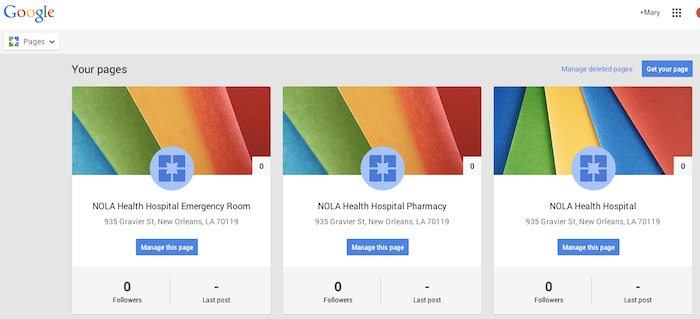
    Let’s say the aforementioned example is called NOLA Health Hospital. NOLA Health Hospital, in this instance, should have three Local (Storefront) Google Plus Pages. Note that these pages, while most likely using the same address, should have unique phone numbers. They should also have unique names; for example, “NOLA Health Hospital,” “NOLA Health Hospital Emergency Room,” and “NOLA Health Hospital Pharmacy” would be the proper names. These pages should also list their hours of operation according to their department-specific hours. If these pages were properly set up in the Google My Business dashboard, they would look like the following screenshot.

    Google My Business Dashboard - Search Influence

    Setting Categories:

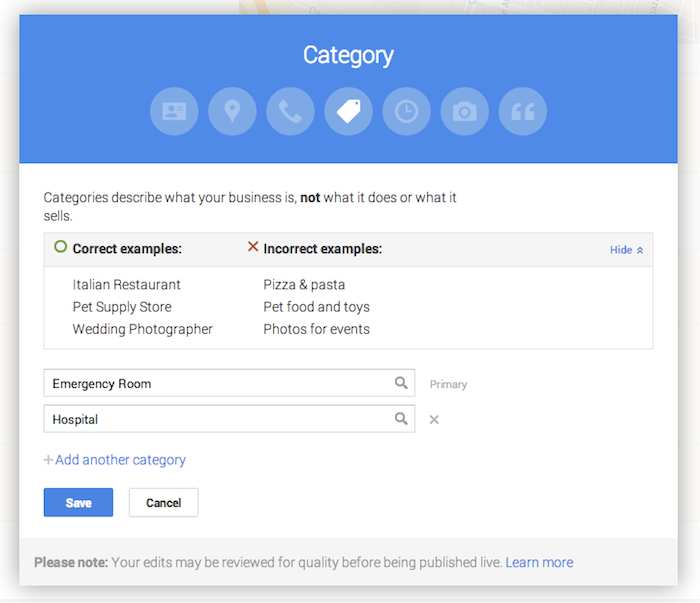
    Now that you have created the pages, it is important to use the categories to distinguish the differences between them. Google’s guidelines for businesses explicitly state that “For each department, the category that is the most representative of that department must be different from that of the main business and that of other departments.” This means that the primary category for each page should be different. In this example, NOLA Health Hospital Emergency Room will have the primary category “Emergency Room,” NOLA Health Hospital Pharmacy will have the primary category “Pharmacy,” and the general hospital of NOLA Health Hospital will have the primary category “Hospital.”

    Google Plus Page Editing - Search Influence

    While these settings are typically arranged during the page creation process, they can also be edited after the page is created. Click on “Manage this page” from the Pages dashboard, then click “Edit” in the top right-hand corner, and finally click into the “Category” section of the editing page to adjust the category. This is also where you can build out supplemental categories for the page. However, it may be wiser to use a few specific categories, as Google’s guidelines advise that it is best to “choose the fewest number of categories it takes to describe your overall core business.”

    As always, if you’re ever confused about how to proceed with your page, you can find the Google My Business “Guidelines for representing your business on Google” on the support site.