Blog

  • How Your Online Presence Wins and Loses Cosmetic Patients [Download Free Guide]

    Online Medical Presence Guide Image - Search Influence

    Download the Free Guide

    Want tips, stats, and strategies about how to take charge of your practice’s online presence? Fill out the form below to download the free guide, “Attracting Patients by Proactively Managing Your Online Reputation.”

    Consider this: one person wrote a negative online review for a plastic surgeon. In the next few months, the practice’s online leads and Internet referrals mysteriously plummeted by 28 percent. Coincidence? Don’t bet on it. Even if that single negative online review only contributed to the decrease, that drop in leads translated to the loss of literally hundreds of potential customers.

    If you think your practice’s online presence doesn’t have the power to attract—or repel—patients, think again. For physicians in the cosmetic medicine industry—whether plastic surgery, dermatology, or even cosmetic dentistry—a practice’s online presence is a powerful tool. And if it is left uncultivated, it can be dangerous.

    Search Influence details this pressing issue and its real-world implications for your cosmetic medical practice in a new guide, “Attracting Patients by Proactively Managing Your Online Reputation,” available to download for free by filling out the form below. The guide was produced with input from Richard M. Escoffery, an attorney with the law firm Elarbee, Thompson, Sapp & Wilson, LLP.

    Patient Reviews … Haunting or Rewarding?

    In the digital era of online marketing, even when a cosmetic surgeon is heavily recommended by a friend, coworker, or family member, 94 percent of people still take to the Internet to perform secondary online research before making a commitment, according to our free online guide. What’s even more astounding is that 72 percent of all consumers give an online review the same weight and credibility as a personal recommendation, the guide reports.

    For example, here’s a general view of how customers typically find many plastic surgery practices online by using organic (or free) search methods:

    1. Potential patients research the procedure they want.
    2. They research the cosmetic and plastic surgeons in their area, usually looking through numerous review sites.
    3. They start searching for their surgeon of interest by name, which is often termed a “branded organic search” in the online world.

    Paging Dr. Google

    Yes, this means patients are “googling” the cosmetic procedures you offer and your practice. How high a practice’s site ranks on search engines has a lot to do with the amount of website traffic the practice receives. And the very first search result in a Google search typically receives a third of the traffic share. Having your practice show up as a top search result for targeted keywords ranging from “breast augmentation” to “tummy tuck” takes not only cultivation, but also online marketing expertise.

    In the free “Attracting Patients by Proactively Managing Your Online Reputation” guide, you’ll find more important takeaways. For example, Google and other search engines give higher ranking to such sites as Angie’s List, Yelp, RateMDs, and the like. These sites not only perch atop search engine rankings due to Google’s algorithm updates, but they also often feature regularly updated content, which, in search engine terms, is an important indication of reliability.

    In other words, patient or customer review sites have all the makings of a search-engine friendly site. So, negative online comments and an uncultivated online presence can literally tank a practice’s website traffic.

    Get a FREE guide & take charge of your online presence
  • Googleplasty: How to Reshape Your Search Results (Part 1)

    As businesses grow more in touch with their online presence, it becomes more and more challenging to stand out in the search results of highly competitive markets and areas—and nowhere is this perhaps more true than in the cosmetic medicine industry.

    Search Influence - Plastic Surgeon Local Google Search Results

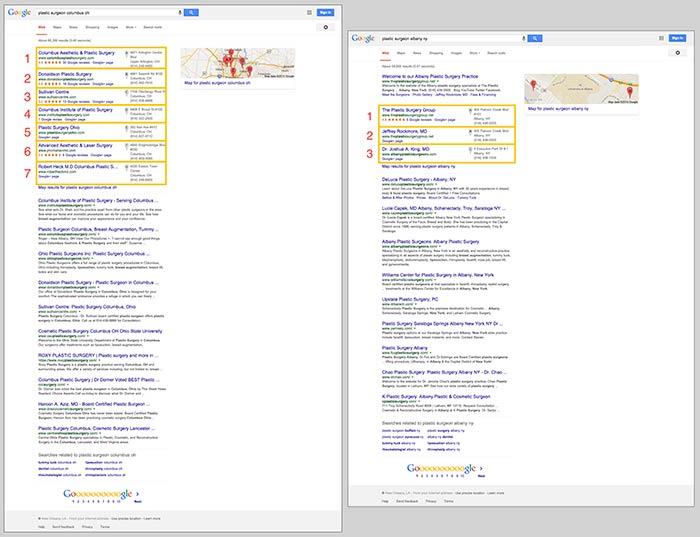
    First things first, let’s make sure we’re on the same page about the two major kinds of results that we see in desktop results for plastic surgeons. “Localized organic” search results and “maps pack” results typically appear together in what is referred to as “combined” search results. The factors that determine what appears in these two areas are not the same, as you can tell by the the difference in results and by the appearance of a site more than once between the two. Maps packs can come in a variety of forms and don’t show up for all search queries, which is also important to note.

    In the screenshot below on the left for the search “plastic surgeon columbus oh,” you’ll see 10 localized organic results below a 7-count maps pack. In the screenshot on the right for “plastic surgeon albany ny,” you’ll see 10 localized organic results, but the 3-count maps pack appears below the first organic result.

    Search Influence - Google Maps Pack Plastic Surgeon

    Stand Out in the Maps Pack

    In the maps pack itself, the most striking features are the review stars and rating display. The data in the maps pack area is pulled directly from Google Plus local listings in Google Maps. So, to make your practice stand out in the maps pack, you should claim and verify your Google Plus listing via Google My Business.

    Once you’ve claimed and verified your listing, you’ll want to get reviews from your patients. It’s important to understand that one or two reviews a month over a few months is better than 15 reviews in one week. As with most online marketing strategies, natural behavior is the best behavior.

    Stand Out in Localized Organic

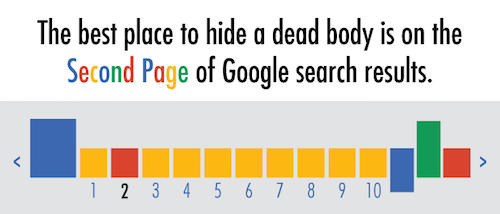
    The most obvious way to stand out in the localized organic results is to be ranking as high as possible and to AT LEAST be in the top 10 so that you’re on the first page. As the age-old SEO joke goes, “The best place to hide a dead body is on the second page of Google search results.” Hardly anyone looks past the first page, and—according to eye-tracking data—not many look past the top half of the search results page.

    Search Influence - dead body Google Search Results meme

    The Google PageRank algorithm that determines these rankings takes into account somewhere around 200 factors, so it’s not as simple as pinpointing one or two efforts to be made.

    Now that we’ve got a better understanding of what we’re looking at in search results, we can start to understand the major factors that affect ranking in each of these sections. Stay tuned for my next blog, where we’ll talk about the top five ranking factors in the maps pack, in the localized organic results, and in competitive markets!

  • Five for Friday: Go Natural, Rock Your SEO, Navigate Apple Maps, and More

    1. How Your Band Can Rock SEO – Moz

    Most people don’t discover new music by Googling “indie rock bands.” Folks are more likely to discover a band through other means and then turn to the Internet to search for tour dates, song lyrics, etc. If you’re a musician, this presents a unique opportunity for optimizing your band for search engines. Learn how to reach a wider online audience with these tips for improving your band’s search engine optimization.

    2. Want to Transfer Your YouTube Account to the Proper Google+ Page? – Search Engine Roundtable

    Does this YouTube predicament ring a bell? Say you’ve been uploading industry-related videos to your YouTube account, which is connected to your personal Google+ page. You’ve finally gotten around to creating a Google My Business account for your company, and you want to transfer your industry-focused YouTube account over to your business page. Now you can! The only catch is that this move can’t be undone, so make sure it’s really what you want to do.

    3. Apple’s Maps App Gets Reviewed – Blumenthals

    Apple’s Maps app, which has heretofore only partnered with Yelp for integrated customer reviews of businesses, has now expanded to incorporate reviews from TripAdvisor and Booking.com. It’s still pending an announcement from Apple, and it’s unknown whether this change is still in its testing stage, but you will likely begin seeing reviews from a wider audience across multiple platforms.

    4. Beat the Competition with Natural Content – Marketing Land

    Google’s algorithm updates are all focused on one thing: improving online content. Search engines have gotten smarter, and so have people. If your business is just providing “common sense” information with keywords stuffed in, you are not likely to convert a lot of searchers to customers or clients. Optimize your content for intent by providing natural, factual, quality information that tells your company’s unique story!

    Act Natural Search Influence Image

    5. Facebook Dominates Ad Spending – Marketing Land

    Where have businesses been focusing their advertising efforts? The numbers are in! In 2014, social media advertising grew 41 percent, and perhaps unsurprisingly, Facebook pulled in 75 percent of total advertising spending on social networks globally, accounting for $11.4 billion of the total $15.3 billion spent.

    Image sources:

    Act natural

  • Google & Twitter Rekindle Old Flame with New Deal

    Today, I’m going to tell you a love story between two Internet powerhouses. There’s drama, there’s intrigue, and there’s a rekindling of romances. Is it for the money? Is it for the power? That’s for you to decide.

    You may have heard that in February, Twitter CEO Dick Costolo announced that Twitter and Google have rekindled a former partnership. Apparently, the two companies have agreed to a deal that would put a real-time feed of tweets from Twitter back into Google’s search result pages at some point in the first half of this year.

    In this post, I’ll lay out what we do know about these star-crossed lovers: a little bit of background on the duo’s previous tryst, how this new partnership benefits Google and Twitter individually, and what this means for you (especially if you’re a business owner).

    The Skeletons in the Closet

    Back in 2009 (or centuries ago in Internet time), when Twitter was a mere three years old, the two companies formed a similar agreement. As that young relationship took off, Google unleashed something it called Real-Time Search, which featured current tweets and other instant information appearing right alongside your searches. Real-Time Search was well on its way to becoming pretty awesome when, suddenly, in 2011, that feature and the relationship met a tumultuous end. Twitter decided not to renew partially due to growing pains and partially because the COO at the time, Ali Rowghani, was into keeping Twitter’s content proprietary to its users. As a result, Google was left to crawl Twitter’s site in order to index tweets, which is clearly a recipe for failure, and thus, the two were left to go their separate ways. Until now.

    What’s in it for Google?

    When Google was a young, nascent startup, the founders formed a list of the 10 things that comprise the company philosophy. Topping this (pretty tender) list is, “Focus on the user and all else will follow.” If you keep reading, you’ll find that numbers three and four respectively are, “Fast is better than slow,” and “Democracy on the Web works.” The list also includes several items oriented towards the power of and need for information.

    With Twitter, Google gets fast, user-focused information. And as that old adage goes, information is power. Or is it knowledge? Regardless, you get the idea. Twitter is powerful: it has facilitated uprisings, coordinated revolutions, encouraged dialogue on important issues, revolutionized protests, and most of all, it’s user-generated. That kind of authority and relevancy is pretty invaluable.

    Search Influence Twitter Firehose Image

    So, in this partnership, Google gains access to what’s known as the “fire hose” of tweets, which basically means it gets a stream of 9,000 tweets per second, giving it immediate access to whatever is going on in the Twitter-sphere at the time. This kind of power allows Google to provide even more relevant, reliable information to its users.

    At this time, it is unclear whether or not Google will be paying for these tweets, though it did last time. If it does pay this time, however, there’s a good chance it won’t be very much, given that Twitter came to Google asking to rekindle this flame. So, who can really blame Google for wanting to try this whole partnership thing again?

    What’s in it for Twitter?

    In case this wasn’t already clear, I’ll give you a short answer: GLOBAL EXPOSURE. Google is a socialite with connections to everyone, everywhere, and Twitter is just trying to get in on a piece of that sweet pie. If you’re anything like me, you may be thinking, “Well, isn’t Twitter doing just fine on its own? Can’t it be successful without returning to its almighty ex?”

    The answer to that, apparently, is…not so much. In 2013, 46 percent of Twitter users visited the site daily. In 2014, that stat dropped down to 36 percent. On top of losing grip on what was once seen as a stalwart user base, Twitter has the smallest market share out of the top five social media sites. Finally, only 19 percent of the U.S. adult population uses Twitter, which seems fine, but that is the lowest amount of all the top five social media platforms. Who knew Twitter was the runt of the social media litter?!

    They did. And this is their effort to remedy that. By partnering up with Google again, Twitter gets a marketing cachet like never before. They’ll likely see more signups, more engagement, and higher ad revenue. As Costolo so eloquently put it in a recent earnings call, it’s all about the eyeballs:

    “We’ve got the opportunity now to drive a lot of attention to and aggregate eyeballs, if you will, to these logged-out experiences, topics, and events that we plan on delivering on the front page of Twitter. And that’s one of the reasons this makes a lot more sense for us now.”

    Though this almost certainly does not mean tweets will magically get favor from the Google gods and outrank other types of content, it does promise lots of rewards for Twitter.

    What does this mean for YOU?

    Basically, it means you should use Twitter. If you’re a business that works online in any capacity, this will likely be a positive development. Through this agreement, you can expect better, localized SEO results and new advertising benefits every time Google picks up your tweet.

    However, it’s important to keep in mind that this also means tweets have a bit more longevity now. There’s a chance that Google will archive relevant tweets, which means they could show up on a search results page six months down the road.

    In the same vein, any negative tweets from disgruntled customers have the potential to leave a more enduring imprint on a related Google search. It could be best practice to invest in some kind of social media/Google monitoring service so you can stay up to date on what’s being said. If you opt to respond to a negative Tweet, make sure you remain professional and work to mitigate the issue.

    On the other hand, positive feedback from clients on Twitter will also show up on those results pages, meaning the invaluable customer testimonial is making a mean comeback.

    What happens now?

    Now, we wait. As tweets enter the public domain, it’s hard to say what will happen to the importance of Twitter followers and Google+. If you’re wondering where exactly the tweets will appear, Bloomberg theorizes that they “will start to be visible in Google’s search results as soon as they’re posted.” This leads us to believe they’ll probably show up in a section like the existing Knowledge Graph; however, it’s also possible that they’ll position the feed to the right of the current search results.

    Who’s to say where this Internet powerhouse duo will take us next? Share your thoughts, predictions, and questions in the comments section below. We’d love to hear from you!

    Image source:

    Hashtag Burn

  • Five for Friday: Social Media Ad Wars, De-Spam Yourself, Text for Food, & More!

    1. Google Fiber Launches New Product! – Google Fiber

    This week, Google Fiber introduced its newest Web connectivity feature, Fiber Dial-Up, to help us all get back some of the time that’s constantly being consumed by ever-present technology. The folks at Google were able to recognize that many of us can’t seem to find enough time during our busy days to get back to the little things, like “texting your mom, hugging your child, running to the restroom …” This is where the dial-up mode idea started, and now Google has found a way to give us our time back so we can go back to enjoying the little things in life. Check it out here and get ready to meditate to the relaxing and nostalgic sounds of dial-up. What will you do with your time?

    Thanks, Google! (April Fools!)

    2. E-Commerce and Text: Two Sides of the Same Coin – Tech Crunch

    Two important messaging announcements hit the tech world recently:

    1. 600 million users of Facebook Messenger will soon be able to order food, buy products, and text directly with businesses.
    2. Magic messaging company is raising an astonishing $12 million from Sequoia to allow you to order any on-demand service simply by sending a text message.

    In short, this means that mobile messaging is now a commerce platform in which the user can seamlessly go from text messaging to ordering food, products, and direct business communication. This is the beginning of the “conversational commerce” revolution—a term coined by Chris Messina—that will open up much more opportunity for companies to join the texting revolution and ditch their countless applications. This will absolutely simplify companies’ paths to their consumers by eliminating the need for apps and non-compatible services and allowing marketing messages to reach users directly through their texting service. Put more simply: we all text more than ever, so why not expand texting’s potential to sending payments, buying products, ordering on-demand services, paying bills, and more? What do you think about this development—will the ability to text a business or make online purchases via text increase your participation in e-commerce?

    3. Twitter and Facebook vs. Google and Yahoo – Marketing Land

    Last week, online research firm eMarketer released data predicting that Twitter and Facebook are poised to surpass both Yahoo and Google in terms of display advertising revenue in the United States. Additionally, Yahoo and Google are both predicted to see a share decrease in online display ad revenue in 2015.

    The financial success in ad space for both Facebook and Twitter is attributed in large part to marketers allocating more of their budgets to mobile display advertising. This goes to show that advertising on social media outlets is paying off for both marketers and social advertising platforms. How do you think these trends will play out over the course of the year? Will Google and Yahoo hold their own against these competitors, or is social media the wave of the future for online advertising?

    4. Moz Releases New Spam Score Feature – Moz

    Over the past year or so, Moz has been developing a metric that can determine whether or not a site may trigger a negative reaction from Google. Utilizing 17 different factors, the folks at Moz have compiled an algorithm that calculates the “spamminess” of a given website in order to predict any penalties or bans that Google might graciously bestow upon that site. This calculation will assign a site with a “Spam Score” of either “Looks Good,” “On The Borderline,” or “Trouble’s Lurking.” For now, this tool only operates on the subdomain level, but it will soon launch on a larger scale to be able to grade full pages or root domains. Subscribe to Moz.com or start a free trial to learn more about this feature and access your Spam Score now!

    5. Dive Into Your Content With Analytics – Moz

    When such a large part of our business has to do with content marketing, it’s important to stay up to date on the latest creative trends and most successful channels. However, sometimes the best information is in your Google Analytics data. Last week, Jeff Sauer from Moz published a thorough analysis showing how reviewing performance metrics in Google Analytics can inform your content strategy, thereby validating your content marketing efforts and producing greater traffic and revenue results.

    Sauer dives into Google Analytics and provides examples of how we can explore content groupings, specific dimensions, and even coding features to highlight common content topics, adjust our definitions, and monitor the effectiveness of our content. These practices can be extremely helpful for advertisers who are looking to get the most out of their marketing and really optimize their content to its fullest potential. Check out Sauer’s article here for his full analysis, along with some helpful tips!

    Image Sources:

    Gotcha!

    This Means War

    I Don’t Like Spam

  • Avoid Customers Crying In Your Parking Lot: A Cautionary Tale

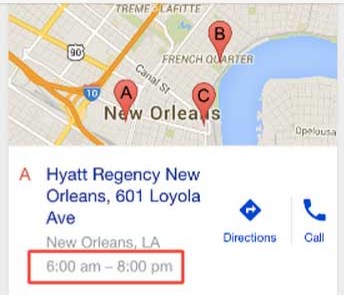
    If you’ve ever done a Google search for a business, you’ve likely seen this kind of result.

    MapsTimeViewImage

    And I’m sure at least once, you’ve seen this result, driven to the location, and found it to be closed.

    CatDrivingImage

    In that crushing moment, did you hear your heart beating in your ears? Did you see black spots? Did you curl up into a fetal position?

    Google lied to you. It clearly said the business was “open.” You had a full 8 hours before they closed! Rapidly stalking the business’ multiple social media platforms, you finally find one tiny post that says “Closed for the holidays.”

    If this has happened to you, you definitely are not alone. Rest assured that I have cried in a coffee shop parking lot due to this very scenario.

    QuoteImage

    With Great Power Comes Great Responsibility

    Know this, my comrades: it is not the fault of Google—nay! This falls on the responsibility of business owners as part of properly managing and maintaining a Google My Business profile.

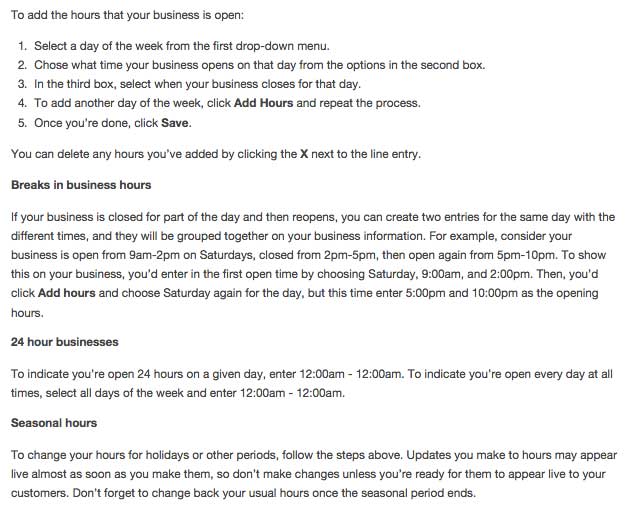
    Currently, Google has not built out the functionality for saving holiday-specific hours ahead of time. As the profile setup currently stands, you’ll need to manually edit the hours of operation on a given day when your business is open (or closed) outside your standard hours of operation.

    See Google’s steps on how to update your business’ hours.

    InstructionsOnAddingHoursImage

    After scouring Google’s forum for topics related to holiday-specific hours, it doesn’t seem like they’ll be adding the ability to set such hours ahead of time. Many of you may grumble and say that this is the last thing you’d think about during the holidays and, man, I get it, but know this:

    If customers have just one instance where they very much look forward to coming to your establishment and are discouraged by misleading information, they have less of a chance of coming back. How can they know if you’ll be open?

    This issue, however, is not specific to the holidays. It’s also applicable to businesses that have season-specific hours, and … really, all businesses! Companies with out-of-date or incorrect hours will quickly lose favor with customers. Really, take this as a larger lesson for why displaying accurate information across the World Wide Web is essential to a business’ success.

    As Google’s search engine becomes increasingly more sophisticated, results will become increasingly more accurate. Online users already rely on the Internet to supply the most up-to-date information on any given topic, so why should your business be immune to this demand? The point is, it isn’t.

    Google Time Stops For No Man

    Set a calendar reminder the day before to update your hours. Set an alarm on your phone! Put post-it notes all over the place. Tie a ribbon to your finger. Pay your tech-savvy kid to do it. Or hire an Internet marketing company to manage your profile for you. Whatever method you choose, just know that you are doing a great service to your customers—and to the world!

    In addition to managing an accurate and up-to-date Google My Business profile, it’s a good idea to update your social profiles as well. Facebook has easy-to-manage settings on your business’ page. Additionally, if your website has a built-out blog, it might be a good idea to have a holiday-specific post. In addition to alerting your customers about abnormal hours, a holiday-specific blog post opens the door to great time-sensitive content marketing opportunities.

    Opportunistic Marketing

    For instance, let everyone know your restaurant is open on St. Patrick’s Day and post your holiday-specific menu for the day, highlighting any specials you may have on account of the holidays.

    Contracting company closed for Christmas? Make a blog post about being unavailable on certain days, but highlight necessary winter-related structural checks or services that you will be offering when you return to normal business hours. Share the blog post across your social media platforms.

    Medical practice open for limited hours over Easter? Post a piece highlighting choking hazards for Easter-related paraphernalia, common food dye allergy reactions, or the importance of a dental check-up after candy-centric holidays.

    CatBunnyHatImage

    Clothing boutique open on the Fourth of July? Embellish a blog post with photos of your cutest red, white, and blue outfits. Have a friendly contest amongst shoppers and get them to post the Fourth of July outfits they purchased at your store. Who wore it best?

    Sno-ball stand closed for the winter? Write up a cute post about how you’ve gone north to collect more “snow” for the next coming season and when your customers can expect you to return! Also, post new flavors that they can anticipate for next season (or new combinations of old flavors). Or have a contest over the winter to see who can come up with the best flavor!

    CatAbeLincolnImage

    Go Forth And Update

    So, let this be a warning to you. Every time a search result for your business shows inaccurate information, you may just be losing a customer. Don’t think of maintaining accurate information as a chore but as an opportunity to engage and educate your customers.

    Have questions about maintaining other aspects of your Google My Business profile or opportunistic content marketing? Have an incorrect-business-info experience you’d like to share? Let us know in the comments below!

    Image Sources:

    Grumpy cat

    Easter cat

    Bearded cat

  • Search Influence launches Mobile SEO truck helping businesses with mobile-friendly websites

    Internet marketing company launches Web truck, not food truck, in time for ‘Mobile Apocalypse’

    SEARCH INFLUENCE PRESS RELEASE – APRIL 1, 2015

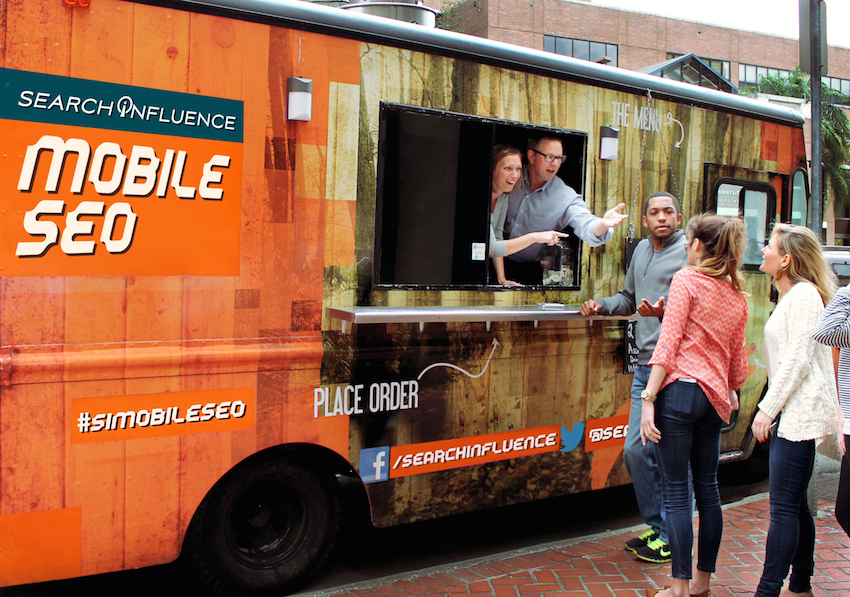
    Search Influence Mobile SEO Truck Image April Fools

    New Orleans-based online marketing company Search Influence launched a new twist on the food truck—the Mobile SEO truck to help businesses become more mobile friendly in advance of Google’s “Mobile Apocalypse” or “Mobilegeddon” deadline Tuesday, April 21. Google’s new focus means businesses with websites that are not mobile friendly may suffer in mobile search results. The Search Influence Mobile SEO truck offers targeted, hands-on services convenient for America’s small- and medium-sized businesses.

    The Mobile SEO truck functions similar to a food truck, but instead of the latest in trendy food, it offers affordable search engine optimization services designed to kick-start a heightened mobile online presence for businesses. The Mobile SEO truck will begin its tour in New Orleans, La., April 1–4. Other cities in the tour include Birmingham, Ala., April 5–8; Atlanta, Ga., April 9–12; Nashville, Tenn., April 1–16; and Washington, D.C., April 17–20.
    The Mobile SEO truck is staffed with Search Influence SEO experts and website designers, and is also equipped with several hands-on stations, including an interactive Responsive Website Booth, an Automatic Click-to-Call Website Button Generator and Driving Directions Optimizer Portal to help companies attract new business from the near majority of customers who search for products and services via smartphones.

    “A mobile-friendly online presence is no longer optional—no matter the size of your business. Our Mobile SEO truck is the perfect solution for any business struggling with Google’s new mobile-friendly algorithm,” said Search Influence CEO Will Scott. “To reach business owners in their own backyard, we’ve given new life to a defunct New Orleans food truck, so we can take these priority services on the road.”
    Early this year, Search Influence purchased an out-of-commission food truck in New Orleans and retrofitted it with the latest hands-on website technology. What was originally a $6,000 fixer-upper was morphed into a $750,000 state-of-the-art online marketing machine.

    “As a business owner, I appreciate the kind of hands-on online marketing help that literally drives to my office. For the best website strategies, you can’t beat the Mobile SEO truck,” said David Scheuermann of PayrollRx. “If they only served food along with the technology, it would be perfect!”

    Search Influence Spacer

    For media interviews or high-resolution photos, please contact Mikel Pak, PR/marketing manager at Search Influence. Please note, this is an April Fools’ Day joke. We hope you enjoyed the humor. Remember, mobile-friendly websites are key to a successful local business.

  • Champions in the Field: SI Finishes Strong at its Spring Team-Building Event

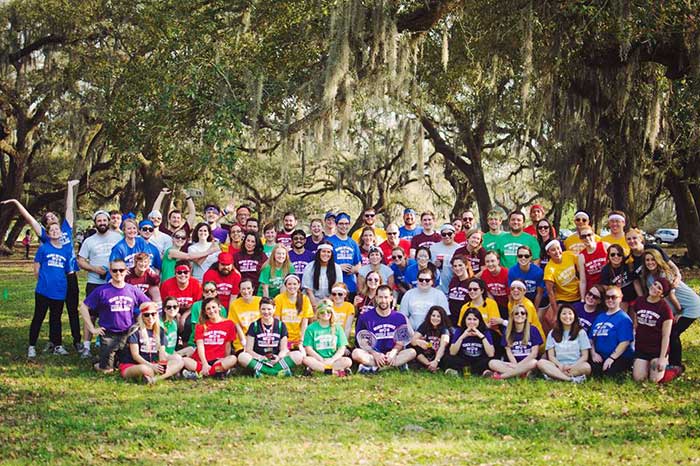
    Three-legged race. Water balloon toss. Potato sack race. Search Influence. What do all of these have in common? The first ever Search Influence Field Day!

    This quarter’s team-building event was planned by the Partner Accounts Department, and they did not disappoint. Taking it back to our school days, Influencers were divided into teams and competed against each other in various events. Field Day was held at the beautiful City Park on Friday, March 20.

    SI Field Day Group Image - Search Influence

    The Events

    There were a total of seven events that the teams had to participate in.

    To start off the relay, the first event was the shoe switch race. People participating in this event had to take their shoes off and put them in a pile with the other teams’ shoes. At the start of the race, participants had to run to the pile, put on and tie their shoes, and then run back to the start to tag the next person.

    The next event was the three-legged race. Influencers partnered up, were tied together at the knee, and raced to the finish line to then tag the next person to move on to the next event.

    Three Legged Race Image - Search Influence

    The third, and “coolest” (pun intended) event was the water balloon toss. No one could move on from this event before completing five tosses of water balloons with their partner, getting farther and farther away from each other.

    Afterward, the teams could move on to the spoon balance. Eggs were put on a spoon, placed in the team member’s mouth, and balanced as they walked to the finish line of this event. If your egg fell, you had to start over!

    Egg On Spoon Race Image - Search Influence

    Next was trivia. Team captains asked their team members questions about the company, SEO, and even Will Scott himself! Once the team answered 15 questions correctly, they could move on to the final event!

    This event was for every member of the team. After lining up, they had to pass a beach ball over and under each person. The team that finished first won the Search Influence Field Day!

    Over And Under Image - Search Influence

    The Aftermath

    After a long and hard fight, the gold team took the win. Search Influence Field Day, of course, ended with great food, drinks, and team-building fun.

    All That Glitters Gold Team Image - Search Influence

    Photo credit:
    Mary Silva Photography

  • Sweep Away The Competition By Spring Cleaning Your Backlinks

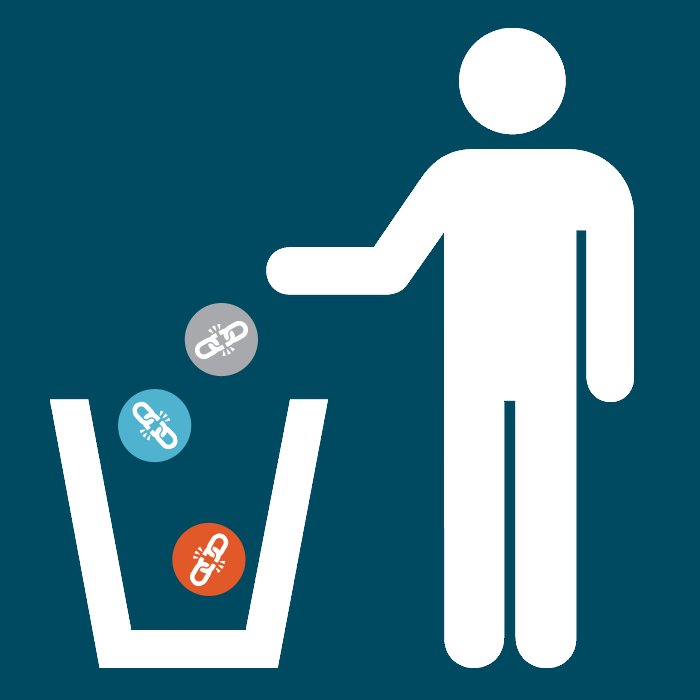
    So you want to do link building the white-hat way, but it seems these days most link building practices are pretty sketchy. One Google-friendly way to do link building is through identifying and fixing broken backlinks to redirect to pages on your site. Spring backlink cleaning, here we come!

    While there are many ways to approach broken link building, the method I find most doable is scanning relevant, authoritative sites for broken backlinks to pages for more info. Once you find a broken link and determine that a page on your site will adequately replace it, you’ll want to reach out to the owner of the site with the broken link to help them recognize the issue and take your opportunity.

    This practice is best for businesses with sites that already serve as a resource and that have many informational pages regarding various aspects of their industry. It is, however, totally doable for businesses that don’t meet these ideals, but said businesses will have to build out resource pages on the identified subject areas as they identify broken link opportunities.

    Throwing Away Broken Links

    Finding Sites

    So first, you’re going to have to find the best and most authoritative sites in your industry. Moz’s MozBar extension allows you to easily see Domain Authority and Page Authority of sites you’re on and sites in search results, which can be helpful in the hunt for good sites. Think of products and services that complement what your business offers to find more opportunities. For example, if I were trying to find a complementary business or service to Search Influence, the first type of business that comes to mind is a social reputation management service.

    Once you find one or more authoritative reputation management sites, you could use them to find MORE opportunities! To do this, you could use Moz’s Open Site Explorer and find backlinks to the sites you’ve already found that are also authoritative and relevant to your industry. You can use any backlink-finding tools you prefer, though. Other tools that can do this include LinkResearchTools’ Quick Backlink Tool and Majestic’s Site Explorer.

    liam neeson seo meme backlink

    Finding Broken Links

    Once you’ve got the list of sites you’d like to scan for broken links (I’d suggest at least 20 to 30, but it’s up to you), you’ll need to find said broken links. Internally, we use a tool (Screaming Frog’s SEO Spider) to find broken links for all of your sites, but any tool you find will probably do the job just fine.

    If you’re using Screaming Frog, you’d go to “Configuration,” then “Spider” to make sure your settings are set for an internal crawl. Enter the domain you want to crawl, and then click start. Once the crawl is complete, go to “Bulk Export,” then “All In Links.” Open the file, and we’re ready to get organized!

    Since we only want links, the first header you’ll want to filter is “Type” to only show HREF. Then filter “Status Code” to show everything but 200s, since 200 links are O.K. Finally, sort the “Destination” column alphabetically so that you can easily see and prioritize rows with off-site destinations. The site owners are most likely to be willing to replace broken off-site links. They might prefer to fix rather than replace broken internally directing links.

    Once you’ve followed the above steps for finding broken links on your chosen sites, we’re ready to take action.

    Finding Opportunities

    Here’s the tedious (but worth it) part of the whole process. Now that you’ve got lists of broken links, you’ll have to look through them and see if you can find the new page on that site that it should link to. If you can’t find the page and your site has links that will fulfill the objective of the original links, note that replacement link as one of yours instead of one on the original site. Sometimes this means looking at the “Source” column and checking out the context of the broken link. It also might mean creating content on your site, if it’s relevant to your business, to fulfill the needs of the broken link objective before moving forward.

    The last thing you’ll need is a list for each site you’ve investigated that includes the page that has the broken link (“Source”), the broken external link (“Destination”), the fixed URL, and the corresponding page on your site that could replace the broken link or be added to that page.

    Reaching Out

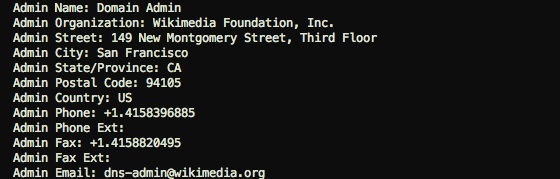
    Once you’ve got your lists of opportunities organized, you can reach out to the site administrator to have the broken link(s) replaced with your good one(s). You can find contacts to sites in multiple ways. The obvious way would be by finding a contact email or form in their “About” or “Contact” pages. I like this option because most times, if a site has created a way for users to contact them on-site, they’re responding to outreach through these mediums. If you’re unable to find any obvious way to contact a site, you can also use a whois lookup. I use the terminal emulator iTerm2 to do whois lookups, but you can also just use a web hosted whois lookup like whois.domaintools.com to find an email for the site Admin or Registrar.

    Here’s an example of a whois lookup for Wikipedia (You probably don’t even want to try to communicate with them, by the way. Possibly too big of a fish to fry.):

    WhoIS Lookup WIkipedia

    For time-saving purposes, I’d suggest creating a template you can use to email all of these prospects. In doing manual link removal requests in the past, I found some bits of information to be more fruitful to provide than others. You want to seem natural and authoritative (not spammy) while providing clear information, but you also want to be as concise as possible to avoid losing the attention of the receiver.

    You’ll want to include a short intro to introduce your authority and what you do, say that your message is intended for the site’s webmaster (as they would be the one implementing your suggested fixes), and note the Source page, the broken Destination URL, and the recommended replacement URL. If the replacement URL is just one you found originally linked to the site, now is your opportunity to share that you might have some additional information on your site that their readers might benefit from. Send all your messages, and then wait!

    While I’d say to make your own templates to sound more natural and fit your needs, here are two of mine for both use cases.

    Replacing URL With Same-Site URL

    Hi,

    My name’s (insert name here), and I am an industry specialist and was doing some research when I landed on your site…

    I was hoping to pass on some information to your webmaster or web developer, as I found a broken link on your site that your readers might need.

    While looking at this page on your site (source URL), I clicked on the link to this site (broken destination URL) and found that it didn’t work.

    Once on the site, I found that they must have moved that information here (replacement URL).

    While you’re working on updating this page, I was wondering if you’d be interested in including my page about (insert summary of page here) as a resource that might also be beneficial to your readers: (insert link to your site’s relevant URL here).

    Replacing URL With Your-Site URL

    Hi,

    My name’s (insert name here), and I am an industry specialist and was doing some research when I landed on your site…

    I was hoping to pass on some information to your webmaster or web developer, as I found a broken link on your site that your readers might need.

    While looking at this page on your site (source URL), I clicked on the link to this site (broken destination URL) and found that it didn’t work.

    I tried finding the correct page on their site for this info, but it seems that it might be gone altogether.

    My site happens to have some similar information, so I was wondering if you’d be interested in including my page about (insert summary of page here) as a resource that might also be beneficial to your readers: (insert link to your site’s relevant URL here).

    Hopefully, this helpful, good link building practice will aid in your efforts. Let us know your favorite, white-hat link building practice in the comments!

  • Five for Friday: Facebook P2P Payments, Social Media Madness, SXSW recap, & more!

    1. Are P2P Payments on Facebook Messenger Just the Beginning? – Marketing Land

    It seems that every other week, Facebook rolls out a new feature to keep the social media mammoth at the forefront of its industry. Now, Facebook is looking to become a leader in peer-to-peer payment. Recently, Facebook added the option to send and receive money via its messenger app, immediately positioning itself as a direct competitor to successful companies like PayPal and Venmo. Marketing Land discussed how the new process works and the possible next innovations for Mark Zuckerberg and the team.

    UK Basketball Chet White UK Athletics

    2. Social Media Lessons from NCAA Top 10 Men’s Basketball – Rival IQ

    March is clearly the month for madness. These teams have excelled on the basketball court this season, but how have they performed on social media? Rival IQ takes a look at six social media lessons we can learn from 10 of the top men’s college basketball programs.

    3. The Ultimate Roundup of 2014’s Biggest April Fools’ Day Pranks – Mashable

    April Fools’ Day is almost here. In previous years, this holiday has become a successful way for companies to spread their brand across the Web. Mashable provides a nice recap of the greatest corporate April Fools’ Day pranks from 2014. Do you think this year’s pranks can live up to them?

    4. SXSW Interactive Wrapping Up: 5 Things to Remember – Inc.com

    South by Southwest—a set of film, interactive, and music festivals—recently wrapped up in Austin, Texas. Among the topics discussed, one highlight was a panel discussion on gender bias in tech. WWL-TV and WDSU-TV recently featured Search Influence in stories about New Orleans leading the way for women in tech. Inc.com put together a great list of five things to remember from SXSW 2015.

    5. 7th Annual Shorty Award Winners for Best Use of Social Media, Apps and Video – Adweek

    Each year, the Shorty Awards attempts to recognize the top brands and organizations producing real-time short form content across various social media outlets. The seventh annual Shorty Award winners were recently announced, and Adweek featured a recap of all the winners and honorable mentions. Check out the full list of winners, and who knows, maybe you’ll make the list next year!

    Image Sources:

    April Fools’ Dog Image

    Awards Reaction Image