Blog

  • 5 for Friday – Links, Stories & Posts for Your Weekend

    Google Introduces ‘Hot Searches’ in Google Trends — SEOptimize
    Google recently announced an update to their Google Trends product offering: Hot Searches, which will allow you to see the most searched for keywords across the nation in real time. The results show the most searched words, as well as a short description and a few links about the subject.

    ICANN Reveals New Top-Level Internet Domain Applications — MarketingLand
    The Internet Corporation for Assigned Names and Numbers (ICANN) is now recieving applications for new generic top level domains. While most of us are familiar with .com, .org, .edu, and .gov, soon there will be many, many more options. Google placed bids on over 100 gTLDs including: .and, .google, .how, .meme, music, .lol, .love, and .wow. 1930 applications were placed from over 60 countries all over the globe. Some of the new gTLDs may even be in non-Latin alphabets, such as Arabic, Chinese, or Cyrillic.

    A Tech Buildup on the Bayou — Wall Street Journal
    We love hearing good news about New Orleans, and here’s a doozy as the Wall Street Journal discusses the recent tech boom in our beloved hometown. With tax benefits that cover 25% of a company’s production costs and 35% of payroll expenses, Louisiana and especially New Orleans have been getting a lot of business from tech companies. Tech jobs in New Orleans grew by 19% from October 2005 to April 2012, compared to the national growth of 3%. Per capita personal income is also up: we ranked at 28th in 2010-2011, versus 44th in 2004.

    Bing Does Local Content Deal With Yelp — Search Engine Land
    After the recent news of Google’s assault against other local search engines with the new Google+ Local, it should not come as a surprise that Bing is taking an opportunity to strike back. As you may recall, Google has teamed up with Zagat in an attempt to bring a more social aspect to what formerly was Google Places. Bing has now teamed up with Yelp, in an attempt to personalize their local listings system. It’s been a good week for Yelp, who also confirmed a deal with Apple for a new map app on Monday.

    Facebook Exchange: Real-Time Ad Bidding & Retargeting Set to Launch Soon — Search Engine Watch
    Finally, Facebook will soon launch a service which will allow advertisers to bid on ads in real time and retarget users. The prices will be based per thousand impressions, and will allow advertisers to specifically target those users who have shown interest in a product by their browsing history. The retargeting and real-time bidding will begin within just a few weeks: do you have any big plans to get your business out there?
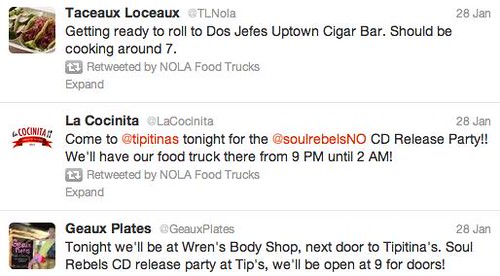
  • Driven to Feed: Why Food Trucks Learned to Use Social Media

    NOLA Food Trucks' twitter feed


    You may have been told at one point or another that it’s a bad idea to go to the grocery store hungry. There’s another hunger hazard to watch out for that’s sprung up more recently: the Internet. More specifically, the major offenders are Twitter, Facebook, tumblr, Pintrest, and a variety of other social networking sites that constitute the delightful temptations of food truck social media. You won’t be in any danger of impulse-buying that Jimmy Fallon flavor of Ben & Jerry’s (which is quite good, in my ice cream connoisseur’s opinion), but a very real enemy of your hunger lurks in various social networking feeds.


    Imagine this scenario: you were going about your afternoon not thinking about BBQ beef sliders at all until, out of nowhere, there’s a picture of one right before your very eyes. And wait, the exact geographic point where you could acquire this small sandwich at this very moment in time is there, too. You can have a slider just like the one on the screen in a matter of minutes! The secret is out that street food vendors and pop-up restaurants thrive on this strategy to interact with, and subsequently make friends, fans, and (most importantly) patrons out of their followers.

    #foodtruckAccording to these Portland food truck proprietors, Twitter drives a remarkable 80% of their business. This is significantly higher than the amount of growth many other types of businesses can attribute to a social media outlet alone. For food trucks especially, social media outlets like Twitter and Facebook are uniquely suited to the sort of outreach that drives customers their way. Tweeting locations, posting pictures of daily specials, and receiving feedback are invaluable methods of getting and keeping customers coming to you day after day. Even stationary restaurants have caught up to the marketing strategy employed by food trucks and mobile eateries, tweeting specials and forming customer relationships before people even walk through their doors.


    Unfortunately it’s not all low-overhead and roses for trucks using social media to attract attention. The Sun Times reports that law enforcement in the city of Chicago — a city where food trucks have recently proliferated and gained popularity — has used social media against food truck owners by monitoring their Tweets and Facebook posts in order to intercept the roving food sellers and issue citations for violating strict laws dictating how close to an existing restaurant a mobile food establishment can set up shop. Vendors must tweet and post with caution, or face being charged with heinous crimes such as “premeditated selling of a cupcake…”


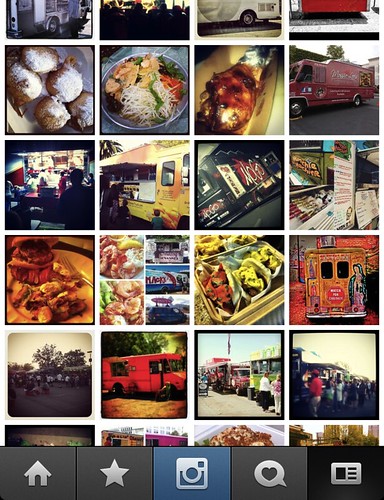
    As in many arenas in life, with risk often comes a satisfying reward. You’ve been warned: risk checking your sites hungry and you may end up sitting on a street corner with a mouthful of Brazilian BBQ, not even knowing how you got there. All it often takes is one Instagram of a skewer and the food truck has got you in its crosshairs. Enjoy it, target market. Enjoy your dinner.

  • Apple Maps + Local Search Kicks Google Maps to the Curb in iOS 6

    Along with 200+ other new features on the new iOS6, the long awaited improvement to driving directions on your iPhone and iPad is here. No, it’s not a new and improved Google Maps app, but a homebrewed maps solution by Apple, including a local search database. As if I didn’t love Apple enough already, they’ve come up with something that can trump even Google Maps.

    Apple Local Search through Siri on iOS 6 Apple Local Search in iOS 6

    Apple’s press release today states “Local search includes information for over 100 million businesses with info cards that offer Yelp ratings, reviews, available deals and photos.”

    Thanks to Greg Sterling’s Search Engine Land post, we know that Localeze is powering the local search listings database. You may recall that Localeze also the sole provider of Facebook Places data when it was first released.

    How does this affect you as a business owner?

    Well, if Google Maps have given you trouble in the past, you’re in luck. If you are one of the many businesses whose customers relied on GMaps to get them to you, you may have less customers driving to the wrong location now, provided your Localeze information is up-to-date and correct.

    To ensure your business information is correct through Localeze, you can always submit to Localeze.com. There is a premium fee in order to get listed directly with their team; you should be sure to ask them about what’s already listed in their database that may already have your name, address, or phone number on it. Updating of your Localeze information comes with any organic or local SEO service with Search Influence, so if you’re working with us or plan to, you can rest easy that this is covered. (Of course, there are always some issues that might be stickier to solve, so just let us know if you think Localeze has got you wrong!)

    We feel a bit better about directions being powered by this database, as we’ve found it much easier to “clean up” your presence if there are issues. The Google Maps system pulls from many different data sources, but since Localeze is just one, clean-up will be much easier to take on. It doesn’t hurt that this update brings a fresh face lift to the app, as well as turn-by-turn directions.

    In addition to checking up on Localeze, you’ll also want to check up on your Yelp listing(s), including the sentiment of your ratings and reviews. These will also be integrated, just as they already are with Siri.

    There will definitely still be lots to learn once we get our hands on iOS 6 and get to test out our customers’ listings in the new database, so until then, stay tuned!

  • Will Scott discusses Google+ Local on Thunder SEO

    Our CEO Will Scott is among a bevy of local SEO luminaries called in by Thunder SEO to discuss the recent launch of Google+ Local.

  • 5 for Friday — Links, Stories, & Posts for Your Weekend

    1.  The Never-Ending Quest For The Perfect Map – Google Official Blog

    Wednesday afternoon, Google unveiled an assortment of new plans for their Maps features. For starters, they’re now extending their ambitious and mildly creepy quest to photograph every last inch of the planet to the level of an Olympic event, sending photographers out into the road-less netherworld with skis, galoshes and hiking boots to ensure the absolute accuracy of their maps. While this development is great for EXTREME map-users, it’s distinctly bad news for an entire sub-genre of B horror movies that hinges on teenagers’ proclivity to getting lost on foggy, foreboding camping trips. The bigger takeaway from this set of updates is the revelation that Maps will soon be available offline for Android, enabling navigation in the absence of an internet service signal. The particulars of the nature and timing of the update process are sure to be fodder for many future SEO meetings.

    2. 6.46 Million LinkedIn Passwords Leaked Online – ZDNet

    Wednesday brought frightening news for social networkers, as many LinkedIn users learned that their password information was compromised. LinkedIn has been a bit vague about the breadth and details of the hack publicly, but it offered some general information and instructions to its users on the LinkedIn Blog. Essentially, affected users have been notified and directed to change their passwords. Meanwhile, ZDNet has some intriguing coverage of the security breach culled from a Finnish security team that is handling the matter, including speculation that the encrypted passwords were stolen and, at least to some extent, decoded by a Russian hacker who bragged about the attack and welcomed decryption assistance on an internet forum. While everyone would certainly hope that no harm has come of these attacks, it is not wrong to also hope that the head Russian hacker has a quirky, nefarious henchmen — and that the leader of the referenced Finnish security team managing the attack’s aftermath takes his martinis shaken, not stirred.

    3. Taking Flight: #twitterbird – Twitter Blog

    In significantly less dramatic social networking news, Twitter’s rebranding efforts have led the site to change its ubiquitous blue “Larry” bird logo into… a new blue bird logo. Millions of outraged Twitter users promptly took to the streets in major cities across the globe, engaging in impassioned riots and protests upon learning of the change. Also, nothing in the previous sentence actually happened. According to absolutely legitimate sources, however, one guy in Cambridge, MA looked at Twitter on his phone on Thursday and audibly muttered, “hunh.” In any case, the exhilarating details of the new Twitter bird’s construction are helpfully diagrammed in the video on Twitter’s official blog post about the matter. While I hesitate to even attempt to summarize an event of this magnitude on my own, I will give it a shot: the bird is looking up a little bit now, and it’s made of circles. I’m sure we will all remember exactly where we were when he heard this bit of news.

    4. Google Planning New Small Business Service As Part Of Local Revenue Push? – Search Engine Watch

    Getting back to Google, the recent absorption of Google Places pages into Google+ Local pages is beginning to look like a small step in a much bigger process of small business promotion on Google’s part. While Google has yet to acknowledge these rumors, the word on the street is that many additional changes are on the way to better serve the interests of smaller, locally based businesses in all regions. The suggested nature of this new plan would include an emphasis on communication between consumers and local businesses, as well as a possible incentive plan rewarding customer loyalty. Given the potential impact of such a new focus for internet marketers, this is one bit of water cooler talk to follow closely in the coming weeks.

    5. What’s Apple Going To Announce Next Week? – Gizmodo

    Finally, the folks at Gizmodo offer some educated guesses as to the most likely major announcements we can look forward to at Apple’s World Wide Developers Conference, which begins Monday. While the possibility of new hardware models and Apple TV advancements is intriguing, the item to watch closely from an SEO perspective is the likely unveiling of iOS 6. Of particular significance are any details as to Apple’s much ballyhooed new map plans of their own, which have appeared poised for a direct attack on one of Google’s staples. If all of that gets tabled for the conference, however, I think we can all make do with a new MacBook, which is evidently a highly probable presentation point.

  • What Are You Talking About? Semantic Keyword Search & SEO

    What Are You Talking About? Semantic Keyword Search & SEO

    Have you ever noticed two people to be arguing over the semantics of something? If so, they might make good SEOs! When it comes to search engine optimization, the meaning of the keywords being used in a search are as important as the well-optimized content you spend hours perfecting before rolling live.

    Semantic Keyword Search & SEO Blog Post Header Image

    A keyword is the word or group of words that a person types in to a search engine in hopes of finding a particular result. Someone searching “apple” may want to find a piece of fruit, but there may be different information that someone else hopes to find in their search results. This is where semantics comes into play.

    Semantics is the study of words’ meaning or how we comprehend something. Until recently, this concept was irrelevant to search engine marketers. However, with the many changes we have been seeing from Google — Panda, Venice and Search Plus Your World, among others — it is not very surprising that our keywords are changing now, too.

    Google has recently relayed the message that, while people worldwide search Google for answers to their every question, the search engine monster does not always understand what we are talking about. For years now, search engine users have thought that the better their keyword or keyword phrase, the better results they would receive.  Unfortunately, that is not the case. Amit Singhal, a Senior VP of Engineering and Fellow of Google, explains that “We cross our fingers and hope someone on the web has written about these things or topics.” Google will provide you with search results, but they may not be exactly what you were hoping for. So what does this mean?

    The Future of Search and Semantics

    With time, searching online will not be what we know it as. It will be focused on semantic keywords, which will be processed via artificial intelligence to understand the meaning of the search query. This is called semantic search, and is currently one of Google’s focuses. It will become necessary to understand the relationship between the keywords typed into a search rather than just searching for those specific words.

    For instance, what could someone mean when they search “apple?”

    • Apple nutrition information
    • Apple recipes
    • Apple computers and products
    • Different kinds of apples and their growing traits
    • The “Big Apple,” as in New York City

    As you can see, there is a limitless list of meanings to the search of just one word.

    What Does This Mean For SEO?

    It will be critical to detect accurate keywords based on the searchers intent for a real world application and then to create content around those words. The content must be created for the keywords that are answering particular questions that people are asking about that topic. Consider our “apple” example. If you chose to focus on the Apple Company, you would want to create content focused on Apple computers and products, and answering any specific questions searchers may have about those products. If you’re a food writer, you’ll want to create recipes and creative essays that are easily readable. If you’re a horticultural specialist, it’ll be necessary to make sure you have clean, precise information and are backed up by appropriate scientific sources, and so on.

    With time, we will be able to thank Google for allowing us to search online and find exactly what it is we are looking for. In the mean time, start researching and preparing your keywords and content for the future!

  • Search Influence named in Five Elms Capital’s Flyover 50 Fastest-Growing Companies

    Search Influence was named in the first Flyover 50, a list compiled by Five Elms Capital to highlight the 50 fastest-growing companies in the central U.S. Search Influence named in Flyover 50 Fastest Growing Companies

    Topping the list is Appcore, a company based in Des Moines, which provides cloud computing infrastructure. To be considered for the inaugural Flyover 50, companies applied or were nominated, and the top companies were determined by a percentage of growth in revenue.

    In order to qualify, a company’s revenue must have exceeded $1 million in 2011 and be based within a 20-state area in the central United States.

    The 50 honorees are invited to attend an awards ceremony at the Mid America Corporate Growth Conference in Kansas City, Mo. on Thursday.

    View the complete list of Mid-America’s fastest growing companies here.

    Search Influence is a national, full-service online marketing company based in New Orleans. The largest online marketing company on the gulf coast, Search Influence employs 35 full-time employees and 40 contract writers to support hundreds of direct and white label customers. Search Influence was co-founded by Will Scott and Angie Scott in 2006.

  • Read This! – June 2012

    Every month, our Read This! series brings you the best in practical web marketing and online presence-building pieces from across the net. Read on for this month’s selection:

    The Direct Path to Finding Prospects and Customers Online

    Direct marketing is focused on the customer, speaking directly to them in order to grow the brand. Find out why this discipline accounts for over half of all ad spend and how to communicate with your prospects to turn them into loyal fans.

    5 Tips For More Impact From Social Media Participation

    Of course, getting likes and followers is just half the battle: for maximum exposure and customer interaction, you have to encourage audience participation whenever possible. Check out these handy tips to get tongues wagging and topics trending for your business.

    9 Hot Skills That Are Trending on LinkedIn

    Social media and the analytics thereof are a booming topic right now, and everyone’s on the lookout for qualified folks. Check out these phrases that are attracting interest among LinkedIn users in 2012.

    Study Shows Return Policy Can Make or Break the Sale

    If you’re in the business of distributing inventory online, give this one a look. Small factors such as the structure of your return policy or need to log in before making a transaction can have huge impacts on your bottom line.

    How Many Fans Do Your Facebook Posts Reach?

    With the advent of promoted posts, many Facebook users are becoming aware that their posts aren’t reaching the maximum amount of fans possible. Use this simple formula to figure out how many of your fans are actually seeing your content and how effective your pages are.

  • 5 for Friday — Links, Stories, & Posts for Your Weekend

    5 For FridayWe’re back with another 5 for Friday, a collection of the freshest and tastiest SEO news stories, blogs and recommendations from across the web!

    Most importantly, this happened. Now for the rest:

    Beluga Analytics Offers Demographics & Stats Behind Your Guiltiest Pleasures — AimClearBlog.com

    We’ll start today with something really fun: Grooveshark released Beluga Analytics today, which is a wealth of demographic data using music as a touchstone for marketing data. Did you want to know what game systems Faith No More fans likely have? Maybe not, but beyond simple interest, this data gives a really interesting and sneaky way to target people for advertising. If you see that a certain band’s fans are disproportionally predisposed to own a certain product, targeting them with your Facebook ads might give you business you never thought existed.

    Google+, Calendar to get events feature — ITProPortal.com

    Amidst the hubbub of the Google+ Local Release, events were announced for Google+. Integrated with your Google Calendar, the new events will integrate Hangouts and other Google+ features, allowing you even more personalization and real-life interaction. This expands the social layer to yet another Google property, giving users more reason to join Google+ and differentiating the network further from the social media giants it competes with.

    Helping to Create Better Websites: Introducing Content Experiments — Google Analytics Blog

    Many marketers use A/B testing to make sure they’re giving their users the best possible experience. For years, Google’s Website Optimizer tool has been a standalone product, separate from analytics tracking. But now, Google Analytics, which has undergone a swath of changes lately on other fronts, is taking over for the Optimizer. With Content Experiments, Google has streamlined the process of conversion optimization and added in the power of their analytics platform to make it even easier to test. If you’re interested in A/B testing, you can always check your gut with Which Test Won, which puts out a new A/B test every week to test yourself against the users.

    Why You Should Care That .Com Can Be .Anything — LawLawLandBlog.com

    Top-level domains, like .com or .org, are now open to almost anything. For $185,000, you too can have a personal TLD! Google recently bought a bunch with $9,000,000 of pocket change. LawLaw Land talks about the ramifications for business, though most businesses just aren’t big enough to handle such a problem, much less even worry about the proposition. Still, it’s worth checking this list of new TLDs to make sure that you don’t want to get in touch with the owner of the generic TLD for your industry to strengthen your brand.

    Facebook Allows Varying Levels of Admin Access — MarketingPilgrim.com

    In the light of Google+’s recent expansions, Facebook gave itself new tools to help make it stand out too. Facebook expanded its options for page administration this week, allowing you to set up different kinds of managers to monitor and interact with your fans on the site. Combined with scheduled posts, Facebook is clearly seeking to edge out 3rd-party management software, which has been shown to have a lower CTR anyway. Keeping it all on the platform gives small businesses on Facebook an easy way to meet best practices.

    There’s a little lagniappe this week for our readers, too: I got to write a guest post for Practical SEO, which focuses solely on stuff you can do today to help your internet marketing efforts.

    3 Steps to Protect Consumer Privacy and Be FTC Compliant — PracticalSEO.org

    Recently, The FTC and White House have been clamoring for more protections for consumers on the Internet. A 75-page report yields three actions to take to make sure you’re doing the most to ensure your online customers are aware of their ability to control how their data is used on the web. Revising your privacy policy, setting up a Do Not Track cookie on your site, and avoiding “gated communities” focused on privacy-eroding sign-ups gives a marketer or business owner a set of tools to both follow the FTC framework and increase the trust of your visitors.

  • Google+ Local Business Pages: The Future of Local Search

    If you’ve been perusing the Search Marketing blogosphere, you no doubt heard the big news from Google today. If not, we’re here to give you the skinny on Google+ Local. What it means for you, how to prepare, and how this will change the local scene forever.

    Long story short: Say goodbye to Google Places, and say hello to Google+ Local. It’s long been rumoured that Google would soon integrate the two, creating a more social experience for local search. So, what’s included in the update?

    First, you can still access and manage your business in the Google Places LBC, and all of the user-generated content that exists there currently will be pulled over, e.g. reviews and photos. The content will display as coming from “A Google User” until you migrate them from your old Places page to Google+ Local.

    You’ll also have the ability to decide which user content displays publicly and what remains privately attributed to “A Google User.”

    Next, you may have read way back in September 2011 that Google acquired Zagat, the local reviews juggernaut. Now we all know why. Not only will Zagat’s reviews be brought over to Google+ Local, but their trusted 30-point rating system will now replace the measly 5 star system used in Places. This will enable users to provide a more personal experience than the previous system, with the ability to rate specific aspects such as food, atmosphere, and service.

    OpenTable has also been integrated into the listing, where users can reserve a table directly from applicable Google+ Local business pages.

    Another big change is that Google+ Local Pages will be indexed, according to Search Engine Land.

    From a user standpoint, the new pages provide a much more social experience. They’ll be able to search for business reviews made by those within their circles, which adds much more trust than those from faceless strangers.

    What does all this mean for the small business owner? It will place even more importance on having a clean Google+ page that is consistent across the board, and well-integrated with your site using authorship markup. Google+ Local makes reviews and photos more integral than ever before.

    All these changes are allowing Google to get a much needed leg up over Facebook, Twitter, and Yelp. The “Local” tab will appear in your Google+ business page, and all of the listings will be available across Google organic search, maps, mobile, and Google+. For now the mobile look has already come to the Android phones but iPhone users will be able to start seeing these changes as soon as it’s approved by Apple.

    If there’s one thing you should take out of this post it’s this: If you don’t have a Google+ page for your business yet, you better get to work ASAP. For a quick and easy guide on how to best create one, download our ebook.

    This blog was written in collaboration with Tina Hua.