Blog

  • Making a Hobby into a Business

    A hobby game store, or as many call it the Friendly Local Gaming Store (FLGS) represents a kind of niche business that by its nature needs to be brick and mortar. Part retail hodgepodge, part gathering space, the FLGS must live up to all parts of its name. This applies to both business practices as well as marketing.

    by Jorge Leal

    Being friendly seems like a simple concept, but ensuring that each customer or potential customer feels comfortable in your store is essential to any FLGS. Many visitors often feel intimidated by more dedicated or experienced hobby gamers, and often miss out on amazing board game experiences. Proper social media targeting of these casual players can inject necessary growth and revenue into an FLGS. Plus, casual explanation of modern games can generate real interest in a new customer.

    Make sure that your community knows where you are and what you do. Direct mail flyers may seem old-school but they can be a great way to inform the kind of repeat and local customers you need.

    Remember that you are selling games, as well as the gaming experience. Having a place for customers to play different games allows for exposure to new audiences. I started playing Magic the Gathering because of seeing it at a local comic/slash game store.

    by Sara Reid

    Finally, remember you are a store. Find a way to capitalize on each type of customer in a way that makes them feel welcome and satisfied. Be both a friendly and open face for new players and a knowledgeable guide for veterans. Plus, try hosting pay to play leagues and tournaments in shop to monetize that display area on nights and weekends. And, as any repeat customer of a FLGS knows, snacks and drinks are a must for long gaming sessions and can help pad thin sales margins.

  • The Search Influence Education

    Affecting a smooth transition into any company requires an emphasis on education at the outset. From best practices and company traditions to memorizing industry protocols and even coworkers’ names, there’s definitely a lot to learn. For the first few weeks, even the first few months, your new job may feel like a trip back to grade school. Eventually you graduate, but hopefully the learning never stops.

    for dummies

    This is especially so at Search Influence, where our clients come from a variety of industries, are located across the country and have a wide range of goals. Through these clients, Search Influencers are continuously granted unique insight into expertise other than our own. A week’s work may require us to brush up on the qualities of stainless steel, the psychology of a floor plan or the history of beer. As to what Search Influence itself offers, we know the qualities of a good website, we embrace teamwork no matter our floor plan, and coffee is our beverage of choice.

    Some fields interest different people while others don’t, but familiarizing ourselves with clients’ industries is a vital part of our work. We make efforts every day to pick up more and more knowledge from each client so to properly represent them and act in their best interest. That’s one of the main things I’ve learned here at Search Influence–knowing the basics of a wide variety of subjects can help in ways that more specialized knowledge cannot. Each day, I strive to learn more about our clients, and I always learn something new. Hopefully this makes me more able to understand clients’ motivation and give them exactly what they need to succeed.

  • 4 Things I Have Learned So Far from Google Manual Actions

    Like most  in the SEO industry, I see the addition of Manual Actions in Webmaster Tools as a move by Google toward more transparency.  Of course, it is in Google’s interest to report Manual Actions.  According to Matt Cutts in this video, Google receives 5,000 reconsideration requests a week.  I imagine any company would want to put into place some funnels to whittle those numbers down a little.

    Like most SEO agencies, we have seen a few websites penalized, but up until August 8th when the Manual Actions made their debut, we debated if the penalties these sites experienced were manual penaltiesalgorithm hits, or devalued backlinks effects.  Really, a Penguin algo hit and a devalued links hit is basically the same result, so that’s just a name game when you are trying to fix the problem.  But there is a real difference between the clean-up effort for a Manual Action and an Algorithm smack down.

    Manual Actions are a big red flag

    The most obvious result of the Manual Actions showing up in WMT is that we–the Search Influence team–have learned which penalized sites were the results of Manual Actions.  If there is a Manual Action in WMT, we have a definitive course to follow.  Yes, a single site could have multiple penalties, but if we have a big red flag Manual Action, we have a solid place to start.  This removes some of the educated guesses — it removes a LOT of the educated guesses. I am always a fan of having more information.
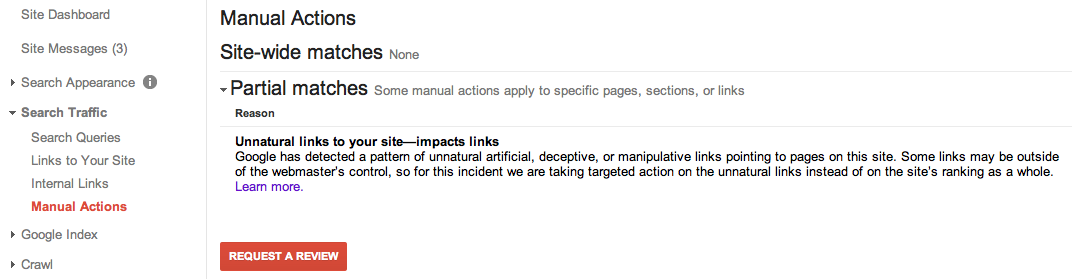
    Manual Actions in WMT are a big red flag

    Surprise!

    In some instances, the affecting backlink example given in the Manual Action tab was a surprise. The clear majority of the examples given were not surprises, but a small few raised some eyebrows, followed by, “Oh, damn.”  In these few cases, the examples were quite enlightening, and I sure would like for each Manual Action to give me just a few more examples!  I’m being a little greedy, I suppose, wanting everything handed to me on a platter.

    Limits are good

    Up until August 8th, no one in this industry could definitively say a client’s site was hit with this penalty or that penalty.  The general discussions were do a Disavow and a reconsideration request just to cover all of your bases.  I have not been a proponent of doing a reconsideration request just because your site lost rankings, even dramatic losses.  I don’t have to defend my opinion anymore, because now a reconsideration request is simply not allowed for an algorithm penalty.  I’m pretty excited about this.  We can only do an RR in the Manual Actions tab in WMT if a Manual Action was taken.  The RR form is gone: “Google only allows you to submit a reconsideration request, which they are now calling ‘request review,’ under the manual actions.”   I have to say I really like this.

    We have had a some percentage of clients come to Search Influence because they have had penalties and need us to help them clean up after their previous SEO company who used questionable tactics.  (Yes, we do penalty audit and clean-up services.)  When we felt like the penalty was an algo hit, we found ourselves fruitlessly defending our decision to submit a Disavow but not an RR.  There are a lot of scared businesses out there wanting to throw everything at it, hoping something will fix the problem.  I understand that, but now we truly can say we simply cannot submit an RR.  It’s just not an option.  Limits are good in this scenario–they help us stay focused and give us more to reassure the nervous clients.

    Reconsideration Requests don’t disappear into a black hole

    So the Manual Action is a step toward more transparency.  Although, I think providing it is ultimately self-serving for Google, I still appreciate that it’s there and that we seem to be getting some quick responses. We submitted a reconsideration request, and within 24 hours we had a message in WMT saying that the request was received.  Woo hoo!  This is unlike a Disavow file where it feels a little like throwing your text file into a black hole and hoping and hoping ….

    Also, we received notice at day 7 that they processed the RR, and we had some feedback.  We didn’t pass with an A+, but we had some success and just have to go a little further on that one. There are a lot of businesses out there who have gotten a lot of really ugly backlinks built over years and years.  It took years to put on that link weight, and it will take some time to get shed the excess.  Clean up is not overnight, y’all!



  • Pizza Party USA: Finding a Way to Survive While Working an Unpaid Internship.

    One of the most important bits of advice I was given while finishing my undergrad in Graphic Design and Communication Studies was to get an internship. So while I was in my senior year, I did just that. However there was one small problem, it was an unpaid internship. Although the fairness of unpaid internships is a hotly debated topic in the media right now, it’s pretty common practice. What you need to remember is that it’s not impossible to live while doing so.

    pizza

    So as I did my 6-month internship gaining valuable experience that I rely on today, I was faced with a dilemma: I needed to make money somehow to pay my rent and buy my ramen food supplements. With school and work during the day, I was at a lost of how I could work at night without lessening the already dwindling hours I slept each night. It was a friend that came up with the solution: pizza delivery.

    The most taken-for-granted job ever became my savior to my financial problems. I could work from 6 till 11 p.m., which was great compared to being a bartender and staying up till 3 a.m. I could listen to class notes or use the alone time to think of assignments or projects. I could use the opportunity to talk to the very people I was trying to design for in some of my projects.

    intern

    So my advice to students or recent grads, get an internship. Go out there and try to get a job at your dream company. The connection you make as an intern could lead to a full-time position once you graduate, and even if it doesn’t, you’ll gain invaluable experience. Don’t be afraid if it is unpaid either. While not ideal, you can survive. Just think creatively about part time work available to you–even if it means going on a Ramen diet, like I did.

  • Kick Butt with Keyword Research

    keywords

    Keyword research may seem like a rudimentary aspect of SEO, but this one component can really make or break search traffic to your website. It is of the utmost importance to get the right words and place them on the correct pages of your website. Think of these words as the golden ticket to bring traffic to your website. That’s why we call it research folks. Put some real effort and elbow grease when working on this project. When you break it down to its core, keyword research is essentially market research.

    Below are the best ways to get those solid gold keywords:

    •  Simply begin typing a phrase into the Google search box and see what appears in the suggested search terms below. You might find that your current words might not be so ideal after all.

    keywordresearch

    • Another resource that I enjoy using is the Google Keyword tool. This also provides other words related to the root term that is entered. Keep it relevant though!

    narwhalkeywordresearch

    • The final and most simple method is to become the ideal customer of the website. Clear your mind of all the SEO trappings and just search what you think the average Joe would type in his or her search engine of choice. It even helps to ask your peers for their opinion.

    While this may seem menial in the scheme of things, keywords are the chupacabra of online marketing. When you spot that great keyword phrase, it is like catching a glimpse of a narwhal (the unicorn of the sea) in real life. So go out there and find your unicorns!

  • Importance of Having User-Friendly Mobile Website

    Phone 1

    If you have a great web presence but haven’t made your site mobile friendly, chances are you are missing out on business. Recent research shows that more than 90% of people with a smartphone are using local searches while on their phone. Those using mobile searchers are typically looking for general information. From locations to services, they want to find what they need while they are on the go.

    By having a mobile-friendly website, you widen your presence and open yourself up to a larger customer-base. In fact, users are more likely to make purchases on their phone than they are sitting at home on their computer. Transitioning your current site to a mobile platform doesn’t have to be overly complicated either. Just follow some of the same rules when optimizing your site, such as targeting popular keywords. Also make sure the most important information like directions and contact information is easy to access.

    Phone 2

    When you are designing your mobile site, be sure to keep it user-friendly and compatible with all devices. Sites should have a responsive design element that adjusts the content to fit on the various screen sizes and be easily readable so that it translates properly to all phones and tablets. Having this element of design will also prevent you from needing two completely different sites, eliminating the risk for inconsistencies and making it easier for each user to find content.

  • OMG: No More PIN Verification Required to Change Address on Merged Google+ Local/Social

    Spoiler alert: Merged Google+ Local/Social pages are crazy easy to update. Read on for the details.

    Local SEO Despair Image - Search Influence
    How I normally feel every time I think about my client moving offices and the pain Google is surely to put me through. Maybe it’s time to reconsider? Image courtesy of diy.despair.com

    We’ve been talking and brainstorming on address change around here lately as we have two different local SEO clients who are moving their offices in September. Lucky for us, they are both keeping their phone numbers, which makes it a little easier. Both of these businesses have been clients of ours for several years, so you can imagine the local directory listings we’ve created and/or optimized for them over time.

    Where to begin? With a few key resources (like this), we set out to execute the ultimate plan for local directory cleanup when a business is moving locations. Of course we’re starting with the major datafeeds and the major search engines’ local/maps databases.

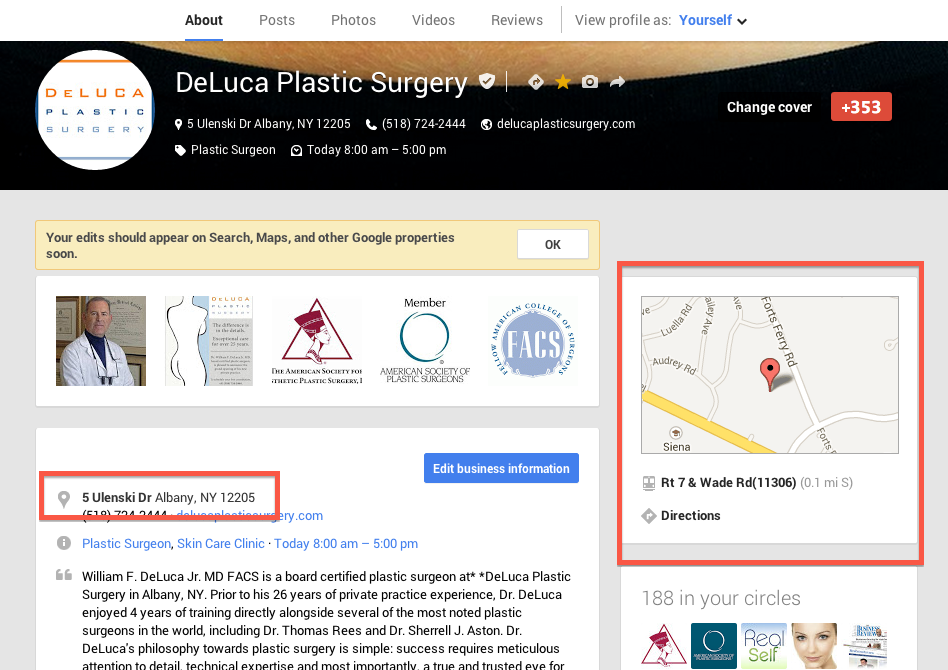
    One of my biggest concerns was the Google+ Local listing for my client DeLuca Plastic Surgery (forgive me for the blatant plug and branded link, this client is kind enough to let us use him as a testbed and also an example, so I think he deserves it!). A while back, when it first became a thing and before Google backpedaled on it, we successfully merged his Google+ Local and Social pages by way of the form request.

    This merge, combined with the fact that in 2012 Google (for the first time EVER) told us we couldn’t have a practice and practitioner listing since Dr. DeLuca is the sole practitioner, resulted in lackluster local maps rankings for the past year or so. (It’s OK, though, we make up for it by killing the organic rankings)

    Given the history plus the fact that re-verification was likely, and potentially troublesome since the client is still in the process of moving his practice, we were very apprehensive about changing the address on his Google+ Local/Social page. We’ve also never changed an address or phone number on a merged Local/Social page before, so we didn’t know what to expect. The unknown = scary.

    To our surprise, the address change went live in a matter of minutes with no new PIN! I say again: NO PIN! Thankfully we were swift enough to screenshot the process so I can share it with you here:

    1. In the “Edit Business Information” screen, Google warned us at the bottom that our edits “may be reviewed for quality before being pushed live.”

    1. As suspected, after saving our edits, we got the usual “Pending” and a warning that the edits may take time but, hmmm….. no PIN or verification was triggered!

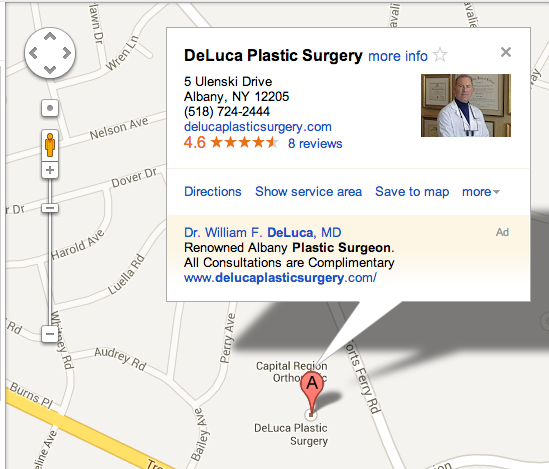
    1. Within minutes, the address change was updated and live on the page and in Maps Search. Although our pin marker had the proper placement within the Edit Business Information portal, the pin is still showing his former address, both on the listing and in Google Maps results.


    I’ve scoured the industry blogs and haven’t found anyone posting about this incredibly easy and pain-free process so far. If you ask me, I don’t think Google is intentionally allowing a change of address on Local/Social Pages without triggering verification. Google has a tendency to roll out half-baked products so I wouldn’t be surprised if verification becomes a requirement in the future.

    For now, at least, I’m rejoicing in the almost automatic update to my client’s NAP information on Google+ and Maps! If you want to freely update your business information on your Google+ listing, I suggest upgrading to a Local/Social page. The upgrade feature is currently in roll out, and will soon be available to automatically upgrade with the click of a button, IF your Local listing is in the new Places Dashboard vs. the old LBC.

    Have you ever changed an address or phone number in a Google+ Local/Social Page? If so, tell us whether you had to verify by PIN in the comments!

  • Stop Writing Press Releases For The Wrong Reasons

    As many in the SEO industry already know, Google is not impressed with link building strategies of old, especially when those links are coming from optimized anchor text in press releases. New guidelines are decreasing the SEO value of press releases and their use for link building at all is up in the air, so now seems to be the perfect time to refocus the purpose of your press releases.

    Gone are the days of pointless keyword-stuffed press releases being used to generate valuable backlinks–but that’s good news. Even with the new guideline regarding optimized anchor text, press releases can still be part of a comprehensive link building strategy. More importantly, they can be a great addition to your content marketing strategy, which you should never ignore. A good press release can still reach people and can still bring people to your site, and isn’t that the whole point after all?

    When it comes to quality, you’ve got to start at the beginning—your topic. The key word here is newsworthiness. Now, this doesn’t mean that you can’t publish a press release unless the media is hounding you for a comment, but something does need to have happened or be about to happen. Opening a new location? Launching a new website? Got a new certification? Great! You’ve got a press release. Unfortunately, it won’t look like this:

    New press release daily newspaper headline

    Alternatively, if you play it right, you can also offer some comment or insight into other news events that are related to your industry. This is a popular strategy when study findings or reports are released. This can sound misleadingly simple, but things can go laughably wrong when the connection between the event/report/etc., that you are piggybacking on is a stretch. Newsjacking can have negative consequences on your reputation when it’s done poorly, and you want to add something to the conversation, not just recount it. You should also make sure that you have fully investigated whatever it is that you are commenting on. You don’t want to end up coming off as uninformed.

    Though the topic is important, it’s not the only thing that you need to consider when preparing a press release. While you might have come to press release writing as part of an SEO campaign, don’t forget that this is an established form of communication with rules and standards. If you want to have your press release published on reputable sites, it’s going to need to pass review. These might not be stringent inspections, but you’ll still want your release to look professionally written by someone with journalism experience.

    Monkey
    This guy definitely knows what he’s doing.

    The most important thing to consider with the writing is probably whether the press release emphasizes the news you are writing to share. The best way to do this is by writing in the Inverted Pyramid style. This means that the vital facts are all included in the first paragraph, and everything else follows in order of importance. Though no writer wants to plan for people to stop reading what they have written, the point is that if the reader were to not finish your press release, they would already have read the most important bits. However, the goal is the same as all content — write for people, not machines. It probably won’t even do you much good to write a press release for machines at this point.

    In fact, it looks like it might hurt your campaign to write for the machine now. Though you can read a more in-depth guide to safely linking in press releases here, there are a few things to keep in mind:

    1. You need to be linking to content that is of high quality and is interesting. This content should also not be stuffed with keywords.

    2. The content should be relevant to the press release, meaning if a reader wanted to learn more about what you are writing about, the link would bring them to a page that gives them what they are looking for.

    3. The links should be inserted naturally. This means no more keyword-rich anchor text. Google has caught on to this and does not like it.

    Here’s the bottom line: even with the devalued links, you can and should still use press releases to your advantage, but they need to be done right.

  • Google Launches Manual Actions in Webmaster Tools

    On August 9th, Google rolled out the manual actions alert in Google Webmaster Tools. The full rollout wasn’t complete until August 12th.

    Back in the day, Google would only alert you via messages, but you would still not know whether or not you had a manual penalty. With the new feature, the notification is obvious under the Search Traffic section.  Even though Google does not send you an alert through messages, it should still notify the webmaster that you have an alert in your Manual Actions section. This is an important issue that needs immediate attention. Google should send a big alert if you had any manual actions since this is a huge penalty for your site.

    manual-actions-in-webmaster-tools

    If your rankings dramatically dropped, most people prior to the release of the manual actions alert would not be sure if they should submit a reconsideration request. The messages that Google previously sent would not indicate whether a manual penalty was taken against the site. The manual actions can be site wide or just a few links on your site. If you have received a message, you should consider the following actions.

    Steps to Take After a Manual Action Notification:

    1. Pull a list of “links to your site”

    In Google Webmaster Tools, you can find a list of links of sites that link to you. Go through the list and start with the domains that have the most links to you. Perform a link analysis and find sites that are not relevant and appear questionable. Take a screenshot of the current amount of links pointing to your site.

      Links-to-your-site

    2. Reach out to webmasters with unnatural linking

    Email the webmaster of the site politely requesting that they remove the link. If someone does not respond to your request, you will be compiling these links in your disavow request. Make sure you keep a record of your correspondence and who you have reached out to.


    3. Submit a Disavow Request

    You will need to compile a list of spammy domains that link to you. You can submit the file through Google Webmaster Tools. Just upload the file and wait. Google will not alert you and let you know whether or not they have made any actions. You can check your Links to Your Site section in a few days or weeks to see if any changes have been made.


    4. Submit a Reconsideration Request

    How long should you wait to submit a request? It depends on the severity of your situation. Repent for your sins when you are submitting a review. Explain in a nice way to Google what happened and what you have done to remedy the situation. This may include details about firing your previous SEO firm. You should also include screenshots of your correspondence with the webmasters you tried to reach out to and a list of your disavow file. Google says it can normally take days to process your request, but the process time can vary depending on the number of requests they receive.

    Good luck!


  • New Orleans Non-profit Spotlight: The NOLA Project

    Nola Project

    One of the many wonderful things about New Orleans is the appreciation of the arts. The NOLA Project is a non-profit theatre company whose goal is to “challenge, entertain, and engage diverse New Orleans audiences through high-quality and innovative performances of relevant great works.” They also work to develop and produce new plays and to provide “educational opportunities for aspiring theatre artists.”

    This season The NOLA Project line-up includes:

    September 4-21, 2013: A Truckload of Ink, an original play by Jim Fitzmorris

    November 14-25, 2013: Oregon Trail, an original play by A.J. Allegra

    December 6-22, 2013: A Very Merry Unauthorized Children’s Scientology Pageant, by Kyle Jarrow

    March 2014: Cat on a Hot Tin Roof, by Tennessee Williams

    May 2014: Alice in Wonderland, an original adaptation by company member Pete McElligott

    Lineup
    The NOLA Project’s 9th Season Line-up

    Do displays of urban corruption or comical, gruesome journeys across the country interest you? How about an interpretation of a controversial religion translated into children’s musical? A poetic presentation of greed and sin or a whimsical tale of a girl falling down a rabbit hole? If any of this seems like it’s up your alley, then you should check out The NOLA Project, and their website, for more information on this season’s upcoming shows. And of course, as it gets closer to each show’s opening, you can check out their Facebook page for a glimpse at their rehearsal and production photos.

    Performance
    The NOLA Project performing Shakespeare’s Much Ado About Nothing in the NOMA Sculpture Garden, May 2013

    The NOLA Project is one of the most active non-profits I have noticed on social media platforms. They use Facebook, Twitter, Instagram, YouTube, and Tumblr to reach out to their audience. I recently had the opportunity to discuss the company’s social media marketing strategy with their Marketing Manager, Richard Pomes. He said the main focus for their social media marketing is Facebook, where their audience is most active. The content that brings the most activity to their page are their rehearsal and production photos. Their fans enjoy seeing candid photos from the shows and rehearsals, and sometimes even share them with their friends using various social media platforms. Twitter is the main platform their fans use when sharing NOLA Project updates.

    While Facebook tends to be their main social media tool for marketing, Richard says that they have over 2,000 followers on Twitter and over 200 followers on Instagram. Their fans mention The NOLA Project frequently during events on Twitter, and use specific hash tags, which help to boost their attendance at future shows.  To find out more information on The NOLA Project, or to purchase tickets to their upcoming shows, visit www.nolaproject.com.

    Members
    The Company Members of The NOLA Project