Alternative credentials and other innovative program offerings are reshaping higher education. To successfully launch these programs, your institution needs a strategic approach tailored to its unique structure, appeal, and audience.
SEO ensures your program is visible to prospective students at the start of their search, putting your institution on their radar early and making it a critical component of your launch strategy.
A well-executed higher ed SEO strategy drives sustained traffic, boosts enrollment, and amplifies the impact of your other marketing efforts, all while saving time and resources down the road.
Our SEO Roadmap provides a step-by-step plan to help you market your new program effectively. It ensures maximum visibility through proper keyword research, content strategy, technical SEO, and link building.
Higher education institutions are adapting to meet workforce demands and shifting learner interests. This evolution introduces entirely new offerings, including microcredentials — short-term programs designed to provide flexibility, affordability, and career-aligned skills.
Despite their growing popularity, many universities lack a clear, institution-wide strategy for effectively marketing these programs. Unlike traditional degrees, marketing credentials require a different approach — one that reflects their shorter duration, lower cost, and the fact that they are often purchased directly rather than requiring an application.
To successfully promote any new academic offering, whether it’s a four-year degree or an alternative credential, search engine optimization (SEO) must be the foundation. This ensures the program gains visibility where today’s learners begin their search: online.
If you’re launching a new program, here’s how to market it using SEO as the framework.
Why Use SEO to Promote New Academic Programs
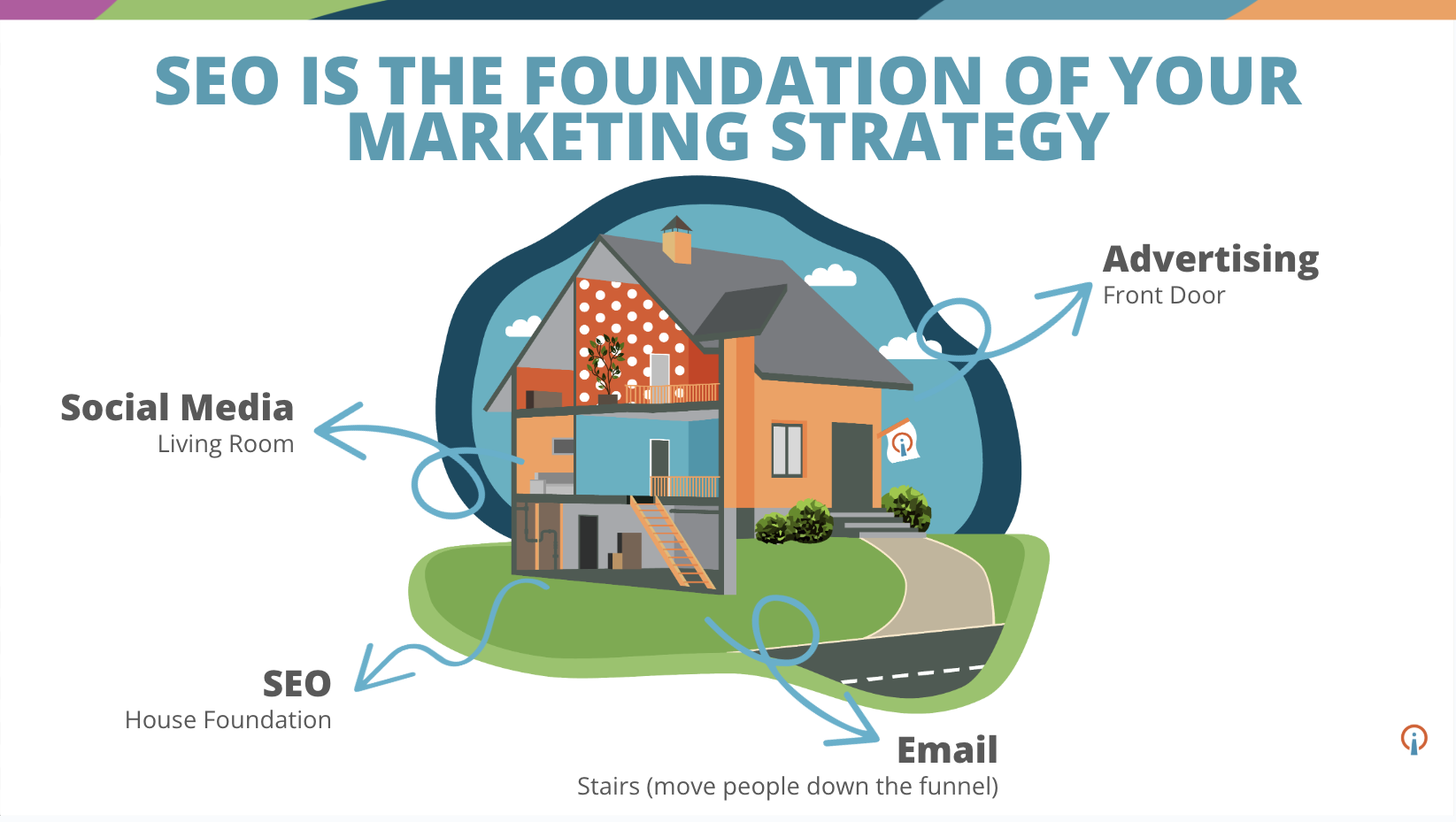
SEO is your marketing foundation
SEO isn’t an optional tactic; it’s the cornerstone of a successful higher education marketing strategy. As highlighted in our UPCEA webinar, “Top Trends for Your 2025 SEO Strategy to Attract the Modern Learner,” universities must change their view of SEO and integrate it from the start.
At its core, higher ed SEO focuses on improving your website, which is the central hub for all marketing activities. The student journey always leads back to your site, whether students arrive through paid search, social media, or email campaigns. A strong SEO foundation aligns your website with institutional goals, helps prospects find the information they’re looking for, and delivers measurable outcomes.
Adding SEO later or tackling it piecemeal limits your program’s reach and engagement potential.
When you prioritize SEO from the outset, you save time and resources, eliminating the need to retrofit a more expensive website later.
SEO reaches learners at the beginning of their search
Search engines are a prime starting point for most learners exploring education opportunities. For example, according to EducationDynamics research, 70% of online college students rely on search engines as their first source of information when researching higher education institutions.
Failing to invest in strategic SEO for your new program means missing out on early-stage prospects, leaving your competitors to dominate the organic search results.
SEO puts your institution on your prospect’s radar during the awareness stage. In the consideration stage, it fills a critical gap in being present when your prospects are actively searching for educational offerings.
SEO supports long-term growth
SEO is one of the most sustainable strategies for promoting new programs.
Unlike paid advertising, which stops driving traffic when campaigns end, SEO continues to deliver long-term advantages. Strong search engine rankings drive consistent website traffic and leads, even after the initial optimization work is complete.
SEO also enhances the success of your advertising campaigns. Your paid advertising efforts drive traffic to your website, where strong SEO ensures users find valuable, well-optimized content that encourages them to take the next step.
Combine SEO with other marketing efforts to create a synergistic strategy that boosts enrollment and maximizes your ROI.
For instance, a prospective student may see your ad, conduct a follow-up Google search for your program, and land on your well-optimized page. Without SEO, they might struggle to find your program in search results, reducing the return on your ad spend.
SEO sets the stage for site-wide success
Optimizing your new program page benefits your entire website.
SEO improvements made for one program can inform strategies for other pages, creating a ripple effect of improved rankings and organic traffic. For example, a student researching a credential in digital marketing might discover related offerings like a certificate in data analytics, increasing the likelihood of enrollment in multiple programs.
Start by optimizing your new program page and testing the results. Then, use the valuable insights gained to refine your approach and apply successful strategies to other program pages.
Over time, your collective SEO efforts will compound, leading to exponential growth in visibility and enrollment.
How to Market a New Program FAQs
SEO is the core of your new program launch, but getting started may lead to more questions than initially accounted for. If you’re finding it troubling to develop a marketing strategy that reaches prospective students, these FAQs may help.
What marketing strategies do colleges use?
Digital marketing for universities involves a myriad of strategies to attract students and guide them toward enrollment. Your new program marketing strategy should include:
SEO: Optimize your website so students can easily find programs through search engines.
Paid Search Advertising: Place targeted ads to reach prospective students actively searching for programs.
Social Media Marketing: Connect with students on the social media platforms they already use, such as Instagram and LinkedIn.
Email Campaigns: Share personalized updates about programs, deadlines, and events directly with prospects.
Content Marketing: Create blog posts, videos, and other resources that build trust and answer student questions.
These strategies work best when combined with a cohesive marketing plan tailored to your audience and overall goals.
How do I plan a marketing campaign for a single degree?
Planning a campaign for one degree starts with understanding your audience. Who are you trying to reach, and what matters most to them?
For example, if you’re marketing microcredentials, focus on professionals and career changers who prioritize flexibility, affordability, and specific skills over prestige. Create program pages that cover key details like career outcomes, professional development opportunities, ROI, and other unique benefits.
Make sure your new program page is optimized for SEO so prospective students can find it online.
From there, build a funnel that matches the student’s journey and decision-making process. Include relevant marketing channels like digital advertising, social media, and email to build awareness and drive traffic. Your campaign should lead back to your program page or dedicated landing page, where students can take the next step.
Then, ensure a nurture strategy is in place (with an automated email nurture strategy at a minimum), and ideally include texts and personal outreach.
How can my higher education institution optimize my website for SEO?
Proper site optimization relies on a solid site structure.
Is it mobile-friendly, fast-loading, and free of broken links? Once the foundation is strong, focus on creating informative content that speaks directly to what students are searching for. Research relevant keywords they use and incorporate them naturally into your pages. Make navigation easy so students can find what they need without frustration, and build credibility by earning backlinks from trusted sources.
With these steps, your website becomes a resource students can count on — and a tool that drives enrollment.
How can I create high-performing program pages?
Think of a program page as more than just an information source. It’s ultimately where students decide if your program is right for them.
Start with the basics: Include program outcomes, costs, and timelines, but present them clearly and engagingly. If you’re marketing microcredentials, lean on testimonials and success stories that emphasize quick, tangible results (e.g., “Gain advanced coding skills in just 4 weeks!”)
Remember to use action-oriented CTAs to guide students down the funnel, whether that’s requesting more information or applying. For microcredentials, skip the long admissions cycle and simplify your sales funnel with direct CTAs like “Enroll Now.”
Aligning your messaging with your audience’s specific needs ensures your program page converts interest into action.
How can I measure the success of my new program marketing?
Measuring your program’s marketing success is about seeing how well you connect with prospective students.
Do students find your program when they search online? Tools like Google Analytics can show you how much traffic your program page gets and what keywords drive it. Next, look at how students engage — do they spend time on the page, exploring other areas of your site, or clicking on CTAs? Most importantly, check if they take action, like filling out an inquiry form.
By monitoring these higher education metrics, you will see what’s working and what isn’t and make adjustments that bring you closer to your goals.
SEO Roadmap for Marketing New University Programs
Marketing a new program requires a strategic plan, but many institutions struggle to find the time or resources to develop one. Our SEO Research Study revealed that 51% of higher education institutions don’t have an established strategy — severely limiting their ability to compete online.
At Search Influence, our SEO Roadmap provides a clear and practical solution designed to address how to market a new college program. This three-month plan includes easy-to-implement recommendations for one top program, allowing you to build an SEO basis for your new launch.
With your SEO Roadmap, you’ll receive an actionable higher ed SEO strategy from our team of seasoned strategists, covering:
Keyword Research: A comprehensive analysis of the terms prospective students use to find programs like yours.
Content Strategy: A framework for building a program page that resonates with your target audience.
Technical SEO: An assessment of site speed, mobile usability, and technical factors affecting search rankings.
Authority & Link Building: Recommendations for improving credibility and search visibility through high-quality backlinks.
This Roadmap provides a focused starting point for improving your program’s visibility and impact online. Use it to test the waters, refine your approach, and expand the marketing tactics to your other program pages.
Ready to market your new program in a way that effectively converts? Request your personalized Roadmap today to master SEO for college programs!
With enrollment trends shifting, target learners evolving, and search habits changing, your 2025 higher ed SEO strategy may need a refresh.
In a webinar with UPCEA, Search Influence shared tips and tricks for accommodating new search trends such as AI Overviews and social search to ensure your institution remains visible to prospective students.
As these trends shake up the higher ed playing field, your university must have an up-to-date SEO strategy in place to outpace the competition and reach your enrollment goals.
Search Influence and UPCEA hosted our webinar, “Top Trends for Your 2025 SEO Strategy to Attract the Modern Learner.”
As SEO and Creative Manager at Search Influence, I joined Paula French, our Director of Sales and Marketing, alongside UPCEA’s Chief Research Officer Jim Fong, and Bruce Etter, Senior Director of Research and Consulting, to discuss the state of higher ed SEO going into 2025.
In the webinar, we unpacked how the industry faces a seismic shift — one that universities must adapt to remain relevant in the eyes of prospective students.
With enrollment decline upon us and a change in how students research potential schools, many marketing leaders are left to rethink their SEO strategy. Emerging trends like Google’s AI Overviews and the rise of social search are disrupting traditional search patterns, but they’re not without the promise of new possibilities to connect with prospects.
Our webinar explored practical ways of thinking about the “new wave” of SEO and how your university can future-proof its strategy in the face of evolving search behavior.
If you missed it live, here’s a recap of the top takeaways to help you build an SEO strategy that outlasts trends and attracts the modern learner.
Higher Ed SEO Webinar: Top Takeaways
The state of higher education
The higher ed industry is reckoning with both a “demographic cliff” and changing perceptions of college’s value:
Only 36% of those surveyed have a “great deal” or ”quite a lot” of confidence in higher education, down 19% from 2015. (Gallup, 2023)
Though high school graduation rates are strong, fewer learners pursue college immediately after graduating, with the rate dropping from 70% to 62% over the past decade. (National Center for Education Statistics, 2024)
In fall 2023, first-time student enrollment declined by 3.6%. Undergraduate enrollment rebounded during this time, mostly due to community college (+4.4%) and certificate growth. (National Student Clearinghouse, 2023)
Despite justifiable concern for how this shifting student outlook may affect your institution, it opens the door to a new target demographic: the modern learner.
This type of learner, often categorized by their interest in program flexibility, is exploring alternative pathways to achieving their career goals. They take an interest in non-traditional programs, including for- and non-credit training and certificates, as well as stackable undergraduate and graduate credentials.
To stay competitive, university and marketing leaders must broaden their focus to develop and effectively promote diverse program types. Achieving this requires an SEO strategy that aligns with evolving trends in how students search for and choose schools.
SEO higher education trends for 2025
Impact of AI on SEO
Generative AI platforms like ChatGPT are changing the way people find information online. According to 2024 Hubspot research, 1 in 3 (33%) of people use gen AI to complete their searches online, compared to just 12% in 2023.
In the context of higher ed, this equates to a growing deviation from the search for programs in traditional search engines like Google or Bing. Students can learn about your institution and decide whether or not your programs are a good fit for them without ever having visited your website. (Note: ChatGPT’s paid version and Perplexity’s free version do include sources, so you may get referral traffic to your site if you are filtered into responses.)
Though the mass movement is toward AI, traditional search engines still hold high prominence in the search journey, with Google processing 5.9 million searches each minute.
However, the rise of AI-driven tools is reshaping user expectations for speed and relevance in search results. To stay ahead of these shifts, Google has responded by introducing its own AI-powered feature, AI Overviews (AIOs).
AI Overviews
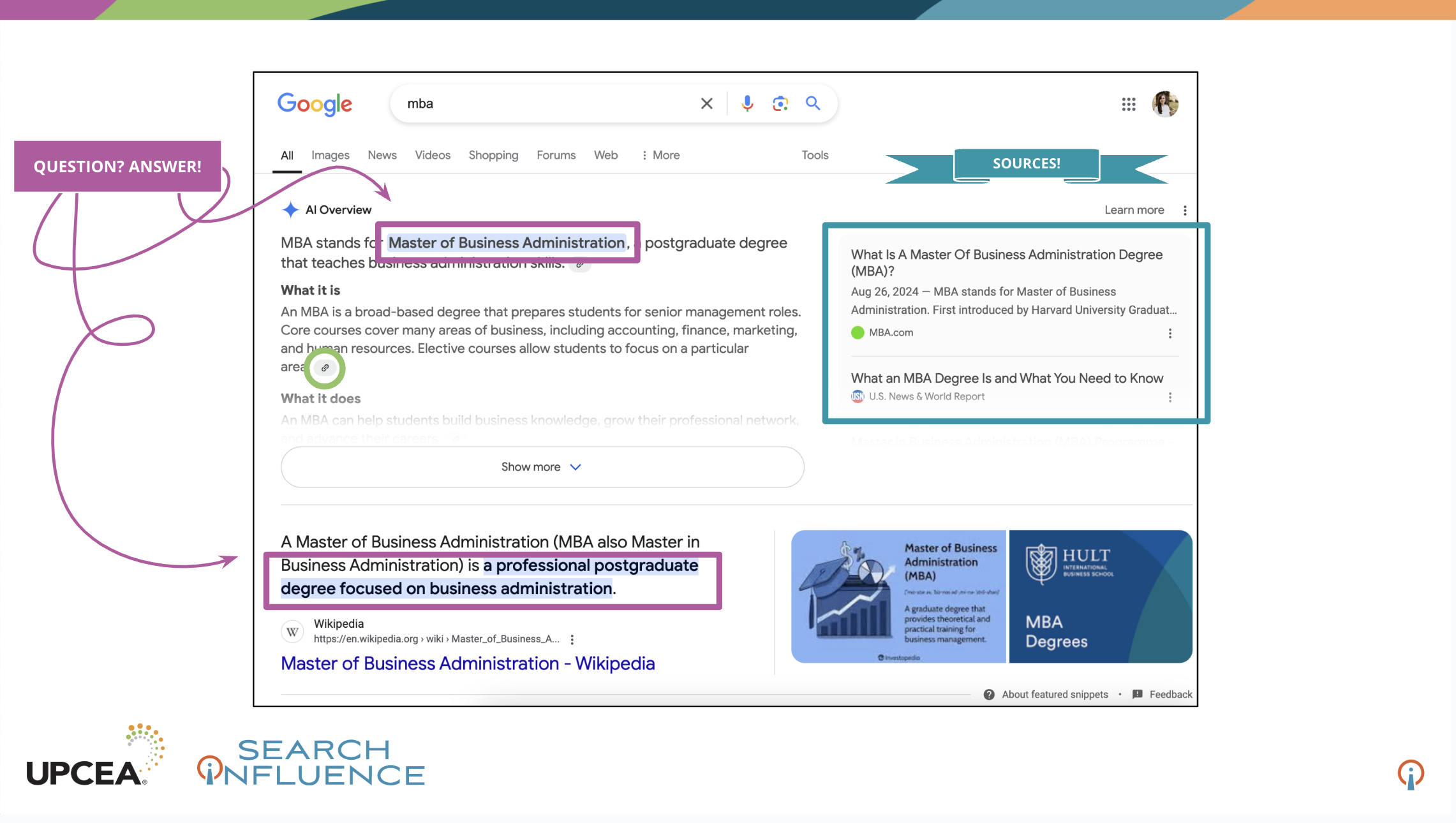
Launched in May 2024, AIOs surface above organic search results to deliver quick, concise summaries of key information in response to queries. Each overview includes clickable sources, allowing users to explore the original content behind the summarized insights.
While helpful for users, AIOs push organic listings further down, reducing visibility — even for top 5 rankings — as prospects may not scroll far enough to find your site.
Research by Seer Interactive shows that the organic click-through rate (CTR) declines by roughly 70% when an AIO is present in the search engine results. For queries that do not generate an AIO, organic CTR trends around 2.94%. When an AIO is present, organic CTR declines to about 0.84%.
On the positive side, organic CTR increases to 1.08% when a site is included as an AIO source.
Adapting your strategy for AI
While gen AI, whether ChatGPT or an AI Overview, is disrupting the search landscape, it doesn’t mean you should abandon focus on your SEO strategy. Instead, refine your university’s strategy to embrace AI and use it as a different opportunity to appear in front of prospects.
To adapt your strategy to account for AI searches:
Optimize for commercial/transactional keywords: Informational-intent keywords (ex: “Why pursue an MBA?”) trigger an AIO 99.2% of the time. However, they only display 10% of the time for commercial and transactional-intent keywords (ex: “MBA program online”). Organic click-through rates are likely higher for these types of searches since they are less likely to be overshadowed by an AIO. While you shouldn’t deprioritize informational-intent keywords entirely, you should pay love to relevant commercial and transactional terms.
Evaluate search competition and how well you rank: Knowing how competitive your search phrases are and where your content ranks helps identify the changes needed to improve your visibility. If a search term does not have considerable competition and you rank well for it already, you may just need to optimize the content to potentially grab a spot in an AIO.
Look at search intent: Search intent informs how to develop your content. For example, if the search intent is informational, you’ll want to draft your content in the format that Google most often prefers for these types of searches (i.e., articles, videos, and guides). Step-by-step, “how-to” content generally ranks best, and thus gets pulled into an AIO, for informational content.
Develop question-based content: Google’s primary job is to help people find answers to their questions. Your content should always be positioned toward providing answers to those questions. If you’re unsure of the questions your prospective students are asking, you can perform a search of the root keyword term and look at the People Also Ask (PAA) section.
Make your content digestible: Your content should be clear and scannable for both prospects and search engines, using headings, bullet points, and short paragraphs. AI platforms like ChatGPT favor conversational, natural language, so optimizing for human-like speech can also boost your chances of being included in AI-generated responses.
Impact of social search on SEO
After AI, the second most disruptive search trend to consider in 2025 and beyond is social search.
Social search refers to the use of social media platforms as search outlets, where users find information, recommendations, or content within platforms like TikTok, Instagram, or LinkedIn. This trend leverages the power of community-driven insights and visually engaging formats to connect users with information in a more interactive way.
For higher education, social search means prospective students are increasingly using these platforms to explore programs, read reviews, and engage with content that shapes their enrollment decisions.
To effectively reach these searchers, institutions must understand the different sides of social search and how each offers a new way of meeting prospects online.
Types of social search
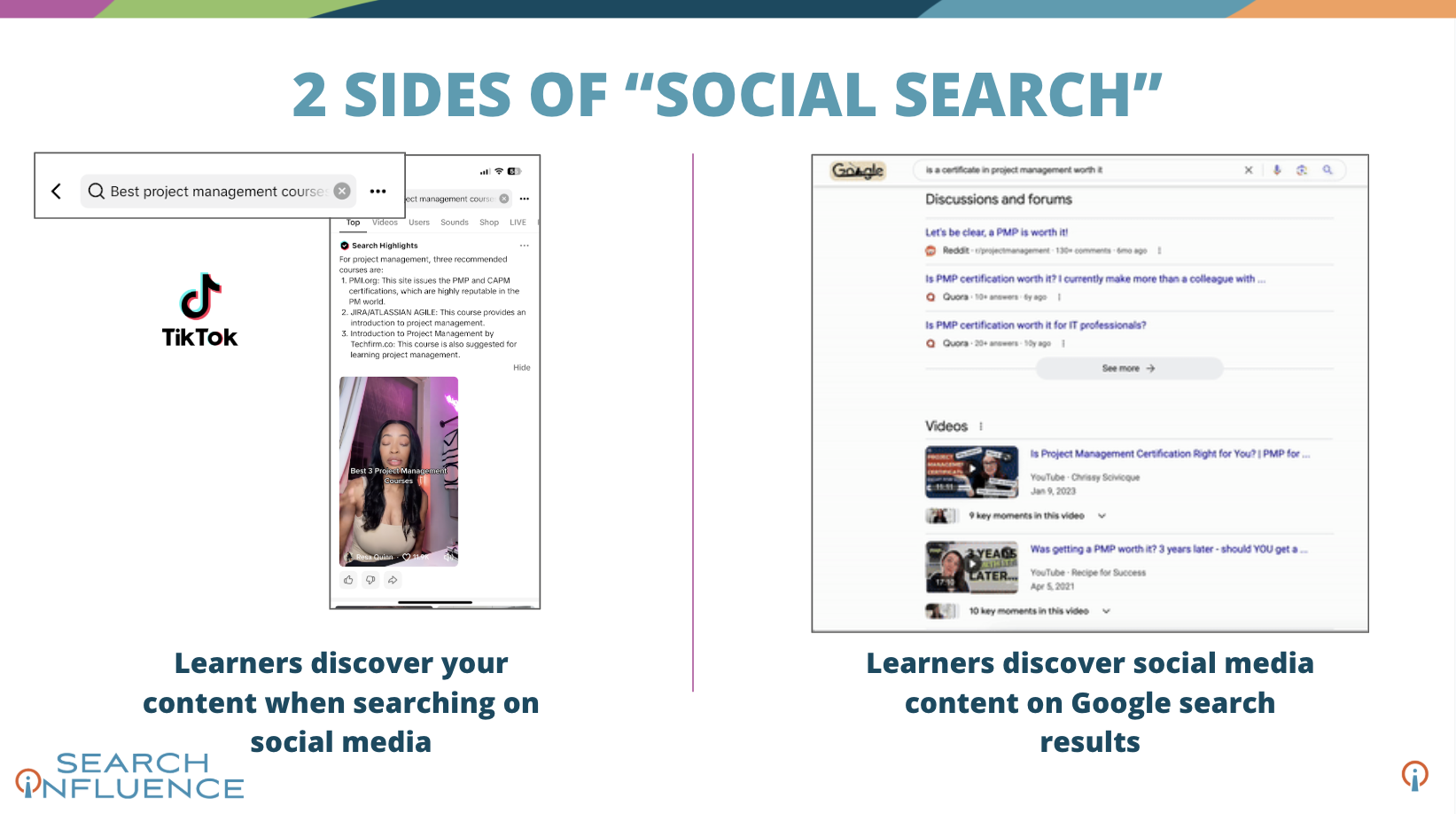
There are two ways social search works. One involves prospective students searching for your content directly on social media, while the other happens when your social media content surfaces in search engine results
The first side to social search is gaining steady favorability among searchers, primarily younger generations. According to Hubspot research, in 2023, roughly 15% of people preferred to search directly on social media over traditional search engines, with about 30% of Gen Z and Millennials most likely to use this method. However, in 2024, Hubspot found that the percentage of all generations that prefer to search on social media had increased, up from 15% to 21%.
The other side of social search presents the opportunity to enhance your brand’s visibility directly within search engine results. More and more social sites, like LinkedIn and YouTube, are ranking on Google, and sometimes they even pull into AIOs. By optimizing your social profiles for search, you can increase the likelihood of appearing in these high-visibility spots, referring more prospects to your institution.
Adapting your strategy for social search
Since it offers more real estate for you to be found online, social search can have a considerable impact on your SEO strategy. When you prioritize building robust social media content, you can reach prospects both in traditional search engines and across highly trafficked social media platforms.
To successfully integrate social search into your SEO strategy:
Repurpose your website content on social: The most efficient way to get started is to repurpose your high-performing content on your social accounts. You can do this by republishing videos from your site to your social account or publishing text-based articles on platforms like LinkedIn. Other ideas include adapting your blog content into videos or crafting video overviews of key program page information.
Expand your definition of social: When most people think of social media, they picture Instagram, TikTok, and Facebook. However, sites like YouTube, Quora, and Reddit are their own forms of social media and are often filtered into the search results, too. When you embrace all social search outlets, you can improve your visibility on social platforms themselves, potentially making you more visible in a Google search.
Strategies to attract and enroll the modern learner
Start investing in SEO now
The definition of SEO has broadened to include three mediums for meeting your audience online: traditional search engines, AI platforms, and social media. As a higher education marketer, you now have extra opportunities to nurture your prospects down the funnel, but it won’t happen without a solid investment in SEO.
While 84% of marketing departments view SEO as a core part of their marketing strategy, half (51%) do not have an established strategy in place. SEO is not additive or something to execute piecemeal when you have time or can just do the easy bits — it’s the foundation of your marketing strategy. Your website is where all your other marketing efforts lead, with SEO being the area of marketing that yields the most long-term results.
Ranking high in search continuously becomes more complex with the latest trends, and the student journey is changing. If your university fails to adopt a comprehensive SEO strategy, it could result in losing prospects to more visible competitors.
Develop the tenets of a solid SEO strategy
Since SEO is foundational, it must serve as the solid framework upon which your entire marketing strategy is built. A strong SEO strategy prioritizes impactful tactics such as:
Targeted, relevant keywords tailored to each program, degree, or certificate page
Content plans for every offering, including pillar pages and cluster content
Link-building strategies that leverage profiles, directories, PR/media, and internal linking
Regular monitoring of technical site health to ensure peak performance
Equally important is establishing key performance indicators (KPIs) and implementing a routine reporting process. Metrics such as organic inquiries, organic traffic, referral traffic from key sources, and rankings — including competitive comparisons — are essential for tracking success.
Despite its importance, reporting is often overlooked. Our research with UPCEA reveals that while 62% of institutional leaders want regular updates on SEO metrics, only 31% currently receive them, leaving a critical gap in strategic oversight.
If you lack the skills, time, and resources to execute a proper SEO strategy, consider working with an agency. They can help take much of the strategizing off your plate, while also granting you the confidence that your strategy is both up-to-date and optimized for success.
Key Questions From the Webinar Audience
Should we write in the first person when using question-based content since many users search using first-person wording?
Using first-person language in question-based content can be effective but isn’t mandatory. FAQs and similar website sections typically adopt a second-person perspective, as it directly addresses the reader. Both approaches can rank well in search results, so the choice ultimately depends on your university’s style and tone. However, consistency across your content should always remain a priority.
What’s the best way to find keywords to help with an SEO strategy?
Begin by identifying root keywords related to your programs and understanding what prospective students are searching for. You can also utilize keyword research tools to expand this list and analyze metrics like search volume and ranking difficulty. Once you have a refined list, evaluate search intent to ensure the keywords align with your content’s purpose. A practical approach is to search for the keyword directly and review the top-ranking results to confirm its relevance to your target audience and content strategy.
Should social media efforts focus on university accounts, personal accounts, or both?
University accounts are often the primary choice for social media efforts. However, leveraging personal accounts, such as those of professors or staff who can act as influencers or thought leaders, can significantly enhance your strategy. Using both in tandem allows for broader reach and a more personalized connection with your audience.
Guest writers tend to get better rankings within search engines. Is it wise to invest in such writers?
The value of guest writers depends on their qualifications and expertise. Writers with specialized credentials or industry authority can enhance content ranking and credibility. Additionally, consider whether their content is well-optimized for SEO and aligns with your goals. Evaluating these factors will help determine whether guest writers are a worthwhile investment for your strategy.
Is the shift to conversational content replacing keyword-centric strategies?
While conversational content is becoming increasingly important, it doesn’t replace the need for keyword-centric strategies. High-value head terms and less conversational searches will always play a crucial role in driving visibility. A smarter approach balances both, integrating conversational content alongside targeted keywords to address diverse user intents.
Discover More Higher Education SEO Best Practices
Staying ahead of the latest trends in SEO is the most effective way to reach the modern learner and meet your enrollment goals in 2025. For deeper insights into the state of the industry and how you can adapt, be sure to watch the full recording of “Top Trends for Your 2025 SEO Strategy to Attract the Modern Learner,” linked here.
Feeling stuck on implementing a strategy that moves the needle toward full-funnel success? Search Influence is here to help with higher ed resources to fuel your enrollment pipeline:
SEO Higher Ed Research Study: Read the latest on higher ed SEO, where marketing leader priorities lie, and the work that your university must do to outpace your competitors.
SEO Blog: Learn how to make a strong case for SEO to your higher-ups to ensure your university’s organic presence is optimized for success.
SEO Workbook: Gain access to exercises that help you develop three months of SEO techniques to boost your online visibility, from keyword strategy to technical SEO improvements.
SEO Roadmap: Rev up your SEO engine with snackable strategy recommendations for one top degree or program, plus dedicated time with our team to review and consult.
Your higher ed SEO goals are within reach. Solidify your visibility in changing times with expert support today.
SEO is crucial for online visibility, increased website traffic, brand recognition, and revenue growth.
While it may be tempting to handle SEO in-house, it’s essential to recognize that effective SEO requires meticulous attention to detail, constant monitoring, and adaptation to evolving search engine algorithms.
When deciding between in-house and outsourced SEO, consider your budget, the need to stay updated on SEO trends, your SEO goals, and the tech necessary for effective SEO.
Incorporating SEO into your digital marketing strategy is paramount in today’s fiercely competitive online arena. SEO (Search Engine Optimization) is one of the driving forces behind your business’s online visibility.
It’s the key that unlocks the doors to higher website traffic, increased brand recognition, and, ultimately, greater revenue.
When deciding the best route for your SEO success, it might be tempting to take SEO efforts into your own hands, especially if you have an in-house team with some digital marketing know-how.
After all, who understands your business goals better than your employees? But before you embark on the journey of handling SEO in-house, it’s crucial to pause and reflect.
Effective SEO isn’t just about understanding your business; it’s a multifaceted discipline that demands meticulous attention to detail, constant monitoring, and adaptation to ever-evolving search engines.
In this blog post, we’ll delve into the debate of SEO in-house vs. outsourcing, offering insights and compelling reasons why entrusting your SEO efforts to a specialized SEO agency may be the smartest move for your business’s growth and online success.
Crafting a successful SEO strategy hinges on thorough research and analysis. This entails extensive keyword research and competitive analysis, the basis for well-informed SEO campaigns.
Content writing
Content remains central to SEO, demanding the creation of SEO-friendly materials. This encompasses everything from on-page optimizations to new content marketing pieces. Proficient content writers produce high-quality, engaging content that resonates with your target audience while also favorably positioning your site in search engine results.
Technical SEO expertise
Technical SEO is a critical facet of the SEO landscape. It involves optimizing website structure, enhancing loading speeds, and ensuring search engine compatibility.
Website development
Proper SEO goes hand-in-hand with seamless website development. SEO success often requires collaboration with web developers and graphic designers to create a user-friendly, visually appealing website. A well-designed website improves user experience and plays a pivotal role in SEO rankings. Search Influence’s web development team works with your existing website to execute our SEO recommendations.
Outreach / PR for link building
Link building is a fundamental element of SEO. Building valuable backlinks demands skillfully executed outreach and PR activities. These high-quality backlinks enhance website authority and visibility in search results.
Data and analytics
Data-driven decision-making is at the core of effective SEO. Leveraging advanced analytics tools, SEO practitioners monitor the performance of strategies, providing insightful reports.
Analytics and lead tracking allow for adjustments and alignment of SEO efforts with your business objectives.
These skills and knowledge areas are essential for anyone looking to successfully navigate the complex world of SEO. Whether you choose an in-house SEO team or partner with an SEO agency, understanding these foundational aspects is crucial for achieving favorable results in the digital landscape.
Time Commitment for Successful SEO
Effective SEO isn’t a one-time task; it’s an ongoing commitment that demands significant time and effort. Typically, you can expect to allocate anywhere from 25 to 50 hours per month for SEO-related activities. This allocation includes time spent on strategy development, execution, and continuous evaluation.
SEO campaigns require meticulous planning and execution, involving keyword research, content optimization, technical SEO enhancements, and link building efforts. Managing this workload can overwhelm a small business or those with limited resources.
Plus, SEO isn’t static. Search engine algorithms evolve, user behavior changes, and competitors adapt their strategies. To remain competitive, you must update your SEO strategies and tactics every three months. This iterative approach ensures your SEO campaign stays aligned with industry trends and search engine updates.
It’s essential to take a step back and assess the performance of your SEO efforts annually. Determine which pages are excelling in search engine rankings and which are not. This evaluation allows you to reallocate resources and update your priorities for the following year.
For many businesses, maintaining this level of commitment and staying up-to-date with the SEO world can be challenging. This is where SEO agencies and their teams of SEO experts come into play, offering the time commitment required and the expertise and ongoing training needed to ensure your business grows and thrives in the digital marketing arena. An agency’s dedicated marketing manager or SEO team can handle specific tasks and provide the time and skills to drive your business forward online.
What You Get From a Skilled SEO Agency
Outsourcing SEO to a skilled SEO agency offers many advantages that impact the success of your projects.
Some of the benefits of hiring a skilled SEO agency include:
Access to and Knowledge of Tools: SEO agencies are equipped with a wide array of essential tools and resources for effective SEO management, such as Semrush, Ahrefs, and Google Search Console. These tools aid in keyword research, competitive analysis, and performance tracking.
Staying Up-to-Date on SEO Trends and Changes: SEO is a dynamic field with frequent algorithm updates and evolving best practices. SEO agencies are dedicated to staying current with these changes, ensuring your SEO strategy remains effective and compliant with industry trends.
Established Processes for Implementation: SEO agencies have well-defined processes for implementing changes and optimizations swiftly and efficiently. This systematic approach ensures a seamless execution of your SEO strategy.
Experience: SEO professionals within an agency have extensive experience working on various SEO projects. Their expertise allows them to easily navigate the complexities of SEO, offering solutions tailored to your unique needs.
Skills Across Specialties: A skilled SEO agency boasts a diverse team of experts, including content writers, researchers/strategists, and technical SEO specialists. This multidisciplinary approach provides you with a range of skills at your fingertips without the need to build and manage an in-house SEO team.
Data-Backed Strategy: SEO agencies base their strategies on data-driven insights. They analyze performance metrics to gauge the impact of your tactics on rankings, traffic, and lead generation, ensuring concrete evidence guides your SEO journey.
Diagnosing Underperformance: When your SEO efforts don’t yield the desired results, SEO agencies have the expertise to diagnose underperformance and recommend corrective actions promptly. This proactive approach is crucial for maintaining and improving your organic traffic and search engine rankings.
Collaborating with an SEO agency grants you access to a team of seasoned professionals who can streamline your SEO efforts, enhance your online visibility, and confidently drive your business forward.
An outsourced SEO success story
The Tulane School of Professional Advancement (SoPA) partnered with Search Influence, an experienced higher education digital marketing agency, to enhance their online visibility and attract prospective students. Over this multi-year collaboration, Search Influence has implemented a suite of digital marketing strategies, including SEO, paid digital ads, and email marketing. These digital marketing tactics have increased enrollment across various programs, from bachelor’s to master’s programs and graduate certificates.
One of the standout success stories from this partnership came when Search Influence helped Tulane SoPA bring an underperforming third-party Online Program Management (OPM) built microsite back from the dead.
On the direction of Tulane SoPA’s former OPM partner, the private continuing education school hosted information about their information technology and cybersecurity degrees on a microsite separate from their main website.
Tulane SoPA came to Search Influence with the following concerns about their microsite:
The look and feel (user experience) was inconsistent across the two properties.
The OPM did not allow Tulane SoPA to apply edits to the microsite, adding another layer of complication that made it difficult to capitalize on the IT undergrad program.
It was difficult to holistically analyze data and performance.
The former OPM partner owned Tulane SoPA’s microsite, which meant that a vendor change would prompt the loss of any SEO authority gained from the microsite.
On top of the above concerns, Search Influence also recognized a separate set of challenges:
Running these two programs on individual websites proved to be a counterproductive strategy. The online visibility of both programs suffered as they couldn’t tap into the wealth of educational content available on the primary website. Conversely, the main website lacked the necessary depth of information about these programs and what they offered.
Both websites faced the risk of being flagged for duplicate content. Vital details such as tuition fees, the admissions process, and financial aid information were duplicated on each site, making them susceptible to search engine penalties. Neither site was positioned to organically rank well for IT or cybersecurity keywords, nor were they effectively nurturing prospective students interested in these programs to take the next step and apply.
Search Influence used an SEO-first approach to migrate the OPM microsite pages into Tulane SoPA’s main site. At the end of the project, the microsite was completely sunset.
As a result of this strategy, Tulane SoPA:
Enhanced their content’s richness by implementing comprehensive front and back-end content optimization and expansion strategies
Ensured the microsite’s search engine prominence remained intact during a seamless technical transition
Solidified its position as a prominent leader by actively refining conversion strategies and introducing supplementary inquiry forms
Search Influence’s expert SEO knowledge and implementation fixed Tulane SoPA’s website woes and helped them drive more prospective students to their site.
The results below look at a year-over-year comparison to the three-months prior to the migration (to account for seasonality).
90% increase in total organic traffic
456% increase in organic blog entrances
890% increase in organic blog traffic
895% increase in new users to the blog
54% of organic website traffic is attributed to the blog in this time period, compared to just 10% prior.
This success reflects the expertise of an outsourced SEO agency in driving targeted results and leveraging industry insights to optimize websites. It demonstrates the value of outsourcing SEO tasks to dedicated specialists and the potential for substantial business growth through practical SEO work.
Questions to Ask Yourself When Making Your Decision
What’s our organization’s budget for SEO services?
When deciding between in-house SEO or outsourcing SEO services, consider the following financial factors:
Initial Investment and Ongoing Costs: Understand the distinction between one-time setup costs and monthly or annual expenses. Also, consider potential overruns or unexpected costs that may arise during your SEO journey. You will be responsible for these unforeseen costs if you choose in-house SEO.
Cost of an In-House SEO Expert vs. Agency Retainer/Fees: Compare the cost of hiring and maintaining an in-house SEO team to the fees associated with an SEO services agency or freelance SEO expert. If you choose to outsource SEO, it may be more expensive upfront but will save you money and headaches in the long run.
Tools and Software: Evaluate the availability and cost of essential SEO tools and software needed for effective SEO campaign management. Can your in-house team afford the necessary digital marketing software?
Training and Conferences: If you choose an in-house SEO specialist, you must set aside funds for courses, webinars, and potentially attending SEO conferences for your SEO professional’s ongoing education and skill enhancement.
While hiring a skilled SEO agency for your higher education marketing can help you craft successful campaigns, Search Influence understands that might not always be in the budget.
That’s why we created an SEO workbook to help higher ed markets take charge of their online campaigns.
Do we know the latest SEO best practices and trends?
When deciding between in-house SEO or outsourced SEO services, you should consider the following:
Internal Expertise: Assess the current knowledge level of your internal teams or SEO manager and identify any gaps in expertise that might require external training or assistance.
Stay Up-to-Date: Recognize the frequency of search engine algorithm updates and the importance of staying ahead in a constantly evolving field.
Dedicated Learning Time: If you can’t allocate regular time for your team to learn and stay updated on the latest SEO best practices, ensuring continuous improvement, you should consider hiring an SEO specialist agency.
What are the goals of our SEO project?
When deciding between in-house SEO or SEO outsourcing, you should consider the following:
Short-Term vs. Long-Term Goals: Define immediate objectives and long-term SEO strategies to ensure your SEO efforts align with your business goals.
On-Page vs. Off-Page Optimization: Determine the balance between improving on-page website elements and addressing off-page SEO factors to achieve your desired results.
Local vs. National Focus: Decide whether to prioritize local search optimization or expand your reach to a broader national or global audience.
Integration With Other Marketing Efforts: Understand how SEO will fit into your overall marketing strategy, including its integration with PPC, social media, and email marketing efforts. Most SEO agencies can handle all your digital marketing needs.
What does a staff member or agency need to learn about our niche?
When deciding between in-house SEO or SEO outsourcing, you should consider the following:
Unique Challenges of Niche Industries: Recognize potential obstacles or limited resources specific to your niche sector that may impact your SEO strategy.
Specialized Knowledge: Consider the specific information needed to understand keywords, your target audience, and the intricacies of your industry, which will be vital for practical SEO work and content creation.
Do we have the technical skills and software subscriptions necessary for effective SEO?
When deciding between in-house SEO or an outsourced agency, you should consider the following:
SEO Toolkits: Review the availability of tools for keyword research, link building, and on-site optimization to ensure you have the necessary resources for your SEO campaign.
Website Infrastructure: In order to implement effective SEO, you must have someone who knows how to evaluate your current website’s SEO-friendliness and then determine whether migrations or significant overhauls are needed.
Analytics and Reporting: Ensure access to robust analytics tools that allow you to measure and report on the progress of your SEO efforts effectively.
Integration Capabilities: Before deciding to bring your SEO in-house, you should determine if you know how to integrate SEO tools with other marketing and analytics platforms to streamline your SEO operations and improve overall efficiency.
After considering your SEO goals and industry knowledge, it will be easier to decide between an in-house or outsourced SEO strategy.
Should You Outsource SEO Services or Build an Internal Team?
But should you build an in-house team or hire an agency?
Several key takeaways emerge when deciding between outsourcing SEO services and building an in-house team. Your choice depends on various factors, including budget constraints, existing expertise, the need to stay current with SEO trends, and your specific project goals.
One critical consideration is the remarkable potential of partnering with the right SEO agency.
When you collaborate with a skilled agency, they don’t merely provide services; they become an extension of your team. This partnership can yield immense cost savings, as agencies have the tools and expertise required for efficient SEO results.
Search Influence Can Help Your Business Grow
As a leading SEO agency in New Orleans, we understand the significance of being found online. That’s why we’ve spent nearly 20 years helping businesses just like yours find success.
Our dedicated experts have honed their SEO skills through years of strategizing, testing, and developing cutting-edge methods to ensure potential customers can discover your business.
Take Search Influence’s In-House vs. Outsourcing SEO Quiz to answer whether partnering with a higher ed digital marketing agency is the right approach for your institution.
Search Influence and UPCEA hosted the joint webinar “Top Trends for Your 2025 SEO Strategy to Attract the Modern Learner.”
AI-generated search results and social search have transformed user behavior, including how prospective students research and apply to institutions. As higher education marketers, our job is to make it easy for prospective students to find the information they need. Therefore, failing to adapt to these higher ed SEO trends could result in losing prospects to more visible competitors in 2025.
In this webinar, we explored a new way to think about SEO that will future-proof your strategy in a time of changing search behavior. UPCEA’s Chief Research Officer Jim Fong and Senior Director of Research Bruce Etter, joined UPCEA Platinum Partner Search Influence to share a blueprint for a 2025 SEO strategy that attracts and guides more students through the funnel.
Learning Objectives for the Higher Ed SEO Trends Webinar
How AI-generated search results and social search impact your institution’s visibility
The key components of a higher ed SEO strategy built to outlast trends
How to communicate to your team about this new way of thinking about SEO
How to Watch the Webinar
Watch the webinar recording to learn how to build your 2025 SEO strategy to attract and engage the modern learner.
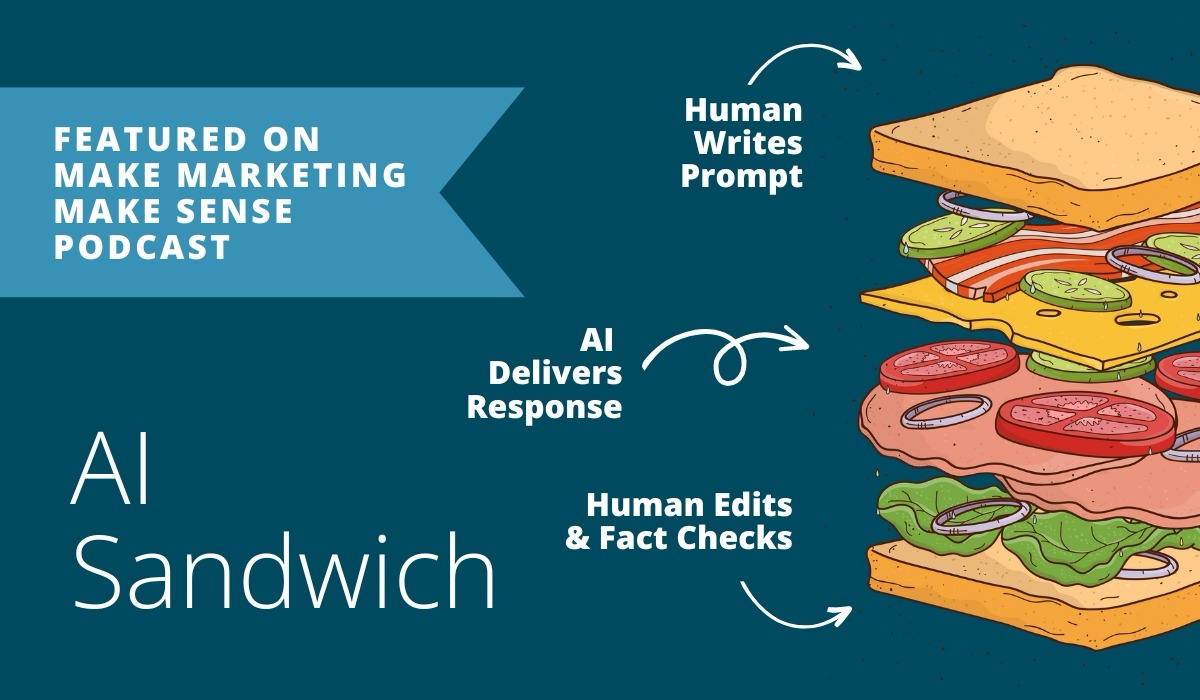
Search Influence Co-Founder and CEO Will Scott made his first appearance on the Make Marketing Make Sense podcast to share how marketers should utilize AI to supercharge their SEO efforts.
Make Marketing Make Sense is a weekly podcast hosted by Comfy Stone Films Co-Founder and Account Manager Josh Owen. The podcast invites entrepreneurs and marketing experts to simplify the latest trends in this ever-evolving industry.
Comfy Stone Films helps businesses grow by making effective online video content on such topics as video marketing strategies and production tips.
Watch the full podcast below to gain valuable insights into how AI can take your SEO strategies to the next level.
AI for SEO Insights From Will Scott
Since putting his first website online in the mid-90s, Will has worked through countless evolutions of SEO. Few advancements have had the same impact as Artificial Intelligence.
During his guest appearance in Make Marketing Make Sense, on the episode Utilizing AI for SEO, Will discusses:
How AI can streamline SEO content creation
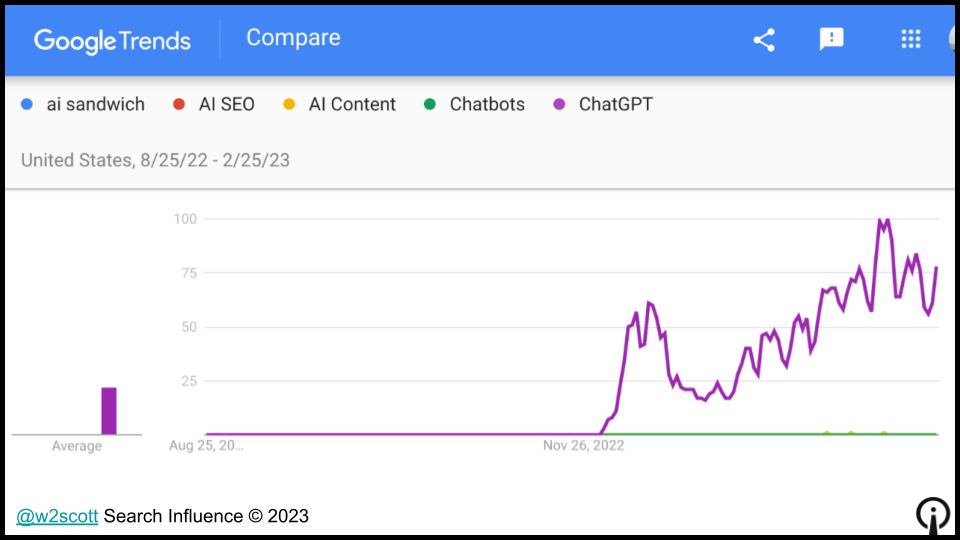
How to combine AI with a human touch using the “AI sandwich” method
How to prompt AI to create SEO-optimized content
The SEO vet also explains how tools like Wave.video and Make.com can help you create worthwhile video content and automate your workflows.
Looking for more ways to use AI to boost your marketing efforts?
Marketers who invest in paid search but don’t use SEO miss out on valuable opportunities to grow their brand, impact, and results.
Paid search offers immediate, measurable results, while organic search provides long-term, cost-effective benefits. Both are essential for a balanced marketing approach that captures the ideal target audience.
When you leverage these strategies in tandem, you can stretch your advertising budget further and gain a higher return on your investment.
Already diving into the world of paid search? You’re likely experiencing satisfactory — if not excellent — returns on your investment. Your click-through rates are healthy, your conversion funnels are a work of art, and the ROI numbers speak for themselves.
But, why stop at one win when you can score a double?
The ROI potential of organic search is often underestimated, yet its impact is monumental. With organic search, you invest in a long-lasting asset that continuously draws in high-quality traffic and gains.
By leveraging both paid and organic search, you create a powerhouse that maximizes your budget and outperforms each strategy used in isolation.
Comparing the Advantages of Organic Search vs. Paid Search
Organic search refers to the unpaid search engine results that appear when you type a keyphrase into a search engine, such as Google, Bing, or Yahoo.
Organic search differs from paid search in two primary ways: You don’t pay for high-rankings, and you earn those rankings based on how relevant your content is to the user’s search query.
The higher you rank in the organic listings, the higher the traffic to your website.
Data from Brightedge shows organic search constitutes over 53.3% of all website traffic, while 15% comes from paid search.
However, despite pulling in a lion’s share of page visits, organic search shouldn’t trump your paid efforts, and vice-versa. Choosing one approach at the expense of the other only risks leaving valuable opportunities on the table.
Organic and paid search are complementary marketing strategies. When used together, they yield results much greater than the sum of their individual parts.
Benefits of paid search
Paid search is popular for a reason. It’s fast-acting, easily adaptable, and you can measure its performance down to the most granular details.
Some of the top benefits you get by investing in this marketing strategy include:
Immediate visibility: Unlike organic search, which can take time to yield results, paid search offers immediate visibility. As soon as your ads are set up and approved, they can appear in relevant search results, driving instant traffic to your website.
Targeted reach: Paid search allows for precise targeting based on a variety of factors, such as keywords, location, demographics, and device type. This level of targeting ensures that your ads are shown to a highly relevant audience, increasing the likelihood of conversion.
Measurable and actionable results: Paid search offers detailed metrics and insights into your ads’ performance. This data helps you assess the effectiveness of your campaigns and make more informed decisions. You can optimize by testing different ad creatives, landing pages, and keywords.
Cost-effective: While you pay for each click, the ability to set a budget and bid strategy allows you to control your spending. Additionally, the targeted nature of paid search can lead to higher conversion rates, making it a cost-effective advertising method.
Benefits of organic search
When marketers invest in an organic search strategy, they’re investing in the tried-and-true practice of search engine optimization (SEO). This technique involves optimizing a website to appear higher on the search engine results page.
Successful SEO encompasses many different moving parts, including:
Keyword research: Identifying and targeting specific keywords relevant to your business helps tailor your content to attract qualified traffic.
Link building: Acquiring backlinks from reputable websites boosts your site’s authority, which can improve its ranking in search engine results.
On-page optimizations: Improving elements like titles, meta descriptions, headers, and content itself ensures that both search engines and users find your pages relevant and valuable.
Technical SEO: Optimizing your website’s underlying code, speed, and structure makes it easier for search engines to crawl and index your content.
Local SEO: Optimizing your site for local search helps you rank higher in geographically relevant queries, making it easier for local customers to find you.
User experience (UX): Enhancing your site’s usability and navigability keeps visitors engaged and signals to search engines that your site is user-friendly.
Each of these tactics plays a distinct role in optimizing your site for a better position in organic search results. When utilized correctly, effectively, and efficiently, they can lead to several compelling benefits, such as:
Increased organic traffic: By optimizing for relevant keywords and creating quality content, SEO helps increase the visibility of a website in search engine results, leading to more organic traffic.
Improved user experience: In revamping the structure and content of your website, you make it easier to navigate, which can improve the overall user experience.
Higher conversion rates: Through targeted optimization, SEO can attract more qualified leads to your website, leading to higher conversion rates, as visitors are more likely to take desired actions.
Why You Need a Paid Search + SEO Strategy
Adding SEO to your paid search strategy isn’t about dishing out hefty dollars or doing extra heavy lifting to reap results.
This one-two punch is about working smarter, not harder. When you adopt a comprehensive strategy, your paid and organic search efforts merge to inform each other for a budget-friendly, high-impact approach.
SEO is one of paid search’s biggest allies and strategic influences. It works to bolster the impact of your pay-per-click (PPC) ads by offering numerous advantages, including:
Brand credibility: If your site ranks high in organic search for relevant keywords, it may enhance your brand’s credibility and authority. This trust can translate into higher click-through rates for your paid search ads.
Improved quality score: Google’s Quality Score considers the relevance and quality of your landing pages. If your organic search efforts result in well-optimized landing pages, it might indirectly contribute to a higher Quality Score for your paid search ads, leading to lower costs and better positioning.
Shared insights: Your paid search campaigns can gain data from your organic search efforts, including effective keywords and user behavior. With these insights, you’re able to ensure more effective targeting and ad creation.
User experience and relevance: Successful organic search optimization involves creating relevant, engaging content that resonates with users. By leveraging this content in paid campaigns, like Google ads, you create a consistent user experience that enhances conversions.
Double visibility: Appearing in both organic and paid search results increases your overall brand visibility and reinforces your message, making users more likely to engage with either your organic result or paid ad.
Use case: Paid search & SEO for improved keyword visibility
Seeing double doesn’t always mean it’s time to visit your nearest eye care clinic.
In the search engine marketing world, double visibility for certain keyword searches opens the door to increased brand awareness, clicks, and conversions.
By occupying both paid and organic real estate on the search engine results pages (SERPs), you crowd out competitors and offer multiple avenues for potential customers to interact with your brand.
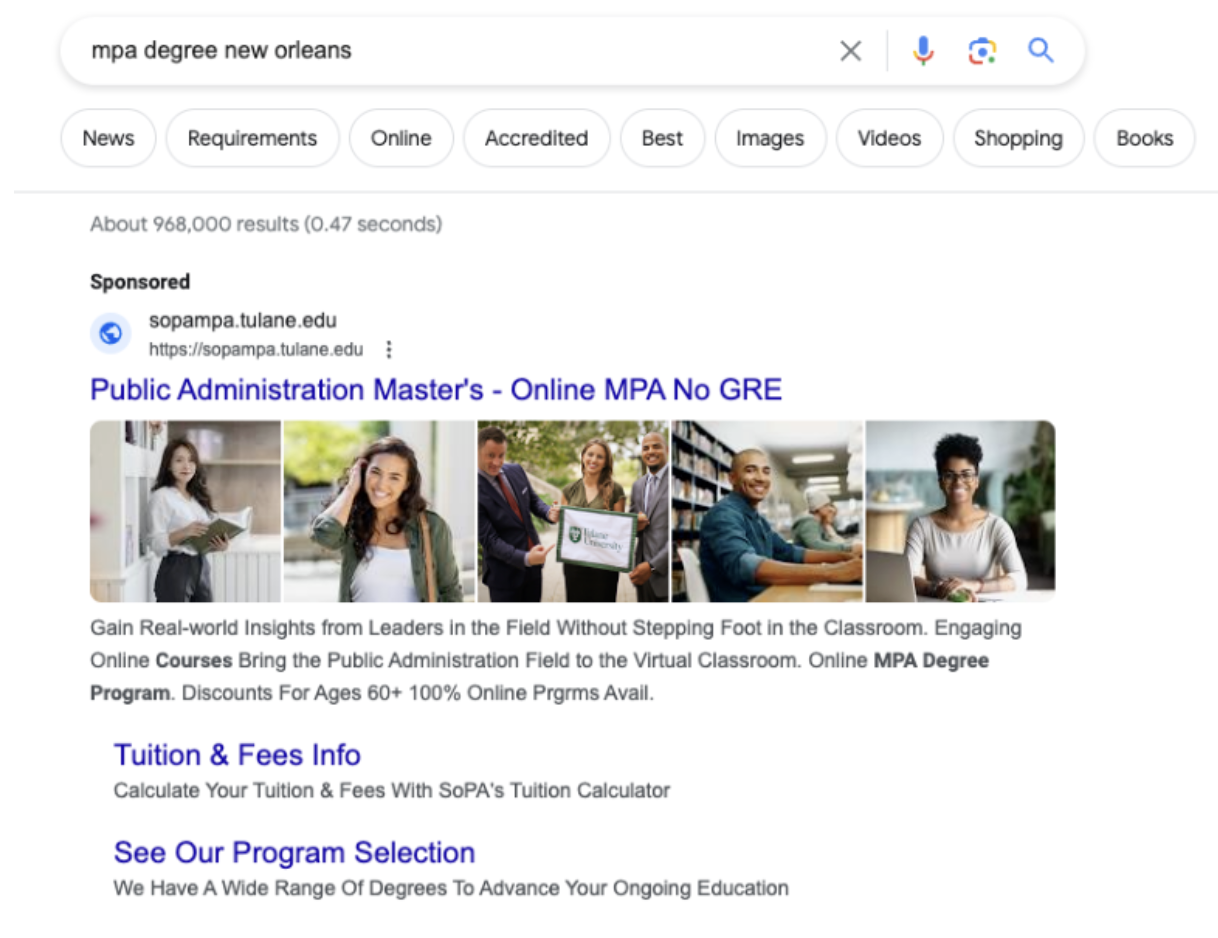
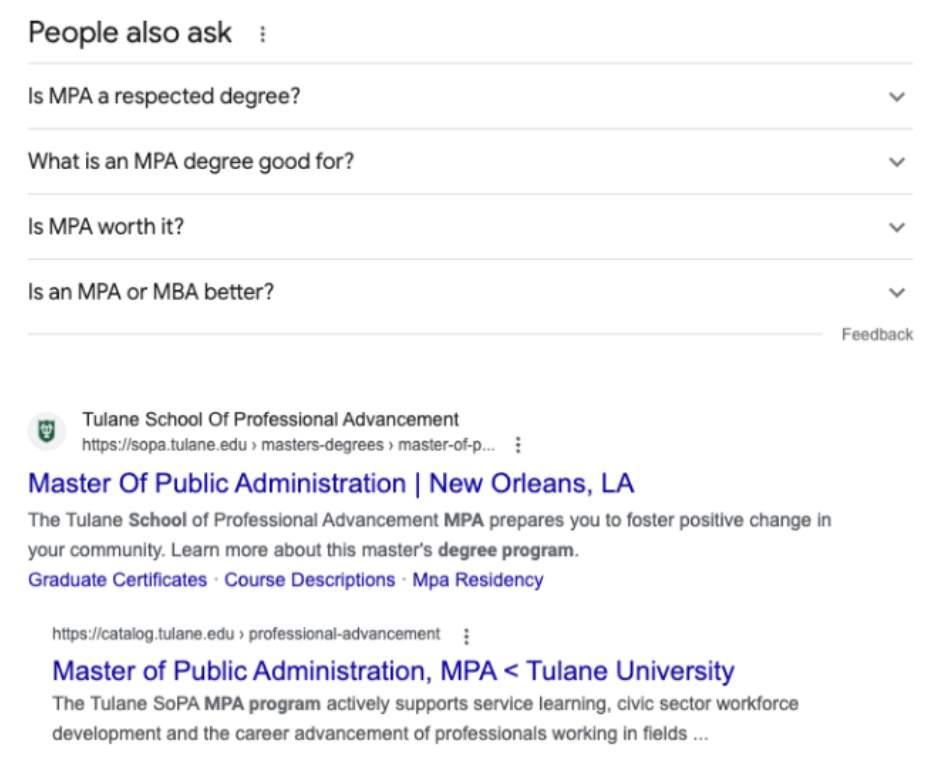
Our higher education client, Tulane SoPA, reached double visibility in the SERPs for the keyword “MPA degree New Orleans.”
The top page, flagged as “sponsored,” is the university’s paid search effort, and it leads to the corresponding landing page for the Master of Public Administration program.
Tulane SoPA’s organic listing for the MPA degree lies just below Google’s “People Also Ask” feature, still on page one.
Interested prospects searching for the perfect MPA program in their preferred locale are met with multiple signals pointing them to Tulane SoPA. When they click through to one of the pages, Tulane SoPA has higher chances of increasing their conversion rates.
The ROI Potential
The ROI of an organic vs. paid search strategy may look different, but they don’t have to be mutually exclusive. With a combined search strategy, you can do more with your marketing and have better returns, without breaking the bank.
Used in tandem, paid and organic search stretch your budget further. Their complementary inner workings drive more conversions and dollars to your brand, particularly by:
Increasing overall traffic: By targeting different segments and stages of the buyer’s journey, both paid search and SEO can drive more traffic, improving overall reach and potential conversions.
Increasing conversion rates: Utilizing insights from both channels can lead to better targeting and more relevant content, thereby increasing the likelihood of converting visitors into customers.
Offering data-driven optimizations: Using data from both channels allows for more informed decisions and continuous optimization of both organic and paid strategies, leading to improved performance and ROI.
Allocating resources strategically: Understanding the performance and ROI of both channels enables you to strategically allocate resources, investing in areas with the highest returns.
Increase Your ROI With SEO & Paid Search Experts
Sticking to just one marketing channel is like running a race with one shoe. You might still finish, but you’re hobbling your chances for a winning performance.
A superior marketing strategy is holistic, leveraging both the quick returns of paid search and the sustainable growth offered by SEO.
At Search Influence, we put these winning, comprehensive strategies within your reach. With over 15 years of experience offering custom solutions, analytics-based strategies, and results you can measure, we are your partner in optimizing your full potential.
Interested in learning more about merging organic and paid search in your strategy? Let’s talk about it.
I can’t believe I’m sharing this, but after doing it a few times, I realized that the Skyscraper Technique, when paired with ChatGPT data mining, is too good to keep to myself.
But look, don’t tell anyone else, alright?
[ez-toc]
Everybody’s afraid of the impact of derivative content. I say, if you can’t beat ’em, join ’em.
[bctt tweet=”Everybody’s afraid of derivative content. I say, if you can’t beat ’em, join ’em.” username=”w2scott”]
Lean into the power of derivative content and take a lesson from Brian Dean in the Backlinko heyday.
At the time, I was getting back from Pubcon, having presented on AI content (as much as we understood at the time), and was super pumped about the opportunity.
I started experimenting with sampling existing content to build personas for voice and tone, but it was nothing like we’re able to do now. With updates to the core OpenAI GPT, both in the underlying technology and in the size and scope of content one can process, we can go both deep and wide on topics.
The more recent ability to execute a web search with plugins and the expanded data exploration enable summarization and understanding of exceptionally long and complex topics.
The machine learning models and artificial intelligence technology are amazing in and of themselves. The killer app, in my experience, is the ability to analyze the aggregated content of those articles you’re summarizing and glean really useful information.
ChatGPT As a Data Analysis Engine
In a recent experiment, I had ChatGPT summarize the top ten articles on a topic, including highlighting unique positions. This use of natural language processing makes ChatGPT a much more valuable tool to perform tasks where the data collection and correlation analysis are themselves a competitive edge.
It’s simple to get started — search Google for your target keyword. The answer will give you a ton of new ideas and more links than you know what to do with.
Then, use ChatGPT data mining to extract common elements. In this case, we’re talking about the most commonly cited higher education marketing strategies.
[bctt tweet=”Search Google for your target keyword. You will get a ton of ideas and more links than you know what to do with. Then, use ChatGPT data mining to extract common elements.” username=”w2scott”]
It’s these kinds of classification tasks where I think ChatGPT really shines.
I’m looking forward to the very near future, where AI image tools like Midjourney and Dall-E can take the language model output and turn it into data visualization. Obviously, getting accurate responses from the code can lead to a better piece of content.
This is just one of many factors that must be addressed before data scientists can rely on this powerful tool.
Will this work for every subject? Maybe not, but for any topic with abundant informational content available, it should be effective.
What Is the SEO Skyscraper Technique?
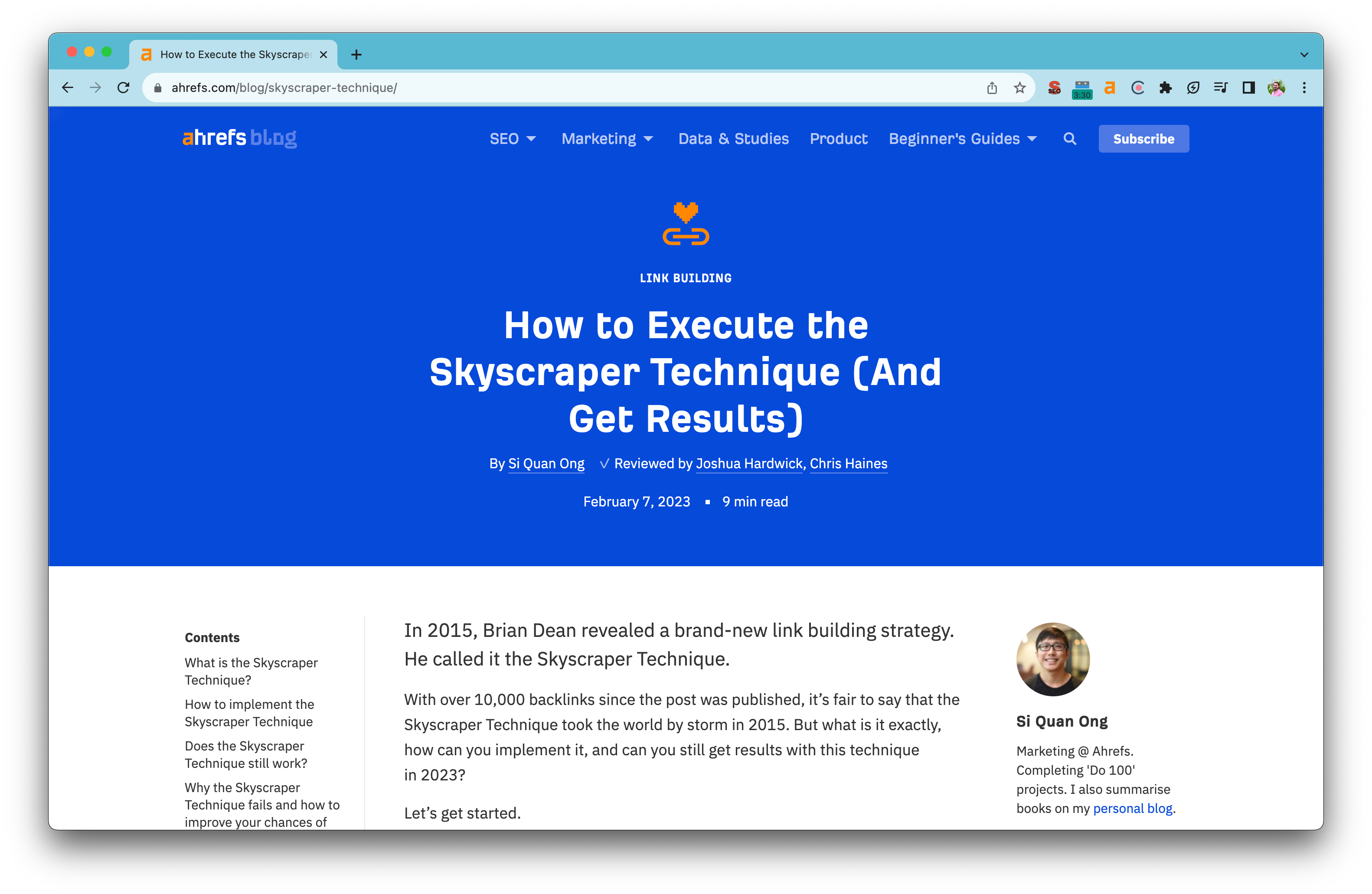
The Skyscraper Technique was popularized by Brian Dean at Backlinko. As you would imagine, it’s been imitated, misquoted, and SEO’d beyond belief.
Step 1: Find link-worthy content.
Step 2: Make something even better.
Step 3: Reach out to the right people.
[bctt tweet=”The Skyscraper Technique was popularized by @brianedean at @backlinko. As you would imagine, like most tactics that work, it’s been imitated, misquoted, and SEO’d beyond belief” username=”w2scott”]
Note that the first filter is about links. Links are great and a strong signal of authority, but since Dean’s original article, Google has moved much further down the road toward a semantic, entity-based web.
Links are still critical to ranking, but it’s widely acknowledged they are also very manipulable.
This means that the page’s content and its relationship to already recognized entities can be as important as the links pointing to it.
In fact, if you believe Kyle Roof or Koray Tuğberk Gübür, you might think you can own the SERP without links at all.
So, the difference in this approach is that, instead of looking at a single piece or a small set of content, we look at all the content to which Google is giving the love.
[bctt tweet=”Instead of looking at a single piece or a small set of content, we look at all the content to which Google is giving the love.” username=”w2scott”]
Another difference is the respect we show the other ranked articles we’re referencing. We’re not just trying to one-up them — we’re giving them their dues with a summary and a link.
And yes, by including the summary, we’re assuring we include all those juicy semantic entities and keywords in our article, too. We’re, therefore, also relieved of the challenge of keyword research because we know these articles rank. Look at a great number of sources and build the tallest skyscraper, and you win.
And finally, by syndicating the content we’ve created, with derivative content enabled by AI, we’re presenting a 360-degree view of both the content and the link universe.
And we’re setting ourselves up so that the first links pointing back are both super authoritative and, potentially, linkable assets in their own right.
How Do You Use ChatGPT for Data Mining?
In the last six months, ChatGPT has become a fantastic tool for data mining. With the addition of web crawling and integrations to third-party data sources like Google Sheets, what was previously just a content regurgitator is now a proper data analysis tool.
In my original article on ChatGPT data mining, ChatGPT didn’t have live web crawling ability and was still giving out a lot of information it shouldn’t have been. In fact, it was giving me email addresses — accurate or not — for Pubcon speakers, past and present.
But, as that article showed, you can’t trust ChatGPT to tell the truth, and there’s a fair likelihood that some of those addresses are made up.
[bctt tweet=”You can’t trust ChatGPT to tell the truth, and there’s a fair likelihood that some of the information is made up.” username=”w2scott”]
And just like that, it went away.
From the earliest days of ChatGPT, you could ask it to identify frequency, relationships, and even format information in tabular form. But you still couldn’t trust it.
Now, with ChatGPT ingesting data from web crawling and Google Sheets, for instance, it’s the content that gets ingested one has to worry about, not ChatGPT’s famous hallucinations.
[bctt tweet=”I’m human, I’m helpful, some of this is AI, and that’s OK.” username=”w2scott”]
The Prompt I Used to Summarize the Articles
As anyone familiar with the ChatGPT language patterns knows, you must ask follow-up questions to produce great content:
Please write a synopsis for each of the articles at the following URLs.
Please use the article’s HTML title as the heading and include enough detail that I don’t need to actually read the article.
If an article references multiple strategies, please list them.
Please identify any unique or noteworthy positions taken by the author.
Please include the URL immediately below the HTML title.
I used the Access Link plugin and pasted the URLs of Google’s top 10 ranking entries.
In prior iterations of this idea, pre-ChatGPT plugins, I have copied and pasted the whole article or used BingGPT — pour one out for BingGPT, y’all.
Now, I know some of you prompt engineering pros will find ways to improve this. If so, please share.
Keep in mind that I wasn’t trying to have ChatGPT write my whole article. I needed it to extract and present information from other articles that I could review and comment on.
The Prompt I Used to Extract the Top 10 List
As often happens with prompt engineering, I had to iterate my way to the final, golden output.
I started with:
Please identify the most common strategies cited in the articles synopsized below:
[Text of ALL of the synopses from the prior exercise]
[bctt tweet=”Please identify the most common strategies cited in the articles synopsized below – and then copy in the text of all the synopses” username=”w2scott”]
This gave me a long list that didn’t seem to have any prioritization, so I asked for the top three, then the top five, and finally:
Top 10 in order of frequency?
And that was the money. From that, I got a great list with brief descriptions of the top 10 higher education marketing strategies. Given the iteration and the clarification in the prompt, I was also more inclined to believe the output.
If you are going to use this technique for something more serious than SEO, please be sure to fact-check both the source articles and ChatGPT’s interpretation of them.
Some Examples of ChatGPT Data Analysis for the SEO Skyscraper Technique
For this exercise, I used the following prompt:
Please write a synopsis for each of the articles at the following URLs.
Please use the article’s HTML title as the heading.
Please include enough detail that I don’t need to actually read the article.
Please include any background resources cited in the article, the actual strategies used, and the steps in order.
Please identify any unique or noteworthy positions taken by the author.
Please include the URL immediately below the HTML title.
Articles:
[List of articles to analyze]
Once all the articles were summarized, I asked ChatGPT to help identify some recurring themes.
Most Cited Methods for Keyword Research in an SEO Skyscraper Link Building Strategy
[bctt tweet=”Most Cited Methods for Keyword Research in an SEO Skyscraper Link Building Strategy” username=”w2scott”]
Based on the articles reviewed, the most frequently cited methods for keyword research, in order of frequency, are:
Use SEO Tools: Most articles emphasized the importance of using specialized SEO tools to identify high-performing content and relevant keywords. The most frequently mentioned tools were:
Ahrefs: Especially its “Content Explorer” and “Keywords Explorer” features.
Semrush: Known for its keyword research and domain overview capabilities.
Analyze Competitor Content: Many articles recommend examining content from competitors or top-performing content in the niche. This method helps identify what topics or keywords are already successful and where there might be gaps or areas for improvement.
High vs. Low Competition Keywords: There was a notable emphasis on the strategy of choosing between high and low-competition keywords. While traditional approaches often focus on low-competition keywords, some methods, like the Shotgun Skyscraper, suggest targeting high-competition keywords due to their potential for more backlinks.
Google’s “Searches Related to” Section: A significant number of articles pointed to the utility of Google’s own search results. The “Searches Related to” section at the bottom of search results can provide insights into related keywords and topics that users search for.
Long-Tail Keywords: Several articles highlighted the importance of targeting long-tail keywords. These are longer, more specific keyword phrases that might have lower search volumes but can be easier to rank for and attract a more targeted audience.
While these methods were the most frequently cited, it’s worth noting that the effectiveness of each method can vary based on the specific goals of the content and the niche in which one is operating.
Most Cited Methods of Outreach for SEO Skyscraper Link Building
[bctt tweet=”Most Cited Methods of Outreach for SEO Skyscraper Link Building” username=”w2scott”]
Based on the articles reviewed, the most frequently cited methods for link outreach, in order of frequency, are:
Personalized Email Outreach: Almost all articles emphasized the importance of personalizing outreach emails. This involves:
Addressing the recipient by name.
Mentioning specific details about their content or website.
Explaining why your content would be valuable to their audience.
Use of Outreach Tools: Many articles mentioned the use of specialized outreach tools to streamline and automate the process. Some of the most frequently cited tools include:
Hunter.io: For finding email addresses associated with a particular domain.
Mailshake: For automating and tracking outreach campaigns.
Respona: For acting as an all-in-one PR and link-building tool.
Snov.io: For finding email addresses and conducting email outreach.
Follow-Up Emails: Several articles highlighted the importance of sending follow-up emails if there’s no response to the initial outreach. This can increase the chances of getting a reply, but it’s crucial to strike a balance to avoid being too pushy.
Offering Value: Many articles emphasized the need to offer value in the outreach email. This could be in the form of:
Sharing your superior content as a resource.
Suggesting specific improvements or updates to their existing content.
Offering to share their content on your platforms in return.
Segmentation and Targeting: It’s essential to segment your list of prospects and tailor your outreach accordingly. This involves:
Identifying websites or blogs that are relevant to your niche.
Targeting sites that have linked to similar content in the past.
Avoiding sites that are unlikely to link back due to competitive reasons or misalignment in content themes.
In addition to these methods, building genuine relationships and networking in your industry was a recurring theme. Gaining trust and rapport can significantly increase the chances of securing backlinks.
So, You Want to See the Synopses?
Since this is more of an explanatory article, I’m only going to include a handful, rather than the full top 10.
Ahrefs: The Skyscraper Technique: How to Build High-Quality Backlinks to Your Content
[bctt tweet=”Synopsis: Ahrefs: The Skyscraper Technique: How to Build High-Quality Backlinks to Your Content” username=”w2scott”]
Synopsis: The article begins by referencing Brian Dean’s introduction of the Skyscraper Technique in 2015, which quickly gained popularity. The technique works by improving upon existing popular content and replicating its backlinks.
Steps to Implement the Skyscraper Technique:
Find Relevant Content With Lots of Backlinks:
Use Ahrefs’ Site Explorer to identify pages with a high number of referring domains.
Use Ahrefs’ Content Explorer to search for content on a broad topic related to your niche.
Use Ahrefs’ Keywords Explorer to identify high KD score keywords and the top-ranking pages for them.
Make it Better:
Improve the content’s length, freshness, design, and depth.
Reach Out to the Right People:
Use email outreach to contact those who have linked to the original content you’ve improved upon. Find these people using Ahrefs’ Site Explorer.
Does the Skyscraper Technique Still Work? While the technique has been oversaturated over the years, many SEOs and marketers still believe in its effectiveness. However, only 18% of SEOs still use it, as per Aira’s Annual State of Link Building report.
Reasons the Skyscraper Technique Might Fail & How to Improve:
Sending Only Brian’s Email Template: Many SEOs used Brian’s original email template verbatim, leading to its overuse and decreased effectiveness.
Not Segmenting Your Prospects: Tailor outreach emails based on the context in which prospects linked to the original content.
Not Reaching Out to Enough People: A link building strategy is a numbers game. Expand the list of link prospects by also considering backlinks from other top-ranking pages on the same topic.
Thinking Bigger Equals Better: Simply increasing the length or number of items in content doesn’t necessarily add value. Curation and quality are key.
Not Considering Brand: Content quality isn’t the only factor; the reputation of the content creator or brand also plays a role.
Final Thoughts: The Skyscraper Technique can be effective if executed correctly. It’s essential to focus on quality, value, and consistent content creation.
Comparison With the Original Article by Backlinko:
Both articles emphasize the importance of improving existing content and reaching out for backlinks.
Ahrefs provides specific tools and methods to find and analyze potential content for the Skyscraper Technique.
Ahrefs highlights the potential pitfalls and oversaturation of the technique, suggesting that its effectiveness might be limited in the current landscape.
The Ahrefs article emphasizes the importance of brand reputation in the success of the Skyscraper Technique, which is not heavily discussed in the original Backlinko article.
Unique or Noteworthy Positions:
The article suggests that the Skyscraper Technique’s popularity might have decreased because SEOs are now focusing more on content than links.
The emphasis on the importance of brand reputation and the potential pitfalls of the Skyscraper Technique provides a more nuanced perspective on its effectiveness.
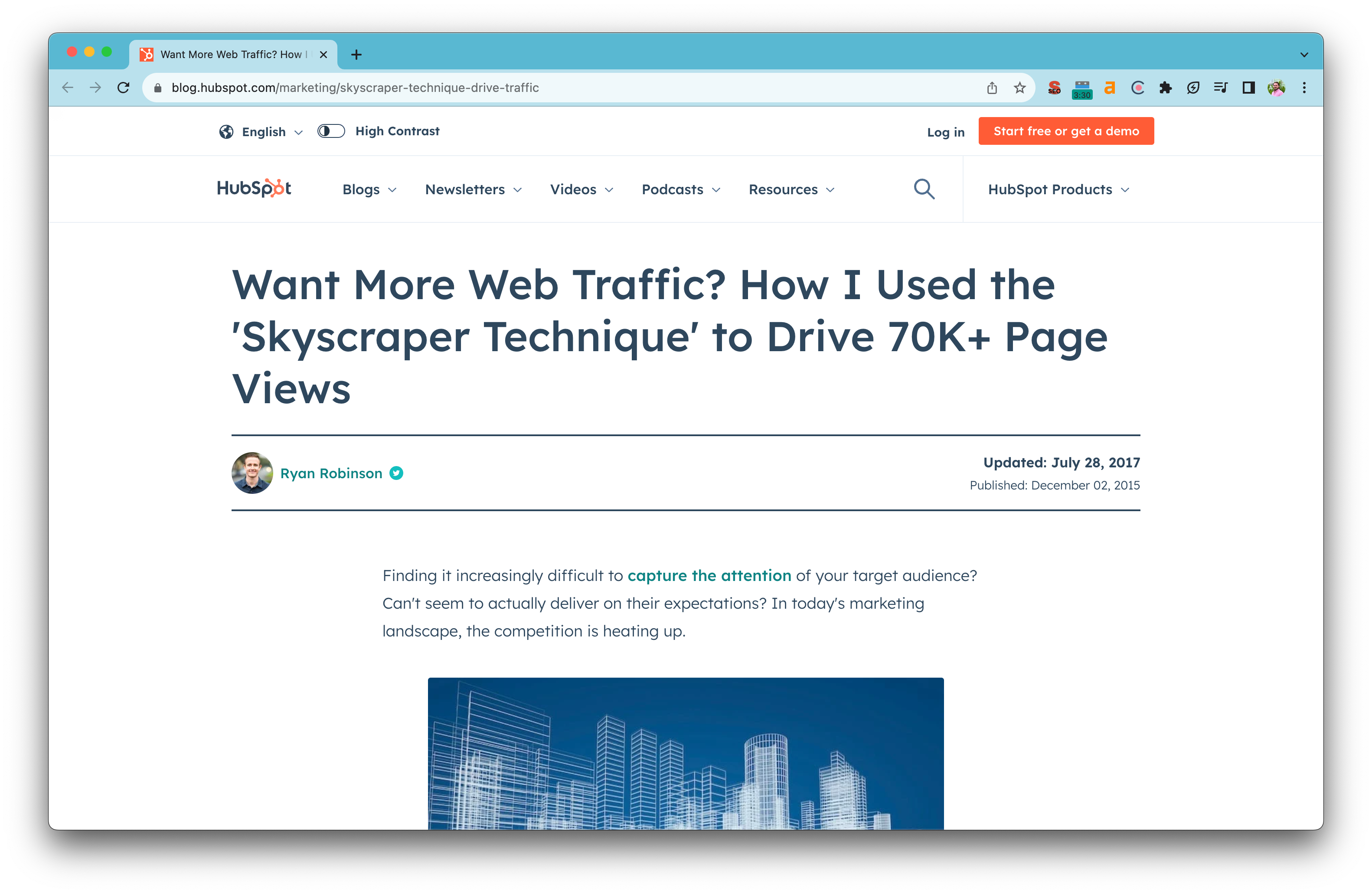
HubSpot: How to Use the Skyscraper Technique to Drive Traffic
[bctt tweet=”Synopsis: HubSpot: How to Use the Skyscraper Technique to Drive Traffic” username=”w2scott”]
Synopsis: The article discusses the increasing difficulty of capturing audience attention in the current marketing landscape. It introduces the Skyscraper Technique as a solution, detailing its creation by Brian Dean of Backlinko. The technique involves improving existing popular content and then reaching out for backlinks.
What’s the Skyscraper Technique?
It’s a method for turning content into high-quality backlinks.
The process involves researching popular content, creating a better version, and then reaching out to those who linked to the original content.
Reasons for its effectiveness include:
Proven demand for the content topic.
Engaging an already primed audience.
Potential for high search rankings.
How HubSpot Used the Skyscraper Technique:
The author shares a personal experience where they saw a similar article from Fast Company about a freelance hourly rate calculator.
They created a visually appealing infographic on the same topic and promoted it.
The result was over 8,200 shares, 72,000+ page views, and 3,648 new email subscribers.
6-Step Checklist for Using the Skyscraper Technique:
Research and Uncover Opportunities: Use tools like Google Alerts, BuzzSumo, HubSpot’s Keyword App, and Google’s Keyword Planner.
Build a List of Potential Distribution Partners: Start with known contacts and expand using BuzzSumo.
Create Better Content: Consider different content mediums and focus on delivering more value.
Promote to Your Audience: Share on social channels, email lists, and internally.
Reach Out to the Right People: Contact influencers, brands, and bloggers who share related content.
Stay Current: Update content to ensure it remains relevant over time.
Comparison With the Original Article by Backlinko:
Both articles emphasize the importance of improving upon existing content and reaching out for backlinks.
HubSpot provides a personal case study to showcase the effectiveness of the technique.
HubSpot offers a step-by-step checklist, making the process more actionable for readers.
Unique or Noteworthy Positions:
The article emphasizes the importance of staying current and updating content over time.
HubSpot’s personal case study provides a tangible example of the Skyscraper Technique’s success, highlighting the potential benefits when executed correctly.
Content Marketing Institute: Skyscraper Content the Right Way: How to Truly Help Your Readers
[bctt tweet=”Synopsis: Content Marketing Institute: Skyscraper Content the Right Way: How to Truly Help Your Readers” username=”w2scott”]
Synopsis: The article critiques the overuse and misuse of the Skyscraper Technique in content marketing. While acknowledging the original brilliance of the concept, the author argues that many content creators equate the technique with producing longer content, rather than more valuable content.
What Is Skyscraper Content?
It involves finding successful content, reverse-engineering its success, creating a better version, and replicating its distribution strategy.
The author encourages readers to refer to Brian Dean’s post on Backlinko for a good example of the methodology.
What’s Wrong With Skyscraper Content?
Many content creators mistakenly believe that longer content equates to more value.
The focus on length can lead to padding posts with unnecessary information, making it difficult for readers to find valuable insights.
Skyscraper content can become inaccessible if it’s always lengthy and doesn’t consider the reader’s experience.
Google’s algorithm prioritizes content that meets readers’ needs, so skyscraper content that doesn’t prioritize readers may not rank well.
Unoriginal Content:
Skyscraper content can lead to unoriginality, as creators model their content after existing successful pieces.
The challenge is to find a unique angle and add value to the original topic.
Merely adding more words without offering a fresh perspective can make the content redundant.
How to Make Skyscraper Content Work:
Genuine Need: Update content that’s outdated or full of broken links.
Unique Angle: Offer a new perspective or personal account on a familiar topic.
Focus on Value, Not Text: The goal is to create content that’s more valuable, not necessarily longer. For instance, transform a long article into a video or an interactive tool.
Conclusion: While the Skyscraper Technique can be powerful, it’s essential to use it correctly. Content creators should prioritize value over length and ensure they’re genuinely helping their readers. If the content doesn’t add value, it’s better to create something original that delights the audience.
Comparison With the Original Article by Backlinko:
Both articles discuss the Skyscraper Technique’s methodology.
The Content Marketing Institute article critiques the overuse and misuse of the technique, emphasizing the importance of value over length.
The article suggests that many content creators misunderstand the Skyscraper Technique, leading to redundant and unoriginal content.
Unique or Noteworthy Positions:
The article offers a critical perspective on the Skyscraper Technique, highlighting its potential pitfalls.
It emphasizes the importance of originality and value in content creation, rather than merely replicating successful content.
CoSchedule: The Skyscraper Technique: Why You Should Use It
[bctt tweet=”Synopsis: CoSchedule: The Skyscraper Technique: Why You Should Use It” username=”w2scott”]
Synopsis: The article introduces the Skyscraper Technique, a three-step SEO method that involves finding top-performing content, creating better content, and then promoting it to gain backlinks. The author emphasizes that while the technique is rooted in SEO, it’s beneficial for all content marketers, not just SEO experts.
Understanding the Skyscraper Technique:
It’s not exclusively an SEO strategy.
It’s not a license to steal or replicate someone else’s content without adding value.
How to Use the Skyscraper Technique:
Find Top-Performing Content:
Use tools like BuzzSumo to identify popular content based on keywords.
Analyze the top content to understand its themes, content length, number of images, and overall quality.
Use tools like the Moz Toolbar to gather backlink information and understand the authority of the content.
Create Better Content Than Current Top Performers:
Make content longer and more in-depth.
Incorporate rich content like images, videos, and infographics.
Delve deeper into the topic to provide more value.
Think strategically about SEO and keyword usage.
Get People to Link to Your Content:
While promoting with social media marketing is a start, the key is to earn backlinks by producing superior content.
The focus should be on generating better content ideas and improving content quality.
Conclusion: The Skyscraper Technique provides insights into what content is performing well and what’s being shared the most. It’s a valuable method for generating new content ideas and improving content marketing strategies. The ultimate goal isn’t to replicate but to innovate and produce better content.
Comparison With the Original Article by Backlinko:
Both articles describe the Skyscraper Technique’s methodology.
CoSchedule emphasizes the technique’s applicability beyond just SEO experts and highlights its broader benefits for content marketing.
The article provides specific tools and methods to implement the technique effectively.
Unique or Noteworthy Positions:
The article stresses that the Skyscraper Technique is not just for SEO experts but is a valuable strategy for all content marketers.
It underscores the importance of adding value and not merely replicating existing content.
Semrush: What Is the Skyscraper Technique?
[bctt tweet=”Synopsis: Semrush: What Is the Skyscraper Technique?” username=”w2scott”]
Synopsis: Semrush provides a comprehensive guide on the Skyscraper Technique, emphasizing its role in SEO link building. The article breaks down the technique’s definition, its benefits for SEO, and a step-by-step guide on its execution. It also discusses the importance of skyscraper content and the factors that make it stand out.
Key Points:
Definition of the Skyscraper Technique: A method that involves identifying competitive content with many backlinks, improving it, and then encouraging sites to link to the superior content.
Skyscraper Content: Content crafted as part of the Skyscraper Technique, designed to be a superior version of a widely linked resource. It should be more comprehensive, up-to-date, credible, and presented effectively.
Benefits of the Skyscraper Technique for SEO:
Inheriting links that previously pointed to competitors.
Earning backlinks on pages with established traffic and authority.
Encouraging the creation of quality content.
Scalability.
Implementation Steps:
Find Competitive Content: Identify content types suitable for the Skyscraper Technique, such as how-to guides, comparison guides, listicles, and more.
Analyze Competitors’ Content: Use tools like Semrush’s Backlink Analytics to find competitors’ most linked pages.
Review Backlink Opportunities: Determine the potential and value of inheriting specific backlinks.
Create Skyscraper Content: Outdo the competition by being more comprehensive, adding unique insights, improving user experience, establishing credibility, and incorporating images and videos.
Optimize Content for Search: Ensure the content is optimized for relevant keywords and follows on-page SEO techniques.
Conduct Email Outreach: Identify link building prospects and send personalized pitches to encourage them to link to your content.
Conclusion: The Skyscraper Technique is a targeted approach to link building that can yield significant SEO benefits when executed correctly.
Unique or Noteworthy Positions:
Semrush provides a detailed breakdown of the types of content suitable for the Skyscraper Technique, offering clarity on content selection.
The article introduces tools and resources available within the Semrush platform, guiding readers on how to optimize their skyscraper content and conduct effective outreach.
It emphasizes the importance of personalizing email outreach and provides a sample skyscraper email pitch to inspire readers.
Brian Dean Didn’t Have Today’s Software
Yes, machine learning and natural language processing are making the collection and production of website content more approachable. Data analysis is also helping with optimization. With tools like SurferSEO, Frase, and others, you can ensure your content isn’t just longer and more comprehensive, but also better optimized.
Link builders know that one of the best ways to get new links is for your site to be the answer to what people are searching for.
There is an explosion in data exploration products for on-site optimization. The challenge isn’t finding one — it’s limiting yourself to just one.
[bctt tweet=”There is an explosion in data exploration products for on-site optimization. The challenge isn’t finding one — it’s limiting yourself to just one.” username=”w2scott”]
No lie, I currently actively use at least five machine learning-enabled SaaS products.
Concluding Thoughts: No, It’s Not Data Science
Hopefully, you see how incredibly powerful this technique can be.
Like many users of AI content — consistent with human nature, you may be tempted to take shortcuts.
SEO tactics, when abused, lose effectiveness. So, please don’t abuse this.
The SEO Skyscraper Technique with ChatGPT Data Mining will be most useful when a human, knowledgeable in the topic, is making a good AI Sandwich. If you copy and paste and perfunctorily add the non-AI bits, you won’t be adding value to the internet and will eventually see any rankings you did gain disappear.
Something noteworthy in this example is that I’m seeing more sites that aren’t accessible to ChatGPT. I wonder if this is due to those webmasters blocking the OpenAI crawler.
[bctt tweet=”I’m seeing more sites that aren’t accessible to ChatGPT. I wonder if this is due to those webmasters blocking the OpenAI crawler.” username=”w2scott”]
Also, ChatGPT has some words that show up again and again. You should be on the lookout for these so you can edit them where appropriate. “Delve” and “boost,” particularly in the context of SEO, come up again and again.
You’ll notice I tend to be polite when I’m making requests of ChatGPT. This is for two reasons. First, I’m generally a polite person. Politeness counts. Second, when the robots take over, I want every advantage I can get. I would rather they see me as a collaborator 🙂
Finally, as the list of articles to analyze gets longer, you may need to prompt ChatGPT to “continue.”
If you’ve already been using this technique, please hit me up on Twitter and show me some examples, @w2scott.
If you’re just getting started, I hope you find it as useful as I have.
[bctt tweet=”SEO Skyscraper Method + ChatGPT Data Mining = Winning the SERP” username=”searchinfluence”]
Proper search engine optimization (SEO) increases the chances your website will rank highly in search engine results, which could introduce more people to your brand.
Keyword research, content writing, SEO-focused web development, link building, and analytics are all key SEO skills that work together to give you greater results.
Do-it-yourself SEO presents several pitfalls and challenges that waste time, money, and resources. Having a dedicated team of SEO specialists is a more reliable way to achieve long-term search success.
Imagine a world where over half of your website’s traffic comes purely from organic search (i.e. the unpaid listings that appear on a search engine results page).
In reality, it’s not that far-fetched, considering 53.3% of website visits originate from this digital marketing channel.
But, ranking at the top of search engine results and reeling in more website traffic isn’t just about having an online presence. It’s about leveraging the magic touch of search engine optimization (SEO) to rank high and stay ranked high.
It takes many different skill sets — technical, creative, strategical, and analytical — to truly “win” at SEO and markedly increase website traffic. As an under-experienced SEO practitioner, proper SEO can be difficult to successfully implement.
You need an experienced team to maximize your SEO campaigns and enjoy the benefits of a well-optimized, high-traffic site.
5 Essential SEO Skills to Boost Website Rankings
Research and analytical skills for effective SEO
Every search starts with a keyword or search term.
Consequently, every SEO strategy starts with keyword research.
Keyword research is the process of identifying words, phrases, and queries that users search for and incorporating them into your website’s content to improve your site’s rankings on search engine results pages. It entails analyzing what you currently rank for, what your competitors rank for, and what you should rank for.
Performing thorough keyword research means better understanding users’ search intent, which is what they are trying to get out of a particular search. But, for more novice SEO practitioners, pinpointing intent can be tricky. Many phrases and queries can be interpreted in multiple ways.
For example, a higher education institution would have to consider the many possible meanings behind the keyphrase “how to go back to school.” An SEO specialist can cater to each niche search, tailoring strategies to capture where prospective students are on their path to enrollment.
Content writing for keyword optimization
After identifying high-value keywords and phrases, you need to integrate them into the written content on your website.
SEO experts use relevant keywords to create compelling title tags and meta descriptions for each page, as well as in longer sections of text, such as blog posts and descriptions of products and services.
Using these SEO copywriting skills for engaging content creation ensures that your site contains the right keywords and phrases. This improves your on-page SEO and your rankings in search engine algorithms.
But, including keywords is only half the battle. First and foremost, your content needs to include all the important information on the topic and meet Google’s E-E-A-T standards (Experience, Expertise, Authority, and Trustworthiness). With an SEO specialist’s content and research expertise, both users and search engines will know what your business is about and the services you provide.
Technical SEO expertise for site health
Having a slow, clunky, user-unfriendly website will quickly drive potential customers away.
A professional digital marketing team has the SEO knowledge and technical SEO skills for site speed optimization, which includes:
Implementing a responsive and easy-to-use design
Crafting readable and logical URLs
Optimizing image sizes
Proper technical SEO means anticipating the unique challenges that a site presents and using the toolkit of skills to mitigate them.
Link-building skills for off-page SEO
Backlinks are links to your website that exist on sites other than your own. They help build your web pages’ quality, relevance, and credibility, which ultimately aids with gaining Google’s trust and ranking higher in search.
Seasoned SEO specialists use a number of strategies to grow the number of backlinks to your website, including link building and link earning.
Link building involves manually placing links to your site on social media platforms and directories such as Yelp and Google Maps. With link earning, an SEO professional pinpoints other websites to link to yours organically. This “earned” backlink often occurs because the external site finds your content helpful and engaging to its users.
Analytics and data analysis for SEO
Analytics and data analysis help you learn more about your website’s audience and whether your SEO efforts work as intended.
SEO professionals use tools like Google Search Console and Google Analytics to gather information about visitors to your site, including their age, location, gender, and interests. They can also learn how long visitors stay on your website, click-through rates, which pages are viewed the most, and which features and pages are getting ignored.
This information is incredibly valuable for revising and improving your overall SEO strategies moving forward.
Challenges and Pitfalls of DIY SEO
Unless you have the resources and budget for a robust in-house SEO team, you’ll need to partner with an outside SEO-focused agency. One unexpected pitfall or neglected search tactic could lead to missed conversion opportunities and rankings well past the 10th+ page in the search results.
The cost of subpar SEO efforts isn’t just financial. When you settle for less, you can face costly mistakes and consequences like:
MISTAKE: Only focusing on on-site SEO and missing out on opportunities to build backlinks.
IMPACT: Hinders your site’s authority and ranking potential, limiting its reach and effectiveness in attracting a wider audience.
MISTAKE: Neglecting to create and optimize page titles and meta descriptions.
IMPACT: Leads to suboptimal search engine rankings, reduced click-through rates, and a missed opportunity to attract users through relevant queries.
MISTAKE: Not regularly adding fresh, relevant content to your site.
IMPACT: Results in under-optimized and insufficient content that fails to interest users, which can negatively affect search engine rankings.
MISTAKE: Lack of comprehensive keyword research and proper keyword targeting.
IMPACT: Ends in fewer keyword rankings, which leads to less visibility in search engines and decreased site traffic.
MISTAKE: Viewing SEO as a one-time task instead of continuously improving existing strategies and trying new ones.
IMPACT: Results in stagnant or declining search rankings, reduced web traffic, and missed opportunities for growth and adaptation in a constantly evolving digital landscape.
MISTAKE: Failing to meet Google’s E-E-A-T requirements (Experience, Expertise, Authority, and Trustworthiness) for on-site content.
IMPACT: Leads to useless, under-performing content that is unlikely to engage users or generate backlinks.
Why You Need an SEO-Focused Agency in Your Corner
Expertise is your greatest ally
Choosing an SEO-focused agency means tapping into years of cross-industry expertise. Their holistic teams master everything from the intricacies of technical SEO to content strategy and analytics. Plus, they’re always on the pulse of search’s ever-evolving best practices and SEO industry standards.
You get help tracking leads and overall performance
With an SEO-specialized agency, tracking leads and assessing overall performance become seamless. By mastering platforms such as Google Analytics, they map out user trends, traffic flow, and conversion points. Equipped with a constant pulse on keyword performance, you’re kept in the loop about rankings, search prevalence, and click metrics.
Scaling efficiency is the standard
With an SEO-attuned agency by your side, you get efficiency that’s geared to scale. Their prowess ensures marketing techniques ebb and flow with your growth and diversifying needs, always on the lookout for new market horizons and untapped customer sectors.
It’s cost-effective in the long run
Partnering with an SEO-driven agency is a strategic move for long-term cost savings. Their expertise ensures the best search ROI — making every dollar count to drive maximum value from your investment. Proficient teams maintain efficient resource use, eliminating unnecessary expenditures to achieve the best possible results. In addition, their arsenal of specialized SEO tools, often expensive to procure independently, becomes yours.
Our New Orleans SEO Agency Is Here to Help
Using SEO successfully takes a lot of skill and patience, but the payoff is well worth the effort. From higher search rankings and boosted web traffic to increased revenue, the rewards are transformative — and imperative — for your overall performance.
An experienced and dedicated SEO specialist can do the heavy lifting for you and help you see real-world, real-time results.
Search Influence is an SEO-focused, full-service digital marketing agency with the tools, expertise, and driven professionals you need to build your business through SEO. Our designers, developers, writers, and campaign strategists will work together to help you reach and grow your online audience with greater ease than ever before.
Ready to craft a winning SEO strategy? Contact us today to learn more about our SEO services and results.
We’re grateful for the engaged audience, who brought us compelling questions. It was obvious from what they asked that we had some tech-savvy folks attending.
For those who have yet to dive into the study, we’ve got you covered with a summary of the key takeaways:
Marketing and institutional leaders see SEO as foundational but admit their PCO units lack SEO strategy.
In fact, in the SEO readiness audit of 100 random UPCEA member institutions, only 19% had an excelling score.
And to pre-answer a question some may ask, this is an UPCEA metric. Search Influence collaborated on the factors, but the grades came from the research itself.
Why Is SEO Important in Higher Education?
From our discussions with higher ed marketing leaders, individual PCO units spend significant dollars on paid online advertising and next to nothing on SEO.
The ROI of SEO is obvious to anyone paying for paid search. Keywords in search can inform your SEO strategy. If you’re paying for it and you don’t rank #1, that’s an opportunity.
Any department that has in-house web management, social media, or content creation staff has the makings of an SEO team already in place.
In short, SEO is foundational — most know it, and few are doing it.
Higher Education SEO Questions From the Audience
The following questions came directly from the audience in the webinar Q&A section. We clearly had a smart audience and appreciated all the great questions.
Q: Which other tools do you use for keywords?
In the webinar, we talked about how we used Semrush data for part of the SEO audit done by the UPCEA team, hence the “other tools.”
A: One of the best “keyword” tools any organization can use — especially resource-strapped higher ed marketers — is Google Search Console. GSC gives you the ability to see page-by-page and query-by-query where your opportunity is.
It also shows you what Google thinks you’re relevant for already, which can identify a shorter path to execution.
In addition to GSC, at Search Influence, we rely on a few tools depending on the use case:
Ahrefs – Great overall tool, with an especially good view of page and subdomain level authority
Semrush – Another great tool overall, with reporting and site auditing capabilities
Surfer SEO – This one is newer in our toolbox. It’s not a pure “Keyword” tool. It’s actually an optimization tool that can help identify content clusters for building topical authority, as well as auditing and outlining SEO optimization of individual pages.
Q: How do you navigate building backlinks without buying backlinks in a way that Google “disapproves” of?
Google says, “Any links that are intended to manipulate rankings in Google Search results may be considered link spam.”
That doesn’t mean that all “backlinks” are bad. It just means you should look for good links. What is a good backlink? A good backlink is one that is relevant, directional, and on a site likely to drive real users.
Just because you ask for it doesn’t make it bad. It’s about intent.
Some easy opportunities:
Local citations, such as directory listings
Other schools within your parent university or college
Institutions you collaborate with in real life
Local organizations with which you support or partner
Q: Are internal links counted as backlinks?
No. They’re internal links, which are awesome, too.
There are a bunch of great things about internal links:
You get to control the anchor text used.
They can help to reinforce topical authority, e.g.:
You have portfolio pages
Which have program pages
Who have individual courses and
Instructors and
Resources and
Etc.
They’re navigational — in other words, they support the student journey, moving prospects down the funnel toward their eventual application.
Q: Advice on structuring some complete revision of websites? Would you recommend program by program, or another way?
This is a classic “it depends” kind of situation. From a business and organizational perspective, what matters most?
Is it most important to categorize by type, e.g., on-campus, hybrid, certificate, non-degree, etc.?
Or by program, e.g., homeland security, human resources, organizational management, etc.?
Once you make that decision, stick to it, build your silos — but not too deep — and think about reasonable interlinking between them.
Q: From the user side, have you noticed any impact on CTR with truncated title tags?
Not really, but it’s not something we’ve studied.
Q: Any concern with title tags and truncating on Google?
No. In our opinion, this is an opportunity. It’s Google telling you what great looks like. What we’ve seen is that these are most often picked up from some on-site content.
If you find it happening, consider recrafting your title tag and your leading H1 to match. That should give the machine what it wants.
Q: Any advice on how to shift the narrative that SEO is free or should be very low cost and doesn’t need as much investment?
Echoing what I said above: The ROI of SEO is obvious to anyone paying for paid search. Keywords in search can inform your SEO strategy. If you’re paying for it and you don’t rank #1, that’s an opportunity.
The keyword ranking tool we use just came out with a new “forecasting” feature. It allows you to build a keyword group, assign dollar value and conversion rate, and see the business impact of moving from position X to position Y over time.
We looked at paid search accounts, grabbed keywords we know to convert, and built forecasts. The impact, in many cases, is staggeringly obvious.
Reach out and we can run a limited version for you.
Conclusion
The UPCEA Higher Education SEO Research Study shed light on the critical need for SEO in PCO marketing and beyond. Many, perhaps most, institutions have a lot of room for growth and optimization.
It’s crucial for universities to recognize the value that SEO can bring to their marketing and seize the opportunity to be present for all their prospective students.
The webinar showcased that, while leaders acknowledge SEO as a foundational element, there’s a gap in implementing effective strategies within PCO units. Additionally, the need for improved reporting for institutional decision-making and better SEO performance among UPCEA members was clear.
It’s time for universities to embrace SEO and reap the benefits of higher visibility, engagement, and growth.
We encourage you to join the conversation, share your own experiences, and learn from others. Feel free to comment below to keep the conversation going.
If you’re looking for expert guidance to help you navigate the world of SEO, don’t hesitate to get in touch with Search Influence.
We’re here to support you in optimizing the potential of your organization.
Update from the “Correlation is not Causation” file.
While investigating more, I noticed this in Google Search Console. A client who has historically had consistent #1 ranking for a specific phrase showed significant volatility in the last month. That volatility roughly coincides with the finalization of the March Core Update.
Original Post: May 5th, 2023
On a monthly basis, we look at various data for some, not all, clients to include in what we call “Highlights and Insights,” or H&I as I like to call them.
Among the things we look at are:
Traffic
Ranking
Pages getting traffic
Recent work (i.e., deliverables)
SMART goals, if applicable
I have personal responsibility for the SEO strategy of a small number of clients. I know it’s funny — the CEO is doing SEO strategy. But, with maternity leaves, hiring, research and development, and personal relationships, it’s important to me.
This means I’m responsible for three clients’ H&I. I was surprised as I was preparing them to see that their April 2023 Google organic and paid search traffic is universally down month-over-month.
So I wondered, is it me? Are we doing something wrong? But, no.
It turns out that all of them have seen increases in ranking, both in our keyword tools and in Google Search Console. We’re also seeing individual pages we’ve been optimizing or promoting get more prominence relative to the site as a whole.
I feel a little bit vindicated.
So I took my confusion to Twitter.
The first to chime in was Brett Tabke of Pubcon fame.
Zero click Serps are up again. The amount of spam Google is throwing on Serps continues to grow unabated.
Next was Susan Staupe, LocalU Superfan and a great marketer in her own right.
Im seeing organic and ads down across the board! ugh.
— Susan M. Staupe – Beyond SEO, LLC (@SusanStaupe) May 5, 2023
And I was reminded of Cindy Krum’s presentation at the recent Zenith Conference in Duluth, where she talked about Google features pushing her client out of the entire space above the fold during the World Cup for Football (aka Soccer) related searches.
So, of course, I mentioned that, and Cindy contributed.
Yup – Zero-click or a Google-mediated click, where they send to Product Knowledge Graph/Merchant Center/Doorway pages.
And finally, though he gave a “hard to say” on this one, Barry Schwartz suggests this may be related to the April 2023 Reviews Update:
why did you include my post about an unconfirmed update from this week (i.e. May 2023) in regards to a traffic drop in April… If anything, maybe it is related to the April 2023 reviews update (which I assume you know about?) https://t.co/buiUYyh0FU
Or perhaps, for “I’m wondering” kind of questions people are going to ChatGPT.
The masses know about ChatGPT — the headlines are everywhere. And as I showed in my AI content presentation at Pubcon and Zenith, Google Trends data demonstrates that ChatGPT is in the consciousness of everyday Americans.
Who knows?
I’m just glad it’s not just us, and I’m hopeful Google gets its act together for the sake of all those businesses who rely on that traffic.
And our outlier — because there’s always one — Lawn and Garden. It’s springtime, you know.