Category: SEO

  • UPCEA Webinar Top Takeaways: SEO for AI Search

    \This post was updated by Ren Horst on 05/01/2025 after the webinar took place. It was originally published on 04/02/2025.

    Key Insights

    • AI is driving a shift toward instant answers, changing how online content is found and reducing the need to click through to webpages.
    • To compete, your content must reflect people’s intent, not just what they type.
    • Institutions that act now can maintain visibility where it matters most: at the decision point.
    • Pages that emphasize clarity, structure, and real-world context are more likely to be picked up by AI tools.
    • External signals like mentions, citations, and schema help reinforce your authority.

    As artificial intelligence reshapes how prospective students search for information online, higher education marketers are under growing pressure to adapt.

    In the recent webinar “SEO for AI Search: Protect Your Student Enrollment Pipeline,” presented by Search Influence and UPCEA, Search Influence Director of Paula French (Director of Sales and Marketing, Search Influence), Will Scott (Co-Founder and CEO, Search Influence), and Bruce Etter (Senior Director of Research and Consulting, UPCEA) broke down what institutions need to know — and do — now.

    The session covered three critical areas: how AI is transforming search behavior, why core SEO practices still matter in this new search world, and what your team can start doing today to remain visible.

    If you missed it live, here are the top takeaways to help shape your AI SEO strategy.

    SEO for AI Search Webinar: Top Takeaways

    Understanding AI search

    What is AI search?

    AI search is a search experience powered by artificial intelligence that delivers complete, synthesized answers to queries, instead of the traditional list of clickable links.

    Platforms like Google’s AI Overviews, ChatGPT, Gemini, Microsoft Copilot, and Perplexity don’t always send users to web pages—instead, they generate answers using large language models (LLMs) trained on vast datasets, sometimes enhanced by retrieval-augmented generation (RAG), which pulls in real-time web content.

    However, these models also rely on entities, citations, and structured data to decide what gets included in responses.

    These tools prioritize clarity and credibility, reshaping how content is surfaced. This shift is changing how users interact with search and how institutions must approach their content strategy.

    How is AI search changing user behavior?

    Instead of scrolling through organic results, users increasingly receive answers to search queries directly from tools like Google’s AI Overviews and ChatGPT.

    This has led to a sharp increase in zero-click searches, where the search ends with the summarized response, without a need for the user to visit a website.

    The trend is accelerating fast as AI usage grows. ChatGPT reached 100 million users within two months of launch, and generative AI adoption has already hit 39.4%, outpacing the early growth of both the internet and personal computers.

    As these platforms prioritize quick, in-platform answers, some sites are seeing organic traffic drop by as much as 15% to 64%.

    The space for traditional organic links continues to shrink. It’s not just AI-generated results pushing them down—today’s search engine results pages (SERPs) are packed with product carousels, featured snippets, People Also Ask boxes, and other dynamic elements that crowd out classic blue links.

    But the window isn’t closed. It’s simply shifting. Clear, structured, and credible content still has a shot at visibility, especially if it aligns with how people phrase questions and how AI systems choose what to surface.

    Rethinking SEO in the age of AI

    What is SEO for AI search?

    SEO for AI search is the strategy of optimizing digital content to be surfaced, cited, or featured in answers generated by AI-powered search tools.

    This approach focuses on helping AI platforms recognize your content as authoritative, relevant, and structured enough to use in their responses.

    Instead of focusing on organic search engine results rankings, the intent is to be referenced directly in the answer, whether through a citation or inclusion in the response itself.

    To achieve this, your content must be semantically clear, supported by schema markup, and aligned with what AI considers trustworthy. The goal is to build pages that speak fluently to both human intent and machine logic.

    How does traditional SEO differ from AI search SEO?
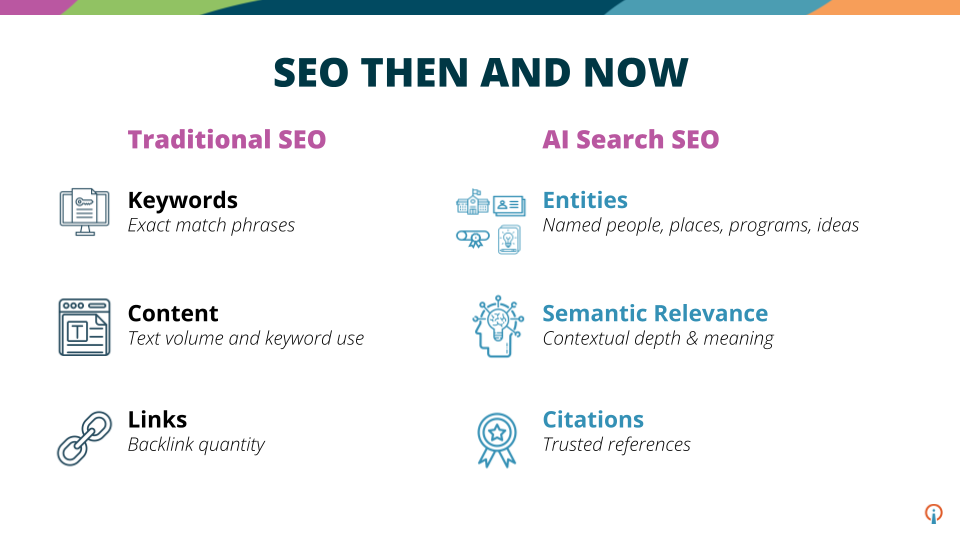
    SEO THEN AND NOW. Traditional vs AI Search SEO

    Traditional SEO is driven by ranking factors like exact-match keywords, content volume, and backlinks. AI search SEO takes a different approach, one that aligns with how artificial intelligence models gather, interpret, and present information.

    Instead of keywords, it prioritizes entities: clearly defined people, programs, places, or concepts that AI can recognize and connect across sources.

    Rather than focusing on content volume, it values semantic relevance: how well your content reflects user intent and contextual meaning.

    And instead of relying solely on backlinks, it rewards citations: trusted references that help AI validate your authority.

    Some refer to this evolving strategy as Generative Engine Optimization (GEO). At Search Influence, we prefer AI SEO or AI search SEO, because it’s still SEO, just built for visibility in the next generation of search.
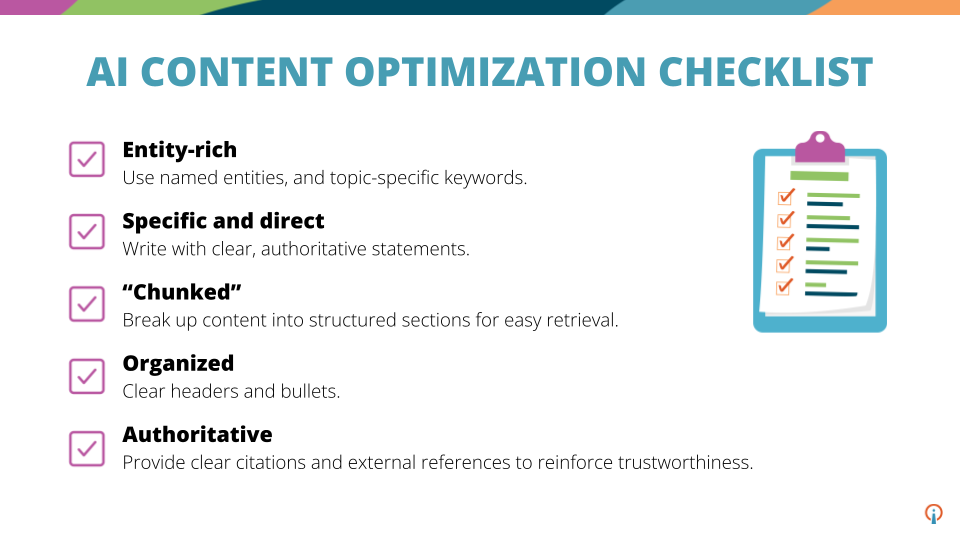
    AI Content Optimization Checklist

    Improving visibility in AI-driven search

    How can you make your content entity-rich?

    The more your content aligns with how entities are framed in trusted sources, the better chance you have of being included in AI-generated responses.

    To show up in AI-powered search, your content needs to be entity-rich. That means using clear, recognizable references to your university, schools, programs, and related topics, so AI knows exactly what you’re talking about.

    But getting there takes more than keyword tools. You need to look at the places where entities already “live,” like Wikipedia.

    For example, if you’re trying to rank for higher education, it helps to know that Wikipedia actually treats that as part of a broader entry: tertiary education. Inside that page, you’ll also find related concepts like continuing education and vocational education, all tied to the same entity. In this example, you can use structured data and clear language to help AI connect your content to those recognized ideas.

    Why is schema markup important for entity optimizations?

    A traditional SEO tactic, schema markup is a type of behind-the-scenes code that helps search engines understand your content and relate it to the right entities.

    It’s not visible to site visitors, but it gives AI extra signals about your content’s topic and structure.

    While it’s still unclear how directly AI tools use schema, we know it plays a key role in organic search, and strong organic signals are still one of the best ways to boost your website’s visibility in AI results.

    On university websites, schema can clarify who you are, what you offer, and how different pieces of content relate to your institution. It helps reinforce entities like your university name, academic programs, and faculty, especially when paired with clear language on the page.

    Some helpful types of schema include:

    • Article schema: Tells AI the headline, description, and type of content
    • Publisher schema: Links content back to your institution as the source entity
    • SameAs schema: Connects your content to other relevant entities and concepts across the web

    There are also education-specific options, like EducationalOrganization and Course schema, that help AI connect your site to topics like higher education and online learning.

    How do you optimize for semantic relevance?

    AI-driven search engines and tools prioritize meaning over keywords. To stay visible, your content needs to reflect how real people think, search, and ask questions.

    1. Write with intent: Answer specific questions, connect related topics, and provide helpful context, even if you’re not writing in a Q&A format. This shows AI your content is built to inform, not just rank.
    2. Keep it chunked: Use short, focused blocks of around 170–200 characters. That’s how information appears in AI Overviews and featured snippets, and it increases your chances of being included.
    3. Prioritize structure: Use clear headings (H1s, H2s) and make sure your page titles say exactly what the content delivers. When your content is easy to scan, it’s easier for AI to understand and surface in results.

    How can you use semantic triples to make your content more findable?
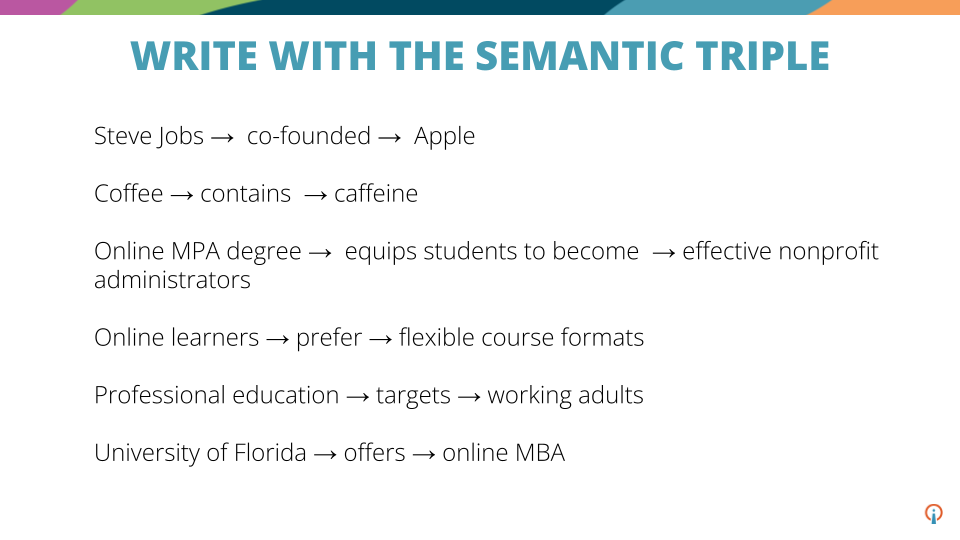
    Write with the Semantic Triple
    Semantic triples are foundational to AI-powered search. From Google’s Knowledge Graph to AI Overviews, these tools rely on clear, structured relationships to understand what your content means and when to surface it.

    Each semantic triple follows a simple format: subject → predicate → object.

    For example:

    University X → offers → a nationally ranked online MBA
    That MBA → leads to → career advancement for working professionals

    This structure helps AI connect the dots between your institution, your programs, and the outcomes students care about. The more often these relationships appear, both on your site and across trusted sources, the more likely AI is to recognize your relevance and elevate your content in search.

    To use semantic triples effectively:

    • Identify the core relationships in your messaging (Who? Does what? Why does it matter?)
    • Express those ideas in short, direct statements, especially in headings, intros, and metadata.
    • When possible, link related triples together in a way that still sounds natural to readers.

    For instance, you can combine two triples into a persuasive sentence:

    University X offers a nationally ranked online MBA that leads to career advancement for working professionals.

    This kind of structure isn’t just good writing. It’s exactly what AI is built to understand.

    What are citations in SEO, and how do they help AI understand your authority?

    Citations (mentions of your institution, programs, or people across the web) help AI connect your brand to the topics you want to rank for.

    These references don’t always need to be clickable links. What matters is consistent, contextual mentions in trusted places.

    AI-powered search engines look for co-occurrence, which is how often your name appears near relevant terms on authoritative sites. These mentions could come from news articles, faculty bios, higher ed directories, speaker bylines, or awards listings.

    The more often your institution is tied to specific keywords or subject areas, the more likely AI is to recognize you as an authority.

    To strengthen your citation signal:

    • Choose a consistent, “locked-in” phrase that reflects your niche (e.g., top-ranked online business program).
    • Use it in boilerplate descriptions, press releases, faculty bios, and guest content.

    However, citations work both ways. When your site links out to reputable sources, it shows AI that you’re part of a trusted information network. Referencing government data, academic research, or respected media outlets adds credibility and helps AI understand the context of your content.

    Where can you build citations?

    There are plenty of places to earn citations — if you know where to look.

    Some require cross-team coordination, while others are quick wins you can act on immediately. The key is to show up consistently in trusted, topic-relevant spaces.

    Ideas include:

    • Online directories like Niche, Peterson’s, and BestColleges
    • Media coverage in outlets such as Inside Higher Ed, The Chronicle, or local press
    • Alumni stories and features on industry-specific sites
    • Conference speaker bios and event listings
    • Professional associations like UPCEA, GMAC, and CIC

    Tools for tracking AI search performance

    What are the best tools to track your visibility in AI-powered search?

    Despite popular belief, it is possible to track your AI SEO performance. New tools are emerging fast to meet that demand.

    At Search Influence, some of our top picks include Scrunch, RankScale, and Profound. These platforms offer insights tailored specifically to AI-powered search, helping you understand how your content is being surfaced in tools like Google’s AI Overviews or ChatGPT.

    Other helpful tools include:

    Some platforms focus on surface-level AI visibility metrics, while others dive deeper into entity tracking, co-occurrence analysis, and content structure. The right tool for you ultimately depends on your goals, budget, current tech stack, and reporting needs.

    Q&As From the Webinar

    If you’re a resource-strapped institution, what’s the most important place to start?

    Many academic websites are weighed down by long, unbroken blocks of text. Start by structuring your content in semantic-friendly chunks.

    Chunking your content is one of the simplest, highest-impact ways to improve visibility, especially when time and resources are limited.

    By breaking that content into clear sections, with meaningful headers, concise paragraphs, and scan-friendly formatting, you improve readability for users and make it easier for AI to understand and surface your content.

    Is there a limit to how many external links you should include, or does it depend on the content?

    It depends on the type and length of the content.

    For shorter or more narrative-driven pieces, you may have fewer opportunities to link out. In those cases, it’s better to focus on clarity and flow than forcing in links.

    More external links can be valuable for technical, research-based, or program-specific content, especially when pointing to trusted sources that support your claims.

    If there’s relevant data, industry standards, or authoritative context available off-site, link to it. Just make sure every link adds real value and helps AI understand the credibility and depth of your content.

    How do paid search ads influence AI SEO?

    Paid search doesn’t directly impact how your content is pulled into AI-generated responses, but it can still play an important supporting role. It’s still important to bid on your branded terms. Even if your content appears in an AI-generated answer, paid search helps you control what users see and where they land next.

    There are two layers to how AI search tools work today:

    • LLMs generate responses based on pre-trained data.
    • RAG systems ground those responses in real-time web content pulled from traditional search indexes.

    That means traditional search ranking signals still matter, including engagement metrics like time on site, click-through rate, and user behavior. And that’s where paid search comes in.

    Paid ads can boost visibility and drive more engagement with your content. In turn, that engagement feeds into ranking signals, making your site more likely to be included when AI systems pull from live search data to shape responses.

    There’s another layer to consider: In tools like Google’s AI Overviews, when users click on suggested links, they’re often sent to a follow-up Google search, not directly to your website.

    The first thing they see? Your paid search ad, if you’re running one.

    Why Partner With Search Influence
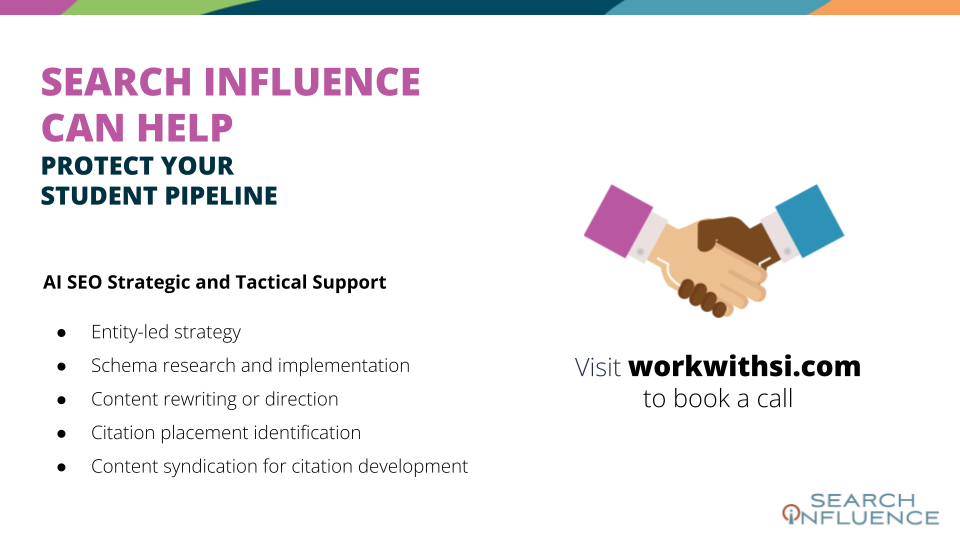
    Search Influence can help protect your student pipeline with AI SEO strategic and Practical Support

    SEO is evolving fast. If your institution wants to stay visible as search engines shift toward AI, your strategy needs to reflect how search works now, not how it worked five years ago.

    At Search Influence, we help colleges and universities take practical steps to improve visibility, increase qualified traffic, and support enrollment goals amidst emerging trends. We’ve spent nearly two decades working with higher ed teams to turn complex websites and limited bandwidth into measurable results.

    We’re here to help you where it makes the most sense, whether that’s full-service execution, in-house team support, or a hybrid approach.

    Ready to explore what’s possible? Book a call with our team, and let’s talk AI search optimization strategies for your institution.

    More resources for higher ed marketers

    • SEO Research Study: Our original research with UPCEA on how colleges and universities are approaching SEO, including gaps, priorities, and benchmarking data you can use to advocate for strategy updates.
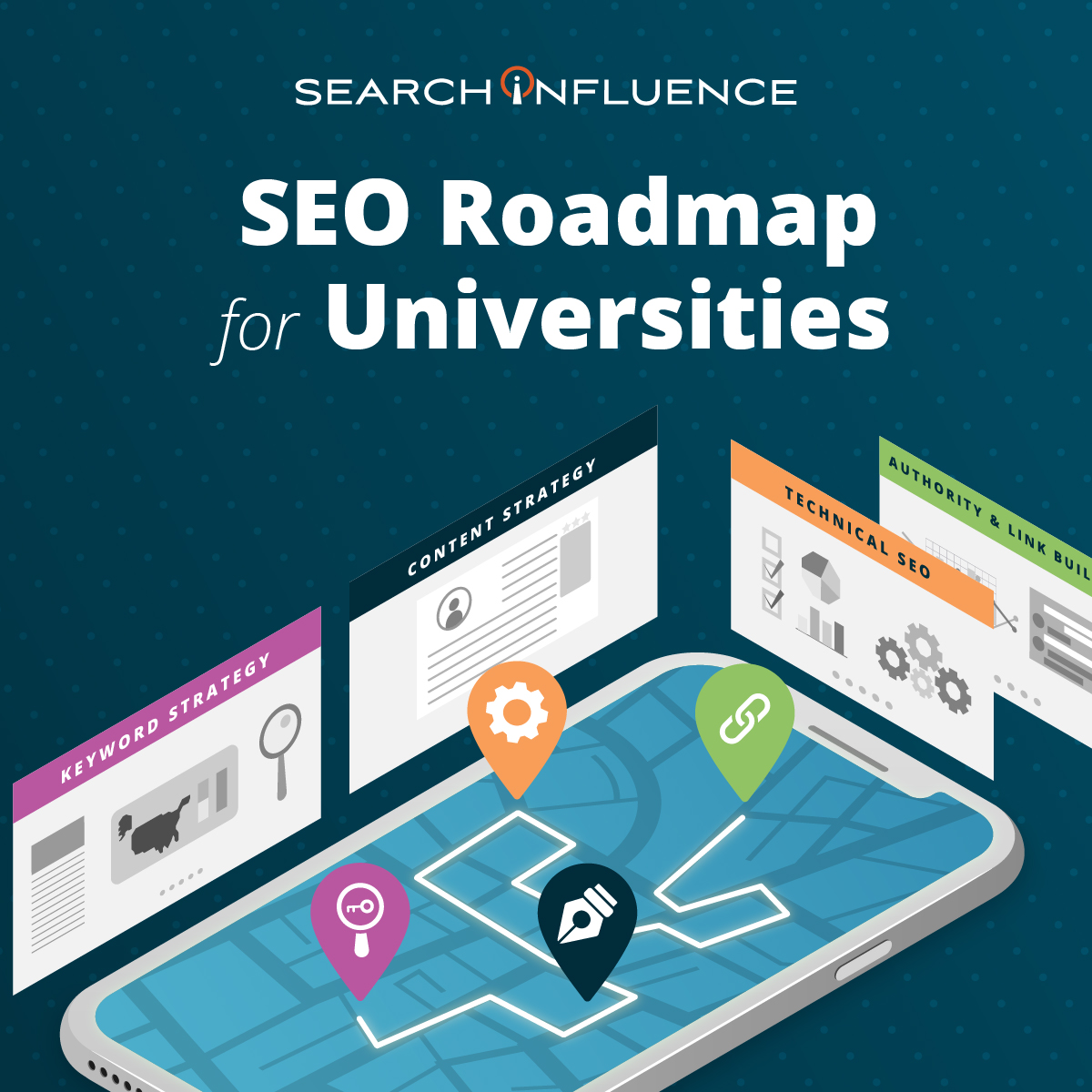
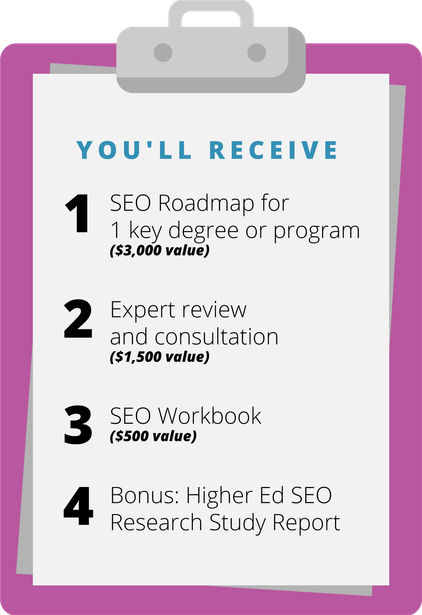
    • SEO Roadmap: A done-for-you strategy (updated for AI search) that focuses on one top program or degree. Built by our team, this roadmap delivers a clear, prioritized plan you can implement over three months, covering keyword strategy, technical updates, content improvements, and authority-building tactics.
    • SEO Workbook: A guided, do-it-yourself resource that helps you uncover site issues, understand your authority, define keyword priorities, and more. You’ll walk away with at least three months of actionable SEO tactics your team can put into place immediately.

    Missed the Webinar? Watch the Replay

    If you want to see the full conversation, including live examples, audience Q&A, and deeper discussion from our panel, watch the complete recording of “SEO for AI Search: Protect Your Student Enrollment Pipeline” on YouTube.

    Whether you’re building your strategy from the ground up or refining what you already have, the full session will give you the clarity, context, and insights you need to make smart decisions in the age of AI search.
  • UPCEA Guest Blog: Paula French Analyzes the Latest SEO Trends in Higher Ed

    Paula French Analyzes the Latest SEO Trends in Higher Ed blog

    Search is evolving fast. Is your institution keeping up?

    In her latest guest blog for UPCEA, “Higher Ed SEO Trends to Stay Competitive,” Search Influence’s Director of Sales and Marketing, Paula French, breaks down four key trends redefining SEO in higher education.

    She explores how AI Overviews are lowering organic results, why platforms like TikTok and YouTube are becoming primary search tools, and how Google’s “People Also Ask” and E-E-A-T signals are raising the bar for ranking.

    If you’re seeing organic traffic drop or struggling to reach qualified prospects, Paula’s blog is your guide to what’s happening and what to do next.

    The Latest SEO Trends in Higher Education, Unpacked

    AI Overviews are reshaping search results

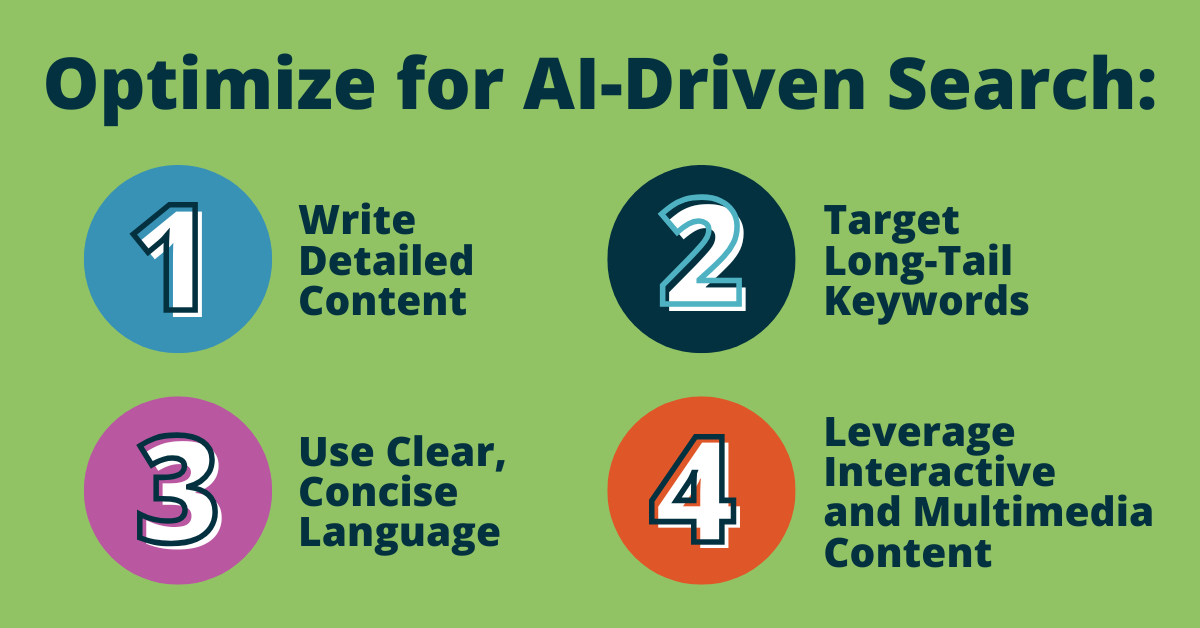
    Google’s AI Overviews now provide quick, synthesized answers from multiple sources and display them at the top of many search results. While this shift can reduce organic traffic, Paula explains how universities can optimize for these summaries by writing detailed, concise content that invites clicks — and still positions the institution as a trusted resource.

    4 steps to optimize for AI-driven search

    Social search is gaining ground

    Today’s students are just as likely to search on TikTok, Instagram, LinkedIn, or even YouTube as on Google. That means institutions must think beyond traditional SEO to social search. Paula shares how repurposing website content and leveraging student-generated media can help schools appear where generations like Gen Z are already searching.

    “People Also Ask” is a missed opportunity

    Google’s “People Also Ask” section remains a powerful place to earn exposure, yet many institutions overlook it. Paula explains how answering common student questions — and structuring content with search in mind — can help universities appear in these high-traffic dropdowns, even as traditional rankings fluctuate.

    E-E-A-T matters more than ever

    With so much information being summarized or reinterpreted by AI, Google’s emphasis on trustworthy sources is only increasing. Paula reinforces why meeting Google’s quality standards, E-E-A-T (Experience, Expertise, Authoritativeness, and Trustworthiness), must remain central to any SEO and AI search strategy for better visibility.

    Across all four trends, Paula offers a strategic lens on what matters most right now: earning attention, trust, and action from the students who are most likely to apply. For more in-depth insights into each trend and how to make them work for you, check out Paula’s full blog post on UPCEA’s page.

    From Insight to Action: The SEO Workbook

    Reading about the latest SEO trends is one thing. Acting on them is another.

    To support higher ed marketing teams in building a competitive SEO foundation, Search Influence created the SEO Workbook, an easily accessible resource packed with hands-on exercises and strategy planning tools.

    Inside the workbook, you’ll find guidance on how to:

    • Evaluate your site’s authority and visibility
    • Build a content strategy around high-value academic programs
    • Strengthen your site’s technical foundation for search
    • Improve discoverability across search results so your organization ranks better in AI summaries, social platforms, and traditional search

    Completing the exercises will give you a prioritized action plan and three months of SEO techniques you can start using immediately.

    If your institution is ready to compete for attention in today’s search environment, this workbook will help you focus your efforts and start seeing real results. Download our SEO Workbook today to bridge the gap between what’s changing in search and what your team does next.

  • AI-Powered Search Is Here — Why It’s Time to Invest in SEO

    AI-Powered Search Is Here — Why It’s Time to Invest in SEO graphic

    Key Insights

    • AI-powered search is changing how users interact with search engines, reducing visibility and click-through rates for traditional organic results.
    • Foundational SEO tactics like high-quality content, structured data, and technical SEO remain essential for visibility in AI-generated answers.
    • AI search tools pull information from multiple sources, favoring authoritative websites that demonstrate expertise, trustworthiness, and topical relevance.
    • Optimizing for conversational, long-tail queries and structured formats like FAQs increases the chances of being featured in AI Overviews.
    • As AI-driven search expands rapidly, higher education, healthcare, and hospitality brands must prioritize investing in a tailored SEO strategy to stay competitive.

    The way people search is changing — fast.

    With AI-powered search engines generating rich, conversational answers on the fly, the traditional list of blue links is no longer center stage. Instead of just indexing keywords, AI search interprets intent, pulls context, and synthesizes content to deliver smarter, faster results.

    Even as AI evolves, one thing remains clear: SEO is still your ticket to visibility.

    But it’s no longer just about rankings — it’s about relevance. And that requires adapting your SEO strategy to show up in these new, AI-powered answers.

    We get it: Investing in SEO can feel like a long jam session with no clear chorus — especially if you’ve been managing things in-house with limited resources.

    You might be wondering…

    Do I have the resources to improve my SEO strategy? Or do we need an SEO agency to keep up with AI search?

    Here’s the truth: Waiting it out isn’t the move. Search engines are changing whether you’re ready or not — and the brands that act now are the ones that will stay visible later.

    If you’re in higher ed, healthcare, or hospitality, your audience is already searching differently. The right strategy will help you adapt your tactics, maximize your visibility, and stay ahead of the curve.

    Learn how investing in SEO can boost your marketing success and prepare your campaigns for AI search.

    Why Is SEO Important for Marketing Success?

    AI-powered search is rolling out across major search engines, changing how users interact with information. For marketers, this means one thing: The earlier you adapt, the bigger your competitive advantage.

    But here’s the kicker — despite all the buzz around AI, users aren’t abandoning traditional search. They’re blending AI tools with classic search queries, using both to explore topics, compare options, and make decisions.

    That means good, strategic SEO content is still the foundation of SEO success.

    If you ignore SEO now, you’re not just missing out on more traffic today — you’re setting yourself up to lose organic traffic when AI search fully integrates across platforms. Search engines will continue to prioritize content that’s relevant, well-structured, and aligned with user intent. If your content isn’t built to meet those standards, AI won’t surface it.

    Industries like higher ed, healthcare, and hospitality are already seeing shifts in how users search, especially as queries become longer, more conversational, and more nuanced.

    Having the right SEO strategy in place now ensures you’re not scrambling to catch up later.

    Ultimately, SEO is a long-term investment. Not just in rankings, but in sustained visibility, brand trust, and future-ready marketing. A smart SEO investment today lays the groundwork for success, no matter how the search landscape evolves.

    Common Hesitations About SEO Investment

    Let’s be real.

    Deciding to invest in SEO can feel overwhelming, especially for local brands trying to balance limited resources and big goals.

    Here are some of the most common reasons marketers hold back:

    “We’re already getting some traffic. Do we really need SEO services?”

    “SEO takes too long to show results.”

    “We tried SEO before and didn’t see much of a return.”

    “Our team doesn’t have the time or budget right now.”

    “Social media and paid ads are working. Isn’t that enough?”

    “AI is changing everything. Should we wait and see what happens?”

    These concerns are understandable, but here’s the truth: Your website is your most important digital asset — it’s the foundation of your online visibility.

    Your “Welcome, come on in!” sign in the digital world.

    Without SEO, it’s not reaching its full potential (or your prospective customers).

    Investing in SEO now means you’re preparing your brand to show up where it matters most. It’s a long-term strategy that drives organic visibility, builds trust, and brings in the right audience over time.

    With so many brands competing for attention online, SEO helps your site stand out to prospects by showcasing engaging online content that makes your brand an authority in your respective industry.

    And now that AI search is rolling out across Google and other search engines, SEO is more than just a nice-to-have. AI relies on structured, high-quality content to deliver answers. If your site isn’t optimized, it’s likely to be skipped over entirely.

    With the right expert guidance, SEO becomes a smart, sustainable way to grow — even in the face of constant change. If you’ve been waiting for the right moment, this is it. AI is changing the way people search, and SEO is the key to staying visible in that new reality.

    What Is AI-Powered Search?

    AI-powered search refers to search engines and platforms using artificial intelligence to generate direct answers, summarize content, and deliver more intuitive, conversational results. It’s a shift from traditional link-based results to dynamic, synthesized responses.

    Google’s version of this — AI Overviews, also known as Search Generative Experience (SGE) — compiles information from multiple sources and presents it directly at the top of the page.

    That means users often get the answer they need without clicking through, a growing trend known as zero-click search. For marketers, this translates to fewer clicks and impressions on traditional organic listings, especially since these AI summaries push results further down the page, shrinking visibility and hurting click-through rate (CTR).

    But there is a silver lining!

    If your brand is optimized for and shows up in AI Overviews, which results in a zero-click search, you still get the benefits of brand recognition. Over time, that brand recognition can lead to clicks.

    How Does AI Search Work?

    A robot using AI-Search

    AI search works by using large language models (LLMs) to understand the meaning behind search queries and generate natural, conversational responses.

    LLMs power tools like ChatGPT, Gemini, and Perplexity.

    These models are trained on massive datasets to understand natural language and generate human-like responses, making them powerful engines for question answering, content generation, and semantic search.

    But there’s more. One of the key technologies enhancing LLMs is retrieval-augmented generation (RAG).

    RAG allows these models to pull in fresh, external information — such as up-to-date articles, databases, or brand pages — before generating a response. This results in answers that are more accurate, relevant, and timely, which is crucial for fields that require research or precision, like healthcare and higher education.

    Here are the key differences between LLMs and RAG:

    LLMs

    • Trained on massive datasets to understand and generate natural language
    • Responses are based solely on the data they were trained on
    • Knowledge quickly becomes outdated
    • Great for generating fluent, conversational text but may lack accuracy on recent topics

    RAG

    • Enhances LLMs by pulling in real-time or external data during response generation
    • Combines the language skills of LLMs with up-to-date information from knowledge bases
    • Produces more accurate, relevant, and current answers
    • Ideal for tasks that require fact-checking, recent developments, or specialized knowledge instead of relying solely on pre-trained data like LLMs

    How Will AI-Powered Search Impact Website Rankings and Traffic?

    AI-powered search will reduce visibility and organic traffic for websites that don’t appear in AI-generated overviews because it pushes traditional rankings down the page.

    To maintain traffic and relevance, marketers must optimize for inclusion in AI summaries through authoritative content and strong SEO practices. Focus on clear information architecture, topic clusters, authoritative writing, and optimized UX.

    Pro Tip: Prioritize solidifying your brand’s authority. You build trust and recognition if users consistently see your content surface in AI Overviews, even if they don’t click the first time. And when they do click, it’s because they see you as the expert.

    AI search is here to stay. You must invest in your SEO strategy to stay visible, relevant, and competitive.

    What’s an AI-Driven Search Campaign?

    An AI-driven search campaign is a strategic approach to SEO and digital marketing that’s designed to help your brand stay visible in today’s evolving AI-powered search environment.

    AI-driven campaigns require more than basic keyword research and on-page SEO. They prioritize semantic search alignment, structured data, entity optimization, consistent authority signals like backlinks, and high-quality SEO content. These elements help search engines understand and trust your brand, increasing the chances your content will appear in AI-generated answers.

    Even your paid ads strategy must adapt. If fewer users click through to organic content, your ad placements become even more critical in capturing attention and driving traffic.

    Ultimately, an AI-driven search campaign is not just an SEO investment — it’s a comprehensive strategy that aligns your content, site structure, and brand presence with how people search today and how they’ll continue to search in the future.

    How to Optimize for AI-Driven Search Engines

    As AI-powered search engines evolve, marketers must adapt their SEO tactics to maintain visibility. Optimizing for AI search means reinforcing foundational strategies while embracing new formats and technologies that support question answering and semantic understanding.

    Double down on SEO best practices

    AI search still relies on the fundamentals.

    Core SEO principles like E-E-A-T (Experience, Expertise, Authoritativeness, Trustworthiness) remain essential. Search engines prioritize well-researched, expert-driven SEO content from reputable sources. If you want to appear in AI-generated search results, you must demonstrate topical authority and earn high-quality backlinks from other websites.

    People-first content still wins.

    Google continues to reward content that provides all the information users are looking for — clearly and efficiently. AI search favors concise, relevant content that directly addresses intent and reflects a human tone.

    Structured data boosts visibility.

    Implementing schema markup (FAQ schema, local business schema, product info schema) makes it easier for AI to extract answers. Most websites miss this opportunity. Structured data signals what your content is about, improving your chances of being pulled into AI-generated responses.

    Shift toward AI-friendly content & formatting

    Structure content for AI comprehension.

    Break content into sections with clear headers, bullet points, and short paragraphs. Well-organized content improves readability and extraction by semantic search models.

    Optimize for conversational, long-tail queries.

    AI search interprets language naturally. Including long-form, question-based phrases aligns your content with how users search today. Focus on how people ask, not just what they type.

    Add FAQs and summaries.

    AI pulls from FAQ sections and concise summaries for question answering. Adding these elements increases your content’s likelihood of being featured in AI search results.

    Improve technical SEO for AI readability

    Page speed and mobile usability are non-negotiable.

    AI-generated results favor fast, mobile-optimized websites. Slow or clunky pages can be excluded entirely due to poor user experience. Clean site architecture and responsive design are critical for success.

    Technical SEO supports all your efforts.

    From crawlability to internal linking, technical SEO makes your content easier for AI to access and understand. Don’t overlook it — it’s the foundation of all AI search visibility.

    Build stronger authority & backlinks

    Brand authority is a top signal in AI search.

    AI models surface results from trusted brands. Google reviews, backlinks from high-authority domains, and consistent publishing all contribute to your site’s credibility.

    Brand recognition improves your chances of inclusion.

    If users consistently see your brand cited or referenced across the internet, it reinforces your reputation as a reliable source. In AI Overviews, where screen space is limited, being seen as a go-to authority is crucial.

    Now is the time to build.

    The exponential growth of AI in search means the window to adapt is shrinking. Whether you’re relying on organic or pay-per-click, investing in a smarter SEO strategy today ensures your site continues to show up tomorrow.

    Invest in SEO With Search Influence

    AI-driven search is here, and the time to act is now. Staying visible on Google means investing in proven SEO strategies that prioritize high-quality content, structured data, and strong technical performance.

    At Search Influence, we specialize in helping brands in higher education, healthcare, and hospitality adapt to evolving search trends. Our team delivers AI-optimized SEO strategies that drive long-term results.

    In higher ed? With our SEO Roadmap, you get a custom plan to prepare your website for AI-powered search. Our roadmap helps you align your content, structure, and authority signals to stay competitive. It’s the perfect investment to set up your strategy for the future while also learning what it’s like working with an SEO agency.

    Don’t fall behind.

    Contact our award-winning agency to take the next step in optimizing your brand for the future of search.

  • The Latest SEO Trends and Challenges You Can’t Ignore

    The Latest SEO Trends and Challenges You Can’t Ignore

    A robotic arm pointing at connections being made

    Key Insights

    • Search Is Evolving Beyond Traditional Rankings: AI Overviews, social search, and video SEO are changing how users find content, making engagement and authority more important than ever.
    • Brands That Adapt Will Stay Competitive: Search success comes from aligning with current trends — structuring content for AI and optimizing for social discovery.
    • SEO Requires a Multi-Layered Approach: Visibility in today’s age depends on strong content, technical optimization, and authority-building strategies working together.
    • Search Influence Delivers Expert SEO Solutions: Our SEO services, roadmap, and audit give brands the tools to improve rankings, drive traffic, and navigate search changes with confidence.

    From social search and AI Overviews to the rising influence of video, emerging trends are shaking up the SEO playing field.

    Although these developments create new opportunities to engage audiences and drive conversions, they can just as easily hurt organic rankings without an agile SEO strategy. Brands that fail to adapt risk losing visibility, while those that embrace these changes will build authority, attract more traffic, and stay ahead of the competition. 

    This blog will unpack today’s top SEO trends and strategies to transform them from looming challenges into actionable opportunities.

    Latest SEO Trends & Challenges

    The rise of social search

    Social search is changing the way people discover brands, and it’s boosting visibility far beyond the feed. Today’s most engaging social content isn’t just influencing users on platforms like TikTok, Instagram, and LinkedIn. It’s also showing up in Google results. 

    For brands, that means a single post optimized for social search can appear in both social feeds and traditional search engine rankings, doubling the opportunity to get noticed.

    Social search refers to the growing practice of using social media platforms as search engines. Rather than heading straight to Google, many users, especially younger demographics, turn to these platforms for quick answers, product insights, and peer recommendations. 

    According to HubSpot, social media is now the leading channel for product discovery among Gen Z, Millennials, and Gen X, highlighting just how ingrained this trend has become. 

    Beyond increased visibility, social search also plays a key role in building trust, allowing potential customers to see real-time engagement, authentic interactions, and proof of a brand’s credibility. 

    Ignoring this search method means losing visibility, as more consumers naturally gravitate toward brands they see actively engaging on popular platforms. 

    How to accommodate social search

    With social platforms influencing discovery and rankings, brands need to intentionally optimize their content for visibility and engagement. Simply posting isn’t enough — success comes from creating interactive, search-friendly content that resonates with target audiences.

    For example, a boutique skincare brand launching a vitamin C serum might have informative blog posts on its website, but potential customers are searching TikTok and Instagram for real reviews, application tips, and before-and-after results. To capture this audience, the brand could:

    • Encourage engagement: Posting Q&A sessions, polls, and comment-driven discussions increases interactions, signaling relevance to social algorithms and improving content reach.
    • Use search-friendly hashtags: Tagging posts with relevant, high-traffic keywords (e.g., #VitaminCSerum or #GlowingSkin) helps surface content when users search within social platforms.
    • Repurpose content: Transforming blog insights into Instagram carousels, TikTok tutorials, or LinkedIn infographics extends the lifespan of content and reaches users in their preferred format.
    • Leverage video: Short clips showing product application techniques, expert insights, or customer testimonials create a compelling visual experience that builds trust.
    • Feature user-generated content: Sharing authentic customer reviews, before-and-after photos, or influencer collaborations reinforces brand legitimacy and encourages further engagement.

    AI Overviews in Google Search

    Google’s AI Overviews (AIOs) are summarized responses that appear at the top of the search engine results page (SERP), providing users with quick answers to their queries. These automated summaries often include links to original sources but take up prime space on the SERPs, pushing traditional organic listings further down the page.

    As AIOs become more common, brands that rely on organic visibility for educational or informational content may see a drop in traffic. According to Ahrefs, 99.2% of AIO keywords are informational, meaning many brands that produce educational or research-based content could see fewer click-through rates.

    AIOs also reduce the visibility of featured snippets, previously key positions for capturing search traffic.

    At the same time, AIOs offer an opportunity for brands that structure their content to be seen as authoritative. If Google’s AI consistently pulls information from your site, you gain valuable exposure at the top of the results, reinforcing credibility and positioning your brand as a trusted source.

    How to navigate AI Overviews

    AIOs are changing how users interact with search results, often providing direct answers before they ever click on a website. That means fewer opportunities for your content to drive traffic, generate leads, or convert visitors — even if you’re ranking on page one.

    To adapt, brands must rethink how they present their content, ensuring it’s structured in a way that AI recognizes as trustworthy while also offering depth that encourages users to seek out more details. 

    For example, a personal injury law firm might notice that AIOs are summarizing legal timelines, filing deadlines, or compensation estimates for common searches related to personal injury claims. If the firm doesn’t adapt, potential clients may get surface-level information from AIOs without ever clicking through. To remain competitive, they could:

    • Use clear, structured formatting: Organizing content with direct, well-labeled answers (such as FAQ sections or bullet points) makes it easier for Google’s AI to recognize and pull from their site.
    • Target long-tail, case-specific searches: While AIOs address general topics, users searching for detailed legal guidance, such as “personal injury statute of limitations in Texas,” are more likely to click for in-depth information.
    • Provide interactive resources: Tools like a settlement calculator or a case eligibility quiz offer personalized insights that AIOs can’t replicate.
    • Reinforce credibility with authoritative sources: Citing legal codes, court rulings, or expert analysis can position the firm as a trusted reference from which AIOs are more likely to pull.
    • Leverage multimedia content: AIOs can summarize text, but they can’t replace a video explaining the claims process or an infographic breaking down compensation factors.

    Growing importance of E-E-A-T

    E-E-A-T — short for Experience, Expertise, Authoritativeness, and Trustworthiness — serves as Google’s framework for evaluating the credibility of a webpage.  If your site doesn’t meet these standards, it may struggle to appear in both traditional search ranking and AI-based, quick-answer summaries.

    Since Google aims to provide users with the most accurate and relevant answers, content that reflects strong E-E-A-T consistently outperforms material that lacks depth or credibility. This is especially crucial in the age of AIOs, where Google prioritizes information from sources it deems highly authoritative. 

    Beyond search engine rankings, E-E-A-T helps build trust with your audience. Readers are more likely to engage with, return to, and convert on sites that demonstrate expertise and reliability. Neglecting these factors can weaken both user confidence and visibility, making it harder to compete and capture the right attention.

    How to establish E-E-A-T

    Google rewards websites that demonstrate clear expertise and credibility, but strong E-E-A-T doesn’t happen by chance. It requires a deliberate approach to content creation, reputation building, and transparency. Strengthening E-E-A-T means proving to both Google and users that your website is a trusted source of information.

    For example, a higher education institution looking to improve the visibility of its degree programs must ensure its website reflects academic authority and reliability. To build stronger E-E-A-T, the institution could:

    • Publish well-researched, high-quality content: Program pages, course descriptions, and faculty research should include clear, credible information backed by reputable sources.
    • Showcase faculty expertise: Creating faculty bio pages highlighting professors’ credentials, publications, and industry experience signals high authority in their fields.
    • Earn authoritative backlinks: Links from government sites, research institutions, and respected academic organizations strengthen the university’s credibility in Google’s eyes.
    • Incorporate testimonials and case studies: Featuring student success stories, alumni career outcomes, and employer partnerships builds trust with prospective students.
    • Maintain transparency with accreditation and policies: Clearly listing accreditation details, admission requirements, and tuition policies reinforces transparency and, thus, trustworthiness.

    Increasing competition in Google’s “People Also Ask”

    If your content isn’t answering common user questions clearly and effectively, it risks being buried beneath competitors in Google’s “People Also Ask” (PAA) feature. PAA typically appears alongside or below the main search results, listing a series of related questions that expand to reveal concise, snippet-style answers. When a user clicks on a question, Google sources a short response from a page it deems both relevant and authoritative.

    These boxes are appearing more often, with data showing a 34.7% increase on mobile and a 37.5% increase on desktop in the U.S. from February 2024 to January 2025.

    Much like AIOs, snagging a PAA placement can significantly boost your visibility by surfacing your content when users seek more context or deeper insights beyond their initial query. However, competition for these coveted spots is fierce as brands increasingly recognize PAA’s potential to capture high-intent traffic. 

    By structuring your content to address common questions directly (and ensuring it’s credible, well-labeled, and keyword-optimized), you will improve your chances of ranking in these high-value SERP positions and engage users at their highest point of curiosity.

    How to use “People Also Ask” for SEO gains

    Because competition is growing for PAA placement, brands need to anticipate the types of follow-up questions potential customers have and structure their content to align with those search patterns. By providing direct, well-formatted answers, brands will improve their chances of being featured in this highly visible SERP element.

    For example, a zoo looking to increase ticket purchases might find that searchers commonly ask:

    “What animals can you see at [Zoo Name]?”
    “Does [Zoo Name] offer behind-the-scenes tours?”
    “Are there interactive exhibits at [Zoo Name]?”

    To optimize for PAA and drive more visitors, the zoo could:

    • Add a detailed FAQ section: Attraction pages should include well-structured answers to common visitor questions, making it easier for Google to pull relevant content.
    • Use clear, structured responses: Answers should be concise yet informative, directly addressing the user’s query in a way that aligns with search intent.
    • Incorporate headings that match search patterns: Formatting content with H2 and H3 headings that mirror commonly searched questions could improve the chances of ranking in PAA.
    • Implement structured data markup: Adding schema markup helps search engines recognize key information and increases the likelihood of appearing in PAA results.
    • Optimize for location-based searches: Ensuring details like hours, ticket pricing, and special events are easily accessible increases relevance for users searching for local attractions.

    The move toward video SEO

    As video consumption continues to rise, it has become a major force in modern search behavior. Whether users are looking for quick product demos or in-depth research, video offers an engaging, easily digestible format — and audiences are paying attention. 

    In fact, Americans now spend an average of four hours per day watching digital video content, making it one of the most powerful ways to capture interest and drive engagement.

    Google has responded to this shift by prioritizing video in search results, giving brands direct access to users right on the SERP.

    However, simply publishing a video without a focused plan makes it difficult to stand out in such a saturated environment. To effectively reach searchers who rely on video for information, brands need a video marketing strategy that aligns with audience demand for visually engaging, easy-to-consume insights.

    How to optimize videos for SEO

    Businesses that integrate video effectively into their SEO strategy will enhance brand authority, increase engagement, and drive meaningful traffic. However, search engines don’t automatically prioritize every video — content must be structured and optimized well to ensure visibility. Maximizing the impact of video requires a strategy that aligns with user intent and search-friendly best practices.

    For example, a plastic surgeon aiming to educate potential patients and build trust could enhance their video content by:

    • Creating procedure-focused videos: Short explainer clips on treatments help answer common questions and keep viewers engaged.
    • Optimizing video titles and descriptions: Using targeted keywords like “Facelift Recovery Timeline” or “What to Expect After Liposuction” improves visibility in search.
    • Encouraging audience interaction: Prompting viewers to like, comment, and share increases engagement signals, helping videos rank higher.
    • Adding captions and transcripts: Providing text versions of video content makes it more accessible while giving search engines more text to crawl, which is highly beneficial for SEO.
    • Maintaining a consistent posting schedule: Regular uploads improve channel authority and attract returning viewers.

    Get Ahead of the Latest SEO Challenges With Search Influence

    Letter tiles spelling out the word Search

    A full suite of SEO services

    Staying competitive in the evolving world of SEO demands a well-rounded strategy. At Search Influence, we offer a comprehensive range of SEO services designed to help you navigate the trends of today and tomorrow. 

    From content marketing (including text and video creation) to technical optimizations, our team ensures your website is primed for maximum visibility in organic search. We conduct deep-dive keyword research tailored to your target audience, which helps inform on-page optimizations and drive sustainable growth.

    Offsite authority building is another core component of our approach. By cultivating high-quality backlinks and managing your online reputation, we help your brand establish the credibility needed to thrive in an era where E-E-A-T is critical. 

    Our consistent reporting further ensures you stay informed about your website’s performance, enabling data-driven decisions that keep you on track for long-term success.

    SEO Roadmap for higher ed marketers

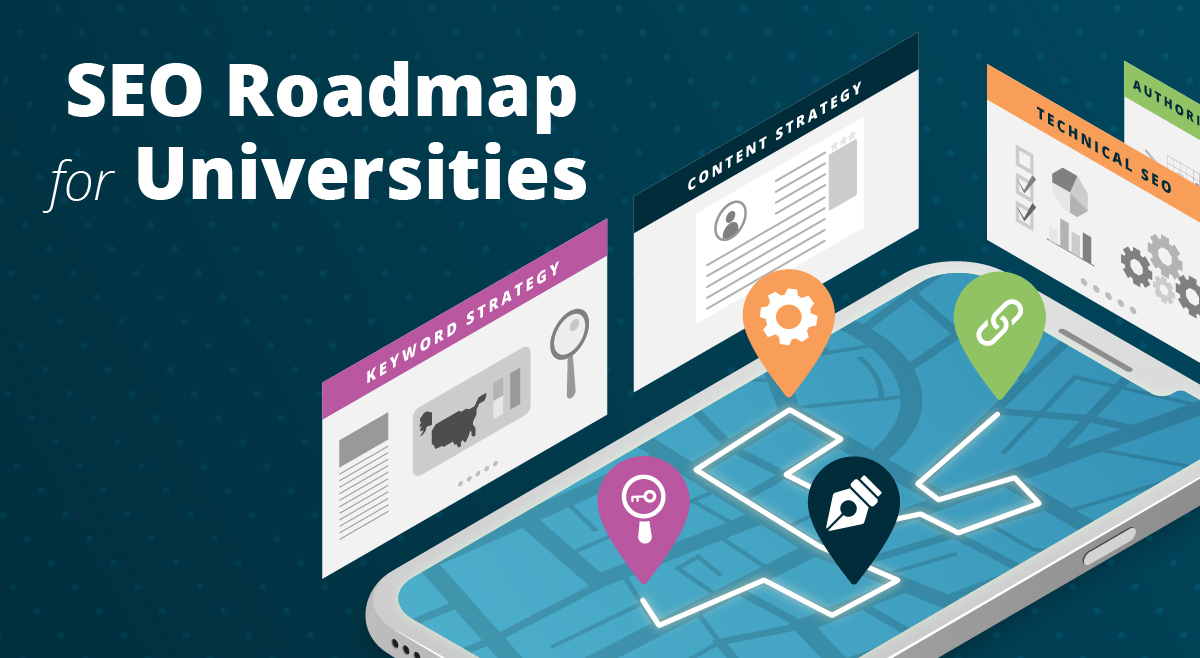
    Higher education marketing requires a strategic approach to search, especially when competing for prospective students exploring degree options online. Our SEO Roadmap is a focused plan designed to improve search visibility for one top-priority program, giving you clear, actionable recommendations tailored to your institution’s needs.

    This roadmap covers four essential areas: keyword strategy, content strategy, technical SEO, and authority building. Each component is informed by deep research into how prospective students search for programs like yours, ensuring your strategy aligns with real opportunities in search.

    With straightforward, easy-to-implement recommendations, the SEO Roadmap helps you take immediate action to improve visibility. It’s also a practical way to explore working with an SEO agency, offering a focused strategy without the commitment of a long-term engagement.

    SEO audit for all industries

    Not in the higher ed space? Our SEO Audit is an excellent resource for organizations across all industries. This report provides a clear assessment of your current SEO performance, highlighting technical issues, content gaps, and opportunities to strengthen your online presence.

    Our experts keep the latest SEO trends top of mind, recommending best practices for structured data, E-E-A-T, and even emerging features like AIOs. By the end of the audit, you’ll have a clear, actionable plan to improve your rankings. 

    Whether you’re a budding e-commerce store or an established B2B enterprise, our customized recommendations help you compete and adapt to whatever the search landscape throws your way.

    Optimize Your SEO Strategy for Success Today

    At Search Influence, we’ve spent nearly two decades helping brands navigate search shifts and adapt to new user behaviors with agile, data-backed tactics. 

    If you’re ready to safeguard your rankings and grow your digital footprint, our team is here to guide you through recent SEO changes with custom solutions. 

    Contact us today to discover how to leverage the latest SEO trends for greater online visibility, stronger audience engagement, and measurable results.

    Images:
    Image 1
    Image 2

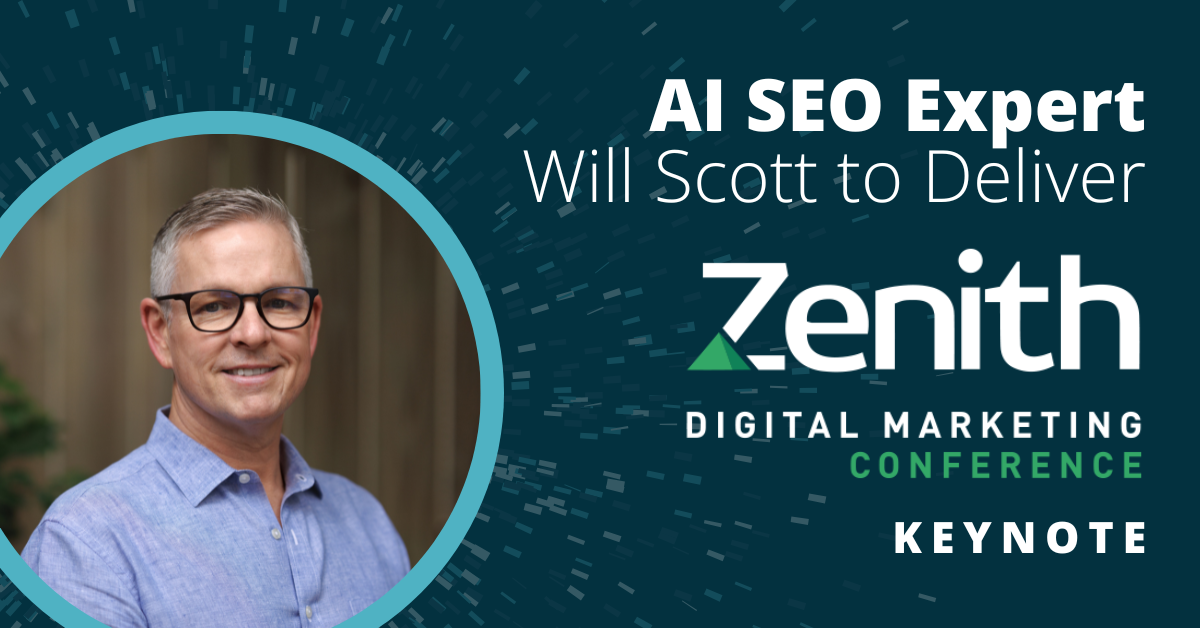
  • AI SEO Expert Will Scott to Deliver Zenith 2025 Conference Keynote

    AI SEO Expert Will Scott to Deliver Zenith 2025 Conference Keynote graphic

    Search Influence Co-Founder and renowned AI SEO expert Will Scott will headline the Zenith 2025 Marketing Conference with his keynote address, “AI Isn’t the End — It’s Your Next Beginning,” on Thursday, April 10, 2025, in Duluth, Minnesota.

    Having presented at past Zenith conferences, Will returns this year to offer fresh insights into harnessing AI technology to amplify your marketing strengths and position yourself ahead in an evolving digital landscape.

    About Will Scott’s Keynote

    In his keynote, “AI Isn’t the End — It’s Your Next Beginning,” Will will illustrate how marketers can leverage artificial intelligence to amplify their existing skills instead of replacing them.

    Will will offer actionable strategies for marketers to maintain their competitive edge in an increasingly AI-driven search world by drawing parallels between his personal journey of rebuilding after a health crisis and navigating the rapid evolution of AI technology.

    With extensive experience in integrating AI into SEO strategies, Will has been at the forefront of developing methods that enhance visibility and engagement through AI-powered tools. His insights reflect deep expertise in blending human creativity with AI-driven analytics, positioning marketers to excel in a technology-first environment.

    Read more of Will’s insights:

    Will Scott: A Leading Voice in AI SEO

    Will is internationally recognized as a trailblazer in digital marketing and AI SEO, known for coining the influential term “barnacle SEO” in 2008.

    Will co-founded the f SEO agency Search Influence with his wife, Angie, where he serves as CEO. Alongside building the business over the past two decades, Will serves as  faculty emeritus of LocalU. His extensive career has positioned him as a sought-after speaker at premier industry events, including Pubcon and SMX.

    His diverse professional background, including a degree in Architecture from Tulane University and background in higher education technology and online learning, informs his holistic perspective on problem-solving and strategic growth.

    About Zenith 2025

    Hosted by marketing agency Aimclear and the Duluth Area Chamber of Commerce, the Zenith Marketing Conference is celebrating its 12th year of empowering digital marketers.

    Zenith brings together forward-thinking marketing professionals to share innovative strategies and practical tools for driving revenue and boosting online engagement.

    Attendees will leave equipped to optimize their digital marketing efforts, from generating quality leads and maximizing social media reach to ensuring cost-effective marketing spend.

    Achieve Your AI SEO Potential

    Curious about the role AI SEO can play in your marketing strategy?

    Search Influence is your trusted AI SEO agency, ready to guide you through the opportunities and complexities of leveraging AI for digital marketing success.

    Get in touch with Search Influence today, and let’s start reaching the right audience, no matter where they are.

  • The Future of Search: SEO and AI Impacts Explained

    The Future of Search: SEO and AI Impacts Explained

    Key Insights

    • AI is reshaping search behavior: Users increasingly rely on AI-driven platforms for quick answers, changing how content is surfaced in search results.
    • SEO remains foundational: Despite AI’s rise, organic search remains the backbone of visibility, particularly for high-intent and local searches.
    • Authority and credibility matter more than ever: AI models favor trusted sources, making brand authority, expertise, and transparency essential for being cited in AI-generated responses.
    • Optimizing for AI requires a strategic approach: Marketers need to structure content for AI readability, incorporate long-tail keywords, strengthen technical SEO, and prioritize conversational language to improve discoverability.

    Generative AI has changed the way people search for information online. According to research by Higher Visibility, 71.5% of people report using AI tools for search, with 14% turning to them daily. 

    AI search, powered by Google’s AI Overviews and platforms like ChatGPT, Perplexity, and Google Gemini, offers fresh ways to reach users. However, it also introduces new challenges for marketers. AI-powered search results push organic rankings lower, while conversational search engines provide answers to queries without users having to click through to a website. 

    Search has always evolved, and this shift is no different. To stay competitive and continue reaching your target audience, your SEO strategy must adapt to accommodate AI-driven search — or you risk losing ground to competitors who are.

    Maintaining your relevance and traffic requires implementing tactics specifically designed to improve AI search visibility — also known as generative engine optimization — alongside your traditional SEO strategy. Here’s what to know about SEO and AI impacts, plus how to navigate them in the new era of search.

    What Is AI Search?

    AI search refers to search engines and digital platforms that use artificial intelligence to generate direct, summarized answers to user queries. Rather than simply ranking web pages, these tools analyze vast amounts of data, identify key insights, and deliver structured responses that align with the user’s intent.

    AI search is generally divided into two categories: AI Overviews and AI search engines/chatbots.

    AI Overviews

    Introduced in May 2024, Google’s AI Overviews (AIOs) appear at the top of search results in response to queries. These summaries use AI to pull information from multiple sources and generate a concise, structured response. By applying machine learning and natural language processing, they identify relevant details, summarize content, and present it in an easy-to-read format.

    AIOs also list citations alongside summaries, giving users the option to explore original sources for more in-depth information.

    AI Overviews’ impact on SEO

    Declining search visibility

    Because AIOs appear at the top of search results, they push traditional organic listings further down the page. As more users rely on AI-generated summaries, ranking in AIOs has become essential for maintaining search visibility and reaching audiences where they are actively looking for information.

    The rise of zero-click searches

    AIOs contribute to the growth of zero-click searches, where users get answers directly in search results without clicking through to a website. While this reduces organic traffic, being featured in an AIO ensures your content is still seen. It allows you to build brand awareness and authority even when users don’t visit your site.

    AIOs and informational search queries

    AIOs dominate informational searches, with 99.2% of AIO keywords classified as informational. This means they frequently surface when users look for general knowledge in the awareness stage. Appearing in AIOs puts your brand in front of users earlier in their search journey, increasing the likelihood of engagement before they turn to a competitor.

    The role of AIOs in branded searches

    AIOs don’t just affect informational searches — they also appear in branded queries, which make up 45-60% of all Google searches (LinkedIn, SparkToro). If an AIO includes information about your business, it can influence how users perceive your brand and shape future interactions. 

    AIOs and click-through rates (CTRs)

    Although zero-click searches are increasing, inclusion in AIOs can still improve click-through rates (CTR). A study by Seer Interactive found that organic CTR increases to 1.08% when a site is included in an AIO, compared to just 0.6% for those that aren’t. 

    Even when users don’t click through, appearing in AIOs increases brand impressions and helps maintain relevance in search. AIOs are heavily leveraged for voice search, meaning your content has the potential to surface in spoken responses across AI-powered assistants. Ignoring AIOs means missing out on a major shift in search behavior — while your competitors secure the space at the top.

    AI Search Engines and Chatbots

    AI-powered search engines and chatbots — such as Perplexity, ChatGPT, and Bing Copilot — offer a conversational way to search for and explore information. Unlike traditional search engines, which present ranked lists of web pages, AI-driven platforms generate detailed answers and allow users to refine their queries through follow-up interactions. 

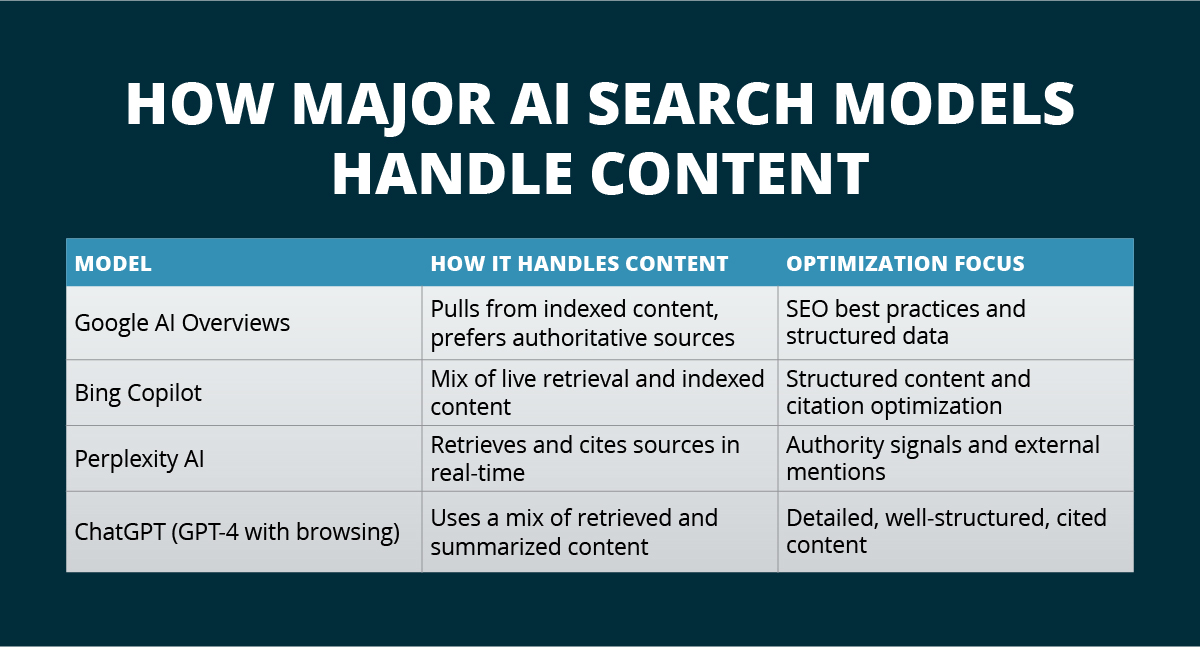
    While AIOs primarily pull from indexed content and authoritative sites, other AI search tools vary in how they retrieve and present information:

    • Bing Copilot offers a mix of live retrieval and indexed content
    • Perplexity emphasizes real-time, cited sources for greater transparency
    • ChatGPT (with browsing enabled) pulls from both retrieved and summarized conten

    Understanding these differences helps you tailor your approach when optimizing for AI-driven search experiences.

    How major AI Search models handle content

    AI search engine/chatbot impact on SEO

    Growing search traffic through AI-powered platforms

    With platforms like ChatGPT, Perplexity, and Google Gemini attracting millions of users, conversational search is becoming a key way people discover information. ChatGPT alone has an estimated 300 million weekly active users worldwide, while Google Gemini averages 275 million monthly visits. As more users turn to these tools instead of traditional search engines, ensuring your content is referenced in AI-generated responses helps increase visibility and establish authority.

    AI search engines/chatbots and brand recognition

    Some AI platforms, like Perplexity, consistently provide citations in their responses, while others, such as ChatGPT, vary in how they attribute sources. Free-tier models may offer only basic references, while premium versions provide more detailed citations, pulling from multiple sources and adding contextual annotations.

    When these platforms do cite sources, being included is a valuable opportunity to increase your credibility. Even if users don’t click through to your site, being cited in responses helps you gain your audience’s trust as a trusted source of information.

    The connection between traditional SEO and AI visibility

    Ranking well in organic search directly impacts the likelihood of being referenced in AI-generated responses. AI search engines prioritize authoritative, high-ranking sources when generating answers, making a strong SEO strategy essential for increasing visibility within these platforms.

    Many core SEO principles still apply to AI search strategies, including understanding user intent, structuring content around entities, and maintaining high-quality information. However, AI-driven search shifts the focus from backlinks and keyword targeting to citations and specificity. The more detailed and entity-rich your content, the better AI models can reference it. 

    While SEO helps content rank, ensuring it is clear, credible, and easily retrievable increases its chances of appearing in AI-generated results.

    What Is Generative Engine Optimization?

    Generative Engine Optimization explained

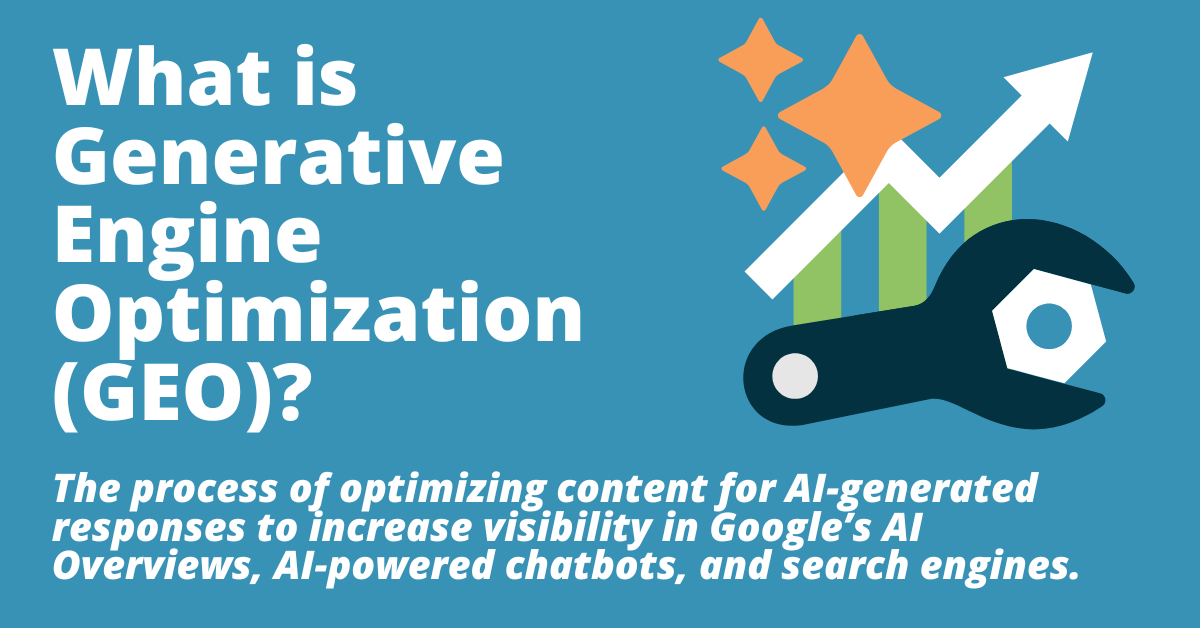
    Generative engine optimization (GEO) is the process of optimizing content for AI-generated responses, increasing visibility in Google’s AIOs and AI-powered chatbots or search engines. While traditional SEO focuses on ranking web pages, GEO tailors content for AI models that extract and present direct answers.

    By aligning content with how AI processes and prioritizes information, GEO helps marketers maintain authority, improve engagement, and capture opportunities across evolving search platforms.

    How to Get Featured as an AI Source

    A successful GEO strategy means getting included as an AI source, whether that’s in an AIO or a Perplexity response. Use these tactics to strengthen your AI visibility:

    Improve your E-E-A-T

    Google is more heavily emphasizing brand authority when ranking content and generating AIOs. Instead of solely optimizing for rankings, brands need to focus on strengthening Expertise, Experience, Authority, and Trustworthiness (E-E-A-T) to improve visibility.

    AI models prefer sources that demonstrate credibility, which means establishing strong brand authority is essential. To improve E-E-A-T:

    • Demonstrate expertise and experience: Highlight author credentials, industry insights, and first-hand knowledge.
    • Maintain accurate business and directory listings: Ensure consistency across platforms like Google Business Profile and industry directories.
    • Ensure content transparency: Properly cite sources and reference factual, verifiable data.

    Focus on relevant, high-quality content

    AI favors concise and informative content, meaning readability and structure are just as important as accuracy. Google’s passage ranking feature allows AI models to pull specific sections of your content to answer queries directly, so structuring information in a clear, digestible way improves its chances of being referenced.

    To make your content more AI-friendly:

    • Anticipate user intent and provide concise and informative responses that align with what users are searching for. AI-driven search prioritizes content that directly answers queries with detailed, structured, and context-rich information.
    • Write in conversational language, using a natural, direct writing style and concise phrasing. AI models rely on natural language processing (NLP) to interpret and generate human-like text, making them more effective at understanding content that mirrors everyday speech. Overly complex or formal wording can create friction in processing, while clear, natural phrasing ensures better readability.
    • Break down complex information into digestible, skimmable formats, such as bullet points or numbered lists, with clear subheadings.
    • Include FAQ sections, as a structured Q&A format can help AI identify relevant insights quickly. 
    • Leverage multimedia content with schema markup, since AI increasingly references videos and images in responses.

    Leverage long-tail keywords

    AI-generated search results are more likely to pull from content that matches specific, detailed queries. Long-tail keywords — phrases that are longer and more precise than broad search terms — help target the kinds of questions AI models reference in responses.

    Search intent plays a crucial role when optimizing for long-tail keywords. While informational-intent keywords trigger AIOs 99.2% of the time, commercial and transactional queries only generate AIOs 10% of the time

    To best capitalize on long-tail keyword opportunities:

    • Review “People Also Ask” (PAA) questions to identify commonly searched queries that AI models may prioritize.
    • Analyze AI search engines like Perplexity to see what types of queries generate responses.
    • Optimize for natural, conversational queries that reflect how users phrase searches in AI chatbots and voice search.

    A quote from Michelle Boyd about AI-driven search

    Optimize content for entities

    AI models process content using entities — specific people, places, organizations, and concepts — rather than just keywords. While keywords are the words or phrases users type into search engines, entities act as nodes in a knowledge graph, helping AI understand relationships between concepts and generate more relevant responses.

    To improve AI-driven visibility, structure your content to clearly define and connect entities:

    • Use Schema.org structured data: Define entities such as businesses, products, authors, and services to help AI recognize key concepts.
    • Link to authoritative sources: Reference Wikipedia, industry databases, and government sites to align with established entities AI understands.
    • Leverage co-occurrence: When two or more words, phrases, or entities frequently appear together in content, AI models — especially LLMs like ChatGPT without search — become more likely to generate them. Strategic co-occurrence helps reinforce associations between key concepts.
    • Utilize co-citation: When two entities (brands, websites, or sources) are cited or linked from the same source, it strengthens their perceived relationship in AI models, even if they aren’t directly connected.
    • Structure content with semantic triples: AI processes information in subject-predicate-object statements (e.g., “Apple manufactures the MacBook Pro”), so clearly defining these relationships enhances AI comprehension.
    • Enhance entity salience: Ensure that the most important concepts stand out within your content. Salience determines how relevant an entity appears in AI-driven searches and conversations. Think of it as a more structured way to signal significance without relying on keyword stuffing.

    Prioritize your technical SEO

    Strong technical SEO helps AI models better interpret, index, and surface your content. Without a solid technical foundation, even well-written and authoritative content may struggle to appear in AIOs or AI-driven search results.

    To improve your technical SEO:

    • Use schema markup to structure data: Properly coded structured data helps AI search engines understand key business details, such as operating hours, services, and locations, increasing the chances of being included in AIOs.
    • Optimize title tags and meta descriptions: Clear, well-crafted metadata improves indexing and can enhance how AI models retrieve your content.
    • Improve site navigation and internal linking: AI favors well-structured sites where information is easily accessible and logically organized.
    • Ensure fast page speed and mobile usability: A slow, poorly optimized website signals low trustworthiness to search engines, reducing the chances of being referenced.

    Monitor your standing in AI search

    As AI-powered search evolves, tracking your visibility in AI-generated results is just as important as traditional SEO monitoring. New and existing tools now offer AI search tracking features, helping you understand how your content appears in AIOs and other AI-driven search responses.

    To stay ahead, leverage these AI search tools to track your rankings, analyze competitor performance, and identify opportunities for optimization:

    • Recent AI search entrants: Semrush AI Toolkit, Otterly, Rankscale, Profound, xfunnel, Peec.ai
    • Existing tools adding AI metrics: Semrush, Advanced Web Ranking, Ahrefs

    Does Bing Matter in AI SEO?

    While Google dominates search, Bing still holds a significant share of queries, particularly in the U.S. Bing powers 28.3% of online searches when factoring in Yahoo and Microsoft voice searches, making it an important platform to consider.

    Here’s how to pay attention to Bing in your AI SEO efforts:

    • Submit your site to Bing Webmaster Tools (BWT) to ensure proper indexing and visibility.
    • Monitor Bing rankings: While brands ranking on page 1 of Google strongly correlate (~0.65) with AI mentions, Bing rankings also play a role (~0.5–0.6).
    • Stay updated on Bing’s algorithm changes: SEO best practices currently align with Google, but keeping an eye on potential Bing-specific shifts ensures continued optimization.

    SEO and AI Impacts: Is SEO Still Important? 

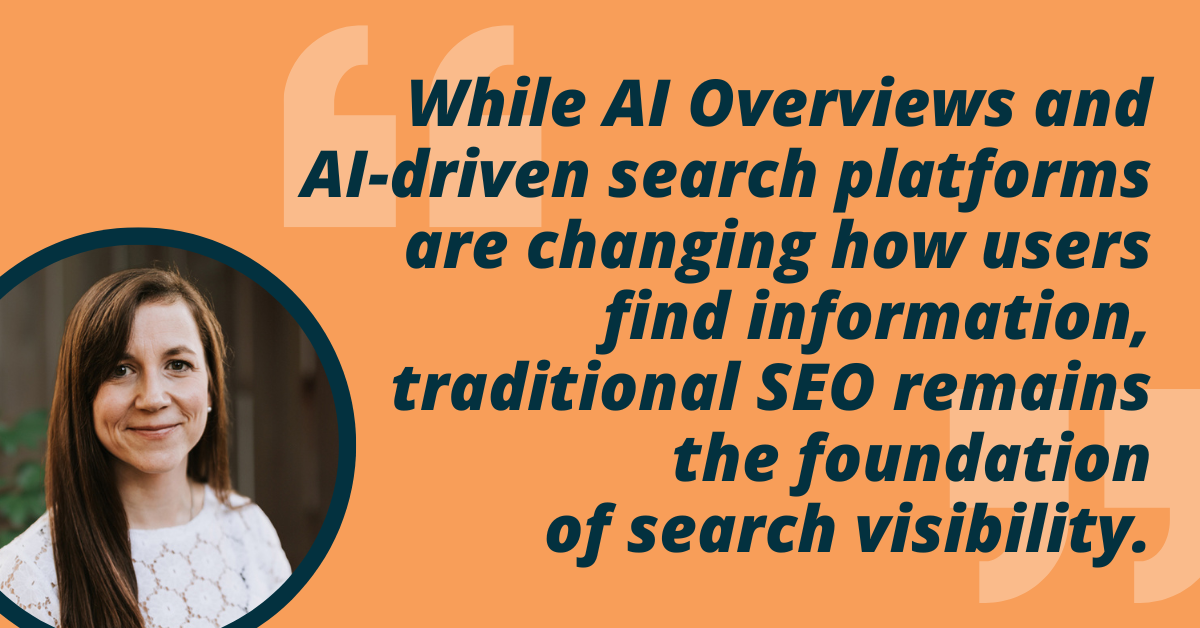
    Short answer: yes. While AIOs and AI-driven search platforms are changing how users find information, traditional SEO remains the foundation of search visibility. 

    Research shows that 52-73% of AIO sources come from pages already ranking in the top 10 organic search results. This means that if your site isn’t ranking well in traditional searches, it’s unlikely to be referenced in AI-generated responses. 

    At the same time, only 10% of middle to low-funnel keywords trigger an AIO, meaning AI-generated results are not replacing the most valuable searches — those tied to users actively looking for a business, product, or service.

    SEO is even more critical for local businesses. Searches for local goods, services, and businesses rarely populate an AIO, making local SEO tactics essential for maintaining visibility. 

    What’s more, the highest-volume AIO keywords average just 150 searches per month, while non-AIO keywords drive an average of 29,000 searches. This means that despite AI-driven changes, organic search remains the dominant traffic driver. Businesses that prioritize SEO are still best positioned to reach high-intent users, capture search demand, and drive meaningful engagement.

    Stay Ahead in the Age of AI With Search Influence

    AI search is evolving every day, reshaping how users find and engage with content. To stay visible, you need a nimble, data-driven approach that keeps up with both traditional SEO and AI-powered search trends

    That’s where partnering with an experienced agency can make all the difference. 

    At Search Influence, we continuously track organic traffic, click-through rates, and AI-related search shifts to help our clients adjust their strategies and maximize their visibility in an AI-driven world.

    SEO Roadmap for Higher Ed

    For higher education marketers, our SEO Roadmap is designed to ensure your program pages remain competitive — even as AI-driven search changes the way students explore their options. 

    This customized, three-month strategy provides clear, actionable recommendations you can implement right away. It helps you improve rankings, strengthen visibility, and optimize for AIOs and AI-powered platforms. We factor in AI’s impact from the start, ensuring your content is structured for both organic search and AI-driven discovery.

    Whether you’re refining an existing SEO strategy or building one from the ground up, Search Influence helps you stay ahead of AI search shifts so your brand remains visible where it matters most. 

    Let’s build a strategy that works for the future of search.

  • Will Scott to Lead Two-Day AI for SEO Master Class at SMX & LocalU Workshop

    Will Scott to Lead Two-Day AI for SEO Master Class at SMX & LocalU Workshop

    This March, Search Influence Co-Founder and CEO Will Scott brings his SEO expertise to two major conferences, leading in-depth sessions designed to help marketers harness AI for search.

    First, he’s hosting a two-day workshop for SMX’s Master Class series, Generative Engine Optimization, on March 10-11. This live and on-demand event will focus on helping marketers optimize their content for ChatGPT, Perplexity, and other AI platforms while maintaining strong search visibility. 

    Then, on March 26, he’ll take the (virtual) stage at LocalU Global to present The AI Shortcut to Local SEO Domination, a must-attend session for marketers looking to leverage AI for local search success.

    These sessions will provide actionable strategies and expert insights to help you build ROI-driven campaigns in the era of AI.

    Will’s SMX Master Class Presentation

    AI search is changing how and where people search.

    Will’s SMX Master Class session will provide you with strategies to adapt to these changes. 

    Attendees will gain practical, actionable insights on:

    • Generative Engine Optimization (GEO) Fundamentals: Learn how AI-driven search differs from traditional search engines and the key ranking factors that impact AI visibility.
    • Content Optimization for AI Platforms: Discover how to format and structure content to enhance visibility in AI-generated responses while keeping human readers engaged.
    • Keyword Strategy for AI & Natural Language Processing: Adapt your keyword approach, focusing on conversational AI queries while maintaining relevance in traditional search.
    • Competitive Analysis for AI Rankings: Get hands-on experience evaluating how competitors perform in AI-driven results and identify opportunities to strengthen your own presence.
    • Building Brand Authority & Trust Signals: Explore how AI platforms assess authority and learn strategies to establish your brand as a recognized, credible source.
    • Tracking Performance & Future-Proofing Your Content: Learn the latest tools and metrics to monitor AI search performance and adjust your strategy as AI search evolves.

    This two-day intensive training is perfect for SEO professionals, content strategists, and digital marketers who want to gain a competitive edge in the AI-powered search landscape. 

    Will’s LocalU Global Presentation

    Will Scott’s presentation at LocalU Global is a must-attend event for marketers looking to optimize local search rankings with AI-driven strategies.

    The AI Shortcut to Local SEO Domination presentation is designed to help business leaders and marketers leverage AI to streamline their local SEO efforts and achieve better visibility.

    His session will dive into actionable insights, including:

    • Optimizing Local Content for AI & Search: Learn how AI tools can enhance your content strategy, ensuring local relevance while improving search visibility.
    • AI-Powered Google Business Profile (GBP) Posts: Discover how AI-driven automation can help businesses generate engaging, keyword-rich GBP posts effortlessly.
    • AI-Generated Local Videos: Explore how AI-powered tools can streamline video creation, making it easier to create engaging content that connects with your audiences.
    • Scaling Local SEO With AI: Understand how AI frees up human resources, allowing marketing teams to focus on strategy, planning, and high-impact decision-making.
    • Implementing Local Schema With AI: Get insights on how AI can simplify schema markup, helping search engines better understand and display local business information.

    Don’t miss this opportunity to learn how AI can transform your local SEO strategy by creating efficiencies that improve results and free up human resources. . 

    About Will Scott

    With decades of experience in SEO and digital advertising, Will Scott is a recognized industry leader known for his expertise in search optimization, AI-driven strategies, and local search marketing. 

    He is credited with coining the term “barnacle SEO” in 2008, a widely adopted strategy that helps businesses improve visibility by leveraging high-authority platforms.

    As Co-Founder and CEO of Search Influence, Will has spent two decades leading teams in creating thousands of websites, optimizing millions of search visits, and developing data-driven marketing strategies for businesses of all sizes. 

    Since launching Search Influence in 2006 with his wife, Angie Scott, they have built the agency into a trusted name in SEO, helping clients navigate the ever-evolving digital space.

    Will’s thought leadership extends beyond his agency. He is a full-time faculty member of LocalU and a frequent contributor to top marketing publications. 

    His insights have been sought after by industry leaders across various sectors, and he has delivered expert presentations at some of the most renowned marketing conferences, including Pubcon and. 

    Learn More About AI for SEO With Search Influence 

    Don’t miss your chance to gain expert insights into AI for SEO at two premier virtual events this March:

    Sign up today to discover AI-driven strategies that will help you optimize content, automate local SEO tasks, and scale your efforts for greater impact.

    With a passion for educating marketers, business owners, and industry professionals, Will continues to push the boundaries of SEO — especially in the era of AI-driven search.

    As a leader in AI for SEO, Will Scott continues to develop innovative products and services that help businesses stay ahead in this evolving landscape. 

    AI search and other SEO trends are transforming the higher education landscape. Recognizing this shift, Search Influence developed the SEO Roadmap—a strategic guide designed to help universities navigate and succeed in this new era of search.

    Our SEO Roadmap provides a personalized plan that dives deep into one top program or degree, delivering immediate, high-impact recommendations you can implement immediately.

    Ready to build a future-proof SEO strategy? 

    Contact Search Influence to learn how we can help you optimize for success.

  • Higher Education SEO Trends in 2025: How to Compete

    Higher Education SEO Trends in 2025: How to Compete

    Key Insights

    • AI-Driven Search Requires Adaptation

      Emerging technologies like Google’s AI Overviews are reshaping search visibility. Universities must optimize content for AI retrieval, emphasizing depth, authority, and structured data to stay competitive.

    • Social Search Is Reshaping Discovery

      Younger audiences increasingly use social platforms for search. Universities must integrate SEO strategies with social media, prioritizing engaging, visual content to enhance discoverability.

    • SEO Roadmap Ensures Long-Term Success

      A structured SEO roadmap helps universities systematically improve rankings. Key actions—keyword research, content updates, and link-building—align institutions with evolving search algorithms.

    SEO IS THE FOUNDATION OF YOUR MARKETING STRATEGY

    Why Is Higher Education SEO Important?

    Higher education SEO ensures universities stay visible in search results, attracting prospective students.

    With students relying on search to research programs, strong SEO improves rankings, enhances discoverability, and increases enrollment opportunities. Optimizing for AI search, social search, and evolving algorithms is critical for maintaining a competitive edge.

    Yet, according to our recent Higher Ed SEO Research Study developed with UPCEA, 51% of universities lack an established SEO plan.

    This oversight in strategy puts institutions at a disadvantage when it comes to improving search engine rankings and standing out in a crowded market.

    For universities ready for export guidance for 2025, an SEO roadmap serves as a crucial starting point to bridge this gap and develop a program-focused SEO strategy that incorporates upcoming trends.

    Search Influence’s SEO roadmap provides a customized guide for one key academic program including recommendations for:

    • Keyword strategy
    • Content strategy
    • Link building
    • Technical SEO optimizations

    But before you climb the Everest that is search engine visibility in 2025, you should know what to expect.

    In this blog, we’ll explore the key SEO trends impacting higher education and discuss how universities can develop a strategy to improve their search engine rankings and connect with prospective students.

    SEO Higher Education Trends in 2025

    Small animated rocket flying away from 3D computer browser windows, charts, and data

    Impact of AI Overviews on higher ed SEO

    As search continues to evolve, higher education digital marketers must leverage generative engine optimization (GEO) to reach their target audiences. Understanding AI Overviews is the first step in mastering this new form of search.

    In May 2024, Google introduced AI Overviews as part of its Search Generative Experience at Google I/O. This new feature leverages Google’s generative AI model, Gemini, to provide users with quick answers to their queries. AI Overviews generate brief snippets based on Google AI’s understanding of the question and relevant content from across the web.

    Alongside the generated answer, Google includes links to resources, allowing users to dive deeper into the topic if they choose.

    Possible challenges of AI Overviews

    • Informational content pushed down: Blog posts or general content on university websites are often pushed lower in search results by AI-generated responses, impacting traffic that universities previously earned from organic search results..
    • Limited visibility for non-featured websites: Educational institutions not featured in AI Overviews may struggle to gain online visibility, even if they rank well on traditional search engine results pages (SERPs).
    • Lack of content attribution: AI Overviews pull content from various sources without clear attribution, making it harder for universities to gain proper recognition or build brand awareness.
    • Reduced prominence of featured snippets: As AI Overviews take up more space in search results, traditional featured snippets may become less visible, reducing visibility for universities who worked hard to gain this placement.

    Strategies to overcome AI Overview challenges

    • Create detailed, well-researched content: AI Overviews often provide brief, surface-level answers. Universities can encourage users to click through and engage with the full material by developing in-depth content that offers more comprehensive insights.
    • Target long-tail keywords and specific queries: Focus on relevant keywords and highly specific searches that AI Overviews do not fully address. These keywords can help drive organic traffic from users seeking more detailed information, particularly for degree programs and specialized content.
    • Offer interactive content and direct user engagement: AI Overviews can’t replicate the value of user-driven experiences. By providing downloadable resources, webinars, or interactive tools, universities can offer unique value that sets them apart and builds stronger connections with prospective students.

    How social search is changing SEO for universities

    Social search is rapidly gaining traction, particularly among Gen Z and Millennials, who increasingly use social media platforms to find information, discover products, and learn about services. This shift away from traditional search engines like Google is transforming how universities must approach recruitment SEO. Social search leverages the dynamic, interactive nature of platforms like TikTok, Instagram, and YouTube, where user-generated content (UGC) and real-time interactions play a significant role in how information is consumed and shared.

    Beyond social platforms becoming an alternative to traditional search, social content itself has started to rank higher in Google search results. This means that what universities post on social platforms impacts their visibility on social media and plays a crucial role in their overall SEO strategy.

    Possible challenges of social search for universities

    • Changing search habits: As Gen Z and Millennials shift towards social search, traditional SEO tactics designed for search engines like Google may not be as effective in capturing their attention. As social search continues to grow, higher ed websites must adapt to maintain visibility.
    • Limited control over rankings: Unlike traditional search engines, social search algorithms prioritize engagement over keyword optimization, making it harder for universities to rank higher based solely on incorporating relevant keywords. Social platforms are unpredictable, with ever-changing algorithms that often favor highly engaging content like likes, shares, and comments.
    • Engagement-driven visibility: Social search tends to favor content that generates high engagement, which can be difficult for universities to achieve organically without paid promotions. Smaller schools or institutions with less interactive content may find it challenging to compete with more popular or active brands.

    Strategies to overcome social search challenges

    • Repurpose content for social media: Universities can repurpose existing website content into highly shareable formats such as videos, infographics, or student testimonials on social media. This helps maintain a consistent message across platforms while catering to the content preferences of younger audiences.
    • Focus on visual content: Social platforms like Instagram and TikTok prioritize visual content, particularly videos. Incorporating multimedia into your digital marketing strategy is essential for keeping content relevant and visible for longer.
    • Boost engagement: To rank higher on social platforms —where algorithms prioritize engagement — universities need to focus on creating content that encourages interaction. Developing content that sparks discussions and encourages likes, shares, and comments can increase visibility in social search algorithms. For example, interactive posts like live Q&A sessions can help universities capture more organic search traffic from social platforms.

    Optimize “People Also Ask” to answer prospective students’ queries

    The “People Also Ask” (PAA) section in Google search results displays a list of questions related to the user’s original query. Each question can be expanded to reveal a brief answer, typically pulled from relevant websites. While PAA helps users quickly find information, it presents both challenges and opportunities for universities looking to attract prospective students through SEO for higher education.

    Competition for visibility is fierce, as the PAA box often pushes traditional organic search results further down the page. Even websites ranking on the first page may struggle to gain traffic. That’s why optimizing for PAA is critical. Prospective students increasingly rely on search engines to discover university programs, and the PAA box provides a valuable way to capture their attention.

    The good news is that structuring your content to answer PAA questions clearly and concisely also supports AI Overview visibility. This dynamic approach ensures that your educational website stays relevant in search results.

    Possible challenges of People Also Ask

    • Click-through rate (CTR) impact: Users may find their answers directly in the PAA section without needing to click through to a website, potentially lowering CTR even for high-ranking pages.
    • Answer quality control: Google pulls content for PAA from various sources, meaning the quality or accuracy of the answers won’t always reflect the expertise of your site, even if you provide more in-depth information.
    • Unpredictability of ranking in PAA: Google’s algorithm dynamically chooses which content to feature in PAA, making it difficult to guarantee your content will appear in this section.
    • Content cannibalization: If your content ranks both organically and in the PAA box, users might click on the PAA result, which offers less interaction and brand recognition than a direct visit to your site.

    Strategies and insights to overcome People Also Ask challenges

    • Provide concise answers to common questions: To increase the chances of appearing in the PAA section, create clear, concise answers within your content. Use structured headings and bulleted lists to make it easier for search engines to identify and feature your content.
    • Focus on long-tail queries: Target niche topics and long-tail keywords that have less competition. This can increase the likelihood of your content being featured in the PAA for specific questions related to your degree programs or student services.
      Build content around your expertise: Enhance the authority of your answers by including references to credible sources, expert quotes, and in-depth insights. This builds trustworthiness and improves your chances of being featured in PAA.
    • Use structured data: Incorporate technical SEO strategies such as structured data to help search engines better understand your content and increase its chances of appearing in the PAA box.

    Utilize video SEO to boost engagement with your audience

    Is video SEO the future of search?

    According to Hubspot, 96% of people say they watch explainer videos to learn more about a product.

    Let that sink in — 96% of people watch videos to learn more about a product!

    This underscores the importance for higher education institutions to create engaging video content.

    Video SEO involves optimizing your video content to rank higher in both search engine results and video platforms like YouTube and TikTok. This process includes targeting relevant keywords, optimizing video descriptions, transcribing videos, and creating high-quality content that engages viewers. Video SEO aims to increase visibility, drive organic search traffic, and boost audience engagement — all of which can improve your institution’s brand awareness and conversions.

    Not only does video SEO help with audience engagement, but it also contributes to improving your website’s search rankings, benefiting your overall SEO strategy.

    Possible challenges of video SEO

    • Competition: Platforms like YouTube and TikTok are highly competitive, with millions of videos uploaded daily, making it difficult for your content to stand out.
    • Time and resources: Creating and optimizing video content requires significant time, effort, and resources, more so than text-based content.
    • Technical SEO elements: Ensuring proper video metadata, schema markup, and fast loading speeds can be challenging, particularly when embedding videos on your site.
      User behavior: While video can be engaging, some users may prefer quick text results.

    Strategies and insights to overcome video SEO challenges

    • Create short-form videos: Whenever possible, create short, TikTok-style videos to answer users’ questions quickly. While longer videos can be valuable, short-form content is especially effective in the era of social search.
    • Keyword research: Focus on long-tail keywords specific to your audience’s search intent. This can help you target less competitive niches in the higher education space and boost your video content’s visibility.
    • Use engaging thumbnails and titles: Eye-catching thumbnails and compelling, keyword-rich titles can increase your click-through rates and overall engagement.
    • Include video transcripts: Transcripts make your content more accessible and provide search engines with additional text to crawl, improving your video’s SEO performance AND your website’s SEO. Transcribing your videos on your website also ensures you reach potential searchers who prefer reading content over watching a video.
    • Encourage engagement signals: Encourage viewers to like, share, comment, and subscribe. These engagement signals indicate to search engines that your content is valuable, increasing its chances of ranking higher.
    • Implement schema markup: Use proper schema markup to help search engines better understand your video content. This increases the likelihood of your video being featured in search results, especially in video carousels.
    • Consistent content creation: Regularly upload videos and promote them across multiple platforms, including your website. This consistency keeps your institution relevant and boosts your SEO efforts over the long term.

    Even universities need to prove E-E-A-T

    With AI Overviews as a dominant feature in search results, universities must focus more on creating authoritative, trustworthy content. Luckily, the search engine Goliath has laid out criteria for SEOs to do exactly that: Google E-E-A-T (Experience, Expertise, Authoritativeness, and Trustworthiness).

    These are the key factors Google uses when human reviewers evaluate the quality of content, especially for websites dealing with sensitive topics like higher education.

    E-E-A-T ensures that your institution’s content is accurate, well-researched, and delivered by credible sources — a must for higher education websites looking to thrive in today’s search engine results pages

    Leveraging authority and trustworthiness online is essential for universities to attract prospective students and build partnerships with academic and research institutions.

    Possible challenges of establishing E-E-A-T

    • Maintaining consistency: With various contributors producing content, ensuring that all pages across the university’s website meet E-E-A-T standards can be challenging.
    • Building authority: Smaller universities or newer programs often find it difficult to compete with established institutions in search rankings.
    • User trust: Consistently delivering accurate and up-to-date information is critical. Any outdated or incorrect content can damage the trustworthiness of the university.
    • Dynamic content: Frequent changes to curricula, research publications, and academic programs can make maintaining content relevance and authority resource-intensive.

    Strategies and insights to overcome E-E-A-T challenges

    • Highlight expertise: Feature content authored by faculty members, ensuring their credentials, academic achievements, and research experience are clearly showcased. Author bios and academic qualifications reinforce the expertise of your institution.
    • Enhance trustworthiness: Include student testimonials, case studies, and partnerships with respected organizations to build trust with prospective students and academic partners.
    • Content review process: Implement a rigorous content review and update schedule to ensure all information remains accurate, relevant, and aligned with the institution’s authority in the field.
    • Leverage user-generated content: Encourage reviews and success stories from current students and alumni. This content demonstrates real-world experience and fosters trust with your target audience.
    • Structured data and transparency: Use structured data to help search engine crawlers better understand the content on your site. Transparency in policies, admissions, and course details will enhance trust and improve your organic traffic.
    • Third-party mentions: Gaining citations or backlinks from respected educational sources, government websites, or reputable media outlets can help boost your university’s authority in search rankings.

    How an SEO Roadmap Can Help You Stay Ahead of SEO Trends

    In the ever-evolving world of higher education marketing, staying ahead of the latest trends is critical for attracting more prospective students.

    But how do you know where to start for an institution that’s attracting thousands of students to sometimes hundreds of programs?

    An SEO roadmap offers a strategic guide to ensure your university’s website remains visible and effective in search engine results.

    Here’s how an SEO roadmap will help fast-track your enrollment journey:

    Optimize for student search behavior

    An SEO roadmap provides valuable insights into how prospective students are searching for degree programs and other academic offerings. By understanding the keywords and phrases potential students use, your institution can adapt content to match their queries more effectively, helping you connect with a broader audience of prospective students.

    Adapt to algorithm changes

    Google’s search algorithms are constantly changing, which can impact your university’s website performance. An SEO roadmap ensures you stay on top of these changes by addressing updates like core algorithm shifts, mobile-first indexing, and search ranking signals. This helps your site maintain strong visibility in organic search results, keeping your content in front of more potential students.

    Stay ahead of emerging trends

    An effective SEO roadmap also accounts for emerging trends in the digital landscape, such as voice search, mobile-first indexing, and AI-generated results. These trends are crucial for reaching tech-savvy students who rely on the latest technology to find educational institutions. By adapting your SEO strategy to incorporate these changes, your university will stay competitive and relevant.

    Improve your content strategy

    An SEO roadmap offers actionable insights into what content updates your website needs and highlights new topics to address. It also identifies new types of content — such as videos, infographics, or interactive tools — that will help you engage your audience more effectively. This ensures your content marketing strategy aligns with both search engine algorithms and student interests, driving more organic traffic to your site.

    Gain authority through link building

    Building authority is key to ranking higher in search results, and an SEO roadmap helps identify valuable link-building opportunities. You’ll learn which websites your program should be featured on to gain credibility and boost your search rankings. Additionally, internal links can enhance the user experience and improve your site’s functionality, leading to better SEO performance.

    Stay Ahead of the Latest SEO Trends With Search Influence

    A screenshot of Google Analytics, showing 102 users for an unknown site in the last 30 minutes

    Uncover new opportunities to improve your educational website’s visibility and performance with an SEO roadmap tailored to your institution’s needs.

    At Search Influence, we provide actionable recommendations that align with the latest SEO for higher education strategies, ensuring your institution remains competitive in search results.

    Our team of SEO experts monitors evolving search engine trends and algorithm changes, so you feel confident that your strategy is up-to-date. With nearly two decades of experience, we understand the unique challenges faced by higher education institutions, and our SEO roadmap will help you capture the right search intent, increase rankings, and boost traffic.

    Looking for even more higher ed marketing insights?

    Don’t miss my presentations at the 2024 UPCEA MEMS conference in Philadelphia this December.

    My session, “Visibility is Vital: Maximize Enrollment by Tracking Marketing Metrics,” presented alongside Bruce Etter of UPCEA, will give valuable insights into which marketing metrics matter the most and how to use those metrics to optimize campaigns, maximize budget allocation, and improve conversions.

    I will also be presenting a 10-minute session “Practical Magic: How to Navigate 2025 SEO Trends” that will take a more in-depth look at all the higher education SEO trends covered in this blog.

    Contact our team today to learn more about all our digital marketing services.


    Images

    Unsplash and Unsplash

  • Improve Page Rankings for Your University With a Hybrid SEO Team

    Improve Page Rankings for Your University with a Hybrid SEO Team

    Key Insights

    • Achieving top rankings for your program pages is no easy feat, especially when managing SEO in-house. It takes advanced skills and consistent effort to outpace growing competition.
    • A hybrid SEO team empowers your in-house staff to focus on their strengths, as an agency handles the higher-level SEO tasks that drive measurable improvements in your program’s visibility.
    • Whether you need immediate help for a specific project or long-term strategy support, working with an agency gives you the flexibility to scale your SEO efforts as needed.
    • Take Search Influence’s Higher Ed SEO Quiz to determine whether combining your in-house strengths with agency expertise is the best way to optimize your program rankings.

    You’ve spent weeks perfecting your program pages and refining the messaging to speak directly to prospective students. You know the ins and outs of your institution, its values, and what makes it unique. Despite your best efforts, your pages still aren’t ranking near the top of the search engine results, where visibility matters most.

    Sound familiar?

    Growing competition in higher ed and a shrinking pool of traditional 18-year-old college students have made it harder to reach and capture the attention of the right prospects.

    Your program pages need to rise above the digital clutter — yet, without advanced SEO skills, all your hard work may never pay off.

    If your in-house team is hitting a wall with SEO, collaborating with an agency gives your strategy the push it needs while ensuring your team’s impact stays integral to the approach. With a hybrid team, you’re rewarded with the best of both worlds: the strengths of your in-house insights and the technical expertise of an agency.

    The Expertise an Agency Brings to the Table

    Agencies provide the technical muscle and fresh strategies needed to elevate your SEO efforts beyond what your in-house team can accomplish alone.

    Broader sector experience

    SEO agencies work with clients across industries, including higher ed, healthcare, and hospitality. This diversity means agencies bring ideas and strategies from sectors beyond education, offering new perspectives to your team.

    They know what works in SEO, what doesn’t, and will advise on how to approach your strategy accordingly.

    Dedicated SEO focus

    Unlike your internal team, which juggles multiple institution-wide priorities, an agency has dedicated experts focused specifically on your SEO strategy. With decades of combined experience among their digital marketing specialists, they know all the tricks of the trade and the latest trends.

    Their specialized knowledge keeps your strategy moving forward — whether it’s fine-tuning content, solving tricky technical issues, or outsmarting algorithm updates.

    Advanced technical SEO

    Agencies bring a laser focus to technical SEO, tackling tasks like site structure improvements, crawlability fixes, and schema markup implementation. By uncovering and resolving hidden technical errors, they eliminate barriers that could drag down your rankings.

    This targeted expertise ensures your site performs at its best and captures the attention of both search engines and users.

    Effective link-building strategies

    According to recent research by Backlinko, a website’s link authority closely correlates to its ranking success. Agencies know how to build links that matter, connecting your website with high-authority sources to improve your domain’s credibility and rankings. By incorporating authority-building tactics into your strategy, an agency will improve your E-E-A-T (Experience, Expertise, Authoritativeness, and Trustworthiness) and generate more links back to you.

    Think of it as networking for your website — building relationships that get your university noticed by the right audiences.

    Sophisticated analytics and tools

    SEO tools like SEMrush and Screaming Frog uncover powerful insights into keyword and listing management opportunities, plus on-site issues like broken links, but it takes expert analysis to turn those insights into results. Agencies excel at transforming raw metrics into strategic actions that deliver measurable outcomes.

    Through clear analytics tracking and reporting, they make complex data easy to understand and even easier to act on.

    Understanding the Strengths of Your Internal Team

    With a strong grasp of your university’s inner workings, your in-house SEO team members know what to prioritize to meet your institution’s most pressing goals.

    Familiarity with institutional culture

    Your internal team knows your institution better than anyone — its mission, values, and branding guidelines. They ensure your SEO strategy aligns with institutional priorities, making your content feel genuine while keeping your messaging consistent across every channel.

    Relationships with faculty and departments

    From individual staff members to college departments, your team has built the relationships needed to uncover stories and insights that bring the best of your university online. They know how to facilitate internal collaboration for creating academic program pages, research highlights, and in-depth faculty profiles.

    On-the-ground understanding of priorities

    Your internal team has a pulse on what’s important to everyone: prospective students, current students, faculty, and alumni. They know exactly when to spotlight admissions deadlines, open houses, and other seasonal priorities to grab the attention of your target audience.

    Local knowledge of audiences

    Targeted marketing works best when it’s backed by a clear understanding of your audience. Your team knows the local culture, regional trends, and demographic factors that shape the interests and behaviors of prospective students, alumni, and the community.

    This helps you connect with your prospects in a way that feels authentic and relevant.

    A quote about SEO skills and tools from the SI team

    How to Decide If a Hybrid SEO Team Is Right for Your Institution

    Combining your in-house strengths with an agency’s expertise creates a well-rounded SEO strategy, but the balance must meet your institution’s needs.

    So, how do you decide if this approach works for you?

    And, more specifically, what tasks should remain in-house vs. outsourced?

    Questions to ask yourself

    To determine if a hybrid model is right for your institution, check your priorities, skill level, and overall capacity to take SEO head-on. Ask yourself and your broader team these questions:

    • Are we ranking competitively for key academic programs and university pages?
    • Do we have the in-house expertise to manage technical SEO challenges?
    • Are we consistently tracking and analyzing our SEO performance?
    • Do we have the resources and bandwidth to focus on SEO long-term?

    If any of your answers expose gaps, a hybrid SEO team will help mend them with the full focus and time dedication your strategy deserves.

    Indicators that a hybrid approach will work

    If you think a hybrid approach is ideal for you, but are not sure if it will play out the way you’re hoping, here are some signs it’ll work:

    • You have a small but knowledgeable in-house team that needs support in technical areas.
    • You’re looking to scale your SEO efforts without overloading internal staff.
    • You’re struggling to keep up with competitors’ online visibility.

    The most successful collaborations happen when you focus on what you do best and leave the heavy lifting to a dedicated SEO team.

    Examples of tasks to keep in-house

    If you’re set on a hybrid approach, now you need to decide which SEO tasks to handle in-house vs. with an agency. Because your internal team has a unique understanding of your university’s mission and culture, some tasks may make more sense to keep in-house. These include:

    • Writing content like course descriptions, faculty profiles, and blogs that showcase your inner knowledge of your institution’s strengths and values.
    • Managing faculty and departmental collaboration.
    • Leading university-wide projects tied to institutional priorities, such as alumni engagement initiatives.

    Note: While these tasks may stay in-house, an agency is uniquely positioned to provide strategic oversight, ensuring all efforts align with a cohesive SEO plan. Agencies bring a fresh perspective to your internal initiatives and offer valuable insights that enhance the overall impact of your efforts.

    Examples of tasks to outsource

    While your team focuses on internal collaborations and managing university priorities, there are certain SEO strategy must-haves best handled by experts. These include:

    • Conducting technical audits and fixing issues like site structure, crawlability, and broken links that affect search performance.
    • Securing backlinks and implementing off-site strategies to increase your site’s domain authority and rankings.
    • Tracking SEO performance and generating detailed reports to provide actionable insights for ongoing strategy improvements.

    By handling these tasks externally, your team has more time to dedicate to strategic initiatives while maintaining a strong SEO strategy.

    Benefits of Hybrid SEO Teams for Higher Education

    With the power of your hybrid marketing team, you’ll gain the following benefits:

    Comprehensive SEO strategies

    This approach lets your in-house personnel bring the heart of your university’s story to life while the agency works behind the scenes to boost your SEO, build links, and monitor your most important analytics. With a collaborative SEO strategy for your university, you’ll have a dynamic, comprehensive framework that strengthens your university’s online visibility for sustained impact.

    Optimized use of resources

    You create a powerhouse of efficiency by combining your team’s insider knowledge with an agency’s data-driven tools and SEO skills. Tasks get done faster and smarter, with to-do’s distributed based on skill sets and priorities. This creates a streamlined system that optimizes your resources without wasting time or effort.

    Enhanced flexibility

    A hybrid SEO team will ramp up your university’s efforts for key campaigns or dial them back for long-term projects — whatever the moment calls for. This flexible approach evolves with your priorities and adjusts to the fast-paced world of higher ed trends, keeping your SEO relevant and effective.

    Is a Hybrid SEO Partnership Better for Short-Term or Long-Term Goals?

    Whether you’re looking for a one-and-done partnership or a years-long commitment, an agency works with you to tailor the right level of support for your needs and goals. Here’s how to determine which path will deliver the best results for your university.

    When a short-term engagement makes sense

    A short-term engagement is the perfect fit when your university needs a quick boost or targeted support. Consider this option for:

    • Addressing specific issues, such as conducting site audits or executing link-building campaigns, with the support of experienced SEO professionals.
    • Launching a new academic program or marketing initiative that requires a focused, short-term SEO push to generate immediate visibility.

    Benefits of a long-term partnership

    A long-term, outsourced SEO partnership sets your university up for sustained success and growth. This option is best when you need:

    • Continuous monitoring and fine-tuning of your SEO strategy, so you’re always optimizing and staying ahead of the competition.
    • Dynamic, ongoing support that adapts to your university’s evolving goals, whether it’s launching a new program or adjusting to shifting priorities.
    • A roadmap designed for long-term success, keeping your SEO strategy on track for consistent results.

    Collaborating With Search Influence

    At Search Influence, we adapt to how you work, sharing SEO duties in a way that makes sense for your team. Some examples of what this looks like:

    For one client, we provide the SEO strategy, optimize program content, and handle off-site SEO while their in-house team focuses on blog content and PR. We regularly collaborate to ensure that their in-house marketing efforts support their SEO rankings.

    For another client, we provide topic and keyword strategy and technical SEO recommendations, while their in-house team writes and publishes content and implements technical updates.

    No matter how hands-on you want to be, we’ll collaborate to ensure your SEO efforts are on par with your expectations.

    Leverage a Hybrid SEO Team to Maximize Your University’s Potential

    Keep your higher ed SEO efforts on track without overloading your internal team.

    With the combined strengths of a hybrid SEO team, you’ll improve your program rankings and attract more students, faculty, and donors.

    Discover whether a hybrid SEO team is the ideal approach for your university. Our Higher Ed SEO Quiz takes the guesswork out of deciding between an in-house, outsourced, or hybrid SEO team. After completing just five questions, you’ll receive personalized recommendations that help you make informed staffing choices and optimize your resources.

    Take the SEO Quiz today, and let us guide you on your way to improved program page rankings.

  • Accelerate Your Higher Ed Program Enrollment With Our SEO Roadmap

    Accelerate Your Higher Ed Program Enrollment With Our SEO Roadmap

    Get your SEO Roadmap for Universities by Search Influence

    Imagine this: You’re part of a university marketing team tasked with boosting visibility for a new program. You know SEO is critical, but with so many options and resources to consider, figuring out where to begin feels overwhelming. 

    You’re not alone — according to our higher ed research study we conducted with UPCEA, 51% of higher ed marketers report not having an SEO strategy in place.

    Here’s where Search Influence’s SEO Roadmap will help. Designed to provide a clear, actionable plan for your institution, our SEO Roadmap focuses on one top program or degree, delivering custom recommendations you can implement immediately.  

    The value of implementing an expertly developed SEO strategy cannot be understated. Consistent online visibility is the key to maintaining and growing enrollment for your programs. An SEO Roadmap gives you the tools you need to build that online presence while exploring the value of agency support without a long-term commitment.

    Our higher education SEO Roadmap is ideal for launching a new program or refreshing an existing one, providing a budget-friendly entry point that gives your institution a strategic edge in the crowded higher ed landscape. 

    Read on to discover how our SEO Roadmap will drive meaningful results for your program. 

    What Is an SEO Roadmap for Higher Education?

    Educational websites are large, complex entities, often involving many voices — from marketing teams to IT, communications, and even department heads. 

    Each team has its own ideas about how to increase enrollment and make an impact, leading to a multitude of directions without a unified strategy. 

    This is why a detailed, custom SEO roadmap is essential. You need an action plan tailored to the unique strengths and opportunities of your program, rather than a generalized report from a basic SEO tool. 

    Backed by a deep understanding of higher ed audiences and how they search, the SEO Roadmap from Search Influence provides actionable insights specifically designed to help you reach and connect with more prospective students.

    Stats about higher education marketing - Search Influence

    SEO Roadmap vs. Audit: Which Is Right for Me?

    An SEO roadmap may be right for you if…

    • You want to understand the SEO opportunities for a specific program, degree, or credential 
    • You recognize the need for external SEO support
    • You want to understand what expertise you are missing in your SEO strategy 
    • You want to make a case for SEO to your team or boss 
    • You want to see what it’s like to work with Search Influence 
    • You want to try working with an SEO agency without a long-term commitment

    Search Influence’s SEO Roadmap is ideal for higher ed marketers who recognize the need for dedicated SEO support but need a little extra help developing their strategy. 

    An SEO audit may be right for you if…

    • You have a strong in-house SEO team and want an expert opinion on your performance 
    • You want dedicated external SEO support and are ready to dive deep into improving your website as a whole as well as focus on program-specific enrollment
    • You have worked hard on your SEO, but the rankings and traffic aren’t improving 
    • You have concerns about the navigation and user experience on your site 
    • You believe your website setup may be holding you back 

    Search Influence’s SEO Audit is perfect for…

    • Experienced in-house marketers looking to refine their strategies and tackle challenges that limit their website’s SEO effectiveness
    • Marketers who want dedicated external SEO help to dive deep into improving their entire website as well as focus on program-specific enrollment

    A breakdown of what you get with Search Influence's SEO Roadmap

    Search Influence’s SEO Roadmap

    Experience the value of working with Search Influence through our SEO Roadmap — a targeted, customized strategy designed to elevate one of your institution’s top programs or degrees. This Roadmap provides a firsthand look at our proven SEO approach and delivers expert recommendations you can implement right away that will make a real impact on visibility and enrollment.

    Our SEO Roadmap covers the essential pillars of an effective SEO strategy, giving you a comprehensive taste of the results we will achieve together:

    • Keyword Research: Discover what prospective students are searching for and uncover the key terms that position your program front and center.
    • Content Strategy: Receive tailored insights to optimize your existing content, create engaging new pieces, and reach students on and off your website.
    • Technical SEO: Understand the technical steps needed to enhance your site’s performance, ensuring a smooth user experience that search engines reward.
    • Authority & Link Building: Build credibility through targeted link-building strategies and connections to trusted sources that strengthen your program’s authority online.

    This Roadmap is more than a one-off solution — it’s a glimpse into the level of expertise and dedication our team brings to every partnership. Powered by 20 years of SEO success, your Roadmap reflects our deep commitment to helping institutions like yours thrive in the digital arena.

    For only $1,497, you’ll get:

    • SEO Roadmap for 1 Key Degree or Program – A $3,000 value
    • Expert Review and Consultation – A $1,500 value
    • SEO Workbook – A $500 value
    • Bonus: Higher Ed SEO Research Study Report

    We’ll also schedule a one-on-one review meeting, to guide you through each recommendation and ensure you feel confident in implementing each step. 

    This Roadmap is an opportunity to see what’s possible when Search Influence is in your corner. Get started today, and together we’ll build a path to long-term success.

    Learn More About Our SEO Roadmap

    Search Influence has helped countless higher education institutions boost their online presence and attract more students.

    This includes longtime client, Tulane SoPA, who saw a 569% increase in keywords ranking in Google’s top spots and a 445% rise in organic traffic after working with us. 

    Our SEO Roadmap gives you an actionable plan to achieve top search rankings and greater visibility — just as we’ve done for Tulane SoPA and countless other higher ed institutions.

    We continue to research and adapt to the latest search trends, including the impact of AI-generated search and social search on student behavior. Watch our joint webinar with UPCEA for expert insights and recommendations on these subjects.  

    Get started on the Higher Ed SEO Roadmap with our easy online checkout, or reach out to schedule a call with our team to explore how we will support your goals.