Category: Marketing Analytics

  • New York Hotel Fines $500 For Negative Online Reviews. How Can They Fix It?

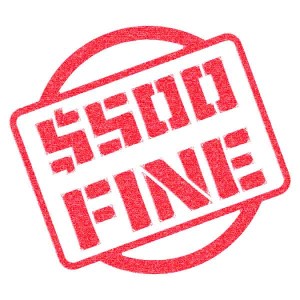
    500fineA Hudson, NY hotel has a perplexing way of dealing with bad reviews. According to Page Six, instead of using bad reviews as constructive criticism, the hotel charges wedding couples $500 for each bad review their guests post online.

    “Please know that despite the fact that wedding couples love Hudson and our inn, your friends and families may not,” reads an online policy. “If you have booked the inn for a wedding, or other type of event . . . and given us a deposit of any kind . . . there will be a $500 fine that will be deducted from your deposit for every negative review . . . placed on any Internet site by anyone in your party.”

    As expected, this caused the Internet to go into a frenzy. The day the story broke, the company’s Yelp page was flooded with over 500 bad reviews causing their review rating to plummet.

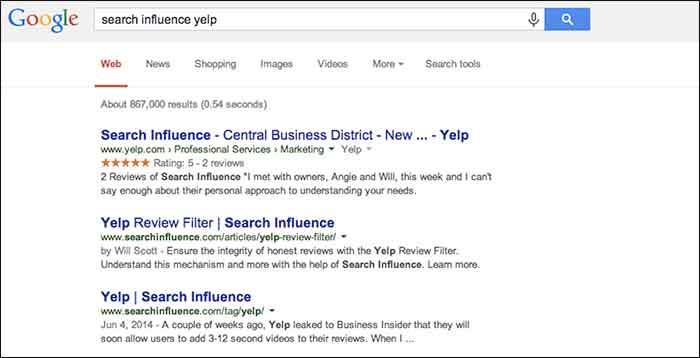
    Since Yelp recently received a well-deserved boost from Google in their search results, Yelp reviews can significantly help or hinder a business.

    Here are a few ways you can handle bad reviews without charging a $500 fine:

    1. Respond to good and bad reviews:

    Respond to all reviews, especially if they are asking a question or expressing a concern. When people take time out of their day to review your business, they like to be recognized. Responding to reviews lets consumers know that you care about your customers.

    2. Strive to be great at what you do:

    If you provide an all around excellent experience, you will get great Yelp reviews. It’s that simple!

    3. Calmly address the Reviewer’s Issues:

    When addressing a bad review remain polite and respectful. The reviewer is someone that gave your establishment a try and wasn’t happy with their experience for whatever reason. Hear this person out. If you respond in a negative way, it only makes your business look bad to other consumers. Not only can you ruin the chance of the reviewer changing their review or revisiting your establishment, this can also cause you to lose potential customers who choose businesses based on online reviews.

    4. Offer a remedy:

    If you think there is a way to rectify the situation, try to offer the person an incentive to come back. Send a private message that includes a coupon for a free milkshake or discounted service. Yelp users can use the update function to change their initial review. Everyone likes to feel that his or her opinion matters, so feeding a disgruntled user’s ego can sometimes quell the fury, and may lead them to reconsider their initial opinion of you.

    5. Bad reviews should be used as constructive criticism

    Never take a bad review personal. Bad reviews that are rational and deserved are not completely a bad thing. Use that negative review as a way to improve your business. Once you have fixed an issue or improved your business based on critiques, let the Yelp community know. They will be happy to know that their concerns matter and that you are listening.

    SIyelpSearchImage

  • What the Father of Facebook Can Learn from SEO About Conversion Optimization

    Everyone has heard of Mark Zuckerberg, Facebook Founder, but he owes much of his success to his father Edward Zuckerberg, DDS. Zuckerberg describes himself as the actual “Father of Facebook”, teaching Mark the ins and outs of computer programming on their Atari 800. In an effort to promote his Westchester, NY dental office he turns to Facebook and other social media tools. According to Zuckerberg, “It’s a tremendous marketing tool for business. It certainly is the biggest bang for your marketing buck”. So how exactly does Zuckerberg use Facebook and other social media you might ask?

    Check out his Facebook page. Going by the name of “Painless Dr. Z”, he believes “Facebook is a brilliant marketing tool, which targets young people and spreads the word about local business”. While it’s great to see him using the site his son created to maximize his business there are definitely a few changes he could make to his Facebook page as well as his website. Let’s start with how to improve SEO for his Facebook:

    Facebook Conversion Optimization
    Exhibit A — Which one is more compelling?

    Exhibit A: The “Like” iframe
    Graphically, this iframe needs a fair amount of improvement. The “Call to Action” can be more clear and bolder. It needs to make people want to click the “Like” button. There needs to be less words and more bold graphics.

    Exhibit B: Website

    As all SEO professionals know your website is one of the top tools for busting your SERPs on search engines, especially Google. Optimizations of keywords, meta data, img alt tags, and internal linking all play a part in increasing your rank on Google. Let’s take a look at how Zuckerberg could boost his on-site SEO.

    Facebook Conversion Optimization
    Exhibit B — Where is the Focus? How Do I Do Anything?

    1. Title Tags: These provide the user and search engine the content of the page. Currently, Dr. Z’s title tags give very little detail to what the page is about. The use of keywords is essential for rankings.

    Example:
    Current: Edward J. Zuckerberg, D.D.S., F.A.G.D. | High Tech Dentist in Dobbs Ferry, Westchester County, New York

    Update: Dentist Dobbs Ferry | Edward J. Zuckerberg, D.D.S., F.A.G.D. | Westchester County, New York

    2. Internal Linking: Looking at the Services page, there does not seem to be internal linking between other pages on the site. Here is where Dr. Z’s site could benefit from some good ol’ internal linking. So what’s the benefit of internal linking you ask? It helps boost a sites site performance in the SERPs and keeps visitors on the site for a longer period of time.

    3. Optimizing content on-site: This is a simple step. For the best results insert the keyword 3 to 4 times on desired page. Looking once again at the Services page it’s clear Dr. Z does not use keywords for any of his procedures. Also, the procedures do not have their own separate pages. With a page for each service, this can boost the site’s rankings.

    Just a few tips on how Dr. Z and anyone with a website can improve their rankings online.

  • An Overview Of Google Analytics

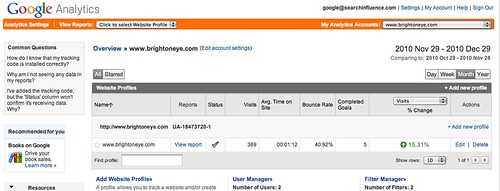
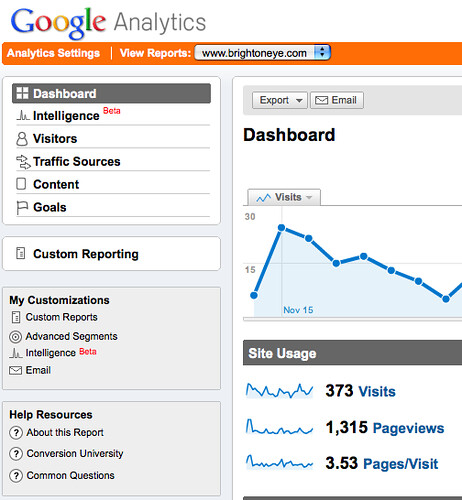
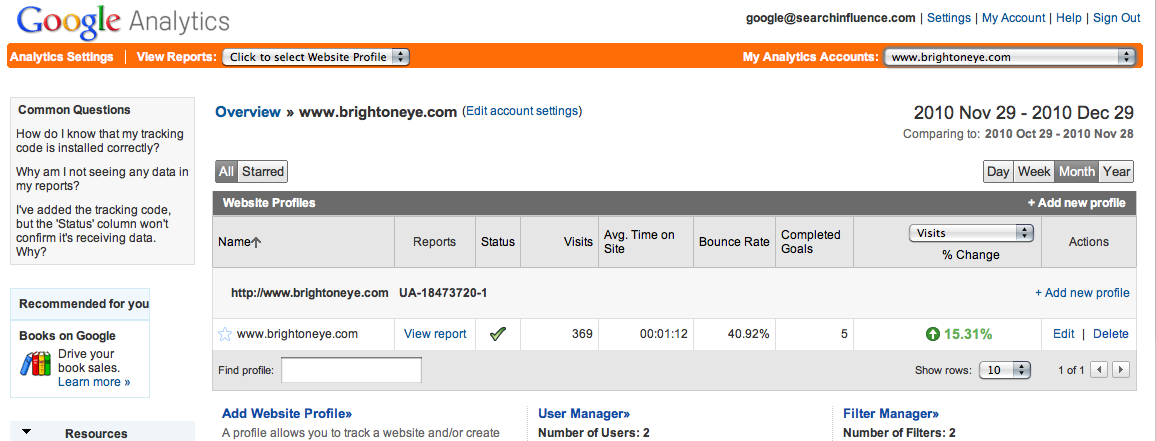
    Upon installing the Google Analytics code on your Web site, you will have an abundant amount of information to navigate through relating traffic sources and visitor information.

    To begin analyzing your Web site’s data, go to http://www.google.com/analytics/ – Click “Access Analytics” (blue button on the right side) and login using your Google account, under which the installation was made.


    The first screen is the Overview page.


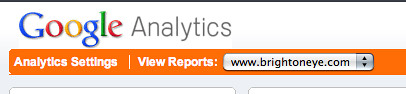
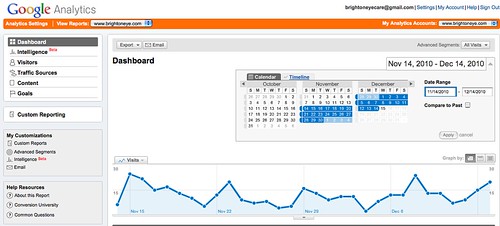
    To access the Dashboard with all the data for your site make sure the “View Reports” drop down menu on the top left corner displays your site’s name correctly.


    To specify the dates of the data you want to analyze, adjust the calendar on the right. Usually, a month to month comparison is best, but the smallest period of time you can compare by is day by day.  Note that data is only collected from the date Analytics was first installed on your site, any information from before that time will be unavailable.


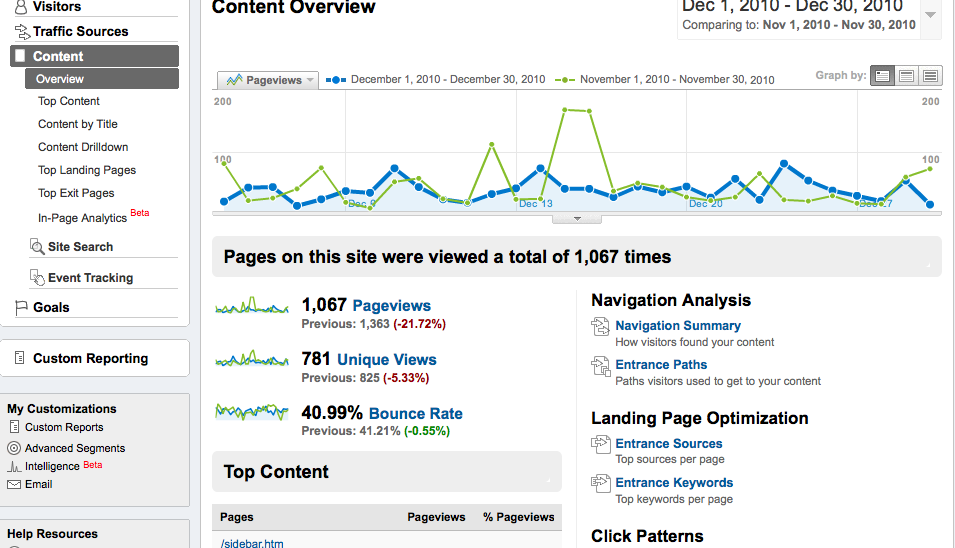
    On the left hand navigation, you will see a variety of options to analyze including Intelligence, Visitors, Traffic Sources, Content and Goals.

    Under “Intelligence” you can set up customized alerts regarding your data that can either be emailed or sent directly to your phone.

    Under “Visitors” you can gain some insight on what browsers your visitors are using to get to your site, what mobile devices are being used to reach your site, what kind of Internet connection they used and their geographical location.

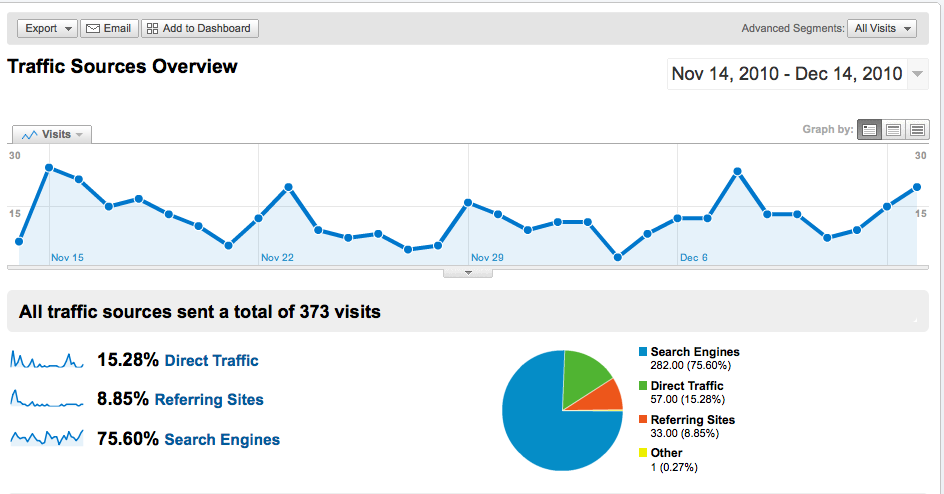
    Under “Traffic Sources” there is a link that will direct you to “Traffic Sources Overview,” which highlights Direct Traffic, Referring Site Traffic, and Search Engine Traffic. The percentage shown reflects the percentage of visitors coming in through those traffic sources and the pie graph illustrates that.


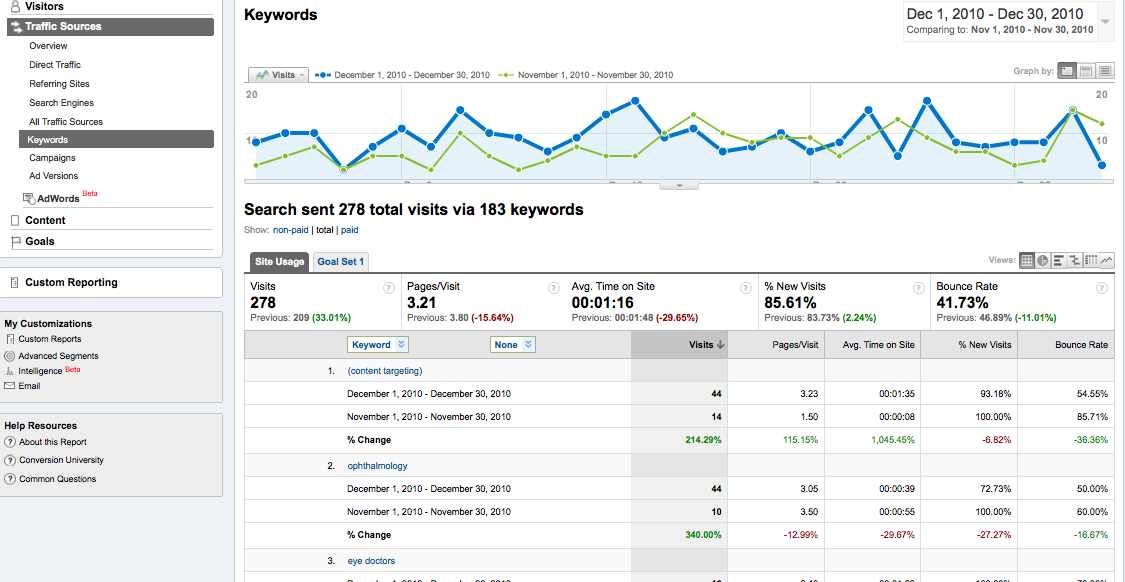
    Beneath the “Traffic Sources” drop down menu, you will notice an option that says “Keywords”. This offers valuable information on what type of search keywords are leading visitors to your Web site. If a keyword appears as [content targeting] this is an indication that a Pay Per Click campaign is leading people to your site.


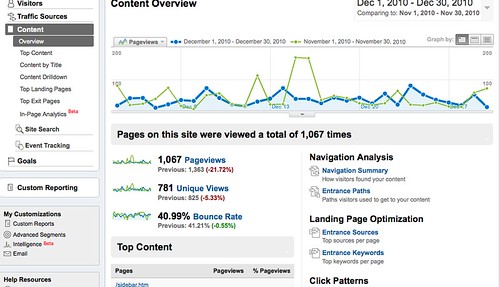
    Under “Content” you can gain insight on specific pages on your Web site including page views, unique visitors and bounce rate. Analyzing this information is particularly beneficial in determining the effectiveness of the design of your site. If your site has a high bounce rate, it indicates that visitors are immediately leaving your site, either because it is unappealing or it didn’t provide them with the information they were searching for quickly or effectively enough. Under “Top Content” you can determine which pages are receiving the most views and thus, the most interaction.


    Finally, you can export any of these pages as PDFs or other formats. You may also email the data results of any page with its respective information.


    Though this is but a brief overview, there are a number of additional features in Google Analytics including setting up alerts and customized reporting. Together, all of this data can give you a deeper understanding of your Web site and help you determine its effectiveness and help you make important decisions regarding your internet marketing efforts.

  • Website Goals: Convert Traffic to Sales!

    What is the function of your website?  Do you use your website as an information tool?  Do you use it as an arm of your sales team?  Why not have your website do both?  Too often small business owners focus on creating a flashy, aesthetically pleasing website. Instead, they should focus on a website that produces results.

    The Web Analytics Association defines conversion as a “percentage of a visitor type who complete a multistep conversion process with a defined beginning and end within 30 minutes, whether it be signing up for a newsletter, buying a product online or some other desired outcome.”

    Turn this into cash!

    How can you turn your website into more conversions? Below are a few pointers:

    Call to Action

    Think about it. How are you supposed to create conversions without a call to action? Each page of your site should include one or more of the following: a form to request more information, your phone number prominently displayed, somewhere to sign up for a newsletter, or a purchasing option.

    Create Goals

    Define what type of conversion you want from your website and what a conversion means to your business. Many business owners have not identified what conversion means for their site. Each business is unique and every website has different objectives. It is imperative that you properly define a conversion. In order to be considered a conversion, the site visitor must take some form of action. This can include completing an online form, signing up for a newsletter, or picking up the phone and calling.

    Track your Goals

    Once you have defined what you classify as a conversion, track it. Use tools like Google Analytics to discover where your conversions are coming from and focus your marketing efforts on these areas.

    Provide Information that Helps Consumers Make Purchasing Decisions

    Most consumers are on your site looking for a reason to purchase your product. They are not looking for a flashy picture or video that lacks quality information. Provide the consumer with a reason to purchase your product or service.

    Having people visit your site is great, but having people visit your site and purchase your product or service is better. Your site can be more than a flashy information tool; it can make you money!

    You like money, don't you?

  • Yahoo! is an Entertainment News Site…Wha?

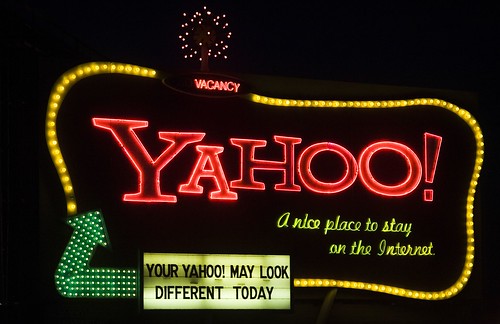
    Yahoo Fails At Search, Tries Its Hand At Being A “Pretty Woman”

    "Your Yahoo! May Look Different Today!"

    It is a sad day when search engines are reduced to stalking celebrities to keep themselves relevant.

    That is the thought I had when I saw the latest Yahoo TV commercial. Since their merger with Microsoft was announced, Yahoo has been trying to carve out a niche for itself as a entertainment news site (seriously how many E!s, TMZs, OhNoTheyDidnts, and Superficials must we have! How are all the celebrity bloggers going to eat and stay in white MSpaint to draw on photos?). They are even going as far as to declared themselves THE NUMBER ONE visited site for such frivolous news  – when in all honesty, they are including Yahoo Search,Yahoo Mail, and Yahoo Games (noticed I didn’t include the “!” because there just isn’t anything exciting about Yahoo anymore) into this data.

    Is it misleading? Hell, yes.

    It would be like Kanye West running into a social media award ceremony and shouting  “Yo Facebook, I’m really happy for you…I’ll let you finish. But Google had the most users of all time!”

    For Yahoo to not only call it quits with search but to instantaneously declare themselves the number one at something is delusional. Yahoo has never been first at anything, not even being absorbed in a significantly more successful search engine *cough*…AOL…*cough*.

    Oh and speaking of Kanye West, what’s the deal with Yahoo using “Flash Lights” in the commercial? That song is about pure narcissism (which is such a stretch for Mr. West to rap about *eye roll*)!  What does Yahoo have to be narcissistic about? It certainly didn’t live up to the promise of all those awesome 00’s commercials with the cowboy cry “yahoo!” at the end. In fact the only thing Yahoo should be proud of is knowing how to make money even in rough times. Yahoo is like a 80’s film star that got downgraded to tv dad in the 90’s and is now doing guest spots as the murder victim on cop dramas between infomercial and night manager gigs. Yahoo is a shining example of just because you’re well known at something, doesn’t mean it will make you rich.

    Am I mad at Yahoo? No, but I am upset at internet companies allowing Google to swallow more and more of the search engine pie chart. This merger is not going to increase Yahoo/MSN slice of the pie, it’s just going to make search professionals realize we are practically on Google’s payroll.  :/

    Thanks to Thomas Hawk for the image!

  • Buying Yelp Reviews Is BAD for Business

    Yelp is intended as a review site where users can write and read reviews for local businesses to help make informed buying decisions. It’s a powerful tool in that users trust the real opinions and feedback from their friends and neighbors. Yelp’s user-driven reviews allow everyone to add in their opinions of products and services at local clubs, restaurants, and businesses in all forms.

    There is obvious value to a small business owner in getting users to leave positive reviews. The question is how much should a business pay for a review? No, no, no … I’m joking. The question really is how do you encourage customers to leave Yelp reviews naturally and organically without abusing the intent of the site?

    To Solicit or not to Solicit

    Yelp is clear about incentives for reviews: “Yelp has advised business owners not to offer incentives for reviews. For starters, paying people to write reviews about your business is another form of shilling and that’s just wrong. Second, very often you’ll offend a customer and the offer will be quickly outed in your reviews, resulting in unintended negative reviews and/or negative publicity. Finally, it’s typically a fruitless exercise.”

    It’s a fruitless exercise because of the Yelp review filter.  Yelp knows their site is a great opportunity for illegitimate behavior, and they have built tools to attempt to minimize the spam and attempt to maintain the authenticity of the site. They haven’t been entirely successful. Says Luther Lowe of Yelp,

    ‘It’s very tough to design algorithms that can tell the difference between the guy who’s cranking out a fake five-star review about himself, and the guy who’s flipped that laptop around and handed it to his customer and said, “Hey, write a five-star review about me.” So, you know, I know that businesses are going to ask people to write reviews. If you do that, you need to be prepared for pretty violent review fluctuation.”

    From Yelp Common Questions: “Some reviewers are more credible than others. For the most part, users can decide for themselves which reviewers they trust the most. We remove some of the guesswork by filtering out reviews that are written by less established users. We do this in order to provide more trustworthy and useful content to our users and to help protect against fake reviews from malicious competitors and disgruntled former employees.”

    Control Yourself on Yelp

    Every small business wants testimonials to help drive traffic. Yelp is tremendously trusted by real world users. (Isn’t it more encouraging to try the new restaurant in town after you read 10 great reviews online?)

    And Yelp is tremendously trusted by search engines, and being so trustworthy makes it ripe for abuse by some businesses and internet marketers. The prime example is Google Local map rankings, which are influenced by some degree by the presence of online reviews on select review sites.

    But Yelp advises you to control yourself:

    “Should I ask customers to write reviews for my business?

    While we understand that there is a temptation to solicit reviews from your customers, it is not something we encourage. The most successful businesses on Yelp have had their reviews come organically. This is for a couple of reasons:

    1. Potential customers can sometimes have an adverse reaction to a business that looks like it has solicited reviews.

    2. Quite often those solicited reviews will be filtered out (see above) based on the activity level of those users within the Yelp community.

    If you do ask your customers for reviews, please be prepared for the review number fluctuation that might follow.

    Also, keep in mind — success on Yelp is primarily measured by the number of people who view your page and thus walk in the door or set an appointment, not the number of reviews you have. Yelp users are savvy: they care about quality — not quantity — when it comes to your business reviews.”

    To be completely genuine, solicitation of reviews even without incentive is frowned upon. And incentivized reviews (buying Yelp reviews) are absolutely unethical …

    This picture taken in the store suggests completing a review, and not only a review … but “as good as it gets” review, to get 20% off the next purchase. One reviewer complains on this business’ Yelp profile about the incentivized review request in the store; Mel T comments on Yelp:

    “How would they base the authenticy of a Yelp review? What if I just claimed ownership of Jane D.’s (as in Jane Doe – I’m not trying to impersonate any fellow Yelpers here) review? How would they know if I was really Jane D.?

    – Would I still get a discount if I had written a review, but it wasn’t “raving?”

    Well, I’m sorry, Pure Beauty. You cannot buy a five star Yelp review from me. Instead, your blantant bribary is going to cost you two whole stars. Yep, that’s right; I’m knocking you down TWO full stars. Had it not been for your sign, I would have given you three stars – an A-OK for decent employees during my visits, a relatively clean shop, and reasonable prices.

    But, again, I will not stand for your bribary. Hmph. (Hmm..wonder if I can get 20% off with this review..?)”

    This beauty supply store has bigger issues than their Yelp spamming. There are quite a few reviews blasting their customer service. Perhaps, they should consider better ways to combat negative publicity.

    Asking for Help on Yelp

    One self-proclaimed newbie small business on Yelp asks help of the Yelpers, Greg “GSKChicago” K., asks, “I am relatively new to Yelp and still learning my way around … What do Yelpers look for from a business owner on Yelp?”

    The answers:

    Miguel “the Coach” R. says: “honesty!”

    Lauren “Order” H. says: “if you do anything related to your own busines, disclose that you are the owner. and don’t use the talk boards or other parts of the yelp site as free promo or spam.”

    nikki c. says: “just be real, honest and your own worst critic.”

    Seems legitimate enough. This business owner wants to do the Yelp thing correctly, but Miguel “The Coach” R. comes back later to point out some problems, and all of Greg’s good intent evaporates:

    Miguel “the Coach” R.:  “Greg -No offense but after reading the reviews for your business, I am a little disappointed. Everyone who did a review on your business – only did a review on your business. So, that means that you either made several profiles, had your friends make profiles, somehow convinced your customers to make a profile and only rate your company – or – some combination of the three.

    If you want my opinion. No company will EVER completely 100% satisfy each and every customer. And to see nothing but 5 stars for each review is flat out unbelievable.

    As of right now I feel as though you have already been dishonest by doing what you did, and that will eventually hurt your business rather than help it.”

    Using Social Media to Drive Fans over to Yelp Profile

    (Some text has been edited from original post.)

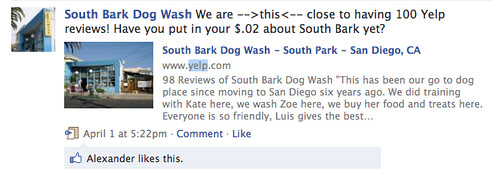
    If your small business has a strong Facebook Fan base, you can attempt drive Fans over to your Yelp profile and hope that some percentage of them will actually leave reviews. These businesses on Facebook are technically soliciting reviews but offering nothing in return, so their Yelp review building may be considered more legitimate. They are still soliciting, but they aren’t buying Yelp reviews.
    This Facebook-er is more blatant. The Lone Star Salon tells Fans if they leave a review on a review site, Lone Star Salon will give them $10.   Totally buying a review.

    And ….
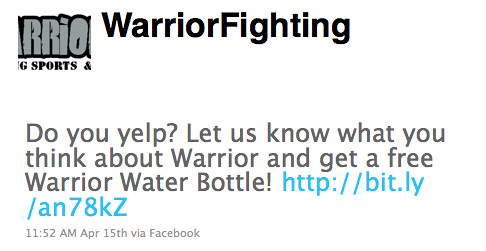
    And …

    We’re talking about pretty low value transactions here – a water bottle, a free cookie, etc. – but any incentive can be enough for a reviewer to take a few moments to drop a review into a Yelp profile that they would not have done if not incentivized.

    Raffle Your Incentive … is Still Incentive

    Another way to buy a review is a little more subtle, but it is still crossing Yelp’s guidelines for good Yelping. Essentially it is offering a chance to win a free product or gift certificate in a raffle. It’s not a direct exchange like Lone Star’s program, but these are still incentive for leaving a review.
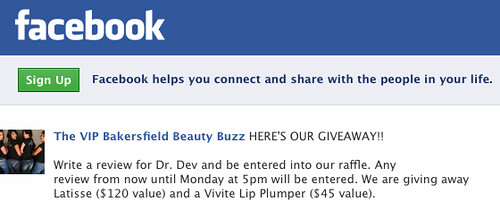
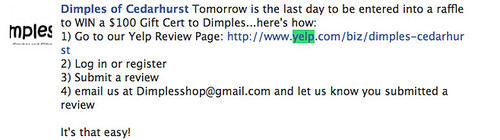
    Any reviews on Yelp from these campaigns are not the natural and organic reviewing that is Yelp has struggled to maintain. From Yelp Terms of Service:

    “You agree that you will not, and will not assist or enable others to: use the Site in a manner that may create a conflict of interest, such as trading reviews with other business owners or writing or soliciting shill reviews”

    And there are a few abusers on Twitter too …

    Again, offering a chance to win free product or discount is not directly buying a Yelp review, but it is definitely incentive for the reviewer, warranting the review as forced.  Not natural behavior for Ramona Family Naturals.
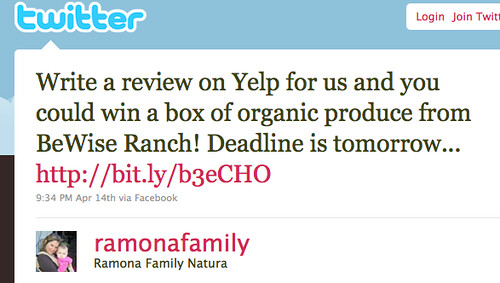
    They tweeted on the 14th and got 2 5-star reviews on the 15th. (I wonder who won the box of organic produce?  They should tweet that.)

    And The Spot Yogurt in Santa Monica appear to be naively direct in their request.
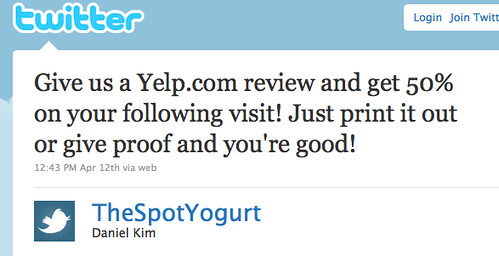
    And before that, they requested on March 31st too.

    Of course, we know that ignorance of the rule is not exception from it.  Yelp says of this type of false reviewing:

    “very often you’ll offend a customer and the offer will be quickly outed in your reviews, resulting in unintended negative reviews and/or negative publicity”

    Luther Lowe on business owners aggressively soliciting reviews from customers:  “it just looks spammy and decreases the authenticity of your overall presence. That can turn the customers off to you.”

    Charles Grumblemouse O. has a more virtuous Yelper attitude. He says of being Paid to write reviews:

    “… the impetus for writing reviews is surely different if you’re paid than if you were just doing it for the love right?”

    And finally, it’s important to be creative and sincere. Here’s a great case study of a New York Locksmith. He’s got a great perspective on how to get Yelp reviews without direct solicitation.

    Image credits: Thanks to “twonjosh,” “Silver Smith,” ZDNEt, and Steve Rhodes for the images!
  • Burying Negative Content – What to Do Versus What Not to Do


    These days it is really easy to tarnish the online reputation of a company.  Just one bad review or article posted on a high traffic web site is all it takes.  In most instances it is impossible to have negative comments and stories removed.

    The best way to fight negativity is through positivity.  The simplest way to do this is to drown it out.  Good news can chase bad news down the search engine ranks to the 2nd or 3rd page, where it is less likely to be found.

    Here are some action steps:

    1) Monitor activity- Find all of the sites where the bad news lives.

    2) Stay calm- Be patient, it takes some time.

    Patience for reputation management techniques to work!

    3) Post positive- Here are just a few ideas:

    Create a social networking profile – Facebook
    Create a business profile – Linked In
    Start a blog – WordPress
    Share photos- Flickr
    Claim your identity- Naymz
    Create a Wiki- Wetpaint

    The number 1 thing NOT to do is search for yourself or search for the negative information.  This is the fastest way to ensure it will NEVER go away.

    It is hard work and extremely time consuming to bury bad press.  I know it is tempting to look, but that one search can enable the bad news to resurface and erase all of the work that was already done, bringing you right back where you started.

    Even if you do not have a reputation management issue at this time, please know if one does present itself, there are ways to fix it, as well as one major way to prevent it from disappearing!

    Image Credits: Thanks to ladybeames and stevoarnold for the great imagery for this post.

  • Unethical Customer Reviews Can Cost You Big

    Lifestyle Lift is learning the cost of unethical customer reviews. The New York State Attorney General has reached a $300,000.00 settlement with cosmetic surgery company Lifestyle Lift in response to fabricated consumer reviews.

    It appears that Lifestyle Lift was directing employees to spend their time in reviewing their own facilities.

    Lifestyle Lift is a plastic surgery chain store. From those online customer reviews one finds, which appear truly authentic, they’re not doing so great in good old fashioned customer service. According to the article in the NY Times it seems that Lifestyle Lift is resorting to aggressive reputation management techniques to suppress bad reviews and advance their own message.

    Where did Lifestyle Lift go wrong?

    According to the article, it appears that Lifestyle Lift fabricated reviews of their own facilities and even went so far as to create entire new “review” sites to advance their message.

    To be clear, user reviews are great. The creation of alternate sites for search or more targeted messaging are a long accepted technique to obtain ranking and spread the message.

    Where it becomes a problem is when these reviews and sites are presented as authentic user generated content and they are, in fact, a fabrication in support of public relations.

    In short, the creation of false consumer reviews with the intent to deceive is the problem. It’s long been held to be unethical and now, in the state of New York, it’s illegal

    Examples of likely fabricated reviews:

    These aren’t for Lifestyle Lift, but for other plastic surgery searches. I’m not saying the following are specifically relevant to bunk reviews, but there are a couple listings – you can find them yourself – which have an abundance of positive or non-informative, yet 5-star, reviews.

    http://www.google.com/search?q=breast+augmentation+san+francisco
    http://www.google.com/search?&q=plastic+surgery+new+jersey

    And we don’t know that these are definitely a fabrication but “cool” has 3 reviews, all of which are for the same plastic surgeon, focusing on different locations (1 of which includes “Plastic Surgery” as the business name) and no reviews for other businesses.

    And “Happy”, whose reviews look more authentic has a similar instance of 1 each for business name”Plastic Surgery” and for the doctor’s name itself – again, with no reviews for other businesses.

    At a minimum, what the above demonstrate is how not to ask for customer reviews. Whether “Happy” and “cool” are real people or employees of the practice, a little digging makes it appear these are inauthentic and calls into question the validity of all the reviews.



    So what’s a small business to do?

    As the examples show it’s a dog-eat-dog world in online reviews.

    Ironically we’re preparing a much more focused post on how to get reviews but in the meantime remember:

    • Be authentic! Chances are if you fake it you’ll get caught.
    • Have customers tell their story. They’ll be much more believable than you.
    • In doubt? Don’t do it! Lifestyle Lift should be a lesson – it might cost you $$

    Of course, this case is different than most because Lifestyle Lift got busted. The New York State Attorney General has drawn the line for us with regard to clearly egregious behavior but I think we can all agree they’re not the only ones.

    Where does that line get drawn for you? As with every ethical question there are many shades of gray between here and there.

    I’d love to hear your thoughts.

    Thanks to the Blog Herald for tipping me off to this story. It’s very relevant to our livelihood and that of our customers.

  • Reputation Management or Just Good Old-Fashioned Customer Service: What Works Better?

    “Markets are conversations”, states the Cluetrain Manifesto, the online reputation managers’ Bible. And if you sell any kind of product or service today, you must be part of the conversation or get left out.

    Crowd Pleaser - The Power of Word of Mouth
    Crowd Pleaser – The Power of Word of Mouth

    In the days before the internet, reputations were built on word-of-mouth (WOM) and reputation management was a term that referred to damage control and crisis communications. The growing reach of the internet means that online business is now a two-way conversation.

    Consumer-generated product reviews play a big role in online purchasing behavior. 55% of US internet users indicate that they check other people’s opinions online before making purchases. A study by Deloitte & Touche USA reports that 18% of customers purchased a beauty or grooming aid based on reviews posted by other consumers.

    The fact that reputation matters online is beyond debate. At Search Influence, we believe that business is not just about putting a positive spin on your product or service. It’s also about creating value for your customers. And the value you provide is what will create good buzz online, with positive reviews and comments from happy customers.

    Very Satisfied Customer
    Very Satisfied Customer

    Customer reviews are not only useful on blogs, forums and review sites. They’ve also been reported to improve site conversion, retention and customer loyalty, and boost search engine results by increasing on-site content.

    eBay was one of the first web companies to harness the power of Consumer Generated Media (CGM) feedback. By using user generated feedback ratings, it helped other users make purchasing and selling decisions.

    Unfortunately, many businesses are still in reactive mode today. This includes even big brands, such as McDonald’s, KFC and Coca Cola. Few have woken up to the fact that consumer reviews and opinions are playing an increasingly important role in word-of-mouth marketing online. It’s only when they get negative buzz that they go all out to clean up the mess.

    One example of how negative buzz can play havoc with your brand is the recent Domino’s Pizza YouTube video fiasco, that resulted in criminal charges being filed against two members of the staff at a Domino’s outlet, for posting a video that shows a staffer shoving cheese up his nose.

    To minimize the backlash Dominos uploaded a video on YouTube addressing the issue. Not exactly the most effective way to salvage their reputation. You can bet a lot of people (us included) will be avoiding those pizzas for a while!

    In the long run, the best approach is to take a proactive stance on creating and maintaining a good reputation online. Here are some steps we recommend to help you create more positive buzz for your products or services.

    • Provide value: The #1 rule of thumb for brick-and-mortar stores or offline businesses is also what works best online. Customers appreciate businesses that offer them quality products and services, whether they operate online or off.
    • Ask for feedback: Are your customers unhappy? Do you get complaints about your systems, processes, staff or services? Ask each customer to fill in a form with feedback and reviews, no matter how inconvenient it can be.
    • Take action: View your customer’s complaints and feedback constructively and take the steps you need to improve what you’re offering. It’s easier and cheaper to offer a refund or a replacement than it is to clean up the bad press and damage to your business reputation created by an irate customer.
    • Monitor your online reputation: You could do this yourself using Google Alerts, but if your online reputation matters a lot to you, it makes sense to hire a reputation management firm to monitor buzz about your company.
    • Participate in the conversation: If your business generates a lot of positive feedback from customers, ask them for permission to use their reviews and testimonials online. Participate in industry forms, social networks and consumer review/opinion sites.
    Be Part of The Conversation
    Be Part of The Conversation

    Even if your online reputation is suffering, it’s not too late to change the negative perception of your business. You can syndicate articles to industry newsletters and article engines. Put up a blog on your own website and post your articles there. Allow visitors to post comments and reply to them.

    Learn about social networking and how to make it work for you. Build a mailing list and keep your subscribers in the loop with an email newsletter. Send out press releases on recent developments in your industry.

    Rules of the road for creating visibility online:

    • Get personal. Build relationships with potential customers.
    • Be human. Use consumer-speak, not corporate-speak.
    • Don’t advertise blatantly. A link to your website at the end of a forum post is acceptable.
    • Be patient and consistent in your efforts. It takes time to build trust and see results.
  • Will Scott Head Shots for SMX Local Search Ranking Tactics

    I’d like a little help here please. Like my friend, Portland OR Web Designer, David Mihm I needed a head shot for SMX Local Mobile where I’ll be on a panel with a fine bunch of fellows on ranking factors for local search.

    I went to see one of our clients Jessica Johanningmeier a New Orleans Wedding Photographer to have her shoot a few.

    “Make me look young, thin and beautiful” I said and she felt right at home.

    So without further ado I give you the choices. Please have a look and tell me in the comments which is your favorite:

    Will Scott Head shot 01


    Will Scott Head Shot 01

    Will Scott Head Shot 02

    Will Scott Head Shot 02

    Will Scott Head Shot 03

    Will Scott Head Shot 03

    Will Scott Head Shot 04

    Will Scott Head Shot 04

    Will Scott Head Shot 05


    Will Scott Head Shot 05

    I’ve got a favorite but interestingly my wife disagrees 🙂

    And… remember what grandma used to say… “If you don’t have something nice to say” — I think you know the rest.

    Thanks for your help!

    Will