Author: Alison Zeringue

  • How to Conquer the Biggest Higher Ed Marketing Challenges in 2026

    How to Conquer the Biggest Higher Ed Marketing Challenges in 2026

    Key Insights

    • Student Search Behavior Is Changing, and Marketing Must Follow: Shifting demographics, alternative education pathways, and AI-driven search are changing how prospective students discover and evaluate institutions. Universities must align their strategies with search behavior that now spans AI tools, social platforms, and traditional search engines.
    • AI Search and Social Discovery Drive Visibility: AI Overviews and social search are redefining online visibility. Traditional SEO alone is no longer enough. Institutions need clear, authoritative content that performs across AI-powered and engagement-driven platforms.
    • Tracking the Right Metrics Is Essential: As clicks become less reliable signals, understanding cost per inquiry (CPI), cost per enrolled student, and channel performance is critical for optimizing budgets and improving enrollment outcomes.

    Nearly 50% of prospective students now use AI tools at least weekly, and 79% say they read Google AI Overviews when researching academic programs.

    Search behavior isn’t just changing. It’s fragmenting across search engines, social platforms, and AI-powered tools, forcing universities to rethink how they show up and stay visible.

    As traditional student populations decline and digital marketing evolves, higher education institutions face growing pressure to adapt their recruitment strategies to meet prospective students where they actually search. From shifting discovery behaviors to the rise of alternative education pathways, academic leaders are navigating an increasingly complex and competitive landscape.

    The biggest challenges in higher ed marketing today aren’t tied to a single channel or tactic. They require institutions to redefine how they connect with an audience that is more diverse, digitally savvy, and selective than ever before.

    To better understand these shifts, Search Influence partnered with UPCEA to conduct AI Search in Higher Education: How Prospects Search in 2025, a national study of 760 adult learners exploring professional and academic programs. The research offers critical insight into how prospective students use search engines, social platforms, university websites, and AI tools throughout the decision-making process.

    In this blog, we’ll break down the most pressing higher ed marketing challenges in 2026 and share practical, research-backed strategies to help your institution:

    • Strengthen student engagement
    • Refine its digital approach
    • Compete more effectively in a rapidly evolving search environment

    Higher Ed Marketing Challenges

    AI’s impact on behavior and the search landscape

    The students of tomorrow are already using AI today. And for many, it’s now a routine part of how they search for and evaluate academic options.

    Search Influence’s AI Search in Higher Education research found that 79% of prospective students read Google AI Overviews, and 56% are more likely to trust institutions cited by AI.

    This shift is influencing the student journey well before application, shaping how prospects explore programs, compare institutions, and narrow their choices.

    AI chatbots, search assistants, and generative search experiences are increasingly embedded in the consideration process, acting as filters between prospective students and institutional websites.

    In many cases, students now get answers directly within search results without clicking through to a university website, a behavior known as zero-click search. AI Overviews frequently summarize program information, admissions details, and outcomes on the results page itself, especially for non-branded and early-stage research queries. This means visibility increasingly depends on being cited and trusted by AI systems, not just driving traffic to a landing page.

    As AI becomes more integrated into everyday search behavior, students expect universities to provide clear, accessible information that AI systems can surface accurately, not just compelling messaging once they arrive on a website.

    How to overcome this challenge

    As AI reshapes how content is discovered and summarized, higher education marketers must refine their content strategies to support both human decision-making and AI-driven retrieval.

    Universities will stand out by developing clear, in-depth, and well-structured content that AI systems can confidently reference and prospective students can trust. Research-backed program pages, detailed FAQs, and content that directly answers common search questions improve the likelihood of being surfaced in AI Overviews and other generative search experiences.

    Targeting specific, intent-driven queries, such as program outcomes, career pathways, and admissions considerations, helps institutions remain visible across traditional search, AI-powered results, and emerging discovery channels.

    Incorporating interactive elements such as webinars, virtual tours, and downloadable guides creates engagement opportunities that go beyond AI summaries, encouraging prospective students to take the next step once initial discovery happens elsewhere.

    Institutions that adapt their content and SEO strategies with AI search in mind will be better positioned to maintain visibility, build trust, and connect with future students as search behavior continues to evolve.

    A guy taking notes next to a computer

    Social search

    Social search is redefining how prospective students discover and engage with universities, and it plays a dual role in modern visibility: how people search and how AI systems understand and trust brands.

    Search Influence’s AI Search in Higher Education research shows that prospective students’ search behavior is increasingly diversified when researching programs:

    • 84% use search engines
    • 61% use YouTube
    • 50% use AI tools

    Social platforms sit squarely within this ecosystem. Prospective students now use platforms like TikTok, Instagram, YouTube, and LinkedIn as search engines in their own right, entering queries, scanning results, and comparing options through video, comments, and creator content.

    Instead of typing formal queries and clicking ranked links, students search social platforms with intent-driven phrases, looking for campus tours, student perspectives, program outcomes, and day-to-day academic experiences. Discovery happens through scrolling, watching, and evaluating content in context, often before a university website ever enters the picture.

    Unlike Google’s algorithm, which relies heavily on structured SEO signals, social search is driven by engagement. Visibility is determined by watch time, shares, comments, and interaction, making discovery harder to influence through traditional optimization alone.

    This behavior matters beyond student engagement. AI-powered search engines increasingly pull context and authority signals from social platforms. Social content helps AI systems validate what an institution offers and which queries it should be connected to in generative search results.

    Higher ed marketers must transform existing content into social-native, program-focused formats that support discovery and credibility. Simply having a website is no longer enough.

    How to overcome this challenge

    To succeed in social search, universities must treat social platforms as extensions of their search and content strategy, not just promotional channels.

    Institutions should focus on creating educational social content, such as:

    • Instagram Reels or TikTok videos that clearly explain academic programs, career outcomes, or student experiences
    • Short-form student testimonial videos that speak directly to institutional value, flexibility, and real-world impact
    • YouTube videos that provide deeper program overviews, faculty insights, or recorded info sessions
    • LinkedIn articles that discuss industry trends, academic expertise, or workforce alignment related to your institution and target programs

    By approaching social media as a strategic input into AI-driven search, higher ed marketers can improve discoverability, strengthen brand credibility, and support enrollment goals across an increasingly fragmented search landscape.

    Tracking key metrics for performance

    Tracking key metrics is essential for ensuring the success of higher education marketing efforts, yet many colleges and universities still struggle to measure the true impact of their campaigns.

    UPCEA and Search Influence collaborated on the Higher Ed Marketing Metrics Research Study: What Gets Measured Gets Managed to address this challenge.

    This study highlights a critical issue: While most marketing teams can identify the source of inquiries, far fewer track the actual cost per inquiry (CPI) or cost per enrolled student — two essential metrics for assessing marketing efficiency.

    In fact, while nearly 73% of marketing units track the source of inquiries for online and professional education programs, only 46% track CPI, and just 43% monitor the cost per enrolled student. Even more concerning, 17% do not track any of these key performance indicators at all.

    Understanding CPI and cost per enrolled student provides significant benefits for colleges and universities looking to optimize their campus recruitment efforts.

    Tracking these metrics allows marketing teams to assess whether they are generating an appropriate volume of prospects and determine if those inquiries are converting into actual enrollments. More importantly, it enables data-driven decision-making by showing where budget optimizations can improve efficiency.

    For example, if one marketing channel consistently delivers high CPI but low conversion rates, adjustments can be made to targeting, messaging, or spend allocation to maximize future results. Tracking these metrics provides a foundation for deeper analysis, helping universities evaluate lead quality, conversion ratios, and the overall effectiveness of different marketing channels.

    How to overcome this challenge

    By prioritizing CPI and cost per enrolled student, higher education marketing teams can make informed adjustments to their strategies, ensuring that resources are directed toward the highest-performing channels. This approach improves campaign performance and allows institutions to better understand how their marketing investments drive student engagement.

    Changing demographic and enrollment landscape in higher education

    The higher education landscape is shifting dramatically, and the long-anticipated demographic cliff is here. As the number of “college-aged” students declines, institutions historically relying on traditional undergraduate enrollments must rethink their approach.

    To stay competitive, higher education institutions must expand their focus beyond recent high school graduates and embrace a broader audience — adult learners, career changers, and professionals seeking skills-based education.

    The move away from traditional education pathways

    The traditional four-year degree is no longer the only, or even the preferred, pathway for many modern learners.

    Rising tuition costs, evolving workforce demands, and a desire for flexibility are driving students toward microcredentials, online degrees, and non-credit-to-credit pathways that allow them to tailor their education to their career goals.

    The workforce is evolving too quickly for rigid, 120-credit degree programs to keep up.

    As Aaron Brower highlights in From Degrees to Microcredentials: Higher Education Must Evolve to Embrace the Modern Economy, this shift isn’t just about cost; it’s about relevance.

    Instead, students are adopting a “mix-and-match” approach to learning, combining traditional coursework with certifications, industry-recognized credentials, and skill-based training. This shift is forcing schools and universities to adapt their higher education marketing and university marketing strategies to ensure they reach and engage today’s learners.

    Prospective students are looking for technology-driven solutions that allow them to engage with coursework without sacrificing work, family, or other commitments. Institutions must emphasize the benefits of flexible learning options to attract more students.

    This means adapting marketing communications to highlight the value of alternative education pathways, including non-credit programs that can stack into degrees, online learning that fits busy schedules, and credentials that provide immediate career impact.

    How to overcome this challenge

    For campuses to thrive in this new landscape, institutions need to evolve their messaging to focus on lead generation and long-term student engagement. Universities that successfully communicate the advantages of non-traditional education will attract more students and position themselves as forward-thinking leaders in an era where lifelong learning is essential.

    The Importance of Upskilling Your Team With AI SEO

    To overcome today’s higher ed marketing challenges, institutions must upskill their teams with a clear understanding of AI SEO.

    AI SEO isn’t a passing trend or a niche tactic. It’s the new operating environment for search.

    As AI-powered systems increasingly determine which content is surfaced, cited, and trusted, marketers need to understand how content is interpreted by people and machines.

    New technology can feel intimidating, but adapting to AI SEO is no different than learning any other essential marketing tool. Working in marketing today without understanding AI SEO is like working at Office Depot without knowing how to use the Xerox machine. It’s simply part of the job now.

    For many institutions, the fastest path forward is partnering with an AI SEO agency that recognizes how search is evolving and how higher ed audiences behave.

    Contact Our Award-Winning Higher Ed Marketing Agency

    From understanding AI’s impact on search and social discovery to navigating changing demographics and tracking the right performance metrics, higher education marketers are being asked to do more in an increasingly complex environment.

    That’s where Search Influence comes in. We help colleges and universities adapt with research-backed strategies.

    Of all these challenges, AI search may be the steepest climb. Search behavior is shifting faster than most institutions can track, and visibility now depends on how AI systems interpret, summarize, and trust your content.

    Consider our AI Search in Higher Education research study the climbing gear you need. It offers practical insight to help you navigate this shift with clarity and confidence.

    Download the AI Search in Higher Education study to understand how prospective students use search engines, AI tools, social platforms, and university websites.

    Images:

    1. Unsplash
    2. Unsplash
  • Now Available: AI Visibility Tracking Powered by Scrunch – November Client Insider

    Now Available: AI Visibility Tracking Powered by Scrunch – November Client Insider

    How Visible Is Your Brand in AI?

    AI Visibility Tracking expands your AI SEO reporting

    AI search has changed how users find your brand.

    Tools like Google’s AI Overviews, ChatGPT, and Gemini deliver conversational answers that often don’t require a click to your site. Your brand visibility now extends well beyond traffic, and traditional SEO reports only tell part of the story.

    This shift creates a new challenge: how do you measure and influence conversations happening in a zero-click search world?

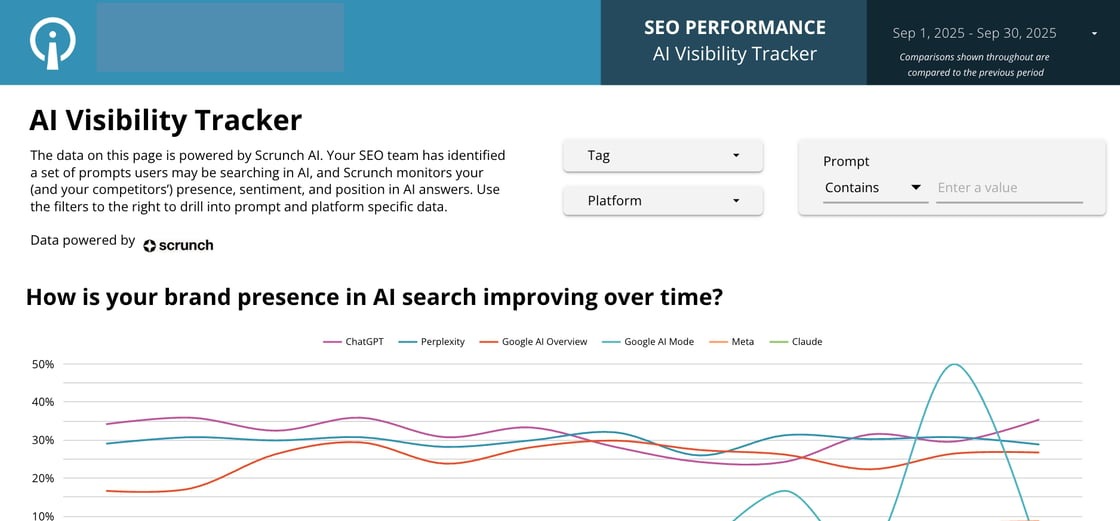
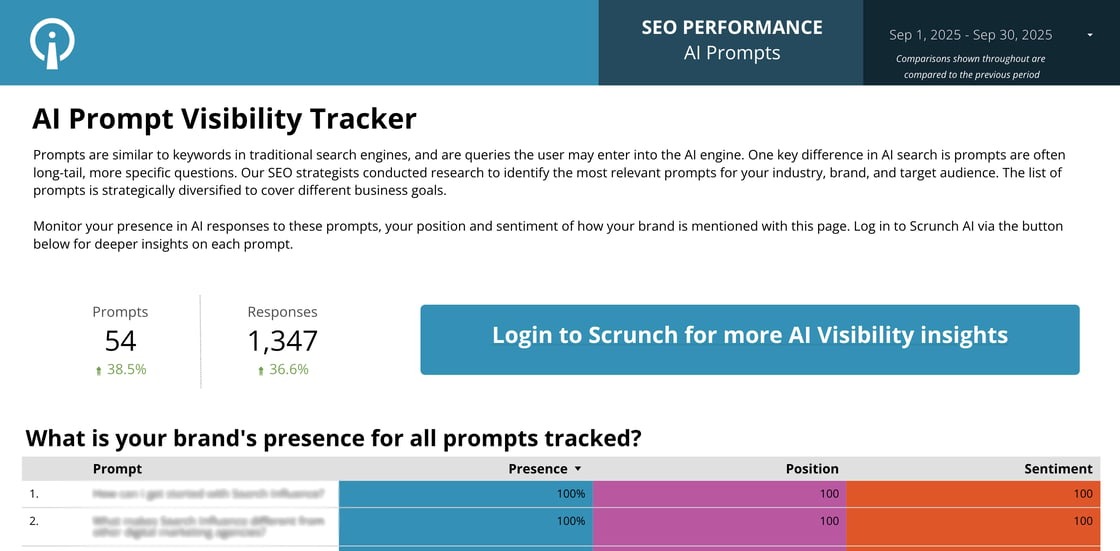
    Introducing Scrunch AI Visibility Tracking, a reporting add-on that shows how AI platforms see, describe and cite your brand across major AI engines.

    Ways We’re Tracking Your AI Visibility

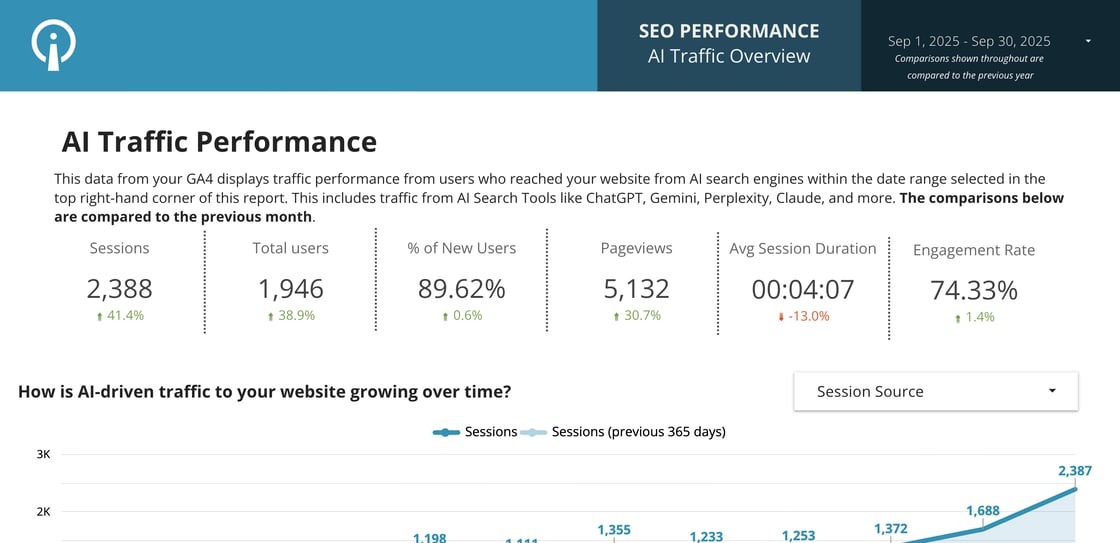
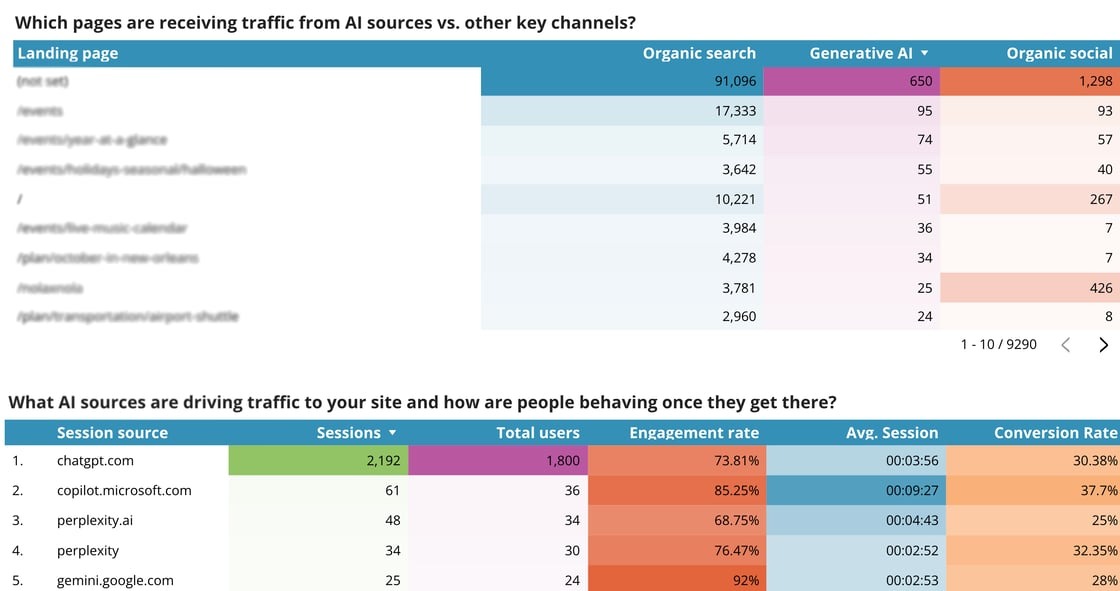
    Search Influence expanded your current AI reporting by combining GA4 traffic insights with advanced AI visibility tracking. You can now get a complete picture of how users reach your site AND how AI represents your brand.

    1. AI Traffic Report, powered by GA4

    A report in looker studio

    A report in looker studio

    Already available in most client dashboards. See how much traffic AI tools drive to your site, plus engagement metrics and top landing pages from AI sources.

    2. New & Available Now: AI Visibility Tracker, powered by Scrunch

    A report in looker studio

    AI Visibility Tracking moves beyond traffic and reveals how AI engines talk about your brand. You’ll see:

    • Prompt-level tracking across ChatGPT, Google’s AI Overviews and other major platforms
    • Citations and mentions across AI-generated responses
    • Sentiment analysis that shows how your brand is positioned in AI results
    • Competitive benchmarking that reveals share of voice and where competitors are winning
    • Insights that uncover content gaps and new citation opportunities to improve AI visibility

    All Scrunch data integrates directly into your Looker Studio dashboard, so AI insights live beside your SEO performance metrics in one place.

    To launch AI Visibility Tracking for your brand, our SEO team will identify 25–75 relevant AI prompts for your industry and competitors, then configure the tool with your brand details and audience data. The result is AI reporting that reflects real behavior and delivers actionable insight.

    Your SEO Strategist will analyze AI Visibility data monthly, report on highlights and insights, and leverage this information to drive your AI optimization strategy.

    Interested? Talk to your Account Manager about adding AI Visibility Tracking to your dashboard today.

  • Boost Paid Search Results With Demand Gen + Performance Max – October Client Insider

    Boost Paid Search Results With Demand Gen + Performance Max – October Client Insider

    Unlock the Power of Demand Gen + Performance Max

    The Upgrade Your Paid Search Strategy Needs

    Different kinds of paid advertising

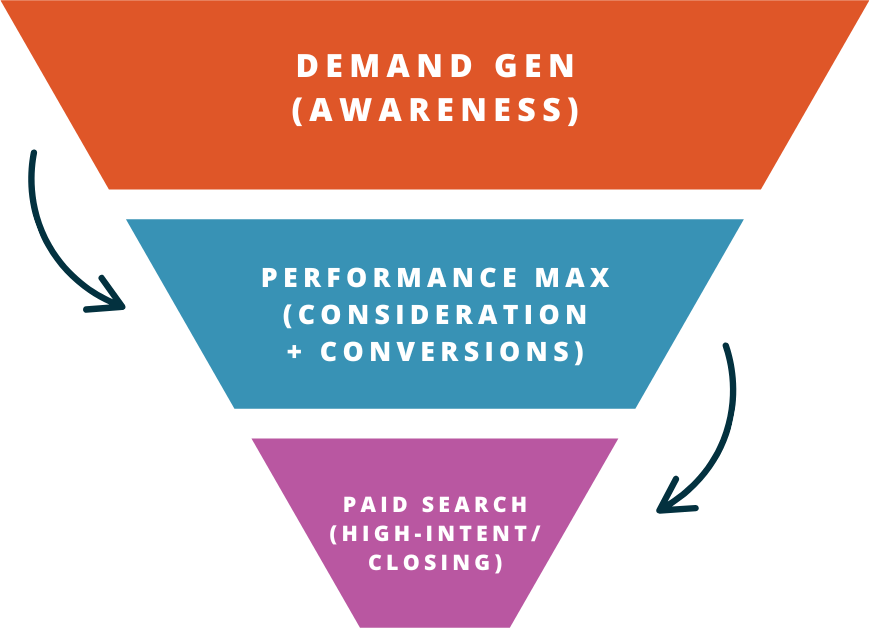
    Paid Search captures intent. When someone types in a query, your ads put your business front and center. But what about reaching people before they search?

    Google’s Demand Gen and Performance Max campaigns are built to do just that:expand your visibility, build your awareness, and move your prospects toward conversion.

    How Demand Gen Works

    Demand Gen campaigns act like a premium version of Display, placing your ads in social-style feeds where discovery happens. These campaigns help you spark interest early by reaching audiences across:

    • YouTube Shorts and in-feed video for immersive, mobile-first experiences
    • Discover feeds to connect with users scrolling curated content
    • Gmail placements where ads appear natively within inboxes
    • Google Display Network with high-quality, visually engaging inventory

    By building awareness in these environments, Demand Gen presents your brand before customers even begin searching.

    How Performance Max Drives Conversions

    Performance Max extends your reach across all of Google’s properties while using AI to optimize performance. With this campaign type, you benefit from:

    • Cross-channel reach across Search, YouTube, Display, Discover, Gmail, and Maps
    • Predictive audiences powered by Google AI and your first-party data
    • Creative optimization that tailors ad combinations from your assets
    • Real-time bidding and budget pacing to maximize conversions against your goals

    The result is a campaign that complements Paid Search, capturing high-intent traffic while driving new conversions efficiently.

    Paid search funnel

    Why Add Both to Your Strategy

    Together, these campaigns build a full-funnel approach: Demand Gen fuels awareness, Performance Max converts interest, and Search closes the loop. Adding them ensures your ads reach customers at every stage of the decision journey.

    Looking to take your Paid Search strategy to the next level? Talk to your Account Manager about adding Demand Gen and Performance Max to your campaigns today.

  • Client Insider – August 2025: Tracking AI Visibility

    How We’re Adapting Your Strategy for AI Search

    We’re managing the technical nuances for you. There are two key things we want you to know about this important industry change:

    1. We’ve shifted our SEO approach to optimize for AI search. 

    Some examples are:

    • Keyword Targeting: Adjusted the way we select keywords to target concepts that AI understands best
    • Content Structure: Updated the way we structure content so AI parses it easily and uses it in results. This means we’ll update pages we’ve already optimized with AI best practices.
    • Language Use: Changed the language we use in writing to be simpler and more direct
    • Citations: Expanded our link building strategy to prioritize brand mentions, brand mentions even when there isn’t a link
    • Content Republishing: Began encouraging production and republishing content on trusted off-site sources (like LinkedIn and YouTube) to give you a stronger chance of being included in the AI answers
    • AI Visibility Tracking: Updated reporting to show AI-driven traffic and will be offering enhanced AI visibility tracking (similar to keyword ranking tracking) soon

    These changes to your SEO approach will increase your visibility in Google’s AI Overviews, ChatGPT, and more. It also helps with organic search engine ranking.

    2. Traditional SEO tactics support AI search ranking. 

    The presence in Google’s top 10 organic results is highly correlated with being cited in AI Overviews (~41% of citations come from Google’s top 10).

    How AI is Changing Search and SEO

    SEO is undergoing a significant transformation in an AI-powered search world, requiring adaptation of fundamental strategies rather than a complete overhaul.

    In our recent webinar, we dove into the overall shift as well as the changes to SEO strategy.

    Watch the replay to learn more, or read our blog post recap here.

  • Webinar Recap: How AI Is Changing Search and SEO

    Webinar Recap: How AI Is Changing Search and SEO

    Webinar Recap: How AI Is Changing Search and SEO

    Key Insights

    • AI search is changing the rules but not the game. Foundational SEO fundamentals still matter, but success now depends on adapting them to how AI understands, cites, and delivers information.
    • Visibility comes from trust, context, and structure. Entity-rich content, credible citations, and clear organization make it easier for AI and traditional search engines to surface your brand.
    • Optimizing for Google means optimizing for AI search everywhere. Google’s AI Overviews influence visibility across multiple platforms, making Google-centric AI SEO the highest-impact starting point.

    SEO is not becoming obsolete but is undergoing a significant transformation in an AI-powered search world, requiring adaptation of fundamental strategies rather than a complete overhaul.

    In our recent client webinar, “SEO for AI Search: Stay Visible in the Age of Generative Answers,” we discussed the overall AI shift and the necessary changes to SEO strategy.

    Watch the replay to learn more, or read on for a high-level recap.

    Evolution, Not Replacement

    While the search landscape is changing with the rise of AI, traditional search (dominated by Google) still holds the majority of market share. AI-powered search tools like ChatGPT are a growing segment that needs our attention now to stay ahead.

    AI Search Defined

    AI search uses artificial intelligence to comprehend complex queries, generate concise summaries, and provide direct answers, moving beyond just a list of links. Key features include conversational input, AI-generated overviews, context awareness, entity recognition, and citations.

    Shift in SEO Focus

    The fundamental pillars of SEO are adapting…

    From keywords to entities

    The focus is shifting from exact keyword matching to understanding and optimizing for entities (named people, places, things, ideas). AI tools use entities to understand context rather than literal search terms. A significant finding is that ~87% of the time, the exact search query does not appear in the AI Overview (AIO) summary, emphasizing the importance of context and the decline in exact-match keyword optimization importance.

    From content volume to semantic relevance

    Content optimization moves from mere text volume and keyword use to semantic relevance, meaning content that demonstrates depth, is structured for natural search, and reflects how people genuinely ask questions and connect topics. Content needs to be structured in the same way, be clear, and be concise to be chosen by AI as a trusted source.

    From links to citations

    While links are still important, the emphasis shifts to citations, which involve building trust through mentions and references from authoritative sources. Being present in Google’s top 10 organic results is highly correlated with being cited in AIOs (~41% of citations come from Google’s top 10).

    Google’s Continued Importance

    Optimizing for Google Search and its AIOs is the most impactful strategy for immediate and long-term results. Google’s AIOs are a hybrid model that pulls real-time data from its index, uses a language model to generate answers, and blends various search results and structured data. Moreover, optimizations made for Google AIOs also positively impact visibility in other AI search platforms like ChatGPT.

    Brand Impression in Zero-Click Searches

    With the rise of “zero-click searches” (where users get answers directly from AIOs without visiting a website), being cited in an Overview can still create a crucial brand impression and even encourage later brand-specific searches.

    Actionable AI SEO Strategies

    Search Influence is actively taking concrete, AI search-optimized steps for our clients where applicable:

    • Content Design: Writing entity-rich, specific, direct, “chunked,” organized, and authoritative content, incorporating clear citations and external references.
    • Semantic Triple: Structuring content using a subject-predicate-object format to help AI extract facts easily.
    • Internal Linking: Linking to and from entities rather than using generic call-to-action anchor text.
    • Schema Markup: Utilizing web code like schema to reinforce entities and structure content, which AI-powered search reads and benefits from.
    • Citation Building: Actively building citations through online directories, media mentions, thought leadership, speaker bios, and professional associations, reinforcing the desired association between your brand and its offerings.
    • Tracking and Analytics: While data for AI search tracking is rapidly developing, current tools like Google Analytics 4 can provide referral traffic from AI, and Google Search Console can identify conversational queries. Newer AI SEO tracking tools are emerging to monitor presence and sentiment in AI results.

    We recommend a proactive and adaptive SEO approach that understands and leverages how AI processes information, prioritizing:

    • Contextual understanding
    • Structured content
    • Credible external validation over traditional keyword-focused content and link quantity

    Stay Ahead in the AI Search Era

    We’re in the middle of one of the biggest shifts in search since Google was founded, but the fundamentals of SEO still matter. How you apply them just looks different in an AI-driven world. The brands that adapt now will be the ones that stay visible tomorrow.

    Watch the full webinar recording for practical examples and strategies you can start using right away.

    Wondering what this all means for your brand? Contact us, and let’s talk about how to position your brand for success in both traditional and AI search.

    Image

    Unsplash

  • Is Your Website Leaving Visitors Behind? [Plus: Ads in AI Overviews!] – July Client Insider

    Is Your Website Leaving Visitors Behind? [Plus: Ads in AI Overviews!] – July Client Insider

    The Latest on Ads in AIOs & Creating an Inclusive Web Experience for Your Audience

    Ads in AI Overviews are Coming

    From Google: “Advertisers who are already using Performance Max, Shopping, and Search campaigns with broad match, including AI Max for Search campaigns, will be eligible to have their ads appear in AI Overviews and AI Mode.”  

    Currently, advertisers do not get much control or reporting on performance in these placements. 

    We’ll continue to keep you updated as we learn more, and we’re optimistic this could become an important tool to regain some organic traffic lost to AI Overviews and SERP features.

    Discover How accessiBe Can Make Your Website ADA Compliant and Accessible to All

    Website accessibility isn’t just a legal requirement; it’s fundamental to creating a positive online experience for all users. When you make your website accessible, you comply with ADA regulations and open the doors to a broader audience, improve user satisfaction, and enhance your company’s reputation as an inclusive and socially responsible entity.

    How accessiBe Helps

    accessiBe provides a widget that makes accessibility modifications to your website based on a user’s individual needs. Artificial intelligence (AI) also runs in the background to scan your website every 24 hours and automatically optimizes its accessibility level. 

    Some of the most used features include: 

    • Changing the font to be a standard, legible font
    • Increasing the font size
    • Emphasizing titles and links
    • Content scaling (zooms in the whole page) 
    • Adjust word spacing
    • Screen reading software for full or partial blindness

    How Can I Add accessiBe to My Site?

    We can guide you through the key steps to improve the accessibility of your site. accessiBe requires an annual subscription and a one-time implementation of website code. Once set up on your site, it will be present at all times, so long as you continue to renew your subscription.

    • accessiBe Annual Subscription: Starting at $490/year
    • Search Influence-facilitated Implementation: Starting at $475/website

    Reach out to your Account Manager to get started, and our team of experts will facilitate setting up your account and implementing the code across your website. 


    Read More About Web Accessibility


  • Should You Be Marketing During a National Crisis?

    Should You Be Marketing During a National Crisis?

    This post was updated by Alison Zeringue on July 14, 2025 to reflect current best practices. It was originally published on Nov 4, 2024.

    Key Insights

    • Data shows that marketers who continue marketing during economic, political, health, or environmental crises recover faster and build stronger customer trust than those who cut back.
    • In times of crisis, whether it’s an economic downturn or a natural disaster, your marketing strategy must adapt to meet changing consumer needs and maintain visibility.
    • Digital marketing channels like SEO, PPC, and performance TV provide high value during crises by maximizing reach and minimizing wasted ad spend.
    • Staying focused on brand longevity positions you for growth and success once the uncertainty passes.

    In a world where change is the only constant, every brand’s ability to adapt is tested time and again. Whether facing economic downturns, political unrest, health epidemics, or environmental disasters, marketers have to remain agile to respond to the inevitable effects of a national crisis.

    Yet, one thing remains true: Resilience in these trying times separates thriving brands from the rest.

    When a disaster strikes, the stakes for such adaptability and resilience are higher than ever.

    Marketers across the country face a dilemma: retreat and cut brand marketing budgets or seize the moment to strengthen their brand’s longevity.

    Cutting down on marketing during a crisis is a tale as old as time, though not a wise one. While crises often cause public turmoil, they also create valuable opportunities to maintain loyalty with your core audience and earn new customers at the same time.

    In this blog post, we’ll discuss the importance of marketing during a national crisis and show you how to maintain a strategic advantage during times of adversity.

    Importance of Brand Communication in Times of Uncertainty

    Importance of Brand Communication in Times of Uncertainty

    Here’s the stark reality: If you halt advertising during a national crisis, you delay your rebound and stifle your brand’s potential.

    Yes, consumers tend to temporarily alter their spending habits during tough times, prioritizing essential goods versus discretionary ones. But if you follow suit and slash your marketing budget to the very bare bones, you risk missed opportunities to stay top-of-mind when it matters most.

    Properly managing business disruptions, should they occur, is essential to maintaining a steady connection. When you keep your audience updated about any changes to your operations — whether it’s new safety measures, service interruptions, or modified hours — you demonstrate your commitment to their well-being and ensure they don’t feel left in the dark.

    As the country recovers from the mayhem, your target audience will, too (in time). If you don’t remain present, they won’t be thinking about your brand, even when they have the mental capacity to. Steady engagement builds trust and shows that you remain reliable and transparent during challenging times.

    Failure to do so translates to a crucial blow to your brand’s health, keeping you ten steps behind your competitors who were actively engaged during the mayhem.

    Tips for Budgeting for Smarter Marketing

    Hesitation is the enemy of progress. Instead of going into hibernation mode during a recession, brands need to embrace the challenge and pivot to a proactive budgeting approach.

    Don’t be tempted by budget cuts

    In times of crisis, the knee-jerk reaction is to tighten the purse strings, often resulting in reduced, or even halted, advertising spend. Sure, budget cuts give you the illusion that they’re helping your brand, especially in the short term.

    But, spoiler alert: Marketing research suggests otherwise.

    Instead of cutting the cord on marketing spend, shift your focus to staying visible and resilient to set your brand up for long-term success and faster recovery.

    As Hubspot says regarding crises “… just keeping promotional spend flat will put your brand in a dominant position. As an example, if all the companies in your category cut their promotional spend in half, suddenly your budget that was 10% of the total share of voice now doubles to 20% as a result.”

    Explore cost-effective advertising channels

    Advertising doesn’t always have to be synonymous with “expensive” — it boils down to what you choose to spend your dollars on.

    Digital marketing tactics, whether through SEO (search engine optimization), PPC (pay-per-click) ads, or performance TV, are generally an economically efficient choice. For example, online ad campaigns offer distinct advantages over traditional methods, such as precise targeting, expanded reach, and real-time performance metrics, helping you maximize your impact while minimizing wasted ad spend.

    SEO is also an excellent, cost-effective choice for maintaining visibility in search and driving long-term growth among your prospects. Start implementing strong SEO tactics now, and you just might see considerable results by the time the crisis is over.

    Whichever your preferred channel(s), focus on the ones that are most cost-effective for you. Those with the best cost-to-performance ratio will keep your brand afloat even in the most unexpected times.

    Stay focused on the long-term

    You’ve likely heard marketing is a long game. Go all in for the long haul.

    Consumer spending may dip temporarily, but your mission is to use this time wisely. Position your brand as a dominant presence in the minds of potential and existing customers, even if they’re not making immediate purchases. The downtime is a ripe opportunity to refine your strategic plans and strengthen your marketing processes to set your brand up for success when business picks back up.

    Think of your advertising opportunity today as a brand and pipeline-building objective for tomorrow. Focus on preparing for the future and what you can control rather than reacting to short-term fluctuations.

    Doing so makes you the go-to choice when they’re ready to buy, unlocking the key to loyal customers.

    Effective Marketing Strategies During a National Crisis

    Search Influence - Effective strategies during a national Crisis

    Marketing during an economic crisis

    Marketers en route to budget cuts during a recession should take a lesson from the mighty hand of the Great Recession of 2008. This economic downturn hit marketers hard and their strategies even harder.

    But it was kind to those who stayed the course.

    As the saying goes, “When the going gets tough, the tough get going.” Kantar research shows that brands that took the risk to continue advertising during the 2008 recession recovered 9x faster than those who jumped ship.

    Flipping the angle, Millward Brown data exposed the consequences of cutting advertising spend during this time. A staggering 60% of brands that paused TV ad spending for just six months experienced a 24% decline in brand use and a 28% drop in brand image. Brands that slashed budgets more aggressively than competitors faced an even grimmer fate — a painful loss of market share.

    For businesses already grappling with revenue losses, reducing marketing budgets during a recession often spells disaster. Your strategy must adapt, whether the intensity of a recession is minimal or as impactful as 2008.

    Recommended strategies

    To navigate low consumer sentiment, maximize your budget, and effectively market your business during a recession:

    • Allocate budget funds to the most value-driven marketing channels proven to work for your brand
    • Offer brand discounts, promotions, bundled services, or loyalty programs to reach cost-wary buyers
    • Highlight the cost-effectiveness and long-term savings of your products or services

    Marketing during a political crisis

    From government shutdowns to civil unrest and corruption scandals, political crises are historic shock factors that often lead to mass mayhem. Among these, elections introduce power shifts that, while typically orderly, can still disrupt markets and shake public confidence.

    Despite the so-called “election year effect,” your brand doesn’t have to get lost in the shuffle. Your job is to acknowledge and address the heightened consumer uncertainty head-on.

    In times of political transition, consumers may be more cautious with their decisions, seeking stability and clarity. As a marketer, this is your opportunity to position your brand as a reliable constant amid the noise. Focus on crafting messages that reassure, offering value and trust when consumers need it most.

    Recommended strategies

    To reach your audience and adapt your marketing during political crisis:

    • Focus your budget on long-term brand awareness to ensure your presence remains strong during and after the unrest
    • Prioritize clear, transparent communication to reassure your audience during times of political change or uncertainty
    • Avoid polarizing or controversial messages to maintain broad appeal and avoid alienating any part of your customer base

    Marketing during a health crisis

    Much like the Great Recession of 2008, marketers learned valuable insights during the COVID-19 pandemic — this time, in the context of marketing during a global health crisis.

    COVID-19 or not, a health crisis is often an agent of chaos, but it does bring brands real opportunity. Marketers should hold steady and adopt proactive strategies that position their brand as a trusted leader when customers need it most.

    As consumers tightened their belts and hunkered down at home, many brands instinctively pulled the plug on their advertising expenditures during COVID-19. According to Marketing Week research, more than half (55%) of marketers either delayed launching campaigns or were rethinking budget commitments in March 2020, the month the WHO declared COVID-19 a pandemic.

    The outcome? An environment teeming with advertising inventory but devoid of competition. Advertising costs plummeted to historic lows during the pandemic year (from March 2020 to the following year), resulting in astonishingly low costs per lead (CPL).

    With more people at home, significantly more time was spent online. In March 2020, Facebook reported record usage each day, creating ripe advertising opportunities for many marketers who just wouldn’t bite.

    In this chaotic landscape, the brands with a solid marketing strategy were the ones setting themselves up for success in the future.

    At Search Influence, we saw the success of our clients who chose to stick it out. In March 2020, one of our higher education marketing clients’ Facebook Display campaign generated the most inquiries in one month since its launch. There was also a 111% increase in inquiries from Google Smart Display month-over-month. For Q1 2020, our client achieved an impressive 47% of 2019’s inquiries — with only 29% of their budget.

    Recommended strategies

    To effectively manage prospect and customer relations during a health crisis:

    • Allocate funds to digital marketing channels, such as social media and email, where engagement increases as people spend more time online
    • Emphasize health and safety in your messaging, reassuring prospects that their well-being is your top priority during uncertain times
    • Shift to virtual services or events, offering online consultations, webinars, or shopping options to maintain accessibility and engagement

    Marketing during an environmental crisis

    The United States is, unfortunately, no stranger to the effects of environmental catastrophes. From California wildfires to Hurricane Katrina, these crises often leave devastating impacts on communities and businesses alike in their aftermath.

    Each environmental crisis brings a wave of uncertainty, many times disrupting supply chains, damaging infrastructure, and shifting consumer priorities toward immediate needs and safety. Communities are forced to adapt, and businesses must quickly pivot to meet new demands and expectations — all while doing everything possible to keep operations running.

    This makes staying connected with prospects and existing customers all the more important. Clear, compassionate communication reinforces your brand’s reliability during the immediate crisis and builds trust that can last long after it has passed.

    Recommended strategies

    To stay connected during an environmental crisis, adjust your marketing budget to allocate for messaging that shows empathy and provides real value. You should:

    • Prioritize transparent communication about key business details, such as closures, adjusted hours, or service availability, to keep prospects and customers informed
    • Demonstrate your brand’s commitment to recovery, whether by supporting local relief efforts, offering donations, or sharing sustainability initiatives that resonate with your audience
    • Implement real-time engagement tools, like live chat or automated messaging, to address customer concerns promptly and offer support in challenging times

    Marketing During a National Crisis FAQ

    What is crisis communication?

    Crisis communication is the strategic exchange of timely, accurate information between an organization and its stakeholders during a disruptive event.

    Crisis communications is the discipline that keeps employees, customers, partners, and the public informed when normal operations are threatened. A strong crisis communications program clarifies what happened, what the brand is doing about it, and what people should do next. It blends PR, customer service, and internal messaging across owned, earned, and paid channels to minimize misinformation, protect reputation, and maintain trust.

    How should I communicate with customers during a crisis?

    Effective crisis customer communication relies on clear, empathetic, and rapid updates delivered through the channels your audience already uses.

    Lead with empathy, acknowledge the issue, and state specific actions you’re taking. Keep messages short, jargon-free, and consistent across email, social, SMS, and on-site banners.

    Why is it important to have a crisis communication plan?

    A crisis communication plan ensures fast, coordinated responses that protect brand trust and speed recovery.

    When every minute counts, a pre-approved playbook defines roles, approval paths, key messages, and preferred channels, eliminating guesswork and delays.

    Helping You Turn Uncertainty Into Opportunity

    National uncertainty can be jarring for brands, but it doesn’t have to mean abandoning your marketing efforts.

    At Search Influence, we’ve helped countless businesses navigate turbulent times, enabling them to maintain momentum with targeted marketing. Our crisis marketing strategies, industry experience, and proven services are a cornerstone for brands looking to weather the storm and emerge stronger.

    Don’t let mayhem madness knock you off your path to digital marketing success. Contact us today to discuss your goals and make them a reality.


    Image Credits:

    iStock and Pexels

  • Behind the Scenes of Your SEO Strategy – May Client Insider

    Behind the Scenes of Your SEO Strategy – May Client Insider

    SEO Success Takes Strategy, Not Just Software

    We boost your business’ visibility through ongoing monitoring, tactical adjustments, and expert insights.

    When you invest in SEO with Search Influence, you’re not just paying for a one-and-done strategy or a quick fix. You’re getting an iterative, strategic plan that our SEO pros adapt based on your business goals, audience, performance data, and changes in the search landscape.

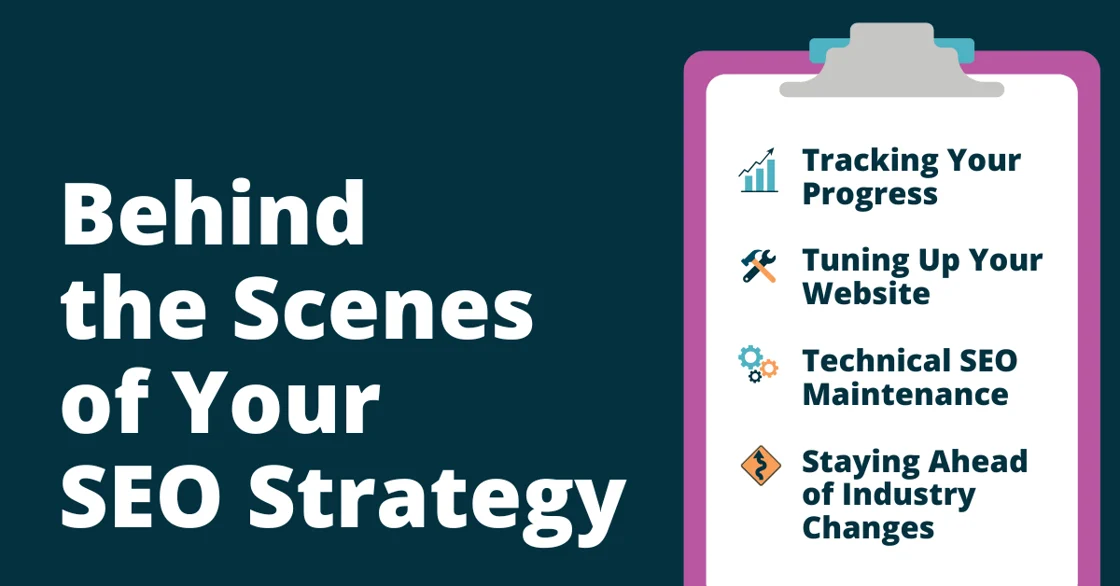
    Behind the scenes of your SEO Strategy graphic

    Here’s a behind-the-scenes look at what our strategists monitor and adjust to keep your business reaching the right people:

    Tracking Your Progress
    We look at your site’s traffic, keyword rankings, and search performance to make sure we’re on track to achieve your SMART Goals.

    • Organic traffic trends: Are more people finding your site through search? Are there opportunities to reach other audiences?
    • Platform insights: Which keywords and pages are earning visibility and clicks?
    • Search intent shifts: Are competitors using different types of content that are performing better for similar searches?

    Tuning Up Your Website Content
    We make targeted updates to the content and structure of your site to help search engines, AI engines, and users better understand and engage with your site.

    • Titles, meta descriptions, and headings: Are they clear, relevant, and eye-catching enough to drive clicks?
    • Internal links and anchor text: Are we guiding users and search engines to the most important information?
    • Content freshness: Is your content aligned with what people are searching for? Does it reflect your current offerings?

    Technical SEO Maintenance
    We run regular behind-the-scenes checks to ensure your site is performing at its best.

    • Routine technical audits: We identify and fix issues like crawl errors, flagged pages, and slow site speeds.
    • Smooth site performance: We ensure your site’s pages are indexed properly and resolve any errors that could affect how search engines treat your website.

    Staying Ahead of Industry Changes
    We stay on top of what’s new so your strategy stays strong.

    • AI search: We’re adapting your tactics to help you show up in AI searches like AI Overviews, ChatGPT, and Gemini.
    • Platform updates: We adjust when Google releases major updates (like its March core update).
    • New search result features: Are things like AI Overviews, “People Also Ask,” or Maps pushing organic listings further down the page
    • Constant strategic improvement: We stay ahead of SEO trends by developing new best practices. Our experts are sought after to share our knowledge with others in the industry.

    Keep your SEO strategy evolving

    Every optimization is driven by expert analysis, strategic adjustments, and a dedicated team that knows how to make real impact.

    READ MORE:

    The Future of Search: SEO and AI Impacts Explained
    by Michelle Neuhoff Boyd

    AI-Powered Search Is Here — Why It’s Time to Invest in SEO
    by Chuck Wilkins

    Got questions or want to discuss how we can take your strategy even further? Reach out to your Account Manager today.

  • How to Market Microcredentials for Maximum Program Visibility

    How to Market Microcredentials for Maximum Program Visibility

    How to Market Microcredentials for Maximum Program Visibility blog graphic

    Key Insights

    • Microcredentials are on the rise as adult learners, career changers, and working professionals seek faster, more affordable ways to gain in-demand skills.
    • Unlike traditional degrees, microcredential enrollment funnels are short, fast-moving, and often self-directed. Learners may enroll within days, not months.
    • Messaging that resonates with microcredential audiences emphasizes job relevance, flexibility, and immediate outcomes, rather than campus life or long-term learning.
    • A strong cross-channel strategy, spanning SEO, paid ads, social, and email, is essential to reach today’s learners where they are and convert interest into action.

    If your institution is offering microcredentials but struggling to fill seats, the issue might not be the program. It may be the marketing.

    Microcredentials are short, skills-based credentials built for speed, flexibility, and career impact. They appeal to learners seeking advancement without the commitment of a full degree. To meet rising market demand, many institutions have expanded non-degree offerings to accommodate microcredentials and stay competitive. 

    According to Coursera’s 2024 Micro-Credentials Impact Report, 51% of higher ed leaders globally now offer microcredentials as part of their curricula.

    Yet many are still applying degree-style marketing to a very different kind of learner.

    Microcredential audiences move quickly. They prioritize outcomes over campus life and expect easy, immediate access to information. Reaching them requires a distinct, streamlined strategy that reflects how they search, decide, and enroll.

    To boost your visibility and connect with these learners, follow these best practices for marketing your microcredentials.

    Why Are Microcredentials Gaining Popularity?

    People working on laptops and tablets at a coffee shop

    Shifting demographics are reshaping higher ed

    The traditional college-aged population is declining, creating enrollment challenges for institutions that have long relied on recent high school graduates. As the demographic cliff approaches, colleges and universities are looking to expand their reach to a new target audience, especially adult learners, career changers, and working professionals seeking practical options.

    Millions are seeking an accessible path forward

    According to UPCEA, more than 40 million adults in the U.S. have some college credit but no credential. Many of these individuals face external pressures (full-time employment status, financial strain, and family responsibilities) that make returning for a traditional bachelor’s degree difficult. Microcredentials, especially affordable and stackable ones, offer a flexible alternative for advancing professionally.

    Economic pressures are driving new priorities

    Over the past few years, rising education costs and mounting student debt have changed how people evaluate their learning investments. Many learners now prioritize programs that are affordable, low-risk, and lead to near-term career benefits. Microcredentials check all three boxes, offering focused, skill-based continuing education without the long-term commitment of a degree.

    Employers are hiring for skills, not just degrees

    Employers are increasingly prioritizing job-ready skills over traditional credentials. Microcredentials allow learners to gain and showcase specific, in-demand abilities that align with job market needs. Morning Consult research found that 81% of employers believe they should consider skills versus degrees when hiring. In many industries, demonstrable competencies are more valuable than academic transcripts. 

    Marketing Microcredentials vs Traditional Degrees

    Marketing funnel differences

    Microcredentials attract a different kind of learner, which means the path to enrollment also looks different. While traditional degrees involve extended timelines and multiple stages of engagement, microcredentials often require quick, outcome-driven decisions.

    Traditional degree funnels typically involve:

    • Long consideration periods, often spanning several months to a year
    • Fixed application windows and admissions cycles
    • Emphasis on relationship-building, exploration, and multiple touchpoints before enrollment
    • Decisions influenced by long-term academic or personal goals

    Microcredential funnels, by contrast, are defined by: 

    • Short decision-making windows — learners may enroll within days of discovering a program
    • Rolling or frequent start dates that demand consistent promotion
    • Higher expectations for fast outcomes, affordability, and convenience
    • Learners motivated by immediate career needs, not long-term campus experiences

    The enrollment process also plays a role. Some microcredential offerings are self-serve, allowing learners to register and start immediately without applying. Others still involve an application or review process. Knowing which type you’re marketing, application-based or on-demand, will shape how you message urgency, availability, and next steps. 

    Marketing messaging differences

    Microcredential learners are goal-oriented, and your messaging needs to match that mindset. Unlike traditional students who may be drawn in by campus culture or the promise of a four-year journey, microcredential prospects are focused on immediate, practical learning outcomes.

    Traditional degree marketing often emphasizes:

    • Institutional reputation and academic prestige
    • Campus life, student community, and support services
    • Long-term growth and personal development
    • Deep subject immersion over multiple years

    This messaging supports a slower decision cycle where students take time to explore, attend events, and speak with admissions counselors.

    Microcredential marketing requires a different focus. Your content should highlight:

    • Clear career relevance and targeted skill development
    • Fast, flexible online learning formats that fit into real life
    • Tangible ROI, like job advancement, new credentials, or salary increases
    • Social proof and real-world outcomes through testimonials or employer partnerships

    Concise, career-focused messaging is key to building trust and driving action, especially when your audience is ready to move.

    Since many microcredential learners bypass traditional touchpoints like info sessions or one-on-one meetings, your digital content must do more heavy lifting. Messaging across your website, ads, and email campaigns needs to quickly answer core questions such as: Is this relevant to my goals? How quickly can I start? What will this do for my career?

    Aligning Your Microcredential and Graduate Program Marketing

    To market microcredentials effectively, you need to understand how they relate to your existing graduate programs. Are they meant to stand alone, or are they part of a larger academic pathway?

    Start by defining the relationship

    Clarifying the purpose of each offering helps avoid mixed messaging and ensures that your marketing reflects the learner’s intent.

    Microcredentials often appeal to learners exploring a field, building targeted skills, or seeking quick career advancement. These are typically short-term career goals. Graduate programs, by contrast, attract those ready to invest in long-term academic or professional growth.

    Connect the path when it makes sense

    If both options fall under the same subject area, consider framing your marketing around the learner’s goals rather than the credential type. 

    Positioning microcredentials as an on-ramp, not just an alternative, helps fuel engagement across all your program types. It reinforces long-term value while meeting learners where they are now.

    For example: Instead of promoting a “Digital Marketing Microcredential” and an “MS in Marketing” as separate tracks, position them together as “Marketing Programs for Every Stage of Your Career.” This approach helps prospective students understand how various educational programs fit into a broader professional path.

    There’s still value in marketing each program individually, but building cross-awareness can strengthen both funnels. If your microcredentials are stackable, make that progression clear in your messaging and visuals. Show how learners can move from a single course to a certificate or a digital badge, and eventually to a master’s degree if they choose.

    How to Market Microcredentials With a Cross-Channel Approach

    A chess piece being moved on a chess board

    To reach today’s fast-moving, outcome-driven students, you need a coordinated presence across search, social, and email. Microcredential learners don’t follow a single path to enrollment, so your marketing strategy shouldn’t rely on a single channel. 

    SEO

    Roughly 68% of online experiences begin with a search engine, according to Ahrefs. For prospective learners, that makes SEO the natural first touchpoint, and a critical one. Whether they’re comparing options, looking for a specific skill, or exploring career next steps, your program pages need to rank and resonate.

    Start by creating dedicated pages for each microcredential, and structure them around what your audience cares about most:

    • What new skills they’ll gain
    • How the program is delivered (online, hybrid, self-paced)
    • How long it takes and how much it costs
    • Who’s teaching it and what kind of outcomes students can expect

    Include strong, clear CTAs and support your value proposition with testimonials, employer recognition, or career placement stats when available.

    To improve visibility, optimize for long-tail keywords that reflect specific intent, such as:

    • “How to earn a microcredential in [topic]”
    • “[Topic] online course for working professionals”
    • “Affordable short-term certificate programs in [industry]”

    You should also support your SEO efforts with blog content that answers common questions and reflects search intent. Topics like career outcomes, comparisons to bootcamps, or time and cost advantages can help draw in qualified traffic while positioning your institution as a helpful resource.

    Paid search

    While SEO builds long-term visibility, paid search helps you capture demand in the moment, especially from learners who are ready to take the next step. By targeting high-intent keywords, you can reach prospective students actively searching for fast, flexible learning options.

    Focus your campaigns on search terms that reflect urgency and career motivation, such as:

    • “[Topic] certificate online”
    • “Short course in [field]”
    • “Learn [skill] online”
    • “Career-focused [topic] course”

    Ad copy should speak directly to what matters most to microcredential learners:

    • Career outcomes: What can they do or achieve after completing the course?
    • Time to completion: Use specifics like “Gain skills in 6 weeks” to set clear expectations
    • Cost transparency: Highlight affordability with phrases like “Only $399” or “Job-ready training for less”
    • Learning format: Reinforce convenience with “100% online education,” “Self-paced,” or “Evening-friendly” messaging

    When done well, paid search drives more than traffic. It drives action. Use your landing pages to reinforce the value promised in your ad, making it easy for learners to take the next step without unnecessary friction.

    Paid social & display

    Paid social and display advertising are powerful tools for expanding your reach and reinforcing program awareness. These channels connect you with prospective learners where they’re already spending time, whether they’re scrolling LinkedIn during a work break or browsing Facebook after hours.

    Use platforms like LinkedIn and Meta to deliver tailored messaging that reflects where someone might be in their decision process:

    Awareness

    • Target by job title, industry, or interests to reach learners who may not yet know about your program
    • Focus on big-picture benefits like career change, flexibility, or upskilling
    • Use headlines like “Break into tech without a degree” or “Get ahead in healthcare. No long-term commitment required.”

    Consideration

    • Highlight program features: length, cost, format, and career outcomes
    • Use short videos or carousels to showcase what learners can expect
    • Highlight learning from experienced faculty who double as industry leaders
    • Keep messaging focused and benefit-oriented: “Gain job-ready skills in just 8 weeks” or “Fully online, on your schedule, courses”

    Decision

    • Reinforce urgency with enrollment deadlines, limited-time offers, or next steps
    • Use testimonials, student quotes, or employer recognition to build trust
    • Retarget those who’ve visited your website or interacted with earlier ads but haven’t yet enrolled

    Well-timed, well-targeted social and display ads help keep your microcredential programs visible and relevant, especially for learners who need a few reminders before they’re ready to commit.

    Organic social

    Organic social media marketing plays a long game. It helps your institution stay present, build credibility, and create meaningful connections with prospective learners over time.

    With social search on the rise, platforms like LinkedIn, Instagram, and Facebook are becoming key discovery tools for those exploring career paths and educational opportunities. A strong presence here highlights the real value of your microcredential programs through authentic, relatable content.

    Share content that reflects learner goals, outcomes, and lived experiences:

    • Career wins: “How I landed a new job three months after earning my certificate”
    • Industry insights: “Top 3 skills employers want in [field] right now”
    • Behind the scenes: “What it’s like to take this course as a working adult”

    Short-form videos, alumni spotlights, and faculty features give your program dimension and authenticity. Focus on flexibility, support, and real-world impact, all core themes that resonate with busy professionals looking to level up.

    A thoughtful organic social presence reinforces the credibility of your program and helps prospective learners see themselves in the experience you offer.

    Email nurture campaigns

    Email marketing is one of the most effective ways to keep prospective learners engaged after their initial inquiry. With the right segmentation and sequencing, email nurture campaigns guide students from interest to enrollment, while reinforcing the value of your microcredential programs along the way.

    Start by segmenting your audience based on what matters most: program interest, learner intent, or stage in the decision-making process. Then build a sequence that delivers timely, relevant content with a clear next step.

    A sample 3-email sequence might look like this:

    • Email 1: Welcome + program overview: Introduce the microcredential, who it’s for, how long it takes, and how it’s delivered. Reinforce accessibility and flexibility.
    • Email 2: Career outcomes + student story: Focus on the real-world value. Share a testimonial or brief case study that shows how past learners applied the credential to advance their careers.
    • Email 3: FAQs + next steps: Address common questions about cost, deadlines, or course requirements. End with a strong, direct CTA that encourages action.

    Calls to action like “Start now,” “View your course options,” or “Get your questions answered” can make a big difference when timed right. The goal is to stay helpful, human, and focused, offering just enough information to move learners forward without overwhelming them.

    Turn Microcredential Interest Into Enrollment

    A successful microcredential marketing strategy doesn’t exist in a silo. It works best when it’s part of a larger, student-centered, cross-channel approach. 

    From SEO and paid search to social and email, your campaigns should reflect how today’s learners search, engage, and ultimately make decisions.

    Search Influence is a higher education digital marketing agency that helps institutions market everything from short-term certificates to full degree programs. We know how to tailor strategies based on learning format, audience intent, and funnel stage, so you can meet prospective students with the right message at the right moment.

    Not sure where to begin? Let’s start by evaluating what you’re already doing. 

    See where your microcredential marketing stands

    Our Self-Assessment for Higher Education Marketers includes seven proven strategies to strengthen your campaigns, covering everything from program pages and CTAs to video, lead generation, and remarketing.

    It’s designed to help your team build full-funnel, cross-channel campaigns that turn awareness into enrollment and position your institution for long-term success.

    Download the self-assessment and start identifying your next best opportunities today.

    Images:
    Unsplash
    Unsplash

  • Could You Be Landing Better Leads? – April Client Insider

    Could You Be Landing Better Leads? – April Client Insider

    It’s Time to Say Yes to Landing Pages

    Focused, optimized, and designed to deliver qualified leads

    We’ve seen it firsthand: dedicated landing pages drive stronger results for your ad campaigns. If your campaigns send ad traffic directly to your website, you could be missing a major opportunity to improve lead quantity, quality, and conversion rates.

    Clients already using landing pages are seeing the difference.

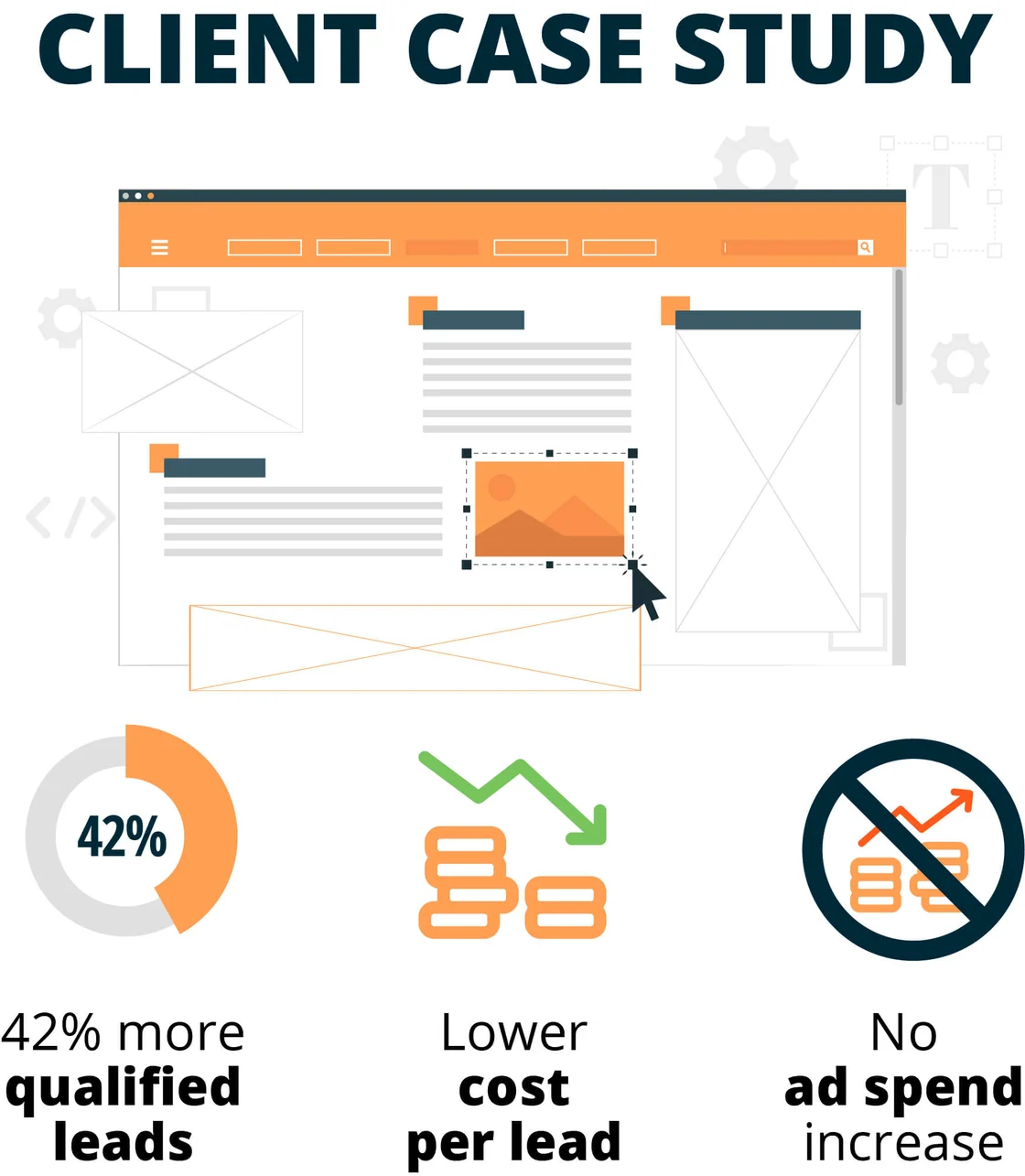
    A luxury event venue saw a 30% increase in qualified inquiries within two months of landing page launch. For another – a senior living provider – our landing pages generated 42% more qualified leads at a lower cost per lead and with no change in ad spend, just from launching landing pages.

    A client case study by Search Influence

    If you’ve been on the fence about adding landing pages to your ad campaigns, here’s why they work:

    • A clear path to conversion: Unlike a website page with multiple links and distractions, landing pages focus on a single goal: turning site visitors into leads.
    • A seamless ad-to-page experience: We match your landing page content to your ad messaging so visitors see exactly what they expect, making them more likely to take action.
    • Agile campaign testing: Landing pages give us greater control over A/B testing headlines, CTAs, and layouts to optimize campaigns without affecting your main website.
    • Smarter lead filtering: Using CallRail automation and custom form fields like budget ranges or timelines, we pre-qualify leads automatically to deliver higher-quality prospects.

    We’ll work with you to identify where landing pages would add the most value to your business while ensuring your main website continues to serve its purpose.

    Without custom landing pages, you risk losing qualified leads. Talk to your Account Manager today to discuss a custom landing page strategy for your business.