Author: Search Influence Alumni

  • When Keeping It Relevant Goes Wrong

    Brenda Johnson Knows What's Up

    I’ve been actively creating and managing Google AdWords campaigns for over five years. In that time, I’ve made a lot of mistakes with everything from keyword selection to match type to ad content. It happens — if no one ever made a mistake on AdWords, we would all be PPC success stories, and that’s certainly not the case. So when I typically see mistakes with sponsored ads, I take a screenshot, write a short heads-up email to the advertiser explaining their mistake, and keep it rollin’. However, over the weekend I came across what could possibly be the worst targeting and most confusing landing page I’ve ever seen on AdWords.

    While I was searching for “delaware county oh plastic surgery” (before you start reading too much into this, no, I was not looking for a plastic surgeon. I am quite comfortable with my stout lil’ man-child body), I came across this gem of an ad…

    Find the Bad Ad

    (more…)

  • Will Scott at Search Starts Here 2012 Local Search Association Conference — Recap

    SI CEO Will Scott recently led a discussion panel at Search Starts Here, the 2012 Local Search Association Conference. This stellar writeup goes over some of his main points and provides a handy bulleted list of key takeaways at the end. You can also check out another writeup on Local Search Insider by clicking right here!

  • Google Adwords Certification: The Breakdown

    Getting Google Adwords Certified can be an invaluable update to your resume. Why? With this professional SEO accreditation, you’re making sure you’re doing everything you can to increase your worth to your clients or company.

    Whether you are planning to start a paid search campaign for your business or if you’re just trying to understand what your PPC manager is always talking about, Adwords certification is an extremely beneficial feather in your cap. However, don’t think you can just roll out of bed, think “I’ll get certified today!” and pass the test with ease.

    To officially become Google Adwords Certified, you must pass both the Advertising Fundamentals exam and one advanced-level exam. Everyone on the account management team here at Search Influence has decided to take on the challenge to get individually certified.  Luckily we have two Google Adwords gurus, Anthony Coleman and Doug Thomas, to answer our never-ending questions while studying.

    To make studying easier, Google has set up a Google AdWords Certification Program Learning Center, where you can find “lesson plans” for each Google Adword exam. Reading all the chapters (from start to finish) for each exam may be a bit time-consuming, but very worth it. I highly recommend the interactive e-learning lessons that are scattered throughout the chapters. Most e-learning lessons have quizzes to test your knowledge before taking the actual exam.

    The first test is 113 questions with 1 hour and 30 minutes to complete the exam. You must get an 85% on the first test, which cost $50, and you must pass the first exam before moving on to the advanced.  After passing the exams, you are certified for two years.  Don’t worry if you don’t pass the exam the first time: you can always retake it. However, you must pay the $50 fee each time.

    VS

    You can become a qualified individual or a qualified company within the Google Professional Certification program. To qualify for an Individual Certification, you must pass both the Fundamentals exam and one of the three advanced exams.  Also, you must accept the program Terms and Conditions (which happens automatically by enrolling in the program).  Also, there is no minimum spend requirement to be Individually Qualified.

    Doug and Anthony have already qualified Search Influence for a Company Certification. To qualify for a Company Certification, a company must have managed at least a $10,000 spend over 90 days, starting the day the AdWords account is linked to the My Client Center. The company must have at least one individually qualified employee and accept the program Terms and Conditions.

    The Google Partner Search tool helps potential advertisers find a Certified AdWords Professional. People enter their estimated budget, along with the type of help they need, then Google compiles a list of certified professionals. Certified Partners receive a badge showing their qualification, while those who are Individually Qualified receive a certificate when they pass the necessary exams.

    Tips for Taking the Exam
    Study. This is easy to put off, but during the exam you’ll be asked a question that you would only know if you read the exam learning materials. Luckily, the study materials are broken out according to which exams they’re covered on.

    • Take the exam in a quiet area with no distractions. Get out of the house with no family, pets or TV shows to divert your focus from the exam.

    You cannot access any other part of your computer until you have completed the exam. Make sure you save and close everything you have open on your computer because once you start the test, it blocks you out of everything and you can’t pause the timer on the exam.

    • One beneficial feature about the exam is that you can mark questions for review and come back to them later. I loved this because if I didn’t know the answer to a question, I marked it for review and moved on to the next.

    Google is a tricky minx. I noticed when taking the first exam that some questions have multiple right answers, but Google wants you to choose the best right answer. Watch out for those questions and always go with your gut feeling.
    You can sign up here to take the exam. Good luck!

  • Mediabistro & Twitter Marketing — SI Shoutout

    Our CEO Will Scott gets a quick shoutout in a Mediabistro article on Twitter article marketingCheck it out!

  • 5 Most Memorable Marketing Fails

    marketing failsOver the years, I’ve seen many companies going into damage control for missteps that they took in pushing their message. To learn from the mistakes of others, I’ve compiled a few of the most memorable marketing fails. These companies tried to do something unique or different to increase their brand awareness or create social interaction — but sometimes, things do not go as plan. Below is a list of the top marketing backfires that some of the biggest corporations have faced, offending or even repelling their customers.

    1. New Orleans hosted the NCAA Men’s Final Four the weekend of March 30, 2012. Coca-Cola, one of the NCAA Final Four sponsors, sprayed painted their logo using a chalk spray throughout the French Quarter. Residents were angered by the graffiti in their neighborhood, and Twitter blew up with tweets to Coca-Cola about the guerilla marketing that defaced their neighborhood. You can see their response and their graffiti below:

    Response_CocaCola

    graffiti

    2. McDonald’s started a hashtag twitter campaign #McDStories to connect with their customers about their new healthy food initiative back in January. Instead of getting positive stories, they received negative backlash. People replied with health issues from eating at McDonald’s, criticism of the business model and disgusting things they had found in their food.

    mcdstories

    3. In March 2011, GoDaddy CEO Bob Parsons posted a video on his blog of him shooting an elephant in Zimbabwe. PETA and several others were upset by this video and shortly after, PETA cancelled their contract with GoDaddy.

    4. Groupon’s offensive ad during the 2011 Super Bowl showed poor taste in making a parody of the problems that the Tibetan people face. This controversial ad caused Groupon to go into damage control mode. This ad was no laughing matter when Twitter users lashed back with hard facts on the deaths caused by the Chinese occupation of Tibet.

    5. While the 2010 BP oil spill devastated the Gulf of Mexico, Spirit Airlines turned the matter into a mockery. No stranger to controversial ads, they launched several ads that said “Check Out The Oil On Our Beaches”. The tasteless campaign did not sit well with Gulf Coast residents whose coastline and wildlife were devastated by the spill.

    When companies think they are on the verge of some creative marketing breakthrough, they’re often failing to see the big picture or contextualize their campaign from the targets’ viewpoint. It’s a miracle some of these even made it past the cutting room. As tempting as it may be to commit our own marketing fail, it’s never funny to just poke fun at someone’s plight: we can all learn from these blunders. What do you think these companies should have done differently, or was their damage control appropriate? Any gaffes of your own to share?

  • Tips and Tricks to Become a Ferocious Facebook Fireball

    The end of February brought another successful and informative Search Marketing Expo West, where yours truly triumphantly (and successfully, if I may brag) returned to present on another mobile panel.  The presentation was so nice, I was named twice. Enough about that, as this post isn’t about me (sad, right?). If you want to read a bit about it, check out this blog from Erica Sendros and our best buds at aimClear. We also had a newb in our midst, with Joseph Henson making his SMX debut. This isn’t about him either, but Kathy Long and our other favorite friends at Bruce Clay Inc. wrote this cool post about it.

    “So if this isn’t about you, what the hell are you on about?” you might ask. Well, you won’t be taking that tone once you walk (click) away from this blog with some awesome Facebook tips and tricks, thanks to me and only me. Actually, you can thank our feminine friend Tami Dalley (Geez, how many friends do we have? Most importantly, how many times can I alliterate when mentioning mates?) from Buddy Media, for presenting this amazing information at SMX. If you apply this not-so-inside information to your business’s Facebook page, your posts will receive greater likes and comments and you’ll be a ferocious foe (last time, I promise) to your competitors.

    The most important thing is to keep it brief. Posts that clocked in at under 80 characters had a 30% higher rate of engagement than those with more. This rule is especially true for photos and videos. Photos should stick to the <80 character rule, while video descriptions should have less than 40. As we say at Search Influence, “Hemingway sentences, not Faulkner.” Another way to put it is, “Brevity is your Bosom Buddy” (I can quit when I want!).

    If you only post once or twice a week, be sure to do so on Thursdays and Fridays. On average, fans are 18% more likely to engage on these days than others. Surprisingly, Thursday receives the most, with Friday right behind it. This is not a hard and fast rule, though. You should monitor your own fan engagement and do what works best for you.

    When considering what type of content to post, photos are the way to go. They easily receive the most likes and comments, with plain status updates and videos trailing behind.  Links and events have the worst rate of interaction. They can have the tendency to peeve your pals (nailed it), so use these sparingly.

    Include clear calls to action in your posts, but the language used is important.  Words such as “like,” “post,” and “take” are much more likely to receive engagement than “order,” “see,” and “become a fan.” Likewise, ask for the sell, but do it softly. “Event,” “winner,” and “offer” are better received than “save,” “free shipping,” and “sale.”

    Lastly, posts that ask questions are a great way to spur comments and interaction on your page. When asking, place the question at the end of your post as opposed to the beginning.  Posts framed in this manner are 15% more likely to be answered. The theory is that if you ask at the start, you’ve lost their interest by the time they get to the end. Fans can be a lazy lot (maybe I have a problem). As with the above, the way in which they’re asked matters. Use words such as “where,” “when,” “would,” and “should” and avoid using “why,” “did,” “what,” and “who.” Fill-in-the-blank posts are fan fodder, with a comment rate nine times higher than the average.

    The study has even more information than what is provided in this post, and I’m going to make you work for the rest, which can be viewed on the Buddy Media site. You can’t have everything handed to you, my cordial comrades.

    For those of keeping count, that was nine.

  • Will Scott & BtoB on Local Search

    Search Influence CEO Will Scott has a chat with our friends at BtoB featured today, covering a variety of local search topics. Check it out right here!

  • 5 for Fridays — Links, Stories, & Posts for Your Weekend

    5 for friday12 Most Valuable Personality Traits of Top SEO Consultants — 12 Most

    This article is an oldie, but a goodie on the 12 best qualifications for a top SEO consultant. Sure you are driven, intelligent and articulate, but if you do not feel that you combine your technical, artistic, and analytical sides, perhaps it is time for a refresher course.

    Google Glasses: Don’t Plan on Buying Them for Christmas – Washington Post

    Google-Vision: Like Wonka Vision, but with more SIRI and less mini Mike TeeVee.  Google’s Project Glass has revealed its Google Glasses this week as co-founder Sergey Brin donned these enhanced spectacles while out to dinner. Don’t get too excited though. These glasses will not be available to consumers for months or even years. To get an idea what these snazzy shades are capable of, check out this photo gallery.

    Google Sending Warnings About “Artificial” or “Unnatural” Links — Search Engine Land 

    If you’ve received a warning about “artificial” or “unnatural” links pointing at your site, you’d probably like to know that Google has recently taken a new stance on link networks. While previously, these link networks were “silently distrusted,” now Google has decided to report such potentially black hat link issues.

    Show Keyword Position Using Filters and Advanced Segments  – SEOMoz

    Here at Search Influence, it is time to send out reports again, so what could be more pertinent to our reporting endeavors than a strategy to provide useful, easily-understood information to clients. Through this easy-to-follow 2-Step process, you can provide your clients with a graph showing the position of your searched keywords as a percentage of total visits. This new reporting process could help you explain exactly what it is that you do.

    Google AdWords Adds ZIP Code Targeting, Location Insertion; Updates Location Targeting – Search Engine Watch

    You’ve probably noticed search results are adapting more and more to location targeting, but Google has just announced new ZIP Code targeting in AdWords as well.  This will allow advertisers to hone in on up to 100 specific regions. Another new feature includes Dynamic Location Insertion. It’s DKI for cities!

  • Kony 2012: Viral Marketing & Media for Social Change

    If you haven’t heard of Kony 2012, chances are that you’ve been living under a rock – a rock without Wi-Fi – for the last month. Created by the non-profit organization Invisible Children, the 30-minute documentary about Joseph Kony, an African warlord, became an almost-instant viral video after its debut in March.

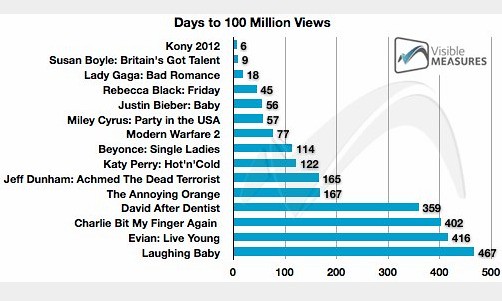
    In under a week, it garnered 100 million views, outpacing Susan Boyle’s audition on Britain’s Got Talent and even “David After Dentist.” The difference between this viral video and others is that it has compelled watchers to act in a way that involves more than just forwarding a link.

    According to Invisible Children, the goal of the film is “to make Joseph Kony famous, not to celebrate him, but to raise support for his arrest and set a precedent for international justice.” To achieve this, the organization took an unconventional approach. Not only does their marketing campaign include the use of a viral documentary, but also it encourages supporters to take action.

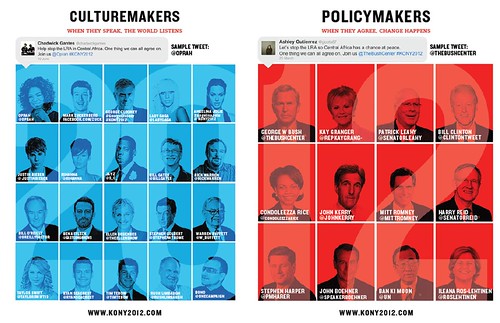
    In addition to sharing the video on their own social media networks, viewers were asked to appeal to 20 “culturemakers” like Bill Gates, Mark Zuckerberg, Lada Gaga, and George Clooney and 12 policymakers like Bill Clinton, John Boehner, and Condoleezza Rice do the same. Celebrities including Oprah, Ryan Seacrest, Rihanna, Justin Bieber, and Kim Kardashian all tweeted about the video to their millions of followers, taking the campaign’s virality to a whole new level. According to research conducted by the Pew Research Center’s Internet & American Life Project, over 5.4 million tweets referencing Kony 2012 were posted in the week after it went live.


    Click through for full image

    Becoming an overnight phenomenon, however, was not without its drawbacks. The increased attention for the cause brought with it an increased scrutiny for the organization. Criticisms came from a variety of sources and included everything from oversimplifying the issue to the more serious charge of presenting misleading information.

    To make matters worse, following a couple of especially high-profile weeks, Invisible Children co-founder and Kony 2012 filmmaker Jason Russell experienced a very public meltdown, drawing even more negative interest to the organization. Even with the critiques of the video and the ensuing PR nightmare, the marketing impact of the campaign can’t be denied.

    The sway of social media influenced millions of people to act, which has not only led to an increased awareness of the situation, but also has resulted in U.S. lawmakers making a political effort. In mid-March, a resolution was introduced in the House that would increase the number of regional forces in Africa to protect civilians and place restrictions on those supporting Kony. Shortly thereafter, another resolution was introduced in the Senate that would support ongoing international efforts to remove Kony and boost U.S. mobility, intelligence, and logistical support of regional forces pursuing Kony.

    In addition to achieving their goal of effecting change, Invisible Children’s utilization of an innovative, viral marketing campaign, also had the added benefit of increased brand recognition. The video directed viewers to their website, where supporters could purchase merchandise and download an “Action Kit,” which includes two posters that can be printed and plastered around the U.S. on April 20, as part of their “Cover the Night” event.

    A mere month ago, most people would not have been able to tell you anything about Joseph Kony, much less Invisible Children. Now, both are practically household names. In an effort to make Kony famous, Invisible Children became famous, too. It was a clever marketing tactic that, despite some extremely damaging PR, continues to benefit both the cause and the organization.
  • Read This! — April 2012

    As always, our Read This! feature profiles stories and how-to’s you can’t afford to miss for your business, offering direct and practical advice for competing online. Check out this month’s offerings after the jump!

    The Twitter Guide for Small Business

    With the advent of its small business ad products, Twitter has published an official 22-page ebook showing you how to “engage with your customers and put Twitter to work for your business.” Look for the PDF link below the video!

    Measuring Your Company’s Online Success

    While we’ve given you a plethora of tips to increase your online visibility and interaction with your customers, finding hard data as to whether your efforts are working is a whole ‘nother story. Check out this handy guide to the metrics of web success and see if your company is measuring up.

    Your Analytics Tool May Be Lying to You

    Now that you’re familiar with the basics of web metrics, let’s take a slightly more contextualized look. While the analytics data can give a good indication of where you are succeeding or failing, it’s important to look at it within the scope of other numbers in your industry.

    The 375 Million Active Searchers You`re Probably Ignoring

    iTunes is the go-to resource for finding podcasts, videos and other media, and if you’re not making your presence know there you could be missing out on a huge chunk of the action.

    Practical Tips to Make Your Blog More Useful & Interactive

    TopRank’s Lee Odden shares a wide array of effective blogging tidbits from the #smchat and #nptalk social media chats.

    Over Optimizing Your Website, What to Look Out For

    While making your site search engine-friendly is an important part of maintaining an online presence, “keyword stuffing” or other forms of over-optimizing can be the death knell for your rankings. Read up on the best ways to keep up a strong site while avoiding being penalized.