Tag: videos

  • 3 Actionable Ways to Make Your Creative More Diverse

    Example of diverse photo assets for ad campaigns

    Key Insights

    • Diverse creative does not stop at just photography—companies should diversify their videos, illustrations, and voiceovers.
    • Companies who do not have the resources to create their own assets can purchase existing diverse photos and videos and edit existing illustrations to be more representative of diverse audiences.
    • The presence of POC in creative is not enough; designers and marketers must be thoughtful of how minorities and POC are portrayed across all mediums.

    In a perfect world with a bottomless budget and endless hours, companies would always be able to hire skilled photographers, illustrators, videographers, and actors to acquire custom creative assets that represent the company and their target and aspirational demographics for every marketing campaign. A lot of companies, however, must rely on existing stock assets due to varying limitations. The problem with stock photography, illustrations, videos, and audio, however, is that most of what is available depicts white men and women. Does this even matter? Maybe not as much to people who look like the subjects of these photos.

    By excluding people of different races, genders, body types, ages, and abilities, marketers are ignoring and erasing members of these communities. If that isn’t reason enough to prioritize the inclusion of diverse assets in marketing campaigns, Google and The Female Quotient conducted a survey in 2019 concluding “that people are more likely to consider, or even purchase, a product after seeing an ad they think is diverse or inclusive.” Specifically, “64% of those surveyed said they took some sort of action after seeing an ad that they consider to be diverse or inclusive. 69% of black consumers say they are more likely to purchase from a brand whose advertising positively reflects their race/ethnicity.”

    The study also states that “71% of LGBTQ consumers said they are more likely to interact with an online ad that authentically represents their sexual orientation,” and data shows that LGBTQ households spend 35% more on online purchases each year than non-LGBTQ households.

    #1 Use Diverse Stock Photography and Video Resources

    As marketers, we should strive to not only include minority groups and POC in our creative, but we should also be thoughtful about how these communities are portrayed in photos and videos. Who is leading the meeting? Who is teaching the class? Who is in handcuffs? If the answer to these questions could perpetuate any stereotypes—no matter how subtle—consider skipping those assets and continuing your search.

    The mere presence of underrepresented communities is not enough; we must make sure they are represented positively and in a way that would make members of said communities proud. Nappy.co is an excellent free resource for photos of Black and Brown people and a great jumping off point for diversifying your photo library.

    Example of diverse vector art for a marketing campaign

    #2 Adapt Vector Art

    Illustrations may seem more straightforward, but will actually require the designer to be just as, if not more, thoughtful as when selecting stock photos. Whether starting from scratch with an illustration or purchasing stock vector art, the considerations are the same. Just as with stock photography, we want to:

    • Avoid perpetuating any stereotypes, not only in subject matter, but also in more subtle ways.
    • Pay extra attention to how facial features, hair, or skin tones are depicted.

    Even in anthropomorphized objects, these considerations need to be prioritized. A design choice may be unintentional or innocuous, but they can have serious implications and reveal damaging subconscious biases. In 2017, a Kellogg’s Corn Pops box depicted a community of corn pops, and the one brown corn pop in the entire group was depicted as a janitor. Kellogg’s understandably faced serious backlash for the illustration and quickly corrected and reprinted the box.

    Luckily, illustrations (unlike photography) are adaptable. Obviously creating vector illustrations from scratch allows the designer to create any scene they want, but stock vectors are also fully customizable, too.

    • These file types usually include .ai, .eps, or .svg files that can be edited in graphics editing software like Adobe Illustrator.
    • Body types, skin tones, facial features, clothing, positioning, and so much more can be edited to represent people of all races, genders, body types, ages, and abilities in various settings.

    #3 Expand Audio Talent Search

    Marketers can’t deny the prevalence and effectiveness of video in marketing and advertising, so a company’s journey to diversifying their creative should not stop at visual assets. In recent years, there has been a push in Hollywood to cast POC voice actors to play non-white characters. While this is a move in the right direction, diversity in voice acting for marketing can be taken a step further.

    Traditionally, women were hired for voice-overs about fashion and beauty, and men were hired for voice-overs about beer and cheeseburgers. We are seeing a cultural shift in household dynamics, where men and women are making important decisions together.

    Adweek estimates that today, 85-90% of voice-overs are done by women across categories, reinforcing that women have more power over the wallet and decision making than originally thought. No matter the industry, marketers should seek out POC voice actors if their videos contain POC characters, and should keep in mind that actors of any gender can be persuasive and appropriate for their videos.

    Purchasing existing diverse creative assets can seem like a daunting task for companies on a budget, but becoming aware of what resources are out there and leveraging additional options for inclusivity is key.

    Stock assets are often thought of as cheesy, unnatural, and overwhelmingly white, but this is not always the case! Marketers must explore diverse stock photo and video options, edit purchased or custom illustrations to be more diverse, and hire diverse voice actors if they want their campaigns to be more effective and reach a wider audience.

    Every organization is different, and not everyone has a dedicated marketing team with the expertise needed to source or create diverse assets. When you work with Search Influence, you’ll leverage our team’s expertise to create diverse and inclusive content for your marketing campaign. Connect with our experts today to discuss your digital marketing goals.

    Sources

    nappy.co

  • How to Create Effective and Engaging Video Content on a Budget

    In 2019, it’s impossible to deny the importance of video content for businesses. Visitors spend 2.6 times more time on pages with video, and websites with videos are 53 times more likely to reach the front page of Google than ones without. 95% of the message is actually retained from a video (as opposed to only 10% of information read via text) and a whopping 85% of consumers want to see more video content from brands. The evidence that video is going to dominate the marketing world for the foreseeable future is everywhere, and it’s exciting!

    We’re going to give you a few tips below to help you create optimized videos that won’t break the bank.

    Visual representation of good video implementation on site

    Tip 1: Choose a Style and Tone for Your Video

    The tone of your video can make or break how it’s received by your viewers and ultimately your ROI, and since some marketing professionals consider video to be the type of content with the best ROI, you need to choose wisely. If you’re making an informative video about wills and estate planning, you’ll probably want to take a more serious approach. This not only goes for the content of the video but the animation style, too. You don’t want to use an animation style that’s too playful for your subject, but you also shouldn’t use an overly professional video style for more fun and casual content.

    Tip 2: Appeal to Your Audience’s Emotions

    Instead of focusing narrowly on your product or service, you should also try to appeal to the emotional side of the viewer by focusing on the mission of your product or company. Focusing on a story will connect more to the user subconsciously, which is how 95% of all purchases are made.

    Tip 3: Utilize Existing Content

    Two examples of video production products

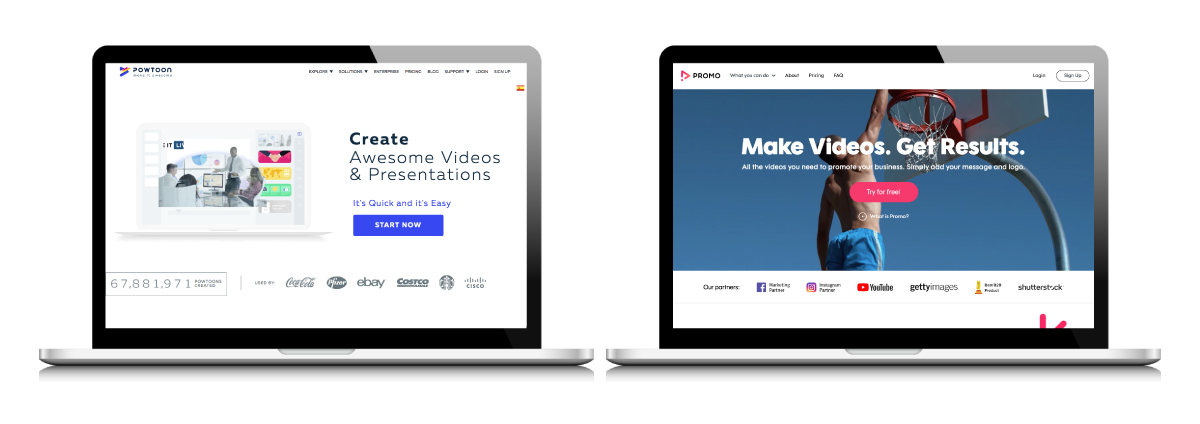
    Making videos in-house will save you a lot of money, and you don’t need to be an experienced filmmaker or video editor to make quality marketing content. There are plenty of resources out there that don’t require any special software to use. Powtoon, for example, is a great resource for creating animated videos. Multiple different animation styles are available to choose from that can work for any industry or topic.

    Another helpful video creation resource is Promo. Promo provides free music and live action and animated video clips that you can combine with text or your own footage and audio. You will save countless hours by using what is already available to you on these and other platforms.

    Tip 4: Focus on the First Ten Seconds

    It is essential to grab your viewers’ attention in the introduction of your video. A fifth of all viewers will stop watching after ten seconds if their attention is not captured in the first ten seconds. You have until the 30-second mark to engage your viewers or you’ll lose 33% of them, and one minute until you lose 45%. You need to know your audience well enough to know what will stand out to them enough to stop scrolling and pay attention throughout your whole video. Once they do make it to the end of the video, a strong CTA is just as important as those first ten seconds. Choose something specific like subscribing to a newsletter or visiting a page on your site.

    Tip 5: Optimize Your Video for SEO & Mobile

    Over half of all videos on the web are viewed on mobile. Of those mobile viewers, over 90% of them share video content with others. The potential shareability of videos viewed on mobile is not something to be ignored, and which is why you need to optimize your videos for mobile. The standard aspect ratio for videos viewed on desktop is 16:9, but this is not ideal for mobile as it does not show up big enough on the screen. Ideally, videos optimized for mobile would be designed with a 9:16 aspect ratio so that they fill the entire screen. To ensure your video is viewed well on both desktop and mobile, create a square video with a 1:1 aspect ratio. For Facebook, your videos should have both captions and audio. This is not required, but it is recommended, as 85% of videos on Facebook are viewed without sound.

    Animaker is just one resource available to you that allows you to create vertical videos tailored specifically for mobile viewing.

    According to the digital marketing institute, you should be hosting your video on your own domain: “enable embedding on your video as this will help you increase the likelihood of receiving inbound marketing links,” and make sure your descriptions and keywords are thorough and unique to the video you created. Video can drive up organic traffic as much as 157%, so you need to make sure your video is optimized for SEO.

    These tips should help get you started on creating and optimizing your own video content in-house. If you should still need some SEO guidance on making sure the right people and customers are seeing your video content, the team at Search Influence can help. Contact us today to get started.

  • The Strategic Marketing Method to Building Your Brand on Youtube

    In true Search Influence fashion, I am going to start this blog post the same way we typically start our weekly company meetings, with a quote:

    “You cannot teach a man anything; you can only help him discover it in himself.” – Galileo

    Though Galileo provided us with this insightful quote, Frances Bacon formulated one of the most important tools to aid in this self-discovery, the scientific method.

    Now, Let’s Get Started…

    Neil DeGrasse Tyson science meme

    There is a method to the madness! What if I told you that to build your brand on YouTube, all you need to know is the scientific method that you learned in 5th grade? You may ask yourself, what exactly are the six steps of the scientific method and how the heck does this relate to digital marketing? For a little refresher, I have listed the steps to get us started:

    1. Ask a question
    2. Do background research
    3. Construct a hypothesis
    4. Test your hypothesis
    5. Analyze the data and draw a conclusion
    6. Share your results

    STEP 1: Ask a Question

    In the first step, you are going to want to think of multiple questions around the reasoning your experiment. I highly recommend taking the time to write this out, whether it’s with a pen and paper or on your computer. Like any great scientist, you should be documenting all of your brainstorming, research, strategies, and data.

    • What is your niche?
    • What is the problem you want to solve?
    • What is your area of expertise?
    • Who do you want to target?
    • Why are you choosing to focus on this niche?

    The last question is key because there is never going to be the same level of commitment if you aren’t choosing something you are truly passionate about.

    STEP 2: Do Background Research

    Now that we have sorted through all of those questions and have a clearer idea of the direction we want to take, it’s time to start our background research.

    We need to look at what our competitors are doing. Our competitors will be the brands or people that are doing something similar to what we have chosen as our niche. When analyzing them, we should ask the following questions:

    • How do they engage?
    • Which formats do they use?
    • What is their content strategy?
    • Is what they’re doing working?
    • What is your market missing?
    • What can you do differently from them?

    Once again, this last question is the key to your success! What can you do differently that will set you apart from your competitors?

    STEP 3: Construct a Hypothesis

    Now the fun part (and my personal favorite)! We need to construct a hypothesis, or, in marketing terms, create a strategy. We will want to use our research from Step 2 to construct keywords, content, and visual styles that will work with your target audience while utilizing the competitive advantage you identified in Step 2. In this step, you will also want to determine your overall strategy to remain consistent. This is going to include your posting schedule, engagement plan, and who (brands or people) you would like to collaborate with in the future.

    An important part of this step is determining the metrics that matter, what we like to call “SMART Goals.” What are the metrics you should measure to prove the success of your strategy?  This will include constructing a timeline of when you would like to check in on these SMART Goals of your strategy.

    Neil DeGrasse Tyson meme about bracing yourself for digital marketing knowledge

    STEP 4: Test Your Hypothesis

    Testing your hypothesis is when the party really gets started. It’s time to experiment. You are going to implement your strategy. You will take the creative strategies you planned out in Step 3 and put them into action.

    STEP 5: Analyze the Data and Draw a Conclusion

    Using the timeline determined in Step 3, analyze the data and draw a conclusion. Look at those metrics that matter. Ask yourself the following questions:

    • Is your strategy helping you achieve your goals?
    • Did you determine the right goals to track in Step 3?

    STEP 6: Share Your Results

    Now, unfortunately, I can’t say that this is the final step because “sharing your results” means you will now use your conclusions to decide on optimizations for your strategy. You’ll know if you’ve achieved your goals or if certain aspects need to be revisited when you analyze the data in the previous step.

    Scientists share their results to provide insightful information that can be used as research for future experiments. Experiments aren’t meant to be done once. This process should be repeated and repeated to study and improve your marketing strategy.

    Once you’ve got your results, ask yourself the following questions:

    • Should you restrategize your brand?
    • Did you choose the right market?
    • Should you restrategize your execution?
    • What parts of your plan are working?

    And the final question to ask yourself after reading this post is… are you smarter than a 5th grader?

    Luckily, the marketing experts at Search Influence got straight A’s in 5th grade. If you need help developing an effective marketing strategy for your business or building brand awareness on YouTube or any other social media platform, start a conversation with one of our strategists today.

     Images

    NDT 1

    NDT 2

  • How to Optimize YouTube Videos for SEO

    Man watching optimized Youtube videos on his phone at Search Influence in New Orleans, LA

    What’s your first thought when you think of YouTube videos? Funny pet compilations or cooking tutorials? Well, if so, then it might surprise you that YouTube is more than just a resource for entertaining clips or personal vlogs (video blogs); it’s actually the second-most visited website in the world, behind Google. More than 1.5 billion users log into YouTube per month. It’s even crept into the television market, and the time that people spend watching YouTube on their TV has doubled in the past year.

    Still, only 9% of small businesses utilize YouTube. And, because YouTube is owned by Google, it pays to ensure that your videos are optimized for SEO just like your website. That might be the difference between a few views and a few thousand.

    Gif of Youtube logo

    A Beginner’s Checklist to YouTube SEO

    1. Title

    Just as your company’s web pages need metadata that contains clear and concise title tags with researched keywords, your video’s title needs to clearly list the topic while also using keywords. It’s one of the few places where you can put keywords, so it’s important to do some preliminary keyword research to see how people are searching for your product or service. A word of caution though—don’t put keywords in your video’s title just for the sake of inserting keywords. As with Google, this practice will not help your position in the YouTube search results page (YSRP). The key is to make it relevant while describing what the video is about.

    Example title of an optimized Youtube video from Search Influence in New Orleans, LA

    1. Description

    A video’s description should be just that—a description of the video. You don’t need to transcribe the entire video or write a short story about it; you just need to give a relevant but brief description. In addition to your title, descriptions are a place where you can utilize keywords. Again, don’t go throwing keywords into your description hoping that it will make your video rank highly in the YSRP. YouTube is smarter than that. Use choice, relevant keywords.

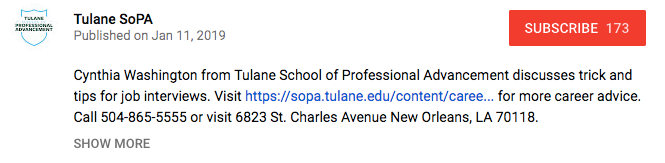
    For length, it’s best to aim for under 250 characters, or roughly 30 words. After this character limit, YouTube uses the “show more” prompt to hide the rest of your description. It’s also important to fit your keywords, a valuable resource link, and a call to action before this threshold. What’s a valuable link? Your company’s homepage can work just fine. But, you’ll get even better value if you can use a page deep in your site—think service pages, product pages, testimonials, limited offer pages, etc. Also, make sure to use “http://” or “https://” before the URL, or it won’t hyperlink in the description!

    After the “show more” fold, you can add more useful links and information, including prompts to follow you on Twitter, subscribe to your YouTube channel, or like you on Facebook.

    Example Youtube video description from Search Influence in New Orleans, LA

    1. Tags

    You’ve got your title; you’ve optimized a concise description; now it’s time to add tags. This is where you don’t want to be stingy. Add any keywords you’ve already used as well as other related keywords, as long as they make sense and are relevant to the content of your video. Also, YouTube recently starting using hashtags as another way to improve searchability.  

    Stephen Colbert saying

    1. Transcript

    This is one that not everyone may know about. YouTube will automatically create subtitles for your video, but their automated transcription process can be unreliable. By uploading a transcript (captions) of your video, you’ll know that someone who watches silently on mobile (which, if Facebook video is a point of reference, a lot of people do) will see an accurate transcription of what’s being said.

    Anna Kendrick saying

    1. Interaction on your part!

    YouTube is similar to social media in that you shouldn’t use the tactic of “set it and forget it.” Just like if someone is interacting with your business’s Facebook page or Instagram post, you should respond in a timely, professional manner. YouTube is also susceptible to, how should I put it, lively discussions in the comment thread. If there are any negative comments or reviews, respond to the ones where you feel you can actually help remedy a situation, and ignore the ones that are simply trolling.

    1. Promotion

    So you’ve uploaded your video and interacted with users in the comments. Great job! But, you’re still seeing pretty low views. Paradoxically, one of the ways to get your video higher up in YSRP is through views, but it’s hard to get views if it’s not being found. Now is the time to promote it. Share it on your blog, social media channels, email marketing campaigns, and even tell your friends, family, or network associates. This can help bring in those valuable views. You can track viewer data through YouTube Analytics. To learn more about using YouTube Analytics, Hootsuite has a detailed guide here.

    It’s Never Been Easier to Create Quality Video Content

    Since the launch of YouTube in 2005, not only has traffic within the platform drastically increased, but the quality of the content being produced has jumped leaps and bounds when compared to the very first video, a 19-second clip of YouTube co-owner Jawed Karim at the zoo talking about elephants.

    But one of the limitations that used to exist, whether or not you had a nice camera or a crew to shoot your video, doesn’t exist anymore. With the capabilities of smartphones, it’s very easy to point and shoot a tutorial, video blog, company profile, or any other type of video content you want to share with the world. By utilizing these tips, you can be on your way to adding some bingeable video content to the YouTube community. At Search Influence, our digital marketing experts can help your business build and grow your brand online. Check out some of the many clients we’ve worked with. Want to chat? Fill out the form in the sidebar today.

    Images:

    Man With iPhone on Head

    Youtube Logo 

    Stephen Colbert

    Anna Kendrick

  • Don’t Leave Your Website Buffering: How to Make Big SEO Gains with Video Content

    Everyone likes watching videos on the Internet—funny videos, cute animal videos, cute kid videos, and cute videos with kids AND animals.

    And while there will always be a place for these videos in our hearts and on the web (what would YouTube be without them?), video content has recently found a new, even greater purpose on the Internet. In recent years, videos have emerged as an integral part of any and every SEO campaign. Based on four main metrics, there are several ways video content can help your business and website gain more traction.

    • With YouTube rising to the lofty status of the world’s second-largest search engine (behind only Google, which just so happens to own YouTube), videos are getting more screen time than ever.
    • Videos have been proven to improve SERP rankings. Because YouTube and Google are in such close cahoots these days, videos from the popular video site are ranking higher than ever in Google searches. The more popular a video, the higher its authority, which affords a greater opportunity of appearing at the top of search pages.
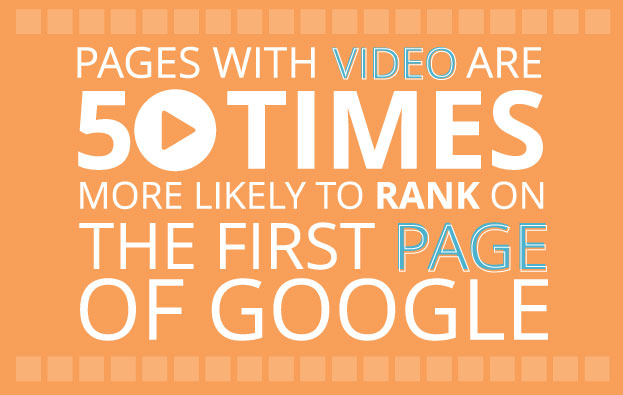
      • A study conducted by Forrester discovered that pages with video are about 50 times more likely to rank on the first page of Google search results.

    1511-SI-BlogImage-B-01

    • For that reason, among others listed below, here is Search Influence’s latest video, a brief case study about our partnership with the Audubon Nature Institute in New Orleans.

    • This is also why properly optimizing videos is so important—all video content (title, description, transcription, links, etc.) is crawled and processed by the search engines.
    • Every business should have their own YouTube channel that is accessible via their website. But to make even better use of videos, embedding YouTube videos directly onto website pages has been proven to be even more effective.
      • Embedded videos can improve click-through rate with up to a 41% higher CTR than plain text, according to study conducted by Cisco and aimClear.

    • Embedded videos can also reduce bounce rate. The longer a visitor spends on a website, the more authority it is given by Google. Unfortunately, the average online attention span is less than 10 seconds. Video content allows visitors to become engaged with something on your site for a longer period time. The average length watched of a single Internet video is over 2.5 minutes—all that extra time is crucial in the SEO world.
    • Videos communicate a lot of information quickly, which lets people sample content without committing to reading lengthy text. Videos are also much more useful in establishing trust with potential customers than written content, especially if the video features the business owner or a client testimonial.
    • Finally, video content is much more likely to generate social interaction and shares, which equals quality backlinks. Videos are easy to watch and share, therefore more appealing and likely to be watched (and allowing for more people to discover the video, and by extension, discover the business in general).
      • In a fascinating experiment, Gemma Holloway at Koozai compared two posts covering the same exact topic—one featured a short video introduction and the other had only text. The video post received between 200% to 300% more page views and shares on social media than the text-only article.

    So don’t leave your website or your business buffering. Incorporate videos into your SEO and Internet Marketing strategy and watch the benefits play out on your computer screen!

  • Tell Me a Story: Nonprofit Storytelling Tips for Effective Social Conversion

    Nonprofit Storytelling Image - Search Influence

    Effective nonprofit marketing (and fundraising) starts with a story. A good story resonates with the audience, advances the mission of the nonprofit, and calls people to action. Nonprofits are unique from their for-profit counterparts, because even more important than facts are feelings. A good story creates an emotional connection between the supporter and the organization. The Center for Social Impact Communication at Georgetown University recently conducted a survey of 81 nonprofits in the Washington, D.C., area and discovered that 78 percent of them had a goal or purpose for storytelling, but only 64 percent felt their goals were met. So how can your nonprofit leverage compelling, inspirational, emotional stories to get more online engagement, more supporters and more donations?

    Be Authentic.

    True passion is contagious. You can’t expect others to get excited about your cause if they can’t see the passion behind your efforts.

    Make them Feel.

    Don’t tell your audience how they should feel; show them how the characters in your story feel. Choose active players in your organization—those with a passion for the work and those affected by the work—and ask them to share their challenges and triumphs. Rather than simply saying, “This organization changed my life, and it can change yours too …” have them tell their entire story from start to finish. Encourage them to include sensory details as they explain what their life was like before, throughout their experience and now.

    Get Visual.

    A picture says a thousand words. According to a study conducted by SimplyMeasured, videos are shared 12 times more often than links and text posts combined, and photos are liked twice as often as text updates. Though words are an essential part of storytelling, the digital market begs for compelling images to support strong stories. Photos have the power to spark human rights campaigns, change public policy, and more. Visual media fosters awareness and compels people to act.

    Ask your Audience to be a Part of your Story.

    Include a clear call to action. Make sure the call to action is supported by a conflict from the story, which makes people want to act urgently.

    Sharing your organization’s impact from the perspective of those impacted is the most effective way to get others to care and offer their support. So while social media is a great platform for sharing industry updates and tweeting about your latest project, don’t forget to tell the story that connects your organization’s mission to the people you serve.

  • Healthy Content: 4 Tips to Drive Conversions in the Medical Industry

    Healthy Content Marketing Image - Search Influence

    In the medical and plastic surgery industries, it can be hard to get past the medical jargon and engage with readers online. But despite these challenges, building up an online presence is vital in this day and age. Everyone online wants to gather information quickly, and they seek immediate gratification when it comes to scheduling appointments and learning about procedures. To keep their interest, you have to present your content in a user-friendly, engaging and attractive way. Let go of the olden days of long-winded explanations and paragraphs upon paragraphs of medical terminology that no one can understand. Step into the 21st Century with these four types of content:

    1. Infographics

    We all want something that is nice to look at and easy to understand. Infographics are not only engaging, but they can also be super informative! The medical terminology that your current and prospective patients need to know can be easily explained in shorter phrases and pictures or guidelines. Infographics help your patients connect with you and your practice.

    Infographics are also more likely to be shared by your customers. People love sharing fun and interesting infographics on their own social media pages, so this will ensure more conversions and potential new clients! Find out more about how infographics can give your content marketing strategy a facelift.

    2. Videos

    Videos are another great visual way to engage your website visitors. You could explain your processes and surgical procedures easily without scaring visitors off with long, complicated paragraphs. This is also a great way to introduce yourself and your practice to potential patients.

    You don’t have to do a stand-up; you could make a slideshow video with voiceover narration, or if your budget allows, an animated video. Make sure you include a call to action at the end so the viewer can take the next step in becoming a patient!

    3. Lists

    Lists are great. You’re reading one now! Putting the number of listed items in the title is especially helpful so people know exactly what they’re getting into. Readers are more likely to click through and take the time to read if there are 10 or fewer items. They’ll think it will only take a couple of minutes, then BAM! They’re hooked. They’re converting, and they’re your next patient!

    Make sure to write lists that are interesting and preferably not common knowledge, such as “10 Things You Didn’t Know about ____” or “5 Ways to Look Younger Without Surgery.” You could even promote your products or services with a list of great products for this, that, or the other thing. Keep it short, sweet, and to the point.

    4. Guides

    Because you specialize in a certain medical field, you have knowledge that is credible, useful, and interesting. Write it down! Guides can be about absolutely anything, and they’re excellent sharing material for those who want to stay informed and keep their social media followers/friends informed. For an example, check out the Search Influence guide on how your online presence can win and lose patients.

    An excellent way to drive up conversions is to make your guide a downloadable file and request information from the reader before they can download. This allows you to add them to your email newsletter list, which will make them more likely to become a patient in the future.

    Deciding how you want to present yourself online can be time-consuming and frustrating, but these four winning types of content are fun, engaging, and can help your conversion rates. Play around with some ideas and be sure to use different content on different pages to keep people wanting more!

    Interested in more content marketing tips for medical marketing? See how natural content can help your practice’s website attract patients.


  • Five For Friday: Death to G+, Facebook Video Calling, A Tech Movie Rec & More

    1. Schema Marks Up Gmail – Moz

    Not too long ago, thanks to a pair of excellent blog posts from David and Ian, we learned all about schema—what it is, what it does, and how it can dramatically help a client’s online marketing strategy.

    After that wealth of knowledge was handed down, it should come as no surprise that schema.org markup can improve your email, too. It aids in allowing people to take action on Gmail quickly and simply. The Moz blog gives a comprehensive introduction explaining who should be using schema markup in their emails and why.

    2. Is Google Plus on its Deathbed? – Marketing Land

    Mark Traphagen, a columnist for Marketing Land, addresses the persistent rumors that Google Plus is going to dismantle the network and its social media component because of its perceived lack of popularity. To counter, he offers several key points that show why these Google+ detractors are misguided.

    3. Why Video is a Marketer’s Best Friend – Marketing Land

    Search Influence has been using videos for online marketing purposes for as long as I can remember (i.e. the year I have worked here). As the Video Coordinator (<—- a fancy, self-given title) over on the Production Team, I have learned why and how videos are so important. For those who may not know, Marketing Land breaks down why video is the perfect medium to enhance all online marketing strategies.

    4. Facebook Announces Video Calling – Search Engine Journal

    Facebook announced on its blog two new updates to its messenger services: video calling and a new app called “Hello,” which functions as a caller id, call blocker and search tool.

    5. SI Movie Recommendation: New Sci-Fi Thriller Ex Machina – The Independent

    In the new sci-fi film Ex Machina, a tech genius and CEO of Bluebook (a fictional Google-Facebook hybrid) has managed to successfully create a robot with artificial intelligence using the data collected by his worldwide, all-knowing search engine. The film touches on some really intriguing themes, such as consciousness, voyeurism, technology and human-machine “singularity.” It is a really interesting and exciting film that, as an employee at a tech company, really resonates—and it’s getting rave reviews across the board!

    The film is rated R for language, nudity, and some violence. It stars Oscar Isaac, Domhnall Gleeson and Alicia Vikander. It is written and directed by Alex Garland (28 Days Later, Sunshine and The Beach).

    Image sources:

    Missy Elliot Gif

    Ex Machina

  • How A Little Nip And Tuck Can Improve Your SEO

    Makeovers aren’t just for mommies looking to restore and improve their post-pregnancy appearance through multiple, personalized plastic surgery procedures. Makeovers can also work wonders for websites in the cosmetic medicine industry. If your website isn’t bringing you a consistent stream of new patients, it may be time to give your site a much-needed SEO facelift. Learn how adding graphics to your website can help you get results!

    DoctorImageQuick—what do professional skin care, breast augmentations, and braces all have in common?
    Give up? Well, first of all, if you want any of these things, you’ll need to seek the help of an accredited medical professional—a dermatologist, cosmetic surgeon, or orthodontist, respectively. More importantly, however (at least for the sake of this blog post), is the fact that you can actually see the end results of these types of medicine. So how can medical professionals incorporate these visible results into their SEO strategy?

    If your medical specialty provides some sort of aesthetic benefit, there is a good chance you could (and should) be doing more to improve your rankings in organic search results. “More” in this context doesn’t mean “more keyword-rich text” or “more high-quality links to your site.” Instead, it means taking advantage of industry-specific SEO opportunities. Optimizing and adding images, educational infographics, or patient testimonial videos can have a significant impact on your site’s search visibility.

    Optimize Existing Images

    Optimizing image file names, alt text, and title text will give search engines information about the image and the content on your site. Any images can be optimized with keywords, but before and after images of your patients are an excellent industry-specific opportunity to naturally incorporate relevant keywords into your site’s content.

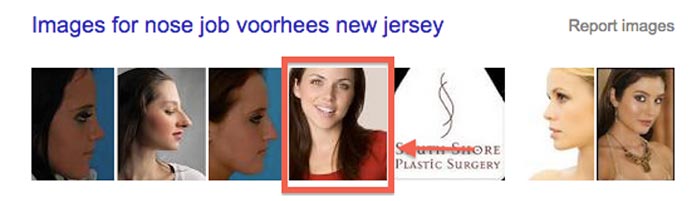
    One of our clients, a plastic surgeon, has a before and after image gallery on his site. We optimized each of the images in the gallery and saw some interesting results. Links to the gallery outperform the corresponding page on his site for the majority of his targeted keywords. The same client even has images that rank in organic search results!

    NoseJobSearchImageResults

    Add Relevant Images

    It’s important to note that Google can’t read or understand images without alt text or title text. But a page with relevant images that have no alt text or title text will most likely still rank better than a page without images! Why? The answer is simple—the ranking algorithm also pays attention to user behavior. If your site’s visitors are happy with what they see, search engines will recognize a pattern and reward your website for providing quality content.

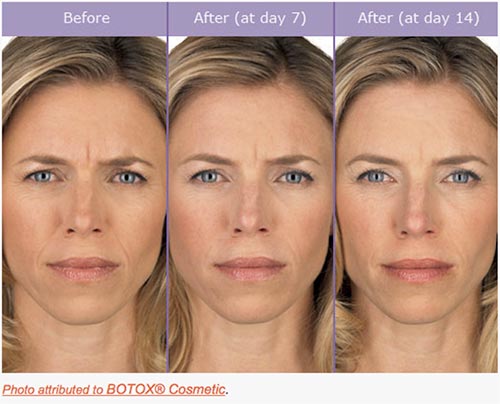
    Another one of our clients, a plastic surgeon in New York, didn’t have a before and after image on his BOTOX® page. As an authorized physician, our client was allowed to use some images provided by Allergan, the manufacturer of BOTOX® Cosmetic. We chose this relevant image and placed it on his site:

    BotoxBeforeAndAfterImage

    In the 30 days after we implemented this image, the average visitor spent 13% more time on the page compared to the previous 30 days. When visitors landed on the page from organic search, the bounce rate improved by 24%. Both of these stats demonstrate to Google that users are not only finding the information that they’re looking for on this page, but that it’s also engaging enough to keep them on the site.

    Create Custom Graphics

    Another behavioral signal that has become increasingly more important is social behavior. Adding custom graphics to your site is a great way to promote social media sharing and demonstrate positive social signals to search engines. And, like other images, custom graphics also give you the opportunity to create keyword-rich file names, alt text, and title text.

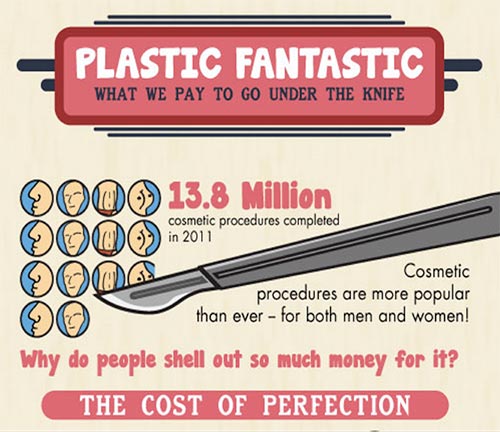
    PlasticFantasticInfographicImage

    The infographic above was shared more than 2,000 times on Facebook. The month it was published, the site saw a 25% increase in referral traffic compared to the previous year. It’s relevant, informative, and interesting for viewers. In other words, it’s exactly the kind of content that helps with SEO.

    Upload Testimonial Videos

    There are other options if you don’t want to use before and after images or infographics. Another one of our clients in the field of plastic surgery uploads patient testimonial videos to his site. Generating nearly 9,000 page views in 2014, these testimonials have certainly had a positive impact on his site’s search rankings. The fact that these patients were so happy with their results has also helped to bring in new business.

    TestimonialVideoGalleryImage

    *Note the keywords in the video titles.

    Get Results

    In the end, people considering a cosmetic procedure want to know that they’ll be satisfied with the results. Search engines want to see that your site is providing quality results for the people who are searching. Using images, graphics, and videos can help kill both of these birds with one stone. You’ll be rewarded with better organic rankings, website traffic — and, ultimately, more business.

  • I’m So Trendy. You Already Know… Using Google Trends on YouTube

    The last time I wrote about Google Trends, I explained how it could be useful in your keyword research process. I am now going to explore how this tool can be used to create a strategically optimized YouTube video.

    Note: As mentioned in my previous blog, keep in mind that the numbers on the graphs presented are not absolute numbers. They are relative to each other to reflect a trend.

    Search by Keyword

    If a client already has a YouTube video featuring a general overview of their business, then we typically try to match up another one of their keywords with a YouTube topic centered around that keyword. Google Trends has a section of the site dedicated to finding trends in search results on YouTube only, so you can see if that keyword is trending and if there are related phrases to consider adding to the title and description of the video.

    Here’s how to get there:

    1. Visit http://www.google.com/trends.

    2. Change your search setting in the top right drop down box in the top navigation from “Web Search” to “YouTube Search.”

    YouTubeSearchImage

    3. Type in the root of the keyword(s) you want to use in the search box under “Compare.” You can compare up to five keywords at a time. This can be used to help you decide between keywords to use as a video topic.

    CompareChartImage

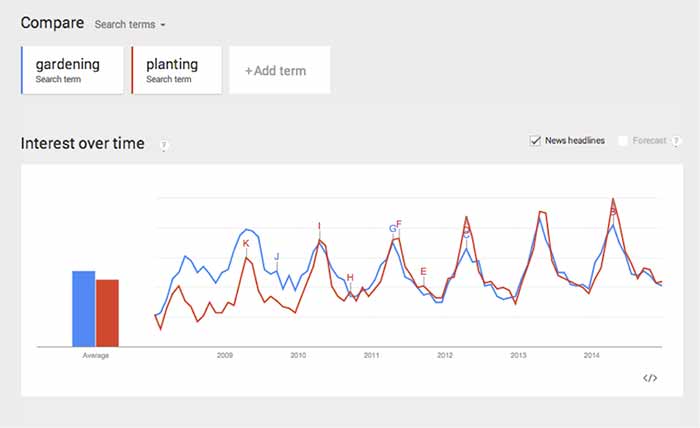
    In this case, both search terms fluctuate at the same time, so seasonality wouldn’t be a factor, but it could be in other instances. This chart tells me that “gardening” used to be a more popular search trend than “planting” on YouTube, but the gap has closed, and “planting” is actually trending more now. It’s interesting that both of the trends dropped so steeply in 2014.

    Because of this, we should look at similar phrases that could have a stronger trend. This is easy to do when you scroll down the page to “Related Searches.”

    Related Searches

    4. Scroll down the page to “Related Searches.”

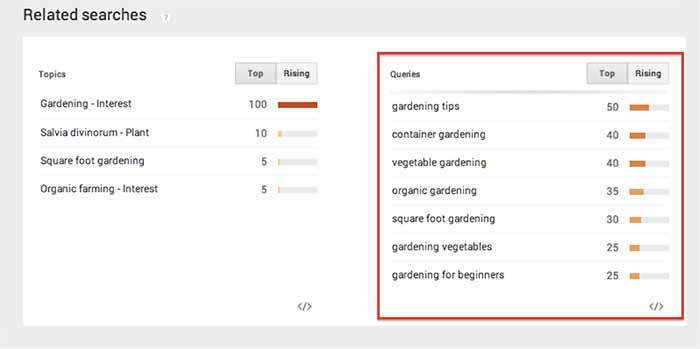
    5. Within “Related Searches” you will see a “Queries” box that shows the most consistently trending searches that are similar to your keyword(s). This is a good place to look for topics that are already popular on YouTube.

    RelatedSearchesImage

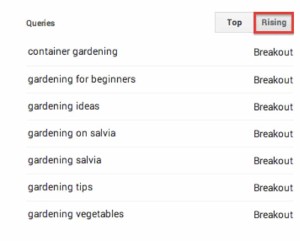
    6. Note the “Rising” column next to “Queries.” These are terms that have been searched for often recently and could become long-term trends.

    As you can see above, I searched for “gardening” and found “container gardening” and “gardening for beginners” as “Related Search” queries. If one of my keywords is “gardening livonia mi,” then I can use “container gardening livonia mi” in the title and description of the video, to optimize it for both terms.

    RisingImage

    Whether you are looking for a way to strategically choose a keyword to optimize a YouTube video or you just need an interesting video topic, Google Trends’ YouTube Search will be a handy tool to explore!