Tag: search engine optimization

  • Interview with Brian Russell of Media Distribution Solutions; Behold the Power of Video

    MediaDistributionSolutionsLogoImageIn early 2014, we partnered with Media Distribution Solutions to deliver their best-in-class video solution to our customers. The BetterVideo platform has enabled Search Influence to scalably deploy custom, 30-60 second, high quality videos in our search engine optimization packages. Video dramatically increases the time spent on websites, improves social sharability and customer engagement. Earlier this week, our VP of Sales and Marketing, Kelly Benish, interviewed MDS COO Brian Russell on the growth of their company, the evolution of their platform and the importance of video.

    Media Distribution Solutions / BetterVideo

    BrianRussellImage
    Brian Russell

    Interviewee: Brian Russell

    Title: COO

    When were you founded?

    We founded Media Distribution Solutions in 2006, the same time we founded Metrix4Media (a Search Engine Marketing company).

    Where did M4M go?

    M4M was acquired by Hearst Corporation in 2007 for an undisclosed amount. (Sorry, Hearst is private and I cannot disclose the terms of the deal). Metrix4Media is still operated today by LocalEdge as the SEM platform.

    How did you come up with the idea for your company?

    In 2006 our CEO was approached by a technology group that had “the next big thing” in video. After spending some time working with their technology, we felt there was an opportunity to bring video to small and medium sized businesses through some of our prior partners. We had a relationship with the team at LocalEdge and knew that they are always pushing the envelope in terms of what they offer their advertisers. Up to this point, the cost of video had just been too high for SMBs to consider it, but through our technology, we were able to make it accessible and extremely scalable. These were still the very early days of video, prior to the overwhelming popularity of YouTube. Partners like LocalEdge and For Rent Media Solutions were pioneers in offering video through our BetterVideo platform. Over the years, video has evolved from our early, proprietary video codec, through Flash, and now to industry standard H.264/MP4 format. We continue to see advances in compression, which will further fuel the consumption of video on mobile devices. We are still seeing incredible growth as several other large media companies are now embracing video and leveraging the work done by the early adopters.

    What solutions do you offer?

    Video is our core, but there are many different flavors; from top of funnel awareness videos, which are a critical piece that allows the business to not only describe their offering, but also “tell their story.” This gives them an opportunity to differentiate themselves from their competition. The cost to produce high quality video content continues to fall, and business owners are realizing they can create more videos; testimonials videos, products and services videos, as well as more actionable videos for specials or seasonal offerings. The high value of video content is giving their site incredible lift in search results—the more video, the better!

    Where do you see MDS in the next 5 years? What do you predict your evolution will look like?

    Driving them to the future is video advertising. Google/YouTube rolled out TruView and Google Adwords, where an advertiser can target geographically and demographically who sees their video advertisement. This allows them to show relevant, local content to people that have shown interest.

    What have been some of the challenges in scaling out your video solution?

    BetterVideo has experienced the same challenge that other digital advertising solutions see, how to scale, yet serve the needs of the local small business owner. We have addressed this by the appropriate application of technology in key places. We still believe that an experienced video editor needs to play a role in the creation of every single video we produce, but we have automated processes to remove manual, repetitive tasks and allow or video editors to spend their time doing what they do best, creating exceptional videos that allow our advertisers tell their stories, promote their businesses, and deliver strong ROI.

    What types of videos provide the highest engagement level?

    Engagement levels come from relevancy. A person will be engaged with a video that is relevant to them—either through search results or some level of targeting. People are searching to find the answer to a question… How do I do this? How does that work? How do I fix this? Where can I get a great pizza? If they can be shown a video that shows them the answer to the question they have asked, they are very likely to be engaged. We read the studies and know how engagement drops off at certain points in a video, and we produce every one of our videos to deliver key information to overcome these “drop off points,” allowing advertisers to connect with their audience.

    What are the benefits of video for a small business?

    Small businesses get to tell their stories and showcase their specialties. They get to find a way to put themselves out there to show viewers their store, their people, what makes them different. Video offers them to opportunity to show viewers why they should do business with them. It really gives them a chance to showcase the value of their business. Video testimonials are the sweet spot for SMB’s. Reading a review is great, but seeing a review really allows the business to show what the consumer has experienced.

    What are the verticals that benefit most from Videos?

    Hotels and apartment properties love video because people really want to see where they are going to stay or live. They want to see the location, amenities, etc., so this is an extremely hot niche. A lot of service industries such as landscapers, pool builders, and general contractors see a huge benefit because video allows them to showcase their best work. Garage door repair, plumbers and HVAC companies have a list of things they’d like to you try before you call them—video offers them a great way to show you what you need to try before you call. The additional benefit from these types of videos allows these professionals to establish themselves as experts. A consumer will show loyalty to a business that saved them some money by showing them how to fix something simple on their own and will trust that business when they have something larger than they are uncomfortable handling on their own.

    Anything else I should know?

    Never underestimate the value of quality production. It’s so easy to shoot video and post it now, but video is an important part of your business and should be considered a critical component of your brand. You want to make sure you put your best foot forward. A professionally produced video allows a company to showcase their business and differentiate themselves from their competitors.

    Some Video Examples:

    Dominion Enterprises – For Rent Media Solutions:

    Hearst Media Solutions – LocalEdge: Ellis Eye and Laser Medical Center

    Concentra / Humana

    Product Video

  • Why is Google Doing That?

    nest

    Techcrunch announced yesterday that Google acquired the connected device company Nest for approximately $3.2 billion dollars USD. [1] While this may seem like a large investment to us laymen (laywomen? laypeople…), it is understood that Google’s disposable capital cannot be quantified by the finite numbers we are used to using. So this investment may not mean as much for the company as the tech-blogosphere would suggest. But what will happen if the people at Wired and Techcrunch are right, and Google keeps doing more Google-y things like buying every robot ever along with the firms that produce them? Well for one thing, SEO will probably work a little differently.

    Prediction 1:

    In the Future Google/Future SEO Realm/Matrix, display space will be even more precious and SEM will get more expensive.

    A lot of SEO bloggers have been beating this drum for a while now. It’s obvious to most that if the screen space is smaller, the amount of results consumers are willing to investigate will reduce as well. The Google Glass has approximately 90% less surface space than traditional smartphone platforms.[2] Intuitively, this kind of face streaming will probably devalue the real estate of any ranking positioned outside of the top three. As the displays get smaller and smaller, SEM will gain more and more popularity as companies like Bing and Google are likely to price gouge for the precious paid display space on these next generation platforms.

    Prediction 2:

    In the forthcoming Future Google Realm, it will be simply irresistible – if not physically irresistible – to share everything.

    With the iphone, consumers were given the opportunity to commodify everything they experienced in their lives.[3] As we begin to wear microphones and cameras on our faces[4] and while the most mundane of our home appliances become members of the global village,[5] there will be more and more opportunities and incentives to share everything. As we begin to create more devices and metrics to record social media, sticking out in the endless void of user created content will become even more challenging, and social currency will become even more invaluable. With the creation of these new outlets, we should expect to see SEO become even more dependent on social media rankings, while performing well in these arenas will be crucial for any successful business.

    In conclusion, now is the perfect time to start honing your SEO and social media chops. Now I’ll leave you with a gif of a stock photo model using different technology.

     output_dAJDKN
    [1]To put this in context, Instagram sold to Facebook for $1 billion in 2012. 

    [2]Made this up.

    [3]A recent study showed that users are three times more likely to share content via their Iphone versus their desktop. http://bit.ly/1d3DAAw

    [4]Shout-out to Google Glass.

    [5]Google’s Nest acquisition will likely lead to the existence of a consumer experience where home appliances – fridge, oven, stove, coffee maker etc. – will all be connected to the internet and synced up to your smart phone.

  • SEO vs. PPC: What’s The Difference Anyway?

    A while back, SEO guru David McBee wrote a post in his awesome blog about how he differentiates SEO tactics from PPC strategies. In David’s mind, it can all be related to the difference between dieting and plastic surgery. SEO is a diet, and PPC is plastic surgery.

    To illustrate his point, David created this awesome infographic which I think spells things out pretty well. In many ways, this categorization really gets to the root of the differences between what you would do to increase your site’s profile online using SEO tactics versus the much more immediate PPC strategies we all employ.

    The SEO Diet

    It is very true that SEO is like a diet for your online presence. You need to be in it for the long haul, and you really need to establish clearly defined goals before you start. In exactly the same way that a crash diet will not yield the long term results you are looking for, link baiting or deploying tons of spammy content will not help you reach your idea SEO weight.

    I really like the comparison of PPC to plastic surgery because I feel like you should be putting the same kind of thought to the planning stages of a PPC campaign that you would before a procedure like a face lift or tummy tuck.

    The PPC Procedure

    You need to figure out exactly what you want to focus on and a lot of thought has to go into what you want to look like on the other side. Nothing is worse than not being prepared for an onslaught of traffic hitting your site on the heels of a successful PPC campaign.

    What do you think of David McBee’s comparison? What would you say the SEO/PPC dichotomy resembles in your experience? Let us know in the comments! We would love to hear from you, even if you are on a juice cleanse SEO diet.

    Link for infographic: http://davidmcbee.com/seo-is-a-diet-ppc-is-plastic-surgery-infographic/

  • 3 Easy Steps to Launch a Successful PPC Campaign

    I’ve been in online advertising for about 8 years now. In that time, I’ve launched hundreds of accounts and thousands of search campaigns. Not all of them have gone as smoothly as I would like to believe. Instead of relying on my years of knowledge, I have a blueprint that I follow to ensure there is a successful launch.

    Here’s an easy 3-step beginner guide to to launching a successful campaign that your clients (and boss) will be proud of.

    Step 1. Check You Campaigns Settings

    One of the most important parts of setting up a paid search account is checking all of your campaign settings. This is especially important when using something like the Bing Ads’ import feature or creating new campaigns in AdWords Editor.

    • Location
      • Make sure your location is targeting where you or the client have specified. While you could use geo-modified keywords for a state or region, you are likely to see a lower CTR due to poor ad relevancy and low conversion rates.
    • Language
      • Make sure the language you are targeting matches your location targeting and your ad content. If you are targeting a bilingual region such as Quebec, it is best practice to create a French and an English campaign with ad content in the appropriate language. Serve French ads to French speakers and English ads to…you get the point. 🙂
    • Ad Networks
      • This is a big mistake for a lot of new advertisers — your campaigns should never target more than one network at a time. While it is perfectly fine to advertise text ads on the display network, you do not want your low CTR from the display network negatively impacting your search text ads.
    • Device Targeting
      • On July 22nd, this setting will be non-existent, but you must be sure to check you bid adjustments for mobile devices. Not all businesses or websites lend themselves to mobile devices, and despite Google’s certainty that mobile is the future, there is no reason to overbid on a low-performing segment.

    enhanced-campaign-mobile-bidding


    Step 2. Assembled the Ad Groups

    good keyword themes

    • Keyword Themes
      • How your keywords relate to your ad content, the search query, and the landing page really matter. While it isn’t the biggest factor in quality score (CTR is still 70% of the a good QS), keyword theming it majorly important to relate your service/product/whatever to the searcher. Over- and under-simplifying themes is a common mistake that even a lot of veteran PPC advertisers make, so don’t be discourage if you aren’t sure where to start.  The best way to determine how keywords should be grouped is by figuring out what they mean to the searcher and what the searcher is expecting to see.
    • Keywords Match Types
      • Like keyword theming, this has a lot to do with anticipating what question a user is going to ask a search engine and how. I am a huge fan of exact and phrase match because if gives you the best CTR and limits the amount of negative keyword research you’ll have to do. However, for the PPC noob I would recommend using modified broad match with a hefty list of negatives to eliminate search noise. If you follow this advice your quality score and wallet will thank you.
    • Ad Content
      • One of the most important elements of a good launch is good ad content. When writing ad content, the most important things is answering the search query’s question. It is equally important to show why you answer the question better than your competition. Including value props, calls-to-action, and relevant ad extensions will help you get the click.


    Step 3. Set Up Conversion Tracking and Analytics Integration 

    • Conversion Trackers
      • This is probably the most overlooked and financially dangerous thing to forget when setting up a PPC campaign. Whether you consider a conversion a click-to-call, a form submission, or even view of keypage, you have to set up conversion tracking. With both AdWords and Bing Ads this is a simple process — you just insert a snippet of code onto your determined conversion page. This is typically the last action you want a visitor to do on your site before leaving your site.
    • Google Analytics
      • Undeniably the most powerful free analytics tool available. Google Analytics allows you to see what your PPC visitors are doing on your site. Having this knowledge will allow you make data driven decision about on-page factors such as images, content, or layout. One of my personal favorite reports is Visitor Flow. This report shows the path a visitor takes on your site and what information you should include on your landing pages.

    That’s it!

    Setting up a new PPC campaign can become daunting and confusing. Using these three steps will help you stay on track and not waste time or money. A properly set up campaign will ensure you can make better ROI decisions without backtracking and guesswork.

    Pro-Tip: If you have a hard monthly cost and want to effectively manage your spend use the shared library’s Budget feature. It will allow you to assign a set daily spend to multiple campaigns. It will alleviate the stress of manually adjusting each campaigns’ daily spend. Be sure to check your performance though. If you start seeing more opportunity in a particular account you may want to separate it from the others and assign an individual budget.

    Share Budgets for PPC Campaigns

  • Penguin 2.0 May Not Be Done Just Yet

    Penguin 2.0 reconfigure?We’ve been watching Penguin 2.0 and its effects, and as a team we have noticed some fluctuating data that suggests the algorithm has not quite settled in yet.  In another blog post, I put it out there that rankings are not everything, and they are not the primary measure of success.  Ranking reports have known flaws, but they can be used as a weather vane.  When we look at the ranking weather for a few clients, we see some ups and downs, clearly with some effect from the most recent Penguin, but it appears that the players on Google page 1 are still moving around more than a month after the rollout.

    When we look at a few examples, we see the musical chairs being played on page 1 with nobody being safe and comfortable for very long.  We’re watching rankings for a  plastic surgeon in New Jersey for the term “rhinoplasty New Jersey.”

    SEO for plastic surgery

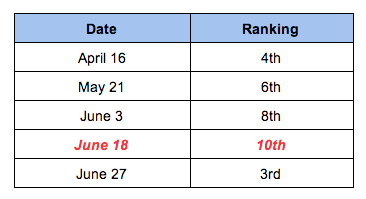
    Here’s a summary of his rankings hopping all over.  His biggest drop was on June 18th:

    Rhinoplasty New Jersey

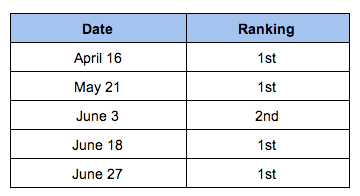
     The same client for “breast augmentation New Jersey” had more subtle changes, but they are meaningful.

    Breast Augmentation New Jersey

    So it looks like he got a little hit from Penguin 2.0, but may be rebounding.  We have done nothing out of the ordinary for this surgeon to move his site from 10th to 3rd in just nine days, so we make an assumption that Penguin is still adjusting.

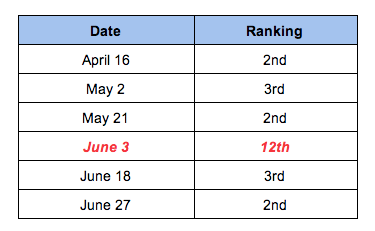
    Another example in ranking fluctuations for “Columbus allergist” is in a doctor’s rankings seen below.  His biggest decrease was on June 3rd vs the guy above who got the hit on June 18th:

    Columbus Allergist

    Rankings Aren’t Everything!

    Rankings are not the only measure by which we watch successes and failures. Organic traffic is another layer of data, and in some organic traffic trends, we see noticeable changes around June 3rd then again around June 18th.

    The client represented in the chart below is a cocktail bar in the South.  They saw a dip in organic traffic after May 22, but they enjoyed an unexpected bump in early June (the traffic dropped off again after that early June peak, but what I want to know is what’s behind that weird little bump up earlier on?):

    Penguin 2.0 adjustment in early June?

    The next example is a traffic bump around June 18th.  This client is a completely different business on the west coast.  We see a little effect from Penguin, then a weird spike:

    Penguin 2.0 adjustment June 18th?


    And Then There Are Other Data Too

    Bounce rates before and after Penguin 2.0It gets a little fuzzier when you start looking at Bounce rates and Time on Page and these data in Analytics.  Who’s to say that these increases or decreases are a direct effect from Penguin?  You could argue your site is having better or worse quality traffic because of ranking and where your site now shows up vs where it showed before Penguin.  You could argue lots.  All I know is that 3 of the 4 clients mentioned above saw an improvement in Bounce rate after Penguin.


    Bounce rates before and after Penguin 2.0 2013Bounce rates improved after Penguin 2.0

    So … what?

    I’m not convinced that Penguin 2.0 was a one time algorithm update, it did its thing on May 22nd, and we’re experiencing the good or the bad or the indifferent.  I think it’s still shaking out, and we may still see a few odd spikes or odd drops in ranking or traffic or some other data.  We may have a few more weeks before websites settle into a relatively comfortable placement on page 1, and it is only then that we can claim some clear understanding of the full effect of Penguin.

    And because Penguin 2.0 is still reconfiguring, it may not be time for drastic action.  If your site is experiencing some definite ups and downs, then yes, you should look at your backlinks quality, the anchor text quality, internal links, etc.  All of this stuff is covered in many other blog posts.  You should have been long ago working on authoritative backlinks and building up your social cred.  But it’s not time to throw up your hands, and just Disavow everything. It’s not time to scrap your website and start with a brand new domain and design.  Take some time to digest what’s going on before bulldozing ahead.

    What I would really like to know is if anyone else noticed definite odd fluctuations around June 3rd and June 18th.  Or if you noticed unusual changes at anytime after May 22nd.  Leave a comment, and let us know.

  • Five for Friday

    Five for Friday1. How Google Now Will Impact SEO & What You Can Do to Get a Head Start – Search Engine Watch

    Google hosted their big developers conference this week, Google I/O. Although there were no big new products introductions, one service that has been getting a lot of attention is Google Now. Although this product was released over a year ago, it is now available for free download on Apple and Android phones and tablets. Guillaume Bouchard has some interesting ideas about how Google Now will affect the SEO community and what we can do to stay ahead of the curve.

    2. Google Maps Gets a Brand New Look – Search Engine Watch

    Google announced another big update this week. Google Maps is undergoing a complete makeover. The maps will be more interactive and customized for each user. Search results will be clearly labeled on the map with icons and brief descriptions. They’re also promising “smarter directions” and “tours generated from user-submitted photos.” The update is invitation-only right now.

    3. How My Mom Thinks Search Engines Work – SEO Moz

    This is a fun article and a good read for anyone working in SEO. Introducing somebody to SEO is not easy, and it’s good to take a step back from our industry jargon and realize that clients – usually small business owners – might not know what “organic search” is!

    4. Content Marketing is a Hit! [Infograhic] – Marketing Pilgrim

    We’ve been hearing for a while about the importance of content marketing. This infographic lays out the cold hard facts about how and why content marketing is essential for your business.

    5. Google Local Adds New Troubleshooter to Move Reviews When a Business Relocates – http://blumenthals.com/blog

    One more update from the all-important Google. Google has announced that they now have a process in place to submit requests for when a business relocates, changes its name, or changes ownership. This is something that has plagued Maps teams for a while and it’s great to see Google doing something proactive in order to simplify the process.

  • Google Evolution Video: The Past, Present and Future of Search

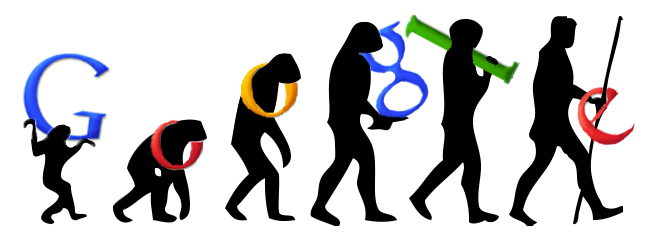
    As a followup to their recently-released peek under the hood, the Google team has produced this video showing the remarkable evolution of their search service. Watch the once-humble engine (check out that MS Word Art logo!) exploding in under fifteen years from plain-text results with a month or more’s lag time between indexes to the omnipresent, light-speed information giant we all know and love today. Since its inception as a tool for data-gathering, Google has taken a keen emphasis on speed of results, with the end goal being an almost “seamless” meld between the user’s query and the answer to such; they’ve also expanded in other dimensions, covering new paradigms such as images, breaking news, and semantic results to help users navigate to the information they’re seeking as efficiently as possible.

    Google has evolved to an almost unthinkable degree of complexity in such a short time — and advances are coming at a breakneck pace, particularly with the social and business opportunities afforded by the introduction of G+. What do you think is next for Google and us?

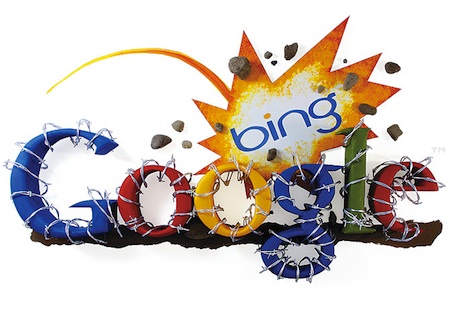
  • Can Bing Ever Compete with Google?

    If you keep up with what’s in the news in the world of search engines, you know that there’s been a bitter little rivalry between Bing and Google for some time. In early February, Bing accused Google of stealing their search results. It didn’t help Bing’s case that they didn’t deny the claim either, instead saying, “…we use multiple signals and approaches when we think about ranking, but like the rest of the players in this industry, we’re not going to go deep and detailed in how we do it.”

    Fast forward to now, where Microsoft was recently the topic of discussion in a lengthy article in the New York Times about Bing’s profitability — and how long it may take them before they have any chance of breaking even. Other reports claim that Microsoft has claimed 30% of the search market and that Google is “slowly sinking”, even though it still controls roughly 65% of the search market.

    Bing has made respectable strides since its launch two years ago, but even so, it hasn’t been able to match the brute force of Google, which was the leading search engine among ten competitors back in 2002, only two years after its launch.  Surely, Bing will continue to grow, but even if can find itself on equal footing with Google, can that be considered success?

    Microsoft’s Qi Lu says, “To break through, we have to change the game. But this is a long term journey.” He’s right … but how long will that journey be? Sources seem to think that Bing will need to demonstrate some sort of clear success before its tenth birthday to remain a contender.

    How can Microsoft accomplish this? Voices all over the web have tons of ideas, but several of the key ones seem to stick out. Some suggest that Bing work both ends of the user spectrum, finding a way to appeal to every age range (much like Nintendo did with the launch of their Wii videogame console). Since Google tends to appeal to a young, tech savvy audience, this could be a valid approach for Bing. Microsoft should also focus carefully on their acquisitions, and try to see what could work best for them (here’s a hint: buying Skype for $8.5 billion might not have been the best choice).

    Personally, I’m a fan of Google’s products, so until Bing can offer something better, I’m staying put. How do you feel about it?

  • Facebook Local Search: Facebook Declares War on Google’s Empire

    Is Facebook the next evolution of Local Search?

    We all knew it was a matter of time before Facebook started expanding into web search and they’ve finally done it by unveiling their own Facebook local search option: Open Graph search engine. What is Open Graph, you might ask, here’s what Facebook reps are saying, according to an allfacebook.com story:

    “all Open Graph enabled web pages will show up in search when a user likes them”

    Why is this important? Imagine a more personalized web experience where community feedback drives interaction and search position. You can search for a cosmetic surgeon or dentist and immediately be able to contact his patients for real feedback. This is huge! No longer will you type in “Atlanta dentist” and dozens of sleek websites – you’ll be able to find information on the dentist, his office location, and talk with his clients. As Facebook continues to develop this open graph search, you will see Facebook profiles and page results as well as websites being ranked by user feedback from REAL people.

    If this catches on, not only will the face of SEO change, how people think about searching will change as well. It’s like Facebook is developing Deathstars and photon rifles, while Google is reloading the Spaniard cannons.

    Do I think this is the end of Google local search? No, but I do think that Facebook is moving in the right direction. Users having control over results and ranking seems like a no-brain. My only concern is potential spammers hindering the evolution of search.

  • Will Scott Interview on Search Engine Journal

    A quick thanks and a link, for your information, to an interview Mat Siltala did with me on Search Engine Journal.

    Picture of Mat Siltala and Will Scott at SMX West
    Picture of Mat Siltala and Will Scott at SMX West

    Mat and I often speak about search, local, social media and his favoriteviral marketing. I appreciate the opportunity for the exchange of ideas and am always happy to spend time with Mat.

    In the interview we talk about some of the Top Local Business Listing questions we receive.

    For those who don’t know Mat Siltala, his Internet Marketing Firm Dream Systems Media is one of the best in the industry. With customers ranging from small businesses to some of the biggest names on the Internet, Mat and his team are a worthy choice for any business, seriously thinking about online marketing who recognizes that Investment is the first part of Return on Investment.

    Again, a big thanks to Mat and the Search Engine Journal team for helping spread the word about the value of Local search for small business.

    Written at 38,000 ft somewhere over Indiana