Tag: reputation management

  • Google “My Social Circle” Invading The SERPs

    Google Buzz with its “Connected Sites”option is deeper, and perhaps more insidious, than we thought. It appears, that in addition to insinuating itself into Gmail, Gchat and Google’s mobile services, through Google My Social Circle Google Buzz is picking up information from sites listed in your Google Profile and including “Social Content” in the actual search results, blended as they might News or Video content.

    My Mumbai Social Circle
    My Mumbai Social Circle

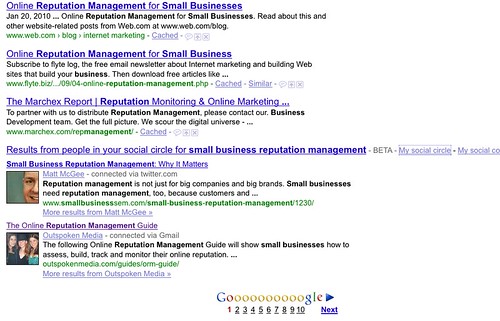
    I was reading a blog post from Small Business SEM’s Matt McGee this morning in which he referenced a search result for “small business reputation management“. So I clicked the link and got the following results set:
    Results for Small Business Reputation managerment
    Results for Small Business Reputation managerment

    In case it’s not obvious, you can see in the image above two referenced blog posts from sites I frequent run by industry friends Matt McGee and Outspoken Media (Lisa Barone).

    My first thought was “Wow, that’s kind of cool. I wonder why Mat Siltala’s not there” ;).

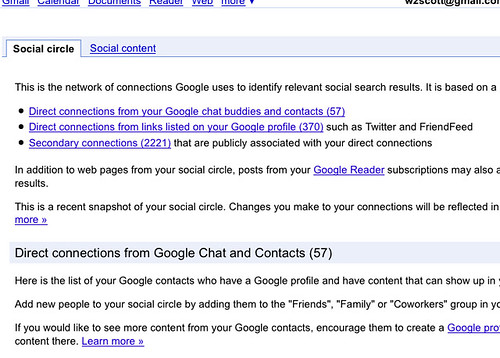
    And then I drilled down to see what was driving this particular social graph. It’s interesting to see where Google draws data regardless and in this case, more so because assumptions are being made about my likes and dislikes in this Google, My Social Circle by inference from other sites I frequent.
    My Social Circle - Reminiscent of LinkedIns Degrees of separation
    My Social Circle – Reminiscent of LinkedIn's Degrees of separation

    As you can see My Social Circle includes:

    • Direct connections from Google Chat buddies,
    • Direct connections from sites such as Twitter and FriendFeed (that’s a lot of data)
    • Secondary Connections linked by inference to my direct connections

    So basically, Google has digested all of the data from those accounts I have listed on my personal Google Profile page and used them to assemble this My Social Circle idea. And, with my social circle defined, my search results are further personalized.

    This is a good thing right? Google’s trying to help out and give me what I’m looking for, right?

    Maybe.

    At this point the implementation is pretty mild. It’s a nice leverage of the data available thanks to the Google Personal Profile page – personal profile pages which are all the more prominent thanks to buzz. And, my position that the implementation is mild is based on my usage.

    I’m a business user and I keep it clean. I may be occasionally smart-alecky but other than that I don’t have anthing online I don’t want my mother to see.

    If this isn’t you if you might have something to hide, and particularly if you browse on a public or work computer, you may want to reconsider whether Buzz is for you. While the idea of my industry friends who blog showing up in search results is OK for me, it might not be OK for you. And, even if you’re squeaky clean, Google sometimes gets it wrong.

    Have you seen any examples of this? What searches? I’d love to see screen shots.

  • Unethical Customer Reviews Can Cost You Big

    Lifestyle Lift is learning the cost of unethical customer reviews. The New York State Attorney General has reached a $300,000.00 settlement with cosmetic surgery company Lifestyle Lift in response to fabricated consumer reviews.

    It appears that Lifestyle Lift was directing employees to spend their time in reviewing their own facilities.

    Lifestyle Lift is a plastic surgery chain store. From those online customer reviews one finds, which appear truly authentic, they’re not doing so great in good old fashioned customer service. According to the article in the NY Times it seems that Lifestyle Lift is resorting to aggressive reputation management techniques to suppress bad reviews and advance their own message.

    Where did Lifestyle Lift go wrong?

    According to the article, it appears that Lifestyle Lift fabricated reviews of their own facilities and even went so far as to create entire new “review” sites to advance their message.

    To be clear, user reviews are great. The creation of alternate sites for search or more targeted messaging are a long accepted technique to obtain ranking and spread the message.

    Where it becomes a problem is when these reviews and sites are presented as authentic user generated content and they are, in fact, a fabrication in support of public relations.

    In short, the creation of false consumer reviews with the intent to deceive is the problem. It’s long been held to be unethical and now, in the state of New York, it’s illegal

    Examples of likely fabricated reviews:

    These aren’t for Lifestyle Lift, but for other plastic surgery searches. I’m not saying the following are specifically relevant to bunk reviews, but there are a couple listings – you can find them yourself – which have an abundance of positive or non-informative, yet 5-star, reviews.

    http://www.google.com/search?q=breast+augmentation+san+francisco
    http://www.google.com/search?&q=plastic+surgery+new+jersey

    And we don’t know that these are definitely a fabrication but “cool” has 3 reviews, all of which are for the same plastic surgeon, focusing on different locations (1 of which includes “Plastic Surgery” as the business name) and no reviews for other businesses.

    And “Happy”, whose reviews look more authentic has a similar instance of 1 each for business name”Plastic Surgery” and for the doctor’s name itself – again, with no reviews for other businesses.

    At a minimum, what the above demonstrate is how not to ask for customer reviews. Whether “Happy” and “cool” are real people or employees of the practice, a little digging makes it appear these are inauthentic and calls into question the validity of all the reviews.



    So what’s a small business to do?

    As the examples show it’s a dog-eat-dog world in online reviews.

    Ironically we’re preparing a much more focused post on how to get reviews but in the meantime remember:

    • Be authentic! Chances are if you fake it you’ll get caught.
    • Have customers tell their story. They’ll be much more believable than you.
    • In doubt? Don’t do it! Lifestyle Lift should be a lesson – it might cost you $$

    Of course, this case is different than most because Lifestyle Lift got busted. The New York State Attorney General has drawn the line for us with regard to clearly egregious behavior but I think we can all agree they’re not the only ones.

    Where does that line get drawn for you? As with every ethical question there are many shades of gray between here and there.

    I’d love to hear your thoughts.

    Thanks to the Blog Herald for tipping me off to this story. It’s very relevant to our livelihood and that of our customers.

  • Reputation Management or Just Good Old-Fashioned Customer Service: What Works Better?

    “Markets are conversations”, states the Cluetrain Manifesto, the online reputation managers’ Bible. And if you sell any kind of product or service today, you must be part of the conversation or get left out.

    Crowd Pleaser - The Power of Word of Mouth
    Crowd Pleaser – The Power of Word of Mouth

    In the days before the internet, reputations were built on word-of-mouth (WOM) and reputation management was a term that referred to damage control and crisis communications. The growing reach of the internet means that online business is now a two-way conversation.

    Consumer-generated product reviews play a big role in online purchasing behavior. 55% of US internet users indicate that they check other people’s opinions online before making purchases. A study by Deloitte & Touche USA reports that 18% of customers purchased a beauty or grooming aid based on reviews posted by other consumers.

    The fact that reputation matters online is beyond debate. At Search Influence, we believe that business is not just about putting a positive spin on your product or service. It’s also about creating value for your customers. And the value you provide is what will create good buzz online, with positive reviews and comments from happy customers.

    Very Satisfied Customer
    Very Satisfied Customer

    Customer reviews are not only useful on blogs, forums and review sites. They’ve also been reported to improve site conversion, retention and customer loyalty, and boost search engine results by increasing on-site content.

    eBay was one of the first web companies to harness the power of Consumer Generated Media (CGM) feedback. By using user generated feedback ratings, it helped other users make purchasing and selling decisions.

    Unfortunately, many businesses are still in reactive mode today. This includes even big brands, such as McDonald’s, KFC and Coca Cola. Few have woken up to the fact that consumer reviews and opinions are playing an increasingly important role in word-of-mouth marketing online. It’s only when they get negative buzz that they go all out to clean up the mess.

    One example of how negative buzz can play havoc with your brand is the recent Domino’s Pizza YouTube video fiasco, that resulted in criminal charges being filed against two members of the staff at a Domino’s outlet, for posting a video that shows a staffer shoving cheese up his nose.

    To minimize the backlash Dominos uploaded a video on YouTube addressing the issue. Not exactly the most effective way to salvage their reputation. You can bet a lot of people (us included) will be avoiding those pizzas for a while!

    In the long run, the best approach is to take a proactive stance on creating and maintaining a good reputation online. Here are some steps we recommend to help you create more positive buzz for your products or services.

    • Provide value: The #1 rule of thumb for brick-and-mortar stores or offline businesses is also what works best online. Customers appreciate businesses that offer them quality products and services, whether they operate online or off.
    • Ask for feedback: Are your customers unhappy? Do you get complaints about your systems, processes, staff or services? Ask each customer to fill in a form with feedback and reviews, no matter how inconvenient it can be.
    • Take action: View your customer’s complaints and feedback constructively and take the steps you need to improve what you’re offering. It’s easier and cheaper to offer a refund or a replacement than it is to clean up the bad press and damage to your business reputation created by an irate customer.
    • Monitor your online reputation: You could do this yourself using Google Alerts, but if your online reputation matters a lot to you, it makes sense to hire a reputation management firm to monitor buzz about your company.
    • Participate in the conversation: If your business generates a lot of positive feedback from customers, ask them for permission to use their reviews and testimonials online. Participate in industry forms, social networks and consumer review/opinion sites.
    Be Part of The Conversation
    Be Part of The Conversation

    Even if your online reputation is suffering, it’s not too late to change the negative perception of your business. You can syndicate articles to industry newsletters and article engines. Put up a blog on your own website and post your articles there. Allow visitors to post comments and reply to them.

    Learn about social networking and how to make it work for you. Build a mailing list and keep your subscribers in the loop with an email newsletter. Send out press releases on recent developments in your industry.

    Rules of the road for creating visibility online:

    • Get personal. Build relationships with potential customers.
    • Be human. Use consumer-speak, not corporate-speak.
    • Don’t advertise blatantly. A link to your website at the end of a forum post is acceptable.
    • Be patient and consistent in your efforts. It takes time to build trust and see results.
  • Joycelyn Elders says it’s OK to Google Yourself

    I want to apologize for any juvenile references to follow — my 40th birthday is ~ 6 weeks away and this may be part of my mid-life crisis.

    Or as my friend Michael, a New Orleans commercial insurance agent, says: “go Google yourself”!

    Surely you realize Dr. Elders didn’t really say that. But, what she did say is alleged to have gotten her fired. For those who don’t remember, Joycelyn Elders was fired by Bill Clinton in the 90’s because she said things that, while true, could have used a little more finesse. That said, she was talking about AIDS which clearly warrants a direct approach.

    Joycelyn Elders - Surgeon General Fired by Bill Clinton

    Joycelyn Elders – Surgeon General Fired by Bill Clinton

    Talk about a reputation management issue…

    This all came about as I was groping for a sticky (affiliate link) way to get across the concept of reputation management to my BNI group (a very valuable weekly networking lunch: Business Networking International).

    As a kid I recall the juxtaposition of “kids should be taught to respect themselves” with the aids AIDS messaging below and we of course came up with “respecting yourself” as a euphemism for you-know-what.

    Words can get you fired.  Jocelyn Elders could have used a little Reputation Management
    Words can get you fired. Jocelyn Elders could have used a little Reputation Management

    Serendipitously, this seems to have been my theme for the last couple weeks.

    No, not that (get your mind out of the gutter)… Reputation management.

    We’ve had a few clients develop reputation management challenges with which we’re contending and it makes me think: in a world where many small businesses don’t even have email how are they supposed to manage their reputations.

    I was having a conversation with a young attorney at the New Orleans NetSquared meetup who was actually taking the view that her clients should publish less online! And as I expressed to her, just because you’re not part of the conversation doesn’t mean it’s not happening. It’s happening without you and about you and you as the business owner need to Google yourself.

    Start with your company name, then your name in various iterations and go at least 4 or 5 pages deep. It’s a heck of a lot easier to fix a problem before it’s on page 1. Not everyone is ready to spend the money for an industrial strength reputation management tool like Andy Beal’s Trackur

    (affiliate link) but using this simple mechanism you can assure you manage potential issues before they get out of hand.

    This may be the most critical issue for small businesses for the next few years. There have been some great writings from friends of mine on the value of ratings and reviews for small business but I’m telling you right now, off the coasts this is a relatively unknown issue.

    Small business owners, Joycelyn Elders says it’s OK. Please go Google yourself.