Tag: reputation management

  • Five Surefire Signs Your Online Reputation Needs Work

    A bad reputation is terrible for business, and yet online reputations are difficult for many business owners to fully understand—much less control. When a customer is upset in your restaurant or store, it’s relatively easy for a manager to handle the situation in person. Problems with online branding can be harder to detect than an angry patron. A negative online review might feel less urgent than a disgruntled customer screaming at your employees, but that review may be seen by countless potential customers in the future. An unpopular social media presence is a missed opportunity for cost-effective community engagement, and unpopular websites appear lower in search rankings. Learn how to identify the signs of a reputation problem online and protect the future of your brand.

    Thumbs down key on a keyboard - Search Influence

    1. Your Bounce Rate Is High

    We all do it. You visit a website, but it doesn’t have what you wanted, so you return to the search engine and try elsewhere. When your website has a high bounce rate, it means that people aren’t finding what they wanted. Bounce rate issues are insidious because they erode your online reputation with search engines, but they can be caused by a combination of overlapping factors. Low-quality content can drive up a bounce rate, but so can technical details about website formatting.

    Websites that aren’t responsive or mobile-friendly have a high bounce rate because mobile users are unable to access the content. On the other hand, some sites are difficult to navigate on any device because of unclear menu options and poor organization. The text on a page should be clear and helpful, relevant to the topic at hand. If a link about a specific product directs to a landing page with information about the general industry, then users may decide to search elsewhere. The easiest way to address a high bounce rate is to work with a web designer and content creator to improve the user experience.

    2. There’s an Increase in Negative Reviews

    It’s impossible to please everyone, and some customers always seem to find a reason to be disappointed. Nevertheless, a streak of negative reviews can undermine any online reputation. When negative reviews appear, it is important to address the reviewer’s concern within your company. Accept the feedback as an opportunity to prevent a repeat of the same disappointment.

    When the reviewer’s concerns are being addressed, it sometimes makes sense to reply to the review. Make it a brief and professional response to avoid getting entangled in an argument. As quickly as possible, move the discussion out of the public eye, preferably by providing an email address for further correspondence. Many people are more understanding and open to resolution in direct correspondence, but remember that anything you write in email can still be copied into a public forum. Ultimately, any response to negative reviews is an exercise in damage control. The best solution is prevention, providing such a high quality of service that the positive reviews outnumber negative ones.

    3. Your Social Media Engagement Is Lacking

    Social media marketing is a cost-effective way to interact with customers and build your brand awareness. An inactive Facebook page is a missed opportunity for advertising, and so is a mismanaged page. Excessively promotional posts don’t offer value to your audience and can give a negative impression. If none of your recent posts have any likes, shares, or comments, then your audience is not engaged with your message.

    Rather than only promoting your business, use social media to share other kinds of content as well. Share informational posts about recent news and updates relevant to your industry or community. Include frequent posts that aim primarily to elicit engagement, whether they share a cute animal picture or joke. Depending on what’s appropriate for your industry, you can also post a poll asking for people to voice their preference between popular techniques or theories.

    4. Your Website Is Not Authoritative

    Authoritative websites rank higher on Google, but building authority takes time. One of the most reliable methods for building authority is inbound links. When important, trustworthy websites link to your website, it shows search engines that your content is a trustworthy authority on those subjects. In the early days of search engine optimization, you could improve your ranking by posting links to your website in random blog comments and basically spreading the links as many places as possible. Now, algorithms are smart enough to sort out what is authentic, and will not reward those who take shortcuts to improve their ranking.

    To build authority, invest time into quality content that provides useful information to visitors. Accelerate the authority-building process by getting your business (and website) mentioned in newspapers and trade journals, resources that have already established themselves as reliable. Ultimately, a high quality and helpful website will be shared by people organically as a resource. Your authority will grow as visitors share your page with their friends.

    Rotating image of a person's identity - Search Influence

    5. Your Branding Is Inconsistent

    Inconsistent branding isn’t always as obvious as it sounds. Some companies might change their name while keeping the same website, and then it’s obviously important to go through and eliminate all appearances of the old name. On the other hand, many businesses use a shortened version of their full name in casual conversation. It can be tempting to use the shorter name in website content, making the tone friendly and hospitable, but search engines don’t appreciate that your company’s nickname isn’t an altogether different name. If a search engine thinks your business can’t keep its own name straight, then that’s a sign that the content may not be reliable. Avoid using shortened versions of your name, and make sure to proofread when you’re publishing content and adding your business to online directories.

    To protect and improve your online reputation, talk with a digital marketing consultant. The team at Search Influence has experience managing all the key aspects of your brand’s internet presence.

    Images:

    Changing Identity 

  • Word of Mouth in the Digital Age: The Importance of Online Reviews

    SmallBusinessWoman

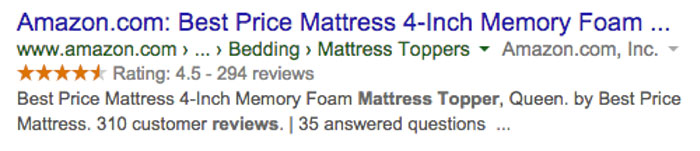
    Having just moved, I’ve spent a lot of my free time shopping on Amazon. From new bathmats to nice wine glasses, a majority of my paychecks have gone towards furnishing my new house. One thing I really needed, though, was a solution to the rock of a mattress that came with the apartment. I needed a mattress topper. Since it was something I would use every night, I wanted the ability to test out the feel of it first. The only negative of Amazon is that you can’t do that. So, whose opinions can I trust other than my own? Fellow customers.

    I spent all night (on the rock) searching through different mattress toppers. I didn’t look at the actual toppers as much as the reviews, though. “This one’s too lumpy,” or “This one smells funny” were the words that guided me to finding the perfect topper. And now, I’m sleeping like a queen, thanks to my fellow customers.

    In this scenario, I was the customer, and the product was the business. I passed up on a lot of toppers that were probably just as good as the one I ended up getting. Having a lot of bad reviews or no reviews at all were the deciding factors for me, and these things can be the deciding factors for whether or not your business succeeds online.

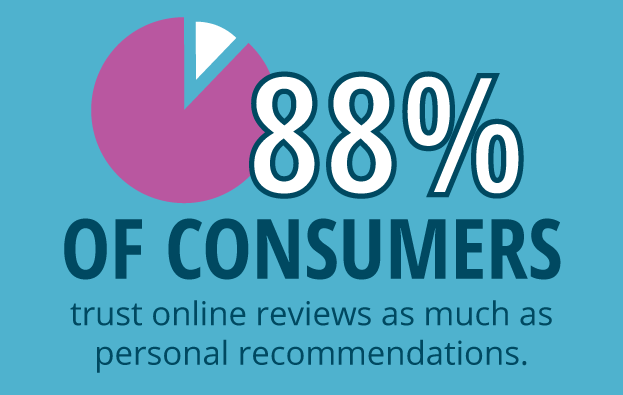
    Consumers Trust Online Reviews Statistic Image

    Why Reviews Matter

    According to a study done by BrightLocal, “88% of consumers trust online reviews as much as personal recommendations.” Reviews can greatly impact consumer decisions, showing how valuable positive reviews are to local businesses. In the same study, “72% of consumers say that positive reviews make them trust a local business more.” Thus, positive reviews increase conversions.

    Negative reviews can hurt business and prevent a potential customer from converting. However, negative reviews can also be a positive thing. Negative reviews give a business unique insight in the ways they can improve, and they can also help eliminate consumer suspicion if there are too many positive reviews. A study done by Econsultancy found that “68% of consumers trust reviews more when they see both good and bad scores, while 30% suspect censorship or faked reviews when they don’t see anything negative at all.” Overall, businesses should leverage the value of negative reviews by working to enhance their business and improve customer relationships.

    SEO Benefits of Reviews

    Not only do consumer reviews enhance customer experience, but they also provide some SEO benefits:

    • Improving local rankings by showing Google that people are engaging with your brand on third-party sites like Yelp.
    • Adding new content to your site. Search engines like to see unique content being added to a site regularly.
    • Increasing chances of ranking for long-tail keywords. Users reviewing your business tend to use the same terms that other potential customers may use when searching for your business.
      • Add reviews to many pages on the site in order to increase the amount of pages ranking for long-tail terms.
    • Adding schema markup for reviews, which enables rich snippets.

    AmazonReviewScreenshot

    Sources:

    http://searchengineland.com/88-consumers-trust-online-reviews-much-personal-recommendations-195803

    https://www.brightlocal.com/2014/07/01/local-consumer-review-survey-2014/#methods

    https://econsultancy.com/blog/8638-bad-reviews-improve-conversion-by-67

    https://econsultancy.com/blog/9366-ecommerce-consumer-reviews-why-you-need-them-and-how-to-use-them/

  • Your Fortunes Are Written in the Stars (Your Facebook Star Reviews, That Is)

    In a time when smartphones can do everything from tracking down our car keys to acting as a 3D mobile scanner, the modern American consumer is more connected than ever. The Internet lets us share photos with people across the world or down the street, but in addition to sending Snapchats and Facebook messages, people are increasingly looking for opinions and suggestions from their community of savvy fellow consumers, who are often ready and willing to share their thoughts on everything from the best place to eat on date night to the new laptop they just bought on sale.

    Wading through this sea of advice and opinions can be intimidating for a small business—but it’s also necessary. If you’ve ever diligently scoured sites like Yelp or Amazon for information before making a major purchasing decision, you already know that reviews can be powerful. Not only do they give you great feedback about how well your business is doing, but they also share valuable information about the quality of your products and services. And today—now that we’re far from flipping through hard copies of Consumer Reports when researching a purchase—modern Internet users tend to rely on the insights and second opinions provided by their existing online network.

    While online reviews tend to hold more sway among younger generations, a June 2015 study found that 70% of Americans look to review sites before making a major purchase, and another 57% of respondents say that they also seek out recommendations on social media.

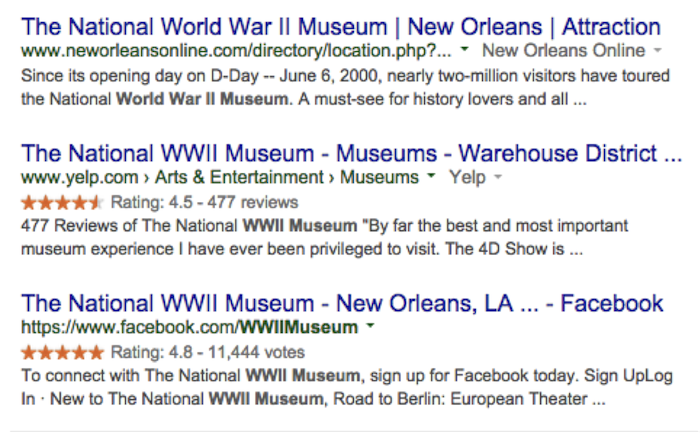
    To that end, it’s more important than ever for businesses to elicit positive reviews across the board. Google has always made it patently simple for Internet users to see the verdict of public opinion on any given product or service at a glance, thanks to a display of five-star reviews that act as a visual guide in the search engine results pages. Without even clicking on a link, searchers have the opportunity to learn how well a product or service has been received by the online community.

    In the past, major review sites like Google+, TripAdvisor, and Yelp have all been prominent sources for this type of information, and the most recent site to join their ranks is Facebook.

    Facebook Star Reviews Image Search Influence

    These five-star reviews show up near the top of the search engine results for brand-name searches, but they also occasionally turn up in broader searches as well.

    This is good news for businesses. Internet users tend to prefer leaving reviews on Facebook over other review sites, showing a preference for giving feedback on Google+, Facebook, and Yelp—in that order. Facebook has the added benefit of a strong user base, since most of your customers are likely to already have Facebook logins and reviews are quick and easy to post. In addition, Facebook reviews don’t get filtered like Yelp reviews do.

    In the past, we’ve recommended building up your business’s credibility by getting reviews in multiple places, and it’s worth restating: Google+, Yelp, Yahoo, Facebook, Twitter, and similar sites are all essential when it comes to showing off the quality of your products and services to as many potential customers as possible. And Google’s new update means that if you haven’t yet gotten a toehold in the Facebook review arena, it’s probably a good idea to work it into your long-term reviews strategy for a dose of extra visibility on search engine results pages.

    If your review game is not strong or you’re worried about your online reputation, don’t fret. Check out our tips for handling reviews, and let us know how we can help!

  • Don’t Give a Dang About a Bad Reputation: I’ve Got No Online Reputation

    Don’t Give a Dang About a Bad Reputation: I’ve Got No Online Reputation

    Reviews are essential to a successful business. Bad reviews can make or break a long-established business or a fledgling one. Companies have even sprung up to help combat bad online reputations. But what of the companies that have little or no online reputation at all? This scenario can be just as detrimental to a business. In fact, there are many websites that can help businesses drive customers to write online reviews:

    Reputation.com

    • PRO: Along with many other reputation management services, Reputation.com offers in-depth review-garnering solutions. Services range from very hands-off on the part of the business or very hands-on. The very hands-off approach offers the ability to send out emails that can be customized with customer names, employee names, and business logos. It also offers an in-store review option that customers can fill out immediately after a purchase or visit. The online management part of this site gives in-depth analytics of the reviews garnered through its services as well as pre-existing reviews.
    • CON: Review management is just part of Reputation.com’s many services. If you already have search engine optimization services for your business, you might be getting more than what you really need to pay for.

    Chatmeter

    • PRO: Chatmeter monitors any reviews a business may receive online on various websites, and it gives daily updates so business owners can quickly respond to both positive and negative reviews. With constant interaction, customers can see that the business is active and working positively to improve its customer service. This site also gives in-depth analysis of the reviews received so a business owner can see if the reviews are trending positive or negative. Chatmeter also offers the ability to monitor competitors’ reviews and gives insight on what competitors are doing right.
    • CON: Chatmeter does not offer the ability to reach out to customers directly from the tool. The business must work on garnering reviews through strictly organic means, which can be a slow-moving process.

    Get 5 Stars

    • PRO: Get 5 Stars is strictly a review management tool. The tool can be used to monitor existing reviews as well as send out requests for new reviews from customers. This creates a survey for customers to fill out with differing results depending on the type of review. Bad reviews can be managed before they hit any other websites. Good reviewers can be asked to review on any number of sites or to have their review published directly to the company’s website. This tool also offers in-depth analytics to see open rates, success rates, and any problem areas that might be initially overlooked.
    • CON: This tool requires a way to collect customer emails, which can be difficult if the business does not have a storefront that customers frequent.

    These are just a few of the many ways a business can monitor a fledgling online reputation. Online review management coincides closely with local SEO, since a business needs a presence online before it can build a reputation.

    Image sources:

    Haters Gonna Hate GIF


  • 6 Methods For Healthcare Providers To Turn Great Service Into Great Reviews

    As society continues to evolve into a highly mobile culture, we see how heavily online reviews influence the selection of a practice or practitioner. In fact, among patients who look for online reviews of doctors, an estimated one-third reported choosing a physician based on good ratings, according to a national survey published in the Journal of the American Medical Association. Most people trust an online review just as much as they trust a personal referral from a close friend or family member. Maintaining a positive online reputation is essential, because while your healthcare practice cannot control what patients write, you can control your response to their reviews.

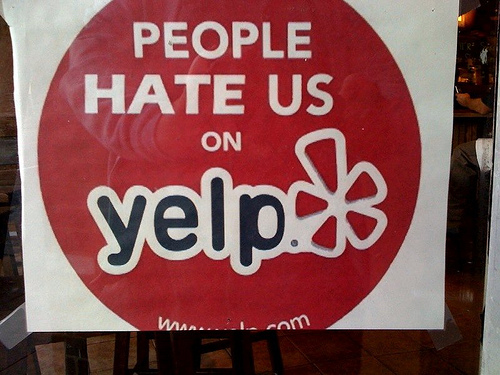
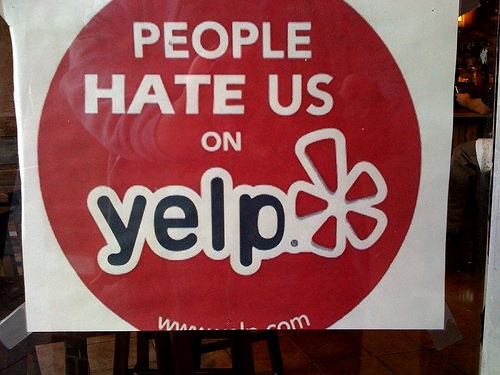
    People Hate Us On Yelp Image - Search Influence

    The medical industry is highly competitive, so the more positive reviews your business obtains, the more likely it is that your business will be found online. The success of your business heavily weighs on online reviews, so you’ll need to learn how to effectively ask for reviews from your customers. Here are six methods to encourage your customers to leave reviews.

    Make Writing Reviews Simple For Everyone

    Most people, unless they have a negative experience to share, will not make the extra effort to leave your practice a review. You need to make it as easy as possible for your patients to leave a review for your company, and you can do this by adding links to your review profiles in multiple places, such as in a follow-up email, on a thank-you page, etc.

    Get Listed On The Top Business Review Sites

    Everyone has their preferred review sites, so it is necessary to have a strong online presence across the most popular ones. All profiles and listings need to be consistent and include as much current information about the practice as you can squeeze in (photos, certifications, awards, degrees, etc.).

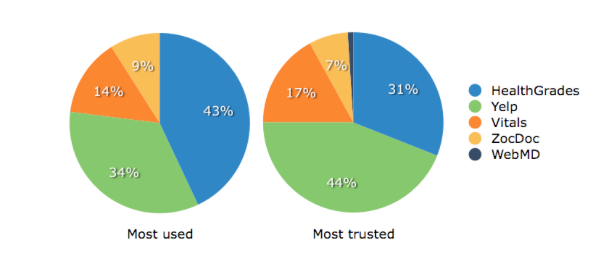
    Business Review Sites For Health Industry Pie Charts Image - Search Influence

    Healthcare providers should have a listing on the following directories:

    1. Yelp
    2. Healthgrades
    3. Google+ Local
    4. Vitals
    5. RealSelf
    6. RateMDs
    7. Facebook
    8. Twitter
    9. LinkedIn

    Ask customers to leave a review on their favorite site—never pressure them to write reviews on multiple sites.

    Be Genuine While Asking For Reviews

    Let your customers know that you would appreciate it if they could take a few moments of their time to share their experience on one of your company’s review sites, as their opinion matters not only to the company, but also to other customers. You can do this by saying something as simple as, “Do you read online reviews? We do, and so do other customers. That’s why we’d love it if you would take a few moments to review your experience.” Just be honest; the worst answer you will get is a “no.”

    Never Pressure A Patient For Reviews

    You should always request that patients rate their experiences, but never make them feel pressured to leave a review. Even if a customer is extremely satisfied with your services, writing an online review may be the last thing on their mind. However, if a client had a great experience with your business, they will probably be happy to share their thoughts when prompted. The best approach is to simply ask your most satisfied customers to add their positive feedback to one of your business review sites.

    Consider Your Customers

    If your customers are millennials, consider yourself lucky! Most millennials are already comfortable with sites that allow users to share experiences online, and they will likely be happy to share their thoughts on your business without much prompting. Bombarding customers under the age of 25 with requests to post a review will probably push them away. However, if you have older or less social media-savvy customers, they may require direct prompting.

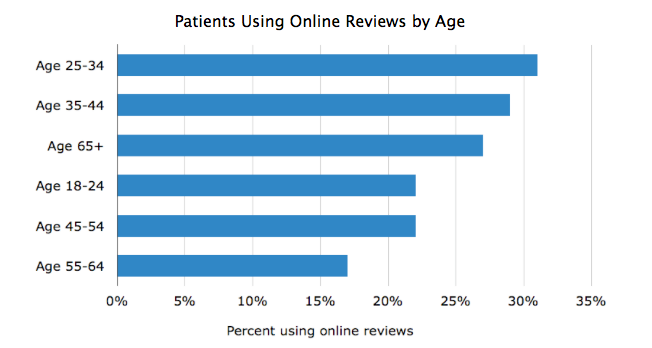
    Software Advice, a company that reviews practice management software, conducted a study to better understand online reviews and the processes of researching and writing these reviews. This study found that the largest age group of patients using online reviews ranges from ages 25–34, with males being 25% more likely to leave a review than females.

    Alt Text - Percent Of Patients Using Online Reviews By Age Bar Graph Image - Search Influence

    Don’t Ignore Negative Reviews

    While your overall goal is to gather good reviews, unsatisfied reviewers will inevitably make their way online to air their bad experiences. Bad reviews aren’t necessarily a business-killer; it’s how you handle the negative review or situation that defines the impact it will have on your business.

    Take note of negative reviews and respond to the criticism in a non-defensive manner. This can be done with a standard, generic reply that thanks the reviewer for the comment. Always ask the complaining patient to contact you directly so that you can further resolve his or her dissatisfaction offline.

    Take a negative review as an opportunity to better your customer service and your facility. Many negative patient reviews involve simple issues that can easily be resolved: long waiting times, issues with billing practices, lack of parking spaces, etc. If your complaints are targeting things that can easily be fixed, take advantage of this useful feedback to better your practice.

    Provide And Deliver Top-Quality Customer Service

    At the end of the day, the best path to having great reviews is to offer a great product and customer experience. If you’re doing everything you can to create a remarkable experience for your customers, there’s no harm in reminding them about the importance of sharing reviews.

    Image Sources:

    Most Used and Most Trusted Reviews Chart and Patients Using Online Reviews By Age Graph

    People Hate Us on Yelp


  • New York Hotel Fines $500 For Negative Online Reviews. How Can They Fix It?

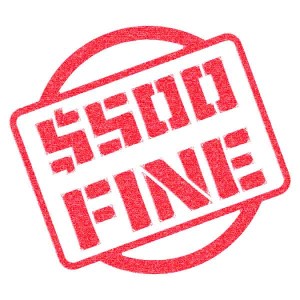
    500fineA Hudson, NY hotel has a perplexing way of dealing with bad reviews. According to Page Six, instead of using bad reviews as constructive criticism, the hotel charges wedding couples $500 for each bad review their guests post online.
    “Please know that despite the fact that wedding couples love Hudson and our inn, your friends and families may not,” reads an online policy. “If you have booked the inn for a wedding, or other type of event . . . and given us a deposit of any kind . . . there will be a $500 fine that will be deducted from your deposit for every negative review . . . placed on any Internet site by anyone in your party.”

    As expected, this caused the Internet to go into a frenzy. The day the story broke, the company’s Yelp page was flooded with over 500 bad reviews causing their review rating to plummet.

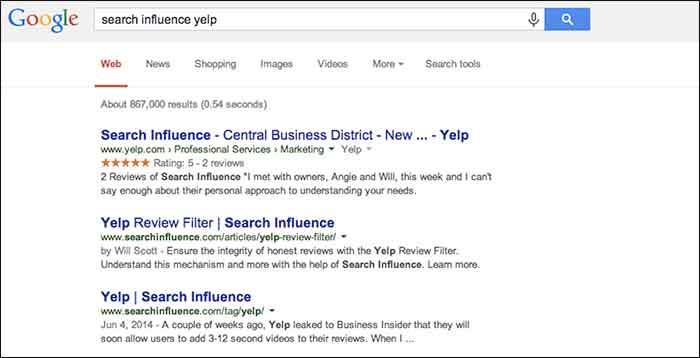
    Since Yelp recently received a well-deserved boost from Google in their search results, Yelp reviews can significantly help or hinder a business.

    Here are a few ways you can handle bad reviews without charging a $500 fine:

    1. Respond to good and bad reviews:

    Respond to all reviews, especially if they are asking a question or expressing a concern. When people take time out of their day to review your business, they like to be recognized. Responding to reviews lets consumers know that you care about your customers.

    2. Strive to be great at what you do:

    If you provide an all around excellent experience, you will get great Yelp reviews. It’s that simple!

    3. Calmly address the Reviewer’s Issues:

    When addressing a bad review remain polite and respectful. The reviewer is someone that gave your establishment a try and wasn’t happy with their experience for whatever reason. Hear this person out. If you respond in a negative way, it only makes your business look bad to other consumers. Not only can you ruin the chance of the reviewer changing their review or revisiting your establishment, this can also cause you to lose potential customers who choose businesses based on online reviews.

    4. Offer a remedy:

    If you think there is a way to rectify the situation, try to offer the person an incentive to come back. Send a private message that includes a coupon for a free milkshake or discounted service. Yelp users can use the update function to change their initial review. Everyone likes to feel that his or her opinion matters, so feeding a disgruntled user’s ego can sometimes quell the fury, and may lead them to reconsider their initial opinion of you.

    5. Bad reviews should be used as constructive criticism

    Never take a bad review personal. Bad reviews that are rational and deserved are not completely a bad thing. Use that negative review as a way to improve your business. Once you have fixed an issue or improved your business based on critiques, let the Yelp community know. They will be happy to know that their concerns matter and that you are listening.

    SIyelpSearchImage

  • Reputation Rescue: Dealing with Your Business’s Online Reviews

    Reputation Rescue: Dealing with Your Business’s Online Reviews

    These days more customers are turning to their social networks and online review sites before making purchases. While local directories and review sites are important for your business’s online presence and SEO, it also opens up the door to both positive and negative reviews from customers.

    Reputation Rescue Infographic

    Copy and paste the code in the area below to place “Reputation Rescue: Dealing with Your Business’s Online Reviews” image on your site for free.

    Yes, People are Actually Looking at Them

    It’s been estimated that about half of American consumers have written at least one online review. Even those not writing reviews are reading them, with 70% of consumers saying they read reviews before making a purchase decision. The same number, seven out of ten, share the reviews they read with friends and family, meaning that these reviews are reaching even more people.

    And Making Decisions Based Off of Them

    For positive reviews, this is great! In fact, 87% of consumers say a positive review confirmed their decision to make a purchase. As one might expect, a similar yet opposite effect comes from negative reviews. Four out of five consumers report having reversed a purchase decision based on negative reviews. Yep. That’s 80%.

    But You Can Take Action

    Luckily, for businesses, there is a positive way to handle negative reviews. Respond quickly and publicly, keeping your response polite yet personal. Own the issue without being defensive and try to rectify the situation while still keeping your response simple. A whopping 97% of people found the reviews of a product they purchased to be accurate. This confirms that no one should be brushing off negative reviews. Responding correctly will give future customers confidence that they will not have the same experience.

    You know the saying about the best defense, right? Give your business a good offense by encouraging reviews from loyal customers. Reach out to customers via Facebook, Twitter, and email. Make reviewing your business as easy as possible and send those that do review a thank you.

    Real Reviews = Real Revenue

    Getting a considerable volume of real, accurate reviews will lead to real revenue. Positive online reviews have been shown to increase sales by 74%, and on a related note, consumers who conduct research online spend 18-36% more than those who do not.

    Don’t be scared to put your business out there! Transform your online review portals into revenue-making tools by garnering your existing customer relationships, addressing negative experiences, and improving your online presence. Reviews also create 21% higher purchase satisfaction and 18% higher customer loyalty. These are huge numbers for something that you aren’t even spending money on.

  • 5 for Friday — Links, Stories & Posts For Your Weekend

    Round 1-01Google AdWords Announces Enhanced Campaigns -Search Engine Watch

    Google announced Enhanced Campaigns this month, much to the dismay of some and delight of most. The Enhanced Campaigns work to simplify mobile marketing – sounds good, right? So why are some advertisers viewing this update negatively? Check out our blog post by resident Google AdWords Expert to learn why.

    The Ultimate Guide for Monitoring your Reputation Online  -Search Engine Journal
    Here’s an infographic Beyonce might be interested in. We’ve all had unflattering or embarrassing photos taken. Reputation monitoring is something we all need to think about in these days of hyped-up connectivity online. This infographic explains the steps businesses and individuals need to take to protect their image online.

    A Glimpse into Facebook Graph Search -Search Engine Journal
    A step-by-step tutorial explaining the new features of Facebook Graph Search. Options to search include: My friends, Photos of my friends, Restaurants nearby, Games my friends play, Music my friends like, and Photos I have liked. Different filters will help you hone down the results even further, based on things like ‘Employer’, ‘Likes’, ‘Following’, and ‘Married to’. Want to find people in your area who are interested in the things you like? Here’s your chance.

    40 Important Local Search Questions Answered -SEOmoz
    Local search is increasingly playing a bigger part in search engine optimization. The takeaway from this piece? “Even though local has arrived, it’s still a mess.” In an attempt to de-mystify this genuinely confusing piece of the puzzle, Mike Ramsey has kindly compiled the 40 most important questions and their answers concerning Local Search.

    How Unique Does Content Need to Be to Perform Well in Search Engines?  -SEOmoz
    Here’s a great questions we’ve been running into a lot lately: “What is meant by duplicate content and how unique do I have to be?” First, let’s qualify that navigation, ads, footer, sidebars, etc., don’t count. This leaves us with the on-page content. Copying internal or external sources can be a problem – but as long as you’re adding unique value it’s not duplicative.

  • Online Reviews and Reviewers: Using Yelp’s Messaging Features

    I discussed the value of online reviews in my previous blog post — check it out here: The Importance of Online Reviews: What Your Customers Really Think.

    I’d like to delve more deeply into the subject to discuss the ways in which a business owner can use reviews in a proactive manner. Since you’re obviously already following the best practices I described in my last post, I won’t go into depth about them here.

    If you are actively involved in your online presence, it’s likely you have heard of Yelp! If not, see below for an introduction to the variety of tools that are available to business owners. It’s brief and very informative!

    Now that you have been formally introduced to the wonderful world of Yelp! I’d like to talk about using the messaging feature discussed in the video.

    We will dive a bit deeper into the advantages briefly discussed in step 3 & 4 and 7 & 8.

    Take some time to read all of the reviews that are on your Yelp! business page. When reading comments:
    • Be patient and diplomatic
    • Do not take complaints personally
    • Treat each review as a valuable source of feedback and a way to improve your businesses success

    Once you have taken the time to read the comments, decide which Yelpers you wish to reach out to. If there is a trend that you are able to pick up on while reading the reviews, you can bet potential customers will do the same. For example, examining a restaurant’s page with multiple reviews commenting that the ambiance is loud or the service is slow, readers might come to the (quite reasonable) conclusion that your restaurant is, in fact, noisy and badly-staffed. Now you know what you need to address and get to work.

    There are two different types of messaging options; Send a Private Message or Post a Public Comment.

    Yelp Online Reviews

    Yelp! allows Biz.Yelp Accounts to contact up to 5 people per day. Use these to either post public comment responding to reviews or send private messages to individual reviewers. Below are the top 3 things you can do on Yelp!

    1. Respond Publicly to Negative Reviews – For reviews that speak to issues that may have existed and been corrected since the review was placed. Thank the reviewer for their feedback and inform them of the changes that you or your staff took to address and fix the problem mentioned. Invite the guest back to experience the positive changes first hand. Do this publicly so that everyone that reads the reviews sees an active business owner that is concerned about customers’ experience with them.

    2. Respond Privately to Individual Guest Issues – For those reviewers that had issues associated with their individual experience respond via private message. If a guest complained that their meal was cold, send a private message apologizing for the cold food and invite them to come back to have a free sample of your wares. Be mindful that you are not allowed to solicit reviews on Yelp!, though. Obviously you can hope the reviewer has a better second experience and updates their original review; however, you can not directly request that they do so. I recommend that you use the private message feature for this type of complaint. You do not want to give the impression that everyone that goes to your business and makes a complaint will get something for free.

    3. Be active – Offer promotions, sales, or information on your Yelp! business page to encourage people to come back on a regular basis. An active business owner will go a long way to create engagement and interaction with their reviewers.

    These are just some of the main ways to reach out to Yelp! users. The simplest way to think about how to interact with these reviews is how you would respond if they had directed the review in person. How would you respond? What would you say? What would you do? Think about it and respond in the manner you deem appropriate; keep it professional and positive. The tools are free, so why not?

  • Are Online Reviews More Influential Than Advertising?

    When it comes to how we consume, things have dramatically changed over the last twenty years. For instance, if your mother and father wanted to go to a restaurant in the seventies, it was probably because they heard it was good from friends or neighbors or simply wanted to give it a shot. 1979 brought about the debut of the Zagat guide, which of course gave people more of a guideline than ever before. Fast forward a few decades, and there’s suddenly more information than you could imagine available for everything from eateries to shopping for clothing. Because of the popularity of the internet as a means of sharing information, people can now log on and leave reviews for all sorts of experiences, making it that much harder to pass off a bad meal or a sleazy transaction than it used to be. In some ways, it’s great. But how is it affecting us as consumers?

    If numbers are to be believed, the effect is greater than you might think. In fact, it seems as if user reviews are the method of choice when it comes to consumers making decisions in the modern age. Financial agency Deloitte were recently quoted as saying that:

     “82% (of consumers) say their purchase decisions have been directly influenced by the user reviews, either influencing them to buy a different product than the one they had originally been thinking about purchasing or confirming the original purchase intention.”

    Naturally, Deloitte aren’t the only ones noticing the trend. Media Planning company EXL Media also tells us that the numbers are rising when it comes to advertising versus consumer review:

    “55% of U.S. consumers believe strongly/somewhat that online consumer reviews and ratings influence their buying decisions more than any type of online advertising.”

    These are no small figures! So I guess all those people logging into Yelp from their phones and madly blogging about their experiences aren’t just a voice after all. Collectively, we form something stronger — a body of opinions that has enough klout to get people reading and making choices. In fact, making choices that disdain traditional advertising. In other words, the system is changing yet again — and advertisers will be forced to reinvent themselves if they want to compete with the voices of the common people.

    This movement isn’t limited to finding a good place to eat, either. Even doctors are included, as there are websites such as Vitals that allow you to find and rate doctors. Deloitte tells us that home electronics rate among the items people seek out online reviews for most often, with personal electronics, games and toys and kitchen appliances close behind.

    Because of these new perimeters, every business faces a new challenge: To not only provide good service and leave customers impressed, but to also properly address unhappy ones and help to resolve their concerns. Otherwise, a bad review or two could smudge your name and drive away potential clients. Gives a whole new meaning to “Honesty is the best policy,” doesn’t it?