Tag: paid search

  • Boost Paid Search Results With Demand Gen + Performance Max – October Client Insider

    Boost Paid Search Results With Demand Gen + Performance Max – October Client Insider

    Unlock the Power of Demand Gen + Performance Max

    The Upgrade Your Paid Search Strategy Needs

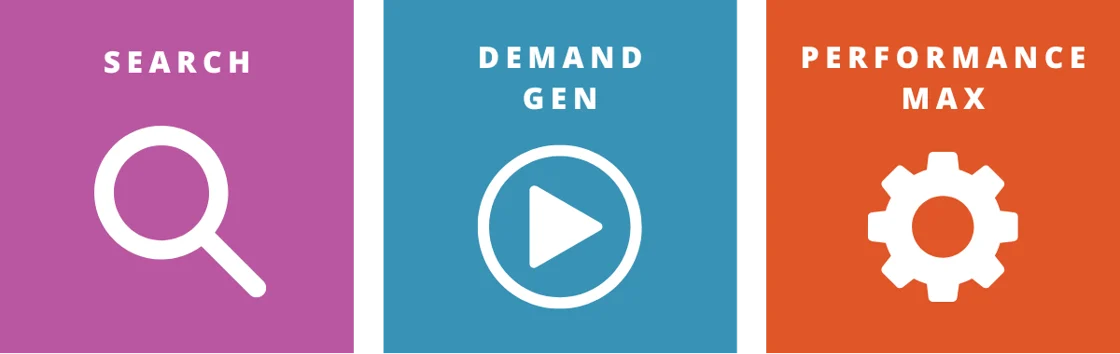
    Different kinds of paid advertising

    Paid Search captures intent. When someone types in a query, your ads put your business front and center. But what about reaching people before they search?

    Google’s Demand Gen and Performance Max campaigns are built to do just that:expand your visibility, build your awareness, and move your prospects toward conversion.

    How Demand Gen Works

    Demand Gen campaigns act like a premium version of Display, placing your ads in social-style feeds where discovery happens. These campaigns help you spark interest early by reaching audiences across:

    • YouTube Shorts and in-feed video for immersive, mobile-first experiences
    • Discover feeds to connect with users scrolling curated content
    • Gmail placements where ads appear natively within inboxes
    • Google Display Network with high-quality, visually engaging inventory

    By building awareness in these environments, Demand Gen presents your brand before customers even begin searching.

    How Performance Max Drives Conversions

    Performance Max extends your reach across all of Google’s properties while using AI to optimize performance. With this campaign type, you benefit from:

    • Cross-channel reach across Search, YouTube, Display, Discover, Gmail, and Maps
    • Predictive audiences powered by Google AI and your first-party data
    • Creative optimization that tailors ad combinations from your assets
    • Real-time bidding and budget pacing to maximize conversions against your goals

    The result is a campaign that complements Paid Search, capturing high-intent traffic while driving new conversions efficiently.

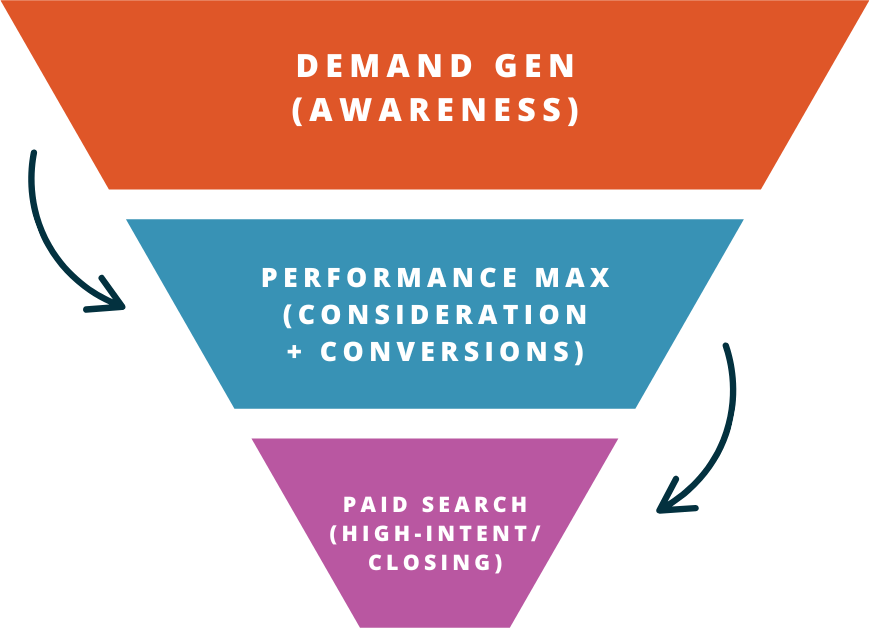
    Paid search funnel

    Why Add Both to Your Strategy

    Together, these campaigns build a full-funnel approach: Demand Gen fuels awareness, Performance Max converts interest, and Search closes the loop. Adding them ensures your ads reach customers at every stage of the decision journey.

    Looking to take your Paid Search strategy to the next level? Talk to your Account Manager about adding Demand Gen and Performance Max to your campaigns today.

  • Higher Education Marketing Strategies: Align SEO & Paid Ads for Smarter Results

    Higher Education Marketing Strategies: Align SEO & Paid Ads for Smarter Results

    Higher Education Marketing Strategies: Align SEO & Paid Ads for Smarter Results

    Key Insights

    • The modern student journey is multi-channel: Your marketing efforts must span search engines, social platforms, and AI tools.
    • SEO builds long-term visibility: SEO is a key strategy for sustaining awareness and reducing overall acquisition costs over time.
    • Digital ads deliver speed and precision: Paid ad placements boost visibility during critical enrollment windows and for time-sensitive offers.
    • Together, SEO and ads drive better results: Aligning both helps you maintain visibility and adapt to changing search behaviors.

    Today’s prospective students are intentional researchers in their college search.

    They explore degree programs, admissions requirements, and career outcomes on platforms like Google, ChatGPT, TikTok, and YouTube, often before visiting your website. To reach them during these early moments of consideration, your higher education marketing strategies must prioritize visibility across search engines, social platforms, and AI-driven tools.

    This is where SEO and digital ads work in tandem to keep your institution present, credible, and competitive.

    When aligned well, these tactics guide prospective students from first search to final enrollment with greater efficiency and impact.

    Search Engine Optimization (SEO) at a Glance

    Search Engine Optimization (SEO) at a Glance

    What is SEO?

    SEO stands for search engine optimization. It’s a long-term strategy that improves your website’s visibility in organic (non-paid) search results. This involves refining your content, technical structure, and site authority so your pages appear more prominently when prospective students search on platforms like Google, ChatGPT, and other AI-driven tools.

    In higher education, visibility at key points in the decision-making process directly impacts who finds your programs and who doesn’t. SEO helps your institution show up across the enrollment journey, from early awareness to application. When your site is optimized effectively, it becomes easier for students to find the information they need and easier for you to convert interest into action.

    Why is SEO important for higher education institutions?

    SEO is important for higher education institutions because it helps your programs appear where student intent begins. Research shows that 68% of online experiences start with a search engine, making visibility in those early interactions critical for attracting qualified prospects.

    Today’s students are self-directed and often explore degree options, admissions requirements, and tuition costs on their own, sometimes weeks or months before they ever reach out to an academic institution. If your content doesn’t surface during that initial research phase, your school may never make the shortlist.

    By investing in SEO, higher ed institutions build lasting authority, credibility, and trust. It reinforces your brand presence without relying entirely on paid channels and sets the foundation for long-term enrollment growth.

    What are the benefits of higher education SEO?

    A strong SEO strategy does more than drive traffic. It brings the right traffic. In aligning your content with what prospective students search, you improve visibility and engagement at every stage of the recruitment pipeline.

    Some of the leading benefits of higher education SEO include:

    • Capturing high-intent search traffic from students actively searching for programs like yours
    • Supporting content marketing by making blogs, guides, and admission web pages more discoverable
    • Improving user experience through technical SEO that enhances site speed and mobile responsiveness
    • Boosting credibility with higher rankings, rich snippets, and inclusion in AI Overviews and other AI-powered search features
    • Enabling smarter decisions through keyword research and user behavior analytics
    • Strengthening long-term visibility as ad costs rise and search algorithms evolve

    SEO is not just a marketing add-on. It’s a strategic asset that improves performance across digital channels. When done well, it strengthens your institution’s credibility and reaches students where they’re actively searching.

    What does higher education SEO entail?

    Higher education SEO requires a strategic approach that reflects how 1) students search and 2) how modern search engines and AI platforms process content. It focuses on clarity, structure, and alignment with user intent.

    Key elements of a higher education SEO strategy include:

    • Conducting keyword research based on student goals, questions, and decision-making stages
    • Using entity-based and semantic SEO to match how AI systems interpret and connect information
    • Optimizing on-page elements like meta tags, headers, and image alt text
    • Creating evergreen content such as program pages, tuition details, and frequently asked questions
    • Improving technical performance through mobile-friendly design, fast load times, and structured data
    • Strengthening internal linking and earning high-quality citations from trusted sources
    • Monitoring performance metrics and adjusting tactics to respond to algorithm changes and user behavior

    This ongoing work creates a structured foundation that helps your institution remain relevant across traditional and AI-driven search platforms.

    Digital Advertising (Paid Ads/Pay-Per-Click) at a Glance
    Digital Advertising (Paid Ads/Pay-Per-Click) at a Glance

    What are digital paid ads/PPC?

    Digital paid advertising refers to any online campaign where you pay to promote your content, programs, or brand across platforms where prospective students spend time. These ads can appear in search results, on social media feeds, within videos, or across websites through display networks.

    PPC, or pay-per-click, is one of the most common payment models used in digital advertising. Instead of paying for impressions, you’re charged only when someone clicks your ad. In this way, paid advertising describes the strategy, while PPC refers to how you’re billed.

    Common platforms include Google Ads for search and display, Meta (Facebook and Instagram) for interest-based targeting, YouTube for video promotion, and programmatic networks for broader reach. Each offers a different way to connect with prospective students based on their behaviors, demographics, and intent.

    Why should digital advertising be part of your higher ed marketing strategy?

    Digital advertising is a vital tool for reaching students during critical decision-making windows. Unlike organic strategies, which take time to gain traction, paid ads offer “immediate” visibility in high-traffic environments like search results and social feeds. This immediacy is especially valuable during application pushes, event promotions, or when organic rankings fluctuate.

    For colleges and universities competing for attention in crowded markets, digital ads offer the agility to respond to shifting trends and student behavior in real time. They also create a clear path to visibility when SEO alone can’t secure top placement, especially for high-volume, high-competition keywords.

    When time-sensitive goals are at stake, paid ads allow you to act quickly, focus your message, and precisely reach your target audience.

    What are the benefits of digital ads?

    Digital ads offer a level of control, speed, and insight that is difficult to achieve through other channels. With the right setup, you can run targeted campaigns that respond to real-time behavior and performance data.

    Benefits of digital ads include:

    • Fast results, bringing qualified traffic to your site shortly after a campaign launches
    • Trackable performance that allows you to connect ad spend to inquiries and applications
    • Targeting precision based on factors like location, age, device, interests, or behavior
    • Budget efficiency through dynamic allocation based on campaign performance
    • Seasonal flexibility to scale campaigns up or down as enrollment cycles shift
    • Campaign testing to compare messages, creative formats, and calls to action
    • Retargeting power to re-engage visitors who left your site without taking the next step

    Well-executed campaigns go beyond visibility gains. They deliver measurable insight into which messages and channels are driving potential students to act.

    What does a digital advertising strategy entail?

    A strong digital advertising strategy involves setting clear goals, targeting a well-defined audience, and choosing ideal platforms for delivery. This helps your institution stay adaptable while reaching students where they spend their time online.

    Key elements of a digital advertising strategy include:

    • Identifying high-intent keywords and audience segments by program, location, age, and behavior
    • Choosing platforms that align with campaign goals, such as Google, YouTube, Meta, LinkedIn, or display networks
    • Writing ad copy, headlines, and landing pages tailored to each platform and audience
    • Designing creative assets that reflect your brand and support campaign objectives
    • Setting budgets, bids, and targeting rules by geography, demographics, or device
    • Launching campaigns with tracking to measure clicks, inquiries, and conversions
    • Adjusting creative, targeting, and spend based on performance
    • Retargeting visitors who viewed your site but didn’t convert

    This coordinated approach helps higher ed marketers reach the right students at the right time while maintaining full visibility into campaign success.

    Why SEO and Digital Paid Ads Work Better Together

    Why SEO and Digital Paid Ads Work Better Together

    When used together, SEO and digital ads give you better control over how and when students discover your programs. They serve different purposes but share the same goal: helping your institution show up, build trust, and guide prospective students toward taking the next step.

    Maximize visibility in search results

    Running both SEO and paid search campaigns lets your institution appear in multiple positions on a single results page. This increases your visibility, reinforces brand credibility, and reduces the likelihood of competitors taking that spot instead.

    Drive traffic while SEO gains traction

    SEO is a long-term, yet sustainable, investment. Paid ads help you stay visible in the meantime, especially when launching a new program or entering a competitive market. While your organic rankings build, ads keep inquiries flowing.

    Test messaging before you commit

    Digital ads allow you to quickly test headlines, descriptions, and offers. The best-performing messages can then be applied to SEO page titles, meta descriptions, and even on-page content, improving both click-through rates and relevance.

    Validate keywords with real results

    Paid search shows you which keywords actually drive clicks and conversions. This data can guide your SEO strategy by helping you focus on the terms students search most often and respond to rather than relying solely on keyword tools.

    Retarget prospects who leave

    SEO may attract the initial visit, but not every student is ready to apply right away. With paid ads, you can retarget those visitors and keep your institution top of mind, especially during high-stakes decision windows.

    Lower CPC with better landing pages

    SEO principles like clear structure, fast load times, and relevant content can improve your ad landing pages. This often leads to higher Quality Scores in Google Ads, which reduces your cost-per-click and increases return on ad spend.

    Share data to make smarter decisions

    When SEO and paid ad teams work together, both channels benefit. Search terms, audience behavior, and performance metrics from one can shape strategy for the other, leading to stronger messaging, better targeting, and higher conversion rates.

    How to Align Your Strategy and Budget with Goals

    A thoughtful, comprehensive marketing plan considers how SEO and paid ads contribute at different points in the recruitment cycle. While both digital marketing strategies play a unique role, aligning your investment with your institutional goals (rather than dividing tactics by default) helps you make more strategic, data-informed decisions.

    Use SEO for:

    Building visibility for evergreen content

    Program pages, admissions FAQs, and degree outcomes are high-interest assets that students search for year-round. SEO ensures these pages consistently rank and remain discoverable across enrollment cycles.

    Answering long-tail, high-intent questions

    Students often search with specific phrases like “best online MPH programs for working adults.” Optimizing for these longer queries helps your content meet students at key decision-making moments.

    Strengthening authority over time

    Search engines and AI platforms reward content that demonstrates expertise and trust. By publishing helpful, on-topic SEO content regularly — and earning backlinks and citations from reputable sources — you signal authority over time and improve your chances of ranking across high-impact search terms.

    Supporting decision-making after inquiry

    SEO helps prospective and admitted students find the content they need after expressing interest, such as financial aid resources, enrollment steps, and orientation details. Optimizing this type of content ensures your institution remains visible and helpful beyond the initial click.

    Reducing long-term CPI

    Unlike paid ads, organic traffic doesn’t require a cost per click. A strong SEO foundation lowers dependency on paid placements over time, driving qualified leads while keeping cost per inquiry (CPI) in check.

    Use digital ads for:

    Accelerating time-sensitive goals

    Campaigns tied to deadlines, events, or scholarships need instant visibility to drive action. Paid ads allow you to deliver focused, high-priority messages exactly when timing matters most.

    Launching new programs or locations

    New academic offerings or secondary campuses often lack the organic search authority to rank well early on. Paid ads help you build awareness and attract early interest while SEO efforts gradually take hold.

    Competing on high-volume search terms

    For highly competitive keywords where top rankings are difficult to secure, paid ads keep your institution visible. This ensures you’re not missing out on critical traffic during peak search activity.

    Testing and refining your message

    Digital campaigns offer a fast, low-risk way to test headlines, offers, and positioning statements. Use this performance data to gain insights, inform future updates, and shape messaging across other channels.

    Reaching segmented or niche audiences

    With detailed targeting options, paid ads let you focus on specific groups, like adult learners, out-of-state students, or those interested in a particular program. This helps extend your reach beyond what organic search alone can deliver.

    Questions to help allocate budget

    Before deciding how much to invest in SEO or digital ads, it’s important to clarify the goals, timeline, and audience of each initiative. Use the following questions to guide a smarter, more intentional allocation of resources:

    • Is this a short-term campaign or a long-term visibility play?
    • Do you already rank organically for target keywords, or are you starting from scratch?
    • Are you trying to increase awareness, generate inquiries, or drive completed applications?
    • What is the lifetime value of the program or student audience you’re targeting?
    • Do you need geographic or behavioral targeting that SEO alone can’t deliver effectively?
    • What insights from past campaigns can inform your channel mix for this initiative?

    Think of SEO as the groundwork for sustained visibility and trust, while paid campaigns offer speed and flexibility. By evaluating timing, audience intent, and program priorities, you can allocate budget where it makes the most impact.

    Create a Stronger Higher Education Marketing Strategy

    The most effective higher education marketing strategies don’t rely on a single channel. They align tactics to meet student expectations at every stage of their search journey.

    By pairing long-term organic visibility through SEO with the immediacy and precision of digital advertising, your institution will reach more prospective students, guide them through complex decisions, and support better outcomes from first search to final enrollment.

    If you’re looking for a more intentional way to prioritize your marketing efforts and budget, we’d be honored to help. Download “Solve Your Higher Ed Marketing Puzzle With SEO and Paid Digital Ads” to learn how to:

  • Focus on the tactics that make the biggest enrollment impact
  • Reduce wasted spend and improve lead quality
  • Increase conversions with personalization, testing, and retargeting
  • Tie campaign performance to ROI metrics that matter to leadership
  • See how you can integrate SEO and paid advertising to power your enrollment pipeline today.


    Image Credits:

    Unsplash , Unsplash and Pexels

  • How Search Influence Uses AI to Improve Your Ad Results – April Client Insider

    How Search Influence Uses AI to Improve Your Ad Results – April Client Insider

    Unlocking Conversions: Meta and LinkedIn Introduce Advanced AI Targeting

    Discover how predictive audiences and Advantage+ targeting can elevate your advertising campaigns.

    AI for paid campaigns

    New Meta and LinkedIn AI Features Help “Find” Conversions

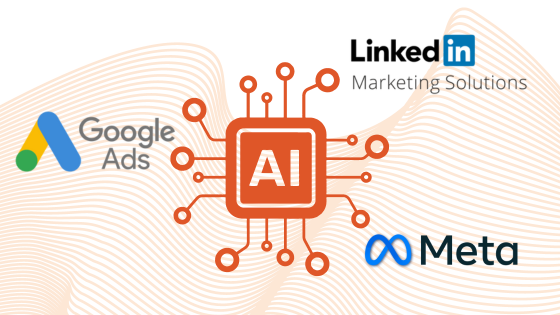
    As part of our ongoing commitment to optimizing your advertising campaigns, we’re excited to introduce you to the powerful AI features offered by Meta and LinkedIn, designed to help you reach and convert your target audience more effectively.

    Predictive Audiences with LinkedIn Ads

    On LinkedIn, we can leverage predictive audiences, a feature that expands your campaign’s reach by creating an audience predicted to perform actions similar to those within your source data.

    We work with you to curate a list of existing contacts you have that represent the ideal customer – this could be high quality leads or high quality clients/customers. LinkedIn combines your data source and LinkedIn’s AI to automatically generate a new custom audience that has more potential to convert.

    Advantage+ Audiences with Meta Ads

    In addition to LinkedIn, we’re excited to introduce Meta Advantage+ audiences, which harnesses Meta’s advanced AI capabilities to find your audience. (P.S. Meta = Facebook and Instagram.)

    Meta’s AI utilizes a wealth of information including past conversions, pixel data, and interactions with previous ads to continuously refine and evolve your audience targeting. You can rely on Meta’s AI to find your audience, or provide specific information about the people you want to reach. Meta prioritizes audiences matching your suggestions before broadening its search.

    By testing AI-driven targeting in your campaigns, you can expect improved results! We are working these features into our clients’ campaigns where relevant to test their power to drive more conversions within your budget.

    AI has been driving success in your campaigns for years

    Over the years, AI has revolutionized advertising, reshaping how we connect with audiences and optimize campaigns – in Google, Meta, LinkedIn, and programmatic digital advertising.

    AI has evolved to deliver personalized ads, enhancing relevance. Predictive algorithms forecast trends and behaviors, enabling data-driven decision-making, while dynamic creative optimization tailors ad content in real-time to maximize engagement and conversion rates. Now we are testing new audiences created using AI to drive conversions!

    At Search Influence, we continue to adjust our campaign best practices and processes to leverage AI’s potential to drive your advertising success.

    Have questions about AI in your campaigns? Chat with your account manager to understand more!

  • #1 Organic & No Clicks? Google Ads 2023 SERP Smackdown!

    #1 Organic & No Clicks? Google Ads 2023 SERP Smackdown!

    High Ranking Keywords and Low Traffic?

    google ads 2023

    Are algorithm updates and AI just a red herring for more Google Ads in 2023?

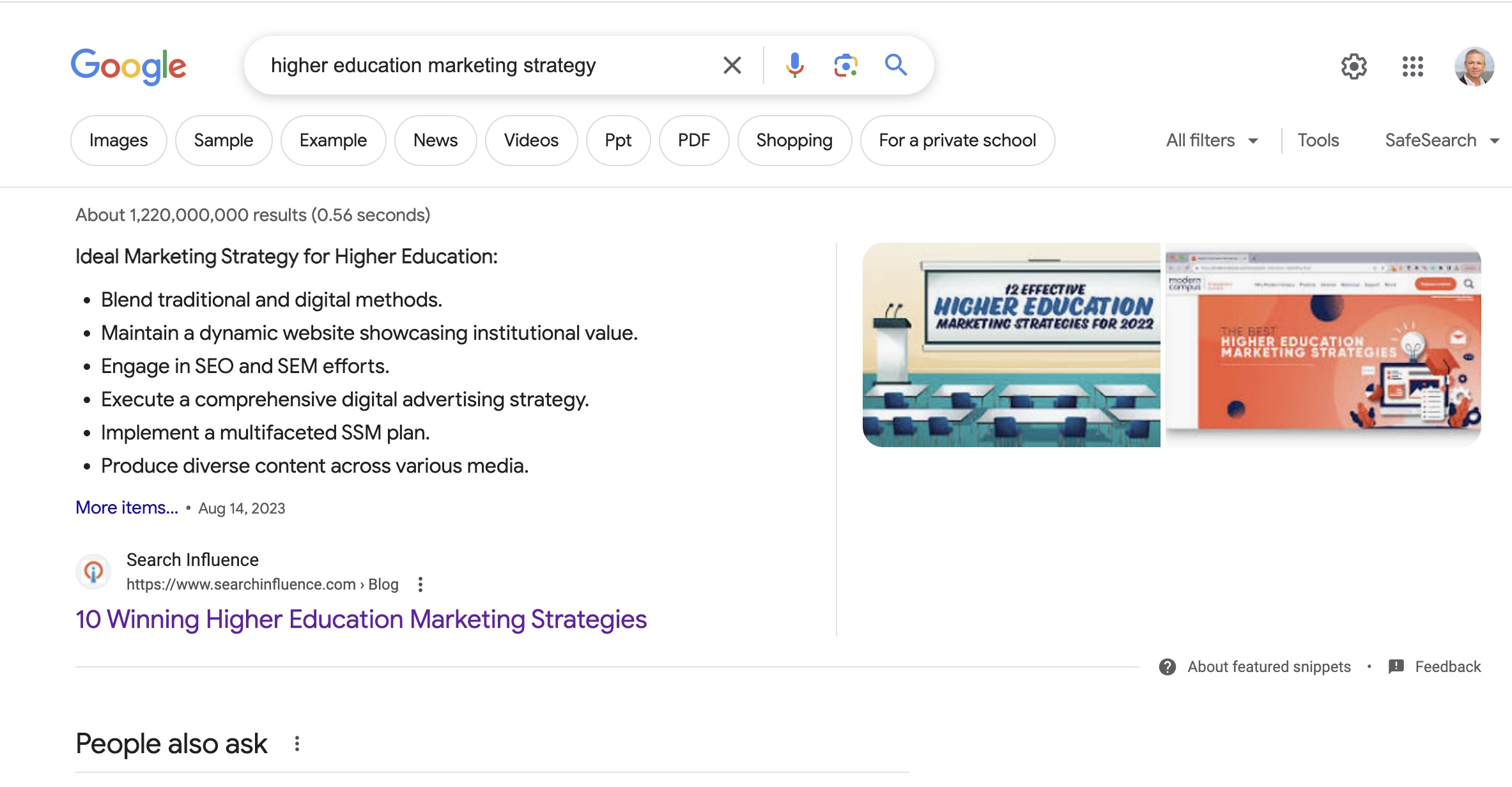
    It’s not just a #1 position. It’s a rich snippet. And a full-feature rich snippet with images, a bulleted list, and everything.

    But the CTR (click-through rate) is a measly 3%.

    We searched for the cause. Was it not a real ranking? Were we seeing a personalized search?

    higher ed marketing

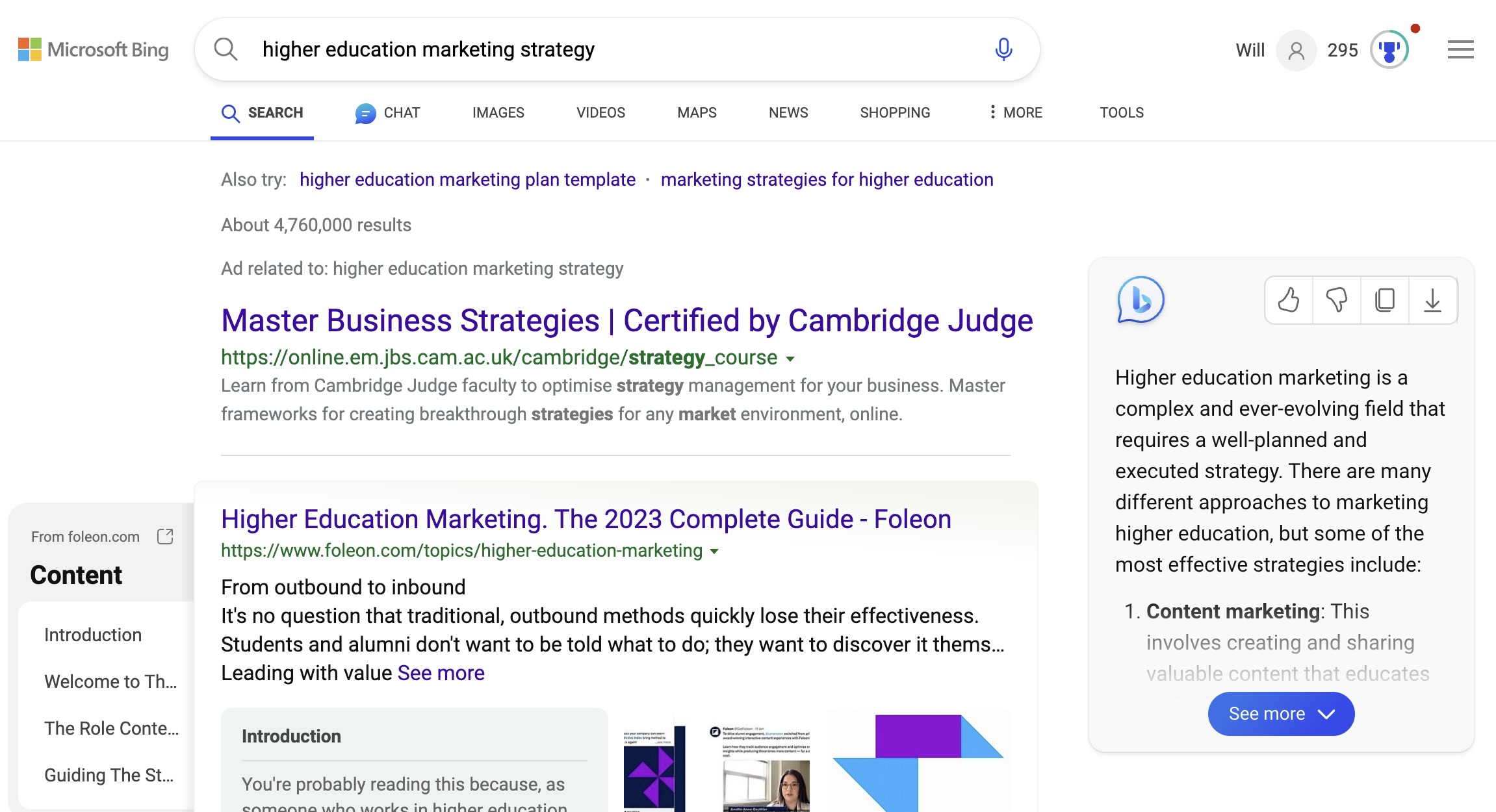
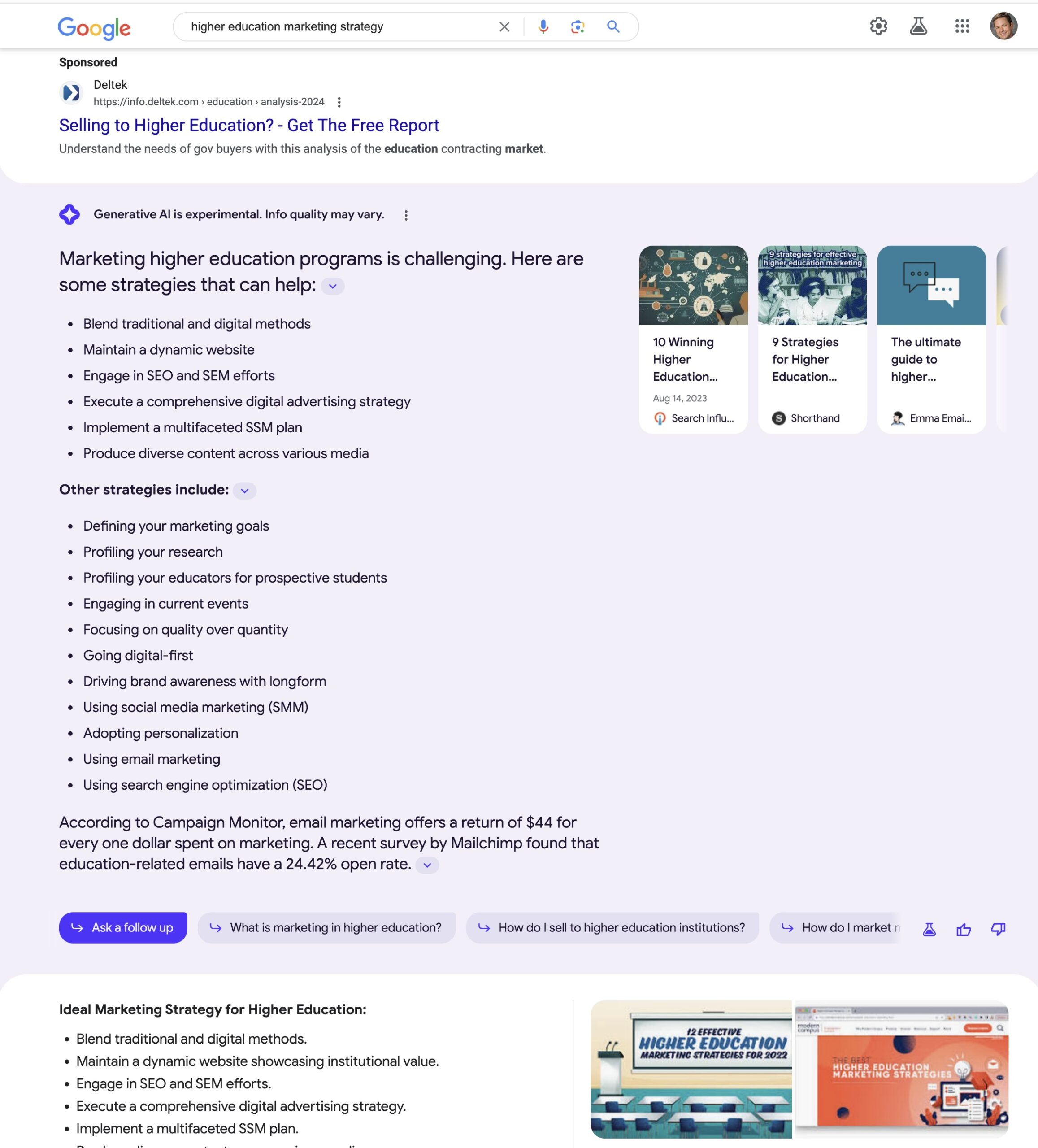
    Screenshot of “Higher Education Marketing Strategy” query on Google

    No. It was Google!

    Google Ads, to be specific.

    And for some searches, Google SGE, the new Search Generative Experience.

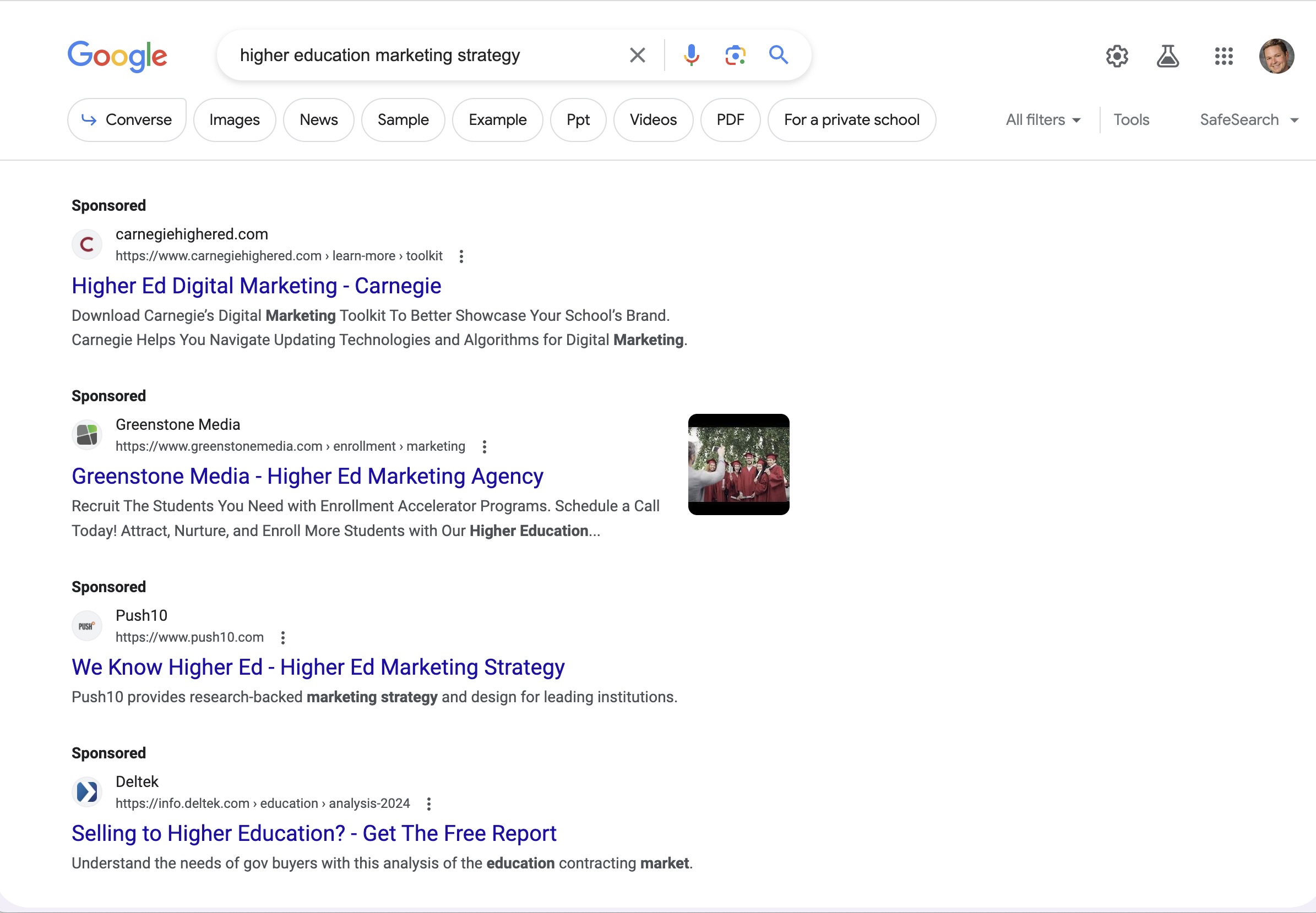
    We discovered that there was now a big fat pack of ads over the top of organic results. Where there used to be a couple of small ads, there are now four, with site links and lots of white space.

    Depending on the search, you have to scroll once, and sometimes twice, to get to the organic results.

    google ads 2023

    Screenshot of “Higher Education Marketing Strategy” query on Google from a non-SI account.

    Why would Google want to suppress organic search results? Let’s look at some examples and see what we find.

    While the SEO community has been worrying about Google Algorithm updates and the impact of AI, Google has quietly expanded the real estate devoted to Google Ads in 2023.

    Perhaps the talk of algorithm updates and AI was a red herring.

    Google SERP (Search Engine Results Page) 2023

    2023 was a busy year for Google. In addition to several algorithm updates, Google had to contend with AI, both in its index and in its user interface.

    AI, specifically the use of Large Language Models, exploded in early 2023. Tools for AI-enabled content creation, previously on the fringe, became mainstream.

    In addition to a flood of new content clogging up its index, Google — already an AI-powered platform — brought some of that intelligence to the search interface in the form of SGE (Search Generative Experience).

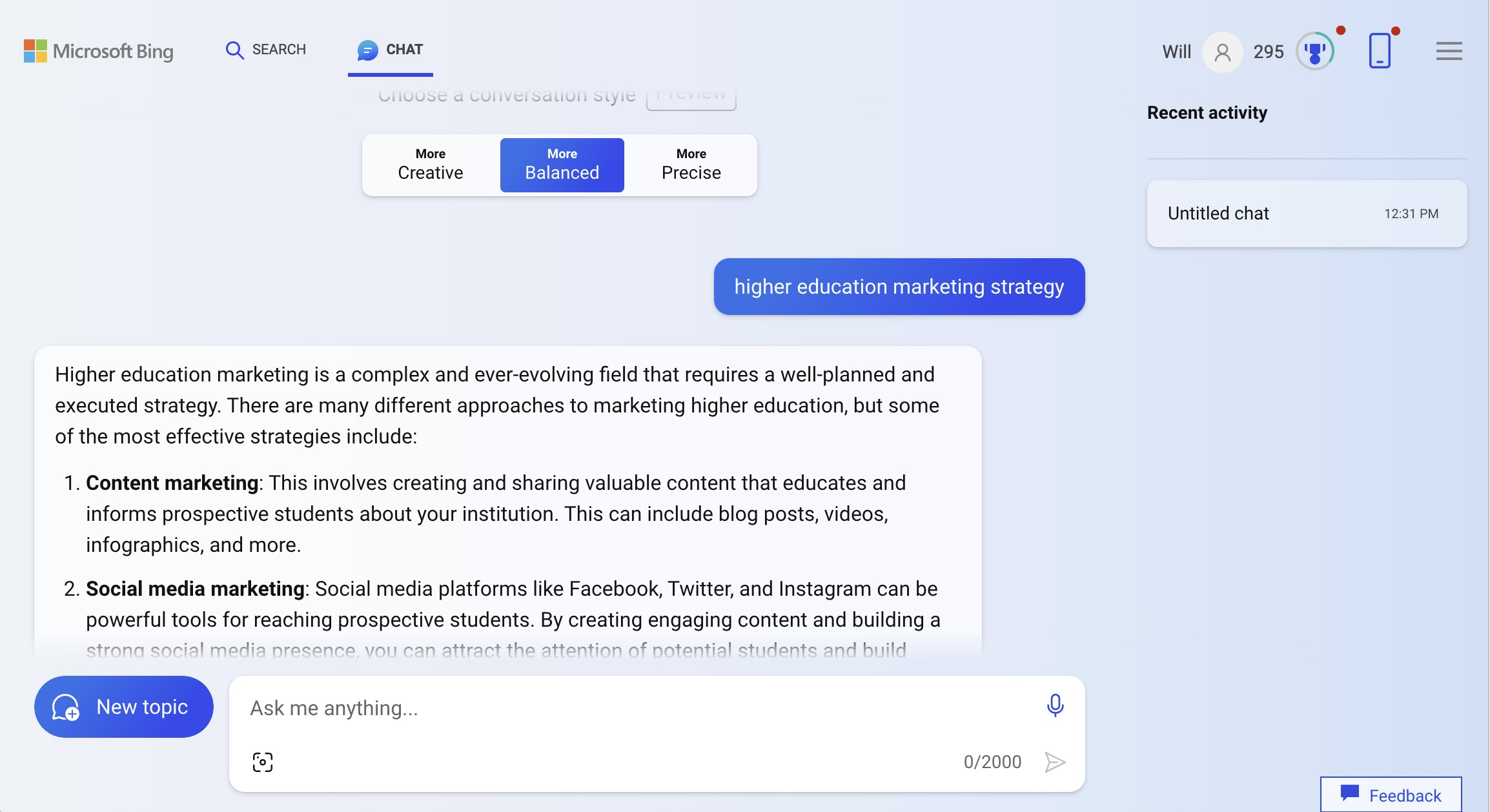
    Bing was the first to market with an AI-powered search experience. But, since it required the Microsoft Edge web browser, it only got a little play outside the Windows world.

    google ads 2023

    That little box on the right is the OpenAI-powered chat module.

    When BingGPT first launched, it was much more like the current Google interface, where the AI-powered elements were above the fold. This version is still accessible in “Chat” mode on Bing, but it’s not the default.

    google ads 2023

    Depending on the search query, Google has gone all in. Some see a slimming of the SGE box, but for our example search “Higher Education Marketing Strategy,” SGE is even more impactful than the ads.

    google ads 2023

    The good news is our content is good enough to be included in (scraped for) the SGE-generated result, but as you can see, even on my 27-inch monitor, I have to scroll to get past the ads and SGE to the rich snippet.

    Not to mention how far you would have to go to reach the traditional 10 blue links.

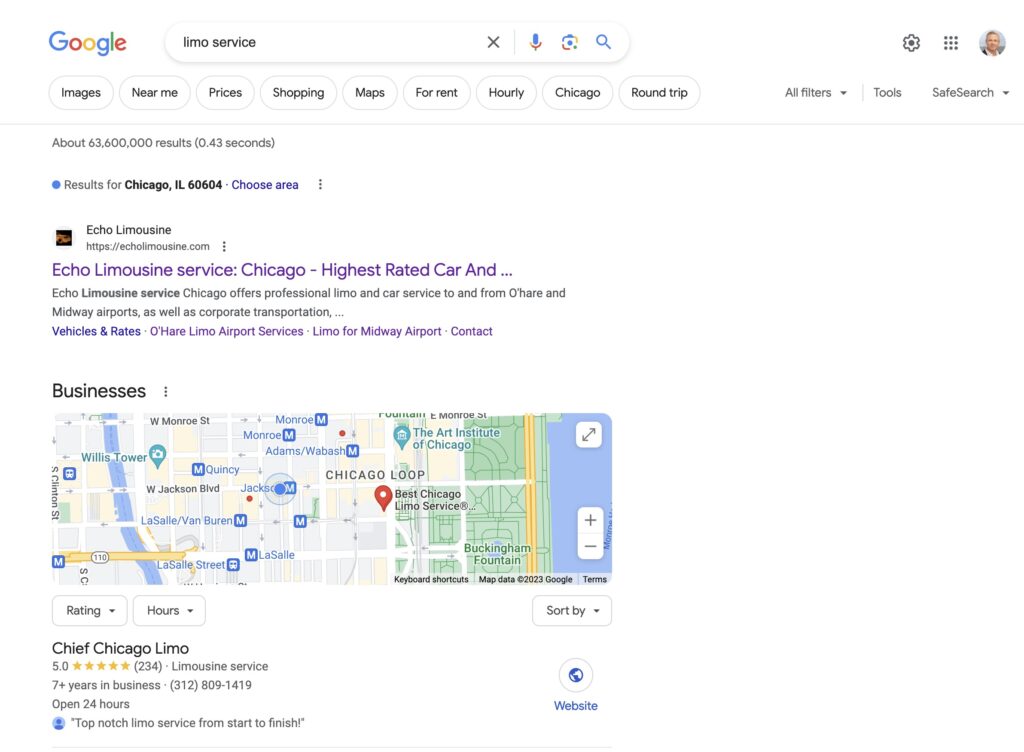
    More good news is that for many very local (hyperlocal, as Greg Sterling would say) searches, the map still prevails.

    google ads 2023

    Digital marketers and Google still have much to learn about user behavior on the SGE results page.

    It’s safe to say that, presented with the above and the typical attention span of the search engine user, the organic results will not get the clicks. And the ads may seem like the most useful part of the page.

    The Rise of Google’s Ad Empire

    Back in the early 2000s, Google ad placements were a speck on the vast landscape of organic search results. Today, as we see above, they’re monolithic.

    The History of Google Ads

    When I first ventured online in the late ’90s, online ads were the equivalent of newspaper ads. They were giant banners with obvious messaging that as much as screamed, “I’m an ad!”

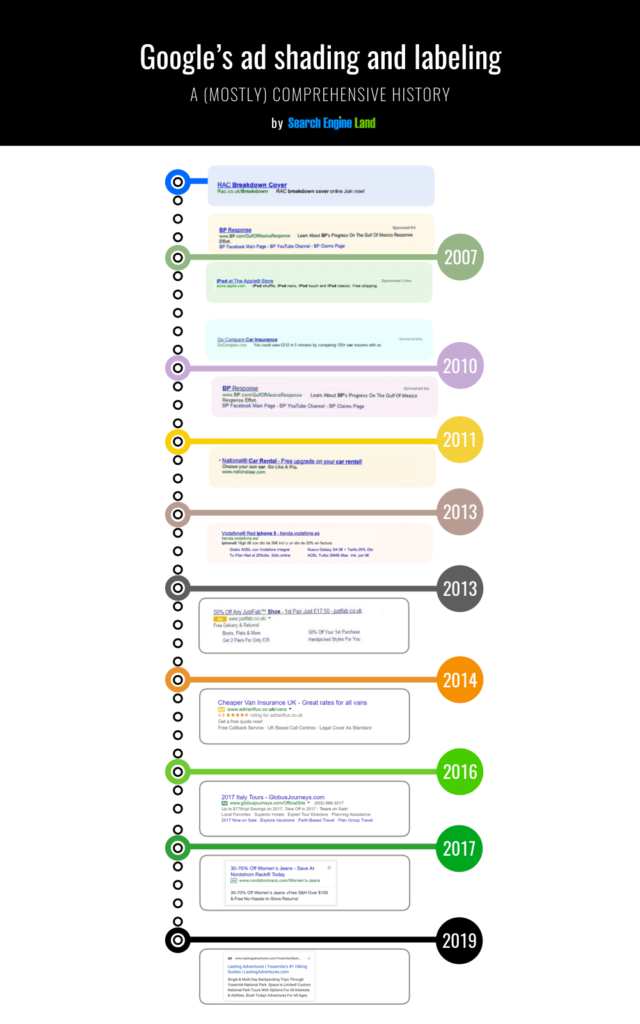
    Google, starting with “Premium Sponsorship,” over the years made their ads more and more subtle, ultimately looking like native content.

    This graphic from Ginny Marvin in her Search Engine Land article A visual history of Google ad labeling in search results tells a pretty good story of how what was originally an obvious ad has become increasingly subtle over time.

    google ads 2023

    It’s compelling to remember back to a time when ads were so obvious they were highlighted. It’s almost as if the original user interface engineers wanted to make sure you knew it was an ad.

    The graphic is a couple of years old and doesn’t account for the more visual ad types like product ads. In the case of product ads and some local service ads, they’re indiscernible from organic content.

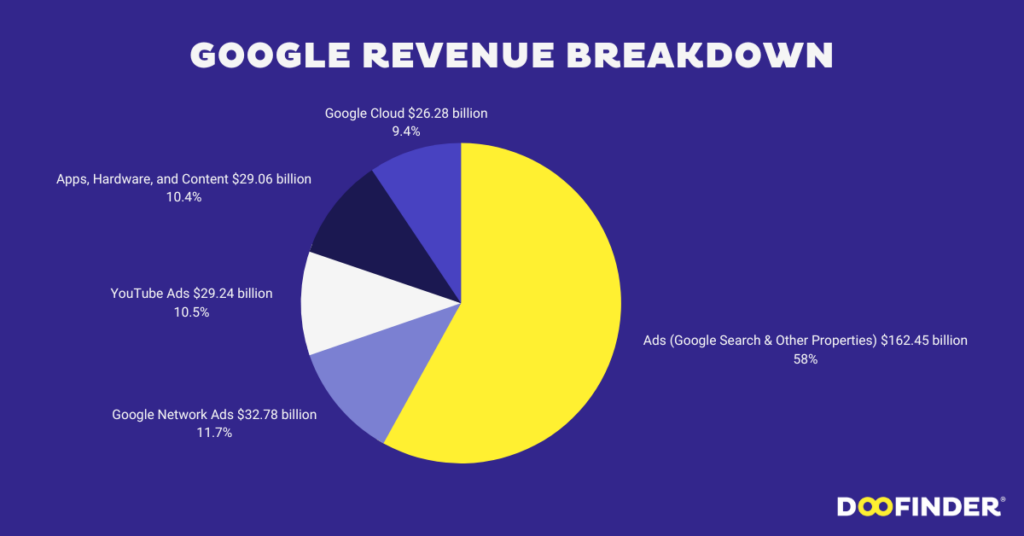
    Follow the Money

    As this chart from Doofinder, an e-commerce site search provider, shows, ads are the most significant part of Google’s revenue.

    google ads 2023

    Yes, Facebook, Amazon, and TikTok all take their share of the digital advertising market, but Google is still far and wide the leader with the most to lose.

    Why Is Google Doing This? Is This Ethical?

    On socials, there’s argument over whether Google should be regulated or if they’re entitled to do whatever they want.

    The argument goes, “They’re a public for-profit corporation, they can do as they please.” But can they? As the monopoly provider of access to business information, they have become a de-facto public utility.

    In the 1990s, the telephone companies were forced to give up their listing data to competitive phone books, and in the early 2000s, Microsoft was sued for antitrust violations and made two separate parts of their business.

    Is it crazy to think that when Google becomes self-serving (sometimes through aggressive — perhaps “unfair” competition), they should be regulated?

    What are some reasons Google would be taking this approach?

    1. Greed: It’s their search engine, and they can do what they want. The free listings aren’t paying anything, and they’re seeing benefits from inclusion.
    2. Spam: AI content is flooding the internet (not throwing stones, by the way.) Google has recently had issues indexing all the content.
    3. Resources: Indexing is hard. Even excluding spam, the rate of content production from “reputable” publishers is accelerating.
    4. Reality: The search engine results pages are getting pretty crappy. For most searches, authority sites dominate, whether or not they are niche-relevant. Some at Google might argue they at least have validation, by payment, of the trustworthiness of their advertisers.

    The European Union has started to regulate big tech, but the U.S. is not there yet. Arguably, the effect of regulation in the EU is a drop in the bucket compared to the valuations of Google, Facebook, and Amazon.

    We May Be on Our Way to a Pay-to-Play Google

    Until and unless Google reverts the SERP, we may have to buy back our hard-earned ranking for non-local searches.

    As an agency and a business owner, this is frustrating. We will have to watch the evolving SERP to understand the ratio between paid and organic search needs to maintain and grow the number of leads we’ve been accustomed to.

    I know that organic SEO will continue to deliver leads and value. While we wait to see the final form of the Google SERP, we should be focused on two strategies:

    1. Suck it up and buy our previously high-converting keywords.
    2. Continue developing content.
      • Long-tail content where there are fewer ads.
      • Alternative channels: YouTube, Social Media, etc. — the good news on this front is it doesn’t have to be new and unique but just repackaged for the medium.

    We would love to hear your thoughts. Are you seeing the same thing? Is it time to break up Alphabet? What else should we be looking for?

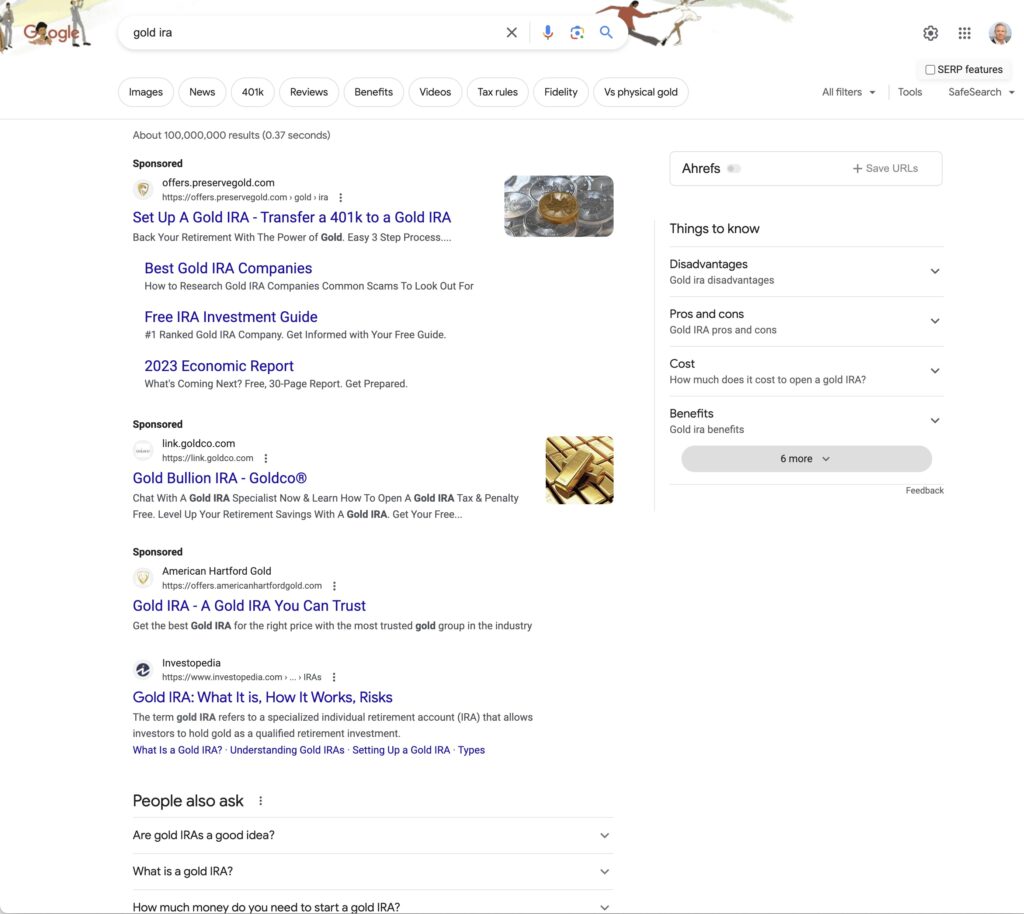
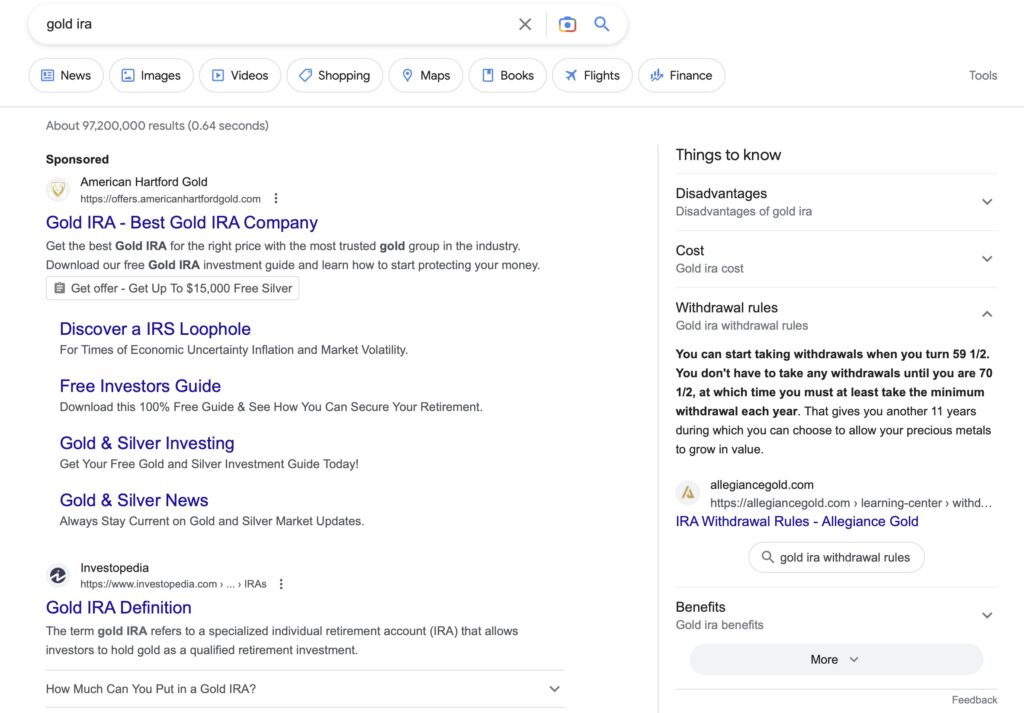
    Postscript – Google Ads 2023 Before & After Pics

    I was asked to provide some screenshots of the new fat ads pack by our marketing associate and had surprisingly few SERP screenshots. The two below show the extreme nature of the Google Ads 2023 SERP smackdown.

    Gold IRA Today

    google ads 2023

    Gold IRA April 2023

    google ads 2023

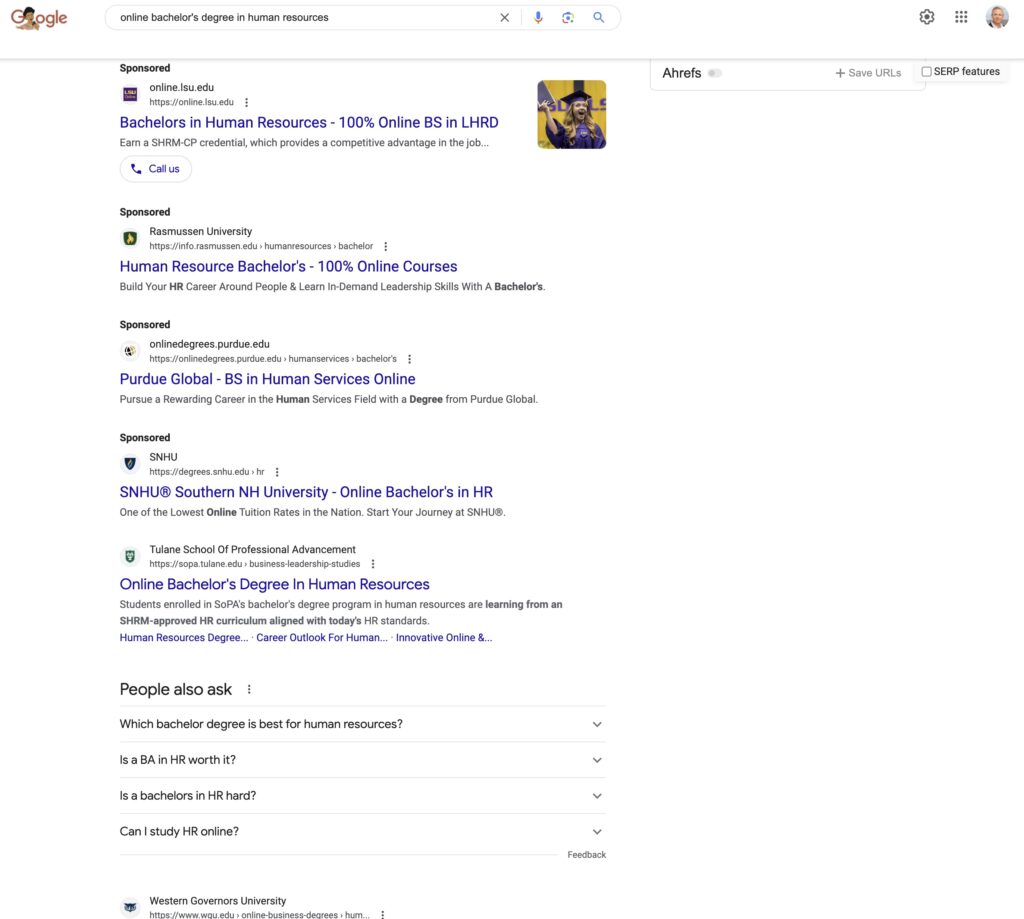
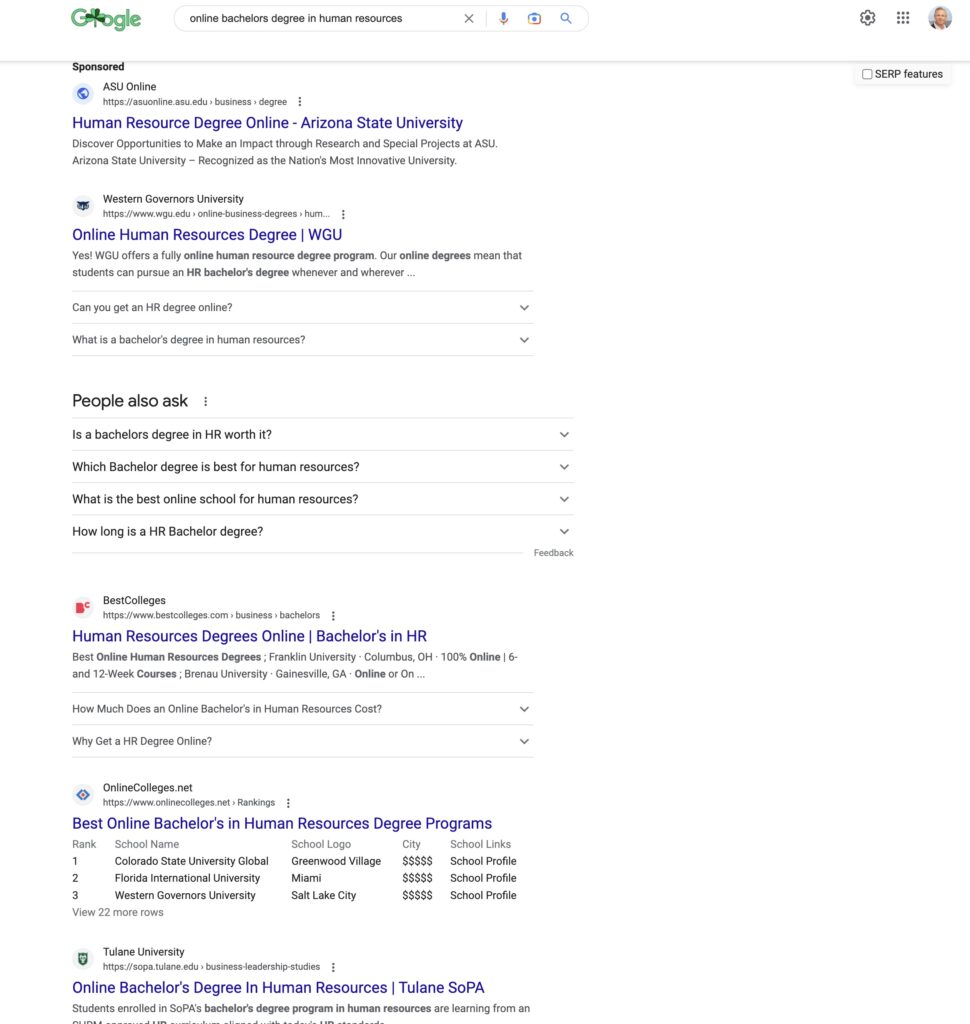
    Online Bachelor’s Degree in Human Resources Today

    google ads 2023

    Online Bachelor’s Degree in Human Resources March 2023

    google ads 2023

    Additional References

    Everything wrong with Google in one competitive result – Cyrus Shepard
    How Search Generative Experience works and why retrieval-augmented generation is our future – Mike King

  • Organic & Paid Search: Stretch Your Advertising Budget With this Dynamic Duo

    Key Insights

    • Marketers who invest in paid search but don’t use SEO miss out on valuable opportunities to grow their brand, impact, and results.
    • Paid search offers immediate, measurable results, while organic search provides long-term, cost-effective benefits. Both are essential for a balanced marketing approach that captures the ideal target audience.
    • When you leverage these strategies in tandem, you can stretch your advertising budget further and gain a higher return on your investment.

    Already diving into the world of paid search? You’re likely experiencing satisfactory — if not excellent — returns on your investment. Your click-through rates are healthy, your conversion funnels are a work of art, and the ROI numbers speak for themselves.

    But, why stop at one win when you can score a double?

    The ROI potential of organic search is often underestimated, yet its impact is monumental. With organic search, you invest in a long-lasting asset that continuously draws in high-quality traffic and gains.

    By leveraging both paid and organic search, you create a powerhouse that maximizes your budget and outperforms each strategy used in isolation.

    paid vs organic search

    Comparing the Advantages of Organic Search vs. Paid Search

    Organic search refers to the unpaid search engine results that appear when you type a keyphrase into a search engine, such as Google, Bing, or Yahoo.

    Organic search differs from paid search in two primary ways: You don’t pay for high-rankings, and you earn those rankings based on how relevant your content is to the user’s search query.

    The higher you rank in the organic listings, the higher the traffic to your website.

    Data from Brightedge shows organic search constitutes over 53.3% of all website traffic, while 15% comes from paid search.

    However, despite pulling in a lion’s share of page visits, organic search shouldn’t trump your paid efforts, and vice-versa. Choosing one approach at the expense of the other only risks leaving valuable opportunities on the table.

    Organic and paid search are complementary marketing strategies. When used together, they yield results much greater than the sum of their individual parts.

    Benefits of paid search

    Paid search is popular for a reason. It’s fast-acting, easily adaptable, and you can measure its performance down to the most granular details.

    Some of the top benefits you get by investing in this marketing strategy include:

    • Immediate visibility: Unlike organic search, which can take time to yield results, paid search offers immediate visibility. As soon as your ads are set up and approved, they can appear in relevant search results, driving instant traffic to your website.
    • Targeted reach: Paid search allows for precise targeting based on a variety of factors, such as keywords, location, demographics, and device type. This level of targeting ensures that your ads are shown to a highly relevant audience, increasing the likelihood of conversion.
    • Measurable and actionable results: Paid search offers detailed metrics and insights into your ads’ performance. This data helps you assess the effectiveness of your campaigns and make more informed decisions. You can optimize by testing different ad creatives, landing pages, and keywords.
    • Cost-effective: While you pay for each click, the ability to set a budget and bid strategy allows you to control your spending. Additionally, the targeted nature of paid search can lead to higher conversion rates, making it a cost-effective advertising method.

    Benefits of organic search

    When marketers invest in an organic search strategy, they’re investing in the tried-and-true practice of search engine optimization (SEO). This technique involves optimizing a website to appear higher on the search engine results page.

    Successful SEO encompasses many different moving parts, including:

    • Keyword research: Identifying and targeting specific keywords relevant to your business helps tailor your content to attract qualified traffic.
    • Link building: Acquiring backlinks from reputable websites boosts your site’s authority, which can improve its ranking in search engine results.
    • On-page optimizations: Improving elements like titles, meta descriptions, headers, and content itself ensures that both search engines and users find your pages relevant and valuable.
    • Technical SEO: Optimizing your website’s underlying code, speed, and structure makes it easier for search engines to crawl and index your content.
    • Local SEO: Optimizing your site for local search helps you rank higher in geographically relevant queries, making it easier for local customers to find you.
    • User experience (UX): Enhancing your site’s usability and navigability keeps visitors engaged and signals to search engines that your site is user-friendly.

    Each of these tactics plays a distinct role in optimizing your site for a better position in organic search results. When utilized correctly, effectively, and efficiently, they can lead to several compelling benefits, such as:

    • Increased organic traffic: By optimizing for relevant keywords and creating quality content, SEO helps increase the visibility of a website in search engine results, leading to more organic traffic.
    • Improved user experience: In revamping the structure and content of your website, you make it easier to navigate, which can improve the overall user experience.
    • Higher conversion rates: Through targeted optimization, SEO can attract more qualified leads to your website, leading to higher conversion rates, as visitors are more likely to take desired actions.

    Why You Need a Paid Search + SEO Strategy

    Adding SEO to your paid search strategy isn’t about dishing out hefty dollars or doing extra heavy lifting to reap results.

    This one-two punch is about working smarter, not harder. When you adopt a comprehensive strategy, your paid and organic search efforts merge to inform each other for a budget-friendly, high-impact approach.

    SEO is one of paid search’s biggest allies and strategic influences. It works to bolster the impact of your pay-per-click (PPC) ads by offering numerous advantages, including:

    • Brand credibility: If your site ranks high in organic search for relevant keywords, it may enhance your brand’s credibility and authority. This trust can translate into higher click-through rates for your paid search ads.
    • Improved quality score: Google’s Quality Score considers the relevance and quality of your landing pages. If your organic search efforts result in well-optimized landing pages, it might indirectly contribute to a higher Quality Score for your paid search ads, leading to lower costs and better positioning.
    • Shared insights: Your paid search campaigns can gain data from your organic search efforts, including effective keywords and user behavior. With these insights, you’re able to ensure more effective targeting and ad creation.
    • User experience and relevance: Successful organic search optimization involves creating relevant, engaging content that resonates with users. By leveraging this content in paid campaigns, like Google ads, you create a consistent user experience that enhances conversions.
    • Double visibility: Appearing in both organic and paid search results increases your overall brand visibility and reinforces your message, making users more likely to engage with either your organic result or paid ad.

    Use case: Paid search & SEO for improved keyword visibility

    Seeing double doesn’t always mean it’s time to visit your nearest eye care clinic.

    In the search engine marketing world, double visibility for certain keyword searches opens the door to increased brand awareness, clicks, and conversions.

    By occupying both paid and organic real estate on the search engine results pages (SERPs), you crowd out competitors and offer multiple avenues for potential customers to interact with your brand.

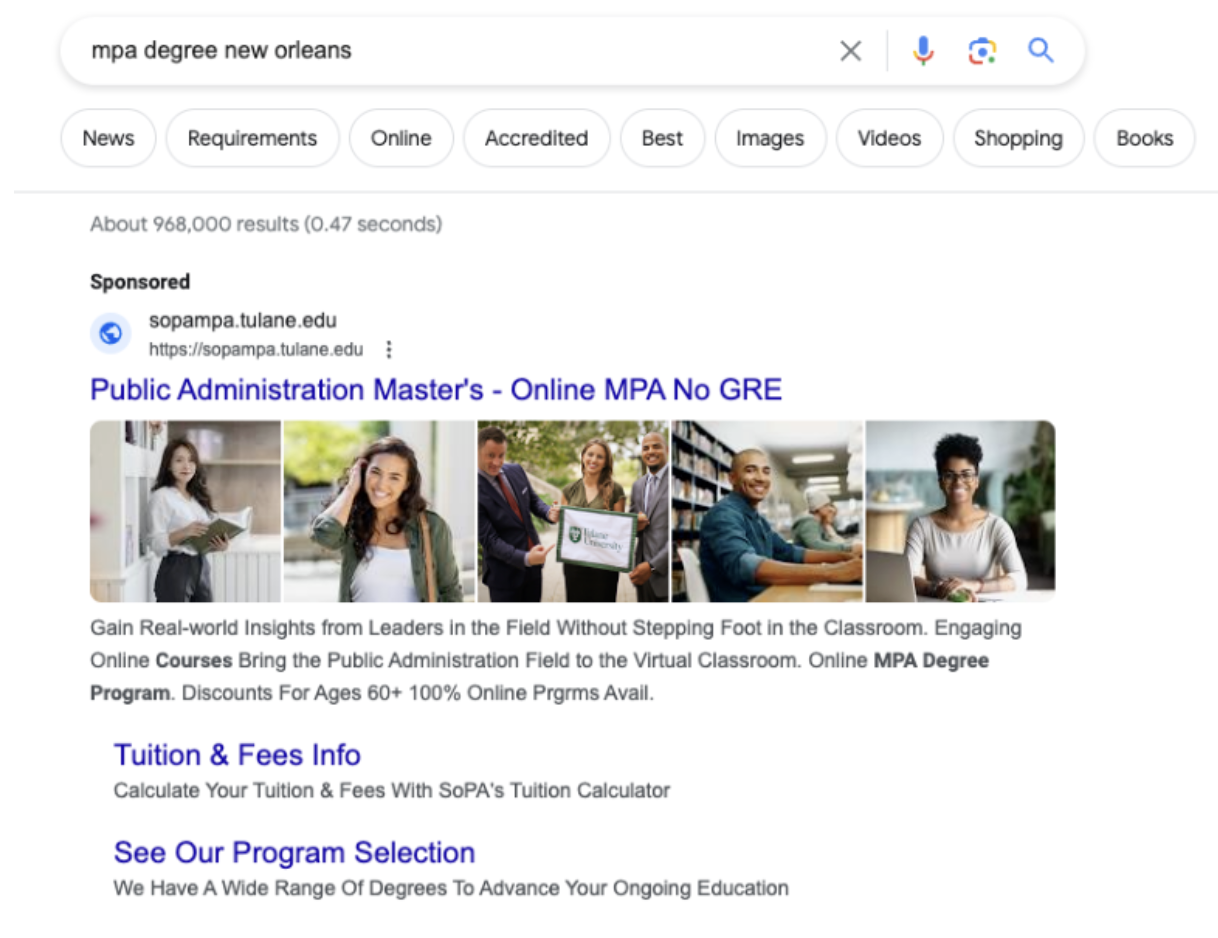
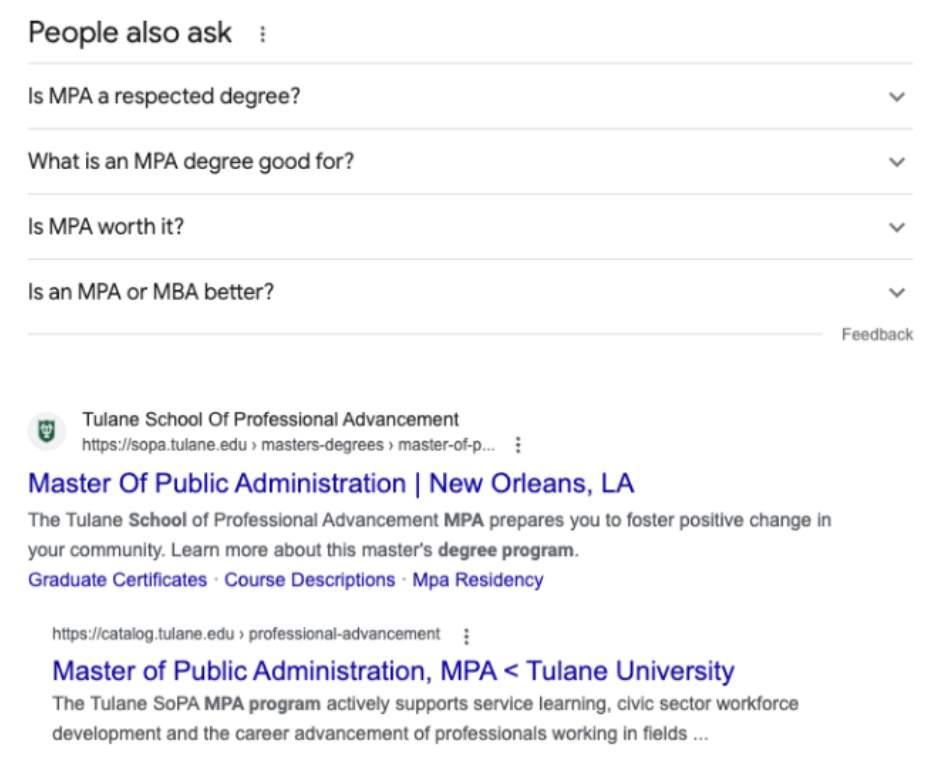
    Our higher education client, Tulane SoPA, reached double visibility in the SERPs for the keyword “MPA degree New Orleans.”

    mpa degree nola

    The top page, flagged as “sponsored,” is the university’s paid search effort, and it leads to the corresponding landing page for the Master of Public Administration program.

    mpa degree nola

    Tulane SoPA’s organic listing for the MPA degree lies just below Google’s “People Also Ask” feature, still on page one.

    Interested prospects searching for the perfect MPA program in their preferred locale are met with multiple signals pointing them to Tulane SoPA. When they click through to one of the pages, Tulane SoPA has higher chances of increasing their conversion rates.

    The ROI Potential

    The ROI of an organic vs. paid search strategy may look different, but they don’t have to be mutually exclusive. With a combined search strategy, you can do more with your marketing and have better returns, without breaking the bank.

    Used in tandem, paid and organic search stretch your budget further. Their complementary inner workings drive more conversions and dollars to your brand, particularly by:

    • Increasing overall traffic: By targeting different segments and stages of the buyer’s journey, both paid search and SEO can drive more traffic, improving overall reach and potential conversions.
    • Increasing conversion rates: Utilizing insights from both channels can lead to better targeting and more relevant content, thereby increasing the likelihood of converting visitors into customers.
    • Offering data-driven optimizations: Using data from both channels allows for more informed decisions and continuous optimization of both organic and paid strategies, leading to improved performance and ROI.
    • Allocating resources strategically: Understanding the performance and ROI of both channels enables you to strategically allocate resources, investing in areas with the highest returns.

    Increase Your ROI With SEO & Paid Search Experts

    Sticking to just one marketing channel is like running a race with one shoe. You might still finish, but you’re hobbling your chances for a winning performance.

    A superior marketing strategy is holistic, leveraging both the quick returns of paid search and the sustainable growth offered by SEO.

    At Search Influence, we put these winning, comprehensive strategies within your reach. With over 15 years of experience offering custom solutions, analytics-based strategies, and results you can measure, we are your partner in optimizing your full potential.

    Interested in learning more about merging organic and paid search in your strategy? Let’s talk about it.


    Image Sources:

    https://bit.ly/45ZC5pN

  • How to Track the Success of Your Online Ads

    Marketing can sometimes feel like a black box to business owners. Luckily, with digital marketing, there are ways to track pretty much everything so that you can know exactly how your campaigns are performing. As a marketer, I’m often up to my elbows in Excel sheets, pouring through the data provided from Google Ads or Google Analytics. But as you’ll soon learn, only looking at that data is not enough. To have successful campaigns, you, the business owner, must also be involved in the process to help track everything from the first impression to a closed lead.

    Gif of Colin Farrell shrugging about online ads

    How Do You Know If Advertising Is Effective?

    In order to determine if your advertising is working, you first need to do some self-reflection. Most business owners know they need to spend money on marketing in order to grow, and often, the first thing they do is begin vetting (and maybe even hiring) an agency. But truthfully, it’ll be more difficult for you and your agency to create winning campaigns if you haven’t defined your business and marketing goals before getting started.

    Luckily, we have put together an awesome guide that walks you step-by-step through the process of determining the metrics that matter to your business and how to tie those to marketing goals. To get started, gather the necessary stakeholders, download our guide, and fill out the worksheet. When you are done, you will have…

    The “M” in S.M.A.R.T. stands for “measurable,” and defining this on the front end helps you determine what Key Performance Indicators are important to you. This doesn’t have to be complicated, and the less metrics, the better!

    Man incorrectly measuring the success of his online ads campaign

    How Do You Measure the Success of a Campaign?

    Now that you’ve defined your metrics and KPIs, you’ll need to figure out what you need to track online and how you will track it. Some common things you might track are leads through phone calls and form fills, transactions and revenue through e-commerce purchases, or interest in your location through “Get Directions” button clicks. Let’s walk through some common platforms for tracking online actions.

    • Google Analytics: You can use this free platform to track user behavior on your website and set up goals to track form fills, clicks on buttons, views of key pages, and e-commerce transactions. This allows you to compare performance across all campaigns similarly, using the same attribution model and metrics. It integrates well with Google Ads (you can import your Google Analytics goals directly into Google Ads) but doesn’t send conversion data to other advertising platforms.
    • Ad Platform Pixels and Trackers: Each ad platform offers their own tracking solutions, so you can determine exactly which of your advertising campaigns, keywords, audiences, and ads are converting. If you are using something other than Google Ads, you’ll want to install these pixels in addition to Google Analytics. Most of them work very similarly to Google Analytics, but may have slight variations on how conversions are counted or tracked. Examples include Facebook Pixels, Google Ads Conversion Trackers, Bing Conversion tags, and LinkedIn Insight Tags.

    • Call Tracking Providers: Setting up call tracking is a must for businesses that receive a lot of phone calls. Call tracking works by placing a piece of code on your site that identifies the source of your site visitor and dynamically switches the phone number to attribute that call back to the source. More advanced call tracking providers are even able to tie these calls to specific ads. They offer a ton of features to make it easier for you to manage your internal process for answering and responding to these calls and to audit your team to ensure they are providing the best customer service. There are several different providers, so do your research on which one best meets your needs.

    Setting up all of these things on your website does require some coding skills, so it helps to consult with a developer (or a marketing agency like Search Influence) on the best ways to set up tracking.

    How Is ROI Calculated in Digital Marketing?

    I don't do math gif

    So now that you are tracking all of your online actions, you’re all set to calculate ROI, right? Well, not exactly. In fact, tracking just online conversions does not give you a full understanding of the success of your efforts. This is mostly true when it comes to lead-based businesses. If we deliver 100 leads to you, but not a single one turns into a client, would you call that a success? This is why it is SO CRUCIAL for you to track the quality of your leads and to provide that information to your marketing agency as close to real-time as possible.

    There are many ways to determine lead quality, but some important things to track include the following:

    • Lead Score: What is a lead worth to you? Devise a scoring system and train all customer service reps on this. Think about scoring the leads based on things like, “I want more leads like this!”
    • Score Reason: What makes the lead good or bad? What was the roadblock as to why this lead couldn’t become a customer?
    • Lead Stage: Did the person schedule a consultation? Have they been sent a proposal? Did they become a client? Document where each potential customer is in the process.
    • Customer Lifetime Value: What was the revenue associated with the services they received?

    Using a Customer Relationship Management (CRM) platform makes this process super easy. It can help you track the volume of leads, close rate, and average sale value, which are all important metrics to know and understand. It can also help your internal team keep track of who’ve they’ve talked to and when to follow up with them. The biggest benefit of having a CRM is having a ton of great actionable information to provide to your marketing agency so they can optimize campaigns to meet and succeed your marketing goals.

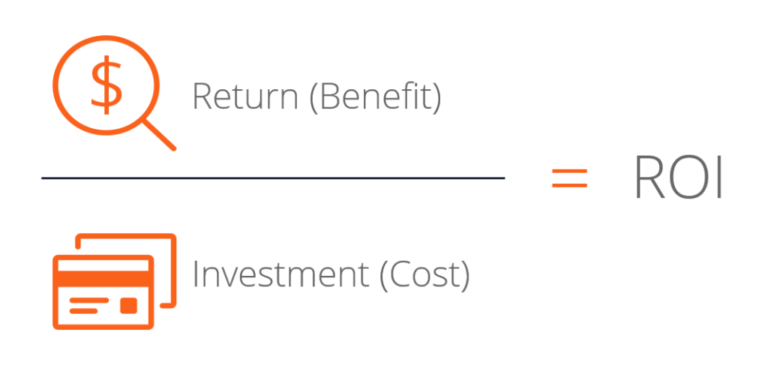
    Once this data is collected, you can also determine the Return on Investment (ROI) of your marketing efforts. You’ll take the total revenue you received, subtract the costs associated (return), and divide by your investment.

    ROI evaluation of online ads campaign from Search Influence in New Orleans, LA

    Combine the Data and Make Smart Decisions

    Implementing these tracking mechanisms and processes allows you to better understand exactly which campaigns and tactics are driving real revenue for your business. It is also one of the huge advantages of running digital advertising campaigns (real data that is tied directly to campaigns). It gives you and your marketing agency the insight to make decisions that you can trust will result in growth and allow you to continue to work toward your goals.

    If you need help figuring all of this out, don’t worry! Search Influence is stocked with seasoned pros at all things tracking and analytics, and we love to dive deep into numbers to figure out what is working for our clients. We will also provide guidance as you set up your internal systems to make it as easy as possible to track the data on your end. We find that the most successful campaigns we run are ones where there is open communication between our team and our clients—providing honest feedback on the work we are doing because, ultimately, we want to optimize their business’ potential. So start a conversation with one of our digital marketing experts today so you can feel confident in your marketing efforts!

    Images

    Colin Farrell

    Helpless Man

    Schitt’s Creek


  • Common Google Analytics Terms Explained

    Google Analytics is a free service provided by our friends at Google that automatically collects and allows you to analyze data about your website visitors. Google Analytics is an essential tool for digital marketers, businesses, bloggers, and everyone in between with a website.

    Google Analytics can help guide your decision-making processes and marketing strategies. You can figure out why your website visitors are bouncing, learn about the demographics of your audience, monitor progress towards your goals, and more.

    With the plethora of information available in Google Analytics, it can be difficult to understand all of its dashboards and metrics.

    Google Analytics Terms for Beginners

    • Users

      • The number of people who viewed your website at least once within a given time period is represented by users.
    • Pageviews

      • Pageviews is the number of times visitors to your site view a page. Every page visit is included in this number, including if someone refreshes the same page. Pageviews is a great metric to look at when you want to determine which pages are your website’s most popular.
    • Sessions

      • Sessions are the individual periods of time someone visits your website. A session resets in increments of 30 minutes. A website visit ends when 30 minutes have passed. If a visitor leaves and returns to your site within 30 minutes, that counts as one session.
    • Bounce Rate

      • Bounce rate is a number that is found by dividing the number of total bounces by total visits. This represents the percentage of people who visit one page on your website and then leave without going to any other pages. Bounce rates can be applied to an entire website or individual pages.

    Dimensions

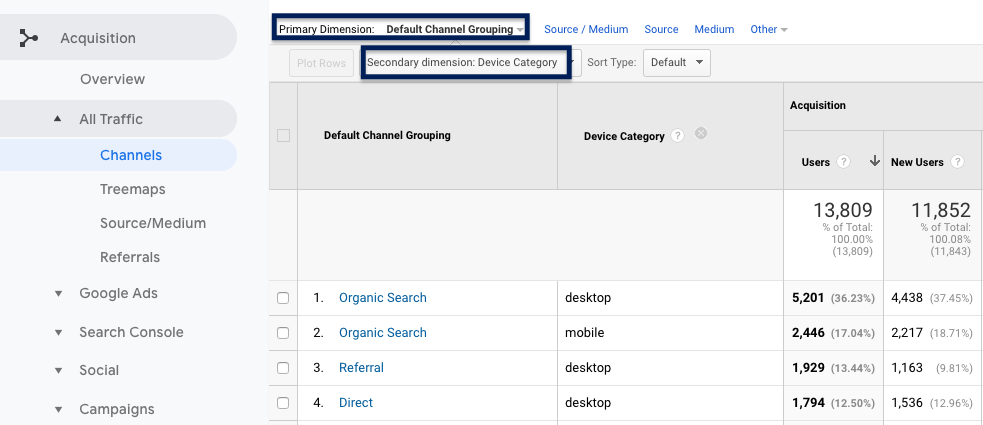
    Dimensions are attributes of your Google Analytics data. Some examples of dimensions are the source/medium, which we’ll discuss later, or location. There are several options, including device category, language, and campaign. Dimensions are helpful for making sense of the data generated by different reports.

    • Primary dimension

      • A primary dimension in Google Analytics is the first displayed attribute of your data, which differs depending on the report you’re looking at. For example, if you’re looking at Channel under Acquisition, the channels by which people used to visit your website is the primary dimension.
    • Secondary dimension

      • A secondary dimension in Google Analytics allows you to add another layer to parse through your data. So, let’s say you wanted to know how many people visited your site through each channel and the device they used to get there, you can add “Device Category” as a secondary dimension to see the data sorted by the device.

    Screenshot of a Google Ads campaign managed by Search Influence in New Orleans, La

    Reviewing Acquisition Reports

    If you’re curious about how people found your website, acquisition reports will tell you which sources visitors used to get there. The acquisition report shows the origin of the visit (like a search engine, a Facebook ad, or email marketing campaign) and the specific medium.

    • Channels

      • Channels in Google Analytics provide a broad idea of where your website visitors came from. Analytics has a default channel grouping. This grouping consists of channels like Direct, Organic Search, Social, and Referral.
    • Organic Search Traffic

      • An organic search visit is a visit that came from a search engine. If someone typed in your business name or keywords related to your business in Google and clicked on your website in the Search Engine results page, this counts as an organic website visit.
    • Direct Traffic

      • Direct traffic is a result of a user typing in your exact web address in the address bar or clicking a bookmark in their browser.
    • Referral Traffic

      • Referral traffic visits are a result of visitors getting to your site from another site on the web. If I were on Yelp browsing restaurants for dinner and came across a place I’d like to check out and then clicked a link to their website from their Yelp listing, this would show up in their Analytics as a referral visit. Reviewing referral traffic can be helpful for deciding if certain off-site tactics are worth the time and effort. For example, if you’re doing a lot of posting and promotion on Facebook and you see that your referral traffic has not increased, you may decide to spend less time on that strategy and focus elsewhere.
    • Source/Medium

      • Source/medium provides a closer look at where your website visitors are coming from. Source identifies the referrer of a site visit. A source can be a search engine, an ad, a newsletter, etc. while the medium is the channel used. Examples of source/medium include the following:
            • Google/organic – Google is the source, organic the medium.
            • Google/CPC – Google again is the source, but the medium is a paid search ad.
            • Yelp/Referral – Yelp is the source and a referral is the medium.

    Search Influence employee working on Google Ads campaign in New Orleans, LA

    For Understanding User Behavior & Measuring Conversions

    • Landing Page/Exit Page

      • A landing page is the page a user first sees when they visit your website, and an exit page is last one they browse before leaving.
    • Events

      • Events are actions that a user takes on a website. Ideally, these should be created around your key performance indicators. For example, if you have a button on your website that allows users to check the rates of your B&B for a night’s stay, you can set up an event to know how many people clicked that button.
    • New vs. Returning Visitors

      • Google Analytics allows you to divide your site traffic into new and returning visitors. New visitors are people who had not previously visited your website during the time period you’ve selected. Returning visitors have viewed your website more than once during that time frame.
    • Goals

      • Goals are similar to events but are more focused on conversions. An example of a conversion is someone making a purchase or requesting a proposal from your company. Google Analytics provides 20 slots to track these.

    Navigating Google Analytics and all of its reports can be difficult. Properly utilizing the tools within Google Analytics to inform your business decisions can be even more challenging, but we can help with that. At Search Influence, we love analytics and lead tracking. Give us a call at 504-881-1597 to learn how we can help you know where your customers are coming from.

    Images

    Google Ads on Laptop

    Person Working on Laptop

  • How to Navigate the NEW Google Adwords Experience

    AdWords recently announced that they are fully switching to the new experience by the end of the year, and I’m here to tell you it’s going to be okay! The new experience has been available to all advertisers since October, but we’ve had exclusive access for a while and have been able to get acquainted with the new UI and I’m here to share our findings.

    For those of you thinking, “Google’s changing something AGAIN?” I’m right there with you! But with the following tips and resources, you’ll soon love all the new experiences it has to offer.

    So What’s so Different?

    Google updated the interface to provide, “a faster and more intuitive experience that’s focused on helping you reach your goals.” All the features you rely on are available in the new experience, and Google incorporated feedback as well, since this has been in beta for a while. They’ve also rolled out some exclusive features that are available in the new interface, so you have to switch to take advantage of them. Some of my favorite new features are below.

    A New “Overview” Page

    The overview tab provides performance insights that are generated by Google depicted as charts and graphs for you to quickly review and take action. These make reviewing data for devices and time of day much more visually appealing and easier to understand.

    Bid Adjustments for Calls

    Adjust your bids on call extensions to show call interaction ads more frequently. This allows you more flexibility and control over how often these ads appear and how customers can connect with your business. The bid adjustments range from -90% (I don’t want these to show as much) to +900% (yes, please, show these all the time!).

    Promotion Extensions

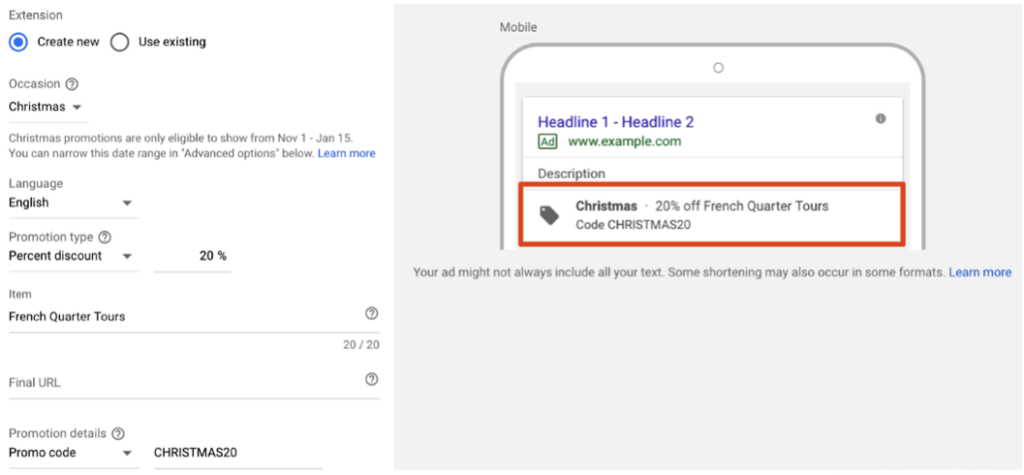
    Promotion extensions are pretty fantastic! They allow users to show and link to a special offer in their search ads and even include a tag icon to help the promotion stand out. You can highlight specific sales and offers, all while taking up more valuable real estate in the SERPs.

    Shortcuts

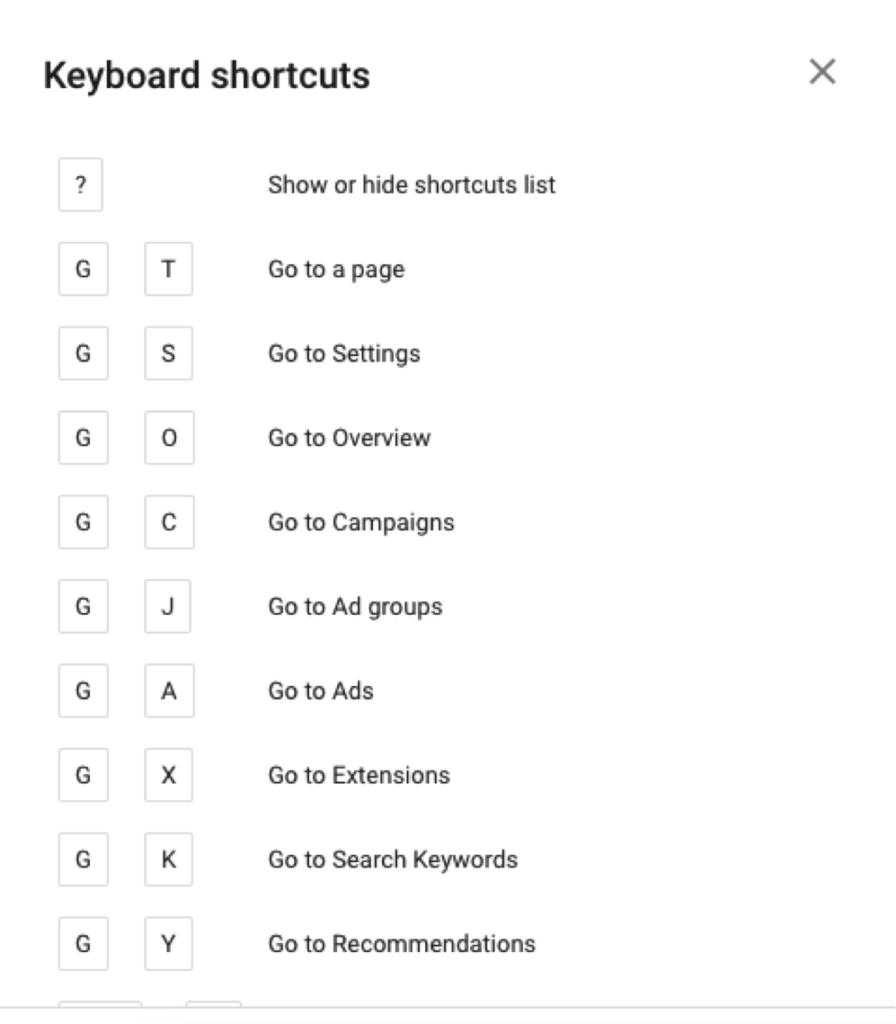
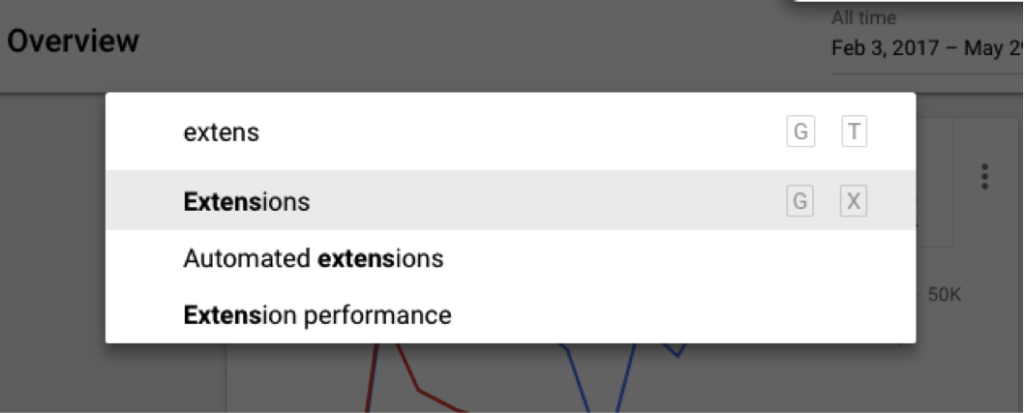
    One of my all-time favorite new features is the introduction of shortcuts. You can pretty much navigate to anywhere in the interface in a matter of seconds! Need a list of shortcuts, just hit the question mark on your keyboard. Hit G and T (GoTo) to bring up a search bar, making it super easy to find anything you need!

    Need More Help?

    I couldn’t possibly cover all of the benefits of the new AdWords experience but wanted to include a few more tips and resources to get you started.

    • The dimensions tab used to be one of my favorite places to go to pull reports to find actionable insights. I thought it was gone, but AdWords has re-named this and moved these reports to “Predefined reports,” found under the little graph icon in the upper right corner.
    • Google has a guided tour of the new interface, which is great for beginners to get familiar with the changes. They also have a Help Center, which has been updated to help you navigate all the new features (bookmark this page!).
    • Follow this page to view new information on AdWords features as they are added to the platform.
    • If learning by video is more your thing, check out the guides to the New AdWords Experience Part 1 and Part 2.
    • There are a few things that are changing and some features that are not yet available, so familiarize yourself with these in case you need to find a different solution.

    Getting on board with big changes like this can take some time, so I recommend that you start poking around now. The end of the year will come quickly and is a critical time for most advertisers, so the more experience you have with the platform the more you’ll be able to take advantage of all the new features to set your campaigns up for success. If you have any questions or need help navigating this switch, the Online Advertising team at Search Influence has experts that can help.

    All screenshots captured by Jeanne Gaudet Lobman on May 30, 2018

  • Why Are My Ads Disapproved by Google’s Misleading Content Policy?

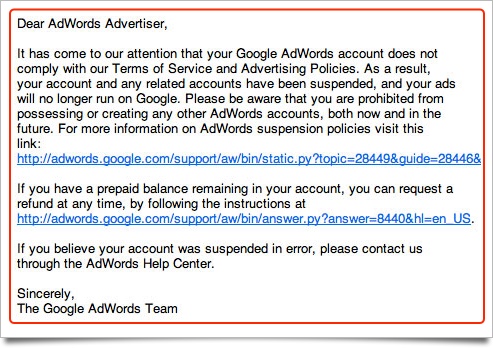
    In its continual quest to better serve users, Google has cracked down on misleading content in advertisements as well as website content. When your advertising campaign is slammed for “misleading content,” it can come as quite a surprise. Because Google holds advertisers to a high standard, some of the violations might seem like harmless marketing strategies. Regardless of how the situation arose, it’s important to bring your website and account back in line with Google’s expectations. The sooner you resolve potential violations, the sooner you can get back to building your brand’s online reputation.

    What Is the Google AdWords Misleading Content Policy?

    “Misleading content” is an umbrella term that includes several types of violations, ranging from problematic testimonials to deceptive branding. The main objective of the misleading content policy is to provide a set of clear standards for online advertisers to follow as to not deceive users with exaggerated or false content. The central component of these standards states that:

    – Disclaimers need to be included alongside perceived claims, even if the claims are direct quotations from past customers.

    – Images that show before-and-after results also need disclaimers. More broadly, improbable assertions are likely to draw the attention of the Google AdWords team.

    We’ve all seen investment opportunities and weight loss programs that sound “too good to be true.” As you might imagine, some of the standards allow room for interpretation, and many affected advertisers find that they need to resolve multiple policy violations to resume advertising.

    At least, in theory, Google’s policy should benefit both users and advertisers. Users shouldn’t have to scroll past misleading or spammy content, and advertising slots will become more valuable as users learn that paid search results are also informative and trustworthy. When you edit your ads and website to align with the Google AdWords misleading content policy, you’ll also be improving content and sales copy that might have sounded suspicious to potential customers. The things that Google considers “misleading” may also be off-putting to your target audience.

    What Kinds of Businesses Are Most Impacted by This Crackdown?

    With shifting expectations for disclaimers and testimonials, medical businesses like plastic surgeons and dermatologists are particularly vulnerable to being caught on the wrong side of AdWords policies. Whenever possible, peer-reviewed journals and other reputable sources can be referenced to support claims. Images are useful for showing the results of weight loss programs and cosmetic procedures, but those types of images need to include disclaimers to emphasize that individual results vary.

    Investment firms, lawyers, and other businesses may run afoul of Google AdWords misleading content policy, even though they aren’t making medical claims. The misleading content policy looks for vague guarantees and other wording that implies certainty or permanence. Depending on the phrasing used to describe results, virtually any business can find itself on the wrong side of Google’s misleading content policies.

    How Does Google Review and Determine If Content Is Misleading?

    In case there was any doubt, Google doesn’t employ a review board of physicians or lawyers to determine which claims are unjustified. Instead, an editor on the Google team judges whether the wording or formatting of a page is misleading. When the editor finds one or more violations that justify disapproving the account, they may (or may not) make a note in your case file. With the number of campaigns and sites reviewed by editors, it doesn’t make sense for them to make exhaustive lists of recommendations beyond the first one or two violations.

    As a business owner, you might never interact directly with an editor at Google. When you call the account representatives on the Google helpline, they only have the information that editors chose to note in your case file. If you fix the problems that were cited as “misleading,” there may be additional problems found when your site is re-evaluated. It can be a frustrating runaround but don’t get angry at the person on the helpline. They aren’t the ones who flagged your content, and they don’t have the power to reinstate your account. Instead of focusing on the people who made the decision, it’s better to try to understand the aspects of the policy that might apply to your site and campaign.

    What Do I Need to Do to Get My Ads Approved and Running Again?

    Not everyone gets site-specific recommendations in his or her case file, and even if you’re lucky enough to get actionable advice, it’s still important to be proactive about finding additional violations. After your campaign account has been flagged, the responsibility is on your company (and your web developer) to make sure that your site and your PPC campaign meet the standards set by Google. Look through your landing pages in search of other potential violations.

    Could your seals and stamps be perceived as mimicking government seals? Site layouts and deceptive popups can also trigger penalties. Popup windows shouldn’t simulate messages or system errors, displays intended to trick users into clicking through or interacting by accident. As previously discussed, assertions about future results need to be carefully worded. Some violations are more obvious than others but use due diligence to ensure that your site complies with relevant policies.

    How Can I Avoid Getting Ads Disapproved in the Future?

    Look at the penalty “sandbox” as a learning opportunity, and try to avoid repeating the same mistakes in future campaigns. Make a point of looking beyond your PPC campaigns to your website and your company’s approach to branding online. The campaigns flagged by AdWords often have issues on the landing page, marketing strategies that may be mirrored across the rest of the website. Even if a PPC campaign can be restarted with changes to a few key pages, it’s worth adjusting other website content to align with misleading content policies. Search algorithms favor high quality, unique content, and the misleading content policy hints at indicators that could eventually affect overall search rankings.

    If you don’t have time to spend waiting on the Google helpline, consider getting professional help through digital marketing consulting. Google’s policies and expectations shift periodically, and anticipating changes can become a distraction from your day-to-day business.

    As a Google Premier Partner, Search Influence has over 25 employees certified in Google AdWords Search, Video, Mobile, Display, and Analytics. Our digital marketing agency keeps up to date with the latest trends in search engine algorithms and online advertising to best serve our clients. Contact us so we can help get your ads approved and running again.

    Image Credits:

    Google Adwords Email

    Magnifying Glass

  • Successful Physicians Do This to Quickly Increase Their Online Presence

    Doctor greeting patient

    Gone are the days when Americans simply used the Internet to merely research symptoms they or their loved ones were experiencing. Instead, they are now going online to determine which doctors to see, what treatment to get, and what services a hospital might provide — and using that information to drive their choices.

    According to Manhattan Research, which surveyed 5,210 adults who use the Internet as a health resource, 54% of respondents said they did online research to decide what services they might need and who should provide them. Other surveys like this one from Pew Research have said that roughly 75% of American adults search for health information online.

    No doubt, one thing is certain: people are becoming more comfortable with using the Internet for health-related decisions. And this upward trend isn’t likely to stop anytime soon. One out of every five patients uses online health information to choose a primary care physician, according to Manhattan Research.

    What’s that mean to health care professionals? It’s time to put more effort into beefing up your online presence. Communicate who you are and what you do. The quickest way to increase your visibility is to advertise on the Google Display Network. Watch this SlideShare or read this blog to learn more.

    Image Credit:

    Doctor Shaking Hands With Patient Image