Tag: organic search

  • What’s the REAL Organic Search Market Share? Part II

    A few months ago, I wrote a blog post about the difference between comScore’s organic search market share numbers and what I’ve seen in Google Analytics accounts over the years. In the numbers I’ve seen, Google’s share of search was always much more dominant than the approximately 65% market share reported by comScore.

    So, what does comScore say this time?

    comScore February 2012 Search Market Share

    In the graph above, you will see that Google, Bing and Yahoo had 66%, 15% and 14% of the search market share respectively in February 2012 (read the official report here).

    For a little background on the comScore numbers, you can consult my previous blog post or check out their official word here, but as I’ve said before, they seem to go to incredible lengths to get valid, representative data — unlike me, who just has a spreadsheet featuring data from 69 websites.

    Last time, I speculated that the inflated organic search visits from Google that I observed could have been due to traffic from Search Influence, since everyone here uses Google and we’re always viewing SERPs relevant to our clients (and likely clicking without regard). Since then, we have installed filters on every Analytics account that blocks data collection from Search Influence’s static IP address. In spite of this, the results were pretty much the same.

    Organic Search Visits graph

    We no longer have access to 4 of the 73 (a random number… you get tired after 73 exports) Analytics accounts that we had access to in September of 2011. In spite of that, we still have an approximately 450,000 visit sample, and the sites that we lost were a very small percentage of the visits from last time. Out of that many visits, in a wide variety of industries, Google has an 88% share of search.

    Why? DOES ANYONE KNOW WHY!? I still don’t know. I do believe that the comScore numbers are probably accurate, but I can’t think of many reasons outside of coincidence that our numbers differ from theirs so much. Maybe Google under-reports referrals from other search engines? Maybe we optimize solely based on Google results and our clients rank best in Google, therefore we don’t get a representative share of visits from Bing and Yahoo? That would ostensibly seem to hold water, but there are very few differences in SEO for Bing and Google that I know of.

    The data is from Feb 1, 2012 – March 2, 2012 (to match the number of days of the September data). As you can see below, directories, health and beauty and non-profit make up a significant portion of the industries represented. Even if you remove the directories data from the mix, though, the numbers are approximately the same.

    So once again, does anyone have any ideas why this information doesn’t mesh with comScore reporting? I’d truly love to hear your feedback on this issue. If anyone has any data they would like to contribute, that would be great — but even better would be a tool to extract GA data on a massive scale so that we could have more representative information.

    You can go here to see the data.
  • What’s the REAL Organic Search Market Share?

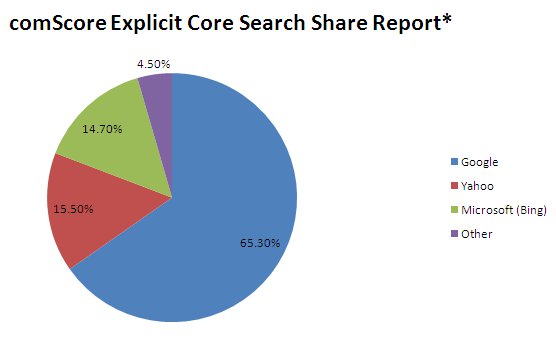
    If you work in interactive marketing, you’re are probably familiar with comScore and its monthly estimate of the United States search market share that consistently looks like the following graph, reflecting data collected September 2011. It’s safe to assume that these numbers apply to the websites that you promote as well, right? Not really.

    comscore search market share for September 2011

    For the past few years, it seems like every dataset that I’ve seen contradicts these market share reports, so I decided to dig a little deeper and see what I can find.

    comScore’s numbers:

    comScore is extremely thorough in its calculations. It obtains this information by installing software on the devices of a large number of paid users, which tracks and records all the searches performed on that device. In the month of September 2011, the company recorded over 17 billion search results. It claims to get data from a variety of users that is representative of the market share of major ISPs in the U.S., but other than that, I’m not sure how they pick users. Either way, 17 billion intuitively seems like a big enough sample to come to firm conclusions.

    My Tiny, but Interesting Dataset

    To find numbers that I thought would be representative of the search engine market share for our clients and sites, I created a custom report in Google Analytics that provides the number of site visits from organic searches, and breaks them down by each particular search engine, over the last month (10/2/11 – 11/1/11). To figure out which sites to use, I exported data for the first 75 sites I found that I was certain were active and received organic search visits. The total number of visits was approximately 350,000, so it’s a relatively small sample. There was one site that I excluded because its total visits exceeded all other sites by 3!

    organic search market share for search influence clients

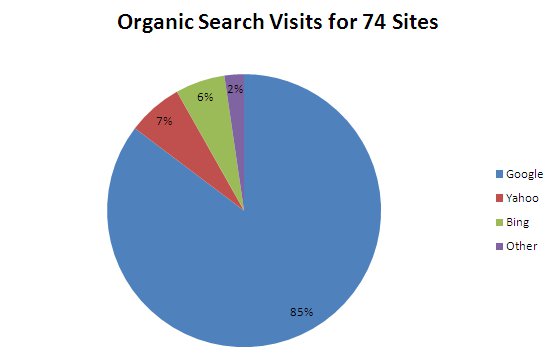
    As you can see in the chart, Google searches account for a whopping 85% of the organic visits! Like the comScore data, Yahoo and Bing are about even. This is pretty amazing, right? Even though these numbers are too small to make comparisons to the U.S. market share as a whole, the information is representative of Search Influence clients and therefore important to us.

    Industry Segments

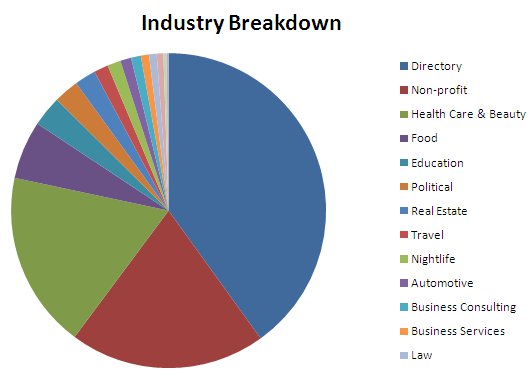
    Most of the sites we looked at are small businesses throughout the country. 40% of the results come from 2 medium sized yellow pages directories–but when you take these two sites out, the share is virtually the same. We also see big numbers from Health Care & Beauty and Non-profit. The Non-profit is actually one large organization and the Health & Beauty segment is mostly composed of dentists and plastic surgeons. Two of the sites included are informational sites that attract national visits. Those two sites alone, which represent about 1% of the total visits in this set, received on average 94% of their organic visits from Google.

    industry breakdown for market share information

    Why the Numbers are Different

    The numbers differ for many possible reasons, but none that I have been able to completely pin down. Obviously the set of websites used here is not representative of sites on the Internet as a whole. Another reason could be that Google inaccurately reports referrals from other search engines, or perhaps small businesses rank better on Google, so our small business clients get more visits from Google. Another factor may be that none of these sites target American users that search in a language other than English. Whatever the case may be, it’s obvious to me that Google has an even bigger impact on our small business clients than the comScore numbers suggest.

    What about you? Feel free to share your data, do a similar study, speculate on these results, or tell me why I’m full o’ bull.

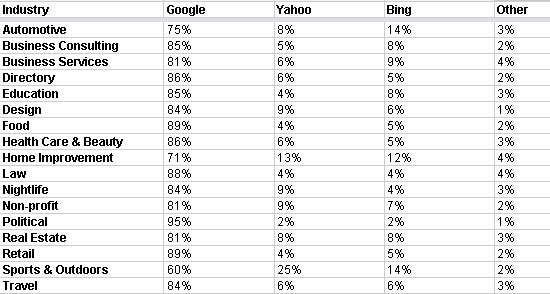
    Oh, and if you’re interested in a more detailed breakdown of the results in a particular industry, here it is. Here is a link to the spreadsheet.

  • SEO Optimization Tips for the Yahoo-Bing Merge

    While Google has reigned supreme when it comes to optimization, now may be the time to reassess your Bing strategy. As we mentioned in an earlier post, Yahoo anticipates that their organic search results will be fully powered by Microsoft sometime in August or September. However, Yahoo has already begun testing Microsoft’s organic and paid listings. Up to 25% of their current organic search results come from Bing, while up to 3.5% of paid listings can be from their AdCenter.

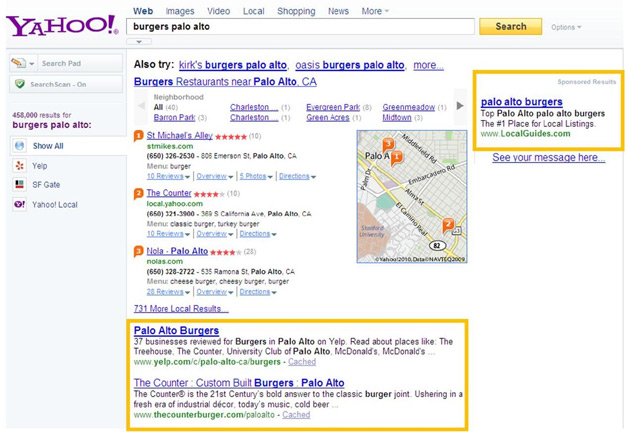
    While the results may be coming from Microsoft, Yahoo assures that they will retain their familiar format. They offer up the following image, where the boxed areas are those that come from Microsoft:

    They also offer up the following tips for SEO:

    • Compare your organic search rankings on Yahoo! Search and Bing for the keywords that drive your business, to help determine any potential impact to your traffic and sales
    • Decide if you’d like to modify your paid search campaigns to compensate for any changes in organic referrals that you anticipate
    • Review the Bing webmaster tools and optimize your website for the Bing crawler, as Bing results will be displayed for approximately 30%* of overall search query market share after this change

    These tips- along with many more- can be found here. Not much work will have to come from you, but it’s best to familiarize yourself with the changes now in order to be better prepared.

  • Fall 2010 Yahoo Will Show Bing Organic Results

    Yahoo!Last week, Yahoo sent out emails explaining how the merger with MSN/Bing would effect paid search advertiser.  The most interesting piece of information the email provided was about the transition to Bing search algorithm in early Fall.

    Organic Search Transition
    To date, we’ve focused most of our communications to you on the paid search transition to adCenter. However, another key aspect of the Yahoo! and Microsoft Search Alliance is the transition of Yahoo! organic search results (those found on the main body of the page). Assuming our testing continues to yield high quality results, we anticipate that our organic search results will be powered by Bing beginning in the August/September timeframe.

    Frankly Yahoo’s effectiveness at generating leads has been on a slow decline for years.  I completely blame this fact on Yahoo’s refusal to evolve. They spent so many development hours creating Yahoo Messenger, Yahoo Games, and Yahoo Groups, they forgot to focus on the quality of their search results. While I’m not thrilled by the merger, I am excited that SEOs will have one less search engine to optimize.