Tag: healthcare marketing

  • Healthy Content: 4 Tips to Drive Conversions in the Medical Industry

    Healthy Content Marketing Image - Search Influence

    In the medical and plastic surgery industries, it can be hard to get past the medical jargon and engage with readers online. But despite these challenges, building up an online presence is vital in this day and age. Everyone online wants to gather information quickly, and they seek immediate gratification when it comes to scheduling appointments and learning about procedures. To keep their interest, you have to present your content in a user-friendly, engaging and attractive way. Let go of the olden days of long-winded explanations and paragraphs upon paragraphs of medical terminology that no one can understand. Step into the 21st Century with these four types of content:

    1. Infographics

    We all want something that is nice to look at and easy to understand. Infographics are not only engaging, but they can also be super informative! The medical terminology that your current and prospective patients need to know can be easily explained in shorter phrases and pictures or guidelines. Infographics help your patients connect with you and your practice.

    Infographics are also more likely to be shared by your customers. People love sharing fun and interesting infographics on their own social media pages, so this will ensure more conversions and potential new clients! Find out more about how infographics can give your content marketing strategy a facelift.

    2. Videos

    Videos are another great visual way to engage your website visitors. You could explain your processes and surgical procedures easily without scaring visitors off with long, complicated paragraphs. This is also a great way to introduce yourself and your practice to potential patients.

    You don’t have to do a stand-up; you could make a slideshow video with voiceover narration, or if your budget allows, an animated video. Make sure you include a call to action at the end so the viewer can take the next step in becoming a patient!

    3. Lists

    Lists are great. You’re reading one now! Putting the number of listed items in the title is especially helpful so people know exactly what they’re getting into. Readers are more likely to click through and take the time to read if there are 10 or fewer items. They’ll think it will only take a couple of minutes, then BAM! They’re hooked. They’re converting, and they’re your next patient!

    Make sure to write lists that are interesting and preferably not common knowledge, such as “10 Things You Didn’t Know about ____” or “5 Ways to Look Younger Without Surgery.” You could even promote your products or services with a list of great products for this, that, or the other thing. Keep it short, sweet, and to the point.

    4. Guides

    Because you specialize in a certain medical field, you have knowledge that is credible, useful, and interesting. Write it down! Guides can be about absolutely anything, and they’re excellent sharing material for those who want to stay informed and keep their social media followers/friends informed. For an example, check out the Search Influence guide on how your online presence can win and lose patients.

    An excellent way to drive up conversions is to make your guide a downloadable file and request information from the reader before they can download. This allows you to add them to your email newsletter list, which will make them more likely to become a patient in the future.

    Deciding how you want to present yourself online can be time-consuming and frustrating, but these four winning types of content are fun, engaging, and can help your conversion rates. Play around with some ideas and be sure to use different content on different pages to keep people wanting more!

    Interested in more content marketing tips for medical marketing? See how natural content can help your practice’s website attract patients.

     

  • Give Content a Natural Glow: Medical Marketing Makes the Switch to Natural Content

    Content marketing natural glow image - Search Influence

    Back in the early days of search engine optimization, there were a lot of shady practices that were less than ideal for site visitors. Keyword-stuffing, spammy tweets, backlink schemes, and useless content were often the norm, as these tactics helped websites climb the ranks of the search engine results page. With content more focused on algorithms than the audience, many websites scared off potential users. While some of these tactics have been left firmly in the past, many SEO strategies still optimize for Google bots instead of users. This is especially true when it comes to geo-modified keywords in healthcare marketing (think “plastic surgeon new orleans”), which continue to make many pages feel stuffy and awkward.

    Of course, letting go of geo-modified keywords can seem like a hard pill to swallow—especially for those in highly competitive fields such as the plastic surgery industry, where medical practices are constantly battling for the top spots in a Google search. “Going natural” when it comes to content might seem like an overwhelming change at first, but the benefits to your patients and your practice make it a worthwhile strategy in the long run.

    Content is King

    So what do we have when we eliminate all the spam? Natural content. Google rewards sites that provide better user experiences, relevant information, and quality content—those with high click-through rates, low bounce rates, and long time-on-site—with better overall rankings.

    What’s more, all of the updates to Google’s algorithm have made the search giant incredibly advanced, and you might be surprised by some of the astonishing leaps it can make. A search engine results page might pull up one or more high-ranking pages that never actually include the words a user originally entered as a query. For example, a search for “breast implants new orleans” might return pages that never actually use this exact term. Highly relevant pages on “breast augmentation” might rank higher in a Google search than irrelevant, keyword-stuffed pages. What does all this mean? Google’s smarter than you thought.

    Interested in more content marketing strategies for your website? Find out how infographics can give your online strategy a facelift.

    It’s All About the Audience

    As its name suggests, SEO has always focused on search engine optimization—but the best way to earn trust from your patients is to focus on your patients. Forget trying to keep up with algorithm changes: Google’s updates are always centered around providing a better user experience, so why not focus on that as well?

    Spammy, keyword-stuffed content isn’t doing your patients any favors. Visitors to your site can see through the awkward “fluff” content, and they’ll abandon it to find content that actually answers their questions and meets their needs. Sites with overly optimized content tend to see higher bounce rates and less time spent on the site overall.

    Protection Against Algorithm Updates

    Beyond the fact that you’re losing your human visitors by focusing your content on the needs of Google bots, you also hurt yourself with this approach. Overly optimized content is vulnerable to every new update to Google’s algorithm. Well-written natural content, on the other hand, won’t need any of the major edits that spammy content will regularly require. Content that is relevant to the needs of your patients will always be useful—and Google’s algorithm can see that without your help. If you need help determining whether your website content will pass the Google test, fill out the short form on our homepage to sign up for a free website analysis.

    Search Intent Optimization

    At the end of the day, your potential patients are looking for something, and it’s your job to figure out what. Maybe they need help to become informed about a procedure they’re considering, maybe they’re weighing the pros and cons of several medical options, or maybe they know what they need and are searching for a trustworthy practice in the area.

    Whatever the case, you’ll need to do your research. Figure out what they consider useful and decide how you can use unique and creative content to solve their problems. Patients will be able to see the value in content that gives them the answers they need, and they’ll trust the information more if it doesn’t seem awkward or spammy. Go from there to build your relationship with them—rather than building a relationship with an algorithm.

    If you’re ready to take the dive into offering patients more natural content, but you’re not sure where to start, let us know how we can help! Interested in the ins-and-outs of search engine optimization for the medical industry? Check out our tips on the art of “Googleplasty.”

  • Survive Google’s ‘Mopocalypse’ with these Tips for Your Mobile Strategy

    Survive Google’s ‘Mopocalypse’ with these Tips for Your Mobile Strategy

    Mobile Friendly Image Search Influence

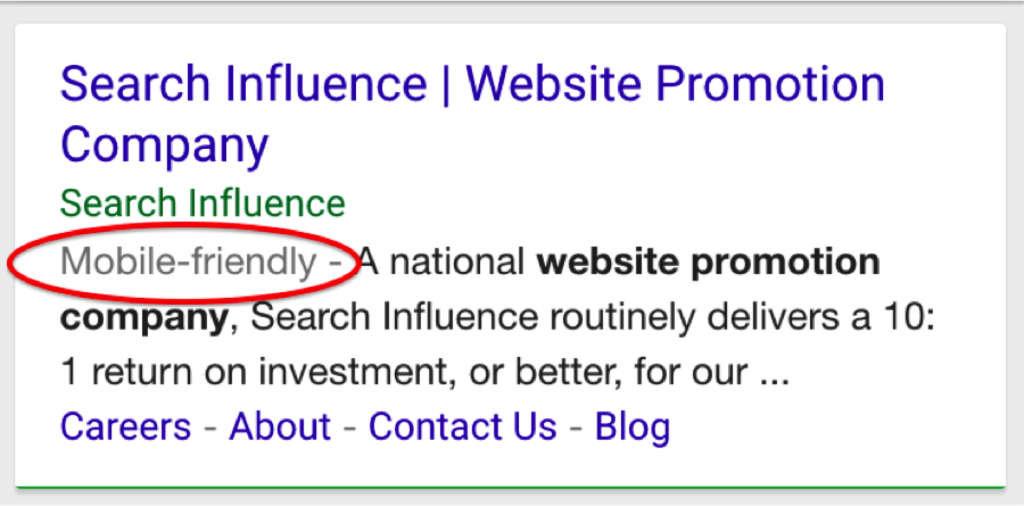
    Google’s new mobile-friendly update, which I originally discussed in my Search Engine Land column, is rolling out this month, and it’s time to put the focus on mobile. But with all this buzz about mobile websites, you may be thinking, “My website looks fine on my smartphone when I pinch and zoom, so what’s the big deal?”

    Well, there’s much more to it than that.

    Step 1: Get a Mobile Website

    Just because your Web developer tells you your site is mobile doesn’t necessarily make it true. Make sure you’ve used Google’s handy mobile-friendly testing tool to check your website. In Google’s eyes, businesses have three main options for becoming mobile-friendly: responsive website design, dynamic serving, and separate URLs.

    So what option is right for your business? The bottom line is this: for businesses with growing mobile traffic that has not yet reached a critical percent of site traffic, a purely mobile version on a separate URL is a viable option. But for businesses with mobile website traffic pushing 50 percent or more of all site traffic, it is time to invest in a responsive website. While a responsive website typically requires a complete overhaul, your customers will probably thank you when your website can display differently based on the screen size.

    Step 2: Use ‘Barnacle SEO’

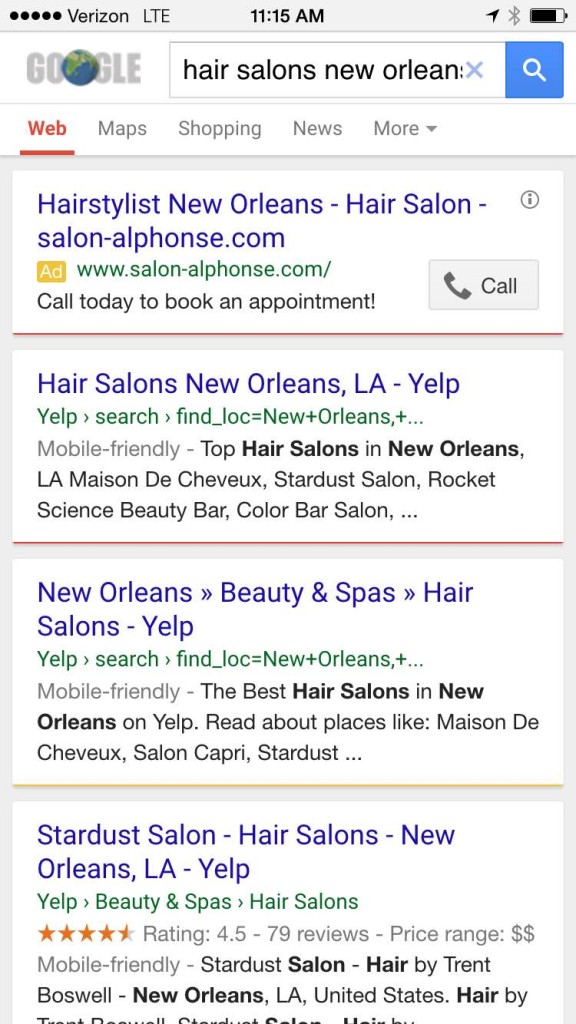
    Even before your mobile website is in action, your business needs to attach itself to large, fixed objects, and then wait for mobile customers to float by in the powerful current. I like to call this Barnacle SEO, also known as the “If you can’t beat ‘em, join ‘em” strategy. Basically, this means identifying large, high-ranking online directories such as Yelp, for example, and adding your information there in the hopes of “borrowing” some of their page one rankings. And there are many trusted online directories like Yelp out there you can barnacle up to: Angie’s List, Foursquare, Google+, Avvo (for lawyers), HealthGrades (for doctors), even TripAdvisor.

    This strategy works well in mobile because these websites are optimized for the mobile experience—providing the targeted information that local customers searching on their smartphones really need. When you perform a Google search for “hair stylists New Orleans,” for example, the top results are mostly from Yelp:

    Yelp Mobile Screenshot Image - Search Influence

    Step 3: Focus on Location, Location, Location

    Let’s face it: when mobile matters, location matters. Consider this: 50 percent of consumers who performed a local search on a smartphone visited a store within a day, according to a recent study from Google. So that’s good news for brick-and-mortar businesses with a mobile-friendly website. Those businesses will enjoy the additional ranking factors from the upcoming mobile-friendly algorithm, getting these small businesses in front of their target market at the time and place searchers are looking.

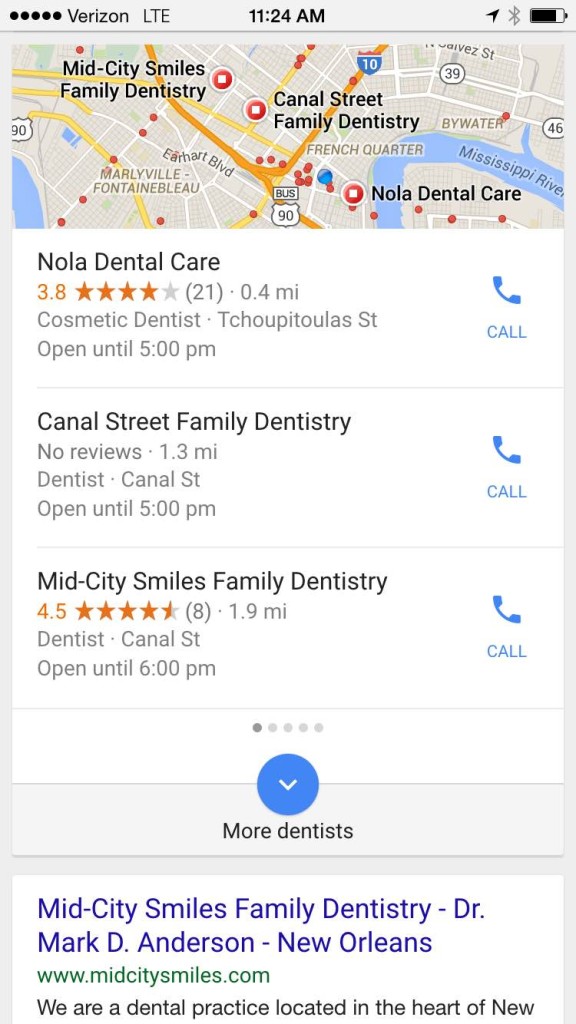
    The challenge? Local businesses must break into the top three local results—the ones typically seen on your smartphone. For example, if I search for “dentists,” Google is going to give me dentists near me … and I see only the first three results:

    Dentists Near Me Search Image - Search Influence

    To wrap it up, these are three steps you can get started on now. But remember, as with all Google algorithm updates, stay calm and give it time. April 21 was not the end-all-be-all date. This rollout will likely be a period of rollouts rather than a single-day launch. We usually recommend giving an update 60 days to see the full impact. And even then, there are revisions and updates and you just don’t know.

    So what’s your next move? Keep an eye on your website traffic to see if the update is impacting your mobile traffic. If you need help, give us a call at 504-208-3900. We’re here to help ease your “Mopocalypse” fears.

  • Let’s Get Medical: How To Manage Healthcare Listings On G+

    When it comes to adding healthcare listings in Google My Business (now the one-stop shop that includes Google Plus business management), there are many things to consider when managing multiple entities within one location. While building out multiple listings unnecessarily is not ideal, some instances may call for multiple listings in order to distinguish between unique departmental differences.

    If there are multiple departments within your hospital or practice that have unique information (for example, a different phone number from the main hospital or practice) and operate differently from the primary location (for example, unique hours are typically considered an operational difference), then it is best to build out separate location pages for each of the departments to provide this information to customers more clearly.

    Let us delve into an explicit example of this. If your general hospital houses a hospital pharmacy and an emergency department, then these departments serve different purposes and might have separate hours and phone numbers.

    IMPORTANT NOTE BEFORE PROCEEDING: The following examples are ENTIRELY FICTIONAL BUSINESSES.

    Creating Pages:

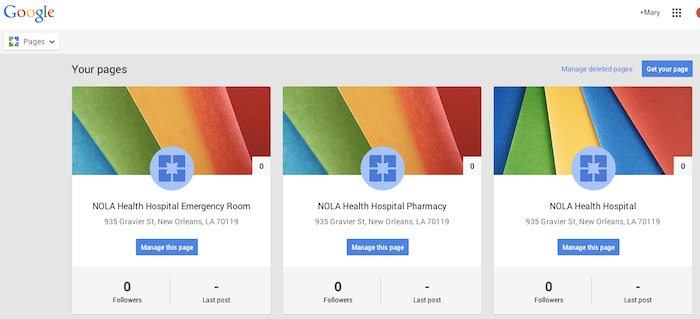
    Let’s say the aforementioned example is called NOLA Health Hospital. NOLA Health Hospital, in this instance, should have three Local (Storefront) Google Plus Pages. Note that these pages, while most likely using the same address, should have unique phone numbers. They should also have unique names; for example, “NOLA Health Hospital,” “NOLA Health Hospital Emergency Room,” and “NOLA Health Hospital Pharmacy” would be the proper names. These pages should also list their hours of operation according to their department-specific hours. If these pages were properly set up in the Google My Business dashboard, they would look like the following screenshot.

    Google My Business Dashboard - Search Influence

    Setting Categories:

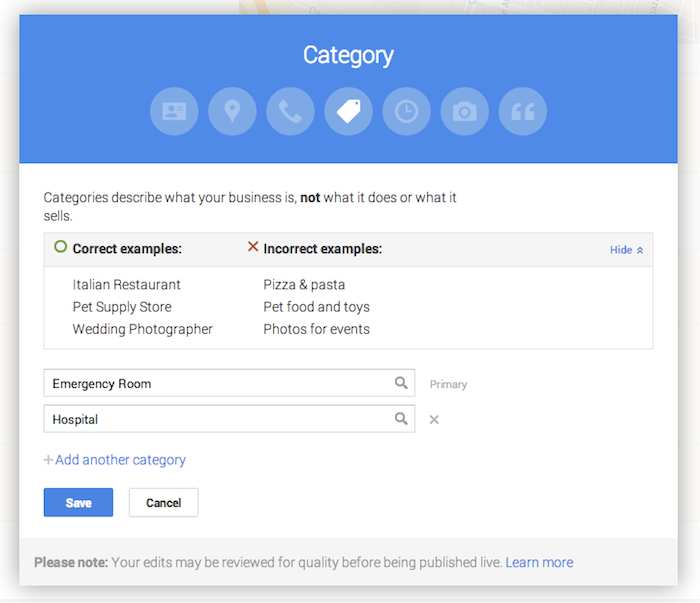
    Now that you have created the pages, it is important to use the categories to distinguish the differences between them. Google’s guidelines for businesses explicitly state that “For each department, the category that is the most representative of that department must be different from that of the main business and that of other departments.” This means that the primary category for each page should be different. In this example, NOLA Health Hospital Emergency Room will have the primary category “Emergency Room,” NOLA Health Hospital Pharmacy will have the primary category “Pharmacy,” and the general hospital of NOLA Health Hospital will have the primary category “Hospital.”

    Google Plus Page Editing - Search Influence

    While these settings are typically arranged during the page creation process, they can also be edited after the page is created. Click on “Manage this page” from the Pages dashboard, then click “Edit” in the top right-hand corner, and finally click into the “Category” section of the editing page to adjust the category. This is also where you can build out supplemental categories for the page. However, it may be wiser to use a few specific categories, as Google’s guidelines advise that it is best to “choose the fewest number of categories it takes to describe your overall core business.”

    As always, if you’re ever confused about how to proceed with your page, you can find the Google My Business “Guidelines for representing your business on Google” on the support site.

  • Five for Friday – LG Hires Bros to Build Brand, Your New Favorite Robot & Google Sees the Future of Eye Care

    Comic5

    1. LG Teams Up With Bro-tastic YouTube Network for Content Marketing Campaign
    – Advertising Age

    YouTube famous stars known as Dude Perfect are getting more than just views from their unbelievable, athletic trick shots. They have already acquired advertising leads with brands such as Pringles, Nerf, and as of this week, smartphone maker LG.

    LG hopes that by standing behind these bros, they can extend their reach to younger audiences and hopefully create some competition for other dominating brands in their industry.

    Incorporating this “jaw dropping” content may boost LG’s brand recognition, but stealing market share from Apple may be a bit of a reach.

    RobotWavingHandSmallImage2. Say Hello to the Robotic Personal Assistant of Your Dreams
    – Entrepreneur

    Meet Jibo, a robotic personal assistant created by Dr. Cynthia Breazeal, a Boston-based professor and entrepreneur. Jibo is a “family robot,” designed to interact with your household, take photos and remind you of important events.

    Having had a strange personal experience with Siri, I’m a bit skeptical of personalized interaction with a computer. Jibo seems to break the mold, but will this technology continue a pattern of diminishing personal interaction in today’s culture?

    3. Novartis, Google to Develop Contact Lenses to Monitor Blood Sugar
    – Mashable

    Google is currently joining with Novartis, a Swiss pharmaceutical research and sales company, to develop smart contact lenses. These lenses, expected to make their debut as early as next year, will be equipped with blood glucose monitors and autofocus for troubled vision.

    “The promise here is the holy grail of vision care, to be able to replicate the natural functioning of the eye,” Jimenez said in the Bloomberg report.

    As if being “the holy grail” of the internet was not impressive enough, Google is taking it a few steps further and improving health care and the quality of life as well.

    ContactsEyeImage

    4. Prototype Improves Mobile Typing by Ditching the Keyboard
    – DNews

    Are you fed up with ineffective, awkward mobile and tablet typing methods? Well, a startup based in Austin, Texas is in the early stages of creating a nonexistent keyboard to solve that #FirstWorldProblem.

    Just as the name implies, the AirType project’s goal is to create a system allowing the user to type freely with no restriction but the mobile sensors around your hands and knuckles. Not only does this keyboard (or lack there of) allow you to type freely, it will also adapt to your activity and begin recognizing your habits, like voice recognition for your hands.

    5. Retargeting Is Flawed; the Future Is Pretargeting
    – Digital Next

    What if ads were designed to service needs that we don’t even know we have? Retargeting will soon be a thing of the past, the future of advertising is our future behavior.

    Most are familiar with retargeting efforts, taking products and services we already recognize and driving marketing for those brands. Marketers are beginning to refocus their goals to be more predictive and create wants and needs we may have in the future. The more information consumers divulge, the more predictive marketers become.

    Image Sources:

    Niek Beck, Moms contact