Tag: healthcare marketing

  • Search Influence Partners with the Louisiana Hospital Association for a Virtual Training

    Search Influence presents “The Great Resignation: How to Stabilize and Even Boost Your Marketing in this Uncertain Time” in partnership with the Louisiana Hospital Association (LHA) on Thursday, Sept, 22, 2022. This is Search Influence’s fourth time partnering with the LHA for a virtual training exclusively for the organization’s members.

    Louisiana Hospital Association logo image

    Established in 1926, the LHA is a not-for-profit association representing all types of hospitals and healthcare systems throughout the state. The LHA carries out its mission by providing services and resources to members through advocacy, education, research, representation and communication.

    About the Virtual Training:

    The Great Resignation is impacting every industry, especially the medical industry. A recent survey by Marketing Hire News found that marketers are not an exception to this trend. But how can medical practices ride the wave of this turnover and still continue to push their marketing objectives forward? How can your in-house mar comm be prepared for turnover whether that is now or later? How can medical practices take advantage of the Great Resignation on the marketing front?

    The Great Resignation sounds scary but let HR handle the comings and goings of staff and deep dive on the marketing engine driving your company’s objectives and revenue. Best practices and strategic line of sight can keep marketing tactics such as third party review sites, patient testimonials and storytelling in motion while staff positions are vacant.

    Shore up four key areas of focus within the marketing communications function that can position your company to excel even without being fully staffed in-house.

    1. Plan
    2. Partners
    3. Performance
    4. Pivot
  • Search Influence Presents Virtual Training in Partnership with the Louisiana Hospital Association

    Louisiana Hospital Association logo image

    Search Influence presents “How to Gain CEO/Admin Trust & Buy-in on New Marketing Strategies” in partnership with the Louisiana Hospital Association (LHA) on Thursday, June 24, 2021. This is Search Influence’s second time this year partnering with the LHA for a virtual training just for the organization’s members.

    Established in 1926, the LHA is a not-for-profit association representing all types of hospitals and healthcare systems throughout the state. The LHA carries out its mission by providing services and resources to members through advocacy, education, research, representation and communication.

    About the Virtual Training:

    As a medical marketer, it’s your job to help hospital CEOs and administrators understand how new marketing strategies will fuel patient growth.

    Join Search Influence for a virtual training that demonstrates how to build a case for new marketing efforts, including tips on how to showcase how they’ll help you reach your audience and impact your hospital.

    Learning objectives for this event:

    • How to use qualitative & quantitative goals to plan and pitch marketing strategies
    • Tactics to demonstrate how a given strategy will help you reach a specific target audience
    • Guidance to tailor your discussion based on personality styles and role
    • Opportunities to leverage data in your decision making and discussions
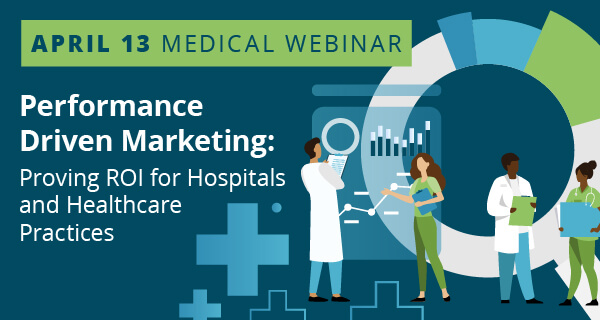
  • Search Influence to Host Healthcare Marketing Webinar, “Performance Driven Marketing: Proving ROI for Hospitals and Healthcare Practices”

    Performance driven marketing: proving ROI for Hospitals and Healthcare Practices

    As a medical marketer, it’s your job to help hospital administrators and practice owners understand how their medical marketing investment fuels patient growth.

    Join Search Influence Director of Sales and Marketing, Paula French, and Sales and Partner Strategist Gabrielle Woodard for the free webinar, Performance Driven Marketing: Proving ROI for Hospitals and Healthcare Practices.

    Paula and Gabrielle will demonstrate how to tie your marketing efforts to the revenue of your hospital or healthcare practice and share best practices on how to measure performance data and track the value of your work.

    Learning Objectives for this Webinar

    • How to use marketing performance data to advocate for your marketing budget and plan
    • Guidance to evaluate if your marketing strategy helps reach your patient acquisition goals
    • Opportunities to bring conversions and transactions online, and how this makes everything—including your marketing—more trackable
  • Healthcare Marketing Laws: Language to Keep Your Ads Legal

    This post was updated by Jordan Polhemus on December 21, 2020 to reflect recent trends and refreshed statistics. It was originally published on November 26, 2019.

    Key Insights

    • Review your current Facebook targeting strategies to determine how the recent changes to Facebook’s targeting options will impact your campaign’s performance.
    • Review your entire messaging and targeting strategy with your legal team before launching any marketing campaigns.
    • Prepare for more health regulations within the Facebook advertising platform.

    Doctor's stethoscope on desk next to laptop

    The healthcare industry, unlike almost any other industry today, has incredibly strict advertising regulations that both individual physicians and large hospitals must follow. Violating these regulations could lead to anything from ads not being permitted on certain platforms to legal action—or even a revocation of a physician’s license.

    This post covers the do’s and don’ts for ad copy and demographic targeting to keep your ads legal in an ever-changing healthcare marketing landscape. Please note that this is not an exhaustive list of everything you should and shouldn’t do for medical marketing. It’s an overview of advertising best practices within the medical industry. Additionally, these recommendations do not include all the specifics for every state.

    Changes to Facebook Advertising Targeting

    Facebook has made several changes to their targeting options since 2019.

    The Removal of Third-Party Information

    The most impactful difference is the removal of third-party information that gave organizations the ability to target users based on personal information, such as (but not limited to):

    • Income
    • Cars owned
    • The age of user’s house
    • The age of the people in the user’s household

    Before this update, many data providers partnered with Facebook to create a more descriptive profile of their users that allowed marketers to create extremely detailed and specific targeting.

    After the Cambridge Analytica scandal, Facebook decided it didn’t want to be responsible for the data that third parties brought in, so it eliminated Partner Categories and other third-party data programs.

    The Removal of Potentially Discriminatory Targeting

    Facebook has worked to remove potentially discriminatory targeting to prevent misuse of the ad platform in the future, including:

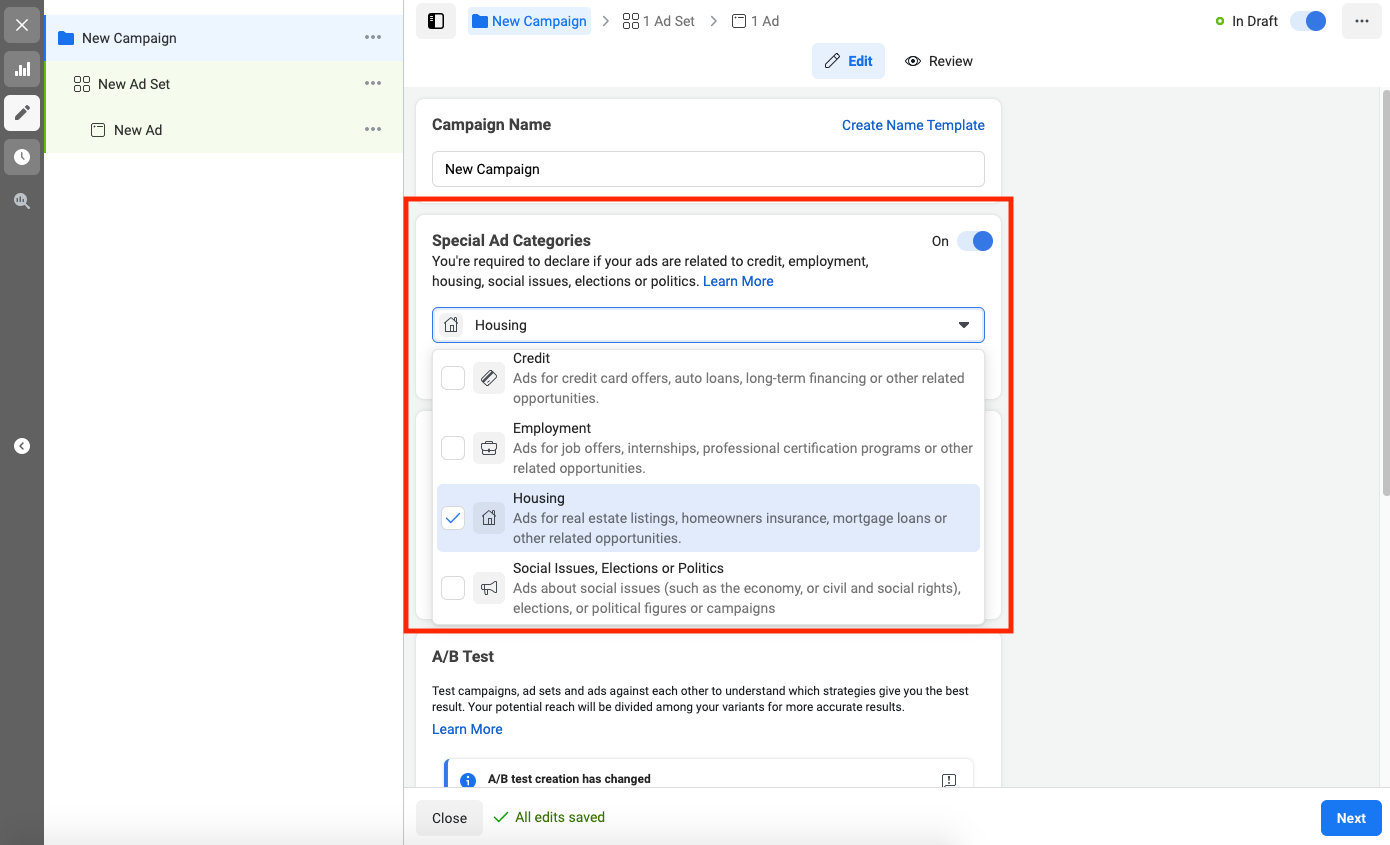
    Facebook’s “Special Ad Categories”

    In the last few years, we’ve seen a considerable tightening in what marketers can do when promoting organizations in certain industries. The types of ads impacted include:

    • Housing
    • Employment
    • Credit card
    • Political

    Screenshot showing Facebook's special ad category options

    Predictions for the Medical Industry

    Although this isn’t the case yet in the medical industry, we believe that Facebook will move in this direction soon and require all medical providers to follow additional guidelines, which will place further restrictions on their targeting and messaging. Although not currently in place, you will likely have to choose a “special ad category” to advertise in the medical industry on Facebook in the future.

    For example, if you are running ads for any political organization, such as a political candidate, PAC (political action committee), or even for small local elections, the advertiser and the ads must comply with a very strict set of rules, including:

    • Verifying the page
    • Providing special documentation proving the identity of the page manager
    • Complying with specific messaging guidelines
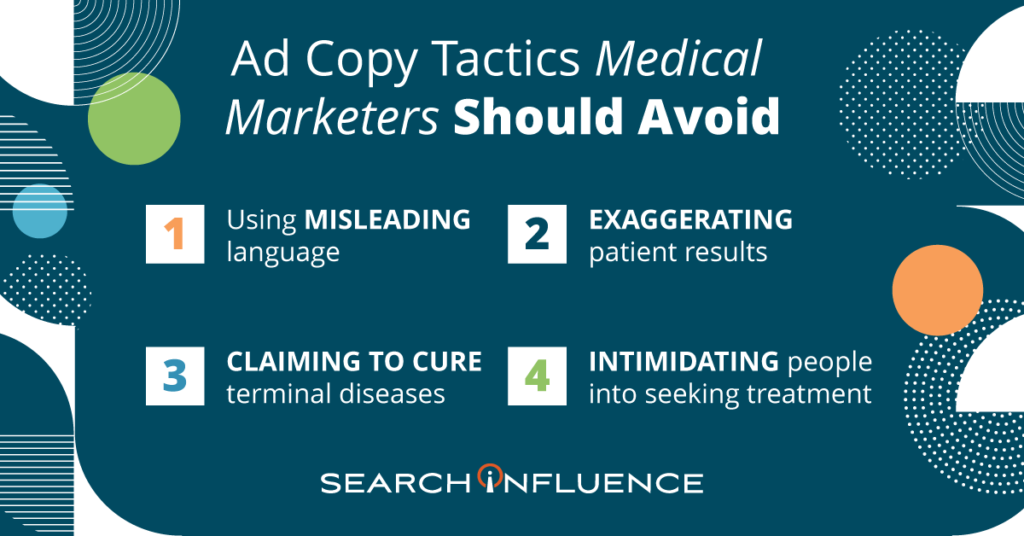
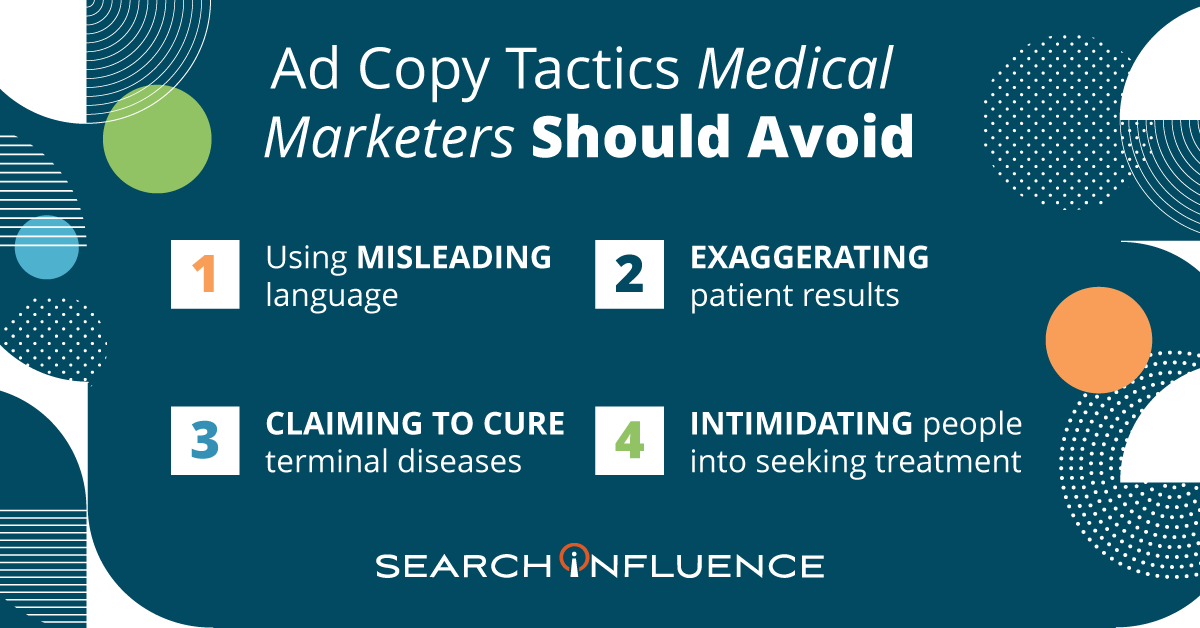
    Ad copy tactics medical marketers should avoid

    Advertising Language Do’s and Don’ts

    Advertising cannot be misleading in any way

    Misleading or deceitful language is strictly forbidden in all medical advertising. This includes implications that would cause a reasonable person to misunderstand or be deceived. Consider the impact of the words you choose in your Healthcare SEO strategy as well.

    Examples:

    • “This procedure will heal you.”
    • “You will look just like Kim Kardashian.”
    • “You will never need to see another doctor again”.

    Don’t use words like “best” or “superior”

    Unless there is objective evidence to support the claim, practices cannot claim professional superiority in any way.

    Examples:

    • “We are the best plastic surgeons in the world.”
    • “You will be under the care of the greatest ophthalmologist in your area.”
    • “Make an appointment with the most talented doctor.”

    Don’t use hyperbole when describing your techniques or results

    A potential patient’s health should be discussed factually and without embellishment, so using exaggerated statements or claims (even if they’re not meant to be taken literally) can be seen as deceptive and misleading.

    Examples:

    • “Your skin will be softer than silk.”
    • “Make an appointment for the best day of your life.”
    • “You’ll be as skinny as a toothpick.”

    Don’t assure a permanent cure for an incurable disease

    Don’t use intimidation or undue pressure for services, products, or procedures

    Examples:

    • “If you don’t get this procedure done by ____doctor, then you will die”
    • “If you don’t see Dr. X, then you are doing a disservice to your children”

    Don’t make any scientific claims unless you provide a reliable, peer-reviewed study as evidence

    Because of the amount of trust patients put in their healthcare providers, physicians are required to provide truthful information when making healthcare decisions and recommendations.

    Therefore, it would be an ethical violation for any practice to claim results or benefits that cannot be scientifically proven, whether or not that physician is talking to their own patient.

    Example:

    • “Getting X surgery will extend your life by 15 years”

    Don’t show before and after photos without the proper disclaimers

    Because before and after photos can influence a patient’s decision-making process, each practice must clearly state that results may vary and the results shown are not guaranteed. Otherwise, patients could reasonably expect to see similar outcomes.

    Practices must include disclaimers alongside perceived claims, even if the claims are direct quotations from past patients.

    Don’t reveal patient details

    Anonymizing patient information isn’t as simple as changing a name. Under HIPAA, there are more than 18 categories of personal health information (PHI) that can result in patient identification.

    It is best to either create a fictional scenario in your messaging or work with your attorney to secure a no-compensation, signed patient release before using any of their PHI in advertising.

    Don’t make any claim about the cost of a service or product that your practice cannot substantiate

    Due to differences in medical coverage based on health insurance, advertisements should never include prices—unless the practice can ensure that all patients receive that price regardless of their healthcare coverage.

    Don’t use a competitor’s name or any other trademarked name in ad copy or advertising without written permission

    If you wouldn’t say it in the elevator, don’t put it online

    Try reading the content of a post out loud and to others before posting. If it sounds like something you wouldn’t say in an elevator (where you can be overheard), then it shouldn’t be something that you put in advertising.

    Have your marketing plan, including ad copy, reviewed by an attorney to confirm that no laws are being broken in any of the states your ads will appear.

    By working with both large hospitals and small private practices, we’re well-versed in medical marketing and have years of experience running successful campaigns for our clients. Our digital marketing agency keeps up to date with the latest medical search trends, as well as updates to regulations and best practices.

    As a Google Premier Partner, the majority of Search Influence’s employees are certified in Google’s advertising platforms, including Search, Video, Mobile, and Display, just to name a few.

    For more information about how we can help promote your practice on Facebook and other social media platforms, start a conversation with us today.

    Resources

    Images

    Stethoscope

  • Put a Ring on It: Turning Inquiries Into Lasting Patient Relationships

    Let’s envision an ideal scenario. Your private practice has a dynamic social media campaign, your website is optimized for all the right keywords, your blog showcases helpful and engaging posts, and maybe you’re even showing up on page one of Google’s search results. Basically, you’re an online marketing all-star. Well, to be honest, the real payoff relies on what you do next.

    Image Of Character Ron Burgundy - Search Influence

    How do you respond when all of this great marketing generates a lead? After all, you put a lot of hard work into building new patient relationships. But while all of this marketing could be seen as the courtship, handling the inquiry is the proposal. You better time it right and create an experience worth remembering.

    At this point, the prospective patient is taking the initiative to make contact, which means they are serious about taking action—they’re ready for a commitment. Even if you’re just posting your first Facebook status or still need some SEO guidance, every inquiry is the potential for a new patient to make the jump from interested to committed.

    Responding to inquiries is your first real engagement with a prospective client. They responded to your presence online, but how does it stack up to your presence IRL? In the healthcare industry, competition is high, and patients may be willing to travel great distances for the right provider—but that prospective patient may just move on to the next option if they don’t hear from you quickly or get the right answer.

    So, what’s the best way to ensure a “yes” to your proposal? Here are three tips to turn inquiries into actual patients.

    Image of Beyonce - Search Influence

    Respond Quickly

    Quickly can’t be overemphasized. In fact, according to The Lead Response Management Study conducted by Dr. James Oldroyd of MIT, the odds of qualifying a lead are 21 times less likely when comparing a response rate of 5 minutes vs. 30 minutes. Similarly, according to research from Harvard Business Review, companies that follow up on leads within an hour are 7 times more likely to have a meaningful conversation with the decision maker. This isn’t all that surprising when you consider our fast-paced culture of instant gratification. That same person who reaches out to your practice is likely contacting your competition, scouring through Google results and online directories to weigh the best healthcare options. They may already have their appointment scheduled at the office next door if you don’t respond quickly.

    You can increase your response speed by creating a short cheat sheet or script for answers to common questions, especially pertaining to pricing. This will empower an administrative team to handle inquiries confidently and quickly without consulting with the doctor or dentist before every response. Don’t forget that inquiries on social media, like questions through Facebook messaging, should be treated with the same level of professionalism and timeliness. Other features like online chat and online appointment scheduling make the conversion happen even more quickly. Many users are opting for digital communication, and it’s important to talk to your prospective patients in the format that they prefer.

    Track Your Leads…and Your Successes

    So how do you know what your patients prefer? You can start by collecting valuable information about the behaviors of your current and prospective patients to meet their needs better and make communication as seamless as possible. Online and call lead tracking will allow you not only to understand which communication methods work best, but also what led interested parties to your practice in the first place. Are they interested in a specific treatment page? Are they looking for plastic surgeons close to a particular location? Tracking this behavior can help tailor your response and deliver the right information.

    A tracking system also allows you to keep a detailed record of your correspondences and successful conversions. Use these metrics to determine what’s working and where to focus your energy. Maybe you see the biggest conversions through your online appointment scheduling feature, or maybe most of your new patients are searching on mobile and calling the office—use the data to build on your successes. For example, if you see a lot of phone call conversions, you can tailor your online marketing campaign to feature your phone number more prominently in your ads and website copy. Either way, you can’t make improvements if you don’t have the data. Learn more about the value of lead tracking and analytics.

    Listen to Their Needs and Make It Personal

    Now that you have systems in place for generating prompt replies and tracking your successes, you can focus on the actual response. This part might seem obvious, but it’s the most important aspect—especially in the healthcare industry where your customers are trusting you with, well, their health. Make sure your response includes questions, and spend more time listening to the inquiry than dishing out information. While phone scripts or automated email responses are great timesavers, be sure you consider multiple lead types and create responses that can fit different common inquiries like procedure costs or consultation requests.

    Remember that your response should show that your office is competent, knowledgeable, and compassionate. This extends beyond the healthcare professionals to the caring and attentive administrative staff answering the phones and making the appointments. Each employee is a representative of your brand and can create a memorable first interaction—whether it’s a phone call, email, or social media post. Your staff or a marketing agency should be equipped and ready to handle responses appropriately through multiple channels.

    Essentially, your response should be crafted to potential patients’ needs from the very start. While it may seem simple, ensuring that these steps are built into your systems and training will result in consistent and successful conversions. When it comes to healthcare, patients are looking for the gold standard in quality. So if you’re popping the question (you know, the “do you want to schedule an appointment?” question), be sure to time it right and execute a thoughtful, personalized message. Of course, if you’re still working on your online marketing all-star status, we’re always here to help.

    Images:

    Ron Burgundy

    Beyonce

  • Here Are Our Top 5 Blogs You May Have Missed Last Month

    Woah! Did June fly by for you, too? If you are on the beach this week and doing some summertime reading, here are our most popular five blogs from last month that you will want to check out.

    Knowledge is power gif

    What Happened to Facebook’s 20% Text Grid Tool?

    Michelle’s blog is coming in hot as Search Influence’s most-read blog of 2016! If you’re advertising on Facebook, you need to understand the rules and limitations of the images you include. Facebook’s allowance for text within ads has changed slightly over the past few months, so be sure to read up about the latest updates and what they mean for online advertisers.

    5 Medical Practices Effectively Using Instagram

    Calling all doctors: Is your social media strategy healthy? Are your social media channels helping you generate more traffic to your site and more qualified leads? Read how these five medical practices have been utilizing Instagram to further establish their brand, increase their online presence, and stimulate user engagement.

    Instagram gif

    These 10 Expert Tips Will Drive Traffic to Your Business’s Website

    Feel like you’re doing everything to strengthen your online presence but still not seeing the traffic numbers you’d like to see within Analytics? From schema markup to shareable content to video syndication, we provide ten valuable tips from industry experts to help you increase your site traffic with ease.

    Getting Hands On With the New Google My Business

    Though originally written in 2014, this June blog is still hyper-relevant to the industry. Quite a lot has changed within the Google landscape since 2014, but it can be JUST as confusing to navigate through business pages and local profiles. Let Mary guide you through what’s changed in the world of Google business and what these changes mean for your bottom line. Additionally, if you need help claiming your Google My Business page, check out this recently-completed Search Influence video to painlessly walk through the steps!

    5 Rookie Mistakes That Will Ruin Your New Website’s SEO

    Just launched a new site? Don’t let all of your efforts go to waste; make sure your site is optimized properly so search engines deem it “worthy!” Read on to learn about five big new-site mistakes, and ensure that your site is strong and ready to rank.

    Gif 1 Credit  |  Gif 2 Credit

  • Workplace Wellness Helps Your Waistline and Your Bottom Line

    When pondering the thought of working in an office, several defining factors come to mind quite promptly. One of these components is the sedentary aspect of the job’s general environment. Often, active and health-conscious individuals will refrain from taking office jobs for this reason, because sitting all day long is not exactly healthy.

    yogauned

    A Modern Focus on Wellness

    Changing mindsets have altered the way office spaces are set up today, and many companies have rearranged their once-traditional setups with wellness in mind. As it turns out, this new perspective results in benefits far greater than just the health of employees. In fact, having a health-driven workplace is conducive to overall productivity and satisfaction in the workplace.

    Search Influence has incorporated several health-driven components to the company’s office in order to benefit its employees. Yoga balls replace desk chairs, and standing desks are available alternatives to sitting. Search Influence also provides frequent healthy snacks to its employees, such as fresh fruit and unsalted, raw nut blends, along with filtered water and fresh coffee daily.

    couchsuned

    Saving Money by Saving Your Health

    The US Department of Labor notes that company health programs can not only help promote healthier behavior, but also help increase employees’ overall health knowledge and skills. In addition, creating a corporate wellness program, environment, or even a fitness challenge for employees can pay off collectively, from improved health to the overall company culture. For example, co-workers who come together to eat healthy meals and focus on fitness goals work better as a team at work, too. Healthy employees typically also have fewer missed days of work due to illness, as having a healthy lifestyle and healthy habits translates to stronger immune systems. In fact, many employers have found that implementing a wellness program significantly decreased the costs of both health insurance and workers’ compensation insurance. Studies have reported company-wide insurance cost reductions of up to 30 percent.

    Companies can maximize on this change from the traditional office space by presenting their employees with the chance to enhance their health and fitness and by following up with a reward for their employees’ efforts. This type of program has proven to boost collective morale, making companies more inviting to potential employees when looking to expand.

  • Health Care on the Home Front: Recruit Mommy Bloggers

    Mommy Bloggers For Health Care Image - Search Influence

    When it comes to online influence, mommy bloggers are a huge force in social media and the blogosphere—something many major brands have noted in the past. Names like Pepsi, Wal-Mart, Home Depot, and Coach have all made space for these influential bloggers in their content marketing strategy, adding a dose of authenticity to their campaigns.

    Information exchange has always been a big part of raising children, whether parents are looking for advice on dealing with a behavior problem or trying to find new food options. You can call your friends or your own parents, but there’s always the network of experienced parents ready to give advice online—and with roughly 4.2 million mommy bloggers on the Web, 60 percent of whom say that they blog about brands they love, these influential resources can be a crucial part of a campaign. The bloggers with good advice and entertaining updates rise to become Internet celebrities. Not unlike professional athletes with sponsorship deals, an endorsement from popular mommy bloggers can boost your medical Internet marketing campaign to the next level.

    To tap into the reservoir of parental advice-givers online, keep these four tips in mind.

    Know Your Mommy

    Different bloggers have very different backgrounds and attitudes, and a look at the list of the top U.S. mom bloggers shows the diversity of their backgrounds, attitudes, and writing styles. Many have posted a lot of information about themselves, and you should be able to determine which bloggers would be more interested in your products or services. If you’re looking to raise awareness about new vaccination services at your hospital or practice, you might expect less enthusiastic support from a blogger who has been vocal against immunization in the past. On the other hand, a PTA leader active in community projects might be able to help with your next awareness campaign.

    Participate in the Conversation

    Once you see the kinds of subjects that capture the attention of online parents, look out for topics relevant to your industry. For medical Internet marketing, establish yourself as an authority by posting informative updates about subjects that matter to parents. When it comes to important issues like vaccinations, there will always be rumors and hearsay online, but presenting an informed medical perspective can give mommy bloggers a resource to reference or link in the discussion. However, because of legal complications, you’ll want to avoid offering specific medical advice online, especially in response to individual questions. The American Medical Association’s Code of Medical Ethics is a great resource for anyone who is uncertain about treading into the waters of ethical online content.

    Make Your Health Care Message Viral

    When you have an announcement that’s less interesting, consider the kinds of clever images and videos that get circulated online. To advertise a touchless flush system, KOHLER worked with WhatsUpMOMS, a YouTube channel and video blog produced by a trio of mothers, to create a video titled “How to Potty Train Your Kid in 5 Seconds!” You may not have the budget for a clever commercial as part of your medical Internet marketing, but you can show that you understand the stresses and concerns of parenthood.

    Kohler Potty Train Mommy Blog Image - Search Influence

    Stay Professional

    Ultimately, the parents in your area have a vested interest in health care for the sake of their children. The first priority is to make your website informative and then to improve your search result rankings to make your website more visible. Once the public is able to find your site, you can work on turning satisfied customers into positive reviews. If your practice is more focused on cosmetic services, then you may want to take a more active approach by advertising on social media.

    In the past, companies selling breast pumps or minivans have offered mommy bloggers free samples or test-drives in exchange for reviews, but free samples are less applicable in the arena of medical Internet marketing, and some women might take offense at being personally offered cosmetic procedures. The best approach is simply to make your business visible and available.

    Image source:

    How to Potty Train Your Kid in 5 Seconds!

  • Reconstruct the SEO Strategy of Your Medical Practice

    Medical SEO Image - Search Influence

    A referral by a physician used to be the most common way people chose health care specialists. However, now patients are turning to Google and other search engines for health information and to select a physician. In fact, 62 percent of smartphone owners used their phone to search for information about a health condition, according to the latest statistics from the Pew Research Center. Among those who look for online reviews to shop for doctors, roughly one-third reported choosing a physician based on good ratings, according to a national survey on the use of online physician rating sites published just last year in the Journal of the American Medical Association.

    To make the most of this trend, your practice must show up in Google search results prominently. If your practice is getting lost in a sea of search results, implement some of these medical search engine optimization tips to attract more patients.

    Create Great Content

    As demonstrated by the Pew Research Center’s facts on Internet use and health care, consumers today are hungry for health information. Your practice can benefit by providing the information consumers are looking for, but there’s a strategy to this. The days of simply putting the most common medical keyword strings all over your web pages are over. With Google’s new algorithm updates, websites that have consistent, quality content are the ones that will get the bump in the rankings.

    For a medical SEO campaign, create distinct web pages for related topics that prove your practice is  an authority on the subject. For example, an orthopedic practice that wishes to bolster its search engine rankings, should create separate web pages for a diverse range of topics such as  pediatric orthopedics and sports medicine. To offer more detail about specific treatments or procedures, these pages can then be broken down further into subtopics. On the sports medicine page, for example, include a subtopic about ACL reconstruction surgery or muscle tear prevention tips. Unsure what topics and procedures potential patients are interested in? With a personalized SEO package, Search Influence can help determine what topics your target consumers are searching for the most.

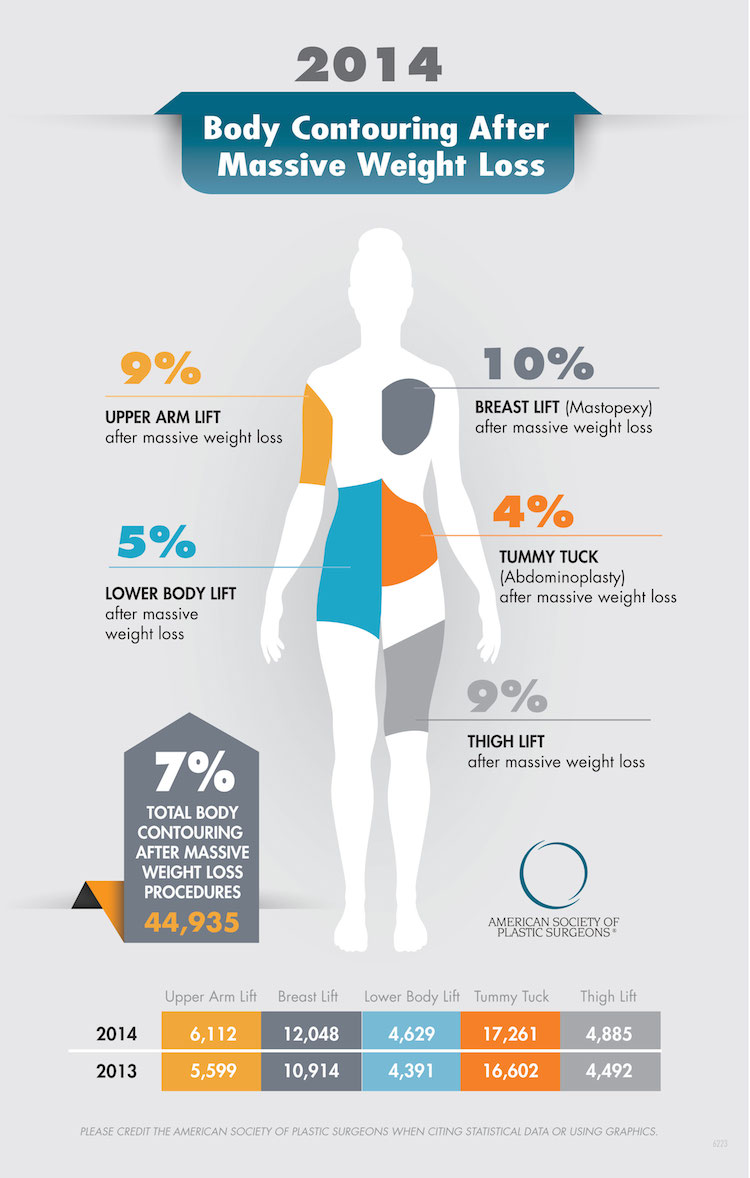
    Infographics are also great content to invest in for medical SEO because infographics can help grow website traffic. Research by AnsonAlex, a tech company focusing on tutorials, found that publishers who use infographics grow website traffic 12 percent faster than those with no infographics. In fact, the popularity of infographics has surged in recent years—increasing by 800 percent from 2010 to 2012, according to research from Web company Unbounce.

    Plastic surgery infographic image - Search Influence

    Image Optimization

    Along with infographics, you will want to include other images on your website as well. As we’ve said before, Google rewards websites that have interesting and relevant images displayed. Images keep people looking at your site longer, which gives you website more authority in the eyes of the algorithm.

    Help people find your pictures by optimizing them to include alternative text. For example,  say your practice has a diagram of what happens when a person suffers from a pulmonary embolism. If you optimize your diagram, it will likely appear when people perform a Google Image Search for pulmonary embolisms—possibly appearing as one of the first images they see. When they click on this image, they are giving a hit to your site and increasing your overall medical SEO ranking.

    Mobile Websites

    As evidenced by the whopping 62 percent of smartphone owners who use their mobile devices to look up health information, a mobile SEO strategy is  crucial. Google’s recent “Mobilegeddon,” or mobile-friendly update, was a move to further demonstrate just how important mobile websites are for SEO. It is imperative your medical practice has  a mobile-friendly design users can easily access on the go.

    But, be warned. Just because your Web developer tells you your site is mobile-friendly does not make it so. To see if your medical website passes the mobile-friendly test, use Google’s testing tool.

    Where has your medical practice seen the most success with Healthcare SEO and content marketing? Let us know in the comments.

    Image source:

    Infographic from the American Society of Plastic Surgeons


  • Web Augmentation: 9 Tips to Get Your Plastic Surgery Practice Trending

    Web Augmentation for Medical Practice Marketing Image - Search Influence

    Every second, there are almost 50,000 unique searches on Google. With that much traffic, it’s crucial to establish your plastic surgery practice as an online authority. By using social media, search engine optimization, and paid search strategies, you’ll be able to climb to the top of Google’s rankings in short order.

    Tips for Social Media

    Utilize “Audience Insight” on Facebook

    As of March 31, 2015, there are 1.44 billion monthly active users on Facebook, making it the platform with the largest audience for your advertisements. With Audience Insight, Facebook helps you sort through your targeted demographics in order to understand the kind of content that is popular among them.

    Use targeted Facebook ads

    If you use targeted Facebook ads, you can choose what kind of Facebook users will see your microdermabrasion advertisements. Not only can you sort your audience by age, location, and gender, but you can also target them according to their relationship status, whether they have children, and their personal interests. Facebook fan-building campaigns are also effective in making patients and customers into fans.

    Tag and post about local events and businesses 

    If you want to maximize your visibility, you’ll have to post outside of your practice. By sharing posts about local events and businesses, you’ll increase your presence in the community. Your potential clients will start to follow and share your content if your page is a reliable source for interesting information. 

    Tips for Search Engine Optimization

    Research Longer Keywords

    A short keyword like “chemical peels” is a competitive keyword, which means a lot of practices will be using it. Try to find a longer keyword that your audience will search for, like “chemical peel for rough skin in NJ.”

    Host Webinars

    Live Internet events boost your SEO rankings because they keep your audience on your website for a long time. Set up some demonstrative or informational webinars that prove your expertise while optimizing your search results.

    Make Your Site Mobile-Friendly

    More and more people use their phones and tablets, rather than a computer, to browse the Internet. A mobile-friendly website will ensure that the information on your website is accessible to everyone. In fact, mobile website traffic for our plastic surgery clients’ websites averaged 48.6 percent. And that doesn’t include tablet traffic; it is purely mobile.

    Another way to pump up your plastic surgery website is to use natural content on your practice’s website. Find out about how medical marketing is making the switch to natural content.

    Tips for Paid Search

    Post Lots of Information on Your Landing Page

    By having a wealth of information on your landing page about topics that are relevant to your practice—such as eyelid surgery—you ensure that your potential client gets the knowledge they desire. When this happens, they’ll stay on your page longer, and their trust in your expertise will grow.

    Invest in High-Quality Video Production

    Potential clients will seek out videos demonstrating a procedure before they schedule an appointment for one. If your practice has a high-quality video demonstration of laser hair removal, 79 percent of the potential clients who watch it will visit your website. In addition to videos, other types of content can help attract patients searching online for your practice. Find out the four ways to drive conversions in the medical industry.

    Have Your Contact Information Readily Available

    The content you make available on your website is meant to inspire more people to come to your practice. Having your contact information readily available increases the chance that potential clients will call your site, visit it, or save it for later.

    Implementing these tips will get your plastic surgery practice trending in no time!