Tag: Google

  • Home Sweet Home: Think of Your Website Like a House to Help Your Business

    It’s the American dream: work hard, build your business up, start a family, and buy a house with a white picket fence. Most of us are cruising for the same kind of idyllic dream for our business as well, even if we have a harder time figuring out how to get there. But what if I told you that one of the biggest factors contributing to business growth was, basically, a house? One you don’t need a mortgage to buy.

    Ok, so it’s not really a house: it’s your website.

    Image Of A House Working Like A Website - Search Influence

    But a website is a lot like a house. Its construction and design both build on top of each other and work to create a structure that is your business’s online home where people come to visit you. If you need a general contractor to make sure your house isn’t going to cave in, you can request a site analysis from us. But if you’re unsure if that’s necessary, or you’re just really obsessed with House Hunters and need to see where this is going, read on.

    Building From the Ground Up

    Your realtor wants you to see a new house on the market. First things first: you have to drive to it. The road you’re on is like the internet. You can get pretty much anywhere, and each road feeds off into more roads, creating the path you take (or the black hole you find yourself in when you’re “taking a five-minute break”). To avoid following random roads and hoping you get where you want instead of the Arctic, you need to know what your destination is. For a house, that’s the address. For a website, that’s the domain, also called the web address. See, I’m not making this all up; they’re completely related. The domain name in the example URL www.exampleswag.com is “exampleswag.”

    Image Of Floating House From Disney's Up - Search Influence

    So you know how you’re getting there, and you know the address, but what are you going to? Houses don’t float in the sky, and it would be very difficult for municipalities to enforce building regulations if they did.

    Just as a house sits on a physical lot, so too does a website have a physical home—the hosting and server. The server is a physical machine that sits somewhere out in the world, storing all the files that comprise your website onto its hard drive. Your hosting administrator owns and maintains the servers. When you pay someone like GoDaddy or HostGator to host your site, you’re asking them to host your website’s files on their servers, essentially renting land from them to build your house on. Sketchy real estate practice, but totally normal and secure for websites.

    Front End and Back End

    So you roll up to the house with your realtor for the walk-through. What exactly are you looking at as you’re exploring the property? On a website, there are essentially two different halves: the front end and the back end. The front end is everything a visitor to your site can see and interact with, similar to the walls, furniture, and doorknobs in your house. The back end involves the more structural aspects of the site: the wiring, plumbing, and framing of your house. When you’re buying a house, you want it to look nice on the front end and to have all the features you need (clawfoot bathtub, anyone?), but you also need it to function well on the back end. It doesn’t matter how beautiful the granite countertops are if the roof leaks every time it rains. This is why it’s so important to ensure your website has good bones. You can request a site analysis from us to find out where yours stands.

    The Foundational Platform

    Your website is built on a platform just like your house is built on a foundation. Popular platforms include WordPress and SquareSpace, but there are others. These two, in particular, are so popular because they are CMSs (content management systems) with really user-friendly interfaces. Once you get your CMS “key,” meaning the CMS platform has been installed on your site, you get easy access to all the contents of the house and can move furniture around and paint walls to your heart’s content.

    You could, of course, build your house without a foundation, or build your website from scratch one line of code at a time instead of using a CMS. It’s a pretty big job, and it really only works best for websites with few, static pages. Best to leave the roughing it to the survivalists and Mainer moose hunters.

    Bricks and Mortar: What Is Your Site Actually Made Of?

    The first known use of lime mortar was in 4th century BC Greece and Egypt. The first publically available description of HTML was in 1991. Times are a-changing, but structural integrity never goes out of style. HTML stands for HyperText Markup Language, but essentially it’s just the basic coding language used to create a website. Its primary use is to create each page of the site. It’s the framework that holds all of your stylish branding and outstanding content. Speaking of style…

    External Stylesheets Are the New Black

    HTML can be used to add some style to your website, but it’s a bit limited to tinted plaster and popcorn ceiling—think of the oldest website you can remember visiting because it was probably all HTML. The reason it looks so basic is that HTML is also what makes the bones of the house, so it ends up being a bit like trying to use the insulation of your house to create the wall color when that’s just not the insulation’s job.

    CSS (cascading style sheet), however, exists outside of the construction of the functional aspects of the site. All the CSS code is accessed separately from the HTML, so the style is rendered on top of each page as it loads. If HTML is the framework, CSS is the paint, wallpaper, and fancy flooring of your house. You can go crazy with customization and design whatever you can envision (I’m thinking mauve, personally).

    CSS can be housed above the fold content, the chunk of code that fits within the frame you see when the page first loads, but it’s better when it’s kept on an external stylesheet. An external stylesheet is a separate file from the page file and is accessed from the server individually to render a given page. When your site keeps the styling on an external stylesheet, search engines can clearly distinguish between style and substance as they go through the page code, leading to faster and more accurate crawls.

    Bringing In Personal Style

    The house has been bought and built, it’s all spruced up with trendy finishings, and now it’s time to fill it with furniture. Website copy is your site’s furniture. Having stellar copy is important for two reasons: it gives function and form. Each room in your house is divided into different functions by the furniture. Having content on each page of your site that is focused on the topic of the page tells visitors what information they should be expecting from that page and makes it easier to navigate to the information they want. When a guest comes to your house looking for a bathroom, for example, they’ll know which room is the bathroom because they will see bathroom furniture, and they will skip over the room with a bed because they know beds don’t live in bathrooms.

    In addition to having informational and focused content, you need to have strong content. If your copy is full of typos, lacks value, or has a tone that is off-putting to your readers, they’re going to leave, no matter how well the rest of your site functions. Would a guest notice your stunning parquet floors if they’re covered in dirty rugs and chairs that probably aren’t safe to sit on?

    Putting All the Pieces Together

    In the end, each piece of your website ends up working with the others to create the site, and if one isn’t receiving top marks, the whole site isn’t meeting its potential. After all, it only takes one dealbreaker to turn a dream house into a fixer-upper. But you can make your dream house work for you and your business. Take a good hard look at how your website looks now (or use the audit you’ve cleverly gotten from us as a guide), and decide what work needs to be done. If you’re not the DIY home improvement type, don’t worry—Search Influence has master carpenters on staff, so reach out to us for help!


    Image Of A Beautiful House Revealed - Search Influence

  • Top 10 Search Influence Blogs of 2016

    The year 2016 was filled with memes, the Olympics, superhero movies, and the election. You can bet, with over 46% of people now online worldwide, there were plenty of changes to online marketing, too. If you haven’t kept up, here are the top 10 blogs of 2016 to make sure your business is poised for the #bestyearever.

    Lieutenant Dan And Forest Gump At New Years - Search Influence

    1. What Happened to Facebook’s 20% Text Grid Tool?

    Our Internet Marketing Team Lead, Michelle Neuhoff Boyd, created this informative blog post that eased the confusion of Facebook’s 20% text grid tool. Find out how this new rule may affect your business.

    2. An Update: How to Get Rich (Answers, That Is) with Google

    Jim Carrey Typing - Search Influence

    Not rich with money, but with Google. Over the years, Google has changed their algorithm, and our team at Search Influence is making sure to stay on top of every change. Read this post from 2015 to learn more about rich answers.

    3. Getting Hands on With the New Google My Business

    Having a hard time understanding the new Google My Business? This engaging blog post can clear up any confusion on listings, editing, and more.

    4. Three Top Picks for The Big Idea at New Orleans Entrepreneur Week

    During New Orleans Entrepreneur Week, The Big Idea picked 10 entrepreneurs’ ideas in front of a large crowd, and everyone got to vote their favorite. See the top three picks that Paula Keller, our director of sales and marketing, enjoyed the most by reading this post.

    5. Email Marketing for Small Business: 9 Things Not to Do

    Find out how not to email your customers when just starting your business. Originally published in 2010 by a Search Influence Alumni, read all about effective email marketing.

    6. A Dentist’s Guide for Choosing Target Audiences on Facebook

    Jean-Luc Picard Star Ship Enterprise - Search Influence

    Ever wondered how to market your dentistry on Facebook? This guide will help you understand the most successful dental campaigns in the industry. You’ll know what age group and interests to target.

    7. Should You Be Using Google’s URL Shortener in Your Social Media Campaigns?

    Are you still unsure if you should use Google’s URL shortener? This blog post talks about the benefits of using their shortener, such as the URL analytics, redirects, ease-of-use, and more.

    8. Barnacle SEO – Local Search Engine Optimization for the Sam’s Club Crowd

    Will Scott, CEO and co-founder at Search Influence, published this post back in 2011. Learn more about the term Barnacle SEO and which sites to trust for small businesses.

    9. Nix the Wix SEO Challenge: Tips & Tricks

    This post from 2015 helps you make the most out of your Wix website by guiding you on the meta tags updates, sharing your site on social media, making your site visual, and more.

    10. 10 SEO Blogs You Should Be Following

    Do you want to read reliable SEO blogs? Here’s a list of the most informative SEO blogs that Monica Shariffskul put together. Many of these are on my top list, too.


    Be sure to subscribe to our Search Influence blog, and you’ll be the first to know when a new blog has been posted. Also, Happy New Year!

  • Google’s Ascent With User Experience

    Being found on the internet is essential to any business. We all know it, but few understand what it takes to be found. Luckily, there is an easy approach to beginning your own online marketing journey.

    Start by looking at Google, not as a search engine where businesses tirelessly compete to appear at the top spot, but as a user tool. Back in the ancient times of the internet, Yahoo had a $125 billion market cap, and Google was hoping to be acquired for $1 million. As time marched on, Google surpassed Yahoo as the number one search engine because of one key difference between them: the user experience. Google didn’t provide results promoting Google brands or its own material. Instead, it happily delivered the most relevant search results to the user. Results that took the user to a different website.

    While this may seem counter-intuitive—helping users leave your site and go to another—it has proved successful. Sure, users temporarily left Google by clicking on a third party’s link; it also guaranteed their return. Such a great user experience will entice anyone to return time and again for a similar experience. This is how Google surpassed Yahoo as the leading search engine, and it’s the best way for you to start your online marketing process.

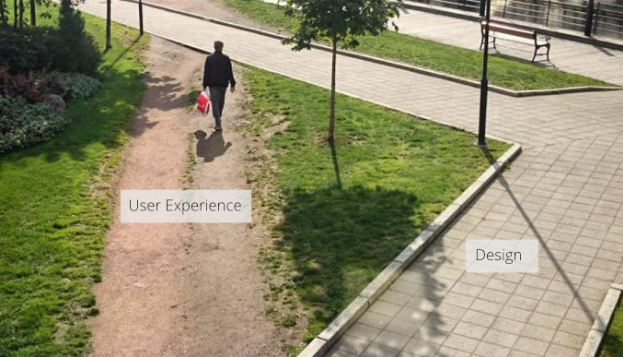
    User Experience Vs. Design - Search Influence

    The lesson for you to take away as you embark on your journey is to put user experience first. When creating your website or content, don’t try to be overly fancy or technical. Start by making it simple and convenient. Websites become popular when users can easily navigate and find content that is relevant to their search. Don’t try to force your consumer into a Corvette when they are really looking for a minivan. Your customers will thank you when they can easily access your website, it loads quickly, and the information they are searching for is plain for them to see and understand.

    Going forward, as you build out your website, keep the consumer in mind each step of the way. How would you want to interact with the website of a business like yours? If you don’t know where to start, talk to the friend who doesn’t quite understand what you do. They can be your guide, explaining how they would want to navigate your site and their desired outcome. Use this to cater each step of the user experience to your actual users.

  • Search Influence Year in Review: Our Top 10 SEO Blog Posts of 2016

    With this year drawing to a close, now is the time to reflect on the year and prepare for a successful and productive 2017. In keeping with this, we’ve highlighted our top SEO blog posts of 2016 to get you extra pumped for your New Year’s re-SEO-lutions.

    Image Of Happy New Year Script - Search Influence

    1. An Update: How to Get Rich (Answers, That Is) With Google

    In 2016, it’s estimated that approximately 40 percent of queries on Google resulted in “Rich Answers.” So what are these Rich Answers, and how can your website get selected for a Rich Answer on Google’s search engine results page (SERP)? This updated post gives you all the details.

    2. Barnacle SEO – Local Search Engine Optimization for the Sam’s Club Crowd

    3745255

    For small businesses with small budgets, the “Barnacle SEO” approach may have big payoffs. Learn how attaching yourself to the white whales of the SEO world can expose you to new markets and customers.

    3. Nix the Wix SEO Challenge: Tips & Tricks

    Sure, Wix is the uber-easy-to-use, code-free web developing platform for dummies, but just how well do Wix sites get along with search engine optimization? Thanks to these quick tips and tricks, it’s easier than you may think for Wix sites to play nice with SEO.

    4. 10 SEO Blogs You Should Be Following

    Fancy yourself a true SEO connoisseur? This list outlines all the insider blogs you should be reading to stay up to date on the constantly changing world of search engine optimization. Hey, even if you’re new to the game, resources like the Google Blog and MOZ Blog provide a plethora of information to get started.

    5. These 10 Expert Tips Will Drive Traffic to Your Business’s Website

    Driving traffic to your website means driving sales for your business. Our in-house experts share their insights when it comes to getting people in the online door. Hint: If you’re promoting on Facebook and publishing press releases, then you’re off to a good start.

    6. 5 Tips to Improve Local Search Rankings Even If You Don’t Have a Physical Location

    Many businesses are opting for prime real estate on the interweb instead of brick and mortar locations, but that doesn’t mean you need to sacrifice website optimization. Check out these five tips for increasing your ranking.

    7. Google My Business for Doctors: Visibility, Authority, & SEO

    Claiming or creating a Google My Business listing can have big search impacts for medical practices. Follow this step-by-step guide for single practitioner practices, multi-practitioner practices, and multi-location practices.

    8. Local SEO: How to Clean up Citations for Better SERP Visibility

    A citation is the presence of a business’s name, address, and phone number (NAP) on any website. The consistency and accuracy of your NAP across sites will improve your local SEO rankings. Learn the four basic steps to complete an effective citation cleanup.

    9. 12 Things You May Not Know About Online Marketing

    Are you ready to be shocked and awed by the amazing (and hard to predict) world of online marketing? Here’s a list of some of the things that caught our Search Influence team members by surprise when they were rookies in the game.

    10. The Importance of Content Marketing to Your SEO Strategy

    Content marketing is the bread and butter of your SEO strategy and, in many ways, the success of your brand. Are you telling a relevant and compelling story about your business? Are you targeting the right audiences? This post will help you answer these important questions.

    What better way to bring in the new year than with a new online marketing strategy? We hope these posts offer some helpful insights and maybe even a little motivation for a productive and optimized 2017.

  • #NOLATech Week 2016: How To Drive More Traffic To Your Site

    In conjunction with NOLATech Week 2016, Search Influence hosted a workshop to help support small businesses in their online marketing efforts. Paula Keller and Mary Silva presented on how to boost your local search rankings and ways to drive traffic to your website respectively.  

    Paula Keller’s “How To Boost Your Local Search Rankings”

    Paula’s “How To Boost Your Local Search Rankings” presentation took the audience through what types of businesses benefit from local SEO efforts. It also detailed the different types of Google My Business pages and how to use them. With the insight from Paula’s presentation, business owners can better understand how to optimize their business both onsite and offsite to gain better local search rankings.

    search-influence-university-how-to-boost-your-local-rankings-10-11-2016


    Mary Silva’s “10 Ideas To Drive Traffic To Your Website”

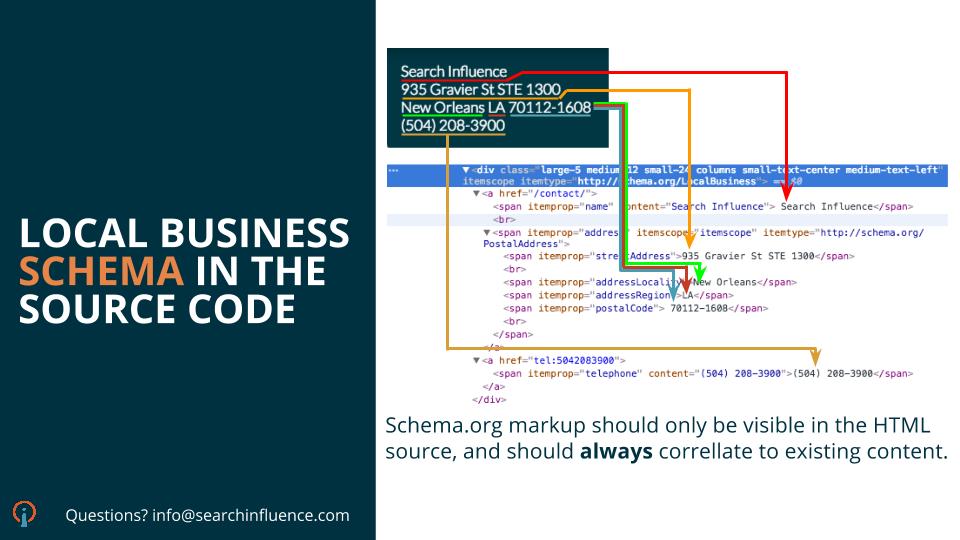
    Mary’s “10 Ideas To Drive Traffic To Your Website” presentation tackled concepts that influence your site’s user experience and actionable ways to help improve traffic to your site. It covered topics ranging from highly technical concepts like Schema markup and Google Search Console Analysis to less laborious efforts like directory and authoritative link earning. She explained how to use Schema.org rich snippets to create more engaging search results for your website on Google. Her presentation also went into detail on how to use social media efforts effectively to not only post but also promote engaging content like infographics. “Think of your online marketing efforts as a service,” said Mary, Internet Marketing Team Lead at Search Influence. “We know our users, and we’re getting them closer to their end goal faster. Make your overall goal to give users a cleaner, better experience and make users lives easier. ”

    search-influence-university-10-ideas-to-drive-traffic-to-your-website-5-26-2016

    In utilizing some of the tips and tools explained in these two presentations, guests could help increase their business’s online success in many ways including, but not limited to, improved visibility in local search results and increased traffic to their sites.

    For more information on the event, visit townsend.bunksite.com/ or contact the office directly at 504-208-3900 or Search Influence, 935 Gravier St #1300, New Orleans, La. 70112.


  • Nothing More Local Than My Pocket #pubcon 2016

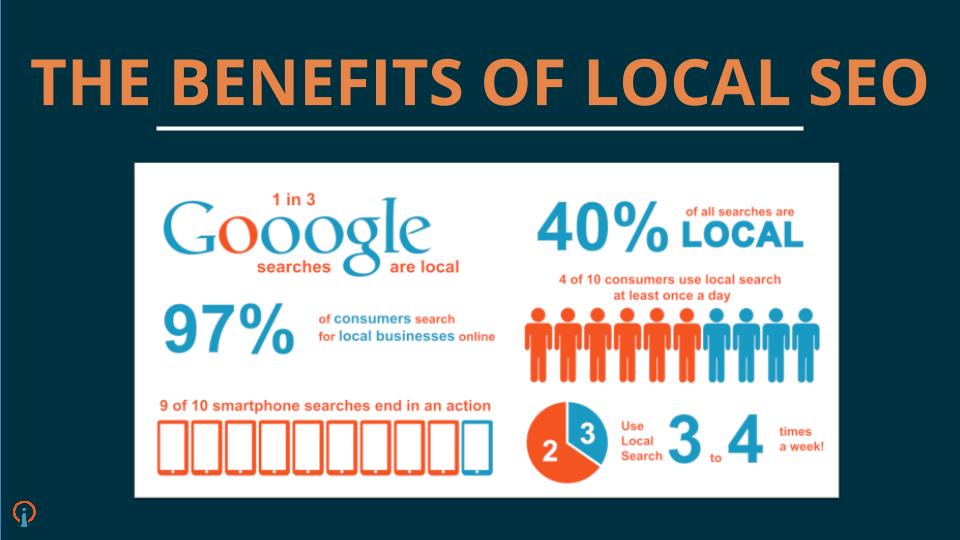
    Today I’m presenting at Pubcon on Mobile PPC. We all know mobile phones are ubiquitous, but there are a bunch of great stats which show how important they’ve become to us.

    • 33% of Americans would rather give up sex for a week rather than their cell phones.
    • 70% of Americans would rather give up alcohol for a week than their cell phones.

    Clearly this poll was not in New Orleans.

    And now the presentation.

  • Here Are Our Top 5 Blogs From September

    Another month, another top five blogs from Search Influence! All of these posts are chock-full of information that will help you keep your website in tip-top shape and give you some insight into life at Search Influence. Subscribe to our blog to stay up to date on what’s going on in the world of SEO and Search Influence.

    #5: How Google Possum Has Affected 3 Pack: A Before and After Review

    Google’s newest update has had some drastic effects on the search results 3 pack. Amy Arnold gives us the lowdown on some listings that are pretending to be dead.

    Google Possum Update

    Look at that beautiful Google update devouring those listings.

    #4: What Happened to Facebook’s 20% Text Grid Tool?

    Michelle Neuhoff Boyd is back at it again this month and refuses to leave the top five standings. Whether you’re a Facebook fiend or a business taking advantage of the social platform, this blog entry has mountains of information about the inner workings of the Social Media giant.

    #3: Happy Working Parents Day: 10 Influencers on Lessons From Their Working Parents

    To celebrate National Working Parent’s Day, Mary Silva whipped up a heartfelt blog post complete with written and video interviews of some of our employees. Tears may be shed by the time you reach the end of the video, so be sure to have that tissue box ready.

    Kid nodding head

    #2: Search Influence Adds 3 New Hires in August

    Search Influence added three more employees in August and a lot of people were interested. Learn more about our new team members in this post compiled by Melissa Verzwyvelt.

    #1: Barnacle SEO – Local Search Engine Optimization for the Sam’s Club Crowd

    Last but not least, Mr. Barnacle SEO himself, Will Scott, saw a massive resurgence in popularity of his blog where he coined the industry changing term. Take a gander at this super informative blog.

    While you’re at it, follow our blog to get the latest updates from Search Influence.

  • Link Building: How to Develop a Winning Link Profile

    The Basics of Link Building

    Backlinks are a significant factor in a website’s search visibility. When a site links back to your website, it signals to search engines that it’s authoritative enough to be an information resource for other websites. That’s why it’s so important to any SEO strategy.

    However, SEO’s and businesses alike walk a thin line when it comes to generating backlinks for their sites. Each backlink has a different value depending on that source site’s own authority and trustworthiness. The goal is to develop a diverse but high-value link profile of authoritative links from a variety of source types. This process is called link building.

    I like that your backlink profile's so natural image

    Link building can be categorized into two different types of work: manual link building, where a link is submitted to directories or included in profiles, and editorial link earning, where a site links to your website organically because they want to share or refer to your content.

    Manual Link Building

    It may seem like this is not the preferred method for link building. However, don’t forget that we want a diverse link profile. The character of your link profile reflects the character of your business to search engines.

    It’s natural to place your website and information on sites that potential customers may use to find a business like yours (i.e. directories) or in your social profiles. This is the same as adding your business’s information to a phone book or business card that you share with people.

    When doing manual link building, just remember that you want the sources of your links to make sense and reflect the authority and relevance you’d like your website to have. Ideally, these links come from sources like your social profiles, local directories like Google Maps or Yelp, and niche directories that apply to your industry (Healthgrades.com for doctors, for example).

    Editorial Link Earning (aka Link Attraction)

    It’s a little more difficult to build out the other side of your link building strategy—editorial link earning. You can’t control these links like those that you manually build. However, link earning is a great opportunity to show the internet just how great you are at what you do and can result in some of the most valuable links out there. It should also already fit into your overall branding strategy.

    So, what are editorial backlinks? These are links that people have shared on their own websites or social media back to your website. For example, if someone read a blog post that you wrote for your business and thought the content was so engaging and noteworthy, they shared it on Facebook or wrote their own blog referring to yours, you’ve just received an editorial backlink.

    Social interaction vector image

    This type of link building starts with creating great content and ends with sharing and strategically placing that content for the most relevant and influential users to see and engage with it.

    That’s it, the basic composition of any good link building strategy. Link building definitely takes some thinking but it is immensely valuable to your overall SEO. Directory and social profile links are important in building brand awareness, and creating and sharing great content is highly integral to exhibiting your business’s overall value and capabilities both on- and offline.

    To find out why link building is important for dentists, click here.

    Image 1 Credit

  • How Google Possum Has Affected 3 Pack: A Before and After Review

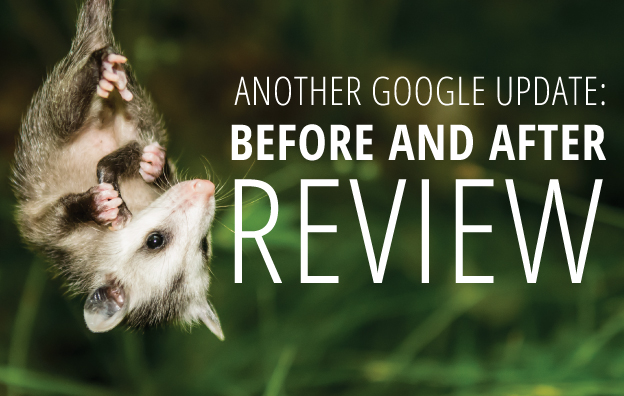
    Google Possum Update

    Throughout September, the local search industry has been watching the results of the dubbed Google Possum update.

    In August 2015, Google shook up local search results, which changed the Map Pack from a 7 Pack to a very exclusive 3 Pack. This change was a dramatic one by omitting many local businesses and by making inclusion nearly impossible for businesses in the exterior of city limits and in suburbs.

    Fast-forward two years, and we now have Possum.

    “Possum?”

    Joy Hawkins wrote an excellent blog post summarizing the effects observed by the Possum update, and in that post she attributes Phil Rozek with creating the Possum moniker because “it is fitting since many business owners think their Google My Business listings are gone, when in fact they are not. They have just been filtered — they’re playing possum.”

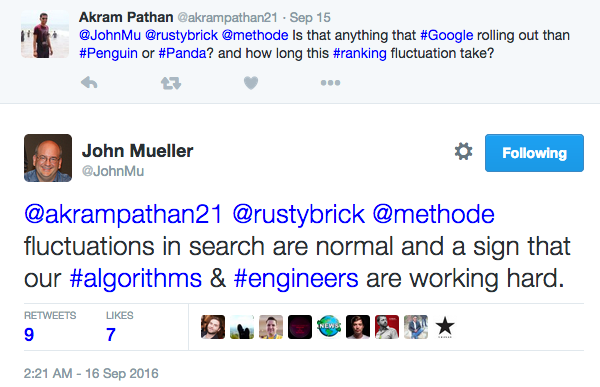
    And officially? … Possum is an unannounced update, meaning the SEO community collectively compared notes and decided this was an algo update. Google did not directly announce or confirm this update. However, John Mueller did Tweet a comment, which I completely paraphrase as “if you see stuff happening, maybe the Google Engineers are doing something.”

    Possum Update Tweet


    “Google is now filtering based on address and affiliation.”

    In her post on all things Possum, Joy Hawkins cleanly lists the effects of this change. Among her list is the observation that Google is now filtering results based on duplicate address, website, or affiliation.

    We see duplicates all the time in map results for local searches for any place that has multiple practitioners:

    • Doctors (plastic surgeons, orthopedists, dermatologists … )
    • Lawyers
    • Dentists and orthodontists
    • Hair salons
    • Etc.

    For example, a doctor’s clinic can have numerous Google-allowed listings: one for the practice and one for each physician or practitioner seeing patients at that practice. Each of these listings will have the same address, phone number, and website, so one clinic or practice can end up with multiple listings and dominate the results landscape.

    But user experience for such a repetitive Local Pack is not ideal, and Google is all about user experience. We have a plastic surgeon client, Deluca Plastic Surgery in Albany, NY, who has been fighting this battle for a long time.

    Dominating the Local Pack No More

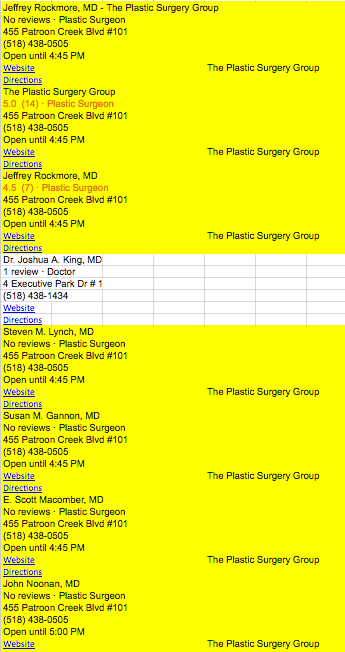
    Anyone searching “plastic surgery Albany NY” back in April 2016 would have seen the 3 Pack all leading to the same practice. In fact, in the “More Places” Maps results, the same practice completely dominated with positions 1, 2, 3, 5, 6, 7, 8, and 16. What the heck, Google?!

    I had copied and pasted the Maps results into a spreadsheet just for fun back in April. I’m glad I did, because I can share this story with you. Here are just the first eight results from that April 2016 Maps search—those in yellow all lead back to the same practice:

    April 2016 Maps Search Results

    Our client was ranked at 18th and 20th. Our client is in Albany, and the website had and has stronger Domain Authority, stronger NAP, more reviews, and on and on, so it just didn’t make sense.

    We did some work to mitigate those results. We had some minor success, but fighting a battle against Google’s algorithm, you might not always come out a winner.

    And Then Possum Came Along

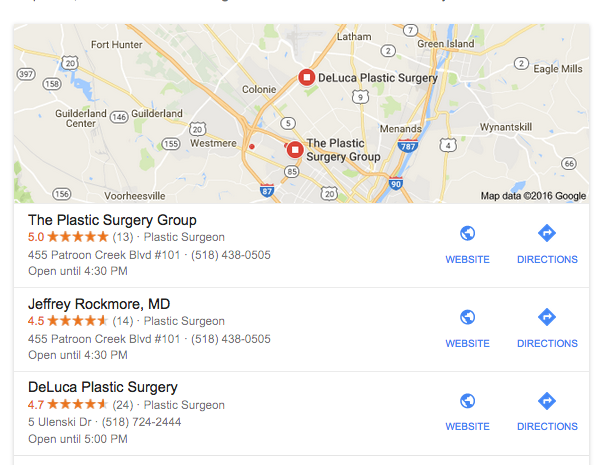
    Today, we now see Deluca in the 3 Pack. Woo hoo!
    Google maps results after Possum roll out

    We are feeling pretty good about this (don’t take the wind out of my sails), but we acknowledge that all is not perfect in this scenario. In this 3 Pack, the doctor in the second listing is a plastic surgeon at the practice represented in the first listing.  He has the same address and phone number, but he has his own, personally branded, website.

    This is one example among millions of searches, but it may suggest that domain is a primary indicator of the duplication filter. This needs lots more observation and input, and I encourage you to let us know if you have seen 3 Pack changes this September.

  • Here’s How to Take Advantage of Google’s Expanded Text Ads

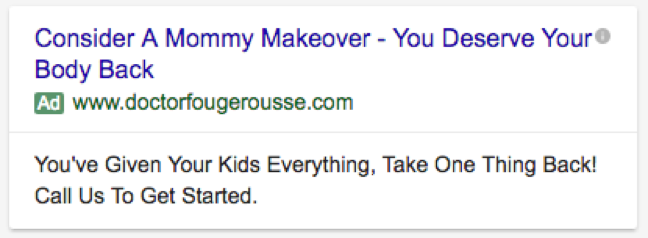
    AdWords Text Ads Image 3

    In May, Google announced a major expansion of the traditional 25-35-35 text limits we’ve come to know and begrudgingly abide. Trying to squeeze your brand name, unique selling propositions, an emotional appeal, a sense of urgency, and a killer call to action into just 95 characters, at times, amounted to a game of linguistic Tetris.

    Now, with double the characters to convince potential customers why they should convert, it’s become crucial to rethink how we think about ad copy and develop new tools for improving our Paid Search ad copy strategy.

    1: ALWAYS Use All of the Available Characters

    Take full advantage of Google’s generous gift! There has been some debate in the PPC realm concerning the truncation of ad copy based on the user’s device. However, an overwhelming majority of the literature suggests that you should be trying to get as close to that 30-30-80 limit as you can.

    2: Lead With Your Most Important Copy

    54531900

    Put the most important information at the start of a line, such as your call to action or promotional text. Headline 1 will always show, but depending on the screen size of the searcher’s device, Headline 2 and the Description could be truncated depending on the pixel width of your text.

    Even though you should be trying to hit the full 150 characters, you do want to ensure that the absolutely crucial information in your ad copy is placed at the start of each line.

    3: Brand + USP + Emotional Appeal + CTA = Click!

    We all have a variation of a similar formula for winning ad copy, now you can make sure that your ads are checking each of those boxes. Expanded Text Ads allow you to include content that previously may have been bumped from an ad in lieu of the more important call to action or brand name. Now, you have the space to try out new versions of your formula and find what works for your business.

    4: Develop Thematic Content

    AdWords Text Ads Image 2
    Don’t treat the different elements of the ads as separate entities. Use your extra characters to create content that flows from Headline 1 to Headline 2 and through the description.

    5: Provide Pre-Qualifying Information

    Are your landing pages seeing a lot of traffic but not converting visitors into customers? Now you can pre-screen would-be bounces by including qualifying information in the ad copy!

    For instance, if your plastic surgery practice only accepts candidates for Breast Lift surgery who are physically healthy, non-smokers, you can include this information in your ad to prevent users who won’t end up converting from initiating that first click (and spending your ad dollars!).

    Bonus Tip: Path Fields = Not Optional

    The “optional” Path 1 and Path 2 fields have replaced Google’s Display URL with the domain name now automatically populated from the Final URL. These combined 30 characters are a great area of opportunity to showcase the relevancy of your landing page to the searcher’s query. Highlight topical keywords, location specific services, or even promotions that show the user that your business provides exactly what they’re looking for.

    The number one rule is to be creative and try new things, so get started augmenting your ad copy today and share your results with us in the comments! Need help? Call the experts at Search Influence.