Tag: Google

  • Google+ Opens For Businesses — Potential And How To Get Your Face In The SERPs

    Google+ for Apps One Bar

    Google+ for Business
    Are we not men?

    The new kid on the block has opened itself to businesses in two principal ways. Unlike Facebook, which focuses on admin-managed pages, and Twitter, which couldn’t care less if a person, place, or animal is represented in a feed, Google initially maintained its focus on people in its business-level implementation of its social network, not announcing any kind of branded pages. Then Monday’s announcement of Facebook-style business pages opened a new avenue for marketers, if only those in selected niches. Both new tools allow for the implementation of the “authority” metrics hinted at in numerous Google quality documents.

    But should a business even have a Google+ presence? Facebook of course is ubiquitous, and Twitter has proven itself to be a direct customer relations tool. Google+, however, has languished as Robert Scoble’s main soapbox and Android users’ photo repository. Google+ isn’t a lead generator, lacking the customization of Facebook tabs, and it isn’t a customer service tool, lacking the plurality userbase (8% of the US) Twitter enjoys.

    Applications of Google+ for Business

    But it’s not just those on the social network who will benefit from business applications of Google+. Integration with search and the use of the network as an authority metric seem to be major advantages of Google+ for businesses. Once set up correctly, a robust Google+ profile can give authority to local ranking and regular integrated SERP rank depending on page type. Unsurprisingly, this leaves the active maintenance lacking; however, even that aspect can be worthwhile in the right niches.

    Internally, Hangouts combined with Google Docs allows decentralized businesses a face-to-face online collaboration tool. Users can avoid the loss of communication from short text comments in edits, enriching group writing and design. This use of Docs can help a variety of businesses, both for internal meetings and for work with clients. The possibilities previously hinted at are relatively endless, and make Google+ a must-have for remote businesses, some design firms, and any company needing to build something in front of a customer or each other without being in the same room.

    But most companies don’t need that kind of ability for real-time document editing. For them, Hangouts provide a simple way to start webinars, live shows, and other almost TV-styled content. Something like SEOmoz’s Whiteboard Friday could be live broadcast with question-and-answer, recorded locally, and quickly uploaded to YouTube or another video site, then added to a website for further life out of the content. If live videos would take too much effort, even a simple video exclusive to Google+ can help drive uses both to your Plus Page and create user interaction. This kind of direct, personal, and instant communication with users and the ease of creating something for all visitors is nearly unprecedented in social media.
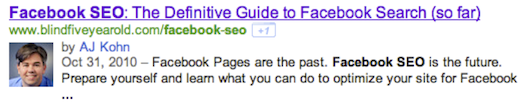
    rel=author SERP Display
    How Your Employees

    Keeping with the focus on both users and non-users of the network, Google+ offers ways to interact with customers outside of the realm of the social network — being the only outlet for rel=”author” and introducing rel=”publisher”, the best way to get your personal face and name ad your company’s image in the SERPs. Reinforcing the authority metrics hinted at in Panda and the related effects, Google+ is the gatekeeper for bridging the gap between semantic and visible authorship in the SERPs, and the exposure and connection of a face and name to a business can humanize and connect with customers in a way that couldn’t be done for someone who isn’t just signed into Facebook. “The face in the SERPs” is perfect for any company with a regularly maintained blog or article section. Similarly, a company might see its logo next to its web site when rel=”publisher” is implemented.

    Using Google+ to Put Your Face in the SERPs

    Happily, WordPress sites have a relatively simple solution for implementing a multi-person rel=”author”. It does the first step for you, linking to the author page with rel=”author”. Then, add your canonical Plus account url to the Website field in Your Profile under Users:

    Wordpress Website Field for rel=author
    Place your canonical Google+ url in this field under User > Your profile

    Then, you need to edit the theme, adding this to the body of either your main template, or the author template, author.php, omitting the if-statement:

    <?php if (is_author()) {
    $curauth = (isset($_GET['author_name'])) ? get_user_by('slug', $author_name) :
    get_userdata(intval($author));
    ?>
    <a rel="me" href="<?php echo $curauth->user_url; ?>">
    Visit me on Google+
    </a>
    <?php } ?>

    This will get the author name if it’s set, then get all of the user data, then display the url from that author in a link with the all-important rel=”me”.

    rel=publisher fair
    Oops! Not what you'd like to see…

    Similarly, to set up rel=”publisher”, just a link tag on all pages without rel=”author” on it will connect your site with your company Google+ Page. Why only on those pages? Because as Search Engine Land’s rich snippet test shows, Google will prioritize author over publisher.

    <?php if (!is_single()) { ?>
    <link href="https://plus.google.com/113323125805722144061/" rel="publisher" />
    <?php } ?>

    Once it’s all set up, check your url in that same Rich Snippet Tester tool, making sure it shows your face and name. The wait time on recognition from Google is inconsistent, but such connections are key to establishing authority.

    Google+ Establishes Thought Leaders

    A secondary effect of individual commercial Google+ profiles is that giving a face to a URL can create a sense of thought leadership, pulling in longer-term researchers with high quality informative articles and blogs. Having one author connected to your name will heavily associate the one person with the site; having multiple writers will strengthen the authority of each writer as an individual source of quality knowledge. A logo, if well-chosen, transforms the SERPs into display ads. Through either, one positions their employees as experts and their company as prominent: certainly an admirable position.

    Google+ might not be for every business, even businesses that rely on their current Apps as the underpinning for their online productivity. However, for businesses with the specific needs for which Google+ provides killer apps, Google+ is a perfect addition to the social media profile of your business. Furthermore, it’s ease of setup provides deep support beyond social interaction, leaving much utility even for more straightforward businesses.

    …And hey, maybe one of your employees can criticize you while still garnering support for the company in a precarious time…

    Image Courtesy Cambodia4KidsOrg.
  • What’s the REAL Organic Search Market Share?

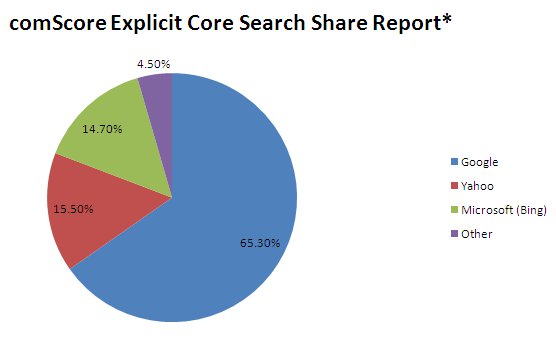
    If you work in interactive marketing, you’re are probably familiar with comScore and its monthly estimate of the United States search market share that consistently looks like the following graph, reflecting data collected September 2011. It’s safe to assume that these numbers apply to the websites that you promote as well, right? Not really.

    comscore search market share for September 2011

    For the past few years, it seems like every dataset that I’ve seen contradicts these market share reports, so I decided to dig a little deeper and see what I can find.

    comScore’s numbers:

    comScore is extremely thorough in its calculations. It obtains this information by installing software on the devices of a large number of paid users, which tracks and records all the searches performed on that device. In the month of September 2011, the company recorded over 17 billion search results. It claims to get data from a variety of users that is representative of the market share of major ISPs in the U.S., but other than that, I’m not sure how they pick users. Either way, 17 billion intuitively seems like a big enough sample to come to firm conclusions.

    My Tiny, but Interesting Dataset

    To find numbers that I thought would be representative of the search engine market share for our clients and sites, I created a custom report in Google Analytics that provides the number of site visits from organic searches, and breaks them down by each particular search engine, over the last month (10/2/11 – 11/1/11). To figure out which sites to use, I exported data for the first 75 sites I found that I was certain were active and received organic search visits. The total number of visits was approximately 350,000, so it’s a relatively small sample. There was one site that I excluded because its total visits exceeded all other sites by 3!

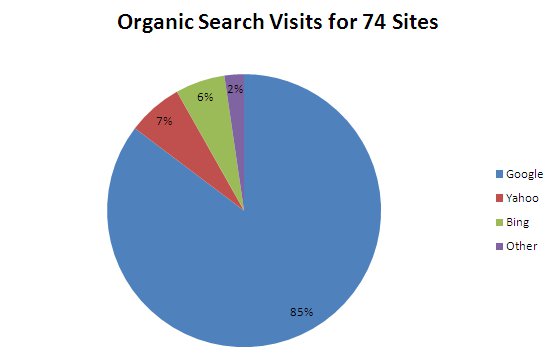
    organic search market share for search influence clients

    As you can see in the chart, Google searches account for a whopping 85% of the organic visits! Like the comScore data, Yahoo and Bing are about even. This is pretty amazing, right? Even though these numbers are too small to make comparisons to the U.S. market share as a whole, the information is representative of Search Influence clients and therefore important to us.

    Industry Segments

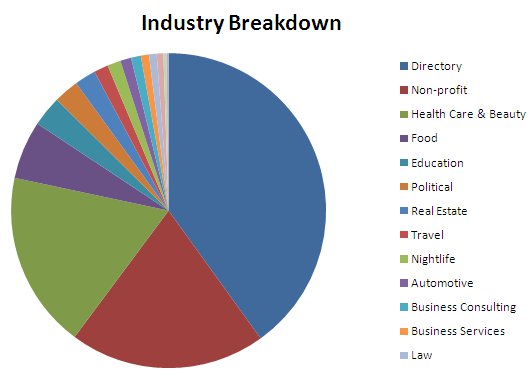
    Most of the sites we looked at are small businesses throughout the country. 40% of the results come from 2 medium sized yellow pages directories–but when you take these two sites out, the share is virtually the same. We also see big numbers from Health Care & Beauty and Non-profit. The Non-profit is actually one large organization and the Health & Beauty segment is mostly composed of dentists and plastic surgeons. Two of the sites included are informational sites that attract national visits. Those two sites alone, which represent about 1% of the total visits in this set, received on average 94% of their organic visits from Google.

    industry breakdown for market share information

    Why the Numbers are Different

    The numbers differ for many possible reasons, but none that I have been able to completely pin down. Obviously the set of websites used here is not representative of sites on the Internet as a whole. Another reason could be that Google inaccurately reports referrals from other search engines, or perhaps small businesses rank better on Google, so our small business clients get more visits from Google. Another factor may be that none of these sites target American users that search in a language other than English. Whatever the case may be, it’s obvious to me that Google has an even bigger impact on our small business clients than the comScore numbers suggest.

    What about you? Feel free to share your data, do a similar study, speculate on these results, or tell me why I’m full o’ bull.

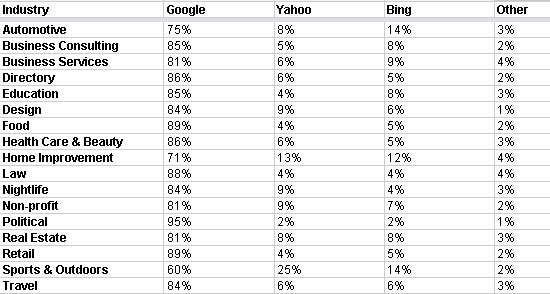
    Oh, and if you’re interested in a more detailed breakdown of the results in a particular industry, here it is. Here is a link to the spreadsheet.

  • Google-Groupon Faceoff: Google Daily Deals Enter The Arena As Other Social Media Backs Off

    Just four months after jumping into the daily deals pool, Facebook abandoned its efforts with regard to small business space (at least those not related to check-in services). Given that the business in question had to have a Facebook profile and only about 15% of the average business’ fans are located in the same city as the business itself, it makes sense that the social media giant would turn its focus toward more profitable venues — eliminating its Groupon competitor while reducing its lame-duck Foursquare competitor to a sideline project. Hot on the heels of this news, however, comes the announcement from local-focused entity Yelp that their daily deal program will be severely scaled back, and that “we’ll continue to email out any amazing Deals we find; rest assured when it comes to quality vs quantity, we’ll choose quality every time.”

    Well, there are worse places to get your deals.
    Well, there are worse places to get your deals.

    While Yelp isn’t on the same scale as the ‘book as far as user base or diversification of services, it is by nature a very local presence, making the small-biz deal model a seemingly natural fit. However, Yelp CEO Jeremy Stoppelman has stated concerns with the “deep discount” approach that has provided an extremely negative experience for many small-scale businesses, leaving nobody happy in the end via use of an unsustainable model — albeit one with considerable consumer response. However, despite the reputational backlash growing from the business end, Groupon has reported record profits and its name has even been bandied about as the fastest-growing company ever. While long-term results are as of yet unproven and more merchant-friendly policies seem inevitably necessary to keep the brand afloat, it’s certainly hard to argue with the numbers at the moment.

    So why, with other social web presences getting washed out of the pool by Groupon’s leviathan-scale belly flop, is Google dipping a toe in? The search behemoth has established a deals program in Portland, OR and seems to be looking to expand, given its recent display of a New York-based deal on admission to the Museum of Natural History. I guess the saying goes that if you can’t beat ’em, attempt to acquire them for $6 billion and if that doesn’t work, well, go back to trying to beat them.

    Part of this is almost certainly to do with timing, as Groupon recently filed for an IPO that could happen as soon as next month, launching it as a publicly-traded company and opening up an entire new world of earning potential. Its unprecedented fast-track growth also offers significant incentive to mount a counter-campaign and nip the competition in the bud before it grows to Death Star-like proportions. El Goog is facing an uphill battle, given that it’s moving against some pretty entrenched competitors — but at the company’s current scale it wouldn’t have much trouble deploying a nuclear bomb to swat a fly. There’s no clear path to adoption for users (certainly nothing as convenient and reliable as an email plunking into one’s mailbox every morning) and no real incentive to sign on when faced with the plethora of other, more popular options, at least for the moment. However, the sheer number of eyeballs (particularly if location-targeted deals are to be featured on Google’s famously minimalist home page) is a force to be reckoned with in and of itself. (In fact, a Piper Jaffray analyst estimated the Nexus One placement on the Google home page to be worth between $4 and $5 million if it were a bought-and-paid-for ad.)

    The Google brand, for better or for worse, has a lot of leverage with consumers and products that gain popularity tend to stick around for the long haul. The company also seems to have wider ambitions with its deal models, tying the Offers brand up with Google Wallet and check-ins, as well as developing Google Offer ads and coupons that can be displayed along regular PPC content. While Groupon is currently mobile-accessible, the all-in-one convenience of Google Wallet could be a strong selling point to those who want all their resources and grabs in one place. It’s clear that with the resources at their fingertips the success of Google’s deals platform isn’t contingent simply upon the “daily deals” Groupon-like aspect; however, it remains to be seen whether the attempt at diversification will pay off or Groupon’s 115 million users will stay true to the service that’s provided staggering discounts for its duration as an entity.
  • Can Bing Ever Compete with Google?

    If you keep up with what’s in the news in the world of search engines, you know that there’s been a bitter little rivalry between Bing and Google for some time. In early February, Bing accused Google of stealing their search results. It didn’t help Bing’s case that they didn’t deny the claim either, instead saying, “…we use multiple signals and approaches when we think about ranking, but like the rest of the players in this industry, we’re not going to go deep and detailed in how we do it.”

    Fast forward to now, where Microsoft was recently the topic of discussion in a lengthy article in the New York Times about Bing’s profitability — and how long it may take them before they have any chance of breaking even. Other reports claim that Microsoft has claimed 30% of the search market and that Google is “slowly sinking”, even though it still controls roughly 65% of the search market.

    Bing has made respectable strides since its launch two years ago, but even so, it hasn’t been able to match the brute force of Google, which was the leading search engine among ten competitors back in 2002, only two years after its launch.  Surely, Bing will continue to grow, but even if can find itself on equal footing with Google, can that be considered success?

    Microsoft’s Qi Lu says, “To break through, we have to change the game. But this is a long term journey.” He’s right … but how long will that journey be? Sources seem to think that Bing will need to demonstrate some sort of clear success before its tenth birthday to remain a contender.

    How can Microsoft accomplish this? Voices all over the web have tons of ideas, but several of the key ones seem to stick out. Some suggest that Bing work both ends of the user spectrum, finding a way to appeal to every age range (much like Nintendo did with the launch of their Wii videogame console). Since Google tends to appeal to a young, tech savvy audience, this could be a valid approach for Bing. Microsoft should also focus carefully on their acquisitions, and try to see what could work best for them (here’s a hint: buying Skype for $8.5 billion might not have been the best choice).

    Personally, I’m a fan of Google’s products, so until Bing can offer something better, I’m staying put. How do you feel about it?

  • Pittpatt Puts Google Acquisitions To 100

    Thursday, Google acquired Carnegie-Mellon University spinoff project PittPatt, which specialized in facial recognition software for businesses like GE. We’ll be a bit naïve here and take Google at their word when they claim they won’t implement full facial recognition software without “strong privacy protections” and intentionally excluded the feature from Google Goggles. It seems clear that Google will use the technology to enhance video quality and would otherwise be caught in crass doublespeak during a time to play it straight.

    It is striking that Google seems utterly unfazed by two government commissions investigating it for its aggressive vertical integration into niche search and social media.

    PittPatt marks the hundredth merger by Google, the sixteenth this year. For comparison, the slightly older and smaller Yahoo has acquired 64 companies and the more traditional technology company Microsoft purchased 144, both with only two acquisitions over the past seven months.

    Google seems to be almost thumbing its nose at both European and American investigators. Not only are they explosively expanding and refining their social tools, they are reinforcing use of Google properties on Maps and de-emphasizing other sites’ role in local search. Google is even boasting its wide variety of overt technologies by giving the user everything they could love (with a layout ripped from a Mahalo demo video) even as they take away a line of customer interaction with the company.

    Of course companies change, and to be mired in chasing the FTC algorithm would be much more likely than and as damaging as wrongdoing being found by the inquiry. Even more important is that these acquisitions allowed Google to provide a wide range of products, most of which were cobbled together from multiple targets’ technology. But is Larry Page’s aggressive business strategy going to engender the company to the FTC during the Google Antitrust case?

    Check back tomorrow for an informative infographic from SI’s own Joe Luft on the situation!

  • Google Antitrust Case – Google+ Defiant in the Shadow of Harvey Birdman

    Google Antitrust Case
    "I'll take the case!"
    Over the past few years, Google has been investigated by the FTC over most aspects of their business, largely circling around their aggressive acquisition of properties to vertically integrate other services into their core search. As Google has added features such as Products, Maps, and Video searches and integrated them into the main search results, competitors have seen their traffic decrease as users stay on Google-owned sites.

    Making good on a somewhat threatening letter from the Senate Subcommittee on Antitrust, Competition Policy, and Consumer Rights two weeks earlier, on June 23, the FTC continued their impression of Harvey Birdman. Issuing a subpoena “relating to a review… of Google’s business practices, including search and advertising,” the FTC has opened an investigation to “address fundamental questions of business operations.” These questions, though immediately unclear to Google (if their admission and response on their blog isn’t just rhetoric), have been speculated on rather endlessly by pundits.

    Starting from their blog, Google lists a few ways that they believe they put the user, i.e. their consumer in economic terms, first in their decisions. Search neutrality, vertical integration of search, the relationships involving paid search, clarity of function and policy, and consumer choice and freedom of movement, are all core facets upon which Google prides itself. Similarly, SEO dominatrix Matt Cutts discussed with Bloomberg news about the case, but managed to deflect most of the more interesting questions.

    On first glance, this investigation seems to parallel the Microsoft case that crippled the company’s ability to innovate on its OS, but not its market share or company size. The Findings of Fact from that case, which were not overturned in the successful appeal, offer insight into the kinds of inquiry Google will endure. However, it’s quickly becoming clear that substantive differences may doom the FTC’s case.

    Much of the argument for monopoly power in the Microsoft case stems from an inability for consumers to effectively and seamlessly switch from platform to platform. If you have a PC, you’ll either have to run Windows or put in serious effort to run your computer like Windows. But in Google’s case, they are more like the open-source alternatives in that there is a high level of customizability and a large number of competitors that are easy to switch to. Google and Microsoft both benefit from the positive feedback loop (or arguably vicious cycle, if you’re a competitor) caused by being the dominant firm in the industry. Consumers and business partners (read: surfers and webmasters) use and develop for Google first and primarily, as it is the best-known way of finding things on the Internet.

    Google’s close-to-first-mover advantage is, of course a major effect on competitiveness of the industry, outstripping Yahoo and, so far, with more panache than Bing. Furthermore, Google’s dominance isn’t just in search. Their maps and directions have all but relegated Mapquest to vintage sites; YouTube is clearly the most-used video site on the web; the image search, though lacking some of the features of TinEye, certainly is used more; Google Docs is infinitely more well-known than any of its competitors, including offerings from Microsoft Office and Adobe; and their forays into social platforms, though rather unsuccessful, may have finally found its niche, cutting into Facebook shares per article across the top 100 tech sites. Google might even suffer the same fear of pre-installation, as three of four major browsers, one of which is owned by the company, search on Google by default.

    Sure, Google has the majority of search share, between 60% and 70%. But do the influences of Facebook’s social search, Twitter’s massive linksharing search, the vertical search engines, and the distinctive qualities that truly separate Google’s broad search competitors from the Big Panda really have no effect on the breadth of choices the consumer has to find content on the web? Even more so, many of the features of Docs are better implemented outside of a browser. And ever-lurking behind that success is the fact that technology, and especially non-physical products and services, have a habit of being fleeting or changing focus rapidly — case in point: Mahalo. Google isn’t invulnerable — their social networks so far have been rife with deep enough privacy issues to be all but shuttered by a class-action settlement.

    Even further complicating the antitrust case is the increasingly incestuous relationship between Google and the US government. “Only” $40 million (.13%) of Google’s revenue comes from government contracts, but it’s extraordinarily clear that even having government contracts gives a major foothold in emerging markets, amplifying the first-mover advantage already in place. These contracts range from simple things like email (using Google’s Apps for Government) and Analytics to more bizarre agreements involving Google Earth for the Pentagon, FBI, and DEA and aircraft parking deals with NASA. Even more sticky is the enormous amount of lobbying Google has done over the past 5 years, increasing their budget from $800,000 in 2006 to over $5.1 million in 2010. Eric Schmidt, former Google CEO, is a close friend of President Obama, and the company came in 5th for campaign donations to his campaign.

    But the obvious monopoly power wasn’t even the focus of the Microsoft trial — it was, in fact, a bait-and-switch on the general public to garner support for much more complex antitrust issues. The trial was to “address fundamental questions of business operations” concerning how it licensed the APIs differently to different companies to limit competition. While on the one hand Google has relentlessly supported open source coding, helping create a transparent and easy-to-enter market, they are also constantly involved in boxing out competitors, though this doesn’t minimize that coalitions have gathered to do the same to Big Panda too.

    A slough of allegations regarding Google’s advertisement business have cropped up in the wake of the announcement of the investigation. Two arguments are at the center of the debate: that Google unfairly affects the Adwords bidding process in favor of Google-owned entities, and that Google unfairly affects the organic rankings in favor of high-revenue Adsense partners. Both of these arguments fly in the face of official Google policy.

    Those claims must be on the radar of FTC officials, but judges and prosecutors will almost certainly either be too unfamiliar with the system to be able to parse out the technical details in place, or be baffled by the ubiquity of Google ads across the internet and lose the forest for the trees — such relatively outlandish accusations drive attention away from more prescient issues in the advertising system, such as uneven application of standards for content. These arguments break down even further on investigation, since social sharing likely drives more traffic to larger content farms, such as perennial slacker favorite and Demand Media flagship Cracked, which enjoys a vibrant social share rate. It would be extremely surprising if either of these accusations turn out to be true; however, if they are, Google will have to answer for significantly more than anyone expected.

    The other side of the allegation coin is significantly less conspiracy-theory. The massive vertical integration Google has committed since moving away from simply being a text search engine, starting with Images and moving towards Maps and GIS systems, Books, shopping, and travel links. Such rapid expansion into every money-making part of the web leads some to ask “How many industries is Google allowed to index under search and deprive the creators of an ability to monetize it?”

    That would be a valid question if two factors weren’t in play. First, modern economic theory finds vertical integration to be more economically efficient and better for consumers — the real victims of noncompetitive markets for antitrust theory, as opposed to the monopoly’s competitors. But this isn’t enough — if the only portal to websites were search engines, it would be a travesty to allow search engines to keep eating up website business models and including them as “search.” But why would a company solely rely on a third party to provide traffic? Certainly the reason why one would go to Kayak or Expedia is because of more traditional marketing they’ve done to draw attention to their site. Where the internet is concerned, many e-businesses seem to forget that their branding isn’t their top-ranking keyword — it’s actually having a business that people will want to use and recommend to their friends.

    Recommendations are not only through social media sites, either. +1 and Facebook and Twitter and whatever else is around the bend isn’t the only kind of endorsement e-business can enjoy — whatever happened to meatspace? Yelp, Foundem, and Kayak have all registered complaints against Google, saying that the vertical search integration has damaged their businesses irreparably. The short answer is “get over it;” the longer one involves some stern words to the companies’ marketing departments.

    But Google+ is different, and may be taken as a gigantic pyrotechnic middle finger to the FTC. Facebook and Google do compete, but the lines have always been in different business models, even as Facebook includes more and more Internet searching into their platform. Google+ is the first real competitor to Facebook, as Orkut was pre-existing and woefully underpopulated in the US and Buzz was more of a Twitter competitor. This kind of vertical integration and attempt to eat up more of people’s time on the web is exactly the wrong kind of publicity Google needs, even as it avoids the problems of stagnation that Microsoft had when it was under investigation. It’s hard to believe the competition-themed sales pitch Google cooked up after receiving the FTC notification, when even the Economist sees Google+ as a direct competitor to FB in order to return Google to its position as the “main conduit via which people access the web.”

    Regardless of the intent or timing of Google+, the expansion and Internet buzz around the new service shows the power of the already-abandoned mantra “Don’t be evil.” The Economist likened the “addictiveness” of Google to chocolate instead of cigarettes; Internet analyst Greg Sterling mentions Google’s “capacity to evoke a certain kind of enthusiasm when it tries to do something that is difficult;” and everyone’s Facebook feed seems to have one friend who’s closing up shop and scooting over to feed El-Goog because they somehow trust Singhal, Schmidt, and Cutts over Zuckerberg.

    And that consumer trust, despite the wails of webmasters of various types and complaints of those who work closely with Google, might be the deciding factor in this case. In general, we choose to search, share, and produce with Google, despite the fact that we might be more than gently directed recursively back to other Google properties. While this FTC investigation could spell the end of Google dominance, the tipping point is a filing of a complaint, not the start of the review, and even former FTC official David Balto assumes that there is likely no explicit wrongdoing. This FTC case, however, may give Bing its golden ticket to significantly differentiate itself from Google and become a more significant competitor.

    The AP reported a 1.4% drop in stock value immediately following the FTC announcement, but the stock has since recovered.

    For edification, here are the Bing and Google organic results pages for a variety of broad Google Services.

  • Results Pagination in Google Places View

    For a while now, Google has been showing “Related Places” AKA “The Competition in places view.

    Screenshot of Google Related Places - AKA The Competition
    Google Related Places – AKA The Competition

    While looking at the results for one of our clients who has recently opened a new office for his law practice in a New Orleans LA suburb I came across this.

    Screenshot of Paginated Google Places Results
    Paginated Google Places Results

    Clearly Google is trying to offer some alternative results for “Metairie Divorce” than our guy Will Beaumont at 3814 Veterans Memorial Blvd #302, Metairie, LA 70002 – (504) 834-1117.

    You’ll have to click through as I can’t figure out how to link directly.

    Beyond going down the page to look at the “Related Places” (AKA “The Competition”) you can now conveniently scroll through them. And, better still, hovering over your searched for phrase at the top of the page gets you this drop-down list.

    Screenshot of Select Your Competitor - Google Places Drop-Down List
    Select Your Competitor – Google Places Drop-Down List


  • Google Transparency – Is It Really That Bad?

    Could it hurt Google to be a little bit more clear? Mr. Kohn at Blind Five Year Old thinks not. Google’s public persona can be unclear and capricious, while the size of their user base is so large that noise from their algorithm can have deep effects on the livelihood of those users. Are his principles of “real” engagement, transparency, and amplification already seen across Google’s user interactions? Or does the the SEO community and the SEO dominatrix take care of the rest?


    Support Forums – MUST GET FIX BEFORE SOMEONE GET KILL!!!

    The ecosystem of the Google Forums allows professionals, amateurs, and Google professionals to come together and try to solve the problems that come up in the daily life of a website owner. However, the average website owner or business professional doesn’t have the faintest idea of how Google is organized or to whom even to address problems.

    When a Map Error puts customers in danger, you’d like to see a fast response and some targeted information to help your specific situation. The first response to the thread is by a Google Employee, probably on the Maps team. However, the responder who is best situated to directly take a look at the problem and at least explain what’s going on to cause the error simply puts a boilerplate answer.

    It takes a community member to explain in detail what’s going on. This could be Google awaiting a naturally crowdsourced solution to support problems, but that sounds like a euphemism for “we don’t have time for this through inappropriate channels.” That’s fair, of course, but those channels are hard to find and cold copypasta doesn’t reheat well, especially when it’s an error so far beyond the ken of most business owners.


    Blog Posts – “In short. This articles fails it’s own goals.”

    For those without a “MUST GET FIX,” researching Google through their corporate blogs would seem to be a worthy pursuit. But even when giving deep information about what factors enter into the search algorithm, Google isn’t immune to denouncements of “unmitigated prevarication.” Again, the complaint is that it’s PR instead of real help.

    To be fair, I can’t see this complaint, especially in the Panda algorithm change posts. Through sticking to their guns about not releasing too much algorithm data, Google has provided intuitive, i.e. non-technical, ways to check the perceived quality of a site. Here, despite claims of “misdirection” and “saying one thing and doing another,” Google might even be giving better information than they’re credited with, saying that the algorithm is using techniques that are either fuzzy or heuristic or some other kind of higher statistics that somewhat accurately model real human interactions — basically, don’t bother chasing the algorithm, it chases you.

    Compounding this problem of transparency, webmasters only see the noise; that is, they don’t see how well the algorithm works overall and are only concerned with their own site, a little statistical blip that is hard to reconcile with the overall trends. Furthermore, well-educated webmasters also see where Google policy and practice diverge, whether it’s for Ads, Maps, or Snippets. In addition, the wheedling that can happen when a site owner talks directly to Google and the mystique of getting that number for that red phone undermines the transparency Google works to show.


    ThinkInsights – Data Beats Opinion

    When it comes to the state of search, Google offers a set of studies they’ve conducted and compiled at their ThinkInsights, giving a glimpse at what Google is interested in right now. Since April, they’ve been pushing Mobile internet, which affects most areas of internet marketing: PPC, website design, and specified marketing. These reports are published as slideshows in Powerpoint and PDF formats.

    These studies are Google’s way to keep everyone up to date while pushing its products. Like the early videos for learning AdWords, this kind of infotising does a lot for Google, but may not give the kinds of in-depth information some might hope. Here, Google could  improve two areas. Firstly, they need to amplify. These things could be better shown to the average person if they were one-shot infographics or otherwise promoted for easy sharing and larger reach. But it’s not just that — format and distribution might not be a problem if the information were targeted, but it’s neither juicy enough for the common reader, nor specific or new enough for the marketer. The information is often more of a middle-ground, possibly good for the part-time marketer, but not for keeping up with new trends or finding the next big thing. But is that Google’s job?


    Matt Cutts – Yes, there is a Santa

    Regardless of whose job it is, Google has its own unofficial mouthpiece in its head of Search Quality, Matt Cutts. While he’s a bit of a god among mortals in the search community, his position allows him to discuss with professionals and semi-professionals on forums, blogs, and other social arenas. Most recently, his role in shutting down incorrect speculation on ranking penalty factors puts him at the forefront of any transparency discussion. In this case, he seems to follow the debunking flowchart Danny Sullivan created. He sees a fairly bizarre claim, but didn’t respond until he saw the same claim repeated on Hacker News.

    Looking at the comments, you immediately see issues with the one-man show. Not only is a real person capable of mistakes and poor wording, but the nature of a small industry gives people long memories. Furthermore, his direct connection to Google and his dislike of discussing specifics of the algorithm give way to vagueness and expected corporate doublespeak. Finally, the high level of technical savvy of his audience lets them research well, leaving others to repeat the supporting data to undermine his transparent claims.

    I feel for Mr. Cutts — he doesn’t have to trawl messageboards and blogs to help people understand his business better, but he does, often to a less than warm welcome. But his position is somewhat self-made as the most vocal Google Guy, leaving the door open for the last line of transparency, the SEO community, who are the alternative to top-down transparency.


    SEO Community – Publishing the Factors

    Google is a corporation, and therefore sometimes has to avoid certain topics or cloud the waters to dissuade people from gaming the system. The SEO community comes to the rescue and fills in the blanks. Anecdotal reports, such as case studies, forum posts, and SEO blogs, are incredible sources, especially when you find yourself in the same situation. But it’s not these that provide the greatest transparency for those under Google’s will; it’s things like Rand Fishkin’s Search Ranking Factors and David Mihm’s Local Search Ranking Factors that fill in the blanks that Google leaves through its inability to talk about the algorithm or provide meaningful search data.

    These factors reports are the result of serious research and collected soft feelings from knowledgeable industry professionals — a good combination of information. Furthermore, since they provide methodologies and even raw data, you can double-check or even focus on a subset of their data, allowing the ultimate kind of transparency.

    These information sources beyond Google’s reach are the real transparency for the Search Industry. They are the ones who give as unbiased as possible information (minus high-level trade secrets of course) and unplug the bung for much of the meaningful search truths.


    It’s hard to be a large, looming company and give enough care and information to your users to make them feel like you’re being transparent. Giving credit where it’s due, Google is often meeting the criteria asked; however, meeting the criteria and meeting the small business owners’ expectations of those criteria are two separate issues.

    The biggest issue for Google’s transparency, despite the multiple sources of information and moderately high level of involvement, is amplification. They aren’t making their information particularly easy to access, nor are they making the answers they give very public. But that’s not the worst thing — bloggers, researchers, and other SEO kings are more than happy to throw their two cents in, letting independent sources keep the information lines clear. Finally, the quest for transparency, especially on the internet, is a bit of a red herring: the Internet is not the democratic utopia we hoped it was.


    Is Google doing enough to make its products, services, and policies clear for you?

  • Quora: More Than the Average Q&A Site

    I first discovered Quora just a few months ago, and quickly grew addicted. When searching for opinions, recent history, or even anything involving the tech world, Quora becomes my first stop. The site’s main strength lies in the quality of its users who also create quality questions and answers. Many of these users are Silicon Valley insiders, and for a while, Quora was the next big thing. Whether that is still the case can be debated, but Quora has a lot of collected knowledge that is easily accessible.

    Quora looks similar to many other Q&A sites, and indeed, the basic format hasn’t changed. However, a few things Quora handles particularly well are the profile, the feed, and the search. When starting an account, Quora emphasizes ties to either Twitter or Facebook and insists that you use your real name. The real identity becomes especially important as your name and title accompany each answer. While anonymous answers and questions are an option, a real identity and relevant title greatly increase the answer’s credibility. This becomes particularly important when insiders answer questions about their company, often the case for questions about Quora itself, Twitter, or even Google.


    Much like Facebook’s newsfeed (the two founders came from Facebook, after all), Quora provides questions and answers that should be relevant for each user. Not only can users follow topics, but they can also follow other users or particular questions to be notified of any new answers. As you develop your interests, the newsfeed becomes more interesting to explore as new things are constantly popping up.

    The search bar at the top helps users find the content they need with suggestions much like Google’s, and by combining search with the question input field, redundant questions also get rooted out. Quora seeks to keep duplicate questions out, so users only have to find one place for the information they need. Once the right question is found, the answers are ranked by various up-votes and down-votes much like Digg, so the relevant information comes easily.

    These features, an overall smooth performance, and a little bit of the right publicity have created a user experience that attracted many of the Silicon Valley insiders that laud the service. This emphasis has helped create valuable and high-quality content in a relatively niche subject. However, the scope of this subject has reached beyond just the tech world. Other topics such as politics, food, science, movies and business have good followings that have developed high quality answers. Already, I have found Quora to be a great way to learn about new topics such as cooking and real estate at a moderate depth. This way, you gain a little personality in your answers and also avoid much of the lower quality advice that can creep to the top of some Google searches.

    I happen to eat through Quora’s content like candy, and there doesn’t seem to be an end to it in sight. However, I rarely feel guilty about spending my time there as I’m constantly learning new things, finding new viewpoints, or keeping up on relevant topics. If you are unfamiliar with this site, I strongly suggest you check it out. Chances are you’ll learn something.