Tag: community

  • Search Influence Is a Proud Keeper Sponsor of Zoo-to-Do and Zoo-to-Do for Kids

    Search Influence has proudly sponsored Audubon Nature Institute’s Zoo-to-Do and Zoo-to-Do for Kids for over ten years

    Search Influence is pleased to announce our continuing partnership with Audubon Nature Institute as a Keeper Sponsor for the 46th annual Hancock Whitney Zoo-to-Do and the 35th annual Zoo-to-Do for Kids presented by Children’s Hospital of New Orleans.

    This marks our thirteenth year of sponsoring this event and over a decade of helping Audubon Nature Institute craft results-driven digital marketing campaigns.

    Learn more about our distinguished partner’s one-of-a-kind fundraising event and the vital conservation work it helps to finance.

    About Hancock Whitney Zoo-to-Do

    Held at Audubon Zoo in beautiful Uptown New Orleans, Hancock Whitney Zoo-to-Do is a party with a purpose.

    This event promises an elegant evening of exceptional cuisine, live entertainment, and unique activities that capture the essence of New Orleans’ cultural heritage.

    This year’s entertainment lineup includes live performances from:

    • Phunkey Monkeys
    • Sierra Green and the Giants
    • Casa Samba

    Other forms of fun at this year’s Zoo-to-Do include:

    • Lexus luxury car raffle
    • Lee Michaels Fine Jewelry Pick-A-Present
    • Online silent auction

    While attendees enjoy craft cocktails, gourmet dishes, and live music, their dollars go to support conservation efforts and the maintenance of critical facilities at Audubon Nature Institute.

    As this year marks the 100th anniversary of Audubon Zoo’s historic Odenheimer Complex, it’s only right the original home of the Audubon Aquarium gets a facelift courtesy of Zoo-to-Do. Proceeds from this year’s event will enable Audubon Nature Institute to undertake renovations of the Odenheimer Complex’s rotunda, scheduled for completion in late 2024.

    The 2024 Hancock Whitney Zoo-to-Do will also allocate funds to support Audubon Nature Institute’s efforts to protect the decreasing population of Louisiana pine snakes. Through its Louisiana Pine Snake Conservation and Recovery Program, Audubon Nature Institute has successfully bred and reintroduced hundreds of these endangered snakes into the wild.

    This important work is why Search Influence has been committed to our Audubon Nature Institute partnership for over a decade.

    Zoo-to-Do for Kids Presented by Children’s Hospital of New Orleans

    The kids deserve some fun, too, right?

    Presented by Children’s Hospital of New Orleans, Zoo-to-Do for Kids offers a family-friendly evening packed with live entertainment, large inflatables, various games, delicious food, and plenty of good times. This delightful event creates an enchanting atmosphere where children and their families can explore a world of wonder while supporting their friends in the animal kingdom.

    Search Influence’s Commitment to Community

    Since we started helping businesses optimize their potential back in 2006, Search Influence has been dedicated to volunteering and community involvement.

    Along with sponsoring Zoo-to-Do for nearly 15 years, we have committed to many other worthwhile causes, including:

    • Breastoration
    • Audubon Scales & Ales
    • PowerMoves NOLA
    • YouthForce NOLA
    • International Women’s Day

    Partner With Our SEO and Digital Marketing Agency

    Search Influence is a digital marketing agency in New Orleans that values long-standing relationships, like the one we have with Audubon Nature Institute. For over a decade, Search Influence has helped Audubon Nature Institute craft digital advertising campaigns that drive growth and conservation efforts.

    Interested in partnering with Search Influence for your next digital marketing campaign?

    Contact us today to learn more about all of our services.
  • New Orleans CityBusiness Recognizes CEO Will Scott in the 2022 Power List

    Key Insights

    • Weekly business publication New Orleans CityBusiness highlighted Search Influence CEO Will Scott in its quarterly edition of the 2022 Power List.
    • The July edition of the 2022 Power List focused on New Orleans’ top 20 influential professionals in the tech industry.
    • From the agency’s early start-up days to its status as a national digital marketing firm, Scott’s feature in the Power List covers all things Search Influence.

    On July 29, 2022, weekly business publication New Orleans CityBusiness named Search Influence Co-Founder and CEO Will Scott in its 2022 Technology Power List.

    Since 1980, CityBusiness has covered high-profile and emerging businesses in the metropolitan New Orleans area.

    Will Scott named to 2022 New Orleans CityBusiness Power List

    Will Scott’s Feature in the 2022 Power List

    The Power List, appearing quarterly in CityBusiness, takes a look at some of the most influential professionals in the Greater New Orleans region. This past month, the publication spotlighted the technology sector, an industry that has grown locally in recent years, with both established corporations and ambitious entrepreneurs looking to make their mark on the Crescent City.

    Among the 20 named leaders pioneering the New Orleans tech industry, Scott’s feature talks about all things Search Influence—from its grassroots foundation with COO and wife Angie Scott—to its status as a national digital marketing firm, reaching clients in all 50 states.

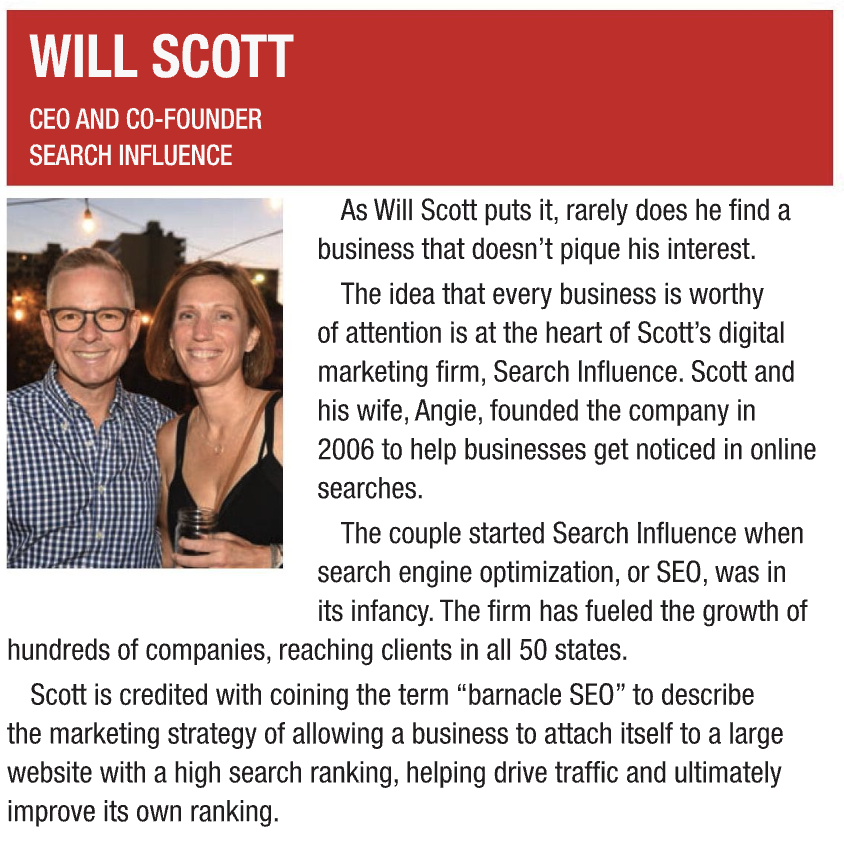
    “As Will Scott puts it, rarely does he find a business that doesn’t pique his interest,” writes CityBusiness. “The idea that every business is worthy of attention is at the heart of Scott’s digital marketing firm, Search Influence.”

    Fueling the growth of hundreds of companies since 2006, Scott is credited with coining the term “barnacle SEO.” In his feature in the Power

    Streetcar riding down st charles avenue in new orleans, la

    List, CityBusiness describes this marketing strategy as a method of allowing businesses to attach themselves to large websites with high search rankings, helping to drive traffic and ultimately improve their own rankings.

    Learn More About Search Influence’s Impact

    Led by Scott, the team of dedicated marketing professionals at Search Influence have helped businesses across industries optimize their potential.

    New Orleans made and proud, Search Influence works with clients in education, medicine, tourism, law, and beyond to deliver digital marketing results that lead to business growth.

    Fill out our online form today to learn more about Scott’s marketing expertise and the digital marketing services at Search Influence.

    Images

    Streetcar

  • #FreelancerFriday: 10 Common Rookie Freelancing Mistakes and How to Overcome Them

    In his rookie season, Peyton Manning threw a league-high 28 interceptions as his team struggled to a 3–13 record. As a rookie, Tom Brady was third string and only managed 1 completion for six yards.

    Even a pair of all-time greats had to start somewhere as newcomers in the league. The point is, they got better—much better—but not without first learning from their rookie mistakes.

    Freelancing is not professional football, but like most things, it requires a set of skills that are built up through time, practice, continued education—and most importantly—learning from your past mistakes.

    No matter if you are freelancing your way through college or retirement, there will always be a few bumps in the road. Here are the most common rookie freelancing mistakes and tips on how to overcome them:

    1. Using an unprofessional email address

    This is the most common and frustrating, yet easiest-to-fix mistake a rookie freelancer can make. Avoid anything that is immature, ambiguous, cutesy, or just unnecessary to your freelance business. This includes nicknames and writer-based names like “SEOwriter” or “MommyBlogger.” To keep things simple, your email address should be your actual name and little else.

    2. Exaggerating your experience

    Just like a resume for any job, it is not acceptable to lie about your writing and freelancing experience. Don’t say you wrote for a publication when you didn’t. Don’t say you are an expert in technical writing when all you’ve written are lifestyle blogs. It will always catch up to you, and it will ultimately cost you jobs and payment when the truth is discovered.

    3. Not marketing yourself or building your brand

    As a freelancer or contract worker, you are essentially setting up a business for yourself. And just like any business, marketing is very important. Without marketing, you are leaving a lot of business out there. Craft your own unique selling proposition on how you are different from other freelancers. Next, create a comprehensive marketing plan through various channels, including email and social media. Daily activities focused on brand building and business development will help increase your visibility and build interest in your services.

    4. Never turning down work

    I know, it seems counterproductive to turn down work, but accepting every job only creates problems, including poor time management. Not all jobs are created equally. You have to learn to identify and turn down the bad ones, or you’ll just end up wasting your time, often with more stress and less money. You can’t just accept work for work’s sake; it’s not the best path to earning more.

    5. Missing deadlines

    Lots of people miss deadlines, not just newcomers. But since rookies are more prone to mistakes, this is especially important when you are first starting out and are trying to establish a positive professional reputation. If missing the deadline is unavoidable, tell your editor as soon as possible. Don’t pile on the excuses—just apologize and accept responsibility. The next step is to confirm when it will be completed or ask for an extension.

    6. Ineffectively balancing your workload

    It is common to underestimate how long and how much effort a certain project will take, especially if you are a new freelancer or fighting others to land the gig. Be honest with yourself, and remember, it is usually better to under-promise and over-deliver. Avoid taking on a lot of new work all at once, or before you fully complete a big project. Find and take advantage of your most productive time of the day, make and stick to a schedule, stay organized, and know your limits.

    7. Being afraid to ask your editor questions

    The writer-editor relationship is a special one that needs to be nurtured over time. When a writer is just starting out, there is a lot of uncertainty on both sides of the table about one another. Undoubtedly, questions will arise for new writers working for a new client. You cannot be afraid to ask these questions. Experienced editors should be expecting questions from freelancers and always be eager to answer them. Asking editors questions is the best way to avoid simple misunderstandings and ensure the project is completed exactly as they wanted.

    8. Not accepting criticism & refusing to learn new things

    As a freelancer, feedback is just part of the job—it’s unavoidable. You must learn to accept criticism gracefully, or better yet, use the feedback to improve your work. Of course, not all criticism is justified, but more often that not, it is. Don’t be argumentative. Make your case politely if needed, or accept the feedback, thank them, and make the changes.

    Another stubborn trait that many new freelancers possess is the refusal to learn new things or even adapt their skillset—whether it is their style, habits, equipment/applications, etc. Nothing reveals amateur status more than a stubborn refusal to adapt. Freelancers should always be working to improve themselves, which includes additional training, earning certifications, and keeping up with current market trends.

    9. Not standing up for yourself or reading your contract

    As a contracted worker, not an employee, it should go without saying that, eventually, someone is going to try and take advantage of you and your work. This can include deadline changes, endless rounds of edits, pay discrepancies and delays, or any additional countless ways freelancers can be unfairly treated.

    This goes hand-in-hand with contract negotiations. Unfortunately, many freelancers do not even read their contract upfront before signing, which only opens you up to unfair treatment and/or legal issues down the line.

    10. Poor Communication

    Freelancing these days is rarely a face-to-face thing. Communication is largely done via email, phone and video calls, or text and instant messaging. Because you are not an in-office employee, maintaining communication is very important. Equally important is the tone, clarity, and detail in your communication. You likely will not talk to your editor or project manager on a daily basis, so you want to be sure both parties are always on the same page to avoid delays and mistakes.

    Mistakes are going to happen when you’re first starting out in the freelancing game. But, with practice, some patience, and by following these pointers, you can be a freelancing pro in no time.

    Images:

    Tom Brady

    Betty White

  • Zoos, Aquariums, and Non-profits: Here Are Three Top Tips to Fundraise Like a Pro

    Based in a city known for its tourism and attractions, Search Influence is no stranger to digital marketing for zoos, museums, and other non-profits. We’re here today to pass on some of our knowledge to you! These three tips for fundraising through social media are sure to spark your creativity and help get donations flowing through the door.

    Two hands holding a ball of money - Search Influence

    1. Make Giving Easy

    Even the most dedicated patron can get turned off if they have to fill out confusing forms or trudge to your office in person. Streamline the donation process by taking advantage of easy online giving platforms. Some user-friendly platforms and campaigns include:

    FundRazr

    MuseoBlogger points to the Boston Museum of Science’s success with FundRazr. This app is free to download and offers patrons a number of custom giving options. For example, they can either choose to contribute anonymously or to identify themselves via their Facebook profiles. Similarly, they can choose to give either by credit, debit, or PayPal. MuseoBlogger writes that FundRazr is “intuitive, convenient, and provides both instant gratification and recognition.” Maybe that’s why Boston Museum of Science raised over $1,200 from Facebook users alone—likely all donors who were not contributing via the traditional channels.

    Text to Give

    Colleen Dilenschneider, Chief Market Engagement Officer for IMPACTS Research & Development, highlights Cameron Park Zoo’s mobile giving campaign and Rosamond Gifford Zoo’s Adopt an Animal program as two nontraditional fundraising campaigns. As part of their mobile giving campaign, the zoo encouraged guests to donate $5 or $10 through a simple text message, making it easy for patrons to show support from home or say thanks after a great day at the zoo.

    Adopt an Animal

    The Adopt an Animal program at Rosamond Gifford Zoo is available to animal-loving patrons throughout the year, but in honor of National Adoption Day, the zoo ran a two-day promotion to spread awareness of the program. To reach a wider audience, they lowered the minimum donation requirement and created a smaller, custom donation package. This promotion generated an extra $350 and gave incentive to those who may not normally donate to the program.

    It’s simple. The easier it is to give to your organization, the more likely people are to donate.

    2. Establish a Brand

    Having easy donation platforms is great—as long as people know about them! To make the most of any digital fundraising campaign, you first need a community of fans and followers. And the first step in building that community is establishing your own brand. This gives patrons a clear idea of who they’re engaging with and helps them feel a personal connection with your organization and its values. After all, no one wants to give away hard earned money to a stranger on the internet!

    Complete branding should be an in-depth endeavor. It requires cohesion between your physical location, website, and social media platforms. If you’re looking for a place to start, think about visual branding: assure your color scheme, logos, fonts, and overall visual aesthetic remain consistent across all your on- and off-line locations. Or, you could start with brand values. Post clear causes or ideals that your organization believes in, and then provide evidence of those values through success stories and patron or employee spotlights. For an at-home example of establishing brand values, check out our About Us page and see how we communicate our dedication to optimizing business’ potential and the New Orleans community. Then, pop over to our pages about Success Stories and Company Culture to see those values demonstrated in action.

    3. Get Inspired With Engagement Ideas

    With your brand established and clearly communicating exactly who patrons support when they donate to you, it’s time to engage with the community! There are tons of great ideas out there, but here are some of our personal favorites.

    First, make it very clear where donations will be going and how patrons will benefit by giving. Just like how people prefer to support trusted brands over internet strangers, patrons are more likely to donate if they know exactly what their money will achieve. Consider offering additional perks for high-dollar donors. For example, a newsletter with updates about their chosen animal or a plaque with their name by their sponsored exhibit.

    Another popular engagement idea is live-streaming certain exhibits. Offer a night-stream that shows patrons what nocturnal creatures are up to when the zoo or aquarium is closed. Keep a 24/7 feed going on monkeys or other active and entertaining animals. Or, if one of your animals is expecting, consider broadcasting her pregnancy and birth, as well as her baby’s early growth. While this isn’t as directly tied to fundraising as animal adoption programs, it will nonetheless warm viewers’ hearts and get them engaged with and excited about your organization, building the meaningful connections that could turn into donations down the road.

    Finally, appeal to photographers. Nothing gets people excited about zoos and aquariums like cute pictures of fuzzy animals, and encouraging visiting professionals to take photos means your organization gets all the exposure with a fraction of the cost and effort. Consider using your social media accounts to host fan photo contests, like the Shedd Aquarium, or repurpose the photos you already have with a caption contest. To go even further, consider hosting photographer-only after-hours events, like Aquarium of the Pacific. This offers amateurs and professionals alike the opportunity to take great pictures without the general public getting in the way. When they post their photos, it’s free advertising for your organization, and it’s a great opportunity to extend your network to include the photography communities.

    Consult the Experts

    We promised three fundraising tips, but here’s a bonus fourth! If you want to focus the majority of your time and energy on running your organization, Search Influence is here to help you with everything from content marketing to online advertising. Request your proposal online today.

    Images:

    Moneyball

    Zootopia

    Giraffe

  • Connect Your Brand With Your Community

    Human beings are social animals, but what kind of community would form around your company’s online branding? Brand loyalty is easily observed in beverage and automotive industries, and fans of a particular brewery or manufacturer often consider that brand preference a part of their personal identity. Coke or Pepsi, Chevy or Ford, and Windows or Mac: these rivalries and preferences elicit emotions like the choice between sports teams. The fans of a brand develop a tribal sense of community, but it doesn’t happen with just any company. What if you could make your brand inspire that degree of enthusiasm and loyalty?

    A collection of company branding icons - Search Influence

    Make Your Brand Relatable

    When kids try to make friends, the classic advice is to “be yourself.” Similarly, your online branding strategy needs to come from a genuine place if it’s going to build a following. Big promises and low prices will motivate a purchase, but you need to meet or exceed a customer’s expectations in order to make them a fan. When you think about brands that have been popular for decades, they have earned the lasting support of repeat customers. Quality products and reliable service aren’t just slogans, they’re perceptions that match the experience of satisfied customers.

    A branding campaign should not require an overhaul of the way you do business. It can be as simple as identifying your strengths or making your marketing more consistent. But where do you go once you’ve got your brand established? The first step is finding those that relate to your brand the most. Target the interest groups and demographics most likely to identify with your brand through online advertising, and track their progress along the consumer journey. After they’ve visited your site or clicked on an advertisement, keep your brand visible with targeted remarketing. Every impression and interaction is an opportunity to confirm the value and reliability of your brand.

    Three women having coffee and a business conversation at a diner - Search Influence

    Emphasize Human Interaction

    Automation is great for business efficiency, but customers appreciate interacting with your human employees. When an existing customer calls with a problem or question, they react differently when answers come directly from a person instead of a recorded message. We’ve all experienced the frustration of answering a dozen automated questions in order to complete a simple task. In contrast, it’s easy to imagine how it feels to interact with a single employee throughout an interaction with a business. Whether they’re contacting a travel agent, realtor, or secretary at a law firm, people have a different experience when they have the chance to repeatedly connect with the same human being. Their connection with that individual becomes their connection with the whole company.

    Of course, the conduct of your employees can have a positive or negative impact on the way your brand is perceived, depending on how they interact with customers. When training and managing employees, remember how their treatment of customers can impact the long-term reputation of the business. Efficiency is important, but be sure to acknowledge and reward employees who go the extra mile for customers. It can be as simple as remembering a name or some other personal detail. A friendly voice and attention to detail can make customers feel valued by your company, even when you’re offering a no-frills product or service.

    Find Followers on Social Media

    Find a voice that resonates with your target audience and sets your business apart from the competition. On social media, your company’s response to news and trends will give the public additional opportunities to identify with your brand. Whether you develop a presence on Facebook, Instagram, LinkedIn, or Pinterest will depend on your target audience and what’s appropriate for your industry.

    You’ll want to post frequently in order to keep your business visible, but the majority of the posts should not be directly promotional. That doesn’t mean you have to spend all your time writing your own witty blogs. Not everyone is rocking the digital marketing industry like Search Influence. Rather, you can share news stories and articles related to your industry and community. By sharing authoritative, newsworthy content, you prove to followers that your business is keeping up with the latest trends. Not only are you building your brand, but you’re also making your business a valuable resource to potential customers, even when they aren’t currently in the market for your services.

    One of the biggest benefits of social media is that it provides a more detailed view of your target audience. As your following grows, you’ll gain a more detailed understanding of the interests, demographics, and preferences of people interested in your company. This information enables you to develop customer profiles and more specifically define your target audience. Identify the trends that groups of your fans have in common, and you’ll have an edge on the competitors who still advertise indiscriminately to the public at large.

    How Does Community Generate Revenue?

    Your customers understand how traditional advertising works. Across all platforms, paid content and advertisements get a lower CTR than personal content generated by close friends and family. When a friend recommends a business or vacation destination, that recommendation is more impactful than a commercial. By building a connection with the community, your online branding can make itself a topic of conversation. You can design promotions that encourage fans to show their support on social media. When people see that a close friend voluntarily supports your business, that recommendation carries weight. Get customers to advocate for your tourist attraction, dealership, or boutique, and you have a powerful alternative to conventional ads.

    Establish Your Brand As a Community Ambassador

    Members of the public are generally skeptical about the motivations of corporations and businesses. The global economy never ran on gumdrops and compliments, but consumers like to see brands that make a visible effort toward conservation, disaster relief, and other causes with a broad base of support. Politically controversial issues are a gamble because they needlessly turn away potential customers. It’s far better to publicly give to a popular cause and leverage social media so that fans can share the news of your good work. Many of your donations to non-profits can be tax-deductible. Improving the image of your company isn’t a fast process, but it has the potential to greatly increase your revenue by converting potential customers into supportive fans.

    If you need help clarifying your brand or marketing your business online, our team can help. Grounded in a foundational understanding of SEO, we know how to build authority and make your business stand out. Digital marketing isn’t just a way to generate new leads—it’s an increasingly vital part of remaining competitive in today’s marketplace. Request a proposal from Search Influence to amplify the digital voice of your online branding.

    Images:

    Brands

    Facebook

    We Like You

  • Five Tips for Creating Customer Advocates for your Tourist Attraction

    When your past customers talk to their friends and family about their vacation, are they likely to recommend your business? Word of mouth is critical for sustainable, long-term business growth, and social media has multiplied the number of connections between people sharing travel advice and reviews. In fact, a recent study from Nielsen found that 92 percent of consumers say they trust brand advocates, including recommendations from friends and family. Here are just a few of the ways to encourage customers to help promote your tourist attraction.

    Spongebob Sqaurepants laughing - Search Influence

    1. Attach Your Brand to a Real Person

    People naturally connect better with human beings, and it’s even better if customers interact with the same face repeatedly. Do you have a secretary or hostess who can orient new customers to your services and their options? Family-run and personality-driven businesses have an easier time identifying their brand with friendly owners and managers, but any business can make itself more relatable by avoiding shortcuts that result in impersonal service.

    Whenever possible, avoid using automated responses and impersonal emails. Over the phone, your business should be represented by a friendly voice. When electronic communication is necessary, try to use the same staff member so that customers have a chance to develop a rapport. By creating that dialogue, you’ll appeal to your audience’s emotional side, which neuroscientific research has linked directly to decision making in the brain. This genuine and friendly first impression is the first step toward creating a lasting customer who can, in turn, become an advocate for your brand among their peers.

    An excited man with a camcorder on a beach - Search Influence

    2. Create Photo-Ready Shareable Experiences

    If you know you’re creating a remarkable in-person experience for your guests, be sure you make it easy for them to translate that into photos, videos, and content online through their social channels. Tour guides and attraction managers know the best locations for group photos, and you can remind parties and couples of the optimal times to take out their cameras. Introverts may be reluctant to ask for someone else to take pictures, but waitresses and tour guides can start the conversation by suggesting a photo op. All of your customers’ friends will be curious to see where the picture was taken.

    Whether it’s a funky statue that’s perfect for a photo op or a contest through your social media platform to get guests to share their best photos in exchange for a gift certificate or branded swag, make sharing fun and interactive. You can even offer free Wi-Fi at your location and post signage with your branded hashtag or social media handles to make it as easy as possible for your guests to share right away and include you in their posts.

    3. Claim Your Online Presence & Stay in Touch Through Social Media

    Speaking of social, don’t forget to continue to foster that relationship with your guests online, even long after they’ve left. One of the most important steps of building customer advocacy is claiming your online presence. Brand your social media platforms with your company logo and beautiful photos of your attraction so that guests will know right away that you’re legitimate. Rather than just trying to promote your business on social media, be sure you also provide helpful information, fun events in the community, and posts that showcase your brand “personality.” When your fans find your posts helpful and relevant, they’re much more likely to share them with their fanbase.

    In addition to the usual social media platforms like Instagram and Facebook, you need to claim your Google My Business page. Since the Google ratings and reviews appear alongside search results, it’s important that your listing is accurate, detailed, and looks professional. This includes checking your hours of operation and adding photos of your attraction so that guests know they’re looking at the right listing.

    4. Collect Emails By Offering Promotions

    Every business is offering membership discounts and promotions these days, and an email signup is an easier alternative to the sometimes cumbersome memberships. When advertising on social media and your website, encourage customers to sign up for future promotions. Potential customers who are still planning their vacation will be interested to see whether special discounts or offers coincide with the time of their planned visit. In the meantime, your well-crafted emails will make sure your attraction isn’t forgotten as they get closer to finalizing plans.

    At the end of their visit, satisfied customers will be interested to see if you offer promotions they can share with friends. By giving email subscribers advanced notice about special events, you make them feel like they have inside information. When they feel like they have a special connection with your business, customers are more likely to advocate for your business. When their friends are visiting the same destination, they’re even more likely to recommend your business because you’ve continued to make a positive impression.

    Amy Poehler in Parks and Recreation saying Please - Search Influence

    5. Ask Nicely

    Just like Google My Business, it’s important to keep track of reviews on all social platforms. Depending on your industry, Yelp or TripAdvisor or another website may be more relevant. Many business owners forget to ask customers for reviews. Unfortunately, the customers who are self-motivated to write reviews are often the ones looking to vent about a negative experience. Happy and satisfied customers rarely feel the need to go through the necessary steps to write a review, but they’re more likely to take the time if someone at your company makes it clear how much their time would be appreciated.

    Whether you’re running a Ferris wheel or a hole-in-the-wall gourmet donut shop, you need customers to spread the word and advocate for your business. Once you’re confident in the quality of your services and products, it becomes a matter of encouraging customers to share their excitement online. The good news is that most of the things that help build advocacy also improve your connection with customers. When you leverage that connection to further improve your business, you can join in the success of tourist attractions that are winning on social media.

    Need help getting started? Learn more about our consulting services to help build a solid reputation for your attraction.

    Images:

    Spongebob

    Camcorder Dad

    Parks and Rec

  • 5 Strategies to Get Guests Talking and Increase Event Attendance

    5 Strategies to Get Guests Talking and Increase Event Attendance

    With the right marketing strategy, your event will be the topic that everyone seems to be discussing. Potential attendees will feel compelled to join in the fun. Millennials have coined a term for this pervasive social anxiety: “FOMO,” for “fear of missing out.” This social enthusiasm is great at motivating that final step for a successful gathering: converting people who are merely aware of the event into participants who actually attend. Whether you’re still sending invitations or collecting RSVPs, every event planner needs to know how to make their big bash the talk of the town.

    Image of Ariel from little mermaid in New Orleans, LA

    Email Marketing

    You know the contact information for your most dedicated fans and colleagues. Give newsletter subscribers and loyal customers the inside scoop, and they’ll be happy to make plans in advance. Include links to any special promotions or contests leading up to the event to help encourage your fans to spread the word and invite friends through social media. And be sure to tease out the event over a few targeted emails, building excitement and revealing new surprises that your customers can’t get enough of.

    Whether it is your regular newsletter or promotional messages for the big event, less is more, especially when it comes to emails. Flooded inboxes are a familiar experience, and many people cull through their incoming mail on a smartphone, further limiting the time and screen space allowed for each message to make its case. When you’re promoting an event, don’t send out too many emails to the same recipients, or you may turn potential attendees into unsubscribers.

    Facebook Promotion

    Facebook events allow you to track RSVPs and disseminate essential information. People need clear details about the time, location, and parking. Facebook makes key logistical information easily accessible, and it also provides a platform for easy promotion. With event marketing on Facebook, you can pay for promotion to get more views and attendees. Even without paying for advertising, you can design posts that encourage engagement. Produce exciting promotional infographics, and your fans will be happy to spread the word.

    Schedule important posts for the early afternoon, preferably from Wednesday to Friday. Those times allow a larger number of active Facebook users to see your posts, and they can still share the news before the weekend. Social media also allows you to gauge enthusiasm and adjust your promotional strategy, depending on which posts get more engagement. Learn more about how social media management can help you find attendees for your big event on Facebook and other platforms.

    Remarketing

    Not everyone who clicks on your page will attend, but people who visit your website and event page have demonstrated interest. Target those undecided visitors with remarketing through Google Display or Facebook Display to remind them about the event and keep it top of mind. This is especially important if your event tickets typically sell closer to your event. As with other forms of targeted advertising, you can put your message in front of local viewers with relevant interests, and you can even filter by age groups and other demographic variables. Remarketing is special because it is tailored to potential guests who have demonstrated a very specific interest.

    Not everyone checks Facebook more than five times a day, and it’s easy to forget about upcoming events. Online advertising provides reminders for converting interested viewers into actual attendees. Even users without a social media presence will still see advertising on search engines and other web page banners.

    Influencer Marketing

    Advertisements are great reminders for upcoming occasions, but trusted online personalities can have an even more profound influence on attendance. Make your gathering popular by getting relevant influencers on board. In some ways, the internet is still a lot like high school, and influencers are the popular kids with a lot of sway over which parties and trends are “cool.”

    Reach out to the internet personalities relevant to your industry and audience, and they may be interested in helping to spread the word. Some influencers are content creators who rely on sponsorship. Others are bloggers who share reviews and news relevant to their followers. Influencers make great VIPs, and they may also be interested in giving away tickets, further spreading the word.

    Social media icons rotating in New Orleans, LA

    Snapchat and Instagram Stories

    If you’re targeting a younger audience, you need to keep up with the latest trends. Snapchat and Instagram allow you to tell a compelling visual story. The week and day of the event, be sure to have someone on staff dedicated to updating your feed with behind-the-scenes videos, live updates, and reactions from attendees. You can even get your influencer to take over your social account during the event to stir more excitement. Publishing a lot of content during the event, and encouraging your guests to do the same, is the best way to jumpstart your marketing and attendance for the following year.

    From underwater welders to teenaged musicians, a surprising range of communities are active on Instagram and Snapchat. If you aren’t sure about the best place to reach your audience, then it’s worth getting professional help. Consulting services can help you determine which outlets are most effective for your industry and target audience, while lead tracking and analytics will help you determine how best to elicit reactions from followers.

    Event marketing is about more than spreading the word. Use your established branding to show how every attendee will have a great time. With the right impression and frequent reminders, your local community will be FOMO-ing all the way to your big day. Whether you’ve booked an exclusive venue or amazing guest speaker, promotion (through advertising or social media) is just a way to spread the exciting news. Once you’ve done the hard work of planning a gathering, FOMO is the natural reaction of people who understand what a great time you have pulled together.

    Have a big event coming up but no time to promote it? Request a proposal to learn how Search Influence can help you succeed.


    Images:

    Social Media Pendulum 

  • #FreelanceFriday: What Freelancers Need to Know Before, During, and After Doing Their Taxes

    This blog is part of our Freelance Friday series, where we discuss everything and anything related to freelancers. For more freelance information, tips, and trends, follow us on Twitter.

    It’s the end of yet another year. Mixed in with all the holiday celebrations is a sense of closure on the past year and the beginning of a new one. Helping bridge the gap between the old and new is everyone’s favorite time of year–tax season!

    Okay, tax season is probably not most people’s favorite time of the year, but it is an extremely important one nonetheless. Everyone who is gainfully employed–including freelancers–are required to pay taxes. And even though Tax Day isn’t until April, you should start preparing for it now (if you haven’t already).

    Determining Your Income

    Most freelancers work with several companies and/or clients, as well as other jobs and side gigs to make ends meet. Before tax season gets started, it’s important to gather all sources of income so that everything is accounted for and reported. Search your desk, your computer, under the couch, and everywhere else for all the receipts and invoices you accumulated throughout the year.

    Taxes are different for everyone, especially freelancers. Freelancing is a unique job in many ways, including major perks like more freedom and flexibility. So, it should come as no surprise that taxes for freelancers is a little different as well.

    Self-Employment Taxes

    The first major thing that sets freelancer taxes apart is the self-employment tax, which covers Social Security, Medicare, and additional state taxes for individuals who work for themselves. This main part of the self-employment tax comes out to 15.3%. 7.65% covers your share of Social Security and Medicare and another 7.65% for the share an employer would normally pay (though you can deduct all or some of the employer portion). Additional state self-employment taxes vary by location.

    Whereas regular wage earners have these taxes withheld from their paycheck, if your independent freelance business generates more than $400 annually, you have to pay this tax during tax season. It is best to plan ahead and set aside some money throughout the year to cover this obligation. This will keep it present in your mind, alleviate pressure, and help eliminate any surprises year after year.

    Paying Estimated Taxes Quarterly

    Paid periodically throughout the taxable year, estimated taxes are fractional payments of your final year-end tax liability that you ultimately responsible for. The payments are required to be paid by specific dates throughout the year (Apr 15, Jun 15, Sept 15, Jan 15) using specific IRS forms. If you fail to make these payments throughout the year, the IRS will tack on late fees to the total you ultimately owe.

    To accurately determine your estimated tax payments, it is crucial that you keep up-to-date and accurate financial records that will allow you to keep an ongoing calculation of your business’ profits. Knowing your profit in any given quarter will help you determine how much you should pay to the IRS for these quarterly payments.

    If you have a full or part-time job where you receive a W-2, you can likely void paying estimated taxes simply by increasing your withholding at that job.

    Necessary Tax Forms

    The main form you will need depends on what kind of freelancer you are. If you freelance as a side gig or as an established LLC, you will report your income and make payment via your annual Form 1040 individual return.

    If your freelance business is on a larger scale than that–such as a structured multiple-member LLC or a corporation–you will need to file a separate return for your business. For example, a partnership return requires a Form 1065, a C-corp needs a Form 1120, and an S-corp return uses a Form 1120S. No matter what federal form you end up using, make sure you to all get the corresponding state forms as well!

    Next up, is your 1099. If you are paid more than $600 from any one client, they are obligated to send you a Form 1099-MISC. Companies are required to provide contract workers with this form by January 31, so that you have plenty of time between then and Tax Day.

    If your freelance payments are sporadic and/or not your main source of income, you can list them under the “Other Income” section of your main tax return. However, if your work is substantial enough to be considered self-employed, you must report this income on a Schedule C attachment to your tax return.

    Itemize and Record Business Expenses

    One of the advantages of being self-employed and having a 1099 is more flexibility with deductions. The IRS guideline for freelancer tax deductions is that expenses must be ordinary and necessary. A good thing to keep in mind is: if you would have purchased something even if you weren’t running a freelance business, it will likely not qualify for a deduction. And remember to always keep those receipts!

    According to TurboTax, freelancers can write off some expenses for: business-related travel and food (up to 50%), office expenses, and required equipment and supplies, as well as continuing education, certifications, registrations, and licensing fees.

    Close out the Year and Start Prepping for the New One

    Being your own boss means making sure things get done. The biggest part of this is making sure you get paid promptly and accurately. Find out who still owes you money and make sure you get it in time for that year’s taxes.

    Another major responsibility is organization, particularly accurate record keeping. If you are scrambling this tax season and in years before, make a commitment to help yourself throughout the year rather than in just the final weeks. Develop a filing system for receipts and invoices (both paper and digital), create spreadsheets to track all work and payments,

    Ask Questions and Get Help

    Freelancing comes with a lot of perks, but the trade-off is that you have to do your own taxes. It can be difficult, time-consuming, and generally overwhelming. Don’t be afraid to ask for help.

    Certified tax preparers and accountants know what needs to be done and how to do it. Take advantage of the offseason to meet with these professionals, because once tax season gets into full swing by February, March, and April their schedule fills up quickly.

    Images:

    Tax Season

    W-2’s, W-9’s 

    Prince John 

  • Diversity in the Workplace: Why Who’s at the Table Matters

    In the corporate landscape, it’s easy to overlook words like diversity or inclusion, which often get tossed out as buzzwords lacking real meaning. But building an inclusive workplace where employees with different backgrounds, viewpoints, and identities can succeed is a benchmark for company success as well. In fact, a 2015 McKinsey report found that ethnically diverse companies are 35 percent more likely to outperform the national industry median and 15 percent more likely to have better financial returns.

    But let’s be real—diversity in the workplace is far from the norm.

    According to the New York Times, there are more male CEOs at S&P 1500 companies named John or David than the total number of female CEOs. And of the CEOs at Fortune 500 companies, only five are African American.

    This issue isn’t just for leadership either. A study from the Society for Human Resource Management found that 41 percent of managers surveyed said they were “too busy” to create structured diversity efforts in the workplace. Even so, more than half of employees surveyed by Glassdoor said they think their companies should be doing more to increase diversity.

    This data shows that there’s immense work to be done. But we can look to companies who have successfully incorporated diversity into their operational ethos as an example for what works—both for the employees and for the bottom line.

    Defining D & I in the Workplace

    Teenagers Young Team Together Cheerful Concept Diversity - Search Influence

    Diversity and inclusion can’t be achieved without first setting a clear definition for what these words mean, how they align with the business’ values and mission, and what systems are in place to create them. Building an inclusive workplace means being accepting and accommodating for gender and race, but also for sexual orientation and identity, religious affiliation, disabilities, age, and even thinking styles or backgrounds.

    By creating a workplace with diversity of thought—as in, collaboration among people with vastly different perspectives and viewpoints to solving problems—organizations can create systemic change. A study from Deloitte found that diversity of thought can help prevent “groupthink,” allowing for more creativity and more thoughtful decision making.

    But how does diversity of thought become a reality in the workplace?

    It Starts at the Top

    If diversity is built into the company ethos, then its leaders should be advocates on the frontline. For example, Arne Sorenson, president of Marriott International, regularly advocates for LGBTQ equality in the workplace. Marriott was ranked #7 on the 2016 Best Workplaces for Diversity list and scored a 100 on HRC’s 2017 Corporate Equality Index. Ethnic minorities make up 64 percent of Marriott’s workforce, with 2.7 percent of employees identifying as LGBTQ. Sorenson has fought for LGBTQ rights publically, even writing an open letter on his LinkedIn account about diversity in government and business.

    You can also include the LGBTQ community at large in your brand’s marketing efforts. Take a look at these ideas.

    Offer Benefits That Enhance Inclusivity

    On an operational level, businesses can also build inclusion into the brand identity by offering benefits that defend their stance on diversity. Rather than just relying on an annual cultural sensitivity class or a blanket statement in the employee handbook on diversity, companies should take a multi-faceted approach that includes diversity in the training, communication methods, and employee benefits.

    For example, AT&T offers Employee Resource Groups (ERGs) and Employee Networks (ENs) connecting over 130,000 members from across the company’s global workforce. The ERGs are nonprofit organizations that support, mentor, and advocate for communities in the company, including ethnic groups, the disabled, women, LGBTQ employees, and military veterans. The ENs are more informal, employee-led initiatives that convene around specific professional development issues.

    Groups like this give a voice to individuals who might feel marginalized and help individuals find common interests—both key for building a culture of inclusivity.

    Other ways to help enforce and validate inclusivity include offering English as a Second Language classes for foreign employees, providing benefits for employees with same-sex partners, and working with other companies that share the same values (or saying no to companies that don’t).

    Make Diversity Measurable

    Think Tank Around Measuring Diversity - Search Influence

    While meeting quotas doesn’t determine your company culture or employee morale, it does make a difference. Including diversity goals in annual reviews for managers and building it into hiring practices can help set the baseline for what diversity really looks like in your company’s daily operations.

    Some companies have even created positions dedicated solely to diversity. Abbott, ranked #10 on DiversityInc’s 2017 Top 50 Companies for Diversity, has a Director of Next Generation Recruitment, Diversity, & Inclusion who focuses on using technology to hire and retain employees with diverse perspectives. While not every company has the budget to devote an entire position to D & I, small businesses can still make diversity part of the recruiting, hiring, and review processes in order to measure success.

    When diversity is measurable, employees feel accountable and empowered to make it a priority. Give employees outlets to share feedback anonymously about the success of diversity initiatives, and be transparent about what is working and where the company can still improve.

    In today’s globalized economy, a diverse workforce can better reflect the needs and wants of a much bigger, much more varied consumer base. By building diversity and inclusion into every facet of your company, you’re building a workforce that is more empowered, innovative, and ready to take on the complex problems of our ever-changing, increasingly-connected world.

    At Search Influence, we realize that we still have a long way to go in order to foster an inclusive and diverse community—especially in the tech industry. Learn some ways we fight for women in the workforce and read more about our company culture.


  • ‘Tis the Season to Get Creative: Using Social Media for Holiday Marketing

    Many of your customers are gearing up for numerous holiday festivities that involve family, friends, and coworkers. This time of year also inspires lots of shopping. According to a study done by Deloitte, the average American will purchase 15 gifts during the holidays with the months of November and December generating 30 percent more revenue than non-holiday months. With all the gift giving and celebration, a stellar online presence, particularly on social media, is key to your business having a shining season. Keeping your customers engaged and informed of specials, events, and general happenings in the behind-the-scenes aspect of your business builds trust but also can build sales. In 2015, 75 percent of shoppers used the internet to research which gifts to purchase. So, don’t be afraid to get creative and light up your customers’ timelines with compelling copy. Need a little inspiration of your own? Here are some social media marketing tips that will get you in the holiday spirit.

    Christmas gift giving from 22 minutes - Search Influence

    Deck The Halls…With Lots Of Images

    Photos, videos, and other images are paramount to a healthy social media presence and they also present the perfect opportunity to engage potential shoppers on all levels. Create an Instagram video and show quick, behind-the-scenes clips of your store or showcase a new product or one of your lesser-known services. According to Wyzowl, 74 percent of shoppers who watched a demonstration video about a product or service subsequently bought it. So, show off your Spielberg skills and put together a product video to demonstrate how a featured item in your store is used. Remember, this doesn’t have to be a costly high-tech venture; just use a smartphone and tell a short and sweet story about how your shop is preparing for the holidays. Upload to your social media or even YouTube. If stills are more your thing, take some high-quality photos using your iPhone or a more professional camera and post images of employees who are in the holiday spirit. You can even include some shots of that huge order fulfillment you and your crew are working tirelessly on. Make the images personal and easy to share. If you are running low on your own photos, try incorporating user-generated photos from your customers.

    Tinsel Everything From Wall to Wall

    In other words, cover your bases when it comes to social media. Since your potential customers are more than likely shopping for other people, you are not necessarily trying to gain the attention of your traditional customer base. You may be trying to appeal to a mother buying a gift for her 20-year-old son, or a 30-something purchasing something for his niece. If dad is buying something for his daughter and your business has the perfect gift, let him know. Facebook has proven to be a wonderful resource that really does appeal to pretty much every demographic. With tools like Facebook ads, it’s becoming easier to target your potential shopper, so make sure the language that you’re using in your content speaks directly to your audience.

    Tinsel being placed on a tree in It's a Wonderful Life - Search Influence

    Spread the Joy of Your Business

    Today’s consumers want to know the ethics behind the companies they are shopping with. According to a 2015 Nielsen report, 66 percent of respondents were willing to pay more for products and services that came from companies who were committed to positively impacting social and environmental issues. So, tell your customers who you are and what you stand for. Are you doing any fundraising or charity events for the holidays? Share it! Are you participating in a food drive or giveaway? Tell us about it! Does your company’s mission align with the spirit of the season? Even better. These are positive events that can not only create a space for your company to give back but also encourage trust with your customers and impact sales, too.

    Give the Gift of Hashtags

    Added to the Oxford Dictionary in 2010, the hashtag is social media’s way of organizing ideas, keywords, and campaigns. Search some of the current trends and see if an existing hashtag fits your company’s voice or vision for the season. If not, jump start your own! Consider running a promotion based on your customers reposting or sharing a specific photo or post. Have them use a catchy hashtag you’ve created that is personal to your holiday messaging. To incentivize their repost or share, offer participants a small discount.

    Jimmy Fallon and Justin Timberlake using hashtags - Search Influence

    Embrace All the Holidays

    Facebook is a wonderfully diverse platform that will surely get you views from people of all walks of life, so don’t narrow your focus on just one holiday. Show love to each one of them and give them a shout out on your page. Let everyone know how inclusive you are across age groups, interests, and religious and cultural holidays alike. Take the time to wish your current and potential customers a happy holiday season and welcome them to your store.

    This time of year, after all, is about love, celebration, and gratitude. Let your customers know you care with a thoughtful social media campaign that will inspire them. If you need assistance with creating a holiday strategy and managing your social media, contact our team. We are happy to help you deck the halls with holiday content that will get your customers into the spirit of the season!

    Images:

    Gift Giver

    Tinsel

    #Hashtag