Blog

  • Hello Bing, Goodbye Yahoo Local: Moz Local Makes Moves

    Moz Local made some small changes to its reporting dashboard over the past week or so. These small layout differences indicted a large change in the capabilities of the tool.

    Only announced on August 18th (though acknowledging that updates slowly rolled out over the previous week), Moz has added City Grid (City Search), Insider Pages (not fully rolled out yet), and Bing to the growing list of sites that they can submit information directly to. The tool also removed Yahoo from listings that they find and evaluate for you.

    What does this mean for you, a business owner?

    City Search and Bing were already available for Moz Local users to find and address, but they have now made the move over to their “Direct Network.” Since both require verification to edit business information, this change could make it even easier to send out your correct business information out into the wild, wild web for customers and search engines to see.

    Since Moz Local offers an easily navigated and editable interface, when an address, website, or even hours change, you can modify it in just one place and watch it change throughout the high-authority directories and data aggregators.

    What does this mean for you, a marketing professional?

    Moz’s removal of Yahoo Local listings in an strong indication that Yahoo is moving away from being a source for native, unique listing information. As it stands now, native Yahoo listings are being replaced/overpowered with Yelp listings with reviews. By not even caring to show a client’s information on the site, Moz is acknowledging that Yahoo is no longer an independent listing source.

    By adding Bing to their direct network, Moz could change the amount of sites that require client confirmation. With every client, there is a varying amount of difficulty that can happen with verifying listings. Postcards can get lost. Phone calls can get missed. Moz seems now to give a way to circumvent those problems. However, completely dropping the process of claiming Bing would not be wise. Claiming the listing gives you the power to change information immediately and to see how often the listing is seen.

    Moz is showing that it has a great ear to the ground for changes that may be rumbling in the local citation world, and I know that I will be keeping an eye out for any of the new changes that it says should be rolling out soon.

  • Go Go Google Grantspro

    Nonprofit Marketing PPC Image - SearchInfluence

    Being a Google Grants Pro:

    So you’ve heard of Google Ad Grants … in fact, you applied to be a part of the program ages ago. IN FACT, you have been a part of the Google Ad Grants program since like 2005 and you’ve been running campaigns in AdWords to promote your mission and grow your nonprofit organization like a pro (and all on Google’s dime—$10,000 worth of dimes, to be precise).

    Well, that’s cool. Congrats on being a pro with your Google Ad Grants account. But what if we told you—you’re not really a pro until you get accepted into Google Grantspro?

    That’s right. After Google Ad Grants comes Grantspro, and along with Grantspro comes $40,000 of Cold. Hard. AdWords spending limit. Get excited. Your nonprofit organization is about to expand its reach to where it has never reached before…gain visibility where it was never visible before…increase awareness where it was never aware before!

    Wait. What?

    Becoming Eligible for Google Grantspro

    Ah, the good part. Pay attention.

    To become eligible for Google Grantspro, you must:

    • Currently be a part of the Google Ad Grants program. (What’s that? Oh, boy.)
    • Have conversion tracking installed and have successfully tracked at least one conversion.
    • Hit the Google Ad Grants budget cap for at least two different months over the past six months.
    • Currently be a part of the Google Ad Grants program. (What’s Google Ad Grants? Seriously?)
    • Have maintained an average account level click-through rate of 1 percent or higher over the past 6 months.
    • Be on good terms with the Google Ad Grants program.
    • Submit an online application for Google Grantspro.
    • Currently be a part of the Google Ad Grants Program. (How do I become a part of that? Come ON!)
    • Complete biweekly maintenance of your AdWords account.
    • Complete an annual survey.
    • Agree to share your impact or conversion data.

    Sounds simple enough, right? You just have to meet all of the above requirements and you’ll be good to go! Just kidding. Space is limited, and meeting the minimum eligibility requirements does not guarantee acceptance.

    It’s OK. Don’t cry. This is why we’re here: to make sure your application stands out to the College Admissions Rep so you get into your first choice school. Erhm…

    Seriously though, think of Search Influence as your admissions coach. We’ve been through this process before, and we’re familiar with every step of the Grantspro application process. This is part of our job. Get in touch and let us help your nonprofit rise above the rest!


  • Running With The Pack: Competing in Local Search Just Got Harder

    Running With The Pack: Competing in Local Search Just Got Harder

    Overnight on Aug. 6, Google updated search results for mobile and desktop searches from local seven-pack to a three-pack. This is not just in the United States; it seems to be worldwide and rolled out at one time. It’s really early to start dissecting this change, but I’m not seeing much good about it.

    What Does This Mean for Organic Search?

    For organic search, it means it’s even harder for searchers to find you. It looks as if these changes from Google are driving consumers to a business’ My Business page and perhaps encouraging more ad spending.

    Organic—Looking a Little Closer

    On Mobile

    Before Google rolled out this change, when a search on mobile gave local pack results, the user could immediately click on what they needed directly on the search results page, including:

    • Click-to-call
    • Click to get some directions
    • Click on the website

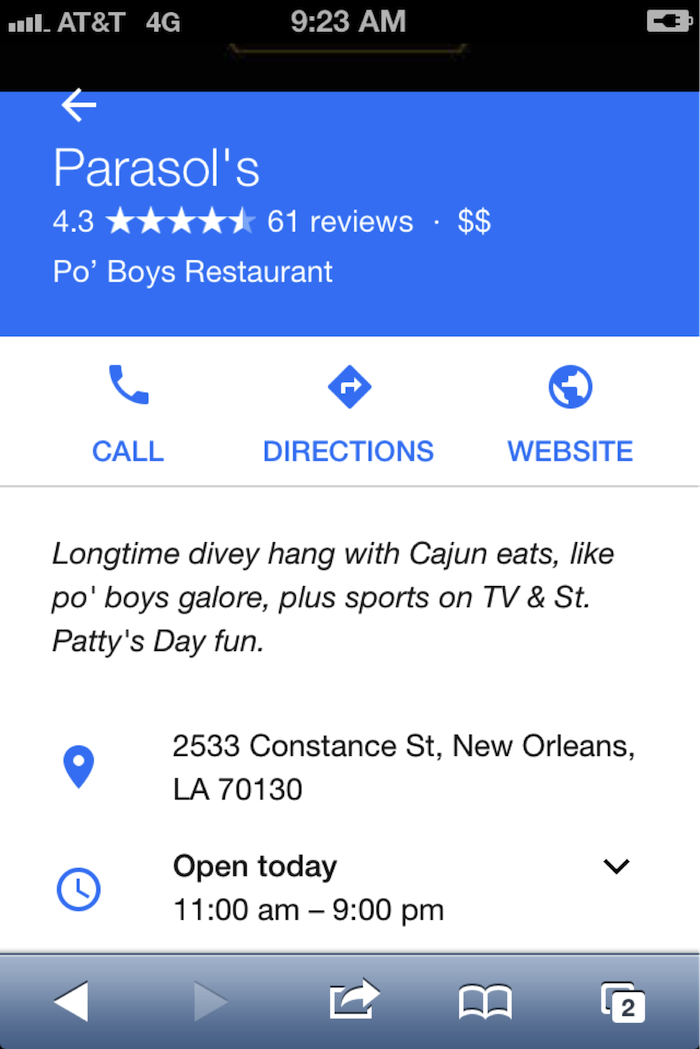
    Now, the mobile local pack only provides a click-to-call button:
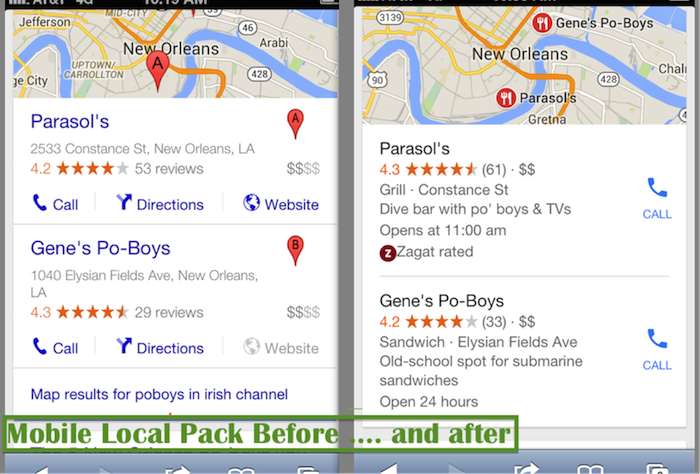
    Mobile Local Pack Click Call Image

    If the searcher wants to visit the website for more info, they have another click in order to navigate to the My Business page:
    Navigate Google My Business Page Image

    On Desktop

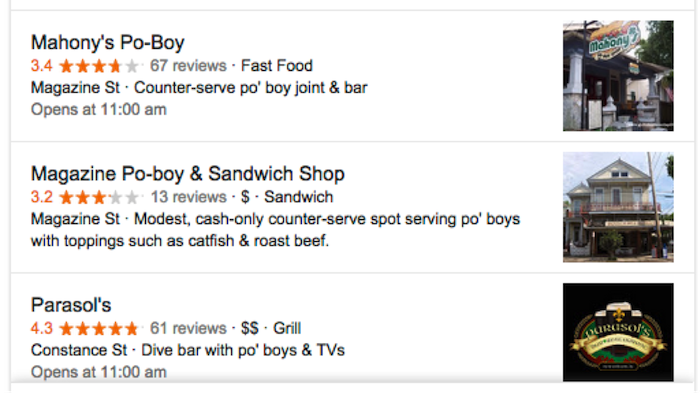
    With the new update, I get the three-pack with no immediate click opportunities:
    DesktopThree Pack Google Image - Search Influence

    Update:

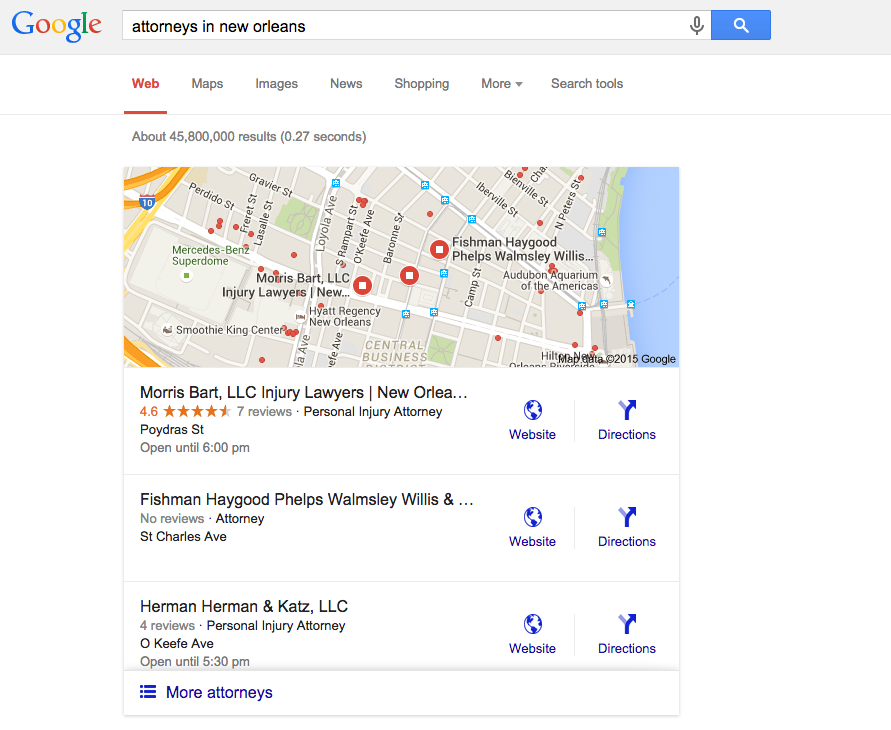
    Ryan Schulze, Senior Account Associate, commented, on this published post with an interesting correction. (It takes a village.)  He shows how some searches on desktop are giving the website link in the 3-Pack.  It suggests different search categories have different clicking opportunities.  I would guess this is based on percentage of search performed on mobile vs desktop.
    attorneys in new orleans 3 pack desktop

    Back to the story …

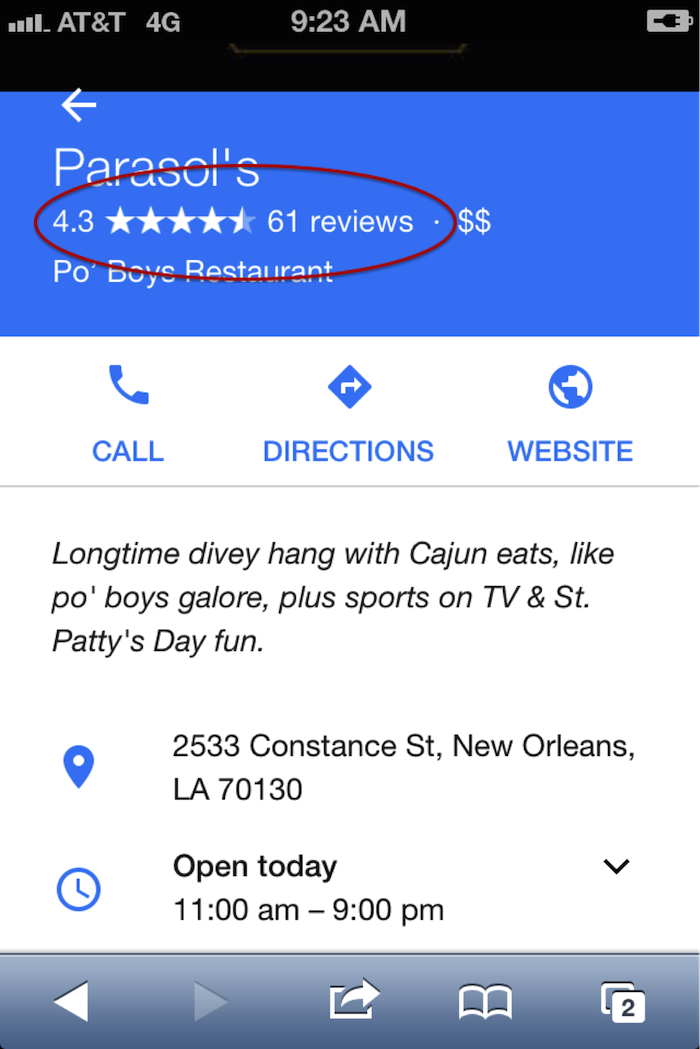
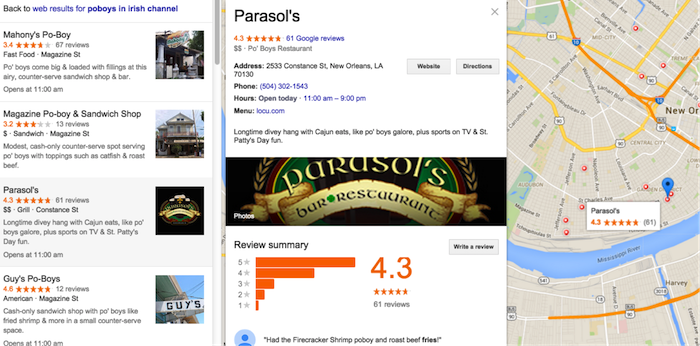
    I click on Parasol’s, thinking I will get its website or the Google My Business listing. Instead, it drives me to the local finder with ALL of the competitors right there!

    • This is not great if you’re in the three-pack because you must fight the competitors again for the searcher’s attention.
    • If you’re not in the three-pack, this levels the playing field. You have a chance to woo the searcher away from their initial choice.
    • If you are a searcher, it’s annoying because you have already indicated your preference with your first click, and Google forces you into an extra click to call the business. In addition, you are forced into viewing more choices after you made your decision.

    Desktop searches are losing ground to mobile, but desktop isn’t dead, and it still dominates search in some industries—usually those that skew to an older population.

    This does show us that it is still incredibly important to claim and optimize a Google My Business listing. Those Google My Business listings can get your business into the desktop local finder list, which is a long list of competition, so images and reviews are still important efforts to woo the searcher over to your business:
    Local Business Maps Pack Image - Search Influence

    Reviews on branded search results on desktop and mobile:
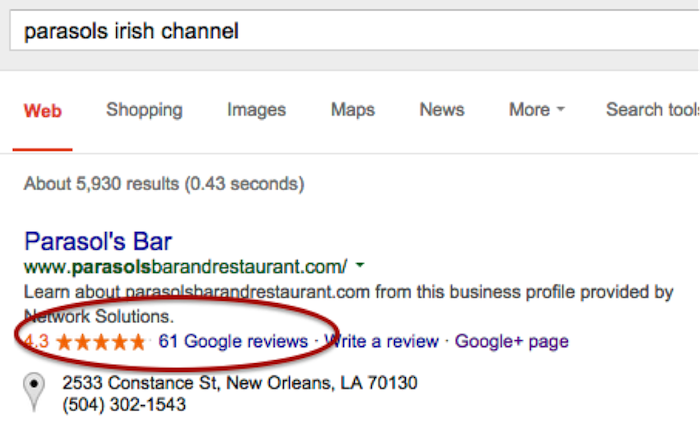
    Online Reviews Branded Search Image - Search Influence

    Online Business Reviews Mobile Image - Search Influence

    (FYI: if you’re ever in New Orleans in March, Parasol’s is a great place to be.)

    Early Data on Organic Visits

    I was chatting with Megan Lindsey, senior account manager at Search Influence, about the effect of this change for one client in particular. Lindsey sums it up nicely: “I imagine now since a searcher has to click on the business name and then once more on the ‘website’ button that people aren’t as inclined to keep clicking. I would think that most clients, even if they were in the top three maps results, are losing organic traffic because of it, but especially the ones who aren’t there anymore.”

    The early Google Analytics data supports Lindsey’s hypothesis. I found no great winners: Several clients’ Google organic was static, and several were worrisome. These clients are local businesses that are historically very strong in their markets. Over the weekend dates, there were 20 percent to 35 percent losses in organic website traffic, which seems to have rebounded Monday to Wednesday, so it appears things are still settling down.

    CLIENT A

    google / organic

    Aug. 7, 2015 – Aug. 10, 2015: 179 visits

    July 30, 2015 – Aug. 3, 2015: 285 visits

    % Change -37.19%

    Aug. 7, 2015 – Aug. 12, 2015: 319 visits

    July 31, 2015 – Aug. 5, 2015: 364 visits

    % Change -12.36%


    CLIENT B

    google / organic

    Aug. 7, 2015 – Aug. 10, 2015: 161 visits

    July 30, 2015 – Aug. 3, 2015: 210 visits

    % Change -23.33%

    Aug. 7, 2015 – Aug. 12, 2015: 161 visits

    July 31, 2015 – Aug. 5, 2015: 210 visits

    % Change -6.76%


    CLIENT C

    google / organic

    Aug. 7, 2015 – Aug. 10, 2015: 36 visits

    July 30, 2015 – Aug. 3, 2015: 54 visits

    % Change -33.33%

    Aug. 7, 2015 – Aug. 12, 2015: 58 visits

    July 31, 2015 – Aug. 5, 2015: 67 visits

    % Change -13.43%


    Have Calls Increased?

    The clients above usually do really well in the local pack and in organic website traffic, so let’s see what happened to their call volume. If you are a lucky business falling in the three-pack, consumers might be calling your business more now than visiting your website.

    When you log into the Google My Business page and go to Insights, this is the data you get:
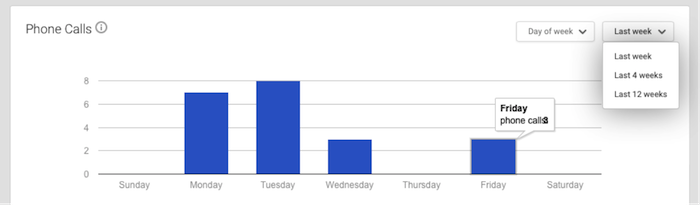
    Phone Call Data 1 Image - Search Influence

    It’s severely limited and not really insightful. The date ranges are not customizable. There is no data after Aug. 8. I have to wait until next week to get any data on effects of call volume from the three-pack rollout, and I can’t compare to the previous week. I will have to do some elementary math that surely Google could program to ensure a better user experience.

    The data is summarized to the point of being so generalized it is virtually useless. This is 12 weeks of call data. I know Google can do better.
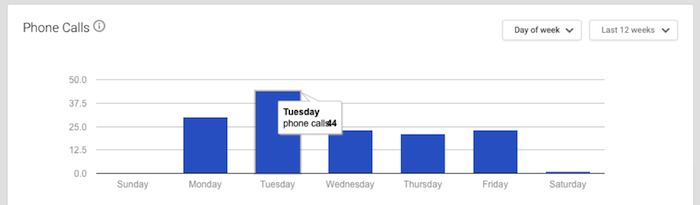
    Phone Call Data 2 Image - Search Influence

    It warns that call volume is “approximate and only significant values may be shown.”

    Also, the call numbers could be calls from three different sources: Google Maps, search and maps for mobile. This is so frustrating for business owners. I would want to know EVERY call I received! And I would want to know where I received the calls! Google has the data, and it just isn’t sharing with business owners.

    And Paid Search?

    On the first day of the this rollout, local search expert Mike Blumenthal made these early comments: “I am not sure what will happen on clicks for AdWords, but those businesses that were lower in the old display may feel compelled to double down on their AdWords activity.”

    I asked Jeanne Lobman, senior online advertising manager at Search Influence, to check it out and give us some input. “Those businesses that were previously only ranking in spots four to seven in the local pack (and nowhere organically) are now going to need to spend money on AdWords ads in order to be seen in the search engine results pages. Additionally, since Google has removed the website URL and the phone number from the local pack info, it could be beneficial to run AdWords in order to make sure searchers can easily find your phone number and call you (on desktop). This would be accomplished by using call extensions with your campaigns, which adds your phone number to your ad (as seen in the below example).
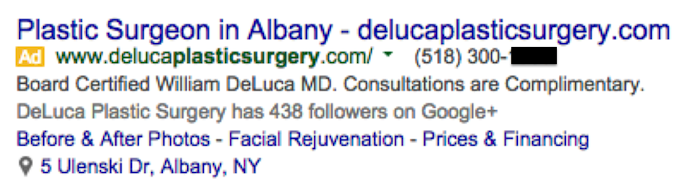
    Plastic Surgery Google Ad Phone Image - Search Influence

    On mobile, the local pack results do include the call button, but there’s no link to the website. When you click the local result on mobile, you are taken to the G+ page, which then has a link to the website. To avoid having that extra step, running an AdWords campaign on mobile ensures you can land people directly on your website with one click.”

    Lobman pulled some AdWords reports to see what impact this change may have had on click-through rate. She says it’s really too early to tell any effects, but the data so far suggests there seems to be an increase in clicks and impressions but little to no change in click-through rate, conversions and conversion rate.

    So Now What?

    We need to give it a little more time to settle in before we make any dramatic changes. When we looked at six days of organic visitor data versus four days of data, we see big improvements, so watching the data to make smart moves is the action item.

    Walk through the process that visitors might use to find your website online, and try to improve what you can control, such as adding phone numbers in your desktop AdWords ads or continuing to encourage reviews from your customers.

    Your engagement online is a reflection of how you engage with your customers in real life. Providing for the searcher with easy linking from ads, Google My Business images, reviews and informative website content is a long-term plan, and it’s a good one to win trust and authority.




  • Continuity Is Key: 5 Tips for Syncing Up Your Multi-Location Franchise Marketing Plan

    1511-SI-Newsletter-KG-B-02

    To the Small Business/Franchise Owner Interested in Growth:

    You have started a business and are considering an expansion, which will include another location (or several)! In doing so, you’ve been able to achieve what many people only dream of doing. You’re reaping the rewards and ready for more, so what do you do next with this new intent to further grow your business?

    You probably have hundreds of things on your business “to-do list,” but be careful not to lose sight of your online marketing efforts along the way. After all, 97 percent of consumers search online for products and services, according to SCORE, a U.S. Small Business Administration-supported nonprofit association. Although 51 percent of small businesses have websites, many are not built for success. Simply put, the success of a business can depend on the success of its online marketing strategy. Therefore, while you may be concerned with all of the logistics of expanding, you must remember to analyze your current marketing and understand how to evolve your strategy with regards to the changing business environment.

    Small businesses have great potential to benefit from localized advertising and franchise marketing. Several factors are to be considered when expanding your marketing strategy across multiple locations with regards to SEO for small business, Internet franchise opportunities, and more.

    Timing (Is Everything)

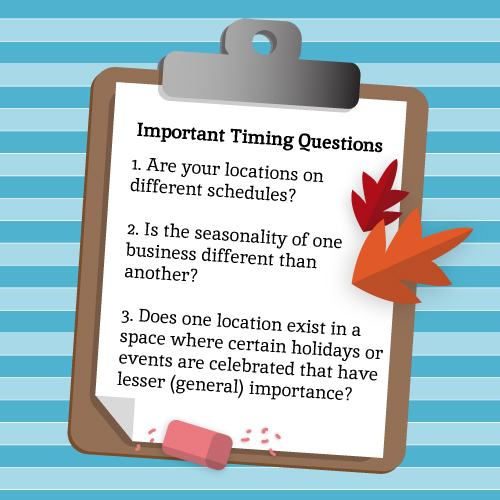
    Important Franchise Marketing Questions Checklist Image - Search InfluenceAs with your decision to open a new franchise location, the timing of your release of marketing initiatives is crucial. If your marketing efforts are out of sync, you can easily confuse potential customers about your brand and the logistics of your new operation. Here are a few questions you should ask yourself about the timing of your Internet marketing efforts:

    •Are your locations on different schedules?

    •Is the seasonality of one business different than another? For example, if you work in retail, will one store have a stronger focus for the holiday season?

    •Does one location exist in a space where certain holidays or events are celebrated that have lesser (general) importance? For example, if you operate a clothing store in Baton Rouge and want to open a new location in New Orleans, you have to consider adding merchandise and respective advertising for events like Red Dress Run, White Linen Night, and of course, Mardi Gras.

    Implement Franchise Social Media at the Local Level

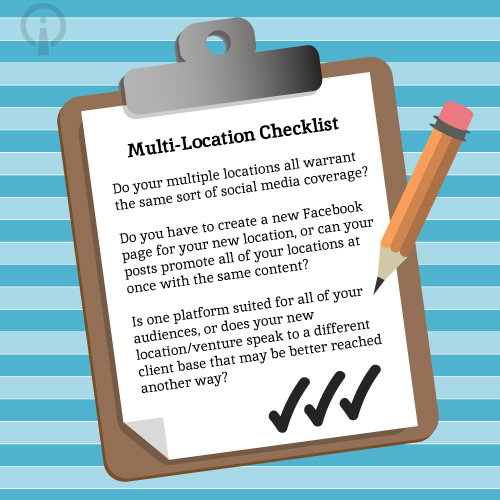
    Checklist Image For Multiple Locations On Social Media - Search Influence

    Whether it was a part of your previous local business Internet marketing efforts or you’re new to promoting your business on social media, it is important to create and maintain a social media strategy as your business grows and you build more locations. From there, you can manage your growing business and make sure the right people are seeing you throughout their daily routine on their platform of choice, and you can investigate the Ads Managers available to your business. Keep these questions in mind while you consider what role social media plays in franchise SEO for your business expansion:

    •Do your multiple locations all warrant the same type of social media coverage?

    •Do you have to create a new Facebook page for your new location, or can your posts promote all of your locations at once with the same content?

    •Is one platform suited for all of your audiences, or does your new location/venture speak to a different client base that may be better reached another way?

    Consistency Across Platforms

    In addition to social media, it is important to make sure you provide marketing coverage for your business across all of your existing channels. Maybe your new location is something you want to push a little harder, so you might decide to purchase an outdoor advertising package or a television ad spot! No matter what marketing channels you use, do not lose sight of your original message. Don’t get so caught up in your expansion that you lose your brand and unique identity. Make sure that, no matter the platform, whether it’s traditional or digital media, you are consistent in your output.

    Content Marketing Strategy

    During this tumultuous time that could possibly make or break your brand, it is crucial to produce fresh, up-to-date content with a consistent message across all of your media channels. More eyes will be on you during the first few weeks (even months) of your new location, so soak up that limelight and wow them with fresh and captivating content! Keep in mind “content relevance.” For example, if your new location attracts a different type of customer, even a slightly different type, think about the sort of content that will spark their interests the most. Research the latest trends in your industry and see what they’re suggesting you write about or how you present yourself. Always remember: the medium is the message!

    Build Solid Relationships

    You’ve done it from the very start of your business, and it continues to be important as your business grows. Networking never goes out of style. As your business grows and you expand your marketing across multiple platforms, remember to keep spreading the word about your brand! Of course, if your brand is well-established already, people may be excited enough that they will come to your additional location without question. But some may require more convincing. Therefore, don’t neglect the relationships and connections you’ve made throughout the life of your business, as they can prove useful in helping to promote your newest venture.

    Want to make sure you attract customers online for your expanding business or franchise? When it comes to online marketing solutions for multi-location businesses and franchises, trust the experts at Search Influence. For example, a Search Influence franchise client with more than 160 locations saw a more than 85 percent increase in total website traffic and an increase of more than 135 percent in total organic (unpaid) website traffic. This website traffic increase resulted from just two years of online marketing efforts. To translate that to dollars, revenue generated from organic website traffic increased by 65 percent. If you would like to see these results across your own business, contact us today to get started with a new, successful strategy to online marketing with Search Influence.

  • Tell Me a Story: Nonprofit Storytelling Tips for Effective Social Conversion

    Nonprofit Storytelling Image - Search Influence

    Effective nonprofit marketing (and fundraising) starts with a story. A good story resonates with the audience, advances the mission of the nonprofit, and calls people to action. Nonprofits are unique from their for-profit counterparts, because even more important than facts are feelings. A good story creates an emotional connection between the supporter and the organization. The Center for Social Impact Communication at Georgetown University recently conducted a survey of 81 nonprofits in the Washington, D.C., area and discovered that 78 percent of them had a goal or purpose for storytelling, but only 64 percent felt their goals were met. So how can your nonprofit leverage compelling, inspirational, emotional stories to get more online engagement, more supporters and more donations?

    Be Authentic.

    True passion is contagious. You can’t expect others to get excited about your cause if they can’t see the passion behind your efforts.

    Make them Feel.

    Don’t tell your audience how they should feel; show them how the characters in your story feel. Choose active players in your organization—those with a passion for the work and those affected by the work—and ask them to share their challenges and triumphs. Rather than simply saying, “This organization changed my life, and it can change yours too …” have them tell their entire story from start to finish. Encourage them to include sensory details as they explain what their life was like before, throughout their experience and now.

    Get Visual.

    A picture says a thousand words. According to a study conducted by SimplyMeasured, videos are shared 12 times more often than links and text posts combined, and photos are liked twice as often as text updates. Though words are an essential part of storytelling, the digital market begs for compelling images to support strong stories. Photos have the power to spark human rights campaigns, change public policy, and more. Visual media fosters awareness and compels people to act.

    Ask your Audience to be a Part of your Story.

    Include a clear call to action. Make sure the call to action is supported by a conflict from the story, which makes people want to act urgently.

    Sharing your organization’s impact from the perspective of those impacted is the most effective way to get others to care and offer their support. So while social media is a great platform for sharing industry updates and tweeting about your latest project, don’t forget to tell the story that connects your organization’s mission to the people you serve.

  • The Write Stuff: Search Influence’s Freelancer Community

    Search Influence Tech Jobs Image

    Search Influence’s mission is to help businesses succeed online, and one of the ways we do that is by delivering high-quality content, from engaging blog posts to specialized website content and more. Talented freelance writers are a vital part of our content creation process. In fact, we’ve developed some great tools for managing our entire content creation process as well as an internal team of editors to ensure our freelance community is diverse and vibrant. Now it’s time we shine a spotlight on our talented community members and offer a look into what it’s like to work as a freelancer for Search Influence.

    Who Can You Find Freelance Writing for Search Influence?

    Saying that the Internet is diverse would be an understatement, so producing quality content means having a diverse team. Our community includes professional freelancers, students in undergraduate and professional programs, stay-at-home parents, world travelers (as I write this, we have freelancers spending time in Chile, Indonesia, and Italy), and more. We are always thrilled to match the right content with the right writer, whether that means a journalism student getting the chance to write a press release or an aspiring comic taking a crack at Twitter posts or blogs.

    Developing a Diverse Writing Community

    Over time, we have learned that our writers’ particular expertise is their greatest asset, so we’ve spoken to freelancers to identify the biggest challenges to leveraging that expertise to produce quality content. We have adjusted our grading scale to prioritize original and in-depth work, in order to encourage writers to focus on producing informative, natural content. Meanwhile, although our editorial team ensures all writing meets our standards for quality, we don’t penalize writers over minor technical mistakes. These changes encourage our freelancers to write content that improves our clients’ online presence by conveying valuable content to their audiences.

    We have also taken steps to make sure our freelance community benefits from these changes. First, we raised our pay rates to ensure our writers felt how much we value them. Then, in Spring 2015, Search Influence created a new position, the Freelance Community Coordinator—that’s me—to develop our freelance community by providing valuable training to all of our writers. Before coming to Search Influence, I worked as both a writer and a writing instructor. I taught college writing courses and published articles and a book about Eastern Europe. I also worked as a freelance editor for international corporate and governmental clients, so I’m familiar with the freelancer perspective. In the coming year, I’ll be using that experience and insider knowledge to help Search Influence’s writers develop their freelance writing and professional skills.

    Matching Talent with Content

    Our freelancers come from many walks of life, so we don’t take a one-size-fits-all approach to workloads. We’ve developed a new software system in-house that allows writers to select their own tasks. This way, writers can select the assignments that best match their skills and interests. They can also take on as much or as little work as they want, based on their schedule.

    This means that, at Search Influence, freelancers can decide to take on full-time workloads or only occasionally grab work when they need it. According to Mary S., that’s made a big difference: “The change in the system which allows writers to choose jobs from a list has been a huge improvement … Because of Search Influence’s system, I’ve been able to continue working at a slower pace and dedicate more time to my family.” Joel F., who freelances full-time, also sees the new system as a big improvement: “As a bonus, I like the modern task selection system, which allows me to schedule my work week according to the volume I can handle.”

    Freelance Writing Image Search Influence

    Why They Choose Freelance Writing for Search Influence

    Rather than telling you how our writers feel about writing for us, I’ll let them give their own review of freelancing for Search Influence:

    Katie D. enjoys having a writing career that gives her the freedom to make her own work schedule. “I decided to seek out projects independently. I love the diversity of assignments. I also appreciate the flexibility, especially with a family,” she said. It only took her a few months to prove she’s an exceptionally well-rounded writer who’s dedicated to her work.

    Over 10 years of freelancing, Mary S. has built up an impressive list of clients. She appreciates the variety of topics and media she can write at Search Influence. “The flexibility and variety of jobs is important to keeping my motivation strong … Having a variety of topics and clients helps keep things interesting and presents new challenges with each job.” Freelance writing for Search Influence has also made Mary incredibly adept at capturing the tone and message of specific clients—so much so that we’ve even had clients specifically request her work!

    For Joel F., who has experience in everything from content production to graphic design, freelancing is about preparing for the future. “To put it simply, freelance writing is a fantastic way to practice. Formal tone, business style, marketing tactics, every one of these genres is explored regularly … My goal is to hone my marketing skills in writing so that when I eventually want to promote myself and my own businesses, I have all the skills already finely sharpened.” Joel has diligently developed time-management skills that have made him one of our most productive writers.

    We are proud to count Katie, Mary, and Joel among the talented freelancers writing for Search Influence. As our freelance community continues to grow, we will continue to refine our system to provide them with valuable training and the flexibility to set their own schedules and develop their own specialties, all while continuing to deliver high-quality content that helps businesses succeed online.

    Interested in a freelance writing gig for Search Influence? Apply online today!

  • A Tale of Two Google+ Updates: Shutting Down G+ Pages & Disconnecting YouTube From G+

    Shuttered Google Local Pages - Search Influence

    In the past week, two new Google Plus updates have come to light. First, we found out that as of July 28, Google has plans to shut down inactive and unverified Google My Business (aka Google Plus) listings. On Monday, July 27, Google’s Bradley Horowitz posted on Google’s official blog that in the coming months, it will be removing the requirement for users to have Google+ profiles to use various Google products such as YouTube and Google Photos.

    The Update: Google My Business is Shutting Down Unclaimed, Unverified Listings & Unverifying Inactive Accounts’ Listings

    On July 23, a Local Search Forum user posted an email they received from Google as follows:

    UPDATE – Announcement from Google July 22, 2015

    Dear photographers and agencies,

    In the past few months, you may have seen some changes in the look of Google+ pages that have been associated with Google My Business (GMB) accounts. These changes, including how we treat business pages without owners, are part of Google’s ongoing effort to simplify people’s experience with our tools. We are constantly working to provide only valuable and rich content to our users.

    On July 28, Google will begin shutting down those GMB–associated Google+ pages that have not been associated with user accounts and are also not verified. You may find that some of your Business View tours also sit on such pages, but note that after this removal of unverified Google+ pages, the Business View tours will still remain available on Google Maps and Google Search.

    Here are a few recommendations for informing any business customers that may be impacted by this:

    Encourage your business customers to verify their listings if they wish to retain their Google My Business page …

    If a business owner decides later that they would like to have a Google My Business page, please advise them to create a new page and verify their listing. The Business View virtual tour can be then transferred to the new verified listing. Please log a case to our support teams to request that images for your business customer be forwarded to the new GMB page.

    Please point your business customer to their images in Google Maps.

    Best,

    The Google Maps | Business View team

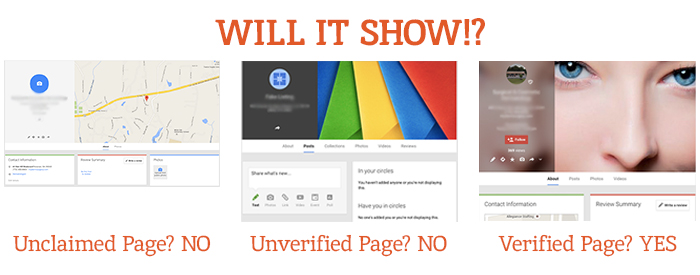
    This was specifically geared towards photographers so they would know how to handle the effect on Business View tours. What this means for all Google My Business users is that unclaimed local pages will most likely no longer be visible (as Google has always said is the case for unverified Google Plus Local pages).

    Different Google Local Pages - Search Influence

    As always, this update is accompanied by Google’s explanation that all actions are in the best interest of users and geared towards improving the user experience. Thanks, Google!

    On June 4, via the Google Business Help forums, Jade Wang (come visit us in NOLA again soon 😉 ) of the GMB Maps team also announced: “If a user is unresponsive to our attempts to contact him or her and has not logged into Google My Business for a significant length of time, then we may unverify pages in the account.” Here’s the full update from Jade:

    In some cases, we may contact Google My Business users via email to confirm that they are still actively managing a business page. If a user is unresponsive to our attempts to contact him or her and has not logged into Google My Business for a significant length of time, then we may unverify pages in the account. We’re doing this in order to continue to provide users with the best experience when they’re looking for local businesses like yours. If you find that a page in your account has been incorrectly unverified, please contact support to get assistance restoring verification.

    It’s a good idea to keep an eye on the inbox associated with your Google My Business (Locations) account. It’s also a good idea to regularly log into Google My Business (Locations) to confirm that your business information is current and accurate.

    My Take On It

    Both of these updates could mean great news for businesses that have struggled with requesting ownership of listings that were verified in the past by a person or an account they no longer have access to. To fix this issue in the past, you’d have to submit an ownership request form to Google to gain access to these listings. Then, you’d have to wait 10 business days (as per Google’s rules) and reach out to support (they could check to see if the account never responded to the request). After this 10-day period, the support representative could determine that the account that owned the listing was inactive and release the listing to you for claiming and verification.

    Basically this means inactive accounts are no longer roadblocks to getting access to business listings in Google My Business!

    While some issues may be alleviated with the update, what’s harder for search engine optimization work is that now it’ll be more difficult for us to see unverified duplicate G+ pages, old or closed G+ pages, and practitioner G+ pages that could be hurting businesses’ local rankings. Map Maker should allow us to still see the data but not the pages themselves.

    But there are signs this hasn’t rolled out completely yet. I have some unverified, fake listings in my Plus account (shhh, I know) that I use for training purposes that haven’t been touched yet. This is likely a slow rollout that started July 28. I did notice some changes to Maps navigation recently that were probably in preparation for this, though. For example, you used to be able to click “Write a review” from the Maps results to get to the G+ local page for a business, but now that just opens a review dialogue in the Google search results for that business in another window. This makes sense, since unclaimed businesses will no longer have pages.

    The Update: Google+ Is Disconnecting From Unnecessary Services

    On Monday, July 27, Bradley Horowitz posted on Google’s official blog that Google+ would be moving towards a “more focused Google+ experience,” which basically means no longer forcing users of various other Google products to have a G+ profile to use said products.

    Specifically, Google wants to foster the natural sharing environment of G+ by adding new features such as Google+ Collections. This update means that all you need to share content, communicate, and have a YouTube channel (among other things) is a Google account and not necessarily a G+ profile. Also, it will continue to keep Google accounts private and unsearchable. For those who were forced to create G+ profiles to use YouTube and other Google products in the past, Google promises that it will “offer better options for managing and removing those public profiles.”

    My Take On It

    Congrats to everyone who was pissed when they couldn’t use YouTube without a Google+ profile!

    Mad Men Cheers Joan

    At first, it seemed that G+ pages that are already connected to YouTube channels might be disconnected. But, that last comment about offering ways to get rid of unwanted G+ profiles, points to the fact that this update will not actively affect anyone in this way.

    Since this update has not yet rolled out, however, it is important for users to realize that they should not delete their G+ yet! Doing so prior to roll out will force you to delete your entire YouTube presence!

    Let me know your thoughts on all of these new Google updates! I’d love to hear what other users think of these changes.

    Image source:

    Mad Men gif

  • Search Influence Welcomes Six Shining Stars to the Team

    Search Influence New Influencers Blog

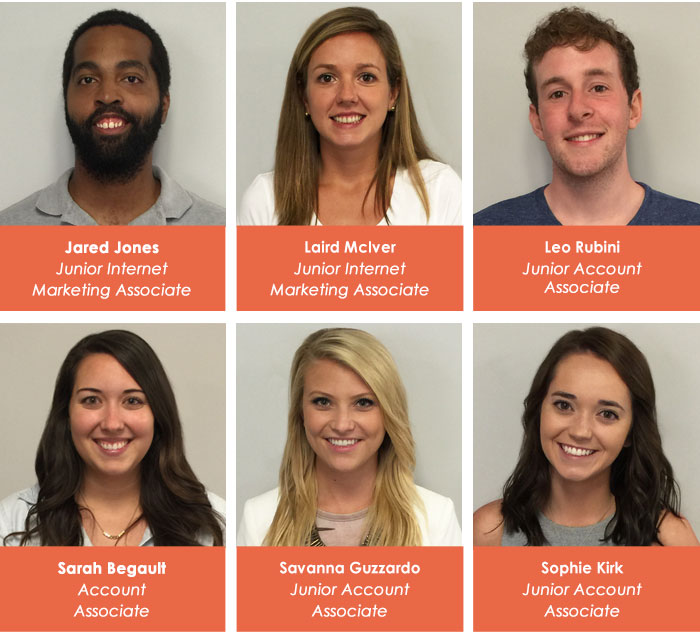
    Search Influence is hiring and we are still growing! Six talented new Influencers have joined our team and hit the ground running.

    Jared Jones – Junior Internet Marketing Associate

    Jared is from Pensacola, Fla., and studied at Xavier University. He can be over-the-top at times, but he’s good at directing all of his excess energy. His hidden talent is a wealth of random information stored in his head that comes out at any given moment!

    Laird McIver – Junior Internet Marketing Associate

    Laird is originally from North Carolina and went to Rhodes College. She has phenomenal glittering skills due to her time decorating shoes for the Krewe of Muses, and she recently became a riding member! In her free time, she reads books, cooks, and scuba dives with sharks.

    Leo Rubini – Junior Account Associate

    Originally from Atlanta, Ga., Leo is a recent Tulane University graduate who couldn’t be more excited to begin his professional life in New Orleans. In his free time, Leo likes to explore the city, cook, travel, and go on runs. 

    Sarah Begault – Account Associate

    Sarah is from Metairie, La., and currently lives in Kenner. She graduated from Louisiana State University in May 2014 with a degree in business and was a member of Pi Sigma Epsilon business fraternity for three years while in school. She has two German Shepherds that she loves (Beau and Sasha)! Her hobbies include reading, baking, painting, Pinterest projects, and crafts, and she’d like to start a blog soon about her crafting successes and fails. Sarah is currently obsessed with Orange Is the New Black and The Walking Dead. She loves country music but listens to just about everything from Lil Wayne to Taylor Swift.

    Savanna Guzzardo – Junior Account Associate

    Savanna is from Covington, La. She recently graduated from the University of Southern Mississippi with a degree in public relations and a minor in marketing. During Savanna’s time at USM, she was a member of Delta Delta Delta Fraternity, where she enjoyed raising money for its chosen charity, St. Jude Children’s Research Hospital. In her free time, she loves to read and spend time with her pets. Savanna is excited to be back in Louisiana and joining the Search Influence team!

    Sophie Kirk – Junior Account Associate

    Sophie is originally from Mandeville, La. She is a recent graduate from Louisiana State University, where she majored in mass communication with a concentration in public relations. At LSU, Sophie was a very active member of her sorority, Delta Zeta. She is very excited to become a part of the Search Influence team!

    Join us in welcoming Jared, Laird, Leo, Sarah, Savanna, and Sophie to the team. We’re so glad to have you on board! Interested in life at Search Influence? Find out about our company culture.


  • Small Business, Big Difference: Social Media Use on the Rise

    Small Business Social Media Use Image Search Influence

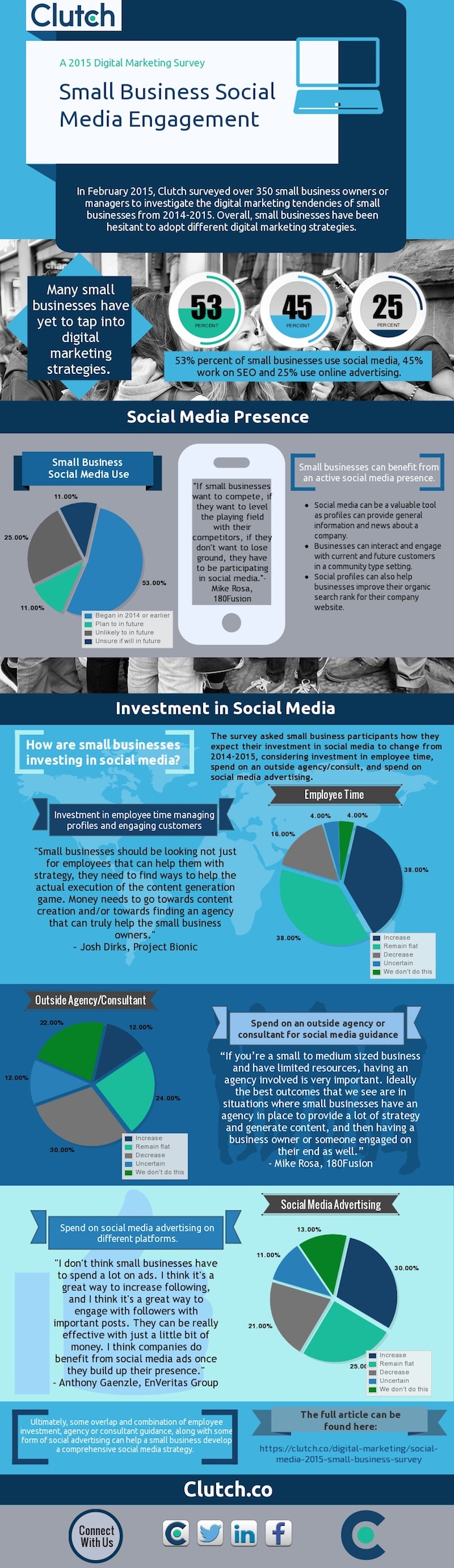
    Clutch, a B2B research firm, has released the results of its 2015 survey on small business practices in social media. The survey, which received more than 350 submissions, asked small business owners or managers to give insight into their social media and Internet marketing practices.

    The Findings

    Here are some highlights of the small businesses surveyed:

    Small business digital marketing strategies

    • 53% of small businesses use social media
    • 45% of small businesses work on SEO
    • 25% of small businesses use online advertising

    Company size

    • 60% of responding businesses have fewer than 10 employees
    • 14% have between 11 to 50 employees
    • 18% have between 51 and 250 employees
    • 8% have over 251 employees

    Investment (employee time, agency spend, ad spend)

    • 38% expect to increase their investment
    • 38% plan on keeping the same investment
    • 16% plan to decrease investment

    Clutch Infographic Small Business Survey Image Search Influence

    What Does This Mean?

    It’s weird to think back to 2006, when Facebook was essentially just for high school and college students to interact with each other through basic status updates. Nine years later, Facebook has around 1.44 billion monthly active users, yet only 53% of businesses surveyed indicated they use social media. In today’s social media age, having an active social presence is one of the easiest and most inexpensive options available to small businesses. It’s free to create a business page on Facebook, Twitter, and the other myriad of social media pages. Additionally, with the abundance of users on these sites, your customer base and target audience is already available to you; you just need to bring them to your page.

    Benefits of Social Media for Small Businesses

    When customers shop at small businesses, they tend to value the qualities of these stores versus their big-box competitors. Having a question answered on a local bike shop’s Facebook page is usually easier than reaching out to a large retailer’s customer service team. Allowing customers to post to your business’ page also gives other viewers the ability to see reviews, photos, and that the business cares about its customers by maintaining an active social presence. Maintaining a strong social presence can work as a way to “warm up” your potential customers and introduce them to your brand for a relatively low initial cost.

    Small Business Investment

    Besides simple statistics, the survey discusses the necessary investment of small businesses to ensure that their social media strategy has the best chance to be successful. While it may seem that just having a profile is enough to effectively market your business, there is additional effort that should be taken if you want to see your desired results. Employees should have a hand in the content strategy and the day-to-day operations. Various opinions can help diversify your strategy and give additional insight into your broader customer base. By spreading the responsibilities of managing the page across a few employees, each individual’s workload should not be greatly affected, while the overall product will be of high quality. Wondering how you can make time for social media and continue to run your small business? Check out these social media tips for time-starved entrepreneurs.

    Content Strategy

    In addition to diversifying where your content is coming from, it helps to vary the content you’re sharing with your followers. If you’re only talking to your current customers about products or direct business promotions, people new to your page may dismiss your content, as it doesn’t apply to them. Try to think outside of the box and delve into your potential customers’ other interests. By using this practice, your pages and posts can be beneficial in more ways than reminding customers of your weekly promotions. Writing about the best local bike trails may bring more people to your page through liking, sharing, and commenting, and it can help to organically get your store’s name into your community.

    Takeaway

    Seventy-six percent of the companies surveyed responded that they would either keep the same investment moving forward or increase it. Facebook and Twitter have shown over the past five to 10 years that the sites are not simply the most visited social media pages, but two of the most visited websites of any kind. When establishing your small business, it is important that your business could be found on Google. But in 2015, it is becoming important that your business be available on social media sites as well. Moving forward, each company should take the necessary time to see what resources can be used to begin a social media campaign. Start off by managing a page yourself, working your way up to reach an ideal social media campaign, and involving an overlap of employee involvement, agency guidance, and some use of social media advertising such as Facebook fan-building campaigns, for example, which have shown to have the best results for success with these small businesses.

    To view the complete report, visit Clutch.

    Image source:

    Clutch infographic

  • Have Hashtags Become the New Slogans?

    Hashtag Art Image Search Influence

    In the world of marketing, businesses seem more focused on creating a captivating hashtag to correspond with the newest campaign rather than a fresh slogan. Is it possible for the two to coexist, or are slogans as we know them well on their way to becoming a thing of the past?

    Slogans 101

    Slogans are defined as brief, catchy phrases used in marketing campaigns with the intent to direct a customer’s attention toward a particular product or company. Often referred to as taglines, especially in advertising, these short strings of words often stick with the company for a long time or forever if they are successful.

    McDonalds Slogan Image Search Influence

    However, that success may have been transferred over to the power of the hashtag, as there has been a steady decline in the use of advertising slogans in both the United States as well as the UK over the past 20 years. Perhaps they were on their way out before hashtags were more than just a pound sign smashed into a string of words.

    The Hashtag Takeover

    Hashtag is defined as a word or phrase that is preceded by a hash or pound sign and used to identify messages on a specific topic, generally on social media sites such as Twitter.

    The newly invented hashtag first appeared as a practice of writing for Twitter posts during the 2009-2010 Iranian election protests by both English- and Persian-speaking users.

    However, the term was presented in a blog post by Stowe Boyd, where “Hash Tags = Twitter Groupings” was written Aug. 26, 2007. Twitter jumped on board and began to hyperlink hashtags in tweets July 2, 2009 as a way to link all corresponding tweets to a particular hashtag to be incorporated in search results for Twitter users.

    A Look at #TodayAsWeKnowIt

    Fast forward to 2015, and hashtags are used for numerous reasons, including event promotion, campaigns, human rights, awareness and absolutely for marketing, making the hashtag far more versatile than the slogan. For example, the recent trending hashtag #mondaymotivation received more than 76,000 tweets as of July 28, according to Twitter. The #betterforit Nike Women brand campaign hashtag, for example, has received more than 800 tweets just this month. That’s according to Hashtracking.com, a website that tracks hashtag mentions. And so we circle back to the question at hand: Is the traditional slogan to be replaced by the ever-present hashtag?

    Image sources:

    Hashtag image

    McDonald’s cart image