Blog

  • Using Facebook Markup Language for Social Media Marketing

    When I was in elementary school I hated my school uniform. The yellow shirt, brown tweed jacket, blue slacks, and that awful little tie. I remember questioning the school taste level and being matter-of-factly told the uniforms made us focus on school rather than each other. I hate those uniforms because of their lack of personality. I initially had the same feelings towards Facebook. Despite it many features and (annoying) applications, everyone’s accounts looked the same. Sure this was FB’s way to avoid the flashing gif walls and neon colors of Myspace profiles but it took away people’s individuality. Anyone who is into social media marketing can tell you, if you want the community following you gotta stand out. Thankfully Facebook understood this and gave developers Facebook Markup Language.
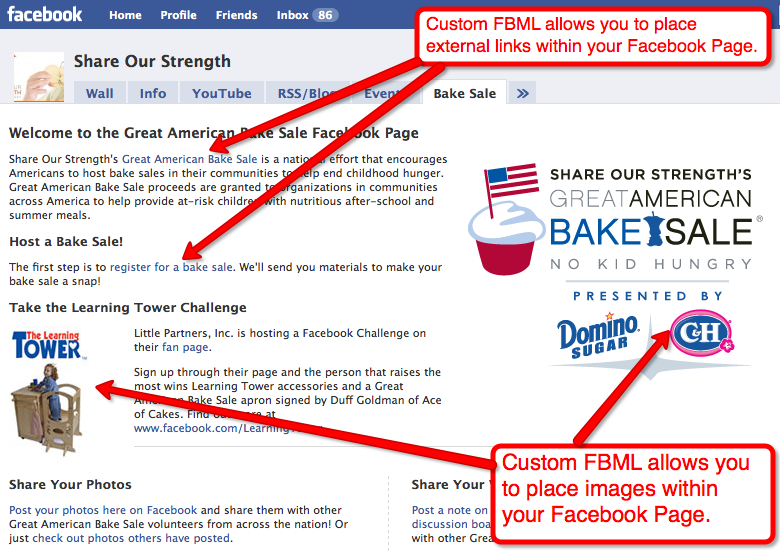
    Using Facebook Markup Language
    Facebook Markup Language at Work

    Facebook Markup Language
    Not so much of a language as a bastardization of xhtml, Facebook Markup Language (FMBL) allows users to “build full Facebook Platform applications that deeply integrate into a user’s Facebook experience” (otherwise known as not be boring). FBML is really huge for social media marketing and building a fan community. Having integrated pages with additional options not only keeps visitors on the page longer but it always encourages fans to interact with the page.

    Think about the level of engagement you would have if you put an iframe with rotating daily specials onto a Facebook page. With FMBL you can embed your Youtube, Twitter, and Flicker, Adobe Flash objects in the lifeless page.

    Even though FBML has existed since late 2007, many companies with a FB presence are still not capitalizing on its power.  However, there are companies like Target who are really using FBML to promote their brand and it’s many lines of business. By having their lines of business listed on their fan page, Target can to market new products, promotions, and store locations to loyal (and highly active) customers.
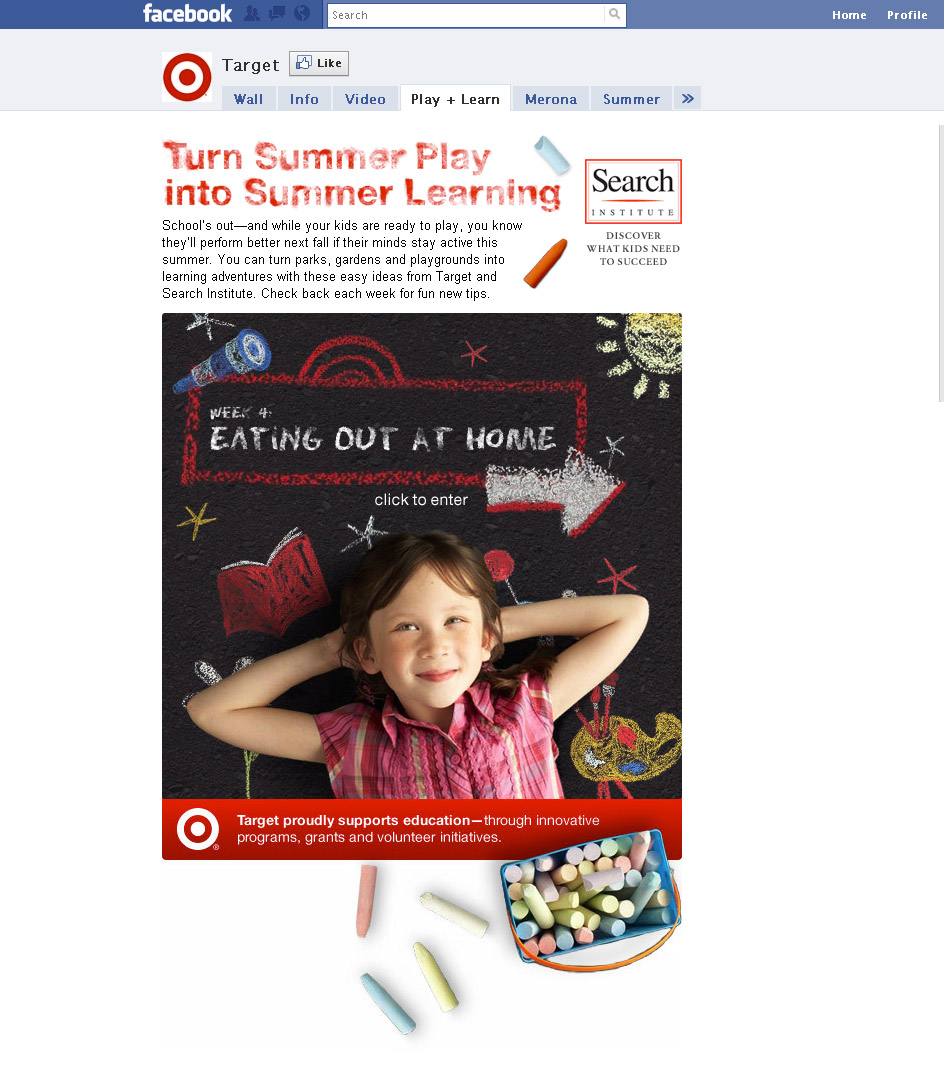
    Using Facebook Markup Language
    Target Using FBML for Summer Promotion

    While Facebook Markup Language can’t completely reskin your Facebook page, it does allow a level of customization that the social media platform previous lacked. As the number of FB users continues to grow and social sites become more and more a part of everyday life, having unique content and pages not only allows you to promote products and services but set your business apart from the crowd because no one wants to wear a uniform.

    If you’d like to learn more about Facebook Markup Language, please visit Facebook Developer.

    Special thanks to johnscotthaydon for the image at the beginning of the post!

    The bottomline is Facebook Markup Language is a great tool for businesses who want create active online followings.
  • Will Scott Speaking at SMX Advanced June 8-9

    Next week’s SMX Advanced Conference in Seattle is sure to prove itself a valuable experience for all in attendance. On June 8 and 9, some of the brightest minds in search marketing will gather in Seattle for a conference that has come to be know as a must-attend for those interested in gathering high level actionable information to apply to their strategies.

    Will Scott Speaking at SMX Advanced, June 8-9

    Will Scott will be speaking on two panels at the two day conference. On the 8th he’ll be joining Marty Weintraub and Lisa Williams on “Opening The Contracts Kimono: Translating Your Pricing Model To Legal Agreement,” to speak on search marketing contracts, who will be defining the overall scope of contracts, and discussing making them performance-based, respectively. Will will discuss the liability aspect of contracts from the perspective of a search marketer who is actively updating and optimizing clients’ sites. This panel will be especially valuable for search marketing consultants and owners of search marketing companies.

    Will is also part of a group of search marketers who have taken the initiative to conduct the first ever Foursquare advertiser sentiment survey! The exciting results of this first-of-its kind survey will be presented during the SEO & Vertical Search Track at “Location Services: The New Local Search?” on June 9.

    This panel will be moderated by Greg Sterling, Founding Principle of Sterling Marketing Intelligence and the other speakers are to include Vince Blackham, Michael Martin, Mat Siltala, and Dylan Swift. More information about the Foursquare Advertiser Survey can be found on our blog, including profiles on the great companies that took part in making it happen!

    Both of these panels will be must-sees next week in Seattle. For more information on SMX Advanced, visit their website. Will looks forward to meeting you at the conference!

  • Pay Per Click for Dummies? Hire a Professional.

    When Doing It Yourself Isn’t Such a Smart Idea

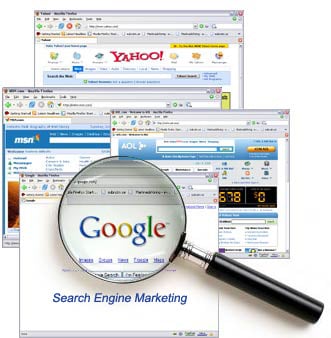
    Pay Per Click Search
    Pay Per Click Search

    I come from a family of “do-it-yourselfers”.  When my mom wanted new curtains for the kitchen, she’d go to the local craft store and purchase 3 – 5 feet of fabric and hot glue to her heart’s content.  My dad was no better; I remember watching him jury rig the plumbing after the basement flooded.  While I always admired their “make it work” attitudes, these (and many other) situations always ended with a call to a professional.  So when I hear that non-search marketers are doing pay per click marketing, I have flashbacks of curtains falling apart, pipes constantly leaking, and money being wasted.

    Pay per click marketing is a tricky platform with many intricate pieces.  As a PPC professional, I find myself in the role of a copywriter, researcher, accountant, analyst, and a gambler.  It’s a daily routine juggling daily budgets, maximum bids, and demographic settings to ensure the highest possible ROI with the given budget.

    Paid Search Keywords
    One of the biggest mistakes in many paid search campaigns is choosing keywords. Instead of choosing terms that visitors are searching for, first-timers choose keywords they are familiar with or possibly even industry terms – an example of this is “abdominoplasty” versus “tummy tuck”. While abdominoplasty is the correct term, it yields significantly lower traffic because the average person would type in tummy tuck.

    Another aspect of choosing keywords for a campaign is determining niche keywords. A niche keyword is a low traffic but high CTR phrase. For instance, while most searchers will use the phrase “tummy tuck,” there is a smaller segment of the population that will type in “tummy tuck stories.” This type of searcher has already done the “tummy tuck” search and is now looking for further information regarding the procedure.  This visitor is also most likely to convert into a lead.

    PPC Ad Content

    A big part of a successful campaign is the ad’s content. Writing compelling copy that follows the search platform’s and your industry’s best practices in 75 characters can be difficult. Most novice marketers tend to overload the ad with irrelevant content or keywords.

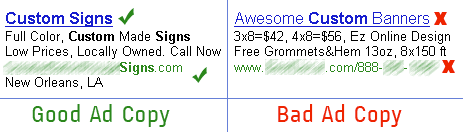
    Google Adwords Ad Copy
    Good Ad Copy, Bad Ad Copy

    If you look at the two examples below, you can see that the ad I deemed “good” has more bold keywords (keywords automatically bold based on the phrases the searcher used), the copy has a voice with a clear competitive advantage and call-to-action, and the location of the advertiser.  You might be wondering why I decided that the right ad is bad – well even though it gives pricing information, a phone number, and a competitive advantage (“Free Grommets&Hem”), it lacks a call-to-action, voice, location, and most importantly suggests a lack of professionalism by including “Awesome” in the title.

    Not only will the good ad be rewarded by Adwords for incorporating more keywords naturally into the ad copy, but people respond better to complete statements in ads and more likely to click through.

    Managing Your Paid Search Campaigns

    This is probably the hardest because it relies on advertisers knowing how to analyze site metrics, campaign details, and conversion rates.  Even after years of being Google Adwords certified, I still find quantifying the data difficult. Tracking cost per click at a keyword level is tedious and granular work – if you don’t know what you are looking for or even at, you could negatively impact your conversion rate.

    Another challenge for advertisers is bidding against competitors on ad placement. I always find this the most fun because of the level of difficulty.  It’s like eBay bidding on steroids.  If you are not closely managing your daily budget and cost per click, you can easily be pushed off the page – especially when in competition for placement of broad, high-traffic keywords.

    Anyone can pick up a “for Dummies” book, but there is no substitute for experience.  I don’t want to discourage those who are interested in paid search, but I want to inform do-it-yourself types that there is a lot of work that goes into a PPC campaign. You could easily spend thousands of dollars without a single lead to show for it, so please, hire a professional.

  • Top 10 for the Weekend

    1. Why Local Businesses Can No Longer Ignore Foursquare

    For some reason businesses are hesitant to jump on the social media bandwagon. It’ll never make sense to me because even if you don’t believe in its power, your customers do!  By simply adding a little prize for the mayor or a special for just checking in, you are almost guaranteed loyal repeat customers looking to catch a deal. It’s a game for these people! Make your business the board!

    Top 10 for the Weekend: May 28, 2010 Wordle

    2. The Rise of SMB Reputation Management

    With the rise of social media, small businesses are now able to get their name out there as effectively as the big chains, and for a much smaller price than they’re paying for their marketing too! Check out this blog post for a huge list of SMB reputation management services.

    3. Citysearch Plans Reputation Mgt Offering

    In keeping with SMB reputation management, Citysearch is now offering a fixed-fee service through CityGrid. Check out this blog post and the interview mentioned in it for more information.

    4. Yellowbot Offers Reputation Tool Too

    We’re just crazy about small business reputation management here at Search Influence, so here’s another post about yet another service, this time offered by YellowBot! These blog posts are a fantastic resource in helping decide which service- if not ALL of them- is right for your business.

    5. Google Maps: New Guidelines for Dealing with Multiple Listings & Duplicate Listing Removal

    As much as we love Google Maps here, we don’t hesitate to call attention to its faults. This post gives a few tips on how to check for – and delete – duplicate listings for your business. We had to learn the hard way about the penalties they impose for duplicate listings. Save yourself the headache and check out this blog about duplicate content and how to rectify the problem before it’s too late!

    6. It’s MayDay for Yellow Pages Sites

    An early-May change in Google’s algorithm affects the way massive websites are indexed. While this probably doesn’t affect your site directly, it may affect a site that you’re listed on, a site on which you may be counting for a quality link. If you have a basic listing on a large directory site, the page on which you’re listed may not be viewed as authoritative by Google. In that case, you could then speak with the advertising department of the site and look into options about getting an enhanced listing with unique, rich content that is more likely to be indexed, viewed highly by Google and give a strong link back to your site.

    7. Google Algo Changes Drop ‘The Other Shoe’

    This post from Greg Sterling references the same update to the Google algorithm as Andrew Shotland’s does above, but makes the point that directories with content-rich listings will prevail over directories with simple listings of phone numbers and addresses.

    8. Effective Online Marketing Messages: How to Pace Yourself

    This one comes straight from Search Influence’s own Nick Fidanza. A few weeks ago he wrote a comical blog post about when online marketing messages are ineffective, with the promise of a follow up on how to avoid the outcomes mentioned in the first post. While we could go on for days about how to properly send out online marketing messages, we decided to keep it simple this time. Check out these 4 guidelines to plan out and pace your messages.

    9. Google Lists Top 1,000 Sites On The Web & Then Lets You Advertise On Them

    This Search Engine Land post mentions brand-new-yesterday features available to online advertisers in Google Adwords. These features are thanks to advertisers and users like you who have allowed Google to be privy your site’s analytics data and/or your personal searching and website viewing activity.

    10. Evil Conversion: When Optimization Goes too Far

    That’s right, we agree – there is such thing as too much optimization. Sandra Niehaus provides three vivid examples of consumer purchase experiences that, through over optimization, could end up causing the customer to navigate away from the site before converting or worse, turning the customer away for good.

  • Effective Online Marketing Messages: How to Pace Yourself

    A couple of weeks ago I wrote a post about over-saturating the market with online business communication. While in the last post we gave you tips on how to tell if you are indeed over-saturating the market, we promised we’d do a follow up with some steps to take to help avoid it and to put out effective online marketing messages.

    Effective Online Marketing Messages

    1. Consistent and timely messages. Plan, Plan, Plan! Decide ahead of time when you’re going to be communicating with your audience. In terms of email marketing, how frequently will you message? Monthly, Bi-Monthly, or Quarterly? Tuesdays or Thursdays? While your plan doesn’t have to be as detailed as blueprints, you should still decide when you are going to send and what you’re going to talk about. There are articles and case studies with varying results on when the best times of day to deliver are. Always keep your target demographic in mind. When are they going to have the time to read? I can promise you I won’t be reading any non-personal email after noon on Friday. Who cares at that point in time? Let me at the weekend. If you’re helping me decide what do to with my weekend maybe you should get me that during my mid week hump when I’m impatiently waiting for the weekend to roll around. If you’re tweeting or posting an update don’t overdue it and post daily until the day of the sale, event or whatever you’re pimping. You still need to be timely in your delivery. Again, when is your audience going to listen, care and be able to respond? Of course, don’t forget in social forums it’s not just about you, you must interact – it’s not about one way communication.Effective Online Marketing: Blueprint

    2. Only send something you would read yourself. Don’t send something just to send something. Often, companies find that the months slip by without sending out a message and then rush to put something together at the last minute when they need it. Tactic #1 will help you be prepared and avoid these last minute throw-togethers that could get multiple users unsubscribing from your list if they feel you’ve wasted their time. When it comes to social forums sometimes you can send something to send something but make sure you would read it. If it’s not  interesting, insightful, entertaining to your target demographic don’t do it. Of course be sure it matches your overall marketing message and brand identity.

    3. Define your Goal. What is the point of the message? Do you want readers to call in and book appointments? Do you want them to fill out a form requesting more information? Do you want them to purchase an item from your site?  Are you being re-tweeted? Gaining fans or growing your network? Once you define what it is you consider a “conversion,” figure out how you will measure this goal, and move on to step 4.

    Effective Online Marketing Messages: Track

    4. Track. Track everything, and watch the numbers, read into them, and learn from them. If you see a significant portion unsubscribing from your list, or a decline in conversions, or fewer click throughs on your links perhaps conduct some testing to see if the decline was a result of the message itself or of the timing.

    Tracking and measuring are almost as important as the timing and message itself, and the former should certainly influence the latter. The best part about planning ahead is that you will have a greater chance of learning from your mistakes and you’ll have time to adjust future messages to be more relevant and effective.

  • New Google Interface: My Before and After Images Disappeared from Google Images!

    The majority of plastic surgeons have a robust before and after image gallery on their respective websites.   With a strong plastic surgery client base, in addition to other industries, we pay attention to the images and their inclusion in the Google Image search.

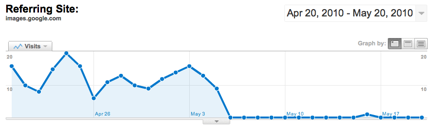
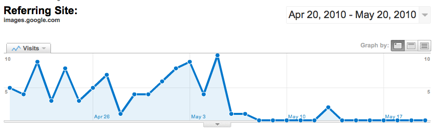
    New Google Interface: Traffic Drop

    In the last week, our SEO team has noticed a severe and dramatic drop in referrals for a few plastic surgeons from Google Image search, which historically has been a strong referrer to the before and after image galleries on the websites.

    Some reactions from our team ranged from the incredulous “Can that be right??” to the flummoxed, “That is totally weird.”

    New Google Interface

    After seeing the first plastic surgeons’ site data with a flat line, I asked a designer with whom we work frequently, Aimee Ellingsen, plastic surgery website design, “um … have you guys replaced or removed all of the images on client X’s website?”  Right.  As if she would completely replace every image in the image gallery … but this data is obviously a problem with images, so I went to the source.

    Aimee’s team looked into it and astutely suggested it was safesearch.  Safesearch is a setting on an individual users’ Google search preferences, so what are the chance that hundreds, thousands, of people have changed their settings on the same day?  That was my first reaction.  … Then it hit me …

    Oop!  The new Google Interface!  Doh!

    Google Support today says:

    “You can choose from among three SafeSearch settings:

    • Moderate filtering excludes most explicit images from Google Images results but doesn’t filter ordinary web search results. This is your default SafeSearch setting; you’ll receive moderate filtering unless you change it.
    • Strict filtering applies SafeSearch filtering to all your search results (i.e. both image search and ordinary web search).
    • No filtering, as you’ve probably figured out, turns off SafeSearch filtering completely.”

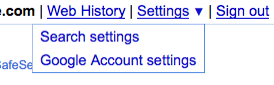
    New Google Interface: Search Settings

    I don’t know what the Google Support said before they launched the new Interface, but what we used to see and now can’t see (unless we change our settings) suggests that it’s a new default implemented with the new interface.

    New Google Interface: How to change your settings

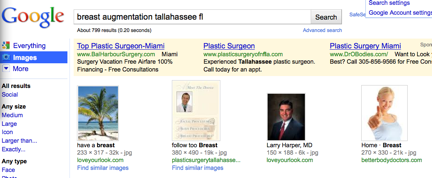
    With Moderate filtering:

    New Google Interface: Google Image Search WITH Moderate filtering

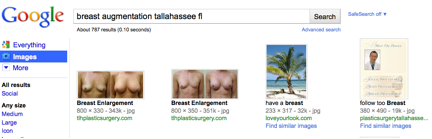
    Without Moderate filtering:

    New Google Interface: Google Image Search WITHOUT moderate filtering

    It appears that Google is slowly rolling out the new interface because not all surgeons’ data is showing this dramatic response, but when it does happen, at least we will know what is going on.

  • Foursquare Advertiser Survey

    Search Influence is proud to be taking part in the first ever Foursquare Advertiser Survey with 3 other companies focused on local search and social media.

    Foursquare Screenshot

    Over the next 2 weeks, leading up to SMX Advanced, we will be polling businesses using Foursquares promotions tools to get the word out about their businesses.

    If you are one of the advertisers we’ve contacted, please be assured we are very interested in your feedback and are excited to share the data we compile.

    Foursquare is an exciting new media type bringing together local search, couponing and loyalty / retention programs around a game -based location-centric service.

    Our partners in this project are:

    Dream Systems Media

    Dream Systems Media LogoDream Systems Media, “DSM”, is a trend setting, full service Internet marketing firm, with locations in Utah and Arizona, and was born when three successful Internet business entrepreneurs decided to join forces to do for others what they had previously done only for themselves.


    Links:

    • A Nickel’s Worth of Free Online Marketing Advice
    • Local Business + Yelp App + iPhone = Money
    • Free Local Marketing Options That Brings Real Traffic

    rYnoweb

    rYnoweb Logo

    Chuck Reynolds of rYnowebrYnoweb provides business website services, specializing in WordPress


    development and implementation, local search marketing, and on-site
    search engine optimization (SEO). rYnoweb serves clients nationwide
    and is run by freelance Web Strategist, Chuck Reynolds out of Phoenix,
    Arizona.

    Read about: Local Search Marketing using Foursquare

    Sterling Market Intelligence

    Sterling Marketing Intelligence LogoGreg Sterling is the founding principal of Sterling Market Intelligence, a consulting and research firm focused on the Internet’s influence on offline consumer purchase behavior. He also is a Senior Analyst for Internet2Go, an advisory service from Opus Research tracking the evolution of the mobile Internet.

    http://screenwerk.com/

    We were surprised to learn, in our investigation, how few in our industry were aware of this great free (for now) advertising medium.

    We’re excited to begin collecting data so we may learn better how effectively this medium is being used.

    Once done, we will be publishing these data on the rYnoweb blog and presenting our findings at SMX Advanced (sure to be the must see session of the show).

    Some related posts from the Search Influence Blog:

  • Facebook Advertisting – The Internet Marketing Gold Rush

    I am frequently asked what the next big thing in paid marketing is – while I tend to keep my online marketing secrets close to my chest, I always answer Facebook. With hundreds of millions active users, it is Sutter’s Mill in the pay-per-click Gold Rush. As paid search platforms are experiencing exponential growth and decay, it offers advertisers an opportunity to target potential leads at a significantly lower cost than traditional PPC.

    As the world’s largest social media site, Facebook has become the popular choice for the local and niche businesses. By allowing marketers to directly interact with people through paid ads, interest groups and applications, it adds a level of engagement lacking in traditional online marketing.

    What Not To Do On Facebook
    Grammar Fail. Picture Win?

    Facebook Paid Ads

    With the increasing cost of paid search marketing, advertisers are looking for more cost effective alternatives. As previously discussed on this blog, FB advertising yields a much higher conversion rate for a significantly lower cost. This is attributed completely to demographic targeting and graphical ads. Running an ad with ad content that appeals to your targeted demographic is key to conversion.

    Little Nugget: Paid ads are great for new and niche businesses trying to generate brand awareness locally.

    Using Facebook Groups and Fan Pages

    Active engagement with potential leads is priceless – literally. The best way to do this is through groups and fan pages. Free to set up and great for social media and SEO, groups and fan pages give businesses an opportunity to strengthen customer interest. Because of Facebook’s social nature, they also give businesses the human element that websites lack.

    Little Nugget: Groups and fan pages can be used to market to leads before they reach the business’ website.

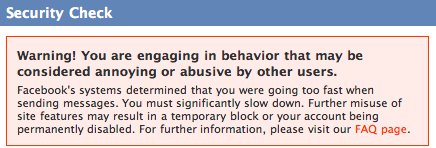
    Facebook Spam Warning
    If you get this message, you're doing it wrong.

    Facebook Applications

    While many only think of Facebook apps in the terms of Farmville and the endless number of “gifts”, there are many applications that are indispensable for brand building. Two personal favorites of mine are Extended Info and Blog RSS Feed Reader.

    Extended Info allows you to integrate custom HTML to create new and interesting fields on the page. Instead of being overly pushing with daily reminders on their timelines, you can designate areas on the page for contest and promotional offers.

    Like with Extended Info, Blog RSS Feed Reader can be used to incorporate content you are discussing on your blog with your profile without the use of status updates. Reader always allows fans a chance to share this information via other social media outlets.

    Internet marketing is no longer the Wild West. It’s becoming more interactive, sophisticated, and accessible to people of all walks of life. While there has always been a question of how to leverage social media, Facebook is making it easier to build communities and generate higher quality leads. I am positive that as it continues evolving, there will be feverish migration of online marketers looking to capitalize on its success.

    Thanks to larcher the Facebook ad image!

  • Top 10 for the Weekend

    Once again we’ve collected some handy links that we thought you’d find enjoyable and useful. Have a look and maybe you’ll get some ideas for what to do on Monday when the clients and customers start calling…

    1. GoogleSpeak – “We currently do not support the location” = Banished?

    As much as we love Google Maps… it’s got a long way to go until it’s a fully reliable business tool. It works perfectly for many, but some businesses end up with a problem-laden listing or market and just can’t seem to get it straightened out. If you’re a small business struggling to get your business details out there, you are not alone! Stay tuned for future posts on how to manage it!

    2. ComScore: Now 30% Browsing Mobile Web

    ComScore’s finding that approximately 75 million people are surfing the web on their mobile phones proves the importance of the tool mentioned in the link above. With the Maps application available for all Andriod, Blackberry, iPhone, Palm, and Windows Mobile, that means it’s available to 97% of smartphone users as of February 2010.

    3. Facebook Posied to Enter the LBS Game

    From the company who only first turned a profit just over 6 months ago, comes another reason why their long-awaited IPO is going to have investors running to Wall Street when it finally comes up. If you haven’t heard of LBS, or “location based service,” you certainly will soon, and you’re probably already using one: Google Maps, Foursquare, and soon 400 million people will be using one: Facebook. It seems they’ll be integrating advertising like no other into their location-based status updates that will roll out later this month.

    4. Three for Thursday

    Mobile seems to be the hot topic this week… Tom Martin details three mobile services or overall ideas that will help some daily tasks just a bit easier: ordering and paying for your lunch via your mobile, the location-based app answer to Craigslist’s “Missed Connections,” (too bad I’m not single), and a possible solution to trying to schedule a call with a potential client on your boss’s jam-packed schedule, which has proven itself a challenge lately.

    5. Buying Yelp Reviews is BAD for Business

    There’s been a lot of talk about proper social media use these days. Yelp seems to usually be at the center of such discussions. This blog by fellow Search Influencer Amy Arnold shows the varying degrees of small businesses’ attempts to “buy” reviews and if you should or shouldn’t do it.

    6. How to Use Facebook for Business and Marketing

    What would a collection of internet marketing posts be without a mention of how to create a fabulous Facebook Page that everyone will want to visit?? Tamar Weinberg explains here how while the typical Facebook user really is on there only for personal use, it is possible to sneak a little marketing in here and there.

    7. Linkbait: The Most Linked to Articles

    Trying to get links back to your site or blog? Often even the most well constructed posts don’t get all the linking attention they deserve. The SEO Doctor shares some research he found about some of the most linked-to blogs AND shares the golden resources and tools he used to conduct it.

    8. Is your blog chasing numbers or dollars?

    Your blog may be attracting readers, but is it attracting them in such a way that they want to buy your product of service? Mack Collier points out something we’ve probably all committed as SEOs. Sorry, potential customers, we’ll be sure to dial down the use of the search lingo!

    We’re not the only ones who love to share the knowledge we come across. See below for Matt McGee’s round up of the best posts in April, and Search Engine Land’s SearchCap, a daily collection of posts.

    9. Matt McGee’s April ’10: Best Search/Marketing Posts

    10. Search Engine Land’s SearchCap for May 6, 2010

  • Google Maps – an equally useful tool for customers and businesses alike

    I can’t fight this feeling any longer. I need to profess my love of Google Maps. Our relationship was a tumultuous one, but she won me over in the end. Living in New Orleans, where some street signs are still missing from their respective corners, Google maps was a saving grace. They also recently started to include bike routes, which guides bikers through the least traffic-laden areas. Though this feature still needs some work, I think it’ll be a great asset to this ever-expanding program.

    Google maps doesn’t just serve to make traveling easier or killing time. It also does wonders for SEOs. Google Places, a new version of its Local Business Center, makes the discoverability of local businesses easy and reliable by having the businesses themselves be able to claim and update their own listings.  Now, they’ve extended this into street view. If you’re viewing the map in street view and see a business that catches your attention, you can now click on an icon that has information like hours, reviews, and more. Here is an example:


    With this feature, you can browse your neighborhood for local restaurants and stores. From there you can see what bars or dessert joints are down the street from where you’re dining or shopping. It’s a great way to take advantage of your city, or learn about a new one while you’re on vacation.

    For now, it will only show the top listings for the area, but they will be expanding to include more businesses and even transit locations. If you’re searching for your business and find the marker is a little off, don’t forget that you can drag it to the proper location.

    The weather looks great today, so I think I’m going to take this thing on a test drive and find a spot where I’ve never eaten before. I can’t wait to see what these guys are going to come with next!