Category: News

  • Will Scott Named to UPCEA Board of Directors as Corporate Partner Representative

    Will Scott Named to UPCEA Board of Directors as Corporate Partner Representative

    Will Scott Named to UPCEA Board of Directors as Corporate Partner Representative graphic

    Search Influence is proud to announce that CEO and Co-Founder Will Scott has been named to the UPCEA Board of Directors as Corporate Partner Representative for a one-year term (2026–2027).

    His appointment reflects his leadership in higher education digital marketing and Search Influence’s longstanding collaboration with UPCEA, the leading association for online and professional education.

    Serving on the UPCEA Board

    UPCEA elected new officers and directors in November, with appointments taking effect at the conclusion of the 2026 UPCEA Annual Conference in New Orleans on April 17, 2026. As Corporate Partner Representative, Will will serve as a liaison between corporate partners and institutional members, contributing insight from the evolving landscape of higher education digital marketing.

    UPCEA leadership emphasized the importance of strategic, forward-thinking expertise during a pivotal moment for online and continuing education. As institutions adapt to AI-driven search behavior, enrollment shifts, and increased competition, the role of data-informed digital marketing has never been more essential.

    About Will Scott, AI SEO Expert

    Will Scott is a recognized leader in digital marketing and is credited with coining the phrase “barnacle SEO” in 2008. A founding faculty member of Local U, Will frequently presents at national conferences and contributes to major online marketing publications. With a Master of Architecture from Tulane University, he approaches marketing as a systems problem, solving for visibility, measurement, and long-term impact.

    Since launching his first website in 1994, Will has overseen teams that have developed thousands of websites, produced hundreds of thousands of directory pages, and generated millions of visits through search.

    Strengthening the Search Influence + UPCEA Partnership

    Will’s appointment to the UPCEA Board of Directors reflects more than an individual milestone. It represents the continued alignment between Search Influence and UPCEA’s shared commitment to research-driven innovation in higher education digital marketing.

    As a Platinum Partner of UPCEA, Search Influence has worked alongside the association to produce actionable, industry-leading research that helps institutions adapt to shifting search behaviors and evolving enrollment strategies. Together, we have collaborated on three major national studies:

    Through conference sessions, webinars, and ongoing thought leadership, the UPCEA x Search Influence partnership delivers practical frameworks for institutions looking to strengthen their visibility, improve ROI, and future-proof their higher education digital marketing strategies.

    Learn More About Higher Education Digital Marketing

    Will’s appointment reflects the deep alignment between Search Influence and UPCEA’s mission to expand educational access and outcomes.

    To learn more about our partnership or to discuss how your institution can strengthen its higher education digital marketing strategy, contact Search Influence today.

  • Paid Search vs. Paid Social in an AI-Driven Funnel

    Paid Search vs. Paid Social in an AI-Driven Funnel graphic

    Key Insights

    • Paid search and paid social do not compete. They complement each other. Paid social creates demand and brand awareness, while paid search captures high-intent users actively searching for solutions.
    • AI has compressed the marketing funnel. Users now move fluidly between social media feeds, AI Overviews, and search engine results pages, making an integrated strategy more important than ever.
    • Paid search is now a validation channel as much as a conversion channel. In AI-influenced SERPs where organic visibility is shrinking, paid placements reinforce credibility and brand trust.
    • Paid social drives measurable downstream search demand. Strong social campaigns increase branded search queries and high-intent traffic that paid search can convert efficiently.
    • Full-funnel orchestration drives stronger performance than channel silos. When paid social and paid search share messaging, data, and optimization insights, brands achieve greater efficiency, higher ROAS, and sustained growth.

    Search Influence approaches paid search vs. paid social as a unified strategy designed to connect demand creation, intent validation, and conversion across the modern marketing funnel.

    The traditional marketing funnel hasn’t just shifted. It has compressed. AI accelerates the speed at which users move from discovery to decision, collapsing awareness, consideration, and conversion into overlapping, nonlinear moments.

    Today, influence happens across algorithmic social feeds, AI Overviews in search engine results pages, short-form video content, conversational search experiences, and branded search queries. A user may first encounter a brand through paid social ads, validate it in search results, scan an AI-generated summary, and then click a paid search ad, all within a single session.

    One of the biggest misconceptions in digital marketing is that paid search and paid social compete. They don’t.

    Paid social creates awareness and demand among targeted audiences. Paid search captures that intent when users actively search for solutions. When aligned, they amplify each other.

    This isn’t a search vs paid social debate. It’s a guide to orchestrating both channels together for measurable growth in an AI-influenced world.

    AI’s Impact on Digital Advertising

    AI compresses the marketing funnel into overlapping micro-moments. Users no longer move predictably from awareness to research to purchase. Instead, they:

    • Discover brands in social media feeds
    • Validate through AI-generated summaries
    • Compare via search engines
    • Click paid search ads when immediate intent peaks

    AI Overviews reduce organic search visibility, pushing organic search results further down search engine results pages. Paid search ads often remain one of the most stable and visible placements.

    At the same time, conversational discovery changes when intent forms. Users don’t always start with specific keywords. We’ve shifted from keyword-first journeys to influence-first journeys.

    In this environment, channel silos fail. Users move seamlessly between platforms. A digital marketing strategy that isolates paid search advertising from paid social advertising misses the interconnected behavior of modern consumers.

    Search and paid social must be planned together to capture qualified traffic at every stage of the entire marketing funnel. Learn more about how AI search affects paid ads.

    What Is Paid Search?

    A close up of a smartphone screen

    Paid search involves paying for ad placement in search engine results pages when users actively search for answers, comparisons, or solutions. Through platforms like Google Ads, advertisers bid on specific keywords and search queries to appear in front of high-intent prospects.

    Unlike paid social, paid search captures existing demand. It doesn’t create awareness; it intercepts it at decision moments.

    In an AI-powered search environment, the role of paid search has shifted from early discovery to validation and confirmation.

    AI feels authoritative but abstract. Users understand that AI aggregates sources, but they can’t always see nuance, depth, or accountability. Paid search ads, by contrast, are explicit and brand-backed. When a recognizable company appears consistently in paid search results, it signals investment and legitimacy.

    Repetition builds credibility. Seeing a brand appear in AI summaries, organic search results, and paid search ads reinforces familiarity. And familiarity increases trust.

    In AI-influenced SERPs where organic visibility is shrinking, paid search is essential for:

    • Brand protection
    • Competitive defense
    • Capturing demand at the moment of immediate intent
    • Maintaining immediate visibility in high-competition spaces

    Pros of Paid Search

    • Captures users actively searching with immediate intent
    • Performs strongly for branded, transactional, and solution-aware search queries
    • Benefits from AI-enhanced bidding, automation, and cost per click optimization
    • Provides clear attribution through Google Analytics and conversion tracking
    • Delivers immediate visibility in competitive search engine results
    • Functions as a reliable pay-per-click conversion engine when demand already exists

    Cons of Paid Search

    • Limited ability to create demand or introduce new audiences
    • Dependent on existing awareness and search volume
    • Rising CPCs as advertisers bid more aggressively using AI automation
    • Vulnerable to diminishing returns without upper-funnel support
    • Less effective for shaping early-stage perception

    You’re competing over a fixed pool of in-market users. Without channels that increase brand awareness and consideration, you limit audience expansion and eventually cap conversion volume and efficiency.

    For some industries, particularly those classified as Your Money or Your Life (YMYL), such as healthcare, finance, and legal, additional compliance layers apply. Without accreditation or verification (like LegitScript), paid search ads may be rejected. These sectors face stricter advertising policies and higher E-E-A-T expectations.

    What Is Paid Social?

    Paid social is algorithm-driven advertising designed to reach users before intent is fully formed.

    Unlike paid search, paid social does not rely on users actively searching specific keywords. Instead, AI-powered social media platforms analyze behaviors, engagement patterns, and demographic signals to place social ads in front of highly targeted audiences.

    Paid social shapes perception. It frames problems. It introduces solutions.

    Social exposure often plants the initial seed of awareness. Users then conduct branded or category searches later for validation, comparison, and confirmation before converting.

    Importantly, social media posts are increasingly included in AI Overviews, further blurring the lines between social and search visibility. This phenomenon, along with the increased number of users searching directly on social channels, is called social search.

    Paid social operates earlier in the funnel, but its impact often shows up later in paid search performance.

    Pros of Paid Social

    • Powerful at generating awareness and introducing new brands
    • Reaches highly targeted audiences without relying on search intent
    • Leverages AI algorithms to expand reach efficiently
    • Enables visual storytelling through engaging ads and video ads
    • Strong performance in early and mid-funnel stages
    • Influences future search behavior and branded search volume

    Cons of Paid Social

    • Lower immediate conversion intent compared to paid search
    • Longer path from first touch to measurable conversion
    • Attribution complexity across devices and platforms
    • Requires continuous creative testing to stay efficient
    • Performance can fluctuate as platform AI algorithms evolve

    Strategies for Integrating Paid Search and Social

    • Social-to-Search Funnel: Use highly visual, engaging paid social ads (Meta, TikTok) to create demand and introduce your brand. Users often turn to search engines to learn more after seeing a social ad, which you can capture with branded paid search campaigns.
    • Search-to-Social Retargeting: Capture high-intent traffic through search, then use platform pixels (like the Meta Pixel) to retarget those visitors on social media with nurturing content, testimonials, or special offers.
    • Synchronized Messaging: Ensure that ad copy, visuals, and offers are consistent across both platforms to create a seamless, trustworthy user experience.
    • Data Sharing for Audience Targeting: Use search query data to create targeted interest groups in social campaigns. Conversely, use social data (like Page Insights) to understand the demographics and interests of your audience to refine keyword targeting.
    • Remarketing Lists for Search Ads (RLSAs): Use social media interaction data to build custom audiences in Google Ads. This allows you to bid higher for users who have already engaged with your brand on social.
    • Leverage Social for Keyword Insights: Monitor the language, questions, and comments in your paid social ads to identify new high-performing search keywords.

    Real-World Example: Hospitality Client Synergy in an AI Environment

    One of our hospitality clients provides a clear example of how paid social and paid search work together to drive measurable results in an AI-driven landscape.

    Meta Performance: Demand Generation & Efficiency

    In January 2026, Meta delivered exceptional efficiency without increasing budget:

    • Revenue: $152,020.58 (29.1% increase month-over-month)
    • Spend: $34,197.79 (essentially flat)
    • ROAS: 4.45 (29% improvement)
    • CPC dropped 51% to $0.39
    • Reels-only promoted ads drove higher engagement at lower costs

    This performance wasn’t accidental. Highly visual, engaging ads in Reels created awareness among the right audience. AI-driven delivery expanded reach to highly targeted audiences most likely to engage.

    Meta served as the demand generator, increasing brand exposure and consideration.

    Google Paid Search: Demand Capture & High-Intent Revenue

    At the same time, paid search delivered:

    • Revenue: $80,550.26
    • Spend: $20,162.22
    • ROAS: 4.00
    • CTR: 20.81%
    • $59,734.49 driven by the “Locals In Market” campaign
    • 173% year-over-year growth in conversions and revenue

    As Meta increased brand awareness, branded search queries and high-intent searches increased. Users who first encountered the brand in social media feeds later searched for tickets and local offerings.

    Paid search captured that demand when users were ready to book.

    Channel Synergy in Action

    This is what full-funnel orchestration looks like:

    • Paid social increased awareness and engagement.
    • Increased awareness led to measurable increases in high-intent search queries.
    • Paid search captured those users when they were actively searching.
    • Consistent messaging across platforms reinforced trust and reliability.
    • AI-driven optimization improved efficiency on both platforms simultaneously.

    In an AI world where users validate across multiple touchpoints, this synergy becomes even more important.

    A person using a laptop

    Paid Search vs. Paid Social FAQs

    Is paid search the same as paid social?

    Paid search and paid social are not the same. Paid search captures existing intent while paid social creates demand before intent exists.

    Paid search ads appear when users are actively searching for specific keywords in search engines. Through platforms like Google Ads, advertisers bid on search queries to show up in search engine results pages at the moment of immediate intent. These users are already evaluating solutions.

    Paid social advertising works differently. Social ads appear in social media feeds based on user behavior, interests, and engagement patterns, not specific search terms. Instead of responding to explicit queries, paid social shapes perception earlier in the marketing funnel.

    Which is better: SEO or SMO?

    SEO and SMO are complementary strategies that work best together by reinforcing visibility, authority, and demand across AI-driven discovery.

    Search engine optimization builds long-term organic search visibility by aligning content with user intent and search engine algorithms. It drives organic search traffic and strengthens brand authority in search engine results.

    Social media optimization amplifies reach and engagement on social media platforms, helping brands connect with highly targeted audiences before intent is fully formed.

    As AI-powered search engines blend signals from multiple sources, including website content and social media posts, visibility across organic search and social media increasingly reinforces credibility. Brands that invest in traditional SEO, AI SEO, and social media create multiple touchpoints, increasing familiarity and perceived trust.

    How is AI affecting paid search?

    AI is reshaping paid search by reducing organic clicks and making paid placements more critical for visibility, validation, and competitive defense.

    AI Overviews now answer many search queries directly within search engine results pages. This reduces clicks to organic search results and compresses visible real estate. Paid search ads often remain one of the most prominent placements on the page.

    At the same time, AI-driven bidding systems optimize pay-per-click campaigns dynamically based on the predicted likelihood of conversion. Advertisers bid more efficiently, but competition increases, raising cost per click in many industries.

    AI also changes user psychology. When users see a brand appear consistently in AI summaries, organic search results, and paid search ads, familiarity increases. That repetition reinforces credibility.

    How is AI affecting paid social?

    AI is transforming paid social into a primary discovery engine by using algorithms to surface content before users actively search.

    Social media platforms rely heavily on artificial intelligence to determine ad placement. Instead of relying on specific keywords, algorithms predict which highly targeted audiences are most likely to engage with particular ad formats, video ads, or messaging.

    This means paid social advertising plays a growing role in creating demand. Engaging ads in social media feeds often influence what users search for later in traditional search engines. Social exposure increases brand recall and branded search queries.

    AI also introduces volatility. Platforms frequently auto-enable new AI features related to copy generation, image optimization, and targeting. Advertisers must adapt quickly to maintain performance.

    In an AI-influenced journey, paid social shapes the early narrative. Paid search captures the resulting intent. When aligned strategically, both channels strengthen performance across the entire marketing funnel.

    Talk to Us About a Full-Funnel Paid Media Strategy

    At Search Influence, we don’t execute isolated channels. We design integrated digital advertising strategies aligned with real user behavior.

    Our AI-enabled digital marketing approach:

    • Increases campaign efficiency by allocating ad spend where performance is strongest
    • Reaches the right audience with precision targeting across search engines and social media platforms
    • Delivers qualified traffic from high-intent prospects
    • Uses AI to analyze performance in real time and continuously refine campaigns

    We combine paid search advertising, paid social advertising, SEO, analytics, and data insights into a unified strategy designed for how users search, scroll, and decide today.

    If you’re ready to move beyond search vs paid social and build a performance-driven marketing strategy across the entire marketing funnel, meet with our Director, Paula French.

    Images:
    Unsplash
    Unsplash

  • Will Scott Shares Higher Education AI Search Research in Search Engine Land Article

    Search behavior has evolved. Most SEO strategies haven’t.

    AI Overviews appear before organic listings. LLM answers shape early trust. Citations determine which brands make it onto a user’s shortlist at all.

    New AI search research makes that shift impossible to ignore.

    In a recent article published in Search Engine Land, “What higher ed data shows about SEO visibility and AI search,” Will Scott breaks down findings from the 2025 AI Search in Higher Education Research Study, conducted in partnership with UPCEA.

    The message is clear: ranking alone is no longer the finish line.

    You now have to win twice — the ranking and the citation.

    AI Is Already Influencing Early Trust

    The AI Search Research Study surveyed 760 prospective adult learners to understand how AI tools influence program discovery and evaluation. The findings confirm what many marketers are beginning to see in their own analytics.

    AI is no longer peripheral. It’s embedded in research behavior.

    • 79% read Google’s AI Overviews when they appear
    • 50% use AI tools at least weekly
    • 56% are more likely to trust a brand cited by AI

    Trust is forming earlier. Consideration is being shaped before traditional comparison begins.

    Brands aren’t losing visibility because they slipped a few ranking positions. They’re losing it because they were never cited in the AI answer at all.

    Discovery No Longer Happens in One Place

    Search is now multi-surface.

    Prospective students move fluidly between:

    • Traditional search engines
    • AI tools
    • YouTube
    • Brand-owned websites
    • Third-party publishers

    What they see in an AI summary influences how they read a search result. A YouTube video can establish credibility before a website earns a click.

    AI visibility is cumulative. It’s built anywhere your brand appears, not just on the pages you control.

    If your strategy treats channels in isolation, your visibility will fragment in the same way.

    Awareness Is High. Execution Is Lagging.

    To understand the organizational side of the equation, a companion snap poll of 30 UPCEA member institutions examined how teams are adapting.

    Most teams recognize that AI search matters. Far fewer have formalized their higher education AI search strategy.

    • 60% are still in early exploration
    • 30% report having a formal AI search strategy
    • 10% have not started

    The most common barriers are familiar: limited bandwidth, competing priorities, and unclear ROI.

    AI search may be on the roadmap, but it often lacks clear ownership, defined processes, and measurable accountability.

    What Actually Gets Cited

    In his article, Will outlines what separates content that ranks from content that gets cited.

    AI systems favor optimized content that can be lifted cleanly and reused without interpretation. That typically means content that:

    • Leads with direct answers
    • Uses headings aligned to search intent
    • Separates ideas into self-contained sections
    • Includes comparison and decision-stage clarity

    Higher education offers a useful lens here. Universities bring authority, depth, and long-standing brand recognition. Yet even established institutions are excluded from AI summaries when their content doesn’t match how users ask questions.

    Authority alone does not guarantee inclusion.

    Clarity increasingly determines visibility.

    Where Things Stand

    AI search hasn’t replaced SEO.

    It has expanded the battlefield.

    Discovery is happening earlier. Trust is assigned sooner. Visibility is often shaped before rankings ever come into play.

    The brands that adapt now will shape how they’re represented.

    The ones that wait may find themselves summarized by someone else.

    Read Will’s full article on Search Engine Land today.

    Want to go deeper? Will Scott will expand on these findings in a Generative Engine Optimization Master Class with Search Engine Land on April 14, 2026. The online training covers AI visibility strategy, entity optimization, and measurement techniques for evolving search environments. View session details.

  • Foundational SEO vs AI SEO: Paula French on What Businesses Actually Need

    Foundational SEO vs AI SEO Paula French on What Businesses Actually Need graphic

    Search is evolving fast. But that doesn’t mean the foundation disappears.

    On February 6, Paula French, Director of Sales and Marketing at Search Influence, joined the SEO On-Air podcast to unpack one of the biggest questions in digital marketing right now: what is the real difference between foundational SEO and AI SEO, and which do businesses actually need?

    As AI search tools, large language models (LLMs), and Google’s AI-driven experiences reshape discovery, many organizations are racing toward “AI-first” strategies. 

    Chasing the future is smart. Forgetting the basics is not.

    AI SEO Does Not Replace Foundational SEO

    One of the central themes of “Foundational SEO vs. AI SEO: What Businesses Actually Need” was that AI SEO builds on foundational SEO. It doesn’t replace it.

    Technical health, crawlability, structured content, internal linking, entity clarity, and topical authority still determine whether a brand earns visibility in the first place. AI tools may interpret and surface information, but they rely on those existing signals.

    If a site struggles with thin content, weak authority, or technical issues, shifting budget into AI-focused tactics will not fix the underlying gaps. The fundamentals remain the starting point.

    SEO Maturity Should Guide Strategy

    Another key insight from the discussion was the concept of SEO maturity.

    Not every organization needs the same next move. Businesses with limited organic traction often benefit most from strengthening foundational SEO first. Brands with established authority and structured content systems may be ready to refine for AI-driven citation and visibility.

    Instead of asking, “How do we optimize for AI?” a better question is, “Are our fundamentals strong enough to support AI visibility?”

    That shift in thinking prevents reactive decision-making and keeps strategy aligned with measurable outcomes.

    Avoiding the “AI-First” Rush

    There is growing pressure across industries to pivot immediately toward AI search optimization. The episode explored the risk of chasing trends without diagnosing readiness.

    AI search is changing how users interact with information. It’s influencing evaluation, comparison, and brand perception before a click happens. But abandoning core SEO practices in favor of hype-driven tactics creates instability.

    Foundational SEO builds durable visibility. AI optimization refines how that visibility is interpreted and surfaced.

    The most effective strategy isn’t either-or. It’s layered.

    Tune In for the Full Conversation

    For SEOs, founders, marketing leaders, and digital strategists navigating this evolving landscape, the full episode of  “Foundational SEO vs. AI SEO: What Businesses Actually Need” provides a grounded, practical perspective.

    If you’re evaluating your 2026 search strategy, wondering whether to double down on fundamentals or invest in AI optimization, this conversation offers clarity without trend-chasing.

    Listen to the February 6 episode of SEO On-Air featuring Paula French to explore how foundational SEO and AI SEO work together, and how to determine what your business actually needs next.

  • Your AI Traffic Has Plateaued. Now What?

    Your AI Traffic Has Plateaued. Now What?

    Key Insights

    • The AI traffic plateau is real and expected. The experimental growth phase is over; we’ve entered an optimization and efficiency phase.
    • AI-referred traffic is smaller but higher quality. Engagement time and intent consistently outperform traditional organic sessions.
    • Visibility ≠ measurability. AI Overviews and AI Mode remain partial black boxes, making citation trends more meaningful than raw rankings.
    • On-site optimization alone isn’t enough anymore. Third-party comparison and aggregator content increasingly shape AI understanding.
    • Winning brands build citation networks, not just pages. Presence across AI-trusted domains now drives long-term visibility.
    • Success metrics must evolve. Citation momentum, brand sentiment in AI responses, and AI-assisted conversions matter more than impressions.

    If you’ve been tracking AI-driven traffic, you’ve probably noticed something: the growth curve is flattening.

    That’s not a bug. It’s a feature.

    The Inflection Point Is Here

    Here’s my working theory: We’ve hit the point where AI presence in search has largely stabilized. The industry has shifted from rapid, experimental rollout to deep infrastructure integration. AI Overviews aren’t new anymore — they’re baked in. The dramatic expansion phase is behind us.

    Unless there are global increases in total search traffic or dramatic expansion of AI features, we should expect:

    • Organic traffic stops declining
    • AI-referred traffic stops growing
    • Everything settles into a new equilibrium

    This isn’t necessarily bad news. It’s just… news. The land grab phase is ending. Now comes the optimization phase.

    The Visibility Gap We Can’t Ignore

    Here’s the piece we don’t have visibility on: AI Overviews and AI Mode as traffic drivers.

    We’re still relying on tracking URL parameters — UTM sources, page anchors, the little breadcrumbs platforms leave behind. But that’s incomplete. Google’s AI Overviews, in particular, represent a black box of citation-driven traffic we can’t fully measure yet.

    What we can see: citations are increasing even as AI Overview rankings plateau. That’s encouraging. It suggests presence is building even when ranking positions stay flat.

    Google Is Refining the AI Overview Experience

    One thing that explains the plateau: Google is getting smarter about when to show AI Overviews.

    According to recent reports, Google is now stripping AI Overviews from searches where users aren’t interacting with them. They’re figuring out what people actually engage with and putting AI Overviews there.

    What this means: You’re not ranking for random, low-intent searches anymore. The pie has shrunk, but it’s a more qualified pie.

    Less visibility in aggregate, but potentially more valuable visibility where it matters.

    The data backs this up. Looking at recent numbers across several higher ed clients, AI-referred traffic consistently shows stronger engagement than traditional organic:

    SEO Engagement Time AI Engagement Time SEO Engagement Rate AI Engagement Rate
    Client A 1:05 3:14 32% 71%
    Client B 2:07 3:17 65% 45%
    Client C 2:27 6:03 67% 46%

    AI traffic isn’t just smaller — it’s more qualified. These users are arriving with higher intent and spending more time with the content.

    What’s Actually Working: Lessons from the Field

    Looking at clients who’ve maintained or grown their AI presence during this plateau period, a few on-site tactics stand out:

    1. Semantic Header Optimization

    Not just “put keywords in H2s” — but structuring headers to reflect how AI models organize information. Think entity relationships, not keyword density.

    2. AI-Friendly Language

    Shift from salesy, marketing-speak to fact-based, outcome-based content. LLMs are trained on informational content. They don’t respond well to “Schedule your free consultation today!”

    What they do respond to: clear statements of fact, specific outcomes, data points.

    3. Structured Data with Linked Entities

    Schema markup matters more than ever, but it’s not just about having schema. It’s about connecting your entities to the broader knowledge graph. Make sure your Course, Organization, and Person entities reference established identifiers.

    4. FAQ Optimization

    Still a consistent win. LLMs love well-structured Q&A content. It’s easy to parse, easy to cite.

    The Comparison Content Problem

    On-site optimization only gets you so far. AI models give weight to what other authoritative sources say about you. If you’re only optimizing your own site, you’re playing with one hand tied behind your back.

    Here’s an uncomfortable truth: AI Overviews are increasingly citing off-site aggregator and list-style content.

    “Top 10 medical billing programs,” “Best car service providers in Chicago,” “Construction management software comparison.”

    This content format is showing up everywhere in AI responses. And for many clients, it’s content they can’t or won’t create.

    Brand compliance teams get nervous about comparing themselves to competitors. Legal wants to vet every claim. By the time approvals come through, the opportunity has moved on.

    The workaround? Third-party placements.

    We’ve had success getting comparison content placed on external sites — parenting blogs, industry directories, and niche publications. It’s not scalable, but it works.

    One example: A comparison article we placed on a regional parenting site now ranks 7th organically for a competitive local service query. Not in the Map Pack, not in the AI Overview, but it’s in the ecosystem. That content is feeding the AI’s understanding of the market.

    The Path Forward: Building Your Citation Network

    So where do we go from here?

    I’m working on building a list of 50-100 article placement opportunities. Sites that:

    1. Accept guest content
    2. Are indexed by Google
    3. Are cited by AI (both Google AI and ChatGPT)

    That third point is key. Being in Google News isn’t enough. The question is: are these domains showing up in AI responses?

    How to verify:

    • DataForSEO has metrics for Google AI and ChatGPT indexing
    • Ahrefs shows indexed pages and citations in their main view
    • Or build your own tool using SERP APIs and LLM APIs (I’m working on this now)

    The hypothesis: if a domain is already cited by AI platforms, content you publish there has a higher chance of feeding those same AI responses.

    Tracking the Right Metrics

    Given the plateau, what should you actually be measuring?

    Stop obsessing over:

    • Prompt-by-prompt rankings (too volatile)
    • Total AI impression counts (too noisy)

    Start focusing on:

    • Citation trends over time (up and to the right)
    • Brand sentiment in AI responses (does the model understand what you do?)
    • Conversion attribution from AI-referred traffic (when trackable)
    • Third-party mentions in AI responses

    All the data is wrong. The question is: how wrong is it? Pick your metrics, track consistently, and look for directional movement.

    What This Means for Your Strategy

    If AI traffic has plateaued, the response isn’t to panic — it’s to shift from growth tactics to optimization tactics.

    Priority 1: Technical Foundation

    AI engines are less patient about crawl than traditional search. If they can’t see your content quickly and cleanly, they won’t cite it.

    • Fix crawlability issues
    • Improve site speed
    • Verify AI bot access in robots.txt

    Priority 2: Content Format

    Structure content for AI ingestion:

    • Clear heading hierarchy
    • FAQ sections
    • Definition lists for key terms
    • Schema markup that connects entities

    Priority 3: Third-Party Footprint

    Build presence on sites that AI already trusts:

    • Industry publications
    • Authoritative directories
    • Comparison content (even if you’re not creating it yourself)

    Priority 4: Measurement Infrastructure

    Set up tracking for AI-referred traffic now, before you need it:

    • Monitor URL parameters (UTM sources, anchors)
    • Track citation trends in AI monitoring tools
    • Document brand mentions in AI responses

    The Monetization Wildcard

    There’s one variable we can’t predict yet: how will future monetization of AI answers affect referral behavior?

    Google hasn’t fully figured out how to make money from AI Overviews. Neither has OpenAI, Perplexity, or anyone else. When they do, the incentive structures will shift.

    A few scenarios to watch:

    Scenario 1: Ads in AI responses. If Google inserts sponsored content into AI Overviews (they’re already testing this), organic citations become less prominent. Your content might still inform the answer, but the click goes to an advertiser.

    Scenario 2: Premium AI tiers. Paid AI modes could behave differently than free ones — deeper research, more citations, different source preferences. Optimization strategies might need to account for which tier your audience uses.

    Scenario 3: Publisher revenue sharing. If platforms start compensating publishers for citations (the way some news partnerships work), the economics of content creation change. Sites that currently can’t justify AI-focused content might suddenly have a business case.

    None of this is certain. But the fact that AI monetization is still being figured out means the referral dynamics we’re seeing today aren’t permanent.

    Build for the current reality, but stay flexible.

    The Bottom Line

    The AI traffic plateau isn’t the end of growth — it’s the end of easy growth.

    The early adopters who were showing up everywhere just by existing have hit their ceiling. What comes next is more intentional: optimizing for how AI models understand and cite your content, building presence on the sites that feed those models, and measuring what actually matters.

    Traditional search isn’t going anywhere. AI is additive, not a replacement. The brands that win are the ones that show up in both.

    What are you seeing with your AI traffic trends? I’m curious whether this plateau is showing up across industries or if it’s specific to certain verticals.

    This post was based on a conversation among the Search Influence SEO team, Will, Cory, and Chuck, with input from Jess, the account manager for a couple of the cited clients.

    The question we were tasked to discuss was how to explain the plateau in AI traffic.

    Ready to learn more about traditional SEO and AI SEO? Contact us to speak with our team of experts.

    Images:
    Unsplash
    Unsplash

  • Harvard Law School’s Program on Negotiation Partners With Search Influence for AI SEO Audit

    Harvard Law School’s Program on Negotiation has engaged Search Influence to conduct a comprehensive AI SEO audit. This audit will focus on how the program’s academic content is represented across AI-driven and traditional search environments.

    As generative search tools and AI-powered summaries continue to influence how people discover and evaluate academic programs, institutions are examining how their content appears, is summarized, and is connected across search platforms.

    The Search Influence and Harvard Law School partnership reflects those evolving discovery patterns and the growing role of AI in early research.

    Reviewing How Academic Content Is Interpreted by Search Systems

    As part of this engagement, our team will evaluate how the Program on Negotiation’s existing digital content is interpreted by AI systems, including LLMs and other AI-generated search experiences. The audit will examine structural clarity, entity alignment, and contextual signals that influence whether the program’s academic expertise, programs, and resources are surfaced during AI search.

    In parallel, we will also assess traditional SEO foundations. This includes reviewing how high-performing content is connected across the site and how effectively that content supports broader program awareness and discoverability across search experiences.

    About the Program on Negotiation

    Based at Harvard Law School, the Program on Negotiation is a university consortium dedicated to developing the theory and practice of negotiation, mediation, and dispute resolution. Founded in 1983 as a research initiative, the program brings together faculty, students, and practitioners from Harvard University, the Massachusetts Institute of Technology, and Tufts University.

    The program serves a global audience through executive education programs, faculty research, publications, training initiatives, and educational resources that support both academic study and applied practice.

    A New Standard for Academic Visibility in Search

    Search visibility is no longer limited to rankings or keywords. AI-driven systems increasingly shape which academic programs are surfaced, how expertise is summarized, and what information enters early consideration.

    For institutions, this creates a new responsibility: ensuring that academic authority, depth, and context carry through as content is interpreted across evolving search environments. Understanding that representation is now a core part of a modern search strategy.

    Our AI SEO audit work focuses on helping institutions gain clarity into how their existing content and signals are reflected across both AI-driven and traditional search systems.

    Expert-Level AI SEO and Traditional SEO Services

    If you’re responsible for visibility, enrollment, or institutional reputation, understanding how your programs appear across today’s search landscape is no longer optional.

    At Search Influence, our seasoned team works with institutions to evaluate search visibility at a strategic level (across AI-driven platforms and traditional search) and to identify where alignment, clarity, and authority can be strengthened.

    Explore our AI SEO and traditional SEO services to see how our work supports institutions navigating the next phase of search.

  • How to Set Up AI Traffic Tracking in GA4

    Key Insights

    • AI platforms are regularly sending real users to websites. This traffic exists today, even if it hasn’t been tracked or discussed widely yet.
    • GA4 doesn’t clearly identify AI-driven visits on its own. Without proper setup, those sessions get grouped with other referrals and are easy to overlook.
    • Visits from AI tools don’t behave the same way as traditional search traffic. They often come from users researching, comparing, or trying to solve a specific problem.
    • Channel-based tracking makes AI traffic easier to find and analyze. Custom channel groups help isolate these visits and keep reporting consistent as AI tools evolve.
    • AI measurement works best when you focus on trends, not perfection. Directional insight is enough to evaluate performance and make smarter decisions.

    Traffic from AI tools is already reaching your website. It’s happening now, and it’s measurable, even if it has never appeared clearly in your reporting. Google’s AI Overviews, ChatGPT, Perplexity, Claude (and so on) are sending users to third-party sites every day.

    The issue isn’t whether AI traffic exists. It’s whether you can see it at all. In Google Analytics 4 (GA4), AI-driven visits are typically classified as Referral traffic, which strips away context and minimizes impact.

    Seeing AI traffic clearly changes how performance is evaluated. Let’s break down how AI traffic shows up in GA4, how to surface it deliberately, and how Search Influence turns those signals into dashboard-level insights that teams can use to make confident decisions.

    What Counts as “AI Traffic” in GA4?

    Before you can track AI referral traffic, you need to be precise about what qualifies. AI traffic isn’t a vague concept or a future trend. It refers to a specific type of visit with a distinct source and intent.

    How AI traffic is defined

    AI traffic includes sessions that originate from AI-powered tools when those tools link users to third-party websites as part of an answer, recommendation, or explanation. These visits happen when a user chooses to leave an AI interface and click through for deeper context, validation, or next steps.
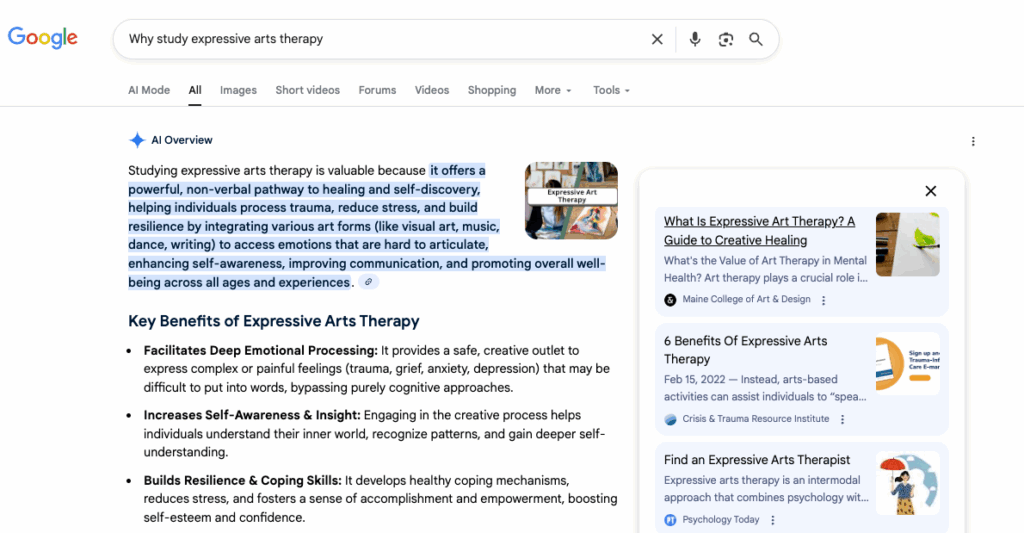
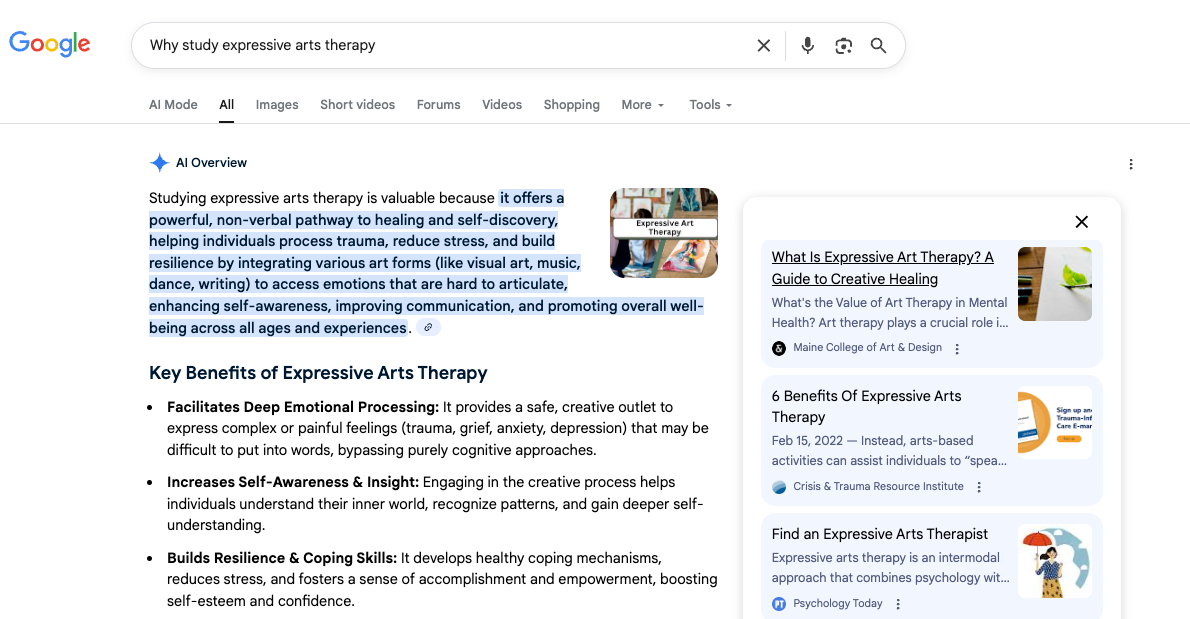
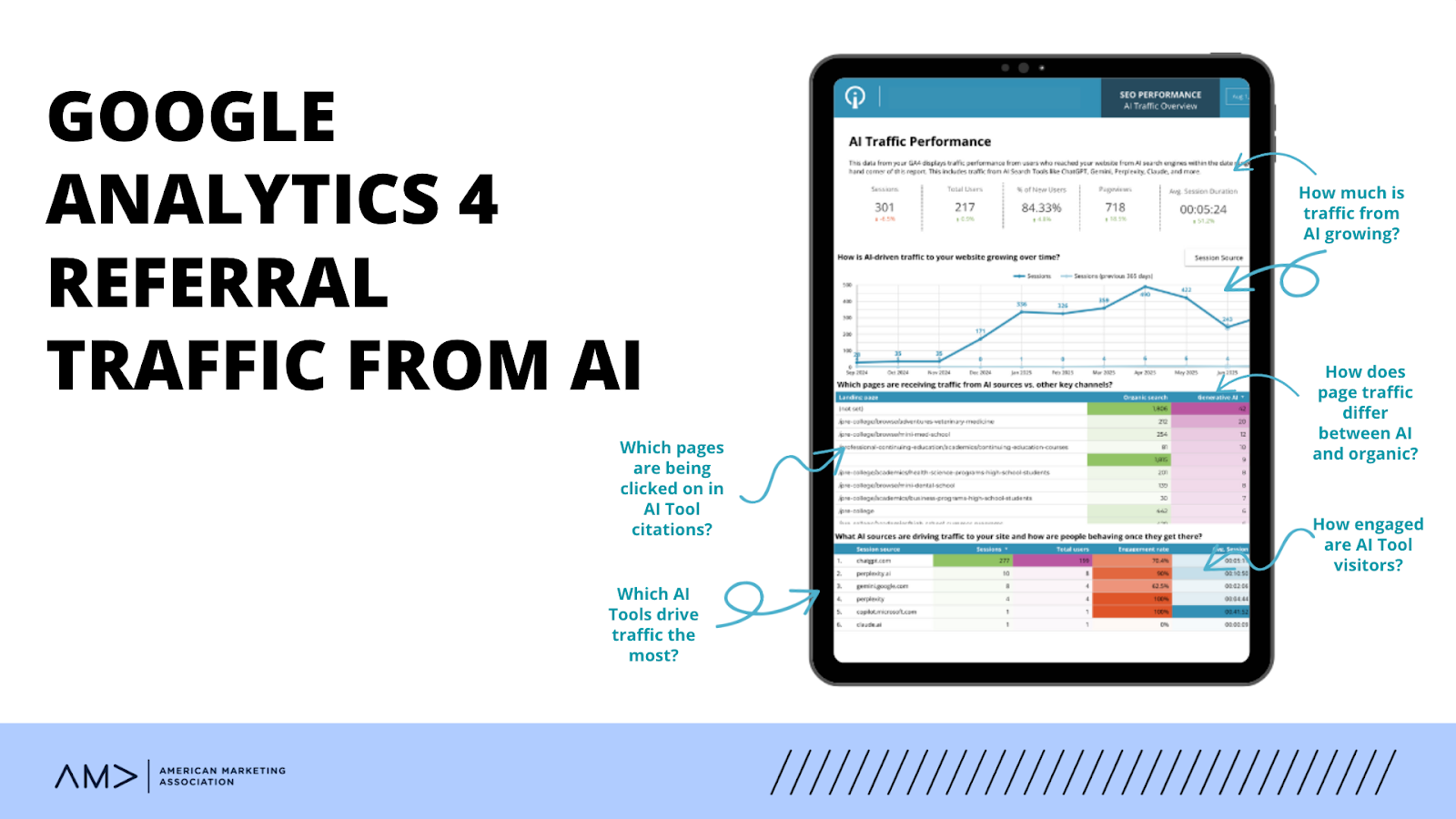
    Pictured: An AI Overview in Google Search showing cited sources alongside the generated response. When a user clicks one of these linked citations to learn more, that visit is sent from the AI interface to the publisher’s website. In GA4, that click-through is classified as AI traffic.

    This type of traffic is already present across many websites. In a 2025 Ahrefs analysis of 3,000 anonymized sites, 63% recorded at least one visit from an AI source.

    Common AI tools that send traffic today include:

    • Google’s AI Overviews
    • ChatGPT
    • Perplexity
    • Claude
    • Gemini
    • Copilot

    If a user clicks a link from one of these platforms and lands on your site, that session counts as AI traffic.

    What AI traffic is not

    AI traffic is often confused with other acquisition channels, which leads to inaccurate assumptions about its role.

    AI traffic is not:

    • Organic search traffic from Google or Bing
    • Paid search or display traffic
    • Standard referrals from publishers, directories, or partners

    Even when AI tools surface content that originally ranked in search, the visit itself does not come from a search engine. The source is the AI platform, not the SERP.

    Why AI-driven visits behave differently

    Users arriving from AI tools typically have a different mindset than traditional search users. In many cases, they are:

    • Researching a specific question or comparison
    • Looking to confirm information they’ve already seen
    • Narrowing options rather than browsing broadly

    As a result, AI-driven sessions often enter deeper into content, focus on fewer pages, and show engagement patterns that don’t always align neatly with organic search benchmarks.

    Why this definition matters

    Without a clear definition of AI traffic, reporting becomes inconsistent fast. Teams end up blending unlike sessions together, misreading intent, or minimizing AI’s contribution altogether.

    Agreeing on what counts as AI traffic makes it possible to:

    • Track it consistently over time
    • Compare it meaningfully against other channels
    • Analyze behavior without muddy attribution

    Once AI traffic is clearly defined, the next challenge becomes visibility (specifically, where this traffic actually shows up inside GA4).

    Where AI Traffic Lives in GA4 by Default

    When AI traffic reaches your site, GA4 has to decide where to put it. That decision happens automatically, based on how GA4 assigns sessions to its Default Channel Groupings.

    GA4 groups traffic by matching source and medium patterns. When a visit doesn’t meet the criteria for search, paid, social, or email, it’s typically assigned to the Referral channel. This is where most AI-driven visits end up.

    Why AI traffic gets classified as Referral

    AI tools send users to websites using standard web links. From GA4’s perspective, there’s nothing about these visits that signals a unique acquisition channel. As a result, traffic from AI platforms is treated the same way as any other external link click.

    That means AI traffic is not labeled, flagged, or separated by default. It’s folded into Referral alongside a wide range of unrelated sources.

    What this looks like in reporting

    In practice, AI traffic blends in with referral sources such as:

    • Software platforms
    • Documentation sites
    • Blogs and media outlets
    • Partner or vendor domains

    Without deliberate segmentation, there’s no clear way to distinguish an AI-driven session from any other referral visit.

    Why this makes AI traffic hard to analyze

    Referral traffic is often reviewed at a high level, if at all. It’s rarely trended with the same attention as organic or paid channels, which makes emerging patterns easy to miss.

    As a result:

    • AI traffic is difficult to isolate over time
    • Growth from AI platforms can go unnoticed
    • AI’s contribution to acquisition and engagement is underrepresented

    AI traffic isn’t invisible in GA4. It’s simply buried, and understanding where it lives by default is the first step toward surfacing it intentionally.

    How AI Traffic Tracking Works in GA4

    Once you know AI traffic is folded into Referral reports by default, the next question is how to surface it consistently. In GA4, that starts with custom AI traffic channel groups.

    Why channel groups work

    Channel groups operate at the acquisition layer in GA4. When AI traffic is defined as its own channel, it becomes visible across standard reports, comparisons, and dashboards without relying on one-off views or manual analysis.

    This approach:

    • Applies consistently to past and future data
    • Integrates cleanly into existing reporting workflows
    • Makes AI traffic comparable to other acquisition channels

    Why filters and ad hoc reports aren’t enough

    Temporary filters and explorations can surface AI traffic, but they don’t scale. They require constant upkeep, fragment reporting, and make trend analysis harder over time.

    Channel groups solve the problem structurally by establishing AI traffic as a distinct acquisition category.

    How AI traffic is identified

    AI traffic is grouped using session source values, not behavior or content signals. When a known AI platform appears as the source, GA4 can assign that session to the appropriate channel.

    This keeps attribution clean and allows rules to evolve as new AI tools emerge.

    A scalable, industry-aligned approach

    Custom channel groups are already a best practice for managing complex acquisition sources in GA4. Applying that same framework to AI traffic creates visibility without overengineering and keeps reporting aligned as AI-driven discovery continues to change.

    High-Level Steps: Setting Up an AI Traffic Channel in GA4

    AI traffic doesn’t need to be created or inferred. It already exists in GA4. The goal of setup is to surface it in a way that’s consistent, durable, and usable across reports.

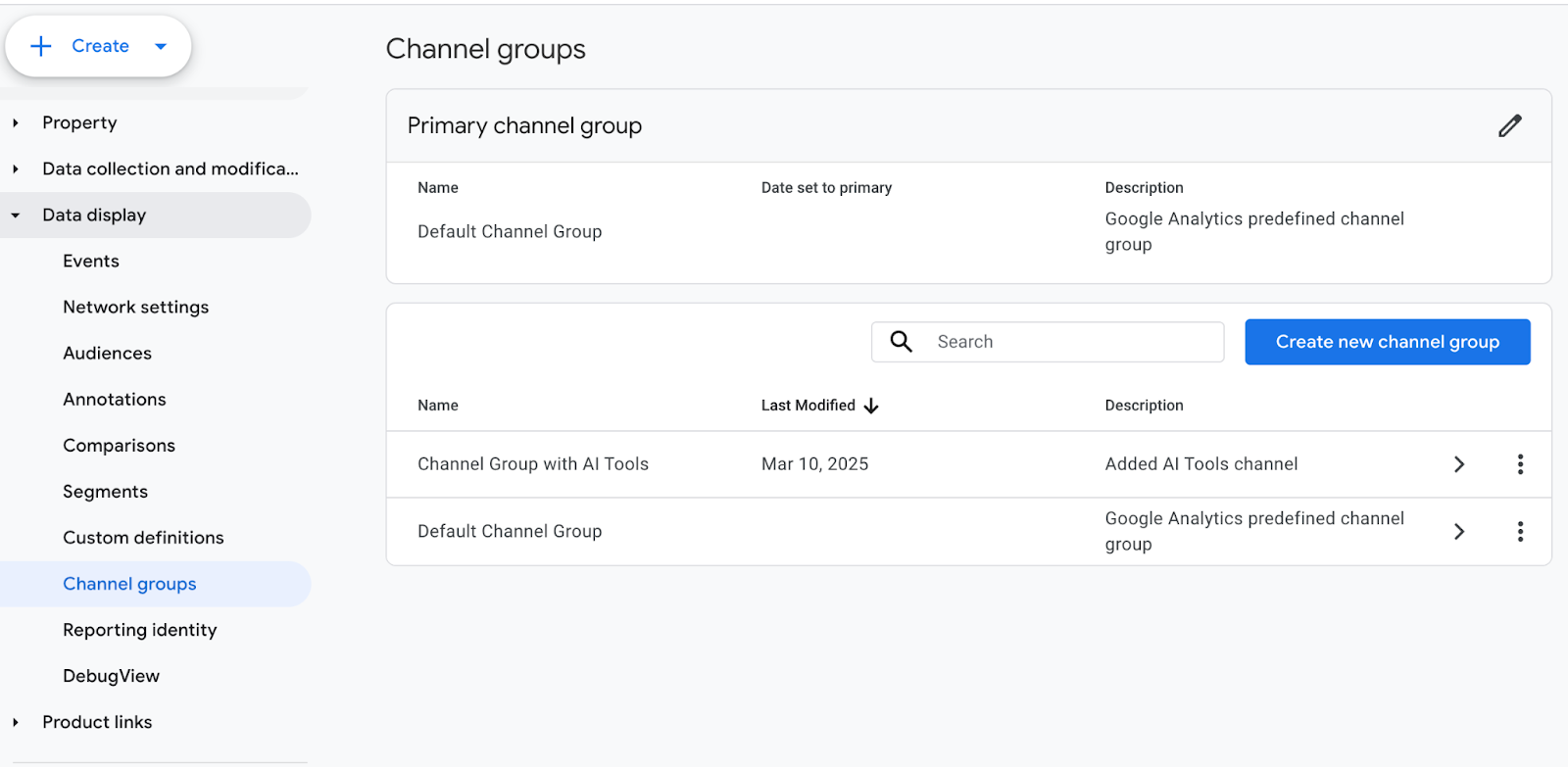
    1. Create a custom channel group for acquisition analysis
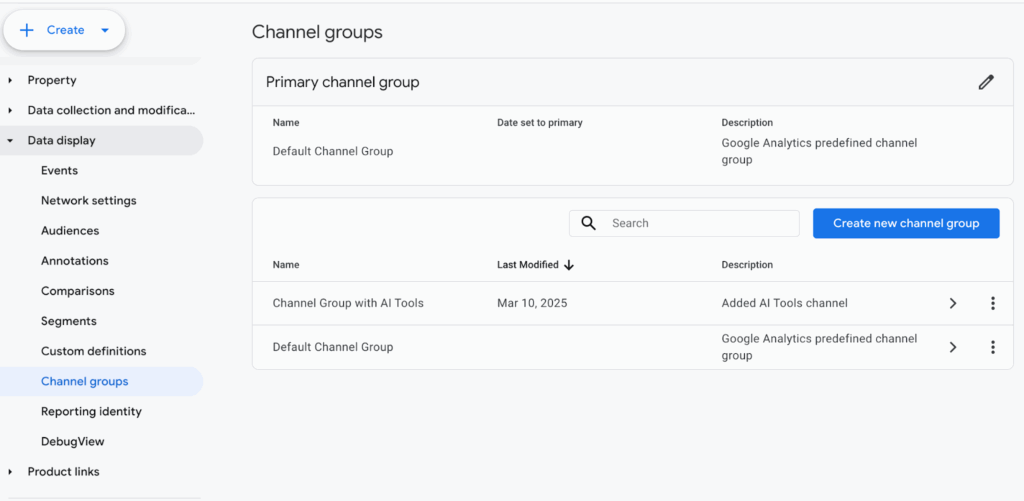
    AI traffic tracking starts with a custom channel group. Channel groups determine how sessions are categorized throughout GA4’s acquisition reporting, which makes them the right layer for isolating AI-driven visits.

    This establishes AI traffic as a first-class acquisition channel.

    2. Add a dedicated channel labeled “AI Tools”

    Within the new channel group, a dedicated channel is defined specifically for AI-driven sessions. A clear label like “AI Tools” keeps reporting readable and reduces ambiguity when data is shared across teams.

    At this stage, simplicity matters more than over-segmentation.

    3. Identify AI traffic using session source values

    As stated above, AI traffic is identified using session source values rather than behavioral or page-level signals. When a session originates from a known AI platform, GA4 can assign it to the AI Tools channel.

    This keeps attribution consistent and avoids guessing user intent.

    4. Apply regex logic to group known AI platforms under one channel

    Known AI platforms are grouped together using pattern-based logic. This allows multiple tools to roll up into a single channel while keeping the structure flexible as AI-driven discovery continues to evolve.

    As new AI tools are released or gain adoption, this regex can be updated to include additional referrers without changing the overall reporting framework. This keeps AI traffic consolidated, prevents fragmentation across referral sources, and ensures visibility keeps pace with the expanding AI ecosystem.

    The channel evolves through periodic refinement, not constant reconfiguration, which makes it sustainable over time.

    5. Reorder channels so AI traffic is evaluated before Referral

    Channel order determines how GA4 assigns sessions. Placing the AI Tools channel above Referral ensures AI-driven visits are captured intentionally rather than falling into the default referral bucket.

    This step prevents AI traffic from being hidden again.

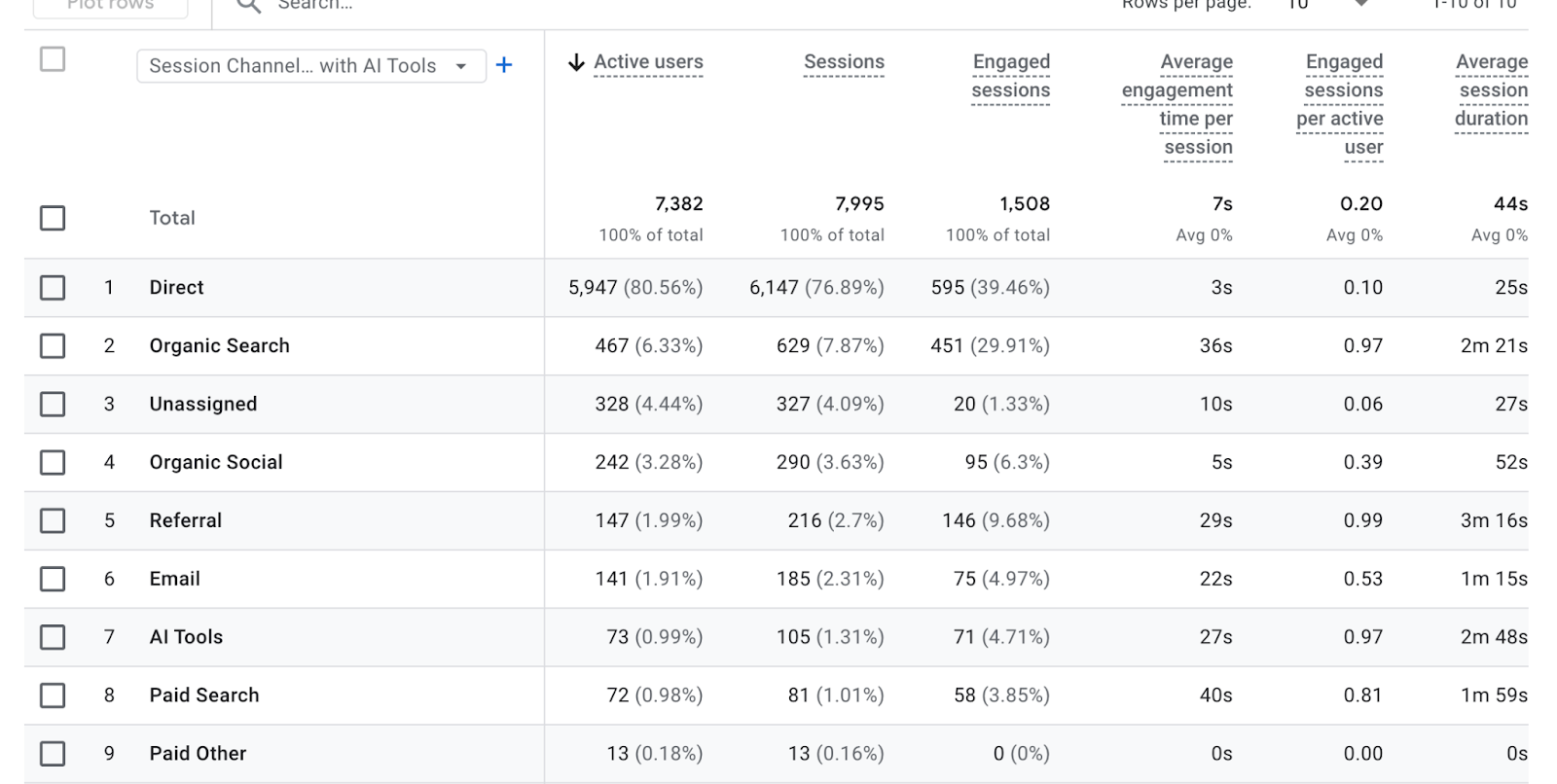
    6. Validate AI traffic visibility in GA4 acquisition reports

    After setup, AI traffic should appear clearly across standard acquisition reports. At that point, teams can begin trending performance, comparing AI traffic against other channels, and incorporating it into regular reporting.
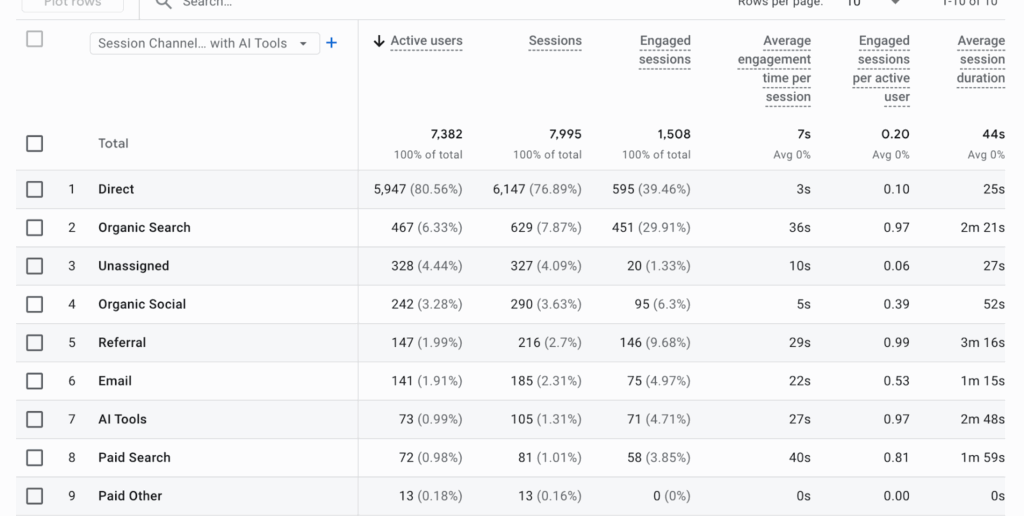
    This setup doesn’t change how GA4 captures data. It simply surfaces AI-driven sessions that were already there, pulling them out of the referral background and into a form that teams can actually use.

    For a more detailed, step-by-step walkthrough of this setup, see Dana DiTomaso’s “How to Track and Report on Traffic from AI Tools (ChatGPT, Perplexity) in GA4.”

    Separating ChatGPT From Other AI Tools

    After AI traffic is surfaced as a channel, some teams notice that one source tends to stand out. In many cases, that source is ChatGPT.

    Why ChatGPT often dominates AI traffic

    ChatGPT often represents a larger share of AI-driven sessions due to its broad adoption (it became the fastest-growing app in history, reaching 100 million active users within two months of launch) and frequent use for explanations, comparisons, and next steps. As a result, it’s often the first AI signal teams notice once tracking is in place.

    How ChatGPT traffic can behave differently

    Not all AI traffic behaves the same. ChatGPT-driven sessions may show different patterns than traffic from tools like Perplexity, Claude, or Gemini.

    Common differences include:

    • Deeper entry points into content
    • Longer engagement on explanatory pages
    • Strong alignment with informational or evaluative intent

    These differences reflect how users interact with various AI tools, rather than their performance quality.

    When separating ChatGPT adds value

    Separating ChatGPT into its own channel can improve clarity when it accounts for a meaningful share of AI traffic or when teams want platform-specific insight. In these cases, segmentation supports analysis rather than adding noise.

    When it’s better to keep AI traffic sources grouped

    For many teams, especially early on, grouping all AI tools under a single channel keeps reporting simpler and trends easier to interpret. Segmentation should be introduced only when it helps answer real questions.

    AI Tool Referrals vs AI-Generated Search Clicks

    AI tools vs AI search features

    AI-driven traffic doesn’t follow a single pattern. One of the most common points of confusion is the difference between AI tool referrals and AI-generated search features.

    AI tools send traffic directly from their own interfaces. When a user clicks a link inside a tool like ChatGPT or Perplexity, that visit arrives as a standard referral session.
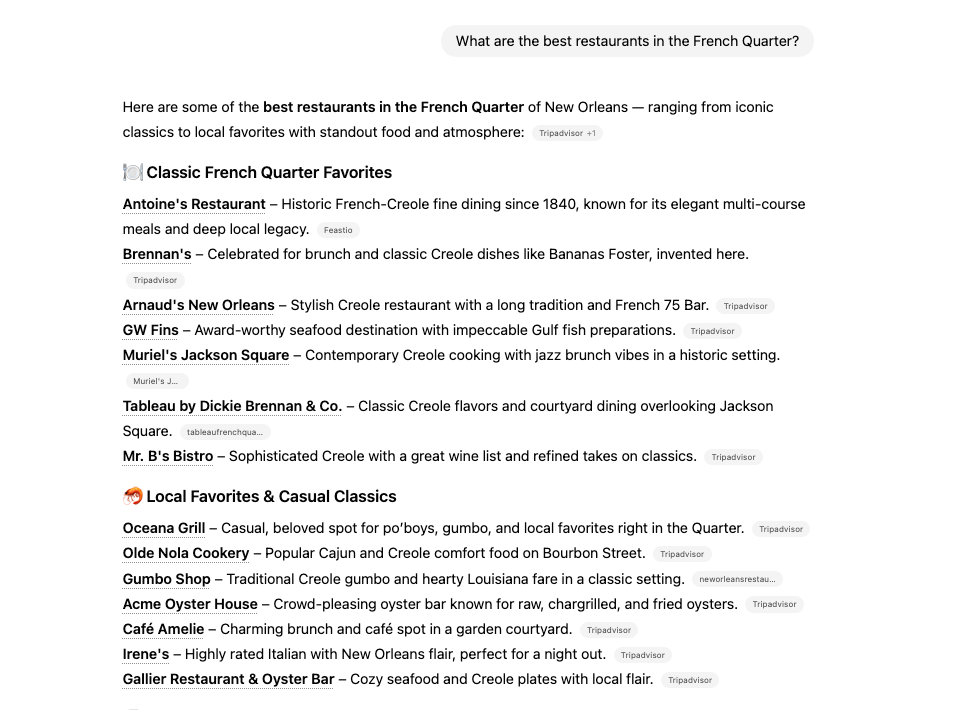
    Pictured: A recommendation list generated inside ChatGPT, where each item includes a clickable external source. When a user selects one of these links and lands on a website, the visit is recorded as a referral from ChatGPT, distinguishing it from clicks that originate within a search engine results page.

    AI-generated search features work differently. These include:

    • AI Overviews
    • Featured Snippets
    • People Also Ask

    In these cases, the user is still on a search engine results page. The click originates from a Google-owned surface, not from an external AI tool.

    Why this distinction matters in GA4

    Because AI tools and AI search features generate different types of URLs, they behave differently in analytics. Channel groups can reliably capture traffic from AI tools because those visits have identifiable external sources.

    AI-generated search clicks, however, often share source and medium values with traditional organic search. As a result, they can’t be isolated cleanly using channel group rules alone.

    Understanding this distinction prevents misreporting. AI tool referrals and AI-generated search features both influence discovery, but they require different tracking approaches inside GA4.

    When Event-Based Tracking Is Needed for AI-Generated Search Links

    Channel-based tracking captures traffic from AI tools, not from AI-generated search features.

    When discovery happens inside AI Overviews, Featured Snippets, or People Also Ask, a different measurement approach is required.

    How event-based tracking fills the gap

    Event-based tracking provides a way to measure clicks from AI-generated search features by identifying specific URL patterns and triggering custom events. This approach typically requires Google Tag Manager and a deeper understanding of how search feature URLs are structured.

    Rather than reclassifying traffic into a new channel, this method captures interactions as events that can be analyzed separately inside GA4.

    What to expect from this approach

    Event-based tracking adds useful context, but it comes with limitations. Teams should go into this with the right expectations:

    • Tracking is partial, not comprehensive
    • URL structures change, which can break rules over time
    • Visibility is directional, not exhaustive

    Because of that, event-based tracking works best as a complement to channel-based AI traffic reporting, not a replacement for it.

    When it’s worth implementing

    This approach is most useful for teams that:

    • Want deeper insight into AI Overviews and other SERP features
    • Have the technical resources to maintain tracking rules
    • Are already comfortable working beyond standard GA4 reports

    For teams looking to explore this layer in more detail, Dana DiTomaso offers a technical deep dive in “How to Track Traffic from AI Overviews, Featured Snippets, or People Also Ask Results in Google Analytics 4”.

    Using GA4 Audiences to Analyze AI Traffic

    Channels show where traffic comes from. Audiences show what users do after they arrive. Once AI traffic is visible as an acquisition channel, audiences become the primary way to understand its quality, intent, and impact.

    How audiences extend AI traffic analysis

    GA4 audiences enable teams to categorize users based on their entry points and subsequent actions. When AI-driven sessions are used as audience criteria, behavior can be analyzed across engagement, conversion, and retention metrics.

    This shifts AI reporting from volume-focused to outcome-focused.

    Common AI-focused audience examples

    Teams often create audiences such as:

    • Users who arrived via AI tools
    • Users who engaged after an AI-driven session
    • Users who converted following AI traffic
    • Returning users whose first session came from an AI source

    Each audience answers a different question about how AI-driven discovery influences performance.

    What audiences reveal that channels can’t

    Channels make AI traffic visible. Audiences make it interpretable.

    With AI-based audiences, teams can evaluate:

    • Engagement depth compared to organic or paid users
    • Conversion rates tied specifically to AI discovery
    • Whether AI traffic introduces net-new users or supports return behavior

    This helps separate curiosity clicks from meaningful acquisition.

    Using audiences to guide reporting and decisions

    AI audiences can be applied across standard GA4 reports, comparisons, and dashboards. Over time, they help teams identify patterns that inform content strategy, UX decisions, and measurement priorities.

    Rather than asking whether AI traffic exists, audiences help answer the more useful question: what that traffic actually contributes.

    What Search Influence Tracks for AI Traffic

    Surfacing AI traffic is only the first step. The real value comes from understanding how that traffic performs, how it changes over time, and how it contributes to broader acquisition and conversion goals.

    Search Influence focuses on a focused set of metrics that balance visibility, behavior, and impact.

    Core AI traffic metrics

    At the foundation, we track AI traffic volume and growth trends over time. This establishes whether AI-driven discovery is increasing, stabilizing, or declining.

    Key metrics include:

    • Total AI sessions and month-over-month change
    • AI traffic share relative to organic search
    • Engagement indicators, such as pages per session and engagement time
    • Conversion performance tied to AI-driven sessions

    These metrics provide directional clarity without overfitting analysis to short-term fluctuations.

    Understanding performance by AI tool

    Beyond aggregate volume, we break AI traffic down by platform to understand how different tools contribute to discovery and engagement.

    This includes:

    • Traffic distribution by AI channel
    • Engagement and conversion behavior by tool
    • Early identification of new or emerging AI referrers

    Comparing tools side by side helps teams spot meaningful differences without assuming all AI traffic behaves the same way.

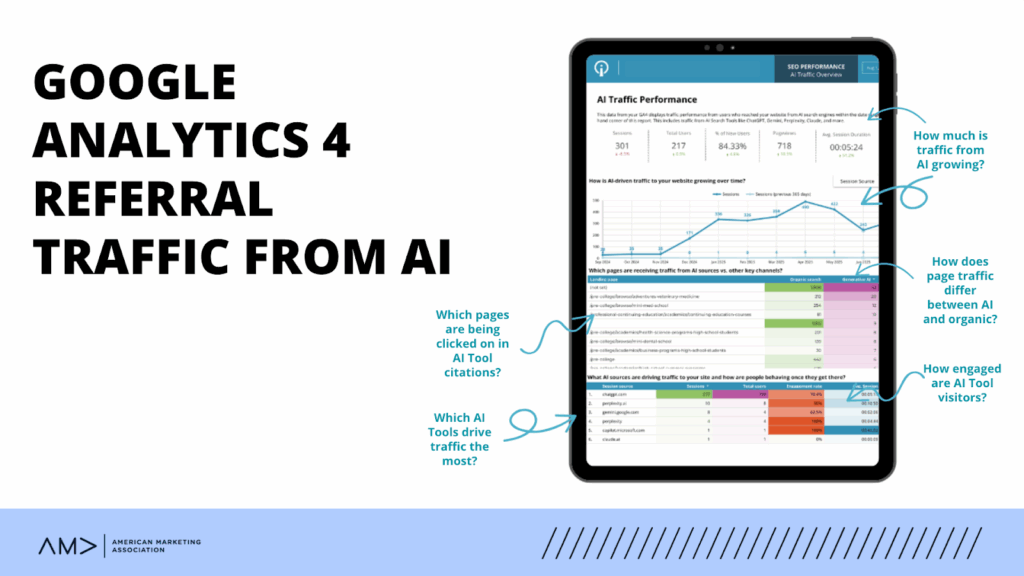
    Visualizing AI Traffic With Custom Dashboards

    Why GA4 alone isn’t enough

    GA4 can store the data, but it’s not built for fast, repeatable AI reporting across a team. Most AI questions require clicking through multiple reports, changing dimensions, and rebuilding the same views every time.

    Common friction points include:

    • AI traffic gets buried unless you know exactly where to look
    • Views are hard to standardize across stakeholders
    • Trend checks take too long to repeat weekly or monthly
    • Non-analysts struggle to pull the same story consistently

    If AI visibility matters, reporting has to be easy to access, easy to trust, and easy to repeat.

    How Search Influence dashboards surface AI insights

    Dashboards translate AI tracking into a shared, repeatable view that teams can rely on. Instead of rebuilding reports, AI performance is surfaced alongside organic and paid channels in a consistent format.

    Our custom-built dashboards typically show:

    • AI session volume and trend movement over time
    • AI traffic share relative to organic and paid
    • Engagement and conversion behavior from AI-driven sessions
    • Platform-level detail when it supports analysis (e.g., ChatGPT vs other tools)

    This shifts AI reporting from exploration to execution, making it part of an ongoing performance review rather than a one-off analysis.
    AI Tracking Tools Beyond GA4

    While GA4 remains the foundation for measuring what happens on your site, other platforms are beginning to surface how brands appear across AI-driven experiences.

    Today, these tools generally fall into three roles:

    • AI visibility tracking tools (such as Scrunch)
      Help teams understand where and how a brand shows up inside generative AI tools, including citation patterns and brand presence.
    • SEO platforms expanding into AI signals (including SEMrush and Ahrefs)
      Provide early indicators around AI citations, content reuse, and discovery, often alongside traditional search performance.
    • GA4 as the system of record
      Confirms what AI-driven discovery actually produces once users arrive, including engagement, conversion behavior, and downstream impact.

    Together, these tools answer different questions. Visibility platforms show where discovery happens. SEO tools reveal how content is reused or cited. GA4 validates what that traffic does next.

    The Reality of AI Traffic Tracking Today

    AI traffic tracking is not static. Referrers change, AI interfaces evolve, and attribution rules shift over time. Precision at the session level will never be perfect.

    What matters is consistency.

    When AI traffic is tracked the same way over time in GA4, patterns become visible. Teams can evaluate momentum, engagement quality, and contribution alongside other channels, even as the ecosystem changes.

    The goal is a usable signal, not a flawless measurement.

    FAQs

    1. Can GA4 automatically identify AI traffic without configuration?

    No. GA4 does not currently recognize AI-driven visits as a distinct channel on its own. By default, traffic from AI tools is classified as Referral, which makes it difficult to identify or analyze without additional setup. Custom channel groups are required to surface AI traffic consistently.

    2. Is AI traffic replacing or supplementing organic search traffic?

    At this stage, AI traffic is best understood as a supplement, not a replacement. Most AI-driven visits reflect users researching, validating, or comparing information before taking action. These behaviors often overlap with search intent, but they represent a different discovery path rather than a direct substitute for organic search.

    3. How accurate is AI traffic tracking in GA4 today?

    AI traffic tracking in GA4 is directional rather than exact. Known AI referrers can be reliably grouped using session source values, but attribution is not perfect and will evolve as AI tools change. The goal is consistent trend visibility over time, not precise session-level certainty.

    4. When should AI traffic be reported separately from organic traffic?

    AI traffic should be reported separately once it reaches a volume or strategic relevance that affects analysis or decision-making. Separating it too early can add noise, but grouping it indefinitely can hide meaningful patterns. The right timing depends on scale, stakeholder questions, and reporting needs.

    5. How often should AI tracking rules and definitions be reviewed?

    AI tracking rules should be reviewed periodically, typically quarterly or when major AI platforms introduce changes. New tools, referrer behaviors, and interface updates can affect how traffic appears in GA4. Regular review helps ensure definitions stay accurate without requiring constant adjustment.

    Turning AI Visibility Into Actionable Insight

    AI-driven discovery is already shaping how users find, evaluate, and engage with content. When tracked intentionally, it provides clear signals that strengthen SEO strategies, content decisions, and performance reporting.

    Search Influence brings structure to this complexity through proven tracking frameworks, executive-ready dashboards, and analytics that teams can act on with confidence.

    To gain clear visibility into how AI traffic is impacting your site, get in touch to explore our SEO, reporting, and analytics support.

    This post is informed by analytics frameworks and methodologies shared publicly by Dana DiTomaso. Our approach builds on those foundational concepts, adapted to how Search Influence configures reporting, analyzes performance, and delivers AI traffic insights through custom dashboards for our clients.
  • The Future of Search Marketing as AI Search Optimization Expands Beyond Google

    Key Insights

    • Search no longer lives in one place. Today’s search behavior spans Google, Reddit, YouTube, social platforms, and AI tools.
    • AI is now the connective tissue of search. AI systems increasingly synthesize answers from multiple platforms, meaning visibility depends on where your content exists, not just how your website ranks.
    • The user journey is shorter and less linear. Many users get the information they need directly from AI-generated answers, videos, or community discussions before ever clicking through to a website.
    • Platforms like Reddit and YouTube now influence search visibility. Community-driven content and video are being indexed, cited, and surfaced in AI Overviews and search results alongside traditional web pages.
    • Winning the future of search requires an omnichannel mindset. Brands that align content, messaging, and authority across platforms are better positioned to earn trust, citations, and long-term visibility in an AI-driven search landscape.

    The future of search marketing is being reshaped by how people discover information, and Search Influence helps brands adapt to that shift.

    People no longer rely on Google alone to find answers.

    That’s not a prediction, it’s observable user behavior.

    Search now happens across Reddit threads, YouTube videos, Instagram posts, TikTok clips, private communities, and increasingly, AI tools that generate answers directly. Traditional search engines still matter, but they’re no longer the sole gateway to information.

    According to the AI Search in Higher Education Research Study conducted by UPCEA in partnership with Search Influence, search behavior is becoming increasingly diversified. Among prospective students surveyed, 84% use search engines, 61% use YouTube, and 50% use AI tools during their research process. While this study focuses on prospective students, it illustrates a broader shift occurring across industries: users are increasingly moving between multiple search platforms before ever visiting a website.

    This creates a new tension in the search landscape. As search behavior fragments, Google Search, AI Overviews, and large language models are doing the opposite — indexing, synthesizing, and summarizing content from all of these platforms into direct answers.

    The user journey is no longer linear or heavily reliant on traditional SERPs. Many users get the rational context they need before clicking anywhere at all. In many cases, the answer replaces the click.

    That shift may feel threatening to organic search traffic, but it also creates opportunity. Brands that understand how the search engine landscape is expanding can earn visibility far beyond traditional rankings.

    Search Influence helps brands optimize their visibility across websites, platforms, and AI-driven search engines.

    This explainer breaks down how search works across platforms today, why Reddit and YouTube matter most right now, and what an omnichannel search strategy really means in an AI-driven world.

    What the Future of Search Marketing Looks Like Today

    The future of search marketing is distributed, platform-native, and behavior-led.

    Search engine optimization and search engine marketing have evolved. Where success once meant ranking webpages on search engine results pages, it now means earning visibility across an ecosystem of platforms, answer engines, and AI-generated summaries. The goal is no longer just organic links. It’s search visibility wherever users express intent.

    AI search optimization acts as the connective layer. It determines which content is surfaced, cited, and trusted across traditional search engines, AI platforms, and conversational search interfaces. This shift affects every industry, from higher education and healthcare to e-commerce and B2B services. The future of search isn’t about abandoning traditional SEO; it’s about expanding beyond it.

    How AI Search Optimization Is Expanding Search Beyond Google

    AI tools like AI Overviews, AI chatbots, and conversational search interfaces generate answers using content pulled from multiple sources. These include websites, forums, videos, social media platforms, and structured data.

    At a high level, AI search optimization works by aligning content with how AI models evaluate relevance, authority, and context. Platforms that provide clear answers, strong community signals, and high-quality content are favored. Instead of ranking ten blue links, AI systems synthesize information into direct answers that often eliminate the need to click.

    This is why search marketing beyond Google is now required to maintain search visibility. If your content only exists on your website, you’re limiting your presence in a search generative experience that increasingly pulls from everywhere else.

    Social Platforms and the Rise of Social Search

    Social search continues to reshape how users discover information. Google now includes a native “Short Videos” filter directly within search engine results pages, signaling how tightly visual search and social content are integrated into the search landscape.

    Brands can leverage short videos by addressing popular FAQs and informational queries, increasing coverage for zero-click search and query fan-out opportunities. Social discovery is driven by visual cues, community signals, and algorithmic recommendations rather than keyword matching alone.

    Instagram supports inspiration and brand validation. TikTok delivers quick demos and direct answers. These platforms are increasingly influencing where users search, rather than Google, especially for lifestyle, education, and product discovery. Social media platforms now firmly sit within the search engine landscape.

    Reddit has become a primary search engine

    Reddit’s role in search has accelerated rapidly. In early 2024, Reddit entered into a data licensing agreement with Google, underscoring its significance in the search engine landscape.

    Users have long added “reddit” to their Google queries to find unfiltered, experience-based answers. They’re seeking peer validation, nuance, and real-world context that traditional organic results often lack. Reddit threads perform well in search results because they deliver long-form, contextual answers supported by community engagement.

    Those same qualities explain why Reddit content frequently surfaces in AI Overviews. Threads frequently answer nuanced informational queries directly, using natural language and lived experience. AI systems favor this conversational format because it aligns with user intent and demonstrates deep understanding.

    From an SEO strategy standpoint, Reddit influences both traditional SERPs and AI-generated summaries. It deserves outsized attention in modern search marketing strategy. Not as a replacement for traditional SEO, but as a powerful signal within the broader search ecosystem.

    YouTube is a search engine, not just a video platform

    YouTube has always been a search platform, but its role in AI-driven search visibility is growing. Videos are increasingly featured, embedded, and cited within Google AI Overviews and other AI summaries.

    Users search YouTube for how-tos, walkthroughs, comparisons, and explanations. Unlike Google search, where users expect links, YouTube search is visual and instructional. The expectation is an answer, not a destination.

    Video search optimization supports AI search because transcripts, titles, descriptions, and engagement signals provide machine-readable context. AI tools can parse video content at scale, reference it as a citation, and surface it alongside traditional organic results. In the new era of search, YouTube SEO is no longer optional; it’s foundational.

    What the AI Search in Higher Education Research Reveals

    The AI Search in Higher Education Research Study, conducted by UPCEA in partnership with Search Influence, surveyed 760 adult learners ages 18–60 interested in professional and continuing education. While the focus is on higher education, the findings reflect broader user behavior across digital marketing.

    The research shows that prospects use multiple platforms to research programs. AI tools and social platforms are increasingly influencing decision-making, and community-driven content plays a significant role in shaping trust.

    Key findings illustrate how search is expanding beyond traditional search engines:

    • 68% of respondents said they are more likely to consider a product or service mentioned or recommended on social media
    • Respondents’ top platforms for program search were: YouTube 57%, LinkedIn 49%, Facebook 43%
    • 1 in 3 prospects trust AI tools for program research

    Higher education often acts as a leading indicator. The developments here reflect broader shifts in search behavior across industries, from healthcare to B2B marketing strategies.

    Omnichannel Search Strategy in an AI-Driven World

    An omnichannel search strategy focuses on visibility across websites, platforms, and AI-generated answers. Optimization can no longer be siloed into traditional SEO, paid search, or social media alone.

    AI systems ingest information from multiple platforms, publications, and outlets. When a brand is consistently present in places where AI is crawling and learning, it sends corroborating signals about topical authority and relevance. This co-occurrence of brand and topic/entity strengthens AI visibility and citation potential.

    AI search optimization rewards brands that appear consistently across aligned signals, including high-quality content, structured data, schema markup, and consistent messaging, throughout their digital footprint.

    What This Shift Means for Marketers

    Rankings alone are no longer enough.

    Visibility is now earned through presence, trust, and relevance across the entire search landscape. Early adoption of AI optimization creates long-term advantage, helping brands stay ahead as user behavior and AI platforms evolve.

    Search Influence helps brands navigate this new era, blending traditional SEO, AI search optimization, and digital marketing strategy to future-proof search visibility before competitors catch up.

    FAQs About the Expanding World of Search

    What is the future of search marketing?

    The future of search marketing is defined by visibility across platforms, communities, and AI-generated answers.

    Search marketing no longer focuses only on ranking webpages in Google. Discovery now happens on Reddit, YouTube, social platforms, and AI tools. AI systems synthesize information from multiple sources instead of directing users to a single link. Effective strategies prioritize presence, authority, and clarity across the full digital ecosystem.

    How is AI changing search marketing?

    AI is changing search marketing by determining how results are selected, summarized, and delivered to users.

    AI-powered search emphasizes answers over lists of links. Content is evaluated based on relevance, context, and trustworthiness. Users receive information without always clicking through to websites. Search marketing now requires content that works for both humans and machines.

    Why does Reddit appear so often in Google and AI results?

    Reddit appears frequently in Google and AI results because it offers experience-based, community-validated answers.

    Reddit threads often address highly specific, real-world questions. Strong engagement signals indicate authenticity and usefulness. Google indexes Reddit prominently for informational and long-tail queries. AI systems reference Reddit due to its conversational language and lived experience.

    How does YouTube function as a search engine?

    YouTube functions as a search engine by matching video content to user intent through metadata and engagement signals.

    Users search YouTube for tutorials, explanations, and demonstrations. Search intent on YouTube is visual and instructional. Video transcripts and descriptions make content discoverable to AI systems. YouTube results frequently influence Google search and AI-generated summaries.

    Where are people searching instead of Google?

    People are searching instead of Google on platforms like Reddit, YouTube, social networks, and AI tools.

    Reddit supports peer-to-peer research and detailed explanations. YouTube enables visual learning and step-by-step guidance. Social platforms like Instagram and TikTok support discovery-driven search. AI tools provide synthesized answers without requiring multiple searches.

    How does AI search optimization work across platforms?

    AI search optimization works by increasing content visibility across websites, platforms, and AI-generated answers.

    AI evaluates content from multiple sources, not just traditional webpages. Clear structure and consistent messaging improve retrievability. Platforms such as Reddit and YouTube influence AI responses alongside websites. Optimization focuses on being referenced, trusted, and cited across the digital footprint.

    Turn Search Behavior Shifts Into Strategic Advantage

    Search has expanded, and AI connects it all.

    The future of search marketing requires optimizing for where people actually search, not just where marketers are comfortable. Brands that adapt now will earn visibility across platforms, AI summaries, and evolving search experiences.

    To explore the full data and strategic recommendations behind this shift, download the AI Search in Higher Education Research Study.

    Search Influence serves as a guide for brands navigating the future of search marketing, helping them stay visible, credible, and ahead in an increasingly AI-driven search landscape. Contact us to future-proof your search engine marketing strategy.

    Images:
    Unsplash
    Unsplash

  • Search Influence Named to New Orleans CityBusiness’s 2025 Best Places to Work List

    Search Influence Named to New Orleans CityBusiness’s 2025 Best Places to Work List graphic

    At Search Influence, people power our performance, and once again, that commitment is being recognized.

    We’re proud to share that our AI SEO marketing agency has been named to the New Orleans CityBusiness 2025 Best Places to Work list in the Small Company category.

    This is our team’s fourth year in a row receiving this honor and our sixth time overall, a milestone made even more meaningful as we head into our 20th year serving clients across higher education, healthcare, and tourism.

    What the Best Places to Work Recognition Means

    Since 2003, the CityBusiness Best Places to Work program has highlighted organizations that demonstrate excellence in employee satisfaction, workplace culture, benefits, and long-term team support. Companies are evaluated through a two-part process involving an employer questionnaire and an anonymous employee survey measuring satisfaction across leadership, communication, pay and benefits, and overall culture.

    To be selected, companies must meet strict survey participation requirements and achieve high levels of positive employee feedback. Recognition indicates not only strong policies on paper but a workplace where employees genuinely feel valued and supported.

    A Culture Built Over Two Decades

    As Search Influence approaches its 20th anniversary, this honor underscores nearly two decades of intentional culture-building. What began as a two-person operation in a spare bedroom has grown into one of New Orleans’ most enduring digital agencies and a national leader in AI SEO strategy.

    Our long-standing employee tenure is a testament to that culture. Benefits that support our fully remote team include:

    • Generous PTO that grows with tenure
    • Moveable company holidays
    • Comprehensive health insurance options
    • 401(k) with employer match
    • Paid parental leave
    • Flexible schedules
    • Continuing education opportunities
    • The employee-created IDEA Committee for inclusivity and representation

    As a woman-owned digital marketing agency with a predominantly female leadership team, we continue to prioritize equitable advancement and meaningful support at every level.

    Looking Ahead

    As search continues shifting toward AI-powered results, the work we do as an AI SEO marketing agency continues to evolve, driven by the same commitment to people-first strategy that has defined our organization for 20 years.

    We’re honored to be recognized once again and excited for what the next chapter brings.

    Contact Search Influence to learn more about our award-winning work.

  • Search Influence Named a Finalist for Best SEO Campaign at the 2025 US Agency Awards

    Search Influence Named a Finalist for Best SEO Campaign at the 2025 US Agency Awards graphic

    We’re excited to share that Search Influence has been named a Finalist in the Best SEO Campaign category at the 2025 US Agency Awards for our AI-driven campaign, The Art of AI SEO, created in partnership with Maine College of Art & Design (MECA&D).

    This recognition marks our second consecutive year of being shortlisted for this category, following our Silver win in 2023 for Best Integrated Campaign, a testament to our continued excellence in SEO, technical strategy, and AI search innovation.

    The Nominated Campaign: The Art of AI SEO

    MECA&D launched three new online graduate certificate programs into a highly competitive market. To stand out against major universities, the institution needed to increase visibility across both traditional search engines and emerging AI-powered platforms.

    Our solution was an AI SEO strategy designed to boost discovery, strengthen authority, and drive enrollment.

    Our Strategy at a Glance

    AI Search Visibility

    We structured site content using semantic signals, schema markup, and clear topical architecture to ensure AI systems could retrieve and cite MECA&D pages.

    Conversion-Focused Program Pages

    We added video content, clarified messaging, and strengthened user pathways to support prospective students at every decision point.

    Content Development

    We produced keyword-driven blogs, instructor spotlights, and high-salience pages that positioned MECA&D as an authoritative voice.

    The Results

    Our AI-optimized SEO strategy fueled exceptional performance:

    • 77% above enrollment goals
    • 171% increase in website sessions
    • 3,894% growth in ranking keywords

    Today, MECA&D’s Arts Education, Expressive Arts Therapy, and Arts Leadership programs all appear in AI search engines, a major competitive advantage as generative results reshape student search behaviors.

    As MECA&D’s Associate Dean of Online Learning, Heather Holland, shared:

    “Our online programs exceeded enrollment targets by 65% in less than a year.”

    Leading AI SEO for Higher Education

    As a higher education digital marketing agency, Search Influence is at the forefront of AI search strategy. Our team combines decades of higher ed SEO experience with deep expertise in AI content structuring, generative search visibility, and technical optimization.

    Our CEO and Co-Founder, Will Scott, is a national thought leader in AI SEO and the instructor of an SMX Master Class on Generative Engine Optimization. Our approach has been grounded in semantic SEO and structured data since the earliest days of the Knowledge Graph, long before AI Overviews made structured content essential.

    We help higher education institutions:

    • Build full-funnel SEO strategies tied to enrollment goals
    • Improve program visibility in AI and organic search
    • Develop content ecosystems designed for both humans and AI systems
    • Strengthen authority through structured data, internal linking, and topic clusters

    2025 AI Search in Higher Education Research Study

    This announcement follows the release of our 2025 AI Search in Higher Education Study, which uncovers how prospective students use AI tools to research programs, evaluate institutions, and form their initial consideration sets.

    Higher ed marketers can access the full report to understand:

    • Which AI tools prospects use most
    • How AI citations influence credibility
    • What strategies institutions need to stay visible

    Looking Ahead

    We’re honored to be recognized by the US Agency Awards and grateful to MECA&D for their partnership. As AI search reshapes visibility, Search Influence remains committed to helping colleges and universities compete and win in this new era of search.

    If you’re ready to strengthen your AI SEO strategy, our team is here to help you lead. Contact us today to learn more.