Author: Ren Horst

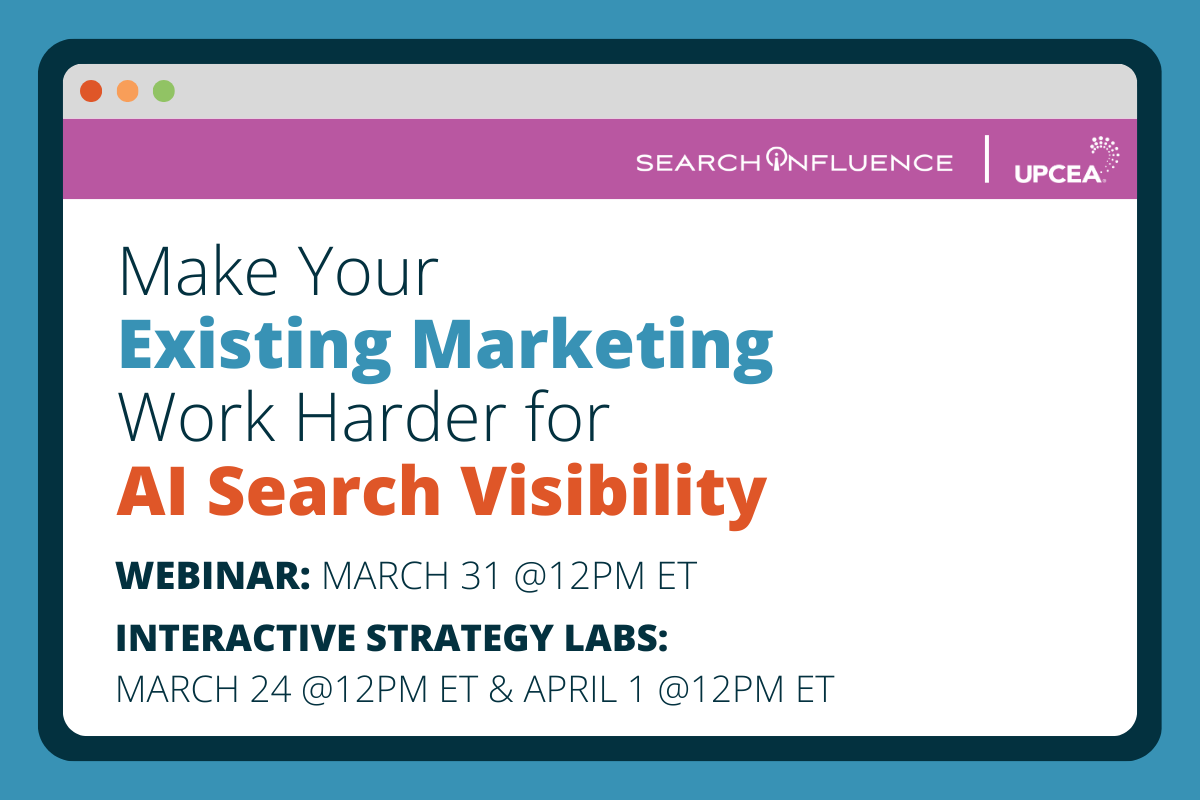
  • [WEBINAR] Make Your Existing Marketing Work Harder for AI Search Visibility

    [WEBINAR] Make Your Existing Marketing Work Harder for AI Search Visibility

    Make Your Existing Marketing Work Harder for AI Search Visibility webinar graphic

    AI search is changing how prospective students discover programs. But building an entirely new marketing strategy from scratch isn’t realistic for most higher education teams.

    Budgets are tight, staff capacity is limited, and priorities compete for attention.

    That’s why we partnered with UPCEA for this spring’s live webinar:

    Make Your Existing Marketing Work Harder for AI Search Visibility
    Tuesday, March 24
    12 PM ET | 11 AM CT

    Your presenters: 

    • Paula French, Director of Sales and Marketing, Search Influence
    • Will Scott, CEO and Co-Founder, Search Influence
    • Emily West, Senior Market Research Analyst, UPCEA

    Why AI Search Visibility Matters for Higher Education

    AI-powered search tools are shaping discovery, oftentimes before a prospective student ever clicks your website. Platforms powered by LLMs evaluate your site, paid campaigns, PR coverage, and social media to determine what information to surface.

    When those channels operate in silos, AI tools may pull incomplete or inconsistent details. In some cases, your programs may not appear at all.

    For higher education marketers, the opportunity isn’t to rebuild everything. It’s to unify what already exists. When messaging aligns across channels, institutions increase relevance, strengthen credibility, and improve their presence in AI-driven results.

    What You’ll Learn in the Webinar

    This session is built for teams who want practical guidance they can apply immediately.

    In this live webinar, we’ll break down how to:

    • Create a consistent, credible presence across the marketing channels AI evaluates
    • Leverage existing assets to improve higher education AI search visibility
    • Strengthen trust signals so AI tools surface accurate program information
    • Reduce gaps that limit discoverability in AI-powered search

    You’ll walk away with clear steps to support your higher education AI search strategy without adding major lift to your team.

    If you’ve read our recent insights on how marketing supports SEO and AI search or explored our perspective on AI SEO for higher education, this webinar brings those concepts into focused, actionable execution.

    Save your seat now

    Go Deeper: Interactive AI Search Strategy Labs

    After the webinar, join one of our small-group Strategy Labs:

    Tuesday, March 31
    Wednesday, April 1
    12 PM ET | 11 AM CT

    Led by Will and Paula, these interactive sessions offer hands-on coaching. Bring your questions about specific programs, campaigns, or content gaps. We’ll workshop actionable recommendations to strengthen your AI search visibility and connect strategy to measurable outcomes.

    Save your seat now

    Build Visibility Without Building From Scratch

    AI search is evolving quickly. Visibility now depends on alignment across every channel AI evaluates.

    You don’t need to start over. You just need to coordinate the marketing ecosystem you already have.

    Register for the webinar and secure your place in a Strategy Lab today.

  • Will Scott Shares Higher Education AI Search Research in Search Engine Land Article

    Search behavior has evolved. Most SEO strategies haven’t.

    AI Overviews appear before organic listings. LLM answers shape early trust. Citations determine which brands make it onto a user’s shortlist at all.

    New AI search research makes that shift impossible to ignore.

    In a recent article published in Search Engine Land, “What higher ed data shows about SEO visibility and AI search,” Will Scott breaks down findings from the 2025 AI Search in Higher Education Research Study, conducted in partnership with UPCEA.

    The message is clear: ranking alone is no longer the finish line.

    You now have to win twice — the ranking and the citation.

    AI Is Already Influencing Early Trust

    The AI Search Research Study surveyed 760 prospective adult learners to understand how AI tools influence program discovery and evaluation. The findings confirm what many marketers are beginning to see in their own analytics.

    AI is no longer peripheral. It’s embedded in research behavior.

    • 79% read Google’s AI Overviews when they appear
    • 50% use AI tools at least weekly
    • 56% are more likely to trust a brand cited by AI

    Trust is forming earlier. Consideration is being shaped before traditional comparison begins.

    Brands aren’t losing visibility because they slipped a few ranking positions. They’re losing it because they were never cited in the AI answer at all.

    Discovery No Longer Happens in One Place

    Search is now multi-surface.

    Prospective students move fluidly between:

    • Traditional search engines
    • AI tools
    • YouTube
    • Brand-owned websites
    • Third-party publishers

    What they see in an AI summary influences how they read a search result. A YouTube video can establish credibility before a website earns a click.

    AI visibility is cumulative. It’s built anywhere your brand appears, not just on the pages you control.

    If your strategy treats channels in isolation, your visibility will fragment in the same way.

    Awareness Is High. Execution Is Lagging.

    To understand the organizational side of the equation, a companion snap poll of 30 UPCEA member institutions examined how teams are adapting.

    Most teams recognize that AI search matters. Far fewer have formalized their higher education AI search strategy.

    • 60% are still in early exploration
    • 30% report having a formal AI search strategy
    • 10% have not started

    The most common barriers are familiar: limited bandwidth, competing priorities, and unclear ROI.

    AI search may be on the roadmap, but it often lacks clear ownership, defined processes, and measurable accountability.

    What Actually Gets Cited

    In his article, Will outlines what separates content that ranks from content that gets cited.

    AI systems favor optimized content that can be lifted cleanly and reused without interpretation. That typically means content that:

    • Leads with direct answers
    • Uses headings aligned to search intent
    • Separates ideas into self-contained sections
    • Includes comparison and decision-stage clarity

    Higher education offers a useful lens here. Universities bring authority, depth, and long-standing brand recognition. Yet even established institutions are excluded from AI summaries when their content doesn’t match how users ask questions.

    Authority alone does not guarantee inclusion.

    Clarity increasingly determines visibility.

    Where Things Stand

    AI search hasn’t replaced SEO.

    It has expanded the battlefield.

    Discovery is happening earlier. Trust is assigned sooner. Visibility is often shaped before rankings ever come into play.

    The brands that adapt now will shape how they’re represented.

    The ones that wait may find themselves summarized by someone else.

    Read Will’s full article on Search Engine Land today.

    Want to go deeper? Will Scott will expand on these findings in a Generative Engine Optimization Master Class with Search Engine Land on April 14, 2026. The online training covers AI visibility strategy, entity optimization, and measurement techniques for evolving search environments. View session details.

  • Foundational SEO vs AI SEO: Paula French on What Businesses Actually Need

    Foundational SEO vs AI SEO Paula French on What Businesses Actually Need graphic

    Search is evolving fast. But that doesn’t mean the foundation disappears.

    On February 6, Paula French, Director of Sales and Marketing at Search Influence, joined the SEO On-Air podcast to unpack one of the biggest questions in digital marketing right now: what is the real difference between foundational SEO and AI SEO, and which do businesses actually need?

    As AI search tools, large language models (LLMs), and Google’s AI-driven experiences reshape discovery, many organizations are racing toward “AI-first” strategies. 

    Chasing the future is smart. Forgetting the basics is not.

    AI SEO Does Not Replace Foundational SEO

    One of the central themes of “Foundational SEO vs. AI SEO: What Businesses Actually Need” was that AI SEO builds on foundational SEO. It doesn’t replace it.

    Technical health, crawlability, structured content, internal linking, entity clarity, and topical authority still determine whether a brand earns visibility in the first place. AI tools may interpret and surface information, but they rely on those existing signals.

    If a site struggles with thin content, weak authority, or technical issues, shifting budget into AI-focused tactics will not fix the underlying gaps. The fundamentals remain the starting point.

    SEO Maturity Should Guide Strategy

    Another key insight from the discussion was the concept of SEO maturity.

    Not every organization needs the same next move. Businesses with limited organic traction often benefit most from strengthening foundational SEO first. Brands with established authority and structured content systems may be ready to refine for AI-driven citation and visibility.

    Instead of asking, “How do we optimize for AI?” a better question is, “Are our fundamentals strong enough to support AI visibility?”

    That shift in thinking prevents reactive decision-making and keeps strategy aligned with measurable outcomes.

    Avoiding the “AI-First” Rush

    There is growing pressure across industries to pivot immediately toward AI search optimization. The episode explored the risk of chasing trends without diagnosing readiness.

    AI search is changing how users interact with information. It’s influencing evaluation, comparison, and brand perception before a click happens. But abandoning core SEO practices in favor of hype-driven tactics creates instability.

    Foundational SEO builds durable visibility. AI optimization refines how that visibility is interpreted and surfaced.

    The most effective strategy isn’t either-or. It’s layered.

    Tune In for the Full Conversation

    For SEOs, founders, marketing leaders, and digital strategists navigating this evolving landscape, the full episode of  “Foundational SEO vs. AI SEO: What Businesses Actually Need” provides a grounded, practical perspective.

    If you’re evaluating your 2026 search strategy, wondering whether to double down on fundamentals or invest in AI optimization, this conversation offers clarity without trend-chasing.

    Listen to the February 6 episode of SEO On-Air featuring Paula French to explore how foundational SEO and AI SEO work together, and how to determine what your business actually needs next.

  • Harvard Law School’s Program on Negotiation Partners With Search Influence for AI SEO Audit

    Harvard Law School’s Program on Negotiation has engaged Search Influence to conduct a comprehensive AI SEO audit. This audit will focus on how the program’s academic content is represented across AI-driven and traditional search environments.

    As generative search tools and AI-powered summaries continue to influence how people discover and evaluate academic programs, institutions are examining how their content appears, is summarized, and is connected across search platforms.

    The Search Influence and Harvard Law School partnership reflects those evolving discovery patterns and the growing role of AI in early research.

    Reviewing How Academic Content Is Interpreted by Search Systems

    As part of this engagement, our team will evaluate how the Program on Negotiation’s existing digital content is interpreted by AI systems, including LLMs and other AI-generated search experiences. The audit will examine structural clarity, entity alignment, and contextual signals that influence whether the program’s academic expertise, programs, and resources are surfaced during AI search.

    In parallel, we will also assess traditional SEO foundations. This includes reviewing how high-performing content is connected across the site and how effectively that content supports broader program awareness and discoverability across search experiences.

    About the Program on Negotiation

    Based at Harvard Law School, the Program on Negotiation is a university consortium dedicated to developing the theory and practice of negotiation, mediation, and dispute resolution. Founded in 1983 as a research initiative, the program brings together faculty, students, and practitioners from Harvard University, the Massachusetts Institute of Technology, and Tufts University.

    The program serves a global audience through executive education programs, faculty research, publications, training initiatives, and educational resources that support both academic study and applied practice.

    A New Standard for Academic Visibility in Search

    Search visibility is no longer limited to rankings or keywords. AI-driven systems increasingly shape which academic programs are surfaced, how expertise is summarized, and what information enters early consideration.

    For institutions, this creates a new responsibility: ensuring that academic authority, depth, and context carry through as content is interpreted across evolving search environments. Understanding that representation is now a core part of a modern search strategy.

    Our AI SEO audit work focuses on helping institutions gain clarity into how their existing content and signals are reflected across both AI-driven and traditional search systems.

    Expert-Level AI SEO and Traditional SEO Services

    If you’re responsible for visibility, enrollment, or institutional reputation, understanding how your programs appear across today’s search landscape is no longer optional.

    At Search Influence, our seasoned team works with institutions to evaluate search visibility at a strategic level (across AI-driven platforms and traditional search) and to identify where alignment, clarity, and authority can be strengthened.

    Explore our AI SEO and traditional SEO services to see how our work supports institutions navigating the next phase of search.

  • Higher Education AI Search Strategy: What Students Expect vs. How Institutions Must Adapt

    Higher Education AI Search Strategy: What Students Expect vs. How Institutions Must Adapt graphic

    Key Insights

    • Students have shifted how they search.
      Prospective learners now use AI tools alongside traditional search, making structured, consistent program information essential for visibility.
    • Institutional readiness lags student behavior.
      Many colleges recognize the influence of AI search but still lack the systems and processes to monitor and improve their presence in generative results.
    • An AI search strategy requires core operational alignment.
      Institutions must unify program data, structure pages for AI readability, reinforce entity signals, and maintain ongoing data hygiene to stay competitive.

    Half of prospective students use AI tools weekly. Nearly 80% read Google’s AI Overviews before clicking a single search result. 

    For most higher education institutions, that means students are forming opinions about your programs before they ever reach your website. If your information isn’t structured for AI retrieval, you’re invisible during the moment that matters most.

    The UPCEA x Search Influence AI Search in Higher Education Research Study tracked how students search for programs in 2025. A parallel Snap Poll of 30 UPCEA members measured institutional readiness. Together, they reveal a sector-wide gap: students have moved to AI-assisted search faster than colleges have adapted their content strategies.

    This guide breaks down how students search today and outlines the four operational components institutions need to compete for visibility in AI search.

    The New Student Discovery Model and Its Impact on AI Search Visibility

    Higher ed has spent decades optimizing solely for traditional search engines. The challenge now is optimizing for how students actually gather information. That behavior looks much different today than it did even two years ago.

    Students want direct answers, quick comparisons, and credible signals, and they toggle between tools to get them. Generative AI fits naturally into that pattern because it delivers instant interpretation without requiring students to click through multiple pages or sift through fluffy marketing copy.

    AI tools have become routine

    What once felt like experimental search is now embedded in the routine research process.

    • 50% of prospective students use AI tools weekly
    • 79% read AI Overviews before clicking a single blue link

    AI compresses the “orientation” phase of search, the stage where students try to understand what a program involves and which institutions align with their goals. Historically, that moment used to happen on your website. Now it happens in a summary box before a student decides whether your program is worth investigating further.

    If that summary box is inconsistent or simply missing your institution entirely, you’ve lost visibility at a moment that shapes early impressions.

    Students layer Google, YouTube, & AI together

    Even with all the AI buzz, students aren’t abandoning traditional search engines in their search for professional and continuing education (PCE) programs. They’re simply supplementing them.

    • 84% still use traditional search for core information
    • 61% use YouTube to explore programs visually
    • 50% use AI tools for context and comparison

    This creates a layered research journey where each channel serves a specific function:

    1. AI platforms provide the first pass of understanding — condensing program details and requirements, and fitting them into digestible summaries
    2. Google (and other search engines) expand the options — surfacing alternative programs, comparison articles, and third-party reviews
    3. YouTube shapes expectations and emotional resonance — showing campus life, faculty interviews, and student testimonials
    4. Institution websites verify credibility — confirming details, checking accreditation, and exploring outcomes data

    Consistency in presence and messaging across each channel is the new baseline for visibility.

    Universities still hold trust, but AI sets the stage

    Despite the rise of new tools, institutions remain the source students trust most. 77% rely on university websites to verify program information.

    But in many cases, students don’t start with you. They end with you.

    A very typical sequence now looks like this:

    1. AI-generated overview or citation → Initial understanding and shortlist formation
    2. Verification on .edu pages → Credibility check and detail confirmation
    3. Shortlist decisions → Final comparison and enrollment consideration

    AI shapes the expectation. Your website proves (or disproves) the details. Accuracy and clarity must exist in both places for a student to move forward. (Example: If the AI search results say your MBA is 18 months and your program page says 24 months, the friction kills momentum.)

    This reversed discovery model has profound implications for content strategy. You can no longer afford to treat your website as the sole first impression. It’s now the verification step. And if AI has already set the wrong expectation, your website becomes a correction tool instead of a conversion tool.

    Source: UPCEA x Search Influence — AI Search in Higher Education: How Prospects Search in 2025

    Institutional Readiness: Where Colleges Stand in 2025

    If student search trends are moving quickly, institutional readiness is moving much slower. Conducted with 30 UPCEA members, the UPCEA x Search Influence Snap Poll reveals a sector that understands the importance of AI search but lacks operational capacity to support it.

    Most institutions know AI matters. The question is whether they have the bandwidth, expertise, and internal alignment to respond.

    Awareness is high, execution is thin

    The majority of institutions recognize that AI is reshaping the discovery process. But knowing and acting are two very different things.

    • 60% are in the early stages of “exploring” AI search
    • 30% have a formal AI search strategy
    • 10% haven’t started or don’t believe AI will impact program discovery

    “Exploring” signals curiosity, but not implementation. A formal strategy requires solid infrastructure (ownership, processes, consistency), and that’s where many institutions are falling behind.

    Without clear ownership, AI search becomes everyone’s concern and no one’s responsibility. Marketing assumes IT will handle technical implementation. IT assumes marketing will define content standards. Enrollment assumes someone else is tracking whether programs appear accurately in AI summaries. Meanwhile, competitor institutions with defined workflows are reinforcing their visibility signals daily.

    The barriers are structural, not philosophical

    No one is debating whether AI-driven search matters. The bottlenecks are operational:

    • 70% cite limited bandwidth or competing priorities
    • 36.67% cite lack of in-house expertise or training
    • 26.67% cite unclear ROI or uncertainty about AI mechanics

    AI systems evolve monthly. Waiting six months to decide “what to do” means falling behind institutions that have already begun reinforcing their information. Every month your program data remains inconsistent is another month AI models learn to trust competitor sources instead of yours.

    Visibility tracking is still inconsistent

    When asked whether their institution appears in AI-generated answers:

    • 56.7% said “yes”
    • 26.7% said “maybe”
    • 13.3% said “uncertain”

    Only 64.29% of those tracking use structured methods, like formal AI SEO tracking tools.

    If institutions don’t know when or how they’re appearing, they also can’t know:

    • Whether AI summaries are accurate
    • Whether competitors appear more frequently
    • Whether certain programs are misrepresented

    Guessing is not a visibility strategy. Without structured monitoring, institutions can’t identify which programs underperform in AI search, can’t track whether content updates improve citation frequency, and can’t benchmark their visibility against regional competitors.

    Early movers are motivated by accuracy & competition

    Among the institutions already adopting an AI search strategy:

    • 59.26% want to ensure the accuracy of AI-generated information
    • 48.15% are focused on visibility and competitive positioning

    Meanwhile:

    • 22.22% say other priorities rank higher
    • 14.81% are “waiting to see what happens”

    The difference between these groups is trajectory. Early adopters move ahead while others accumulate visibility debt, the long-term disadvantage that forms when AI systems learn from competitors instead of from you.

    Institutions waiting for clearer ROI data or more mature tracking tools are making a strategic bet that the cost of delay is lower than the cost of early action. For some, that bet may prove correct. For most, it won’t.

    Source: AI Search Strategy in Higher Education — Snap Poll, October 2025
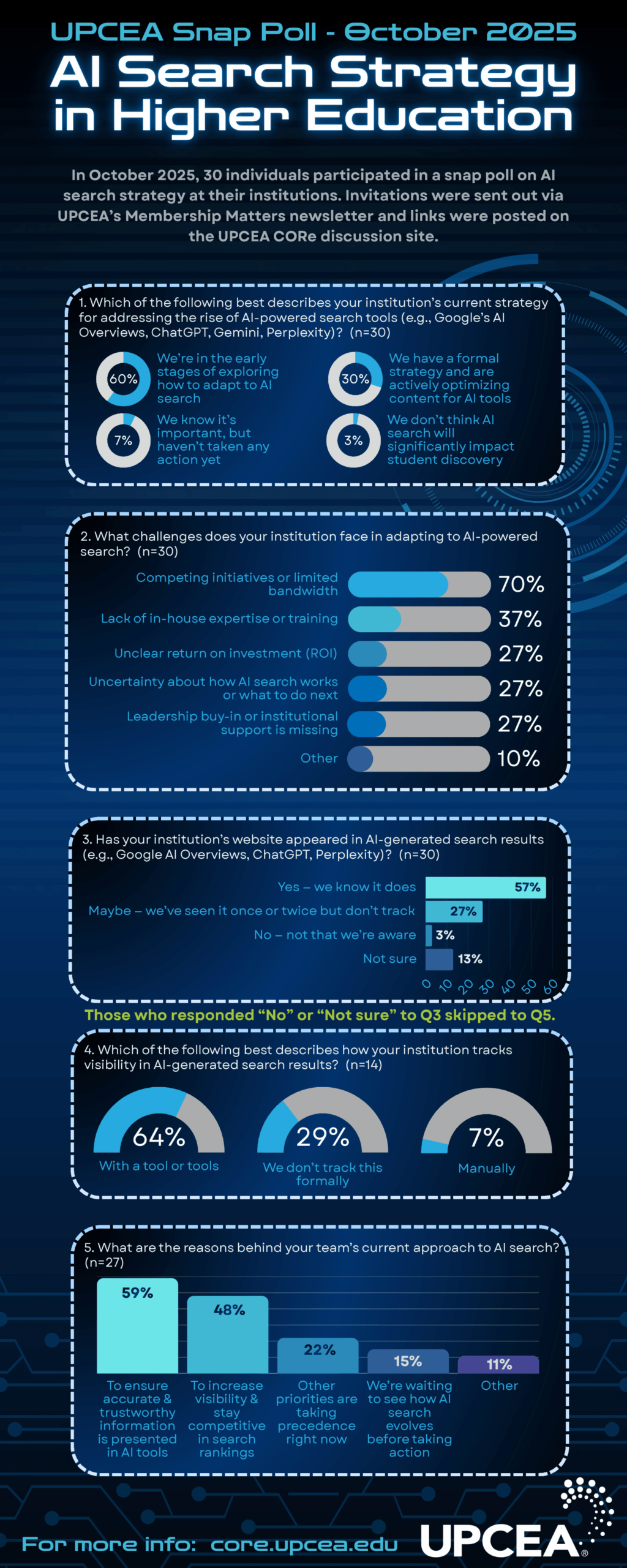
    AI Search in Higher Ed infographic

    Core Components of a Modern Higher Education AI Search Strategy

    Generative search engines don’t reward creativity. They reward clarity. Winning page one and the AI Overview depends on whether a program’s information is consistent, structured, and reinforced everywhere a student or AI tool might encounter it.

    1. Establish program data consistency as the institutional source of truth

    AI models may “misstep” when foundational information is inconsistent. If your academic catalog lists a different cost than the program page, or if PDFs still reference old admissions cycles, AI defaults to whichever source appears most stable, and that isn’t always your institution.

    Your information cleanup has to start with the facts:

    • Cost — tuition, fees, financial aid opportunities, and total program investment
    • Duration — credit hours, typical completion time, and pace options
    • Modality — online, hybrid, in-person, or flexible formats
    • Requirements — prerequisites, application materials, and admission standards
    • Outcomes — employment rates, salary data, and career paths

    When these details are aligned across catalogs, PDFs, program pages, and third-party listings, AI no longer has to choose between conflicting answers. Consistent facts increase trust, and trust improves visibility.

    Program pages can’t be accurate until the underlying data is

    Data consistency isn’t a content problem. It’s a governance problem. Most institutions store program information in multiple systems: student information systems, content management systems, PDF repositories, third-party directories, and marketing automation platforms. Each system may reflect different update cycles, approval processes, and data owners.

    The solution isn’t consolidating all systems into one platform. It’s establishing a single source of truth for core program attributes and building workflows that propagate updates across all systems simultaneously. When tuition changes, that change should flow to every digital property within hours, not weeks.

    2. Build an AI-readable content architecture on program pages

    Even perfectly aligned information can underperform if the page structure makes it hard for AI to interpret. Generative tools scan for clarity, hierarchy, and explicit answers to common user queries.

    Pages are strongest when the essentials sit in predictable, machine-readable patterns:

    • Clean headings that signal structure and topic boundaries
    • Modular sections focused on single topics without mixing concerns
    • Concise explanations that answer specific questions directly
    • Scannable details formatted for quick extraction (tables, lists, definition blocks)

    Students prefer this structure, too. Clear sections for cost, schedule, outcomes, and requirements shorten the time between interest and understanding. AI prefers the same format because it speaks its “language” and reduces ambiguity.

    When program pages feel like reference material rather than brochure copy, visibility improves

    AI-readable architecture doesn’t mean stripping personality from your content. It means organizing information so both humans and machines can extract what they need quickly. You can still include testimonials, brand messaging, and storytelling, but those elements should supplement structured information, not replace it.

    Consider how AI extracts content. It doesn’t read your page top to bottom like a human. It scans for semantic patterns, identifies chunks that answer specific queries, and evaluates whether those chunks are self-contained and coherent. A program page that buries cost information in the middle of a narrative paragraph underperforms compared to one that lists cost in a clearly labeled section with supporting context.

    3. Strengthen program entities through cross-site signals

    AI search isn’t keyword-based. It’s entity-based.

    Models build their understanding of a program by connecting signals across your entire ecosystem. If terminology shifts from page to page, if key details appear in one place but not another, or if older content contradicts newer versions, entity confidence drops.

    Cross-site reinforcement matters:

    • Consistent terminology across all digital properties
    • Internal linking that clarifies relationships between programs, departments, and requirements
    • Schema markup that defines program attributes in a machine-readable format
    • Repetition of essential facts across relevant pages to reinforce entity stability

    The more stable and coherent the entity, the more likely AI is to cite it.

    This is how institutions move from “we sometimes appear” to “AI consistently references us”

    When a student asks an AI tool, “What are the prerequisites for the MBA program at [your institution]?”, the AI doesn’t just check your MBA page. It checks every page where those prerequisites might be mentioned: department pages, catalog entries, PDF documents, and FAQ sections. If those sources conflict, AI either omits your institution or presents the information with lower confidence.

    Schema markup amplifies entity strength by explicitly defining relationships. When you mark up your MBA program with structured data that identifies its parent department, associated faculty, duration, and cost, you help AI understand not just what the program is but how it fits into your institutional structure.

    4. Implement ongoing AI visibility monitoring & data hygiene

    AI visibility is not a one-time project. Models update frequently, and each update reshapes which programs they surface, how they phrase details, and which institutions they trust.

    Monitoring needs to be ongoing and structured around:

    • Citation frequency — how often your programs appear in AI responses
    • Accuracy of summaries — whether AI-generated descriptions match your current information
    • Sentiment and positioning — how your programs are characterized relative to competitors
    • Competitor visibility — which institutions are appearing when yours aren’t

    This level of tracking enables institutions to identify patterns early, correct inaccuracies quickly, and establish authority over time. 

    About Search Influence’s support with AI visibility tracking

    Unsure where to start? Our team provides structured AI traffic reporting that shows how your programs appear across generative platforms and where inconsistencies may be affecting trust. As your tracking partner, we can help your institution gain clear visibility into patterns, changes, and gaps, helping you prioritize the data and content updates that strengthen your position in AI search engines.

    Get the research shaping modern AI search. → 

    FAQs About Higher Education AI Search Strategy

    How does AI decide which programs to cite?

    AI looks for information that is consistent, structured, and verifiable across multiple pages and sources. Programs with aligned facts and clear architecture are more likely to appear.

    How can leadership be convinced to prioritize AI search visibility?

    Show the connection between visibility and enrollment. Students are forming opinions before they reach institutional websites, and institutions that don’t appear in AI-generated search results lose those early moments of influence.

    How often should institutions audit program pages for AI readiness?

    Quarterly, if not more. AI models update rapidly, and audits ensure that key information remains up to date, content structure remains clean, and external listings don’t drift out of alignment.

    What KPIs indicate improvement in AI discoverability or trust?

    Citation frequency, accuracy, sentiment, and competitor comparisons. These KPIs signal whether AI considers your institution a stable source of truth.

    Students Have Shifted Their Discovery Habits. Your AI Search Strategy Must Catch Up.

    AI isn’t a future threat. It’s an active influence in how prospective students search for programs and decide which institutions to trust. 

    Your student search guide

    Based on survey data from 760 prospective adult learners, the UPCEA x Search Influence AI Search in Higher Education Study offers the most comprehensive view of how prospects utilize AI for program research.

    Use the data to:

    • Align leadership around AI search priorities
    • Identify priority programs for content optimization
    • Plan FY26 content investments with confidence
    • Benchmark readiness against peer institutions
    • Strengthen your visibility signals across search engines and AI tools

    AI search is already shaping enrollment. Institutions that build their strategy now will lead the next phase of visibility.

    Download the full study to get the complete data set and a clearer view of how to modernize your AI search strategy.

  • Search Influence to Share AI Search Strategies for Higher Education at MEMS 2025

    Search Influence to Share AI Search Strategies for Higher Education at MEMS 2025

    As AI continues to redefine how students search for and engage with academic programs, marketers are rethinking how they track, measure, and optimize online visibility. 

    This December, Search Influence will share actionable AI search strategies for higher education at the 2025 UPCEA Marketing, Enrollment Management, and Student Success (MEMS) Conference, held December 2–4 in Boston, Massachusetts.

    Three members of the Search Influence leadership team (Will Scott, Paula French, and Jeanne Lobman) will present and moderate sessions on how institutions can:

    • Adapt to generative AI search
    • Integrate data-driven marketing channels
    • Create more credible, student-focused content

    Together, these sessions will help higher ed marketers translate data into decisions and strengthen visibility in the age of AI search.

    Search Influence Sessions at MEMS 2025

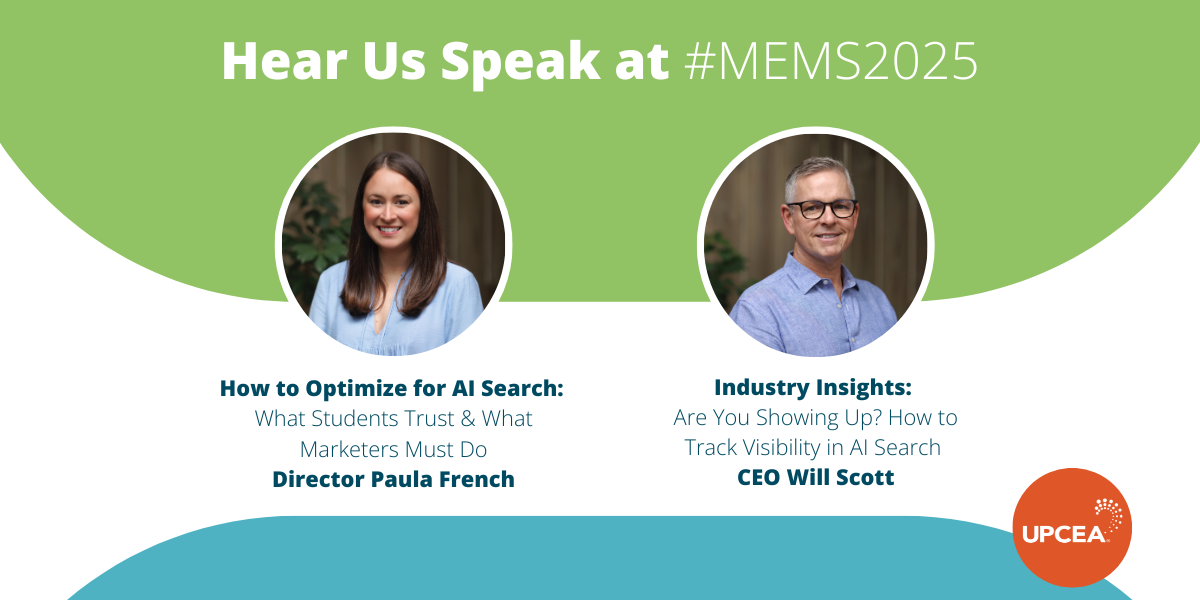
    MEMS2025 speakers graphic

    “Are You Showing Up? How to Track Visibility in AI Search”

    Presenter: Will Scott, CEO and Co-Founder, Search Influence

    Time: Wednesday, December 3 – 10:00 a.m.

    AI search is no longer theoretical. It’s measurable. In this session, Will will show institutions how to connect generative search visibility to real data and use it to drive recruitment strategy.

    Session Highlights:

    • Learn how to measure your institution’s presence across AI platforms like ChatGPT, Gemini, and Perplexity.
    • Discover how to segment AI-driven traffic using Google Analytics 4 and Looker Studio.
    • Identify metrics and tools that help you evaluate AI visibility and performance.

    “How to Optimize for AI Search: What Students Trust & What Marketers Must Do”

    Presenter: Paula French, Director of Sales and Marketing, Search Influence

    Co-Presenter: Emily West, Senior Market Research Analyst, UPCEA

    Time: Wednesday, December 3 – 3:30 p.m.

    Nearly half of prospective students now use AI tools weekly, and 79% read AI-generated summaries. In their presentation, Paula and Emily will translate this data into concrete next steps for marketing teams ready to compete in generative search.

    Session Highlights:

    • Review new findings from the 2025 UPCEA + Search Influence study, AI Search in Higher Education: How Prospects Search in 2025.
    • Understand what prospective students trust in AI-generated results.
    • Learn a three-part framework for AI visibility: discoverability, credibility, and content optimization.

    “From Search to Success: Integrating SEO and Email Marketing to Drive Enrollment”

    Moderator: Jeanne Lobman, Director of Operations, Search Influence

    Panelists: Tim Grenda and Caitlin Dimalanta, San Diego State University

    Time: Tuesday, December 2 – 2:45 p.m.

    Students don’t stop searching once they find a program. They start evaluating how institutions communicate. This session will explore how connecting SEO insights with email marketing creates a continuous, student-centered experience that strengthens engagement and drives enrollment.

    Session Highlights:

    • Explore how integrated SEO and email strategies guide students from search discovery to enrollment.
    • Learn how coordinated messaging increases engagement and conversion.

    “Boosting SEO and Engagement Through Testimonial-Driven Web Content”

    Moderator: Paula French, Director of Sales and Marketing, Search Influence

    Panelists: Caitlin Wilson and Krysten Cole, Boston University Metropolitan College

    Time: Thursday, December 4 – 10:00 a.m.

    Authenticity has become one of higher education’s strongest differentiators. This session will examine how testimonial-driven storytelling can improve SEO performance, strengthen brand trust, and create more meaningful engagement with prospective students.

    Session Highlights:

    • Understand the importance of authentic student and alumni testimonials in building credibility and enhancing visibility.
    • Learn how to turn stories into measurable content assets that support recruitment goals.
    • Explore how to connect storytelling with keywords and SEO strategies for stronger search performance.

    About MEMS 

    Hosted by the Online and Professional Education Association (UPCEA), the MEMS Conference brings together enrollment and marketing professionals from across the country to share strategies that connect innovation with measurable results. 

    Now in its 34th year, the event will focus on emerging technology, shifting student expectations, and the evolving ways higher education institutions can reach, recruit, and retain learners.

    Throughout the conference, Search Influence will host a booth where attendees can learn how to assess their institution’s AI visibility, explore AI SEO tools, and request a complimentary AI Website Grader developed by Will. Our team will be available to discuss real-world applications of AI-driven marketing data and how colleges can start improving their presence across generative platforms.

    Continuing the Conversation

    As AI search evolves, understanding how visibility, trust, and data intersect has never been more important. 

    If your institution is ready to know where it stands in AI search, download AI Search in Higher Education: How Prospects Search in 2025, or meet our team in Boston to explore how strategy, credibility, and creativity can elevate your visibility.

  • UPCEA Guest Blog: Paula French on AI Search Trends in Higher Education

    AI Search in Higher Education

    When prospective students begin researching programs, their first stop may no longer be your website…. or even Google

    Many now use generative AI platforms like ChatGPT, Gemini, and Perplexity to ask questions, compare options, and find fast answers. These tools influence what students see, what they trust, and which institutions they choose to explore further.

    In her latest guest blog for UPCEA, “AI Search in Higher Education: The Student Search Trends You Can’t Ignore,” Director Paula French breaks down what this shift means for enrollment marketers. 

    Drawing on insights from the new UPCEA x Search Influence research study, AI Search in Higher Education: How Prospects Search in 2025, Paula shares a data-backed look at how students search today — and what your team can do to improve visibility across every touchpoint.

    Top AI Search Trends in Higher Education 

    The study surveyed 760 adult learners aged 18–60 who are actively exploring educational opportunities. Their responses point to a growing reliance on digital tools that extend far beyond search engines.

    • 50% of students use AI tools weekly
    • 79% read Google’s AI Overviews
    • 56% are more likely to trust institutions cited in those Overviews
    • 61% use YouTube like a search engine
    • 77% consider university websites to be highly trustworthy

    Together, these numbers reflect a major shift in how trust is built and how options are evaluated during the early stages of the enrollment process.

    How to Improve Visibility Where It Counts

    Paula’s guest blog offers clear, actionable strategies for improving performance in AI and traditional search, including:

    • Structuring content with clarity using headings, bullet points, and schema markup
    • Including factual, up-to-date program details that AI tools prefer to cite
    • Publishing trust-building content like faculty bios, accreditation info, and student outcomes
    • Monitoring your presence in AI tools like ChatGPT, Gemini, and Perplexity to see what students are seeing
    • Auditing your site’s search performance to make sure you’re showing up where students begin their research

    Students are forming impressions earlier in the decision-making process, and they’re doing it in spaces many institutions aren’t actively monitoring. That’s a missed opportunity, and one that’s becoming harder to ignore.

    For a closer look at the data (plus tips on how your institution can adapt), read Paula’s full guest post.

    See Paula and the Team at MEMS 2025

    Attending UPCEA’s 34th Annual MEMS: Marketing, Enrollment Management, and Student Success Conference in Boston this December? Stop by the Search Influence booth to connect with Paula French, Jeanne Lobman, and Will Scott.

    Paula will also co-present with Emily West of UPCEA in a featured session titled:
    “How to Optimize for AI Search: What Students Trust & What Marketers Must Do” on Wednesday, December 3rd at 3:30 PM.

    The discussion will dive deep into student behavior and outline a strategic approach to visibility built around the pillars of AI SEO.

    View session details →

  • [Search Influence x UPCEA] Unpacking New Research on AI Search in Higher Education

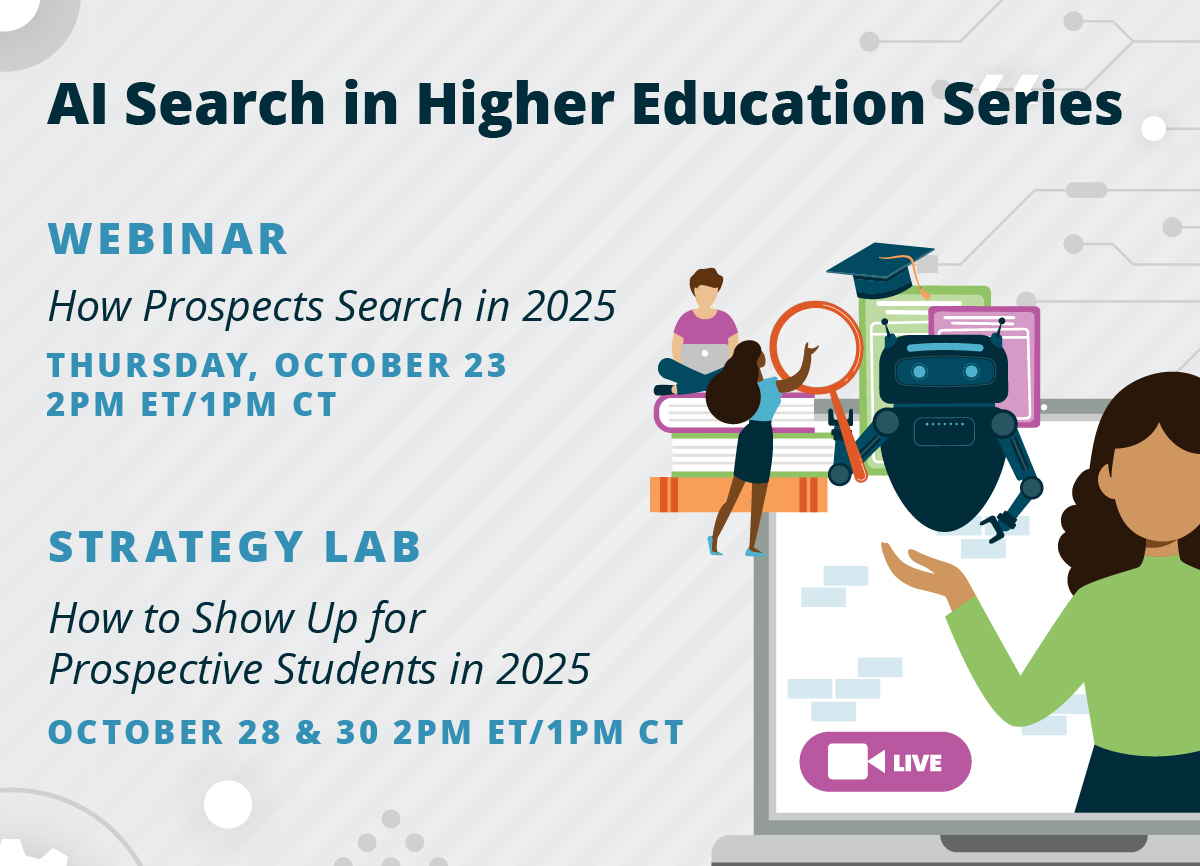
    AI Search in Higher Education Series image for webinars and labs

    This blog post was updated by Ren Horst on November 4, 2025 following the webinar event.

    50% of prospective students use AI tools at least weekly to research information online. 79% read Google’s AI Overviews, and more than half say they’re more likely to trust the institutions AI cites.

    These search behaviors are no longer emerging trends. They’re the new reality for enrollment marketing.

    On October 23, UPCEA and Search Influence hosted the live webinar “AI Search in Higher Education: How Prospects Search in 2025,” unveiling findings from the AI Search Research Study.

    The session explored what’s shaping prospective student behavior today, plus how higher ed marketers can adapt their visibility strategies for AI-driven search.

    How AI Is Changing Institutional Visibility

    The new research highlights a fundamental shift in how students discover, evaluate, and ultimately choose higher education programs. Traditional search engines remain important, but AI-driven platforms are shaping decisions in ways that enrollment marketers can’t ignore.

    For higher ed institutions, the implications are clear: If you’re not present in AI-powered search experiences, you may be invisible to a significant portion of your prospective students.

    “AI Search in Higher Education: How Prospects Search in 2025” unpacked the study findings, explained why they matter, and showed you how to position your institution for visibility in 2026 and beyond.

    Key Takeaways From the Webinar

    SEO then and now

    Search strategy has evolved from keyword targeting to context and credibility. AI engines understand meaning through entities, relationships, and trusted citations, not just keyword density. The webinar discussed how this shift changes on-page SEO priorities, emphasizing entity optimization, structured data, and semantically rich content to help AI engines interpret institutional expertise.

    Authority and content signals

    Institutional visibility depends on demonstrating trust through structure, accuracy, and reputation. AI platforms prioritize content that’s organized, verifiable, and supported by credible references. The webinar explored tactics for improving these signals, like incorporating earning links, highlighting faculty expertise, and securing third-party mentions that reinforce authority beyond your own website.

    Measuring AI visibility

    Understanding your reach in AI search is becoming possible through emerging analytics. Tools such as Google Analytics 4, Search Console, and Scrunch can reveal AI-driven traffic, question-based visibility, and citation frequency. The webinar covered how marketers are starting to quantify AI exposure, sharing practical ways to integrate early visibility tracking into institutional reporting.

    The Opportunity Ahead

    AI is fundamentally changing how students search and how institutions are seen. Yet, many schools haven’t updated their strategies to reflect how AI engines surface information.

    Those who act now will gain visibility in AI and Google, positioning their programs to be found, considered, and chosen.

    Turn AI into an opportunity, not a threat. Watch the full webinar replay and download the AI Search Research Study to understand what this shift means for your enrollment goals.

  • Search Influence to Present on AI Search in Higher Education at AMA Symposium 2025

    Search Influence to Present on AI Search in Higher Education at AMA Symposium graphic

    AI-driven discovery is rewriting the rules of visibility for universities. As prospective students increasingly rely on tools like Google’s AI Overviews, ChatGPT, and Perplexity, the traditional SEO playbook is no longer enough. 

    The next era of visibility requires a strategy built for recognition and trust within AI ecosystems, not just rankings on search results pages.

    Presentation Slides

    At the 2025 AMA Symposium for the Marketing of Higher Education, Paula French, director at Search Influence, and Tara Pope, director of marketing at Tufts University College, will explain how institutions can thrive in this new environment. 

    Their presentation, “How to Win AI Search: Three Pillars for Success,” will be held on Tuesday, November 11, from 2:50 to 3:40 p.m. in National Harbor, Maryland.

    The Evolving World of AI Search in Higher Education

    Recent findings from the new UPCEA + Search Influence research study, AI Search in Higher Education: How Prospects Search in 2025, reveal that generative AI is transforming how students find and evaluate programs:

    • 50% of prospective students use AI tools weekly.
    • 79% read AI-generated summaries when available.
    • 56% are more likely to trust a site featured in an AI Overview.

    These numbers highlight a pivotal shift. Visibility in AI search is now visibility with students. 

    Institutions that fail to appear in AI-generated answers risk being overlooked entirely, even before a prospective student reaches a search results page.

    Inside the Framework: Three Pillars of AI SEO

    In their AMA Higher Ed session, French and Pope will introduce a practical framework that helps institutions strengthen their visibility and authority within AI-generated environments.

    1. Entities

    AI systems interpret structured data and networked entity relationships. By using schema markup, entity-rich language, and consistent identifiers, institutions can help AI better recognize programs, faculty, and departments.

    2. Semantic relevance

    AI favors content that mirrors how people naturally ask questions. Structuring content in concise Q&A form, using natural language headings, and speaking clearly to student intents makes it easier for AI to parse and surface your content.

    3. Citations

    Trust is a currency in AI. When content is cited or linked from reputable sources (media, academic directories, “best of” lists), AI is more likely to elevate it. PR and content teams should actively integrate link building and authoritative mentions into the SEO strategy.

    Together, these three pillars form the foundation of a sustainable AI SEO strategy that builds visibility across traditional and generative search experiences alike.

    About the Speakers

    Tara Pope serves as director of marketing at Tufts University College, where she oversees marketing and communications for a diverse portfolio of programs, including Pre-College, Professional Education, and the Osher Lifelong Learning Institute. With more than 25 years in digital marketing and communications, her career spans technology, e-commerce, and higher education.

    Paula French, director at Search Influence, is a digital marketing leader with 15 years of experience helping higher education institutions enhance their online visibility and enrollment outcomes. She frequently contributes insights on SEO, analytics, and strategy to national audiences and industry publications.

    About the 2025 AMA Symposium for the Marketing of Higher Education

    The AMA Symposium for the Marketing of Higher Education brings together higher ed marketers and communicators from across the country to exchange insights and shape the future of education marketing.

    For more than 30 years, the Symposium has served as one of the field’s leading events, offering peer-reviewed sessions that inspire collaboration, innovation, and actionable learning. The 2025 Symposium will take place November 9–12, 2025, in National Harbor, Maryland, helping institutions refine their strategies, strengthen their reputations, and drive meaningful impact.

    Why This Conversation Matters

    As generative AI continues to influence how students research, compare, and decide on programs, institutions must adapt their content strategies accordingly. Optimizing for AI search in higher education means focusing on recognition, structure, and authority, not just visibility.

    Paula French and Tara Pope’s framework offers higher ed marketers a clear path forward: one grounded in data, built on collaboration, and ready for the AI-driven future of discovery.

    Learn More About the Research

    Want to explore the trends shaping student search behavior in the age of AI? 

    The new UPCEA + Search Influence research study, AI Search in Higher Education: How Prospects Search in 2025, reveals how students use AI, search engines, and university websites to make enrollment decisions.

    Download the study today to learn how your institution can adapt.

  • Will Scott to Lead Generative Engine Optimization Master Class on October 7

    Search is no longer limited to ten blue organic links. Today, platforms like Google AI Overviews, ChatGPT, and Perplexity generate direct answers that change how people discover information.

    If your content isn’t optimized for these generative engines, you risk being left out of the results entirely.

    On October 7, 2025 (11:00 am – 4:45 pm ET), Search Influence CEO and Co-Founder Will Scott will lead a live, online Generative Engine Optimization (GEO) Master Class with Search Engine Land. This intensive session will show SEO professionals and content strategists how to align with AI-driven search while continuing to perform in traditional results.

    Why AI SEO Can’t Wait

    AI-powered search surfaces content differently than Google’s organic results. Instead of ranking pages, these engines parse entities, measure authority, and pull contextual answers.

    For marketers, that means adapting keyword strategy, strengthening trust signals, and structuring content so AI systems can cite it directly.

    Will Scott, who coined the term “barnacle SEO,” has long helped businesses prepare for shifts in digital visibility. His GEO Master Class is designed to provide a practical framework so marketers can maintain and expand reach across both AI-driven and traditional search environments.

    What the Master Class Covers

    Fundamentals of GEO

    Learn how generative engines interpret relevance, authority, and citations, and what that means for your content.

    Content Structuring for AI

    Explore formatting and entity optimization techniques that improve your chances of being cited in AI-generated responses.

    Keyword Strategy for AI Queries

    Move beyond static keywords and into conversational phrasing, questions, and modifiers that trigger AI responses without losing organic visibility.

    Competitive Analysis for AI Visibility

    See how competitors perform in generative results, where opportunities exist, and how to adapt their wins to your own strategy.

    Authority and Trust Signals

    Understand how AI systems assess brand authority and what steps you can take to strengthen recognition.

    Measurement and Iteration

    Gain tools and frameworks for tracking appearances in AI answers and adjusting content accordingly.

    Future Outlook

    Get an informed view of what’s next in AI search and how to prepare your strategy today.

    Who Should Attend

    This training is built for content strategists, SEO specialists, and digital marketers with 2–5 years of experience who need actionable techniques for AI SEO. Whether you manage in-house content or work with multiple clients, the session will equip you with skills to keep visibility strong in a generative-first world.

    Agenda at a Glance (ET)

    • 11:00–12:15 — GEO fundamentals: entities, citations, and semantic relevance
    • 12:30–1:45 — Keyword and entity optimization, with a schema deep dive
    • 2:00–3:15 — AI-ready content strategies and hands-on competitive analysis
    • 3:30–4:45 — Measurement, tools, and a forward look at AI search

    About Will Scott

    With decades of experience in SEO and digital marketing, Will Scott has been at the forefront of shifts in search behavior. Beyond leading Search Influence, he has presented at SMX, Pubcon, and LocalU, sharing strategies on AI-driven search and optimization.

    Earlier this year, he led a two-day AI for SEO Master Class with SMX and presented at LocalU Global on using AI for local search. His upcoming session with Search Engine Land builds on that momentum, offering professionals practical frameworks they can apply immediately.

    “Marketers don’t need to abandon SEO. They need to evolve it,” Scott explains. “Generative Engine Optimization is about ensuring your content is both discoverable by AI systems and valuable to human readers.”

    Register Now

    The Generative Engine Optimization Master Class will be held live online on October 7, 2025, from 11:00 a.m. to 4:45 p.m. ET. Registration is $249 and includes on-demand access.

    Don’t miss your chance to learn directly from Will Scott and gain practical skills for AI SEO.

    Register now to secure your spot.


    Images:
    Unsplash Image 1
    Unsplash Image 2