Author: Paula Keller French

  • Mobile Site SEO: Pier 1 vs. Crate and Barrel

    Over the past year, we’ve been fielding many questions related to mobile websites — and specifically mobile site SEO. Should I get a mobile site? Where do I get a mobile site? Will a mobile site bring me more business? How will a mobile site affect my SEO?

    In the midst of working on some mobile site specific tasks this week, I also happened to be doing some online browsing / shopping on my mobile device (iPhone 4).

    I went furniture shopping yesterday evening (you know, at a real store) and found a piece of furniture that I liked.


    Later, I went on my phone, and instead of going straight to Pier 1’s site and navigating through all the other pieces of furniture, I went to Google, as most users tend to do these days out of convenience, and typed in “Pier 1 Mia Headboard” — I was thrilled to see a search result that would lead me straight to the product page.

    Mobile Site SEO: Pier 1 Search Results

    I clicked on the result, and was let down when I was rerouted to the home page of their mobile site.

    Mobile Site SEO: Pier 1 Mobile Site Homepage

    It’s no surprise they are looking to hire an SEO Specialist… too bad the job posting on LinkedIn doesn’t call for someone with mobile site experience.

    Mobile Site SEO: Pier 1 SEO Specialist Job Posting


    On the other hand, I was also looking for Crate and Barrel bedding and did a similar search on Google.


    Mobile Site SEO: Crate and Barrel Mobile Product Search Results


    When I clicked on the result, I was pleased to be immediately taken to the correct section on the site.


    Mobile Site SEO: Crate and Barrel Mobile Site Products Page


    How can you be sure your mobile site is search engine friendly? There are a couple of different technical approaches to making mobile SEO happen, so stay tuned for a blog from the great Doug Thomas on how you can make it work best.


    Have any examples of good or bad mobile sites that you love, or love to hate? Share with us! We just might use it in a future post on mobile website SEO!


    Thanks to torley for the awesome lamp photo.
  • Google FTC Investigation: The Inevitable has Become Reality

    Google announced today that they received official notification from the U.S. Federal Trade Commission that it has started an investigation into allegedly unfair business practices.
    Google announces official FTC Investigation

    The monster search and advertising company has been called many things over the years related to their monopoly-esque control of the search market. In the past, search engine marketers and optimizers have said “we just have to deal with it” when it comes to the toughest challenges with certain Google products, and moved on to find inventive and round-about ways to combat the issue at hand.

    In Search Influence’s road map to serving clients, Google Places is stand-out problem child, often presenting data problems, mix-ups, and merges that have been costly, time-consuming, and frustrating to fix. It goes almost without saying that this move was inevitable, as Google has undergone similar scrutiny in other nations of the world, including China and Italy. A Tech Crunch article from early last year reports that various Google products and content are blocked in one fourth of countries in which it offers products.
    While the investigation and following proceedings will almost certainly take years to be resolved, search marketers and the small businesses they help succeed online can rest easy with some solace that one day, there may be some changes that make your website promotion just a little bit easier.
  • New Google Local Changes Everything

    Google is rolling out a nationwide update that drastically changes the way prospective customers see you and your competitors through what Google calls “Place Search.”

    The new integrated results combine your organic and local rankings in a new Google algorithm intended to make finding businesses easier.

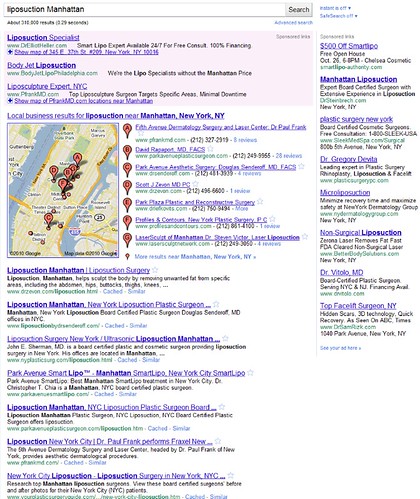
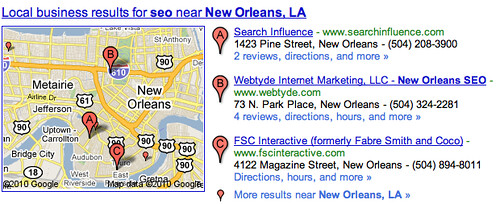
    Old results:

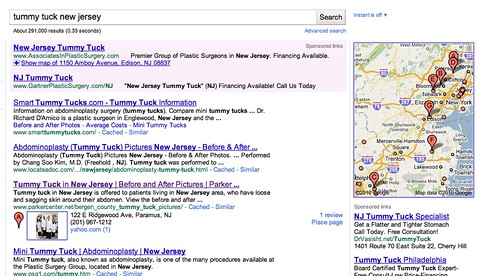
    New results:

    A site which ranks well organically (below the map) has always had a better chance of ranking on the map. Those who weren’t strong organically could sneak on the map provided a low level of competition.

    This update hurts those businesses with strong local/maps presence and so-so organic presence. We do see, in some cases, that local prevails. A business with a strong local listing may be ranked within the organic results with just their listing data – not with any search specific information in the result.   The good news is that clients with strong local presence might get pushed up in the results.  The bad news is there is no search specific information in the result so click through might not be great.

    In the past businesses in suburbs who wanted to rank for “the big city” had a hard time getting on the map. This may continue to challenge suburban based businesses with this new Google update. Those with strong organic rankings who previously ranked organically for their targeted “big city” could count on traffic from the searchers who ignored the map and went straight to find what they wanted in organic rankings. This update, though, adds an additional factor to what Google considers relevant in regards to geography, which may pose a problem for suburban-located businesses.

    The new Google update stresses the importance of maintaining a strong presence in all aspects of the web.

    Rest assured, it appears an extremely strong organic ranking site will remain top of page even without a strong local listing attached to it, as in this picture:

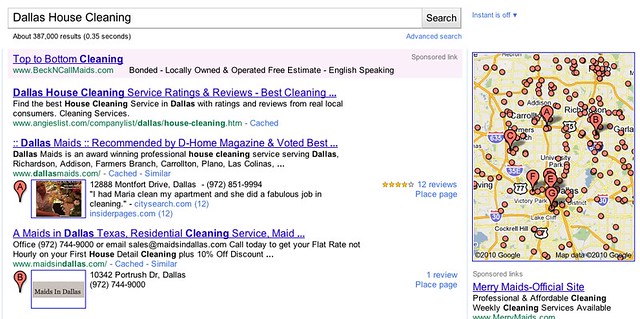
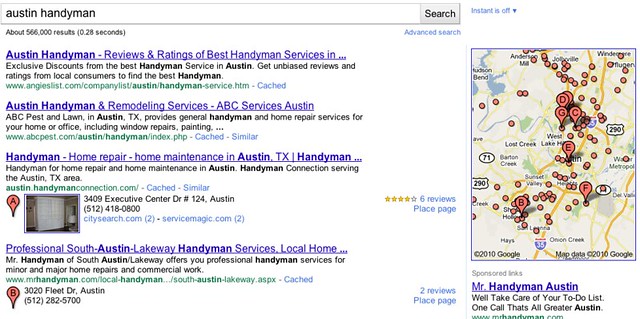
    Angie’s List, a directory of service providers, remains strong despite its lack of relation to a Place Page, as seen here for Dallas House Cleaning and Austin Handyman:

    New Google Local Results - Dallas House Cleaning

    New Google Local Results - Austin Handyman

    The new integrated results shows the importance of reviews, in particular on third party review sites such as Citysearch and Yelp by linking straight out to those sites from the main search engine results page.

    As seen in many of these screen shots shared above, If your Google Place page has pictures, your position on the search engine results pages will also be more prominent.

    There’s much more to be seen and discovered regarding this update. We look forward to working with our clients sites to be sure they maintain strong rankings.

    For further information on the subject, check out these blogs:

    Place Search: a faster, easier way to find local information – from the Official Google Blog
    What are the implications of the new integrated Local Search results? – by Mike Blumenthal on Understand Google Maps & LOcal Search
    5 Quick Impacts of Google’s New Local Search Results
    – by Matt McGee on Small Business Search Marketing
    Meet the New Google Local SERPS
    – by Andrew Shotland on Local SEO Guide
    New Place Search Shows Google’s Commitment to Local
    – by Greg Sterling on Search Engine Land

  • Recent IAB Study Proves Advantages of Online Marketing

    The Internet Advertising Bureau (IAB) has released the results for their 2010 Half- Year study on Internet Advertising Revenue.

    Not surprising to many is that Internet Marketing Revenues for the 1st half of 2010 alone totaled $12.13 billion dollars – an 11.3% increase over the same period in 2009.  If that number is surprising, it’s likely you haven’t yet had your eyes opened to the wonder that is Internet Marketing.

    Obviously I’d be a champion for all businesses to hop on the online marketing train, but my beliefs are founded in the great results I’ve seen in my time working within the field, as well as the benefits that online marketing offers, particularly compared to traditional forms of advertising.

    The main benefit, in my opinion,  is that you can measure the true effectiveness of your online marketing campaigns. Through the use of phone call tracking numbers and contact forms, you can see the source of your leads, which allows you to measure which aspects of your online marketing mix are most effective. Given strong internal processes, this data also allows you to track leads and potential customers all the way through the close of the sale, giving you your true return on investment figure.  This brings up the importance of making use of the technology available to assist business owners with tracking leads, or even simply using a spreadsheet if you can maintain the data.

    For example, say you receive 20 leads over a period of time from source A, and 10 from source B. Many marketing managers or small business owners might view source A as more valuable. However, if you have strong systems in place that track the sales process from the submission of a form or a call to the close of the sale, you might see that 30% of leads from source B become actual customers (3) while only 10% of leads become customers from source A (2).

    The benefits of tracking are evident in the IAB study as they report that “the most prevalent pricing model since 2006” is performance-based pricing. The effectiveness of tracking can also fall into the hands of your online marketing agency, as many use leads to prove their value. They may also be willing to work with you to compare your new customers to incoming leads in order to further prove a real-life ROI.

    Additional benefits of online advertising include, but are certainly not limited to, the ability to target as well as the cost effectiveness of many programs available. Many online campaigns have a relatively low cost of entry. With search engine optimization and pay-per-click ads, since the magic is in the text, once your site is built there’s no hefty graphic design costs compared to print.

    Advantages of Online Marketing

    According to the IAB study, retail is the leading purchaser of online advertising. Small to medium businesses need not be intimidated by the large share of the market for which their industry accounts, as yet another benefit of online marketing is that small businesses can compete with larger businesses in the online realm.

    Top Industries of Online Advertising:

    1.     Retail

    2.     Telecom companies

    3.     Leisure Travel

    4.     Financial Services

    5.     Automotive

    6.     Computing advertisers

    7.     Consumer Packaged Goods and Food Products

    8.     Entertainment

    9.     Pharma and Healthcare

    10. Media

    The IAB also reports that the largest portion of revenue is spent on search-related advertising. Search related advertising can be the most effective and bring in more quality leads than display advertising because your products and services are being shown to individuals who are seeking what you are selling (if you target your ads appropriately).

    All things considered, online marketing can certainly work for you, but many times, when done incorrectly, advertisers and small business owners don’t see the value because they don’t have enough information to either a) conduct it effectively or efficiently or b) to even know if they are. In this case, advertisers, both small and large, should reach to a seasoned Internet marketing firm with the skills and experience to help you and your business utilize this ever-growing segment of the advertising world.

    View the full report here.

    Thanks to vizzzual-dot-com for the photo!

  • Old Google Keyword Tool Gone – Oh My!

    New Google Keyword Tool vs. the Old Google Keyword Tool – that is the question, or at least it was before the legacy tool, that I kept bookmarked ever since Google started encouraging SEOs to use the “new” tool, suddenly disappeared this past Friday.  We knew the day would come. We knew we wouldn’t like it, but now we’re forced to use it.

    The biggest internal debate I’ve had with myself is which one to trust.  No doubt you’ve noticed by now the vast difference in the keyword values that it displayed. Many wonder what is the cause of this. Now that the legacy tool is gone, I am even more curious, as I previously simply ignored the other tool’s existence. After digging through blogs and forums, I finally found “Google’s Answer” to this question. AdwordsPro shares this in the Google Help Forum.

    “If you use both the previous and updated versions of the Keyword Tool to search for keywords, you may notice differences between the tools for statistics on Global Monthly Searches and Local Monthly Searches. This is because the previous version of the Keyword Tool provides search statistics based on Google.com search traffic and traffic from search partners, while the updated version of the Keyword Tool provides search statistics based on Google.com traffic only.  We’ve updated these statistics based on user feedback, and hope you find them helpful for keyword selection.”

    User feedback showed they wanted less data instead of more data? While many SEOs, myself included, tend to use Google as the tool by which we measure all, I still don’t want to ignore the other engines. In addition, as with any research, I’d rather have data coming from a larger sample than a smaller sample, so we can get a bigger piece of the pie.

    While now we don’t have the luxury of choosing which one to trust, we’re just going to have to stick with what we’ve got.

    Google Adwords Keyword tool is a hot-button topic around here at Search Influence. In fact, as I write this, I received a ping from collegue Melanie Aleman: “Is the Google AdWords tool working for you?” While I knew it was likely giving her some sort of error in this case, I thought to myself how many different ways I could take that question. No, in fact, the Google AdWords tool doesn’t seem to be working for me, but working against me.

    Another issue with the keyword tool that I have yet to even mention in this post is the disparity between numbers when you are logged in vs. logged out. Stay tuned for a post that digs deeper into this question, if we can ever get to the bottom of it, that is, as the answers posted on forums don’t quite seem to be right on the money.

    I found this question and answer in the sidebar Help section on the new keyword tool.

    “Why do search traffic statistics vary between keyword tools?

    Search Traffic Variations

    The Keyword Tool combines search data across Google.com and all affiliated search properties. Data from the tools may vary due to the ad group you’ve selected to research, or whether you’ve accessed the tools from outside of your account. Numeric data between the tools may also differ due to rounding.”

    But why…

    “Data from the tools may vary due to … whether you’ve accessed the tools from outside of your account.”

    I attempted to do a quick test to see just how different the numbers are displaying today, but currently Adwords is returning an error and I’m unable to even log in.

    So while we may have the answer to why the new tool displays different results than the old, the question remains if it’s going to be beneficial, and only time will tell.

    Thanks to Caitlinator and BenedictFrancis for the great photos!

  • The Many Faces of Google Maps

    Google Maps… the Local Business Center… Google Places… so many faces, so many problems. While it brings me great happiness once an issue is resolved, when trying to work them out, it seems like it’s never going to end. In the past, I’ve used a puzzle as an analogy for local search. I never really did like puzzles, and if Google Maps was a puzzle it would be a 2,000 piece box full of 1 inch pieces, 50 of which have been eaten by your kitten and thrown about the house by your children.

    So, being that I’ve spent countless hours digging in the sofa cushions for lost pieces of the puzzle, so to speak, and still haven’t gotten them all laid out on the table, I can imagine small business owners often have the same issues.

    Here’s a rundown of some of our latest challenges of Google Maps:

    1. Disappearing Citations

    Disappearing citations = drop in rankings. While citations aren’t essential to beating our your competitors in some markets, in others it can make or break you. When a client came to us for help with Maps rankings on particular search phrases, he was ranking for a number of “money phrases,” despite the listing breaking numerous quality guidelines. We rapidly cleaned everything up on our quest to come out in the end with a clean, strong listing. Then, numerous citations were disassociated with the listing – what! We followed the rules and the listing was ultimately penalized.

    2. The Importance of a Clean Listing – your listing as well as your competitors’

    It is true, the success of your listing can be dependant upon the cooperation of your competitors. In particularly competitive markets, we see a lot of keyword stuffing in titles and all throughout the listing. We’ve learned that the more muddled up the market gets, the less Google trusts the information businesses are including in their listings, and in some cases, penalizes the whole market by removing the map results from the SERPs.

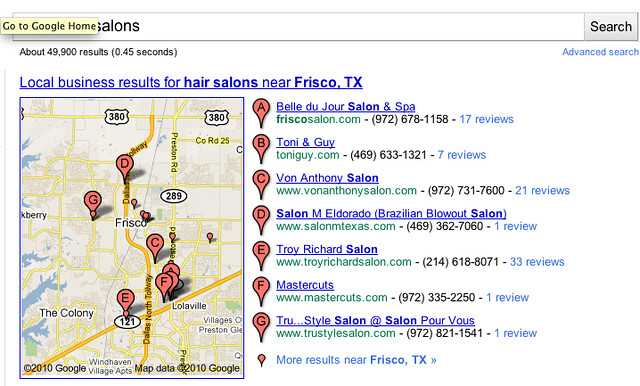
    Let’s use the market of hair salons, Frisco, TX:

    About a month ago, this is the map that was being pulled by the search “Frisco hair salons”

    and now, about a month later:

    As you can see, there’s been quite the mix up of whose listings Google is favoring.  Your best bet is to stick with correct information and avoid anything spammy in order to maintain a strong listing.

    3. Duplicate Listings

    While the recommended strategies have changed over time, one thing is clear: duplicates are bad!  It’s likely that when you search your business’s phone number, you see more than one listing –  they may or may not have correct information, and in either case, you should address the extra listings in order to reinforce your own. For this issue, Google has handed us a couple of pieces to the puzzle, and let us on to the best way to deal with it. First, only claim your main listing. For all others, you should “report a problem” and tell Google that “This Place has another listing.” While it won’t be instant, this should help clean up your market’s cluster of listings AND help your customers find you and your real information more easily.

    So, whether you are a single location of a business that’s moved a few times, or Matt Dillard Hair Salons, Frisco, TX, Google Places could be your best friend, or it could make you crazy trying to put together all the pieces of the puzzle.

    Thanks to plasticrevolver for the great kitty image!

  • Looks like Google CAN admit they are wrong!

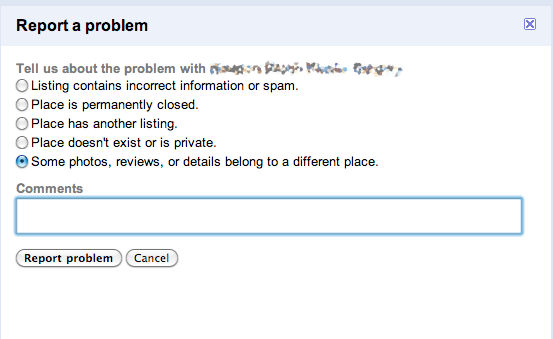
    So today while working with a particularly problematic listing within a particularly jacked up (for lack of a better word) market and cluster of listings, I noticed a new option Google is showing in the “Report a Problem” section.

    Google Listing Crossover: A new way to report it!

    We worked for months to straighten out a client’s listing and were finally feeling a bit of relief when everything seemed to be working… the address was showing up correctly, as was the URL, pictures, and details. Thank goodness, we thought!

    That is, until this morning, when I logged into Google Places to test out the tags that are now available in 29 states. This client has some great videos and we hoped to highlight them to searchers in the 3- and 7-packs that are showing up for various terms in the market. But when I clicked on the listing, alas, it was once again pulling in details from a competitor – just a different one this time. As Places gains popularity, this issue of listing crossover appears to be a growing problem – and clearly, Google recognizes that, and even admits it by giving us the option to report that “some photos, reviews, or details belong to a different place.”

    Thank you, Google, for giving us the option to report this… now, let’s see how long it takes for the reported issues to be fixed!

  • The Best Things our Fathers Taught us…

    Fathers have a way of attempting to instill wisdom upon their children, even when it’s not asked for! While their nuggets of advice may not all be as quotable as Confucius, every once in a while, something sticks… something that we carry with us our entire lives…something that we will no doubt drill into our kids… even when they don’t ask for it.

    So in the spirit of Father’s Day, we decided to celebrate our fathers by sharing their best teachings with you!

    Surfing or otherwise, fathers teach their kids great stuff!

    “Well my father has taught me a lot of things, but I think one of the most important things he has taught me since I was very young is to respect nature and take care of the environment and the wildlife that depends on it.”

    –       Melanie Aleman, Junior Account Associate

    “My dad was a man of few words, wise decisions, and leading by example.  Trying to model that is a challenge everyday!”

    –       Amy Arnold, Account Director

    “Choose your battles wisely”

    –       Allison Cates, Account Manager

    “I come from a teenage parent family – my mom and dad were married and had me when they were barely legal. And while my grandmother loves to explain to my parents how I raised them, my dad did teach me a lot growing up, the most vital being the importance of learning. Even though he never got the chance to attending college because his life-path involved a short-lived term with the US Marine Corp, 18+ years of employment at Ford Motors and numerous side jobs, he always found the time to learn something new. When I was growing up, my dad would take night classes, watch historical documentaries, and read the dullest technical training books whenever he had the time. My father might not be a jack-of-all-trades but he’s certainly always willing to give it a try. Despite all of the adversity, my father is without a doubt the source of my mantra ‘What do I know?’ and is a continued source of inspiration for me to never stop learning. Thanks Dad.”

    –       Anthony Coleman, Paid Search Manager & Budding Know-It-All

    “Don’t take any wooden nickels” –Nick Fidanza, Operations Director

    “One of the best attributes my father passed along to me is his attention to detail. Our perfectionism can be an annoyance to some, but guarantees the best job possible will be done for any task!”

    –       Rodney Hess, Junior Account Associate

    “My dad has taught me many many valuable things in life so far – but I guess the most unique thing that he has passed on to me is his excitement for Disney World!  This year will be my daughters’ 1st trip to Disney World and I had a hand in planning the whole thing with my dad… You see, there’s a strategy to planning a Disney vaca.  Choosing a resort and what section in the resort to stay in; what parks to go to on which days; where to make advanced dining reservations; what attractions to visit first; and so on…  I have enjoyed helping my dad plan this coming vacation and I hope to pass along this tradition to my children :)”

    –       Amanda Barth Graves, Major Accounts Coordinator

    “To get a job that involves the internet… and how to conserve gas by slowing down when approaching red lights”

    –       Paula Keller, Account Associate

    “Serious answer:  to take pride in everything you do no matter how trivial the task may seem because it is a reflection of your character. Funny answer: how to turn a simple household repair situation into a weekend long project.”

    –       Jeff Kinkopf, Internet Marketing Intern / Interim Content Manager

    “The best thing my father ever taught me was how to save and manage money. With that knowledge I’ve been able to stay debt free my whole life. ‘You can’t buy happiness, but you can buy freedom.’”

    –       Luke Ledet, Super Star

    “I dont know if this is the best thing my dad taught/told me, but he always reminded me that, ‘money doesn’t grow on trees’ and that he’s ‘not an infinite supply,’ haha. I think we both obsess over saving money, and getting the most from our dollar dollar bills.”

    –       Briana Prevost, Associate Content Editor

    “The best thing my father taught me was to live life to its fullest. Treat yourself, don’t cheat yourself.”

    –       Evan Soso, Internet Marketing Intern

    “To keep every door open. It’s drafty, but it makes sure you can get everywhere you want.”

    –       Doug Thomas, Internet Marketing Associate

    “He taught me how to be responsible and manage my money.  Luckily he had the patience to explain how it all works.”

    –       Janna Vastola, Account Manager

    Not so crummy neckties!

    This Father’s Day, try thanking him for all the knowledge he bestowed upon you. It’ll let him know you’ve been listening and is a much better gift than that crummy neck tie you bought him…

    Special thanks to mikebaird and stevendepolo for the great images!

  • 2010 Local Search Ranking Factors

    Putting Together the Pieces of the Local Search Puzzle

    Search Influence is honored to have once again been invited by David Mihm to take part in his annual study on Local Search Ranking Factors. The best part of this collaboration is that the questions have remained fairly constant from year to year in order to study the change from year to year that SEOs have observed in Google’s local algorithm.

    2010 Local Search Factors Released

    The 2010 Local Search Ranking Factors results, which were published early this week, feature input “from 34 prominent bloggers and practitioners.” While my personal local search experience began just a short 6 months ago, it’s been a whirlwind of claiming, verifying, re-verifying, suspending, categorizing, picture-adding, and detail-tweeking. Working with local listings has been an interesting and patience-testing experience, and reading the comments of fellow SEOs has certainly helped calm my anxiety. Luckily, everyone seems to have problems! I also believe it was beneficial after that period of time to sit down and analyze which aspects of our optimization efforts had been working and which may have turned into a waste of time.

    The 2010 Top 5 Local Search Ranking Factors:

    1. General Importance of Claiming Place Page / Local Listing
    2. Business Address in City of Search
    3. Associating Place Page with Proper Categories
    4. Volume of Citations from Major Data Providers + IYP Portals
    5. General Importance of Off-Page / Off-Listing Criteria

    My biggest take-away from the report confirms a thought I’ve had for a few months now: there is no end-all be-all trick to increasing rankings. The top two ranking factors: claiming your listing and having a business address in the city in which you desire to rank, each has its respective caveats. While claiming your listing is of high importance (4.40 according to the study), I’ve often seen un-claimed listings trump claimed ones.

    Putting Together the Pieces of the Local Search Puzzle

    In regards to the number two ranking factor, if you’ve been in a business location for 20, or even 2 years, outside the city limits and don’t have a business address in the city for which you desire to rank, you obviously wouldn’t change that just for your listing… or maybe you would?

    That said, I wouldn’t assume one distinct factor would influence rankings, because that’s just not how these search algorithms work, but I felt it was worth it to point out for those of you who don’t deal with search rankings on a daily basis. So, when you are working on your listing, follow the rules, all of them, and work with as many elements available. Just remember – when testing out a new feature – keep an eye on your listing, or better yet, check out the blog of anyone who participated in this study and you’ll find some tips on whether or not the feature is ready for mainstream use.

    Thanks to myklroventine for the puzzle photo!

  • Foursquare Mayor Competition: Leveling the Playing Field

    Last night I was ousted as Foursquare mayor of my new favorite watering hole by the owner.  Is this fair?

    Foursquare Mayor Competition: Leveling the Playing Field

    I think not. The red flag that popped in my head when I got the news via e-mail was not that my pride was hurt by losing my title, but that this is likely an issue across the board for Foursquare advertisers.

    If you aren’t familiar with the concept of Foursquare or would like more information about how to conduct local business marketing on Foursquare, check out our previous blog post on the subject. The basic gist of mayorship is that a Foursquare user becomes mayor of an establishment by “checking in” more than anyone else in the previous 60 days.

    Naturally, an owner or manager of a business is going to be at his place of business more than most customers (clearly there are exceptions to this), so, considering the fact that Foursquare is a “game,” would it be considered cheating for the owner to check in? Probably not, but it may be a good business and marketing decision to sit back and just be an observer when it comes to Foursquare competition on your home turf, especially if you are actively using it as a marketing tool.

    This also brings up the question of whether or not your employees should check in when they come to work. Say an employee is the mayor and has 50 check-ins in the last 60 days, I’m not going to be motivated to compete for mayorship.

    One Starbucks patron, as eater.com reported, was so appalled that a barista became mayor of one of the coffee giant’s locations that she filed a complaint with the company.

    If you want to have a competition between employees of who works more, than that’s one thing. If you want to encourage customers to compete with each other for mayorship, and hence, come back again and again to defend their position, then it’s time for employees to just say no to Foursquare at work.

    In addition to mayorial competitions encouraging top competitors to return to your business, an added bonus is that each time a user overtakes another as the mayor of your business, it is posted to each of the individual’s Facebook wall. Voilà! Free marketing.

    While Starbucks basically told the disgruntled customer that there was nothing they could do, as marketing-oriented person, I would suggest highly encouraging your employees to keep it fair for the customers, because really, for most, there’s no bragging rights in being the mayor of your place of employment anyway. It’s likely that the check-ins of your employees would make it practically impossible for any customer, even a regular, to stand a chance to become mayor, and squashes that marketing and competition aspect of Foursquare for your business.