Author: Marissa Maggio

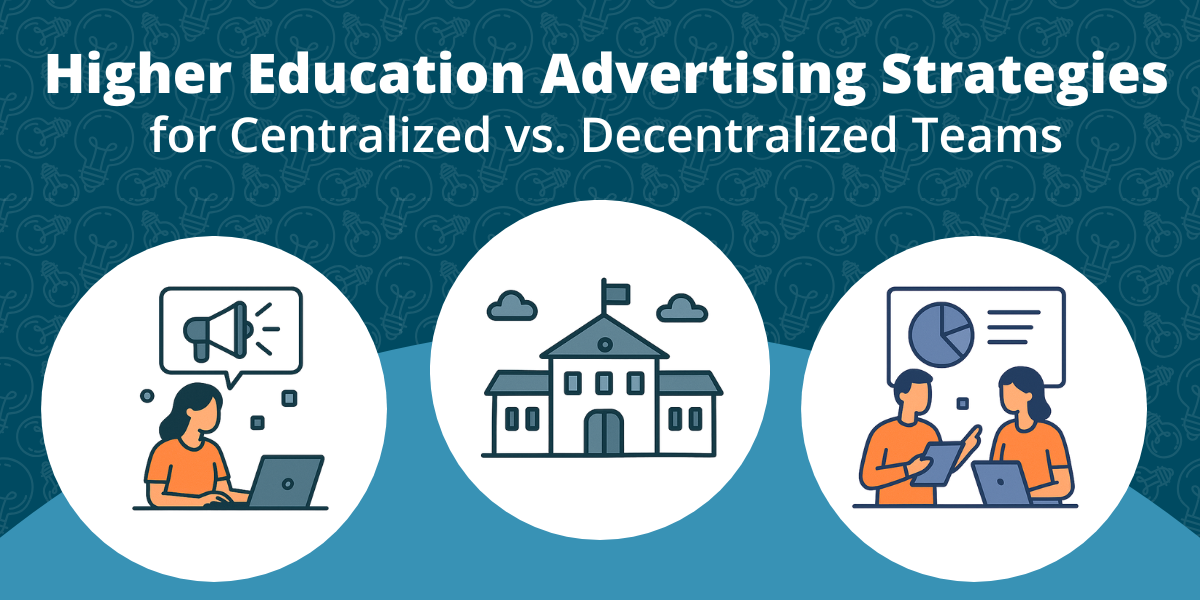
  • Higher Education Advertising Strategies for Centralized vs. Decentralized Teams

    Higher Education Advertising Strategies for Centralized vs. Decentralized Teams

    Key Insights

    • Team structure drives advertising performance. A centralized marketing team delivers efficiency and consistency, while decentralized teams excel in agility and program-level targeting.
    • Most universities operate in hybrid models. Few are purely centralized or decentralized. Hub-and-spoke and collaborative networks are common, and each impacts paid advertising differently.
    • Aligning strategy with structure prevents wasted spend. The right setup helps higher education marketers avoid overlapping ads, mixed messages, and underperforming budgets.
    • Paid advertising success comes from clarity. Institutions that match their organizational model to their media strategy see stronger ROI, better audience targeting, and more meaningful enrollment outcomes.

    If you’re responsible for higher education advertising at an institution, you already know the challenge.

    Every school, program, and department wants visibility, and they all want it yesterday.

    Meanwhile, leadership expects a unified brand that builds credibility and delivers enrollment results.

    That tension comes to a head in paid campaigns, where budgets are closely watched and wasted spend is difficult to justify.

    Should all campaigns be managed by one centralized marketing team to ensure control and consistency? Or should departments run their own ads to tailor messages for specific programs and audiences?

    Most institutions operate somewhere in between. Knowing where your structure falls (e.g, centralized, decentralized, or hybrid) is the first step toward building a digital advertising strategy that makes every dollar work harder.

    Variations in Centralized and Decentralized Higher Education Advertising

    Not all universities fit neatly into “fully centralized” or “fully decentralized.” Recognizing your model is key to avoiding wasted budget and reaching the right students.

    Centralized Variations

    Centralized structures are common when leadership wants control, efficiency, and a unified voice. Within this approach, there are two main models institutions typically follow:

    Fully centralized

    In this model, one marketing office controls all budgets, creative, targeting, and reporting. Paid campaigns for undergraduate admissions, graduate programs, and brand-building all flow through the same team. This creates consistency and accountability, but campaigns often move more slowly, and programs with niche audiences may feel underserved.

    Hub-and-spoke

    With a “hub-and-spoke” setup, the central office sets strategy and creative standards, and likely also provides already-approved ad templates. The departments then execute campaigns within those guidelines.

    For example, a nursing school might adapt central paid search templates to highlight clinical outcomes, while the business school uses the same framework to promote MBA career paths. This model gives programs flexibility without losing alignment, but it requires clear governance to work well.

    Decentralized Variations

    Decentralized structures give schools more autonomy and agility. Instead of waiting for central approval, departments can quickly tailor campaigns to their audiences. Two common models fall under this approach:

    Fully independent

    In a fully independent model, each school or department manages its own advertising, from budgets to creative to targeting. For example, the business school might run a Meta campaign to boost MBA enrollment, while engineering launches LinkedIn ads for prospective undergraduates.

    This setup gives programs agility and control over their own messaging, but it often leads to inconsistent brand voice, overlapping campaigns, and higher costs when departments compete for the same prospective students.

    Collaborative network

    In a collaborative network, departments run their own campaigns but share certain resources, such as analytics platforms, vendor contracts, or a CRM. For example, multiple schools may use a shared DSP to buy media while still creating their own ads.

    This structure lowers costs and improves visibility across programs, but it depends on adoption. Without consistent use of shared tools, you can still end up with inefficiencies and fragmented audience targeting.

    Pros and Cons of Each Structure

    Centralized Structure

    A centralized marketing team shines when leadership prioritizes consistency and efficiency. But in practice, it can also create friction when programs need specialized campaigns.

    Pros

    • Cohesive brand identity: Every ad, across search, social media, and display, reinforces a unified message for prospective students.
    • Economies of scale: Media dollars go further when a centralized marketing team buys in bulk, lowering CPCs and CPMs.
    • Clear reporting: Centralized audience data makes it easier to connect campaigns to enrollment outcomes.
    • Policy alignment: There’s easier institute-wide compliance with accessibility, privacy, and government regulations.

    Cons

    • Slower response times: Campaigns for specific academic programs or niche demographics may lag.
    • Creative bottlenecks: One team reviewing all assets can delay launches.
    • Departmental disconnect: Faculty and program chairs may feel their priorities aren’t represented.

    Decentralized Structure

    Decentralized models work best when agility matters most, but that same autonomy often leads to inefficiency and fragmentation in higher education campaigns.

    Pros

    • Agility: Departments can launch or pivot enrollment marketing campaigns quickly.
    • Tailored messaging: Schools can highlight unique career outcomes, campus life, and student success stories.
    • Encourages innovation: Independent teams are often able to test new tools, channels, or creative approaches.

    Cons

    • Brand inconsistency: Prospective students may see conflicting messages across multiple channels.
    • Budget inefficiency: Overlapping campaigns may compete for the same target audience.
    • Limited ROI visibility: Multiple CRMs or landing pages can make performance tracking difficult.

    Paid Ad Strategies for Each Structure in Higher Education

    Understanding your structure is only useful if it translates into smarter campaigns. Each model requires a different approach to ensure your ad dollars are invested wisely and drive enrollment.

    For Fully Centralized Teams

    When one marketing office owns all advertising, scale and consistency are your biggest advantages. The challenge is making sure campaigns still connect with prospective students across different programs.

    • Plan around the calendar: Create a campaign roadmap that aligns with enrollment cycles, campus events, and application deadlines. This ensures steady awareness throughout the year.
    • Leverage remarketing: Use centralized retargeting to reach visitors across all university web pages, reinforcing brand visibility and creating a unified experience for potential students.
    • Allocate budgets strategically: Prioritize spend where it aligns with enrollment goals, career outcomes, and high-demand academic programs, not just where the loudest requests come from.

    For Hub-and-Spoke Models

    This hybrid structure allows departments to highlight their strengths while the central office maintains control of strategy. It works best when there’s clear communication and shared insights.

    • Distribute audience research: Share data on audience behaviors and search insights to help schools tailor campaigns to the right demographics.
    • Provide creative frameworks: Branded ad templates and pre-approved copy blocks let departments develop authentic content that still feels consistent.
    • Centralize reporting: A shared dashboard helps leaders and departments monitor engagement, compare performance, and refine higher education marketing strategies.

    For Fully Independent Departments

    When every college runs its own campaigns, speed and specialization come naturally. The risk to avoid, however, is waste, including duplicate targeting, inconsistent messaging, and missed opportunities for collaboration.

    • Hold quarterly ad reviews: Bring departments together to compare results, share key strategies, and reduce overlap.
    • Encourage light-touch brand guidelines: Even voluntary frameworks help create a more unified experience for prospective students.
    • Pool funds for high-cost media: Channels like YouTube, CTV, or sponsored content often deliver deeper connections with specific demographics but may be out of reach for one department’s budget alone.

    For Collaborative Networks

    A collaborative network provides autonomy but relies on shared resources to cut costs and increase efficiency. The success of this model depends on adoption across departments.

    • Invest in shared platforms: A common CRM or analytics system makes it easier to track engagement and communications across the institution.
    • Coordinate retargeting pixels: Prevent schools from competing for the same audiences online by unifying tracking.
    • Offer training: Equip decentralized teams with the skills to interpret insights and use digital marketing tools effectively.

    How to Decide Which Model Works for Your Institution

    Choosing between centralized vs decentralized marketing structures isn’t about which one is “better.” It’s about which one matches your institution’s size, resources, and enrollment goals.

    A small liberal arts college with a handful of academic programs may thrive under a centralized marketing team, while a large research university with multiple colleges often needs hybrid structures to balance control and autonomy.

    Key factors to consider include:

    • Number of schools and programs: The more academic programs you offer, the harder it becomes for one office to manage every campaign.
    • Central marketing staff size: If your team is lean, decentralized departments may need more responsibility.
    • Technology and infrastructure: Institutions with robust CRMs, shared analytics, and advanced digital marketing tools can unify campaigns more easily.
    • Leadership priorities: Some universities value a unified experience and brand voice above all. Others prefer program-level autonomy to reach specific demographics.
    • Hybrid effectiveness: Many higher education institutions succeed with hub-and-spoke or collaborative models, where central offices provide guidance and resources while departments tailor ads for their own prospective students.

    The right fit comes down to aligning your organizational design with your advertising goals.

    Common Challenges in Higher Ed Paid Ad Management

    Even with a well-chosen model, challenges are inevitable. Higher education advertising is complex, with multiple audiences, competing priorities, and budget pressures. Some of the most common issues include:

    • Budget allocation disputes: Programs often compete for limited funds, leading to tension over who gets priority.
    • Duplicated targeting: Without coordination, two departments may spend against the same prospective student audience in major search engines or social media platforms.
    • Fragmented tracking: Multiple CRMs, landing pages, or disconnected web pages make it difficult to attribute campaigns back to enrollment outcomes.
    • Compliance requirements: Accessibility standards, privacy regulations, and institutional diversity goals must all be reflected in campaigns.
    • Balancing consistency with flexibility: Universities need cohesive brand visibility, but also space for departments to highlight authentic content such as student success stories, career outcomes, and campus life.

    Addressing these challenges requires more than good intentions. It takes shared governance, modern tools, and clear reporting structures.

    How an Advertising Agency Can Bridge the Gap

    Many institutions find that bringing in an external partner helps them balance competing needs. An experienced higher education advertising agency acts as both strategist and coordinator, offering:

    • Cross-department coordination: Ensuring enrollment marketing campaigns complement, rather than compete with, each other.
    • Centralized analytics: A unified view of performance across digital marketing channels, from paid search to sponsored content.
    • Audience research: Fresh insights into audience behaviors, college options, and what drives potential students to engage.
    • Budget optimization: Redirecting spend toward the channels and creative that attract more students and deliver ROI.
    • Neutral facilitation: Acting as a “traffic controller” to balance requests from different colleges and departments.

    The right partner doesn’t take control away from internal teams. It creates alignment, so every program benefits from a smarter strategy and cleaner execution.

    FAQs About Centralized vs. Decentralized Marketing Strategies

    How does team structure impact higher education advertising strategies?

    Structure determines who controls budgets, creative, and targeting. Centralized teams create consistent messaging, while decentralized teams allow program-level customization. Hybrid structures aim to capture the benefits of both.

    What KPIs should universities prioritize in paid ad campaigns, regardless of structure?

    Metrics like cost per inquiry, cost per enrollment, website engagement, and conversion rates from landing pages tie directly to marketing goals. These help link advertising dollars to measurable enrollment outcomes.

    How do you measure ROI across multiple departments?

    Shared CRMs, attribution models, and centralized dashboards allow institutions to consolidate insights. Without these, it’s nearly impossible to connect spending with results across multiple academic programs.

    How can universities prevent brand inconsistency in decentralized campaigns?

    Use creative frameworks like branded templates, approved copy blocks, and optional reviews. This allows departments to create authentic content while maintaining a consistent look and feel.

    Is it better to manage university paid media internally or with an external agency?

    It depends on your resources. Internal teams know the culture and campus life deeply, while agencies bring advanced tools, digital marketing expertise, and broader insights. Many educational institutions benefit from a hybrid approach (internal vision with external execution support).

    Digital Advertising for Higher Education: Smarter Ad Spending Starts With Structure

    The structure of your marketing team is one of the biggest factors in the success of your higher education advertising.

    No model is “right” or “wrong” on its own. The key is aligning your digital advertising strategy with how your institution actually operates. When structure and strategy match, you avoid wasted budget, reduce audience overlap, and deliver a unified experience for prospective students.

    Download the ROI White Paper

    At Search Influence, we’ve seen firsthand how much team structure impacts campaign performance. That’s why we developed “3 ROI Models to Prove the Value of Your Education Marketing,” a practical guide to help higher education institutions measure and improve the impact of their digital advertising.

    In the white paper, we share:

    • Three proven models for evaluating higher education marketing campaigns
    • How to turn data and insights into smarter, faster decision-making
    • Tips for preparing confident conversations with leadership and stakeholders
    • Strategies to refine campaigns in real time to attract more students and strengthen ROI

    Don’t wait until the next enrollment cycle to maximize your ad spend. Download our ROI white paper today and start building a more measurable, effective advertising strategy tailored to your institution.

    Images:
    Unsplash
    Unsplash

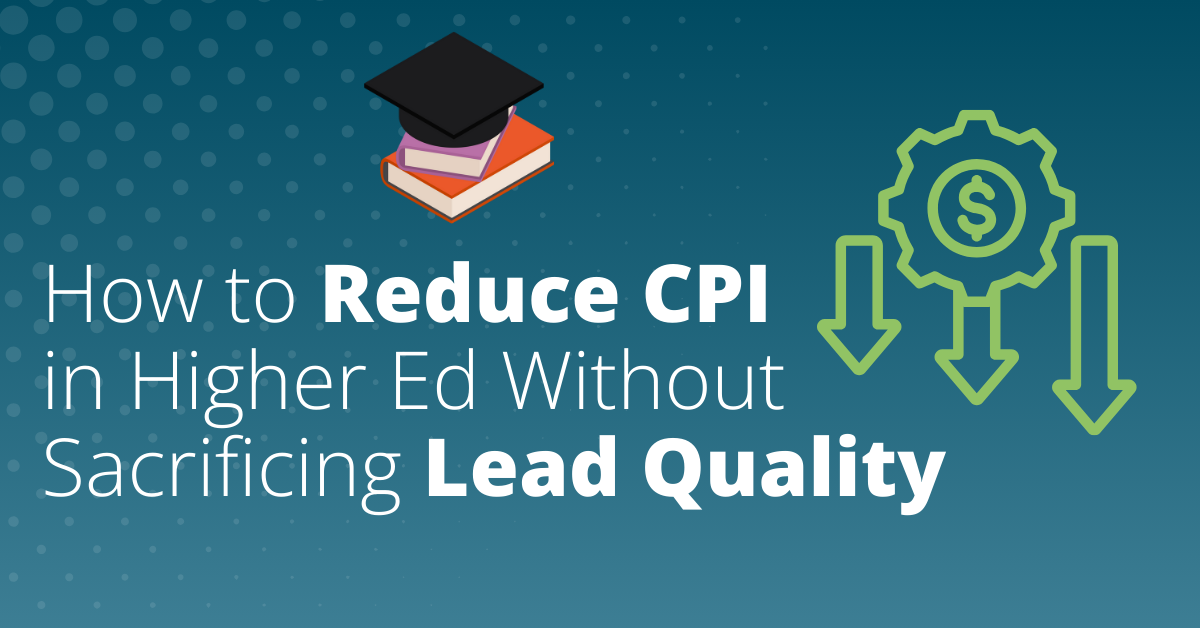
  • How to Reduce CPI in Higher Ed Without Sacrificing Lead Quality

    How to Reduce CPI in Higher Ed Without Sacrificing Lead Quality graphic

    Key Insights

    • Not all inquiries are equal. Tracking lead quality ensures your budget supports those most likely to enroll.
    • Lowering cost per inquiry only works if you maintain your focus on lead quality.
    • When your targeting, messaging, and landing pages work together, you eliminate waste that inflates CPI.
    • Setting clear conversion goals and refining keyword strategies helps ad platforms deliver stronger leads at lower costs.
    • With a higher education marketing agency, you gain the strategic support needed to reduce CPI without compromising results.

    If you’re a higher education marketer already tracking and measuring cost per inquiry (CPI), you know the goal isn’t just spending less. It’s making every dollar count toward the right prospective students.

    However, the challenge is lowering CPI without losing the quality leads that fuel your enrollment pipeline. That means looking beyond quick fixes and closely examining lead quality, campaign performance, audience targeting, landing page experience, and how well your marketing efforts are aligned with student intent.

    Here’s how to reduce CPI with intention, while keeping your pipeline strong and your recruitment goals on track.

    The State of Higher Ed Cost Per Inquiry

    Driving down CPI starts with context. Without a clear understanding of where your institution stands, it’s impossible to know whether you’re optimizing effectively — or leaving budget on the table. 

    Do your campaigns match student intent? Are your landing pages converting efficiently? Are you capturing qualified leads, or just cheaper ones?

    Search Influence and UPCEA’s 2024 Higher Ed Marketing Metrics Research Report: What Gets Measured Gets Managed offers valuable insight into typical performance across program types.

    According to the report, professional and online education programs spend an average of $800,970 annually on digital advertising, representing about 3.6% of total revenue. The average CPI varies by program:

    • $140 for online and professional education
    • $128 for undergraduate programs
    • $157 for graduate programs
    • $51 for noncredit programs

    These benchmarks give higher education institutions a practical frame of reference. If your CPI is significantly above these figures, it’s worth digging deeper. 

    Once you have a clear baseline, the next step is knowing where to focus. Below, we break down how to reduce CPI without sacrificing the quality of your inquiries.

    How to Reduce CPI at Your University

    Money being taken out of a wallet

    Refine your conversion goals to capture more leads

    Defining success from the start helps your campaigns target the right audiences, improve efficiency, and generate quality leads that convert — setting the stage for a lower, more effective CPI. Ad platforms work best when they know exactly which action to optimize for, so setting the right conversion goals is essential.

    If your campaigns aren’t clearly aligned with inquiries, applications, or enrollments, you risk wasting spend on leads that look good on paper but don’t move the needle. 

    Tips for refining your conversion goals

    Align internally and with your agency on primary KPIs

    Start by building alignment across internal teams and agency partners on the key performance indicators (KPIs) that matter most in your current campaigns. Whether you’re focused on inquiries, applications, or enrollments, having shared goals ensures everyone is working toward the same outcomes. This clarity sets the foundation for smarter decision-making, more focused reporting, and campaigns that support institutional priorities.

    Define what counts as a true lead for your institution

    Once your KPIs are established, determine which actions reflect meaningful progress in your enrollment funnel. Brochure downloads, event registrations, contact forms, and applications each signal different levels of intent. While all have value, not all carry the same weight when it comes to lead quality. By identifying which actions qualify as a true lead, you can set smarter conversion goals and ensure your campaigns focus on attracting the prospects most likely to take the next step.

    Set and map conversion goals across the funnel

    With lead definitions in place, assign clear conversion objectives that align with each campaign’s role in the funnel. Awareness-stage campaigns might focus on brochure downloads or event sign-ups, while decision-stage efforts should optimize for inquiries or applications. Matching your goals to user intent gives ad platforms better direction and allows you to measure ROI more accurately across each stage of the enrollment journey.

    Help platforms optimize with consistent signals

    Focus on a small set of high-value conversion actions to give ad platforms the data they need to optimize effectively. When too many different actions (like clicks, page views, or form fills) are tracked as conversions, platforms like Google and Meta struggle to prioritize what matters the most. Their machine learning systems rely on clear, consistent signals to identify patterns, refine targeting, and improve delivery over time. The more reliable the inputs, the stronger your marketing performance and the more optimized your ad spend.

    Restructure campaigns to support focused goals

    As your conversion goals and targeting strategies evolve, make sure your campaign structure reflects those priorities. Grouping campaigns by funnel stage, audience segment, or program type gives platforms cleaner signals and helps you more easily evaluate performance. Taking the time to restructure upfront creates a more efficient optimization process and a clearer path to lowering costs without compromising lead quality.

    Track lead quality to reach the right students

    Tracking and acting on lead quality ensures your marketing budget is spent generating meaningful conversions, not just a higher volume of them. Fine-tuning your conversion objectives can increase volume, but without insight into lead quality, you risk filling the funnel with prospects who are unlikely to enroll. 

    When you monitor how inquiries perform beyond the first click, you can make data-driven decisions about targeting, messaging, and spending, ultimately improving efficiency and enrollment outcomes.

    Tips for tracking and leveraging qualified leads

    Start with a manual lead review

    Begin by manually reviewing individual lead submissions to evaluate quality up close. Ask yourself, “Is this the type of prospective student we want more of?” This quick exercise helps you spot patterns in form fills, like missing information, off-target program interest, or low engagement signals. It also gives you immediate feedback to refine targeting, messaging, or creative in real time, long before more complex attribution models kick in.

    Measure lead quality by campaign or platform

    Once you understand what makes a lead valuable, evaluate how each campaign or platform contributes. Go beyond volume and calculate the percentage of leads from each source that meet your quality criteria. Comparing cost per qualified lead (CPQL) gives you a more accurate picture of performance and helps you identify which channels drive meaningful inquiries — and which may inflate your numbers without adding enrollment value.

    Monitor enrollment outcomes, not just form fills

    An inquiry is only part of the story. To truly evaluate performance, track how leads progress through key stages like application submission and enrollment. This helps separate campaigns that generate lasting impact from those that attract surface-level interest. By focusing on outcomes that reflect your enrolled student goals, you can make more informed decisions about where to invest and where to pull back.

    Score and automate lead qualification in your CRM

    Manage, score, and qualify leads directly in your CRM software to make lead quality measurable. Start by assigning values based on criteria like program interest, verified contact details, or secondary engagement. This will help your team prioritize follow-up and identify which inquiries are most likely to convert. 

    Whenever possible, automate this process. Set up rules that flag high-quality leads in real time, reduce manual review, and ensure your best prospects don’t fall through the cracks. A smart qualification system speeds up decision-making and gives you a consistent framework for evaluating performance across campaigns.

    Use CRM insights to guide optimization

    After your leads have been scored and stored in your CRM, use that data to inform campaign decisions. Look for patterns among your most qualified inquiries. Where did they come from? What messaging resonated? Which programs attracted the strongest potential students? These insights allow you to refine your targeting and creative strategies with a focus on what’s working, not just what’s getting clicks.

    Feed qualified lead data back into ad platforms

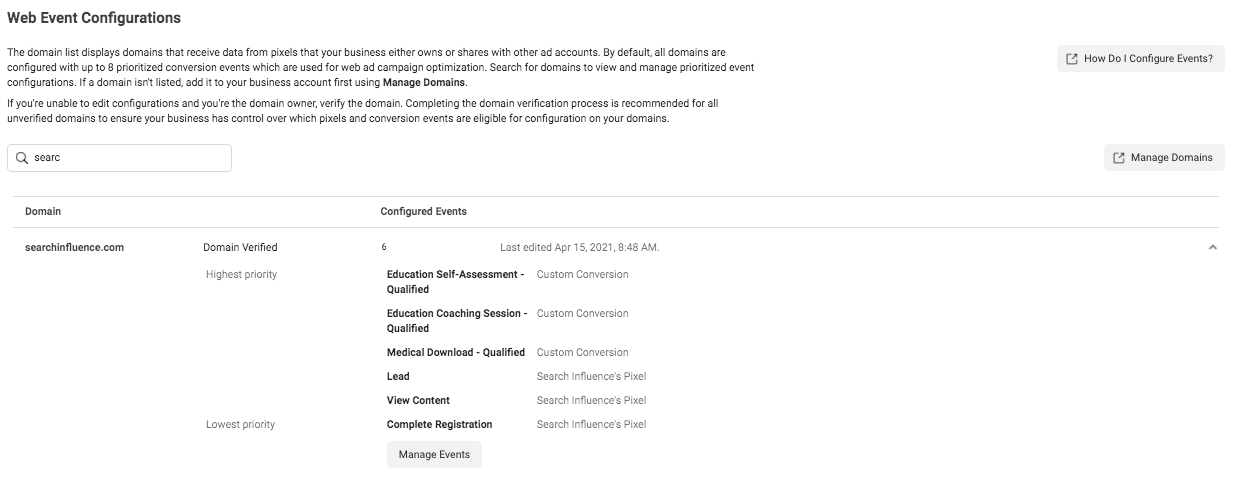
    Take your insights one step further by feeding qualified lead data back into platforms like Google and Meta. By sharing first-party CRM data through tools like Google Offline Conversions or Meta Conversions API, you give platforms the signals they need to optimize for leads that match your enrollment goals, instead of just low-cost conversions. This can significantly improve targeting and reduce wasted spend.

    Build a closed-loop optimization system

    Integrate your CRM, lead scoring, and ad platforms to build a feedback loop that improves campaign performance over time. When qualified lead data flows both ways — from your campaigns into the CRM, and the CRM back into platforms like Google and Meta — you enable smarter targeting, faster optimization, and better use of your budget. 

    This closed-loop system requires effort to set up, but it’s one of the most effective ways to consistently lower CPI while improving lead quality.

    Identify where your Google Ads spend is going to waste

    Refining your keyword strategy avoids wasted spend in Google Search campaigns. Even well-targeted ads can lose efficiency if they’re triggered by irrelevant or low-intent queries. Fortunately, Google Ads shows you the exact terms users searched before clicking, giving you the insight needed to spot misalignment and adjust your targeting before your budget goes off track.

    Tips for finding and fixing wasted Google Ads spend

    Review the Search Terms Report regularly

    Take time to review the search terms triggering your ads to ensure your spend is aligned with your goals. The Search Terms Report reveals what users are typing, not just the keywords you’ve selected, making it easier to catch off-topic or low-intent traffic early. Regular checks help you identify patterns, remove distractions, and keep your campaigns focused on reaching the right target audiences.

    Spot irrelevant search matches

    Not every click is a good one. Look for queries that fall outside the scope of your programs or audience, especially those that suggest confusion about your offerings. For example, if you’re promoting a “sports management degree” and your ad shows for “sports chiropractic school,” that’s a mismatch worth correcting. Flag these terms and add them as negative keywords to prevent further waste.

    Watch for keyword match type issues

    Your keyword match types directly influence how precisely your ads are served. Broad match keywords can open the door to a wide range of loosely related queries, some of which may not reflect your intent. If you’re seeing too many irrelevant impressions or clicks, consider tightening your targeting with phrase or exact match. This change gives you more control over how and when your ads appear.

    Refine your keyword targeting

    Use performance data to expand and adjust your keyword list based on what’s working. Test new terms that better reflect how your prospective students search and remove those that consistently underperform. This kind of proactive refinement helps you reach more qualified users and improves the efficiency of your marketing campaigns over time.

    Double down on high-performing terms

    When certain keywords consistently drive qualified inquiries, treat them as strategic assets. Increase budget allocation, build dedicated ad groups, and explore related variations to expand your reach. Prioritizing high-performing terms helps you scale what’s working and maximize impact without adding unnecessary spend.

    Prune your campaigns consistently

    Keyword lists can grow stale or bloated over time, pulling your campaigns away from their original focus. Set aside time for regular cleanup — removing underperformers, eliminating overlap, and tightening targeting to stay efficient. Campaign pruning helps you avoid wasted impressions, reduce spend on low-value clicks, and keep your strategy aligned with enrollment goals.

    Optimize and test landing pages to boost performance

    Testing and refining your landing pages allows you to pinpoint what drives action, whether you’re using existing site content or building standalone pages tailored to campaign goals. A well-placed ad is only effective if the landing experience meets the user’s expectations. 

    If the page doesn’t match the intent behind the click, whether in content, clarity, or design, you risk losing prospective student engagement and driving up your CPI.

    Tips for optimizing and testing landing pages

    Match message and intent across ads and landing pages

    Landing pages should deliver exactly what your ad promised. When the headline, tone, and call to action on the page reflect the user’s expectations, you’re more likely to keep them engaged and guide them toward conversion. This landing page best practice doesn’t just improve performance. It can also boost your Google Ads Quality Score, helping your campaigns become more cost-effective over time.

    Focus on a single, clear conversion goal

    Each landing page should revolve around one primary action. Make the path obvious, whether you want users to schedule a tour, download a brochure, or start an application. Avoid cluttering the page with competing links or mixed messages that can distract from your main objective. A clear, focused call to action (CTA) keeps users moving in the right direction and increases your chances of conversion.

    Limit form fields to essentials only

    Asking for too much information too early can discourage prospective students from completing your form. Stick to the essentials — only ask for what’s needed to qualify the lead or move them forward in the funnel. In a study of over 40,000 landing pages, HubSpot found that the use of complex form fields like drop-downs and multi-line text areas significantly decreased performance. To keep conversions high, simplify your forms and save additional questions for later.

    Incorporate social proof and trust signals

    Confidence plays a major role in whether users take action. Reinforce your message by adding elements like student testimonials, graduation rates, job placement stats, or recognizable affiliations. These trust signals help validate your offering and reassure prospective students that your programs deliver real value.

    Tailor the experience to the campaign type

    Not all campaigns serve the same purpose, and your landing page should reflect that. For Google Search, ensure the page aligns with the keyword’s intent and delivers immediate relevance. For Display campaigns, match the tone and content to the audience’s funnel stage, offering helpful next steps rather than a hard sell. Aligning page content with campaign context improves user experience and overall campaign performance.

    Consider creating dedicated landing pages when possible

    If your institutional website is difficult to update or shared across departments, standalone landing pages can give you the control and flexibility needed for campaign success. Dedicated pages make it easier to test messaging, customize layout, and iterate quickly, all without disrupting other parts of your site. When built with purpose, these pages can dramatically improve engagement and conversion rates.

    Audit and update regularly

    Even well-built landing pages need regular attention. Over time, content can become outdated, or changes made by other teams can unintentionally affect page performance. Set a schedule to revisit your campaign landing pages to check for accuracy, brand alignment, and effectiveness. Ongoing audits ensure your pages stay relevant, consistent, and ready to convert.

    Dedicated landing page success story

    At Search Influence, we’ve seen the impact that dedicated landing pages have on campaign performance metrics. 

    With our support, one client, leveraging HubSpot, implemented ad-specific landing pages designed to align closely with each campaign’s messaging and intent. Within just over two weeks, they generated 56 qualified submissions and saw their CPI decrease by nearly 50% compared to similar campaigns using standard website pages. 

    The ability to tailor content, streamline the user experience, and iterate quickly played a key role in achieving these results.

    Why Should You Hire an Advertising Agency to Help Reduce Your CPI?

    People working together in a meeting

    Reducing CPI is a complex process that requires a coordinated effort across campaign structure, targeting, tracking, and landing page performance. Even with the best intentions, it’s easy to get bogged down in the details, especially without dedicated resources or specialized expertise.

    Our Marketing Metrics Report shows that only 47% of higher ed marketers in online and professional education are satisfied with campaign performance. 

    Just 29% are confident in their ability to track results. 

    The link between the two is clear: 92% of those who are satisfied with tracking also report satisfaction with performance.

    If your internal team is stretched thin or struggling to connect strategy with outcomes, a higher ed-focused advertising agency can help fill the gap. With access to advanced tools, deep platform knowledge, and the capacity to focus solely on improving results, the right partner can bring clarity and control to complex campaigns and help you lower your marketing expenses with precision.

    Let’s Make Your Higher Education Marketing Dollars Work Smarter

    At Search Influence, we’ve spent nearly two decades helping colleges and universities improve campaign performance while optimizing their marketing budget. 

    Our team has actively shaped how the higher education sector defines and measures cost per inquiry. From benchmarking results to uncovering inefficiencies and implementing data-backed digital marketing strategies, we work alongside educational institutions to lower CPI without sacrificing lead quality.

    Ready to see where your campaigns stand? 

    Download our free CPI Worksheet to calculate your current CPI, evaluate your ROI, and pinpoint where your resources will go furthest. This resource offers actionable instructions for calculating your CPI for all your programs, by program type, and even assessing your cost per enrolled student.

    With the right insights, you won’t just spend smarter — you’ll recruit smarter.

    Images:
    Unsplash
    Unsplash

  • Cookie Tracking 101 – November Client Insider

    Cookie Tracking 101 – November Client Insider


    Digital advertising targeting is changing, and it’s not as scary as it might sound.

    You may have heard chatter about the “death” or deprecation of third-party cookies. Today’s Client Insider will help you better understand what this means and how it’s changing the world of digital marketing and advertising.

    Background

    For years, browsers have explored suppressing third-party cookie-based tracking on websites. Safari was first, and Google Chrome was expected to follow in 2025. Google, however, announced alternative plans: instead of deprecating third-party cookies, Google Chrome intends to let users make an “informed choice” about how they are tracked (there is no timeline for this).

    The good news: Search Influence and our clients do not rely solely on third-party cookies for targeted advertising or tracking. For example, first-party data collected directly from interactions on a client’s website is a key component of our campaigns. This data is more reliable and privacy-compliant than third-party cookies, allowing for effective conversion tracking within the client’s digital properties.

    We view the phasing out of third-party cookies as an opportunity to adopt more sustainable, privacy-friendly practices that strengthen customer relationships and trust.

    Impact

    Two key elements are affected:

    • Targeting: Advertising platforms can still target some users based on data gathered by cookies, but it will be limited.
    • Conversion Tracking: Tracking conversions in the future will require more client involvement. Your account manager will speak with you about upgrading your conversion tracking as needed.

    To ensure our client campaigns remain effective, Search Influence routinely uses and explores alternative methods for tracking and targeting, such as first-party data, contextual advertising, and browser-based tracking solutions like Google’s yet-to-be-released Privacy Sandbox. See “What’s next?” below for more.

    What’s the difference between first-party cookies and third-party cookies?

    First Party Cookies Third Party Cookies
    What are they? Tracking code that a website owner places on their own site. The website owner receives the data. Tracking code for companies other than the website owner. The data is shared with the third party.
    Examples Google Analytics
    Meta Pixel
    Advertising Conversion Pixels / Tags
    Advertising Networks
    Data Companies
    Meta Pixel (first and third-party cookie)
    How is the data used? Understand your website’s visitors and user behavior; remarket to your website visitors Drive interest-based targeting; understand user interests and behaviors across sites
    Who collects the data? Data is collected by the website you are currently browsing Data is collected by other companies/websites (like ad and data platforms) that track users across multiple websites or devices
    Are these cookies suppressed by browsers? NOT impacted by the deprecation of cookies Impacted by the deprecation of cookies

    What’s next?

    What is Search Influence doing to keep clients’ digital ads effective?

    • Targeting based on first-party data
    • Leveraging other targeting that doesn’t rely on third-party cookies, including contextual targeting, addressable geo-fencing, and campaign audience retargeting
    • Upgrading conversion tracking
    • Staying tuned in to platform updates and adapting quickly as new options are available

    What can you do?

    • Maintain and grant us access to up-to-date CRM records
    • Score your leads so the data can fuel your campaigns to drive more high-quality leads
    • Allow access to our team to set up server-side tracking

    Final thoughts

    This isn’t the first major disruption to ad tech. Platforms will adapt to protect their revenue and provide effective advertising services to businesses.

    Your Search Influence team is also ahead of the curve! In our almost 20 years, we’ve navigated countless industry changes and algorithm updates to serve our clients and meet their goals. Thank you for trusting us to navigate yet another change for you!

    If you want to geek out with us, you can learn more about the details in this blog post.

  • Adapting to Google’s Cookies Deprecation: Essential Strategies for Marketers

    Key Insights:

    • Google announced in July 2024 that Chrome will not fully block third-party cookies but instead give users the option to manage tracking permissions. This shift allows for greater user autonomy and may lead to fewer users permitting third-party tracking.
    • With the potential decline in third-party cookie data, competition for the remaining audience segments may increase, impacting ad targeting and cost-effectiveness. Marketers will need to adapt by shifting to alternative data sources and strategies.
    • Marketers can explore new methods, such as contextual targeting, server-side tracking, and tools like Google’s Privacy Sandbox and Meta’s Conversions API. These solutions offer privacy-compliant ways to track and optimize campaigns in a cookieless environment.

    Google Chrome was expected to eliminate the use of third-party cookies starting in early 2025; however, they announced alternative plans in July 2024. Instead of completely not allowing websites to track users with third-party cookies, Google will let users make an informed choice that applies across their web browsing and that they can adjust at any time.

    Google statements are vague, and they haven’t shared a clear plan for rolling out this new Chrome experience.

    Worst case scenario: All Chrome users decide to opt out of third-party cookies.

    More likely scenario: A portion of Chrome users opt out, and competition increases for the remaining inventory (Source: DigiDay).

    Marketers are still preparing for a profound impact on the digital advertising industry, as many advertising campaigns and platforms still rely heavily on third-party cookies to target and track their audience.

    By leveraging a combination of strategies, prioritizing user privacy, and staying agile in adopting new technologies, your campaigns can continue to deliver personalized experiences and measure ad effectiveness in a post-third-party cookie world.

    Learn how in the blog below.

    Cookie Frosted with the Rainbow G Google Logo - Cookie Deprecation with Search Influence

    What Are Cookies?

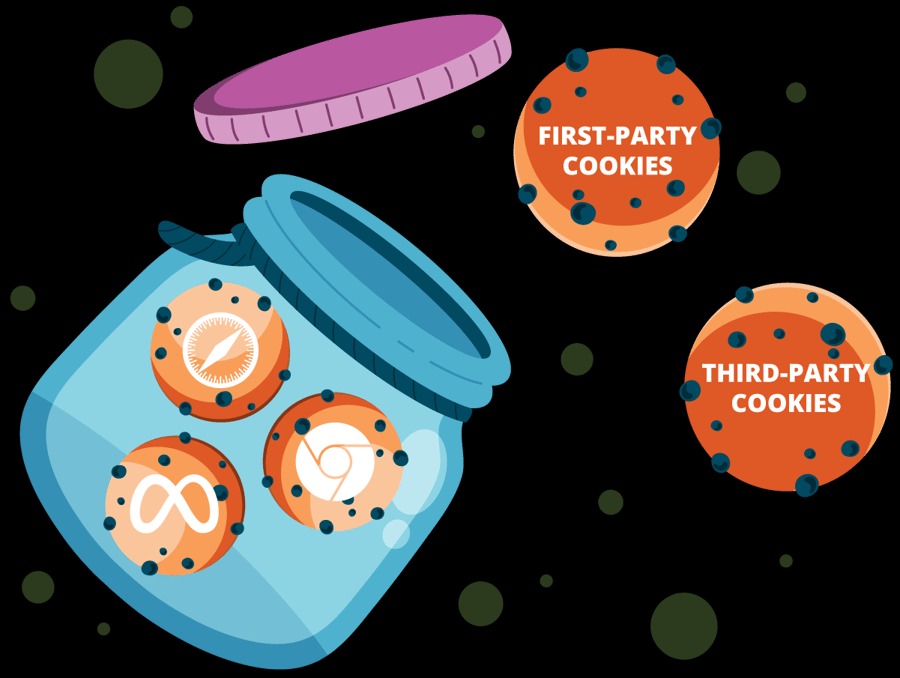
    Websites gather data from first-party cookies on their own sites, while third-party cookies come from other services that keep tabs on users across different sites and devices. You’ll often see advertising platforms and analytics companies using these third-party cookies to track how people behave online for things like targeting ads, attributing conversions, and optimizing performance.

    As Google Chrome initiates third-party cookie deprecation, marketers are exploring alternative methods for tracking and targeting, such as first-party data, contextual advertising, and browser-based tracking solutions such as Google’s Privacy Sandbox.

    First Party Cookies Third Party Cookies
    What are they? Tracking code that a website owner places on their own site. The website owner receives the data. Tracking code for companies other than the website owner. The data is shared with the third party.
    Examples Google Analytics Meta Pixel, Advertising Conversion Pixels / Tags, Advertising Networks, Data Companies
    How is the data used? Understand your website’s visitors and user behavior; remarket to your website visitors Drive interest-based targeting; understand user interests and behaviors across sites
    Who collects the data? Data is collected by the website you are currently browsing Data is collected by other companies/websites (like ad and data platforms) that track users across multiple websites or devices
    Are these cookies suppressed by browsers? NOT impacted by the deprecation of cookies Impacted by the deprecation of cookies

    Impact of Cookies Deprecation

    Two key elements are affected:

    • Targeting: Advertising platforms can still target some users based on data gathered by cookies, but it will be limited.
    • Conversion Tracking: Tracking conversions in the future will require more client involvement. Your account manager will speak with you about upgrading your conversion tracking as needed.

    To ensure our client campaigns remain effective, Search Influence routinely uses and explores alternative methods for tracking and targeting, such as first-party data, contextual advertising, and browser-based tracking solutions like Google’s yet-to-be-released Privacy Sandbox.

    Should marketers fear these changes? How dramatic is the impact?

    The advertising industry is innovating to find new ways to deliver effective ads while respecting user privacy. Phasing out third-party cookies will be gradual, but it’s not necessarily something for marketers to fear. Marketers should view the phasing out of third-party cookies as an opportunity to adopt more sustainable, privacy-friendly practices that lead to stronger customer relationships and trust. By staying informed and proactive, marketers will navigate this transition effectively.

    Do you expect privacy regulations to get more strict?

    The pressure to enhance online privacy is driving Google to develop alternatives to third-party cookies. As privacy concerns intensify, more regions may adopt stricter data protection laws similar to GDPR (Europe’s privacy legislation) and CCPA (California’s privacy legislation). Consequently, businesses must be more transparent about their data practices and secure clear consent from users.

    Historically, the industry has adapted to other disruptions. In April 2021, Apple introduced a requirement for all apps in the App Store to display a prompt, as part of its AppTrackingTransparency framework, discouraging tracking on iOS devices unless users explicitly opt-in. This policy limited certain types of data collection and sharing without direct user consent. In response, marketers shifted their approach by targeting broader audience segments and relying more on ad networks to identify and reach their target audiences effectively.

    To what extent is conversion tracking impacted by the end of cookies?

    Most businesses (including Search Influence’s clients) do not currently rely on third-party cookies for targeted digital advertising or analytics and lead tracking. To maintain ad effectiveness, we recommend continuing to leverage first-party data collected directly from interactions on a client’s own website. This data is more reliable and privacy-compliant, allowing for effective conversion tracking within the client’s own digital properties.

    Generally, the end (or significant reduction) of third-party cookies significantly impacts conversion tracking, but alternative methods and technologies are emerging to address these challenges.

    Alternative Solutions for Tracking Without Third-Party Cookies

    First-party data

    • Leveraging first-party data collected directly from interactions on a client’s website is crucial. This data is more reliable and privacy-compliant, allowing for effective conversion tracking within the client’s own digital properties.
    • Meta’s solution: Meta encourages advertisers to leverage first-party data. This includes data collected directly from interactions on the advertiser’s own website, which remains unaffected by third-party cookie policies.
    • Google’s solution: Enhanced conversions use first-party data and hashed user information (like email addresses) to track conversions more accurately without relying on third-party cookies.

    Server-side tracking

    • Implementing server-side tracking helps bypass the limitations of client-side cookies. Clients maintain control over user data and ensure accurate conversion tracking by processing tracking data on the server.
    • Meta’s solution: Meta has introduced the Conversions API, which allows servers to send conversion data directly to Meta. This server-side solution provides a more reliable method for tracking conversions.
    • Advertisers at risk are those who haven’t implemented first-party cookies with the pixel or the Conversions API.

    Privacy Sandbox

    • Google’s Privacy Sandbox initiatives aim to enable interest-based advertising and conversion tracking without third-party cookies. These solutions group users into cohorts based on similar interests while maintaining individual anonymity. (Google hasn’t rolled this out and hasn’t provided a target date.)

    Will Ad Platform Pixels Still Track Conversions, or Do We Need to Use Google Enhanced Conversions and Meta’s Conversions API?

    Person accessing the Google Search web homepage - the affect on Google's cookie deprecation on tracking and analytics

    Meta will eventually phase out the Meta Pixel, but there’s no timeline for this yet. That said, the most immediate recommendation is to explore Conversions API to preserve campaign measurement proactively.

    On Google Ads, Search Influence recommends implementing enhanced conversions for the web (or leads for importing offline conversions) to protect against cookie deprecation and preserve accurate measurement.

    While conversion tracking has never been 100% accurate, we believe that tracking what you can is crucial to maintaining campaign effectiveness.

    Recommendations on How to Address Changes to Targeting and Strategy

    For Search Influence clients, we do not expect to make dramatic changes to our clients’ strategies based on the way we currently target and leverage data. For some clients, we will work with you on any necessary improvements to the below.

    Collect first-party data

    Focus on collecting and leveraging first-party data (information collected directly from their own users). This can include data from their website, CRM systems, and customer interactions.

    • First-party data is collected directly from user interactions on a company’s own website or app, providing accurate and reliable insights. This includes data from user registrations, purchases, and on-site behavior.
    • Users are generally more comfortable sharing data directly with brands they trust. Clear communication about data usage and robust privacy policies can enhance this trust.
    • First-party data allows for effective personalization, as businesses can tailor experiences based on user preferences and past behaviors observed directly.

    Leverage CRM systems & ad integration

    Adapt a strong CRM strategy to capture valuable first-party data, improve lead nurturing processes, and get more accurate performance insights from advertising campaigns.

    Identify the right CRM system

    • Evaluate CRM systems that best integrate with existing tools and advertising platforms. Popular options include Hubspot and Salesforce. In our experience, Hubspot is the best fit for most businesses (and Search Influence can help you build it out).

    Set up lead tracking and data collection

    • Collect first-party data from your website (registrations, purchases, form submissions) and ensure this data is flowing into the CRM.
    • Implement pixels and APIs (e.g., Facebook Conversion API, Google Ads Enhanced Conversions) to connect user actions on the website with CRM lead data.
    • In Google Ads and other platforms, set up offline conversion tracking by importing sales data from your CRM system or other offline customer interactions (phone calls, in-store purchases).

    Implement lead scoring

    • Establish lead-scoring criteria based on user behavior (e.g., visiting key pages, downloading resources, submitting forms).
    • Use the CRM to track interactions across marketing channels and create a lead-scoring system that assigns value to each action. High-scoring leads can be segmented for more personalized and higher-budget ad campaigns.

    Automate follow-ups and nurturing

    • Leverage your CRM’s automation features to send tailored email follow-ups, segment their audience, and deliver retargeting campaigns based on a lead’s score and behavior.
    • Create automated workflows that nurture leads through email, SMS, or targeted ads, guiding them toward conversion.

    Measure and optimize

    • Once the CRM is fully integrated with your advertising efforts, review the data regularly. Ensure accurate tracking of cost per lead (CPL) and return on ad spend (ROAS) through the CRM.
    • Refine campaigns based on lead score data. Allocate budget to maximize high-quality leads.

    Cookieless targeting solution examples

    • Contextual targeting places ads on content directly relevant to the ad. Instead of relying on user data, it uses themes and interests found in the content to determine relevance. This privacy-friendly targeting method is often applied in programmatic advertising.
    • Addressable geo-fencing enhances traditional geo-fencing by focusing on specific locations without relying on third-party cookies. Instead, it uses address lists sourced from CRM data or carefully curated lists, enabling advertisers to reach users within targeted geographic areas based on first-party insights.
    • Campaign audience retargeting helps advertisers reconnect with existing, cookieless audiences. Advertisers establish an initial campaign to build a retargetable audience, re-engaging them across platforms with relevant content.

    What Changes to Conversion Tracking Do You Recommend?

    To combat Google cookie deprecation, implement your advertising platforms’ recommended tracking solutions, such as Enhanced Conversions for Google Ads and Conversions API for Meta Ads.

    Additionally, leveraging GA4’s reporting identity features can help track users more effectively across devices while respecting privacy. Search Influence recommends the device-based reporting identity to get more data for small businesses.

    Last, Consent Mode v2, combined with GA4, allows advertisers to maintain measurement accuracy by modeling conversion data for users who opt out of cookies.

    • With Consent Mode v2, you can capture and model conversion data even when users opt out of non-essential cookies. This ensures that you still have access to key insights and helps mitigate data loss.
    • When users decline consent, GA4, in conjunction with Consent Mode, uses aggregated and anonymized data to estimate conversions and user journeys, providing a more complete view of campaign performance without breaching privacy regulations.

    How Soon Should You Take Action?

    You should start planning and adapting your 2025 advertising strategy to mitigate the impact of upcoming cookie deprecation.

    While this might seem like a daunting task, there’s no need to worry.

    The Search Influence team is monitoring the deprecation of the third-party cookie and outlining key steps that will be taken in this transition.

    Contact us today to learn how our experienced team can help you transition your digital advertising strategy in 2025 and beyond with our cutting-edge services.

  • How Search Influence Uses AI to Improve Your Ad Results – April Client Insider

    How Search Influence Uses AI to Improve Your Ad Results – April Client Insider

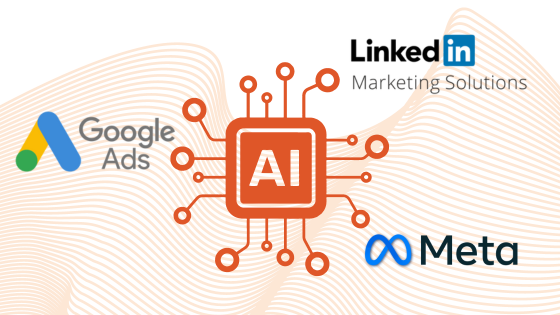
    Unlocking Conversions: Meta and LinkedIn Introduce Advanced AI Targeting

    Discover how predictive audiences and Advantage+ targeting can elevate your advertising campaigns.

    AI for paid campaigns

    New Meta and LinkedIn AI Features Help “Find” Conversions

    As part of our ongoing commitment to optimizing your advertising campaigns, we’re excited to introduce you to the powerful AI features offered by Meta and LinkedIn, designed to help you reach and convert your target audience more effectively.

    Predictive Audiences with LinkedIn Ads

    On LinkedIn, we can leverage predictive audiences, a feature that expands your campaign’s reach by creating an audience predicted to perform actions similar to those within your source data.

    We work with you to curate a list of existing contacts you have that represent the ideal customer – this could be high quality leads or high quality clients/customers. LinkedIn combines your data source and LinkedIn’s AI to automatically generate a new custom audience that has more potential to convert.

    Advantage+ Audiences with Meta Ads

    In addition to LinkedIn, we’re excited to introduce Meta Advantage+ audiences, which harnesses Meta’s advanced AI capabilities to find your audience. (P.S. Meta = Facebook and Instagram.)

    Meta’s AI utilizes a wealth of information including past conversions, pixel data, and interactions with previous ads to continuously refine and evolve your audience targeting. You can rely on Meta’s AI to find your audience, or provide specific information about the people you want to reach. Meta prioritizes audiences matching your suggestions before broadening its search.

    By testing AI-driven targeting in your campaigns, you can expect improved results! We are working these features into our clients’ campaigns where relevant to test their power to drive more conversions within your budget.

    AI has been driving success in your campaigns for years

    Over the years, AI has revolutionized advertising, reshaping how we connect with audiences and optimize campaigns – in Google, Meta, LinkedIn, and programmatic digital advertising.

    AI has evolved to deliver personalized ads, enhancing relevance. Predictive algorithms forecast trends and behaviors, enabling data-driven decision-making, while dynamic creative optimization tailors ad content in real-time to maximize engagement and conversion rates. Now we are testing new audiences created using AI to drive conversions!

    At Search Influence, we continue to adjust our campaign best practices and processes to leverage AI’s potential to drive your advertising success.

    Have questions about AI in your campaigns? Chat with your account manager to understand more!

  • Rising Online Advertising Costs in 2024: The Election Year Effect

    2024-Election-and-Ad-Cost

    Key Insights

    • With the U.S. presidential election coming up, experts project increased advertising competition and rising digital ad costs throughout 2024.
    • While it may be tempting to slash your marketing budget to save short-term advertising costs, you’ll pay the long-term price of leaving your brand dormant this year.
    • The right channel, campaign, and strategy can make the difference between a profitable year and one that succumbs to the pressure of a changing market.

    Yes, it’s an election year. Yes, online advertising costs will rise. No, you shouldn’t take the (mistakenly) “economically sound” route and cut the cord on your campaigns.

    Digital ad costs ebb and flow seasonally each year, which ushers in higher prices for a slice of inventory. The same goes for when a major election is on the table, like the upcoming U.S. presidential election, which is already proving to be an ad-spend field day on its own.

    As high demand and low supply for ad inventory during elections cause prices to hike, many brands put marketing on the chopping block. However, despite the higher price tags, the brands that stay the course and continue advertising are the ones who go into the next year with the best results.

    In this blog, we’ll cover everything you need to know about rising digital ad costs in 2024 and offer practical tips for keeping your strategy in shape amidst uncertainty.

    Digital Advertising Costs Predicted to Remain High Beyond Q4

    Between impromptu holiday campaigns and year-in-review wrap-ups with higher-ups, Q4 is often a frenzy.

    Historically, Q4 brings with it an extra chunk of change, often to the advertiser’s benefit. Shoppers rush to both brick-and-mortar and e-commerce stores for holiday deals, spending more than ever, earlier than ever. A smart marketer runs at least one holiday campaign, which ideally, spikes profits and leads that outperform last year.

    However, despite these hot sales, there are some drawbacks.

    Supply, demand, dilemma

    Q4 is a remarkably advantageous time to advertise, and most advertisers know it — making the market more crowded.

    This time of year, advertisers find themselves in a bidding war against direct competitors in their industry and against a broad spectrum of entities all vying for the same precious commodity: consumer attention. From small-scale Etsy vendors to major national retailers, the fight for digital ad space becomes increasingly fierce — and costly.

    It’s the classic law of supply and demand. More advertisers want online ad space, meaning the demand for inventory on high-converting channels naturally grows. With that growth comes increased competition and rising prices per click or per impression.

    2024 to change the tune

    For safe budgetary measures, you should always expect rising digital advertising costs in Q4 — unless the yearly data shows differently. Fortunately, though, the dust left over from the madness typically settles in Q1 of the new year.

    However, 2024 is shaping up to be different. This year’s Q4 isn’t just about the usual holiday shopping and Black Friday sales. The presidential election will take November by storm, and much of 2024 will be impacted, too.

    As political candidates gear up to increase their spend on advertising throughout the year, experts predict costs to remain high across most of 2024 — not just the tail end of the year.

    Impact of the 2024 Presidential Election on Digital Ad Costs

    2024-Election-and-Ad-Cost

    Presidential elections are great for the advertising market itself. For the average digital marketer looking to get in front of the eyes of potential buyers, not so much.

    Increased spend = increased competition

    The 2020 election shattered political ad spending records, being crowned the most expensive campaign year in American history. From traditional media like broadcast TV to online advertising with Google, political advertisers hopped on any and all channels to push their envelope to whoever would take it.

    This year’s election is set to take 2020’s ad spend and give it a facelift — to the tune of an estimated $15.9b across all mediums. This whopping forecast would be a 30% jump from the previous presidential election, with AdImpact projecting the 2023-2024 election as the most expensive of all time.

    As always, political advertisers mostly rely on local broadcast TV to get their message across. However, an influx of this ad spending growth is moving toward digital channels, with politicians utilizing every medium at their fingertips, from paid search to display.

    There’s a whole new layer of competition in the mix this year, one with a powerful presence on both the advertising industry and its market.

    Increased competition = increased costs

    If there’s one thing all advertisers want, it’s inventory. And if there’s one thing that isn’t always guaranteed, it’s premium inventory.

    Running ads on high-converting channels is the goldmine in any advertising sector, be it political, healthcare, or higher education.

    Elbowing through a tight crowd to get to those channels is generally to be expected. This election year, however, that crowd looks a little different and a lot bigger.

    When competition rises with political advertisers entering the scene, online advertising costs follow suit. Google, Meta, and other prominent digital ad space realtors are auction-based, meaning the bids to show naturally increase with a surge in competition.

    How Competition and Rising Online Ad Costs in 2024 Might Affect Your Results

    Potential impacts on display campaigns

    Being proactive about potential losses during this election year is the best way to safeguard quality results.

    Today, display campaigns are particularly popular. If you’re already running one, this is likely where your results will be hit the hardest in 2024.

    The worst-case scenario? You see fewer inquiries or leads and fewer sales overall from your digital advertising sources. But that’s assuming you keep the same budget as initially planned.

    In this instance, your best bet to mitigate a drop-off in conversions is to increase your ad spend to maintain consistent lead quantities. Sure, the price tag may be a tad higher, but the losses from missed revenue are even greater.

    Potential impacts on paid search campaigns

    Working with paid search? Now, that’s a different, likely easier story.

    With paid search, you’re only competing with other brands relevant to your keywords. Whether you’re a local zoo or a national SEO agency, you won’t be threatened by Candidate X, Y, or Z encroaching upon your space in the search results. You’ll just be warding off direct competitors also bidding on your keywords.

    However, you may see an impact if brands in your industry start cropping up, looking to earn more business around Q1 and Q4. Most brands want to begin and end the year on a high note, and rightfully so.

    Just be sure to stick to a thoughtful, well-executed advertising strategy, and you won’t feel too much pressure.

    The same sentiment goes for all of your digital advertising campaigns in 2024. Put in the right amount of time, effort, and money, and you can maintain the results and even accomplish your goals for the year.

    Strategies to Manage Increased Digital Ad Costs in 2024

    2024-Election-and-Ad-Cost

    Stay the course

    As the old saying goes, “When the going gets tough, the tough get going.”

    Inevitably, the market will be disrupted from time to time. Sometimes, it even gets turned on its head, like we saw with the COVID-19 pandemic. But brands who persist in uncertain times are the ones who come out on top, now and well into the future.

    A consistent online presence is what will make you relevant amidst all the political clutter.

    It’s important to avoid caving into the temptation that pulling the plug on or limiting your use of online ads this year will save you money. In the long run, you’ll only lose your brand reach, impression, and the results you worked so hard to maintain.

    Marketing is a long-term investment, not an on-and-off again, quirky commitment. As long as you keep with the course, budget appropriately, and stay vigilant of your competition, you’ll avoid the aftermath of dormant mode.

    Optimize your marketing mix

    Just because you shouldn’t cut online ad expenditures doesn’t mean you can’t save any money this election year.

    The cheat code for low ad costs and high-performing results boils down to your marketing mix.

    • Where are you advertising?
    • What campaigns are you running, and to whom?
    • Are any campaigns underperforming, and if so, on which channel(s)?

    Keep your budget and results in good standing by leveraging the marketing mix that yields the best returns. We recommend concentrating your efforts on the ad campaigns/channels that yield the most clicks or conversions and are most popular with your target audience.

    Track trends in your target audience and relevant consumer shopping trends to best optimize your marketing mix and meet prospects where they are.

    Remember that consumer behavior is also expected to shift during this election year. Many people will spend more time online to stay updated on the election, which could increase their exposure to your ads. Others may pull back their time surfing the Web or change where they spend their time online.

    Enlist an online advertising agency for help

    If 2024’s advertising market changes leave you with more questions than answers, the good news is you don’t have to navigate it alone.

    Outsourcing your marketing to an agency takes much of the heavy lifting off your plate at a fraction of the headache of doing it all DIY. When you put your strategy in the hands of experts, you’ll get industry insights, creative, tech, and strategic know-how, and performance results backed by rigorous data.

    Working with an agency also doesn’t have to be a huge cost undertaking in an already unsteady landscape. The best agencies are there to ensure you make the most use of your advertising budget by optimizing for the right marketing mix.

    Plus, with their industry expertise, you’ll always be made aware of any economic shifts and trends in the ad atmosphere.

    Proactive, not reactive.

    As Jared Belsky from MarketingPros writes, “Don’t underestimate the cost of not being at the forefront of trends.” Otherwise, you may get lost in the shuffle of the industry’s next bout of turbulence.

    Stay Ahead of the Curve With Search Influence

    At Search Influence, we’ve weathered the advertising storms of elections, pandemics, recessions, and everything in between.

    When you partner with us, your goals become our goals, and we’ll work to always keep your advertising campaigns running at peak performance. This election year, we’ll place extra emphasis on the right messaging and creative and testing new platforms to maintain your results.

    As always, we’ll monitor and optimize your campaigns based on the goals set with a focus on leveraging your competitive advantage. Your dedicated account manager will promptly alert you to any changes we see in your market, with actionable steps for maximizing your online presence.

    Keep your strategy in safe hands during times of uncertainty. See how our expert digital advertising services can put you ahead of the curve today.

    Image Sources:

    Image 1: https://images.unsplash.com/photo-1523292562811-8fa7962a78c8?q=80&w=2940&auto=format&fit=crop&ixlib=rb-4.0.3&ixid=M3wxMjA3fDB8MHxwaG90by1wYWdlfHx8fGVufDB8fHx8fA%3D%3D

    Image 2: https://images.unsplash.com/photo-1622219999459-ab5b14e5f45a?q=80&w=2832&auto=format&fit=crop&ixlib=rb-4.0.3&ixid=M3wxMjA3fDB8MHxwaG90by1wYWdlfHx8fGVufDB8fHx8fA%3D%3D

    Image 3: https://images.unsplash.com/photo-1620325867502-221cfb5faa5f?q=80&w=2957&auto=format&fit=crop&ixlib=rb-4.0.3&ixid=M3wxMjA3fDB8MHxwaG90by1wYWdlfHx8fGVufDB8fHx8fA%3D%3D

  • Organic & Paid Search: Stretch Your Advertising Budget With this Dynamic Duo

    Key Insights

    • Marketers who invest in paid search but don’t use SEO miss out on valuable opportunities to grow their brand, impact, and results.
    • Paid search offers immediate, measurable results, while organic search provides long-term, cost-effective benefits. Both are essential for a balanced marketing approach that captures the ideal target audience.
    • When you leverage these strategies in tandem, you can stretch your advertising budget further and gain a higher return on your investment.

    Already diving into the world of paid search? You’re likely experiencing satisfactory — if not excellent — returns on your investment. Your click-through rates are healthy, your conversion funnels are a work of art, and the ROI numbers speak for themselves.

    But, why stop at one win when you can score a double?

    The ROI potential of organic search is often underestimated, yet its impact is monumental. With organic search, you invest in a long-lasting asset that continuously draws in high-quality traffic and gains.

    By leveraging both paid and organic search, you create a powerhouse that maximizes your budget and outperforms each strategy used in isolation.

    paid vs organic search

    Comparing the Advantages of Organic Search vs. Paid Search

    Organic search refers to the unpaid search engine results that appear when you type a keyphrase into a search engine, such as Google, Bing, or Yahoo.

    Organic search differs from paid search in two primary ways: You don’t pay for high-rankings, and you earn those rankings based on how relevant your content is to the user’s search query.

    The higher you rank in the organic listings, the higher the traffic to your website.

    Data from Brightedge shows organic search constitutes over 53.3% of all website traffic, while 15% comes from paid search.

    However, despite pulling in a lion’s share of page visits, organic search shouldn’t trump your paid efforts, and vice-versa. Choosing one approach at the expense of the other only risks leaving valuable opportunities on the table.

    Organic and paid search are complementary marketing strategies. When used together, they yield results much greater than the sum of their individual parts.

    Benefits of paid search

    Paid search is popular for a reason. It’s fast-acting, easily adaptable, and you can measure its performance down to the most granular details.

    Some of the top benefits you get by investing in this marketing strategy include:

    • Immediate visibility: Unlike organic search, which can take time to yield results, paid search offers immediate visibility. As soon as your ads are set up and approved, they can appear in relevant search results, driving instant traffic to your website.
    • Targeted reach: Paid search allows for precise targeting based on a variety of factors, such as keywords, location, demographics, and device type. This level of targeting ensures that your ads are shown to a highly relevant audience, increasing the likelihood of conversion.
    • Measurable and actionable results: Paid search offers detailed metrics and insights into your ads’ performance. This data helps you assess the effectiveness of your campaigns and make more informed decisions. You can optimize by testing different ad creatives, landing pages, and keywords.
    • Cost-effective: While you pay for each click, the ability to set a budget and bid strategy allows you to control your spending. Additionally, the targeted nature of paid search can lead to higher conversion rates, making it a cost-effective advertising method.

    Benefits of organic search

    When marketers invest in an organic search strategy, they’re investing in the tried-and-true practice of search engine optimization (SEO). This technique involves optimizing a website to appear higher on the search engine results page.

    Successful SEO encompasses many different moving parts, including:

    • Keyword research: Identifying and targeting specific keywords relevant to your business helps tailor your content to attract qualified traffic.
    • Link building: Acquiring backlinks from reputable websites boosts your site’s authority, which can improve its ranking in search engine results.
    • On-page optimizations: Improving elements like titles, meta descriptions, headers, and content itself ensures that both search engines and users find your pages relevant and valuable.
    • Technical SEO: Optimizing your website’s underlying code, speed, and structure makes it easier for search engines to crawl and index your content.
    • Local SEO: Optimizing your site for local search helps you rank higher in geographically relevant queries, making it easier for local customers to find you.
    • User experience (UX): Enhancing your site’s usability and navigability keeps visitors engaged and signals to search engines that your site is user-friendly.

    Each of these tactics plays a distinct role in optimizing your site for a better position in organic search results. When utilized correctly, effectively, and efficiently, they can lead to several compelling benefits, such as:

    • Increased organic traffic: By optimizing for relevant keywords and creating quality content, SEO helps increase the visibility of a website in search engine results, leading to more organic traffic.
    • Improved user experience: In revamping the structure and content of your website, you make it easier to navigate, which can improve the overall user experience.
    • Higher conversion rates: Through targeted optimization, SEO can attract more qualified leads to your website, leading to higher conversion rates, as visitors are more likely to take desired actions.

    Why You Need a Paid Search + SEO Strategy

    Adding SEO to your paid search strategy isn’t about dishing out hefty dollars or doing extra heavy lifting to reap results.

    This one-two punch is about working smarter, not harder. When you adopt a comprehensive strategy, your paid and organic search efforts merge to inform each other for a budget-friendly, high-impact approach.

    SEO is one of paid search’s biggest allies and strategic influences. It works to bolster the impact of your pay-per-click (PPC) ads by offering numerous advantages, including:

    • Brand credibility: If your site ranks high in organic search for relevant keywords, it may enhance your brand’s credibility and authority. This trust can translate into higher click-through rates for your paid search ads.
    • Improved quality score: Google’s Quality Score considers the relevance and quality of your landing pages. If your organic search efforts result in well-optimized landing pages, it might indirectly contribute to a higher Quality Score for your paid search ads, leading to lower costs and better positioning.
    • Shared insights: Your paid search campaigns can gain data from your organic search efforts, including effective keywords and user behavior. With these insights, you’re able to ensure more effective targeting and ad creation.
    • User experience and relevance: Successful organic search optimization involves creating relevant, engaging content that resonates with users. By leveraging this content in paid campaigns, like Google ads, you create a consistent user experience that enhances conversions.
    • Double visibility: Appearing in both organic and paid search results increases your overall brand visibility and reinforces your message, making users more likely to engage with either your organic result or paid ad.

    Use case: Paid search & SEO for improved keyword visibility

    Seeing double doesn’t always mean it’s time to visit your nearest eye care clinic.

    In the search engine marketing world, double visibility for certain keyword searches opens the door to increased brand awareness, clicks, and conversions.

    By occupying both paid and organic real estate on the search engine results pages (SERPs), you crowd out competitors and offer multiple avenues for potential customers to interact with your brand.

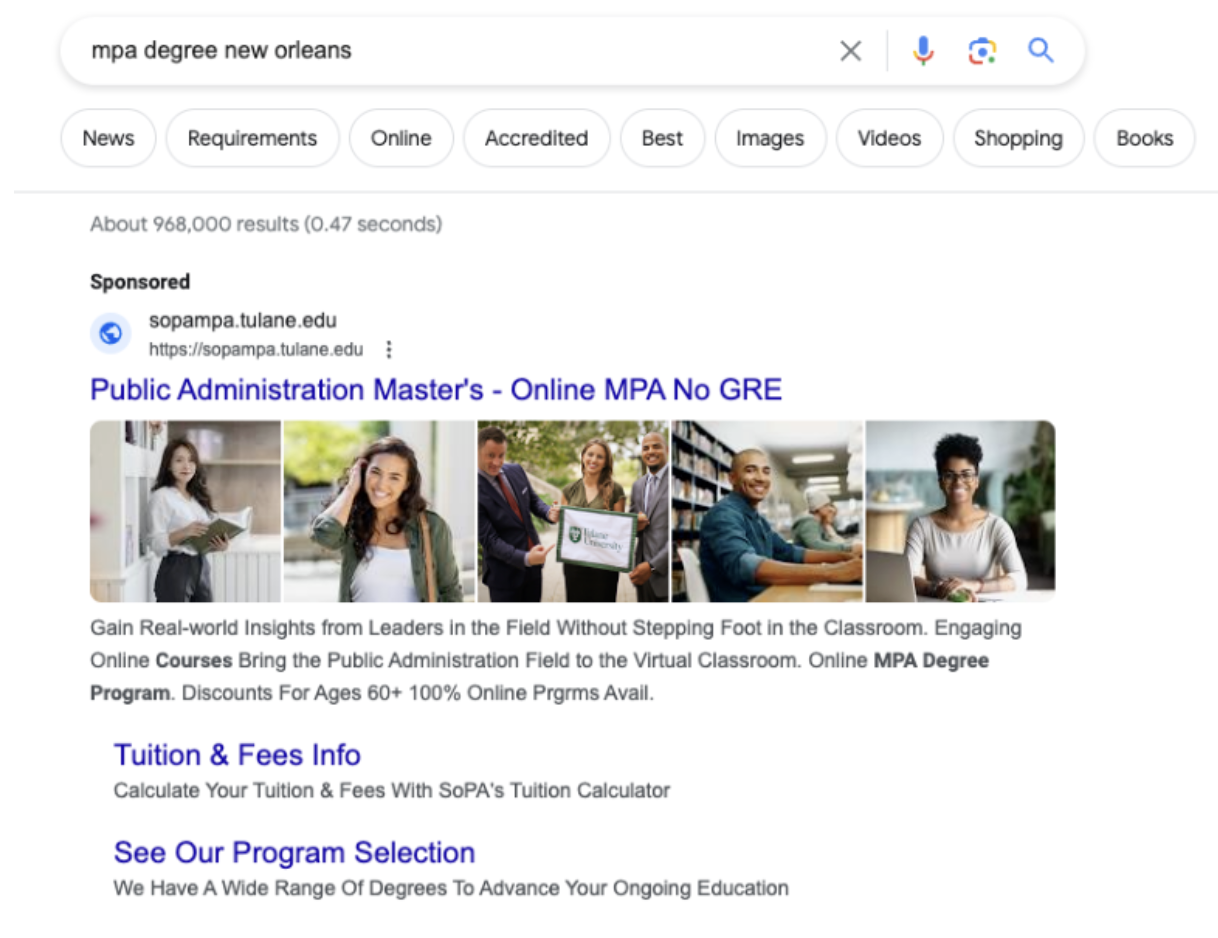
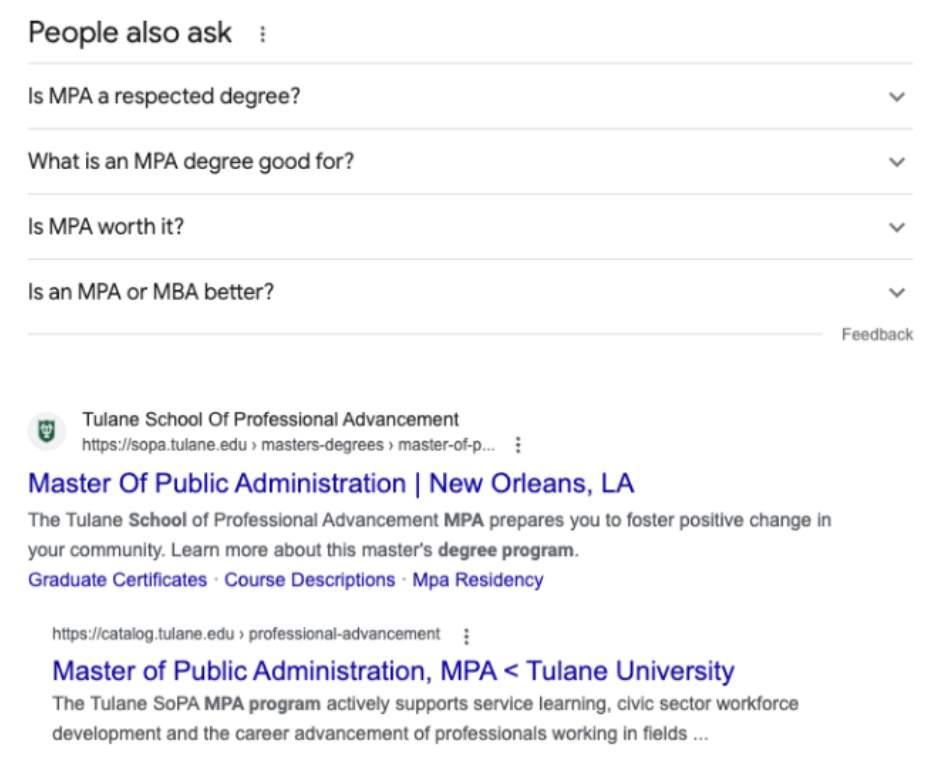
    Our higher education client, Tulane SoPA, reached double visibility in the SERPs for the keyword “MPA degree New Orleans.”

    mpa degree nola

    The top page, flagged as “sponsored,” is the university’s paid search effort, and it leads to the corresponding landing page for the Master of Public Administration program.

    mpa degree nola

    Tulane SoPA’s organic listing for the MPA degree lies just below Google’s “People Also Ask” feature, still on page one.

    Interested prospects searching for the perfect MPA program in their preferred locale are met with multiple signals pointing them to Tulane SoPA. When they click through to one of the pages, Tulane SoPA has higher chances of increasing their conversion rates.

    The ROI Potential

    The ROI of an organic vs. paid search strategy may look different, but they don’t have to be mutually exclusive. With a combined search strategy, you can do more with your marketing and have better returns, without breaking the bank.

    Used in tandem, paid and organic search stretch your budget further. Their complementary inner workings drive more conversions and dollars to your brand, particularly by:

    • Increasing overall traffic: By targeting different segments and stages of the buyer’s journey, both paid search and SEO can drive more traffic, improving overall reach and potential conversions.
    • Increasing conversion rates: Utilizing insights from both channels can lead to better targeting and more relevant content, thereby increasing the likelihood of converting visitors into customers.
    • Offering data-driven optimizations: Using data from both channels allows for more informed decisions and continuous optimization of both organic and paid strategies, leading to improved performance and ROI.
    • Allocating resources strategically: Understanding the performance and ROI of both channels enables you to strategically allocate resources, investing in areas with the highest returns.

    Increase Your ROI With SEO & Paid Search Experts

    Sticking to just one marketing channel is like running a race with one shoe. You might still finish, but you’re hobbling your chances for a winning performance.

    A superior marketing strategy is holistic, leveraging both the quick returns of paid search and the sustainable growth offered by SEO.

    At Search Influence, we put these winning, comprehensive strategies within your reach. With over 15 years of experience offering custom solutions, analytics-based strategies, and results you can measure, we are your partner in optimizing your full potential.

    Interested in learning more about merging organic and paid search in your strategy? Let’s talk about it.


    Image Sources:

    https://bit.ly/45ZC5pN

  • 6 Paid Advertising Trends in 2023 to Stay Competitive

    Key Insights:

    • AI-generated copy allows marketers to generate effective messaging for their ads quickly and easily.
    • Automation lets marketers focus on testing ad variations and creative elements to determine which ads perform best.
    • Video ads are a powerful way to engage your target audience and drive conversions.
    • TikTok’s video-first allows marketers to create engaging, creative ads
    • OTT/CTV advertising offers a cost-effective alternative to TV advertising.
    • Marketers are turning to first-party data to power their advertising campaigns.

    The world of paid advertising evolves constantly, with fresh trends and technologies popping up every year. By keeping your finger on the pulse of these trends, you’ll be able to supercharge your marketing efforts and get the best possible results for your clients. So, what can you expect from the world of paid advertising in 2023?

    1. AI-Generated Ad Copy

    Marketers use AI-generated copy to create effective messaging for their ads. AI copy tools have transformed the advertising landscape with features that even consider tone of voice and audience demographics to craft converting copy.

    By providing these ads in minutes, AI-generated ad copy saves marketers time and effort — so they can focus on other aspects of their campaigns.

    2. Creative Testing With the Rise of Automation

    The rise of automation allows marketers to level up their campaigns by spending time on creative testing.

    Focus on testing ad variations and creative elements to determine which ads perform best with their target audience. This allows for an improved return on investment for advertising campaigns.

    3. Even More Video Ads Than You Ran Before

    Engage your target audience and drive conversions with video ads. We have seen these types of ads get more engagement and have higher conversion rates.

    High-performing video ad elements:

    • Grabbing attention in the first 3 seconds
    • Clear and concise messaging with a call to action
    • Emotional appeal
    • Length: 15-30 seconds for social media ads

    There is a low-cost video solution that is attainable for all marketers — user-generated style videos. Marketers, or your clients, can create these videos at a relatively low cost compared to professionally produced videos.

    User-generated style videos have an authentic, unscripted feel to them that helps to build credibility with the target audience. Test this strategy out on TikTok!

    Influencer taking a photo with smartphone for social media

    4. TikTok Advertising

    TikTok has become one of the most popular social media platforms in the world, with over one billion monthly active users and with users spending an average of 95 minutes per day on the platform. Contrary to popular belief, the TikTok has a diverse audience, with users from all age groups, genders, and backgrounds. We recommend marketers consider this platform for advertising.

    TikTok’s video-first approach allows marketers to create engaging, creative ads that showcase their products or services while connecting with their audience. TikTok’s user-generated content approach means that marketers can also take advantage of user-generated content and create campaigns that encourage online sharing.

    Smartphone with tiktok app open on a phone

    5. OTT/CTV Advertising

    OTT refers to the delivery of video content over the internet, and CTV refers to the use of internet-connected devices to stream content on TV screens. Many viewers turn to OTT/CTV platforms to watch their favorite shows and movies rather than traditional cable TV.

    OTT/CTV ads are typically less expensive to create, the cost of ad placement is generally lower, and marketers can target specific audience segments based on demographic information and user behavior. More importantly, marketers can optimize campaigns in real-time by tracking the campaign’s impressions, clicks, and conversion rate.

    6. Targeting Using First-Party Data

    As the digital world shifts towards privacy and data protection, the use of third-party cookies is becoming increasingly restricted, making it challenging for marketers to track user behavior and target their ads effectively.

    Many digital marketing agencies in New Orleans turn to first-party data to power their advertising campaigns. First-party data refers to information collected directly from users, such as website usage data, purchase history, and demographic information. This type of data is becoming increasingly valuable as it allows marketers to target more effectively.

    By using first-party data, marketers can tailor advertising to specific individuals based on their interests and preferences. Additionally, first-party data can increase the effectiveness of advertising campaigns through remarketing and uses of “lookalikes” of first-party data. Lookalike targeting, a common technique used in Meta Ads, uses first-party data to target users similar to existing customers.

    Learn More About Paid Advertising From Our Advertising Firm in New Orleans

    Marketers who stay on top of these latest trends will produce great campaign results in 2023; however, it’s important to remember that these trends are just a starting point. To truly succeed in paid advertising, marketers must constantly test and optimize their campaigns to ensure they get the best results for their business.

    Staying informed of paid advertising trends ensures you have effective and efficient campaigns that deliver the best possible return on investment.

    Contact our New Orleans digital marketing agency to learn more about paid advertising.

    Images

    Camera

    TikTok

  • Four Steps to Adapt to Apple iOS 14’s Impact on Your Facebook Ads

    This post was updated by Marissa Wehrer on August 24, 2021 to reflect updated news. It was originally published on January 20, 2021.

    Key Insights

    • Apple’s iOS 14.5 privacy update has had an industry-wide impact on businesses that use web conversion events to optimize, target, and report using Facebook’s business tools, such as the Facebook Pixel.
    • The update will allow users to opt-out of having their activity tracked across other companies’ apps and websites.
    • Take these four steps to adapt to this industry-altering change and run conversion campaigns in the future.
      1. Complete domain verification to configure pixel conversion events for Aggregated Event Measurement.
      2. Prioritize up to eight conversion events that are most important to your business.
      3. Understand how reporting changes will affect your ability to measure success and optimize your campaign.
      4. Identify new campaign strategies and best practices.

    How Does the Apple iOS 14 Update Impact My Digital Ads?

    On April 26, 2021, a significant update came to iOS 14 devices that asked users if they would like to “Allow Tracking” or “Ask Apps Not to Track” their activity across other companies’ apps and websites. The general consensus is that the majority of iOS 14 users will opt-out of tracking, thus preventing marketers from sending personalized advertising to those who opt-out.

    Apple’s new policy has an industry-wide impact on personalized advertising.

    This update will impact businesses that use web conversion events to optimize, target, and report using Facebook’s business tools, such as the Facebook Pixel. Effects include, but are not limited to, the inability to do the following:

    • Target the right audience with the right message at the right time
    • Allocate budget efficiently to produce the lowest cost per acquisition or return on ad spend
    • Get the same amount of data and granularity of reporting to inform decision-making

    Understand the scale that your campaign performance could be impacted by reviewing your ad account’s Impression Device delivery breakdown. This will help you analyze the percentage of your impressions served to Apple devices.

    Facebook campaign options in iOS14

    Despite these daunting changes, personalization is not at a total loss. Facebook Ads will remain an effective advertising channel if you rethink your current strategies and best practices.

    If you plan to use Facebook Advertising as a lead driver and revenue generator, the following four steps will be vital to run conversion campaigns due to Apple’s upcoming AppTrackingTransparency framework for iOS 14.5 users.

    Step 1: Complete domain verification to configure pixel conversion events for Aggregated Event Measurement.

    Aggregated Event Measurement is a new Facebook tool that “processes pixel conversion events from iOS devices” in compliance with Apple’s new policy while ensuring advertisers can still run effective campaigns. This tool can only be accessed once your domain is verified.

    As a new best practice for all businesses, you must complete domain verification. Domain verification is a way for you to claim ownership of your domain in Business Manager.

    Following Facebook’s instruction, “Domain verification needs to be done at the effective top-level domain plus one (eTLD+1). For example, for www.books.jasper.co.uk, books.jasper.co.uk, and jasper.co.uk, the eTLD+1 domain is jasper.co.uk. This can help ensure that your domain verification will encompass all variations.” (Source)

    How to verify domains on Facebook

    Step 2: Prioritize the Eight Conversion Events That Are Most Important to Your Business.

    Once domain verification is complete, you must use the Aggregated Event Measurement tool within Events Manager to set up the events that you want to track and their corresponding priorities. As a reminder, events allow Facebook’s machine learning to better target, optimize, and measure campaign performance.

    With the Aggregated Event Measurement tool, Facebook is requiring you to define up to eight conversion events, whether standard events or custom conversions, per domain (this includes subdomains) and to put them in order of priority.

    When it comes to prioritizing the events, you are going to put the most valuable action first and the least valuable action last. When a user completes multiple actions within a conversion window, only the highest priority event will be counted, and the conversions for the lower-prioritized events will not be counted.

    If your campaigns are currently optimizing for over eight events across the same domain, make it a priority to strategize and select the eight events you will optimize for moving forward. If you are currently operating under the limit of eight events, then prioritizing your events is quite simple.

    Follow Facebook’s documentation to configure Aggregated Event Measurement with your conversion events.

    Screenshot of web event conversions in Facebook backend

    Once you have prioritized your events, adjust your conversion campaigns’ ad set optimization events accordingly. You’ll also need to ensure your conversion ads are attached to the proper domain at the ad level in the Tracking section.

    Step 3: Understand how reporting changes will affect your ability to measure success and optimize your campaign.

    There are new reporting limitations that you should note, as they may affect how you measure campaign success and optimize campaign performance.

    Delayed reporting:

    Data may be delayed up to 3 days, which could severely impact optimizing short-run campaigns. Another key difference is that conversions will now be reported at the time the conversion actually happened, instead of getting attributed to the last ad impression or click.

    Estimated results:

    Statistical modeling may be used to account for conversions from iOS 14 users.

    No support for breakdowns:

    Delivery and action breakdowns, such as age, gender, region, and placement will not be supported. This could greatly impact how you review and optimize campaign performance.

    To test theories based on delivery and action, you will need to manually run tests, likely by creating more targeted ad sets. However, be mindful that this directly goes against Facebook’s best practice to use broad targeting to improve machine learning. (Source)

    Changes to account attribution window settings:

    First, the attribution window for all new or active ad campaigns is now set at the ad set level to ensure that the conversions measured are the same ones used to optimize ad delivery.

    How to do Facebook optimization and delivery

    Additionally, the new default window is a seven-day click attribution window, and 28-day attribution will not be supported for new or active campaigns. The following windows will be supported under the new attribution setting:

    • 1-day click
    • 7-day click (default after Apple’s prompt enforcement in April)
    • 1-day click and 1-day view
    • 7-day click and 1-day view

    As of January 2021, we saw a decrease in conversions due to the new attribution window settings set by Facebook.

    Step 4: Identify new campaign strategies and best practices.

    Optimizing: Test new optimization events

    By being limited to only eight events, this may force you to determine new best practices on how to optimize your campaigns. If you previously optimized your campaign with low-funnel custom conversions, you may need to test broadening your optimization events to less-granular or higher-funnel actions to encompass more website touchpoints.

    And if you haven’t switched to Campaign Budget Optimization (CBO) yet, then now may be a good time to let Facebook’s machine learning take some of the guesswork out of optimizing your campaign.

    Targeting: Test new audiences and targeting

    Our ability to target and remarket to your ideal customer with personalized ads will be severely limited. Mitigate the effects of the iOS update first by leveraging in-app products such as Facebook and Instagram Shops, lead gen forms, and using video. On-Facebook, engagement tends to be remarketable, which could replace some of the website data you’ll lose.

    Take advantage of the most available data by using customer list custom audiences to build remarketing and lookalike audiences with website audiences using the pixel.

    You may also want to consider removing the Audience Network as a placement from your ad sets because Facebook is not confident in its ability to deliver personalized ads for this placement to iOS 14 users.

    Facebook stated, “Ultimately, despite our best efforts, Apple’s updates may render Audience Network so ineffective on iOS 14 that it may not make sense to offer it on iOS 14.” (Source)

    Reporting: Test new key metrics

    If you currently report using breakdowns by delivery or action, determine how or if you will continue reporting on this granular data moving forward. Since these reporting breakdowns are no longer available for conversion data, you may need to determine new key metrics to report on.

    Navigating a New Digital Landscape

    Apple’s iOS 14.5 privacy update is transforming the digital advertising landscape. Campaign performance may see its biggest impact around Q4, which is the six- to nine-month mark from the iOS 14.5 update. This is mostly because audience sources using website tracking will shrink even more since we can’t collect the same amount of data we once did. We’ll also see more adoption of the updated iOS as people upgrade their phones.

    Stay on top of the upcoming changes and create new best practices for optimizing, targeting, and reporting to maintain control of your accounts.

    It’s okay to feel a bit confused about the effects on your Facebook Ads because no one has all of the information or answers yet. If you have questions about how you can still generate leads for your business despite these changes, one of the experts at Search Influence can help. Contact us today to learn more.

    Resources:

    Images:

    Mobile phone users

  • 3 Reasons Why YouTube Advertising Is More Effective Than TV Advertising

    Advertising on YouTube grows in popularity each year—especially in 2020, as viewers shift their attention online during the COVID-19 pandemic. Between 2014 and 2016, the number of small-and medium-sized businesses advertising on YouTube doubled (Source: YouTube Global Internal Data, Global, 2016). Traditional TV advertisers should reevaluate whether YouTube can produce results for their campaign.

    Three reasons why YouTube advertising is more effective than TV advertising:

    1. Viewers pay more attention to YouTube than TV
    2. Precise targeting and quick adjustments improve campaign performance
    3. KPI measurement ensures an effective campaign

    A person using Youtube's app on a tablet

    Viewers Pay More Attention to YouTube than TV

    Studies help us infer that YouTube advertising is more cost-effective than TV advertising for brand recall, due to the attention being spent on each platform. According to a Google and Ipsos eye-tracking research study, paid YouTube mobile advertising is 84% more likely to receive viewers’ attention than TV advertising.

    Viewers miss 55% of TV advertising time due to three distractions:

    1. multitasking
    2. switching channels
    3. fast-forwarding

    YouTube’s own data shows that users who both see and hear ads experience higher brand awareness, higher ad recall, and higher consideration than those who only see or only hear ads. Typically, YouTube viewers are engaged with the platform because they select the videos they want to watch at that moment.

    On YouTube, the chances could be higher to serve an ad with sight and sound to a fully engaged viewer. While there can be an option to “skip” YouTube ads, the advertiser does not pay for skipped ads, ensuring budget is not wasted on disinterested viewers.

    Precise Targeting and Quick Adjustments Improve Campaign Performance

    Both YouTube and TV advertising allow for demographic and psychographic targeting; however, YouTube has many more precise targeting options that can easily and continuously be tweaked to improve campaign performance.

    See the YouTube targeting options below, pulled from Google’s documentation:

    • Keyword contextual targeting: Use keywords that help match your ads to web content.
    • Demographic: Reach people by age, gender, or parental status.
    • Topics: Reach people based on certain topics.
    • Affinity audiences: Select from interest-based groups to reach potential customers at scale and make them aware of your business. These audiences were built for businesses running a TV ad that want to extend the campaign to an online context at an efficient price.
    • Custom affinity audiences: Advertisers can create audiences that are more tailored to their brands, compared with broad, TV-like audiences.
    • In-market audiences: Find customers who are researching products or services and actively considering buying something like what you offer.
    • Remarketing: Reach viewers based on their past interactions with your videos or YouTube channel.

    All of the YouTube targeting options can be reevaluated and adjusted at any time to find the most cost-effective audience to reach your campaign’s goal.

    For example, during prime-time hours of an average day in the U.S., more viewers ages 18-49 visit YouTube than any TV network. With this baseline knowledge, you can start your YouTube campaign by targeting ages 18-49. As the campaign collects data, you can review your KPIs at the targeting level and decide to pause or add targeting options.

    If your brand speaks to an older demographic, you may want to consider running TV advertising during prime-time hours. However, with the value YouTube provides, consider running a YouTube campaign complementary to a traditional one.

    KPI Measurement Ensures an Effective Campaign

    All digital advertising allows you to measure the success of your campaign by setting goals, or target KPIs (key performance indicators).

    Setting target KPIs—using metrics such as cost per conversion and click-through rate—allows us to take a step back from the day-to-day campaign analysis and optimizations to assess the big picture data. In doing so, we determine whether we’re being effective with optimizations and meeting campaign goals.

    Contrary to assessing the success of a TV ad campaign, digital advertising performance can be associated with very specific parts of the campaign. If the campaign is not meeting goals, you can single out the KPI metrics in need of attention and make improvements. This ability allows you to adjust specific components, such as a particular ad’s creative message or a single target audience.

    The data you cultivate through YouTube advertising is much more specific, actionable, and accessible than TV advertising. Having an abundance of data to make campaign adjustments improves the metrics and sets you up to meet campaign goals and ensure a successful campaign.

    Test A YouTube Campaign Now

    Now is a great time to test a YouTube advertising campaign, as plenty of eyes are shifted online during the COVID-19 pandemic. TV advertising is a great platform as part of a robust 360-campaign strategy, but as digital advertisers we prefer full control over our campaigns to guarantee measurable success.

    Need advice on how to set up a YouTube video campaign in Google? Contact one of our strategists today. You may also want to check out our top 6 marketing planning activities during COVID-19 to get started.