Author: Michelle Neuhoff Boyd

  • The Future of Search: SEO and AI Impacts Explained

    The Future of Search: SEO and AI Impacts Explained

    Key Insights

    • AI is reshaping search behavior: Users increasingly rely on AI-driven platforms for quick answers, changing how content is surfaced in search results.
    • SEO remains foundational: Despite AI’s rise, organic search remains the backbone of visibility, particularly for high-intent and local searches.
    • Authority and credibility matter more than ever: AI models favor trusted sources, making brand authority, expertise, and transparency essential for being cited in AI-generated responses.
    • Optimizing for AI requires a strategic approach: Marketers need to structure content for AI readability, incorporate long-tail keywords, strengthen technical SEO, and prioritize conversational language to improve discoverability.

    Generative AI has changed the way people search for information online. According to research by Higher Visibility, 71.5% of people report using AI tools for search, with 14% turning to them daily. 

    AI search, powered by Google’s AI Overviews and platforms like ChatGPT, Perplexity, and Google Gemini, offers fresh ways to reach users. However, it also introduces new challenges for marketers. AI-powered search results push organic rankings lower, while conversational search engines provide answers to queries without users having to click through to a website. 

    Search has always evolved, and this shift is no different. To stay competitive and continue reaching your target audience, your SEO strategy must adapt to accommodate AI-driven search — or you risk losing ground to competitors who are.

    Maintaining your relevance and traffic requires implementing tactics specifically designed to improve AI search visibility — also known as generative engine optimization — alongside your traditional SEO strategy. Here’s what to know about SEO and AI impacts, plus how to navigate them in the new era of search.

    What Is AI Search?

    AI search refers to search engines and digital platforms that use artificial intelligence to generate direct, summarized answers to user queries. Rather than simply ranking web pages, these tools analyze vast amounts of data, identify key insights, and deliver structured responses that align with the user’s intent.

    AI search is generally divided into two categories: AI Overviews and AI search engines/chatbots.

    AI Overviews

    Introduced in May 2024, Google’s AI Overviews (AIOs) appear at the top of search results in response to queries. These summaries use AI to pull information from multiple sources and generate a concise, structured response. By applying machine learning and natural language processing, they identify relevant details, summarize content, and present it in an easy-to-read format.

    AIOs also list citations alongside summaries, giving users the option to explore original sources for more in-depth information.

    AI Overviews’ impact on SEO

    Declining search visibility

    Because AIOs appear at the top of search results, they push traditional organic listings further down the page. As more users rely on AI-generated summaries, ranking in AIOs has become essential for maintaining search visibility and reaching audiences where they are actively looking for information.

    The rise of zero-click searches

    AIOs contribute to the growth of zero-click searches, where users get answers directly in search results without clicking through to a website. While this reduces organic traffic, being featured in an AIO ensures your content is still seen. It allows you to build brand awareness and authority even when users don’t visit your site.

    AIOs and informational search queries

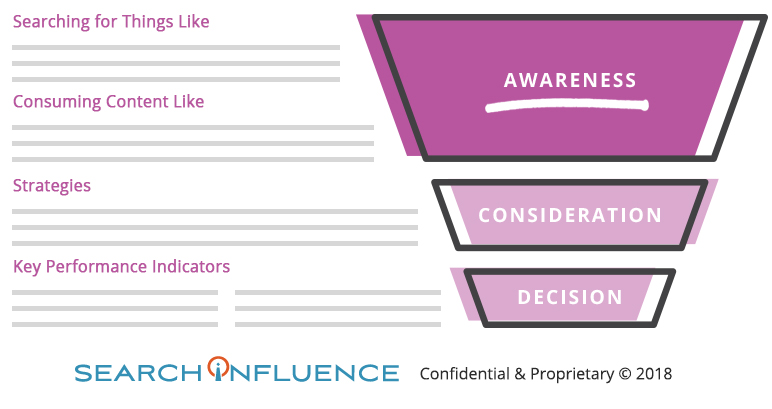
    AIOs dominate informational searches, with 99.2% of AIO keywords classified as informational. This means they frequently surface when users look for general knowledge in the awareness stage. Appearing in AIOs puts your brand in front of users earlier in their search journey, increasing the likelihood of engagement before they turn to a competitor.

    The role of AIOs in branded searches

    AIOs don’t just affect informational searches — they also appear in branded queries, which make up 45-60% of all Google searches (LinkedIn, SparkToro). If an AIO includes information about your business, it can influence how users perceive your brand and shape future interactions. 

    AIOs and click-through rates (CTRs)

    Although zero-click searches are increasing, inclusion in AIOs can still improve click-through rates (CTR). A study by Seer Interactive found that organic CTR increases to 1.08% when a site is included in an AIO, compared to just 0.6% for those that aren’t. 

    Even when users don’t click through, appearing in AIOs increases brand impressions and helps maintain relevance in search. AIOs are heavily leveraged for voice search, meaning your content has the potential to surface in spoken responses across AI-powered assistants. Ignoring AIOs means missing out on a major shift in search behavior — while your competitors secure the space at the top.

    AI Search Engines and Chatbots

    AI-powered search engines and chatbots — such as Perplexity, ChatGPT, and Bing Copilot — offer a conversational way to search for and explore information. Unlike traditional search engines, which present ranked lists of web pages, AI-driven platforms generate detailed answers and allow users to refine their queries through follow-up interactions. 

    While AIOs primarily pull from indexed content and authoritative sites, other AI search tools vary in how they retrieve and present information:

    • Bing Copilot offers a mix of live retrieval and indexed content
    • Perplexity emphasizes real-time, cited sources for greater transparency
    • ChatGPT (with browsing enabled) pulls from both retrieved and summarized conten

    Understanding these differences helps you tailor your approach when optimizing for AI-driven search experiences.
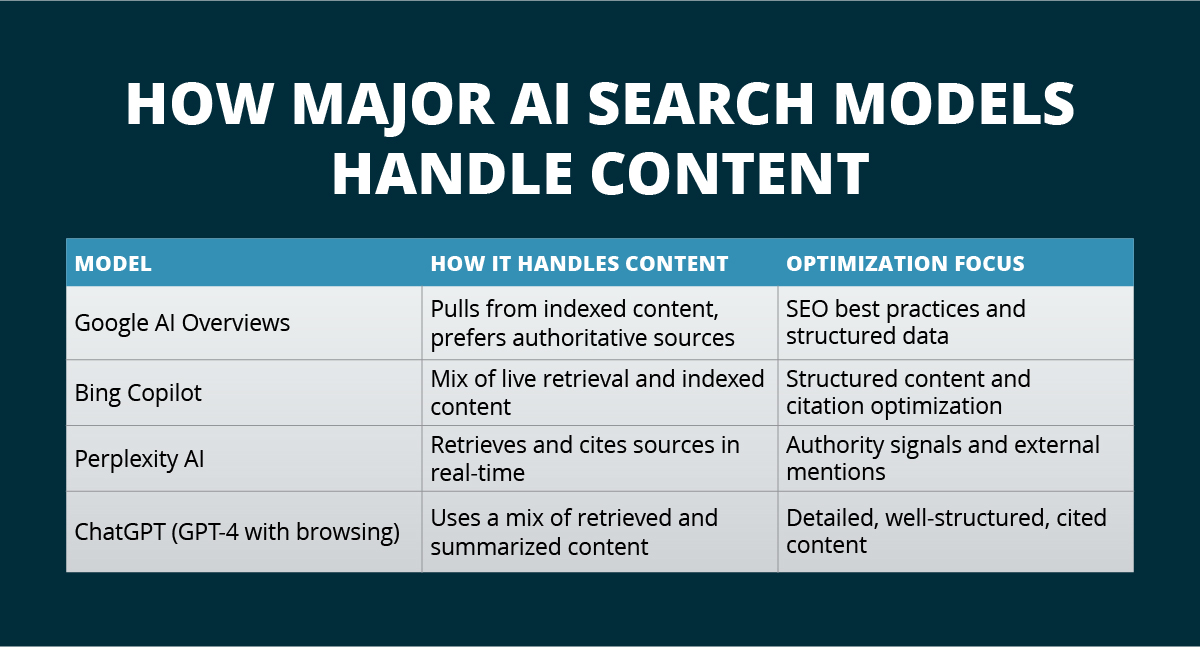
    How major AI Search models handle content

    AI search engine/chatbot impact on SEO

    Growing search traffic through AI-powered platforms

    With platforms like ChatGPT, Perplexity, and Google Gemini attracting millions of users, conversational search is becoming a key way people discover information. ChatGPT alone has an estimated 300 million weekly active users worldwide, while Google Gemini averages 275 million monthly visits. As more users turn to these tools instead of traditional search engines, ensuring your content is referenced in AI-generated responses helps increase visibility and establish authority.

    AI search engines/chatbots and brand recognition

    Some AI platforms, like Perplexity, consistently provide citations in their responses, while others, such as ChatGPT, vary in how they attribute sources. Free-tier models may offer only basic references, while premium versions provide more detailed citations, pulling from multiple sources and adding contextual annotations.

    When these platforms do cite sources, being included is a valuable opportunity to increase your credibility. Even if users don’t click through to your site, being cited in responses helps you gain your audience’s trust as a trusted source of information.

    The connection between traditional SEO and AI visibility

    Ranking well in organic search directly impacts the likelihood of being referenced in AI-generated responses. AI search engines prioritize authoritative, high-ranking sources when generating answers, making a strong SEO strategy essential for increasing visibility within these platforms.

    Many core SEO principles still apply to AI search strategies, including understanding user intent, structuring content around entities, and maintaining high-quality information. However, AI-driven search shifts the focus from backlinks and keyword targeting to citations and specificity. The more detailed and entity-rich your content, the better AI models can reference it. 

    While SEO helps content rank, ensuring it is clear, credible, and easily retrievable increases its chances of appearing in AI-generated results.

    What Is Generative Engine Optimization?
    Generative Engine Optimization explained

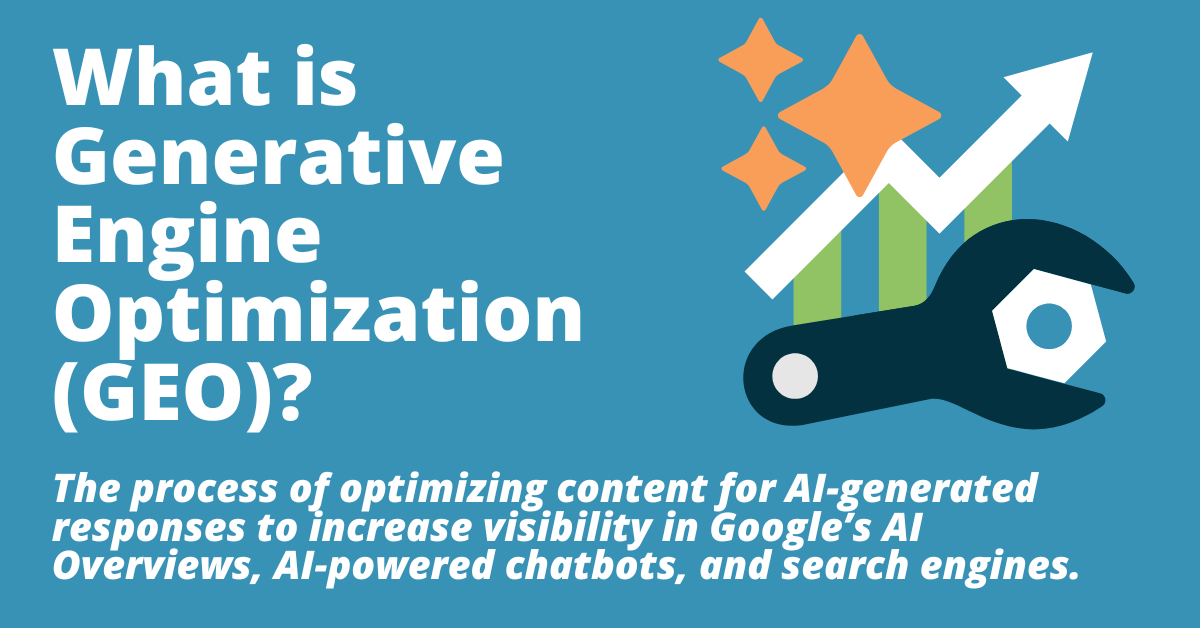
    Generative engine optimization (GEO) is the process of optimizing content for AI-generated responses, increasing visibility in Google’s AIOs and AI-powered chatbots or search engines. While traditional SEO focuses on ranking web pages, GEO tailors content for AI models that extract and present direct answers.

    By aligning content with how AI processes and prioritizes information, GEO helps marketers maintain authority, improve engagement, and capture opportunities across evolving search platforms.

    How to Get Featured as an AI Source

    A successful GEO strategy means getting included as an AI source, whether that’s in an AIO or a Perplexity response. Use these tactics to strengthen your AI visibility:

    Improve your E-E-A-T

    Google is more heavily emphasizing brand authority when ranking content and generating AIOs. Instead of solely optimizing for rankings, brands need to focus on strengthening Expertise, Experience, Authority, and Trustworthiness (E-E-A-T) to improve visibility.

    AI models prefer sources that demonstrate credibility, which means establishing strong brand authority is essential. To improve E-E-A-T:

    • Demonstrate expertise and experience: Highlight author credentials, industry insights, and first-hand knowledge.
    • Maintain accurate business and directory listings: Ensure consistency across platforms like Google Business Profile and industry directories.
    • Ensure content transparency: Properly cite sources and reference factual, verifiable data.

    Focus on relevant, high-quality content

    AI favors concise and informative content, meaning readability and structure are just as important as accuracy. Google’s passage ranking feature allows AI models to pull specific sections of your content to answer queries directly, so structuring information in a clear, digestible way improves its chances of being referenced.

    To make your content more AI-friendly:

    • Anticipate user intent and provide concise and informative responses that align with what users are searching for. AI-driven search prioritizes content that directly answers queries with detailed, structured, and context-rich information.
    • Write in conversational language, using a natural, direct writing style and concise phrasing. AI models rely on natural language processing (NLP) to interpret and generate human-like text, making them more effective at understanding content that mirrors everyday speech. Overly complex or formal wording can create friction in processing, while clear, natural phrasing ensures better readability.
    • Break down complex information into digestible, skimmable formats, such as bullet points or numbered lists, with clear subheadings.
    • Include FAQ sections, as a structured Q&A format can help AI identify relevant insights quickly. 
    • Leverage multimedia content with schema markup, since AI increasingly references videos and images in responses.

    Leverage long-tail keywords

    AI-generated search results are more likely to pull from content that matches specific, detailed queries. Long-tail keywords — phrases that are longer and more precise than broad search terms — help target the kinds of questions AI models reference in responses.

    Search intent plays a crucial role when optimizing for long-tail keywords. While informational-intent keywords trigger AIOs 99.2% of the time, commercial and transactional queries only generate AIOs 10% of the time

    To best capitalize on long-tail keyword opportunities:

    • Review “People Also Ask” (PAA) questions to identify commonly searched queries that AI models may prioritize.
    • Analyze AI search engines like Perplexity to see what types of queries generate responses.
    • Optimize for natural, conversational queries that reflect how users phrase searches in AI chatbots and voice search.
    A quote from Michelle Boyd about AI-driven search

    Optimize content for entities

    AI models process content using entities — specific people, places, organizations, and concepts — rather than just keywords. While keywords are the words or phrases users type into search engines, entities act as nodes in a knowledge graph, helping AI understand relationships between concepts and generate more relevant responses.

    To improve AI-driven visibility, structure your content to clearly define and connect entities:

    • Use Schema.org structured data: Define entities such as businesses, products, authors, and services to help AI recognize key concepts.
    • Link to authoritative sources: Reference Wikipedia, industry databases, and government sites to align with established entities AI understands.
    • Leverage co-occurrence: When two or more words, phrases, or entities frequently appear together in content, AI models — especially LLMs like ChatGPT without search — become more likely to generate them. Strategic co-occurrence helps reinforce associations between key concepts.
    • Utilize co-citation: When two entities (brands, websites, or sources) are cited or linked from the same source, it strengthens their perceived relationship in AI models, even if they aren’t directly connected.
    • Structure content with semantic triples: AI processes information in subject-predicate-object statements (e.g., “Apple manufactures the MacBook Pro”), so clearly defining these relationships enhances AI comprehension.
    • Enhance entity salience: Ensure that the most important concepts stand out within your content. Salience determines how relevant an entity appears in AI-driven searches and conversations. Think of it as a more structured way to signal significance without relying on keyword stuffing.

    Prioritize your technical SEO

    Strong technical SEO helps AI models better interpret, index, and surface your content. Without a solid technical foundation, even well-written and authoritative content may struggle to appear in AIOs or AI-driven search results.

    To improve your technical SEO:

    • Use schema markup to structure data: Properly coded structured data helps AI search engines understand key business details, such as operating hours, services, and locations, increasing the chances of being included in AIOs.
    • Optimize title tags and meta descriptions: Clear, well-crafted metadata improves indexing and can enhance how AI models retrieve your content.
    • Improve site navigation and internal linking: AI favors well-structured sites where information is easily accessible and logically organized.
    • Ensure fast page speed and mobile usability: A slow, poorly optimized website signals low trustworthiness to search engines, reducing the chances of being referenced.

    Monitor your standing in AI search

    As AI-powered search evolves, tracking your visibility in AI-generated results is just as important as traditional SEO monitoring. New and existing tools now offer AI search tracking features, helping you understand how your content appears in AIOs and other AI-driven search responses.

    To stay ahead, leverage these AI search tools to track your rankings, analyze competitor performance, and identify opportunities for optimization:

    • Recent AI search entrants: Semrush AI Toolkit, Otterly, Rankscale, Profound, xfunnel, Peec.ai
    • Existing tools adding AI metrics: Semrush, Advanced Web Ranking, Ahrefs

    Does Bing Matter in AI SEO?

    While Google dominates search, Bing still holds a significant share of queries, particularly in the U.S. Bing powers 28.3% of online searches when factoring in Yahoo and Microsoft voice searches, making it an important platform to consider.

    Here’s how to pay attention to Bing in your AI SEO efforts:

    • Submit your site to Bing Webmaster Tools (BWT) to ensure proper indexing and visibility.
    • Monitor Bing rankings: While brands ranking on page 1 of Google strongly correlate (~0.65) with AI mentions, Bing rankings also play a role (~0.5–0.6).
    • Stay updated on Bing’s algorithm changes: SEO best practices currently align with Google, but keeping an eye on potential Bing-specific shifts ensures continued optimization.

    SEO and AI Impacts: Is SEO Still Important? 

    Short answer: yes. While AIOs and AI-driven search platforms are changing how users find information, traditional SEO remains the foundation of search visibility. 

    Research shows that 52-73% of AIO sources come from pages already ranking in the top 10 organic search results. This means that if your site isn’t ranking well in traditional searches, it’s unlikely to be referenced in AI-generated responses. 

    At the same time, only 10% of middle to low-funnel keywords trigger an AIO, meaning AI-generated results are not replacing the most valuable searches — those tied to users actively looking for a business, product, or service.

    SEO is even more critical for local businesses. Searches for local goods, services, and businesses rarely populate an AIO, making local SEO tactics essential for maintaining visibility. 

    What’s more, the highest-volume AIO keywords average just 150 searches per month, while non-AIO keywords drive an average of 29,000 searches. This means that despite AI-driven changes, organic search remains the dominant traffic driver. Businesses that prioritize SEO are still best positioned to reach high-intent users, capture search demand, and drive meaningful engagement.

    Stay Ahead in the Age of AI With Search Influence

    AI search is evolving every day, reshaping how users find and engage with content. To stay visible, you need a nimble, data-driven approach that keeps up with both traditional SEO and AI-powered search trends

    That’s where partnering with an experienced agency can make all the difference. 

    At Search Influence, we continuously track organic traffic, click-through rates, and AI-related search shifts to help our clients adjust their strategies and maximize their visibility in an AI-driven world.

    SEO Roadmap for Higher Ed

    For higher education marketers, our SEO Roadmap is designed to ensure your program pages remain competitive — even as AI-driven search changes the way students explore their options. 

    This customized, three-month strategy provides clear, actionable recommendations you can implement right away. It helps you improve rankings, strengthen visibility, and optimize for AIOs and AI-powered platforms. We factor in AI’s impact from the start, ensuring your content is structured for both organic search and AI-driven discovery.

    Whether you’re refining an existing SEO strategy or building one from the ground up, Search Influence helps you stay ahead of AI search shifts so your brand remains visible where it matters most. 

    Let’s build a strategy that works for the future of search.

  • AI’s Impact on SEO: Your Top Questions Answered – February Client Insider

    AI’s Impact on SEO: Your Top Questions Answered – February Client Insider

    The Client Insider - Search Influence

    Stay Competitive in an AI Search World

    Worried About AI’s Impact? We’re Here to Help

    The rise of AI in search engines – often referred to as AI Search or AI Answers – is transforming the digital landscape, reshaping how businesses approach SEO.

    On Google, AI-generated snippets called AI Overviews appear at the top of search results and summarize information from various websites, creating a new opportunity to be found by searchers.

    Meanwhile, AI chatbots (ChatGPT, Gemini) and search engines (Perplexity, SearchGPT) generate direct answers to user questions, further shifting search behaviors.

    Our clients’ industries are impacted in varying ways. Sectors relying on informational content face the greatest challenges, as AI Answers are most often sought and generated for high-funnel, informational searches. Many clients’ traffic and revenue come from high-intent, local, and transactional searches – and the great news is that these remain less affected by AI Search.

    AI Search Graphic

    As AI Search evolves, we are adapting your SEO strategy to maximize visibility and traffic. That’s why we’re sharing our perspective on the top questions our clients are asking:

    1. Why should I care to show up in AI Answers?

    AI Answers like Google’s AI Overviews provide brand impressions—even if you don’t get the click—giving you exposure that your competitors aren’t getting. With platforms like ChatGPT and Perplexity gaining popularity, appearing in AI-generated answers offers a chance to boost visibility, position your brand as an authoritative source, and drive audience trust and engagement.

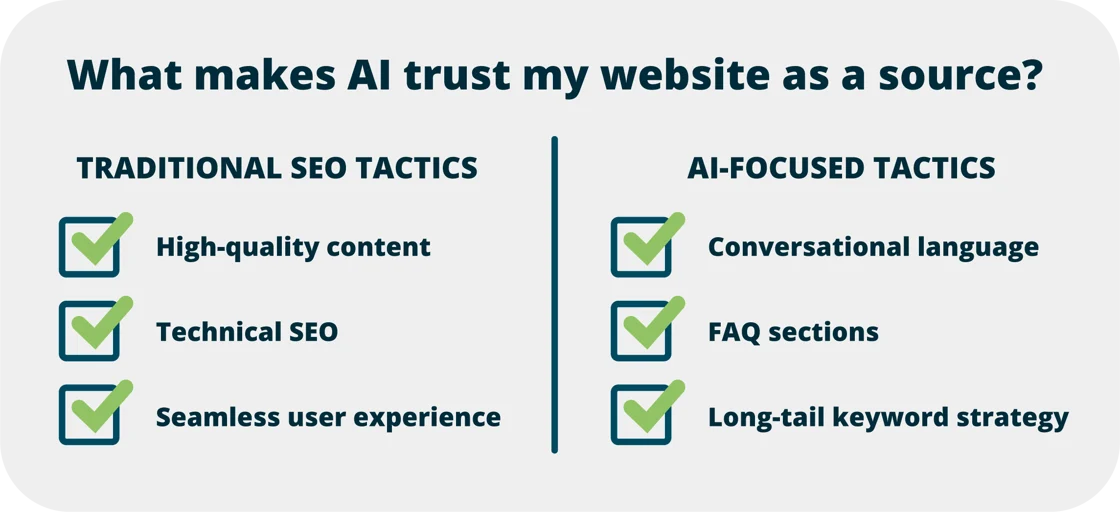
    2. How do I get AI to trust my website as a source?

    Traditional SEO tactics remain essential for supporting visibility in AI Answers, because AI models value sites with authority, expertise, and trustworthiness:

    • High-quality content that’s informative, relevant, and easy to digest and scan
    • Technical SEO tactics like meta descriptions, title tags, and schema markup
    • A seamless user experience including site speed, mobile optimization, and easy navigation

    When our strategists identify queries (keywords) that are relevant to your business and produce an AI Answer, they will deploy tactics designed to improve your visibility:

    • Use conversational language to match AI and voice queries
    • Add FAQ sections that directly answer questions AI looks for
    • Leverage long-tail keywords to answer specific queries that likely trigger AI responses

    What makes AI trust my website as a source - Search Influence

    3. Why is it still important to rank in organic results?

    It’s not all about AI Answers. For one client, of 312,000 keywords, only 464 generate AI Overviews. While AI is impacting informational searches, organic rankings are still critical for attracting qualified leads—not just for appearing in AI Answers, but for non-informational keywords. Organic results remain key for high-intent, local, and transactional searches where purchase decisions are made.

    4. How will AI’s role in search evolve?

    AI Search will continue to advance, and we’ll see more internet users trust and use these kinds of answers. Search engines like Google will focus even more on brand trust and authority, meaning it’s not just about optimizing content anymore—it’s about proving your expertise, reliability, and credibility. Strong performance in AI-driven results will be crucial, and we’ll likely see AI Answers expand further beyond search engines, as we’re already beginning to see on social media.

    Reach out to your Account Manager today to discuss how we’re helping you stay competitive in the AI Search landscape.

  • Improve Page Rankings for Your University With a Hybrid SEO Team

    Improve Page Rankings for Your University with a Hybrid SEO Team

    Key Insights

    • Achieving top rankings for your program pages is no easy feat, especially when managing SEO in-house. It takes advanced skills and consistent effort to outpace growing competition.
    • A hybrid SEO team empowers your in-house staff to focus on their strengths, as an agency handles the higher-level SEO tasks that drive measurable improvements in your program’s visibility.
    • Whether you need immediate help for a specific project or long-term strategy support, working with an agency gives you the flexibility to scale your SEO efforts as needed.
    • Take Search Influence’s Higher Ed SEO Quiz to determine whether combining your in-house strengths with agency expertise is the best way to optimize your program rankings.

    You’ve spent weeks perfecting your program pages and refining the messaging to speak directly to prospective students. You know the ins and outs of your institution, its values, and what makes it unique. Despite your best efforts, your pages still aren’t ranking near the top of the search engine results, where visibility matters most.

    Sound familiar?

    Growing competition in higher ed and a shrinking pool of traditional 18-year-old college students have made it harder to reach and capture the attention of the right prospects.

    Your program pages need to rise above the digital clutter — yet, without advanced SEO skills, all your hard work may never pay off.

    If your in-house team is hitting a wall with SEO, collaborating with an agency gives your strategy the push it needs while ensuring your team’s impact stays integral to the approach. With a hybrid team, you’re rewarded with the best of both worlds: the strengths of your in-house insights and the technical expertise of an agency.

    The Expertise an Agency Brings to the Table

    Agencies provide the technical muscle and fresh strategies needed to elevate your SEO efforts beyond what your in-house team can accomplish alone.

    Broader sector experience

    SEO agencies work with clients across industries, including higher ed, healthcare, and hospitality. This diversity means agencies bring ideas and strategies from sectors beyond education, offering new perspectives to your team.

    They know what works in SEO, what doesn’t, and will advise on how to approach your strategy accordingly.

    Dedicated SEO focus

    Unlike your internal team, which juggles multiple institution-wide priorities, an agency has dedicated experts focused specifically on your SEO strategy. With decades of combined experience among their digital marketing specialists, they know all the tricks of the trade and the latest trends.

    Their specialized knowledge keeps your strategy moving forward — whether it’s fine-tuning content, solving tricky technical issues, or outsmarting algorithm updates.

    Advanced technical SEO

    Agencies bring a laser focus to technical SEO, tackling tasks like site structure improvements, crawlability fixes, and schema markup implementation. By uncovering and resolving hidden technical errors, they eliminate barriers that could drag down your rankings.

    This targeted expertise ensures your site performs at its best and captures the attention of both search engines and users.

    Effective link-building strategies

    According to recent research by Backlinko, a website’s link authority closely correlates to its ranking success. Agencies know how to build links that matter, connecting your website with high-authority sources to improve your domain’s credibility and rankings. By incorporating authority-building tactics into your strategy, an agency will improve your E-E-A-T (Experience, Expertise, Authoritativeness, and Trustworthiness) and generate more links back to you.

    Think of it as networking for your website — building relationships that get your university noticed by the right audiences.

    Sophisticated analytics and tools

    SEO tools like SEMrush and Screaming Frog uncover powerful insights into keyword and listing management opportunities, plus on-site issues like broken links, but it takes expert analysis to turn those insights into results. Agencies excel at transforming raw metrics into strategic actions that deliver measurable outcomes.

    Through clear analytics tracking and reporting, they make complex data easy to understand and even easier to act on.

    Understanding the Strengths of Your Internal Team

    With a strong grasp of your university’s inner workings, your in-house SEO team members know what to prioritize to meet your institution’s most pressing goals.

    Familiarity with institutional culture

    Your internal team knows your institution better than anyone — its mission, values, and branding guidelines. They ensure your SEO strategy aligns with institutional priorities, making your content feel genuine while keeping your messaging consistent across every channel.

    Relationships with faculty and departments

    From individual staff members to college departments, your team has built the relationships needed to uncover stories and insights that bring the best of your university online. They know how to facilitate internal collaboration for creating academic program pages, research highlights, and in-depth faculty profiles.

    On-the-ground understanding of priorities

    Your internal team has a pulse on what’s important to everyone: prospective students, current students, faculty, and alumni. They know exactly when to spotlight admissions deadlines, open houses, and other seasonal priorities to grab the attention of your target audience.

    Local knowledge of audiences

    Targeted marketing works best when it’s backed by a clear understanding of your audience. Your team knows the local culture, regional trends, and demographic factors that shape the interests and behaviors of prospective students, alumni, and the community.

    This helps you connect with your prospects in a way that feels authentic and relevant.

    A quote about SEO skills and tools from the SI team

    How to Decide If a Hybrid SEO Team Is Right for Your Institution

    Combining your in-house strengths with an agency’s expertise creates a well-rounded SEO strategy, but the balance must meet your institution’s needs.

    So, how do you decide if this approach works for you?

    And, more specifically, what tasks should remain in-house vs. outsourced?

    Questions to ask yourself

    To determine if a hybrid model is right for your institution, check your priorities, skill level, and overall capacity to take SEO head-on. Ask yourself and your broader team these questions:

    • Are we ranking competitively for key academic programs and university pages?
    • Do we have the in-house expertise to manage technical SEO challenges?
    • Are we consistently tracking and analyzing our SEO performance?
    • Do we have the resources and bandwidth to focus on SEO long-term?

    If any of your answers expose gaps, a hybrid SEO team will help mend them with the full focus and time dedication your strategy deserves.

    Indicators that a hybrid approach will work

    If you think a hybrid approach is ideal for you, but are not sure if it will play out the way you’re hoping, here are some signs it’ll work:

    • You have a small but knowledgeable in-house team that needs support in technical areas.
    • You’re looking to scale your SEO efforts without overloading internal staff.
    • You’re struggling to keep up with competitors’ online visibility.

    The most successful collaborations happen when you focus on what you do best and leave the heavy lifting to a dedicated SEO team.

    Examples of tasks to keep in-house

    If you’re set on a hybrid approach, now you need to decide which SEO tasks to handle in-house vs. with an agency. Because your internal team has a unique understanding of your university’s mission and culture, some tasks may make more sense to keep in-house. These include:

    • Writing content like course descriptions, faculty profiles, and blogs that showcase your inner knowledge of your institution’s strengths and values.
    • Managing faculty and departmental collaboration.
    • Leading university-wide projects tied to institutional priorities, such as alumni engagement initiatives.

    Note: While these tasks may stay in-house, an agency is uniquely positioned to provide strategic oversight, ensuring all efforts align with a cohesive SEO plan. Agencies bring a fresh perspective to your internal initiatives and offer valuable insights that enhance the overall impact of your efforts.

    Examples of tasks to outsource

    While your team focuses on internal collaborations and managing university priorities, there are certain SEO strategy must-haves best handled by experts. These include:

    • Conducting technical audits and fixing issues like site structure, crawlability, and broken links that affect search performance.
    • Securing backlinks and implementing off-site strategies to increase your site’s domain authority and rankings.
    • Tracking SEO performance and generating detailed reports to provide actionable insights for ongoing strategy improvements.

    By handling these tasks externally, your team has more time to dedicate to strategic initiatives while maintaining a strong SEO strategy.

    Benefits of Hybrid SEO Teams for Higher Education

    With the power of your hybrid marketing team, you’ll gain the following benefits:

    Comprehensive SEO strategies

    This approach lets your in-house personnel bring the heart of your university’s story to life while the agency works behind the scenes to boost your SEO, build links, and monitor your most important analytics. With a collaborative SEO strategy for your university, you’ll have a dynamic, comprehensive framework that strengthens your university’s online visibility for sustained impact.

    Optimized use of resources

    You create a powerhouse of efficiency by combining your team’s insider knowledge with an agency’s data-driven tools and SEO skills. Tasks get done faster and smarter, with to-do’s distributed based on skill sets and priorities. This creates a streamlined system that optimizes your resources without wasting time or effort.

    Enhanced flexibility

    A hybrid SEO team will ramp up your university’s efforts for key campaigns or dial them back for long-term projects — whatever the moment calls for. This flexible approach evolves with your priorities and adjusts to the fast-paced world of higher ed trends, keeping your SEO relevant and effective.

    Is a Hybrid SEO Partnership Better for Short-Term or Long-Term Goals?

    Whether you’re looking for a one-and-done partnership or a years-long commitment, an agency works with you to tailor the right level of support for your needs and goals. Here’s how to determine which path will deliver the best results for your university.

    When a short-term engagement makes sense

    A short-term engagement is the perfect fit when your university needs a quick boost or targeted support. Consider this option for:

    • Addressing specific issues, such as conducting site audits or executing link-building campaigns, with the support of experienced SEO professionals.
    • Launching a new academic program or marketing initiative that requires a focused, short-term SEO push to generate immediate visibility.

    Benefits of a long-term partnership

    A long-term, outsourced SEO partnership sets your university up for sustained success and growth. This option is best when you need:

    • Continuous monitoring and fine-tuning of your SEO strategy, so you’re always optimizing and staying ahead of the competition.
    • Dynamic, ongoing support that adapts to your university’s evolving goals, whether it’s launching a new program or adjusting to shifting priorities.
    • A roadmap designed for long-term success, keeping your SEO strategy on track for consistent results.

    Collaborating With Search Influence

    At Search Influence, we adapt to how you work, sharing SEO duties in a way that makes sense for your team. Some examples of what this looks like:

    For one client, we provide the SEO strategy, optimize program content, and handle off-site SEO while their in-house team focuses on blog content and PR. We regularly collaborate to ensure that their in-house marketing efforts support their SEO rankings.

    For another client, we provide topic and keyword strategy and technical SEO recommendations, while their in-house team writes and publishes content and implements technical updates.

    No matter how hands-on you want to be, we’ll collaborate to ensure your SEO efforts are on par with your expectations.

    Leverage a Hybrid SEO Team to Maximize Your University’s Potential

    Keep your higher ed SEO efforts on track without overloading your internal team.

    With the combined strengths of a hybrid SEO team, you’ll improve your program rankings and attract more students, faculty, and donors.

    Discover whether a hybrid SEO team is the ideal approach for your university. Our Higher Ed SEO Quiz takes the guesswork out of deciding between an in-house, outsourced, or hybrid SEO team. After completing just five questions, you’ll receive personalized recommendations that help you make informed staffing choices and optimize your resources.

    Take the SEO Quiz today, and let us guide you on your way to improved program page rankings.

  • UPCEA Webinar Recap: Top Higher Education SEO Trends for 2025

    Key Insights

    • With enrollment trends shifting, target learners evolving, and search habits changing, your 2025 higher ed SEO strategy may need a refresh.
    • In a webinar with UPCEA, Search Influence shared tips and tricks for accommodating new search trends such as AI Overviews and social search to ensure your institution remains visible to prospective students.
    • As these trends shake up the higher ed playing field, your university must have an up-to-date SEO strategy in place to outpace the competition and reach your enrollment goals.
    • Search Influence and UPCEA hosted our webinar, “Top Trends for Your 2025 SEO Strategy to Attract the Modern Learner.”

      As SEO and Creative Manager at Search Influence, I joined Paula French, our Director of Sales and Marketing, alongside UPCEA’s Chief Research Officer Jim Fong, and Bruce Etter, Senior Director of Research and Consulting, to discuss the state of higher ed SEO going into 2025.

      In the webinar, we unpacked how the industry faces a seismic shift — one that universities must adapt to remain relevant in the eyes of prospective students.

      With enrollment decline upon us and a change in how students research potential schools, many marketing leaders are left to rethink their SEO strategy. Emerging trends like Google’s AI Overviews and the rise of social search are disrupting traditional search patterns, but they’re not without the promise of new possibilities to connect with prospects.

      Our webinar explored practical ways of thinking about the “new wave” of SEO and how your university can future-proof its strategy in the face of evolving search behavior.

      If you missed it live, here’s a recap of the top takeaways to help you build an SEO strategy that outlasts trends and attracts the modern learner.

      Higher Ed SEO Webinar: Top Takeaways

      The state of higher education

      The higher ed industry is reckoning with both a “demographic cliff” and changing perceptions of college’s value:

      • Only 36% of those surveyed have a “great deal” or ”quite a lot” of confidence in higher education, down 19% from 2015. (Gallup, 2023)
      • Though high school graduation rates are strong, fewer learners pursue college immediately after graduating, with the rate dropping from 70% to 62% over the past decade. (National Center for Education Statistics, 2024)
      • Undergraduate and graduate program enrollment has decreased by 2.5 million since peaking at 21 million in 2010. (National Center for Education Statistics, 2024)
      • In fall 2023, first-time student enrollment declined by 3.6%. Undergraduate enrollment rebounded during this time, mostly due to community college (+4.4%) and certificate growth. (National Student Clearinghouse, 2023)

      Despite justifiable concern for how this shifting student outlook may affect your institution, it opens the door to a new target demographic: the modern learner.

      This type of learner, often categorized by their interest in program flexibility, is exploring alternative pathways to achieving their career goals. They take an interest in non-traditional programs, including for- and non-credit training and certificates, as well as stackable undergraduate and graduate credentials.

      To stay competitive, university and marketing leaders must broaden their focus to develop and effectively promote diverse program types. Achieving this requires an SEO strategy that aligns with evolving trends in how students search for and choose schools.

      SEO higher education trends for 2025

      Impact of AI on SEO

      Generative AI platforms like ChatGPT are changing the way people find information online. According to 2024 Hubspot research, 1 in 3 (33%) of people use gen AI to complete their searches online, compared to just 12% in 2023.

      In the context of higher ed, this equates to a growing deviation from the search for programs in traditional search engines like Google or Bing. Students can learn about your institution and decide whether or not your programs are a good fit for them without ever having visited your website. (Note: ChatGPT’s paid version and Perplexity’s free version do include sources, so you may get referral traffic to your site if you are filtered into responses.)

      Though the mass movement is toward AI, traditional search engines still hold high prominence in the search journey, with Google processing 5.9 million searches each minute.

      However, the rise of AI-driven tools is reshaping user expectations for speed and relevance in search results. To stay ahead of these shifts, Google has responded by introducing its own AI-powered feature, AI Overviews (AIOs).

      AI Overviews

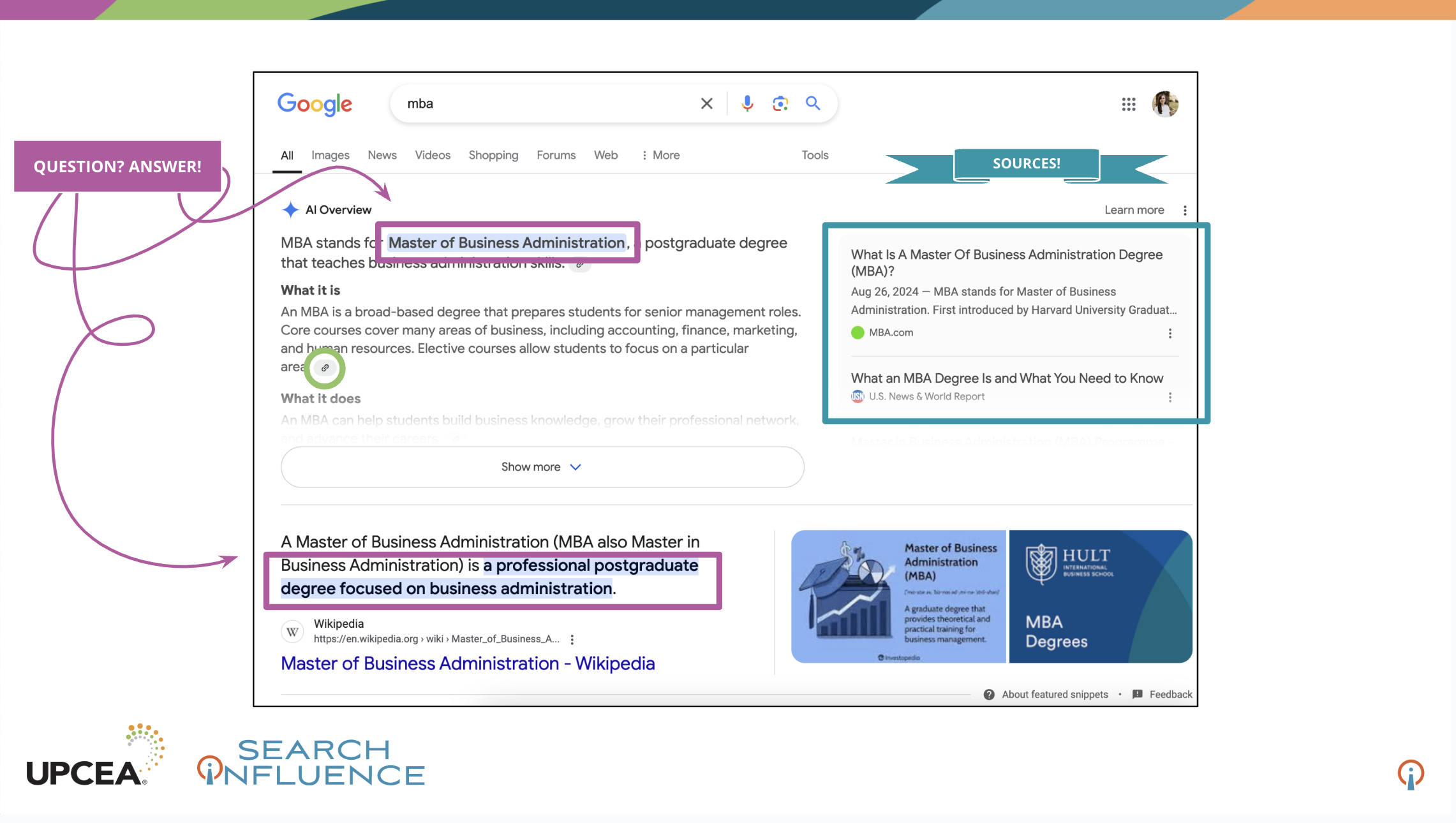
      Launched in May 2024, AIOs surface above organic search results to deliver quick, concise summaries of key information in response to queries. Each overview includes clickable sources, allowing users to explore the original content behind the summarized insights.

      Screenshot showing an AI search result

      While helpful for users, AIOs push organic listings further down, reducing visibility — even for top 5 rankings — as prospects may not scroll far enough to find your site.

      Research by Seer Interactive shows that the organic click-through rate (CTR) declines by roughly 70% when an AIO is present in the search engine results. For queries that do not generate an AIO, organic CTR trends around 2.94%. When an AIO is present, organic CTR declines to about 0.84%.

      On the positive side, organic CTR increases to 1.08% when a site is included as an AIO source.

      Adapting your strategy for AI

      While gen AI, whether ChatGPT or an AI Overview, is disrupting the search landscape, it doesn’t mean you should abandon focus on your SEO strategy. Instead, refine your university’s strategy to embrace AI and use it as a different opportunity to appear in front of prospects.

      To adapt your strategy to account for AI searches:

      • Optimize for commercial/transactional keywords: Informational-intent keywords (ex: “Why pursue an MBA?”) trigger an AIO 99.2% of the time. However, they only display 10% of the time for commercial and transactional-intent keywords (ex: “MBA program online”). Organic click-through rates are likely higher for these types of searches since they are less likely to be overshadowed by an AIO. While you shouldn’t deprioritize informational-intent keywords entirely, you should pay love to relevant commercial and transactional terms.
      • Evaluate search competition and how well you rank: Knowing how competitive your search phrases are and where your content ranks helps identify the changes needed to improve your visibility. If a search term does not have considerable competition and you rank well for it already, you may just need to optimize the content to potentially grab a spot in an AIO.
      • Look at search intent: Search intent informs how to develop your content. For example, if the search intent is informational, you’ll want to draft your content in the format that Google most often prefers for these types of searches (i.e., articles, videos, and guides). Step-by-step, “how-to” content generally ranks best, and thus gets pulled into an AIO, for informational content.
      • Develop question-based content: Google’s primary job is to help people find answers to their questions. Your content should always be positioned toward providing answers to those questions. If you’re unsure of the questions your prospective students are asking, you can perform a search of the root keyword term and look at the People Also Ask (PAA) section.
      • Make your content digestible: Your content should be clear and scannable for both prospects and search engines, using headings, bullet points, and short paragraphs. AI platforms like ChatGPT favor conversational, natural language, so optimizing for human-like speech can also boost your chances of being included in AI-generated responses.

      Impact of social search on SEO

      After AI, the second most disruptive search trend to consider in 2025 and beyond is social search.
      Social search refers to the use of social media platforms as search outlets, where users find information, recommendations, or content within platforms like TikTok, Instagram, or LinkedIn. This trend leverages the power of community-driven insights and visually engaging formats to connect users with information in a more interactive way.

      For higher education, social search means prospective students are increasingly using these platforms to explore programs, read reviews, and engage with content that shapes their enrollment decisions.

      To effectively reach these searchers, institutions must understand the different sides of social search and how each offers a new way of meeting prospects online.

      Types of social search

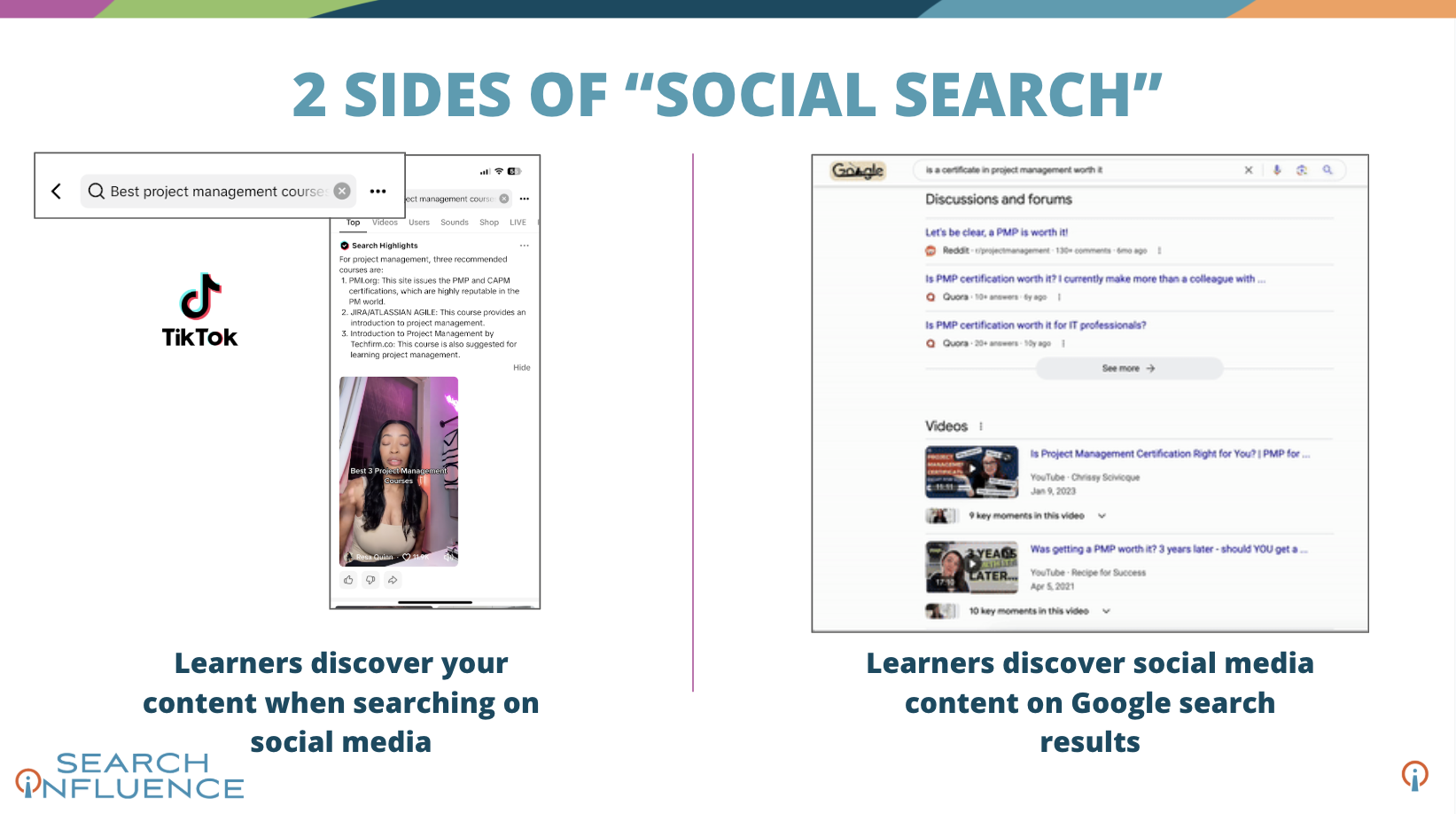
      There are two ways social search works. One involves prospective students searching for your content directly on social media, while the other happens when your social media content surfaces in search engine results

      Screenshot showcasing different types of social search

      The first side to social search is gaining steady favorability among searchers, primarily younger generations. According to Hubspot research, in 2023, roughly 15% of people preferred to search directly on social media over traditional search engines, with about 30% of Gen Z and Millennials most likely to use this method. However, in 2024, Hubspot found that the percentage of all generations that prefer to search on social media had increased, up from 15% to 21%.

      The other side of social search presents the opportunity to enhance your brand’s visibility directly within search engine results. More and more social sites, like LinkedIn and YouTube, are ranking on Google, and sometimes they even pull into AIOs. By optimizing your social profiles for search, you can increase the likelihood of appearing in these high-visibility spots, referring more prospects to your institution.

      Adapting your strategy for social search

      Since it offers more real estate for you to be found online, social search can have a considerable impact on your SEO strategy. When you prioritize building robust social media content, you can reach prospects both in traditional search engines and across highly trafficked social media platforms.

      To successfully integrate social search into your SEO strategy:

      • Repurpose your website content on social: The most efficient way to get started is to repurpose your high-performing content on your social accounts. You can do this by republishing videos from your site to your social account or publishing text-based articles on platforms like LinkedIn. Other ideas include adapting your blog content into videos or crafting video overviews of key program page information.
      • Expand your definition of social: When most people think of social media, they picture Instagram, TikTok, and Facebook. However, sites like YouTube, Quora, and Reddit are their own forms of social media and are often filtered into the search results, too. When you embrace all social search outlets, you can improve your visibility on social platforms themselves, potentially making you more visible in a Google search.
      Looking for more insights into the latest SEO trends for 2025? Check out our blog, “SEO Higher Education Trends in 2025: How to Compete,” for the full breakdown.

      Strategies to attract and enroll the modern learner

      Start investing in SEO now

      The definition of SEO has broadened to include three mediums for meeting your audience online: traditional search engines, AI platforms, and social media. As a higher education marketer, you now have extra opportunities to nurture your prospects down the funnel, but it won’t happen without a solid investment in SEO.

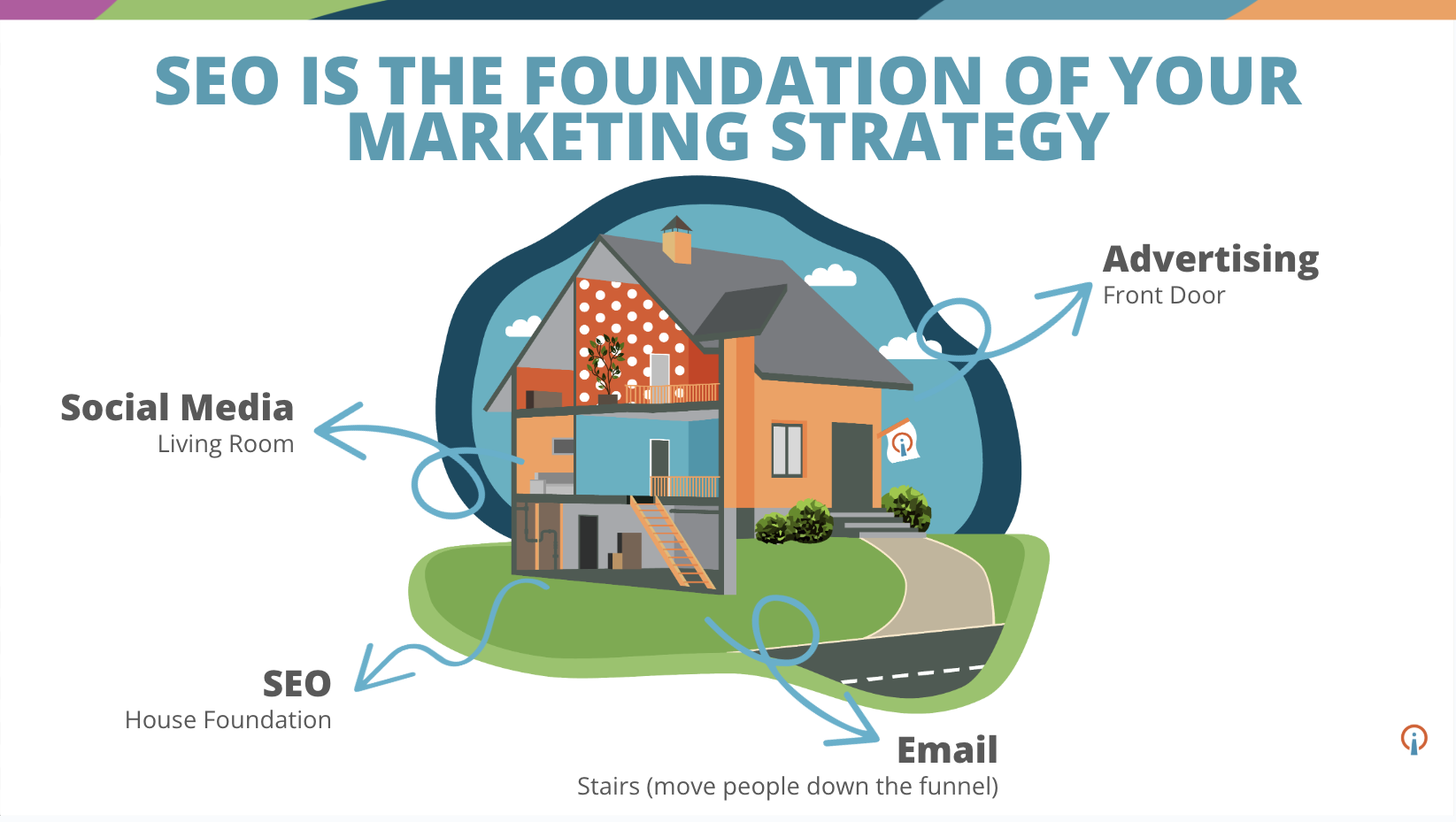
      While 84% of marketing departments view SEO as a core part of their marketing strategy, half (51%) do not have an established strategy in place. SEO is not additive or something to execute piecemeal when you have time or can just do the easy bits — it’s the foundation of your marketing strategy. Your website is where all your other marketing efforts lead, with SEO being the area of marketing that yields the most long-term results.

      A graphical explanation of SEO in marketing strategy

      Ranking high in search continuously becomes more complex with the latest trends, and the student journey is changing. If your university fails to adopt a comprehensive SEO strategy, it could result in losing prospects to more visible competitors.

      Develop the tenets of a solid SEO strategy

      Since SEO is foundational, it must serve as the solid framework upon which your entire marketing strategy is built. A strong SEO strategy prioritizes impactful tactics such as:

      • Targeted, relevant keywords tailored to each program, degree, or certificate page
      • Content plans for every offering, including pillar pages and cluster content
      • Link-building strategies that leverage profiles, directories, PR/media, and internal linking
      • Regular monitoring of technical site health to ensure peak performance

      Equally important is establishing key performance indicators (KPIs) and implementing a routine reporting process. Metrics such as organic inquiries, organic traffic, referral traffic from key sources, and rankings — including competitive comparisons — are essential for tracking success.

      Despite its importance, reporting is often overlooked. Our research with UPCEA reveals that while 62% of institutional leaders want regular updates on SEO metrics, only 31% currently receive them, leaving a critical gap in strategic oversight.

      If you lack the skills, time, and resources to execute a proper SEO strategy, consider working with an agency. They can help take much of the strategizing off your plate, while also granting you the confidence that your strategy is both up-to-date and optimized for success.

      Key Questions From the Webinar Audience

      Should we write in the first person when using question-based content since many users search using first-person wording?

      Using first-person language in question-based content can be effective but isn’t mandatory. FAQs and similar website sections typically adopt a second-person perspective, as it directly addresses the reader. Both approaches can rank well in search results, so the choice ultimately depends on your university’s style and tone. However, consistency across your content should always remain a priority.

      What’s the best way to find keywords to help with an SEO strategy?

      Begin by identifying root keywords related to your programs and understanding what prospective students are searching for. You can also utilize keyword research tools to expand this list and analyze metrics like search volume and ranking difficulty. Once you have a refined list, evaluate search intent to ensure the keywords align with your content’s purpose. A practical approach is to search for the keyword directly and review the top-ranking results to confirm its relevance to your target audience and content strategy.

      Should social media efforts focus on university accounts, personal accounts, or both?

      University accounts are often the primary choice for social media efforts. However, leveraging personal accounts, such as those of professors or staff who can act as influencers or thought leaders, can significantly enhance your strategy. Using both in tandem allows for broader reach and a more personalized connection with your audience.

      Guest writers tend to get better rankings within search engines. Is it wise to invest in such writers?

      The value of guest writers depends on their qualifications and expertise. Writers with specialized credentials or industry authority can enhance content ranking and credibility. Additionally, consider whether their content is well-optimized for SEO and aligns with your goals. Evaluating these factors will help determine whether guest writers are a worthwhile investment for your strategy.

      Is the shift to conversational content replacing keyword-centric strategies?

      While conversational content is becoming increasingly important, it doesn’t replace the need for keyword-centric strategies. High-value head terms and less conversational searches will always play a crucial role in driving visibility. A smarter approach balances both, integrating conversational content alongside targeted keywords to address diverse user intents.

      Discover More Higher Education SEO Best Practices

      Staying ahead of the latest trends in SEO is the most effective way to reach the modern learner and meet your enrollment goals in 2025. For deeper insights into the state of the industry and how you can adapt, be sure to watch the full recording of “Top Trends for Your 2025 SEO Strategy to Attract the Modern Learner,” linked here.

      Feeling stuck on implementing a strategy that moves the needle toward full-funnel success? Search Influence is here to help with higher ed resources to fuel your enrollment pipeline:

      • SEO Higher Ed Research Study: Read the latest on higher ed SEO, where marketing leader priorities lie, and the work that your university must do to outpace your competitors.
      • SEO Blog: Learn how to make a strong case for SEO to your higher-ups to ensure your university’s organic presence is optimized for success.
      • SEO Workbook: Gain access to exercises that help you develop three months of SEO techniques to boost your online visibility, from keyword strategy to technical SEO improvements.
      • SEO Roadmap: Rev up your SEO engine with snackable strategy recommendations for one top degree or program, plus dedicated time with our team to review and consult.

      Your higher ed SEO goals are within reach. Solidify your visibility in changing times with expert support today.

  • SEO In-House vs. Outsourced: Should You Hire an Agency?

    Search Influence SEO

    Key Insights

    • SEO is crucial for online visibility, increased website traffic, brand recognition, and revenue growth.
    • While it may be tempting to handle SEO in-house, it’s essential to recognize that effective SEO requires meticulous attention to detail, constant monitoring, and adaptation to evolving search engine algorithms.
    • When deciding between in-house and outsourced SEO, consider your budget, the need to stay updated on SEO trends, your SEO goals, and the tech necessary for effective SEO.

    Incorporating SEO into your digital marketing strategy is paramount in today’s fiercely competitive online arena. SEO (Search Engine Optimization) is one of the driving forces behind your business’s online visibility.

    It’s the key that unlocks the doors to higher website traffic, increased brand recognition, and, ultimately, greater revenue.

    When deciding the best route for your SEO success, it might be tempting to take SEO efforts into your own hands, especially if you have an in-house team with some digital marketing know-how.

    After all, who understands your business goals better than your employees? But before you embark on the journey of handling SEO in-house, it’s crucial to pause and reflect.

    Effective SEO isn’t just about understanding your business; it’s a multifaceted discipline that demands meticulous attention to detail, constant monitoring, and adaptation to ever-evolving search engines.

    In this blog post, we’ll delve into the debate of SEO in-house vs. outsourcing, offering insights and compelling reasons why entrusting your SEO efforts to a specialized SEO agency may be the smartest move for your business’s growth and online success.

    Skills & Knowledge for Effective SEO

    If you’re considering taking your SEO efforts in-house, the SEO skills you need to drive results include:

    Research and analysis

    Crafting a successful SEO strategy hinges on thorough research and analysis. This entails extensive keyword research and competitive analysis, the basis for well-informed SEO campaigns.

    Content writing

    Content remains central to SEO, demanding the creation of SEO-friendly materials. This encompasses everything from on-page optimizations to new content marketing pieces. Proficient content writers produce high-quality, engaging content that resonates with your target audience while also favorably positioning your site in search engine results.

    Technical SEO expertise

    Technical SEO is a critical facet of the SEO landscape. It involves optimizing website structure, enhancing loading speeds, and ensuring search engine compatibility.

    Website development

    Proper SEO goes hand-in-hand with seamless website development. SEO success often requires collaboration with web developers and graphic designers to create a user-friendly, visually appealing website. A well-designed website improves user experience and plays a pivotal role in SEO rankings. Search Influence’s web development team works with your existing website to execute our SEO recommendations.

    Outreach / PR for link building

    Link building is a fundamental element of SEO. Building valuable backlinks demands skillfully executed outreach and PR activities. These high-quality backlinks enhance website authority and visibility in search results.

    Data and analytics

    Data-driven decision-making is at the core of effective SEO. Leveraging advanced analytics tools, SEO practitioners monitor the performance of strategies, providing insightful reports.

    Analytics and lead tracking allow for adjustments and alignment of SEO efforts with your business objectives.

    These skills and knowledge areas are essential for anyone looking to successfully navigate the complex world of SEO. Whether you choose an in-house SEO team or partner with an SEO agency, understanding these foundational aspects is crucial for achieving favorable results in the digital landscape.

    Time Commitment for Successful SEO

    Effective SEO isn’t a one-time task; it’s an ongoing commitment that demands significant time and effort. Typically, you can expect to allocate anywhere from 25 to 50 hours per month for SEO-related activities. This allocation includes time spent on strategy development, execution, and continuous evaluation.

    SEO campaigns require meticulous planning and execution, involving keyword research, content optimization, technical SEO enhancements, and link building efforts. Managing this workload can overwhelm a small business or those with limited resources.

    Plus, SEO isn’t static. Search engine algorithms evolve, user behavior changes, and competitors adapt their strategies. To remain competitive, you must update your SEO strategies and tactics every three months. This iterative approach ensures your SEO campaign stays aligned with industry trends and search engine updates.

    It’s essential to take a step back and assess the performance of your SEO efforts annually. Determine which pages are excelling in search engine rankings and which are not. This evaluation allows you to reallocate resources and update your priorities for the following year.

    For many businesses, maintaining this level of commitment and staying up-to-date with the SEO world can be challenging. This is where SEO agencies and their teams of SEO experts come into play, offering the time commitment required and the expertise and ongoing training needed to ensure your business grows and thrives in the digital marketing arena. An agency’s dedicated marketing manager or SEO team can handle specific tasks and provide the time and skills to drive your business forward online.

    What You Get From a Skilled SEO Agency

    Outsourcing SEO to a skilled SEO agency offers many advantages that impact the success of your projects.

    Some of the benefits of hiring a skilled SEO agency include:

    • Access to and Knowledge of Tools: SEO agencies are equipped with a wide array of essential tools and resources for effective SEO management, such as Semrush, Ahrefs, and Google Search Console. These tools aid in keyword research, competitive analysis, and performance tracking.
    • Staying Up-to-Date on SEO Trends and Changes: SEO is a dynamic field with frequent algorithm updates and evolving best practices. SEO agencies are dedicated to staying current with these changes, ensuring your SEO strategy remains effective and compliant with industry trends.
    • Established Processes for Implementation: SEO agencies have well-defined processes for implementing changes and optimizations swiftly and efficiently. This systematic approach ensures a seamless execution of your SEO strategy.
    • Experience: SEO professionals within an agency have extensive experience working on various SEO projects. Their expertise allows them to easily navigate the complexities of SEO, offering solutions tailored to your unique needs.
    • Skills Across Specialties: A skilled SEO agency boasts a diverse team of experts, including content writers, researchers/strategists, and technical SEO specialists. This multidisciplinary approach provides you with a range of skills at your fingertips without the need to build and manage an in-house SEO team.
    • Data-Backed Strategy: SEO agencies base their strategies on data-driven insights. They analyze performance metrics to gauge the impact of your tactics on rankings, traffic, and lead generation, ensuring concrete evidence guides your SEO journey.
    • Diagnosing Underperformance: When your SEO efforts don’t yield the desired results, SEO agencies have the expertise to diagnose underperformance and recommend corrective actions promptly. This proactive approach is crucial for maintaining and improving your organic traffic and search engine rankings.

    Collaborating with an SEO agency grants you access to a team of seasoned professionals who can streamline your SEO efforts, enhance your online visibility, and confidently drive your business forward.

    An outsourced SEO success story

    The Tulane School of Professional Advancement (SoPA) partnered with Search Influence, an experienced higher education digital marketing agency, to enhance their online visibility and attract prospective students. Over this multi-year collaboration, Search Influence has implemented a suite of digital marketing strategies, including SEO, paid digital ads, and email marketing. These digital marketing tactics have increased enrollment across various programs, from bachelor’s to master’s programs and graduate certificates.

    One of the standout success stories from this partnership came when Search Influence helped Tulane SoPA bring an underperforming third-party Online Program Management (OPM) built microsite back from the dead.

    On the direction of Tulane SoPA’s former OPM partner, the private continuing education school hosted information about their information technology and cybersecurity degrees on a microsite separate from their main website.

    Tulane SoPA came to Search Influence with the following concerns about their microsite:

    • The look and feel (user experience) was inconsistent across the two properties.
    • The OPM did not allow Tulane SoPA to apply edits to the microsite, adding another layer of complication that made it difficult to capitalize on the IT undergrad program.
    • It was difficult to holistically analyze data and performance.
    • The former OPM partner owned Tulane SoPA’s microsite, which meant that a vendor change would prompt the loss of any SEO authority gained from the microsite.

    On top of the above concerns, Search Influence also recognized a separate set of challenges:

    • Running these two programs on individual websites proved to be a counterproductive strategy. The online visibility of both programs suffered as they couldn’t tap into the wealth of educational content available on the primary website. Conversely, the main website lacked the necessary depth of information about these programs and what they offered.
    • Both websites faced the risk of being flagged for duplicate content. Vital details such as tuition fees, the admissions process, and financial aid information were duplicated on each site, making them susceptible to search engine penalties. Neither site was positioned to organically rank well for IT or cybersecurity keywords, nor were they effectively nurturing prospective students interested in these programs to take the next step and apply.

    Search Influence used an SEO-first approach to migrate the OPM microsite pages into Tulane SoPA’s main site. At the end of the project, the microsite was completely sunset.

    As a result of this strategy, Tulane SoPA:

    • Enhanced their content’s richness by implementing comprehensive front and back-end content optimization and expansion strategies
    • Ensured the microsite’s search engine prominence remained intact during a seamless technical transition
      Solidified its position as a prominent leader by actively refining conversion strategies and introducing supplementary inquiry forms

    Search Influence’s expert SEO knowledge and implementation fixed Tulane SoPA’s website woes and helped them drive more prospective students to their site.

    The results below look at a year-over-year comparison to the three-months prior to the migration (to account for seasonality).

    • 90% increase in total organic traffic
    • 456% increase in organic blog entrances
    • 890% increase in organic blog traffic
    • 895% increase in new users to the blog
    • 54% of organic website traffic is attributed to the blog in this time period, compared to just 10% prior.

    This success reflects the expertise of an outsourced SEO agency in driving targeted results and leveraging industry insights to optimize websites. It demonstrates the value of outsourcing SEO tasks to dedicated specialists and the potential for substantial business growth through practical SEO work.

    Search Influence SEO

    Questions to Ask Yourself When Making Your Decision

    What’s our organization’s budget for SEO services?

    When deciding between in-house SEO or outsourcing SEO services, consider the following financial factors:

    • Initial Investment and Ongoing Costs: Understand the distinction between one-time setup costs and monthly or annual expenses. Also, consider potential overruns or unexpected costs that may arise during your SEO journey. You will be responsible for these unforeseen costs if you choose in-house SEO.
    • Cost of an In-House SEO Expert vs. Agency Retainer/Fees: Compare the cost of hiring and maintaining an in-house SEO team to the fees associated with an SEO services agency or freelance SEO expert. If you choose to outsource SEO, it may be more expensive upfront but will save you money and headaches in the long run.
    • Tools and Software: Evaluate the availability and cost of essential SEO tools and software needed for effective SEO campaign management. Can your in-house team afford the necessary digital marketing software?
    • Training and Conferences: If you choose an in-house SEO specialist, you must set aside funds for courses, webinars, and potentially attending SEO conferences for your SEO professional’s ongoing education and skill enhancement.

    While hiring a skilled SEO agency for your higher education marketing can help you craft successful campaigns, Search Influence understands that might not always be in the budget.

    That’s why we created an SEO workbook to help higher ed markets take charge of their online campaigns.

    Do we know the latest SEO best practices and trends?

    When deciding between in-house SEO or outsourced SEO services, you should consider the following:

    • Internal Expertise: Assess the current knowledge level of your internal teams or SEO manager and identify any gaps in expertise that might require external training or assistance.
    • Stay Up-to-Date: Recognize the frequency of search engine algorithm updates and the importance of staying ahead in a constantly evolving field.
    • Dedicated Learning Time: If you can’t allocate regular time for your team to learn and stay updated on the latest SEO best practices, ensuring continuous improvement, you should consider hiring an SEO specialist agency.

    What are the goals of our SEO project?

    When deciding between in-house SEO or SEO outsourcing, you should consider the following:

    • Short-Term vs. Long-Term Goals: Define immediate objectives and long-term SEO strategies to ensure your SEO efforts align with your business goals.
    • On-Page vs. Off-Page Optimization: Determine the balance between improving on-page website elements and addressing off-page SEO factors to achieve your desired results.
    • Local vs. National Focus: Decide whether to prioritize local search optimization or expand your reach to a broader national or global audience.
    • Integration With Other Marketing Efforts: Understand how SEO will fit into your overall marketing strategy, including its integration with PPC, social media, and email marketing efforts. Most SEO agencies can handle all your digital marketing needs.

    What does a staff member or agency need to learn about our niche?

    When deciding between in-house SEO or SEO outsourcing, you should consider the following:

    • Unique Challenges of Niche Industries: Recognize potential obstacles or limited resources specific to your niche sector that may impact your SEO strategy.
    • Specialized Knowledge: Consider the specific information needed to understand keywords, your target audience, and the intricacies of your industry, which will be vital for practical SEO work and content creation.

    Do we have the technical skills and software subscriptions necessary for effective SEO?

    When deciding between in-house SEO or an outsourced agency, you should consider the following:

    • SEO Toolkits: Review the availability of tools for keyword research, link building, and on-site optimization to ensure you have the necessary resources for your SEO campaign.
    • Website Infrastructure: In order to implement effective SEO, you must have someone who knows how to evaluate your current website’s SEO-friendliness and then determine whether migrations or significant overhauls are needed.
    • Analytics and Reporting: Ensure access to robust analytics tools that allow you to measure and report on the progress of your SEO efforts effectively.
    • Integration Capabilities: Before deciding to bring your SEO in-house, you should determine if you know how to integrate SEO tools with other marketing and analytics platforms to streamline your SEO operations and improve overall efficiency.

    After considering your SEO goals and industry knowledge, it will be easier to decide between an in-house or outsourced SEO strategy.

    Should You Outsource SEO Services or Build an Internal Team?

    Considering that 68% of online experiences begin with a search engine, you can’t afford to ignore SEO.

    But should you build an in-house team or hire an agency?

    Several key takeaways emerge when deciding between outsourcing SEO services and building an in-house team. Your choice depends on various factors, including budget constraints, existing expertise, the need to stay current with SEO trends, and your specific project goals.

    One critical consideration is the remarkable potential of partnering with the right SEO agency.

    When you collaborate with a skilled agency, they don’t merely provide services; they become an extension of your team. This partnership can yield immense cost savings, as agencies have the tools and expertise required for efficient SEO results.

    Search Influence Can Help Your Business Grow

    As a leading SEO agency in New Orleans, we understand the significance of being found online. That’s why we’ve spent nearly 20 years helping businesses just like yours find success.

    Our dedicated experts have honed their SEO skills through years of strategizing, testing, and developing cutting-edge methods to ensure potential customers can discover your business.

    Take Search Influence’s In-House vs. Outsourcing SEO Quiz to answer whether partnering with a higher ed digital marketing agency is the right approach for your institution.

    Your journey to digital success starts here.

    Image Sources:

    Image 1: https://images.unsplash.com/photo-1531545514256-b1400bc00f31?auto=format&fit=crop&q=80&w=2874&ixlib=rb-4.0.3&ixid=M3wxMjA3fDB8MHxwaG90by1wYWdlfHx8fGVufDB8fHx8fA%3D%3D

    Image 2: https://images.unsplash.com/photo-1516321318423-f06f85e504b3?auto=format&fit=crop&q=80&w=2940&ixlib=rb-4.0.3&ixid=M3wxMjA3fDB8MHxwaG90by1wYWdlfHx8fGVufDB8fHx8fA%3D%3D

  • Top 5 SEO Skills Necessary to Drive Results

    Key Insights

    •  Proper search engine optimization (SEO) increases the chances your website will rank highly in search engine results, which could introduce more people to your brand.
    •  Keyword research, content writing, SEO-focused web development, link building, and analytics are all key SEO skills that work together to give you greater results.
    •  Do-it-yourself SEO presents several pitfalls and challenges that waste time, money, and resources. Having a dedicated team of SEO specialists is a more reliable way to achieve long-term search success.

    Imagine a world where over half of your website’s traffic comes purely from organic search (i.e. the unpaid listings that appear on a search engine results page).

    In reality, it’s not that far-fetched, considering 53.3% of website visits originate from this digital marketing channel.

    But, ranking at the top of search engine results and reeling in more website traffic isn’t just about having an online presence. It’s about leveraging the magic touch of search engine optimization (SEO) to rank high and stay ranked high.

    It takes many different skill sets — technical, creative, strategical, and analytical — to truly “win” at SEO and markedly increase website traffic. As an under-experienced SEO practitioner, proper SEO can be difficult to successfully implement.

    You need an experienced team to maximize your SEO campaigns and enjoy the benefits of a well-optimized, high-traffic site.

    5 Essential SEO Skills to Boost Website Rankings

    SEO professionals in a brainstorming meeting

    Research and analytical skills for effective SEO

    Every search starts with a keyword or search term.

    Consequently, every SEO strategy starts with keyword research.

    Keyword research is the process of identifying words, phrases, and queries that users search for and incorporating them into your website’s content to improve your site’s rankings on search engine results pages. It entails analyzing what you currently rank for, what your competitors rank for, and what you should rank for.

    Performing thorough keyword research means better understanding users’ search intent, which is what they are trying to get out of a particular search. But, for more novice SEO practitioners, pinpointing intent can be tricky. Many phrases and queries can be interpreted in multiple ways.

    For example, a higher education institution would have to consider the many possible meanings behind the keyphrase “how to go back to school.” An SEO specialist can cater to each niche search, tailoring strategies to capture where prospective students are on their path to enrollment.

    Content writing for keyword optimization

    After identifying high-value keywords and phrases, you need to integrate them into the written content on your website.

    SEO experts use relevant keywords to create compelling title tags and meta descriptions for each page, as well as in longer sections of text, such as blog posts and descriptions of products and services.

    Using these SEO copywriting skills for engaging content creation ensures that your site contains the right keywords and phrases. This improves your on-page SEO and your rankings in search engine algorithms.

    But, including keywords is only half the battle. First and foremost, your content needs to include all the important information on the topic and meet Google’s E-E-A-T standards (Experience, Expertise, Authority, and Trustworthiness). With an SEO specialist’s content and research expertise, both users and search engines will know what your business is about and the services you provide.

    Technical SEO expertise for site health

    Having a slow, clunky, user-unfriendly website will quickly drive potential customers away.

    A professional digital marketing team has the SEO knowledge and technical SEO skills for site speed optimization, which includes:

    •  Implementing a responsive and easy-to-use design
    •  Crafting readable and logical URLs
    •  Optimizing image sizes

    Proper technical SEO means anticipating the unique challenges that a site presents and using the toolkit of skills to mitigate them.

    Link-building skills for off-page SEO

    Backlinks are links to your website that exist on sites other than your own. They help build your web pages’ quality, relevance, and credibility, which ultimately aids with gaining Google’s trust and ranking higher in search.

    Seasoned SEO specialists use a number of strategies to grow the number of backlinks to your website, including link building and link earning.

    Link building involves manually placing links to your site on social media platforms and directories such as Yelp and Google Maps. With link earning, an SEO professional pinpoints other websites to link to yours organically. This “earned” backlink often occurs because the external site finds your content helpful and engaging to its users.

    Analytics and data analysis for SEO

    Analytics and data analysis help you learn more about your website’s audience and whether your SEO efforts work as intended.

    SEO professionals use tools like Google Search Console and Google Analytics to gather information about visitors to your site, including their age, location, gender, and interests. They can also learn how long visitors stay on your website, click-through rates, which pages are viewed the most, and which features and pages are getting ignored.

    This information is incredibly valuable for revising and improving your overall SEO strategies moving forward.

    Challenges and Pitfalls of DIY SEO

    Unless you have the resources and budget for a robust in-house SEO team, you’ll need to partner with an outside SEO-focused agency. One unexpected pitfall or neglected search tactic could lead to missed conversion opportunities and rankings well past the 10th+ page in the search results.

    The cost of subpar SEO efforts isn’t just financial. When you settle for less, you can face costly mistakes and consequences like:

    • MISTAKE: Only focusing on on-site SEO and missing out on opportunities to build backlinks.
    • IMPACT: Hinders your site’s authority and ranking potential, limiting its reach and effectiveness in attracting a wider audience.
    • MISTAKE: Neglecting to create and optimize page titles and meta descriptions.
    • IMPACT: Leads to suboptimal search engine rankings, reduced click-through rates, and a missed opportunity to attract users through relevant queries.
    • MISTAKE: Not regularly adding fresh, relevant content to your site.
    • IMPACT: Results in under-optimized and insufficient content that fails to interest users, which can negatively affect search engine rankings.
    • MISTAKE: Lack of comprehensive keyword research and proper keyword targeting.
    • IMPACT: Ends in fewer keyword rankings, which leads to less visibility in search engines and decreased site traffic.
    • MISTAKE: Viewing SEO as a one-time task instead of continuously improving existing strategies and trying new ones.
    • IMPACT: Results in stagnant or declining search rankings, reduced web traffic, and missed opportunities for growth and adaptation in a constantly evolving digital landscape.
    • MISTAKE: Failing to meet Google’s E-E-A-T requirements (Experience, Expertise, Authority, and Trustworthiness) for on-site content.
    • IMPACT: Leads to useless, under-performing content that is unlikely to engage users or generate backlinks.

    Why You Need an SEO-Focused Agency in Your Corner

    A notebook with notes about SEO

    Expertise is your greatest ally

    Choosing an SEO-focused agency means tapping into years of cross-industry expertise. Their holistic teams master everything from the intricacies of technical SEO to content strategy and analytics. Plus, they’re always on the pulse of search’s ever-evolving best practices and SEO industry standards.

    You get help tracking leads and overall performance

    With an SEO-specialized agency, tracking leads and assessing overall performance become seamless. By mastering platforms such as Google Analytics, they map out user trends, traffic flow, and conversion points. Equipped with a constant pulse on keyword performance, you’re kept in the loop about rankings, search prevalence, and click metrics.

    Scaling efficiency is the standard

    With an SEO-attuned agency by your side, you get efficiency that’s geared to scale. Their prowess ensures marketing techniques ebb and flow with your growth and diversifying needs, always on the lookout for new market horizons and untapped customer sectors.

    It’s cost-effective in the long run

    Partnering with an SEO-driven agency is a strategic move for long-term cost savings. Their expertise ensures the best search ROI — making every dollar count to drive maximum value from your investment. Proficient teams maintain efficient resource use, eliminating unnecessary expenditures to achieve the best possible results. In addition, their arsenal of specialized SEO tools, often expensive to procure independently, becomes yours.

    Our New Orleans SEO Agency Is Here to Help

    Using SEO successfully takes a lot of skill and patience, but the payoff is well worth the effort.  From higher search rankings and boosted web traffic to increased revenue, the rewards are transformative — and imperative — for your overall performance.

    An experienced and dedicated SEO specialist can do the heavy lifting for you and help you see real-world, real-time results.

    Search Influence is an SEO-focused, full-service digital marketing agency with the tools, expertise, and driven professionals you need to build your business through SEO. Our designers, developers, writers, and campaign strategists will work together to help you reach and grow your online audience with greater ease than ever before.

    Ready to craft a winning SEO strategy? Contact us today to learn more about our SEO services and results.


    Images:

    Unsplash

    Unsplash

  • What Happened to Facebook’s 20% Text Grid Tool? (Updated 2020)

    Editor’s Note: This post was originally published on March 25th, 2016, and has been updated to provide you with the latest information.

    Update (October 1, 2020):

    Back in 2016, we were all so very excited to see the Facebook Grid Tool disappear. Unfortunately, it was replaced with similar restrictions of labeling ads with High, Medium, Low, or Ok amounts of text, and we found that ads were still being penalized for including large amounts of text. So is it true this time? Is it really gone?

    Facebook Grid Tool OFFICIALLY Removed

    See for yourself! The original Facebook Grid Tool (https://www.facebook.com/ads/tools/text_overlay) now redirects to the Business Help Center page on Best Practices For Image Ads on Facebook. These new guidelines strongly advise that testing is the best way to find out what works best for your audience, and we agree! Of course, Facebook still recommends that you should avoid excessive image text. Their new guidelines state “We’ve found that images with less than 20% text perform better,” so it’s clear that they still stand behind their 20% even if they are not enforcing it. As a designer, I agree that there is something to be said for that. Too much text, especially on smaller ads, can negatively impact readability. But what’s so great about the update is that you can now A/B test different types of creative and find what best meets your campaign goals without being limited by Facebook.

    Backend Warnings Removed

    On top of the removal of the actual grid tool itself, we also found that ads with large amounts of text, like this example below, are no longer being flagged by Facebook and campaign reach has not been affected.

    Example of effective Facebook ad with text

    What Does This Mean For You?

    As advertisers, we are thrilled to be more in control over testing creative and optimizing our campaigns. We live for it! For business owners running their own campaigns, this might be somewhat of a scary change. Optimizing campaigns for peak performance can take time and effort, which may be challenging to manage on top of other things. Let us help you! Schedule some time to meet with one of our strategists and discuss your goals as well as any questions you have.


    Wondering about the history of the 20% text grid tool? We’ve been monitoring this for years. Here’s our update from June 13, 2016:

    It looks as though Facebook has officially rolled out this update to the 20% text rule! Here is the link to the new help page. When uploading your images to the new “Image Text Check” tool, you’ll automatically be notified of the likelihood of your ad reaching its intended audience (see our new screenshot below). If you’d like to better understand why your ad receiving less delivery, you can check the Ads Manager “Delivery” column.

    Facebook Screenshot

    Original Post (March 25th, 2016):

    Facebook seems to slowly be rolling up an update to their 20% text rule for Facebook Ads and Promoted Posts, which means some people are no longer able to access the Facebook Grid Tool. Our very own Kaitlyn Levy made this discovery when she was redirected to a Facebook Help Center page after trying to use the grid tool. But this new help page only seems to be accessible to a few, select users.

    So What’s Changed?

    There are four categories for the amount of text allowed on a Facebook ad. Your image text can be considered “OK”, “Low”, “Medium”, or “High.” The amount of text on your ad will determine the reach that it could potentially have. For example, an image that has the following text would be considered “Medium,” which may cause your ad to reach fewer people.

    MediumText

    What Does This Mean for You?

    While the strict 20% text rule seems to be falling by the wayside, the overall amount of text allowed on your ad can still have a huge impact on your ad’s reach. Your ad may not be rejected, but Facebook says that an ad with “High” amounts of image text may not reach your audience.

    Additionally, without a strict grid in place, you may have a bit more flexibility with the layout of your ad, but you still need to keep in mind the overall amount of copy in your message. When loading the examples provided on the help center page into the Facebook Grid Tool, you will see that the example in the “Low” category has 44% text, but the example in the “Medium” category has 36% text. The difference between the two examples is that the “Low” category, even with a larger font that takes up slightly more space on the ad, still has more copy than the “Medium” category example.

    The “Low” Category Example in the Grid Tool:

    NewTextRuleLowCategory

    The “Medium” Category Example in the Grid Tool:

    NewTextRuleMediumCategory

    Are There Any Perks to the New Guidelines?

    Yes! Along with the rollout of the new guidelines, they have also included some “exceptions” to the rule. There are some types of text that won’t limit your ad’s reach. Some of these exceptions include, movie posters, book covers, product images (only where the entire product is seen), legal text, and infographics. Some of the items that will still be counted as text are logos, watermarks, and numbers.

    Do You Have Access to the New Guidelines?

    Check here to find out and let us know by leaving a comment!

    Don’t Have Access? Here’s a Peek at the New Help Center Page:

    NewFBAdTextGuidelines


  • How to Optimize Existing Content for Your Holiday Marketing Campaign

    All of a sudden you realize that the holidays are here and you’re not ready. You have your holiday merchandise in stock, but you haven’t promoted it or even thought about updating your site to include it. It kind of feels like it’s Christmas Eve and you still haven’t gotten that gift on your kid’s wishlist. Are you too late? Will any store still have it in stock? Well, if you have outdated holiday content on your site already, you just might be in luck.

    Animated photo of a person on a laptop computer

    Let’s take a look at a local t-shirt shop here in New Orleans, Dirty Coast, as an example. Dirty Coast offers a wide variety of beautiful t-shirts (and other swag) with clever, locally inspired designs. They’re one of my go-to places for that perfect gift for family members. While I may have a go-to place for New Orleans gifts, there are still about 1,000 people searching for “new orleans gifts” every month, according to a report pulled from SEMRush. Let’s take a look at how Dirty Coast can optimize their preexisting content for this year’s holiday marketing campaign.

    Make Your H1 Relevant and Competitive

    As you may or may not know, H1s are very important for SEO. You want to, ideally, have one relevant H1 on each page of your site. Dirty Coast’s 2018 Gift Guide page shows up as the 7th organic result for “New Orleans gifts”. Fleurty Girl, a local competitor of theirs, is showing up in the #1 spot, so let’s take a look at what they might be doing differently. For starters, the H1 on Fleurty Girl’s page is a little more relevant to the topic. While Dirty Coast has “THE 2018 GIFT GUIDE. GIFTS FROM NEW ORLEANS” for their H1, Fleurty Girl’s H1 is “The Best New Orleans Gifts: Your Ultimate Gift Guide From Fleurty Girl.” The topic “gift guide” actually doesn’t get much volume, so it would be a good idea to adjust the H1 to be more relevant to a topic with a higher search volume like “new orleans gifts.”

    Screenshot of an SEMrush report

    Structure Your Content

    Google loves lists. And on top of that, people like them too! As Matthew Bains discusses in this blog about Writing Tips to Create Web Content That Converts, skimming content is the new normal and bulleted lists help. Taking a look at our example, Fleurty Girl’s page has a numbered list wrapped in H2s and H3s, as well as being organized by different price points. You can see that Google is pulling this list into the description for this page.

    Screenshot of a Google search result

    While the images for each section on Dirty Coast’s site are nice to look at, Google can’t read the headers within these images. So it would actually be better to have the section headers as text wrapped in H2s on the page instead.

    Screenshot of dirty coast website showing recommended holiday gifts for customers' friends and family

    Make Your Content Relevant

    With so little content on the Dirty Coast page, there’s not much opportunity for Google to recognize the content’s relevance to the searched term. Product descriptions can help with that. In looking at the descriptions on the Fleurty Girl blog, there were a total of 11 natural opportunities for them to bring the topic of “new orleans gifts” back up within the content on the page, which ultimately helps Google further associate that page with the search terms. Additionally, it would be nice if users were able to read more about these products, including their prices, without having to click through to the individual product pages.

    Screenshot of Fleurty Girl's website showing best New Orleans gifts under $10

    Add and Optimize Images

    If you don’t already have images, you should. Luckily, Dirty Coast has some, although they may want to update them along with their product lists to only include products that they’re offering this year. In addition to updating them, they’ll want to optimize their images and make sure they have title tags and descriptive alt text. (Side note: you can read more about how to optimize your images in this blog by Shane Kretzmann). Google reads the alt text and title tags to better understand which images to display in image searches. And remember, image searches can also be a great source of traffic to your site!

    Screenshot of Fleurty Girl's online gift guide and the corresponding code

    Always Include a Call to Action

    If you have an e-commerce site, you should be linking to your product pages so that users can easily make purchases. And if that’s still not enough to convert a potential customer, that additional call to action at the bottom of the page telling them to come on in and check out these holiday gifts in person is a nice, soft CTA to tie it all together.

    Need Help?

    As with most things, recommendations may vary on a case by case basis. And these are just some of the things to think about when optimizing your content. Search Influence specializes in optimizing content for a variety of marketing needs. Whether you’re preparing for the holiday season or if you’re just looking to achieve better organic results from the content that’s already on your site, we can help! Contact us today.

  • How to Develop a Strong Content Strategy

    Notepad with words content marketing concept and glasses

    You’ve heard it time and time again, “Creating a strong content marketing strategy is essential.” Is it really that important? Well, according to the Content Marketing Institute, content marketing produces three times as many leads as outbound marketing yet costs about 62 percent less.

    You might still be wondering, what goes into creating a content marketing strategy? Is all of this planning really necessary? While it might seem like something you can just do on a day-by-day basis, building a strategy helps you work more efficiently because you and your team will have already decided how to handle potential issues. But because there are many elements to putting together a successful marketing plan, we’ll walk through some of the most important ones.

    Define Your Goals and Set Your KPIs

    What are you hoping to achieve? You might be looking to get more traffic, position your company as an expert in the industry, increase revenue, improve your search engine rankings, or increase brand awareness. Hone in on what’s most important to your business and clearly define your goals. Set yourself up for success by making your goals S.M.A.R.T. When doing so, make sure your goals are measurable and decide which KPIs (Key Performance Indicators) make the most sense for tracking your campaign’s success. And remember, not every metric is a KPI.

    Know Your Audience and Solve Their Problems

    How will your content help your customers? Your product or service exists and matters because it solves a problem for someone somewhere. Ideally, it should solve a variety of problems for many types of people. An effective content strategy addresses the appropriate audiences by using a variety of content types and educates your audience while they look for information about their problems. But not everyone is at the same stage in their problem-solving quest. Some might still be understanding their problems while others are out there looking for solutions. Keep the marketing funnel in mind as you build out your content strategy.

    Content strategy with words awareness, consideration, decision

    Decide on Publication Platforms and Content Types

    How do you reach your audience? As you work through the process of understanding your audience, you’ll get a better feeling for where they spend their time. First, focus on covering the essentials on your website and blog, and then consider opportunities to broadcast your content beyond that. Make sure your site covers everything that your audience needs to know about your company, its products and services, and what sets you apart. Use your blog to demonstrate your expertise in your niche and maybe even use this as an opportunity to build out other content types that can be shared elsewhere or repurposed into different formats (like infographics and videos).

    Create a Content Calendar

    When do you post what? Now that you know what you want to create, you need to think about how to execute your plan. Creating a content calendar makes it easier to stay focused, keep everything organized, and be productive. You can start with just one month of content in the beginning, but you’ll want to continue building it out in advance and take note of seasonal events, holidays, and other dates that might help you create timely, relevant content further down the road. Take a look at the content types you’ve decided on and then lay out your content strategy, keeping in mind the best times to post and how often to do so. Note any evergreen topics that are relevant throughout the year. They can help you fill in current gaps in your content or provide some flexibility in a time crunch.

    Distribute Your Content and Measure the Results

    What does success look like? It’s finally time to see how successful your strategy has been. To do so, you’ll want to refer back to the KPIs you set and see if you’ve hit your targets. Be sure to think about what’s changed in your industry. Were there any special events or seasonality that might have caused spikes or lowered performance? Be sure to look at your results month-to-month and year-over-year. Monitor your progress and make adjustments at regular intervals.

    Does all of this sound like too much? Creating an effective content marketing strategy can be challenging and stressful, but Search Influence can help! Our content marketing experts know how to research, plan, and execute the goals that are most important to you. If you’re looking to get support on building a content marketing strategy or if you would like a consultation while creating one internally, we’ve got you covered. Speak with one of our strategists today at (504) 208-3900 or fill out this form to request a marketing analysis and proposal.


  • Four Smart Ways to Market Your Tourism Business in the Off-season

    Seasonality is a major marketing challenge for the tourism industry. Considering the struggle to turn a profit during the low season, and the rush of overtime work during the high season, this challenge should come as no surprise. The good news, however, is that we have solutions! With these four smart ways to market during the off-season, travel and tourism companies can combat seasonality and improve business year-round.

    1. Build Email Databases All Year

    Email might seem a bit old-school in the world of digital marketing, but even in 2018, email databases provide a valuable list of people who are genuinely interested in your brand. And when it comes to efficiently targeting your marketing campaigns, interested people who have subscribed to your database are much more likely to buy your product than those who haven’t subscribed. Some simple ways to build your database include prominently featuring sign-up forms on your website and across your social media channels and clearly informing new customers when they will be added to your email list. This transparency will promote trust in your brand and cut down on any annoying surprise emails, thereby limiting your number of unsubscribers and keeping your database numbers strong.

    Even though you’ll be using your email database to communicate during the off-season, it should be a priority during your peak season, as this is when you’ll be interacting with the most customers, both on and offline. For more tips on how to make the most of your email marketing campaign—and which crucial mistakes to avoid—read our past blog post on email marketing for small businesses.

    2. Create a Low-Season Content Strategy

    With your email database in place, you’ll need fantastic content to send to your customers and leads, keeping them engaged with your brand even when they aren’t able to purchase your products or experiences. This Hubspot blog, for example, suggests some great off-season blog topics for pick-your-own fruit or vegetable businesses, including smoothie recipes with frozen berries, and lists of foods for families to grow in the winter. Providing useful and engaging information even when you’re closed can build customer loyalty and encourage people to remember your business for once you’re back open.

    If your business is still open during the off-season, you have even more opportunity to drive sales with content! Consider a blog that addresses a common tourist concern and turns it into a positive opportunity. For example, a company in the tropics, where the rainy season is a big concern, could write a blog focusing on their location’s amazing indoor experiences, like shopping or museums. Or, if the company is a local zoo, they could write a blog explaining different animals that thrive in wet and humid conditions, and then promote the decreased prices and cooler weather that come with a little rain. To make these blogs especially compelling, your team should get out and about during the off-season and share first-hand accounts and photographs of their activities. This will show potential customers what your area is truly like during the off-season and likely convince them that an off-season trip will still be loads of fun. For more great content ideas, visit our content marketing services page, and learn how our business can help yours!

    3. Offer Discounted Off-season Experience Packages

    In addition to sending your team out and about during the off-season, consider using discounted experience packages to send customers exploring, as well. While discounts can feel like a risky strategy for driving business, there are many ways to leverage these discounts to your advantage. For example, host a contest or giveaway and then require the winners to submit photos, videos, or diary entries while on the trip. You can then form these first-hand customer experiences into a blog for your content strategy, or otherwise use them to promote your experience package.

    Because activities and accommodations are already planned in this type of discounted trip, experience packages will likely appeal to short-on-time travelers who want to get straight from Dreaming to Experiencing Moments, without slogging through Organizing and Booking. For more information on these crucial moments, and how your business can use them to attract customers, read our recent blog post on travel micro-moments.

    4. Don’t Forget About the Locals

    Locals deserve a lot of love for showing their hometown love and support during the off-season. The off-season is the perfect time to say thanks to locals, and make some money while you’re at it! Consider offering discounts for local residents, or altering your marketing strategy to promote staycations or otherwise appeal to the local community. Sometimes people just need a reminder of all the fun things they can do in their own city!

    Also, don’t forget that locals are the primary source for visiting friends and relatives, which can contribute heavily to your customer base, especially during the off-season. To see how Search Influence has helped tourism customers in our community market to both locals and visitors, visit our Zoos, Museums, and Attractions page.

    Seasonality will always be a challenge for businesses in the seasonal tourism industry—after all, it’s right there in the name! However, with these four marketing strategies, you can combat the low profits of the low season and improve your business year-round.

    Images:

    Winter, Spring

    Experiences

    Spring in the City