Author: Jeanne Lobman

  • What Your Marketing Dashboard Isn’t Showing You, And How Ours Does

    What Your Marketing Dashboard Isn’t Showing You, And How Ours Does

    Key Insights

    • Most dashboards miss critical context. Standard marketing analytics dashboards typically show surface-level numbers like impressions or clicks, but fail to connect them to real business outcomes like inquiries, acquisitions, or revenue generated.
    • Search Influence marketing dashboards integrate multiple platforms. By pulling from CRMs, call tracking, Google Analytics, Google Ads, and even offline sources, our digital marketing dashboard examples provide a single source of truth for marketing performance.
    • Lead quality matters as much as lead quantity. Search Influence’s marketing dashboards go beyond counting form fills by integrating qualified lead scoring and call tracking data, helping marketing teams focus on the channels most likely to drive conversions.
    • SMART goals make marketing dashboards actionable. Unlike generic marketing dashboard templates, we build dashboards that align directly to Specific, Measurable, Achievable, Relevant, and Time-bound goals, keeping marketing teams focused on progress toward shared objectives.
    • Customization is the ultimate advantage. Search Influence creates customizable dashboards tailored to your business model, ensuring your key marketing metrics tell your story, not someone else’s.

    Imagine looking at your business through a foggy window.

    You can make out some shapes, maybe website traffic here, some social media metrics there, but you’re missing the sharp details that let you make smart decisions.

    That’s how most marketing dashboards work.

    They give you a handful of numbers, but without context, connections, or clarity. They leave digital marketers staring at charts that raise more questions than they answer.

    So what’s the solution?

    At Search Influence, we think a marketing dashboard should do more than just decorate your monthly report. It should tie together multiple platforms, align with your marketing objectives, and give you actionable insights you can use to improve campaigns in real time.

    Even our “standard” dashboards are built to outperform most marketing dashboard examples you’ll see from other agencies.

    And when you need something truly unique? We scope and create custom dashboards that match your business model.

    Here are six key points your dashboard probably doesn’t show you, and how ours does.

    1. Leads From All Sources in One Place

    The Problem: Standard digital marketing dashboards usually spotlight one channel: Google Ads, Facebook Ads, or maybe website form fills. But leads don’t live in silos.

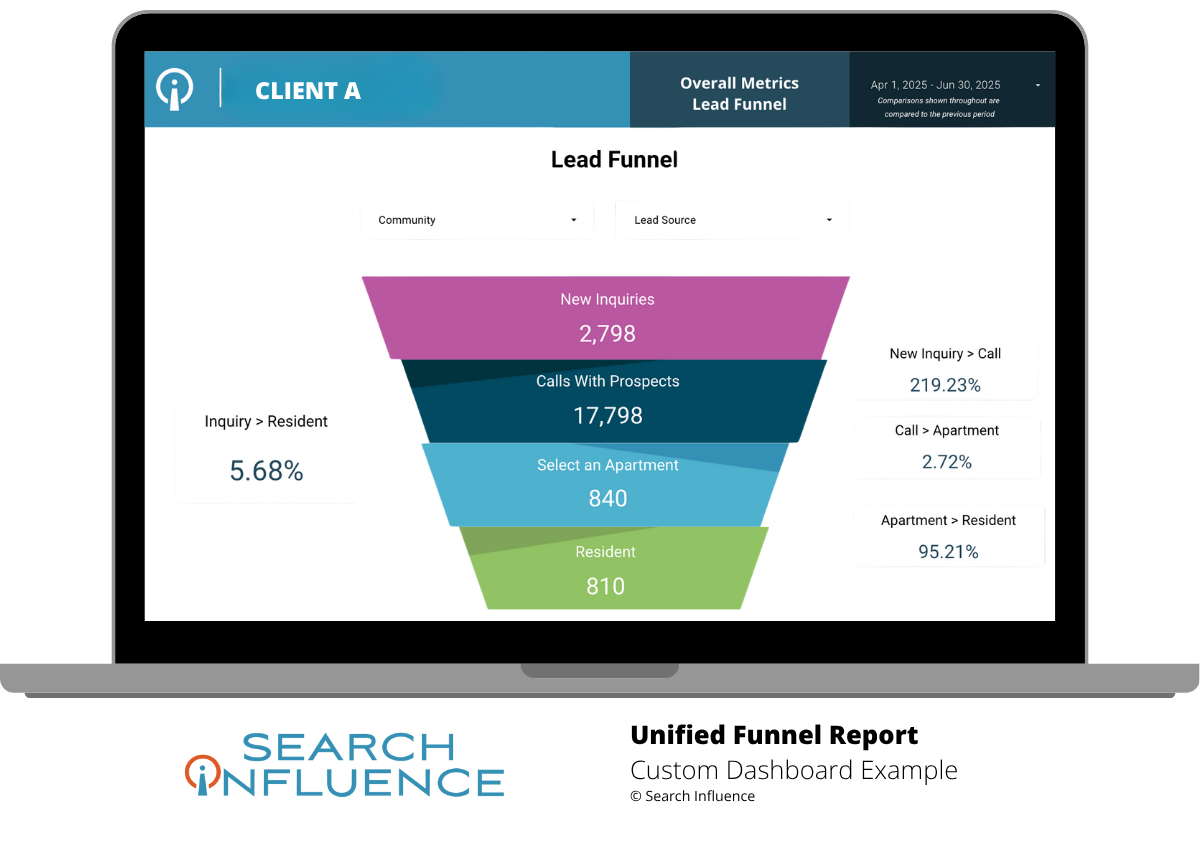
    The SI Difference: We integrate CRM systems, call tracking tools like CallRail, and web forms into one unified lead generation dashboard. Instead of bouncing between platforms, you get a single web analytics dashboard that tracks inquiries, lead generation efforts, and revenue-driving conversions.

    The Benefit: You see the full story of your marketing efforts without the guesswork. One login, one source of truth, and one number you can trust.

    2. Cost Per Inquiry (CPI) and Cost Per Acquisition (CPA)

    The Problem: Many marketing analytics dashboards stop at cost per lead (CPL). But CPL doesn’t tell you whether those leads turn into paying customers.

    The SI Difference: Wherever your CRM and analytics dashboard data allow, we go deeper. We create dashboards that can connect your marketing spend with inquiries and acquisitions, creating a real picture of ROI. Even when we can’t attribute it down to the channel, we show overall CPI and CPA so you understand the cost of growth.

    The Benefit: You make data-driven decisions based on revenue potential, not just click costs.

    3. Lead Quality, Not Just Quantity

    The Problem: A thousand form fills don’t mean much if they’re all spam or unqualified leads.

    The SI Difference: We work with clients to score lead quality. CallRail, for example, allows calls to be tagged and scored. We pull that data into your marketing performance dashboard so you know which channels bring in prospects most likely to convert.

    The Benefit: You stop wasting budget on low-quality leads and double down on marketing channels that actually drive growth.

    4. Multi-Source Data Integration

    The Problem: Your marketing data lives in silos — Google Analytics, social media dashboards, CRMs, email campaign platforms, and more.

    The SI Difference: We merge it all into a single digital marketing dashboard. From SEO dashboards that pull in Google Search Console and keyword rankings, to email marketing dashboards that show open rates and conversions, to paid advertising performance across Google Ads and LinkedIn Ads, everything comes together in one place.

    The Benefit: You see how each channel supports your marketing strategy, without drowning in complex data.

    5. SMART Goal Alignment and Progress Tracking

    The Problem: Many dashboards are just a random collection of numbers. They don’t tell you whether you’re meeting your marketing objectives or hitting key metrics.

    The SI Difference: We build dashboards around SMART goals — Specific, Measurable, Achievable, Relevant, and Time-bound. Your key performance indicators aren’t buried in a sea of metrics; they’re front and center. And for stakeholders who want more detail, we make the detailed metrics accessible with a click.
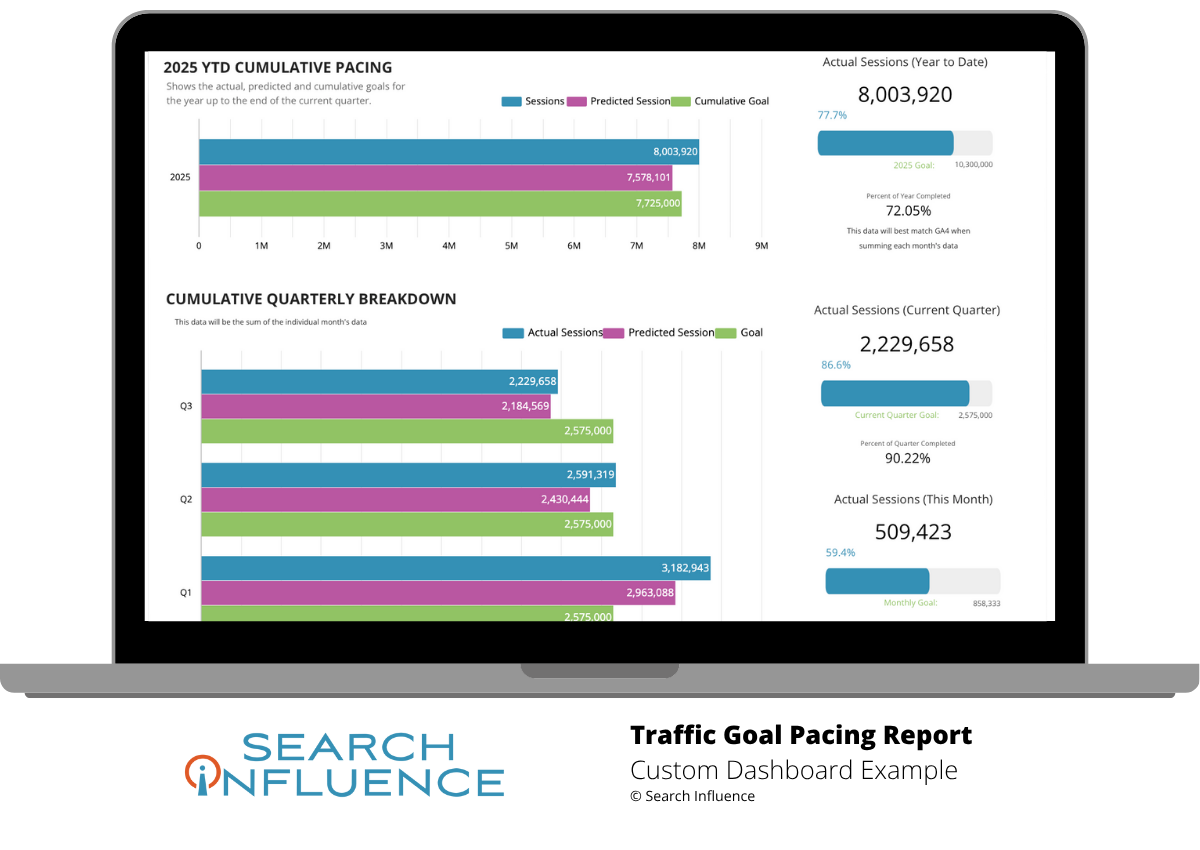
    The Benefit: Everyone sees progress toward the same goals, whether it’s organic traffic growth, lead generation, or improved conversion funnel performance.

    6. Customization for Your Business Model

    The Problem: Off-the-shelf marketing dashboard templates limit what you can measure and how you can view it.

    The SI Difference: Whether you’re in higher education tracking enrollment inquiries, healthcare tracking patient leads, or hospitality tracking bookings, we scope and build customizable dashboards tailored to your operations.

    The Benefit: Your marketing data tells your story, not someone else’s template.

    Search Influence’s Marketing Dashboard Best Practices

    Our dashboards aren’t just pretty charts. They’re high-powered decision-making tools that would even make HAL gush.

    Here’s what we prioritize:

    • Funnel visualization that shows your conversion funnel step by step
    • Integration of all relevant data sources for complete marketing reporting
    • Emphasis on lead quality, not vanity metrics
    • KPI key metrics tracking aligned to SMART goals
    • Custom configurations designed for your specific business
    Marketing Dashboard FAQs

    What does a marketing dashboard include?

    A marketing dashboard includes metrics, visualizations, and KPIs that track marketing performance.

    In practice, this means a dashboard isn’t just a list of numbers; it’s a carefully structured view of how your campaigns are performing across channels. A strong digital marketing dashboard example might combine website traffic, keyword rankings, and lead generation data into charts that reveal trends over time.

    Instead of hunting through Google Analytics, Facebook Ads, and email campaign reports separately, you get one clear picture. Some dashboards even layer in benchmarks or targets, so your marketing teams can quickly see if campaign data is above or below expectations.

    How to create a dashboard for marketing?

    Creating a dashboard for marketing requires defining goals, selecting KPIs, and integrating data sources.

    The process starts with your marketing strategy: What do you want to achieve?

    If your goal is lead generation, your key performance indicators may include cost per lead, lead quality, and conversion funnel stages.

    From there, you identify the data sources (Google Analytics, Google Ads, social media, CRM, etc.) and use a marketing dashboard tool to connect them. The best dashboards allow customization, so you can highlight priority metrics for executives while still offering detailed metrics for specialists.

    Or, you could call Search Influence.

    We scope dashboards that reflect both your goals and your business model, whether that’s patient inquiries, student applications, or e-commerce sales.

    What are the three essential elements of a marketing dashboard?

    A marketing dashboard has three essential elements: relevant KPIs, real-time data, and visual clarity.

    Relevant KPIs ensure the dashboard focuses on the numbers that matter most, not vanity metrics. Real-time or near-real-time data makes sure decisions are based on current performance, not last quarter’s results.

    And visual clarity means presenting complex data in a way that’s easy to interpret, through graphs, funnels, or tables. For example, a marketing KPI dashboard might display how organic traffic, paid advertising, and email campaigns each contribute to overall lead generation. Without all three elements, dashboards risk becoming confusing reports rather than tools for data-driven decisions.

    What is a marketing dashboard used to do?

    A marketing dashboard is used to monitor campaign performance, track ROI, and guide strategic decisions.

    Think of it as a single source of truth for your marketing data. Instead of siloed reports, it consolidates insights into one analytics dashboard so you can evaluate the effectiveness of your digital marketing campaigns. Marketing dashboards typically show you where leads are coming from, how much they cost, and how they move through the conversion funnel.

    Beyond reporting, they’re decision-making tools: Should you increase spend on Google Ads?

    Should you shift resources from LinkedIn Ads to search engine optimization?

    A well-built dashboard answers those questions with clarity.

    What are marketing metrics?

    Marketing metrics are measurable values that indicate the effectiveness of marketing efforts.

    These include everything from social media metrics like engagement and reach, to SEO dashboards that track keyword rankings and organic traffic, to financial metrics like customer acquisition cost and revenue generated.

    The key is to focus on the right mix of performance metrics that align with your goals. For example, a B2B business might prioritize cost per qualified lead, while a retail brand might zero in on website performance and conversion rate.

    By tracking marketing metrics consistently, marketing professionals can see which channels deliver ROI and which need refinement.

    How to measure marketing performance?

    Measuring marketing performance involves tracking KPIs, comparing results to goals, and analyzing trends over time.

    A web analytics dashboard tracks website performance and website traffic, while a social media dashboard pulls in data from platforms like LinkedIn Ads or social media ads.

    But raw numbers aren’t enough.

    The value comes from comparing outcomes to your SMART goals: Did organic traffic hit the growth target?

    Did email campaigns generate the expected inquiries?

    Did your company’s marketing efforts lower acquisition cost?

    By tying performance metrics back to objectives, you gain actionable insights to optimize campaigns. Measuring performance this way isn’t just reporting; it’s steering your marketing strategy with confidence.

    Why the SI Marketing Dashboard Difference Matters

    Most dashboards give you half the picture. They skip over lead generation efforts, gloss over ROI, and bury key insights in complex data.

    Search Influence dashboards give you the whole landscape with all its beautiful details, Ansel Adams style.

    Whether you use our standard marketing dashboard or a fully custom build, you’ll see a clear, actionable view of your digital marketing campaigns. You’ll know how your marketing channels are working together, how your website’s search engine performance is trending, and where to focus resources for the biggest impact.

    If you’re ready to go beyond surface-level reporting, it’s time to see what your marketing dashboard could really do.

    Schedule a consultation and see how Search Influence dashboards turn data into decisions.
  • Overlooked Higher Education Marketing Strategies To Maximize Your Budget

    Overlooked Higher Education Marketing Strategies To Maximize Your Budget blog post

    Key Inights

    • Track Key Metrics to Justify Budget Increases: Monitoring cost per inquiry (CPI) and cost per enrolled student (CPES) helps institutions prove ROI and secure additional marketing budget.
    • Align Campaign Priorities With Institutional Goals: Universities that connect their marketing strategies to enrollment objectives see better results and more efficient spending.
    • Leverage a Full-Funnel Marketing Approach: A blend of SEO, paid search, content marketing, and social media engagement ensures that institutions reach prospective students at every stage of their journey.

    Are you using the right higher education marketing strategies to maximize your budget?

    If your budgeting methods don’t reflect today’s digital-first student journey, you probably aren’t.

    This blog will provide actionable steps to refine your marketing strategy and optimize your budget.

    Backed by industry benchmarks and real-world case studies, these insights will help you develop a comprehensive digital advertising strategy that maximizes enrollment impact while keeping costs in check.

    7 Things You Aren’t Considering in Your Higher Education Marketing Plan and Budget

    All the data in this blog is from our Higher Ed Marketing Metrics Research Report: What Gets Measured Gets Managed, which we conducted in collaboration with UPCEA.

    This study established the sector’s first benchmarks for higher education cost per inquiry (CPI) and cost per enrolled student (CPES) and explored whether online and professional education units track critical metrics that better inform outcomes.

    1. Ensure upfront buy-in from key stakeholders on goals and objectives

    For a higher education marketing strategy to be effective, marketing teams and institutional leadership must align on the right goals and success metrics from the start. 

    Higher education marketing teams that secure upfront buy-in from stakeholders see more satisfaction, stronger support, and greater budget flexibility. By aligning early on the right success metrics, institutions can make smarter marketing investments, increase efficiency, and ultimately drive better enrollment outcomes.

    A strong higher education marketing strategy:

    • Clearly defines what success looks like based on measurable, data-driven insights
    • Compromises with leadership by setting achievable goals alongside stretch goals that challenge the team while remaining realistic
    • Proactively communicates marketing’s impact on enrollment to ensure continued stakeholder support

    2. Track relevant metrics

    Nearly one-third (31%) of higher ed marketing professionals report that they cannot directly correlate their marketing success to enrollment because they lack proper metric tracking. 

    Without these insights, institutions risk inefficient spending, missed enrollment targets, and a weakened ability to compete in an increasingly crowded market.

    While most higher education marketing teams track the source of inquiries, many fail to track the cost of generating those inquiries, leaving a critical gap in understanding marketing efficiency.

    Our research shows:

    • 73% of marketing units track the source of inquiries for online and professional education programs
    • Only 46% track CPI
    • Only 43% track CPES
    • Nearly 17% do not track any of these three key metrics

    To gain leadership’s trust and approval, marketing teams must advocate for tracking relevant content performance, targeted advertising success, and CPI benchmarks while aligning expectations around achievable enrollment growth.

    3. Create a reliable benchmark for your campaign performance

    Institutions must have clear benchmarks for evaluating the efficiency of their marketing expenditures to ensure effective higher education marketing.

    Tracking these benchmarks improves marketing efficiency and helps institutions advocate for additional budgets, refine student recruitment strategies, and boost enrollment.

    CPI and CPES provide precisely that. CPI is one of the most critical metrics in student recruitment, as it helps determine the effectiveness of digital marketing and traditional marketing efforts. Institutions commonly track CPI for specific channels like paid search, organic search, and web pages, allowing them to measure the success of campaigns across multiple platforms.

    Among higher ed institutions offering online and professional education programs, the average CPI is $140. 

    However, CPI varies widely, ranging from $29.03 to $450, depending on factors like audience targeting, advertising platforms, and campaign type.

    Pro tip: See how your marketing efforts compare to industry benchmarks using our CPI Calculator.

    While CPI measures the cost of generating leads, CPES provides a deeper look into the student enrollment process by calculating the cost of acquiring each student who officially enrolls. This metric is critical for institutions looking to:

    • Evaluate the efficiency of marketing expenditures
    • Optimize digital and traditional marketing strategies
    • Align marketing spend with student recruitment goals

    Higher education institutions that track CPES gain valuable insights into which strategies and campaigns contribute the most to actual enrollments. This allows marketing teams to refine their approach, ensuring they target the right prospective students while minimizing wasted budget.

    4. Align your campaign priorities with institutional goals

    For higher education marketers, success is about supporting priorities, not just inquiries. Aligning digital marketing campaigns with institutional goals is key to driving meaningful results and maximizing available resources. This helps support budget efficiency, enhance institutional reputation, and drive stronger engagement with prospective students.

    Each year, educational institutions set strategic goals that impact everything from recruitment to retention. Whether the focus is on increasing applications for specific programs, expanding online offerings, or strengthening engagement with alumni, marketing must be in sync with these objectives. 

    Budgeting plays a crucial role in this alignment. While foundational initiatives — such as search engine optimization, digital advertising, and content marketing — remain essential, institutions also need flexibility to support emerging priorities. For example, if a university is launching a new degree program, marketing must be prepared to adjust strategies to reach the target audience and attract prospective students effectively.

    Collaboration between marketing and academic departments is also key. When marketing teams work closely with department leaders, they gain deeper insights into program strengths, career outcomes, and differentiators that resonate with students. This partnership ensures that marketing technology and messaging are optimized to highlight what makes the institution unique.

    5. Create channels to reach your audience at every stage of the funnel

    Reaching prospective students at every stage of the enrollment funnel requires a mix of traditional and digital methods that work together to create a seamless experience. Many higher education institutions leverage a combination of search engine marketing, email marketing, paid advertising, and content marketing, but even those actively investing in these strategies often have opportunities to refine their approach for better results.

    According to our Higher Ed Marketing Metrics Research Study, email marketing and search engine optimization are most often managed in-house, while Google paid search advertising, Meta paid advertising, digital display advertising, and LinkedIn advertising are typically outsourced. 

    This can lead to many institutions running campaigns in silos, missing out on the opportunity to create a seamless experience across multiple touchpoints. Running full-funnel campaigns with different objectives — such as brand awareness, lead generation, and retargeting — ensures that ads and content engage students at different decision-making stages.

    While these are foundational higher education marketing strategies, success depends on how well these channels are optimized and integrated.

    For SEO, institutions must take a more strategic approach, embracing evolving trends like Google AI Overviews and social search to ensure content remains visible to students searching for programs and schools. A well-optimized website with high-performing landing pages and strong student success stories helps improve organic reach and conversion rates.

    With paid ads, incorporating CRM data into campaigns can enhance targeting, allowing universities to reach students who are more likely to enroll. An example of this may be uploading qualified lead data and optimizing for those conversions in the platform, instead of all inquiries, making better use of your budget.

    Optimizing nurture campaigns can significantly impact the conversion rates from inquiry to application. Many institutions still rely on generic follow-up emails rather than implementing personalized, automated sequences that guide students through the decision-making process. Experimenting with new email marketing tactics, such as interactive emails or dynamic content based on student interests, can improve engagement.

    Video marketing and social media engagement also continue to grow in importance, helping universities connect with students in more authentic and compelling ways. For example, showcasing student success stories through video content can build trust and encourage prospective students to take the next step.

    When planning your marketing strategy for the year, consider what new tactics you want to explore and what budget you might need for testing. Allocating resources for research and development in new marketing tools and techniques gives your institution a competitive edge in an increasingly crowded digital space. 

    6. Ask for more budget to drive better results

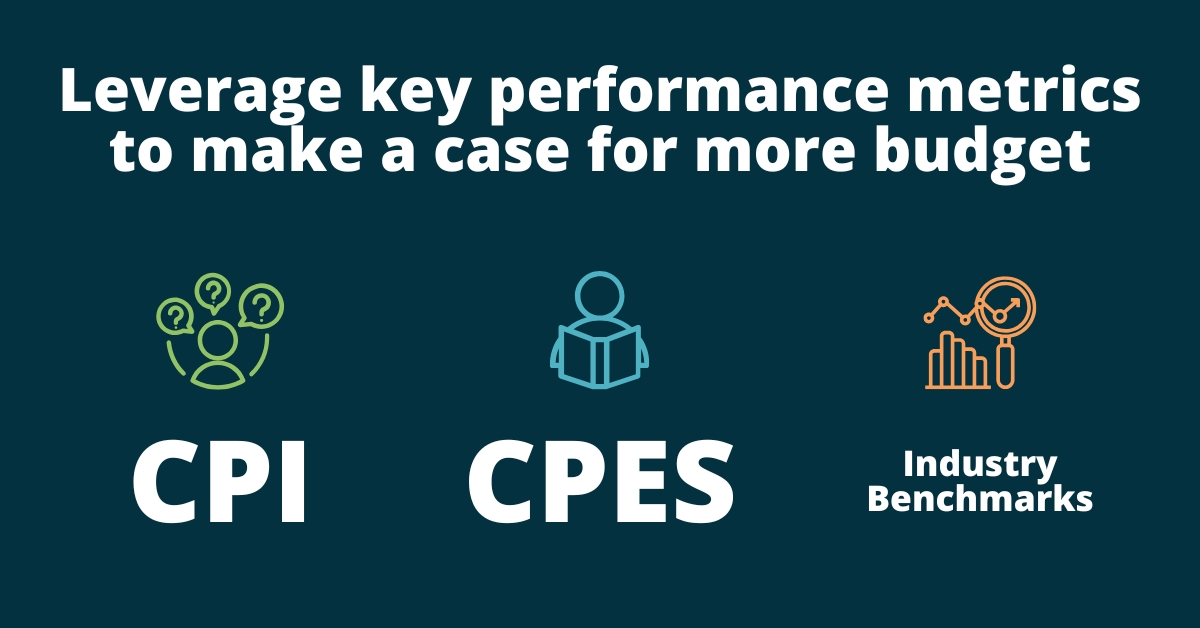
    A graphic explaining how to leverage KPMs to make a case for budget

    If leadership expects an increase in enrollment, marketing teams need the financial resources to support those goals. Leveraging valuable insights from key performance metrics can help you make a strong case for increasing your marketing budget to maximize impact.

    When asking stakeholders for more budget, it helps to show them how much your competitors are spending.

    Marketing budgets vary widely, but data from the 2022–2023 fiscal year provides a clear picture of industry benchmarks.

    Among professional and online education units:

    • 25% spent between $200,000 and $500,000 on marketing efforts
    • 23% spent $50,000 to $200,000 on marketing expenses
    • On average, professional and online education units spent $848,712

    Higher ed institutions increasingly prioritize digital technology to attract prospective students, with a significant portion of marketing spend on digital advertising.

    In the same fiscal year:

    • 40% of professional and online education units allocated $100,000 to $500,000 to digital advertising
    • 19% spent over $1 million on digital ad campaigns
    • The average digital ad spend was $800,970

    If you need more budget to drive better results, tracking key metrics like CPI can support your case to key stakeholders. For example, if your higher ed institution has a CPI of $100 for a specific program, you have the building blocks to make the case that an additional $10,000 investment could generate 100 more inquiries. By understanding your enrollment funnel, you can estimate how many of those inquiries will convert into enrolled students — providing leadership with a data-backed projection of revenue impact.

    7. Use a blend of agency and in-house support

    Balancing in-house and agency support is crucial for higher education marketing teams looking to maximize their impact. 

    Finding the right mix ensures that universities can optimize resources, effectively engage students, and improve overall marketing performance. 

    But how do you find that perfect balance for your higher ed institution?

    Start by asking:

    How many full-time employees work in our marketing department?

    A successful marketing strategy demands significant time, expertise, and resources.

    Smaller teams of 1-3 people are unlikely to have the time and skills required to handle marketing demands fully in-house. 

    4-5 member teams would be suited to do some aspects of marketing, like content writing and SEO-related website updates, while more complex tactics like strategy, off-site SEO, and evaluation of results would be better handled by agency. At this size of a team, a tight-knit partnership will drive strong results. 

    Looking at teams of 8-14 — this is where you can begin to take on more in-house, as long as you have a dedicated marketing strategist to plan, guide execution, and evaluate. With just one team member fully focused on strategy, an agency can back up your team with up-to-date expertise and insight through audits or consulting. 

    Large teams of 15 or more are likely well-equipped to handle marketing in-house, depending on what other priorities you have.

    What strategies does our university already have in place for SEO?

    Consider what tactics and work you already have in place for SEO. Is it a robust or piecemeal strategy? How often do you work on these tactics?

    Some questions to ask are:

    • Do you have identified target keywords for top programs?
    • Are you updating content with SEO goals in mind? 
    • Do you have a link-building strategy or are you just taking what comes naturally?
    • Are you using tools like Semrush or Moz and Google Search Console?
    • Does your team stay up to date on SEO trends and changes? For example, are you exploring and testing tactics for AI search?
    • Finally, are you diagnosing performance? 

    How strongly do you agree with this statement? 

    “My important programs or degrees show up in search results.”

    How well you rank today is a pretty good indicator of how well-equipped your team is to handle SEO internally. 

    If they are ranking well today, you may be set with your current strategy and team. 

    If they are not ranking well and driving traffic and quality leads, then you should consider an agency.

    Which capabilities exist on our team?

    The skills needed to conduct SEO are varied and not typically found in one person. For example, a team member may be great at writing content and PR outreach but may not have data analysis or technical SEO skills. 

    If you have all these skills in-house or can foster them, then you can set yourself up for SEO success internally:

    • SEO strategy development
    • Creating SEO-optimized content
    • Technical SEO expertise
    • Access to and knowledge of SEO tools
    • Website development and management
    • PR outreach for link-building
    • Data analysis

    If you can’t, relying on a credible agency gives you access to these capabilities immediately without having to recruit, retain, and train staff. 

    How much time does our team have available for our SEO priorities? 

    Managing SEO in-house demands significantly more time than working with an agency. 

    Successful in-house teams handle everything from keyword research and content creation to technical updates and performance monitoring. 

    So, how much time are we talking about?

    If your team has less than 8 hours/month, that’s about enough time to manage an agency partnership. 

    If they have 8-20 hours/month, they have time to do some SEO basics within typical marketing work.

    If they have 21-40 hours/month, they can be a little more strategic, do some basics, and spend some time monitoring results. They may also have some time to give tips to other team members on how to incorporate SEO into their work. 

    If they have over 40 hours/month to dedicate to SEO, they should be able to strategize, do some basics themselves, direct other team members, and evaluate results. 

    Ultimately, it’s up to you to consider whether your university has the internal DNA and capacity to succeed independently. If not, an agency will help shoulder the effort to meet your goals and drive consistent SEO performance.

    Search Influence’s SEO Quiz is designed to help you evaluate whether building an in-house team, outsourcing fully to an agency, or blending both approaches will best support your institution’s goals. By clarifying your staffing options in just a few minutes, the quiz enables smarter decisions that strengthen your SEO strategy and enhance student recruitment outcomes.

    Analyzing Effective Higher Education Marketing Strategies

    Palo Alto University increased monthly inquiries by 49%

    When Palo Alto University wanted to increase prospective student inquiries, they partnered with us to refine their digital marketing efforts and expand their reach.

    Initially, Palo Alto University ran Google, Facebook, and SEO campaigns, but their results fell short of their enrollment goals. Our team identified a key opportunity: Their budget was limiting audience reach, meaning they weren’t fully capitalizing on their potential student base. By implementing a strategic, multi-channel approach, we significantly boosted inquiries.

    We focused on:

    • Expanding campaign targeting to promote four key degree programs
    • Increasing investment in paid advertising to engage a broader target audience
    • Optimizing on-site content to improve organic search visibility
    • A/B testing refreshed messaging to better resonate with prospective students

    The results spoke for themselves. Within two quarters, monthly inquiries increased by 49%, exceeding their goal and reinforcing the power of a comprehensive higher education marketing strategy. 

    Tulane SoPA surpassed their inquiry goal by 58%

    For the Tulane School of Professional Advancement (SoPA), meeting enrollment goals meant more than just increasing inquiries — it required a strategic, data-driven approach to connect with the right prospective students at the right time.

    With the launch of three new programs, Tulane SoPA set a target of 500 inquiries per month and partnered with Search Influence to refine their marketing efforts. Recognizing that paid advertising would deliver the quickest impact, we optimized their campaigns for maximum efficiency while improving the overall student recruitment experience.

    To help Tulane SoPA reach their goal, we:

    • Designed a distinct creative concept with custom illustrations to strengthen brand identity
    • Enhanced landing pages to boost conversion rates and guide students through the enrollment process
    • Launched Facebook Lead Generation and Google Smart Display campaigns to increase engagement at multiple touchpoints
    • Expanded geographic targeting to reach a broader audience aligned with Tulane SoPA’s growth objectives

    The impact was immediate. Tulane SoPA exceeded their inquiry goal by 58%, with 80% of all inquiries driven by paid advertising. This success reinforced the value of a well-rounded digital marketing strategy in helping higher education institutions effectively engage students and convert interest into enrollment.

    Higher Education Marketing Strategies FAQs

    What are the best marketing strategies for higher education?

    A strong higher education marketing strategy starts with SEO, ensuring your programs appear early in a prospective student’s search journey. A well-executed SEO strategy drives long-term organic traffic and enhances visibility across digital marketing channels. 

    However, digital advertising is equally important for reaching the right students at the right time, providing immediate visibility, and amplifying organic efforts. 

    By combining SEO with targeted digital advertising, academic institutions can maximize engagement, increase inquiries, and drive more applications.

    How does a university increase its visibility?

    Universities attract students best by utilizing a mix of SEO and digital advertising.

    From optimizing for high-intent keywords and writing engaging blog posts to running targeted Google and social media advertising campaigns, these digital marketing strategies are some of the most efficient ways to attract prospective students. 

    What are the biggest marketing challenges for universities?

    The rise of AI Overviews and social search is changing how students find information, requiring universities to adapt their marketing strategies.

    Additionally, cookie deprecation and reduced tracking capabilities make it harder to measure campaign success across digital marketing channels. 

    To stay competitive, universities must refine their education marketing approach to navigate these evolving challenges.

    Optimize Your Higher Education Marketing Strategy With Search Influence

    Make every marketing dollar count with data-driven strategies designed to boost enrollment and engagement. 

    At Search Influence, we specialize in SEO, paid advertising, and analytics-backed marketing strategies tailored for higher education institutions. 

    Our advanced dashboards consolidate all your marketing metrics in one place, giving you the insights needed to refine your approach and maximize results. We help institutions align marketing efforts with enrollment goals to drive measurable success.

    Get exclusive insights into your higher ed marketing performance — download our Marketing Metrics Research Study today.

  • GA4 Guide: 13 Questions to Evaluate Your Agency’s Analytics Approach

    People working together on marketing and analytics sharing a group fist bump

    Key Insights

    • GA4 is a powerful tool for tracking user behavior and engagement metrics across devices, giving you a clearer picture of how visitors interact with your site.
    • Continuous GA4 tracking, reporting, and analysis enables you to accurately assess your marketing performance, identify trends, and adjust strategies based on real user data.
    • Working with a digital marketing agency simplifies actionable GA4 tracking and reporting, but only if the agency prioritizes aligning data with your specific goals.

    Google Analytics 4 (GA4) is the foundation of modern marketing analytics, helping websites track user behavior and performance like never before.

    Built for a privacy-first web, GA4 moves beyond its predecessor, Universal Analytics, with an event-driven model, cross-platform tracking, and machine learning-powered insights. When properly configured, it helps marketers understand the entire customer journey and optimize campaigns for success.

    However, simply enabling GA4 isn’t enough — its value depends on how well it’s set up, monitored, and analyzed.

    Many marketers turn to agencies to help make sense of GA4’s data, but not all agencies take the same approach. Some rely on default settings and basic reporting, while others customize GA4 to align with your objectives, ensuring accurate data collection and meaningful analysis. 

    If you’re considering partnering with an agency to streamline metric tracking, ask these questions to gauge their ability to turn data into impact.

    GA4 Guide: Top Questions to Ask Your Agency

    1. Which metrics should we prioritize in GA4?

    Before trusting your tracking and reporting to an agency, first verify that they monitor the GA4 metrics that drive results. GA4 tracks a ton of data, but only some metrics directly impact your specific goals. Misleading or irrelevant metrics can waste time and resources, and lead to ineffective business decisions.

    An experienced agency will know exactly which metrics to track based on your industry and conversion goals, and be able to explain the why behind them.

    Sessions, average engagement time, and key event counts are some of the most important GA4 metrics, though their relevance depends on your marketing objectives. 

    For example, an e-commerce brand may prioritize purchase events and checkout drop-off rates, while a lead generation site may focus on form submissions and engaged sessions. A higher education institution might stress metrics that reflect prospective student interest, such as application starts, request-for-information (RFI) submissions, and organic search traffic to program pages.

    2. Which key events and conversions are you tracking for us?

    When evaluating an agency, ask how they determine which key events to track and how they define conversions in GA4.

    Key events are specific actions you’ve identified as important, like button clicks or purchases. GA4 tracks these to reveal user behavior and engagement. Conversions, built from key event data, feed into Google Ads to improve bidding and campaign performance. Key events measure site success, while conversions turn that success into better advertising results. 

    The right agency will track the key events or conversions that match your marketing goals, while also reviewing and adjusting tracking as your strategy evolves. Be wary of agencies that just rely on default settings — these often overlook more nuanced metrics that directly influence your marketing outcomes.

    3. What insights can you provide about our site/business performance?

    Your agency should go beyond just providing basic reports that don’t tell the full story. A good marketing partner will also translate this data into clear recommendations, whether that’s refining content, improving conversion paths, or implementing new marketing efforts to drive stronger results.

    They should also evaluate site engagement and business growth by identifying trends in your GA4 performance tracking. Be sure to verify that your agency provides:

    • Site performance insights, such as user behavior, page-level interactions, and other engagement metrics, to understand how well your website captures interest and where visitors may be dropping off.  
    • Business performance insights, such as the traffic sources and content types driving conversions, to assess what works and identify strategies for ongoing growth.

    4. How do you ensure GA4 is both set up according to best practices and tracking accurately?

    A proper GA4 setup is the backbone of accurate tracking. 

    Misconfigurations lead to reporting gaps and unreliable data, making it harder to measure performance effectively. Your agency should configure properties, data streams, and event tracking correctly from the start, ensuring enhanced measurement settings are enabled and privacy compliance is in place. 

    But accurate setup is only half the battle. 

    Ask your agency how often they’ll audit your setup. GA4 tracking requires ongoing adjustments to stay up-to-date as your website and strategy evolve. The ideal agency will regularly review tracking, refine configurations, and proactively adapt to changes. 

    5. How do you compare performance over time using GA4?

    An all-star marketing agency is proficient in comparing historical and real-time data in GA4 to measure your marketing progress and analyze this data to recommend optimizations for better long-term results.

    Ask your agency how they track user engagement, conversion rates, and traffic sources over time to determine what’s improving and what needs attention. Year-over-year and quarter-over-quarter analyses should highlight shifts in customer behavior, marketing effectiveness, and site performance. 

    Your agency should also factor in seasonality, campaign changes, and market conditions to understand and provide insight into fluctuations. 

    Make sure they provide clear takeaways on what’s driving performance and offer specific recommendations based on historical trends.

    6. What first-party data strategies are you implementing with GA4?

    In a privacy-conscious world where third-party cookies are fading, you must ensure your agency prioritizes first-party data strategies.

    GA4 enables marketers to track and analyze user behavior without relying on third-party cookies, instead leveraging data from sources like CRM systems, email marketing, and customer interactions. Ask how your agency uses this consented first-party data to build detailed customer profiles while ensuring compliance with privacy laws. 

    A great agency will integrate first-party data with GA4 insights to refine targeting and improve campaign performance. Whether it’s segmenting high-value customers, personalizing ad strategies, or improving attribution modeling, they’ll have a set strategy in place that helps you make the most of your first-party data.

    7. How are you aligning GA4 data with our business goals?

    To maximize the value of GA4, your agency should link the data it collects directly to your business objectives, whether you’re focused on customer acquisition, retention, or driving revenue. 

    Ask how they customize dashboards to reflect the KPIs that matter most for your business. For example, if increasing revenue is your priority, they should focus on metrics like sales conversion rates and customer lifetime value. If retention is key, engagement and repeat visits will be top priorities.

    The right agency will go beyond standard reporting, integrating GA4 data into your broader marketing strategy. They will help you understand how tracking specific actions — like the right customer engagement metrics or the proper attribution models — aligns with and accelerates your growth goals.

    8. How do you approach reporting to ensure it’s actionable?

    Data without context is just noise. While visually appealing dashboards and charts are helpful for spotting trends, they don’t provide the insights needed to drive meaningful action. 

    Effective reporting goes further by interpreting the data, identifying key takeaways, and outlining specific recommendations. Your agency should be able to explain what’s working, what’s not, and what adjustments will improve performance.

    Ask for examples of how they’ve used analytics to refine strategies for other clients. Clear, data-driven recommendations should be a core part of their reporting approach, not an afterthought.

    9. How do you ensure reporting balances automation with human expertise?

    Automated GA4 reports streamline data collection and reporting, saving time on routine tasks like traffic tracking and goal completion. 

    However, without human analysis, they lack context, actionable strategies, and clarity on how to boost campaign performance.

    Ask how your agency decides what aspects of reporting to automate and which require a human touch. For example, automated reports might track page views or bounce rates, but a human team analyzes shifts in user behavior, identifies patterns, and recommends adjustments to your strategy.

    10. My data in GA4 doesn’t match Meta, Google Ads, my backend website data, etc. Why?

    Differences between your GA4 data and platforms like Meta, Google Ads, or your backend website are often due to how each system tracks and reports data. These platforms use distinct tracking methods, attribution models, and reporting windows, which can lead to discrepancies.

    For instance, GA4 and Google Ads might attribute conversions differently, and Meta may have its own tracking system, leading to varied numbers for the same event. On top of that, backend website data tends to show all activity, while GA4 might sample or filter out some data to simplify reporting.

    A great agency will help you navigate these differences, explain where the discrepancies come from and why they happen, and ensure you make decisions based on the most accurate, relevant insights.

    11. Why can’t we track everything?

    Digital marketing tools like GA4 offer great potential, but privacy restrictions and technical hurdles limit the data available to track. Some of the most disruptive limitations come from:

    • Privacy technologies: Tools like Intelligent Tracking Prevention (ITP) and ad blockers limit data collection. ITP blocks third-party cookies, preventing tracking across sites, while ad blockers stop tracking scripts from loading, which reduces the data available for analysis.
    • Cross-device and multi-session tracking: Without user login data, it’s difficult to connect interactions across different devices or sessions. This makes it hard to track a complete user journey when someone switches from mobile to desktop or returns to your site after some time.
    • UTM parameters: These parameters, used for tracking campaign performance, can be impacted by browser settings or device restrictions. Some browsers automatically strip UTM parameters from URLs, causing data loss, and switching devices or browsers may break the connection between sessions.

    Despite these limitations, a skilled agency will help you make the most of the data you can track, ensuring you still gather valuable learnings to shape your strategy.

    12. Is GA4 tracking 100% accurate?

    As much as we’d like it to be, no tracking tool, including GA4, is perfect. 

    While GA4 offers advanced features, it’s important to understand that it has shortcomings and is not 100% accurate. Your agency should be transparent about these challenges and explain how they mitigate inaccuracies.

    The right agency will focus on trends and directional insights, using data to estimate what’s working and what isn’t, even when it’s not perfectly precise. They will help you understand the broader picture and guide you in making informed decisions based on overarching trends. 

    13. How do you stay updated on GA4 changes and best practices?

    GA4 is always evolving, and marketers need to stay on top of the latest updates to ensure accurate tracking and data-driven insights. 

    Ask your agency how they keep up with new GA4 changes and best practices. Do they attend industry conferences or webinars, follow thought leaders and key blogs in analytics, or engage with Google’s product updates and announcements? Agencies serious about GA4 will also beta-test new features or use Google’s official training resources to remain ahead of the curve.

    If they show how they’re using the latest and greatest GA4 features for current clients, that’s typically a good sign.

    A laptop with marketing analytics displayed on the screen

    Get More From Your Google Analytics Data With Search Influence

    Your brand deserves an agency that truly understands GA4 and knows how to turn data into results. At Search Influence, we take an expert approach to advanced, strategic tracking and reporting.

    Our experienced team dives deep into user behavior across devices and platforms, uncovering trends that drive smarter, data-backed decisions. We focus on the metrics that matter most to you, aligning GA4 insights directly with your marketing goals to ensure you’re always measuring what counts. Our GA4 dashboards are customized to streamline reporting while providing clear, actionable insights that help you optimize performance.
    Ready to maximize the impact of your GA4 data? Get in touch with us today, and let us refine your tracking strategy to fuel long-term growth.

    Images:

    1. Pexels
    2. Pexels
  • 3 Tips to Choose the Right Attribution Model for GA4

    Man using GA4 with help from New Orleans marketing agency, Search Influence

    Key Insights

    • It’s essential to choose the right attribution model in GA4 to understand how your marketing efforts contribute to user interactions and conversions (key events).
    • GA4’s default data-driven model offers a dynamic approach to attribution, but marketers beware: this model isn’t ideal for all websites.
    • A knowledgeable digital marketing agency can help you choose the right attribution model for your business.

    Does your attribution model show the real value of each touchpoint? Or does it mislead your strategy?

    As you sunset your Universal Analytics property and welcome Google Analytics 4, we recommend you use this time to rethink how you track user engagement.

    But, with so many options, choosing the best way to collect data on user behavior can be challenging.

    Allow our experienced analytics tracking team to make it simple for you, starting with the basics.

    What Is GA4?

    Google Analytics 4 (GA4) represents the next generation of Google Analytics, designed to replace the now-obsolete Universal Analytics. As of July 1, 2023, Universal Analytics ceased processing new data, marking a significant shift in how digital analytics will be managed moving forward. By July 1, 2024, Google will cut all access to the Universal Analytics interface, and its API will be completely discontinued.

    Google Analytics 4 introduces various innovative features to understand and analyze data across platforms. Unlike its predecessor, which primarily focused on session-based data collection, Google Analytics 4 is built on an event-driven data model. This allows for a more flexible and comprehensive approach to tracking users’ interactions with websites and apps.

    Business people understanding GA4 with help from New Orleans marketing agency, Search Influence

    What Are Attribution Models in Digital Marketing?

    Attribution models help marketers understand which marketing channels, campaigns, or interactions contribute most significantly towards achieving their business goals, such as sales and conversions (now called key events in GA4).

    The last-click model has traditionally been the most commonly used model by platforms like Google Ads, Facebook Ads, Universal Analytics, and various other programmatic display networks. But the AI-driven predictive analytics available with Google Analytics 4 is sure to shake things up — more on this later!

    Why might the conversion data between Google Ads and Google Analytics 4 be different?

    Mismatched data across platforms is a common point of confusion for those spending their days in the depths of data collection and user metrics.

    While both Google Ads and Google Analytics 4 capture user interactions, their reporting structures can vary, thus leading to mismatches in key event data.

    For example, using the last-click attribution model in Google Ads but data-driven attribution (GA4’s default) in Google Analytics 4 can lead to Google Ads saying you have three key events, but your GA4 property says two.

    Google Analytics 4 uses the last click as the attribution model for all Google Ads conversions based on key events. Only key events where Google Ads is the last non-direct click are used to create conversions in Google Ads, even if a non-last-click attribution model is selected in Ads.

    If you wish to compare key events for an attribution model in Google Ads against an attribution model in Google Analytics 4, you must select paid and organic channels’ last click to get an accurate comparison of the data.

    The most important thing is to understand the various nuances of attribution across platforms so that you can better analyze what data is being reported on and use that to make decisions.
    If that feels too in the weeds, a knowledgeable analytics and lead tracking agency can help.

    Types of Attribution Models


    In the digital realm, the importance of collecting data is undeniable (some might even call me a data hoarder).

    But how you choose to collect new data or even decipher historical data can make all the difference in understanding customer behavior.

    About the attribution models in GA4:

    • Paid and Organic Data-Driven Attribution: Uses advanced machine learning to analyze each touchpoint’s impact across the customer’s journey, dynamically assigning credit based on the data-driven insights it gathers.
    • Paid and Organic Last-Click Attribution: Credits the key event to the final interaction, whether from a paid ad or an organic search result, focusing on the last point of contact before a purchase or key event.
    • Google Paid Channels Last-Click Attribution: Specifically targets the last ad clicked from Google’s paid channels as the sole contributor to a key event, emphasizing the effectiveness of final paid interactions.

    Other attribution models to be aware of:

    • First-Click Attribution: Prioritizes the initial engagement by assigning all key event credit to the first marketing touchpoint, highlighting what initially attracted the customer.
    • Linear Attribution: Spreads credit equally among touchpoints throughout the entire customer journey on the path to a key event, recognizing each step’s contribution to the journey equally.
    • Time Decay Attribution: Assigns increasing credit to touchpoints nearer to the time of the key event, acknowledging that interactions closer to the sale may have more influence.
    • U-Shaped Multi-Touch Attribution: Allocates more credit to the first and last interactions (typically 40% each) and distributes the remaining credit among the middle interactions, valuing the roles of both initiating and concluding engagements.

    With Universal Analytics, all of these attribution models were available, but as of November 2023, Google Analytics 4 and Google Ads have sunset first-click, linear, time decay, and position-based attribution models, leaving two primary models: data-driven and last-click.

    Understanding the New Default Data-Driven Attribution Model in GA4

    Google Analytics 4 uses a sophisticated data-driven attribution model that shifts from the models used in Universal Analytics. This default model in Google Analytics 4 leverages advanced machine learning algorithms to analyze both converting and non-converting paths across web stream data, providing a nuanced understanding of how various touchpoints influence user actions.

    The mechanics of GA4’s data-driven attribution

    Google Analytics 4’s data-driven attribution model collects data from each interaction or event on your site or app. This attribution model takes everything it knows about a person and then assigns a value to each source based on its understanding of that person’s journey.

    While doing this, it considers multiple factors, such as:

    • The timing of interactions relative to key events
    • The type of device used
    • The number of ad interactions
    • The order of exposure to various marketing initiatives

    This approach allows GA4 to assign partial value to each source, effectively measuring its impact on the user’s journey toward a key event.

    Compared to other models

    Google Ads has used data-driven attribution for years. Many marketers feel it provides a more balanced view that accounts for the entire customer journey rather than just the first or final interaction before a key event.

    This can help guide strategy decisions by not over-weighting lower-funnel tactics that are more likely to result in last-click conversions and under-valuing all of the touchpoints that may influence the customer’s decision.

    Our team believes the default data-driven attribution setting is ideal for large sites where you want to understand how various touchpoints on the customer’s journey lead to a key event. However, the downfall of this model is that Google doesn’t reveal exactly how the model makes these decisions. This means you just kind of have to trust it.

    Early days but promising 

    It’s still the early days for the new Google Analytics setup process and data-driven attribution. While you should be cautious about fully relying on this new default attribution model, its ability to analyze data dynamically and adapt to new web and app data streams is undeniably intriguing.

    Pro tip: To ensure the most accurate results, we believe you should be cautious of data from any and all attribution models, not just data-driven attribution.

    Just like the humans interpreting this data, attribution models have their own quirks that can lead to skewed information. Because of this, our team double-checks all data to ensure the utmost accuracy.

    Tips for Choosing the Right Attribution Model in GA4

    The first step in saying goodbye to Universal Analytics is selecting the optimal attribution model in Google Analytics 4. This step is crucial for harnessing the full potential of your web data streams and improving overall website performance.

    Here are a few tips to ensure your attribution model aligns well with your digital marketing framework.

    Small sites should consider last-click attribution

    For smaller websites with less complex customer journeys, the last-click attribution model may be ideal. This model attributes all the key event values to the last touchpoint before a key event, simplifying analysis and decision-making for sites where single interactions often directly lead to key events. There are two main reasons for using last-click over data-driven for these smaller sites:

    • There is not likely to be much of a difference when comparing these two models, as the data will be limited.
    • Additionally, as Google states, “Depending on data availability, data-driven attribution models may leverage aggregate data from data sharing settings.” This means that conversions could be attributed to sources that aren’t even part of your marketing strategy.

    Large sites should consider data-driven attribution 

    Larger sites with more complex customer journeys should use GA4’s data-driven attribution. This will provide a more complete view of the impact of each marketing channel to better inform decisions.

    Compare models and experiment as much as possible

    Within GA4, you can use the attribution model report to compare last-click to data-driven attribution and see how various channels or sources drive conversions with each model. It is important to note that it is best to look at Chrome browser users only, as other browsers have implemented privacy features that make it less likely that users are tracked across devices or for extended periods of time.

    Don’t hesitate to experiment with different attribution models in GA4. The platform’s flexibility allows you to switch between models to see which offers the most valuable insights, using custom reports to track performance against new metrics.

    By incorporating these strategies, you can enhance your marketing effectiveness through more accurate attribution in GA4, ensuring that your approach not only reflects the complex nature of modern web and app engagement but also aligns with evolving business goals and industry practices.

    Contact the Attribution Tracking Experts at Search Influence

    The time is now: You must transition from Universal Analytics to Google Analytics 4 to track and analyze traffic, marketing campaigns, and audience interactions.

    At Search Influence, our expertise in data-driven digital advertising allows us to capture every lead and assess the quality and source of these leads to fine-tune your marketing strategies for future success. Our team is adept at setting up and customizing GA4 to meet your specific needs, ensuring you can track and maximize the impact of your marketing activities.

    Contact the experts at Search Influence for help transitioning to Google Analytics 4 and to learn more about all of our digital marketing services.

    Image 1: https://images.unsplash.com/photo-1593437955835-fc8c51725430?q=80&w=1970&auto=format&fit=crop&ixlib=rb-4.0.3&ixid=M3wxMjA3fDB8MHxwaG90by1wYWdlfHx8fGVufDB8fHx8fA%3D%3D

    Image 2: https://img.freepik.com/free-photo/businessman-making-presentation-with-his-colleagues-business-strategy-digital-layer-effect-office-as-concept_1423-123.jpg?t=st=1716398015~exp=1716401615~hmac=7b9cc7746e9b67bf0dcbe7e0f015285bfd421a1d171d09b5c89b4f40321a3cd9&w=1800

  • Grow Traffic to Your Higher Ed Content With a Personalized Marketing Strategy

    Key Insights

    • Just like other businesses, higher education institutions need to use marketing tools and strategies to broaden awareness of their brand and attract new students.
    • Education marketing can help a higher education institution to present relevant, personalized information to prospective students, which in turn spurs their interest in enrollment.
    • When you use data to better understand prospective students and provide them with tailor-made content, they will be more likely to engage with you directly on the content you produce.

    When prospective students look for new schools online, they often focus their searches on programs and institutions that will help them achieve their educational and professional goals. The higher education market is extremely competitive, so it can be challenging for prospects to navigate their options and find the right program.

    With a personalized marketing strategy, your higher education institution can more effectively promote your program offerings, highlight what sets you apart from the competition, and attract more students.

    Student at university holding textbooks

    What Is Education Marketing?

    Like businesses, higher education institutions need to use marketing tools and strategies to broaden awareness of their brand and reach new students. In addition to traditional marketing techniques, schools also use digital marketing to increase traffic to their websites, giving prospective students valuable information about their programs and benefits. Education marketing efforts on the web often include search engine optimization (SEO), digital advertising, content creation, and outreach using social media and email.

    Benefits of Education Marketing

    Brand recognition

    Education marketing helps schools increase awareness of their brand, which can be especially useful for attracting new students. The more visible, compelling, and reputable a school’s brand is online— and out in the world — the more that students will be interested in attending.

    Lead generation

    One of the primary goals of any marketing strategy is lead generation, gathering contact information from potential consumers. Education marketing can help a school to present relevant, personalized information to prospective students, encouraging them to provide information via website form submissions, content downloads, or calls to the school. This allows the school to identify and develop a list of prospective students to engage with throughout the marketing funnel.

    What Is a Personalized Marketing Strategy?

    To stand out from competitors, businesses have started to ramp up their marketing efforts by using personalized marketing strategies. Personalized marketing uses data collected from consumers to deliver brand messages tailored to individual prospects. When educational institutions use personalized marketing strategies, they get the chance to know more about prospective students—their interests, browsing behaviors, and search terms, for example—and can then market their brand to them more effectively.

    This attention to detail is paying off for brands across the globe. According to SmartHQ, 72% of consumers claim that they respond to marketing messages that are exclusively crafted to their choices.

    Benefits of Using a Personalized Marketing Strategy for Your Education Marketing Content

    Gain a better understanding of prospective students

    When an educational institution uses a personalized marketing strategy, they learn more about their prospective students’ interests, habits, and desires. This crucial information helps higher education marketers develop smarter marketing strategies and create student-centric journeys through the marketing funnel, giving schools an advantage over competitors when it comes to enticing and recruiting new students. It can also help schools tailor their program offerings and incentives to better match what incoming generations of new students look for in their higher education options.

    Lead nurturing

    Lead nurturing is the process of developing relationships with potential consumers in order to nurture them through the student’s journey. When schools use data to better understand prospective students, they can more effectively market to them as they transition from interested prospects to enrolled students.

    Prospective student engagement

    When you use data to better understand prospective students and provide them with tailor-made, personalized content, they will be more likely to engage with the content you produce. Targeting users with relevant content leads to a 73% higher conversion rate, according to Aberdeen. Increased engagement is a good sign that prospects are interested and can be nurtured toward a final decision.

    Prospective student social sharing

    If your content is useful and engaging, it’s also more likely that prospective students will share it using social media and word-of-mouth. This is a great way to increase awareness of your brand and have your content distributed organically to other prospective students, even those who may not yet be in your personalized marketing strategy.

    Prospective student retention

    A personalized marketing strategy enables you to build closer relationships with prospective students. This helps to retain them from their initial interest in your institution to the moment they decide to enroll.

    Professor giving lecture in a college lecture hall

    Basics of Implementing a Personalized Marketing Strategies for Higher Education Institutions

    Student personas

    Student personas are semi-fictional profiles that mimic the demographic information, goals, and challenges of real prospective students you’re trying to reach and recruit. Personas are a great way to refine your messaging across all marketing tactics, improve your content strategy, and increase applications.

    Remarketing through digital ads based on actions and/or funnel stage

    Remarketing tailors digital ads to prospective students who have already shown interest by visiting pages on a school’s website or interacting with other brand content. This form of re-engagement is useful for nurturing prospects through the marketing funnel and keeping them interested in your brand.

    Program-specific email nurture

    Having data about your prospective students’ interests enables you to send them program-specific emails. These are far more engaging than generalized emails, and they give students valuable information about programs they’re interested in, which helps to nurture them as they consider enrollment.

    Action-driven email nurture

    Emails can also encourage recipients to take action that furthers their engagement with your brand. For example, effective action-driven emails may include a clickable link to a new blog post or video, an invitation to sign up for an event, or an opportunity to start a conversation with a student advisor.

    Appropriate calls to action

    Calls to action in emails and other communications should always be appropriate for the intended recipient. A call to action for a prospective student who is earlier along in the marketing funnel might ask them to request more information about a program, while a call to action for a prospect who’s in later stages of the marketing funnel might ask them to begin filling out an application.

    The Education Marketing Experts at Search Influence

    A personalized marketing strategy enables your educational institution to reach and engage prospective students. Our team of experts at Search Influence will help you to develop a strong marketing strategy and provide you with the digital marketing tools you’ll need to broaden your audience, including SEO, analytics and lead tracking, and content marketing.

    To learn more about the services we offer, fill out our online contact form.

    Images

    Student

    Lecture Hall

  • How to Track the Success of Your Online Ads

    Marketing can sometimes feel like a black box to business owners. Luckily, with digital marketing, there are ways to track pretty much everything so that you can know exactly how your campaigns are performing. As a marketer, I’m often up to my elbows in Excel sheets, pouring through the data provided from Google Ads or Google Analytics. But as you’ll soon learn, only looking at that data is not enough. To have successful campaigns, you, the business owner, must also be involved in the process to help track everything from the first impression to a closed lead.

    Gif of Colin Farrell shrugging about online ads

    How Do You Know If Advertising Is Effective?

    In order to determine if your advertising is working, you first need to do some self-reflection. Most business owners know they need to spend money on marketing in order to grow, and often, the first thing they do is begin vetting (and maybe even hiring) an agency. But truthfully, it’ll be more difficult for you and your agency to create winning campaigns if you haven’t defined your business and marketing goals before getting started.

    Luckily, we have put together an awesome guide that walks you step-by-step through the process of determining the metrics that matter to your business and how to tie those to marketing goals. To get started, gather the necessary stakeholders, download our guide, and fill out the worksheet. When you are done, you will have…

    The “M” in S.M.A.R.T. stands for “measurable,” and defining this on the front end helps you determine what Key Performance Indicators are important to you. This doesn’t have to be complicated, and the less metrics, the better!

    Man incorrectly measuring the success of his online ads campaign

    How Do You Measure the Success of a Campaign?

    Now that you’ve defined your metrics and KPIs, you’ll need to figure out what you need to track online and how you will track it. Some common things you might track are leads through phone calls and form fills, transactions and revenue through e-commerce purchases, or interest in your location through “Get Directions” button clicks. Let’s walk through some common platforms for tracking online actions.

    • Google Analytics: You can use this free platform to track user behavior on your website and set up goals to track form fills, clicks on buttons, views of key pages, and e-commerce transactions. This allows you to compare performance across all campaigns similarly, using the same attribution model and metrics. It integrates well with Google Ads (you can import your Google Analytics goals directly into Google Ads) but doesn’t send conversion data to other advertising platforms.
    • Ad Platform Pixels and Trackers: Each ad platform offers their own tracking solutions, so you can determine exactly which of your advertising campaigns, keywords, audiences, and ads are converting. If you are using something other than Google Ads, you’ll want to install these pixels in addition to Google Analytics. Most of them work very similarly to Google Analytics, but may have slight variations on how conversions are counted or tracked. Examples include Facebook Pixels, Google Ads Conversion Trackers, Bing Conversion tags, and LinkedIn Insight Tags.
    • Call Tracking Providers: Setting up call tracking is a must for businesses that receive a lot of phone calls. Call tracking works by placing a piece of code on your site that identifies the source of your site visitor and dynamically switches the phone number to attribute that call back to the source. More advanced call tracking providers are even able to tie these calls to specific ads. They offer a ton of features to make it easier for you to manage your internal process for answering and responding to these calls and to audit your team to ensure they are providing the best customer service. There are several different providers, so do your research on which one best meets your needs.

    Setting up all of these things on your website does require some coding skills, so it helps to consult with a developer (or a marketing agency like Search Influence) on the best ways to set up tracking.

    How Is ROI Calculated in Digital Marketing?

    I don't do math gif

    So now that you are tracking all of your online actions, you’re all set to calculate ROI, right? Well, not exactly. In fact, tracking just online conversions does not give you a full understanding of the success of your efforts. This is mostly true when it comes to lead-based businesses. If we deliver 100 leads to you, but not a single one turns into a client, would you call that a success? This is why it is SO CRUCIAL for you to track the quality of your leads and to provide that information to your marketing agency as close to real-time as possible.

    There are many ways to determine lead quality, but some important things to track include the following:

    • Lead Score: What is a lead worth to you? Devise a scoring system and train all customer service reps on this. Think about scoring the leads based on things like, “I want more leads like this!”
    • Score Reason: What makes the lead good or bad? What was the roadblock as to why this lead couldn’t become a customer?
    • Lead Stage: Did the person schedule a consultation? Have they been sent a proposal? Did they become a client? Document where each potential customer is in the process.
    • Customer Lifetime Value: What was the revenue associated with the services they received?

    Using a Customer Relationship Management (CRM) platform makes this process super easy. It can help you track the volume of leads, close rate, and average sale value, which are all important metrics to know and understand. It can also help your internal team keep track of who’ve they’ve talked to and when to follow up with them. The biggest benefit of having a CRM is having a ton of great actionable information to provide to your marketing agency so they can optimize campaigns to meet and succeed your marketing goals.

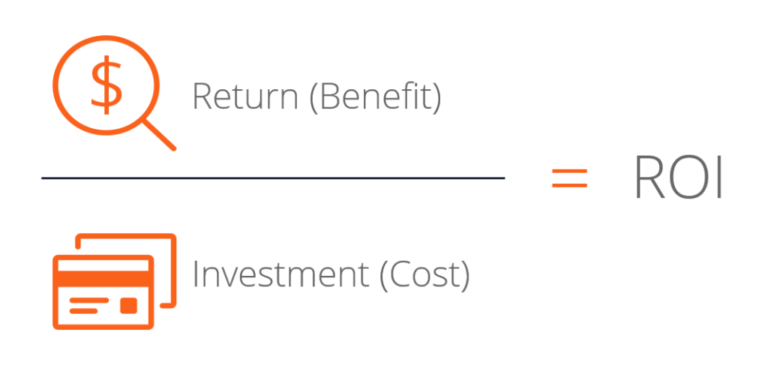
    Once this data is collected, you can also determine the Return on Investment (ROI) of your marketing efforts. You’ll take the total revenue you received, subtract the costs associated (return), and divide by your investment.

    ROI evaluation of online ads campaign from Search Influence in New Orleans, LA

    Combine the Data and Make Smart Decisions

    Implementing these tracking mechanisms and processes allows you to better understand exactly which campaigns and tactics are driving real revenue for your business. It is also one of the huge advantages of running digital advertising campaigns (real data that is tied directly to campaigns). It gives you and your marketing agency the insight to make decisions that you can trust will result in growth and allow you to continue to work toward your goals.

    If you need help figuring all of this out, don’t worry! Search Influence is stocked with seasoned pros at all things tracking and analytics, and we love to dive deep into numbers to figure out what is working for our clients. We will also provide guidance as you set up your internal systems to make it as easy as possible to track the data on your end. We find that the most successful campaigns we run are ones where there is open communication between our team and our clients—providing honest feedback on the work we are doing because, ultimately, we want to optimize their business’ potential. So start a conversation with one of our digital marketing experts today so you can feel confident in your marketing efforts!

    Images

    Colin Farrell

    Helpless Man

    Schitt’s Creek


  • Trust Your Marketing to a Team, Not a Machine

    You’ve probably heard something like this before: “Automated marketing is bad for business!” But, actually, I’m not sure I 100% agree with that—I know, you’re surprised, right? A marketer telling you that machines and automation are a good thing? Well, hear me out. Artificial intelligence is growing at a rapid pace, and in the field of digital marketing where there is data OVERLOAD, you’d be silly not to take advantage of this technology. I’ll admit, I’m one of the silly ones that have, at times, been afraid to trust machines with my campaign performance. But, as AI has become smarter, the real value lies in combining the best that humans have to offer with the speed and data processing capabilities of machines to achieve total marketing domination.

    What Can Technology Do for You?

    SO. MUCH. DATA! Does it make your head spin?! Luckily, machines don’t get dizzy easily, and they are able to process many more data points than we could ever hope to. The more data and history a machine is able to analyze, the more it can learn to make decisions for the future—this is the machine learning aspect. CUE THE FEAR: THE MACHINES WILL TAKE OVER! Just kidding (but more on this later).

    Machines were built to automate simple tasks. If it is a mundane task that is done over and over and over and… well, you get the point. These are the types of things that are perfect for machines to take on. Why pay someone for hours of work when a machine could do this in minimal time? This frees up your time to focus on the more important and creative work that you enjoy doing.

    This technology is now more readily accessible than ever. Google, Facebook, HubSpot, Salesforce, and many other platforms invest heavily in machine learning so that you as a business or marketer don’t have to. Google alone has continued to release new features (such as Smart Bidding options and responsive ad types) that make it easier to set up, run, and manage a successful campaign. They’ll also typically release these features in beta and test them first to assure they have the intended impact before releasing them to the public, so you know that these tools are reliable.
    31 questions to ask a marketing agency

    What About People?

    Wow, machines sound pretty amazing! What’s left for us mere humans to do? In marketing, the most important thing a human can do is to understand your business and marketing goals. With that understanding, marketers can devise strategies to reach your target audience and accomplish your goals. Marketers can deploy these strategies and understand the intentions behind them.

    Humans have two other amazing attributes that give us an advantage over AI: we are innovative and we are creative. We need humans to drive the innovation to test new theories and ideas. Automated systems and machines can only produce the same results if provided the same data, and it’s our innovation that continues to drive machine learning. With machines, however, we are able to test new ideas faster and with better accuracy.

    Because machines have gotten rid of all that boring work, we have more time to be creative and to apply that creativity to your marketing. Marketers can understand your business, what makes you unique, and why you love doing what you do, and they can assure that this message is prevalent throughout your marketing. They can come up with creative concepts and imagery that define your brand and make you stand out among your competitors. Could a machine do all that?

    Human + Machine = WINNING

    In other industries, we wouldn’t let the machines take over, so why would we do that in marketing? Think about it: autopilot technology has existed since 1912, yet we still have human pilots fly planes. Self-driving cars still have a human driver behind the wheel. Even machine assembly lines are often spot-checked for quality by human beings.

    “We need to stop thinking of machines as rivals. Instead, we should see them as an opportunity to take our creativity to the next level,” says Ben Jones, Google’s global creative director.

    So how can humans work together with machines? Let’s go through a few examples.

    1. Use human creativity to write ad copy and create compelling ad graphics, then use machines to make it more personalized. For example, Google’s responsive display ads allow us to put in a combination of assets that the algorithm integrates to be specific to the person it’s targeting, including the content the ad is shown next to and the size of the ad placement. Now that’s powerful! Otherwise, we’d have to create hundreds of combinations of ads to be able to show in all of the available inventory, and on top of that, we’d have to spend a lot of time organizing these ads.31 Questions Checklist square image
    2. Once a marketing strategy is created, marketers can set up campaigns and machines to manage it. However, it’s not a “set it and forget it” mentality. Machines can make decisions based on past performance and data, and they are capable of processing data, but they can only process the data provided. And while machines are getting better at reconciling offline and online data, humans should have the oversight to determine if campaigns are driving the bottom line.
    3. Marketers can work with businesses to define KPI targets, which are then fed into machines to optimize campaigns and work toward these goals. As mentioned above, it helps to have the human oversight to understand that marketing is doing what it is intended to do.

    How Can an Agency Help?

    Agencies have access to more technology, humans, and data. With larger marketing budgets, they are able to invest in some pretty powerful marketing automation tools, those that aren’t so readily (cough*inexpensive*cough) available. And as an important investment, they have likely researched and evaluated several platforms before choosing the one that would help them best achieve client goals most efficiently.

    Agencies also have the benefit of working with many clients across various industries with different objectives, so they’ve been able to put the machine through many different scenarios to figure out what works best in each situation.

    So rather than trusting your marketing to just a team or a just a machine, combine the power, speed, and intelligence of the machine with the creativity and empathy of a human team for a truly winning combination. The experts at Search Influence can help you integrate automated systems into your marketing strategy while providing creative feedback to ensure that your marketing campaign reaches its full potential. If you have any questions about implementing these tactics, start a conversation with one of our marketing strategists today.

    Images:

    Girl with AI

    So.Much.Data.

    Code

  • How to Navigate the NEW Google Adwords Experience

    AdWords recently announced that they are fully switching to the new experience by the end of the year, and I’m here to tell you it’s going to be okay! The new experience has been available to all advertisers since October, but we’ve had exclusive access for a while and have been able to get acquainted with the new UI and I’m here to share our findings.

    For those of you thinking, “Google’s changing something AGAIN?” I’m right there with you! But with the following tips and resources, you’ll soon love all the new experiences it has to offer.

    So What’s so Different?

    Google updated the interface to provide, “a faster and more intuitive experience that’s focused on helping you reach your goals.” All the features you rely on are available in the new experience, and Google incorporated feedback as well, since this has been in beta for a while. They’ve also rolled out some exclusive features that are available in the new interface, so you have to switch to take advantage of them. Some of my favorite new features are below.

    A New “Overview” Page

    The overview tab provides performance insights that are generated by Google depicted as charts and graphs for you to quickly review and take action. These make reviewing data for devices and time of day much more visually appealing and easier to understand.

    Bid Adjustments for Calls

    Adjust your bids on call extensions to show call interaction ads more frequently. This allows you more flexibility and control over how often these ads appear and how customers can connect with your business. The bid adjustments range from -90% (I don’t want these to show as much) to +900% (yes, please, show these all the time!).

    Promotion Extensions

    Promotion extensions are pretty fantastic! They allow users to show and link to a special offer in their search ads and even include a tag icon to help the promotion stand out. You can highlight specific sales and offers, all while taking up more valuable real estate in the SERPs.

    Shortcuts

    One of my all-time favorite new features is the introduction of shortcuts. You can pretty much navigate to anywhere in the interface in a matter of seconds! Need a list of shortcuts, just hit the question mark on your keyboard. Hit G and T (GoTo) to bring up a search bar, making it super easy to find anything you need!

    Need More Help?

    I couldn’t possibly cover all of the benefits of the new AdWords experience but wanted to include a few more tips and resources to get you started.

    • The dimensions tab used to be one of my favorite places to go to pull reports to find actionable insights. I thought it was gone, but AdWords has re-named this and moved these reports to “Predefined reports,” found under the little graph icon in the upper right corner.
    • Google has a guided tour of the new interface, which is great for beginners to get familiar with the changes. They also have a Help Center, which has been updated to help you navigate all the new features (bookmark this page!).
    • Follow this page to view new information on AdWords features as they are added to the platform.
    • If learning by video is more your thing, check out the guides to the New AdWords Experience Part 1 and Part 2.
    • There are a few things that are changing and some features that are not yet available, so familiarize yourself with these in case you need to find a different solution.

    Getting on board with big changes like this can take some time, so I recommend that you start poking around now. The end of the year will come quickly and is a critical time for most advertisers, so the more experience you have with the platform the more you’ll be able to take advantage of all the new features to set your campaigns up for success. If you have any questions or need help navigating this switch, the Online Advertising team at Search Influence has experts that can help.

    All screenshots captured by Jeanne Gaudet Lobman on May 30, 2018

  • Insta-Ads: Facebook Brings Instagram Ads to Life

    Good news for advertisers! It appears that Instagram Ads are now open for advertisers through Facebook’s Power Editor.

    While no official announcement has been made (and Instagram hasn’t even updated their site), I stumbled across these new features while poking around my Business Manager. What tipped me off was the ability to claim Instagram accounts under the Business Settings in Business Manager. From there, you can assign ad accounts to individual Instagram accounts. Interesting, right?

    instagramadscreenshot

    There is also a notification at the top of the page that states that “Instagram ads are gradually rolling out and might not be available to you right now. You can claim your Instagram account to have your setup ready. Read more here.”

    How Do They Work?

    After doing some digging and playing around with Power Editor, I was able to create an ad for Search Influence’s Instagram profile. However, the only ad objectives currently available on Instagram are “Clicks to Website” and “Mobile app installs.”

    Earlier this month, Instagram launched its Ads API Partners program. According to AdWeek, “Instagram Ads API Partners will be able to perform tasks including scheduling and publishing content to the Facebook-owned photo- and video-sharing network, monitoring audiences and sharing access to Instagram accounts across teams.”

    What Does This Mean For You?

    All of these updates come as very welcome news, as managing and advertising for businesses on Instagram was difficult in the past. Previously, Instagram advertising was only open to larger brands willing to spend $200,000 or more on brand awareness for a three-week campaign.

    Do you plan on using Instagram advertising? How do you think it can benefit your business?

  • It’s SNEAUXmageddon!

    It’s SNEAUXmageddon!

    Down here in New Orleans, let’s just say we are not used to the cold. With freezing temperatures threatening, the entire city is shutting down, (but here at Search Influence we are still hard at work!) Although many people are referring to the winter storm as Sneauxmageddon (the world is ending, didn’t you know?), others are taking advantage of the unusual circumstances.

    Hemline Metairie is offering hot cocoa to shoppers, urging them to spend their days off shopping at their store.

    hot cocoa

    Over at Hattie Sparks, they are taking a different route. Closing for the day to stay warm, they are offering 40% off to online shoppers who have plenty of time to spare while at home.

    Hattie Sparks SnowDay


    The brave restaurants that have remained open are serving warm treats that we know all too well: hot gumbo, steamed mussels, and anything to keep us warm.

    At Search Influence, we are bundling up with scarves, hats, and coats hidden deep in our closets. And to be sure we remain productive in the cold weather, we resort to some interesting methods. Check out Influencer Lauren Christy‘s hand-warming mouse pad!

    Lauren's Hand Warmer Mouse Pad

    Although the temperatures are dropping, creativity is on the rise. Websites like isitsnowinginnola.com, have popped up to add some local flair to the typical weather report (chanting “Snow me something, mister!”)  Currently, the forecast states that the snow is “No, it ain’t.”

    Close Y'all

    Hashtags have also emerged to describe the wintry weather in New Orleans. The graphs below from hashtags.org show that they are definitely catching on!

    sneauxday


    sneauxmageddon

    See what others are up to by following hashtags #Sneauxday and #Sneauxmageddon. What’s been your favorite thing to come out of the winter storm?