\This post was updated by Ren Horst on 05/01/2025 after the webinar took place. It was originally published on 04/02/2025.
Key Insights
- AI is driving a shift toward instant answers, changing how online content is found and reducing the need to click through to webpages.
- To compete, your content must reflect people’s intent, not just what they type.
- Institutions that act now can maintain visibility where it matters most: at the decision point.
- Pages that emphasize clarity, structure, and real-world context are more likely to be picked up by AI tools.
- External signals like mentions, citations, and schema help reinforce your authority.
As artificial intelligence reshapes how prospective students search for information online, higher education marketers are under growing pressure to adapt.
In the recent webinar “SEO for AI Search: Protect Your Student Enrollment Pipeline,” presented by Search Influence and UPCEA, Search Influence Director of Paula French (Director of Sales and Marketing, Search Influence), Will Scott (Co-Founder and CEO, Search Influence), and Bruce Etter (Senior Director of Research and Consulting, UPCEA) broke down what institutions need to know — and do — now.
The session covered three critical areas: how AI is transforming search behavior, why core SEO practices still matter in this new search world, and what your team can start doing today to remain visible.
If you missed it live, here are the top takeaways to help shape your AI SEO strategy.
SEO for AI Search Webinar: Top Takeaways
Understanding AI search
What is AI search?
AI search is a search experience powered by artificial intelligence that delivers complete, synthesized answers to queries, instead of the traditional list of clickable links.
Platforms like Google’s AI Overviews, ChatGPT, Gemini, Microsoft Copilot, and Perplexity don’t always send users to web pages—instead, they generate answers using large language models (LLMs) trained on vast datasets, sometimes enhanced by retrieval-augmented generation (RAG), which pulls in real-time web content.
However, these models also rely on entities, citations, and structured data to decide what gets included in responses.
These tools prioritize clarity and credibility, reshaping how content is surfaced. This shift is changing how users interact with search and how institutions must approach their content strategy.
How is AI search changing user behavior?
Instead of scrolling through organic results, users increasingly receive answers to search queries directly from tools like Google’s AI Overviews and ChatGPT.
This has led to a sharp increase in zero-click searches, where the search ends with the summarized response, without a need for the user to visit a website.
The trend is accelerating fast as AI usage grows. ChatGPT reached 100 million users within two months of launch, and generative AI adoption has already hit 39.4%, outpacing the early growth of both the internet and personal computers.
As these platforms prioritize quick, in-platform answers, some sites are seeing organic traffic drop by as much as 15% to 64%.
The space for traditional organic links continues to shrink. It’s not just AI-generated results pushing them down—today’s search engine results pages (SERPs) are packed with product carousels, featured snippets, People Also Ask boxes, and other dynamic elements that crowd out classic blue links.
But the window isn’t closed. It’s simply shifting. Clear, structured, and credible content still has a shot at visibility, especially if it aligns with how people phrase questions and how AI systems choose what to surface.
Rethinking SEO in the age of AI
What is SEO for AI search?
SEO for AI search is the strategy of optimizing digital content to be surfaced, cited, or featured in answers generated by AI-powered search tools.
This approach focuses on helping AI platforms recognize your content as authoritative, relevant, and structured enough to use in their responses.
Instead of focusing on organic search engine results rankings, the intent is to be referenced directly in the answer, whether through a citation or inclusion in the response itself.
To achieve this, your content must be semantically clear, supported by schema markup, and aligned with what AI considers trustworthy. The goal is to build pages that speak fluently to both human intent and machine logic.
How does traditional SEO differ from AI search SEO?
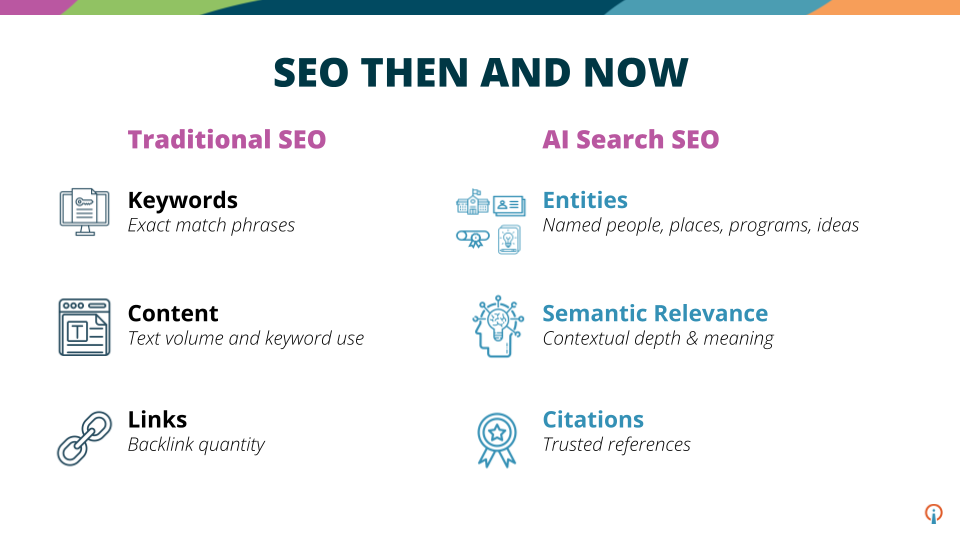
Traditional SEO is driven by ranking factors like exact-match keywords, content volume, and backlinks. AI search SEO takes a different approach, one that aligns with how artificial intelligence models gather, interpret, and present information.
Instead of keywords, it prioritizes entities: clearly defined people, programs, places, or concepts that AI can recognize and connect across sources.
Rather than focusing on content volume, it values semantic relevance: how well your content reflects user intent and contextual meaning.
And instead of relying solely on backlinks, it rewards citations: trusted references that help AI validate your authority.
Some refer to this evolving strategy as Generative Engine Optimization (GEO). At Search Influence, we prefer AI SEO or AI search SEO, because it’s still SEO, just built for visibility in the next generation of search.
Improving visibility in AI-driven search
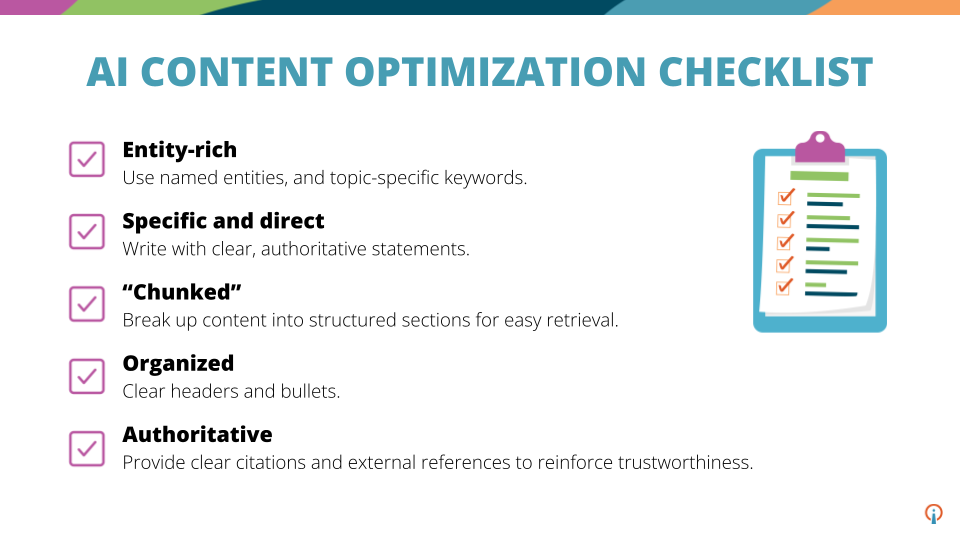
How can you make your content entity-rich?
The more your content aligns with how entities are framed in trusted sources, the better chance you have of being included in AI-generated responses.
To show up in AI-powered search, your content needs to be entity-rich. That means using clear, recognizable references to your university, schools, programs, and related topics, so AI knows exactly what you’re talking about.
But getting there takes more than keyword tools. You need to look at the places where entities already “live,” like Wikipedia.
For example, if you’re trying to rank for higher education, it helps to know that Wikipedia actually treats that as part of a broader entry: tertiary education. Inside that page, you’ll also find related concepts like continuing education and vocational education, all tied to the same entity. In this example, you can use structured data and clear language to help AI connect your content to those recognized ideas.
Why is schema markup important for entity optimizations?
A traditional SEO tactic, schema markup is a type of behind-the-scenes code that helps search engines understand your content and relate it to the right entities.
It’s not visible to site visitors, but it gives AI extra signals about your content’s topic and structure.
While it’s still unclear how directly AI tools use schema, we know it plays a key role in organic search, and strong organic signals are still one of the best ways to boost your website’s visibility in AI results.
On university websites, schema can clarify who you are, what you offer, and how different pieces of content relate to your institution. It helps reinforce entities like your university name, academic programs, and faculty, especially when paired with clear language on the page.
Some helpful types of schema include:
- Article schema: Tells AI the headline, description, and type of content
- Publisher schema: Links content back to your institution as the source entity
- SameAs schema: Connects your content to other relevant entities and concepts across the web
There are also education-specific options, like EducationalOrganization and Course schema, that help AI connect your site to topics like higher education and online learning.
How do you optimize for semantic relevance?
AI-driven search engines and tools prioritize meaning over keywords. To stay visible, your content needs to reflect how real people think, search, and ask questions.
- Write with intent: Answer specific questions, connect related topics, and provide helpful context, even if you’re not writing in a Q&A format. This shows AI your content is built to inform, not just rank.
- Keep it chunked: Use short, focused blocks of around 170–200 characters. That’s how information appears in AI Overviews and featured snippets, and it increases your chances of being included.
- Prioritize structure: Use clear headings (H1s, H2s) and make sure your page titles say exactly what the content delivers. When your content is easy to scan, it’s easier for AI to understand and surface in results.
How can you use semantic triples to make your content more findable?
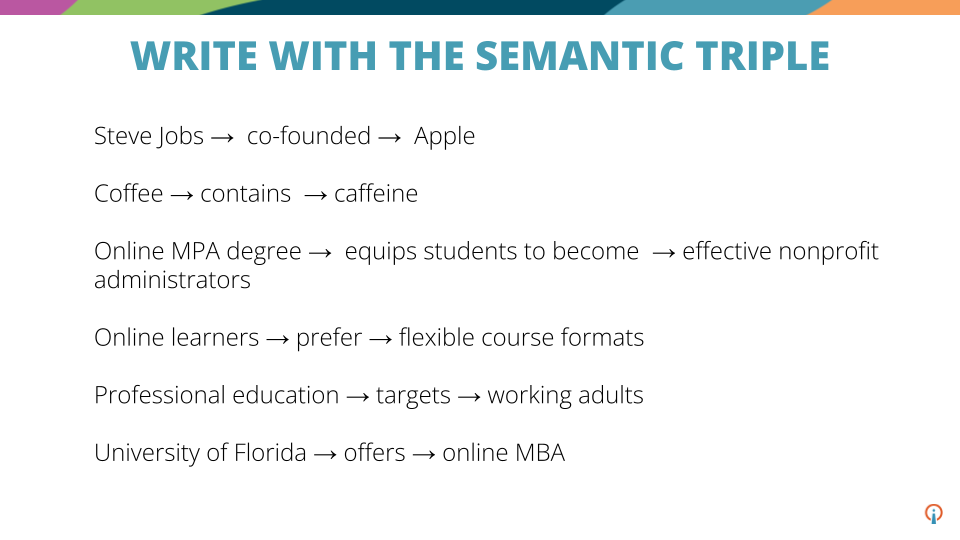
Semantic triples are foundational to AI-powered search. From Google’s Knowledge Graph to AI Overviews, these tools rely on clear, structured relationships to understand what your content means and when to surface it.
Each semantic triple follows a simple format: subject → predicate → object.
For example:
University X → offers → a nationally ranked online MBA
That MBA → leads to → career advancement for working professionals
This structure helps AI connect the dots between your institution, your programs, and the outcomes students care about. The more often these relationships appear, both on your site and across trusted sources, the more likely AI is to recognize your relevance and elevate your content in search.
To use semantic triples effectively:
- Identify the core relationships in your messaging (Who? Does what? Why does it matter?)
- Express those ideas in short, direct statements, especially in headings, intros, and metadata.
- When possible, link related triples together in a way that still sounds natural to readers.
For instance, you can combine two triples into a persuasive sentence:
University X offers a nationally ranked online MBA that leads to career advancement for working professionals.
This kind of structure isn’t just good writing. It’s exactly what AI is built to understand.
What are citations in SEO, and how do they help AI understand your authority?
Citations (mentions of your institution, programs, or people across the web) help AI connect your brand to the topics you want to rank for.
These references don’t always need to be clickable links. What matters is consistent, contextual mentions in trusted places.
AI-powered search engines look for co-occurrence, which is how often your name appears near relevant terms on authoritative sites. These mentions could come from news articles, faculty bios, higher ed directories, speaker bylines, or awards listings.
The more often your institution is tied to specific keywords or subject areas, the more likely AI is to recognize you as an authority.
To strengthen your citation signal:
- Choose a consistent, “locked-in” phrase that reflects your niche (e.g., top-ranked online business program).
- Use it in boilerplate descriptions, press releases, faculty bios, and guest content.
However, citations work both ways. When your site links out to reputable sources, it shows AI that you’re part of a trusted information network. Referencing government data, academic research, or respected media outlets adds credibility and helps AI understand the context of your content.
Where can you build citations?
There are plenty of places to earn citations — if you know where to look.
Some require cross-team coordination, while others are quick wins you can act on immediately. The key is to show up consistently in trusted, topic-relevant spaces.
Ideas include:
- Online directories like Niche, Peterson’s, and BestColleges
- Media coverage in outlets such as Inside Higher Ed, The Chronicle, or local press
- Alumni stories and features on industry-specific sites
- Conference speaker bios and event listings
- Professional associations like UPCEA, GMAC, and CIC
Tools for tracking AI search performance
What are the best tools to track your visibility in AI-powered search?
Despite popular belief, it is possible to track your AI SEO performance. New tools are emerging fast to meet that demand.
At Search Influence, some of our top picks include Scrunch, RankScale, and Profound. These platforms offer insights tailored specifically to AI-powered search, helping you understand how your content is being surfaced in tools like Google’s AI Overviews or ChatGPT.
Other helpful tools include:
Some platforms focus on surface-level AI visibility metrics, while others dive deeper into entity tracking, co-occurrence analysis, and content structure. The right tool for you ultimately depends on your goals, budget, current tech stack, and reporting needs.
Q&As From the Webinar
If you’re a resource-strapped institution, what’s the most important place to start?
Many academic websites are weighed down by long, unbroken blocks of text. Start by structuring your content in semantic-friendly chunks.
Chunking your content is one of the simplest, highest-impact ways to improve visibility, especially when time and resources are limited.
By breaking that content into clear sections, with meaningful headers, concise paragraphs, and scan-friendly formatting, you improve readability for users and make it easier for AI to understand and surface your content.
Is there a limit to how many external links you should include, or does it depend on the content?
It depends on the type and length of the content.
For shorter or more narrative-driven pieces, you may have fewer opportunities to link out. In those cases, it’s better to focus on clarity and flow than forcing in links.
More external links can be valuable for technical, research-based, or program-specific content, especially when pointing to trusted sources that support your claims.
If there’s relevant data, industry standards, or authoritative context available off-site, link to it. Just make sure every link adds real value and helps AI understand the credibility and depth of your content.
How do paid search ads influence AI SEO?
Paid search doesn’t directly impact how your content is pulled into AI-generated responses, but it can still play an important supporting role. It’s still important to bid on your branded terms. Even if your content appears in an AI-generated answer, paid search helps you control what users see and where they land next.
There are two layers to how AI search tools work today:
- LLMs generate responses based on pre-trained data.
- RAG systems ground those responses in real-time web content pulled from traditional search indexes.
That means traditional search ranking signals still matter, including engagement metrics like time on site, click-through rate, and user behavior. And that’s where paid search comes in.
Paid ads can boost visibility and drive more engagement with your content. In turn, that engagement feeds into ranking signals, making your site more likely to be included when AI systems pull from live search data to shape responses.
There’s another layer to consider: In tools like Google’s AI Overviews, when users click on suggested links, they’re often sent to a follow-up Google search, not directly to your website.
The first thing they see? Your paid search ad, if you’re running one.
Why Partner With Search Influence
SEO is evolving fast. If your institution wants to stay visible as search engines shift toward AI, your strategy needs to reflect how search works now, not how it worked five years ago.
At Search Influence, we help colleges and universities take practical steps to improve visibility, increase qualified traffic, and support enrollment goals amidst emerging trends. We’ve spent nearly two decades working with higher ed teams to turn complex websites and limited bandwidth into measurable results.
We’re here to help you where it makes the most sense, whether that’s full-service execution, in-house team support, or a hybrid approach.
Ready to explore what’s possible? Book a call with our team, and let’s talk AI search optimization strategies for your institution.
More resources for higher ed marketers
- SEO Research Study: Our original research with UPCEA on how colleges and universities are approaching SEO, including gaps, priorities, and benchmarking data you can use to advocate for strategy updates.
- SEO Roadmap: A done-for-you strategy (updated for AI search) that focuses on one top program or degree. Built by our team, this roadmap delivers a clear, prioritized plan you can implement over three months, covering keyword strategy, technical updates, content improvements, and authority-building tactics.
- SEO Workbook: A guided, do-it-yourself resource that helps you uncover site issues, understand your authority, define keyword priorities, and more. You’ll walk away with at least three months of actionable SEO tactics your team can put into place immediately.
Missed the Webinar? Watch the Replay
If you want to see the full conversation, including live examples, audience Q&A, and deeper discussion from our panel, watch the complete recording of “SEO for AI Search: Protect Your Student Enrollment Pipeline” on YouTube.
Whether you’re building your strategy from the ground up or refining what you already have, the full session will give you the clarity, context, and insights you need to make smart decisions in the age of AI search.