Tag: UPCEA

  • UPCEA Guest Blog: Alison Zeringue on Using SEO + PPC in Higher Ed Marketing

    UPCEA Guest Blog: Alison Zeringue on Using SEO + PPC in Higher Ed Marketing

    Table of Contents

    Search Influence’s Director of Account Management, Alison Zeringue, is helping higher education marketers rethink their digital strategies in her latest UPCEA guest post: “Digital Marketing Strategy for Higher Education: Drive Enrollment With SEO and PPC.”

    In the blog, Alison highlights why schools can no longer rely on SEO or paid ads alone.

    Today’s student search behavior is fragmented across AI Overviews, social media platforms, and traditional search engines.

    To compete, institutions must build integrated campaigns that engage prospective students, wherever discovery happens.

    A magnifying glass

    Reaching Students in a Fragmented Search Landscape

    The modern student search journey is no longer linear. Students may watch a TikTok video, ask ChatGPT for degree comparisons, browse Google AI Overviews, or click a retargeted Instagram ad, all within the same day.

    Without a unified digital strategy, schools risk losing visibility at critical touchpoints. Alison explains how aligning SEO and PPC helps institutions close those gaps.

    SEO builds brand authority and improves organic visibility in both traditional search results and AI-generated summaries. Paid ads provide guaranteed placement in high-intent moments, supporting awareness, lead generation, and enrollment conversion.

    When combined, these tactics ensure your institution shows up consistently, guiding prospective students through every stage of their decision-making process.

    Building an Integrated Strategy That Drives Results

    A graphical representation of connections

    In her guest post, Alison offers actionable advice for bringing SEO and paid efforts into alignment. She covers how to:

    • Structure SEO content for AI-driven search
    • Build funnel-specific paid campaigns that match student intent
    • Use cross-channel insights to refine targeting and messaging

    As she emphasizes, schools that take a siloed approach will struggle to compete as AI-powered search and social search reshape how prospective students explore their options.

    Build a Smarter Enrollment Funnel

    If your team is ready to bring its marketing strategy in line with today’s search behavior, Alison’s blog is a valuable starting point.

    To go deeper, download our white paper: 7 Strategies to Create a Successful Education Marketing Campaign. It expands on many of the same themes, offering a practical, student-centered framework to help you:

    • Map the full enrollment funnel based on how students actually search
    • Align website content, paid media, and email nurturing to engage prospects at each stage
    • Build a cross-channel marketing strategy that drives more inquiries and conversions


    The white paper is built for higher ed marketers looking to drive measurable enrollment outcomes, not just traffic. If you’re ready to rethink your strategy, this is the resource to guide your next steps.

    Download the white paper to start building a stronger enrollment marketing foundation.

    Images:
    Unsplash
    Unsplash

  • AI in Higher Education: UPCEA Conference Takeaways to Improve Your SEO Strategy

    AI In Higher Education: Search Influence Insights to Improve SEO Strategy

    This post was updated by Ren Horst on April 16, 2025 following this year’s conference. It was originally published on March 18, 2025.

    Key Insights

    • At the 2025 UPCEA Annual Conference, speakers emphasized that higher ed marketers need to adapt their strategies to keep up with changing search behaviors, rising student expectations, and evolving enrollment trends.
    • With more students relying on AI and social platforms to answer queries, strategic SEO keeps institutions searchable, relevant, and competitive.
    • Whether institutions decide to manage SEO in-house or work with an agency depends on the team’s size, skills, and available time, especially if SEO isn’t a core focus.
    • To create better student onboarding, institutions must use retention data to understand early disengagement and support lasting learner success.

    This past March, Search Influence headed to Denver, Colorado, for the 2025 UPCEA Annual Conference.

    Paula French (Director of Sales and Marketing), Jeanne Lobman (Director of Operations), and Will Scott (CEO and Co-Founder) hosted a booth and discussed the state of higher education marketing, with a focus on AI’s impact on SEO and student recruitment. 

    Paula also led two speaking sessions on emerging SEO trends, while Jeanne moderated a panel on using retention data to improve onboarding. Each presentation explored the most pressing marketing insights institutions need to stay ahead in 2025 and beyond.

    In case you missed it, here’s your recap of our high-impact sessions at the AI in higher education conference.

    “2025 Recruitment SEO Trends: Strategic Solutions to Emerging Challenges”

    Presenters: 

    • Paula French, Search Influence
    • Liz Turchin, University of Minnesota College of Continuing and Professional Studies

    During this roundtable session, Paula and Liz discussed how changing search behaviors are reshaping recruitment strategies in higher ed. With Google’s AI Overviews and social platforms playing a growing role in how students research institutions, many schools must rethink how (and where) they show up online.

    The conversational format allowed marketers to share challenges, exchange ideas, and dig into what’s actually working. Paula highlighted emerging SEO trends and shared guidance for leading internal conversations that help marketing teams adapt. 

    She also emphasized the importance of aligning SEO, paid search, and social efforts to increase visibility and keep prospective students engaged.

    To support continued SEO planning beyond the session, Paula introduced our SEO Workbook. This hands-on resource is designed to help higher ed teams assess their current strategy and prioritize tactics that support enrollment in today’s AI-influenced search world.

    “SEO: In-House or Outsource? That Is the Question.”

    Presenter: Paula French, Search Influence

    In this Industry Insights session, Paula addressed one of today’s most common challenges in higher ed marketing: deciding whether to manage SEO internally, bring in outside expertise, or go for a hybrid team

    As search trends continue to disrupt how prospects discover and evaluate colleges, SEO is no longer a “nice to have.” It’s foundational. Effective SEO ensures your content ranks well, nurtures interest, and guides students toward the next step.

    Paula explained why every marketing touchpoint — ads, social media, email, and conferences — ultimately leads prospects back to your website. If your site isn’t well-optimized, you risk losing them before they even make it into your funnel. 

    To help teams choose between an in-house, outsourced, or hybrid SEO team, Paula shared a straightforward framework for evaluating capacity, skill sets, and goals. The session challenged institutions to be realistic about their resources and commit to an approach that ensures SEO isn’t just happening but actually making an impact.

    Not sure which SEO staffing model fits your team best? Take our SEO Quiz for quick, personalized recommendations to guide your in-house vs. outsource decision.

    “Is It Enough? Using Retention Data to Inform New Student Onboarding Practices”

    Presenters: 

    • Jennifer Murray, Fitchburg State University
    • Peter August, Fitchburg State University

    Moderator: Jeanne Lobman, Search Influence

    With more mid-career professionals entering graduate and continuing education programs, the question isn’t just how to recruit them, but how to truly support them from day one. 

    This session offered actionable ideas for using data to improve communication, set clearer expectations, and create more effective onboarding experiences that support engagement and retention.

    The discussion asked institutions to take a hard look at their onboarding processes: Are they assuming too much about new students’ familiarity with academic expectations, technology platforms, and graduate-level demands? Are current onboarding practices truly preparing students for success?

    With our Director of Operations, Jeanne, leading the discussion, the conversation focused on how retention data can, and should, inform onboarding strategies. The presenters emphasized that while retention is often viewed as a long-term outcome, it begins with a student’s earliest interactions. How well they’re welcomed, informed, and supported during onboarding directly impacts whether they stay and succeed.

    Top FAQs from the Higher Education Conference

    How will AI influence higher ed in 2025?

    AI is quickly changing how prospective students search for college information. Tools like Google’s AI Overviews (AIOs), Perplexity, Gemini, and ChatGPT are becoming common starting points for researching programs, requirements, and outcomes.

    These platforms generate quick summaries by pulling from multiple sources to answer user questions directly. While traditional rankings still matter, institutions may see reduced click-through rates if key information surfaces before a user ever reaches the organic listings. While this shift introduces new challenges, it offers new opportunities to stand out.

    AIOs and other AI search platforms often cite the sources they pull from. By creating clear, well-structured content that directly addresses common student questions, your institution can increase its chances of being referenced. Optimizing for AI search builds on your existing SEO efforts and positions your content to appear where students now begin their decision-making process.

    Is traditional SEO still important in the age of AI?

    Yes, traditional SEO is still important, and it also plays a direct role in how your content performs in AI-driven search experiences.

    AI platforms and tools don’t operate in a vacuum — they pull from existing content across the web and often favor sources that already rank well in organic search. In other words, the stronger your SEO, the more likely your content is to be cited in AI-generated summaries.

    Many strategies that support strong SEO also position your content for AI visibility. That includes writing clear, structured content, using descriptive headers and FAQs, and following E-E-A-T best practices. Optimizing for entities — such as specific programs, degrees, and locations — also helps AI tools understand how your content aligns with user queries.

    When paired with technical fundamentals like schema markup and clean metadata, these tactics help ensure your content remains visible across both traditional and AI-powered search experiences.

    How do I decide between in-house vs. agency SEO?

    The right approach depends on your team’s size, skill set, available time, and current SEO strategy’s performance.

    In her Industry Insights session at the AI higher education conference, Paula shared five key factors to help you evaluate the best approach for your institution:

    • Team size: Small teams often need full external support, mid-sized teams may benefit from a hybrid model, and larger teams with dedicated SEO roles can often manage more internally.
    • Search visibility: If your top programs don’t rank, or you’re unsure, that’s a sign your current approach needs attention.
    • What’s in place: Consider whether you have key SEO elements like target keywords, specialized tools, updated content, and performance tracking.
    • Specialized skills: Strong SEO requires technical, content, and analytical expertise, not typically found in just one role.
    • Time investment: In-house SEO takes time. Without 40 or more hours of internal capacity available per month, it may be more efficient to outsource.

    Still unsure? Our 5-question SEO Quiz takes the guesswork out of the decision. In just a few minutes, you’ll get personalized insights to help you optimize your resources and choose the path that best supports your university’s goals.

    What is a social search marketing strategy?

    A social search marketing strategy involves optimizing content to appear in search results on social platforms like TikTok, Instagram, and YouTube.

    An increasing number of prospects use these platforms as search engines, looking up programs, career advice, and campus experiences directly through social apps rather than Google. That shift makes it all the more important to create content that’s discoverable beyond traditional search.

    At the same time, social media content can also appear in Google search results, giving your institution even more visibility across platforms.

    Some tips for optimizing for social search include:

    • Creating engaging, keyword-friendly content native to each platform
    • Repurposing existing site content into short, shareable posts
    • Prioritizing video content, especially formats like Reels, TikToks, and YouTube Shorts

    The goal is to meet students where they’re searching and make sure your content is part of what they find.

    How are adult and online student recruitment strategies different than marketing to college-aged prospects?

    Adult and online learners often need more flexibility, clearer communication, and stronger onboarding support than traditional college-aged students. 

    Unlike traditional students, they’re often managing full-time jobs, families, and other responsibilities. Many are returning to school after time away, which means onboarding plays a critical role in helping them navigate systems, build confidence, and stay engaged early on.

    This focus has become even more critical as the demographic cliff reduces the number of college-aged applicants. To attract and retain adult learners, institutions must communicate clearly, offer accessible support services, and deliver learning options that fit their lives.

    Retention data can reveal where existing students struggle or disengage, whether due to unclear expectations, lack of support, or program inflexibility. By identifying those trends, colleges can adjust their recruitment messaging and onboarding strategies to better meet the needs of adult learners from the start.

    Build a Stronger Higher Ed Marketing Strategy to Drive Enrollment

    The 2025 UPCEA Conference highlighted just how quickly student behavior and the search environment are evolving. To stay competitive, institutions need marketing strategies that align with how today’s prospects search, engage, and make decisions.

    At Search Influence, we work with colleges and universities nationwide to navigate this shift with strategies rooted in data, clarity, and long-term impact. A great starting point is our SEO Roadmap — an actionable plan designed to help you strengthen search performance for one of your most important academic programs.

    The roadmap delivers tailored recommendations for traditional search, AI-generated results, and emerging social search behaviors. It’s a strategic resource built to elevate your authority and visibility, refine your content, and drive meaningful enrollment outcomes. 

    See how the SEO Roadmap can help focus your efforts and reach more students today.

  • WEBINAR: Top Trends for Your 2025 SEO Strategy [Search Influence and UPCEA]


    About the Higher Ed SEO Trends Webinar

    Search Influence and UPCEA hosted the joint webinar “Top Trends for Your 2025 SEO Strategy to Attract the Modern Learner.”

    AI-generated search results and social search have transformed user behavior, including how prospective students research and apply to institutions. As higher education marketers, our job is to make it easy for prospective students to find the information they need. Therefore, failing to adapt to these higher ed SEO trends could result in losing prospects to more visible competitors in 2025.

    In this webinar, we explored a new way to think about SEO that will future-proof your strategy in a time of changing search behavior. UPCEA’s Chief Research Officer Jim Fong and Senior Director of Research Bruce Etter, joined UPCEA Platinum Partner Search Influence to share a blueprint for a 2025 SEO strategy that attracts and guides more students through the funnel.

    Learning Objectives for the Higher Ed SEO Trends Webinar

    • How AI-generated search results and social search impact your institution’s visibility
    • The key components of a higher ed SEO strategy built to outlast trends
    • How to communicate to your team about this new way of thinking about SEO 

    How to Watch the Webinar

    Watch the webinar recording to learn how to build your 2025 SEO strategy to attract and engage the modern learner.

  • Not Tracking Cost Per Inquiry? Expect Budget Waste

    Not Tracking Cost Per Inquiry? Expect Budget Waste

    A woman looking out over her peers after graduation - Search Influence - Higher Education CPI

    Key Insights

    • Tracking and optimizing CPI is crucial for higher education marketers to ensure budget efficiency and maximize return on investment.
    • Failing to track CPI can make it difficult for higher ed marketers to correlate marketing success with enrollment, justify budget allocations, and optimize campaigns.
    • Tracking CPI empowers higher ed marketers to forecast conversion rates accurately, allocate resources cost-effectively, and refine strategies to attract the right audience.

    In the competitive realm of higher education marketing, efficiency is critical.

    Higher education marketers that understand cost per inquiry (CPI) will significantly influence the success of advertising campaigns, when the metric is leveraged properly. CPI, which measures the cost to acquire each inquiry is the first step to budget efficiency and maximum return on investment.

    Failing to track CPI can lead to you missing out on valuable insights that enable you to streamline your marketing efforts and better engage your target audience.

    Search Influence, in collaboration with (UPCEA), The Online and Professional Education Association, has conducted extensive research on the benefits of CPI tracking in higher education marketing.

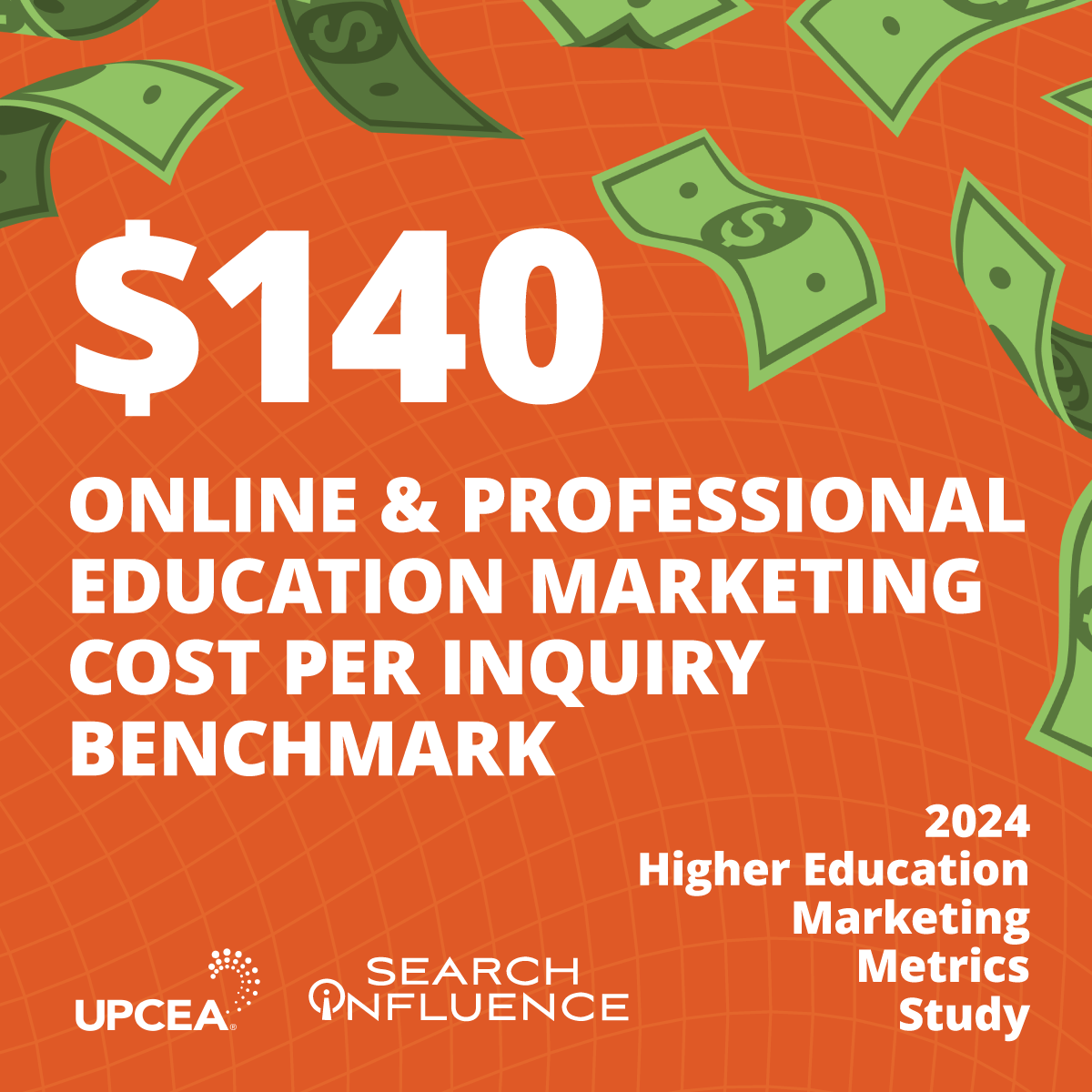
    Through a comprehensive survey collecting data from industry leaders, we established the first higher ed cost per inquiry benchmark of $140. This initiative is part of a broader, multi-year goal to encourage higher education institutions to measure CPI diligently and consider all factors included in advertising costs.

    In this post, we’ll discuss how to successfully track your campaigns using CPI.

    The Importance of Tracking Cost Per Inquiry in Higher Education Marketing

    In higher education marketing, failing to track cost per inquiry results in inefficient budget use and an incomplete understanding of your marketing efforts. Without CPI tracking, higher ed marketers struggle to correlate marketing success to enrollment, making it challenging to justify budget allocations and optimize campaigns effectively.

    When you don’t track CPI, you risk:

    • Spending money on campaigns that drive clicks but no conversions
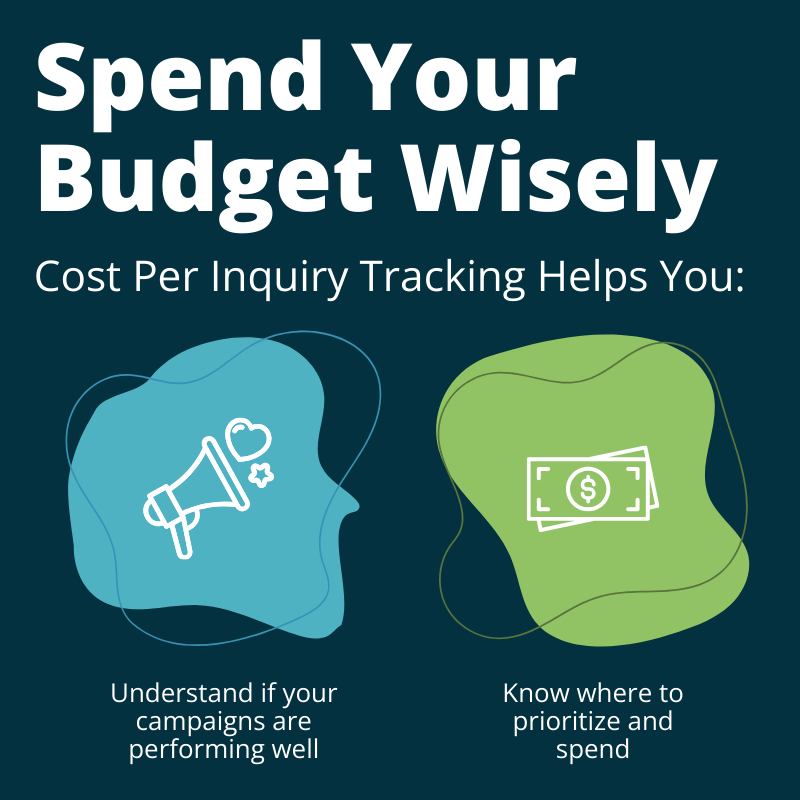
    • Making decisions solely on metrics like cost per click and click-through rate, rather than focusing on which campaigns are actually driving inquiries
    • Funneling money into underperforming campaigns based on the wrong metrics
    • Discontinuing campaigns that effectively generate leads because you’re not focusing on the right metrics

    Tracking CPI offers numerous benefits, including empowering higher ed marketers to:

    • Make data-driven decisions
    • Forecast conversion rates accurately
    • Allocate resources more cost-effectively

    By understanding the cost and quality of inquiries, institutions can refine their strategies to attract the right audience, thereby improving overall campaign performance. Metrics like CPI are vital for evaluating marketing health and success, enabling institutions to enhance enrollment processes and achieve a better return on investment.

    Insights from our higher ed marketing research study

    Our Higher Education Marketing Research Study, conducted in partnership with UPCEA, reveals critical insights that demonstrate the importance of tracking cost per inquiry.

    Higher education institutions spend an average of $800,970 on paid ads each year.

    Without tracking CPI, higher education marketers can’t be sure they’re allocating their resources effectively and getting the appropriate results for the amount they’re spending.

    Only 29% of higher ed marketers are satisfied with their capabilities to track the success of their campaigns. This is a frighteningly low percentage, considering the average higher ed marketer spends nearly a million dollars on paid ads yearly.

    You can achieve your enrollment goals more efficiently by focusing on tracking and reducing CPI.

    Tracking cost per inquiry allows you to:

    • Have confidence that you’re driving an appropriate amount of inquiries and yielding the desired results
    • Direct where to optimize your budget to make it more efficient
    • Understand how adjustments, including targeting and budget changes, impact results
    • Establish a jumping-off point that allows you to look at deeper metrics — such as the lead quality driven by these channels and conversion ratios as these inquiries move through the enrollment funnel

    By establishing a CPI benchmark, we encourage universities to track key metrics and be aware of all factors included in your advertising costs. This benchmark serves as a tool for your institution to compare its results with similar schools and programs, giving you confidence in your efforts by truly demonstrating how much you’re spending — no more guessing games.

    At Search Influence, we know these insights will empower institutions to improve their marketing strategies and achieve better results.

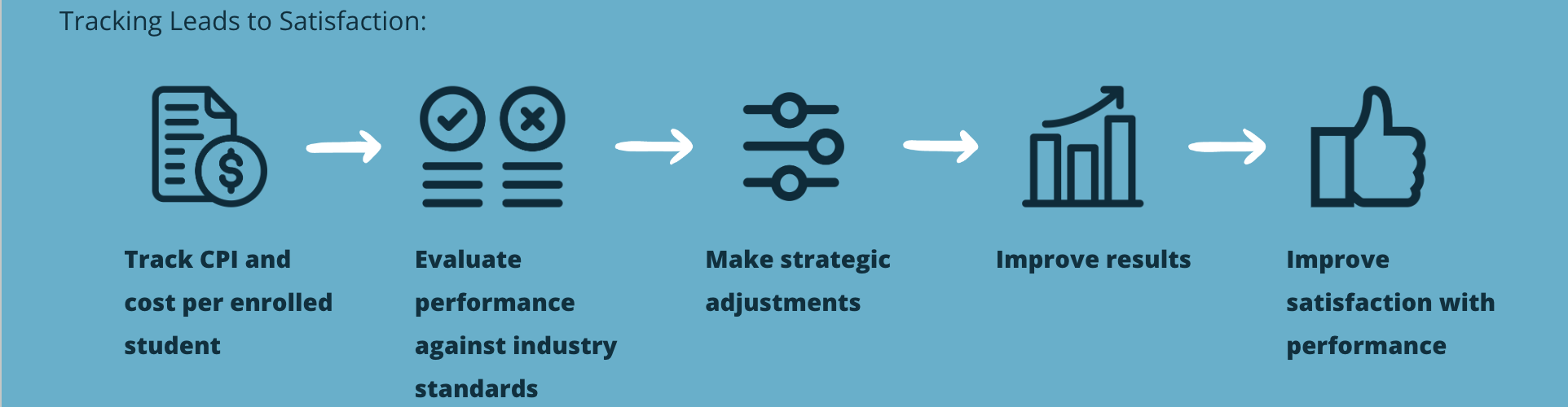
    Tracking leads to satisfaction - Search Influence

    Are You Able to Truly Track the Success of Your Ad Campaign?

    Universities investing in paid advertising must be setup to effectively track the success of their campaigns. Without the necessary information and strategies in place, you risk wasting significant portions of your budget. This underscores the true necessity of tracking cost per inquiry for higher education institutions.

    Some universities suffer from lack of data. Some universities suffer from an overabundance of data spread across disparate systems. Both scenarios hamper effective measurement.
    You need readily available information to make timely adjustments to your strategies, and a process that ensures you regularly analyze cost data and adjust your marketing strategy accordingly. Unfortunately, our research indicates that many institutions struggle in this area. Fewer than half (47%) of marketers are satisfied with their campaign performance, and only 29% are satisfied with their ability to track success. This dissatisfaction highlights a significant gap in campaign efficiency and effectiveness.

    CPI allows you to truly measure the success of your campaigns because your true success is measured by the number of students filling seats at your institution. By focusing on CPI, you get exactly what you pay for, ensuring your budget is used wisely and efficiently to boost enrollment.

    This correlation between tracking ability and campaign satisfaction reinforces the importance of CPI in driving higher ed marketing success.

    According to our research study, 92% of those who are satisfied with their ability to track also report they agree or strongly agree that they are satisfied with the performance of their marketing campaigns.

    Track Cost Per Inquiry With Confidence

    Don’t waste your budget — utilize CPI to achieve precise, measurable results and ensure every dollar spent on advertising contributes to your institution’s enrollment goals.

    At Search Influence, we advocate for robust CPI tracking to help you optimize your strategies and achieve the best possible outcomes. Our team has years of experience assisting higher ed institutions to maximize their marketing results including helping Tulane SoPA exceed its inquiry goal by 58%.

    Need support creating cost-effective campaigns with definitive KPIs?

    Download our Higher Education Marketing Research Study for further insights, or contact us directly to learn more about all our digital marketing services.


    Image Credits: Unsplash

  • Gain Recruitment SEO Insights From Will Scott’s Recent UPCEA Blog Post

    Will Scott on Higher Education SEO Strategies for UPCEA Guest Blog

    Search Influence Co-Founder and CEO Will Scott recently wrote a guest blog post for our higher education marketing partners at UPCEA.

    The blog post, titled “Drive Success: Using Recruitment SEO to Fill Higher Education Seats,” takes an in-depth look at how higher learning institutions can utilize recruitment SEO to adapt to evolving demographics and industry shifts.

    In his blog post, the SEO expert argues that traditional higher education marketing tactics are not enough. Today’s learners discover and explore educational programs differently, and institutions need to adapt their strategies accordingly.

    Takeaways from Will Scott’s UPCEA Blog

    • The Enrollment Funnel in the Digital Age: Today’s students research programs online throughout their decision-making process. Marketers must ensure a seamless online experience, from the initial discovery to application completion. This reiterates the importance of recruitment SEO, or optimizing websites for search engines.
    • A Shrinking Traditional Market: The number of high school graduates is declining, forcing universities to redefine their ideal students. Adult learners and non-traditional students present new opportunities, but also challenges, as they may not be aware of programs that can help them achieve their goals.
    • The Power of SEO: A well-crafted SEO strategy can significantly improve a university’s online presence. It can increase brand awareness, attract qualified leads, and move potential students down the enrollment funnel. Search Influence and UPCEA’s Higher Ed SEO Research Study shows that 84% of marketing departments view SEO as important, but only half have a defined strategy.
    • Beyond Discovery: SEO isn’t just about getting noticed. Prospective students often conduct follow-up searches to validate their initial impressions. Consistent presence in search results builds trust and credibility. Conversely, an absence can undermine an institution’s efforts and benefit competitors.
    • Challenges to Effective SEO in Higher Ed: Many universities lack the resources or expertise to implement a strong SEO strategy. Professional, Continuing and Online departments may be understaffed or underfunded, and institutional leaders may not understand the value of SEO. A Search Influence study revealed that marketing departments rated their SEO skills as just average, and website audits showed significant room for improvement.

    Infographic for Search Influence's Will Scott's UPCEA Guest Blog Post on Higher Education SEO Strategies

    Learn More About Recruitment SEO With Search Influence

    Prospective students are just a search away. Don’t let outdated marketing strategies hold you back.

    Search Influence has years of experience helping universities including Tulane SoPA and Palo Alto University attract qualified leads and fill seats with strategic SEO.

    Contact us today and learn how we can transform your website into a student discovery powerhouse.

  • Search Influence to Present on Higher Ed Marketing Metrics at the 2024 Annual UPCEA Professional and Online Education Conference

    Search Influence to Present on Higher Ed Marketing Metrics at the 2024 Annual UPCEA Professional and Online Education Conference

    UPCEA Annual Conference

    This year at the 2024 Annual UPCEA Conference, Search Influence will present an informative session titled, “Secrets of Highly Successful Enrollment Marketing Teams: Proven Strategies to Set & Reach Goals and Maximize Budgets.”

    Join us as we uncover the secrets to supercharging your enrollment pipeline through efficient higher education marketing.

    Featured Session: A Deep Dive into Enrollment Marketing

    The 2024 Annual UPCEA Conference will take place from March 26-28 in Boston, MA, pooling industry thought leaders from across the globe.

    In their session, Search Influence’s Paula French, together with industry experts Val Fox, Alicia Jasmin, and Leo Rice, will delve into today’s challenges of achieving graduate and adult learner enrollment goals. Attendees will gain various tips and tricks for turning enrollment hurdles into opportunities through:

    • Effective enrollment goal-setting with stakeholders
    • Hands-on enrollment funnel management
    • Strategies to reduce cost per inquiry
    • Maximizing marketing budgets without losing lead quality
    • Keyword optimization and bidding strategies

    Participants will leave equipped with the knowledge and strategies to transform their enrollment processes, setting a new standard for success in higher education digital marketing.

    UPCEA: A Century of Educational Innovation

    Founded in 1915, UPCEA has long been a cornerstone in advancing professional, continuing, and online (PCO) education. Over the years, it has established itself as a vital network for higher education marketing teams, fostering innovation and collaboration across the sector.

    A Platinum Partner since 2022, Search Influence has routinely worked alongside the higher ed association to share industry expertise through insightful research and conference presentations.

    This year’s Annual UPCEA Conference marks just one more chapter in our work of advancing higher education through cutting-edge strategies and insights.

    Refine Your Higher Education Digital Marketing Strategy

    Whether you’re looking to refine your enrollment goals, optimize your marketing budget, or explore innovative digital marketing strategies, our 2024 Annual UPCEA Conference session
    is your gateway to success. Come see us in Boston for our exclusive look into the current state of enrollment marketing.

    Search Influence is here to help you maximize your strategy and results in SEO, paid search, and everything in between. Together, we can turn your marketing challenges into victories.

    Get in touch today and let us show you the way to measurable success and beyond.

  • Search Influence and UPCEA to Present Webinar: “What Gets Measured Gets Managed: Higher Ed Marketing Metrics Research Report”

    Search Influence - Webinar

    53% of our higher ed marketing research respondents aren’t satisfied with their campaigns’ performance. How are you doing?

    On Wednesday, March 13, at 2 PM ET/1 PM CT, Search Influence and UPCEA will host the live webinar, “What Gets Measured Gets Managed: Higher Ed Marketing Metrics Research Report.” We’ll cover our latest research study, which establishes an industry-wide cost-per-inquiry (CPI) benchmark and explores whether higher ed institutions track critical metrics that inform outcomes.

    Join us to see how your campaigns measure up to others in your industry — and which metrics best assess your success.

    What You Will Learn

    Attend the live higher education marketing webinar to learn:

    • The metrics peer institutions track
    • How your university’s CPI metrics compare to peer institutions
    • The most popular sources of inquiries for professional and online programs

    Plus, we’ll give an exclusive first look at our most recent research in collaboration with UPCEA to develop a cost-per-inquiry and cost-per-enrolled student benchmark.

    Bonus: Don’t miss out on our live event giveaway! By registering, you automatically enter the draw to win a $50 prize redeemable across a wide range of over 1,000 top gift cards, prepaid cards, and charitable contributions. We will select four winners — register now to be one of them!

    Your Higher Ed Marketing Presenters

    In “What Gets Measured Gets Managed: Higher Ed Marketing Metrics Research Report,” you’ll hear from industry experts:

    • Jim Fong, Chief Research Officer, UPCEA
    • Bruce Etter, Senior Director of Research and Consulting, UPCEA
    • Paula French, Director of Sales and Marketing, Search Influence
    • Alison Zeringue, Director of Account Management, Search Influence

    Register for the Webinar

    Search Influence became Platinum Partners with UPCEA in 2022. Over the course of our two-year partnership, we’ve co-authored SEO and paid advertising research for higher education institutions looking to elevate their strategy standards.

    “What Gets Measured Gets Managed: Higher Ed Marketing Metrics Research Report” will
    offer an in-depth analysis of current marketing strategies within higher education, highlighting the importance of data-driven decisions. The webinar is a must-attend event for anyone looking to gain insights into optimizing their marketing efforts, understanding industry benchmarks, and improving overall campaign performance.

    Register for the live webinar today to see how tracking the right metrics can impact your school’s bottom line.


    LIVE WEBINAR: 2024 Higher Ed Marketing Metrics Research 

  • UPCEA Webinar Highlights: The Power of CPI in Measuring Higher Ed Marketing Success

    UPCEA Webinar Highlights: The Power of CPI in Measuring Higher Ed Marketing Success

    SI Cost Per Inquiry

    Key Insights:

    • Search Influence and UPCEA have teamed up to create a nationwide benchmark for cost per inquiry (CPI) specifically for professional, continuing, and online education institutions.
    • With an industry-standard benchmark, higher education institutions can better understand how effective their marketing efforts are in attracting prospective students and the factors influencing their success, from media spending to agency fees.
    • To truly harness the power of calculating your CPI, you need a team/system in place that can properly interpret your data.

    Search Influence recently co-hosted a webinar with UPCEA titled “The Power of CPI to Measure Higher Ed Marketing Success.”

    UPCEA is a leading online and professional education association whose members constantly push higher education to new heights. Through everything from professional development to conferences and seminars, UPCEA and its members are diligently working to improve educational access and outcomes.

    Since partnering in 2022, Search Influence and UPCEA have hit the ground running with webinars, research studies, and countless blog posts.

    In our latest collaborative webinar, we stressed the importance of measuring CPI.

    Cost per inquiry (CPI) is the ratio between the amount spent on your online advertising campaign and the actual inquiries made. You can utilize this in your higher education marketing toolkit to measure your campaign’s effectiveness.

    But to truly master the art of measuring cost per inquiry in higher education, you’ll need more details from the experts.

    Watch the recording from our CPI Webinar for a roadmap to guide you through the challenges of calculating CPI for your institution.

    Hear from UPCEA’s Chief Research Officer Jim Fong, Senior Director of Research Bruce Etter, and UPCEA Platinum Partner Search Influence as they provide their insights on the best place to start and how to remove common roadblocks to keep you on your path.

    In this blog post, we’ll summarize the webinar’s highlights and help you determine the best way to utilize cost per inquiry in higher education.


    On-Demand: Cost Per Inquiry Higher Ed Webinar

    What Makes Cost Per Inquiry in Higher Education Important?

    marketing budget

    In higher education marketing, CPI is a vital metric that helps you understand how effective your marketing efforts are in attracting prospective students.

    CPI provides a clear, quantitative way to assess the efficiency and quality of your marketing strategies in engaging with your target audience. It refers to the cost of generating a single inquiry or lead from a prospective student through advertising or promotional campaigns.

    Multiple dimensions of CPI

    When diving into the world of CPI, it’s crucial to consider the various dimensions through which you can examine this metric, including:

    1. Media Spend: This dimension focuses on the direct advertising expenses incurred in generating inquiries. It helps institutions analyze the cost-effectiveness of their digital advertising campaigns, ensuring they allocate resources wisely to reach prospective students. This is most common.
    2. Media Spend and Management Fees: This accounts for both internal and external costs associated with marketing efforts. In addition to direct media expenses, including management fees provides a more comprehensive view of the total investment required to generate inquiries. This is less common than looking at just media spend.
    3. All Marketing Leads and All Leads From Marketing Efforts: Institutions more accurately understand their marketing funnel by considering all leads, not just those that ultimately enroll. This broader perspective allows for the evaluation of the entire journey, from initial inquiry to the conversion of prospective students into enrolled students. This is the least common way to calculate cost per inquiry.

    Benefits of Measuring CPI in Higher Education Marketing Campaigns

    cost per inquiry


    Cost per inquiry holds significant importance for colleges and universities:

    1. Confidence in Inquiry Generation: A calculated CPI instills confidence that an institution’s marketing efforts drive an appropriate volume of inquiries from prospective students. Assurance is vital for ensuring institutions’ marketing campaigns align with their goal of attracting high-quality leads.
    2. Benchmarking Against Industry Standards: CPI allows colleges and universities to benchmark their performance against industry standards. By comparing their CPI to broader industry metrics, higher education marketers can assess whether their outcomes align with expectations and identify areas for improvement.
    3. Vendor Assessment: When working with third-party vendors or partners in higher education marketing, having a clear CPI enables institutions to evaluate the realism of promises made by these vendors.

    Top CPI Questions From the Webinar Audience

    Q. What is the first step in trying to calculate CPI?

    It all starts with the tracking. Most institutions have CRM (customer relationship management) systems and know their spend.

    CRMs can determine the source of the inquiry (which marketing channel brought in that inquiry), but that data isn’t always leveraged, or isn’t viewed in aggregate. If you’re unfamiliar with how to pull this data, seek admin support.

    Determining the source, and pulling high-level reports, will allow you to get more granular with your CPI.

    But data is just data until you have a skilled marketer to interpret it.

    Similar to the need for a thoughtful editor to adjust AI-written copy, a human touch is necessary to truly get nutrition from the data salad your CRM prepares.

    Not interpreting the data from your online advertising campaign is like having a gold mine in your backyard but never buying a rock hammer and picks.

    Utilize tracking data to optimize your future campaigns and help inform decision-makers on the proper next steps for your institution.

    Q. When will the results of the CPI benchmark survey be published?

    Search Influence and UPCEA anticipate publishing the results of our higher ed research survey in Spring 2024.

    Q. How often should schools analyze CPI?

    It depends on your campaign strategy and consistency. Monthly, at a minimum.

    If your school has a more aggressive digital marketing strategy with ads running consistently throughout the year to attract students, analyzing CPI monthly might work best.

    If you are making adjustments and watching them closely, and your spend is large enough, you may look at CPI just a few days after a change.

    You do want to take a step back and look at quarterly, yearly, and monthly trends. Perform seasonal comparisons (YOY) and compare to the same semester the prior year.

    Q. What’s the relationship between cost per enrollment and cost per inquiry?

    Unfortunately, we don’t always have access to cost per enrollment because it can be complicated, especially in the online and professional education world, where adult learners might take a while to decide if they want to go through with the application process and return to school.

    That being said, we have seen that when cost per inquiry is optimized down, your cost per enrollment should also decrease — assuming quality is maintained.

    Search Influence & UPCEA CPI Benchmark Survey

    si & upcea benchmark survey

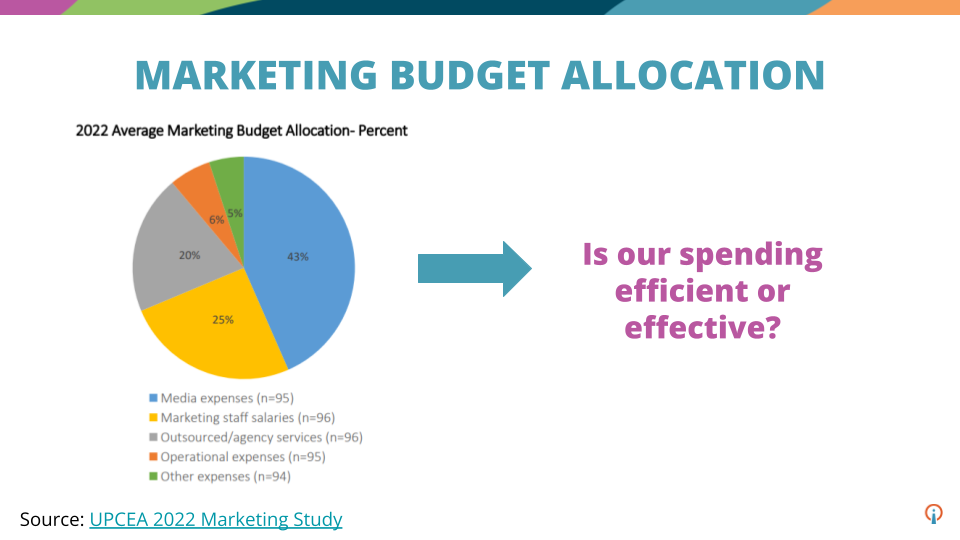
    According to UPCEA, higher ed institutions had an average marketing budget of $1,294,630 in 2022.

    No matter your institution’s budget, you need some standardized measurement to know exactly what your ad spend is getting you.

    That’s why Search Influence and UPCEA have partnered to create a nationwide benchmark for cost per inquiry. This initiative seeks to standardize the measurement of CPI, ensuring uniformity and consistency in how higher education professionals evaluate this critical metric.

    UPCEA and Search Influence believe this metric can help democratize success in higher education marketing.

    Our latest endeavor with UPCEA is a response to the industry’s long-standing need for a credible, industry-specific benchmark for measuring success. The foundation of this benchmark is the CPI Benchmark Survey, an initiative designed to collect diverse insights and data from digital marketers across higher education.

    This initiative is poised to elevate the landscape of higher education marketing strategies, fostering a community of shared knowledge and best practices for engaging new students and optimizing the enrollment funnel.

    With the implementation of an industry-standard benchmark, our shared goal is to enable universities to measure their CPI accurately and gain comprehensive insights into the myriad factors that influence it. From media spend to agency fees, each component plays a pivotal role in determining CPI, and these variables vary from institution to institution.

    If you’re uncertain about your institution’s CPI or are seeking ways to optimize your marketing budget, we designed a CPI Worksheet. You can use it to calculate your CPI and, in the near future, compare it to the broader industry standard we are diligently working to establish.

    Gain a Better Pulse on Your CPI

    With nearly two decades of experience in digital marketing, including higher education digital advertising and search engine optimization, Search Influence is your trusted partner for understanding your institution’s cost per inquiry.

    Our experts simplify CPI analysis, allowing you to effectively assess marketing efforts, evaluate lead generation, and enhance your enrollment funnel.

    Contact Search Influence today to learn more about our lead tracking, reporting, and data analytics services.

    And be sure to watch our recording of The Power of CPI to Measure Higher Ed Marketing Success to gain more valuable insights.

  • What is Cost Per Inquiry (CPI) in Higher Ed Marketing?

    What is Cost Per Inquiry (CPI) in Higher Ed Marketing?

    What is CPI?

    Key Insights

    • Cost per inquiry is the most important metric to measure and drive the efficiency of campaigns.
    • Cost per inquiry is most frequently tracked as a KPI for digital marketing channels (i.e., CPI from paid search or CPI from organic), and it can also measure the effectiveness of digital marketing spend across all platforms.
    • Search Influence and UPCEA’s 2024 research established a reliable industry benchmark for cost per inquiry and cost per enrolled student in online and continuing education.
    • The joint study found a strong link between metric tracking capabilities and overall campaign performance satisfaction.

    As the education sector evolves and marketing programs — especially to adult learners — become more complex, understanding and harnessing the power of cost per inquiry (CPI) is essential for staying competitive and achieving your institution’s goals.

    CPI is the definitive key performance indicator for higher education marketers to track advertising campaign success. Serving as a dual compass, this metric guides your higher education marketing endeavors toward optimal campaign performance and strategic budget spending. It also empowers you to gauge your efficiency, optimize your ad spend, and make data-driven decisions.

    For far too long, higher education digital advertisers haven’t had a benchmark for this critical metric, and certainly not one specific to professional, continuing, and online (PCO) education.

    That’s why Search Influence and our higher education partners at UPCEA (the leading online and professional education association) collaborated to establish the first industry-wide benchmark for CPI — to the tune of $140.

    An infographic courtesy of Search Influence detailing CPI information when doing Higher Education marketing

    In our 2024 study, “Search Influence and UPCEA Higher Ed Marketing Metrics Research Report: What Gets Measured Gets Managed,” we took a look at the state of CPI tracking among PCO units and what marketers need to know to get the most value from their budget spend.

    Before you dive into the research, here’s what to know about CPI in digital marketing, how it’s calculated, and why it should be your school’s top tracking priority.

    What is Cost Per Inquiry in Higher Education Marketing? How Do You Calculate Cost Per Inquiry?

    Cost per inquiry is a fundamental metric that plays a pivotal role in higher education marketing. CPI measures the financial investment required to generate a single inquiry or lead.

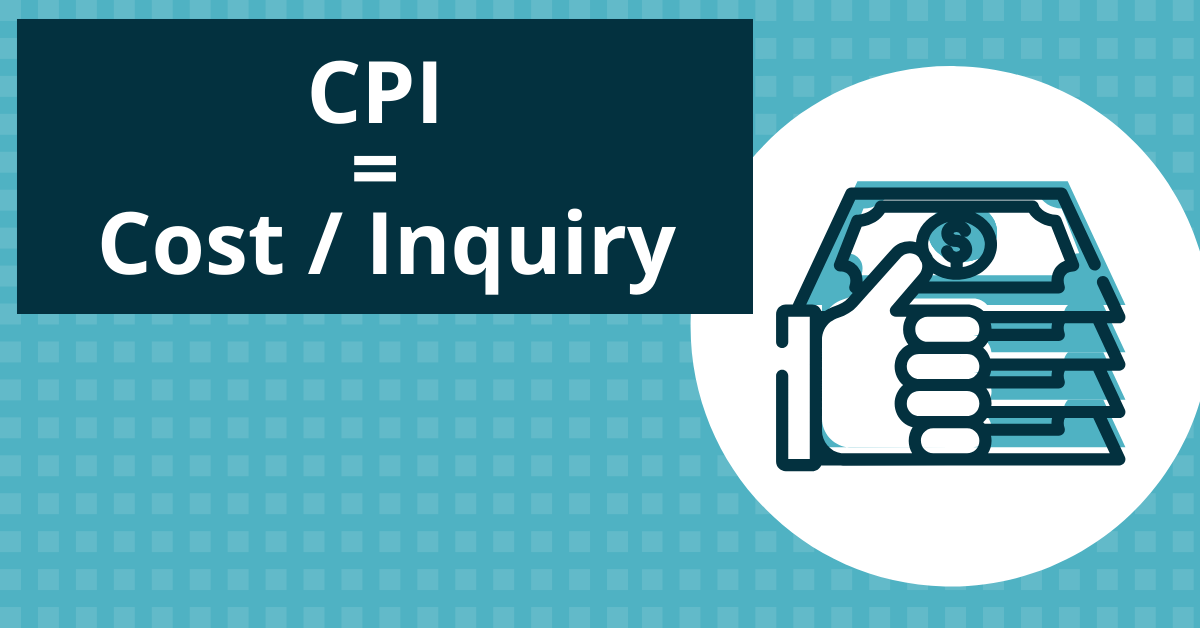
    CPI = Cost / Inquiry

    SI CPI Blog

    In the context of higher education digital marketing, an “inquiry” refers to a prospective student expressing interest in your institution’s programs, courses, or services. This expression of interest could manifest as filling out a contact form, requesting a brochure, or making direct inquiries via email or phone.

    The “cost” in the calculation depends on what marketing campaigns you are trying to measure, your marketing mix, and tracking technology (for example — are you able to track an inquiry back to the source?).

    Cost per inquiry is most frequently tracked as a KPI for:

    • Digital marketing channels (i.e., CPI from paid search or CPI from organic)
    • Digital marketing spend across all platforms

    Some may look at it:

    • CPI per program
    • Organic CPI (leads from organic search visitors)
    • Overall CPI across all marketing expenses

    Different ways to calculate CPI in marketing
    Cost Per Inquiry Worksheet for Higher Education Websites

    In our CPI worksheet, we provide two foundational calculations to help you get started:

    • Digital Advertising Media Spend ÷ # of Inquiries Attributed to Digital Advertising = Digital Advertising Cost Per Inquiry
    • Marketing Expenses ÷ Total Inquiries (All Sources) = Overall Cost Per Inquiry

    This industry-standard cost per inquiry calculation creates an “apples-to-apples” comparison, helping institutions like yours know the real cost and payoff of your marketing efforts.

    Why Measure Cost Per Inquiry in Higher Education Marketing?

    SI CPI Budgeting

    The significance of measuring CPI cannot be understated for marketers.

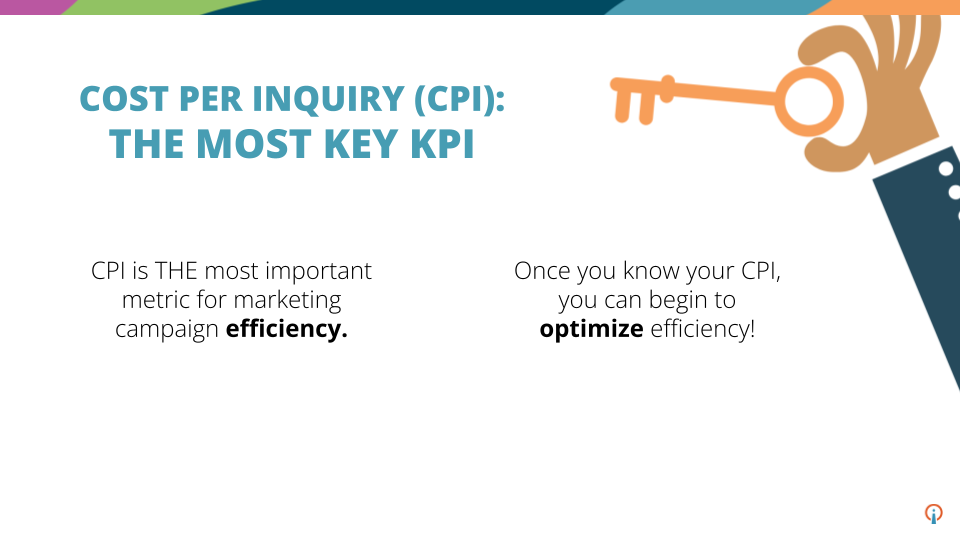
    CPI in advertising is THE most important metric for campaign efficiency.

    Once you know your CPI, you can begin to optimize your efficiency!

    When you consistently measure cost per inquiry in your higher ed marketing campaigns, you can:

    • Have confidence that you’re driving an appropriate amount of inquiries and yielding the desired results
    • Evaluate your outcomes against broader industry standards
    • Project your marketing results and how quickly you can generate necessary inquiries
    • Judge if the promises from third-party vendors are realistic

    Research Numbers at a Glance

    In our 2024 Marketing Metric Research Study, we examined not only whether PCO units tracked cost per inquiry but also their level of campaign performance satisfaction. Our findings yielded a strong correlation between CPI tracking and perceived campaign success — thus bringing to life the old adage, “What gets measured gets managed.

    Key Research Findings:

    • Less than half of PCO units track cost per inquiry (46%) and cost per enrolled student (43%).
    • Nearly one out of five (17%) higher ed marketers do not track the source of their inquiries, nor CPI or cost per enrolled student.
    • Among the PCO units that track cost per inquiry, the average CPI is $140, with a median of $106 and a range of $29.03 to $450.
    • 92% of those satisfied with their tracking capabilities also express satisfaction or strong satisfaction with the effectiveness of their marketing campaigns.

    For further insights into CPI, how it works, and why it works, be sure to check out our full research study. For more tactics to improve your marketing results, take a look at our Higher Education Marketing Resources & Guides.

    Learn More About CPI in Higher Education Marketing

    What is CPI?

    Search Influence and UPCEA are committed to elevating strategy standards in higher education marketing. We hope that, with this industry-wide benchmark for measuring cost per inquiry, you can implement practical strategies for achieving efficient ad spend.

    And, in a world where nearly one in five dollars of programmatic advertising goes to waste, this pivot to efficiency is much needed.

    Ready to see how you measure up to others in the sector? Download the Marketing Metrics Research Study today to take the guesswork out of CPI in advertising.

    Image Sources:

    Image 1: Unsplash

    Image 4: Unsplash

  • UPCEA MEMS Conference Insights: SEO Strategy for Higher Education

    UPCEA MEMS Conference Insights: SEO Strategy for Higher Education

    SI MEMS Conference

    Key Insights:

    • Research indicates that most people’s first interaction with a brand occurs through a search. This makes it critical to optimize your university’s online presence for SEO.
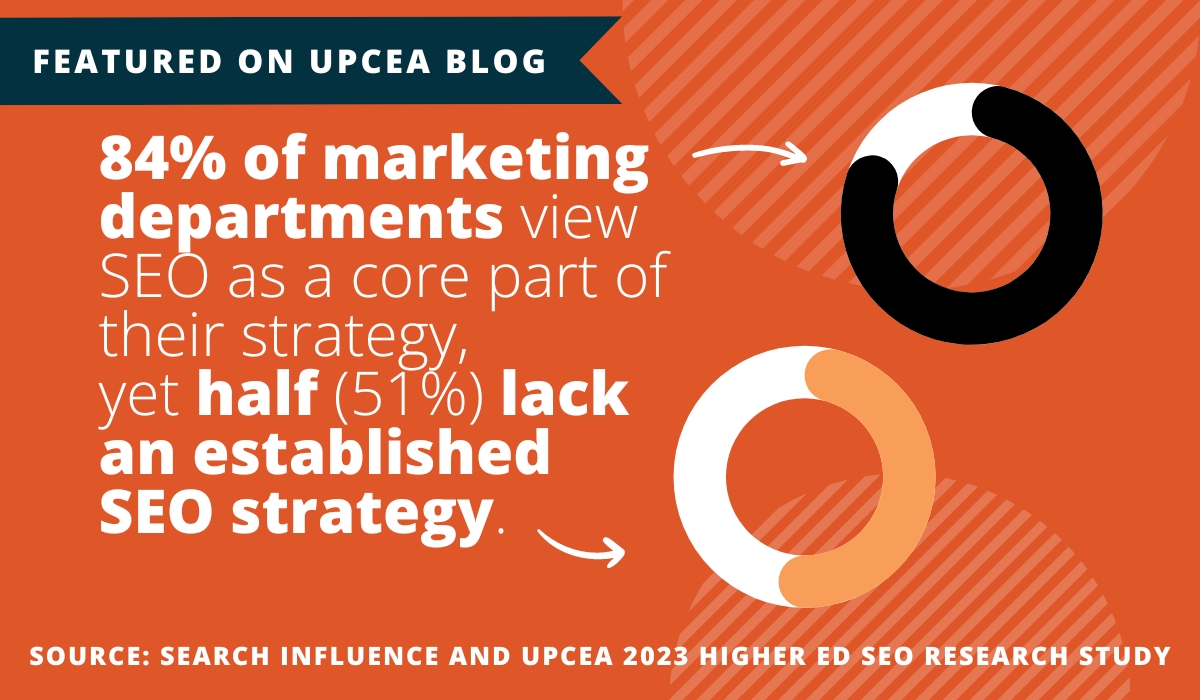
    • Despite 84% of marketing departments considering SEO as a core part of their strategy, 51% of institutions surveyed still lacked an established SEO strategy. This gap in readiness can result in missed opportunities to attract prospective students and increase enrollment numbers.
    • Building a successful SEO strategy for higher education starts with understanding search intent, conducting keyword research, and creating high-quality content that addresses these keywords. It’s also important to build authoritative links both internally and externally.
    • Beyond content, universities must focus on website architecture, user-centric design, site speed optimization, and mobile responsiveness to improve discoverability and enhance the user experience.

    For the second year in a row, Search Influence presented at UPCEA’s MEMS (Marketing, Enrollment Management, and Student Success) conference.


    The UPCEA MEMS conference serves as a watering hole for higher education marketers, specifically those within professional, continuing, and online education.

    At Search Influence, we help higher ed institutions ride the ever-changing waves of SEO strategies. We’ve spent years working on higher education SEO strategies that support universities nationwide in increasing organic traffic and attracting prospective students.

    This dedication to building high-level SEO strategies for educational institutions led us to partner with UPCEA to connect with like-minded individuals.

    Search Influence and UPCEA collaborated on a three-part research study to look at institutional and marketing leaders’ perspectives on SEO and evaluate the readiness of PCO (professional, continuing, and online education) units.

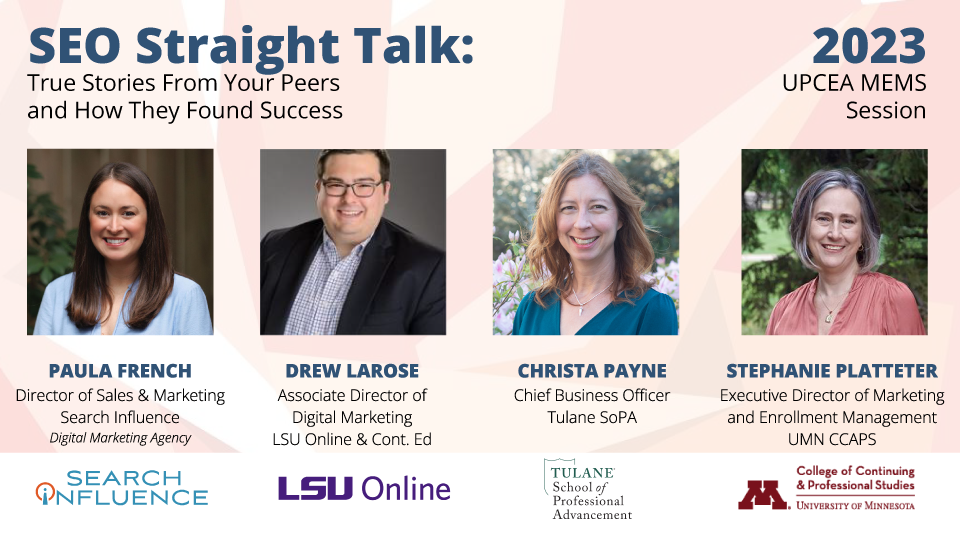
    Our findings shaped our 2023 MEMS presentation. Armed with the understanding that universities need guidance in their higher education SEO strategies, we wanted to show real examples, from multiple schools, of what they have done to improve their visibility in search engines. It was important for us to show not just what the tactics are, but how they drove results. We partnered with 3 great institutions who we knew were effectively executing SEO to share how they have found success.

    Keep reading to learn about our in-depth higher education SEO research and real-world SEO strategies you can implement on your university’s website.

    Search Influence / UPCEA SEO Research Study: Key Findings

    Our collaborative SEO for higher education research study with UPCEA began with a readiness audit of 100 UPCEA member institutions. This audit led to some surprising findings.

    When those surveyed were asked, “How would you rate the SEO capabilities of your PCO unit on a scale of 1 to 5, where a 1 is not very capable and a 5 is extremely capable?,” 3.5 was the average capability rating. 41% of those surveyed rated their SEO capabilities as average or below.

    An even more surprising finding is that 84% of marketing departments see SEO as a core part of their marketing strategy, but 51% do not have an established SEO strategy.

    This missed opportunity leads to fewer clicks from prospective students and lower enrollment numbers for your higher education institution.

    So, how can you improve your higher ed website’s SEO?
    What are the first steps you should take to create an established SEO strategy for your higher-ed website?

    Search Engine Optimization 101


    You must utilize these strategies to keep search engines happy: keywords, content, and links. Think of these three things as your university website’s building blocks.

    Keywords – what are people searching for when looking for your offerings?
    Content – how well does your website provide information that speaks to those keywords?
    Links – how well do other websites reinforce that you are an authority on those keywords?

    Let’s talk through how that might look when you actually do this foundation work:

    Every SEO for higher education strategy must start with determining a prospective student’s keywords (in other words, what terms do they search?).

    For example, say you do some digging in Google Search Console and see your website receives a lot of website traffic for the phrase “online master’s programs.” Recognizing your audience is searching “online master’s programs” is your first win.

    Now that you know your prospective students are scanning through search engines for “online master’s programs,” it’s time to do some keyword research to dial in your strategy.

    You choose to use one of the many SEO tools (even a free tool will work) on the market to take an in-depth look at the search volume of “online master’s programs.”

    Search volume looks good, but your SEO tools inform you this keyword will likely take much work to rank for. Not to worry, “flexible online master’s programs” has a similar search volume but will be much easier to rank higher for.

    After thorough keyword research, it’s time to write high-quality content that uses your focus keyword, “flexible online master’s programs.”

    You decide the best action is to write a 1,400-word blog titled “The Benefits of Flexible Online Master’s Programs for Working Adults.”

    While you’re writing, you link to the pages you want to be associated with this idea, which are the degree pages that offer flexible online master’s programs. You also include links from highly authoritative external sites — you’re really getting the hang of things!

    At the end of this process, you have an informative blog that answers your students’ search intent.

    Now to earn authority, you leverage online profiles, media and PR mentions, and partners to build links back to this blog post as well as related program / degree pages.

    Lather, rinse, and repeat this process continually. Over time, you’ll see your site’s search traffic rise.

    After you’ve mastered SEO 101, it’s time to move on to the next course.

    Search Engine Optimization 201

    You’ve established relevance with your high-quality content.

    You’ve taken the steps to earn authority with link building.

    Now, it’s time to improve your discoverability by focusing on your higher-ed website’s architecture.

    To earn rankings on a search engine, higher education websites must address three things: relevance, authority, and discoverability.

    Fixing the foundation of your virtual storefront

    Think of your website as a virtual storefront that welcomes and engages visitors. Sometimes, you need to fix things inside the walls or under ground to create a welcoming place for visitors, or perhaps improve signage to make it easier for visitors to find their way around. On a website, this is akin to the technical foundation and settings as well as the navigation and user experience.

    Similar to how a brick-and-mortar retail operation would welcome a walk-in customer, the virtual storefront should prioritize the visitor’s experience and ensure that it is user-friendly, informative, and tailored to their needs.

    One common pitfall many universities fall into is designing websites that prioritize their institution’s programs over the potential student’s needs. Additionally, while aesthetically pleasing, overly creative websites might lack a clear target audience, ultimately hindering their effectiveness.

    To succeed in the competitive landscape of higher education, universities must shift their focus and design their websites around students, as well as break down technical barriers that may prohibit a site’s performance.

    A few ways you can design your website around prospective students include:

    • Creating a user-centric design
    • Removing all broken links
    • Creating clear navigation
    • Ensuring your website is easily navigable when used on mobile phones (not just desktop)
    • Prioritizing site speed optimization

    Increase Lead-to-Application Conversion With Blogs — LSU Online

    Our MEMS conference presentation partners at LSU Online increased their lead-to-application conversions with blogs.

    The challenges they navigated included:

    • Their programs’ official names are “distinguished” (not what people actually search for).
    • They competed with on-campus version pages of the same degree.
    • Many adult learners don’t know what degree they want to pursue.

    LSU Online tested varying blog topic strategies to see results on search engine results pages, including:

    • Start your career blogs
    • Comparison content for two programs
    • Faculty/director authored blogs
    • Online student tips blogs
    • Student story blogs

    While these blog topics worked with varying success, this influx in targeted content led to an app increase of 17% in just one year. Moral of the story — high-quality content works.

    Search Influence/LSU Online - Lead to Application Conversion

    Leveraging SEO audit tools for direction and monitoring

    Like any other journey, you need a map to travel to the top of search engine rankings.

    LSU Online found success using site audit tools to guide their rise in organic search traffic. Their SEO audit revealed broken links, broken pages, and program pages missing basic meta information (title tag, meta description, etc.)

    These tools allowed LSU Online to bring their site audit score from 72% all the way up to 90%+.

    Keywords + Content When Launching New Degrees — Tulane SoPA

    In November of 2022, Tulane SoPA launched two new online bachelor degrees: An Online BS in Organizational Behavior & Management Studies and an Online BA in Human Resources.

    SoPA went all in on SEO, primarily content creation and smart optimization, for these two programs as the primary means of promotion, as there was no specific paid advertising budget.

    In one year, Tulane SoPA published 12 blogs that had high SEO value, including: “5 Reasons Every Business Needs An Organizational Management Professional,” “4 Key Legal Considerations for Starting a Small Business.”

    As a result of these higher education strategies, Tulane SoPA had 32 students declared as business majors in just over a year.
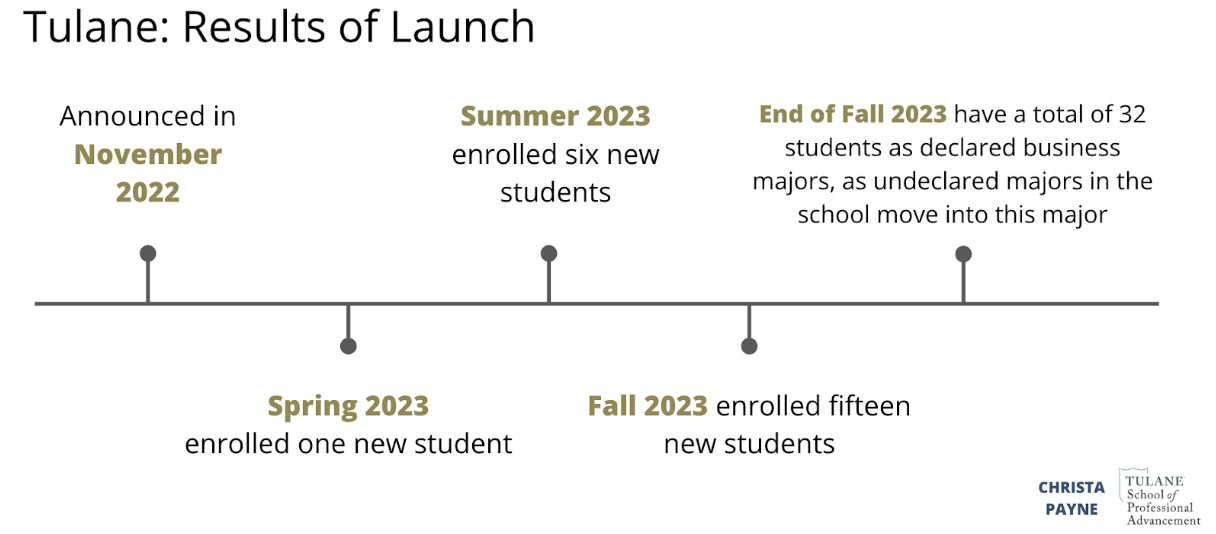
    Search Influence Keywords + Content When Launching New Degrees — Tulane SoPA

    Profiles and public relations to build links

    Search Influence also assisted Tulane SoPA in finding sites with premium (paid) placement for external link building that had value – meaning, they were both authoritative and relevant.

    We went through over 20 sites to help Tulane SoPA find the ones that might be worth it. In the end, Niche and Peterson’s had a fair price, high page and domain authority, and a relatively high percentage of followed links.

    These backlinks helped to build Tulane SoPA’s authority.
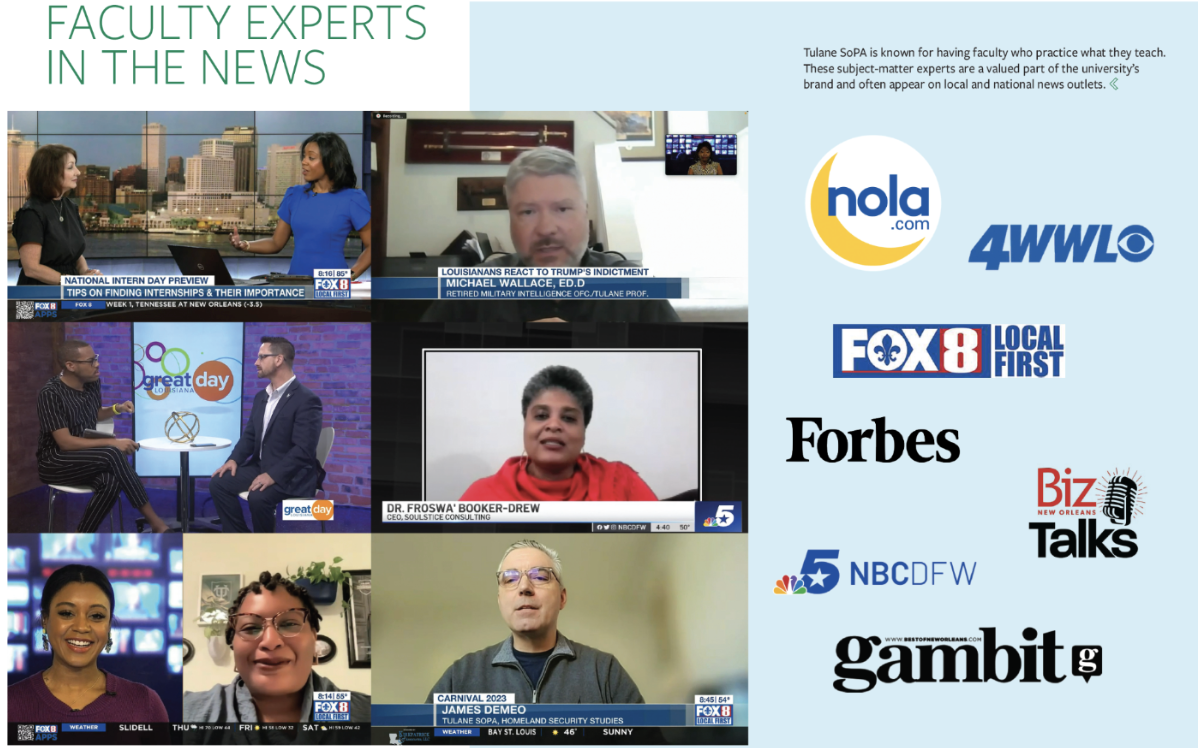
    Search Influence Backlink Authority - Tulane SOPA

    Tulane SoPA also used public relations and earned media to enhance online visibility.

    Tulane SoPA faculty completed over 100 earned media appearances in a year. Each appearance is shared on the Tulane SoPA news site, optimized for SEO value, as well as on social media.

    The above content strategy helped Tulane SoPA rise in search rankings, thus increasing their visibility to potential students.

    Drive New Website Users With Blogs — CCAPS at the University of Minnesota

    CCAPS (College of Continuing & Professional Studies) at the University of Minnesota used blogs to drive web traffic.

    Their content strategy goals:

    • Generate brand awareness
    • Increase web traffic and, ultimately, inquiries
    • Earn backlinks from other sites and pass link authority to program pages through internal links
    • Gain featured snippets

    To do this, CCAPS did the following:

    • Partnered with a digital marketing agency
    • Posted 2–3 blogs per month
    • Completed keyword research and targeting
    • Combined content with schema markup, internal links, and backlinks to improve authority
    • Amplification

    Search Influence CCAPS Blog Content Performance

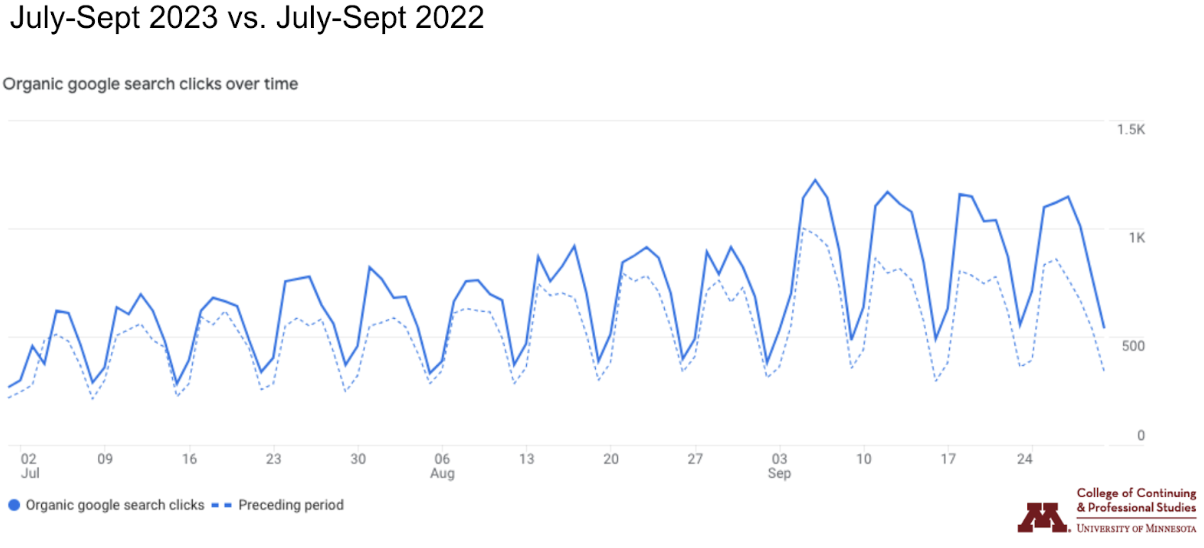
    Since July 2022, CCAPS published over 40 blogs, generating over 50,000 users by September 2023.

    Core web vitals for SEO health

    To climb search engines like Google Search, you must dive deeper into core web vitals for SEO health.

    CCAPS used LCP (Largest Contentful Paint) to measure website load speed, TBT (Total Blocking Time) to measure their website’s interactivity, and CLS (Cumulative Layout Shift) to measure their website’s stability.

    All of these web vitals allowed CCAPS to gauge their SEO health and adjust their strategies to rank higher on search results.

    Learn More About SEO for Your Higher Education Strategy With Search Influence

    Search Influence has helped organizations boost their search engine results and organic traffic for over 15 years.

    From our years of driving results for Tulane SoPA to helping our partners at Palo Alto University exceed their expectations, we understand the factors that can help you rank on Google search and beyond.

    Are you ready to identify keywords and Google trends on your own? Download our SEO Workbook for Higher Education Websites for SEO tips you can implement yourself.

    Need a little more hands-on help to understand Google Analytics and local SEO? Contact the higher education marketing moguls at Search Influence to learn more about successful strategies.