Tag: spam

  • Found: Yelp Reviews Copied and Published as Google Reviews

    In the last week, one very alert client saw saw some very recent reviews on his Google Plus Local listing that looked pretty suspicious.  All 4 of these reviews were published within the week:
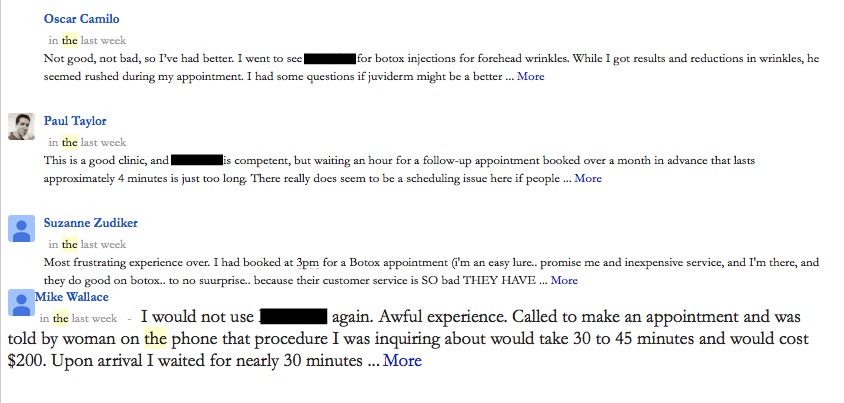
    Google reviews are copies of Yelp reviews

    The client immediately flagged “Oscar” as a spam review on Friday, November 29th.  By Tuesday, December 3rd, we saw that the review was gone.  Removed from the client’s G+ Local.  That was super fast response by Google, which was a pleasant surprise.

    When we looked at the Google+ profiles for Paul, Suzanne, and Mike,

    • none of the 3 had information on their G+ Profiles except where they lived.  No posts.  No videos.
    • none of the 3 lived within 1,200 miles of our client.
    • 2 of the 3 had 100-200 people in their Circle, despite having no account activity.

    With the fast success of the first spam review removal, we immediately flagged the other 3 as spam reviews. Within 1 day, 2 of the 3 remaining spam reviews were removed.   The only one that’s left is “Paul.”  We’re watching Paul, and hopefully, that one will come down fast too.

    Plagiarizing Yelp Reviews

    These Google reviewers were pretty easy to mark as spam based on their Google+ profiles being so bare and their slim reviews profiles — only 1 review each — but I think the real reason they were taken down was because they are not original review text. They are all copy and pasted from Yelp reviews.

    And stating the obvious, the copied reviews are for different businesses and from different reviewers, so there is nothing legitimate about the Google reviews published on our client’s Google listing.

    Suzanne’s Google review…

    Yelp review copied for Google review

    appears to be a close copy of “Cecile Mighty Mouse M.” May 2013 review on Yelp.
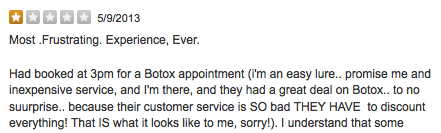
    Plagiarized Yelp review used on Google

    Mike’s Google review:

    Google eview copied from Yelp review

    appears to be a close copy of “Ben S.” July 2013 review on Yelp.
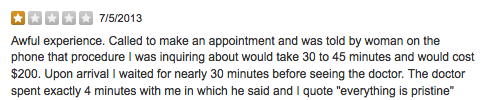
    Yelp review plagiarized for use by Google reviewer

    Paul whose review is still on our client’s G+ Local as of this moment,

    Google review copied and used by Google reviewer

    is a close copy of  “Grainne sounds like Grawn-ya…not Grainy M” May 2012 review on Yelp
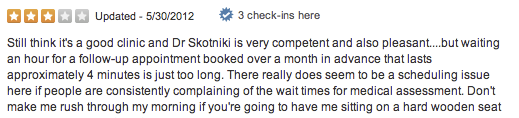
    plagiarized reviews on Google

    If you’re curious to see if a review is spam, try dropping a chunk of it into Google to see if a Yelp review shows up as a close copy. If so, then definitely flag as spam to Google. Has this happened to you? Share your tips and stories of spam comments below.

  • CityGrid Media (an Orange Soda Investor) Scummy Lead Generation

    CityGrid Media, who recently invested significantly in Orange Soda (an SEO/PPC firm out of Utah) has chosen to use the favored tactic of Nigerian princes and Offshore Link-Exchangers to drum up business for their new partner Orange Soda.

    CityGrid Media (Orange Soda) Form Spam Image
    CityGrid Media (Orange Soda) Form Spam Image

    I’m very surprised to see this kind of thing from a company of this stature.

    I’m glad to see that the address is in New York and not American Fork Utah as I’m fairly confident the folks I’ve known at Orange Soda wouldn’t condone this behavior.

    Full text of email message follows:


    Good afternoon, I wanted to reach out to you about your placement in online search. Citygrid is the largest local content and marketing network on the web. I noticed that you are not populating on the major search engines for a few key search terms. Your competition is capitalizing on this and I wanted to discuss how to take some of this market share. We gain placement on Google, Bing, and Yahoo and offer clients 86% of the local web. As part of our SEO, SEM, (Search Engine Optimization, Search Engine Marketing) and content network campaigns we provide phone call tracking, stats, and other comprehensive data to directly track ROI. We will optimize your website to come up on the first page of Google, driving people looking for your services to your business. I’d like to set up a time to speak about this and go over your options to determine if this would be a good fit for your business. Please reach out with your availability. Thank you. Best, x-x-x-x Senior Account Executive P: 212-373-7798 F: 213-351-7011 E: [email protected] www.CityGridMedia.com 555 West 18th St. 5th Floor New York, NY 10011 The largest content and marketing network on the web

    This is shameful behavior from a reputable company. I expect better of both CityGrid and Orange Soda.

  • Twitter SPAM can get you BANNED!

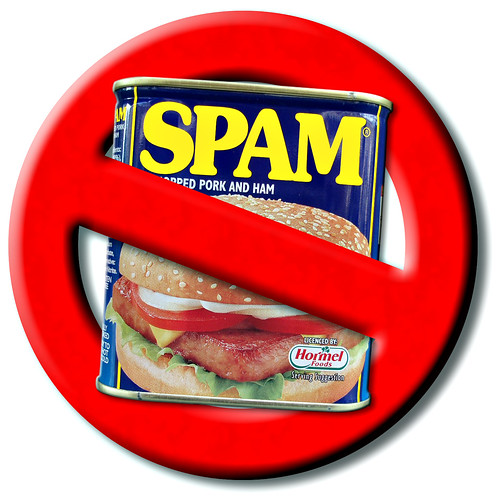
    No one likes SPAM! I’m not talking about the canned meat product. I happen to like the stuff myself. It reminds me of camping when I was a kid. What I am talking about is that which clogs our inboxes, dilutes and degrades the integrity and usefulness of … well, pretty much every new form of communication that arises.

    No Twitter Spam

    In Twitter’s blog post “State of Twitter Spam” they identify

    Twitter SPAM as “behaviors that range from insidious to annoying. Posting harmful links to phishing or malware sites, repeatedly posting duplicate tweets, and aggressively following and un-following accounts to attract attention”

    Their progressive and aggressive approach to taking down the spammers has been a good fight. I’ve had numerous odd accounts follow me who seems to disappear due to “suspicious behavior” before I even got around to seeing who it was. I don’t know about you but I like that, a lot. It gives me confidence that I won’t be completely inundated with crap – I mean spam.

    Some forms of Spam as identified under Twitter’s rules are (as quoted from their forum):

    • If you post duplicate content over multiple accounts or multiple duplicate updates on one account;
    • If your updates consist mainly of links, and not personal updates;
    • If you repeatedly post other users’ Tweets as your own;
    • If you have attempted to “sell” followers, particularly through tactics considered aggressive following or follower churn;

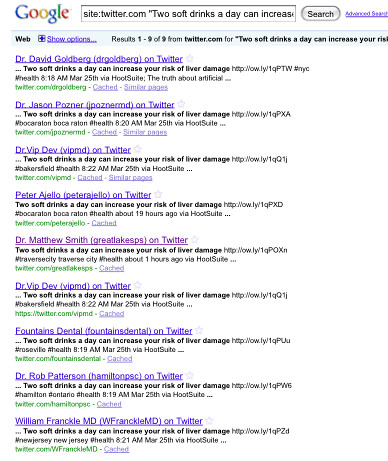
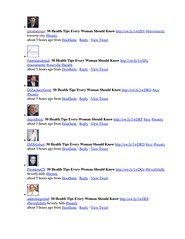
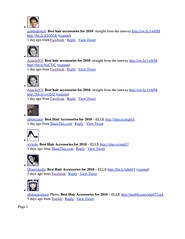
    Here are a few perfect illustrations of Twitter SPAM “duplicate content over multiple accounts”

    Twitter Spam Example

    and the next one ….

    Twitter Spam Example

    And another….

    Twitter Spam-50 Health Tips Every Woman Should Know

    And another…

    Twitter Spam - Best Hair Accesories

    If you were to partake in this sort of evil for yourself or on the behalf of clients, the consequence could be an immediate termination of the account or accounts in question. 

    Obviously, as marketers we need to consider the consequences of what we do for our clients. Ignorance of rules and policies does not exclude anyone from the repercussions of not following or understanding them.

    If your client’s account is terminated, you put them at risk. Your efforts to create your Twitter brand awareness and embrace their customer base will alienate those customers and tarnish their name.

    In the least, a lot of time and effort is lost. All of your building then has to start from over step one. If you did this in a client’s name, I would say it’s a safe bet their Twitter rebuilding efforts will be with someone else.

    As users and viewers we can practice vigilance. If you see this type of behavior, flag it! Let Twitter know. If you’re not sure how, find out here. By all means, don’t follow the links or buy the products. Sometimes it’s hard to spot, but it’s important to be prudent in your clicking and buying.

    Remember, every action is a vote. Don’t vote in favor of spam …

    … unless it’s the salty, occasionally delicious, when-sitting next-to-a-campfire meat product.

    Related reading:

    Internet Marketing for Plastic Surgeons – Less Scary than You Think

    You Can Buy Brand Love on Twitter?,

    The Secret of Small Business Social Media – You Must be Present to Win

    (Thanks for the pics! “hegarty_david” and “pabo76“)

  • Unethical Customer Reviews Can Cost You Big

    Lifestyle Lift is learning the cost of unethical customer reviews. The New York State Attorney General has reached a $300,000.00 settlement with cosmetic surgery company Lifestyle Lift in response to fabricated consumer reviews.

    It appears that Lifestyle Lift was directing employees to spend their time in reviewing their own facilities.

    Lifestyle Lift is a plastic surgery chain store. From those online customer reviews one finds, which appear truly authentic, they’re not doing so great in good old fashioned customer service. According to the article in the NY Times it seems that Lifestyle Lift is resorting to aggressive reputation management techniques to suppress bad reviews and advance their own message.

    Where did Lifestyle Lift go wrong?

    According to the article, it appears that Lifestyle Lift fabricated reviews of their own facilities and even went so far as to create entire new “review” sites to advance their message.

    To be clear, user reviews are great. The creation of alternate sites for search or more targeted messaging are a long accepted technique to obtain ranking and spread the message.

    Where it becomes a problem is when these reviews and sites are presented as authentic user generated content and they are, in fact, a fabrication in support of public relations.

    In short, the creation of false consumer reviews with the intent to deceive is the problem. It’s long been held to be unethical and now, in the state of New York, it’s illegal

    Examples of likely fabricated reviews:

    These aren’t for Lifestyle Lift, but for other plastic surgery searches. I’m not saying the following are specifically relevant to bunk reviews, but there are a couple listings – you can find them yourself – which have an abundance of positive or non-informative, yet 5-star, reviews.

    http://www.google.com/search?q=breast+augmentation+san+francisco
    http://www.google.com/search?&q=plastic+surgery+new+jersey

    And we don’t know that these are definitely a fabrication but “cool” has 3 reviews, all of which are for the same plastic surgeon, focusing on different locations (1 of which includes “Plastic Surgery” as the business name) and no reviews for other businesses.

    And “Happy”, whose reviews look more authentic has a similar instance of 1 each for business name”Plastic Surgery” and for the doctor’s name itself – again, with no reviews for other businesses.

    At a minimum, what the above demonstrate is how not to ask for customer reviews. Whether “Happy” and “cool” are real people or employees of the practice, a little digging makes it appear these are inauthentic and calls into question the validity of all the reviews.

    So what’s a small business to do?

    As the examples show it’s a dog-eat-dog world in online reviews.

    Ironically we’re preparing a much more focused post on how to get reviews but in the meantime remember:

    • Be authentic! Chances are if you fake it you’ll get caught.
    • Have customers tell their story. They’ll be much more believable than you.
    • In doubt? Don’t do it! Lifestyle Lift should be a lesson – it might cost you $$

    Of course, this case is different than most because Lifestyle Lift got busted. The New York State Attorney General has drawn the line for us with regard to clearly egregious behavior but I think we can all agree they’re not the only ones.

    Where does that line get drawn for you? As with every ethical question there are many shades of gray between here and there.

    I’d love to hear your thoughts.

    Thanks to the Blog Herald for tipping me off to this story. It’s very relevant to our livelihood and that of our customers.