Tag: SEO Strategy

  • Foundational SEO vs AI SEO: Paula French on What Businesses Actually Need

    Foundational SEO vs AI SEO Paula French on What Businesses Actually Need graphic

    Search is evolving fast. But that doesn’t mean the foundation disappears.

    On February 6, Paula French, Director of Sales and Marketing at Search Influence, joined the SEO On-Air podcast to unpack one of the biggest questions in digital marketing right now: what is the real difference between foundational SEO and AI SEO, and which do businesses actually need?

    As AI search tools, large language models (LLMs), and Google’s AI-driven experiences reshape discovery, many organizations are racing toward “AI-first” strategies. 

    Chasing the future is smart. Forgetting the basics is not.

    AI SEO Does Not Replace Foundational SEO

    One of the central themes of “Foundational SEO vs. AI SEO: What Businesses Actually Need” was that AI SEO builds on foundational SEO. It doesn’t replace it.

    Technical health, crawlability, structured content, internal linking, entity clarity, and topical authority still determine whether a brand earns visibility in the first place. AI tools may interpret and surface information, but they rely on those existing signals.

    If a site struggles with thin content, weak authority, or technical issues, shifting budget into AI-focused tactics will not fix the underlying gaps. The fundamentals remain the starting point.

    SEO Maturity Should Guide Strategy

    Another key insight from the discussion was the concept of SEO maturity.

    Not every organization needs the same next move. Businesses with limited organic traction often benefit most from strengthening foundational SEO first. Brands with established authority and structured content systems may be ready to refine for AI-driven citation and visibility.

    Instead of asking, “How do we optimize for AI?” a better question is, “Are our fundamentals strong enough to support AI visibility?”

    That shift in thinking prevents reactive decision-making and keeps strategy aligned with measurable outcomes.

    Avoiding the “AI-First” Rush

    There is growing pressure across industries to pivot immediately toward AI search optimization. The episode explored the risk of chasing trends without diagnosing readiness.

    AI search is changing how users interact with information. It’s influencing evaluation, comparison, and brand perception before a click happens. But abandoning core SEO practices in favor of hype-driven tactics creates instability.

    Foundational SEO builds durable visibility. AI optimization refines how that visibility is interpreted and surfaced.

    The most effective strategy isn’t either-or. It’s layered.

    Tune In for the Full Conversation

    For SEOs, founders, marketing leaders, and digital strategists navigating this evolving landscape, the full episode of  “Foundational SEO vs. AI SEO: What Businesses Actually Need” provides a grounded, practical perspective.

    If you’re evaluating your 2026 search strategy, wondering whether to double down on fundamentals or invest in AI optimization, this conversation offers clarity without trend-chasing.

    Listen to the February 6 episode of SEO On-Air featuring Paula French to explore how foundational SEO and AI SEO work together, and how to determine what your business actually needs next.

  • Will Scott to Lead Generative Engine Optimization Master Class on October 7

    Search is no longer limited to ten blue organic links. Today, platforms like Google AI Overviews, ChatGPT, and Perplexity generate direct answers that change how people discover information.

    If your content isn’t optimized for these generative engines, you risk being left out of the results entirely.

    On October 7, 2025 (11:00 am – 4:45 pm ET), Search Influence CEO and Co-Founder Will Scott will lead a live, online Generative Engine Optimization (GEO) Master Class with Search Engine Land. This intensive session will show SEO professionals and content strategists how to align with AI-driven search while continuing to perform in traditional results.

    Why AI SEO Can’t Wait

    AI-powered search surfaces content differently than Google’s organic results. Instead of ranking pages, these engines parse entities, measure authority, and pull contextual answers.

    For marketers, that means adapting keyword strategy, strengthening trust signals, and structuring content so AI systems can cite it directly.

    Will Scott, who coined the term “barnacle SEO,” has long helped businesses prepare for shifts in digital visibility. His GEO Master Class is designed to provide a practical framework so marketers can maintain and expand reach across both AI-driven and traditional search environments.

    What the Master Class Covers

    Fundamentals of GEO

    Learn how generative engines interpret relevance, authority, and citations, and what that means for your content.

    Content Structuring for AI

    Explore formatting and entity optimization techniques that improve your chances of being cited in AI-generated responses.

    Keyword Strategy for AI Queries

    Move beyond static keywords and into conversational phrasing, questions, and modifiers that trigger AI responses without losing organic visibility.

    Competitive Analysis for AI Visibility

    See how competitors perform in generative results, where opportunities exist, and how to adapt their wins to your own strategy.

    Authority and Trust Signals

    Understand how AI systems assess brand authority and what steps you can take to strengthen recognition.

    Measurement and Iteration

    Gain tools and frameworks for tracking appearances in AI answers and adjusting content accordingly.

    Future Outlook

    Get an informed view of what’s next in AI search and how to prepare your strategy today.

    Who Should Attend

    This training is built for content strategists, SEO specialists, and digital marketers with 2–5 years of experience who need actionable techniques for AI SEO. Whether you manage in-house content or work with multiple clients, the session will equip you with skills to keep visibility strong in a generative-first world.

    Agenda at a Glance (ET)

    • 11:00–12:15 — GEO fundamentals: entities, citations, and semantic relevance
    • 12:30–1:45 — Keyword and entity optimization, with a schema deep dive
    • 2:00–3:15 — AI-ready content strategies and hands-on competitive analysis
    • 3:30–4:45 — Measurement, tools, and a forward look at AI search

    About Will Scott

    With decades of experience in SEO and digital marketing, Will Scott has been at the forefront of shifts in search behavior. Beyond leading Search Influence, he has presented at SMX, Pubcon, and LocalU, sharing strategies on AI-driven search and optimization.

    Earlier this year, he led a two-day AI for SEO Master Class with SMX and presented at LocalU Global on using AI for local search. His upcoming session with Search Engine Land builds on that momentum, offering professionals practical frameworks they can apply immediately.

    “Marketers don’t need to abandon SEO. They need to evolve it,” Scott explains. “Generative Engine Optimization is about ensuring your content is both discoverable by AI systems and valuable to human readers.”

    Register Now

    The Generative Engine Optimization Master Class will be held live online on October 7, 2025, from 11:00 a.m. to 4:45 p.m. ET. Registration is $249 and includes on-demand access.

    Don’t miss your chance to learn directly from Will Scott and gain practical skills for AI SEO.

    Register now to secure your spot.


    Images:
    Unsplash Image 1
    Unsplash Image 2

  • AI SEO Fundamentals vs. Foundational SEO: What’s Changed, What Hasn’t

    AI SEO Fundamentals vs. Foundational SEO: What’s Changed, What Hasn’t

    Key Insights

    • AI SEO builds on, not replaces, foundational SEO: Core principles like site structure, crawlability, and authority still power visibility, but AI SEO adapts them for generative search experiences.
    • Entities are the new keywords: While keywords still matter, AI-powered platforms prioritize clearly defined people, places, products, and concepts they can connect in their knowledge graph.
    • Trust signals matter more than ever: Citations, structured data, and mentions in authoritative sources strengthen your credibility in AI-driven results.
    • Content must be precise, structured, and interpretable: AI favors fact-based, well-organized information that it can quickly retrieve, summarize, and verify.
    • Visibility now spans traditional and AI-driven search: Success means optimizing for both blue-link search results and zero-click AI-generated answers.

    Search is shifting. Not in a way that erases what’s worked before, but in a way that builds on it.

    As AI-powered platforms reshape how answers are generated and delivered, marketers are starting to hear more about AI SEO fundamentals and how they differ from foundational SEO.

    The truth is, the two are deeply connected. Foundational SEO gives your site the structure, content, and authority it needs to be discovered, while AI SEO adapts those strengths for generative search experiences. Knowing how they work together is what keeps your brand visible across both traditional search results and AI-driven answers.

    In this post, we’ll explore what’s changed, what’s stayed the same, and where to focus your SEO efforts now.

    What Is AI SEO?

    AI SEO, sometimes called answer engine optimization (AEO) or generative engine optimization (GEO), is the process of optimizing for search platforms powered by large language models (LLMs).

    These systems don’t just match words to queries. They interpret meaning, connect related concepts, and generate answers by pulling from multiple sources.

    The goal of AI SEO is to make your content interpretable, not just indexable. That means presenting information with enough clarity, context, and authority that AI-powered platforms, from Google’s AI Overviews to voice assistants, can confidently surface it in their answers.

    What Is the Difference Between Foundational SEO and AI SEO?

    The easiest way to think about it? Foundational SEO is the playbook. AI SEO is the game adaptation.

    The rules of search visibility haven’t been thrown out. They’ve just been rewritten for a different kind of opponent.

    Foundational SEO focuses on:

    • Indexing – ensuring your pages can be crawled and stored in the search engine’s database
    • Keyword-based ranking – matching specific search terms with the right on-page signals
    • Link equity – building authority through relevant, high-quality backlinks

    AI SEO shifts the focus toward:

    • Understanding – making sure AI grasps the meaning and relationships in your content
    • Summarization – structuring information so AI can distill it into concise, direct answers
    • Entity recognition – clearly defining the people, places, and concepts your content references
    • Trust signals – earning credibility through citations, authoritative mentions, and structured data

    AI SEO builds on foundational SEO, but it doesn’t replace it. Without solid site structure, clean crawlability, and on-page optimization, AI won’t know your content exists, let alone quote it in a response.

    Just like the Braves still rely on strong pitching and fielding, no matter how the opposing team changes its lineup, your SEO success starts with the fundamentals before you adapt to the new game.

    Foundational SEO vs. AI SEO Fundamentals

    Foundational SEO vs. AI SEO Fundamentals

    Foundational SEO Pillars

    Keywords

    In traditional search, exact-match keywords have reigned as the primary way search engine algorithms connect queries to pages. In AI SEO, they’re no longer the only factor, but they still carry weight. Pages in Google’s top 10 results, where keyword targeting is strongest, account for 40.58% of AI citations, suggesting that keyword optimization still contributes to visibility.

    Content

    Foundational SEO rewarded sheer volume and careful keyword placement. AI search rewards content that’s precise, well-structured, and easy to parse. That means answering the full question, organizing information for clarity, and removing anything that doesn’t serve the search intent. Strong content creation now means creating “chunks” of content that can stand alone as a trusted resource.

    Links

    Quality backlinks have long been a direct signal of authority for search engines. When reputable, relevant sites link to your pages, it tells algorithms your content is trustworthy and worth ranking. A well-earned backlink profile improves visibility, strengthens domain authority, and supports higher placements for competitive queries.

    AI SEO Pillars

    Entities

    Entities are the people, places, products, and concepts AI recognizes in its knowledge graph. Optimizing for them means naming them clearly, connecting them to related topics, and using structured data to define their relationships. Whereas keywords are the handshake with traditional search engines, entities are the introduction that AI trusts.

    Semantic relevance

    Semantic relevance is the alignment between your content’s meaning and the intent behind a query. AI models analyze relationships, flow, and coverage of related subtopics to ensure they can extract accurate, context-aware answers. This shifts the focus away from keyword density and toward content that demonstrates topic expertise and logical connections — the qualities AI trusts when deciding what to surface.

    Citations

    Citations are mentions of your brand, content, or expertise in authoritative sources, even without a hyperlink. They act as trust signals, confirming to AI that your content is credible. In foundational SEO, the emphasis is on backlinks as the measure of off-site authority. In AI SEO, citations expand that concept, showing that recognition and validation from trusted sources can influence visibility just as much as linked endorsements.

    This also ties into co-occurrence, when two or more related terms, entities, or phrases appear near each other within your content or across multiple authoritative sources. Even without a direct hyperlink, co-occurrence helps AI understand the relationships between concepts, strengthening your relevance and authority in generative search results.

    How to Optimize for AI SEO

    How to Optimize for AI SEO (Content, Structure, & Technical)

    Once you understand the shifting priorities in search, the next move is to make your content work for both humans and machines.

    Step 1: Identify & Include Recognizable Entities

    If AI can’t tell what (or who) you’re talking about, it won’t feature you in results. Use clear concepts by name and connect them to related ideas so AI crawlers and search engine algorithms understand your content.

    1. Mention people, places, programs, and products by name.
    2. Add related concepts to show the full scope of the topic.
    3. Include brand mentions, institutional affiliations, or commonly searched services.

    Step 2: Write Fact-Based, Declarative Content With Monosemanticity 

    AI-powered tools pick up straightforward, fact-based writing faster than clever wordplay. This is where monosemanticity comes in, i.e., structuring a statement so it carries only one clear meaning, without ambiguity or multiple possible interpretations.

    When applied to content, monosemanticity ensures that each sentence is direct, fact-based, and disambiguated, making it easier for both readers and AI systems to understand.

    1. Lead with simple semantic triples about your brand or related offerings/concepts, including a subject, predicate, and object.
    2. Write with short, direct sentences.
    3. Use credible data sources and skip the filler.

    Step 3: Structure Content for Chunking & Retrieval

    Good structure helps both people and AI quickly parse meaning. The clearer your layout, the faster information can be pulled into relevant answers.

    1. Use short paragraphs, bullets, and clear H2/H3 headings.
    2. Add question-based subheadings that mirror natural searches.
    3. Include a table of contents, jump links, and direct Q&A sections.

    Step 4: Optimize Meta Tags for Clarity

    Your title tags and meta descriptions still matter in an AI search world. They’re one of the first clues search engines use to understand your content and one of the first things users see. In AI contexts, clear and descriptive titles also help LLMs match your page to the right queries.

    1. Write titles that clearly reflect the page’s primary topic.
    2. Keep title tags under ~60 characters so they display fully in search results.
    3. Use meta descriptions (under ~155 characters) to summarize the page in a way that’s useful for both people and AI.
    4. Include your target keyword/entities naturally in both the title and description.

    Step 5: Build Technical Infrastructure That Supports AI

    Even the best content won’t get surfaced if the backend blocks it. Keep the pathways clear so AI can access, understand, and rank your pages.

    1. Keep sitemaps current and allow access to valuable pages in robots.txt.
    2. Use short, readable URLs that signal page relevance.
    3. Improve load times with strong hosting, compressed assets, and fewer blocking scripts.
    4. Strengthen internal links so related topics connect naturally.

    Step 5: Apply Structured Data Markup

    Structured data acts like a guide for AI, showing exactly what your content is about and how it connects to related topics. When applied correctly, it removes guesswork for search engines and generative AI platforms, making your content easier to interpret and more likely to be pulled into results.

    1. Add Schema.org markup for organizations, people, products, courses, and FAQs.
    2. Label relationships between entities so AI can connect the dots.
    3. Keep markup accurate and updated as your content changes.

    Step 7: Distribute Content Across Trusted Platforms

    AI evaluates credibility by looking beyond your website, so your authority should be visible wherever your audience and industry interact. The more your brand appears in reputable spaces, the stronger the trust signals it sends to AI systems.

    1. Publish or repurpose high-value content on platforms like LinkedIn, YouTube, and Medium.
    2. Issue press releases or guest posts in respected industry outlets.
    3. Consistently engage where your target audience spends time to increase brand mentions and citations.

    AI SEO Fundamentals FAQs

    Is SEO going away with AI?

    No, SEO isn’t going away, but it is evolving. The first step toward optimizing for AI SEO is building on strong foundational SEO, because without a clean site structure, relevant content, and credible off-site signals, AI tools won’t surface your pages. Think of AI SEO as an additional layer that works best when the groundwork is already in place.

    What elements are foundational for SEO with AI?

    Core elements like clean site architecture, fast load times, and well-structured content are still essential. These make it easier for both web crawlers and AI models to access, parse, and understand your site.

    Relevant content and credible backlinks build trust with AI-powered search just as they do in traditional search results. Without these fundamentals, your AI optimization efforts won’t have a solid base to succeed.

    Can older content still perform well in AI search?

    Yes, older content can still rank and appear in AI-generated results if it’s accurate, relevant, and updated to reflect current information. AI models prioritize clarity, credibility, and completeness over publish date alone.

    Refreshing older posts with updated data, better structure, and entity optimization can extend their visibility in both traditional search results and AI-driven answers. The key is ensuring the content remains useful and aligned with modern search behavior.

    How does AI SEO apply to higher education marketing?

    AI SEO helps higher education institutions surface in AI-generated answers for prospective students searching across voice search, AI search engines, and conversational platforms. By optimizing for entities like programs, faculty, and campus locations (and pairing that with fact-based, well-structured content), schools can improve their AI visibility.

    This means prospective students may encounter your institution earlier in their research, even without clicking through traditional search results.

    [POP-OUT] Are you a higher education marketer struggling to keep your institution visible in AI-driven search? Our SEO Roadmap delivers three months of actionable tactics you can implement now to strengthen both your foundational and AI SEO for one top program.

    Let’s Make Your AI SEO Strategy Work for You

    Mastering AI search starts with a strong foundation and a clear plan for adaptation.

    By combining proven SEO principles with strategies built for generative search, you can create content that performs now and stays relevant as search technology evolves.

    At Search Influence, we’ve been early adopters of AI SEO, refining foundational tactics while aligning content with the way AI-driven search works today. Our team tracks algorithm changes and AI search updates in real time, ensuring your strategy evolves with today’s top platforms.

    Let us help you adapt existing content, create AI-ready assets, and maintain visibility where it matters most. Contact us today to start building a modern search strategy that works harder for you.

    Images:
    Unsplash
    Unsplash

  • Webinar Recap: How AI Is Changing Search and SEO

    Webinar Recap: How AI Is Changing Search and SEO

    Webinar Recap: How AI Is Changing Search and SEO

    Key Insights

    • AI search is changing the rules but not the game. Foundational SEO fundamentals still matter, but success now depends on adapting them to how AI understands, cites, and delivers information.
    • Visibility comes from trust, context, and structure. Entity-rich content, credible citations, and clear organization make it easier for AI and traditional search engines to surface your brand.
    • Optimizing for Google means optimizing for AI search everywhere. Google’s AI Overviews influence visibility across multiple platforms, making Google-centric AI SEO the highest-impact starting point.

    SEO is not becoming obsolete but is undergoing a significant transformation in an AI-powered search world, requiring adaptation of fundamental strategies rather than a complete overhaul.

    In our recent client webinar, “SEO for AI Search: Stay Visible in the Age of Generative Answers,” we discussed the overall AI shift and the necessary changes to SEO strategy.

    Watch the replay to learn more, or read on for a high-level recap.

    Evolution, Not Replacement

    While the search landscape is changing with the rise of AI, traditional search (dominated by Google) still holds the majority of market share. AI-powered search tools like ChatGPT are a growing segment that needs our attention now to stay ahead.

    AI Search Defined

    AI search uses artificial intelligence to comprehend complex queries, generate concise summaries, and provide direct answers, moving beyond just a list of links. Key features include conversational input, AI-generated overviews, context awareness, entity recognition, and citations.

    Shift in SEO Focus

    The fundamental pillars of SEO are adapting…

    From keywords to entities

    The focus is shifting from exact keyword matching to understanding and optimizing for entities (named people, places, things, ideas). AI tools use entities to understand context rather than literal search terms. A significant finding is that ~87% of the time, the exact search query does not appear in the AI Overview (AIO) summary, emphasizing the importance of context and the decline in exact-match keyword optimization importance.

    From content volume to semantic relevance

    Content optimization moves from mere text volume and keyword use to semantic relevance, meaning content that demonstrates depth, is structured for natural search, and reflects how people genuinely ask questions and connect topics. Content needs to be structured in the same way, be clear, and be concise to be chosen by AI as a trusted source.

    From links to citations

    While links are still important, the emphasis shifts to citations, which involve building trust through mentions and references from authoritative sources. Being present in Google’s top 10 organic results is highly correlated with being cited in AIOs (~41% of citations come from Google’s top 10).

    Google’s Continued Importance

    Optimizing for Google Search and its AIOs is the most impactful strategy for immediate and long-term results. Google’s AIOs are a hybrid model that pulls real-time data from its index, uses a language model to generate answers, and blends various search results and structured data. Moreover, optimizations made for Google AIOs also positively impact visibility in other AI search platforms like ChatGPT.

    Brand Impression in Zero-Click Searches

    With the rise of “zero-click searches” (where users get answers directly from AIOs without visiting a website), being cited in an Overview can still create a crucial brand impression and even encourage later brand-specific searches.

    Actionable AI SEO Strategies

    Search Influence is actively taking concrete, AI search-optimized steps for our clients where applicable:

    • Content Design: Writing entity-rich, specific, direct, “chunked,” organized, and authoritative content, incorporating clear citations and external references.
    • Semantic Triple: Structuring content using a subject-predicate-object format to help AI extract facts easily.
    • Internal Linking: Linking to and from entities rather than using generic call-to-action anchor text.
    • Schema Markup: Utilizing web code like schema to reinforce entities and structure content, which AI-powered search reads and benefits from.
    • Citation Building: Actively building citations through online directories, media mentions, thought leadership, speaker bios, and professional associations, reinforcing the desired association between your brand and its offerings.
    • Tracking and Analytics: While data for AI search tracking is rapidly developing, current tools like Google Analytics 4 can provide referral traffic from AI, and Google Search Console can identify conversational queries. Newer AI SEO tracking tools are emerging to monitor presence and sentiment in AI results.

    We recommend a proactive and adaptive SEO approach that understands and leverages how AI processes information, prioritizing:

    • Contextual understanding
    • Structured content
    • Credible external validation over traditional keyword-focused content and link quantity

    Stay Ahead in the AI Search Era

    We’re in the middle of one of the biggest shifts in search since Google was founded, but the fundamentals of SEO still matter. How you apply them just looks different in an AI-driven world. The brands that adapt now will be the ones that stay visible tomorrow.

    Watch the full webinar recording for practical examples and strategies you can start using right away.

    Wondering what this all means for your brand? Contact us, and let’s talk about how to position your brand for success in both traditional and AI search.

    Image

    Unsplash

  • How Marketing Supports SEO and Helps You Score Big With AI Search

    How Marketing Supports SEO and Helps You Score Big With AI Search

    How Marketing Supports SEO and Helps You Score Big With AI Search

    Key Insights

    • AI search engines reward brands that align SEO with all marketing channels, including social, PR, paid, and email.
    • Social media content marketing reinforces SEO performance by increasing entity signals and driving engagement.
    • Earned media and PR build domain authority and citations that support higher search engine rankings.
    • Email and paid campaigns indirectly boost SEO by influencing user behavior signals like CTR and repeat visits.
    • AI SEO tracking tools and Google Search Console help track how your marketing efforts affect AI search visibility.

    AI-generated search has changed what a winning digital marketing strategy looks like.

    To stay competitive in search, you need more than keywords, high-quality backlinks, and old-school content marketing.

    You need a coordinated offense.

    If AI-powered search is your end zone, then SEO is your quarterback, calling the plays.

    And your other marketing channels (social media, earned media, email, and paid campaigns) are the wide receivers, running backs, and tight ends moving the ball downfield.

    When they work together, you don’t just show up in search —  you win the search results.

    Search rankings success now hinges on how well your entire marketing strategy supports visibility in Google’s AI Overviews and tools like ChatGPT and Perplexity.

    Learn how content marketing, social media, PR, paid ads, and email all reinforce your search engine optimization efforts and help your brand dominate the AI-driven digital playing field.

    How Marketing Supports SEO and Helps You Score Big With AI Search

    Why SEO Needs a Team Effort in the Age of AI Search

    AI search engines reward brands that align SEO and other forms of marketing for maximum authority.

    Search engines like Google Search no longer rely solely on keywords and link building to decide what ranks. AI-powered search pulls from trusted sources, structured content, and recognizable entities.

    Brands that show up consistently across the web, in blog posts, press releases, social profiles, and paid placements, are more likely to be recognized and cited in search engine results pages, including AI Overviews.

    That consistency helps solidify your brand across the three key AI SEO pillars: entity recognition, semantic relevance, and authoritative citations. When your content, PR, and paid efforts echo the same message, it signals trust to both users and search engines.

    Building SEO Momentum Across Your Marketing Channels

    Social media: the unsung SEO MVP

    Social media posts amplify your SEO by reinforcing entities and driving engagement signals.

    Platforms like TikTok, Instagram, and LinkedIn are now part of the search journey. With social content appearing in search results, these channels are critical for reinforcing relevance, brand awareness, and your online presence.

    Best practices for social search optimization include:

    • Using keywords in bios and captions/text posts to reflect your brand and services.
    • Linking consistently to your core SEO pages.
    • Repurposing high-quality content into bite-sized posts to boost visibility.
    • Using hashtags strategically to build topical associations and reach your target audience.

    Even more importantly, optimized social profiles with consistent NAP (name, address, phone number) data contribute to local SEO and entity alignment.

    By driving traffic and user engagement, social also sends quality signals that search engines interpret as ranking factors. This not only improves on-page SEO but also strengthens your presence in organic search results and social search algorithms.

    PR & earned media: link-building powerhouse

    Earned media strengthens SEO by building authoritative citations and backlinks.

    A press hit or podcast appearance isn’t just good publicity; it’s an SEO asset. Media mentions and thought leadership build domain authority and keyword associations that help you rank higher in organic search.

    Ways to reinforce SEO in PR efforts:

    • Include locked-in phrases (your preferred product or service descriptions) in boilerplate bios and releases.
    • Syndicate press releases via newswire services to generate multiple backlinks and citations.
    • Contribute guest posts to relevant industry blogs with links to cornerstone content.
    • Promote media wins on social channels and your website to extend reach and reinforce relevance.

    These earned links and mentions feed directly into Google’s understanding of your authority.

    They can also boost brand awareness and credibility, which in turn fuels more engagement, links, and overall SEO success. In AI search results, those citations often become the deciding factor in whether your content gets featured.

    Paid advertising & email campaigns: driving SEO clickstream data

    Paid campaigns and email traffic support SEO by sending quality signals to key pages.

    While paid search/PPC, digital ads, and email don’t directly influence search rankings, they impact user behavior metrics like pageviews, bounce rate, and time on page, all of which contribute to overall SEO performance.

    Use paid advertising (paid search/PPC and digital ads) and email to:

    • Drive targeted traffic to SEO-priority pages.
    • Retarget users to increase return visits and page engagement.
    • Feature blogs or cornerstone content in newsletters to boost visibility.

    When users consistently visit and engage with your site after a paid ad or email click, analytics and tools like Google Analytics pick up on those signals.

    They show that your content meets user intent and delivers value. In AI search engines, where quality content and user signals are ranking factors, this kind of reinforcement is critical.

    Tracking Your SEO Wins in AI Search

    How Marketing Supports SEO and Helps You Score Big With AI Search

    Tracking tools reveal how your marketing impacts SEO visibility in AI-powered search.

    You can’t improve what you can’t measure. Fortunately, new tools make it easier to track your AI search website traffic.

    Here’s what to monitor:

    • Referral traffic from generative AI sources
    • Presence in AI Overviews or AI-generated responses.
    • Entity recognition for your brand and key pages in tools like Scrunch AI.
    • Search engine rankings and keyword rankings in traditional search. You should still care about organic search rankings because they are still used by most audiences, and they influence AI search results.

    Despite popular belief, AI SEO isn’t a black box.

    At Search Influence, we recommend AI SEO tracking tools for clients who want visibility into how their content is retrieved and referenced in tools like Google’s AI Overviews or ChatGPT.

    Tools like Scrunch AI, Semrush, and Advanced Web Ranking are rolling out new features to help track keyword visibility and AI answer inclusion across different search results.

    The ability to measure these AI SEO metrics gives your team the confidence to double down on what’s working and identify new content marketing opportunities that align with search intent and digital marketing best practices.

    Higher Ed Example: When Marketing Plays as a Team

    An integrated marketing strategy helps universities dominate AI search with consistent brand signals.

    Let’s take higher education as a case study. Universities have complex websites with multiple departments, programs, and voices. When every touchpoint supports a unified SEO strategy, it makes a measurable difference in organic traffic, visibility, and user experience.

    Despite this, 51% of higher ed marketing departments lack an SEO plan.

    That’s like getting ready to snap the ball without having a play drawn up.

    Here’s what it looks like when all higher ed digital marketing channels play like a team to support SEO:

    • Press mentions are strategically related to, and link to, key website pages.
    • Faculty speaking engagements are published on YouTube and social media.
    • Social media posts present the same info as your blogs in a format designed specifically for that platform.
    • Faculty bios link to relevant departments, publications, and press mentions.
    • PR campaigns and social posts highlight research topics tied to search intent.
    • Paid ad teams run ads to SEO-targeted website pages and blogs.
    • Podcast appearances link to and mention key degrees and programs alongside your brand name.

    At Search Influence, we’ve helped higher ed clients align SEO strategy with marketing efforts by identifying opportunities to promote targeted programs and degrees through traditional methods that support SEO, and by republishing assets online in a way that is best found and leveraged by search engines and AI models.

    When SEO, PR, social, paid, and content marketing teams share data and strategy, the result is a powerful flywheel that delivers relevant content, builds domain authority, and earns organic traffic.

    Bringing It All Together: Your Winning SEO Playbook

    To win in the AI search era, you need every part of your digital marketing team working toward one goal: SEO success.

    Here’s how your marketing supports the core principles of AI-driven SEO:

    • Entities: Use structured content and consistent messaging to help search engines understand your brand and offerings.
    • Semantic relevance: Align content across platforms to reinforce semantic relevance and meet user intent.
    • Citations: Earn trust and build authority through strategic outreach, earned media, and consistent engagement.

    A data-driven, coordinated approach ensures you’re not just showing up, but standing out.

    FAQ: Marketing, AI SEO, and Brand Authority

    How does social media help SEO rankings?

    Social media boosts SEO by increasing entity mentions and driving engagement signals.

    Search engines and users alike take note of your brand’s presence across platforms. Social profiles with complete business info, regular content posts, and linked landing pages help clarify who you are and what you do. When your content is widely shared, it gains visibility and relevance in the eyes of search engines.

    How does earned media drive SEO success?

    Earned media strengthens SEO with backlinks and authoritative citations.

    Publications, podcast appearances, and industry blogs serve as third-party validators. These citations build trust and domain authority, two key elements in both traditional SEO and AI-driven rankings.

    What’s the relationship between PPC and SEO?

    Paid search (PPC) supports SEO by driving traffic and reinforcing branded search terms.

    Paid search helps fill gaps while organic SEO takes time to build. When users see both your ad and your organic listing in the search engine results pages, they’re more likely to click. That overlap improves brand recognition, click-through rate, and long-term search performance.

    How do you track AI search visibility?

    AI SEO tools measure your brand’s presence in AI Overviews and conversational search.

    Emerging platforms like Scrunch AI are designed specifically to track AI search visibility. They track how often your content appears in Google’s AI Overviews, ChatGPT citations, and other AI-driven results. Pair that with traditional metrics in Google Analytics and Google Search Console for a complete view of performance.

    Why is branding important for AI search visibility?

    Strong branding improves AI search visibility by helping engines recognize and prioritize your brand as a trusted entity.

    When your name, offerings, and messaging are consistent across the web, from your website and social channels to business directories and review platforms, you build trust. That clarity and consistency make it easier for AI to pull accurate information about your brand and include it in AI-generated responses.

    Ready to Win With SEO? Let’s Talk.

    Want your marketing efforts to work harder for SEO and get results in AI search?

    At Search Influence, we help brands align every part of their marketing strategy to drive visibility, authority, and engagement where it matters most. Our experts bring together quality content, technical SEO, paid media, and brand strategy to help you rank in search engine results and show up in AI-generated answers.

    We specialize in working with higher education, healthcare, and hospitality brands that need long-term, scalable SEO strategies rooted in best practices.

    Contact us today to learn how we can help you create a winning SEO strategy tailored to your goals.

    Images:
    Unsplash
    Unsplash

  • The AI SEO Guide: From Concepts to Application

    The AI SEO Guide: From Concepts to Application

    The AI SEO Guide: From Concepts to Application blog post

    Key Insights

    • AI SEO means creating content that resonates with humans and is easily interpreted by AI systems.
    • Search engines prioritize semantic relevance, so depth and clarity now matter more than exact keywords.
    • AI models pull from trusted sources, making content accuracy and accessibility essential.
    • Content should align with user intent and be structured in self-contained chunks that AI can retrieve.
    • Winning at AI SEO requires ongoing effort, fresh content, and the right tools to track AI visibility.

    AI SEO is the strategic optimization of digital content to perform well with both human visitors and artificial intelligence systems like search engines, voice assistants, and chatbots. As we enter an era where content is increasingly filtered through AI tools like ChatGPT and Google’s AI Overviews, and voice assistants are answering user questions directly, your content must now serve two audiences:

    1. Your human customers
    2. The AI models deciding what content to surface in search results

    To improve your organic traffic and win in this environment, you need to understand how AI works, how search engines are changing, and how to optimize content so it’s both discoverable and compelling. This guide walks through the essential concepts of AI SEO, from AI fundamentals to successful content optimization.

    Part 1: Foundations — What Powers AI SEO

    Artificial intelligence (AI)

    Think of AI as your super-smart digital teammate who learns from data to make decisions, generate content, or answer questions. It’s like having a research assistant who’s read the entire internet and never sleeps.

    In your website’s world, AI helps with:

    • Answering customer questions automatically
    • Suggesting content your visitors might like based on their behavior
    • Improving your SEO by understanding what your content means, not just what keywords it contains

    Try This: Ask ChatGPT to analyze one of your web pages and suggest improvements. You’ll get a taste of how AI “sees” your content.

    Large language models (LLMs)

    LLMs, like GPT-4, Claude, or Gemini, are a type of AI software powering tools like ChatGPT that your team can use for content creation and optimization. These sophisticated platforms process and generate human language based on vast amounts of text data they’ve analyzed.

    For AI SEO specifically, your marketing team can use LLMs to:

    • Create search-optimized content that addresses search intent.
    • Generate blog ideas based on trending topics and search volume.
    • Analyze top-performing search results to identify content gaps.
    • Draft meta descriptions and title tags that improve click-through rates.
    • Develop FAQ sections that address common user queries and help with featured snippets.

    Embeddings in search engines

    Embeddings transform text into numerical vectors that capture meaning. For AI SEO, this is crucial because modern search engines use embeddings to understand the topics in your content.

    For example:

    • “Buy running shoes” and “purchase athletic footwear” would have similar embeddings despite using different words.
    • This allows search engines to match your content with user queries based on meaning, not just exact keyword matches.

    Content creation strategies should focus on comprehensive topic coverage rather than exact keyword density.

    The best AI SEO software tools now use embeddings to analyze how search engines will interpret your content, helping you optimize for semantic relevance.

    Vectors and AI-driven search results

    Vectors are the actual mathematical representations of your content that search engines use to match with search queries. When optimizing content for AI SEO:

    • Each piece of content has a unique vector “signature” based on its topics and meaning.
    • Search algorithms compare query vectors with content vectors to determine relevance.
    • The closer these vectors align, the higher your content may rank in search results.
    • Recent changes in search engine algorithms prioritize semantic relevance over exact keyword matching.

    Try This: Use AI SEO tools to analyze your highest-performing organic content and identify the semantic topics that may be driving its success in search results.

    Part 2: Making AI Smarter — Grounding and RAG

    Grounding

    Ever had a conversation with someone who confidently states something completely wrong? AI can do that too. It’s called “hallucination.” Grounding is like giving AI a fact-checker before it speaks.

    In practical terms, grounding means connecting AI to reliable sources of truth, such as:

    • Your website content
    • Product catalogs
    • Knowledge bases
    • Customer support archives

    This matters because it ensures that when someone asks a question about your business, the AI answers with accurate information, not what it thinks might be true.

    RAG: Retrieval-augmented generation

    RAG is the framework that makes grounding possible. Think of it as a three-step process:

    1. Retrieve: The AI searches for relevant content in your database (using those vector coordinates we talked about).
    2. Augment: It adds this information to its “working memory.”
    3. Generate: It crafts a helpful, accurate response using this fresh information.

    It’s like the difference between asking someone to recall a movie plot from memory versus letting them look up details while they tell you about it. The second approach is always more accurate.

    This is what powers:

    • Custom GPTs with access to your content
    • Site search that gives conversational answers
    • Google’s AI Overviews that summarize search results
    • Enterprise chatbots that know your specific business

    Try This: Test an RAG system yourself by creating a custom GPT in ChatGPT with your website content, then see how it answers questions about your business.

    Part 3: Structuring Content — Relevance, Salience, and Granularity

    Topical relevance

    Topical relevance means your content matches what people are looking for. It’s not just about keyword matching. It’s about addressing the concepts behind the keywords.

    To boost relevance:

    • Focus each page on one clear topic (avoid the “everything bagel” approach).
    • Use natural language that covers related terms and concepts.
    • Match the underlying intent, not just the exact search terms.

    Salience

    Salience is about prominence and focus. Is your core topic front-and-center, or just mentioned in passing?

    Think of it this way: If your page were a movie, is your key topic the star, or just an extra in the background?

    To win at AI SEO, know that:

    • Salient content gets retrieved more often.
    • It ranks better in traditional search, too.
    • It delivers what real users are looking for.

    Chunks (Passages): The unit of retrieval

    Modern search engines and AI don’t read your content like humans do. They break it into bite-sized pieces called “passages” or “chunks.”

    Think of each chunk as a mini-document focused on one subtopic. When someone asks a question, AI might pull just that relevant chunk, not your entire page.

    To optimize your chunks:

    • Use clear subheadings that state the main idea.
    • Make each section answer a specific question.
    • Keep related information together.
    • Aim for self-contained sections that make sense on their own.

    Try This: Look at your top-performing page. Can you identify distinct chunks? Would they make sense if read in isolation?

    Good vs. great: What high-salience content looks like

    Low-salience example: “We offer a range of services, including SEO, PPC, email, social media, and more.”

    High-salience example: “Our SEO strategy begins with a technical audit, followed by keyword mapping and targeted content updates to drive organic rankings.”

    Why this matters: The first mentions SEO, and the second is focused on it. That focus is what makes content salient and retrievable.

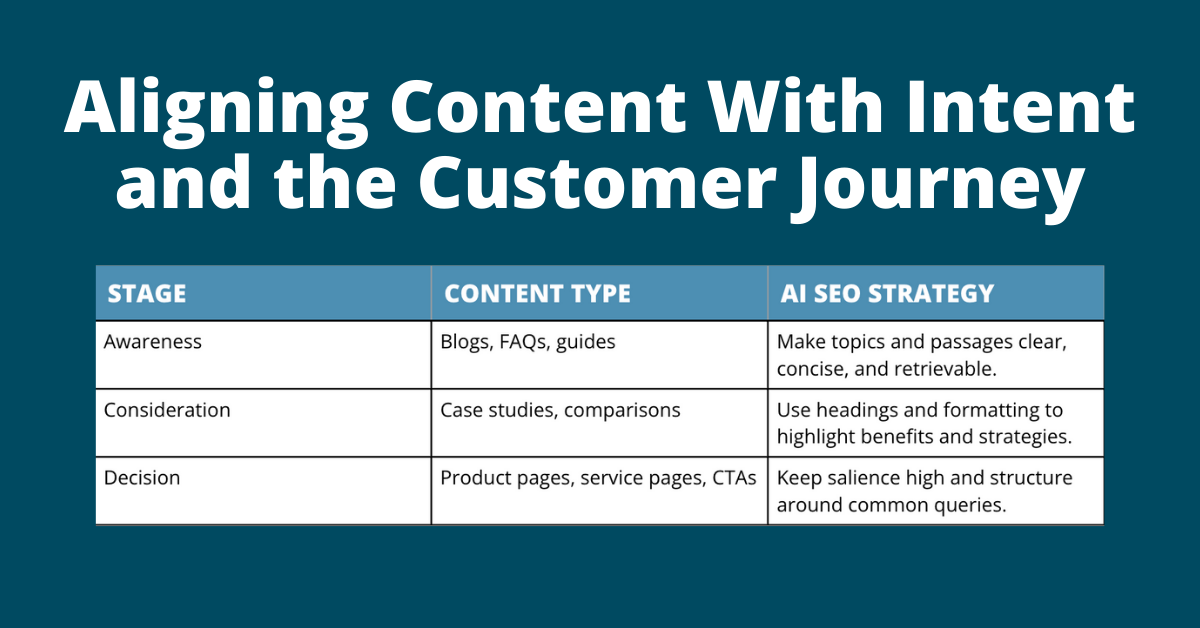
    Part 4: Aligning Content With Intent and the Customer Journey

    Understanding user intent

    User intent is the “why” behind a search. It’s the difference between someone researching a topic and someone ready to buy.

    • Informational: “What is university SEO?” (They want to learn.)
    • Navigational: “Search Influence SEO services” (They’re looking for a specific site.)
    • Transactional: “Hire higher ed SEO agency” (They’re ready to act.)
    • Investigative: “Best SEO firm for colleges” (They’re comparing options.)

    Matching content to intent

    Remember those AI concepts we discussed earlier? Here’s where they come together:

    • Use topical relevance to ensure you’re covering the right concepts.
    • Apply salience to focus your content on what matters most.
    • Structure your content in chunks that answer specific questions.

    Mapping to the customer journey

    Your website isn’t just a collection of pages — it’s a journey you’re guiding users through:

    Aligning Content With Intent and the Customer Journey graphic

    Try This: Audit your content by journey stage. Do you have gaps? Are you heavy on awareness but light on decision content?

    Keep It fresh: Why content age matters in AI retrieval

    Both search engines and AI systems prefer fresh content. It’s not just about having a recent publication date but about having current information.

    Picture this: If two pages have similar relevance, but one was updated last week and one two years ago, which would you trust? AI feels the same way.

    Best practices:

    • Set a calendar reminder to review key pages quarterly.
    • Update statistics, examples, and trends regularly.
    • Add “Last Updated” dates to show content freshness.
    • Consider a content refresh strategy as part of your regular marketing calendar.

    Invisible SEO: Metadata, markup, and machine signals

    AI doesn’t just see what humans see. It reads the code behind your pages, too. These behind-the-scenes signals help machines understand your content:

    • Semantic HTML: Using proper heading tags (H1, H2) instead of just making text bigger
    • Schema markup: Adding code that explicitly tells search engines “this is a product” or “this is an FAQ”
    • Meta information: Writing compelling, keyword-relevant titles and descriptions
    • Image alt text: Describing images for both accessibility and context

    Try This: Use either Schema Markup Validator or Google’s Rich Results Test and see what structured data your site currently has. Look for opportunities to add FAQ, HowTo, or other relevant schema types.

    Your content in vector indexes and AI repos

    Your content doesn’t just rank in traditional search. It gets embedded, chunked, and compared in massive vector databases:

    • For content to be found, it must be crawlable (unless in a private system).
    • It needs semantic richness — context and meaning, not just keywords.
    • Strong internal linking helps establish relationships between concepts.
    • Clear structure signals what’s important and how ideas relate.

    Testing and tuning: How to track your AI SEO performance

    AI SEO isn’t “set it and forget it.” It’s an ongoing process:

    • Track your presence in AI Overviews using monitoring tools like SEMRush or Advanced Web Ranking.
    • Test common customer questions in ChatGPT to see if it references your content.
    • Identify gaps by comparing what questions you want to rank for versus what AI actually retrieves.
    • Consider one of the emerging AI tracking tools like Scrunch, RankScale, or Profound.
    • Use these insights to continuously improve your content strategy.

    Part 5: The Future of AI SEO — Preparing for What’s Next

    Search engine diversity: Beyond Google

    While Google dominates the conversation around search, different search engines and AI platforms approach content evaluation in unique ways:

    • Bing/Microsoft: Often emphasizes freshness and social signals differently than Google
    • DuckDuckGo: Focuses on privacy and may value different content signals
    • Niche Search Engines: Vertical-specific engines like Amazon or YouTube have their own unique ranking factors

    Content optimized for multiple AI systems should:

    • Focus on universal quality factors like clarity and comprehensiveness.
    • Avoid over-optimization for any single algorithm.
    • Test performance across multiple platforms.

    Try This: Compare how your top content performs in Google versus Bing or other search engines to identify potential optimization gaps.

    Knowledge graphs: Entities and relationships

    Search engines use knowledge graphs to understand entities (people, places, things) and how they relate to each other. This structured understanding helps AI comprehend context and meaning beyond just keywords.

    For example, a knowledge graph understands that:

    • “Apple” could be a fruit, a technology company, or a record label.
    • Tim Cook is the CEO of Apple Inc.
    • iPhones are products made by Apple Inc.

    To optimize for knowledge graphs:

    • Use schema markup to clearly identify entities.
    • Build content that reinforces entity relationships.
    • Create content clusters that thoroughly cover related topics.

    Try This: Research how your brand and key products appear in Google’s Knowledge Panel to understand how search engines currently interpret your entity.

    Agentic search: When AI acts on your behalf

    We’re moving from an era where users search for information to one where AI assistants search on their behalf. Think of it as the difference between looking up a restaurant yourself versus telling your assistant: “Book me a table at a good Italian place nearby.”

    This shift has profound implications:

    • Users may interact less directly with your website.
    • First impressions will happen through AI interpretations of your content.
    • Content needs to be both human-friendly AND machine-actionable.

    Try This: Ask an AI assistant like ChatGPT to recommend a product in your category and see what sources it draws from. What made those sources retrievable?

    Agent-to-agent communication

    The next frontier is machines talking to machines on our behalf. Imagine your customer’s AI assistant negotiating with your business’s AI system to book an appointment or customize a product.

    To prepare for this:

    • Structure data in machine-readable formats.
    • Develop clear API documentation.
    • Ensure your content can be easily parsed into actionable items.
    • Consider what permissions and capabilities you’ll grant to external AI systems.

    E-E-A-T: Building trust with both users and AI

    To describe quality content, Google coined the term: E-E-A-T principles (Experience, Expertise, Authoritativeness, Trustworthiness). While not explicitly related to AI search, the factors are increasingly important for AI evaluation:

    • Experience: Show first-hand knowledge and practical application.
    • Expertise: Demonstrate a deep understanding of your field.
    • Authoritativeness: Build recognition from others in your industry.
    • Trustworthiness: Provide accurate, current information with transparency.

    AI systems are getting better at evaluating these signals to determine which content to trust and recommend.

    Try This: Audit your key pages for E-E-A-T signals. Do you clearly communicate credentials? Do you reference authoritative sources? Do you show real expertise?

    Multimodal AI SEO: Optimizing beyond text

    AI systems are increasingly “multimodal,” i.e., able to understand text, images, audio, and video together. This trend has significant implications for comprehensive content optimization:

    • Image Source Optimization: Use descriptive filenames and alt text that help AI understand image content.
    • Video SEO: Include transcripts and structured markup that make video content discoverable.
    • Podcast Optimization: Provide detailed show notes and timestamps that AI can index.
    • Social Media Integration: Coordinate messaging across platforms for consistent brand signals.

    The best AI SEO strategies now incorporate multiple content formats to create comprehensive digital experiences that rank well across all search platforms.

    The evolving link landscape in AI SEO

    While internal linking remains crucial for establishing content relationships, the role of external links is also evolving in an AI-driven search environment:

    • Quality over quantity becomes even more important.
    • Contextual relevance of linking domains matters more than domain authority alone.
    • Links from diverse but topically relevant sources create a more natural signal.
    • Citations and mentions may gain importance alongside traditional links.

    To adapt your link-building strategy:

    • Focus on genuine relationships with relevant content creators.
    • Seek opportunities to be cited as an information source, not just linked to.
    • Create link-worthy resources that AI systems would recognize as authoritative.

    Part 6: AI SEO Tools and Implementation

    Essential AI SEO software and platforms

    To effectively implement AI SEO strategies, your team will need the right tools:

    • AI Content Creation Tools: Platforms like ChatGPT, Jasper, ContentBot, or CopyAI help generate search-optimized content
    • SEO Analysis Software: Tools like SEMrush, Ahrefs, or Moz now include AI-powered content suggestions
    • Search Intent Analysis: Specialized tools that analyze user queries and suggest content angles
    • AI-Powered Keyword Research: Software that identifies semantic keyword clusters and topic opportunities
    • Content Optimization Platforms: Tools that evaluate your content against top-performing competitors
    • Dedicated AI Tracking Tools: Tools like Scrunch, RankScale, or Profound can explicitly track your placement in AI search results

    These tools work best when used by skilled marketers who understand both SEO fundamentals and AI capabilities.

    AI SEO implementation timeline

    For teams looking to adopt AI SEO practices, consider this phased approach:

    1. Audit Current Performance (1-2 weeks)
      • Analyze organic traffic trends.
      • Identify content performing well/poorly with AI systems.
      • Benchmark against competitors.
    2. Tool Selection and Training (2-4 weeks)
      • Choose appropriate AI SEO software.
      • Train your team on new platforms.
      • Develop internal best practices.
    3. Content Optimization (Ongoing)
      • Prioritize high-value pages for updates.
      • Create new content using AI SEO principles.
      • Monitor performance and adjust strategies.
    4. Advanced Implementation (3-6 months)
      • Develop custom AI applications for your website.
      • Create specialized datasets for content creation.
      • Build automated optimization workflows.

    The most successful brands view AI SEO as an ongoing process rather than a one-time project.

    Measuring AI SEO success

    Track these key metrics to evaluate your AI SEO efforts:

    • Featured Snippet Appearances: How often your content appears in position zero
    • SERP Feature Presence: Inclusion in knowledge panels, FAQs, and other enhanced results
    • AI Overview Mentions: References to your content in Google’s AI Overviews
    • Voice Search Results: How often your content is selected for voice assistant responses
    • Click-Through Rate Changes: Shifts in user behavior based on SERP changes
    • Page-Level Engagement: Time on page, bounce rate, and conversion metrics
    • Organic Traffic Quality: Not just more visitors, but more qualified prospects
    • Referrals from AI Engines: It is possible to create filters in GA4 and other Analytics packages to track AI referrals
    • AI Presence: If you invest in an AI tracking tool, you can track your presence in snippets and citations over time

    Set up custom dashboards in your analytics platform to monitor these metrics by page type and content category.

    The AI SEO Opportunity

    AI SEO represents the future of search engine optimization, blending traditional SEO best practices with new approaches designed for AI-powered search. As these trends continue to reshape how people find information online, brands that adapt will gain significant advantages in organic traffic and digital visibility.

    Success in AI SEO requires:

    • Understanding how AI systems evaluate and retrieve content
    • Creating comprehensive resources that address search intent at every stage
    • Optimizing for both traditional search results and AI-generated answers
    • Building content that establishes your brand as an authoritative source
    • Staying current with the latest AI search engine trends and changes

    The most effective teams will use AI tools to enhance their content creation process while maintaining the human expertise and brand voice that connects with their audience.

    Your Next Steps:

    1. Conduct an AI SEO audit on your highest-traffic pages to identify optimization opportunities.
    2. Explore how AI tools can help your team create more comprehensive, relevant content.
    3. Develop a content plan that addresses each stage of your customer journey.
    4. Build internal expertise on how AI is changing search behavior in your industry.

    The brands that embrace these changes now will build sustainable advantages in organic search that will serve them well as AI continues to transform how people find and consume information online.

    Need help navigating the shift to AI SEO? Contact Search Influence to develop a strategy that keeps your content visible, valuable, and ahead of the curve.

  • 5 Higher Education Marketing Challenges Solved by SEO and Paid Digital Advertising

    5 Higher Education Marketing Challenges Solved by SEO and Paid Digital Advertising

    Key Insights

    • SEO and paid digital advertising works. And because they are trackable and measurable, we assure you they do.
    • Drive more qualified leads with SEO and paid digital advertising, which will help you capture prospects actively looking for your offerings.
    • Reach your audience at all stages of the funnel with SEO through broader, career-growth topics in the awareness stage and more specific, branded searches in the decision stage.
    • With the flexibility of these tactics, you can quickly adjust your marketing plan when it isn’t working.

    Prioritize SEO and paid ads to make the biggest impact on your marketing plan

    Education marketing leaders need reliable strategies to drive results. If you don’t know which strategy to favor to meet your enrollment goals, we are here to let you in on something — SEO and paid digital advertising will make the biggest impact on your marketing plan. And because they are trackable and measurable, we assure you they do. (When we refer to paid digital advertising, we mean paid search and display ads. Throughout the rest of the blog post, I’ll refer to paid digital advertising as paid digital ads.)

    While marketing leaders see SEO as important, we at Search Influence don’t believe that they have prioritized it as a key part of their strategy. We also know marketing teams spend a lot of money on paid digital ads but believe they don’t optimize their campaigns to their fullest potential because they don’t look at the data from the right angle.

    In this post, we’ll detail how SEO and paid digital ads can solve the top five challenges we hear from education marketing leaders. Overall, you’ll see that SEO and paid digital ads address the number one goal of a successful higher education strategy: qualified inquiries (at an acceptable cost) that turn into students.

    #1: How Do I Get More Qualified Inquiries?

    Most often, higher education marketing plans have both a quantity and quality issue when it comes to inquiries.

    • You don’t have enough new prospects entering the funnel
    • You receive a decent number of inquiries but not enough high-quality inquiries
    • It seems like you receive high-quality inquiries, but you don’t know how to evaluate their quality

    SEO and paid digital ads help you capture prospects actively looking for your degrees, programs, and certifications, which means you’ll receive more qualified inquiries.

    A comprehensive SEO strategy improves your rankings, which drives more website traffic and more inquiries. When these prospects inquire, you should expect higher quality leads because they got to your site through a search that indicates they are actively considering a solution and want to learn about your educational offerings. Similarly, paid digital ads fuel qualified inquiries in the same way — by driving website traffic from people actively searching for your programs.

    Paid display advertising (i.e., Facebook and LinkedIn advertising) helps you drive more qualified inquiries by targeting the RIGHT audience. Other tactics, such as organic social media, could reach a variety of people. However, when you specifically target your audience through paid digital advertising, the data gives you confidence that your messages reach the right people.

    Graphic showing magnifying glass over marketing metrics

    #2: I Know My Audience Is Out There. How Do I Reach Them?

    SEO and paid digital ads help you reach your audience in distinct ways.

    When people think about SEO, they usually think about reaching audiences that directly search for your programs. Less often, they think about the impact SEO can have at the top of the funnel — when prospects are not yet aware that education may be their answer.

    By writing blog posts about more general topics that your audience may be searching, you can be one of the first organizations to reach them and lead them to consider education. For example, higher funnel topics like “Most Popular Programming Languages for a Career in Web Development” or “How to Launch Your Freelancing Career in 3 Steps” can drive traffic from prospective students who are looking for career growth advice but might not yet have considered a degree. Yes — this is SEO!

    Although higher education marketers generally include paid digital ads as part of their strategy, we often hear from them that their campaigns don’t drive enough inquiries. This isn’t a problem with paid digital ads as a tactic. This suggests there’s an opportunity to adjust your campaigns, which means testing your target audience and/or fine-tuning the creative messaging.

    Campaign adjustments, through both expert human optimization as well as machine learning optimization, help you better reach your audience. For example, a campaign might drive very few inquiries or the wrong types of inquiries because your campaigns target either too narrow or too broad an audience. By making these types of adjustments, paid digital advertising can drive leads at an appropriate cost.

    #3: How Do I Drive Prospects Down the Funnel?

    Some higher education marketing leaders are surprised to hear that both SEO and paid digital ads can drive prospects down the funnel.

    A robust higher education SEO strategy includes a full-funnel approach to content that speaks to prospects in each stage of their decision-making process. Recommended content for each part of the funnel:

    • Top of the funnel: Career growth topics
    • Middle of the Funnel: Program/degree-specific content
    • Bottom of the funnel: Branded search engine optimization, which allows you to capture searches specific to your school/unit and assure that prospects find their answers quickly — and on your website

    Branded SEO is often overlooked and is one of my favorite tactics! Branded searches in the decision phase include application deadlines, reviews, tours, and tuition costs.

    Paid digital advertising allows you to tweak your creative messaging to fit your prospect’s place in the marketing funnel. With the proper campaign segmentation, you can:

    You can also run multiple ad variations to speak to more people. Over time, you will see which messages work more than others and switch them out.

    As you segment your messaging down the funnel, you can create specific messaging you wish your audience knew about. You don’t have to worry about overall/introductory messaging because your audience has already engaged with your institution and knows you. For example, a single ad could focus on:

    • A student’s success story
    • An alumni career achievement stat
    • An award, or special pricing

    #4: What Am I Getting for My Budget?

    The clear accountability of paid digital ads and SEO is a key reason many have moved the lion’s share of their budget to the digital arena.

    SEO and paid digital ads enable you to see the source of the prospect on an inquiry-by-inquiry basis, which means you can track the cost per inquiry and cost per application from each source and overall. Ultimately, this means you can tie ROI back to your campaigns.

    These direct metrics enable you to compare your stats to industry benchmarks and to peer organizations which both give you confidence your results stack up and tell you clearly what you get for your budget.

    Graphic showing a coin being put into a piggy bank

    #5: Can I Quickly Adjust My Marketing When My Plan Isn’t Working?

    The beauty of SEO and paid digital ads is that you can make adjustments along the way.

    With SEO, you can increase your emphasis on optimizations for a given program or degree if the work so far hasn’t been aggressive enough. If one program outperforms the others, you can pivot your time spent to another program.

    Contrary to traditional marketing or longer-term media buys that lock you into a specific time frame, with paid digital ads, you can make adjustments after you have specific data. Optimizations can range from creative/messaging updates to changes to where the ads run to who sees the ads.

    If a campaign has not met your goals, you can actually turn it off and reinvest that money into a campaign that drives results at an acceptable cost. For example, if you have campaigns on Facebook and paid search, and the paid search campaign drives quality leads, you can reallocate your budget from Facebook to paid search.

    Prioritizing SEO and Paid Digital Ads Will Have an Impact on Your Higher Education Marketing Plan

    As a digital marketing agency that started out as a search engine optimization agency, it may not be surprising that we have this point of view. Yet, we think it’s worth repeating: Higher education marketing teams know they should prioritize SEO in their marketing plans, but they often don’t.

    We also believe that universities that invest heavily in paid digital ads and don’t see expected results have not leveraged data to make the best optimizations.

    If you are ready to learn how SEO and paid digital ads can make the biggest impact on your marketing plan, please reach out to the Search Influence team via our contact us form or give us a call at (504) 208-3900.


  • Top 7 SEO Questions You May Be Asking

    This post was updated by Shira Pinsker on 8/31/2022 to reflect recent trends and refreshed statistics. It was originally published on 7/19/2021.

    Key Insights

    • A search engine optimization campaign aims to increase both the quality and quantity of organic traffic to your site.
    • The primary function of search engines is to deliver answers to questions in the most digestible way possible. This is the most important thing to remember when executing an SEO strategy.
    • SEO is a long-term strategy that, when done correctly, pays dividends in results.

    A strong search engine optimization (SEO) campaign is an essential tool for any digital marketing strategy. While effective paid advertising, social media, and other digital strategies are important, organic search brings in the majority of website traffic.

    Effective SEO campaigns can help drive conversions, improve user experience, and ultimately lead to increased customer satisfaction. In this post, we’ll provide the answers to seven SEO questions clients commonly ask.

    Person at desk viewing Google landing page on laptop

    1 – What is SEO?

    Search engine optimization is the “practice of increasing both the quality and quantity of website traffic and exposure to your brand through non-paid search engine results.” (Moz) SEO is performed through a combination of updates both on and off your website to help Google better understand who you are, what you do, and why searchers should see you at the top of search results.

    The most popular SEO tactics include content creation, technical improvements, and link building.

    2 – How do search engines work?

    The goal of Google, Bing, and other search engines is to display the results that are most likely to answer a user’s query in the most digestible format.

    Search engines take three steps to find, analyze, and rank content:

    • Crawl: Search engines comb the Internet and read over the code and content for each URL they find.
    • Index: Search engines store and organize the content found during the crawling process.
    • Rank: Search engines deliver content on the search engine results page (SERP) that is most relevant to a user’s query.

    3 – How does Google rank results?

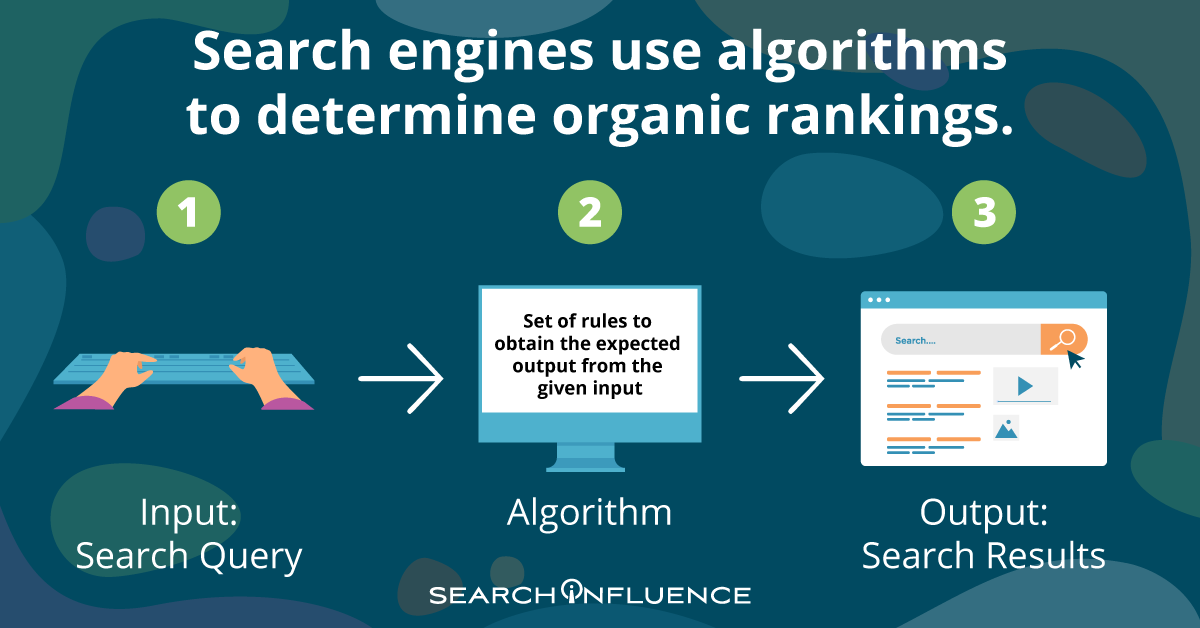
    To determine organic ranking, search engines use algorithms, a process or formula by which stored information is retrieved and ordered in meaningful ways. The algorithm is ever-changing; in fact, modifications are made on a daily basis. Search engines use three factors to rank pages: relevance, location, and authority.

    • Relevance is how your business matches what the searcher is looking for. The primary ways we send signals for which queries are relevant to your business are:
      • Content: All the text, videos, and images on your site. A huge factor in where your page will rank is how well the content on that page matches a search query.
      • RankBrain: The machine-learning portion of Google’s algorithm. While Google does not reveal the specifics of RankBrain, we do know Google’s main goal—fulfilling searcher intent. The best way to fulfill search intent is to provide the most accurate information in the best way possible for people who visit your page. Beyond content, the other factor here is user experience. How easy is it for users to find the information they are looking for on your site.
    • Location plays a big role in local search results as they are very attuned to the searcher’s location or the location included in the query. We can reinforce location information through:
      • Content: Using location in metadata and the body of content.
      • Schema markup: Code that tells search engines what content means. Location schema markup helps search engines easily identify and decipher location information.
      • Listing management and building: Building and maintaining correct business listings not only ensures users have the correct location information but also ensures Google has this information and reinforces your location.
    • Authority—being well known and trusted—is another important ranking factor. We send authoritative signals to Google by:
      • Backlinks: Links from other websites that point to your website. These work similarly to word-of-mouth referrals in real life. Both quantity and quality of these “referrals” are important. We want links from other sites that Google trusts.
      • Reviews: The number of reviews a local business receives, and the sentiment of those reviews, have a notable impact on their ability to rank in local results.
      • Citations: Multiple, consistent references to a business’s name, location, and phone number strengthen Google’s “trust” in the validity of that data.

    Graphic explaining process of search engines algorithmic rankings

    4 – How much content does a page need?

    A common practice for determining word count is to match the length of the top-ranking pages for your targeted topic. While this method may help you figure out how thoroughly you should cover the topic, Search Engine Journal reminds us “it is important to remember that copy on a page should be there to aid the human visitor, not a search bot.” User intent is king in terms of determining the length of content. The key is to think about what a user is looking for when landing on your page from organic queries. Is your target audience looking for a quick, concise answer or a longer, more in-depth explanation?

    5- When will I see results?

    The timing of results from an SEO campaign can vary based on the strategies deployed, the competition within your industry, and your business’s characteristics. You can typically expect to see organic improvement at six, nine, and 12 months.

    After deploying a targeted strategy, such as optimizing the content on a specific page, you will likely see initial movement in results (organic traffic to that page or keyword rankings for that targeted topic) at six months. Then, you can expect to see further growth at the nine-month mark. Finally, you should see a larger jump in results at 12 months.

    6 – Why do my rankings fluctuate?

    Fluctuations in rankings are completely normal and very common. Search engines are constantly crawling and recrawling websites and indexing new information. This means that a page’s rankings will naturally rise and fall as you and your competitors adjust your websites. Also, algorithm updates can cause these fluctuations because they affect how the ranking process works.

    7 – How long do I need to run an SEO campaign?

    The short answer here is forever. Search engine optimization is a long-term strategy. The internet is constantly evolving, and so are search engine results. Google is constantly improving its ranking system based on providing the best user experience, and therefore, what may have been best practice three years ago, may not be today.

    Need help navigating the world of SEO? Search Influence is here to help. Contact our SEO experts to learn more about digital marketing strategies that can drive more customers to your website.

    Images

    Laptop


  • The Rise of Intent Research and What it Means for Keyword Research in 2020

    Keyword research has long been thought of as one of the most impactful ways to gain prime real estate on SERPs. In the SEO world, if you’re not focusing a vast amount of your effort into keyword research, then you’re missing out on a great deal of SEO value. Finding and analyzing search terms by users and incorporating them into your website’s content is about as old as SEO itself. But as 2020 gets underway, a new kind of research is out to dethrone this age-old SEO practice. Intent research is quickly making its case as the new leader in SEO research. Take a look at these two types of research and where you should put your SEO effort in the coming months.

    Understanding the Basics: What is Keyword and Intent Research?

    Gif showing a Google search for Mardi Gras info

    Keyword research is, essentially, the process of identifying and analyzing a word or words users choose to include in search queries and then curating your content based on those specific words or phrases. These words or phrases can be categorized by things like popularity or relevance. Having a good understanding of specific topics is also important. Take, for example, searches done around a holiday—let’s look at Mardi Gras in this case. By understanding the topic, you can assume that users are likely searching for words or phrases like “mardi gras beads,” “mardi gras new orleans,” or “costume stores.” Incorporating those specific keywords into your content in the hopes of getting your content to show up in SERPs is the practice of keyword research.

    Intent research, on the other hand, is less specific and more concerned about what the user is trying to get out of their search. Rather than focusing on particular words and phrases, search engines spit out results based on what they think the user is looking for. Because intent can be hard to pinpoint, and keywords can have several different meanings behind them, how you interpret the keywords you are targeting is essential. Let’s say you’re researching the keyphrase “how to run a marathon.” The intent behind this could mean several different things. Is the user asking how to train for a marathon? How to sign up for a marathon? In understanding the user’s intent behind their search, you can better create content to drive users to your website.

    The Rise of Intent Research

    In a recent video where he discussed what to look forward to in 2020, Bing’s Frédéric Dubut claimed that search engines are quickly moving from keyword to intent research. One of the reasons for this, he believes, is in part due to Google announcing that they are now incorporating their BERT language model into search results. BERT, Bidirectional Encoder Representations from Transformers, is a technique for natural language processing. Google claims that BERT “helps better understand the nuances and context of words in searches” to produce more relevant results. The example they give is the importance of the word “to” in the search “2019 brazil traveler to usa need a visa.” In this example, you can see how the word “to” is what ties together the keyphrase in terms of understanding the user’s intent. By reading and understanding “to” in this context, Google is more likely to weed out content that mentions needing a visa from the USA by a Brazilian traveler, therefore providing them with more accurate search results.

    Is This the End for Keyword Research?

    John Meuller of Google says not so fast. Despite the rise of intent research recently, he believes there will always be room for keyword research. He admits that over time, search engines will become better at understanding a user’s intent, but that at its core, it is more of a balancing act between the two research practices. As he puts it, “even if search engines are trying to understand more than just those words, showing specific words to users can make it a little bit easier for them to understand what your pages are about and can sometimes drive a little bit of that conversion process.”

    So What Does That Mean for SEO in 2020?

    What does that mean gif

    In a nutshell, research practices will largely be a team effort in the coming year. As new language is created and refined and updates to search engines are made, search intent will be easier to understand and interpret. However, specific keywords will still be necessary when understanding that intent. Figuring out what type of research is best suited for your business will take a bit of trial and error. One way to get started is by trying to complete searches as if you were a user and see what sort of results populate. Depending on the types of results generated—and the research practice used—you can get an idea of how you should cater to your target audience. If this sounds overwhelming, don’t worry; we’ve got you covered. Our team of experts is ready to get you on the right path to a successful SEO campaign in the new year. Contact us today for a custom marketing analysis!

    Images

    What does that mean?

  • How Often Should You Revisit Your SEO Strategy?

    So you want to know how often you should revisit your SEO strategy. My recommendation? Go back to the basics! Google is constantly updating its algorithm, so your rankings can always be affected. That means you should constantly be on top of the strategy you set in place to ensure you’re being effective and generating results. When considering how often to revisit your strategy, it would be a good idea to consider the things that affect your rankings. The major players are keywords and content.

    The Key to Keywords

    The way people search for things is always changing. Where people used to Google the term “marketing company,” they may now Google “marketing company near me.” It’s one thing to rank well, it’s another thing for people to be able to find you based on what they’re searching for. If you aren’t ranking well for terms people are using, this won’t benefit you in achieving your marketing goals.

    If you keep a record of your original keyword research, you can always refer back to it to determine if those search volumes have increased or decreased over time. This will allow you to stay relevant on which keywords work best for you. Since it’s recommended that you revisit your keyword strategy every quarter for campaigns and promotions, it’s also a good bet to do this for SEO.

    A person highlighting notes on a desk

    Keeping Content Fresh

    Before you worry about keeping your content fresh, you need to ensure it fits the recommended guidelines set by Google. Title tags are important because they are often the first thing a visitor sees when they search for something and you pop up in their results. Meta descriptions also display in search engine results and should provide visitors some context about that page’s content. Even though that doesn’t directly affect your rankings, it affects people wanting to visit your website, which can affect rankings.

    Title tags and meta descriptions also need to fit within the length recommendations and include the keywords you chose for the campaign, if possible. If the keywords you chose and used throughout your content at the beginning of the campaign are no longer relevant, then it might be time to go back to the drawing board. When these two elements are concise and relevant, they can positively influence your rankings. Just make sure to keep an eye out for any updates made on recommended guidelines for content by Google.

    As far as content on your website, you can always tell if the website page has good and relevant content by how many visits it receives. Low webpage visits can be a good indicator that it may be time for a refresh. This does not exclude old content. While publishing new content is a great way to increase rankings, you can always revisit old content and give it a little TLC to see if the work you already put in can still work for you.

    Off-Page

    When it comes to off-page SEO, here is where it can get a little tricky. There are times where we aren’t in control of the things that happen off your site, like with backlinking, but there are tools and options to assist you in taking back as much control as possible. Let’s say you find a link to your website to be spammy; you can contact the webmaster and request it be removed. There’s no telling if or when this may happen, but you can always combat this by gaining new links from authoritative sites.

    When it comes to listings, you want to ensure your information is consistent across all platforms. Whenever an opportunity presents itself, you should make it a point to submit to as many listings as you can. A great tool you can use for this is Bright Local. It works to show you inconsistencies throughout the listings you currently have, as well as new opportunities you can submit to. It’s best to keep an eye on these and revisit them every month.

    An additional tool that is always accessible to you is social media. This is a great way to create awareness for your business and potentially gain more and new visitors to your website. Staying on top of your social media campaigns is a sure way to help your rankings. If you see a campaign is not performing well, then it may be time to reconsider what changes need to be made to make it better. While social media doesn’t increase your rankings, it can help gain new visitors and increase potential backlinking, which will.

    In the End

    There isn’t an exact recipe that will get you to rank number one. The key to running an effective strategy and campaign is to consistently revisit it. Remaining proactive when it comes to algorithm updates and keeping your website full of organic and fresh content will always be your best bet. If you consistently check and adjust, you’ll be on the right path! And if you need some expert assistance with your SEO or content marketing strategies, start a conversation with the New Orleans SEO pros at Search Influence.

    Images: Desk