
Tag: seo rankings

  • Your AI Traffic Has Plateaued. Now What?

    Your AI Traffic Has Plateaued. Now What?

    Key Insights

    • The AI traffic plateau is real and expected. The experimental growth phase is over; we’ve entered an optimization and efficiency phase.
    • AI-referred traffic is smaller but higher quality. Engagement time and intent consistently outperform traditional organic sessions.
    • Visibility ≠ measurability. AI Overviews and AI Mode remain partial black boxes, making citation trends more meaningful than raw rankings.
    • On-site optimization alone isn’t enough anymore. Third-party comparison and aggregator content increasingly shape AI understanding.
    • Winning brands build citation networks, not just pages. Presence across AI-trusted domains now drives long-term visibility.
    • Success metrics must evolve. Citation momentum, brand sentiment in AI responses, and AI-assisted conversions matter more than impressions.

    If you’ve been tracking AI-driven traffic, you’ve probably noticed something: the growth curve is flattening.

    That’s not a bug. It’s a feature.

    The Inflection Point Is Here

    Here’s my working theory: We’ve hit the point where AI presence in search has largely stabilized. The industry has shifted from rapid, experimental rollout to deep infrastructure integration. AI Overviews aren’t new anymore — they’re baked in. The dramatic expansion phase is behind us.

    Unless there are global increases in total search traffic or dramatic expansion of AI features, we should expect:

    • Organic traffic stops declining
    • AI-referred traffic stops growing
    • Everything settles into a new equilibrium

    This isn’t necessarily bad news. It’s just… news. The land grab phase is ending. Now comes the optimization phase.

    The Visibility Gap We Can’t Ignore

    Here’s the piece we don’t have visibility on: AI Overviews and AI Mode as traffic drivers.

    We’re still relying on tracking URL parameters — UTM sources, page anchors, the little breadcrumbs platforms leave behind. But that’s incomplete. Google’s AI Overviews, in particular, represent a black box of citation-driven traffic we can’t fully measure yet.

    What we can see: citations are increasing even as AI Overview rankings plateau. That’s encouraging. It suggests presence is building even when ranking positions stay flat.

    Google Is Refining the AI Overview Experience

    One thing that explains the plateau: Google is getting smarter about when to show AI Overviews.

    According to recent reports, Google is now stripping AI Overviews from searches where users aren’t interacting with them. They’re figuring out what people actually engage with and putting AI Overviews there.

    What this means: You’re not ranking for random, low-intent searches anymore. The pie has shrunk, but it’s a more qualified pie.

    Less visibility in aggregate, but potentially more valuable visibility where it matters.

    The data backs this up. Looking at recent numbers across several higher ed clients, AI-referred traffic consistently shows stronger engagement than traditional organic:

    SEO Engagement Time AI Engagement Time SEO Engagement Rate AI Engagement Rate
    Client A 1:05 3:14 32% 71%
    Client B 2:07 3:17 65% 45%
    Client C 2:27 6:03 67% 46%

    AI traffic isn’t just smaller — it’s more qualified. These users are arriving with higher intent and spending more time with the content.

    What’s Actually Working: Lessons from the Field

    Looking at clients who’ve maintained or grown their AI presence during this plateau period, a few on-site tactics stand out:

    1. Semantic Header Optimization

    Not just “put keywords in H2s” — but structuring headers to reflect how AI models organize information. Think entity relationships, not keyword density.

    2. AI-Friendly Language

    Shift from salesy, marketing-speak to fact-based, outcome-based content. LLMs are trained on informational content. They don’t respond well to “Schedule your free consultation today!”

    What they do respond to: clear statements of fact, specific outcomes, data points.

    3. Structured Data with Linked Entities

    Schema markup matters more than ever, but it’s not just about having schema. It’s about connecting your entities to the broader knowledge graph. Make sure your Course, Organization, and Person entities reference established identifiers.

    4. FAQ Optimization

    Still a consistent win. LLMs love well-structured Q&A content. It’s easy to parse, easy to cite.

    The Comparison Content Problem

    On-site optimization only gets you so far. AI models give weight to what other authoritative sources say about you. If you’re only optimizing your own site, you’re playing with one hand tied behind your back.

    Here’s an uncomfortable truth: AI Overviews are increasingly citing off-site aggregator and list-style content.

    “Top 10 medical billing programs,” “Best car service providers in Chicago,” “Construction management software comparison.”

    This content format is showing up everywhere in AI responses. And for many clients, it’s content they can’t or won’t create.

    Brand compliance teams get nervous about comparing themselves to competitors. Legal wants to vet every claim. By the time approvals come through, the opportunity has moved on.

    The workaround? Third-party placements.

    We’ve had success getting comparison content placed on external sites — parenting blogs, industry directories, and niche publications. It’s not scalable, but it works.

    One example: A comparison article we placed on a regional parenting site now ranks 7th organically for a competitive local service query. Not in the Map Pack, not in the AI Overview, but it’s in the ecosystem. That content is feeding the AI’s understanding of the market.
    The Path Forward: Building Your Citation Network

    So where do we go from here?

    I’m working on building a list of 50-100 article placement opportunities. Sites that:

    1. Accept guest content
    2. Are indexed by Google
    3. Are cited by AI (both Google AI and ChatGPT)

    That third point is key. Being in Google News isn’t enough. The question is: are these domains showing up in AI responses?

    How to verify:

    • DataForSEO has metrics for Google AI and ChatGPT indexing
    • Ahrefs shows indexed pages and citations in their main view
    • Or build your own tool using SERP APIs and LLM APIs (I’m working on this now)

    The hypothesis: if a domain is already cited by AI platforms, content you publish there has a higher chance of feeding those same AI responses.

    Tracking the Right Metrics

    Given the plateau, what should you actually be measuring?

    Stop obsessing over:

    • Prompt-by-prompt rankings (too volatile)
    • Total AI impression counts (too noisy)

    Start focusing on:

    • Citation trends over time (up and to the right)
    • Brand sentiment in AI responses (does the model understand what you do?)
    • Conversion attribution from AI-referred traffic (when trackable)
    • Third-party mentions in AI responses

    All the data is wrong. The question is: how wrong is it? Pick your metrics, track consistently, and look for directional movement.

    What This Means for Your Strategy

    If AI traffic has plateaued, the response isn’t to panic — it’s to shift from growth tactics to optimization tactics.

    Priority 1: Technical Foundation

    AI engines are less patient about crawl than traditional search. If they can’t see your content quickly and cleanly, they won’t cite it.

    • Fix crawlability issues
    • Improve site speed
    • Verify AI bot access in robots.txt

    Priority 2: Content Format

    Structure content for AI ingestion:

    • Clear heading hierarchy
    • FAQ sections
    • Definition lists for key terms
    • Schema markup that connects entities

    Priority 3: Third-Party Footprint

    Build presence on sites that AI already trusts:

    • Industry publications
    • Authoritative directories
    • Comparison content (even if you’re not creating it yourself)

    Priority 4: Measurement Infrastructure

    Set up tracking for AI-referred traffic now, before you need it:

    • Monitor URL parameters (UTM sources, anchors)
    • Track citation trends in AI monitoring tools
    • Document brand mentions in AI responses

    The Monetization Wildcard

    There’s one variable we can’t predict yet: how will future monetization of AI answers affect referral behavior?

    Google hasn’t fully figured out how to make money from AI Overviews. Neither has OpenAI, Perplexity, or anyone else. When they do, the incentive structures will shift.

    A few scenarios to watch:

    Scenario 1: Ads in AI responses. If Google inserts sponsored content into AI Overviews (they’re already testing this), organic citations become less prominent. Your content might still inform the answer, but the click goes to an advertiser.

    Scenario 2: Premium AI tiers. Paid AI modes could behave differently than free ones — deeper research, more citations, different source preferences. Optimization strategies might need to account for which tier your audience uses.

    Scenario 3: Publisher revenue sharing. If platforms start compensating publishers for citations (the way some news partnerships work), the economics of content creation change. Sites that currently can’t justify AI-focused content might suddenly have a business case.

    None of this is certain. But the fact that AI monetization is still being figured out means the referral dynamics we’re seeing today aren’t permanent.

    Build for the current reality, but stay flexible.

    The Bottom Line

    The AI traffic plateau isn’t the end of growth — it’s the end of easy growth.

    The early adopters who were showing up everywhere just by existing have hit their ceiling. What comes next is more intentional: optimizing for how AI models understand and cite your content, building presence on the sites that feed those models, and measuring what actually matters.

    Traditional search isn’t going anywhere. AI is additive, not a replacement. The brands that win are the ones that show up in both.

    What are you seeing with your AI traffic trends? I’m curious whether this plateau is showing up across industries or if it’s specific to certain verticals.

    This post was based on a conversation among the Search Influence SEO team, Will, Cory, and Chuck, with input from Jess, the account manager for a couple of the cited clients.

    The question we were tasked to discuss was how to explain the plateau in AI traffic.

    Ready to learn more about traditional SEO and AI SEO? Contact us to speak with our team of experts.
    Images:
    Unsplash
    Unsplash

  • Improve Page Rankings for Your University With a Hybrid SEO Team

    Improve Page Rankings for Your University with a Hybrid SEO Team

    Key Insights

    • Achieving top rankings for your program pages is no easy feat, especially when managing SEO in-house. It takes advanced skills and consistent effort to outpace growing competition.
    • A hybrid SEO team empowers your in-house staff to focus on their strengths, as an agency handles the higher-level SEO tasks that drive measurable improvements in your program’s visibility.
    • Whether you need immediate help for a specific project or long-term strategy support, working with an agency gives you the flexibility to scale your SEO efforts as needed.
    • Take Search Influence’s Higher Ed SEO Quiz to determine whether combining your in-house strengths with agency expertise is the best way to optimize your program rankings.

    You’ve spent weeks perfecting your program pages and refining the messaging to speak directly to prospective students. You know the ins and outs of your institution, its values, and what makes it unique. Despite your best efforts, your pages still aren’t ranking near the top of the search engine results, where visibility matters most.

    Sound familiar?

    Growing competition in higher ed and a shrinking pool of traditional 18-year-old college students have made it harder to reach and capture the attention of the right prospects.

    Your program pages need to rise above the digital clutter — yet, without advanced SEO skills, all your hard work may never pay off.

    If your in-house team is hitting a wall with SEO, collaborating with an agency gives your strategy the push it needs while ensuring your team’s impact stays integral to the approach. With a hybrid team, you’re rewarded with the best of both worlds: the strengths of your in-house insights and the technical expertise of an agency.

    The Expertise an Agency Brings to the Table

    Agencies provide the technical muscle and fresh strategies needed to elevate your SEO efforts beyond what your in-house team can accomplish alone.

    Broader sector experience

    SEO agencies work with clients across industries, including higher ed, healthcare, and hospitality. This diversity means agencies bring ideas and strategies from sectors beyond education, offering new perspectives to your team.

    They know what works in SEO, what doesn’t, and will advise on how to approach your strategy accordingly.

    Dedicated SEO focus

    Unlike your internal team, which juggles multiple institution-wide priorities, an agency has dedicated experts focused specifically on your SEO strategy. With decades of combined experience among their digital marketing specialists, they know all the tricks of the trade and the latest trends.

    Their specialized knowledge keeps your strategy moving forward — whether it’s fine-tuning content, solving tricky technical issues, or outsmarting algorithm updates.

    Advanced technical SEO

    Agencies bring a laser focus to technical SEO, tackling tasks like site structure improvements, crawlability fixes, and schema markup implementation. By uncovering and resolving hidden technical errors, they eliminate barriers that could drag down your rankings.

    This targeted expertise ensures your site performs at its best and captures the attention of both search engines and users.

    Effective link-building strategies

    According to recent research by Backlinko, a website’s link authority closely correlates to its ranking success. Agencies know how to build links that matter, connecting your website with high-authority sources to improve your domain’s credibility and rankings. By incorporating authority-building tactics into your strategy, an agency will improve your E-E-A-T (Experience, Expertise, Authoritativeness, and Trustworthiness) and generate more links back to you.

    Think of it as networking for your website — building relationships that get your university noticed by the right audiences.

    Sophisticated analytics and tools

    SEO tools like SEMrush and Screaming Frog uncover powerful insights into keyword and listing management opportunities, plus on-site issues like broken links, but it takes expert analysis to turn those insights into results. Agencies excel at transforming raw metrics into strategic actions that deliver measurable outcomes.

    Through clear analytics tracking and reporting, they make complex data easy to understand and even easier to act on.

    Understanding the Strengths of Your Internal Team

    With a strong grasp of your university’s inner workings, your in-house SEO team members know what to prioritize to meet your institution’s most pressing goals.

    Familiarity with institutional culture

    Your internal team knows your institution better than anyone — its mission, values, and branding guidelines. They ensure your SEO strategy aligns with institutional priorities, making your content feel genuine while keeping your messaging consistent across every channel.

    Relationships with faculty and departments

    From individual staff members to college departments, your team has built the relationships needed to uncover stories and insights that bring the best of your university online. They know how to facilitate internal collaboration for creating academic program pages, research highlights, and in-depth faculty profiles.

    On-the-ground understanding of priorities

    Your internal team has a pulse on what’s important to everyone: prospective students, current students, faculty, and alumni. They know exactly when to spotlight admissions deadlines, open houses, and other seasonal priorities to grab the attention of your target audience.

    Local knowledge of audiences

    Targeted marketing works best when it’s backed by a clear understanding of your audience. Your team knows the local culture, regional trends, and demographic factors that shape the interests and behaviors of prospective students, alumni, and the community.

    This helps you connect with your prospects in a way that feels authentic and relevant.

    A quote about SEO skills and tools from the SI team

    How to Decide If a Hybrid SEO Team Is Right for Your Institution

    Combining your in-house strengths with an agency’s expertise creates a well-rounded SEO strategy, but the balance must meet your institution’s needs.

    So, how do you decide if this approach works for you?

    And, more specifically, what tasks should remain in-house vs. outsourced?

    Questions to ask yourself

    To determine if a hybrid model is right for your institution, check your priorities, skill level, and overall capacity to take SEO head-on. Ask yourself and your broader team these questions:

    • Are we ranking competitively for key academic programs and university pages?
    • Do we have the in-house expertise to manage technical SEO challenges?
    • Are we consistently tracking and analyzing our SEO performance?
    • Do we have the resources and bandwidth to focus on SEO long-term?

    If any of your answers expose gaps, a hybrid SEO team will help mend them with the full focus and time dedication your strategy deserves.

    Indicators that a hybrid approach will work

    If you think a hybrid approach is ideal for you, but are not sure if it will play out the way you’re hoping, here are some signs it’ll work:

    • You have a small but knowledgeable in-house team that needs support in technical areas.
    • You’re looking to scale your SEO efforts without overloading internal staff.
    • You’re struggling to keep up with competitors’ online visibility.

    The most successful collaborations happen when you focus on what you do best and leave the heavy lifting to a dedicated SEO team.

    Examples of tasks to keep in-house

    If you’re set on a hybrid approach, now you need to decide which SEO tasks to handle in-house vs. with an agency. Because your internal team has a unique understanding of your university’s mission and culture, some tasks may make more sense to keep in-house. These include:

    • Writing content like course descriptions, faculty profiles, and blogs that showcase your inner knowledge of your institution’s strengths and values.
    • Managing faculty and departmental collaboration.
    • Leading university-wide projects tied to institutional priorities, such as alumni engagement initiatives.

    Note: While these tasks may stay in-house, an agency is uniquely positioned to provide strategic oversight, ensuring all efforts align with a cohesive SEO plan. Agencies bring a fresh perspective to your internal initiatives and offer valuable insights that enhance the overall impact of your efforts.

    Examples of tasks to outsource

    While your team focuses on internal collaborations and managing university priorities, there are certain SEO strategy must-haves best handled by experts. These include:

    • Conducting technical audits and fixing issues like site structure, crawlability, and broken links that affect search performance.
    • Securing backlinks and implementing off-site strategies to increase your site’s domain authority and rankings.
    • Tracking SEO performance and generating detailed reports to provide actionable insights for ongoing strategy improvements.

    By handling these tasks externally, your team has more time to dedicate to strategic initiatives while maintaining a strong SEO strategy.

    Benefits of Hybrid SEO Teams for Higher Education

    With the power of your hybrid marketing team, you’ll gain the following benefits:

    Comprehensive SEO strategies

    This approach lets your in-house personnel bring the heart of your university’s story to life while the agency works behind the scenes to boost your SEO, build links, and monitor your most important analytics. With a collaborative SEO strategy for your university, you’ll have a dynamic, comprehensive framework that strengthens your university’s online visibility for sustained impact.

    Optimized use of resources

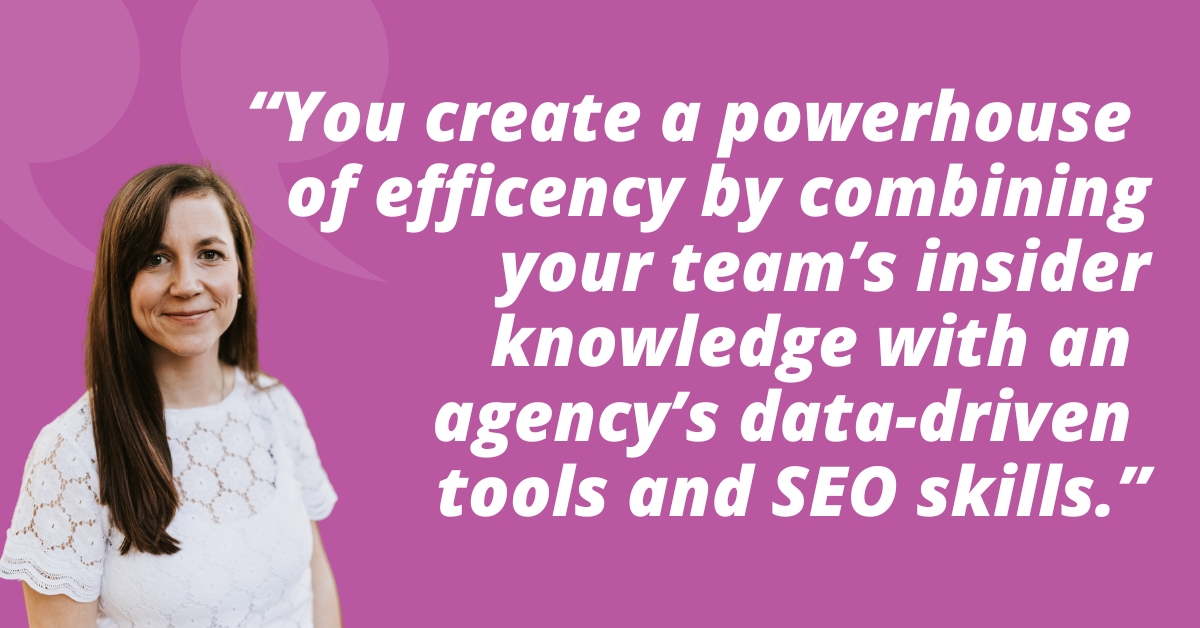
    You create a powerhouse of efficiency by combining your team’s insider knowledge with an agency’s data-driven tools and SEO skills. Tasks get done faster and smarter, with to-do’s distributed based on skill sets and priorities. This creates a streamlined system that optimizes your resources without wasting time or effort.

    Enhanced flexibility

    A hybrid SEO team will ramp up your university’s efforts for key campaigns or dial them back for long-term projects — whatever the moment calls for. This flexible approach evolves with your priorities and adjusts to the fast-paced world of higher ed trends, keeping your SEO relevant and effective.

    Is a Hybrid SEO Partnership Better for Short-Term or Long-Term Goals?

    Whether you’re looking for a one-and-done partnership or a years-long commitment, an agency works with you to tailor the right level of support for your needs and goals. Here’s how to determine which path will deliver the best results for your university.

    When a short-term engagement makes sense

    A short-term engagement is the perfect fit when your university needs a quick boost or targeted support. Consider this option for:

    • Addressing specific issues, such as conducting site audits or executing link-building campaigns, with the support of experienced SEO professionals.
    • Launching a new academic program or marketing initiative that requires a focused, short-term SEO push to generate immediate visibility.

    Benefits of a long-term partnership

    A long-term, outsourced SEO partnership sets your university up for sustained success and growth. This option is best when you need:

    • Continuous monitoring and fine-tuning of your SEO strategy, so you’re always optimizing and staying ahead of the competition.
    • Dynamic, ongoing support that adapts to your university’s evolving goals, whether it’s launching a new program or adjusting to shifting priorities.
    • A roadmap designed for long-term success, keeping your SEO strategy on track for consistent results.

    Collaborating With Search Influence

    At Search Influence, we adapt to how you work, sharing SEO duties in a way that makes sense for your team. Some examples of what this looks like:

    For one client, we provide the SEO strategy, optimize program content, and handle off-site SEO while their in-house team focuses on blog content and PR. We regularly collaborate to ensure that their in-house marketing efforts support their SEO rankings.

    For another client, we provide topic and keyword strategy and technical SEO recommendations, while their in-house team writes and publishes content and implements technical updates.

    No matter how hands-on you want to be, we’ll collaborate to ensure your SEO efforts are on par with your expectations.

    Leverage a Hybrid SEO Team to Maximize Your University’s Potential

    Keep your higher ed SEO efforts on track without overloading your internal team.

    With the combined strengths of a hybrid SEO team, you’ll improve your program rankings and attract more students, faculty, and donors.

    Discover whether a hybrid SEO team is the ideal approach for your university. Our Higher Ed SEO Quiz takes the guesswork out of deciding between an in-house, outsourced, or hybrid SEO team. After completing just five questions, you’ll receive personalized recommendations that help you make informed staffing choices and optimize your resources.

    Take the SEO Quiz today, and let us guide you on your way to improved program page rankings.