Tag: promoted posts

  • Organic, Boosted, & Promoted Posts: What’s the Difference?

    Remember the good ‘ole days when “marketing” meant buying full-page ads in the Yellowpages? Everything was so simple then. TV commercials ruled the airwaves, and people couldn’t help but hum the jingles of Pepsi, Ringpops, and Doublemint Bubblegum commercials. Back then, a catchy jingle was all you needed to give your brand an edge over the competition. But with the dominance of social media, it isn’t as cut and dry as it used to be because marketing platforms are at our fingertips.

    At their peak, YellowPages and TV commercials were industry leaders because there were fewer advertising channels. But now, social media platforms have changed the game because, for the first time, they allow communication through many different avenues. Increasing the distribution of communication yields increased opinions. Put simply by the co-founder of Intuit, Scott Cook, “A brand is no longer what we tell the consumer it is—it is what consumers tell each other it is.” This is why posting on social media is critical to creating awareness and loyalty around your brand.

    Before you jump in and start posting like a maniac, you need to understand how to post, as well as knowing the different types of social posting options. Knowing which posts to use and the best ways to leverage them will help determine the best budgeting decisions for your business.

    Social posting as a business is an effective way to encourage user engagement and increase brand awareness. One way to get your followers to engage with your posts is by catering your content to their interests. Studies have shown that the best performing content elicits emotions from readers. Do this by posting astonishing facts or posing curious questions that a reader can’t help but acknowledge. Another way to keep your followers engaged with social posts is by using different formats. Anyone can create a text post, but adding an image to your post can more than double your engagement rate. Stories and video posts are also effective ways to captivate your audience. Lastly, you can also improve engagement rates by being engaging yourself. People will remember when you engage with their content and will be more likely to return the favor. Liking a follower’s post, acknowledging them with a quick reply, or sharing their post can go a long way.

    Now that you have a better idea about how to write your content, the next step is to decide what types of posts you should be using to deliver that content.

    There are three types of social posts: Organic Posts, Boosted Posts, and Promoted Posts

    The Organic Post

    The OG of posting. Organic posts are the basic posts you create on your page that do not have any spend behind them. These posts display directly on your profile’s page and will be seen only by your followers.

    The Boosted Post
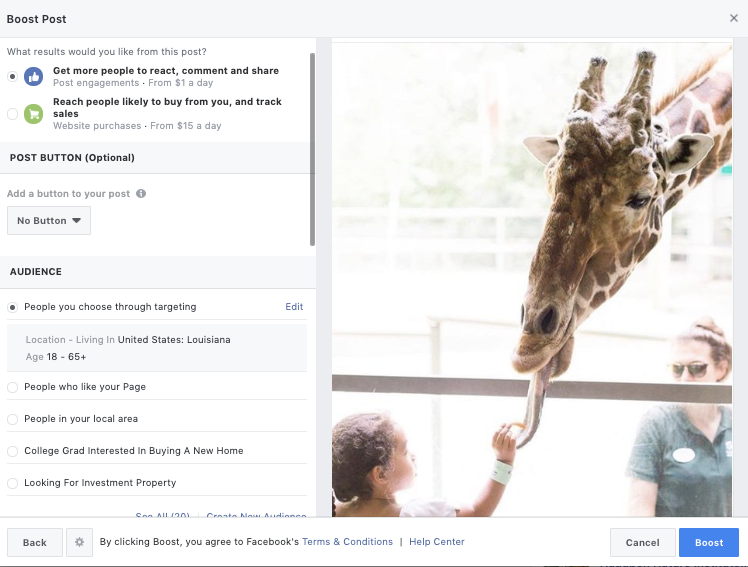
     

    Screenshot of a boost post form on Facebook

    A boosted post is an organic post to your profile that has been amplified to reach a larger audience outside of your current followers. With boosted posts, you set your budget and audience targeting. You can choose between two options of audience targeting for these posts: you can target “People who like your page and their friends” or “People you choose through targeting.” Keep in mind that with the first option, the “people who like your page and their friends” might not be interested in your business, so if you’re boosting something niche, it might be better to choose the second option.

    The Promoted Post

    The promoted post enables you to ensure that your post will appear in the News Feeds of more people. Typically, these posts are labeled as “sponsored,” so people know that it’s an ad, even though it looks like the other posts on their newsfeed. The benefit of promoting a post is that you have more options for targeting, pricing, and bidding. Promoted posts work well for giveaways, freebies, or coupon codes.

    All three of these types of posts provide valuable ways to build your brand’s identity. It’s important not to limit yourself to only one type. I would recommend testing your organic posts to see how your followers respond. Then, once you have a better idea of what works well with your audience, it makes sense to add some spend behind your best performing posts! Using different types of posts will get your content out to the most diverse users, so mix it up!

    If you’d like to improve your reach on social media, Search Influence can help. Since 2006, we’ve helped businesses reach their full potential with our digital marketing services. To learn more about how we can work with you, contact us online or call (504) 208-3900.

    Images:
    Smart Phone
  • Give Your Facebook a Facelift: Social Media for Dermatologists and Plastic Surgeons

    Facebook Facelift Image - Search Influence

    Time Magazine recently posed the question, “Can Plastic Surgery Make You More Likeable?” Certainly, there are many benefits to cosmetic procedures for the patients, but it is also time for plastic surgeons and other physicians to think about how to make their practices more “likeable.” Facebook and social media can be used to attract new patients and shape the local perception of a business. For example, Search Influence helped one plastic surgery practice attract nearly 70,000 new fans on Facebook. Search Influence can help create and manage the online presence of your business through social media, but if you want to get started on your own, follow these five steps:

    1. Make a Facebook Page

    Most Internet users visit social media sites daily, and social media can be a cost-effective place to advertise. Facebook accounts are free to create and maintain, and AdWeek reported last year that advertising on Facebook is 70 percent cheaper than the industry average. While using it effectively will take a significant amount of work, creating a Facebook page for your practice takes only a few minutes. With pictures and information about the procedures you offer, a Facebook page allows potential clients to learn about your practice without following an external link. This can be a great place for a list of services and a few testimonials from past patients. It’s a streamlined version of the most relevant information, and you can direct people to call your office or visit your website to learn more.

    2. Get More “Likes”

    It’s easier said than done, but awareness about your practice will grow as users “like” your page. To draw their attention, it helps to have compelling pictures and interesting information. Showing a little personality can encourage people to identify with your practice, which helps set you apart from the competition. As more people interact with your page, Facebook will give you demographic information about their ages, where they live and other details that can help you better know the local market.

    Struggling to get potential patients and customers to follow you on Facebook? One way to get more likes on Facebook is through Facebook fan-building campaigns, which have been effective for Search Influence plastic surgery clients.

    3. Get People Involved

    Ask questions, and post updates that encourage people to interact with your page. When fans “like” an image you’ve posted, it makes it more likely that their friends will also see your page. If you post about local events and holidays, it will help connect you with your community.

    4. Update Your Page Regularly

    While it’s inadvisable to offer medical advice over social media, your page or a separate blog can be a great place to explain procedures or post updates about your practice. If you explain medical terminology and correct common misunderstandings, then potential patients will see you as more qualified and trustworthy.

    5. Pay to Play

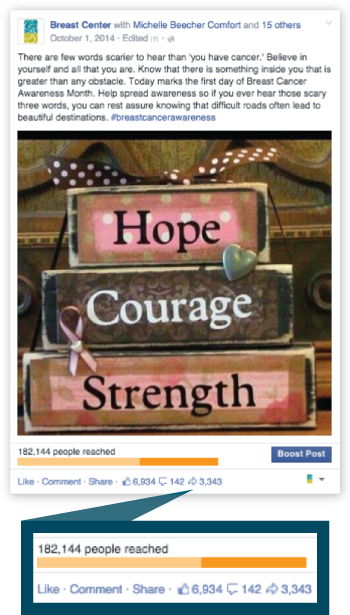
    Advertising your page on Facebook involves a lot of choices. Do you want help accumulating “likes,” or is it more important that people visit your website from your Facebook posts? While pay-per-click (PPC) advertising assures that people are viewing your page, your name will show up on more news feeds if you pay for exposure. For example, a promoted Facebook post for a Search Influence plastic surgery client reached more than 182,000 people.

    First Promoted Facebook Post - Success Study - Search Influence

    Because of the variety of choices involved, streamline your social media strategy and achieve successful results with the team at Search Influence managing your advertising plan. Search Influence can advertise on several sites and measure results in the ways that matter most to your practice, including new patients and calls to your office.

    If you want to give your whole business image a facelift, then injecting social media into your marketing plan is the most cost-effective option. Our team at Search Influence can help you create and manage your online image, and we can advertise on a variety of platforms including Facebook, Google+, Youtube, Pinterest and Twitter. Continuously providing updates can be a lot of extra work for your busy staff, and some employees may already spend too many work hours on their social media accounts. Let Search Influence manage your online image to make sure everything is handled professionally. Find out more about our services by browsing our website.

  • Facebook Engagement: How To Make Your Fans Say “I Do”

    Get more exposure to your business’ Facebook page. Incorporating these elements will enable your business to provide better and more shareable content!

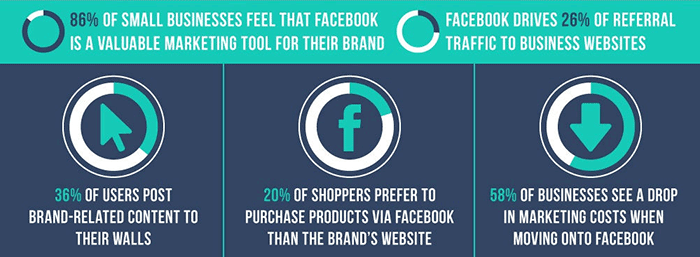
    There are 30 billion pieces of content shared via Facebook every month. That’s billion with a “B”! How is your business going to get noticed in this content sharing frenzy? One way is to write great and engaging posts people want to read! If people enjoy your posts, they will be much more likely to “like” the post, comment, or best of all, share it with their network– which has potential to reach a much larger, untapped audience.

    FacebookBusinessesStatsImage

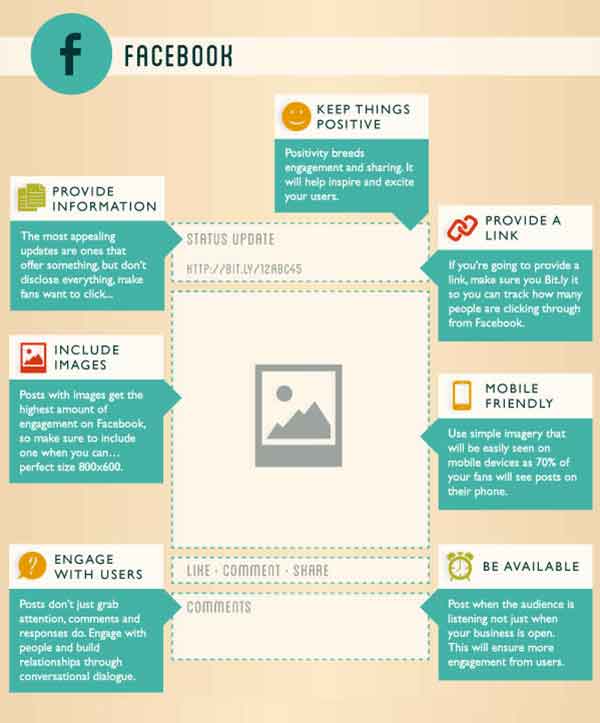
    If you are new to social media or find yourself with writers block, see some of our suggestions to create better and more engaging posts. Below is as brief list of the many ways in which you can create great content, but remember to pick just a few ideas per post to prevent overwhelming your reader.

    1. Don’t make every post “promotional.”

    For example, only posting about your business and the products you offer may not be the most exciting update for a fan to read. Instead, post about specials, sales, or events that are happening in the near future.

    2. Use images whenever possible.

    It has been proven posts with compelling text coupled with an image will get more engagement than plain text or a link alone. Take it a step further, instead of using stock images use authentic and unique images from your business.

    3. Create a “weekly something.”

    If you are a restaurant, post a recipe of the week every Tuesday. Or, if you are a dermatologist schedule a recurring post about products you recommend. Create some consistency and give your fans something to look forward to.

    4. Share or repost other business’s updates that you find interesting.

    Sharing or reposting other business’ great articles, posts, and pictures is a great way to grow your audience and offer great content to your fans.

    5. Respond to comments that are left on your posts.

    Big or small, it is always great when a business comments back on posts. In addition, you should occasionally comment on other people’s posts as well, especially on posts created by fans of your page!

    6. Take a little extra time and create a unique meme for your business to share on your social media platforms.

    This great tool called the Meme Generator allows you to create whatever meme you like with a variety of stock images available.

    7. Lastly, share something silly every once in a while!

    Found a video of an adorable elephant sneezing, two babies talking to each other, or a great gif? Share it! This will not only get your posts more likes, but good chance it will get shared a great deal with your business’s name attached to it. People love companies that have a sense of humor. It shows real people are behind the computer screen.

    PerfectFacebookPostImage

    Image Sources:

    Thanks to Pam Dyer for sharing this infographic about the “Perfect” post.

    Thanks to Steve Parker for sharing this mini graphic about Facebook for businesses.

  • Is Facebook No Longer Effective for Small Business?

    Image Of Facebook LogoIt’s well known that Facebook is, by far, the largest and most successful social network in the world. Here are just a few of the astonishing statistics for this social giant:

    • More than 1,310,000,000 (that’s 1.3 billion) active monthly Facebook users
    • Over 680,000,000 active mobile Facebook users
    • Number of users rose 22% from 2012 to 2013
    • 48% of Facebook users visit the site every day
    • The average number of friends per Facebook user is 130
    • 48% of 18- to 34-year-olds check Facebook when they wake up
    • 28% of 18- to 34-year-olds check Facebook before they get out of bed

    Facebook is obviously home to a massive potential audience. The problem for businesses, especially small businesses, is the same as the advantage: Facebook is massive. And it’s hard to be noticed in the crowd.

    Finding Your Facebook Audience: Then vs. Now

    For quite some time, Facebook has remained the cornerstone of social media marketing. Small business marketers discovered and fine-tuned strategies to grow their Facebook pages organically, gathering page “Likes” and fans who would spread their message willingly to their own friend networks.

    However, there have been a few changes along the way. In late 2013, Facebook acknowledged that the organic reach of posts would drop off for everyone. Advertising Age reported that a statement from Facebook read: “We expect organic distribution of an individual page’s posts to gradually decline over time as we continually work to make sure people have a meaningful experience on the site.”

    Facebook’s New Algorithm

    The driving force behind the “meaningful experience” Facebook is promoting came in the form of algorithm changes. Near the end of 2012, the social network changed its news feed algorithm—and users immediately saw a decline in organic post reach. At the time, Facebook denied the algorithm was intended to reduce news feeds.

    However, another update to the algorithm in 2013 filtered news feeds even more, and this time Facebook stated the reach reduction was deliberate. Coincidentally, the network began offering promoted posts: a program that lets companies buy the ability to push their posts into more Facebook news feeds.

    Organically, page posts will now show up in only around 1 to 5 percent of the news feeds of people who have “Liked” your page. A number of variables, such as relevance and shares, can increase the percentage of exposure within that range—but only paid, promoted posts will exceed it.

    Are Promoted Posts Worth It?

    With organic reach on Facebook in decline, and the reality that businesses must pay to have their posts pushed to enough news feeds for the chance of going viral, is it worth investing your time and resources in Facebook marketing?

    The answer likely depends on your existing circumstances. If you already have a strong Facebook network with a substantial number of followers, you’ll probably benefit by continuing to post actively and buying the occasional promoted posts. It should be noted that promoted posts can cost anywhere from $5 to $300 per post—and the per-action cost of these promotions can run high.

    For small businesses lacking the time and the budget to sink into Facebook as a primary platform, this form of social marketing may no longer be viable. It won’t hurt to maintain a presence on Facebook, but relying solely on this platform to increase your business could be a costly mistake.

    What do you think—has your Facebook reach declined recently? Have you ever tried a promoted post? Share your thoughts in the comments!

    Image courtesy of Gerd Altmann

    Megan Totka is the Chief Editor for ChamberofCommerce.com. She specializes on the topic of small business tips and resources. ChamberofCommerce.com helps small businesses grow their business on the web and facilitates connectivity between local businesses and more than 7,000 Chambers of Commerce worldwide.

  • Facebook Promoted Posts: Taking Away Your Fans?

    Facebook Promoted Posts
    They Took Our Fans!
    Last week, a small ripple went through the Dangerous Minds blog, crying out “I WANT MY FRIENDS BACK!” Letting out a screed of massive proportions, the piece has made its rounds on the very social network it lambasts, even having some of the 59,502 fans replace their profile pictures with the header image. But like most widely-circulated rants, the post is largely sound and fury, signifying nothing.

    Facebook celebrity George Takei had been complaining about this “problem” enough to hit the Wall Street Journal this past June. And while earlier this month Facebook extended their Promoted Posts to individual users, Pages have had the option since late May, and the feature’s older cousin Sponsored Stories have been around since January of 2011. Even more striking is that as early as December 2010, only a small subset of your fans would see your posts, and Facebook was then using an impression count, which seems inflated compared to the Reach metric we see today.

    If none of this seems particularly recent, then the frustration from savvy marketers about articles of this ilk is understandable. However, two notable sources, Facebook statisticians EdgeRank Checker and marketing patriarch Oglivy-Mather, show a recent decrease in reach centering around an algorithm change on Sept 20, 2012. For history’s sake, there appeared to be a much more significant drop in impressions in 2011.

    Facebook Promoted Posts
    We don't see the same drop in these four clients.

    Why Is This Happening?

    An owner of a Page might be frustrated with this, and wonder what causes the low share of meaningful impressions. Blame EdgeRank.

    EdgeRank, like a variety of other Ranks in the internet marketing world, is used to show content in a personalized but algorithmic way. These Ranks are often oversimplified into cute formal models, and EdgeRank is no different:

    EdgeRank = ∑uwd

    where u is the “affinity,” i.e. how much a user clicks, likes, or otherwise interacts with your page’s posts; w is the inherent weight of the type of Facebook post, leaning more heavily on images and videos than text posts or links; and d is the length of time it’s been since the post was made.

    With EdgeRank, you may find your fans living in a shotgun filter bubble, and you may ask yourself, “How did I get here?” Each post has an individual EdgeRank with every user; therefore, a disengaged user base may yield lower than average reach, as the posts won’t have enough affinity with the users. A February webinar with Wildfire, now part of Google’s social team, showed an average of only 16% of page fans see a given post from a page.

    What Can I Do?

    Facebook has increasingly been giving page owners (and, by extension, business owners) paid options to increase their posts’ reach — but before any money is spent, optimizing your posting schedule for EdgeRank goes a long way.

    From Dangerous Minds:

    At Dangerous Minds, we post anywhere from 10 to 16 items per day, fewer on the weekends. To reach 100% of of our 50k+ Facebook fans they’d charge us $200 per post. That would cost us between $2000 and $3200 per day…

    The first thing that stuck in my mind from the original post was that they were clearly using a shotgun approach to their Facebook posting. Unlike in organic SEO, blasting a relatively large number of pieces of content has little benefit — you’re diluting the relative EdgeRanks of your posts by ensuring that few see each individual post and can’t give you the engagement needed to raise your overall affinity. This kind of shotgun approach can be profitable when a page has a large number of fans, but for most pages a more relaxed 2-3 posts per day allow overall affinity to accumulate on valuable posts. Less engaging links can be foregone in the social media strategy for organic sharing by users who click around after reading the shared post, i.e. those that will have a higher chance of viral sharing.

    Moreover, Dangerous Minds posts largely links, which are among the lowest weighted edges, as they likely don’t produce the kinds of interactions that create even more high-value edges as images or videos would. They could easily follow the lead of many Facebook pages and post their links with an engaging image, increasing not only visual but algorithmic prominence in the News Feed.

    Facebook Promoted Posts
    See How Pretty, See How Smart
    Finally, the article’s code is missing high-value social meta tags that will lead to attractive display in the News Feed, missing out on high-value placement in the News Feed. Including og:description, especially one optimized for social media, lets you control the message introducing new users to your site and regular users to that piece of content. Using meta properties that were always part of OpenGraph but a newer recommendation from Facebook, app_id and fb_admins, provide a striking, clickable, and brand-reinforcing display in the News Feeds of the most important group for expanding your fanbase: friends of fans.

    Sponsored and Promoted

    No matter how much you optimize your posts and website to hoard EdgeRank, you may want to spend some money. There are two alliterative ways to promote your posts to a wider audience: Promoted Posts and Sponsored Stories. The two methods are similar in effect, but wildly different in terms of management.

    Sponsored Stories, now an elder statesman of Facebook advertising, runs an ad that shows in the top of the sidebar and in the News Feed. You can choose your interest and location targeting and bid for this ad, and the overall budget and duration for the campaign. This kind of ad is perfect for exposing your brand to people who might not even be aware of it, and when well-targeted can lead to click-through rates of over 5% on a reach of thousands or more. Again, a well-optimized Facebook post is necessary to make it clear to the user what they’ll be clicking on, but your strongest weapon is targeting.

    There are a two types of Sponsored Stories which can be run individually or in tandem. The first is a flat ad, displayed to users in your target; the second is a “Like Ad,” giving prominence to stories created by actions taken on your posts. Which one you choose depends on your goal: expanding your reach to people who aren’t brand-aware, or pushing to your fans’ friends, who might be acquainted with your brand, but haven’t seen your content before. To make management easy, you can set the Sponsored Story to automatically update with your most recent post, and the overall monthly cost can be as low as $500 for blanket saturation of your target market.

    Facebook Promoted Posts
    Left: Regular "Flat" Ad. Right: Interaction "Like" Ad

    Promoted Posts are the simpler, easier way to run Sponsored Stories that only show in the organic News Feed area. By running a Promoted Post, you create 3 Sponsored Stories targeted to the areas that your fans are from. Two of these ads are post ads, targeted to your fans and friends of fans; the other one is a Like Ad. You can’t edit these ads’ targeting, making them a little unwieldy if you have a broad fanbase with friends outside your target area, and the ads only run for a few days; however, the easy setup lets you get on with your day and promote only the posts you want. It’s also harder to identify these posts as ads, avoiding issues from ad-blockers and other tech-savvy users’ plugins.

    If you have the time to manage it, I personally feel that Sponsored Stories are better for most pages because you can control targeting, run ads for longer, and combine with other ads to best draw traffic, interactions, and fans. However, Promoted Posts are great for those who are on a limited budget and looking to avoid losing themselves in overt advertising.

    Get Your Fans Back!

    No, Facebook isn’t taking your fans, at least any more than they usually did. No, you don’t have to use any paid solutions to reach your fans. No, paid ads aren’t anything more than a way to reach those who wouldn’t normally have seen your content. And no, paying for placement and reach won’t make up for content that isn’t shareable.

    Your first steps to getting your fans back is to optimize your posts, schedule and strategy, and website for social media. Then boost content that “sticks” by shrewd, instead of blanket, Promotion and Sponsoring. Finally, spit-shine your boots and watch engagement, reach, and impressions climb.