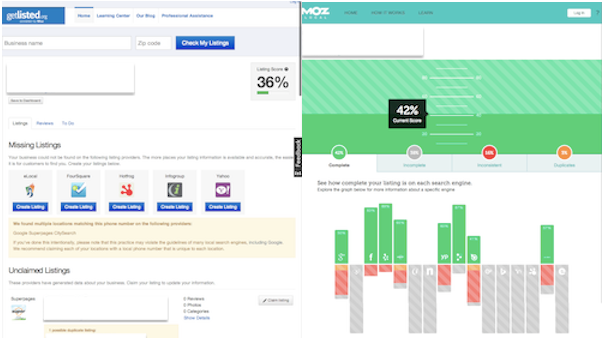
Moz Local made some small changes to its reporting dashboard over the past week or so. These small layout differences indicted a large change in the capabilities of the tool.
Only announced on August 18th (though acknowledging that updates slowly rolled out over the previous week), Moz has added City Grid (City Search), Insider Pages (not fully rolled out yet), and Bing to the growing list of sites that they can submit information directly to. The tool also removed Yahoo from listings that they find and evaluate for you.
What does this mean for you, a business owner?
City Search and Bing were already available for Moz Local users to find and address, but they have now made the move over to their “Direct Network.” Since both require verification to edit business information, this change could make it even easier to send out your correct business information out into the wild, wild web for customers and search engines to see.
Since Moz Local offers an easily navigated and editable interface, when an address, website, or even hours change, you can modify it in just one place and watch it change throughout the high-authority directories and data aggregators.
What does this mean for you, a marketing professional?
Moz’s removal of Yahoo Local listings in an strong indication that Yahoo is moving away from being a source for native, unique listing information. As it stands now, native Yahoo listings are being replaced/overpowered with Yelp listings with reviews. By not even caring to show a client’s information on the site, Moz is acknowledging that Yahoo is no longer an independent listing source.
By adding Bing to their direct network, Moz could change the amount of sites that require client confirmation. With every client, there is a varying amount of difficulty that can happen with verifying listings. Postcards can get lost. Phone calls can get missed. Moz seems now to give a way to circumvent those problems. However, completely dropping the process of claiming Bing would not be wise. Claiming the listing gives you the power to change information immediately and to see how often the listing is seen.
Moz is showing that it has a great ear to the ground for changes that may be rumbling in the local citation world, and I know that I will be keeping an eye out for any of the new changes that it says should be rolling out soon.
In an effort to improve engagement with its more casual users, Twitter has made multiple changes to its platform. The most recent has just rolled out on mobile and web, offering descriptions and metrics on trending topics. Now, you can see what a trending topic means and how many other users have shared it.
SEO authority Moz has just released their annual report for 2014, showing “many ups and downs.” Despite a few challenges this year, CEO Sarah Bird still proudly showcases the decrease in cost-of-revenue, increase in workplace diversity, and interesting work perks like charity donation totals and paid vacation. In this bid for transparency, we see another interesting example of tech company work culture.
Wondering what all the hubbub is about with Google’s new update? Normally, Google doesn’t give much warning ahead of its changes, but this one has been on the SEO world’s radar since last October. Google’s major mobile-friendly push will affect more sites than either Penguin or Panda. But don’t worry: if your site is already mobile-friendly, your ranking won’t be affected. If not, Google’s Webmaster Tools feature will tell you how to fix it.
Speaking of #Mobilegeddon, it’s very likely Google’s Ad Rank formula will be affected by the new mobile criteria. With the changes leading up to the algorithm rollout, we saw both organic search results and AdWords ads labelled with the “mobile-friendly” tag. So it’s not a stretch that AdWords ads will also be affected by how mobile-friendly a website is, both as a factor in the ranking formula and as it affects ad extensions and formatting.
Developer Pierre-Jean Camillieri is trying to answer the question “who influences the influencers” with his new tool, Game of Angels. Though the program is in its early stages, it could help entrepreneurs connect with industry leaders who have the most online clout.
The tool gives a visual map of influencers and their major connections based on the number of interactions they have. However, it’s currently limited to those Camillieri himself deems major influencers and industry leaders.
The presentation below was developed for a joint conference put on by Local University and Moz in Seattle on February 7th, 2015, called LocalUp.
My “beat” if you will as a Local U faculty member is Social Media, and given our work with customers of Search Influence, I have always leaned toward the advertising side of Social Media Marketing. With some of the changes being made by Facebook, most particularly, the elimination of “selling” content from the news feed, that focus is getting more important.
Facebook is no longer a free lunch. You’ve got to pay to play.
That said, it’s still very important to build community and engagement and good content makes it easier. That’s what this presentation is about. I hope you enjoy. I’d love to have your comments here or on SlideShare.
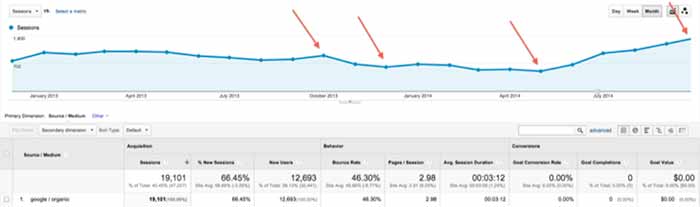
As digital marketers, we regularly analyze site traffic to ensure that our efforts are producing positive results. But what happens when you’re doing all the right things in your SEO campaign (high-quality website content, blogging, link-building, etc.) and your Google organic website traffic is consistently going down?
1) Traffic Deep-Dive
First, log into Google Analytics and narrow your search down to Google organic traffic over the largest date range possible. Look for trends of upward or downward traffic and make annotations of known changes that might have caused traffic to change (such as a new website launch or the installation of a blog). Also, check traffic by landing page to see if only certain pages were affected.
2) Compare to Algo Timeframes
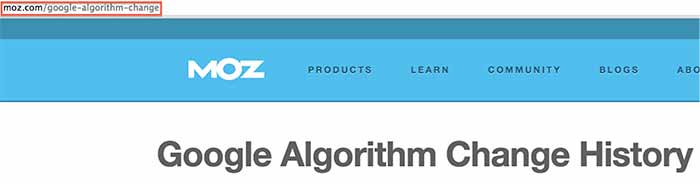
Next, see if any of the changes correspond to one of Google’s algorithm updates using the Moz algorithm timeline. Keep in mind that the date might not be exact, because the updates often take time to roll out. If you can attribute the traffic change to an algorithm update, take the necessary action depending on the update. Hit by Panda? Focus on your content strategy. Hit by Penguin? Take a close look at your inbound links and check for a manual action.
3) Investigate Other Possible Culprits
If your traffic change didn’t correspond to a Google algo update, this is when your analysis gets a little tricky, as there are many possible reasons for the change. Here are some things to check when searching for the source of your traffic change:
Rollout of a new website (setting up 301 redirects is essential to this process as well as carrying over all SEO optimizations)
Removal or adjustment of your content
Relocation of your business (your citations need major focus)
Discontinuation of an ad campaign that was generating traffic
Adjustment of technical elements of your site, such as meta-tags or robots.txt
Change or removal of your Google Analytics tracking code (surprisingly common)
Change in the marketplace or seasonality (like a decreased demand for your products/services in general or during a certain part of the year)—check out Google Trends
Messy directory profile (check your percentage of correct citations using Moz “Check My Listing”)
These tips will hopefully help you get to the root of the issue and take the necessary action to achieve your SEO goals. If you need a professional team to do the work for you or to assist you in your efforts, you can always call us: we’ll be happy to discuss our SEO packages with you.
Have any additional recommendations for things to check? This list is not exhaustive, so please help add to it!
Love making videos on Instagram? Well guess what! The popular app, Vine, is finally allowing users to upload videos from their phones.
In addition to being able to import your own videos, Vine now also allows you to edit videos, and they have been encouraging users to upload older videos stored on their phones and share them with hashtag, #VintageVine. Check out the announcement video below!
Google announced early Wednesday morning that AdWords will now contain a bulk editing feature. This snazzy new tool will allow users to update their settings per campaign in a more user-friendly and efficient way. Some of the benefits include:
A filter for campaigns targeting specific location
Updating multiple campaigns with a new targeted location
Adjusting other settings such as language, campaign end dates, and ad rotation
The Wall Street Journal reported Wednesday that Snapchat is expected to launch Snapchat Discovery in November. This new product will allow Snapchat users to read news articles and watch video clips the same way they do now: by holding their finger down on a phone screen. The Journal also reported that Snapchat CEO Evan Spiegel is looking to get into advertising for his popular app.
Bing announced a massive maps update this week. Bing Maps now has over 100 cities that support Streetside imagery across America, including Richmond, Boston, Denver and more. They also now have 3D city images and new, high resolution aerial images. 3D cities are viewable through the Bing Maps Preview app, available exclusively on Windows 8.1. Bing Maps also has new high-resolution imagery in over 150 countries on every continent in the world, covering five million square kilometers.
Moz released their third guide for marketers this week. As all marketers know, link building has changed over the years. One thing that has not is the importance of link building. In this updated guide, readers will learn:
What is link building, and why is it important in SEO?
If you’re a local SEO geek like me, you were probably super excited to learn that this past Tuesday Moz Local was officially released. If you go to GetListed.org, you’re now redirected to Moz Local, which can also be accessed directly at moz.com/local.
So, you might be asking yourself what exactly has changed and what is Moz Local. You can still do the same free reputation lookup that you used to be able to do with GetListed by clicking “Check my Listing Score.” Now, however, the results are very stylized, as is Moz’s style, and much more visual in nature.
Here’s a comparison view:
Understanding Moz Services
So, outside of the free reputation monitoring tool, Moz Local offers the paid service of being a “self-service location data management software that syndicates listings to all five major U.S. data aggregators,” at a cost lower than services like Yext and UBL. One of the 5 major data aggregators that they submit to is Factual, which if you’ve ever tried to clean up your listings in, you know it can be fairly impossible because you basically need to be a developer to do so. For $49 per year per location, they feed your listing informations to major directories and help you stay on top of how your business is appearing on those sites with a beautiful and easy to read visual report. The time you would have spent locating and figuring out what’s going on in these sites, is greatly reduces by using a helpful and comprehensive service like this. Using efficient tools like this is a great way to make sure you’re being productive and not just keeping busy.
Moz Local is definitely geared towards businesses and agencies who manage multiple locations and/or businesses online. If you want to add multiple listings and locations to the tool at once, you can do it all in one spreadsheet with formatting similar to that of the UBL and Neustar/Localeze upload spreadsheets and exactly the same as Google’s multiple location spreadsheet. So, if you’re familiar with any of those, it’s super easy. If you’re not familiar with those, they’ve got a super helpful page to ensure that you’re filling out the fields properly!
Answering Questions
You might be thinking, “But what about the directory partners that require listing verifications?” Well you don’t have to worry about that! Here’s the direct response to that question from Moz:
When you submit a listing on Moz Local, it must match an existing Google Places or Facebook listing across all of the following attributes: Business Name, Address, Phone Number, and Website. Because you’ve already gone through the phone or postcard verification process with Google and/or Facebook, your Moz Local listings will be validated if they exactly match Google and Facebook.
Thinking Forward
Much like other services such as Yext, if you cancel your Moz Local subscription, many of your listings with Acxiom and Localeze will be reverted back to their status prior to your subscription.
Your best bet to prevent something like that from ever happening would be to use Moz Local as a tool to get your information to those sources correctly, but also take the action of still claiming and owning your listings. This is especially important to do on major sites like Google, Yahoo, Bing, Facebook, Yelp, and Foursquare.
I hope you’re all as excited about Moz Local as I am! If you’ve got other questions about Moz Local, see their FAQ section here.
Feel free to comment below if you’ve got any input or feedback on your experience with this beautiful new upgrade.
The other day I was visiting my normal news sites, Mashable, Coding Horror, and news.google.com among others. While getting my information download I came across a few postings I thought had true value, and I wanted to share them with my social media friends and family. I immediately went to my handy dandy Google URL Shortener which I had added to my Chrome browser toolbar and – click – presto, I have a short url ready to paste to any social media platform, in my clipboard, cocked and loaded. And so I shared, and then shared some more.
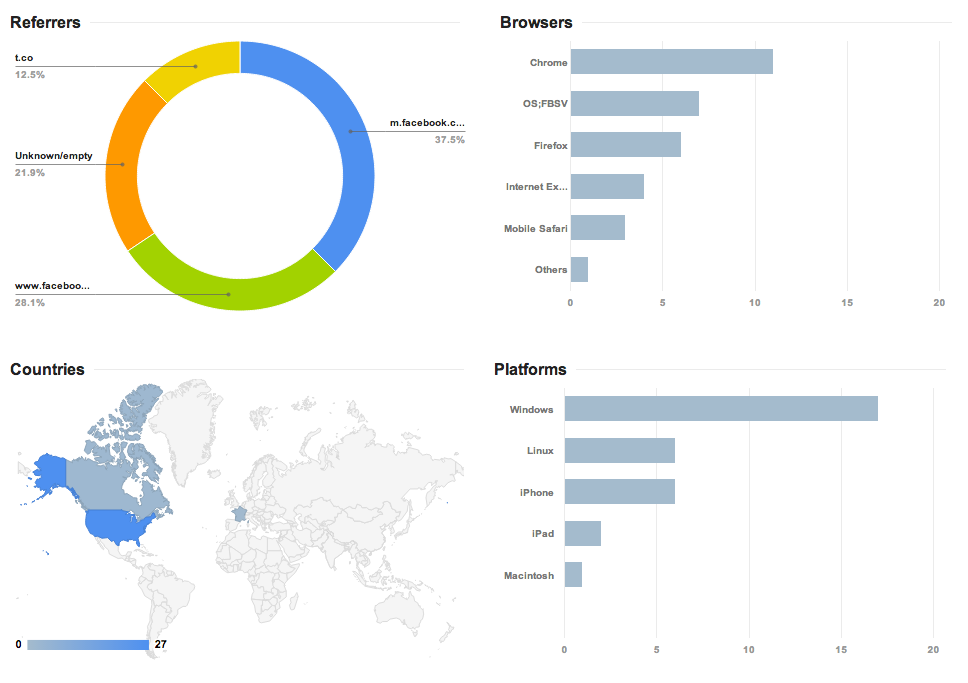
The nice thing about Google’s service is you can track anyone’s goo.gl URL analytics by adding .info, or simply +, to the end of it. For instance, the analytics to the URL http://goo.gl/zlzlYv, which points to townsend.bunksite.com/, can be seen at http://goo.gl/zlzlYv.info. I occasionally went back to my .info page to see which of the links I shared actually had any value (received clicks on their respective pages) to my friends, family and followers.
Google gives some good basic analytics data about URL click throughs, although I’ve seen more in depth analytics from URL shortening service competitors. But I digress, it was about this time when I started wondering, with being the obvious search leader and giant, does using the Google URL shortener give an SEO advantage in search results? It might make sense for Google to use URL shortener data(like number of clicks for a shortened URL) in order determine rank worthy content. Also, it seems logical that since this is another metric to look at how users share content, they would want to encourage the use of their shortener, perhaps by giving some advantage to companies using goo.gl for their social media campaigns, much like the seo benefits of using Google Plus Maggie told us about earlier this month.
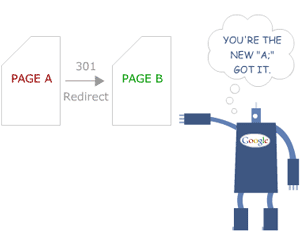
The obvious benefits of using Google as your URL shortening service include proper redirects. You know if you are using their URL shortener you will never run into problems with shorteners that don’t properly treat the redirect conversion as a 301 redirect or don’t properly transfer PageRank or any future possible negative impact. Most popular shorteners conform to the standards set by Google, but still, it’s better to be safe.
Another important issue for short url providers is trust. You must trust the service uptime (availability) is as close to 100% as possible. You have to trust that the redirect process will happen at a speed measured in milliseconds, not seconds. You also need to trust the provider isn’t going to just disappear one day. With an average of 5,922,000,000 (nearly 6 trillion) Google searches every single day, I think they can handle the job of keeping up with this level of service. Besides, you are probably already trusting them to handle your site analytics, search results, pay-per-click advertising and storing documents, among other services. Why not keep all your data in one place?
It is worth noting that Google has pulled the plug on some beloved services in the past, but they generally provide users with a lot of advanced warning before the twilight date. Also, they always provide a way to migrate user data from the shuttered service.
So, we know the Google URL shortening service is worthy of using and helps keep our data in one place, but is there actually a positive weight given to these URLS that translates into higher rankings on the SERPs? For that, I spoke with our Google and Local SEO expert here at Search Influence, Mary Silva. Here is what she had to say on the subject:
“There’s not necessarily any kind of weight given to using the Google URL shortener for linking. Also, Matt Cutts has explicitly said that “goo.gl isn’t an effort to kill anything,” and isn’t some sort of attempt to kill other “product X” URL shorteners.
http://moz.com/learn/seo/redirection
In terms of SEO effects of the shortener, it’s important to recognize that there have been reports that once in a while the Google URL shortener has created broken links, so that would obviously not be beneficial in terms of back-linking and other similar efforts. Always double check that the short url actually works, regardless of the provider you use. Another thing to note is that the Google URL shortener creates a 301 redirect which passes 90-99% of link juice to the redirected page, and is the most ideal for redirects for SEO practices, which isn’t the case for all URL shorteners.”
So, is Google going to rank your linked content higher just because you used their URL shortener? Nope. Content is king and there is no exception to that just because you use Google’s products. Should you use Google’s URL shortener? While no url shortening service is perfect, using this one is certainly no worse than others. Knowing that the service provider is fairly reliable may bring some peace of mind.


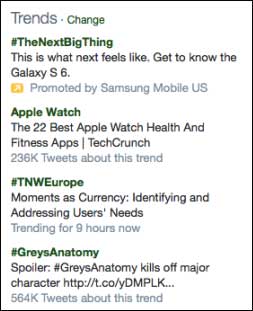 In an effort to improve engagement with its more casual users, Twitter has made multiple changes to its platform. The most recent has just rolled out on mobile and web, offering descriptions and metrics on trending topics. Now, you can see what a trending topic means and how many other users have shared it.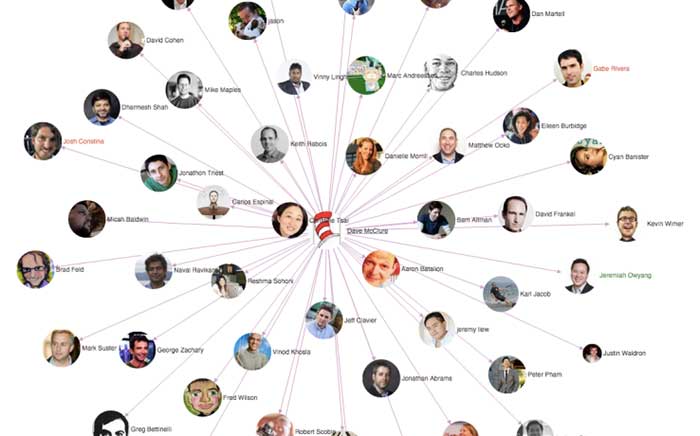

 The Wall Street Journal reported Wednesday that Snapchat is expected to launch Snapchat Discovery in November. This new product will allow Snapchat users to read news articles and watch video clips the same way they do now: by holding their finger down on a phone screen. The Journal also reported that Snapchat CEO Evan Spiegel is looking to get into advertising for his popular app.