Tag: higher education

  • How to Conquer the Biggest Higher Ed Marketing Challenges in 2026

    How to Conquer the Biggest Higher Ed Marketing Challenges in 2026

    Key Insights

    • Student Search Behavior Is Changing, and Marketing Must Follow: Shifting demographics, alternative education pathways, and AI-driven search are changing how prospective students discover and evaluate institutions. Universities must align their strategies with search behavior that now spans AI tools, social platforms, and traditional search engines.
    • AI Search and Social Discovery Drive Visibility: AI Overviews and social search are redefining online visibility. Traditional SEO alone is no longer enough. Institutions need clear, authoritative content that performs across AI-powered and engagement-driven platforms.
    • Tracking the Right Metrics Is Essential: As clicks become less reliable signals, understanding cost per inquiry (CPI), cost per enrolled student, and channel performance is critical for optimizing budgets and improving enrollment outcomes.

    Nearly 50% of prospective students now use AI tools at least weekly, and 79% say they read Google AI Overviews when researching academic programs.

    Search behavior isn’t just changing. It’s fragmenting across search engines, social platforms, and AI-powered tools, forcing universities to rethink how they show up and stay visible.

    As traditional student populations decline and digital marketing evolves, higher education institutions face growing pressure to adapt their recruitment strategies to meet prospective students where they actually search. From shifting discovery behaviors to the rise of alternative education pathways, academic leaders are navigating an increasingly complex and competitive landscape.

    The biggest challenges in higher ed marketing today aren’t tied to a single channel or tactic. They require institutions to redefine how they connect with an audience that is more diverse, digitally savvy, and selective than ever before.

    To better understand these shifts, Search Influence partnered with UPCEA to conduct AI Search in Higher Education: How Prospects Search in 2025, a national study of 760 adult learners exploring professional and academic programs. The research offers critical insight into how prospective students use search engines, social platforms, university websites, and AI tools throughout the decision-making process.

    In this blog, we’ll break down the most pressing higher ed marketing challenges in 2026 and share practical, research-backed strategies to help your institution:

    • Strengthen student engagement
    • Refine its digital approach
    • Compete more effectively in a rapidly evolving search environment

    Higher Ed Marketing Challenges

    AI’s impact on behavior and the search landscape

    The students of tomorrow are already using AI today. And for many, it’s now a routine part of how they search for and evaluate academic options.

    Search Influence’s AI Search in Higher Education research found that 79% of prospective students read Google AI Overviews, and 56% are more likely to trust institutions cited by AI.

    This shift is influencing the student journey well before application, shaping how prospects explore programs, compare institutions, and narrow their choices.

    AI chatbots, search assistants, and generative search experiences are increasingly embedded in the consideration process, acting as filters between prospective students and institutional websites.

    In many cases, students now get answers directly within search results without clicking through to a university website, a behavior known as zero-click search. AI Overviews frequently summarize program information, admissions details, and outcomes on the results page itself, especially for non-branded and early-stage research queries. This means visibility increasingly depends on being cited and trusted by AI systems, not just driving traffic to a landing page.

    As AI becomes more integrated into everyday search behavior, students expect universities to provide clear, accessible information that AI systems can surface accurately, not just compelling messaging once they arrive on a website.

    How to overcome this challenge

    As AI reshapes how content is discovered and summarized, higher education marketers must refine their content strategies to support both human decision-making and AI-driven retrieval.

    Universities will stand out by developing clear, in-depth, and well-structured content that AI systems can confidently reference and prospective students can trust. Research-backed program pages, detailed FAQs, and content that directly answers common search questions improve the likelihood of being surfaced in AI Overviews and other generative search experiences.

    Targeting specific, intent-driven queries, such as program outcomes, career pathways, and admissions considerations, helps institutions remain visible across traditional search, AI-powered results, and emerging discovery channels.

    Incorporating interactive elements such as webinars, virtual tours, and downloadable guides creates engagement opportunities that go beyond AI summaries, encouraging prospective students to take the next step once initial discovery happens elsewhere.

    Institutions that adapt their content and SEO strategies with AI search in mind will be better positioned to maintain visibility, build trust, and connect with future students as search behavior continues to evolve.

    A guy taking notes next to a computer

    Social search

    Social search is redefining how prospective students discover and engage with universities, and it plays a dual role in modern visibility: how people search and how AI systems understand and trust brands.

    Search Influence’s AI Search in Higher Education research shows that prospective students’ search behavior is increasingly diversified when researching programs:

    • 84% use search engines
    • 61% use YouTube
    • 50% use AI tools

    Social platforms sit squarely within this ecosystem. Prospective students now use platforms like TikTok, Instagram, YouTube, and LinkedIn as search engines in their own right, entering queries, scanning results, and comparing options through video, comments, and creator content.

    Instead of typing formal queries and clicking ranked links, students search social platforms with intent-driven phrases, looking for campus tours, student perspectives, program outcomes, and day-to-day academic experiences. Discovery happens through scrolling, watching, and evaluating content in context, often before a university website ever enters the picture.

    Unlike Google’s algorithm, which relies heavily on structured SEO signals, social search is driven by engagement. Visibility is determined by watch time, shares, comments, and interaction, making discovery harder to influence through traditional optimization alone.

    This behavior matters beyond student engagement. AI-powered search engines increasingly pull context and authority signals from social platforms. Social content helps AI systems validate what an institution offers and which queries it should be connected to in generative search results.

    Higher ed marketers must transform existing content into social-native, program-focused formats that support discovery and credibility. Simply having a website is no longer enough.

    How to overcome this challenge

    To succeed in social search, universities must treat social platforms as extensions of their search and content strategy, not just promotional channels.

    Institutions should focus on creating educational social content, such as:

    • Instagram Reels or TikTok videos that clearly explain academic programs, career outcomes, or student experiences
    • Short-form student testimonial videos that speak directly to institutional value, flexibility, and real-world impact
    • YouTube videos that provide deeper program overviews, faculty insights, or recorded info sessions
    • LinkedIn articles that discuss industry trends, academic expertise, or workforce alignment related to your institution and target programs

    By approaching social media as a strategic input into AI-driven search, higher ed marketers can improve discoverability, strengthen brand credibility, and support enrollment goals across an increasingly fragmented search landscape.

    Tracking key metrics for performance

    Tracking key metrics is essential for ensuring the success of higher education marketing efforts, yet many colleges and universities still struggle to measure the true impact of their campaigns.

    UPCEA and Search Influence collaborated on the Higher Ed Marketing Metrics Research Study: What Gets Measured Gets Managed to address this challenge.

    This study highlights a critical issue: While most marketing teams can identify the source of inquiries, far fewer track the actual cost per inquiry (CPI) or cost per enrolled student — two essential metrics for assessing marketing efficiency.

    In fact, while nearly 73% of marketing units track the source of inquiries for online and professional education programs, only 46% track CPI, and just 43% monitor the cost per enrolled student. Even more concerning, 17% do not track any of these key performance indicators at all.

    Understanding CPI and cost per enrolled student provides significant benefits for colleges and universities looking to optimize their campus recruitment efforts.

    Tracking these metrics allows marketing teams to assess whether they are generating an appropriate volume of prospects and determine if those inquiries are converting into actual enrollments. More importantly, it enables data-driven decision-making by showing where budget optimizations can improve efficiency.

    For example, if one marketing channel consistently delivers high CPI but low conversion rates, adjustments can be made to targeting, messaging, or spend allocation to maximize future results. Tracking these metrics provides a foundation for deeper analysis, helping universities evaluate lead quality, conversion ratios, and the overall effectiveness of different marketing channels.

    How to overcome this challenge

    By prioritizing CPI and cost per enrolled student, higher education marketing teams can make informed adjustments to their strategies, ensuring that resources are directed toward the highest-performing channels. This approach improves campaign performance and allows institutions to better understand how their marketing investments drive student engagement.

    Changing demographic and enrollment landscape in higher education

    The higher education landscape is shifting dramatically, and the long-anticipated demographic cliff is here. As the number of “college-aged” students declines, institutions historically relying on traditional undergraduate enrollments must rethink their approach.

    To stay competitive, higher education institutions must expand their focus beyond recent high school graduates and embrace a broader audience — adult learners, career changers, and professionals seeking skills-based education.

    The move away from traditional education pathways

    The traditional four-year degree is no longer the only, or even the preferred, pathway for many modern learners.

    Rising tuition costs, evolving workforce demands, and a desire for flexibility are driving students toward microcredentials, online degrees, and non-credit-to-credit pathways that allow them to tailor their education to their career goals.

    The workforce is evolving too quickly for rigid, 120-credit degree programs to keep up.

    As Aaron Brower highlights in From Degrees to Microcredentials: Higher Education Must Evolve to Embrace the Modern Economy, this shift isn’t just about cost; it’s about relevance.

    Instead, students are adopting a “mix-and-match” approach to learning, combining traditional coursework with certifications, industry-recognized credentials, and skill-based training. This shift is forcing schools and universities to adapt their higher education marketing and university marketing strategies to ensure they reach and engage today’s learners.

    Prospective students are looking for technology-driven solutions that allow them to engage with coursework without sacrificing work, family, or other commitments. Institutions must emphasize the benefits of flexible learning options to attract more students.

    This means adapting marketing communications to highlight the value of alternative education pathways, including non-credit programs that can stack into degrees, online learning that fits busy schedules, and credentials that provide immediate career impact.

    How to overcome this challenge

    For campuses to thrive in this new landscape, institutions need to evolve their messaging to focus on lead generation and long-term student engagement. Universities that successfully communicate the advantages of non-traditional education will attract more students and position themselves as forward-thinking leaders in an era where lifelong learning is essential.

    The Importance of Upskilling Your Team With AI SEO

    To overcome today’s higher ed marketing challenges, institutions must upskill their teams with a clear understanding of AI SEO.

    AI SEO isn’t a passing trend or a niche tactic. It’s the new operating environment for search.

    As AI-powered systems increasingly determine which content is surfaced, cited, and trusted, marketers need to understand how content is interpreted by people and machines.

    New technology can feel intimidating, but adapting to AI SEO is no different than learning any other essential marketing tool. Working in marketing today without understanding AI SEO is like working at Office Depot without knowing how to use the Xerox machine. It’s simply part of the job now.

    For many institutions, the fastest path forward is partnering with an AI SEO agency that recognizes how search is evolving and how higher ed audiences behave.

    Contact Our Award-Winning Higher Ed Marketing Agency

    From understanding AI’s impact on search and social discovery to navigating changing demographics and tracking the right performance metrics, higher education marketers are being asked to do more in an increasingly complex environment.

    That’s where Search Influence comes in. We help colleges and universities adapt with research-backed strategies.

    Of all these challenges, AI search may be the steepest climb. Search behavior is shifting faster than most institutions can track, and visibility now depends on how AI systems interpret, summarize, and trust your content.

    Consider our AI Search in Higher Education research study the climbing gear you need. It offers practical insight to help you navigate this shift with clarity and confidence.

    Download the AI Search in Higher Education study to understand how prospective students use search engines, AI tools, social platforms, and university websites.

    Images:

    1. Unsplash
    2. Unsplash
  • 90+ Higher Education Marketing Stats [2026]

    90+ Higher Education Marketing Stats [2026]

    This post was updated by Paula French on 12/23/2025 to reflect current best practices. It was originally published on 1/9/2025.

    Higher education marketers face more pressure to compete than ever before. From the demographic cliff and evolving modern learner to the rise of AI-driven program discovery, institutions must pay close attention to how they measure up to the industry to stay ahead.

    These 90+ stats, drawn primarily from our continuing and online education research with UPCEA, reveal how institutions approach digital marketing, AI visibility, performance tracking, and student reach. See what’s working, what’s missing, and where to focus your next efforts for greater success.

    Must-Know Higher Education Marketing Stats for 2026

    Prospect Behavior & Outlook Statistics

    AI search usage & adoption stats

    • 50% of prospects use AI tools at least weekly.
    • The majority of prospects use AI search (50%) the same way they use a traditional search engine.
    • 79% of prospects read Google’s AI Overviews.
    • 1 in 3 prospects trust AI tools for program research.
    • 56% of prospects are more likely to trust brands cited by AI-generated answers.

    2024 higher education marketing metric graphic

    Multi-channel program discovery stats

    • 84% of prospects use search engines for program research.
    • 61% of prospects use YouTube.
    • 50% of prospects use AI tools.

    Organic search visibility & consideration stats

    • 82% of prospects are more likely to consider programs on page one of search results.
    • Prospects are most likely to rely on search engines (84%) and university websites (63%) to explore programs.
    • 77% of prospects trust university websites over other sources.

    Social & video discovery stats

    • Nearly 7 in 10 prospects say frequent social media recommendations make them more likely to consider a product or program.
    • YouTube (57%), LinkedIn (49%), and Facebook (43%) are the top social media platforms used for program research.
    • Prospects want program summaries (65%), career advice (54%), and testimonials (50%) in social content.

    Online learner stats

    • 73% of online learners are pursuing degrees.
    • 27% of online learners are pursuing credit-bearing certificates or licensure programs.
    • 58% of online learners are employed full-time.
    • 21% of online learners are employed part-time.
    • 26% of online learners choose a school based on how well its programs align with their career goals.
    • 32% of online learners cite time to completion as a key enrollment factor.

    Adult learner stats

    • Prospects under 35 are nearly twice as interested in professional and continuing education than older adults (41+).
    • Adult learners account for 42% of higher education revenue.
    • The total addressable market of adult learner candidates is estimated to be 242+ million.
    • Gen Z is predicted to comprise 60% of all adult learners by 2031.

    Sources: Search Influence x UPCEA, Education Dynamics, EAB, UPCEA

    Cost Metric & Benchmark Statistics

    Digital advertising cost per inquiry benchmarks

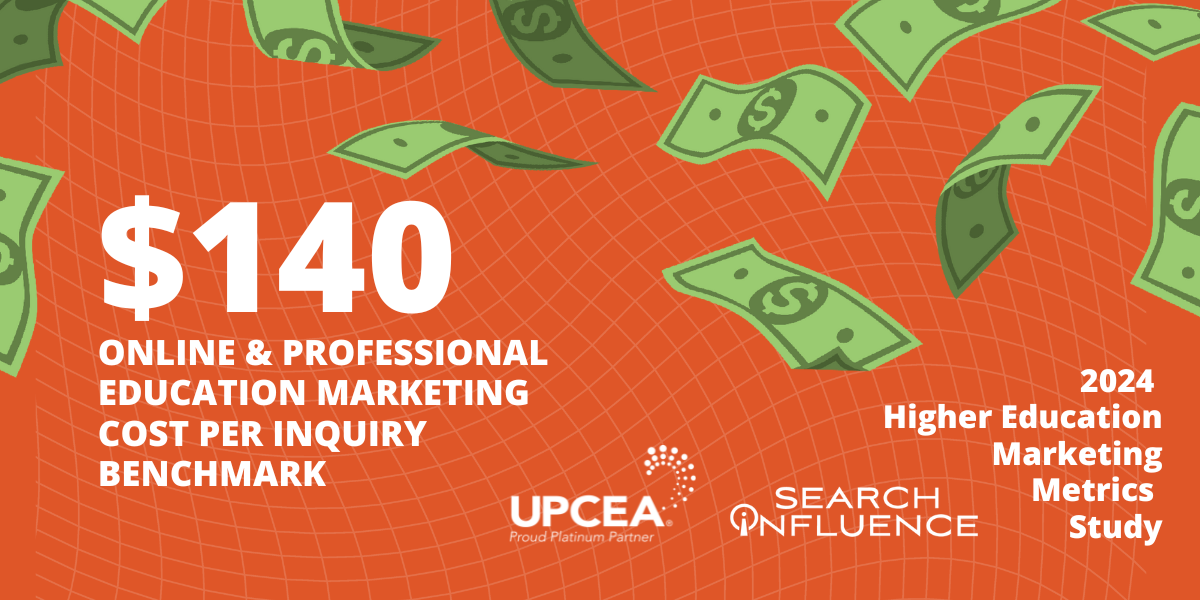
    • $140: Average cost per inquiry in higher ed (online and continuing education)
    • $157: Average cost per inquiry for graduate programs
    • $128: Average cost per inquiry for undergraduate programs
    • $51: Average cost per inquiry for non-credit courses

    Cost per enrolled student benchmarks

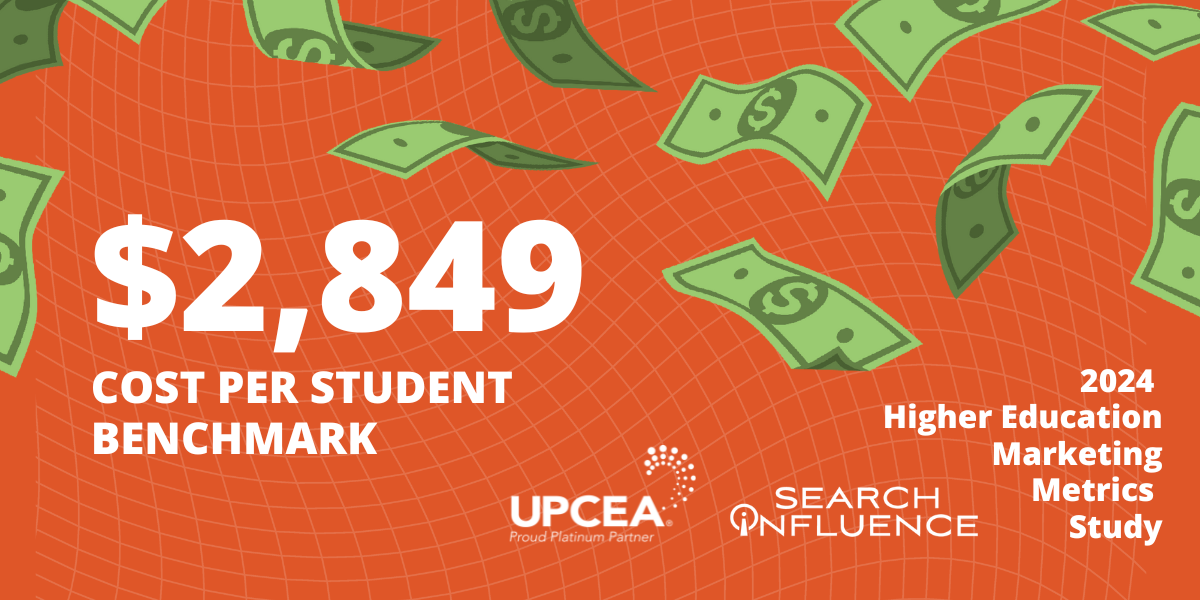
    • $2,849: Average cost per student in higher ed (online and continuing education)
    • $3,804: Average cost per student for graduate programs
    • $1,505: Average cost per student for undergraduate programs
    • $599: Average cost per student for non-credit courses

    Marketer spend & satisfaction stats

    • The average annual digital ad spend is $800,970, accounting for 3.6% of total revenue.
    • 47% of higher ed marketers are satisfied with their marketing campaign performance.
    • 38% of higher ed marketers are satisfied with their cost per inquiry.
    • 27% of higher ed marketers are uncertain about their satisfaction with their cost per inquiry.
    • 29% of higher ed marketers are satisfied with their ability to track their campaign success.
    • 92% of those satisfied with their tracking capabilities also report satisfaction with their marketing campaign performance.

    Source: Search Influence x UCPEA

    Marketers’ SEO/AI SEO Capability & Strategy Statistics

    SEO prioritization & awareness stats

    • 82% of higher ed marketers view digital marketing as a core part of their marketing strategy.
    • 84% of higher ed marketers view SEO as a core part of their marketing efforts.
    • 51% of higher ed marketers do not have an established SEO strategy.
    • 52% of higher ed marketers are highly aware of their continuing and online education unit’s SEO capabilities, processes, and strategies.

    SEO execution & resourcing stats

    • 91% of higher ed marketers implement paid search into their SEO strategy.
    • 27% of higher ed marketers integrate keyword optimization and link-building into their SEO strategy.
    • 55% of higher ed marketers allocate marketing spend to every graduate program in their portfolio.
    • 15% of higher ed marketers allocate funds equally across programs.

    SEO ownership model stats

    • 36% of higher ed marketers say SEO for their online and continuing education programs is handled entirely by the marketing or continuing ed unit.
    • 23% of higher ed marketers say their SEO is split evenly between in-house teams and outsourcing.
    • 18% of higher ed marketers say their SEO is mostly handled in-house, with some outsourcing support.
    • 18% of higher ed marketers say their SEO is mostly outsourced, with some help from in-house teams.

    SEO strategy leadership stats

    • 36% of higher ed marketers say their SEO strategy is mostly led by the continuing and online education unit, with some input from the college or university.
    • 27% of higher ed marketers say their SEO strategy is exclusively led by the continuing and online education unit.
    • 18% of higher ed marketers say their SEO strategy is mostly led by the college or university, with some input from the continuing and online education unit.
    • 18% of higher ed marketers say their SEO strategy is evenly led by the college or university and the continuing and online education unit.

    SEO web content & collaboration stats

    • 36% of higher ed marketers say their marketing team doesn’t involve faculty or staff in SEO keyword selection.
    • 92% of institutions strategically highlight degree, program, and/or course information in their website design.
    • 78% of institutions strategically use title tags and meta descriptions in their website design.
    • 70% of institutions strategically use images and image optimizations in their website design.
    • 20% of higher ed marketers don’t have a plan for developing and updating their website content.

    SEO strategy review cadence stats

    • 50% of higher ed marketers say their unit revisits their SEO strategy every quarter.
    • 18% of higher ed marketers say their unit revisits their SEO strategy once every six months.
    • 14% of higher ed marketers say their unit revisits their SEO strategy once a year.
    • 5% of higher ed marketers say their unit revisits their SEO strategy once every few years.

    AI search strategy adoption stats

    • 60% of institutions are in the early stages of exploring AI search.
    • 30% have a formal AI search strategy.
    • 10% have not started or do not believe AI will impact student discovery.

    AI search adoption challenge stats

    • 70% of institutions cite limited bandwidth or competing priorities.
    • 36.67% cite lack of in-house expertise or training.
    • 26.67% cite unclear ROI or uncertainty about AI mechanics.

    AI search strategy priority stats

    • 59.26% of institutions prioritize ensuring the accuracy of AI-generated information.
    • 48.15% focus on gaining visibility and competitive positioning.
    • 22.22% say other priorities rank higher.
    • 14.81% say they are waiting to see how AI search evolves.

    Marketing Tracking & Reporting Statistics

    AI visibility tracking stats

    • 56.7% of institutions say their institution appears in AI-generated answers.
    • 26.7% say they’ve seen their institution appear in AI-generated answers once or twice, but they do not track it.
    • 13.3% are uncertain.
    • 64.29% of institutions use tools to track visibility in AI-generated answers.

    Lead tracking & attribution stats

    • Less than 60% of higher ed marketers have insight into how leads perform after moving from marketing to enrollment efforts.
    • 31% of marketing departments struggle to correlate their marketing success with enrollment numbers.

    Cost tracking stats

    • 46% of higher ed marketers track cost per inquiry.
    • 43% of higher ed marketers track cost per enrolled student.

    Website performance & traffic tracking stats

    • 93% of higher ed marketers track their programs’ web traffic.
    • 89% of higher ed marketers track their programs’ source of traffic.
    • 85% of higher ed marketers track their programs’ organic visits.
    • 70% of higher ed marketers track time spent on pages.
    • 69% of higher ed marketers track bounce rates.

    SEO reporting expectations & gaps stats

    • 62% of university leaders want consistent reporting on SEO.
    • 31% of university leaders receive the regular SEO reports they want.

    Reporting frequency stats

    • 33% of higher ed marketers report on metrics once a month.
    • 24% of higher ed marketers report on metrics once a quarter.
    • 8% of higher ed marketers report on metrics once every six months.
    • 10% of higher ed marketers report on metrics once a year.

    Sources: UPCEA, Search Influence x UPCEA, Ruffalo Noel Levitz, Search Influence x UCPEA

    Higher Education Marketing Statistics and Benchmarks FAQs

    How is the traditional higher education student evolving in 2026?

    The higher education sector is facing a “demographic cliff,” with a sharp decline in traditional 18-22-year-old students expected over the next two decades. This anticipated decline presents an opportunity to market to a growing population of adult learners, aged 25+. Recent data estimates the total addressable market of adult learner candidates at 242+ million.

    These “modern learners” may be entering college for the first time or returning to school to finish a degree. Because they are often employed part or full-time, they tend to value flexibility and distance-learning programs to accommodate a busier schedule.

    How are prospective students using AI tools to research higher education programs?

    AI tools are becoming a regular part of today’s prospect search process. 50% of prospects use AI tools at least weekly, and 79% read Google’s AI Overviews. While search engines and university websites remain central, 1 in 3 prospects say they trust AI tools for program research, signaling a shift in how discovery and evaluation happen.

    How do AI-generated answers influence trust and program consideration?

    AI visibility is increasingly tied to credibility. 56% of prospects say they are more likely to trust brands cited by AI Overviews. Even as AI tools gain traction, 77% of prospects still trust university websites over other sources, reinforcing the importance of accurate, authoritative institutional content.

    How prepared are higher education institutions for AI-driven search and discovery?

    Institutional readiness varies widely. 60% of institutions are still in the early stages of exploring AI search, while 30% report having a formal AI search strategy. Despite growing adoption, only about 64% of institutions use tools to track visibility in AI-generated answers, highlighting a gap between changing prospect behavior and current measurement practices.

    How centralized are marketing decisions across different departments and the greater institution?

    36% of higher ed marketers report that their continuing and online education unit leads the SEO strategy, with some input from the college or university. Another 27% say their continuing and online education unit manages it entirely. Meanwhile, 18% report that the college or university leads the strategy with some input from the continuing and online education unit, and another 18% say both share the responsibility equally.

    What percentage of higher education marketers have an established SEO strategy?

    Although 84% of higher ed marketers view SEO as a core part of their marketing strategy, only 47% have an established SEO strategy. Higher education SEO marketing statistics reveal that the other 2% are unsure.

    What are the most common SEO metrics universities track?

    Online and continuing education marketers primarily track web traffic (93%) for their programs, followed by traffic sources (89%), organic visits (85%), page time (70%), and bounce rates (69%).

    How important is SEO reporting to higher education leaders/administrators?

    While 62% of university leaders want consistent reporting on SEO, only 31% receive regular updates. 33% of higher ed marketers report on metrics monthly, 24% quarterly, 8% every six months, and 10% annually.

    How often do higher education marketers reassess their SEO strategies?

    50% of higher ed marketers say their unit reviews the SEO strategy and execution for their continuing and online education programs quarterly. 18% reassess their strategy every six months, 14% annually, and 5% every few years.

    How many universities track cost per inquiry and cost per enrolled student?

    Despite being a key indicator of advertising efficiency, less than half of higher ed marketers track cost per inquiry (46%) and cost per enrolled student (43%).

    What is the benchmark for higher education cost per inquiry and cost per enrolled student?

    On average, higher education marketers for online and continuing education programs spend $140 to generate each inquiry and $2,849 to enroll each student.

    2024 higher education marketing metric graphic

    How many higher education marketers are satisfied with the performance of their marketing campaigns?

    47% of higher ed marketers express satisfaction with their marketing campaign performance.

    How does campaign tracking satisfaction correlate with performance satisfaction?

    92% of higher ed marketers who are satisfied with their analytic tracking capabilities also express satisfaction with the performance of their marketing campaigns.

    See More Digital Marketing and SEO Data for Higher Education

    These higher education marketing benchmarks and data figures help you temperature-check the state of your own marketing strategies. Use them to gauge your performance, inform your core focuses, and ultimately set the stage for enrollment success.

    Higher Ed Marketing Metrics Research Study 

    For deeper insights into the data from our Search Influence x UPCEA research, download:

  • How to Market Microcredentials for Maximum Program Visibility

    How to Market Microcredentials for Maximum Program Visibility

    How to Market Microcredentials for Maximum Program Visibility blog graphic

    Key Insights

    • Microcredentials are on the rise as adult learners, career changers, and working professionals seek faster, more affordable ways to gain in-demand skills.
    • Unlike traditional degrees, microcredential enrollment funnels are short, fast-moving, and often self-directed. Learners may enroll within days, not months.
    • Messaging that resonates with microcredential audiences emphasizes job relevance, flexibility, and immediate outcomes, rather than campus life or long-term learning.
    • A strong cross-channel strategy, spanning SEO, paid ads, social, and email, is essential to reach today’s learners where they are and convert interest into action.

    If your institution is offering microcredentials but struggling to fill seats, the issue might not be the program. It may be the marketing.

    Microcredentials are short, skills-based credentials built for speed, flexibility, and career impact. They appeal to learners seeking advancement without the commitment of a full degree. To meet rising market demand, many institutions have expanded non-degree offerings to accommodate microcredentials and stay competitive. 

    According to Coursera’s 2024 Micro-Credentials Impact Report, 51% of higher ed leaders globally now offer microcredentials as part of their curricula.

    Yet many are still applying degree-style marketing to a very different kind of learner.

    Microcredential audiences move quickly. They prioritize outcomes over campus life and expect easy, immediate access to information. Reaching them requires a distinct, streamlined strategy that reflects how they search, decide, and enroll.

    To boost your visibility and connect with these learners, follow these best practices for marketing your microcredentials.

    Why Are Microcredentials Gaining Popularity?

    People working on laptops and tablets at a coffee shop

    Shifting demographics are reshaping higher ed

    The traditional college-aged population is declining, creating enrollment challenges for institutions that have long relied on recent high school graduates. As the demographic cliff approaches, colleges and universities are looking to expand their reach to a new target audience, especially adult learners, career changers, and working professionals seeking practical options.

    Millions are seeking an accessible path forward

    According to UPCEA, more than 40 million adults in the U.S. have some college credit but no credential. Many of these individuals face external pressures (full-time employment status, financial strain, and family responsibilities) that make returning for a traditional bachelor’s degree difficult. Microcredentials, especially affordable and stackable ones, offer a flexible alternative for advancing professionally.

    Economic pressures are driving new priorities

    Over the past few years, rising education costs and mounting student debt have changed how people evaluate their learning investments. Many learners now prioritize programs that are affordable, low-risk, and lead to near-term career benefits. Microcredentials check all three boxes, offering focused, skill-based continuing education without the long-term commitment of a degree.

    Employers are hiring for skills, not just degrees

    Employers are increasingly prioritizing job-ready skills over traditional credentials. Microcredentials allow learners to gain and showcase specific, in-demand abilities that align with job market needs. Morning Consult research found that 81% of employers believe they should consider skills versus degrees when hiring. In many industries, demonstrable competencies are more valuable than academic transcripts. 

    Marketing Microcredentials vs Traditional Degrees

    Marketing funnel differences

    Microcredentials attract a different kind of learner, which means the path to enrollment also looks different. While traditional degrees involve extended timelines and multiple stages of engagement, microcredentials often require quick, outcome-driven decisions.

    Traditional degree funnels typically involve:

    • Long consideration periods, often spanning several months to a year
    • Fixed application windows and admissions cycles
    • Emphasis on relationship-building, exploration, and multiple touchpoints before enrollment
    • Decisions influenced by long-term academic or personal goals

    Microcredential funnels, by contrast, are defined by: 

    • Short decision-making windows — learners may enroll within days of discovering a program
    • Rolling or frequent start dates that demand consistent promotion
    • Higher expectations for fast outcomes, affordability, and convenience
    • Learners motivated by immediate career needs, not long-term campus experiences

    The enrollment process also plays a role. Some microcredential offerings are self-serve, allowing learners to register and start immediately without applying. Others still involve an application or review process. Knowing which type you’re marketing, application-based or on-demand, will shape how you message urgency, availability, and next steps. 

    Marketing messaging differences

    Microcredential learners are goal-oriented, and your messaging needs to match that mindset. Unlike traditional students who may be drawn in by campus culture or the promise of a four-year journey, microcredential prospects are focused on immediate, practical learning outcomes.

    Traditional degree marketing often emphasizes:

    • Institutional reputation and academic prestige
    • Campus life, student community, and support services
    • Long-term growth and personal development
    • Deep subject immersion over multiple years

    This messaging supports a slower decision cycle where students take time to explore, attend events, and speak with admissions counselors.

    Microcredential marketing requires a different focus. Your content should highlight:

    • Clear career relevance and targeted skill development
    • Fast, flexible online learning formats that fit into real life
    • Tangible ROI, like job advancement, new credentials, or salary increases
    • Social proof and real-world outcomes through testimonials or employer partnerships

    Concise, career-focused messaging is key to building trust and driving action, especially when your audience is ready to move.

    Since many microcredential learners bypass traditional touchpoints like info sessions or one-on-one meetings, your digital content must do more heavy lifting. Messaging across your website, ads, and email campaigns needs to quickly answer core questions such as: Is this relevant to my goals? How quickly can I start? What will this do for my career?

    Aligning Your Microcredential and Graduate Program Marketing

    To market microcredentials effectively, you need to understand how they relate to your existing graduate programs. Are they meant to stand alone, or are they part of a larger academic pathway?

    Start by defining the relationship

    Clarifying the purpose of each offering helps avoid mixed messaging and ensures that your marketing reflects the learner’s intent.

    Microcredentials often appeal to learners exploring a field, building targeted skills, or seeking quick career advancement. These are typically short-term career goals. Graduate programs, by contrast, attract those ready to invest in long-term academic or professional growth.

    Connect the path when it makes sense

    If both options fall under the same subject area, consider framing your marketing around the learner’s goals rather than the credential type. 

    Positioning microcredentials as an on-ramp, not just an alternative, helps fuel engagement across all your program types. It reinforces long-term value while meeting learners where they are now.

    For example: Instead of promoting a “Digital Marketing Microcredential” and an “MS in Marketing” as separate tracks, position them together as “Marketing Programs for Every Stage of Your Career.” This approach helps prospective students understand how various educational programs fit into a broader professional path.

    There’s still value in marketing each program individually, but building cross-awareness can strengthen both funnels. If your microcredentials are stackable, make that progression clear in your messaging and visuals. Show how learners can move from a single course to a certificate or a digital badge, and eventually to a master’s degree if they choose.

    How to Market Microcredentials With a Cross-Channel Approach

    A chess piece being moved on a chess board

    To reach today’s fast-moving, outcome-driven students, you need a coordinated presence across search, social, and email. Microcredential learners don’t follow a single path to enrollment, so your marketing strategy shouldn’t rely on a single channel. 

    SEO

    Roughly 68% of online experiences begin with a search engine, according to Ahrefs. For prospective learners, that makes SEO the natural first touchpoint, and a critical one. Whether they’re comparing options, looking for a specific skill, or exploring career next steps, your program pages need to rank and resonate.

    Start by creating dedicated pages for each microcredential, and structure them around what your audience cares about most:

    • What new skills they’ll gain
    • How the program is delivered (online, hybrid, self-paced)
    • How long it takes and how much it costs
    • Who’s teaching it and what kind of outcomes students can expect

    Include strong, clear CTAs and support your value proposition with testimonials, employer recognition, or career placement stats when available.

    To improve visibility, optimize for long-tail keywords that reflect specific intent, such as:

    • “How to earn a microcredential in [topic]”
    • “[Topic] online course for working professionals”
    • “Affordable short-term certificate programs in [industry]”

    You should also support your SEO efforts with blog content that answers common questions and reflects search intent. Topics like career outcomes, comparisons to bootcamps, or time and cost advantages can help draw in qualified traffic while positioning your institution as a helpful resource.

    Paid search

    While SEO builds long-term visibility, paid search helps you capture demand in the moment, especially from learners who are ready to take the next step. By targeting high-intent keywords, you can reach prospective students actively searching for fast, flexible learning options.

    Focus your campaigns on search terms that reflect urgency and career motivation, such as:

    • “[Topic] certificate online”
    • “Short course in [field]”
    • “Learn [skill] online”
    • “Career-focused [topic] course”

    Ad copy should speak directly to what matters most to microcredential learners:

    • Career outcomes: What can they do or achieve after completing the course?
    • Time to completion: Use specifics like “Gain skills in 6 weeks” to set clear expectations
    • Cost transparency: Highlight affordability with phrases like “Only $399” or “Job-ready training for less”
    • Learning format: Reinforce convenience with “100% online education,” “Self-paced,” or “Evening-friendly” messaging

    When done well, paid search drives more than traffic. It drives action. Use your landing pages to reinforce the value promised in your ad, making it easy for learners to take the next step without unnecessary friction.

    Paid social & display

    Paid social and display advertising are powerful tools for expanding your reach and reinforcing program awareness. These channels connect you with prospective learners where they’re already spending time, whether they’re scrolling LinkedIn during a work break or browsing Facebook after hours.

    Use platforms like LinkedIn and Meta to deliver tailored messaging that reflects where someone might be in their decision process:

    Awareness

    • Target by job title, industry, or interests to reach learners who may not yet know about your program
    • Focus on big-picture benefits like career change, flexibility, or upskilling
    • Use headlines like “Break into tech without a degree” or “Get ahead in healthcare. No long-term commitment required.”

    Consideration

    • Highlight program features: length, cost, format, and career outcomes
    • Use short videos or carousels to showcase what learners can expect
    • Highlight learning from experienced faculty who double as industry leaders
    • Keep messaging focused and benefit-oriented: “Gain job-ready skills in just 8 weeks” or “Fully online, on your schedule, courses”

    Decision

    • Reinforce urgency with enrollment deadlines, limited-time offers, or next steps
    • Use testimonials, student quotes, or employer recognition to build trust
    • Retarget those who’ve visited your website or interacted with earlier ads but haven’t yet enrolled

    Well-timed, well-targeted social and display ads help keep your microcredential programs visible and relevant, especially for learners who need a few reminders before they’re ready to commit.

    Organic social

    Organic social media marketing plays a long game. It helps your institution stay present, build credibility, and create meaningful connections with prospective learners over time.

    With social search on the rise, platforms like LinkedIn, Instagram, and Facebook are becoming key discovery tools for those exploring career paths and educational opportunities. A strong presence here highlights the real value of your microcredential programs through authentic, relatable content.

    Share content that reflects learner goals, outcomes, and lived experiences:

    • Career wins: “How I landed a new job three months after earning my certificate”
    • Industry insights: “Top 3 skills employers want in [field] right now”
    • Behind the scenes: “What it’s like to take this course as a working adult”

    Short-form videos, alumni spotlights, and faculty features give your program dimension and authenticity. Focus on flexibility, support, and real-world impact, all core themes that resonate with busy professionals looking to level up.

    A thoughtful organic social presence reinforces the credibility of your program and helps prospective learners see themselves in the experience you offer.

    Email nurture campaigns

    Email marketing is one of the most effective ways to keep prospective learners engaged after their initial inquiry. With the right segmentation and sequencing, email nurture campaigns guide students from interest to enrollment, while reinforcing the value of your microcredential programs along the way.

    Start by segmenting your audience based on what matters most: program interest, learner intent, or stage in the decision-making process. Then build a sequence that delivers timely, relevant content with a clear next step.

    A sample 3-email sequence might look like this:

    • Email 1: Welcome + program overview: Introduce the microcredential, who it’s for, how long it takes, and how it’s delivered. Reinforce accessibility and flexibility.
    • Email 2: Career outcomes + student story: Focus on the real-world value. Share a testimonial or brief case study that shows how past learners applied the credential to advance their careers.
    • Email 3: FAQs + next steps: Address common questions about cost, deadlines, or course requirements. End with a strong, direct CTA that encourages action.

    Calls to action like “Start now,” “View your course options,” or “Get your questions answered” can make a big difference when timed right. The goal is to stay helpful, human, and focused, offering just enough information to move learners forward without overwhelming them.

    Turn Microcredential Interest Into Enrollment

    A successful microcredential marketing strategy doesn’t exist in a silo. It works best when it’s part of a larger, student-centered, cross-channel approach. 

    From SEO and paid search to social and email, your campaigns should reflect how today’s learners search, engage, and ultimately make decisions.

    Search Influence is a higher education digital marketing agency that helps institutions market everything from short-term certificates to full degree programs. We know how to tailor strategies based on learning format, audience intent, and funnel stage, so you can meet prospective students with the right message at the right moment.

    Not sure where to begin? Let’s start by evaluating what you’re already doing. 

    See where your microcredential marketing stands

    Our Self-Assessment for Higher Education Marketers includes seven proven strategies to strengthen your campaigns, covering everything from program pages and CTAs to video, lead generation, and remarketing.

    It’s designed to help your team build full-funnel, cross-channel campaigns that turn awareness into enrollment and position your institution for long-term success.

    Download the self-assessment and start identifying your next best opportunities today.

    Images:
    Unsplash
    Unsplash

  • How to Reduce CPI in Higher Ed Without Sacrificing Lead Quality

    How to Reduce CPI in Higher Ed Without Sacrificing Lead Quality graphic

    Key Insights

    • Not all inquiries are equal. Tracking lead quality ensures your budget supports those most likely to enroll.
    • Lowering cost per inquiry only works if you maintain your focus on lead quality.
    • When your targeting, messaging, and landing pages work together, you eliminate waste that inflates CPI.
    • Setting clear conversion goals and refining keyword strategies helps ad platforms deliver stronger leads at lower costs.
    • With a higher education marketing agency, you gain the strategic support needed to reduce CPI without compromising results.

    If you’re a higher education marketer already tracking and measuring cost per inquiry (CPI), you know the goal isn’t just spending less. It’s making every dollar count toward the right prospective students.

    However, the challenge is lowering CPI without losing the quality leads that fuel your enrollment pipeline. That means looking beyond quick fixes and closely examining lead quality, campaign performance, audience targeting, landing page experience, and how well your marketing efforts are aligned with student intent.

    Here’s how to reduce CPI with intention, while keeping your pipeline strong and your recruitment goals on track.

    The State of Higher Ed Cost Per Inquiry

    Driving down CPI starts with context. Without a clear understanding of where your institution stands, it’s impossible to know whether you’re optimizing effectively — or leaving budget on the table. 

    Do your campaigns match student intent? Are your landing pages converting efficiently? Are you capturing qualified leads, or just cheaper ones?

    Search Influence and UPCEA’s 2024 Higher Ed Marketing Metrics Research Report: What Gets Measured Gets Managed offers valuable insight into typical performance across program types.

    According to the report, professional and online education programs spend an average of $800,970 annually on digital advertising, representing about 3.6% of total revenue. The average CPI varies by program:

    • $140 for online and professional education
    • $128 for undergraduate programs
    • $157 for graduate programs
    • $51 for noncredit programs

    These benchmarks give higher education institutions a practical frame of reference. If your CPI is significantly above these figures, it’s worth digging deeper. 

    Once you have a clear baseline, the next step is knowing where to focus. Below, we break down how to reduce CPI without sacrificing the quality of your inquiries.

    How to Reduce CPI at Your University

    Money being taken out of a wallet

    Refine your conversion goals to capture more leads

    Defining success from the start helps your campaigns target the right audiences, improve efficiency, and generate quality leads that convert — setting the stage for a lower, more effective CPI. Ad platforms work best when they know exactly which action to optimize for, so setting the right conversion goals is essential.

    If your campaigns aren’t clearly aligned with inquiries, applications, or enrollments, you risk wasting spend on leads that look good on paper but don’t move the needle. 

    Tips for refining your conversion goals

    Align internally and with your agency on primary KPIs

    Start by building alignment across internal teams and agency partners on the key performance indicators (KPIs) that matter most in your current campaigns. Whether you’re focused on inquiries, applications, or enrollments, having shared goals ensures everyone is working toward the same outcomes. This clarity sets the foundation for smarter decision-making, more focused reporting, and campaigns that support institutional priorities.

    Define what counts as a true lead for your institution

    Once your KPIs are established, determine which actions reflect meaningful progress in your enrollment funnel. Brochure downloads, event registrations, contact forms, and applications each signal different levels of intent. While all have value, not all carry the same weight when it comes to lead quality. By identifying which actions qualify as a true lead, you can set smarter conversion goals and ensure your campaigns focus on attracting the prospects most likely to take the next step.

    Set and map conversion goals across the funnel

    With lead definitions in place, assign clear conversion objectives that align with each campaign’s role in the funnel. Awareness-stage campaigns might focus on brochure downloads or event sign-ups, while decision-stage efforts should optimize for inquiries or applications. Matching your goals to user intent gives ad platforms better direction and allows you to measure ROI more accurately across each stage of the enrollment journey.

    Help platforms optimize with consistent signals

    Focus on a small set of high-value conversion actions to give ad platforms the data they need to optimize effectively. When too many different actions (like clicks, page views, or form fills) are tracked as conversions, platforms like Google and Meta struggle to prioritize what matters the most. Their machine learning systems rely on clear, consistent signals to identify patterns, refine targeting, and improve delivery over time. The more reliable the inputs, the stronger your marketing performance and the more optimized your ad spend.

    Restructure campaigns to support focused goals

    As your conversion goals and targeting strategies evolve, make sure your campaign structure reflects those priorities. Grouping campaigns by funnel stage, audience segment, or program type gives platforms cleaner signals and helps you more easily evaluate performance. Taking the time to restructure upfront creates a more efficient optimization process and a clearer path to lowering costs without compromising lead quality.

    Track lead quality to reach the right students

    Tracking and acting on lead quality ensures your marketing budget is spent generating meaningful conversions, not just a higher volume of them. Fine-tuning your conversion objectives can increase volume, but without insight into lead quality, you risk filling the funnel with prospects who are unlikely to enroll. 

    When you monitor how inquiries perform beyond the first click, you can make data-driven decisions about targeting, messaging, and spending, ultimately improving efficiency and enrollment outcomes.

    Tips for tracking and leveraging qualified leads

    Start with a manual lead review

    Begin by manually reviewing individual lead submissions to evaluate quality up close. Ask yourself, “Is this the type of prospective student we want more of?” This quick exercise helps you spot patterns in form fills, like missing information, off-target program interest, or low engagement signals. It also gives you immediate feedback to refine targeting, messaging, or creative in real time, long before more complex attribution models kick in.

    Measure lead quality by campaign or platform

    Once you understand what makes a lead valuable, evaluate how each campaign or platform contributes. Go beyond volume and calculate the percentage of leads from each source that meet your quality criteria. Comparing cost per qualified lead (CPQL) gives you a more accurate picture of performance and helps you identify which channels drive meaningful inquiries — and which may inflate your numbers without adding enrollment value.

    Monitor enrollment outcomes, not just form fills

    An inquiry is only part of the story. To truly evaluate performance, track how leads progress through key stages like application submission and enrollment. This helps separate campaigns that generate lasting impact from those that attract surface-level interest. By focusing on outcomes that reflect your enrolled student goals, you can make more informed decisions about where to invest and where to pull back.

    Score and automate lead qualification in your CRM

    Manage, score, and qualify leads directly in your CRM software to make lead quality measurable. Start by assigning values based on criteria like program interest, verified contact details, or secondary engagement. This will help your team prioritize follow-up and identify which inquiries are most likely to convert. 

    Whenever possible, automate this process. Set up rules that flag high-quality leads in real time, reduce manual review, and ensure your best prospects don’t fall through the cracks. A smart qualification system speeds up decision-making and gives you a consistent framework for evaluating performance across campaigns.

    Use CRM insights to guide optimization

    After your leads have been scored and stored in your CRM, use that data to inform campaign decisions. Look for patterns among your most qualified inquiries. Where did they come from? What messaging resonated? Which programs attracted the strongest potential students? These insights allow you to refine your targeting and creative strategies with a focus on what’s working, not just what’s getting clicks.

    Feed qualified lead data back into ad platforms

    Take your insights one step further by feeding qualified lead data back into platforms like Google and Meta. By sharing first-party CRM data through tools like Google Offline Conversions or Meta Conversions API, you give platforms the signals they need to optimize for leads that match your enrollment goals, instead of just low-cost conversions. This can significantly improve targeting and reduce wasted spend.

    Build a closed-loop optimization system

    Integrate your CRM, lead scoring, and ad platforms to build a feedback loop that improves campaign performance over time. When qualified lead data flows both ways — from your campaigns into the CRM, and the CRM back into platforms like Google and Meta — you enable smarter targeting, faster optimization, and better use of your budget. 

    This closed-loop system requires effort to set up, but it’s one of the most effective ways to consistently lower CPI while improving lead quality.

    Identify where your Google Ads spend is going to waste

    Refining your keyword strategy avoids wasted spend in Google Search campaigns. Even well-targeted ads can lose efficiency if they’re triggered by irrelevant or low-intent queries. Fortunately, Google Ads shows you the exact terms users searched before clicking, giving you the insight needed to spot misalignment and adjust your targeting before your budget goes off track.

    Tips for finding and fixing wasted Google Ads spend

    Review the Search Terms Report regularly

    Take time to review the search terms triggering your ads to ensure your spend is aligned with your goals. The Search Terms Report reveals what users are typing, not just the keywords you’ve selected, making it easier to catch off-topic or low-intent traffic early. Regular checks help you identify patterns, remove distractions, and keep your campaigns focused on reaching the right target audiences.

    Spot irrelevant search matches

    Not every click is a good one. Look for queries that fall outside the scope of your programs or audience, especially those that suggest confusion about your offerings. For example, if you’re promoting a “sports management degree” and your ad shows for “sports chiropractic school,” that’s a mismatch worth correcting. Flag these terms and add them as negative keywords to prevent further waste.

    Watch for keyword match type issues

    Your keyword match types directly influence how precisely your ads are served. Broad match keywords can open the door to a wide range of loosely related queries, some of which may not reflect your intent. If you’re seeing too many irrelevant impressions or clicks, consider tightening your targeting with phrase or exact match. This change gives you more control over how and when your ads appear.

    Refine your keyword targeting

    Use performance data to expand and adjust your keyword list based on what’s working. Test new terms that better reflect how your prospective students search and remove those that consistently underperform. This kind of proactive refinement helps you reach more qualified users and improves the efficiency of your marketing campaigns over time.

    Double down on high-performing terms

    When certain keywords consistently drive qualified inquiries, treat them as strategic assets. Increase budget allocation, build dedicated ad groups, and explore related variations to expand your reach. Prioritizing high-performing terms helps you scale what’s working and maximize impact without adding unnecessary spend.

    Prune your campaigns consistently

    Keyword lists can grow stale or bloated over time, pulling your campaigns away from their original focus. Set aside time for regular cleanup — removing underperformers, eliminating overlap, and tightening targeting to stay efficient. Campaign pruning helps you avoid wasted impressions, reduce spend on low-value clicks, and keep your strategy aligned with enrollment goals.

    Optimize and test landing pages to boost performance

    Testing and refining your landing pages allows you to pinpoint what drives action, whether you’re using existing site content or building standalone pages tailored to campaign goals. A well-placed ad is only effective if the landing experience meets the user’s expectations. 

    If the page doesn’t match the intent behind the click, whether in content, clarity, or design, you risk losing prospective student engagement and driving up your CPI.

    Tips for optimizing and testing landing pages

    Match message and intent across ads and landing pages

    Landing pages should deliver exactly what your ad promised. When the headline, tone, and call to action on the page reflect the user’s expectations, you’re more likely to keep them engaged and guide them toward conversion. This landing page best practice doesn’t just improve performance. It can also boost your Google Ads Quality Score, helping your campaigns become more cost-effective over time.

    Focus on a single, clear conversion goal

    Each landing page should revolve around one primary action. Make the path obvious, whether you want users to schedule a tour, download a brochure, or start an application. Avoid cluttering the page with competing links or mixed messages that can distract from your main objective. A clear, focused call to action (CTA) keeps users moving in the right direction and increases your chances of conversion.

    Limit form fields to essentials only

    Asking for too much information too early can discourage prospective students from completing your form. Stick to the essentials — only ask for what’s needed to qualify the lead or move them forward in the funnel. In a study of over 40,000 landing pages, HubSpot found that the use of complex form fields like drop-downs and multi-line text areas significantly decreased performance. To keep conversions high, simplify your forms and save additional questions for later.

    Incorporate social proof and trust signals

    Confidence plays a major role in whether users take action. Reinforce your message by adding elements like student testimonials, graduation rates, job placement stats, or recognizable affiliations. These trust signals help validate your offering and reassure prospective students that your programs deliver real value.

    Tailor the experience to the campaign type

    Not all campaigns serve the same purpose, and your landing page should reflect that. For Google Search, ensure the page aligns with the keyword’s intent and delivers immediate relevance. For Display campaigns, match the tone and content to the audience’s funnel stage, offering helpful next steps rather than a hard sell. Aligning page content with campaign context improves user experience and overall campaign performance.

    Consider creating dedicated landing pages when possible

    If your institutional website is difficult to update or shared across departments, standalone landing pages can give you the control and flexibility needed for campaign success. Dedicated pages make it easier to test messaging, customize layout, and iterate quickly, all without disrupting other parts of your site. When built with purpose, these pages can dramatically improve engagement and conversion rates.

    Audit and update regularly

    Even well-built landing pages need regular attention. Over time, content can become outdated, or changes made by other teams can unintentionally affect page performance. Set a schedule to revisit your campaign landing pages to check for accuracy, brand alignment, and effectiveness. Ongoing audits ensure your pages stay relevant, consistent, and ready to convert.

    Dedicated landing page success story

    At Search Influence, we’ve seen the impact that dedicated landing pages have on campaign performance metrics. 

    With our support, one client, leveraging HubSpot, implemented ad-specific landing pages designed to align closely with each campaign’s messaging and intent. Within just over two weeks, they generated 56 qualified submissions and saw their CPI decrease by nearly 50% compared to similar campaigns using standard website pages. 

    The ability to tailor content, streamline the user experience, and iterate quickly played a key role in achieving these results.

    Why Should You Hire an Advertising Agency to Help Reduce Your CPI?

    People working together in a meeting

    Reducing CPI is a complex process that requires a coordinated effort across campaign structure, targeting, tracking, and landing page performance. Even with the best intentions, it’s easy to get bogged down in the details, especially without dedicated resources or specialized expertise.

    Our Marketing Metrics Report shows that only 47% of higher ed marketers in online and professional education are satisfied with campaign performance. 

    Just 29% are confident in their ability to track results. 

    The link between the two is clear: 92% of those who are satisfied with tracking also report satisfaction with performance.

    If your internal team is stretched thin or struggling to connect strategy with outcomes, a higher ed-focused advertising agency can help fill the gap. With access to advanced tools, deep platform knowledge, and the capacity to focus solely on improving results, the right partner can bring clarity and control to complex campaigns and help you lower your marketing expenses with precision.

    Let’s Make Your Higher Education Marketing Dollars Work Smarter

    At Search Influence, we’ve spent nearly two decades helping colleges and universities improve campaign performance while optimizing their marketing budget. 

    Our team has actively shaped how the higher education sector defines and measures cost per inquiry. From benchmarking results to uncovering inefficiencies and implementing data-backed digital marketing strategies, we work alongside educational institutions to lower CPI without sacrificing lead quality.

    Ready to see where your campaigns stand? 

    Download our free CPI Worksheet to calculate your current CPI, evaluate your ROI, and pinpoint where your resources will go furthest. This resource offers actionable instructions for calculating your CPI for all your programs, by program type, and even assessing your cost per enrolled student.

    With the right insights, you won’t just spend smarter — you’ll recruit smarter.

    Images:
    Unsplash
    Unsplash

  • Overlooked Higher Education Marketing Strategies To Maximize Your Budget

    Overlooked Higher Education Marketing Strategies To Maximize Your Budget blog post

    Key Inights

    • Track Key Metrics to Justify Budget Increases: Monitoring cost per inquiry (CPI) and cost per enrolled student (CPES) helps institutions prove ROI and secure additional marketing budget.
    • Align Campaign Priorities With Institutional Goals: Universities that connect their marketing strategies to enrollment objectives see better results and more efficient spending.
    • Leverage a Full-Funnel Marketing Approach: A blend of SEO, paid search, content marketing, and social media engagement ensures that institutions reach prospective students at every stage of their journey.

    Are you using the right higher education marketing strategies to maximize your budget?

    If your budgeting methods don’t reflect today’s digital-first student journey, you probably aren’t.

    This blog will provide actionable steps to refine your marketing strategy and optimize your budget.

    Backed by industry benchmarks and real-world case studies, these insights will help you develop a comprehensive digital advertising strategy that maximizes enrollment impact while keeping costs in check.

    7 Things You Aren’t Considering in Your Higher Education Marketing Plan and Budget

    All the data in this blog is from our Higher Ed Marketing Metrics Research Report: What Gets Measured Gets Managed, which we conducted in collaboration with UPCEA.

    This study established the sector’s first benchmarks for higher education cost per inquiry (CPI) and cost per enrolled student (CPES) and explored whether online and professional education units track critical metrics that better inform outcomes.

    1. Ensure upfront buy-in from key stakeholders on goals and objectives

    For a higher education marketing strategy to be effective, marketing teams and institutional leadership must align on the right goals and success metrics from the start. 

    Higher education marketing teams that secure upfront buy-in from stakeholders see more satisfaction, stronger support, and greater budget flexibility. By aligning early on the right success metrics, institutions can make smarter marketing investments, increase efficiency, and ultimately drive better enrollment outcomes.

    A strong higher education marketing strategy:

    • Clearly defines what success looks like based on measurable, data-driven insights
    • Compromises with leadership by setting achievable goals alongside stretch goals that challenge the team while remaining realistic
    • Proactively communicates marketing’s impact on enrollment to ensure continued stakeholder support

    2. Track relevant metrics

    Nearly one-third (31%) of higher ed marketing professionals report that they cannot directly correlate their marketing success to enrollment because they lack proper metric tracking. 

    Without these insights, institutions risk inefficient spending, missed enrollment targets, and a weakened ability to compete in an increasingly crowded market.

    While most higher education marketing teams track the source of inquiries, many fail to track the cost of generating those inquiries, leaving a critical gap in understanding marketing efficiency.

    Our research shows:

    • 73% of marketing units track the source of inquiries for online and professional education programs
    • Only 46% track CPI
    • Only 43% track CPES
    • Nearly 17% do not track any of these three key metrics

    To gain leadership’s trust and approval, marketing teams must advocate for tracking relevant content performance, targeted advertising success, and CPI benchmarks while aligning expectations around achievable enrollment growth.

    3. Create a reliable benchmark for your campaign performance

    Institutions must have clear benchmarks for evaluating the efficiency of their marketing expenditures to ensure effective higher education marketing.

    Tracking these benchmarks improves marketing efficiency and helps institutions advocate for additional budgets, refine student recruitment strategies, and boost enrollment.

    CPI and CPES provide precisely that. CPI is one of the most critical metrics in student recruitment, as it helps determine the effectiveness of digital marketing and traditional marketing efforts. Institutions commonly track CPI for specific channels like paid search, organic search, and web pages, allowing them to measure the success of campaigns across multiple platforms.

    Among higher ed institutions offering online and professional education programs, the average CPI is $140. 

    However, CPI varies widely, ranging from $29.03 to $450, depending on factors like audience targeting, advertising platforms, and campaign type.

    Pro tip: See how your marketing efforts compare to industry benchmarks using our CPI Calculator.

    While CPI measures the cost of generating leads, CPES provides a deeper look into the student enrollment process by calculating the cost of acquiring each student who officially enrolls. This metric is critical for institutions looking to:

    • Evaluate the efficiency of marketing expenditures
    • Optimize digital and traditional marketing strategies
    • Align marketing spend with student recruitment goals

    Higher education institutions that track CPES gain valuable insights into which strategies and campaigns contribute the most to actual enrollments. This allows marketing teams to refine their approach, ensuring they target the right prospective students while minimizing wasted budget.

    4. Align your campaign priorities with institutional goals

    For higher education marketers, success is about supporting priorities, not just inquiries. Aligning digital marketing campaigns with institutional goals is key to driving meaningful results and maximizing available resources. This helps support budget efficiency, enhance institutional reputation, and drive stronger engagement with prospective students.

    Each year, educational institutions set strategic goals that impact everything from recruitment to retention. Whether the focus is on increasing applications for specific programs, expanding online offerings, or strengthening engagement with alumni, marketing must be in sync with these objectives. 

    Budgeting plays a crucial role in this alignment. While foundational initiatives — such as search engine optimization, digital advertising, and content marketing — remain essential, institutions also need flexibility to support emerging priorities. For example, if a university is launching a new degree program, marketing must be prepared to adjust strategies to reach the target audience and attract prospective students effectively.

    Collaboration between marketing and academic departments is also key. When marketing teams work closely with department leaders, they gain deeper insights into program strengths, career outcomes, and differentiators that resonate with students. This partnership ensures that marketing technology and messaging are optimized to highlight what makes the institution unique.

    5. Create channels to reach your audience at every stage of the funnel

    Reaching prospective students at every stage of the enrollment funnel requires a mix of traditional and digital methods that work together to create a seamless experience. Many higher education institutions leverage a combination of search engine marketing, email marketing, paid advertising, and content marketing, but even those actively investing in these strategies often have opportunities to refine their approach for better results.

    According to our Higher Ed Marketing Metrics Research Study, email marketing and search engine optimization are most often managed in-house, while Google paid search advertising, Meta paid advertising, digital display advertising, and LinkedIn advertising are typically outsourced. 

    This can lead to many institutions running campaigns in silos, missing out on the opportunity to create a seamless experience across multiple touchpoints. Running full-funnel campaigns with different objectives — such as brand awareness, lead generation, and retargeting — ensures that ads and content engage students at different decision-making stages.

    While these are foundational higher education marketing strategies, success depends on how well these channels are optimized and integrated.

    For SEO, institutions must take a more strategic approach, embracing evolving trends like Google AI Overviews and social search to ensure content remains visible to students searching for programs and schools. A well-optimized website with high-performing landing pages and strong student success stories helps improve organic reach and conversion rates.

    With paid ads, incorporating CRM data into campaigns can enhance targeting, allowing universities to reach students who are more likely to enroll. An example of this may be uploading qualified lead data and optimizing for those conversions in the platform, instead of all inquiries, making better use of your budget.

    Optimizing nurture campaigns can significantly impact the conversion rates from inquiry to application. Many institutions still rely on generic follow-up emails rather than implementing personalized, automated sequences that guide students through the decision-making process. Experimenting with new email marketing tactics, such as interactive emails or dynamic content based on student interests, can improve engagement.

    Video marketing and social media engagement also continue to grow in importance, helping universities connect with students in more authentic and compelling ways. For example, showcasing student success stories through video content can build trust and encourage prospective students to take the next step.

    When planning your marketing strategy for the year, consider what new tactics you want to explore and what budget you might need for testing. Allocating resources for research and development in new marketing tools and techniques gives your institution a competitive edge in an increasingly crowded digital space. 

    6. Ask for more budget to drive better results

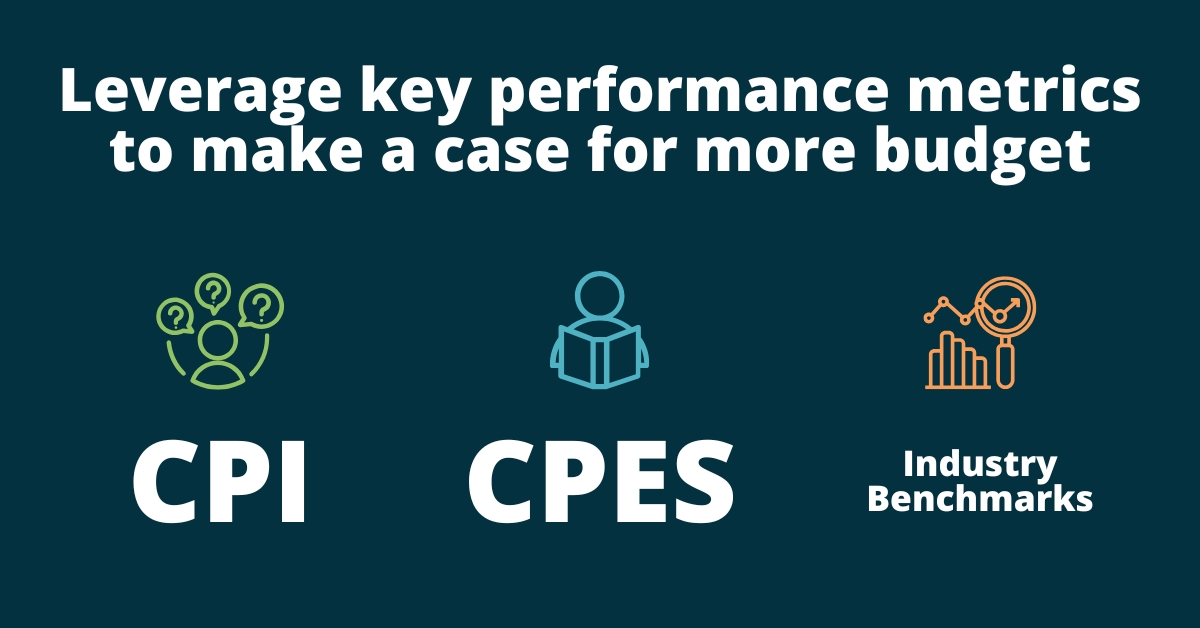
    A graphic explaining how to leverage KPMs to make a case for budget

    If leadership expects an increase in enrollment, marketing teams need the financial resources to support those goals. Leveraging valuable insights from key performance metrics can help you make a strong case for increasing your marketing budget to maximize impact.

    When asking stakeholders for more budget, it helps to show them how much your competitors are spending.

    Marketing budgets vary widely, but data from the 2022–2023 fiscal year provides a clear picture of industry benchmarks.

    Among professional and online education units:

    • 25% spent between $200,000 and $500,000 on marketing efforts
    • 23% spent $50,000 to $200,000 on marketing expenses
    • On average, professional and online education units spent $848,712

    Higher ed institutions increasingly prioritize digital technology to attract prospective students, with a significant portion of marketing spend on digital advertising.

    In the same fiscal year:

    • 40% of professional and online education units allocated $100,000 to $500,000 to digital advertising
    • 19% spent over $1 million on digital ad campaigns
    • The average digital ad spend was $800,970

    If you need more budget to drive better results, tracking key metrics like CPI can support your case to key stakeholders. For example, if your higher ed institution has a CPI of $100 for a specific program, you have the building blocks to make the case that an additional $10,000 investment could generate 100 more inquiries. By understanding your enrollment funnel, you can estimate how many of those inquiries will convert into enrolled students — providing leadership with a data-backed projection of revenue impact.

    7. Use a blend of agency and in-house support

    Balancing in-house and agency support is crucial for higher education marketing teams looking to maximize their impact. 

    Finding the right mix ensures that universities can optimize resources, effectively engage students, and improve overall marketing performance. 

    But how do you find that perfect balance for your higher ed institution?

    Start by asking:

    How many full-time employees work in our marketing department?

    A successful marketing strategy demands significant time, expertise, and resources.

    Smaller teams of 1-3 people are unlikely to have the time and skills required to handle marketing demands fully in-house. 

    4-5 member teams would be suited to do some aspects of marketing, like content writing and SEO-related website updates, while more complex tactics like strategy, off-site SEO, and evaluation of results would be better handled by agency. At this size of a team, a tight-knit partnership will drive strong results. 

    Looking at teams of 8-14 — this is where you can begin to take on more in-house, as long as you have a dedicated marketing strategist to plan, guide execution, and evaluate. With just one team member fully focused on strategy, an agency can back up your team with up-to-date expertise and insight through audits or consulting. 

    Large teams of 15 or more are likely well-equipped to handle marketing in-house, depending on what other priorities you have.

    What strategies does our university already have in place for SEO?

    Consider what tactics and work you already have in place for SEO. Is it a robust or piecemeal strategy? How often do you work on these tactics?

    Some questions to ask are:

    • Do you have identified target keywords for top programs?
    • Are you updating content with SEO goals in mind? 
    • Do you have a link-building strategy or are you just taking what comes naturally?
    • Are you using tools like Semrush or Moz and Google Search Console?
    • Does your team stay up to date on SEO trends and changes? For example, are you exploring and testing tactics for AI search?
    • Finally, are you diagnosing performance? 

    How strongly do you agree with this statement? 

    “My important programs or degrees show up in search results.”

    How well you rank today is a pretty good indicator of how well-equipped your team is to handle SEO internally. 

    If they are ranking well today, you may be set with your current strategy and team. 

    If they are not ranking well and driving traffic and quality leads, then you should consider an agency.

    Which capabilities exist on our team?

    The skills needed to conduct SEO are varied and not typically found in one person. For example, a team member may be great at writing content and PR outreach but may not have data analysis or technical SEO skills. 

    If you have all these skills in-house or can foster them, then you can set yourself up for SEO success internally:

    • SEO strategy development
    • Creating SEO-optimized content
    • Technical SEO expertise
    • Access to and knowledge of SEO tools
    • Website development and management
    • PR outreach for link-building
    • Data analysis

    If you can’t, relying on a credible agency gives you access to these capabilities immediately without having to recruit, retain, and train staff. 

    How much time does our team have available for our SEO priorities? 

    Managing SEO in-house demands significantly more time than working with an agency. 

    Successful in-house teams handle everything from keyword research and content creation to technical updates and performance monitoring. 

    So, how much time are we talking about?

    If your team has less than 8 hours/month, that’s about enough time to manage an agency partnership. 

    If they have 8-20 hours/month, they have time to do some SEO basics within typical marketing work.

    If they have 21-40 hours/month, they can be a little more strategic, do some basics, and spend some time monitoring results. They may also have some time to give tips to other team members on how to incorporate SEO into their work. 

    If they have over 40 hours/month to dedicate to SEO, they should be able to strategize, do some basics themselves, direct other team members, and evaluate results. 

    Ultimately, it’s up to you to consider whether your university has the internal DNA and capacity to succeed independently. If not, an agency will help shoulder the effort to meet your goals and drive consistent SEO performance.

    Search Influence’s SEO Quiz is designed to help you evaluate whether building an in-house team, outsourcing fully to an agency, or blending both approaches will best support your institution’s goals. By clarifying your staffing options in just a few minutes, the quiz enables smarter decisions that strengthen your SEO strategy and enhance student recruitment outcomes.

    Analyzing Effective Higher Education Marketing Strategies

    Palo Alto University increased monthly inquiries by 49%

    When Palo Alto University wanted to increase prospective student inquiries, they partnered with us to refine their digital marketing efforts and expand their reach.

    Initially, Palo Alto University ran Google, Facebook, and SEO campaigns, but their results fell short of their enrollment goals. Our team identified a key opportunity: Their budget was limiting audience reach, meaning they weren’t fully capitalizing on their potential student base. By implementing a strategic, multi-channel approach, we significantly boosted inquiries.

    We focused on:

    • Expanding campaign targeting to promote four key degree programs
    • Increasing investment in paid advertising to engage a broader target audience
    • Optimizing on-site content to improve organic search visibility
    • A/B testing refreshed messaging to better resonate with prospective students

    The results spoke for themselves. Within two quarters, monthly inquiries increased by 49%, exceeding their goal and reinforcing the power of a comprehensive higher education marketing strategy. 

    Tulane SoPA surpassed their inquiry goal by 58%

    For the Tulane School of Professional Advancement (SoPA), meeting enrollment goals meant more than just increasing inquiries — it required a strategic, data-driven approach to connect with the right prospective students at the right time.

    With the launch of three new programs, Tulane SoPA set a target of 500 inquiries per month and partnered with Search Influence to refine their marketing efforts. Recognizing that paid advertising would deliver the quickest impact, we optimized their campaigns for maximum efficiency while improving the overall student recruitment experience.

    To help Tulane SoPA reach their goal, we:

    • Designed a distinct creative concept with custom illustrations to strengthen brand identity
    • Enhanced landing pages to boost conversion rates and guide students through the enrollment process
    • Launched Facebook Lead Generation and Google Smart Display campaigns to increase engagement at multiple touchpoints
    • Expanded geographic targeting to reach a broader audience aligned with Tulane SoPA’s growth objectives

    The impact was immediate. Tulane SoPA exceeded their inquiry goal by 58%, with 80% of all inquiries driven by paid advertising. This success reinforced the value of a well-rounded digital marketing strategy in helping higher education institutions effectively engage students and convert interest into enrollment.

    Higher Education Marketing Strategies FAQs

    What are the best marketing strategies for higher education?

    A strong higher education marketing strategy starts with SEO, ensuring your programs appear early in a prospective student’s search journey. A well-executed SEO strategy drives long-term organic traffic and enhances visibility across digital marketing channels. 

    However, digital advertising is equally important for reaching the right students at the right time, providing immediate visibility, and amplifying organic efforts. 

    By combining SEO with targeted digital advertising, academic institutions can maximize engagement, increase inquiries, and drive more applications.

    How does a university increase its visibility?

    Universities attract students best by utilizing a mix of SEO and digital advertising.

    From optimizing for high-intent keywords and writing engaging blog posts to running targeted Google and social media advertising campaigns, these digital marketing strategies are some of the most efficient ways to attract prospective students. 

    What are the biggest marketing challenges for universities?

    The rise of AI Overviews and social search is changing how students find information, requiring universities to adapt their marketing strategies.

    Additionally, cookie deprecation and reduced tracking capabilities make it harder to measure campaign success across digital marketing channels. 

    To stay competitive, universities must refine their education marketing approach to navigate these evolving challenges.

    Optimize Your Higher Education Marketing Strategy With Search Influence

    Make every marketing dollar count with data-driven strategies designed to boost enrollment and engagement. 

    At Search Influence, we specialize in SEO, paid advertising, and analytics-backed marketing strategies tailored for higher education institutions. 

    Our advanced dashboards consolidate all your marketing metrics in one place, giving you the insights needed to refine your approach and maximize results. We help institutions align marketing efforts with enrollment goals to drive measurable success.

    Get exclusive insights into your higher ed marketing performance — download our Marketing Metrics Research Study today.

  • AI in Higher Education: UPCEA Conference Takeaways to Improve Your SEO Strategy

    AI In Higher Education: Search Influence Insights to Improve SEO Strategy

    This post was updated by Ren Horst on April 16, 2025 following this year’s conference. It was originally published on March 18, 2025.

    Key Insights

    • At the 2025 UPCEA Annual Conference, speakers emphasized that higher ed marketers need to adapt their strategies to keep up with changing search behaviors, rising student expectations, and evolving enrollment trends.
    • With more students relying on AI and social platforms to answer queries, strategic SEO keeps institutions searchable, relevant, and competitive.
    • Whether institutions decide to manage SEO in-house or work with an agency depends on the team’s size, skills, and available time, especially if SEO isn’t a core focus.
    • To create better student onboarding, institutions must use retention data to understand early disengagement and support lasting learner success.

    This past March, Search Influence headed to Denver, Colorado, for the 2025 UPCEA Annual Conference.

    Paula French (Director of Sales and Marketing), Jeanne Lobman (Director of Operations), and Will Scott (CEO and Co-Founder) hosted a booth and discussed the state of higher education marketing, with a focus on AI’s impact on SEO and student recruitment. 

    Paula also led two speaking sessions on emerging SEO trends, while Jeanne moderated a panel on using retention data to improve onboarding. Each presentation explored the most pressing marketing insights institutions need to stay ahead in 2025 and beyond.

    In case you missed it, here’s your recap of our high-impact sessions at the AI in higher education conference.

    “2025 Recruitment SEO Trends: Strategic Solutions to Emerging Challenges”

    Presenters: 

    • Paula French, Search Influence
    • Liz Turchin, University of Minnesota College of Continuing and Professional Studies

    During this roundtable session, Paula and Liz discussed how changing search behaviors are reshaping recruitment strategies in higher ed. With Google’s AI Overviews and social platforms playing a growing role in how students research institutions, many schools must rethink how (and where) they show up online.

    The conversational format allowed marketers to share challenges, exchange ideas, and dig into what’s actually working. Paula highlighted emerging SEO trends and shared guidance for leading internal conversations that help marketing teams adapt. 

    She also emphasized the importance of aligning SEO, paid search, and social efforts to increase visibility and keep prospective students engaged.

    To support continued SEO planning beyond the session, Paula introduced our SEO Workbook. This hands-on resource is designed to help higher ed teams assess their current strategy and prioritize tactics that support enrollment in today’s AI-influenced search world.

    “SEO: In-House or Outsource? That Is the Question.”

    Presenter: Paula French, Search Influence

    In this Industry Insights session, Paula addressed one of today’s most common challenges in higher ed marketing: deciding whether to manage SEO internally, bring in outside expertise, or go for a hybrid team

    As search trends continue to disrupt how prospects discover and evaluate colleges, SEO is no longer a “nice to have.” It’s foundational. Effective SEO ensures your content ranks well, nurtures interest, and guides students toward the next step.

    Paula explained why every marketing touchpoint — ads, social media, email, and conferences — ultimately leads prospects back to your website. If your site isn’t well-optimized, you risk losing them before they even make it into your funnel. 

    To help teams choose between an in-house, outsourced, or hybrid SEO team, Paula shared a straightforward framework for evaluating capacity, skill sets, and goals. The session challenged institutions to be realistic about their resources and commit to an approach that ensures SEO isn’t just happening but actually making an impact.

    Not sure which SEO staffing model fits your team best? Take our SEO Quiz for quick, personalized recommendations to guide your in-house vs. outsource decision.

    “Is It Enough? Using Retention Data to Inform New Student Onboarding Practices”

    Presenters: 

    • Jennifer Murray, Fitchburg State University
    • Peter August, Fitchburg State University

    Moderator: Jeanne Lobman, Search Influence

    With more mid-career professionals entering graduate and continuing education programs, the question isn’t just how to recruit them, but how to truly support them from day one. 

    This session offered actionable ideas for using data to improve communication, set clearer expectations, and create more effective onboarding experiences that support engagement and retention.

    The discussion asked institutions to take a hard look at their onboarding processes: Are they assuming too much about new students’ familiarity with academic expectations, technology platforms, and graduate-level demands? Are current onboarding practices truly preparing students for success?

    With our Director of Operations, Jeanne, leading the discussion, the conversation focused on how retention data can, and should, inform onboarding strategies. The presenters emphasized that while retention is often viewed as a long-term outcome, it begins with a student’s earliest interactions. How well they’re welcomed, informed, and supported during onboarding directly impacts whether they stay and succeed.

    Top FAQs from the Higher Education Conference

    How will AI influence higher ed in 2025?

    AI is quickly changing how prospective students search for college information. Tools like Google’s AI Overviews (AIOs), Perplexity, Gemini, and ChatGPT are becoming common starting points for researching programs, requirements, and outcomes.

    These platforms generate quick summaries by pulling from multiple sources to answer user questions directly. While traditional rankings still matter, institutions may see reduced click-through rates if key information surfaces before a user ever reaches the organic listings. While this shift introduces new challenges, it offers new opportunities to stand out.

    AIOs and other AI search platforms often cite the sources they pull from. By creating clear, well-structured content that directly addresses common student questions, your institution can increase its chances of being referenced. Optimizing for AI search builds on your existing SEO efforts and positions your content to appear where students now begin their decision-making process.

    Is traditional SEO still important in the age of AI?

    Yes, traditional SEO is still important, and it also plays a direct role in how your content performs in AI-driven search experiences.

    AI platforms and tools don’t operate in a vacuum — they pull from existing content across the web and often favor sources that already rank well in organic search. In other words, the stronger your SEO, the more likely your content is to be cited in AI-generated summaries.

    Many strategies that support strong SEO also position your content for AI visibility. That includes writing clear, structured content, using descriptive headers and FAQs, and following E-E-A-T best practices. Optimizing for entities — such as specific programs, degrees, and locations — also helps AI tools understand how your content aligns with user queries.

    When paired with technical fundamentals like schema markup and clean metadata, these tactics help ensure your content remains visible across both traditional and AI-powered search experiences.

    How do I decide between in-house vs. agency SEO?

    The right approach depends on your team’s size, skill set, available time, and current SEO strategy’s performance.

    In her Industry Insights session at the AI higher education conference, Paula shared five key factors to help you evaluate the best approach for your institution:

    • Team size: Small teams often need full external support, mid-sized teams may benefit from a hybrid model, and larger teams with dedicated SEO roles can often manage more internally.
    • Search visibility: If your top programs don’t rank, or you’re unsure, that’s a sign your current approach needs attention.
    • What’s in place: Consider whether you have key SEO elements like target keywords, specialized tools, updated content, and performance tracking.
    • Specialized skills: Strong SEO requires technical, content, and analytical expertise, not typically found in just one role.
    • Time investment: In-house SEO takes time. Without 40 or more hours of internal capacity available per month, it may be more efficient to outsource.

    Still unsure? Our 5-question SEO Quiz takes the guesswork out of the decision. In just a few minutes, you’ll get personalized insights to help you optimize your resources and choose the path that best supports your university’s goals.

    What is a social search marketing strategy?

    A social search marketing strategy involves optimizing content to appear in search results on social platforms like TikTok, Instagram, and YouTube.

    An increasing number of prospects use these platforms as search engines, looking up programs, career advice, and campus experiences directly through social apps rather than Google. That shift makes it all the more important to create content that’s discoverable beyond traditional search.

    At the same time, social media content can also appear in Google search results, giving your institution even more visibility across platforms.

    Some tips for optimizing for social search include:

    • Creating engaging, keyword-friendly content native to each platform
    • Repurposing existing site content into short, shareable posts
    • Prioritizing video content, especially formats like Reels, TikToks, and YouTube Shorts

    The goal is to meet students where they’re searching and make sure your content is part of what they find.

    How are adult and online student recruitment strategies different than marketing to college-aged prospects?

    Adult and online learners often need more flexibility, clearer communication, and stronger onboarding support than traditional college-aged students. 

    Unlike traditional students, they’re often managing full-time jobs, families, and other responsibilities. Many are returning to school after time away, which means onboarding plays a critical role in helping them navigate systems, build confidence, and stay engaged early on.

    This focus has become even more critical as the demographic cliff reduces the number of college-aged applicants. To attract and retain adult learners, institutions must communicate clearly, offer accessible support services, and deliver learning options that fit their lives.

    Retention data can reveal where existing students struggle or disengage, whether due to unclear expectations, lack of support, or program inflexibility. By identifying those trends, colleges can adjust their recruitment messaging and onboarding strategies to better meet the needs of adult learners from the start.

    Build a Stronger Higher Ed Marketing Strategy to Drive Enrollment

    The 2025 UPCEA Conference highlighted just how quickly student behavior and the search environment are evolving. To stay competitive, institutions need marketing strategies that align with how today’s prospects search, engage, and make decisions.

    At Search Influence, we work with colleges and universities nationwide to navigate this shift with strategies rooted in data, clarity, and long-term impact. A great starting point is our SEO Roadmap — an actionable plan designed to help you strengthen search performance for one of your most important academic programs.

    The roadmap delivers tailored recommendations for traditional search, AI-generated results, and emerging social search behaviors. It’s a strategic resource built to elevate your authority and visibility, refine your content, and drive meaningful enrollment outcomes. 

    See how the SEO Roadmap can help focus your efforts and reach more students today.

  • Paula French Talks SEO for Higher Education on The Enrollment Clinic Podcast

    Paula French Talks SEO for Higher Education on The Enrollment Clinic Podcast

    Higher education SEO can drive enrollment growth at your university.

    Listen to Search Influence’s Director of Sales and Marketing, Paula French, on The Enrollment Clinic Podcast to learn how.

    In her episode,“Higher Ed SEO & Digital Strategy: What Universities Get Wrong (and How to Fix It)”, Paula covers:

    • Why 51% of universities lack an SEO strategy (despite 84% of leaders saying it’s crucial)
    • The biggest SEO mistakes in higher education and how to fix them
    • How prospective students search for online and professional education programs
    • Google, AI, and the future of university search marketing
    • The role of SEO in university enrollment strategy

    Below is an overview of Paula’s actionable SEO strategies that will help your university increase visibility, boost applications, and optimize digital recruitment.

    About The Enrollment Clinic Podcast 

    The Enrollment Clinic Podcast explores the challenges and opportunities in higher education admissions, marketing, and enrollment management. 

    Hosted by industry professional Gjergj Dollani, the podcast features discussions with higher ed leaders, marketing experts, and admissions professionals from universities and organizations worldwide. 

    Recent episodes covered topics like international student recruitment, the impact of generational shifts on higher education, and strategies for optimizing enrollment efforts. 

    By bringing together insights from experienced professionals, the podcast provides valuable perspectives for those working to attract and engage students.

    An Overview of Paula’s Enrollment Clinic Episode 

    On The Enrollment Clinic Podcast, Paula shared her expertise on higher education SEO, discussing the challenges universities face and the opportunities they may miss regarding organic search. 

    She highlighted key findings from Search Influence and UPCEA’s Higher Ed SEO Research Study, providing valuable insights into the current state of SEO in higher education marketing.

    The importance of SEO in higher education

    Paula emphasized how search engines significantly influence student recruitment, with 67% of prospective students beginning their education research online. Despite this, many institutions focus heavily on paid digital advertising — spending an average of $800,000 per year — without a strong organic search strategy. 

    She pointed out that higher education SEO is about ensuring the right students find the right programs at the right time, not just t ranking on Google.

    Many PCO units lack a clear SEO strategy

    Online and professional education is widely recognized as a growing area in higher ed, but Paula revealed that 51% of institutions lack an established SEO strategy. 

    While universities engage in activities that resemble SEO — such as publishing content and public relations — they often fail to approach these efforts with a strategic, long-term SEO mindset. 

    How AI is changing SEO

    Paula explored the impact of AI on SEO, explaining how large language models and AI-driven search features influence content creation and discoverability. 

    She noted that AI-generated content often favors clear, conversational language, encouraging marketers to simplify their messaging for better engagement. 

    The importance of backlinks and SEO authority

    Paula also discussed one critical aspect of higher education SEO: the role of backlinks in establishing authority. She explained that backlinks signal credibility to search engines, much like citations in academic research. 

    However, many universities struggle to secure these links strategically, limiting their potential to rank for key search terms.

    Learn More About SEO for Higher Education With Search Influence

    This blog only scratches the surface of Paula’s insights on The Enrollment Clinic Podcast

    To see the full picture of how your university can improve its SEO strategy, listen to the podcast episode and hear Paula’s expert take on the challenges and opportunities in higher education SEO.

    Download Search Influence and UPCEA’s Higher Ed SEO Research Study for a deeper dive into the data behind these insights. 

    This comprehensive, three-part study examines:

    • How institutional and marketing leaders perceive SEO
    • The SEO readiness of professional and online education units
    • Actionable opportunities to improve search visibility

    Download the study today and start making search work for you.

  • Higher Education SEO Trends in 2025: How to Compete

    Higher Education SEO Trends in 2025: How to Compete

    Key Insights

    • AI-Driven Search Requires Adaptation

      Emerging technologies like Google’s AI Overviews are reshaping search visibility. Universities must optimize content for AI retrieval, emphasizing depth, authority, and structured data to stay competitive.

    • Social Search Is Reshaping Discovery

      Younger audiences increasingly use social platforms for search. Universities must integrate SEO strategies with social media, prioritizing engaging, visual content to enhance discoverability.

    • SEO Roadmap Ensures Long-Term Success

      A structured SEO roadmap helps universities systematically improve rankings. Key actions—keyword research, content updates, and link-building—align institutions with evolving search algorithms.

    SEO IS THE FOUNDATION OF YOUR MARKETING STRATEGY

    Why Is Higher Education SEO Important?

    Higher education SEO ensures universities stay visible in search results, attracting prospective students.

    With students relying on search to research programs, strong SEO improves rankings, enhances discoverability, and increases enrollment opportunities. Optimizing for AI search, social search, and evolving algorithms is critical for maintaining a competitive edge.

    Yet, according to our recent Higher Ed SEO Research Study developed with UPCEA, 51% of universities lack an established SEO plan.

    This oversight in strategy puts institutions at a disadvantage when it comes to improving search engine rankings and standing out in a crowded market.

    For universities ready for export guidance for 2025, an SEO roadmap serves as a crucial starting point to bridge this gap and develop a program-focused SEO strategy that incorporates upcoming trends.

    Search Influence’s SEO roadmap provides a customized guide for one key academic program including recommendations for:

    • Keyword strategy
    • Content strategy
    • Link building
    • Technical SEO optimizations

    But before you climb the Everest that is search engine visibility in 2025, you should know what to expect.

    In this blog, we’ll explore the key SEO trends impacting higher education and discuss how universities can develop a strategy to improve their search engine rankings and connect with prospective students.

    SEO Higher Education Trends in 2025

    Small animated rocket flying away from 3D computer browser windows, charts, and data

    Impact of AI Overviews on higher ed SEO

    As search continues to evolve, higher education digital marketers must leverage generative engine optimization (GEO) to reach their target audiences. Understanding AI Overviews is the first step in mastering this new form of search.

    In May 2024, Google introduced AI Overviews as part of its Search Generative Experience at Google I/O. This new feature leverages Google’s generative AI model, Gemini, to provide users with quick answers to their queries. AI Overviews generate brief snippets based on Google AI’s understanding of the question and relevant content from across the web.

    Alongside the generated answer, Google includes links to resources, allowing users to dive deeper into the topic if they choose.

    Possible challenges of AI Overviews

    • Informational content pushed down: Blog posts or general content on university websites are often pushed lower in search results by AI-generated responses, impacting traffic that universities previously earned from organic search results..
    • Limited visibility for non-featured websites: Educational institutions not featured in AI Overviews may struggle to gain online visibility, even if they rank well on traditional search engine results pages (SERPs).
    • Lack of content attribution: AI Overviews pull content from various sources without clear attribution, making it harder for universities to gain proper recognition or build brand awareness.
    • Reduced prominence of featured snippets: As AI Overviews take up more space in search results, traditional featured snippets may become less visible, reducing visibility for universities who worked hard to gain this placement.

    Strategies to overcome AI Overview challenges

    • Create detailed, well-researched content: AI Overviews often provide brief, surface-level answers. Universities can encourage users to click through and engage with the full material by developing in-depth content that offers more comprehensive insights.
    • Target long-tail keywords and specific queries: Focus on relevant keywords and highly specific searches that AI Overviews do not fully address. These keywords can help drive organic traffic from users seeking more detailed information, particularly for degree programs and specialized content.
    • Offer interactive content and direct user engagement: AI Overviews can’t replicate the value of user-driven experiences. By providing downloadable resources, webinars, or interactive tools, universities can offer unique value that sets them apart and builds stronger connections with prospective students.

    How social search is changing SEO for universities

    Social search is rapidly gaining traction, particularly among Gen Z and Millennials, who increasingly use social media platforms to find information, discover products, and learn about services. This shift away from traditional search engines like Google is transforming how universities must approach recruitment SEO. Social search leverages the dynamic, interactive nature of platforms like TikTok, Instagram, and YouTube, where user-generated content (UGC) and real-time interactions play a significant role in how information is consumed and shared.

    Beyond social platforms becoming an alternative to traditional search, social content itself has started to rank higher in Google search results. This means that what universities post on social platforms impacts their visibility on social media and plays a crucial role in their overall SEO strategy.

    Possible challenges of social search for universities

    • Changing search habits: As Gen Z and Millennials shift towards social search, traditional SEO tactics designed for search engines like Google may not be as effective in capturing their attention. As social search continues to grow, higher ed websites must adapt to maintain visibility.
    • Limited control over rankings: Unlike traditional search engines, social search algorithms prioritize engagement over keyword optimization, making it harder for universities to rank higher based solely on incorporating relevant keywords. Social platforms are unpredictable, with ever-changing algorithms that often favor highly engaging content like likes, shares, and comments.
    • Engagement-driven visibility: Social search tends to favor content that generates high engagement, which can be difficult for universities to achieve organically without paid promotions. Smaller schools or institutions with less interactive content may find it challenging to compete with more popular or active brands.

    Strategies to overcome social search challenges

    • Repurpose content for social media: Universities can repurpose existing website content into highly shareable formats such as videos, infographics, or student testimonials on social media. This helps maintain a consistent message across platforms while catering to the content preferences of younger audiences.
    • Focus on visual content: Social platforms like Instagram and TikTok prioritize visual content, particularly videos. Incorporating multimedia into your digital marketing strategy is essential for keeping content relevant and visible for longer.
    • Boost engagement: To rank higher on social platforms —where algorithms prioritize engagement — universities need to focus on creating content that encourages interaction. Developing content that sparks discussions and encourages likes, shares, and comments can increase visibility in social search algorithms. For example, interactive posts like live Q&A sessions can help universities capture more organic search traffic from social platforms.

    Optimize “People Also Ask” to answer prospective students’ queries

    The “People Also Ask” (PAA) section in Google search results displays a list of questions related to the user’s original query. Each question can be expanded to reveal a brief answer, typically pulled from relevant websites. While PAA helps users quickly find information, it presents both challenges and opportunities for universities looking to attract prospective students through SEO for higher education.

    Competition for visibility is fierce, as the PAA box often pushes traditional organic search results further down the page. Even websites ranking on the first page may struggle to gain traffic. That’s why optimizing for PAA is critical. Prospective students increasingly rely on search engines to discover university programs, and the PAA box provides a valuable way to capture their attention.

    The good news is that structuring your content to answer PAA questions clearly and concisely also supports AI Overview visibility. This dynamic approach ensures that your educational website stays relevant in search results.

    Possible challenges of People Also Ask

    • Click-through rate (CTR) impact: Users may find their answers directly in the PAA section without needing to click through to a website, potentially lowering CTR even for high-ranking pages.
    • Answer quality control: Google pulls content for PAA from various sources, meaning the quality or accuracy of the answers won’t always reflect the expertise of your site, even if you provide more in-depth information.
    • Unpredictability of ranking in PAA: Google’s algorithm dynamically chooses which content to feature in PAA, making it difficult to guarantee your content will appear in this section.
    • Content cannibalization: If your content ranks both organically and in the PAA box, users might click on the PAA result, which offers less interaction and brand recognition than a direct visit to your site.

    Strategies and insights to overcome People Also Ask challenges

    • Provide concise answers to common questions: To increase the chances of appearing in the PAA section, create clear, concise answers within your content. Use structured headings and bulleted lists to make it easier for search engines to identify and feature your content.
    • Focus on long-tail queries: Target niche topics and long-tail keywords that have less competition. This can increase the likelihood of your content being featured in the PAA for specific questions related to your degree programs or student services.
      Build content around your expertise: Enhance the authority of your answers by including references to credible sources, expert quotes, and in-depth insights. This builds trustworthiness and improves your chances of being featured in PAA.
    • Use structured data: Incorporate technical SEO strategies such as structured data to help search engines better understand your content and increase its chances of appearing in the PAA box.

    Utilize video SEO to boost engagement with your audience

    Is video SEO the future of search?

    According to Hubspot, 96% of people say they watch explainer videos to learn more about a product.

    Let that sink in — 96% of people watch videos to learn more about a product!

    This underscores the importance for higher education institutions to create engaging video content.

    Video SEO involves optimizing your video content to rank higher in both search engine results and video platforms like YouTube and TikTok. This process includes targeting relevant keywords, optimizing video descriptions, transcribing videos, and creating high-quality content that engages viewers. Video SEO aims to increase visibility, drive organic search traffic, and boost audience engagement — all of which can improve your institution’s brand awareness and conversions.

    Not only does video SEO help with audience engagement, but it also contributes to improving your website’s search rankings, benefiting your overall SEO strategy.

    Possible challenges of video SEO

    • Competition: Platforms like YouTube and TikTok are highly competitive, with millions of videos uploaded daily, making it difficult for your content to stand out.
    • Time and resources: Creating and optimizing video content requires significant time, effort, and resources, more so than text-based content.
    • Technical SEO elements: Ensuring proper video metadata, schema markup, and fast loading speeds can be challenging, particularly when embedding videos on your site.
      User behavior: While video can be engaging, some users may prefer quick text results.

    Strategies and insights to overcome video SEO challenges

    • Create short-form videos: Whenever possible, create short, TikTok-style videos to answer users’ questions quickly. While longer videos can be valuable, short-form content is especially effective in the era of social search.
    • Keyword research: Focus on long-tail keywords specific to your audience’s search intent. This can help you target less competitive niches in the higher education space and boost your video content’s visibility.
    • Use engaging thumbnails and titles: Eye-catching thumbnails and compelling, keyword-rich titles can increase your click-through rates and overall engagement.
    • Include video transcripts: Transcripts make your content more accessible and provide search engines with additional text to crawl, improving your video’s SEO performance AND your website’s SEO. Transcribing your videos on your website also ensures you reach potential searchers who prefer reading content over watching a video.
    • Encourage engagement signals: Encourage viewers to like, share, comment, and subscribe. These engagement signals indicate to search engines that your content is valuable, increasing its chances of ranking higher.
    • Implement schema markup: Use proper schema markup to help search engines better understand your video content. This increases the likelihood of your video being featured in search results, especially in video carousels.
    • Consistent content creation: Regularly upload videos and promote them across multiple platforms, including your website. This consistency keeps your institution relevant and boosts your SEO efforts over the long term.

    Even universities need to prove E-E-A-T

    With AI Overviews as a dominant feature in search results, universities must focus more on creating authoritative, trustworthy content. Luckily, the search engine Goliath has laid out criteria for SEOs to do exactly that: Google E-E-A-T (Experience, Expertise, Authoritativeness, and Trustworthiness).

    These are the key factors Google uses when human reviewers evaluate the quality of content, especially for websites dealing with sensitive topics like higher education.

    E-E-A-T ensures that your institution’s content is accurate, well-researched, and delivered by credible sources — a must for higher education websites looking to thrive in today’s search engine results pages

    Leveraging authority and trustworthiness online is essential for universities to attract prospective students and build partnerships with academic and research institutions.

    Possible challenges of establishing E-E-A-T

    • Maintaining consistency: With various contributors producing content, ensuring that all pages across the university’s website meet E-E-A-T standards can be challenging.
    • Building authority: Smaller universities or newer programs often find it difficult to compete with established institutions in search rankings.
    • User trust: Consistently delivering accurate and up-to-date information is critical. Any outdated or incorrect content can damage the trustworthiness of the university.
    • Dynamic content: Frequent changes to curricula, research publications, and academic programs can make maintaining content relevance and authority resource-intensive.

    Strategies and insights to overcome E-E-A-T challenges

    • Highlight expertise: Feature content authored by faculty members, ensuring their credentials, academic achievements, and research experience are clearly showcased. Author bios and academic qualifications reinforce the expertise of your institution.
    • Enhance trustworthiness: Include student testimonials, case studies, and partnerships with respected organizations to build trust with prospective students and academic partners.
    • Content review process: Implement a rigorous content review and update schedule to ensure all information remains accurate, relevant, and aligned with the institution’s authority in the field.
    • Leverage user-generated content: Encourage reviews and success stories from current students and alumni. This content demonstrates real-world experience and fosters trust with your target audience.
    • Structured data and transparency: Use structured data to help search engine crawlers better understand the content on your site. Transparency in policies, admissions, and course details will enhance trust and improve your organic traffic.
    • Third-party mentions: Gaining citations or backlinks from respected educational sources, government websites, or reputable media outlets can help boost your university’s authority in search rankings.

    How an SEO Roadmap Can Help You Stay Ahead of SEO Trends

    In the ever-evolving world of higher education marketing, staying ahead of the latest trends is critical for attracting more prospective students.

    But how do you know where to start for an institution that’s attracting thousands of students to sometimes hundreds of programs?

    An SEO roadmap offers a strategic guide to ensure your university’s website remains visible and effective in search engine results.

    Here’s how an SEO roadmap will help fast-track your enrollment journey:

    Optimize for student search behavior

    An SEO roadmap provides valuable insights into how prospective students are searching for degree programs and other academic offerings. By understanding the keywords and phrases potential students use, your institution can adapt content to match their queries more effectively, helping you connect with a broader audience of prospective students.

    Adapt to algorithm changes

    Google’s search algorithms are constantly changing, which can impact your university’s website performance. An SEO roadmap ensures you stay on top of these changes by addressing updates like core algorithm shifts, mobile-first indexing, and search ranking signals. This helps your site maintain strong visibility in organic search results, keeping your content in front of more potential students.

    Stay ahead of emerging trends

    An effective SEO roadmap also accounts for emerging trends in the digital landscape, such as voice search, mobile-first indexing, and AI-generated results. These trends are crucial for reaching tech-savvy students who rely on the latest technology to find educational institutions. By adapting your SEO strategy to incorporate these changes, your university will stay competitive and relevant.

    Improve your content strategy

    An SEO roadmap offers actionable insights into what content updates your website needs and highlights new topics to address. It also identifies new types of content — such as videos, infographics, or interactive tools — that will help you engage your audience more effectively. This ensures your content marketing strategy aligns with both search engine algorithms and student interests, driving more organic traffic to your site.

    Gain authority through link building

    Building authority is key to ranking higher in search results, and an SEO roadmap helps identify valuable link-building opportunities. You’ll learn which websites your program should be featured on to gain credibility and boost your search rankings. Additionally, internal links can enhance the user experience and improve your site’s functionality, leading to better SEO performance.

    Stay Ahead of the Latest SEO Trends With Search Influence

    A screenshot of Google Analytics, showing 102 users for an unknown site in the last 30 minutes

    Uncover new opportunities to improve your educational website’s visibility and performance with an SEO roadmap tailored to your institution’s needs.

    At Search Influence, we provide actionable recommendations that align with the latest SEO for higher education strategies, ensuring your institution remains competitive in search results.

    Our team of SEO experts monitors evolving search engine trends and algorithm changes, so you feel confident that your strategy is up-to-date. With nearly two decades of experience, we understand the unique challenges faced by higher education institutions, and our SEO roadmap will help you capture the right search intent, increase rankings, and boost traffic.

    Looking for even more higher ed marketing insights?

    Don’t miss my presentations at the 2024 UPCEA MEMS conference in Philadelphia this December.

    My session, “Visibility is Vital: Maximize Enrollment by Tracking Marketing Metrics,” presented alongside Bruce Etter of UPCEA, will give valuable insights into which marketing metrics matter the most and how to use those metrics to optimize campaigns, maximize budget allocation, and improve conversions.

    I will also be presenting a 10-minute session “Practical Magic: How to Navigate 2025 SEO Trends” that will take a more in-depth look at all the higher education SEO trends covered in this blog.

    Contact our team today to learn more about all our digital marketing services.


    Images

    Unsplash and Unsplash

  • AI in Higher Education: Insights From Paula French on the Filling Seats Podcast

    AI in Higher Education: Insights From Paula French on the Filling Seats Podcast header graphic

    Artificial intelligence is reshaping the way students search for and engage with higher education institutions. From AI-generated search results to evolving SEO strategies, higher ed marketers must stay ahead of these changes to ensure their programs remain visible and competitive.

    That’s why Filling Seats, a podcast dedicated to helping higher ed professionals attract and enroll more students, invited Search Influence Director of Sales and Marketing Paula French to share her expertise. 

    In AI’s Impact on Search and Higher Ed, Paula discussed the rise of AI in search, what it means for higher education SEO, and what institutions can do to adapt.

    Follow along as we break down key takeaways from Paula’s conversation and how your institution can navigate AI’s growing influence on search and student recruitment.

    About the Filling Seats Podcast

    Hosted by Jonathan Clues, the Filling Seats podcast is a go-to resource for higher education professionals looking to grow, shape, and sustain enrollment at colleges and universities. 

    Each episode features conversations with enrollment marketers, thought leaders, and edtech innovators, offering firsthand insights into what’s working in student recruitment today.

    Past guests have included Dr. Carey Dukes from North Greenville University, Amber Fitzgerald from Suffolk University, and Jonathan Clues from StudentBridge. 

    By sharing real-world strategies and success stories, Filling Seats equips educators with the knowledge they need to keep up with the evolving enrollment landscape with confidence.

    Paula on the Impact of AI in Higher Education 

    'As search evolves, one thing stays true: give people the information they're looking for, no matter how they find it - whether through Google, social media, or AI-driven search' - Paula French, Search Influence

    Artificial intelligence is changing how students search for and engage with higher education institutions.

    Here are key insights from Paula’s appearance on the Filling Seats podcast to help you navigate this higher education SEO trend.

    The rise of AI-powered search

    In May 2024, Google introduced AI Overviews as part of its Search Generative Experience (SGE). This feature, powered by Google’s Gemini AI model, generates quick, AI-written snippets that appear at the top of the search engine results page (SERP).

    While these overviews offer users immediate answers, they present new challenges for universities: Organic search results appear lower down the page, leading to universities receiving fewer organic clicks to their websites.

    When AI Overviews are present, click-through rates (CTR) drop significantly:

    • No AI Overview: CTR is 2.94%
    • With AI Overview: CTR plummets to 0.84%

    For higher ed marketers, this means traditional SEO tactics must evolve to ensure university content remains visible and engaging, and is optimized to appear in AI-driven search results.

    The rise of social search & AI tools

    AI Overviews aren’t the only thing disrupting traditional search.

    Social search is gaining momentum, particularly among Gen Z and Millennials, who use platforms like TikTok and Instagram as search engines. Instead of relying on Google, many prospective students turn to social media for recommendations, reviews, and insights about universities.

    This shift is significant — Google now ranks social media content in search results, further blurring the line between traditional and social search. Universities that don’t address social search as part of their marketing strategy are missing out on potential students.

    Universities that create high-quality, engaging social content are more likely to appear in both social media searches and Google results pages, giving them an additional opportunity to connect with prospective students.

    Adapting to a changing higher ed SEO landscape

    So, what can universities do to adapt to AI’s growing role in search and recruitment?

    Paula shared these essential strategies:

    • Optimize for AI-Powered SERPs: Understand which keywords trigger AI Overviews and adjust content strategies accordingly. Informational intent keywords, such as admissions, online degree programs, and scholarships, are most likely to generate AI summaries.
    • Double Down on In-Depth, Engaging Content: AI Overviews scrape the web for information, often summarizing surface-level content. Universities can stand out by providing deep, engaging resources that go beyond what AI can summarize.
    • Leverage Social Search: With more students searching directly on TikTok, Instagram, and other platforms, higher ed institutions need a stronger social presence to engage students where they are already searching.

    Adapt to AI in Higher Education With Search Influence

    There’s no denying it — AI is changing the game. 

    At Search Influence, we help higher ed marketers navigate these changes and build SEO strategies that boost visibility in traditional, AI, and social search.

    Listen to Paula’s full Filling Seats podcast episode to gain even more in-depth insights into AI for higher education.

    Ready to strengthen your AI SEO strategy? Contact Search Influence to learn more about our SEO expertise and commitment to evolving with the industry.

  • Learn About Key Higher Education Marketing Metrics From Paula French’s UPCEA Blog

    Learn about Key Higher Education Marketing Metrics from Paula Frenh's UPCEA Blog

    Search Influence’s Director of Sales and Marketing Paula French recently wrote a guest blog post for UPCEA titled “How Higher Education Marketing Metrics Help You Boost Enrollment.”

    While this is Paula’s first guest blog post for UPCEA, she is a regular speaker at UPCEA conferences and our joint webinars.

    As with her speaking appearances, Paula’s UPCEA blog is filled with higher education marketing insights to help universities see real-world results.

    An Overview of Paula French’s UPCEA Blog Post

    In her guest post for UPCEA, Paula addresses the growing challenges higher education institutions face, particularly the shrinking demand for traditional undergraduate degrees.

    She highlights a key opportunity to boost enrollment: focusing on adult learners — students aged 25 and older — who prioritize career advancement, flexibility, and program quality.

    To successfully reach this audience, Paula emphasizes the importance of understanding marketing benchmarks in higher education, specifically two critical metrics: cost per inquiry (CPI) and cost per enrolled student.

    Paula’s blog underscores that tracking CPI helps institutions optimize their budgets by revealing which of their campaigns best generate inquiries. Additionally, monitoring the cost per enrolled student provides a more comprehensive view of how efficiently marketing efforts convert interest into actual enrollments.

    By consistently tracking these higher education digital marketing benchmarks, universities will make smarter, data-driven decisions that lead to more sustainable growth.

    To dive deeper into these strategies, download the 2024 Higher Education Marketing Metrics Research Study Search Influence created in collaboration with UPCEA.
    Higher Ed Marketing Metrics Research Study 

    The Search Influence x UPCEA Partnership

    As an UPCEA Platinum Partner, Search Influence helps higher education institutions learn how to measure marketing success.

    This partnership focuses on providing valuable insights through joint research, including our recent Higher Education Marketing Metrics Research Study and our 2023 Higher Ed SEO Research Study.

    Together with UPCEA, we explore the state of higher education digital marketing, offering institutions industry insights and data-driven strategies for optimizing their marketing efforts.
    In addition to research, Search Influence and UPCEA collaborate on webinars to educate universities on enhancing their SEO and paid ad strategies.

    Learn More About Higher Education Marketing Metrics

    How Higher Education Metrics Help You Boost Enrollment

    Read Paula French’s full blog post on UPCEA’s website for expert insights into tracking the higher education marketing metrics that matter most.

    Find even more higher education marketing insights in our past UPCEA guest blog posts written by our Director of Account Management Alison Zeringue, and CEO & Co-Founder Will Scott.

    Whether you’re looking to refine your SEO strategies or optimize your paid advertising, Search Influence is here to help.

    Contact us today to learn how we can help your institution achieve sustainable growth through data-driven marketing strategies.