Tag: higher education SEO

  • AI SEO for Higher Education: How to Get Your Institution Recommended by ChatGPT, Perplexity, and AI Search

    AI SEO for Higher Education: How to Get Your Institution Recommended by ChatGPT, Perplexity, and AI Search

    Half of prospective students now use AI search tools weekly to research programs. If your institution isn’t showing up in ChatGPT, Claude, Perplexity, or Google AI Overviews, you’re invisible to half your audience. In 2026, success is measured by AI citations and brand mentions within generative summaries, not just clicks. This guide covers what actually works for AI search visibility, based on testing, not theory. (Data source: UPCEA/Search Influence 2025 AI Search in Higher Education study)

    The Shift in Student Search You Can’t Ignore

    Half of prospective students now use AI-powered search tools at least weekly, and 79% read Google’s AI Overviews before clicking any result. That’s according to the 2025 AI Search in Higher Education study by UPCEA and Search Influence, which surveyed 760 adults actively researching programs.
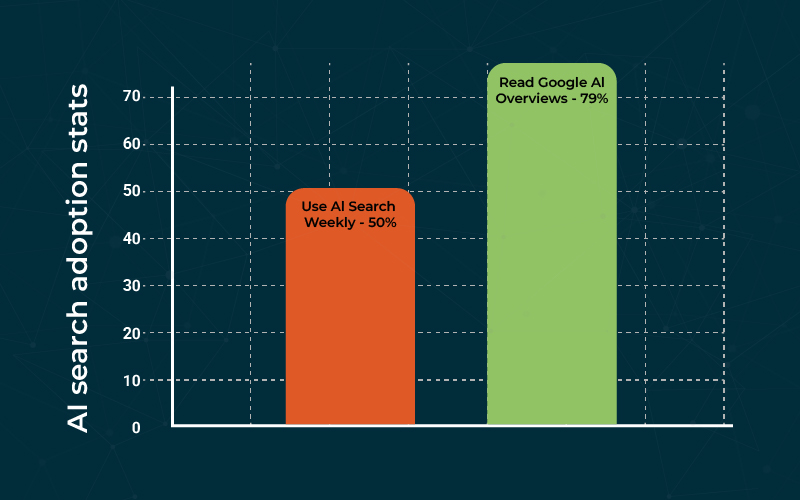
    Source: UPCEA/Search Influence AI Search in Higher Education Study, 2025

    While your team optimizes for Google rankings, half of your prospective students are also asking ChatGPT:

    • “What are the best nursing programs near me?”
    • “Which universities have strong data science programs?”
    • “Should I go to [Your University] or [Competitor]?”

    The uncomfortable truth: traditional SEO rankings don’t automatically translate to AI search results. Your brand is no longer just what you say about yourself, or even what others say about you. It’s what AI believes about you and shares with millions of prospective students.

    I’ve been tracking this space since late 2022. Higher education institutions with strong Google rankings often get completely left out of AI-driven search results. While smaller schools with better-structured content show up consistently.

    Traditional search engines still drive most organic traffic. That’s not changing soon. But AI search is a new channel growing fast, and it’s where a third of your prospective students are already researching. The catch: AI-generated search results often summarize information without requiring users to click through, which means even sites with strong search engine optimization can see declining traffic from AI-driven queries.

    The universities that appear in AI-driven search results now will have a head start that the rest can’t easily catch up to.

    What actually works?

    How AI “Decides” What to Recommend

    To make these SEO strategies work, you need to understand how these systems operate. It’s different from traditional search engines.

    Large language models like ChatGPT, Claude, and Perplexity don’t crawl your site in real-time and rank web pages. They operate on different principles:

    1. They draw from training data

    Content that existed when the model was trained becomes part of its “knowledge.” This is why outdated information persists. The model learned it months or years ago.

    1. They reference recent web crawls

    Some models (like Perplexity and ChatGPT with browsing enabled) pull fresh content. But the freshness varies by platform and query type.

    1. They cite authoritative sources

    AI systems prefer content that appears to know what it’s talking about. They’re pattern-matching on what “good sources” look like — structure, depth, and credibility signals.

    1. They match search intent, not just keywords

    AI understands concepts and entities through natural language processing, not keyword matching. You don’t need “best MBA program for working professionals near Chicago” repeated verbatim. You need content that actually covers the topic in depth and with specificity. Traditional search engines match keywords; AI systems match user intent and search intent. This is why traditional keyword research alone isn’t enough anymore. You need to understand what prospective students actually want to know, not just what phrases they type.

    1. They prioritize E-E-A-T signals

    AI systems, like traditional search engines, favor content that demonstrates Expertise, Experience, Authoritativeness, and Trustworthiness. Faculty credentials, institutional accreditation, specific outcomes data, and cited sources all signal that your content is worth recommending. Generic marketing copy doesn’t cut it.

    What this means for you:

    Your content needs to be structured so AI can understand it, not just index it. With Google, you’re trying to rank. With AI, you’re trying to be the source that gets cited when AI generates its response. Different goal, different tactics.
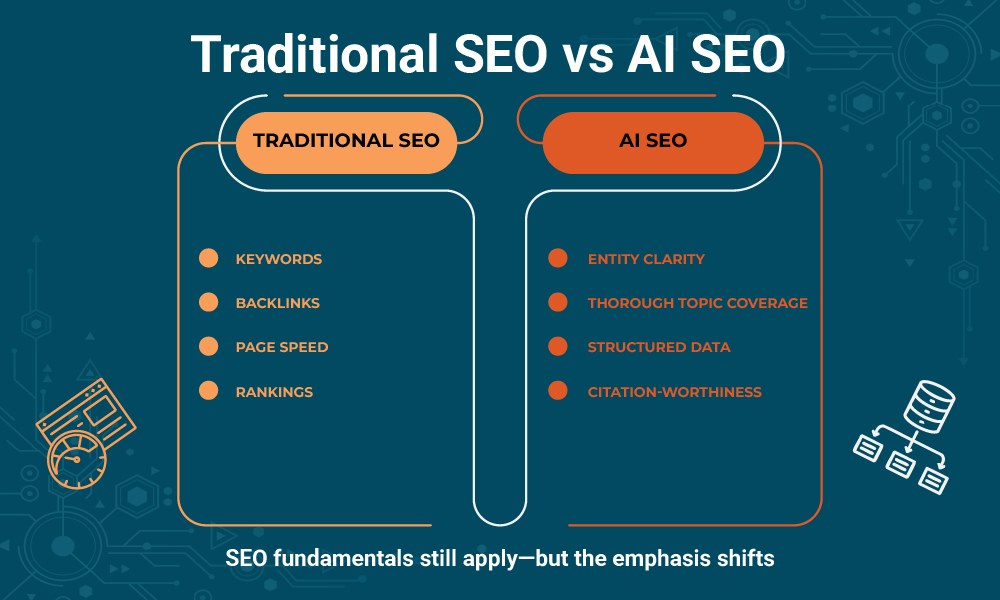
    SEO fundamentals still apply—but the emphasis shifts.

    SEO fundamentals still apply. Sites that rank well in Google tend to get cited more by AI, but it’s not automatic. Backlinks from authoritative sites signal to search engines that your website is trustworthy and valuable, and AI systems pick up on these same credibility signals. You need to optimize for both traditional search and AI platforms.

    One principle remains constant: creating exceptional, high-quality content is the best way to boost SEO performance and satisfy prospective students. Content should prioritize people over bots. If it genuinely helps your target audience, it will perform well with AI systems too.

    Learn how to optimize content for AI search engines with Search Influence.

    Getting Your University Into AI Search Results

    Start with the audit. You can’t fix what you can’t see.

    Step 1: Find Out What AI Currently Says About You

    This takes about 30 minutes, and it’s the most important 30 minutes you’ll spend on AI SEO.

    Open ChatGPT, Claude, and Perplexity. Ask questions like:

    • “Tell me about [Your University]”
    • “What are the best [your program] programs in [your region]?”
    • “Should I attend [Your University]?”
    • “What is [Your University] known for?”
    • “Compare [Your University] to [Competitor]”
    • “What are the admission requirements for [Your University]?”
    • “How much does it cost to attend [Your University]?”

    Document everything in a spreadsheet. For each question, note:

    • What’s accurate?
    • What’s outdated?
    • What’s completely missing?
    • Are competitors mentioned instead of you?
    • Is the information compelling or generic?

    I’ve done this audit for dozens of higher education clients. What I find most often:

    Competitor dominance

    When students ask about programs you offer, competitors show up, and you don’t. This is the most painful finding, but it’s the most actionable.

    Missing differentiators

    AI can describe your university in generic terms, but doesn’t mention what makes you unique. Your $50M new engineering building? Your unique co-op program? Your 95% nursing board pass rate? If AI doesn’t know about it, AI can’t recommend you for it.

    Outdated information

    Programs that no longer exist, old leadership names, incorrect tuition figures, former campus locations. AI models don’t always have up-to-date information, and even when they do, they may have ingested outdated pages from your site.

    Generic descriptions

    AI says you’re “a comprehensive university offering undergraduate and graduate programs in a variety of fields.” That’s true. It’s also useless. Nobody chooses a university based on that description.

    Step 2: Create Content That AI Wants to Cite

    AI systems prefer citing website content that appears authoritative and thorough. They’re trained on high-quality content, so they pattern-match on what those sources look like. Your content creation strategy needs to account for this.

    Create content that answers the specific questions students ask during their research process. That means your content needs to:

    Be structurally parseable

    AI reads differently from humans. Clear heading hierarchies (H2, H3, H4) help AI understand the relationship between concepts. Dense paragraphs of text are harder to parse than structured lists.

    Formats that work well:

    • FAQ sections that mirror natural language questions
    • Definition lists for key terms
    • Comparison tables
    • Bulleted lists with specific data points
    • Step-by-step numbered processes

    Include specific, citable data

    Vague claims get ignored. Specific data gets cited.

    Include:

    • Enrollment numbers (total, by program, by format)
    • Graduation and retention rates
    • Employment outcomes (percentage employed, average salary, top employers)
    • Program rankings and accreditations
    • Tuition costs (total and per credit hour)
    • Financial aid statistics (percentage receiving aid, average package)
    • Student-to-faculty ratios
    • Research funding and grants

    Answer the questions prospective students actually ask

    Look at your website chat logs. Look at your admissions email inbox. Look at your campus visit Q&A sessions. What do prospective students actually want to know? This is better than any keyword research tool for identifying relevant keywords and topics.

    Create structured content that directly answers those questions, and format it so AI can find and cite those answers.

    Create multimedia content

    Creating multimedia content (videos, infographics, virtual tours) enhances engagement and helps students envision themselves on campus. Video testimonials, program overviews, and campus walk-throughs give AI systems additional content to index. YouTube content especially matters; it’s owned by Google and feeds directly into AI training data.
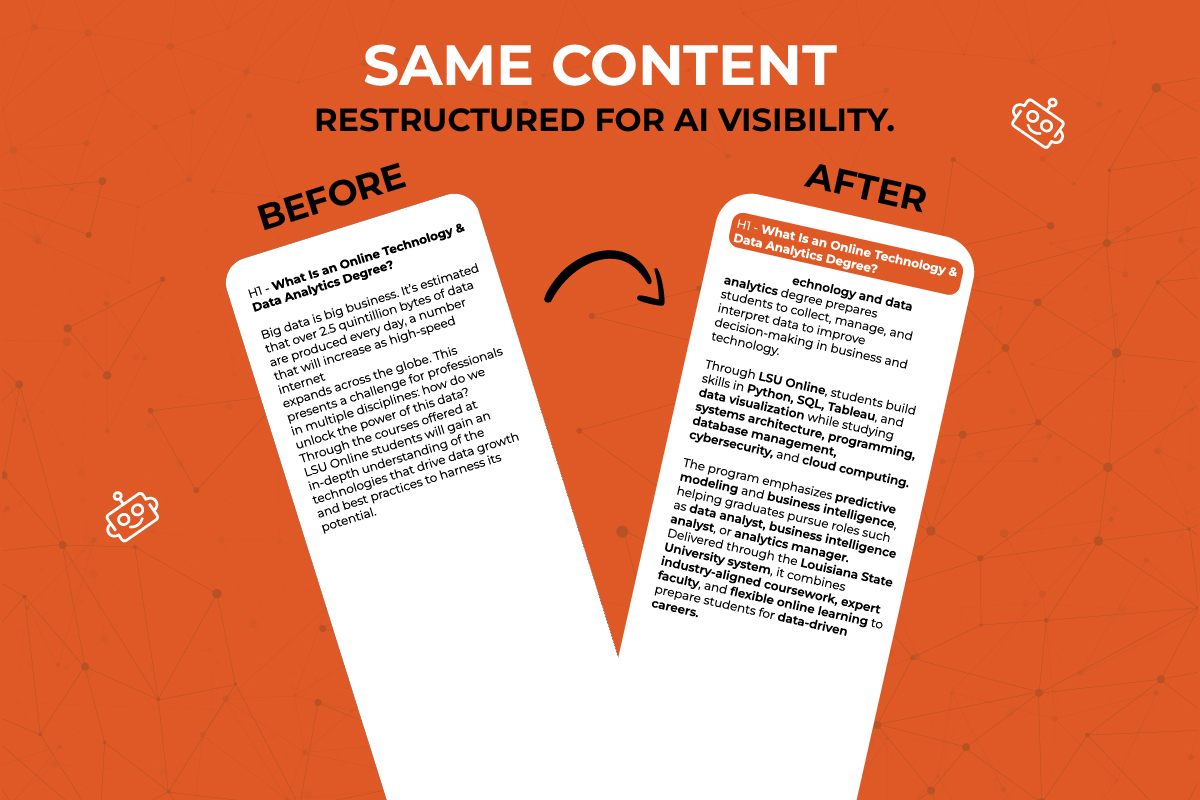
    Same content, restructured for AI visibility.

    Step 3: Make Your Brand “Like Fluoride in the Water”

    You want your brand to be so present across the web that AI just… knows you.

    Think about Kleenex. Or Xerox. Or Google (as a verb). Nobody has to explain what these brands are. AI models have seen so many references across so many contexts that the brand is baked into their understanding.

    Obviously, you can’t become Kleenex overnight. That takes decades. But you can systematically increase your brand’s presence in the sources AI learns from:

    Get mentioned on authoritative sites

    Higher ed publications (Inside Higher Ed, Chronicle of Higher Education, Higher Ed Dive), local and regional news outlets, and industry-specific publications in your strong program areas.

    When journalists write about trends in nursing education, they quote someone. Why not your nursing dean? When publications list “top programs for X,” they source from somewhere. Why not your outcomes data?

    Publish research that others cite

    Original research gets cited. Surveys, studies, white papers, data analyses. Your institutional research office has data that would be valuable to others. Package it and publish it.

    Maintain active, consistent social presence

    AI models train on social media content. LinkedIn, Twitter/X, YouTube. Your consistent presence builds brand recognition in the training data. Video SEO matters here too; YouTube is owned by Google and feeds into AI training data. Optimizing content for YouTube (with strong titles, descriptions, and transcripts) improves visibility across both traditional search and AI platforms.

    Show up in industry rankings and lists

    Rankings aren’t just for prospective students. They’re for AI training data. When AI learns “best X programs,” it learns from published lists.

    Create content that other institutions reference

    Thought leadership content that other universities link to and cite. Best practices guides. Innovative program design. This creates a citation network that AI follows.
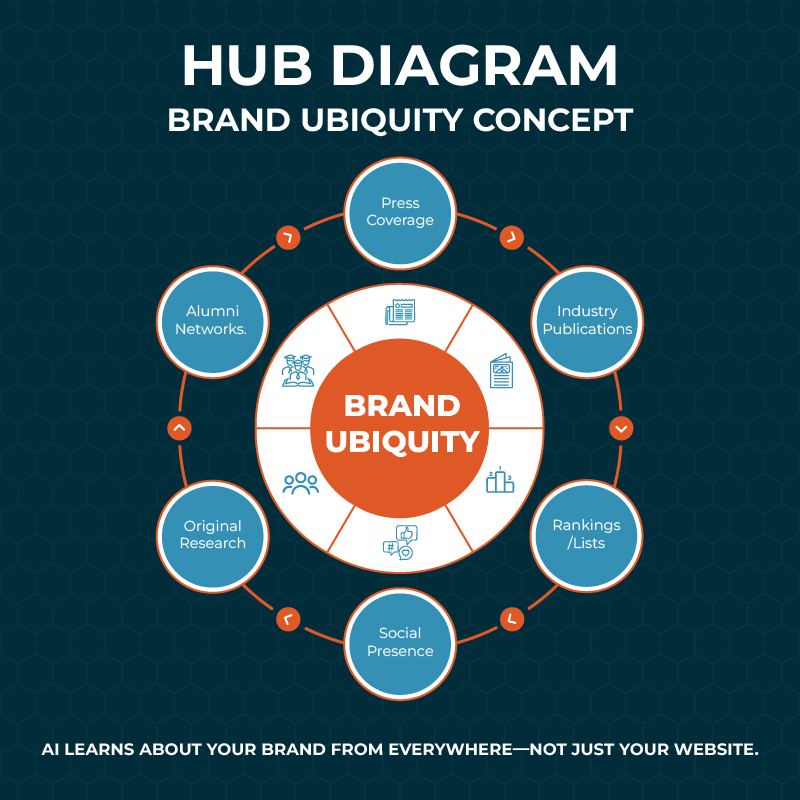
    AI learns about your brand from everywhere—not just your website.

    The goal isn’t any single mention. The goal is to be so present across the web that when AI thinks about your program area, your institution naturally comes to mind. Like fluoride in the water, invisible but everywhere.

    Step 4: Don’t Neglect Local SEO for Regional Student Search

    Local SEO is critical for attracting regional students, especially for institutions with multiple campus locations. For higher education institutions serving regional markets, local SEO directly impacts AI search results and recommendations.

    When a prospective student asks, “What are the best nursing programs near me?” or uses voice search for “colleges in [city],” AI pulls from local signals. These natural language queries are increasingly common as generative AI tools encourage students to ask more conversational questions.

    What to do:

    • Claim and optimize Google Business Profile for each campus location
    • Ensure NAP (name, address, phone) consistency across all web pages
    • Create location-specific content for each campus
    • Incorporate keywords naturally for regional search intent (“nursing program in [city],” “[state] MBA programs”)
    • Encourage and respond to Google reviews. They’re credibility signals for both traditional search engines and AI
    • Build citations in local directories and regional publications

    Local SEO isn’t separate from AI SEO; it feeds it. AI systems learn about your regional presence from these same signals. Higher ed marketers often overlook local SEO because they’re focused on national rankings, but for most higher education institutions, regional search visibility is where enrollment actually happens.

    Optimizing Academic Program Pages for AI-Driven Search Results

    Program pages are where enrollment happens, or doesn’t. When a student asks ChatGPT, “What are the best MBA programs for working professionals?”, AI scans the web, evaluates sources, and generates an answer. Your program page either contains everything AI needs to recommend you, or it doesn’t. There’s no second impression.

    Institutions should create dedicated landing pages for each academic program with detailed information. Most university program pages fail this test. They’re designed for humans who already know about the institution and are browsing to learn more. AI doesn’t browse. It extracts, evaluates, and cites, or moves on.

    Students now expect instant, personalized answers to their questions during their college search. Your program pages need to deliver.

    The Anatomy of an AI-Optimized Program Page
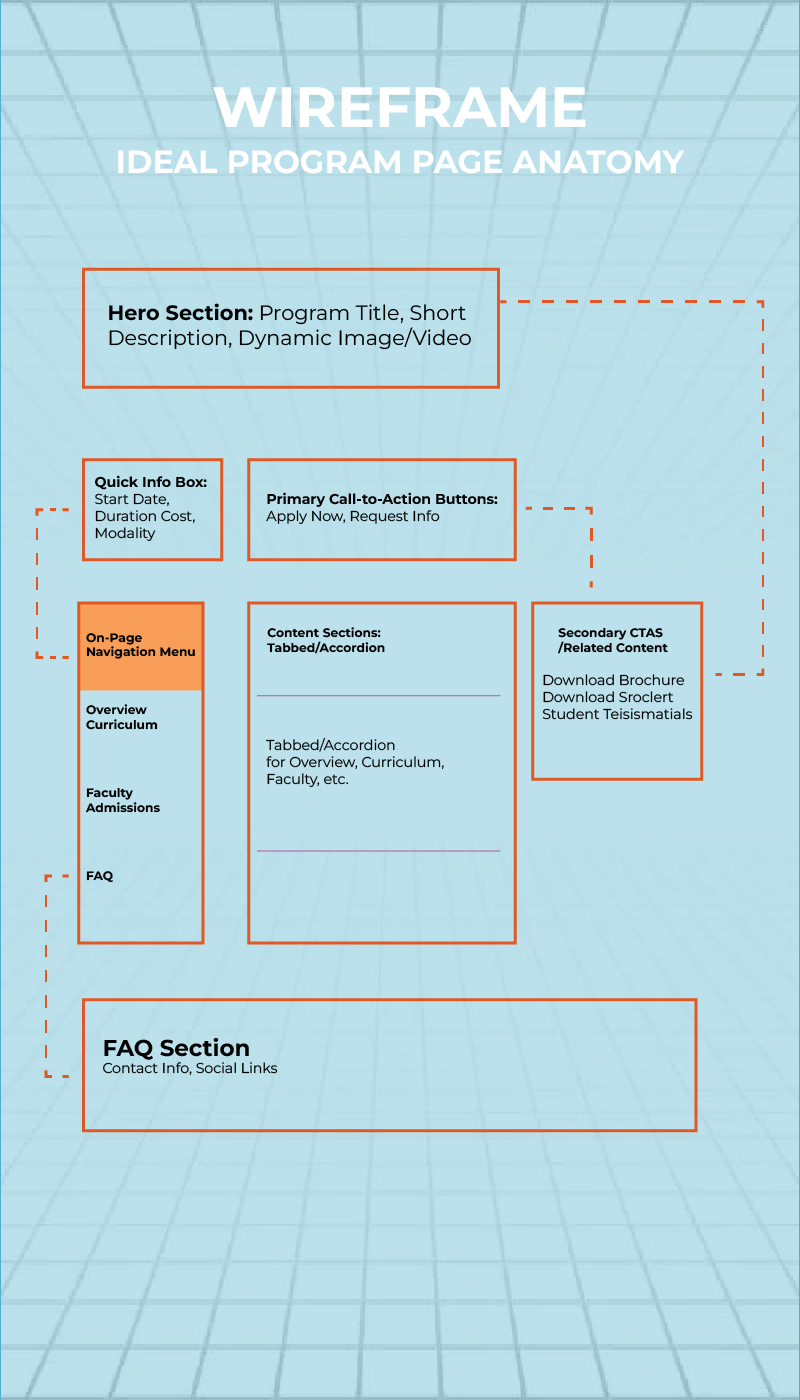
    1. Clear Program Identity (Above the Fold)

    Start with unambiguous program identification:

    • Exact degree name and type (BS, BA, MS, MBA, MEd, PhD, etc.)
    • Program format (on-campus, fully online, hybrid, evening/weekend)
    • Duration (credit hours required, typical time to completion)
    • Accreditation status and accrediting bodies
    • Department and college affiliation

    Why this matters: AI needs to correctly categorize your program. If your page title says “Business Administration” but doesn’t specify MBA vs. undergraduate, AI may miscategorize you.

    2. Outcomes Data (Make It Prominent)

    Universities are often reluctant to publish employment data — worried about liability, or not confident in the numbers. But students make decisions based on outcomes, and AI cites specifics.

    Include:

    • Employment rate within 6 months and 1 year of graduation
    • Average and median starting salary
    • Salary range (10th to 90th percentile)
    • Top employers hiring your graduates (named companies)
    • Job titles graduates hold
    • Career paths and advancement trajectories
    • Professional licensure/certification pass rates (nursing boards, CPA exam, bar exam, etc.)
    • Graduate school acceptance rates (for undergrad programs)

    If you have strong outcomes, show them. If you don’t have this data, start collecting it.

    3. Curriculum Overview (Structured for Scannability)

    Don’t just link to a PDF catalog. Present curriculum information directly on the page:

    • Core/required courses with brief descriptions
    • Elective options and specialization tracks
    • Unique program features (capstone projects, internship requirements, study abroad, lab experiences)
    • Sample course sequence or suggested schedule
    • Total credit hours and breakdown by category

    Format this as a table or structured list, not paragraphs.

    4. Admission Requirements (Be Specific)

    Prospective students ask AI-specific questions: “What GPA do I need for X program?” Make sure AI can find the answer on your page.

    Include:

    • Minimum GPA requirements (and competitive/average admitted GPA)
    • Test score requirements or policies (GRE, GMAT, test-optional status)
    • Prerequisite courses
    • Required application materials
    • Application deadlines (early, regular, rolling)
    • International student requirements

    5. Cost and Financial Information (Don’t Hide It)

    Tuition is one of the top questions students ask. AI will answer it. The question is whether AI gets the answer from your site or somewhere else.

    Include:

    • Total program cost
    • Per-credit-hour rate
    • Fee breakdowns
    • Scholarship opportunities specific to this program
    • Graduate assistantship availability
    • Employer tuition reimbursement partnerships
    • Financial aid statistics for this program
    • ROI calculations, if available

    6. FAQ Section (Mirror How Students Ask)

    FAQ sections structured as question-and-answer pairs are exactly what AI systems are looking for. Easy to implement, high impact.

    Address questions students actually ask:

    • “Can I complete this program while working full-time?”
    • “What’s the difference between the online and on-campus versions?”
    • “Is this program accredited?”
    • “What kind of support services are available for online students?”
    • “Can I transfer credits into this program?”
    • “What technology/software will I need?”
    • “Are there networking or career services?”

    Use the exact phrasing students use. That’s what they’ll type into ChatGPT.

    7. Student Testimonials and Success Stories

    Real stories from real students are citation gold. AI systems recognize authentic student testimonials as credibility signals, and prospective students find them compelling. Student testimonials provide the social proof that influences user behavior during the decision-making process.

    Include named testimonials (with permission), specific outcomes, and career trajectories. “Sarah graduated in 2023 and now works as a data analyst at IBM” is more citable than “Our graduates go on to great careers.”

    Video testimonials work even better. They’re harder to fake and more engaging. If you have them, embed them on the page with transcripts for AI to parse. This combines video SEO with powerful conversion content.

    Common Mistakes I See

    Mistake 1: Content buried in PDFs

    AI can’t easily parse PDF content. If your program details live in a downloadable brochure or catalog PDF, they might as well not exist for AI purposes. Extract that content and put it on the page.

    Mistake 2: Fragmented information across multiple pages

    If students (or AI) have to click through five pages to understand your program (overview, curriculum, admissions, financial aid, outcomes), AI won’t piece it together. Consolidate essential information into a single page, with links to deep dives.

    Mistake 3: Missing or hidden outcomes data

    If you have good outcomes, show them prominently. If you have mediocre outcomes, at least show the data you’re proud of. Something specific beats nothing every time.

    Mistake 4: Generic marketing copy

    “Prepare for success in a dynamic global economy” means nothing. Literally nothing. It’s filler text that adds no information.

    Compared to: “92% of graduates employed in their field within 6 months, with an average starting salary of $68,000. Top employers include Mayo Clinic, Cleveland Clinic, and Johns Hopkins.”

    Which one would you cite? Which one would AI cite?

    Mistake 5: No FAQ section

    If your program page doesn’t have an FAQ section, you’re leaving AI citations on the table. This is the easiest win. Just add it.

    Structured Data and Schema for Higher Education

    This section gets technical. Schema markup is how you explicitly tell AI what your content means — metadata that machines read. It’s becoming increasingly valuable for AI visibility.

    Why Schema Matters for AI

    When AI systems encounter structured data, they don’t have to guess what your content means. You’re telling them directly:

    • This is an educational organization
    • This is a course/program
    • This is an FAQ
    • This is an event
    • These are the properties (name, cost, duration, requirements)

    Think of it as the difference between handing someone a box of puzzle pieces versus handing them the completed puzzle. Same information, wildly different usability.

    AI systems can extract information from unstructured text. But structured data is unambiguous. It removes interpretation. It’s machine-readable by design.
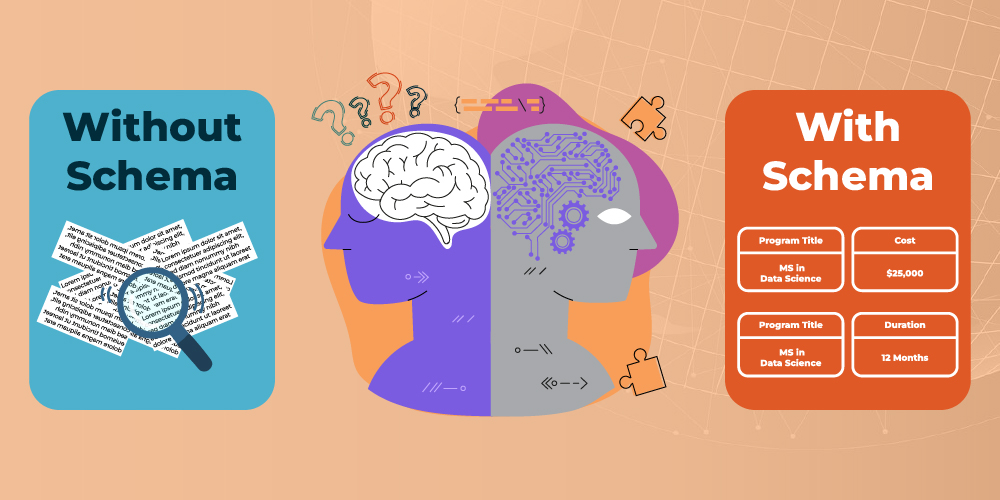
    Schema removes ambiguity

    Schema Types That Matter for Higher Ed

    If you’re not technical, share this section with your developer. If you are technical, here are the four schema types to prioritize:
    EducationalOrganization Schema

    Your foundation tells AI who you are at the institutional level.

    This is especially important for entity disambiguation. If your institution shares a name with another (e.g., multiple “Trinity” universities, multiple “State” schools), schema helps AI understand which one you are. The same applies to Google’s Knowledge Graph. That information panel that appears when someone searches your name. Claim and optimize your Knowledge Panel through Google’s verification process. When AI systems reference knowledge graphs, they’re pulling from that same entity data.

    {

    “@type”: “EducationalOrganization”,

    “name”: “University Name”,

    “alternateName”: “Common Abbreviation”,

    “description”: “Full description of the institution”,

    “url”: “https://www.university.edu”,

    “logo”: “https://www.university.edu/logo.png”,

    “address”: {

    “@type”: “PostalAddress”,

    “streetAddress”: “123 Campus Drive”,

    “addressLocality”: “City”,

    “addressRegion”: “State”,

    “postalCode”: “12345”

    },

    “telephone”: “+1-555-123-4567”,

    “foundingDate”: “1890”,

    “accreditedBy”: [

    {

    “@type”: “Organization”,

    “name”: “Higher Learning Commission”

    }

    ]

    }

    Course Schema

    For each academic program. This is where the detail matters.

    {

    “@type”: “Course”,

    “name”: “Bachelor of Science in Nursing”,

    “description”: “Four-year nursing program preparing students for RN licensure”,

    “provider”: {

    “@type”: “EducationalOrganization”,

    “name”: “University Name”

    },

    “hasCourseInstance”: [

    {

    “@type”: “CourseInstance”,

    “courseMode”: “onsite”,

    “courseWorkload”: “PT120H”

    },

    {

    “@type”: “CourseInstance”,

    “courseMode”: “online”

    }

    ],

    “occupationalCredentialAwarded”: “BSN”,

    “numberOfCredits”: 120,

    “educationalLevel”: “Bachelor’s Degree”,

    “timeRequired”: “P4Y”

    }

    FAQPage Schema

    For those FAQ sections. This makes your Q&A pairs directly extractable.

    {

    “@type”: “FAQPage”,

    “mainEntity”: [

    {

    “@type”: “Question”,

    “name”: “Can I complete this program while working full-time?”,

    “acceptedAnswer”: {

    “@type”: “Answer”,

    “text”: “Yes, our evening and weekend format is designed for working professionals…”

    }

    }

    ]

    }

    Event Schema

    For open houses, information sessions, and application deadlines.

    {

    “@type”: “Event”,

    “name”: “MBA Information Session”,

    “startDate”: “2025-03-15T18:00”,

    “endDate”: “2025-03-15T19:30”,

    “location”: {

    “@type”: “Place”,

    “name”: “Business School Building, Room 100”

    },

    “eventAttendanceMode”: “https://schema.org/MixedEventAttendanceMode”,

    “organizer”: {

    “@type”: “EducationalOrganization”,

    “name”: “University Name”

    }

    }

    Implementation Priority

    If you’re starting from zero, here’s the order:

    1. EducationalOrganization schema on your homepage — Define who you are
    2. FAQPage schema on key program and admission pages — Quick win, high impact
    3. Course schema on each academic program page — The biggest lift, but most valuable
    4. Event schema on recruitment event pages — Good for search and AI

    Full disclosure: implementing this well usually requires developer resources. Your marketing team can specify what needs to be marked up, but implementation typically needs IT involvement. It’s not a quick win, but it compounds over time. Once it’s in place, it keeps working.

    Technical Foundations for AI Visibility

    Technical SEO and Site Performance Still Matter

    Technical SEO is essential for maintaining a website’s backend health and ensuring it can be identified by search engines. Site speed, mobile responsiveness, crawlability, and security (HTTPS) still matter. AI systems may not rank web pages the way traditional search engines do, but they do learn from sites that meet basic technical standards. Search engine optimization fundamentals haven’t gone away; they’re table stakes for any higher education SEO strategy.

    If your higher ed website is slow, broken on mobile, or has crawl errors, fix that first. No amount of schema markup or AI-friendly content will overcome a site that doesn’t load. Run technical SEO audits before diving into the AI-specific optimizations. AI tools can automate tasks like competitor analysis, backlink monitoring, and technical SEO audits. Tools like Screaming Frog, Sitebulb, or AI-powered platforms like Semrush can streamline this analysis.

    Managing AI Crawlers

    AI systems like ChatGPT, Claude, and Perplexity use their own crawlers (GPTBot, ClaudeBot, PerplexityBot) to index content. You can control their access through robots.txt. Same as traditional search engines.

    Most universities should allow these crawlers. If AI can’t access your content, AI can’t recommend you. But if you have gated content or specific sections you want to exclude, you can block specific bots:

    User-agent: GPTBot

    Disallow: /internal-documents/

    User-agent: ClaudeBot

    Disallow: /internal-documents/

    There’s also a newer standard emerging: llms.txt. This file (placed at your domain root, like robots.txt) tells AI systems how to interpret your site—what’s most important, how content relates, and what context matters. It’s not universally adopted yet, but worth watching as AI crawling matures.

    Using AI to Support Student Recruitment

    Everything above is about getting *found* by AI. But AI can also be a tool you use directly in recruitment. This section is optional reading (the core work is in the previous sections), but worth considering if you’re building out your digital strategy.

    AI Chatbots for Enrollment

    A lot of colleges and universities are implementing AI chatbots now. Some are doing it well. Most are not.

    My take:

    Do:

    • Use chatbots for high-volume, repetitive questions (office hours, application deadlines, document requirements, program listings)
    • Train them on your actual FAQ data — real questions from real students
    • Have clear handoff protocols to human staff for complex questions
    • Track what questions come up most often — this is gold for content strategy
    • Set appropriate expectations (tell users they’re talking to a bot)
    • Test extensively before deployment

    Don’t:

    • Let chatbots handle sensitive conversations (financial hardship, disability accommodations, academic concerns, mental health)
    • Deploy without thorough testing across edge cases
    • Expect them to replace human connection — they augment, not replace
    • Use generic chatbot responses — customize for your institution
    • Forget to update the knowledge base as information changes

    An important distinction: The 50% of students using AI search tools weekly? They’re not looking to talk to a bot on your website. They’re using ChatGPT and Google AI Overviews because they perceive these as unbiased, aggregated answers.

    Your institutional chatbot serves a different purpose. Convenience and availability, not research.

    A student at 11 pm who wants to know if their transcript was received?

    Chatbot territory.

    A student trying to decide between your program and a competitor?

    That needs a human.

    AI-Powered Personalization

    Some colleges and universities are using AI tools to create more personalized digital experiences:

    Homepage personalization

    Showing different content based on visitor signals — location, referral source, previous visits, stated interests. A visitor from Texas sees Texas-specific information and regional alumni. A visitor who previously looked at nursing programs sees nursing content prominently.

    Program recommendations

    “Based on your interests, you might also consider…” recommendations powered by AI analysis of similar student paths.

    Dynamic financial aid estimates

    AI-powered calculators that provide personalized estimates based on student-provided information.

    Email campaign personalization

    Content customization within email campaigns based on recipient behavior and preferences.
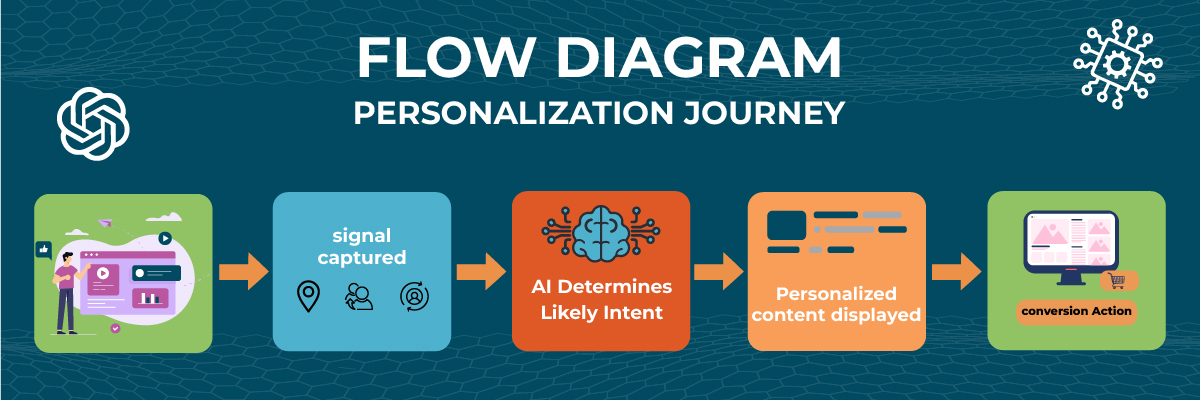
    AI personalization in action.

    The caveat: privacy matters. FERPA applies to student records. GDPR may apply to international visitors. State privacy laws are evolving. Be thoughtful about what data you collect, how you use it, and how you communicate that to visitors.

    The line between “helpful personalization” and “creepy surveillance” is real. Stay on the right side of it.

    Measuring AI SEO and Search Engine Optimization Performance

    You’ve audited, optimized, and implemented. How do you know if any of this is working?

    Measuring AI visibility is nothing like measuring traditional SEO. It’s messier, less precise, and still evolving. And the metrics that matter are different. You’re not just tracking organic traffic, website traffic, and keyword rankings anymore. AI-driven search features are changing how students discover information, and AI-generated search results often summarize information without requiring users to click through to your website. You need new metrics for a new search strategy.

    What You Can Track

    Brand mentions across LLMs

    AI SEO tracking tools like Scrunch, Profound, RankScale, and others now track how often your brand appears in AI responses across ChatGPT, Claude, Perplexity, and Google AI Overviews.

    Full disclosure, we use Scrunch at my agency, and I think it’s the most thorough option for agencies and enterprises. But there are others at different price points:

    • Scrunch: Enterprise-focused, full-stack tracking, API access
    • Profound: Enterprise-focused, detailed insights across 10+ AI engines, custom pricing
    • RankScale: Budget-friendly, credit-based pricing

    The tracking piece is becoming a commodity. Most tools can tell you if you’re showing up. The differentiation is in what they do with that data.
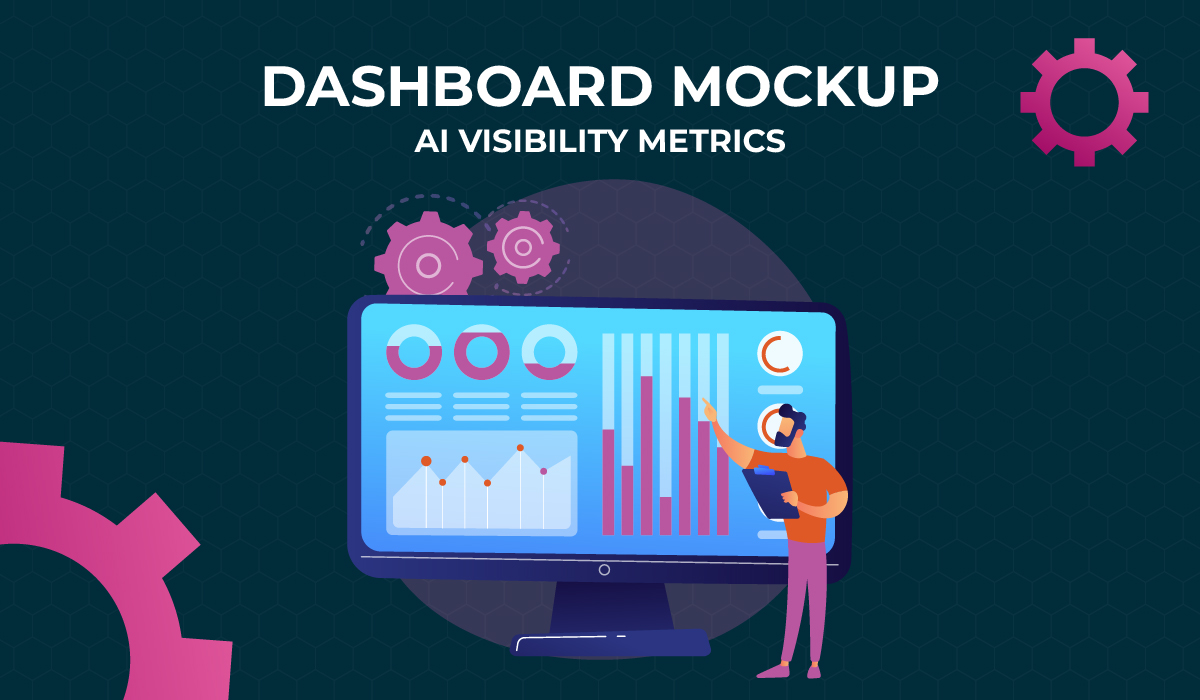
    Example AI visibility dashboard—showing metrics that matter.

    Position in AI-generated lists

    When someone asks “best X programs,” where do you show up? First? Fifth? Not at all? This is trackable and meaningful.

    Citation rate

    How often does AI cite your content as a source? This is particularly important for Perplexity and Google AI Overviews, which show their sources. Being cited is different from being mentioned; it’s a stronger signal.

    Sentiment and accuracy

    What does AI say about you? Is it positive, neutral, or negative? More importantly, is it accurate? Inaccuracies need to be addressed.

    Competitor share of voice

    How do you compare to competitors in AI recommendations? If students ask about your program category, who gets mentioned most?

    What You Can’t (Easily) Track

    • Individual user conversations with AI (privacy and access limitations)
    • Exactly how AI weighs different factors (black box)
    • Real-time changes to AI recommendations (there’s always a lag)
    • Causal attribution (did they enroll because AI recommended you?)
    • Direct impact on website traffic from AI-driven search results (unlike Google Analytics for traditional search)

    The “Windsock” Approach

    I’ve said this before, and I’ll say it again: all AI tracking data is imperfect. Analytics aren’t an absolute truth. They’re opinions with decimal points.

    AI tracking tools are a windsock, not a GPS. They tell you direction, not precise position.

    You’re looking for directional trends:

    • Are mentions increasing over time?
    • Is share of voice improving vs. competitors?
    • Are inaccuracies getting corrected after you update content?
    • Is sentiment trending positive?

    Don’t obsess over precision. Don’t argue about whether you’re mentioned in 47% or 52% of relevant queries. Pick your tool, track consistently, and look for trends up and to the right over time.
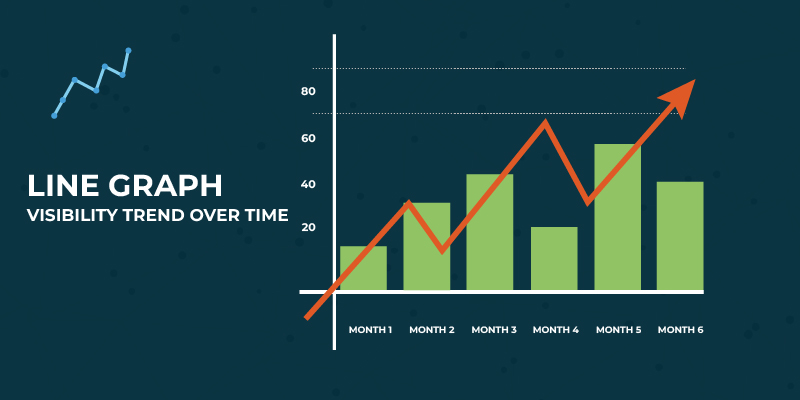
    Example AI visibility dashboard—showing metrics that matter.

    What This Means for Higher Ed Marketers and Marketing Teams

    Where do you actually start? These higher education SEO strategies need to fit into your broader web strategy. My recommendations, scaled to your marketing teams and resources:

    If You Have Limited Resources (Marketing Team of 1-3)

    Start here:

    1. Audit what AI currently says about your institution. This takes 30 minutes and costs nothing. Open ChatGPT, Claude, and Perplexity. Ask the questions we covered. Document what’s wrong.
    2. Fix factual inaccuracies on your website. If AI is saying something wrong, it probably learned it from your site (or from outdated information). Update your site.
    3. Restructure your top 3-5 program pages. Pick your highest-priority programs. Add clear headings, FAQ sections, and outcomes data. This is manual work, but high impact.
    4. Add FAQ sections to key pages. If you do nothing else, do this. FAQs are the easiest content for AI to cite.

    If You Have Moderate Resources (Marketing Team of 4-10)

    Add:

    1. Implement basic schema markup. Start with EducationalOrganization on your homepage and FAQPage schema on key pages. This requires developer time but pays dividends.
    2. Create a thorough “About” page optimized for AI. A single page that fully answers “What is [University Name]?” with specific data points, history, differentiators, and programs.
    3. Set up tracking with an AI visibility tool. Pick one, commit to it, and track monthly. RankScale is affordable for smaller teams.
    4. Train your content team on AI-friendly formatting. Share this guide. Make it part of your content standards.

    If You’re Ready to Go Deep (Dedicated Digital Team)

    Then:

    1. Full schema implementation across all program pages. This is a project. Scope it, resource it, execute it systematically.
    2. Competitive analysis based on AI presence. What are competitors doing that you’re not? Where are they getting cited and you’re not?
    3. Ongoing optimization and monitoring program. Monthly reviews of AI visibility data. Quarterly content updates based on findings.
    4. Integration with broader GEO strategy. AI SEO doesn’t exist in isolation. Connect it to your overall search strategy, content creation strategy, and brand strategy. Your SEO strategies should address both traditional search engines and AI platforms.
    5. PR and content strategy aligned with AI visibility. Proactive outreach to get mentioned in publications AI learns from.

    The Bottom Line: Adapting Higher Education SEO Strategies for AI

    What this all comes down to:

    Brand used to be what you said about yourself. You controlled the message.

    Then it became what others said about you. Reviews, social media, word of mouth.

    Now it’s what AI understands and believes about you. AI synthesizes everything (your content, others’ content, structured data, citations) and forms a representation of your institution that it shares with millions of users.

    Universities that move early get the edge. The rest play catch-up.

    The tactics here work. I’ve tested them. I’ve seen universities go from invisible in generative search results to consistently recommended. But tactics change. AI changes fast. What won’t change is the need to help AI systems understand who you are, what you offer, and why you matter.

    Ultimately, that’s not so different from what we’ve always done in higher ed marketing. We’re just speaking to a new kind of audience. One that never sleeps, has perfect memory, and is advising a third of your prospective students.

    The question isn’t whether to adapt. It’s how fast.

    What’s Next

    Ready to see where you stand?

    Start with our free AI Website Grader at ai-grader.searchinfluence.com. It analyzes your site’s AI visibility and gives you a baseline to work from. Then schedule a conversation with our team to walk through the results and identify your highest-impact opportunities.

    Try the AI Website Grader | Schedule a Consultation

    Resources

    AI Visibility Tracking Tools:

    • Scrunch (enterprise, full-stack tracking)
    • RankScale (budget-friendly, credit-based)
    • Profound (enterprise, custom pricing)

    Schema Implementation:

    • Schema.org/EducationalOrganization documentation
    • Google’s Rich Results Test
    • Schema markup generators (free tools available)

    Further Reading:

    • UPCEA/Search Influence: “AI Search in Higher Education” (2025 research study)
    • SparkToro/Datos: AI Search Usage Data reports
    • Google Search Central: AI Overviews documentation

    Tools Mentioned:

    • ChatGPT
    • Claude
    • Perplexity
    • Google AI Overviews (in Google Search)

    *Will Scott is cofounder of Search Influence, a digital marketing agency specializing in higher education. He teaches the SMX Masterclass on Generative Engine Optimization (GEO) and has been tracking the AI search space since late 2022. Connect with him on LinkedIn.*
  • Search Influence SEO: Powering Your Visibility in AI and Your Enrollment Growth

    Search Influence SEO: Powering Your Visibility in AI and Your Enrollment Growth

    Search Influence SEO Powering Your Visibility in AI and Your Enrollment Growth graphic

    Key Insights

    • Student discovery now happens across multiple channels and moments, not a single search engine. Prospects move fluidly between platforms, which means visibility must extend across every place they form early impressions.
    • AI summaries are becoming the new first impression for many learners. With 79% reading AI Overviews, institutions must ensure AI tools surface accurate, compelling information about their programs.
    • Most institutions recognize AI’s impact but lack the structure to act on it. Bandwidth, expertise, and unclear ownership are keeping teams from implementing consistent, repeatable AI search strategies.
    • Foundational SEO directly fuels AI visibility, accuracy, and trust. Structured content, semantic clarity, and authoritative signals shape how search engines and generative tools interpret and cite your institution.
    • Search Influence’s SEO framework is built for the intersection of rankings, AI summaries, and enrollment outcomes. Our approach unifies semantic SEO, AI visibility tracking, and full-funnel analytics to help institutions stay competitive across every modern discovery surface.

    Prospects aren’t following a straight line to your programs anymore. They’re bouncing between Google, AI, YouTube, and university websites depending on what they need in the moment.

    Some want quick clarity. 

    Some want more depth. 

    All expect quick answers to their questions, wherever they look.

    That’s why SEO now operates as the connective tissue across every discovery channel. It strengthens the signals that help Google rank you, AI tools describe you, and students recognize you early on.

    Search Influence’s SEO approach is built for this reality, where traditional search, AI-driven discovery, and enrollment outcomes converge. Here’s a closer look at the new search playing field, plus how our team keeps your programs at the forefront of the conversation.

    How Prospective Students Search Today

    After years of predictable search behavior (primarily with Google), student discovery has become far more multi-channel.

    To understand how prospects search today, UPCEA and Search Influence conducted AI Search in Higher Education: How Prospects Search in 2025, a study surveying 760 adults exploring professional and continuing education (PCE) programs. The responses provide a clear view of the platforms learners rely on as they compare options and develop early awareness.

    When searching specifically for information about programs and degrees:

    • 84% use search engines
    • 61% use YouTube
    • 50% use AI tools

    Instead of following one path, students build context from multiple places (i.e, search results, videos, AI answers, and university pages), depending on what helps them understand the basics, compare details, or evaluate a brand’s presence.

    AI search now shapes first impressions

    As prospects move between channels, AI often becomes the place where they check their understanding or look for a quick comparison. The AI Search Research Study found that:

    • 79% read Google’s AI Overviews
    • 56% trust the brands cited by AI

    Those two behaviors matter even more in the broader context of student decision-making. Industry research shows that 67% of learners start with a consideration set of three schools or fewer. That means most prospects narrow their options early, and AI-generated summaries increasingly influence who earns a spot in that small set.

    If AI tools cite your institution in response to user queries, you stay visible in those early moments of interest. If your presence is weak or inconsistent, competitors fill the gap, often before a prospect reaches your website.

    Most Institutions Have Opportunity With AI Search

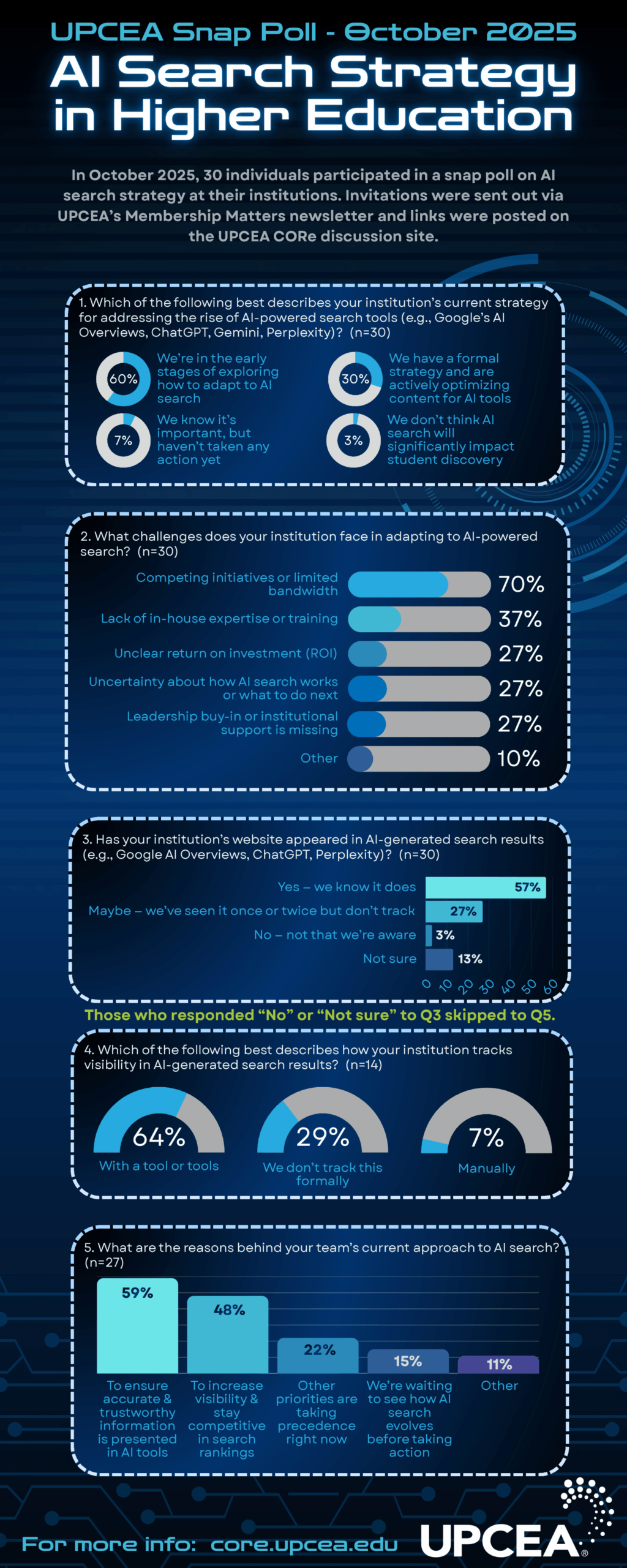
    Even as AI becomes a bigger part of how prospects form early impressions, many colleges and universities are still figuring out how to respond. To understand where teams stand today, UPCEA conducted the AI Search Strategy in Higher Education Snap Poll in October 2025, surveying 30 members about their readiness and efforts.

    The results show a clear opportunity: Most institutions recognize the importance of AI search, but few have the structure or processes to act on it consistently.

    Awareness is high, execution is thin

    Across the surveyed members, interest in AI search was largely widespread, but most teams have not yet fully implemented it. Many are still figuring out how AI fits alongside SEO, online advertising, email marketing, analytics, and their broader digital marketing mix.

    According to the poll:

    • 60% are exploring AI search but haven’t implemented tactics
    • 30% have a formal AI search strategy
    • 10% haven’t begun planning or don’t believe AI will influence program discovery

    This gap between awareness and activation is where many institutions are feeling the pressure. AI is evolving quickly, but internal processes and resources haven’t caught up.

    The barriers are structural

    For the institutions that haven’t formalized an AI search strategy, the obstacles are operational. Surveyed members cited the following limitations:

    • Bandwidth: Competing priorities leave little time to evaluate AI search needs.
    • Expertise: Many teams aren’t yet confident in how AI intersects with SEO, content, or analytics.
    • Capacity: Even with interest, there often isn’t enough staff to take on new frameworks or governance models.
    • Uncertainty about ROI: Leaders want clearer evidence of impact before committing resources.

    The challenge isn’t a lack of intent. It’s the internal constraints that make it difficult to build something consistent, repeatable, and owned across teams.

    Many institutions don’t know if they show up in AI

    Another challenge highlighted in the poll is the uncertainty around AI visibility itself. Many teams simply aren’t sure how their institution appears (or if it appears) in AI-generated responses.

    When respondents were asked whether their institution shows up in AI answers:

    • 56.7% said yes
    • 26.7% said maybe
    • 13.3% were unsure

    Even among those who track their presence, only 64.29% use structured or formal methods. Most rely on manual spot checks or individual queries, which makes it difficult to understand accuracy, consistency, or how visibility changes over time.

    This ambiguity makes it harder to know whether AI tools are surfacing the right details about your programs, faculty, tuition, or modality.

    A white robot with a google logo

    Foundational SEO Fuels AI Visibility and Enrollment Growth

    With student discovery spreading across more surfaces, one truth becomes clear: Your programs can’t earn consideration if they aren’t visible when and where prospects look.

    This is where strong foundational SEO becomes your strategic advantage. It strengthens the signals that influence both your traditional rankings and your presence in AI-generated summaries, the same summaries prospects increasingly use to form their first impressions.

    Visibility won’t close an inquiry on its own, but it gives your programs a seat at the table.

    Traditional SEO + AI SEO work together

    A common misconception is that AI search exists outside the world of SEO. In reality, AI systems depend on the same structured, authoritative content that drives strong organic rankings.

    AI tools pull from the information available in the Google index and other trusted sources. If your pages lack clarity, structure, or credibility signals, AI systems have less to retrieve and summarize.

    • Weak SEO leads to missing citations, outdated or incomplete details, and entity signals that are too thin for AI tools to interpret confidently.
    • Strong SEO increases the likelihood that your programs appear accurately in both search results and AI-generated answers, which boosts trust early in a learner’s process.

    When marketers think about SEO and AI visibility as intertwined rather than separate tracks, the work becomes more streamlined and more impactful.

    The three forces that make or break AI visibility

    Our Co-Founder and CEO, Will Scott, often summarizes what AI-ready SEO requires with a simple, three-part framework:

    • Structure it.
    • Chunk it.
    • Distribute it.

    This framework is what turns your website into content AI can reliably read, segment, and reuse.

    Structure: Semantic SEO and the Knowledge Graph

    AI systems and search engines rely on semantic clarity to understand how your institution, programs, faculty, and credentials relate to one another. Structuring your content strengthens the signals that feed the Knowledge Graph, the database of entities and relationships that both Google and AI models use to interpret meaning.

    To structure your content, focus on:

    • Entity clarity: making program names, modalities, credentials, costs, and outcomes explicit and consistent across your site.
    • Schema markup: providing machine-readable context that reinforces those details and anchors them to recognized entity types.
    • Semantic triples: defining “who you are,” “what you offer,” and “who you serve” in a format AI systems can parse, store, and reuse.

    When your content is structured this way, AI tools are far better equipped to retrieve accurate information about your institution and surface it in Overviews, summaries, and comparison answers.

    Chunking: AI-readable content architecture

    AI models don’t scan a page top-to-bottom the way a human does. They break content into discrete “chunks,” or self-contained sections that they can classify, interpret, and reuse. The clearer those chunks are, the more reliably AI systems can surface accurate information about your programs.

    To chunk your content, focus on:

    • Short, intentional sections: focused paragraphs that keep each idea or task confined to one area.
    • Intent-aligned headers: descriptive headings that signal exactly what the section explains or answers.
    • FAQ-style responses: direct, self-contained answers to common queries that AI models can retrieve cleanly.
    • Scannable program pages: layouts that separate outcomes, costs, modality, and requirements into distinct, easy-to-parse segments.

    Done right, chunked content helps AI models lift and reuse the right information without guessing at context. It also improves the human experience, making pages easier to navigate, helping prospects stay longer, and supporting the engagement metrics that strengthen organic visibility.

    Distribution: Expanding your entity footprint across the web

    Even with strong on-page structure and clear content chunks, AI models still look for validation beyond your website. The more your institution appears across credible sources, the easier it is for AI systems to “trust” you and surface you in summaries and comparisons.

    To distribute your content, focus on:

    • Links: trusted sites pointing to your pages, strengthening authority signals that both search engines and AI models rely on.
    • Citations: brand mentions across third-party platforms (even without a link) that reinforce relevance within your field or topic area.
    • Barnacle SEO: placing your programs on high-authority sites that already rank for the terms your audience searches for. By “attaching” to these strong surfaces, you benefit from their visibility.
    • Faculty and program presence: profiles, publications, and features that broaden the network of entities connected to your institution.

    While university domains are generally strong, individual programs or schools often lack the external authority signals needed for AI visibility, which is why building these signals remains an essential part of the work.

    How Search Influence’s SEO Solves the AI Visibility Challenge

    Higher ed teams need visibility that performs across the full funnel: in rankings, AI summaries, paid surfaces, and every point where prospects compare programs.

    That’s the environment we build for.

    Search Influence combines long-standing SEO expertise with modern AI-driven search strategies, digital advertising, website optimization, and lead tracking. As a New Orleans–based digital marketing agency serving institutions nationwide, we focus on ROI-driven execution: reaching the right audience, developing strategies that scale, and using the right metrics to show what’s working.

    Recognized leaders in SEO, AI search, and higher education strategy

    We pair two decades of SEO leadership with a leading role in AI search innovation. As an UPCEA Platinum Partner and early mover in AI SEO/GEO (generative engine optimization), we help institutions stay visible as search behavior evolves.

    What differentiates our team:

    • Nearly 20 years of SEO success across higher education, healthcare, tourism, and beyond.
    • First-mover expertise in AI search, including entity optimization and AI-ready content modeling.
    • Industry research leadership, through the AI Search in Higher Education Study, Marketing Metrics Research Study, and the SEO Readiness Research Study.
    • National thought leadership, with frequent speaking roles on SEO, GEO, AI visibility, and enrollment strategy.
    • Deep technical and content strength, from semantic SEO to website optimization and competitive analysis.
    • A full-funnel, ROI-focused digital approach that integrates SEO, paid ads, analytics, and targeted advertising to support both discovery and conversion.

    This combination helps institutions strengthen their presence, outpace competitors, and achieve visibility where decisions begin.

    Full-service, hybrid, or consulting: three ways to work with us

    Every institution’s structure is different. Some need a full agency partnership. Others want a hybrid model that supports their in-house marketing team. Others prefer consulting to level up staff and refine direction.

    We offer all three:

    • Full-service visibility strategy: We manage SEO/AI SEO strategy, execution, and evaluation. That means we plan, write, and implement content on your site. We also identify and secure citations, and we write content for social media that supports your AI search visibility.
    • Hybrid execution: Our team collaborates with yours, sharing responsibilities while keeping strategy, priorities, and performance tightly aligned. We handle strategy and performance evaluation. The execution is shared between your team and ours, depending on your strengths and capacity. We hold you and your team accountable for the completion of SEO projects to deliver results.
    • SEO & marketing consulting: We deliver expert, actionable guidance for institutions that want a clear roadmap for what to do and how to do it. Your team receives training and coaching. You get a partner for questions to help your team execute and learn first-class AI SEO.

    Each model gives you flexibility, strategic alignment, and transparency around performance. And if you’re unsure which option fits your structure, our Higher Ed SEO In-House vs. Outsource Quiz helps you assess your needs and internal bandwidth.

    Comprehensive AI visibility tracking

    Most institutions don’t have a reliable way to measure how they appear in AI-generated answers or how that visibility affects traffic and inquiries. Our tracking framework closes that gap by giving teams a clear view of performance across AI search, Google, and the full enrollment funnel.

    • AI Traffic Report (GA4): Connects AI-influenced behavior to site traffic and engagement so you can see how visibility supports inquiry movement using the right metrics.
    • AI Visibility Tracker (Scrunch-powered): Monitors where and how your institution appears in AI summaries, citations, and comparisons.

    This gives higher ed marketers the clarity they need to understand how AI contributes to discovery and where opportunities exist to drive visibility across the funnel.

    A push pin getting put into a map

    Strengthen Your AI Search Visibility With Search Influence’s SEO Roadmap

    Institutions often know they need stronger visibility across Google and AI search, but they aren’t sure where to start, or how to make progress without adding new workload to an already stretched team. Our SEO Roadmap gives you a clear, actionable plan built for today’s discovery environment, one where rankings, AI summaries, and enrollment outcomes all influence one another.

    It’s a quick, low-risk way to evaluate your current position, identify the highest-impact opportunities, and show leadership what’s possible with the right strategy. (P.S. You can purchase through an online checkout – no contracts to run through legal!!)

    What the SEO Roadmap helps you uncover

    Keyword strategy

    A clear view of what prospects search, where you appear today, and the opportunities you’re missing.

    Content strategy

    Specific updates to strengthen existing pages, gaps to fill with new content, and formats that perform well in both rankings and AI-generated summaries.

    Technical SEO improvements

    Site limitations, experience blockers, and structural fixes that influence visibility, crawlability, and AI interpretation.

    Authority & link building

    The external signals that matter most: profiles, directories, citations, and placements across trusted surfaces that boost credibility with search engines and AI tools.

    When an SEO Roadmap is right for you

    • You’re concerned about how AI impacts visibility and early consideration.
    • Your team lacks bandwidth or dedicated SEO expertise.
    • New programs are launching and need fast, authoritative visibility.
    • Leadership wants clearer proof points before expanding investment.
    • Organic performance is stagnating or declining.
    • You’re paying for SEO tools but don’t have capacity to fully use them.

    The Roadmap is designed to give higher ed marketers clarity, direction, and momentum, especially when internal teams are balancing competing priorities and evolving expectations.

    Case Study: AI-First SEO Fuels Enrollment in a Crowded Market

    Maine College of Art & Design (MECA&D) came to us with a challenge many institutions recognize: launching new online programs in a competitive market where larger universities already dominate visibility. They needed search and AI recognition quickly, both to build awareness and to compete for early consideration.

    The strategy

    We focused on building the authority, clarity, and structure that AI tools and search engines rely on:

    Visibility & authority signals

    • Restructured academic content
    • Strengthened semantic and entity signals
    • Prepared high-value pages for AI citation

    Conversion & user pathway improvements

    • Updated on-page messaging
    • Added program videos
    • Improved research and navigation pathways

    Content development

    • Keyword-driven blogs
    • Instructor spotlights
    • High-salience academic pages

    Together, these updates created a strong ecosystem of signals that both humans and AI systems could interpret consistently.

    The results

    MECA&D saw rapid, measurable growth in visibility and enrollment outcomes:

    • 77% above enrollment goal
    • 3,894% increase in ranking keywords
    • 171% increase in website sessions
    • Programs now appearing in AI search
    • Named a US Agency Awards 2025 Finalist for Best SEO Campaign

    Frequently Asked Questions

    What makes Search Influence’s SEO effective in AI search?

    Search Influence’s SEO is effective in AI search because it is grounded in continuous testing, applied expertise, and real performance data across evolving AI systems.

    Rather than chasing isolated tactics, we study how large language models and generative search engines interpret, summarize, and cite institutional content. Our team validates SEO decisions through structured experimentation, longitudinal analysis, and AI visibility tracking, allowing us to refine strategies based on what consistently improves authority, clarity, and citation likelihood.

    The result is SEO built on evidence, not assumptions, that helps institutions earn stronger visibility in rankings, AI summaries, and early-stage discovery.

    How does AI SEO differ from traditional SEO for higher education?

    AI SEO builds on the foundation of traditional SEO by optimizing your content for how generative tools interpret, segment, and reuse information.

    Traditional SEO focuses on rankings, keywords, backlinks, and on-page experience. AI SEO adds layers of semantic clarity, entity relationships, structured data, and chunked content that allow AI tools to retrieve accurate details about your programs. Institutions that strengthen both are better positioned across the full discovery journey.

    Can generative AI tools replace SEO work?

    Generative AI tools like ChatGPT, Claude, and Gemini can support tasks such as keyword research, content ideation, and early drafting, but they cannot replace the strategic work of an SEO specialist.

    SEO requires technical expertise, structured content planning, competitive analysis, governance, and ongoing optimization, all areas where AI still cannot make informed decisions or evaluate impact. AI accelerates parts of the workflow, but the strategy, accuracy, and prioritization must come from an experienced SEO team.

    How does Search Influence track visibility across AI platforms?

    Search Influence tracks AI visibility using a combination of GA4-based traffic analysis and Scrunch-powered citation monitoring to capture how your institution appears in summaries, answers, and comparisons.

    We measure prompt-level behavior, accuracy of surfaced program details, competitive presence, and shifts over time. Together, these tools demonstrate how AI impacts discovery, how students encounter your information, and where further optimization can enhance your visibility.

    Why does SEO directly impact enrollment growth in an AI-driven search journey?

    Search behavior has changed. Prospective students increasingly rely on search engines, AI summaries, and comparison tools to shape their first impressions, and institutions that are not visible in these environments are simply excluded from consideration.

    SEO directly impacts enrollment growth because it determines whether your programs appear during these early decision moments. When your information is structured, authoritative, and accessible to AI systems, you enter the consideration set sooner. Strong SEO strengthens visibility, reinforces credibility signals, attracts qualified prospects, and supports the full enrollment funnel from discovery through inquiry.

    Secure Your Competitive Edge Across Search and AI

    Visibility gaps in search and AI don’t fix themselves. They widen over time, especially as students rely more heavily on AI summaries and comparison tools.

    Our SEO Roadmap shows you how to close those gaps with targeted updates to content, structure, authority, and tracking. It’s built for teams who need clarity, quick wins, and a strategy that leadership can confidently support.

    Take the next step toward stronger rankings, stronger AI performance, and stronger enrollment outcomes. Reserve your SEO Roadmap today.


    Images:

    Unsplash
    Unsplash

  • UPCEA MEMS 2025 Recap: 11 Higher Ed Marketing Presentations That Show Where We’re Heading

    This review was created with AI assistance and human guidance from Will Scott, AI SEO Expert and CEO of Search Influence.

    TL;DR: The UPCEA MEMS 2025 conference made one thing clear: AI isn’t coming to higher education marketing. It’s here. And institutions that aren’t actively optimizing for AI search, building integrated marketing systems, and using data to drive decisions are already falling behind.

    Here’s what we learned from 11 presentations that are reshaping how institutions connect with students.

    The Big Picture

    So, we just got back from MEMS 2025, UPCEA’s Marketing and Enrollment Management Summit, and the theme was impossible to miss.

    AI is fundamentally changing how students discover and evaluate educational programs.

    Not “might change.” Not “will change eventually.”

    It’s happening now.

    The conference brought together marketing and enrollment professionals from institutions across higher education, and what struck us was how many presenters were sharing real implementations, not theoretical frameworks. We’re past the “what if” stage. We’re in the “here’s what works” stage.

    Throughout 11 presentations, three themes kept coming up:

    1. AI search visibility is the new SEO — and most institutions are missing it
    2. Integration beats silos — successful strategies span channels and touchpoints
    3. Data only matters if it drives action — too many institutions collect without implementing

    Let’s break down what we learned from each session.

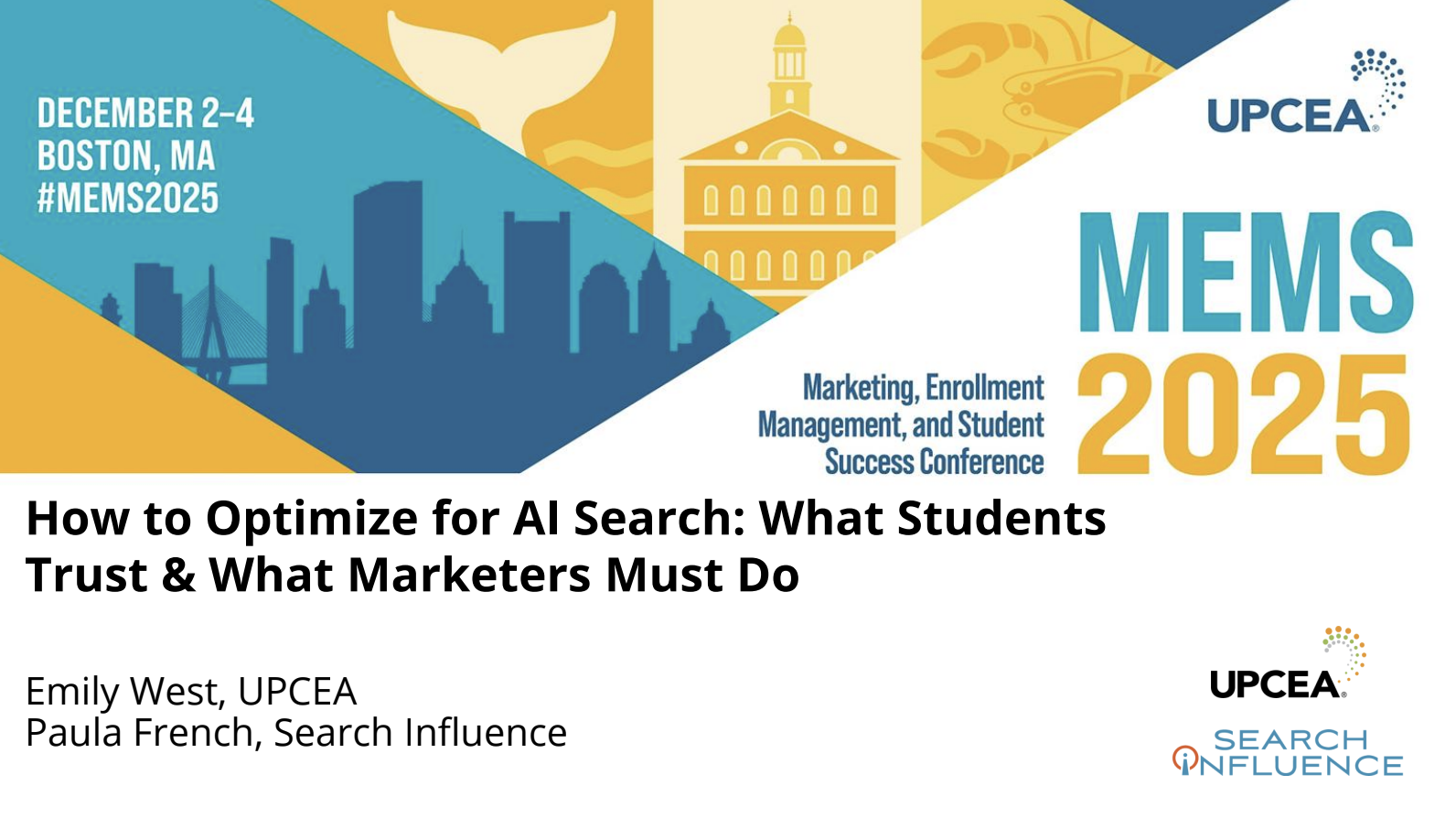
    1. How to Optimize for AI Search: What Students Trust & What Marketers Must Do

    Presenters:

    Emily West and Paula French opened with research that cuts through the speculation.

    The Data:

    • 1,061 individuals surveyed
    • 760 met the qualification criteria
    • One of the largest datasets on student search behavior in the AI era

    What This Means:

    The presentation revealed which search platforms students actually trust and how they perceive AI-driven results. The answer isn’t what most institutions assume.

    The Finding That Stopped Everyone:

    During the Insights & Innovation session (UPCEA’s industry insights presentation), a statistic was mentioned that should prompt every higher education marketer to pause: University websites appear in only 3% of AI Overviews.

    Let that sink in.

    Students are using AI search. AI is generating answers. And institutional websites are barely showing up.

    Students use different platforms for different purposes. They place varying levels of trust in AI-generated results versus traditional search. And they’re developing new research patterns that institutions need to understand.

    The Actionable Part:

    West and French didn’t just present data. They shared strategies for:

    • Creating content that AI systems actually cite
    • Building authority that makes AI search engines trust your institution
    • Understanding the nuanced ways students use AI tools, search engines, and university websites

    The Bottom Line:

    If you’re not thinking about AI search visibility, you’re already behind. The opportunity gap is massive, and it’s only getting wider.

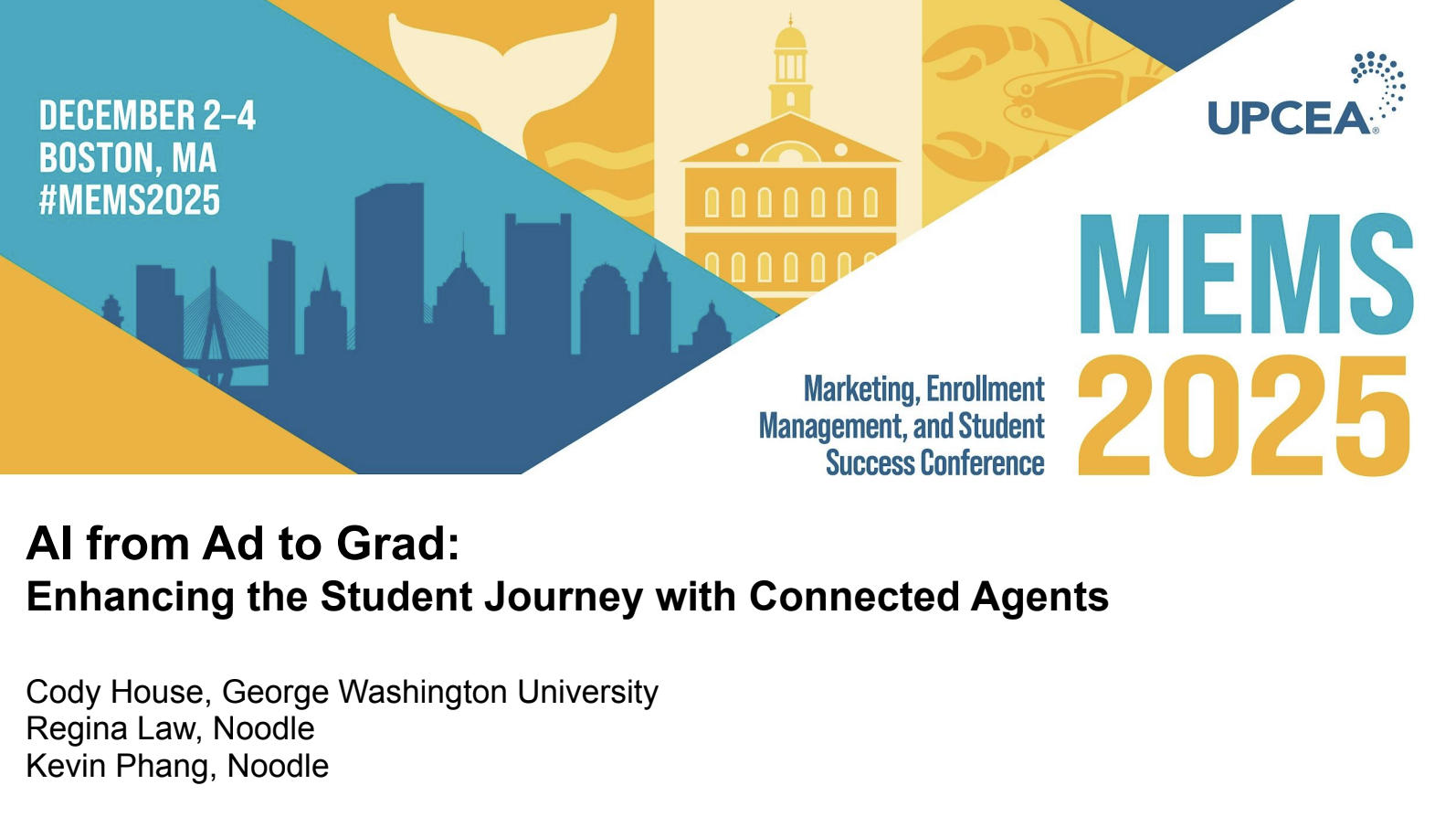
    2. AI from Ad to Grad: Enhancing the Student Journey with Connected Agents

    Presenters:

    This session changed how we think about AI in higher education.

    Most institutions treat AI as a point solution — maybe for chatbots, maybe for content generation. But GWU and Noodle showed something different.

    The Concept: Connected Agents

    Rather than isolated AI tools, they’re building AI systems that work together across the entire student journey, from first advertisement to graduation.

    Consider this: An AI agent that assists with initial inquiries shares context with the enrollment agent, which in turn shares context with the student success agent. Each interaction builds on the last.

    Why This Matters:

    The session’s title, “AI from Ad to Grad,” captures the scope. This isn’t about optimizing one touchpoint. It’s about creating a seamless, intelligent experience that follows students throughout their entire journey.

    The Practical Applications:

    The presentation explored how institutions can:

    • Create AI systems that anticipate student needs rather than just respond
    • Build integrated ecosystems instead of point solutions
    • Develop partnerships that enable comprehensive AI implementation

    The Takeaway:

    AI works better when it’s connected. Isolated tools create isolated experiences. Connected agents create momentum.

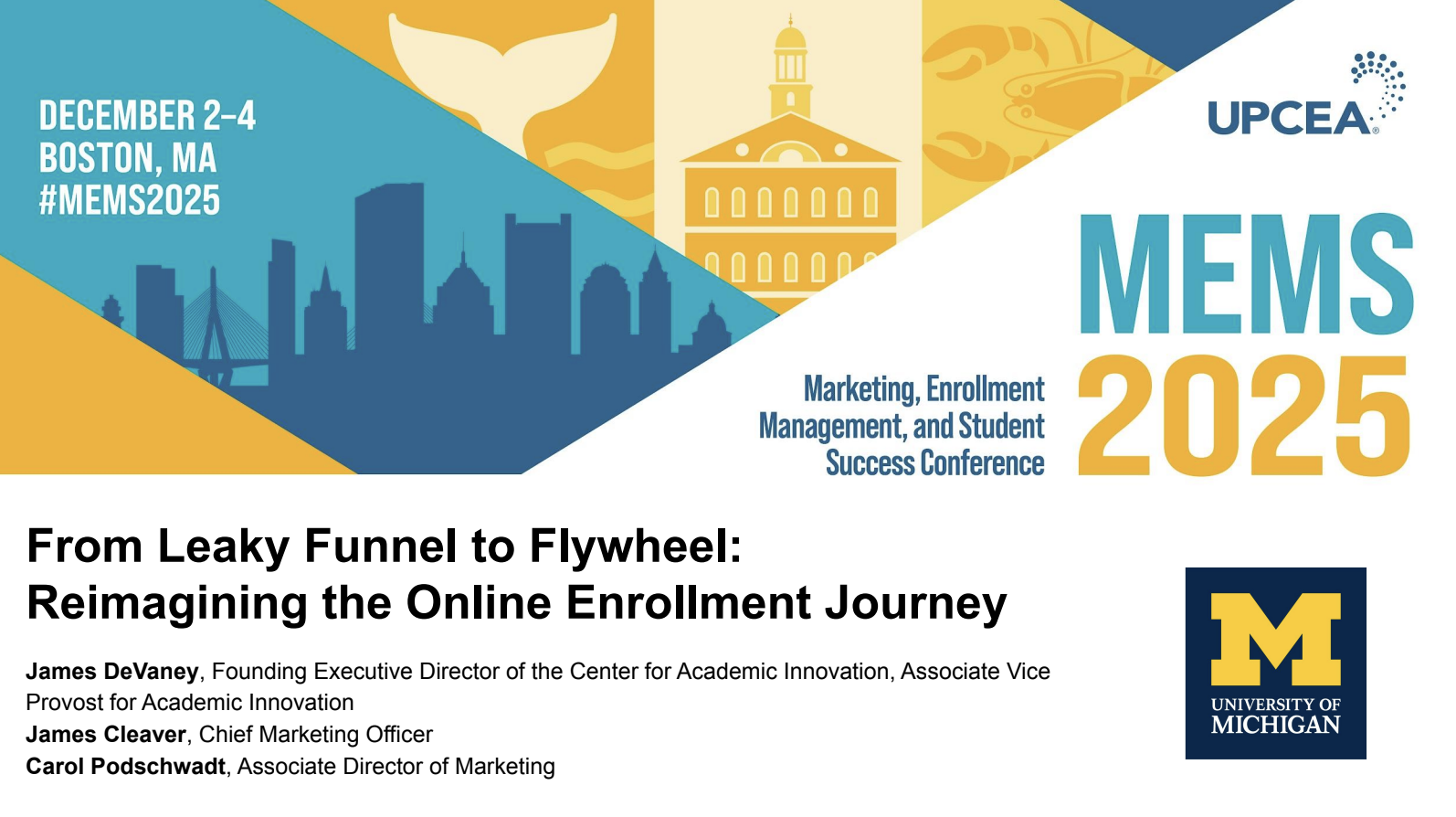
    3. From Leaky Funnel to Flywheel: Reimagining the Online Enrollment Journey

    Presenters:

    This might have been the most conceptually transformative session of the conference.

    The Problem With Funnels:

    The University of Michigan team made a compelling case: The traditional funnel model is fundamentally flawed for modern enrollment.

    Funnels are leaky. They’re one-way. They require constant input of new marketing dollars.

    The Flywheel Alternative:

    Instead, they proposed a self-reinforcing system:

    • Satisfied students create success stories
    • Success stories attract more students
    • More students create more success stories
    • The momentum builds on itself

    This isn’t semantics. It’s a complete reimagining of how institutions approach enrollment.

    The Real-World Proof:

    What made this session powerful: U-M has actually implemented this. They shared real examples of how the flywheel model works in practice.

    The Framework:

    1. Build systems where student success creates marketing momentum
    2. Reduce dependency on constant new marketing spend
    3. Create self-sustaining enrollment cycles

    Why It Works:

    Instead of constantly chasing new prospects, institutions can build systems that naturally attract and convert students while improving the experience for current students.

    The flywheel compounds. The funnel just leaks.

    4. DIY Digital: In-House Strategies That Scale — From Startup to Powerhouse

    Presenters:

    One of the most practical sessions came from two powerhouse institutions sharing their journeys.

    The Question Every Institution Faces:

    When do you outsource marketing? When do you build in-house?

    Purdue and Florida provided frameworks for making that decision, and more importantly, guidance on transitioning between models.

    The Honest Assessment:

    Both teams spoke from experience about the benefits of in-house operations. But they were refreshingly honest about the challenges and trade-offs.

    This wasn’t a sales pitch. It was a balanced exploration of how to scale from startup-level operations to powerhouse marketing teams.

    The Decision Framework:

    1. Assess your institutional needs
    2. Evaluate vendor vs. in-house capabilities
    3. Plan transitions that don’t disrupt operations
    4. Build internal capabilities while maintaining quality

    The Key Insight:

    There’s no one-size-fits-all answer. However, there are frameworks available to help you make the right choice for your institution’s unique situation.

    5. From Click-Chasing to Trust-Building: The AI Marketing Shift

    Presenters:

    This session addressed one of the most fundamental shifts in marketing today.

    The Old Playbook:

    Optimize for clicks. Maximize conversions. Track immediate ROI.

    The New Reality:

    In an AI-driven landscape, that playbook doesn’t work the same way.

    AI systems prioritize authoritative, trustworthy content. They recognize long-term value over quick conversions. They build on relationships, not transactions.

    The Shift:

    The title says it all: “From Click-Chasing to Trust-Building.”

    Success isn’t measured just in clicks and conversions. It’s measured in how institutions are perceived by:

    • AI systems
    • Search engines
    • Prospective students (who are increasingly sophisticated about evaluating marketing messages)

    The Strategy:

    Build long-term trust, authority, and value. Create content that AI systems recognize as reliable. Focus on relationships that extend beyond the initial inquiry.

    The Bottom Line:

    Click-chasing is a short-term game. Trust-building is how you win in the AI era.

    6. Insights & Innovation: Strategic Perspectives from UPCEA’s Trusted Corporate Partners

    Presenters:

    • Will Scott, Search Influence
    • Tracy Kreikemeier
    • Shauna Cox
    • Jennifer Blassingame

    (Full disclosure: This is our group session, so we’re recapping what we presented.)

    Session Focus: Are You Showing Up? How to Track Visibility in AI Search

    The Problem:

    Most institutions have a critical gap in their analytics: Traditional SEO tracking doesn’t capture AI Overviews, AI-generated answers, or how institutions appear in AI-powered search experiences.

    The Question:

    How do you know if your institution is actually appearing in AI search results?

    The Challenge:

    You can’t optimize for what you can’t measure. And traditional analytics tools weren’t built for the AI search landscape.

    The Solution:

    We shared tools and strategies specifically designed for monitoring AI search presence. The goal isn’t just knowing whether you’re showing up — it’s understanding how you’re appearing and in what contexts.

    The Framework:

    1. Track visibility in AI search results (tools that traditional analytics miss)
    2. Understand AI Overviews and their impact
    3. Monitor AI search presence across platforms
    4. Position your institution to appear in AI-generated results

    The Actionable Part:

    This isn’t just about SEO in the traditional sense. It’s about understanding how AI systems evaluate and surface content, and how institutions can position themselves to be included.

    The Tools:

    Several AI SEO tracking platforms are available now. The tracking piece is becoming a commodity — the value is in what platforms do with that data.

    The Takeaway:

    If you’re not tracking AI search visibility, you’re flying blind. And you can’t optimize what you can’t see.

    7. Designing with Data: Using Surveys and Stories to Shape Online UX + ROI

    Presenters:

    • Auris Calvino, Associate Director of Online Marketing and Communications
    • Lindi Ragsdale, Associate Director of Online Data, Technology, and Operations

    This session addressed one of the most common problems in higher ed marketing.

    The Gap:

    Institutions collect student feedback. But do they actually act on it?

    The session opened with a provocative question: “How confident are you that your institution is acting on student feedback and not just collecting it?”

    The Problem:

    Survey fatigue. Data that sits unused. Feedback that doesn’t drive change.

    The Solution:

    Combine quantitative survey data with qualitative stories. Use data to inform UX decisions that actually improve outcomes.

    The Framework:

    1. Collect both quantitative and qualitative data
    2. Bridge the gap between collection and implementation
    3. Create systems where feedback drives continuous improvement
    4. Measure ROI through data-driven design

    The Key Insight:

    Measuring and improving ROI requires both:

    • Quantitative rigor (Ragsdale’s data and technology background)
    • Qualitative insights (Calvino’s marketing and communications role)

    The Takeaway:

    Data is only valuable if it drives action. Too many institutions collect without implementing.

    8. In Marketing, Evolution isn’t Optional: Getting Ahead in an AI-driven World

    Presenters:

    West and Gonzalez presented findings from their 2025 research study.

    The Data:

    • 99 marketing and enrollment professionals surveyed
    • 62 met the qualification criteria
    • Insights into how institutions are responding to the AI revolution

    The Finding:

    61% of respondents say their institution is receptive to emerging technologies.

    That’s up from just 40% in 2024.

    What This Tells Us:

    Institutions are recognizing the need to evolve. The question is whether they’re actually implementing change or just acknowledging the need.

    The Trends:

    The research revealed emerging trends in higher education marketing and enrollment management, showing how institutions are adapting (or struggling to adapt) to new technologies.

    The Gap:

    There’s a difference between recognizing the need to evolve and actually implementing change. The study explored that gap.

    The Actionable Insights:

    The presentation translated findings into actionable insights for institutions looking to get ahead rather than just keep up.

    The Bottom Line:

    Evolution isn’t optional. But recognition without implementation doesn’t count.

    9. From Search to Success: Integrating SEO and Email Marketing to Drive Enrollment

    Presenters:

    • Tim Grenda, SEO and Content Manager
    • Caitlin Dimalanta, Marketing Communications Specialist

    This session addressed one of the most common problems in digital marketing: silos.

    The Problem:

    SEO and email marketing are often managed separately. They operate in isolation. They don’t work together.

    The Solution:

    Integrate SEO and email marketing strategies into cohesive campaigns.

    The Framework:

    1. Break down channel silos
    2. Create campaigns that span search and email
    3. Repurpose search-optimized content through email
    4. Use email engagement data to inform SEO strategy

    The Synergy:

    Content optimized for search can be extended through email. Email engagement data can inform SEO strategy. The channels work better together than apart.

    The Takeaway:

    Integration beats isolation. Every time.

    10. Boosting SEO & Engagement Through Testimonial-Driven Web Content

    Presenters:

    This session addressed one of the most effective but underutilized content strategies.

    The Strategy:

    Leverage student and alumni testimonials for both SEO and engagement.

    The Balance:

    Many institutions struggle with this: How do you optimize for search while maintaining authenticity?

    The Answer:

    Authenticity and search optimization aren’t mutually exclusive. In fact, authentic student stories often perform better because they naturally include the language and questions that prospective students are searching for.

    The Multi-Purpose Approach:

    Testimonials can serve multiple purposes:

    • Improve SEO through natural language and long-tail keywords
    • Build trust with prospective students through authentic voices
    • Create engaging content that keeps visitors on site longer

    The Framework:

    1. Collect testimonials strategically
    2. Optimize for search while maintaining authenticity
    3. Deploy across multiple touchpoints
    4. Measure impact on both SEO and engagement

    The Takeaway:

    Maximize content value. One piece of content can serve multiple purposes if you think strategically.

    11. Education is a Business: Using ROI Data to Have Hard Conversations

    Presenters:

    This might have been the most candid session of the conference.

    The Reality:

    Institutions need to make data-driven decisions about where to invest marketing dollars. Those conversations aren’t always easy.

    The Challenge:

    Using ROI data to make strategic decisions isn’t just about numbers. It’s about:

    • Having the right data
    • Presenting it effectively
    • Navigating the political and cultural challenges that come with data-driven decision-making in higher education

    The Framework:

    1. Measure ROI accurately
    2. Communicate insights clearly
    3. Navigate institutional politics
    4. Make decisions that balance educational mission with financial reality

    The Honesty:

    The presenters were refreshingly honest about what works, what doesn’t, and how to handle difficult situations when data suggests changes that institutions may be reluctant to make.

    The Takeaway:

    Hard conversations are easier when you have the right data, presented the right way, with the right frameworks.

    Common Themes: What This All Means

    So, what do these 11 presentations tell us about where higher education marketing is heading?

    Three themes kept coming up:

    1. AI Search Visibility Is the New SEO

    Multiple presentations highlighted the critical need for institutions to adapt to AI-driven search environments.

    The reality: AI isn’t just another tool. It’s fundamentally changing how students discover, evaluate, and engage with institutions.

    The challenge: Success in AI search requires a different approach than traditional SEO. It’s about building authority, creating content that AI systems trust and cite, and understanding how AI Overviews are reshaping the discovery process.

    The opportunity: Institutions that aren’t thinking about AI search visibility are already falling behind. The gap will only widen.

    2. Integration Beats Silos

    Many sessions focused on integrating marketing channels and strategies rather than operating in isolation.

    The reality: Isolated tactics don’t work in the modern marketing landscape.

    The solution: Successful institutions think holistically about the student experience, creating integrated systems where different channels and touchpoints work together.

    The framework: Think systems, not silos.

    3. Data Only Matters If It Drives Action

    Several presentations addressed the gap between collecting data and actually using it.

    The problem: Too many institutions collect data that sits unused.

    The solution: Institutions need frameworks for interpreting data, communicating insights, and using information to drive decisions.

    The framework: Data → Interpretation → Communication → Action

    The Bottom Line: What Institutions Need to Do Now

    Based on what we learned at MEMS 2025, here’s what institutions should prioritize:

    1. Start Tracking AI Search Visibility

    If you’re not measuring how you appear in AI Overviews and AI-generated answers, you’re flying blind. Traditional SEO analytics don’t capture this.

    2. Build Integrated Systems

    Stop thinking in silos. Start thinking about how channels work together. Whether it’s SEO and email, or AI agents throughout the student journey, integration beats isolation.

    3. Close the Data-to-Action Gap

    Collecting data isn’t enough. You need frameworks for interpreting, communicating, and acting on insights.

    4. Focus on Trust and Authority

    In an AI-driven landscape, trust and authority matter more than clicks. Build long-term value, not short-term conversions.

    5. Think Flywheel, Not Funnel

    Build systems that create momentum. Student success should attract more students. That’s how you reduce dependency on constant new marketing spend.

    Resources and Next Steps

    Presentation Slides: Links to presentation slides will be made available through UPCEA’s member portal and conference resources.

    Presenter Contact Information: Many presenters are available for follow-up questions. Contact information can be found through UPCEA’s member directory or through the presenters’ institutions.

    Tools and Frameworks: Several sessions mentioned specific tools, frameworks, and resources. We’ll be sharing more on these in upcoming posts.

    The Conversation Continues:

    The question isn’t whether higher education marketing will continue to evolve. It’s whether individual institutions will evolve with it.

    What strategies are you implementing? What questions do you have? Let’s keep the conversation going.

    This recap is based on presentations from MEMS 2025, UPCEA’s Marketing and Enrollment Management Summit. For questions or to share your own insights, connect with us on LinkedIn or reach out through Search Influence.

    This recap reflects what we heard on stage.

    To understand how these trends are already showing up in real student behavior, explore Search Influence’s AI Search in Higher Education: How Prospects Search in 2025 research, conducted in partnership with UPCEA.

    The study reveals how prospective students utilize AI tools, search engines, and university websites in conjunction and what higher education marketers need to do now to remain visible in AI-driven enrollment decisions.

  • Search Influence Named a Finalist for Best SEO Campaign at the 2025 US Agency Awards

    Search Influence Named a Finalist for Best SEO Campaign at the 2025 US Agency Awards graphic

    We’re excited to share that Search Influence has been named a Finalist in the Best SEO Campaign category at the 2025 US Agency Awards for our AI-driven campaign, The Art of AI SEO, created in partnership with Maine College of Art & Design (MECA&D).

    This recognition marks our second consecutive year of being shortlisted for this category, following our Silver win in 2023 for Best Integrated Campaign, a testament to our continued excellence in SEO, technical strategy, and AI search innovation.

    The Nominated Campaign: The Art of AI SEO

    MECA&D launched three new online graduate certificate programs into a highly competitive market. To stand out against major universities, the institution needed to increase visibility across both traditional search engines and emerging AI-powered platforms.

    Our solution was an AI SEO strategy designed to boost discovery, strengthen authority, and drive enrollment.

    Our Strategy at a Glance

    AI Search Visibility

    We structured site content using semantic signals, schema markup, and clear topical architecture to ensure AI systems could retrieve and cite MECA&D pages.

    Conversion-Focused Program Pages

    We added video content, clarified messaging, and strengthened user pathways to support prospective students at every decision point.

    Content Development

    We produced keyword-driven blogs, instructor spotlights, and high-salience pages that positioned MECA&D as an authoritative voice.

    The Results

    Our AI-optimized SEO strategy fueled exceptional performance:

    • 77% above enrollment goals
    • 171% increase in website sessions
    • 3,894% growth in ranking keywords

    Today, MECA&D’s Arts Education, Expressive Arts Therapy, and Arts Leadership programs all appear in AI search engines, a major competitive advantage as generative results reshape student search behaviors.

    As MECA&D’s Associate Dean of Online Learning, Heather Holland, shared:

    “Our online programs exceeded enrollment targets by 65% in less than a year.”

    Leading AI SEO for Higher Education

    As a higher education digital marketing agency, Search Influence is at the forefront of AI search strategy. Our team combines decades of higher ed SEO experience with deep expertise in AI content structuring, generative search visibility, and technical optimization.

    Our CEO and Co-Founder, Will Scott, is a national thought leader in AI SEO and the instructor of an SMX Master Class on Generative Engine Optimization. Our approach has been grounded in semantic SEO and structured data since the earliest days of the Knowledge Graph, long before AI Overviews made structured content essential.

    We help higher education institutions:

    • Build full-funnel SEO strategies tied to enrollment goals
    • Improve program visibility in AI and organic search
    • Develop content ecosystems designed for both humans and AI systems
    • Strengthen authority through structured data, internal linking, and topic clusters

    2025 AI Search in Higher Education Research Study

    This announcement follows the release of our 2025 AI Search in Higher Education Study, which uncovers how prospective students use AI tools to research programs, evaluate institutions, and form their initial consideration sets.

    Higher ed marketers can access the full report to understand:

    • Which AI tools prospects use most
    • How AI citations influence credibility
    • What strategies institutions need to stay visible

    Looking Ahead

    We’re honored to be recognized by the US Agency Awards and grateful to MECA&D for their partnership. As AI search reshapes visibility, Search Influence remains committed to helping colleges and universities compete and win in this new era of search.

    If you’re ready to strengthen your AI SEO strategy, our team is here to help you lead. Contact us today to learn more.

  • Higher Education AI Search Strategy: What Students Expect vs. How Institutions Must Adapt

    Higher Education AI Search Strategy: What Students Expect vs. How Institutions Must Adapt graphic

    Key Insights

    • Students have shifted how they search.
      Prospective learners now use AI tools alongside traditional search, making structured, consistent program information essential for visibility.
    • Institutional readiness lags student behavior.
      Many colleges recognize the influence of AI search but still lack the systems and processes to monitor and improve their presence in generative results.
    • An AI search strategy requires core operational alignment.
      Institutions must unify program data, structure pages for AI readability, reinforce entity signals, and maintain ongoing data hygiene to stay competitive.

    Half of prospective students use AI tools weekly. Nearly 80% read Google’s AI Overviews before clicking a single search result. 

    For most higher education institutions, that means students are forming opinions about your programs before they ever reach your website. If your information isn’t structured for AI retrieval, you’re invisible during the moment that matters most.

    The UPCEA x Search Influence AI Search in Higher Education Research Study tracked how students search for programs in 2025. A parallel Snap Poll of 30 UPCEA members measured institutional readiness. Together, they reveal a sector-wide gap: students have moved to AI-assisted search faster than colleges have adapted their content strategies.

    This guide breaks down how students search today and outlines the four operational components institutions need to compete for visibility in AI search.

    The New Student Discovery Model and Its Impact on AI Search Visibility

    Higher ed has spent decades optimizing solely for traditional search engines. The challenge now is optimizing for how students actually gather information. That behavior looks much different today than it did even two years ago.

    Students want direct answers, quick comparisons, and credible signals, and they toggle between tools to get them. Generative AI fits naturally into that pattern because it delivers instant interpretation without requiring students to click through multiple pages or sift through fluffy marketing copy.

    AI tools have become routine

    What once felt like experimental search is now embedded in the routine research process.

    • 50% of prospective students use AI tools weekly
    • 79% read AI Overviews before clicking a single blue link

    AI compresses the “orientation” phase of search, the stage where students try to understand what a program involves and which institutions align with their goals. Historically, that moment used to happen on your website. Now it happens in a summary box before a student decides whether your program is worth investigating further.

    If that summary box is inconsistent or simply missing your institution entirely, you’ve lost visibility at a moment that shapes early impressions.

    Students layer Google, YouTube, & AI together

    Even with all the AI buzz, students aren’t abandoning traditional search engines in their search for professional and continuing education (PCE) programs. They’re simply supplementing them.

    • 84% still use traditional search for core information
    • 61% use YouTube to explore programs visually
    • 50% use AI tools for context and comparison

    This creates a layered research journey where each channel serves a specific function:

    1. AI platforms provide the first pass of understanding — condensing program details and requirements, and fitting them into digestible summaries
    2. Google (and other search engines) expand the options — surfacing alternative programs, comparison articles, and third-party reviews
    3. YouTube shapes expectations and emotional resonance — showing campus life, faculty interviews, and student testimonials
    4. Institution websites verify credibility — confirming details, checking accreditation, and exploring outcomes data

    Consistency in presence and messaging across each channel is the new baseline for visibility.

    Universities still hold trust, but AI sets the stage

    Despite the rise of new tools, institutions remain the source students trust most. 77% rely on university websites to verify program information.

    But in many cases, students don’t start with you. They end with you.

    A very typical sequence now looks like this:

    1. AI-generated overview or citation → Initial understanding and shortlist formation
    2. Verification on .edu pages → Credibility check and detail confirmation
    3. Shortlist decisions → Final comparison and enrollment consideration

    AI shapes the expectation. Your website proves (or disproves) the details. Accuracy and clarity must exist in both places for a student to move forward. (Example: If the AI search results say your MBA is 18 months and your program page says 24 months, the friction kills momentum.)

    This reversed discovery model has profound implications for content strategy. You can no longer afford to treat your website as the sole first impression. It’s now the verification step. And if AI has already set the wrong expectation, your website becomes a correction tool instead of a conversion tool.

    Source: UPCEA x Search Influence — AI Search in Higher Education: How Prospects Search in 2025

    Institutional Readiness: Where Colleges Stand in 2025

    If student search trends are moving quickly, institutional readiness is moving much slower. Conducted with 30 UPCEA members, the UPCEA x Search Influence Snap Poll reveals a sector that understands the importance of AI search but lacks operational capacity to support it.

    Most institutions know AI matters. The question is whether they have the bandwidth, expertise, and internal alignment to respond.

    Awareness is high, execution is thin

    The majority of institutions recognize that AI is reshaping the discovery process. But knowing and acting are two very different things.

    • 60% are in the early stages of “exploring” AI search
    • 30% have a formal AI search strategy
    • 10% haven’t started or don’t believe AI will impact program discovery

    “Exploring” signals curiosity, but not implementation. A formal strategy requires solid infrastructure (ownership, processes, consistency), and that’s where many institutions are falling behind.

    Without clear ownership, AI search becomes everyone’s concern and no one’s responsibility. Marketing assumes IT will handle technical implementation. IT assumes marketing will define content standards. Enrollment assumes someone else is tracking whether programs appear accurately in AI summaries. Meanwhile, competitor institutions with defined workflows are reinforcing their visibility signals daily.

    The barriers are structural, not philosophical

    No one is debating whether AI-driven search matters. The bottlenecks are operational:

    • 70% cite limited bandwidth or competing priorities
    • 36.67% cite lack of in-house expertise or training
    • 26.67% cite unclear ROI or uncertainty about AI mechanics

    AI systems evolve monthly. Waiting six months to decide “what to do” means falling behind institutions that have already begun reinforcing their information. Every month your program data remains inconsistent is another month AI models learn to trust competitor sources instead of yours.

    Visibility tracking is still inconsistent

    When asked whether their institution appears in AI-generated answers:

    • 56.7% said “yes”
    • 26.7% said “maybe”
    • 13.3% said “uncertain”

    Only 64.29% of those tracking use structured methods, like formal AI SEO tracking tools.

    If institutions don’t know when or how they’re appearing, they also can’t know:

    • Whether AI summaries are accurate
    • Whether competitors appear more frequently
    • Whether certain programs are misrepresented

    Guessing is not a visibility strategy. Without structured monitoring, institutions can’t identify which programs underperform in AI search, can’t track whether content updates improve citation frequency, and can’t benchmark their visibility against regional competitors.

    Early movers are motivated by accuracy & competition

    Among the institutions already adopting an AI search strategy:

    • 59.26% want to ensure the accuracy of AI-generated information
    • 48.15% are focused on visibility and competitive positioning

    Meanwhile:

    • 22.22% say other priorities rank higher
    • 14.81% are “waiting to see what happens”

    The difference between these groups is trajectory. Early adopters move ahead while others accumulate visibility debt, the long-term disadvantage that forms when AI systems learn from competitors instead of from you.

    Institutions waiting for clearer ROI data or more mature tracking tools are making a strategic bet that the cost of delay is lower than the cost of early action. For some, that bet may prove correct. For most, it won’t.

    Source: AI Search Strategy in Higher Education — Snap Poll, October 2025

    AI Search in Higher Ed infographic

    Core Components of a Modern Higher Education AI Search Strategy

    Generative search engines don’t reward creativity. They reward clarity. Winning page one and the AI Overview depends on whether a program’s information is consistent, structured, and reinforced everywhere a student or AI tool might encounter it.

    1. Establish program data consistency as the institutional source of truth

    AI models may “misstep” when foundational information is inconsistent. If your academic catalog lists a different cost than the program page, or if PDFs still reference old admissions cycles, AI defaults to whichever source appears most stable, and that isn’t always your institution.

    Your information cleanup has to start with the facts:

    • Cost — tuition, fees, financial aid opportunities, and total program investment
    • Duration — credit hours, typical completion time, and pace options
    • Modality — online, hybrid, in-person, or flexible formats
    • Requirements — prerequisites, application materials, and admission standards
    • Outcomes — employment rates, salary data, and career paths

    When these details are aligned across catalogs, PDFs, program pages, and third-party listings, AI no longer has to choose between conflicting answers. Consistent facts increase trust, and trust improves visibility.

    Program pages can’t be accurate until the underlying data is

    Data consistency isn’t a content problem. It’s a governance problem. Most institutions store program information in multiple systems: student information systems, content management systems, PDF repositories, third-party directories, and marketing automation platforms. Each system may reflect different update cycles, approval processes, and data owners.

    The solution isn’t consolidating all systems into one platform. It’s establishing a single source of truth for core program attributes and building workflows that propagate updates across all systems simultaneously. When tuition changes, that change should flow to every digital property within hours, not weeks.

    2. Build an AI-readable content architecture on program pages

    Even perfectly aligned information can underperform if the page structure makes it hard for AI to interpret. Generative tools scan for clarity, hierarchy, and explicit answers to common user queries.

    Pages are strongest when the essentials sit in predictable, machine-readable patterns:

    • Clean headings that signal structure and topic boundaries
    • Modular sections focused on single topics without mixing concerns
    • Concise explanations that answer specific questions directly
    • Scannable details formatted for quick extraction (tables, lists, definition blocks)

    Students prefer this structure, too. Clear sections for cost, schedule, outcomes, and requirements shorten the time between interest and understanding. AI prefers the same format because it speaks its “language” and reduces ambiguity.

    When program pages feel like reference material rather than brochure copy, visibility improves

    AI-readable architecture doesn’t mean stripping personality from your content. It means organizing information so both humans and machines can extract what they need quickly. You can still include testimonials, brand messaging, and storytelling, but those elements should supplement structured information, not replace it.

    Consider how AI extracts content. It doesn’t read your page top to bottom like a human. It scans for semantic patterns, identifies chunks that answer specific queries, and evaluates whether those chunks are self-contained and coherent. A program page that buries cost information in the middle of a narrative paragraph underperforms compared to one that lists cost in a clearly labeled section with supporting context.

    3. Strengthen program entities through cross-site signals

    AI search isn’t keyword-based. It’s entity-based.

    Models build their understanding of a program by connecting signals across your entire ecosystem. If terminology shifts from page to page, if key details appear in one place but not another, or if older content contradicts newer versions, entity confidence drops.

    Cross-site reinforcement matters:

    • Consistent terminology across all digital properties
    • Internal linking that clarifies relationships between programs, departments, and requirements
    • Schema markup that defines program attributes in a machine-readable format
    • Repetition of essential facts across relevant pages to reinforce entity stability

    The more stable and coherent the entity, the more likely AI is to cite it.

    This is how institutions move from “we sometimes appear” to “AI consistently references us”

    When a student asks an AI tool, “What are the prerequisites for the MBA program at [your institution]?”, the AI doesn’t just check your MBA page. It checks every page where those prerequisites might be mentioned: department pages, catalog entries, PDF documents, and FAQ sections. If those sources conflict, AI either omits your institution or presents the information with lower confidence.

    Schema markup amplifies entity strength by explicitly defining relationships. When you mark up your MBA program with structured data that identifies its parent department, associated faculty, duration, and cost, you help AI understand not just what the program is but how it fits into your institutional structure.

    4. Implement ongoing AI visibility monitoring & data hygiene

    AI visibility is not a one-time project. Models update frequently, and each update reshapes which programs they surface, how they phrase details, and which institutions they trust.

    Monitoring needs to be ongoing and structured around:

    • Citation frequency — how often your programs appear in AI responses
    • Accuracy of summaries — whether AI-generated descriptions match your current information
    • Sentiment and positioning — how your programs are characterized relative to competitors
    • Competitor visibility — which institutions are appearing when yours aren’t

    This level of tracking enables institutions to identify patterns early, correct inaccuracies quickly, and establish authority over time. 

    About Search Influence’s support with AI visibility tracking

    Unsure where to start? Our team provides structured AI traffic reporting that shows how your programs appear across generative platforms and where inconsistencies may be affecting trust. As your tracking partner, we can help your institution gain clear visibility into patterns, changes, and gaps, helping you prioritize the data and content updates that strengthen your position in AI search engines.

    Get the research shaping modern AI search. → 

    FAQs About Higher Education AI Search Strategy

    How does AI decide which programs to cite?

    AI looks for information that is consistent, structured, and verifiable across multiple pages and sources. Programs with aligned facts and clear architecture are more likely to appear.

    How can leadership be convinced to prioritize AI search visibility?

    Show the connection between visibility and enrollment. Students are forming opinions before they reach institutional websites, and institutions that don’t appear in AI-generated search results lose those early moments of influence.

    How often should institutions audit program pages for AI readiness?

    Quarterly, if not more. AI models update rapidly, and audits ensure that key information remains up to date, content structure remains clean, and external listings don’t drift out of alignment.

    What KPIs indicate improvement in AI discoverability or trust?

    Citation frequency, accuracy, sentiment, and competitor comparisons. These KPIs signal whether AI considers your institution a stable source of truth.

    Students Have Shifted Their Discovery Habits. Your AI Search Strategy Must Catch Up.

    AI isn’t a future threat. It’s an active influence in how prospective students search for programs and decide which institutions to trust. 

    Your student search guide

    Based on survey data from 760 prospective adult learners, the UPCEA x Search Influence AI Search in Higher Education Study offers the most comprehensive view of how prospects utilize AI for program research.

    Use the data to:

    • Align leadership around AI search priorities
    • Identify priority programs for content optimization
    • Plan FY26 content investments with confidence
    • Benchmark readiness against peer institutions
    • Strengthen your visibility signals across search engines and AI tools

    AI search is already shaping enrollment. Institutions that build their strategy now will lead the next phase of visibility.

    Download the full study to get the complete data set and a clearer view of how to modernize your AI search strategy.

  • UPCEA Guest Blog: Paula French on AI Search Trends in Higher Education

    AI Search in Higher Education

    When prospective students begin researching programs, their first stop may no longer be your website…. or even Google

    Many now use generative AI platforms like ChatGPT, Gemini, and Perplexity to ask questions, compare options, and find fast answers. These tools influence what students see, what they trust, and which institutions they choose to explore further.

    In her latest guest blog for UPCEA, “AI Search in Higher Education: The Student Search Trends You Can’t Ignore,” Director Paula French breaks down what this shift means for enrollment marketers. 

    Drawing on insights from the new UPCEA x Search Influence research study, AI Search in Higher Education: How Prospects Search in 2025, Paula shares a data-backed look at how students search today — and what your team can do to improve visibility across every touchpoint.

    Top AI Search Trends in Higher Education 

    The study surveyed 760 adult learners aged 18–60 who are actively exploring educational opportunities. Their responses point to a growing reliance on digital tools that extend far beyond search engines.

    • 50% of students use AI tools weekly
    • 79% read Google’s AI Overviews
    • 56% are more likely to trust institutions cited in those Overviews
    • 61% use YouTube like a search engine
    • 77% consider university websites to be highly trustworthy

    Together, these numbers reflect a major shift in how trust is built and how options are evaluated during the early stages of the enrollment process.

    How to Improve Visibility Where It Counts

    Paula’s guest blog offers clear, actionable strategies for improving performance in AI and traditional search, including:

    • Structuring content with clarity using headings, bullet points, and schema markup
    • Including factual, up-to-date program details that AI tools prefer to cite
    • Publishing trust-building content like faculty bios, accreditation info, and student outcomes
    • Monitoring your presence in AI tools like ChatGPT, Gemini, and Perplexity to see what students are seeing
    • Auditing your site’s search performance to make sure you’re showing up where students begin their research

    Students are forming impressions earlier in the decision-making process, and they’re doing it in spaces many institutions aren’t actively monitoring. That’s a missed opportunity, and one that’s becoming harder to ignore.

    For a closer look at the data (plus tips on how your institution can adapt), read Paula’s full guest post.

    See Paula and the Team at MEMS 2025

    Attending UPCEA’s 34th Annual MEMS: Marketing, Enrollment Management, and Student Success Conference in Boston this December? Stop by the Search Influence booth to connect with Paula French, Jeanne Lobman, and Will Scott.

    Paula will also co-present with Emily West of UPCEA in a featured session titled:
    “How to Optimize for AI Search: What Students Trust & What Marketers Must Do” on Wednesday, December 3rd at 3:30 PM.

    The discussion will dive deep into student behavior and outline a strategic approach to visibility built around the pillars of AI SEO.

    View session details →

  • Higher Education SEO Trends in 2025: How to Compete

    Higher Education SEO Trends in 2025: How to Compete

    Key Insights

    • AI-Driven Search Requires Adaptation

      Emerging technologies like Google’s AI Overviews are reshaping search visibility. Universities must optimize content for AI retrieval, emphasizing depth, authority, and structured data to stay competitive.

    • Social Search Is Reshaping Discovery

      Younger audiences increasingly use social platforms for search. Universities must integrate SEO strategies with social media, prioritizing engaging, visual content to enhance discoverability.

    • SEO Roadmap Ensures Long-Term Success

      A structured SEO roadmap helps universities systematically improve rankings. Key actions—keyword research, content updates, and link-building—align institutions with evolving search algorithms.

    SEO IS THE FOUNDATION OF YOUR MARKETING STRATEGY

    Why Is Higher Education SEO Important?

    Higher education SEO ensures universities stay visible in search results, attracting prospective students.

    With students relying on search to research programs, strong SEO improves rankings, enhances discoverability, and increases enrollment opportunities. Optimizing for AI search, social search, and evolving algorithms is critical for maintaining a competitive edge.

    Yet, according to our recent Higher Ed SEO Research Study developed with UPCEA, 51% of universities lack an established SEO plan.

    This oversight in strategy puts institutions at a disadvantage when it comes to improving search engine rankings and standing out in a crowded market.

    For universities ready for export guidance for 2025, an SEO roadmap serves as a crucial starting point to bridge this gap and develop a program-focused SEO strategy that incorporates upcoming trends.

    Search Influence’s SEO roadmap provides a customized guide for one key academic program including recommendations for:

    • Keyword strategy
    • Content strategy
    • Link building
    • Technical SEO optimizations

    But before you climb the Everest that is search engine visibility in 2025, you should know what to expect.

    In this blog, we’ll explore the key SEO trends impacting higher education and discuss how universities can develop a strategy to improve their search engine rankings and connect with prospective students.

    SEO Higher Education Trends in 2025

    Small animated rocket flying away from 3D computer browser windows, charts, and data

    Impact of AI Overviews on higher ed SEO

    As search continues to evolve, higher education digital marketers must leverage generative engine optimization (GEO) to reach their target audiences. Understanding AI Overviews is the first step in mastering this new form of search.

    In May 2024, Google introduced AI Overviews as part of its Search Generative Experience at Google I/O. This new feature leverages Google’s generative AI model, Gemini, to provide users with quick answers to their queries. AI Overviews generate brief snippets based on Google AI’s understanding of the question and relevant content from across the web.

    Alongside the generated answer, Google includes links to resources, allowing users to dive deeper into the topic if they choose.

    Possible challenges of AI Overviews

    • Informational content pushed down: Blog posts or general content on university websites are often pushed lower in search results by AI-generated responses, impacting traffic that universities previously earned from organic search results..
    • Limited visibility for non-featured websites: Educational institutions not featured in AI Overviews may struggle to gain online visibility, even if they rank well on traditional search engine results pages (SERPs).
    • Lack of content attribution: AI Overviews pull content from various sources without clear attribution, making it harder for universities to gain proper recognition or build brand awareness.
    • Reduced prominence of featured snippets: As AI Overviews take up more space in search results, traditional featured snippets may become less visible, reducing visibility for universities who worked hard to gain this placement.

    Strategies to overcome AI Overview challenges

    • Create detailed, well-researched content: AI Overviews often provide brief, surface-level answers. Universities can encourage users to click through and engage with the full material by developing in-depth content that offers more comprehensive insights.
    • Target long-tail keywords and specific queries: Focus on relevant keywords and highly specific searches that AI Overviews do not fully address. These keywords can help drive organic traffic from users seeking more detailed information, particularly for degree programs and specialized content.
    • Offer interactive content and direct user engagement: AI Overviews can’t replicate the value of user-driven experiences. By providing downloadable resources, webinars, or interactive tools, universities can offer unique value that sets them apart and builds stronger connections with prospective students.

    How social search is changing SEO for universities

    Social search is rapidly gaining traction, particularly among Gen Z and Millennials, who increasingly use social media platforms to find information, discover products, and learn about services. This shift away from traditional search engines like Google is transforming how universities must approach recruitment SEO. Social search leverages the dynamic, interactive nature of platforms like TikTok, Instagram, and YouTube, where user-generated content (UGC) and real-time interactions play a significant role in how information is consumed and shared.

    Beyond social platforms becoming an alternative to traditional search, social content itself has started to rank higher in Google search results. This means that what universities post on social platforms impacts their visibility on social media and plays a crucial role in their overall SEO strategy.

    Possible challenges of social search for universities

    • Changing search habits: As Gen Z and Millennials shift towards social search, traditional SEO tactics designed for search engines like Google may not be as effective in capturing their attention. As social search continues to grow, higher ed websites must adapt to maintain visibility.
    • Limited control over rankings: Unlike traditional search engines, social search algorithms prioritize engagement over keyword optimization, making it harder for universities to rank higher based solely on incorporating relevant keywords. Social platforms are unpredictable, with ever-changing algorithms that often favor highly engaging content like likes, shares, and comments.
    • Engagement-driven visibility: Social search tends to favor content that generates high engagement, which can be difficult for universities to achieve organically without paid promotions. Smaller schools or institutions with less interactive content may find it challenging to compete with more popular or active brands.

    Strategies to overcome social search challenges

    • Repurpose content for social media: Universities can repurpose existing website content into highly shareable formats such as videos, infographics, or student testimonials on social media. This helps maintain a consistent message across platforms while catering to the content preferences of younger audiences.
    • Focus on visual content: Social platforms like Instagram and TikTok prioritize visual content, particularly videos. Incorporating multimedia into your digital marketing strategy is essential for keeping content relevant and visible for longer.
    • Boost engagement: To rank higher on social platforms —where algorithms prioritize engagement — universities need to focus on creating content that encourages interaction. Developing content that sparks discussions and encourages likes, shares, and comments can increase visibility in social search algorithms. For example, interactive posts like live Q&A sessions can help universities capture more organic search traffic from social platforms.

    Optimize “People Also Ask” to answer prospective students’ queries

    The “People Also Ask” (PAA) section in Google search results displays a list of questions related to the user’s original query. Each question can be expanded to reveal a brief answer, typically pulled from relevant websites. While PAA helps users quickly find information, it presents both challenges and opportunities for universities looking to attract prospective students through SEO for higher education.

    Competition for visibility is fierce, as the PAA box often pushes traditional organic search results further down the page. Even websites ranking on the first page may struggle to gain traffic. That’s why optimizing for PAA is critical. Prospective students increasingly rely on search engines to discover university programs, and the PAA box provides a valuable way to capture their attention.

    The good news is that structuring your content to answer PAA questions clearly and concisely also supports AI Overview visibility. This dynamic approach ensures that your educational website stays relevant in search results.

    Possible challenges of People Also Ask

    • Click-through rate (CTR) impact: Users may find their answers directly in the PAA section without needing to click through to a website, potentially lowering CTR even for high-ranking pages.
    • Answer quality control: Google pulls content for PAA from various sources, meaning the quality or accuracy of the answers won’t always reflect the expertise of your site, even if you provide more in-depth information.
    • Unpredictability of ranking in PAA: Google’s algorithm dynamically chooses which content to feature in PAA, making it difficult to guarantee your content will appear in this section.
    • Content cannibalization: If your content ranks both organically and in the PAA box, users might click on the PAA result, which offers less interaction and brand recognition than a direct visit to your site.

    Strategies and insights to overcome People Also Ask challenges

    • Provide concise answers to common questions: To increase the chances of appearing in the PAA section, create clear, concise answers within your content. Use structured headings and bulleted lists to make it easier for search engines to identify and feature your content.
    • Focus on long-tail queries: Target niche topics and long-tail keywords that have less competition. This can increase the likelihood of your content being featured in the PAA for specific questions related to your degree programs or student services.
      Build content around your expertise: Enhance the authority of your answers by including references to credible sources, expert quotes, and in-depth insights. This builds trustworthiness and improves your chances of being featured in PAA.
    • Use structured data: Incorporate technical SEO strategies such as structured data to help search engines better understand your content and increase its chances of appearing in the PAA box.

    Utilize video SEO to boost engagement with your audience

    Is video SEO the future of search?

    According to Hubspot, 96% of people say they watch explainer videos to learn more about a product.

    Let that sink in — 96% of people watch videos to learn more about a product!

    This underscores the importance for higher education institutions to create engaging video content.

    Video SEO involves optimizing your video content to rank higher in both search engine results and video platforms like YouTube and TikTok. This process includes targeting relevant keywords, optimizing video descriptions, transcribing videos, and creating high-quality content that engages viewers. Video SEO aims to increase visibility, drive organic search traffic, and boost audience engagement — all of which can improve your institution’s brand awareness and conversions.

    Not only does video SEO help with audience engagement, but it also contributes to improving your website’s search rankings, benefiting your overall SEO strategy.

    Possible challenges of video SEO

    • Competition: Platforms like YouTube and TikTok are highly competitive, with millions of videos uploaded daily, making it difficult for your content to stand out.
    • Time and resources: Creating and optimizing video content requires significant time, effort, and resources, more so than text-based content.
    • Technical SEO elements: Ensuring proper video metadata, schema markup, and fast loading speeds can be challenging, particularly when embedding videos on your site.
      User behavior: While video can be engaging, some users may prefer quick text results.

    Strategies and insights to overcome video SEO challenges

    • Create short-form videos: Whenever possible, create short, TikTok-style videos to answer users’ questions quickly. While longer videos can be valuable, short-form content is especially effective in the era of social search.
    • Keyword research: Focus on long-tail keywords specific to your audience’s search intent. This can help you target less competitive niches in the higher education space and boost your video content’s visibility.
    • Use engaging thumbnails and titles: Eye-catching thumbnails and compelling, keyword-rich titles can increase your click-through rates and overall engagement.
    • Include video transcripts: Transcripts make your content more accessible and provide search engines with additional text to crawl, improving your video’s SEO performance AND your website’s SEO. Transcribing your videos on your website also ensures you reach potential searchers who prefer reading content over watching a video.
    • Encourage engagement signals: Encourage viewers to like, share, comment, and subscribe. These engagement signals indicate to search engines that your content is valuable, increasing its chances of ranking higher.
    • Implement schema markup: Use proper schema markup to help search engines better understand your video content. This increases the likelihood of your video being featured in search results, especially in video carousels.
    • Consistent content creation: Regularly upload videos and promote them across multiple platforms, including your website. This consistency keeps your institution relevant and boosts your SEO efforts over the long term.

    Even universities need to prove E-E-A-T

    With AI Overviews as a dominant feature in search results, universities must focus more on creating authoritative, trustworthy content. Luckily, the search engine Goliath has laid out criteria for SEOs to do exactly that: Google E-E-A-T (Experience, Expertise, Authoritativeness, and Trustworthiness).

    These are the key factors Google uses when human reviewers evaluate the quality of content, especially for websites dealing with sensitive topics like higher education.

    E-E-A-T ensures that your institution’s content is accurate, well-researched, and delivered by credible sources — a must for higher education websites looking to thrive in today’s search engine results pages

    Leveraging authority and trustworthiness online is essential for universities to attract prospective students and build partnerships with academic and research institutions.

    Possible challenges of establishing E-E-A-T

    • Maintaining consistency: With various contributors producing content, ensuring that all pages across the university’s website meet E-E-A-T standards can be challenging.
    • Building authority: Smaller universities or newer programs often find it difficult to compete with established institutions in search rankings.
    • User trust: Consistently delivering accurate and up-to-date information is critical. Any outdated or incorrect content can damage the trustworthiness of the university.
    • Dynamic content: Frequent changes to curricula, research publications, and academic programs can make maintaining content relevance and authority resource-intensive.

    Strategies and insights to overcome E-E-A-T challenges

    • Highlight expertise: Feature content authored by faculty members, ensuring their credentials, academic achievements, and research experience are clearly showcased. Author bios and academic qualifications reinforce the expertise of your institution.
    • Enhance trustworthiness: Include student testimonials, case studies, and partnerships with respected organizations to build trust with prospective students and academic partners.
    • Content review process: Implement a rigorous content review and update schedule to ensure all information remains accurate, relevant, and aligned with the institution’s authority in the field.
    • Leverage user-generated content: Encourage reviews and success stories from current students and alumni. This content demonstrates real-world experience and fosters trust with your target audience.
    • Structured data and transparency: Use structured data to help search engine crawlers better understand the content on your site. Transparency in policies, admissions, and course details will enhance trust and improve your organic traffic.
    • Third-party mentions: Gaining citations or backlinks from respected educational sources, government websites, or reputable media outlets can help boost your university’s authority in search rankings.

    How an SEO Roadmap Can Help You Stay Ahead of SEO Trends

    In the ever-evolving world of higher education marketing, staying ahead of the latest trends is critical for attracting more prospective students.

    But how do you know where to start for an institution that’s attracting thousands of students to sometimes hundreds of programs?

    An SEO roadmap offers a strategic guide to ensure your university’s website remains visible and effective in search engine results.

    Here’s how an SEO roadmap will help fast-track your enrollment journey:

    Optimize for student search behavior

    An SEO roadmap provides valuable insights into how prospective students are searching for degree programs and other academic offerings. By understanding the keywords and phrases potential students use, your institution can adapt content to match their queries more effectively, helping you connect with a broader audience of prospective students.

    Adapt to algorithm changes

    Google’s search algorithms are constantly changing, which can impact your university’s website performance. An SEO roadmap ensures you stay on top of these changes by addressing updates like core algorithm shifts, mobile-first indexing, and search ranking signals. This helps your site maintain strong visibility in organic search results, keeping your content in front of more potential students.

    Stay ahead of emerging trends

    An effective SEO roadmap also accounts for emerging trends in the digital landscape, such as voice search, mobile-first indexing, and AI-generated results. These trends are crucial for reaching tech-savvy students who rely on the latest technology to find educational institutions. By adapting your SEO strategy to incorporate these changes, your university will stay competitive and relevant.

    Improve your content strategy

    An SEO roadmap offers actionable insights into what content updates your website needs and highlights new topics to address. It also identifies new types of content — such as videos, infographics, or interactive tools — that will help you engage your audience more effectively. This ensures your content marketing strategy aligns with both search engine algorithms and student interests, driving more organic traffic to your site.

    Gain authority through link building

    Building authority is key to ranking higher in search results, and an SEO roadmap helps identify valuable link-building opportunities. You’ll learn which websites your program should be featured on to gain credibility and boost your search rankings. Additionally, internal links can enhance the user experience and improve your site’s functionality, leading to better SEO performance.

    Stay Ahead of the Latest SEO Trends With Search Influence

    A screenshot of Google Analytics, showing 102 users for an unknown site in the last 30 minutes

    Uncover new opportunities to improve your educational website’s visibility and performance with an SEO roadmap tailored to your institution’s needs.

    At Search Influence, we provide actionable recommendations that align with the latest SEO for higher education strategies, ensuring your institution remains competitive in search results.

    Our team of SEO experts monitors evolving search engine trends and algorithm changes, so you feel confident that your strategy is up-to-date. With nearly two decades of experience, we understand the unique challenges faced by higher education institutions, and our SEO roadmap will help you capture the right search intent, increase rankings, and boost traffic.

    Looking for even more higher ed marketing insights?

    Don’t miss my presentations at the 2024 UPCEA MEMS conference in Philadelphia this December.

    My session, “Visibility is Vital: Maximize Enrollment by Tracking Marketing Metrics,” presented alongside Bruce Etter of UPCEA, will give valuable insights into which marketing metrics matter the most and how to use those metrics to optimize campaigns, maximize budget allocation, and improve conversions.

    I will also be presenting a 10-minute session “Practical Magic: How to Navigate 2025 SEO Trends” that will take a more in-depth look at all the higher education SEO trends covered in this blog.

    Contact our team today to learn more about all our digital marketing services.


    Images

    Unsplash and Unsplash

  • Gain Recruitment SEO Insights From Will Scott’s Recent UPCEA Blog Post

    Will Scott on Higher Education SEO Strategies for UPCEA Guest Blog

    Search Influence Co-Founder and CEO Will Scott recently wrote a guest blog post for our higher education marketing partners at UPCEA.

    The blog post, titled “Drive Success: Using Recruitment SEO to Fill Higher Education Seats,” takes an in-depth look at how higher learning institutions can utilize recruitment SEO to adapt to evolving demographics and industry shifts.

    In his blog post, the SEO expert argues that traditional higher education marketing tactics are not enough. Today’s learners discover and explore educational programs differently, and institutions need to adapt their strategies accordingly.

    Takeaways from Will Scott’s UPCEA Blog

    • The Enrollment Funnel in the Digital Age: Today’s students research programs online throughout their decision-making process. Marketers must ensure a seamless online experience, from the initial discovery to application completion. This reiterates the importance of recruitment SEO, or optimizing websites for search engines.
    • A Shrinking Traditional Market: The number of high school graduates is declining, forcing universities to redefine their ideal students. Adult learners and non-traditional students present new opportunities, but also challenges, as they may not be aware of programs that can help them achieve their goals.
    • The Power of SEO: A well-crafted SEO strategy can significantly improve a university’s online presence. It can increase brand awareness, attract qualified leads, and move potential students down the enrollment funnel. Search Influence and UPCEA’s Higher Ed SEO Research Study shows that 84% of marketing departments view SEO as important, but only half have a defined strategy.
    • Beyond Discovery: SEO isn’t just about getting noticed. Prospective students often conduct follow-up searches to validate their initial impressions. Consistent presence in search results builds trust and credibility. Conversely, an absence can undermine an institution’s efforts and benefit competitors.
    • Challenges to Effective SEO in Higher Ed: Many universities lack the resources or expertise to implement a strong SEO strategy. Professional, Continuing and Online departments may be understaffed or underfunded, and institutional leaders may not understand the value of SEO. A Search Influence study revealed that marketing departments rated their SEO skills as just average, and website audits showed significant room for improvement.

    Infographic for Search Influence's Will Scott's UPCEA Guest Blog Post on Higher Education SEO Strategies

    Learn More About Recruitment SEO With Search Influence

    Prospective students are just a search away. Don’t let outdated marketing strategies hold you back.

    Search Influence has years of experience helping universities including Tulane SoPA and Palo Alto University attract qualified leads and fill seats with strategic SEO.

    Contact us today and learn how we can transform your website into a student discovery powerhouse.