Tag: higher education research

  • AI SEO for Higher Education: How to Get Your Institution Recommended by ChatGPT, Perplexity, and AI Search

    AI SEO for Higher Education: How to Get Your Institution Recommended by ChatGPT, Perplexity, and AI Search

    Half of prospective students now use AI search tools weekly to research programs. If your institution isn’t showing up in ChatGPT, Claude, Perplexity, or Google AI Overviews, you’re invisible to half your audience. In 2026, success is measured by AI citations and brand mentions within generative summaries, not just clicks. This guide covers what actually works for AI search visibility, based on testing, not theory. (Data source: UPCEA/Search Influence 2025 AI Search in Higher Education study)

    The Shift in Student Search You Can’t Ignore

    Half of prospective students now use AI-powered search tools at least weekly, and 79% read Google’s AI Overviews before clicking any result. That’s according to the 2025 AI Search in Higher Education study by UPCEA and Search Influence, which surveyed 760 adults actively researching programs.
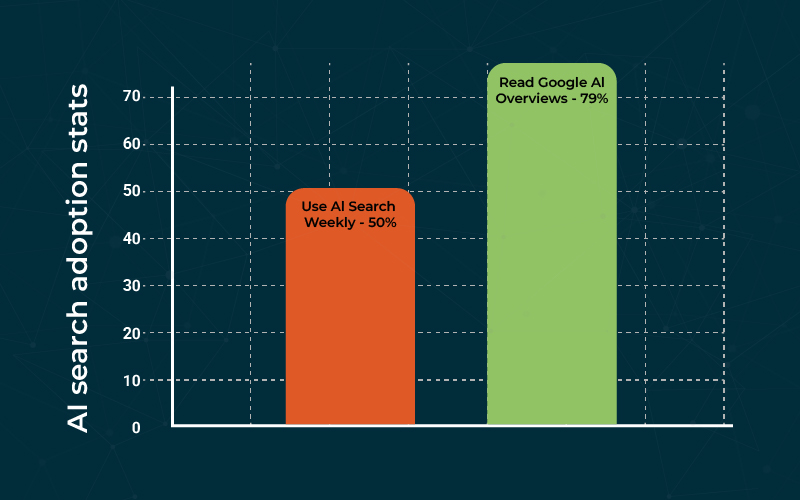
    Source: UPCEA/Search Influence AI Search in Higher Education Study, 2025

    While your team optimizes for Google rankings, half of your prospective students are also asking ChatGPT:

    • “What are the best nursing programs near me?”
    • “Which universities have strong data science programs?”
    • “Should I go to [Your University] or [Competitor]?”

    The uncomfortable truth: traditional SEO rankings don’t automatically translate to AI search results. Your brand is no longer just what you say about yourself, or even what others say about you. It’s what AI believes about you and shares with millions of prospective students.

    I’ve been tracking this space since late 2022. Higher education institutions with strong Google rankings often get completely left out of AI-driven search results. While smaller schools with better-structured content show up consistently.

    Traditional search engines still drive most organic traffic. That’s not changing soon. But AI search is a new channel growing fast, and it’s where a third of your prospective students are already researching. The catch: AI-generated search results often summarize information without requiring users to click through, which means even sites with strong search engine optimization can see declining traffic from AI-driven queries.

    The universities that appear in AI-driven search results now will have a head start that the rest can’t easily catch up to.

    What actually works?

    How AI “Decides” What to Recommend

    To make these SEO strategies work, you need to understand how these systems operate. It’s different from traditional search engines.

    Large language models like ChatGPT, Claude, and Perplexity don’t crawl your site in real-time and rank web pages. They operate on different principles:

    1. They draw from training data

    Content that existed when the model was trained becomes part of its “knowledge.” This is why outdated information persists. The model learned it months or years ago.

    1. They reference recent web crawls

    Some models (like Perplexity and ChatGPT with browsing enabled) pull fresh content. But the freshness varies by platform and query type.

    1. They cite authoritative sources

    AI systems prefer content that appears to know what it’s talking about. They’re pattern-matching on what “good sources” look like — structure, depth, and credibility signals.

    1. They match search intent, not just keywords

    AI understands concepts and entities through natural language processing, not keyword matching. You don’t need “best MBA program for working professionals near Chicago” repeated verbatim. You need content that actually covers the topic in depth and with specificity. Traditional search engines match keywords; AI systems match user intent and search intent. This is why traditional keyword research alone isn’t enough anymore. You need to understand what prospective students actually want to know, not just what phrases they type.

    1. They prioritize E-E-A-T signals

    AI systems, like traditional search engines, favor content that demonstrates Expertise, Experience, Authoritativeness, and Trustworthiness. Faculty credentials, institutional accreditation, specific outcomes data, and cited sources all signal that your content is worth recommending. Generic marketing copy doesn’t cut it.

    What this means for you:

    Your content needs to be structured so AI can understand it, not just index it. With Google, you’re trying to rank. With AI, you’re trying to be the source that gets cited when AI generates its response. Different goal, different tactics.
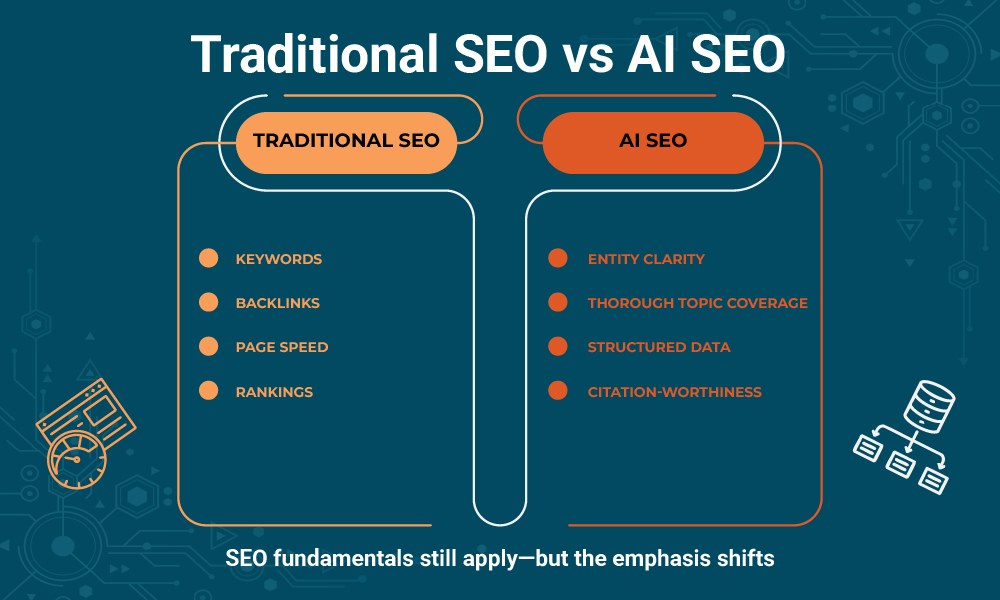
    SEO fundamentals still apply—but the emphasis shifts.

    SEO fundamentals still apply. Sites that rank well in Google tend to get cited more by AI, but it’s not automatic. Backlinks from authoritative sites signal to search engines that your website is trustworthy and valuable, and AI systems pick up on these same credibility signals. You need to optimize for both traditional search and AI platforms.

    One principle remains constant: creating exceptional, high-quality content is the best way to boost SEO performance and satisfy prospective students. Content should prioritize people over bots. If it genuinely helps your target audience, it will perform well with AI systems too.

    Learn how to optimize content for AI search engines with Search Influence.

    Getting Your University Into AI Search Results

    Start with the audit. You can’t fix what you can’t see.

    Step 1: Find Out What AI Currently Says About You

    This takes about 30 minutes, and it’s the most important 30 minutes you’ll spend on AI SEO.

    Open ChatGPT, Claude, and Perplexity. Ask questions like:

    • “Tell me about [Your University]”
    • “What are the best [your program] programs in [your region]?”
    • “Should I attend [Your University]?”
    • “What is [Your University] known for?”
    • “Compare [Your University] to [Competitor]”
    • “What are the admission requirements for [Your University]?”
    • “How much does it cost to attend [Your University]?”

    Document everything in a spreadsheet. For each question, note:

    • What’s accurate?
    • What’s outdated?
    • What’s completely missing?
    • Are competitors mentioned instead of you?
    • Is the information compelling or generic?

    I’ve done this audit for dozens of higher education clients. What I find most often:

    Competitor dominance

    When students ask about programs you offer, competitors show up, and you don’t. This is the most painful finding, but it’s the most actionable.

    Missing differentiators

    AI can describe your university in generic terms, but doesn’t mention what makes you unique. Your $50M new engineering building? Your unique co-op program? Your 95% nursing board pass rate? If AI doesn’t know about it, AI can’t recommend you for it.

    Outdated information

    Programs that no longer exist, old leadership names, incorrect tuition figures, former campus locations. AI models don’t always have up-to-date information, and even when they do, they may have ingested outdated pages from your site.

    Generic descriptions

    AI says you’re “a comprehensive university offering undergraduate and graduate programs in a variety of fields.” That’s true. It’s also useless. Nobody chooses a university based on that description.

    Step 2: Create Content That AI Wants to Cite

    AI systems prefer citing website content that appears authoritative and thorough. They’re trained on high-quality content, so they pattern-match on what those sources look like. Your content creation strategy needs to account for this.

    Create content that answers the specific questions students ask during their research process. That means your content needs to:

    Be structurally parseable

    AI reads differently from humans. Clear heading hierarchies (H2, H3, H4) help AI understand the relationship between concepts. Dense paragraphs of text are harder to parse than structured lists.

    Formats that work well:

    • FAQ sections that mirror natural language questions
    • Definition lists for key terms
    • Comparison tables
    • Bulleted lists with specific data points
    • Step-by-step numbered processes

    Include specific, citable data

    Vague claims get ignored. Specific data gets cited.

    Include:

    • Enrollment numbers (total, by program, by format)
    • Graduation and retention rates
    • Employment outcomes (percentage employed, average salary, top employers)
    • Program rankings and accreditations
    • Tuition costs (total and per credit hour)
    • Financial aid statistics (percentage receiving aid, average package)
    • Student-to-faculty ratios
    • Research funding and grants

    Answer the questions prospective students actually ask

    Look at your website chat logs. Look at your admissions email inbox. Look at your campus visit Q&A sessions. What do prospective students actually want to know? This is better than any keyword research tool for identifying relevant keywords and topics.

    Create structured content that directly answers those questions, and format it so AI can find and cite those answers.

    Create multimedia content

    Creating multimedia content (videos, infographics, virtual tours) enhances engagement and helps students envision themselves on campus. Video testimonials, program overviews, and campus walk-throughs give AI systems additional content to index. YouTube content especially matters; it’s owned by Google and feeds directly into AI training data.
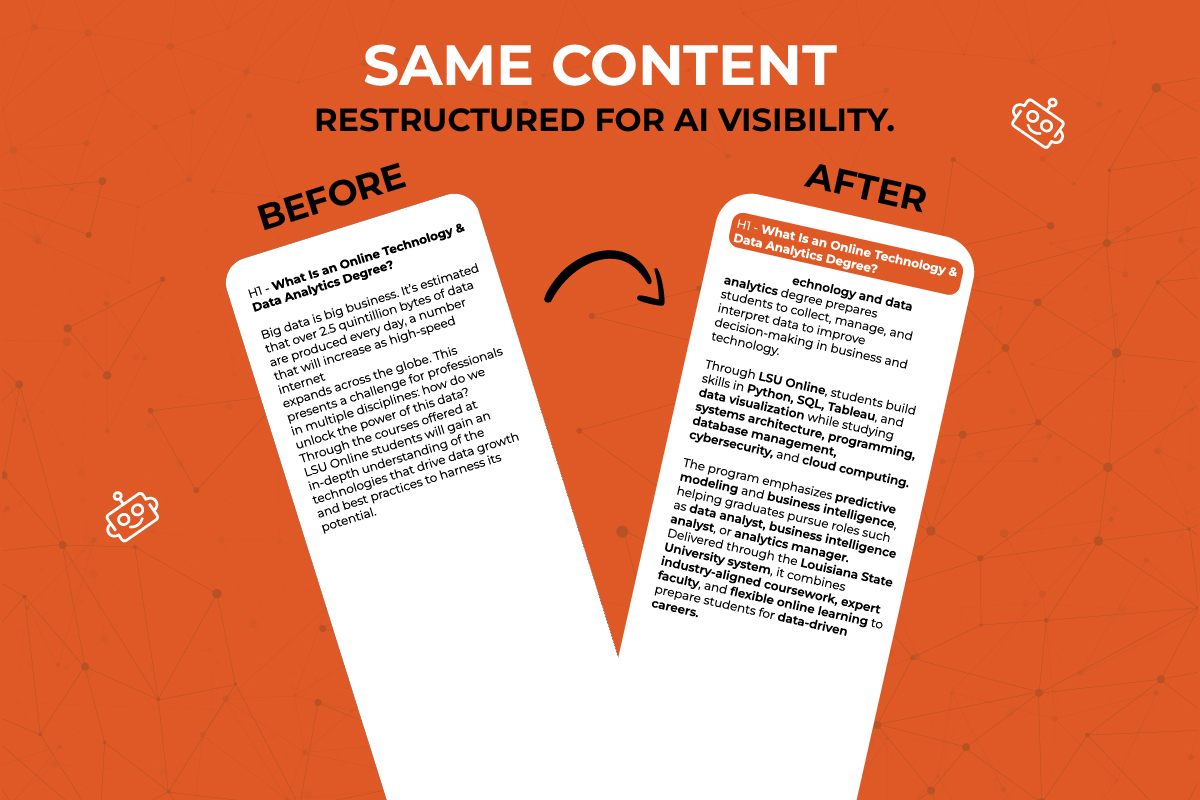
    Same content, restructured for AI visibility.

    Step 3: Make Your Brand “Like Fluoride in the Water”

    You want your brand to be so present across the web that AI just… knows you.

    Think about Kleenex. Or Xerox. Or Google (as a verb). Nobody has to explain what these brands are. AI models have seen so many references across so many contexts that the brand is baked into their understanding.

    Obviously, you can’t become Kleenex overnight. That takes decades. But you can systematically increase your brand’s presence in the sources AI learns from:

    Get mentioned on authoritative sites

    Higher ed publications (Inside Higher Ed, Chronicle of Higher Education, Higher Ed Dive), local and regional news outlets, and industry-specific publications in your strong program areas.

    When journalists write about trends in nursing education, they quote someone. Why not your nursing dean? When publications list “top programs for X,” they source from somewhere. Why not your outcomes data?

    Publish research that others cite

    Original research gets cited. Surveys, studies, white papers, data analyses. Your institutional research office has data that would be valuable to others. Package it and publish it.

    Maintain active, consistent social presence

    AI models train on social media content. LinkedIn, Twitter/X, YouTube. Your consistent presence builds brand recognition in the training data. Video SEO matters here too; YouTube is owned by Google and feeds into AI training data. Optimizing content for YouTube (with strong titles, descriptions, and transcripts) improves visibility across both traditional search and AI platforms.

    Show up in industry rankings and lists

    Rankings aren’t just for prospective students. They’re for AI training data. When AI learns “best X programs,” it learns from published lists.

    Create content that other institutions reference

    Thought leadership content that other universities link to and cite. Best practices guides. Innovative program design. This creates a citation network that AI follows.
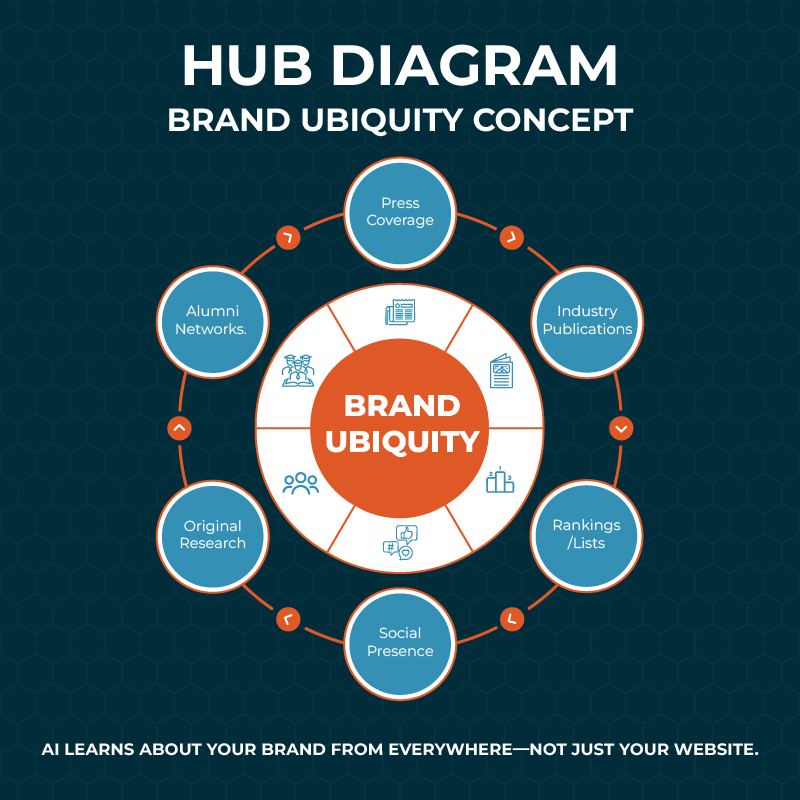
    AI learns about your brand from everywhere—not just your website.

    The goal isn’t any single mention. The goal is to be so present across the web that when AI thinks about your program area, your institution naturally comes to mind. Like fluoride in the water, invisible but everywhere.

    Step 4: Don’t Neglect Local SEO for Regional Student Search

    Local SEO is critical for attracting regional students, especially for institutions with multiple campus locations. For higher education institutions serving regional markets, local SEO directly impacts AI search results and recommendations.

    When a prospective student asks, “What are the best nursing programs near me?” or uses voice search for “colleges in [city],” AI pulls from local signals. These natural language queries are increasingly common as generative AI tools encourage students to ask more conversational questions.

    What to do:

    • Claim and optimize Google Business Profile for each campus location
    • Ensure NAP (name, address, phone) consistency across all web pages
    • Create location-specific content for each campus
    • Incorporate keywords naturally for regional search intent (“nursing program in [city],” “[state] MBA programs”)
    • Encourage and respond to Google reviews. They’re credibility signals for both traditional search engines and AI
    • Build citations in local directories and regional publications

    Local SEO isn’t separate from AI SEO; it feeds it. AI systems learn about your regional presence from these same signals. Higher ed marketers often overlook local SEO because they’re focused on national rankings, but for most higher education institutions, regional search visibility is where enrollment actually happens.

    Optimizing Academic Program Pages for AI-Driven Search Results

    Program pages are where enrollment happens, or doesn’t. When a student asks ChatGPT, “What are the best MBA programs for working professionals?”, AI scans the web, evaluates sources, and generates an answer. Your program page either contains everything AI needs to recommend you, or it doesn’t. There’s no second impression.

    Institutions should create dedicated landing pages for each academic program with detailed information. Most university program pages fail this test. They’re designed for humans who already know about the institution and are browsing to learn more. AI doesn’t browse. It extracts, evaluates, and cites, or moves on.

    Students now expect instant, personalized answers to their questions during their college search. Your program pages need to deliver.

    The Anatomy of an AI-Optimized Program Page
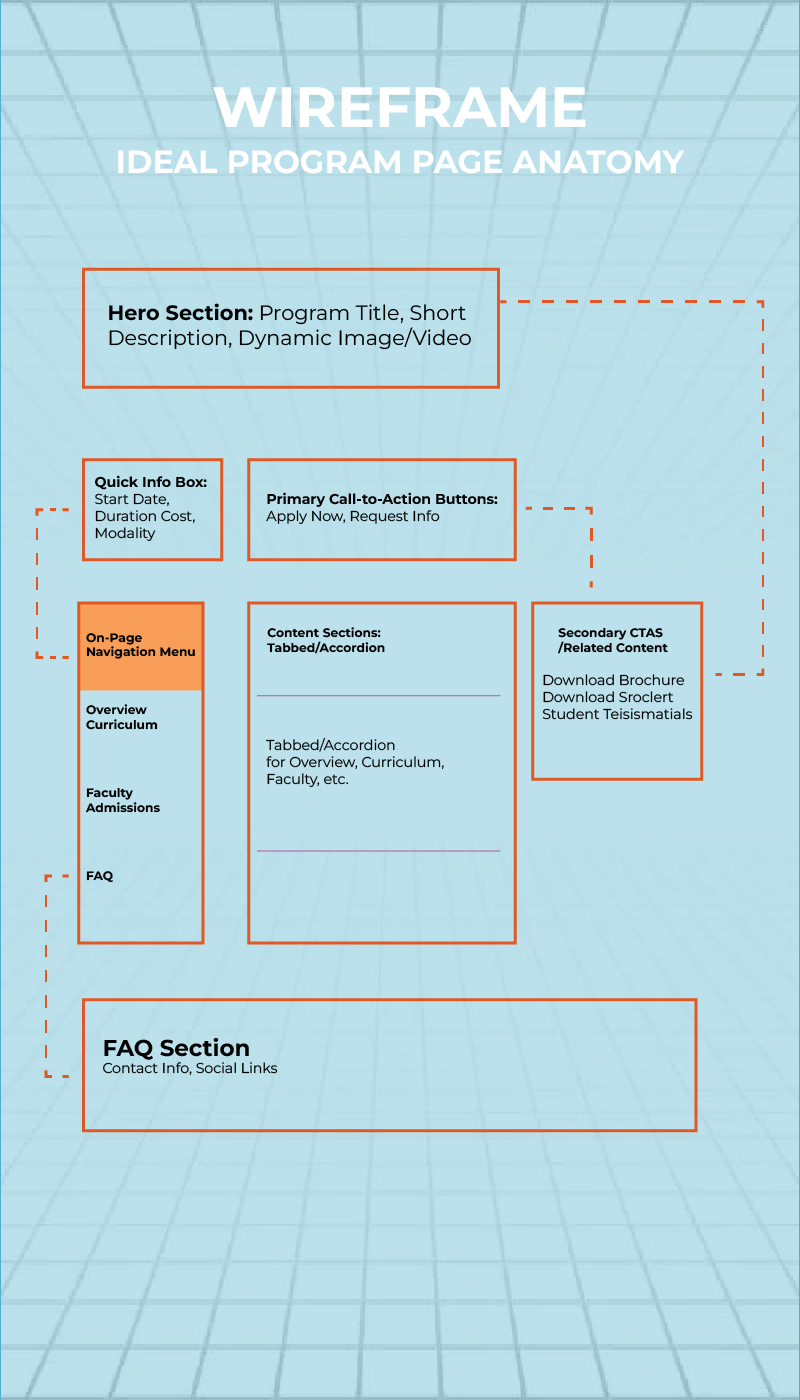
    1. Clear Program Identity (Above the Fold)

    Start with unambiguous program identification:

    • Exact degree name and type (BS, BA, MS, MBA, MEd, PhD, etc.)
    • Program format (on-campus, fully online, hybrid, evening/weekend)
    • Duration (credit hours required, typical time to completion)
    • Accreditation status and accrediting bodies
    • Department and college affiliation

    Why this matters: AI needs to correctly categorize your program. If your page title says “Business Administration” but doesn’t specify MBA vs. undergraduate, AI may miscategorize you.

    2. Outcomes Data (Make It Prominent)

    Universities are often reluctant to publish employment data — worried about liability, or not confident in the numbers. But students make decisions based on outcomes, and AI cites specifics.

    Include:

    • Employment rate within 6 months and 1 year of graduation
    • Average and median starting salary
    • Salary range (10th to 90th percentile)
    • Top employers hiring your graduates (named companies)
    • Job titles graduates hold
    • Career paths and advancement trajectories
    • Professional licensure/certification pass rates (nursing boards, CPA exam, bar exam, etc.)
    • Graduate school acceptance rates (for undergrad programs)

    If you have strong outcomes, show them. If you don’t have this data, start collecting it.

    3. Curriculum Overview (Structured for Scannability)

    Don’t just link to a PDF catalog. Present curriculum information directly on the page:

    • Core/required courses with brief descriptions
    • Elective options and specialization tracks
    • Unique program features (capstone projects, internship requirements, study abroad, lab experiences)
    • Sample course sequence or suggested schedule
    • Total credit hours and breakdown by category

    Format this as a table or structured list, not paragraphs.

    4. Admission Requirements (Be Specific)

    Prospective students ask AI-specific questions: “What GPA do I need for X program?” Make sure AI can find the answer on your page.

    Include:

    • Minimum GPA requirements (and competitive/average admitted GPA)
    • Test score requirements or policies (GRE, GMAT, test-optional status)
    • Prerequisite courses
    • Required application materials
    • Application deadlines (early, regular, rolling)
    • International student requirements

    5. Cost and Financial Information (Don’t Hide It)

    Tuition is one of the top questions students ask. AI will answer it. The question is whether AI gets the answer from your site or somewhere else.

    Include:

    • Total program cost
    • Per-credit-hour rate
    • Fee breakdowns
    • Scholarship opportunities specific to this program
    • Graduate assistantship availability
    • Employer tuition reimbursement partnerships
    • Financial aid statistics for this program
    • ROI calculations, if available

    6. FAQ Section (Mirror How Students Ask)

    FAQ sections structured as question-and-answer pairs are exactly what AI systems are looking for. Easy to implement, high impact.

    Address questions students actually ask:

    • “Can I complete this program while working full-time?”
    • “What’s the difference between the online and on-campus versions?”
    • “Is this program accredited?”
    • “What kind of support services are available for online students?”
    • “Can I transfer credits into this program?”
    • “What technology/software will I need?”
    • “Are there networking or career services?”

    Use the exact phrasing students use. That’s what they’ll type into ChatGPT.

    7. Student Testimonials and Success Stories

    Real stories from real students are citation gold. AI systems recognize authentic student testimonials as credibility signals, and prospective students find them compelling. Student testimonials provide the social proof that influences user behavior during the decision-making process.

    Include named testimonials (with permission), specific outcomes, and career trajectories. “Sarah graduated in 2023 and now works as a data analyst at IBM” is more citable than “Our graduates go on to great careers.”

    Video testimonials work even better. They’re harder to fake and more engaging. If you have them, embed them on the page with transcripts for AI to parse. This combines video SEO with powerful conversion content.

    Common Mistakes I See

    Mistake 1: Content buried in PDFs

    AI can’t easily parse PDF content. If your program details live in a downloadable brochure or catalog PDF, they might as well not exist for AI purposes. Extract that content and put it on the page.

    Mistake 2: Fragmented information across multiple pages

    If students (or AI) have to click through five pages to understand your program (overview, curriculum, admissions, financial aid, outcomes), AI won’t piece it together. Consolidate essential information into a single page, with links to deep dives.

    Mistake 3: Missing or hidden outcomes data

    If you have good outcomes, show them prominently. If you have mediocre outcomes, at least show the data you’re proud of. Something specific beats nothing every time.

    Mistake 4: Generic marketing copy

    “Prepare for success in a dynamic global economy” means nothing. Literally nothing. It’s filler text that adds no information.

    Compared to: “92% of graduates employed in their field within 6 months, with an average starting salary of $68,000. Top employers include Mayo Clinic, Cleveland Clinic, and Johns Hopkins.”

    Which one would you cite? Which one would AI cite?

    Mistake 5: No FAQ section

    If your program page doesn’t have an FAQ section, you’re leaving AI citations on the table. This is the easiest win. Just add it.

    Structured Data and Schema for Higher Education

    This section gets technical. Schema markup is how you explicitly tell AI what your content means — metadata that machines read. It’s becoming increasingly valuable for AI visibility.

    Why Schema Matters for AI

    When AI systems encounter structured data, they don’t have to guess what your content means. You’re telling them directly:

    • This is an educational organization
    • This is a course/program
    • This is an FAQ
    • This is an event
    • These are the properties (name, cost, duration, requirements)

    Think of it as the difference between handing someone a box of puzzle pieces versus handing them the completed puzzle. Same information, wildly different usability.

    AI systems can extract information from unstructured text. But structured data is unambiguous. It removes interpretation. It’s machine-readable by design.
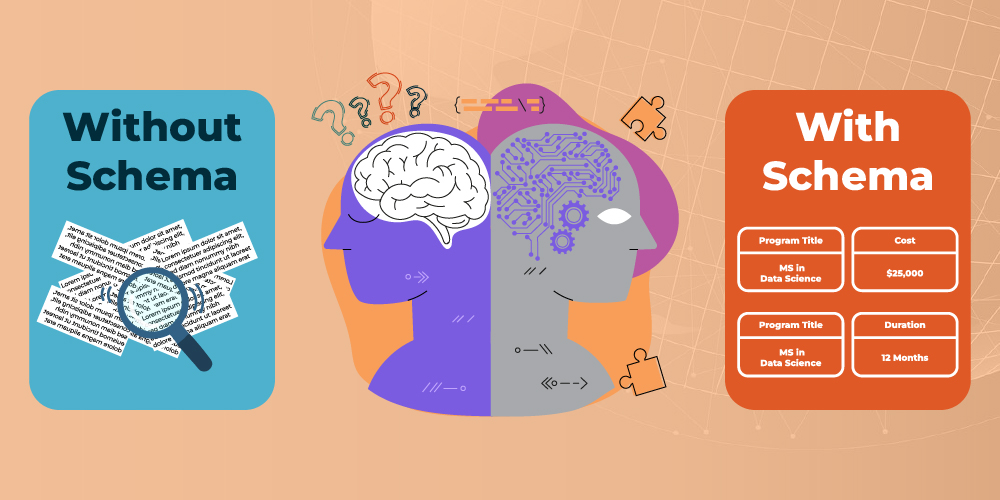
    Schema removes ambiguity

    Schema Types That Matter for Higher Ed

    If you’re not technical, share this section with your developer. If you are technical, here are the four schema types to prioritize:
    EducationalOrganization Schema

    Your foundation tells AI who you are at the institutional level.

    This is especially important for entity disambiguation. If your institution shares a name with another (e.g., multiple “Trinity” universities, multiple “State” schools), schema helps AI understand which one you are. The same applies to Google’s Knowledge Graph. That information panel that appears when someone searches your name. Claim and optimize your Knowledge Panel through Google’s verification process. When AI systems reference knowledge graphs, they’re pulling from that same entity data.

    {

    “@type”: “EducationalOrganization”,

    “name”: “University Name”,

    “alternateName”: “Common Abbreviation”,

    “description”: “Full description of the institution”,

    “url”: “https://www.university.edu”,

    “logo”: “https://www.university.edu/logo.png”,

    “address”: {

    “@type”: “PostalAddress”,

    “streetAddress”: “123 Campus Drive”,

    “addressLocality”: “City”,

    “addressRegion”: “State”,

    “postalCode”: “12345”

    },

    “telephone”: “+1-555-123-4567”,

    “foundingDate”: “1890”,

    “accreditedBy”: [

    {

    “@type”: “Organization”,

    “name”: “Higher Learning Commission”

    }

    ]

    }

    Course Schema

    For each academic program. This is where the detail matters.

    {

    “@type”: “Course”,

    “name”: “Bachelor of Science in Nursing”,

    “description”: “Four-year nursing program preparing students for RN licensure”,

    “provider”: {

    “@type”: “EducationalOrganization”,

    “name”: “University Name”

    },

    “hasCourseInstance”: [

    {

    “@type”: “CourseInstance”,

    “courseMode”: “onsite”,

    “courseWorkload”: “PT120H”

    },

    {

    “@type”: “CourseInstance”,

    “courseMode”: “online”

    }

    ],

    “occupationalCredentialAwarded”: “BSN”,

    “numberOfCredits”: 120,

    “educationalLevel”: “Bachelor’s Degree”,

    “timeRequired”: “P4Y”

    }

    FAQPage Schema

    For those FAQ sections. This makes your Q&A pairs directly extractable.

    {

    “@type”: “FAQPage”,

    “mainEntity”: [

    {

    “@type”: “Question”,

    “name”: “Can I complete this program while working full-time?”,

    “acceptedAnswer”: {

    “@type”: “Answer”,

    “text”: “Yes, our evening and weekend format is designed for working professionals…”

    }

    }

    ]

    }

    Event Schema

    For open houses, information sessions, and application deadlines.

    {

    “@type”: “Event”,

    “name”: “MBA Information Session”,

    “startDate”: “2025-03-15T18:00”,

    “endDate”: “2025-03-15T19:30”,

    “location”: {

    “@type”: “Place”,

    “name”: “Business School Building, Room 100”

    },

    “eventAttendanceMode”: “https://schema.org/MixedEventAttendanceMode”,

    “organizer”: {

    “@type”: “EducationalOrganization”,

    “name”: “University Name”

    }

    }

    Implementation Priority

    If you’re starting from zero, here’s the order:

    1. EducationalOrganization schema on your homepage — Define who you are
    2. FAQPage schema on key program and admission pages — Quick win, high impact
    3. Course schema on each academic program page — The biggest lift, but most valuable
    4. Event schema on recruitment event pages — Good for search and AI

    Full disclosure: implementing this well usually requires developer resources. Your marketing team can specify what needs to be marked up, but implementation typically needs IT involvement. It’s not a quick win, but it compounds over time. Once it’s in place, it keeps working.

    Technical Foundations for AI Visibility

    Technical SEO and Site Performance Still Matter

    Technical SEO is essential for maintaining a website’s backend health and ensuring it can be identified by search engines. Site speed, mobile responsiveness, crawlability, and security (HTTPS) still matter. AI systems may not rank web pages the way traditional search engines do, but they do learn from sites that meet basic technical standards. Search engine optimization fundamentals haven’t gone away; they’re table stakes for any higher education SEO strategy.

    If your higher ed website is slow, broken on mobile, or has crawl errors, fix that first. No amount of schema markup or AI-friendly content will overcome a site that doesn’t load. Run technical SEO audits before diving into the AI-specific optimizations. AI tools can automate tasks like competitor analysis, backlink monitoring, and technical SEO audits. Tools like Screaming Frog, Sitebulb, or AI-powered platforms like Semrush can streamline this analysis.

    Managing AI Crawlers

    AI systems like ChatGPT, Claude, and Perplexity use their own crawlers (GPTBot, ClaudeBot, PerplexityBot) to index content. You can control their access through robots.txt. Same as traditional search engines.

    Most universities should allow these crawlers. If AI can’t access your content, AI can’t recommend you. But if you have gated content or specific sections you want to exclude, you can block specific bots:

    User-agent: GPTBot

    Disallow: /internal-documents/

    User-agent: ClaudeBot

    Disallow: /internal-documents/

    There’s also a newer standard emerging: llms.txt. This file (placed at your domain root, like robots.txt) tells AI systems how to interpret your site—what’s most important, how content relates, and what context matters. It’s not universally adopted yet, but worth watching as AI crawling matures.

    Using AI to Support Student Recruitment

    Everything above is about getting *found* by AI. But AI can also be a tool you use directly in recruitment. This section is optional reading (the core work is in the previous sections), but worth considering if you’re building out your digital strategy.

    AI Chatbots for Enrollment

    A lot of colleges and universities are implementing AI chatbots now. Some are doing it well. Most are not.

    My take:

    Do:

    • Use chatbots for high-volume, repetitive questions (office hours, application deadlines, document requirements, program listings)
    • Train them on your actual FAQ data — real questions from real students
    • Have clear handoff protocols to human staff for complex questions
    • Track what questions come up most often — this is gold for content strategy
    • Set appropriate expectations (tell users they’re talking to a bot)
    • Test extensively before deployment

    Don’t:

    • Let chatbots handle sensitive conversations (financial hardship, disability accommodations, academic concerns, mental health)
    • Deploy without thorough testing across edge cases
    • Expect them to replace human connection — they augment, not replace
    • Use generic chatbot responses — customize for your institution
    • Forget to update the knowledge base as information changes

    An important distinction: The 50% of students using AI search tools weekly? They’re not looking to talk to a bot on your website. They’re using ChatGPT and Google AI Overviews because they perceive these as unbiased, aggregated answers.

    Your institutional chatbot serves a different purpose. Convenience and availability, not research.

    A student at 11 pm who wants to know if their transcript was received?

    Chatbot territory.

    A student trying to decide between your program and a competitor?

    That needs a human.

    AI-Powered Personalization

    Some colleges and universities are using AI tools to create more personalized digital experiences:

    Homepage personalization

    Showing different content based on visitor signals — location, referral source, previous visits, stated interests. A visitor from Texas sees Texas-specific information and regional alumni. A visitor who previously looked at nursing programs sees nursing content prominently.

    Program recommendations

    “Based on your interests, you might also consider…” recommendations powered by AI analysis of similar student paths.

    Dynamic financial aid estimates

    AI-powered calculators that provide personalized estimates based on student-provided information.

    Email campaign personalization

    Content customization within email campaigns based on recipient behavior and preferences.
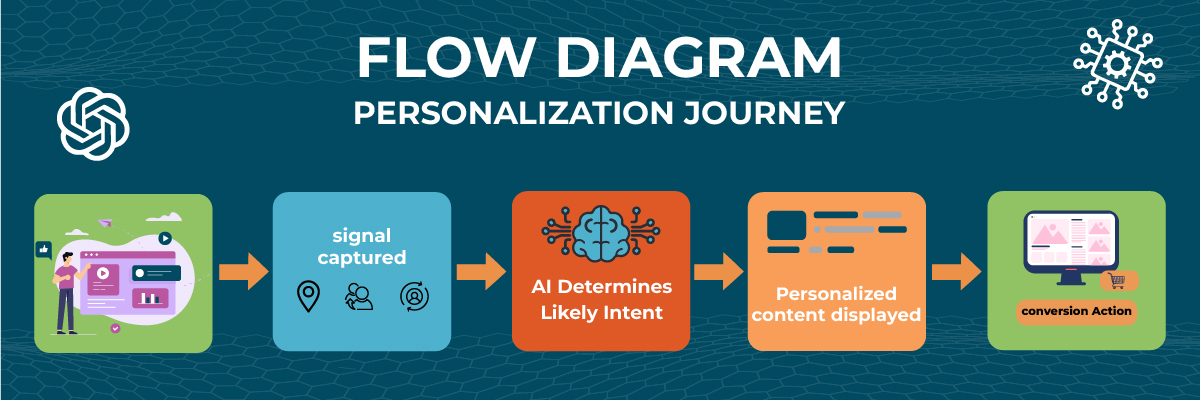
    AI personalization in action.

    The caveat: privacy matters. FERPA applies to student records. GDPR may apply to international visitors. State privacy laws are evolving. Be thoughtful about what data you collect, how you use it, and how you communicate that to visitors.

    The line between “helpful personalization” and “creepy surveillance” is real. Stay on the right side of it.

    Measuring AI SEO and Search Engine Optimization Performance

    You’ve audited, optimized, and implemented. How do you know if any of this is working?

    Measuring AI visibility is nothing like measuring traditional SEO. It’s messier, less precise, and still evolving. And the metrics that matter are different. You’re not just tracking organic traffic, website traffic, and keyword rankings anymore. AI-driven search features are changing how students discover information, and AI-generated search results often summarize information without requiring users to click through to your website. You need new metrics for a new search strategy.

    What You Can Track

    Brand mentions across LLMs

    AI SEO tracking tools like Scrunch, Profound, RankScale, and others now track how often your brand appears in AI responses across ChatGPT, Claude, Perplexity, and Google AI Overviews.

    Full disclosure, we use Scrunch at my agency, and I think it’s the most thorough option for agencies and enterprises. But there are others at different price points:

    • Scrunch: Enterprise-focused, full-stack tracking, API access
    • Profound: Enterprise-focused, detailed insights across 10+ AI engines, custom pricing
    • RankScale: Budget-friendly, credit-based pricing

    The tracking piece is becoming a commodity. Most tools can tell you if you’re showing up. The differentiation is in what they do with that data.
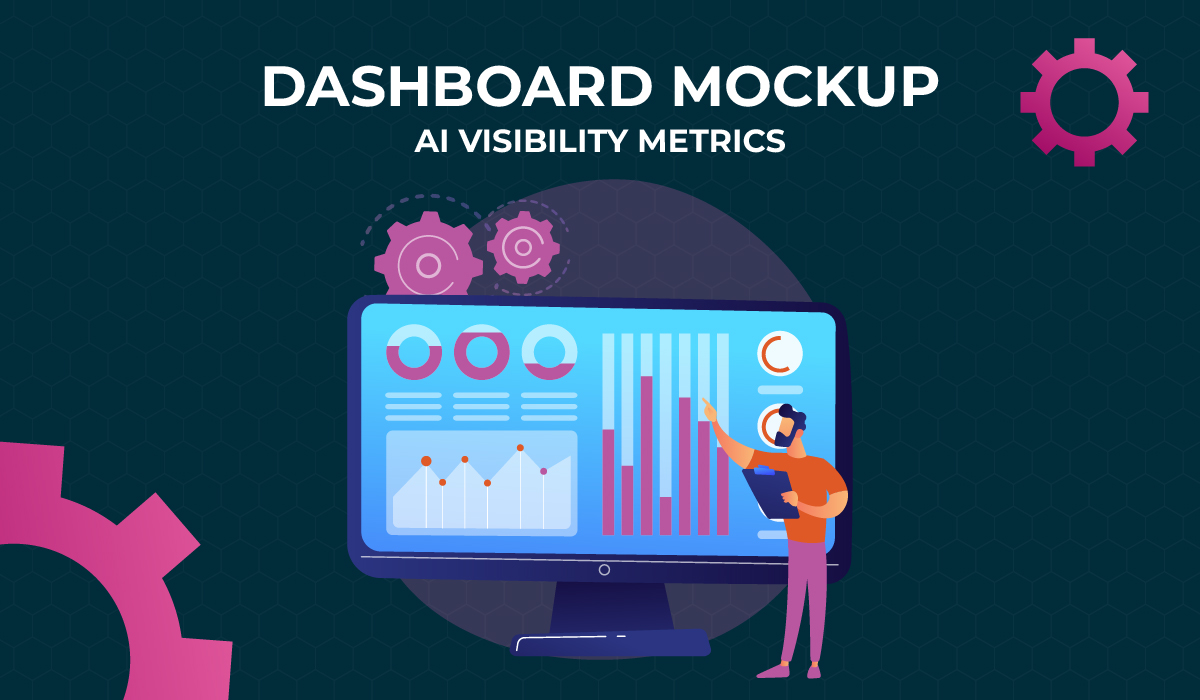
    Example AI visibility dashboard—showing metrics that matter.

    Position in AI-generated lists

    When someone asks “best X programs,” where do you show up? First? Fifth? Not at all? This is trackable and meaningful.

    Citation rate

    How often does AI cite your content as a source? This is particularly important for Perplexity and Google AI Overviews, which show their sources. Being cited is different from being mentioned; it’s a stronger signal.

    Sentiment and accuracy

    What does AI say about you? Is it positive, neutral, or negative? More importantly, is it accurate? Inaccuracies need to be addressed.

    Competitor share of voice

    How do you compare to competitors in AI recommendations? If students ask about your program category, who gets mentioned most?

    What You Can’t (Easily) Track

    • Individual user conversations with AI (privacy and access limitations)
    • Exactly how AI weighs different factors (black box)
    • Real-time changes to AI recommendations (there’s always a lag)
    • Causal attribution (did they enroll because AI recommended you?)
    • Direct impact on website traffic from AI-driven search results (unlike Google Analytics for traditional search)

    The “Windsock” Approach

    I’ve said this before, and I’ll say it again: all AI tracking data is imperfect. Analytics aren’t an absolute truth. They’re opinions with decimal points.

    AI tracking tools are a windsock, not a GPS. They tell you direction, not precise position.

    You’re looking for directional trends:

    • Are mentions increasing over time?
    • Is share of voice improving vs. competitors?
    • Are inaccuracies getting corrected after you update content?
    • Is sentiment trending positive?

    Don’t obsess over precision. Don’t argue about whether you’re mentioned in 47% or 52% of relevant queries. Pick your tool, track consistently, and look for trends up and to the right over time.
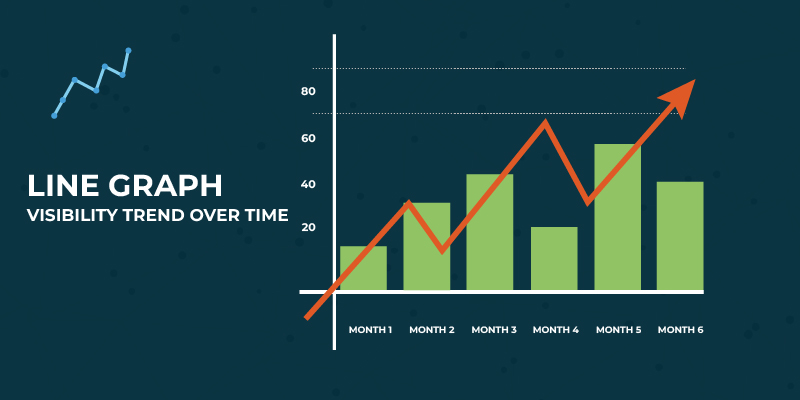
    Example AI visibility dashboard—showing metrics that matter.

    What This Means for Higher Ed Marketers and Marketing Teams

    Where do you actually start? These higher education SEO strategies need to fit into your broader web strategy. My recommendations, scaled to your marketing teams and resources:

    If You Have Limited Resources (Marketing Team of 1-3)

    Start here:

    1. Audit what AI currently says about your institution. This takes 30 minutes and costs nothing. Open ChatGPT, Claude, and Perplexity. Ask the questions we covered. Document what’s wrong.
    2. Fix factual inaccuracies on your website. If AI is saying something wrong, it probably learned it from your site (or from outdated information). Update your site.
    3. Restructure your top 3-5 program pages. Pick your highest-priority programs. Add clear headings, FAQ sections, and outcomes data. This is manual work, but high impact.
    4. Add FAQ sections to key pages. If you do nothing else, do this. FAQs are the easiest content for AI to cite.

    If You Have Moderate Resources (Marketing Team of 4-10)

    Add:

    1. Implement basic schema markup. Start with EducationalOrganization on your homepage and FAQPage schema on key pages. This requires developer time but pays dividends.
    2. Create a thorough “About” page optimized for AI. A single page that fully answers “What is [University Name]?” with specific data points, history, differentiators, and programs.
    3. Set up tracking with an AI visibility tool. Pick one, commit to it, and track monthly. RankScale is affordable for smaller teams.
    4. Train your content team on AI-friendly formatting. Share this guide. Make it part of your content standards.

    If You’re Ready to Go Deep (Dedicated Digital Team)

    Then:

    1. Full schema implementation across all program pages. This is a project. Scope it, resource it, execute it systematically.
    2. Competitive analysis based on AI presence. What are competitors doing that you’re not? Where are they getting cited and you’re not?
    3. Ongoing optimization and monitoring program. Monthly reviews of AI visibility data. Quarterly content updates based on findings.
    4. Integration with broader GEO strategy. AI SEO doesn’t exist in isolation. Connect it to your overall search strategy, content creation strategy, and brand strategy. Your SEO strategies should address both traditional search engines and AI platforms.
    5. PR and content strategy aligned with AI visibility. Proactive outreach to get mentioned in publications AI learns from.

    The Bottom Line: Adapting Higher Education SEO Strategies for AI

    What this all comes down to:

    Brand used to be what you said about yourself. You controlled the message.

    Then it became what others said about you. Reviews, social media, word of mouth.

    Now it’s what AI understands and believes about you. AI synthesizes everything (your content, others’ content, structured data, citations) and forms a representation of your institution that it shares with millions of users.

    Universities that move early get the edge. The rest play catch-up.

    The tactics here work. I’ve tested them. I’ve seen universities go from invisible in generative search results to consistently recommended. But tactics change. AI changes fast. What won’t change is the need to help AI systems understand who you are, what you offer, and why you matter.

    Ultimately, that’s not so different from what we’ve always done in higher ed marketing. We’re just speaking to a new kind of audience. One that never sleeps, has perfect memory, and is advising a third of your prospective students.

    The question isn’t whether to adapt. It’s how fast.

    What’s Next

    Ready to see where you stand?

    Start with our free AI Website Grader at ai-grader.searchinfluence.com. It analyzes your site’s AI visibility and gives you a baseline to work from. Then schedule a conversation with our team to walk through the results and identify your highest-impact opportunities.

    Try the AI Website Grader | Schedule a Consultation

    Resources

    AI Visibility Tracking Tools:

    • Scrunch (enterprise, full-stack tracking)
    • RankScale (budget-friendly, credit-based)
    • Profound (enterprise, custom pricing)

    Schema Implementation:

    • Schema.org/EducationalOrganization documentation
    • Google’s Rich Results Test
    • Schema markup generators (free tools available)

    Further Reading:

    • UPCEA/Search Influence: “AI Search in Higher Education” (2025 research study)
    • SparkToro/Datos: AI Search Usage Data reports
    • Google Search Central: AI Overviews documentation

    Tools Mentioned:

    • ChatGPT
    • Claude
    • Perplexity
    • Google AI Overviews (in Google Search)

    *Will Scott is cofounder of Search Influence, a digital marketing agency specializing in higher education. He teaches the SMX Masterclass on Generative Engine Optimization (GEO) and has been tracking the AI search space since late 2022. Connect with him on LinkedIn.*
  • All of Your Higher Education Marketing Questions Answered

    All of Your Higher Education Marketing Questions Answered

    This post was updated by Paula French on 1/22/26 to reflect current best practices. It was originally published on 11/7/25

    Key Insights

    • Half of all prospective students now use AI tools daily or weekly, making AI-optimized content and entity SEO essential for institutional visibility.
    • Fewer than 50% of higher ed marketers track cost per inquiry (CPI), even though those who do report stronger ROI and campaign satisfaction.
    • 82% of prospective students are more likely to consider programs that appear on page one of search results, underscoring the link between SEO investment and enrollment growth.
    • Most universities lack a formal SEO strategy. 51% admit they don’t have a defined plan, leaving major opportunities for early adopters to dominate AI and organic search.
    • Integrated, data-driven marketing across SEO, content, email, and paid media consistently outperforms siloed efforts by improving student engagement, retention, and brand trust.

    AI Overviews, social search, and shrinking applicant pools have rewritten how students discover programs.

    The old playbook won’t cut it; higher education marketers need clear, actionable guidance fast. This FAQ compiles the most-searched questions we hear from universities and colleges and gives concise, research-backed answers you can apply today.

    This guide draws on three cornerstone studies from Search Influence and UPCEA:

    Together, these reports reveal how today’s students search, how institutions measure success, and where colleges can strengthen their digital foundations. By applying these insights, your marketing team can build an integrated strategy that reaches prospective students across multiple channels and platforms.

    Ready to level up your visibility across digital marketing channels? Let’s start with the basics.

    General Higher Education Marketing FAQ

    What is higher education marketing?

    Higher education marketing is the process of promoting academic programs and institutional value to attract, engage, and enroll students.

    It helps higher education institutions communicate who they are, what they offer, and why they matter to students, families, and communities. Because prospective students make decisions over months or even years, higher ed marketing often targets multiple audiences, from high school students to alumni and employers.

    Success depends on building a unified digital marketing strategy that combines brand storytelling with recruitment goals across multiple platforms. By integrating search engine optimization (SEO), digital advertising, content marketing, email marketing, social media, and PR, institutions can reach students at every stage of their decision-making journey while reinforcing trust and brand recognition.

    What are common marketing mistakes colleges make?

    Common marketing mistakes include underfunding SEO, inconsistent messaging, and failing to track ROI.

    Many colleges focus heavily on awareness but neglect measurable outcomes like inquiries or conversions. Others overlook technical SEO, rely on outdated personas, or split marketing and admissions efforts into silos, causing disjointed communication.

    According to Search Influence and UPCEA’s Marketing Metrics Report, fewer than half of higher education marketers consistently track cost per inquiry (CPI), making it difficult to prove campaign performance.

    To avoid these pitfalls, institutions should refresh audience research, develop clear KPIs, and schedule regular SEO and accessibility audits to keep content relevant and visible.

    How can AI improve college marketing campaigns?

    AI improves college marketing campaigns by helping institutions analyze data, personalize outreach, and optimize performance.

    Artificial intelligence can identify which students are most likely to apply, surface trending keywords, and even predict when to re-engage inactive prospects. AI-powered chatbots and automation tools also allow universities to provide instant responses and tailor messaging to individual interests.

    Search Influence’s 2025 research found that 50% of prospective students use AI search tools weekly, and 1 in 3 trust those tools for program research. With proper oversight and brand alignment, colleges can use AI to streamline workflows, improve targeting, and stay visible in AI-driven search environments.

    How do colleges measure marketing success?

    Colleges measure marketing success by tracking metrics like inquiries, applications, conversion rates, and cost per inquiry.

    These indicators show how effectively marketing turns awareness into enrollment. A strong measurement plan tracks the full student funnel — from impression to click, inquiry, application, and enrollment — using tools like CRM systems, GA4, and Looker Studio dashboards.

    The most effective higher ed marketing teams use dashboards like Looker Studio, Power BI, or Tableau to create data visualizations and surface the metrics that matter.

    Search Influence’s Marketing Metrics study found the average CPI for professional and online education is about $140. Institutions that review KPIs monthly and adjust quarterly see better alignment between marketing efforts and enrollment goals, improving both efficiency and ROI.

    How has higher education marketing changed in 2025?

    Higher education marketing strategies in 2025 have shifted toward AI-driven search, conversational content, and data-informed decision-making.

    Students now rely on AI tools, social search, and short-form video to discover programs instead of just traditional search engines.

    As a result, institutions must create structured, citation-ready content that answers questions quickly and builds trust. With 1 in 3 students trusting AI for research, universities that adapt early with AI-optimized content, transcripts, and accessible multimedia will gain a lasting visibility advantage.

    What’s the role of marketing in student retention?

    Marketing supports student retention by maintaining engagement and strengthening community after enrollment.

    Consistent communication helps students feel informed, supported, and connected to campus resources and culture. When retention-focused marketing shares success stories, wellness initiatives, and career resources, it reinforces the value of the student’s decision to attend.

    Retention campaigns might include orientation emails, progress check-ins, and alumni outreach. By treating current students as an ongoing audience, institutions improve satisfaction, increase graduation rates, and build loyalty that lasts beyond commencement.

    How should universities balance brand awareness and program-specific marketing?

    Universities should balance brand awareness and program-specific marketing by distinguishing long-term reputation goals from short-term enrollment targets.

    Brand campaigns showcase the institution’s mission, faculty excellence, and campus life, while program campaigns speak directly to prospective students evaluating their next step.

    When both are managed under one unified digital strategy, the impact multiplies. Broad brand storytelling fuels recognition, and targeted program pages capture conversions. Shared messaging calendars and attribution tracking ensure that every channel, from video to search, contributes to the same institutional goals.

    SEO for Higher Education FAQ

    How is AI changing higher education search?

    AI is transforming higher education search by prioritizing context, authority, and trust signals over keyword repetition.

    According to our AI Search in Higher Education report, how prospective students search has become increasingly diversified: 84% use search engines, 61% use YouTube, and 50% use AI tools.

    Institutions that adapt to AI-first search behaviors will see stronger rankings, visibility, and engagement.

    How do universities benefit from search engine marketing?

    Search engine marketing helps universities reach qualified students through a blend of paid and organic visibility.

    SEO builds long-term authority and organic traffic, while paid search campaigns deliver immediate exposure for time-sensitive initiatives like application deadlines or open houses.

    When SEO and paid ads work together, they cover the full student journey, helping institutions lower costs per inquiry while improving overall visibility.

    What are common SEO mistakes colleges make?

    Common SEO mistakes include outdated or unstructured content, a lack of strategic links to program pages, and a lack of citations for programs.

    Next, we see weak internal linking and missed opportunities to drive prospects from blog pages to program pages.

    Many institutions overlook technical elements like schema markup or have a challenge with implementing it as deeply as needed.

    Search Influence’s SEO Readiness Research Study found that 51% of higher ed marketers lack a formal SEO strategy, and only 19% excelled in audits. Regular audits, technical maintenance, and clear governance can quickly improve performance and help colleges compete for attention online.

    How does ChatGPT or Gemini impact higher ed SEO?

    ChatGPT and Gemini are changing SEO by influencing how students consume information.

    Instead of clicking through multiple websites, users often receive summarized answers directly within AI-generated results.

    To stay visible, institutions must ensure their content is accurate, well-structured, and clearly attributed. Creating pages that answer student questions concisely, like tuition costs, outcomes, or requirements, increases the chances of being cited in AI Overviews.

    Why are student testimonials essential for SEO success?

    Student testimonials boost SEO by adding authentic content that reinforces expertise and trust.

    Testimonials create fresh, relevant text that both search engines and prospective students value.

    Featuring these stories on program pages, blogs, and video platforms supports Google’s E-E-A-T principles (Experience, Expertise, Authoritativeness, Trustworthiness) and helps potential students see themselves in your campus community.

    What’s the best approach to link building for higher education?

    The most effective link building approach focuses on authority and relevance.

    Universities can earn backlinks by publishing research, contributing expert commentary, and partnering with associations or media outlets.

    Quality always outweighs quantity; credible academic and industry sources signal trust to search engines. Regularly reviewing link profiles ensures ongoing improvement without the risks of spammy or irrelevant backlinks.

    How can universities appear in Google’s AI Overviews?

    Universities appear in AI Overviews when their content is credible, well-structured, and up to date.

    Successful universities create off-site citations through directories, earned media, and social channels that reinforce co-occurrence and co-citation.

    Pages that use schema markup, summarize information clearly, and cite trustworthy sources are more likely to be pulled into generative results.

    Updating program data quarterly, maintaining consistent branding, and writing in a clear, student-focused tone all improve a university’s ability to show in AI Overviews.

    What is entity SEO, and why does it matter for colleges?

    Entity SEO helps search engines understand a university’s identity, structure, and expertise. By marking up elements like programs, faculty, and events with schema and maintaining consistent naming conventions, institutions make it easier for search engines to recognize authority.

    Strong entity SEO enhances visibility in both AI and traditional results, ensuring your institution is accurately represented wherever prospective students search.

    Can Search Influence assist with social media as part of AI SEO?

    Yes, Search Influence integrates social media and AI SEO strategies to help colleges strengthen visibility across both traditional and emerging search environments. Our approach connects entity optimization, structured data, and content strategy with social engagement signals.

    Search Influence will guide your social media team or will produce optimized social media content in support of your SEO strategy.

    This integration ensures that universities build authority where students spend their time (on search engines, AI tools, and social platforms), resulting in greater reach and improved brand perception.

    Where can I find reliable recommendations for tracking competitor visibility in AI searches?

    Tools like RankScale, Scrunch, and Profound can help universities monitor how competitors appear in AI-generated search results.

    These tools track which websites are cited in AI Overviews, how often they’re mentioned, and what types of content earn inclusion. Using this data, marketing teams can identify content gaps, update program pages, and refine SEO strategies to stay competitive as AI-driven search continues to evolve.

    Higher Education Paid Search FAQ

    Can Search Influence help with paid digital advertising for universities?

    Yes, Search Influence manages digital advertising campaigns that are built to generate qualified leads and maximize ROI.

    Our team uses geo-targeting, remarketing, and deadline-based ad strategies to attract prospective students at key decision points.

    Aligning paid campaigns with SEO and landing page optimization ensures cohesive messaging and better conversion rates across your digital marketing efforts.

    What is paid search vs SEO?

    Paid search provides (mostly) immediate visibility through paid placements, while SEO builds organic authority over time.

    Both are essential to a balanced marketing strategy. Paid campaigns can drive quick results, while SEO ensures lasting presence.

    When integrated, they reinforce each other: paid search captures attention now, and organic SEO keeps your institution visible long after the ad spend ends.

    How can paid digital advertising (PPC) support enrollment campaigns?

    Paid digital advertising (sometimes called PPC) supports enrollment campaigns by driving traffic to high-value program pages during key application and decision periods.

    Ads highlighting deadlines, scholarships, or open houses meet students when urgency is highest.

    With tools like lookalike audiences and remarketing lists, colleges can re-engage previous visitors and nurture them toward inquiry and enrollment.

    What metrics matter most in higher ed paid digital advertising (PPC)?

    Conversion rate, cost per inquiry, and return on ad spend are the most important metrics in higher education paid digital advertising (PPC).

    Secondary indicators (like click-through rate, quality score, and impression share) help diagnose performance.

    Tracking inquiries and applications through CRM data gives institutions a full picture of what drives real conversions, ensuring that budgets support measurable enrollment growth.

    Should colleges bid on branded keywords?

    Colleges should bid on branded keywords to protect visibility and prevent competitors from appearing above their own organic listings.

    Branded campaigns are inexpensive, reinforce awareness, and ensure control over messaging.

    By occupying both paid and organic positions, institutions increase credibility and make it easier for students to find official information quickly.

    How does AI automation improve Google Ads performance?

    AI automation enhances Google Ads performance by dynamically adjusting bids, targeting, and creative based on real-time engagement data.

    Smart Bidding and Performance Max campaigns can optimize spend while identifying new audience opportunities.

    Marketers should still monitor automation closely, ensuring that AI-driven adjustments align with institutional priorities, brand tone, and geographic goals.

    Higher Education Content Marketing FAQ

    How does Search Influence approach content marketing?

    Search Influence approaches content marketing through a research-driven process that aligns every piece with SEO and audience intent.

    It starts with an audit to identify opportunities and ends with measurable results in search visibility and student engagement.

    Our strategy includes building content clusters, applying schema for clarity, and measuring outcomes like AI Overview inclusion and inquiry lift. The result is a scalable, data-informed system that helps institutions consistently publish high-performing, search-optimized content.

    What is content marketing in higher education?

    Content marketing in higher education uses educational storytelling to inform and inspire prospective students while building institutional trust. This approach includes creating program guides, faculty Q&As, alumni success stories, and student life videos, all tailored to different stages of the enrollment journey.

    Because prospective students spend significant time researching before applying, consistent, high-quality content helps position universities as credible sources of information. A well-organized content library improves search rankings, nurtures leads, and supports long-term brand awareness.

    What content helps convert prospective students online?

    Content that converts prospective students combines transparency, proof, and personality.

    Decision-making students look for information about tuition, career outcomes, accreditation, and campus culture. They also rely on authentic voices, such as student testimonials and alumni stories, to validate their choices.

    To increase conversions, universities should highlight outcomes, answer cost-related questions directly, and include clear CTAs such as “Request Information” or “Apply Now.”

    Research from Search Influence shows that 82% of prospects are more likely to consider programs that appear on page one, underscoring the link between optimized content and enrollment success.

    What tools are best for managing higher education content marketing campaigns?

    The best tools for higher education content marketing streamline planning, optimization, and reporting.

    Platforms like HubSpot, SEMrush, Clearscope, and MarketMuse allow teams to manage campaigns, track SEO performance, and measure engagement in one place.

    Paired with collaboration tools like Asana or Notion, these systems help marketing teams coordinate across departments and maintain consistent messaging. Monitoring AI search performance with tools like RankScale or Profound adds another layer of insight, helping institutions stay competitive in emerging search environments.

    How can universities repurpose existing content?

    Universities can repurpose content by adapting top-performing assets into new formats to reach different audiences.

    A student panel can become a blog post, a webinar can be turned into short video clips, or a research summary can be reimagined as an infographic for social media.

    Regularly updating and linking repurposed content increases its lifespan and search value. A quarterly refresh of stats, links, and calls to action ensures content remains accurate and relevant to prospective students.

    How do you create content that performs well in AI Overviews?

    Content performs best in AI Overviews when it’s concise, structured, and authoritative.

    Pages that clearly answer questions, include schema markup, and cite reputable sources are more likely to be featured in AI-generated summaries.

    Breaking long content into sections, adding TL;DR summaries, and maintaining up-to-date statistics all help AI tools recognize value and accuracy. Universities that optimize for clarity and structure are better positioned to appear in both AI and traditional search results.

    What role does accessibility play in higher ed content marketing?

    Accessibility ensures that every student can access and understand institutional content, regardless of ability or device.

    Accessible pages — those with alt text, transcripts, readable design, and proper heading structure — improve both usability and SEO.

    Beyond compliance, accessibility signals inclusivity and professionalism, strengthening brand trust. Accessible content also performs better in search because it’s easier for major search engines and AI systems to interpret.

    Email Marketing for Higher Education FAQ

    What is higher education email marketing?

    Higher education email marketing is the practice of nurturing relationships with prospects, students, and alumni through personalized communication at each stage of the student lifecycle. Unlike generic campaigns, effective email strategies deliver content that reflects the recipient’s goals and timeline.

    When emails are segmented by audience and behavior, such as application status or event participation, they create a sense of relevance that drives engagement and enrollment.

    What are the benefits of email marketing for colleges?

    Email marketing benefits colleges by providing a direct, measurable way to engage prospective and current students.

    It delivers high ROI, builds brand awareness, and reinforces trust by keeping communication consistent throughout the decision-making process.

    It’s also one of the most cost-effective digital marketing strategies available, allowing institutions to send targeted, timely messages that guide students from interest to enrollment.

    What’s the role of email in student conversion?

    Email plays a critical role in conversion by guiding students from awareness to action.

    Well-timed sequences can nurture interest with program highlights, student stories, and reminders about upcoming deadlines.

    Each message builds confidence, encouraging students to move from inquiry to application. When combined with personalized calls to action and responsive design, email becomes one of the most reliable conversion tools in enrollment marketing.

    How can universities improve email engagement rates?

    Universities can improve email engagement by segmenting audiences, personalizing content, and testing messages.

    Emails that reference a student’s program of interest or desired start term feel more personal and relevant.

    Short subject lines, strong preview text, and mobile-friendly formatting also improve open and click rates. Maintaining list hygiene and monitoring deliverability ensures that your most engaged contacts always see your messages.

    How should email integrate with other higher ed marketing channels?

    Email works best when it complements SEO, social media, and paid campaigns.

    When a prospect engages with a search ad or social post, follow-up emails can provide more detail, invite them to a virtual event, or connect them with an admissions counselor.

    This omnichannel approach keeps communication consistent across touchpoints and helps institutions track the full impact of their digital marketing strategies.

    How often should colleges email prospective students?

    Most colleges email prospects weekly during active recruitment seasons and scale back to biweekly or monthly when engagement naturally slows.

    Frequency should balance consistency with respect for inbox fatigue.

    Using preference centers or opt-down options allows prospects to control how often they hear from you, improving engagement while reducing unsubscribes.

    What’s a good open rate benchmark for higher ed?

    A good email open rate ranges from 17-28%, depending on audience size and message type. Smaller, more targeted lists usually perform best because they deliver content tailored to specific interests.

    Regularly testing subject lines, send times, and content length can reveal what resonates most with your audience and help refine your email marketing strategy.

    Snap Poll FAQ: AI Search Strategy in Higher Education

    In October 2025, UPCEA partnered with Search Influence to conduct a snap poll examining how higher education institutions are responding to the rise of AI-powered search usage. The poll was shared through UPCEA’s Membership Matters newsletter and the UPCEA CORe discussion site, reaching marketers and leaders across higher education.

    A total of 30 UPCEA members participated, offering a real-time snapshot of institutional readiness for AI search. The questions and response breakdowns below reflect current strategy, challenges, and tracking practices. Together, they highlight a consistent theme seen across Search Influence and UPCEA research: while awareness of AI search is widespread, execution, measurement, and infrastructure are still developing across many institutions.

    Which of the following best describes your institution’s current strategy

    for addressing the rise of AI-powered search tools (e.g., Google’s AI Overviews, ChatGPT, Gemini, Perplexity)?

    • 60%: We’re in the early stages of exploring how to adapt to AI search
    • 30%: We have a formal strategy and are actively optimizing content for AI tools
    • 6.67%: We know it’s important, but haven’t taken any action yet
    • 3.33%: We don’t think AI search will significantly impact student discovery

    What challenges does your institution face in adapting to AI-powered search? Select all that apply.

    • 70%: Competing initiatives or limited bandwidth
    • 36.67%: Lack of in-house expertise or training
    • 26.67%: Unclear return on investment (ROI)
    • 26.67%: Uncertainty about how AI search works or what to do next
    • 26.67%: Leadership buy-in or institutional support is missing
    • 10%: Other

    Has your institution’s website appeared in AI-generated search results (e.g., Google AI Overviews, ChatGPT, Perplexity)?

    • 56.67%: Yes — we know it does
    • 26.67%: Maybe — we’ve seen it once or twice, but don’t track
    • 3.33%: No — not that we’re aware
    • 13.33%: Not sure

    Which of the following best describes how your institution tracks visibility in AI-generated search results?

    • 64.29%: With a tool or tools
    • 28.57%: We don’t track this formally
    • 7.14%: Manually

    What are the reasons behind your team’s current approach to AI search? Select all that apply.

    • 59.26%: To ensure accurate and trustworthy information is presented in AI tools
    • 48.15%: To increase visibility and stay competitive in search rankings
    • 22.22%: Other priorities are taking precedence right now
    • 14.81%: We’re waiting to see how AI search evolves before taking action
    • 11.11%: Other

    Marketing for Higher Education Research

    Search Influence’s higher education marketing research helps universities make data-driven decisions and adapt to AI-era search. In partnership with UPCEA, these reports provide education marketing benchmarks leaders can act on. Supporting budget asks, KPI frameworks, and practical AI SEO ramp plans that align institutional priorities with enrollment marketing campaigns.

    AI Search in Higher Education: How Prospects Search in 2025

    This study shows how students increasingly use AI tools to explore and evaluate programs, and what that means for your visibility. We found that 50% of prospects use AI weekly, 1 in 3 trust AI for program research, and 82% prefer programs on page one of search results.

    The report explains which platforms students use most, how often, and why trust varies by task. You’ll also see how YouTube and university websites influence AI-assisted decisions and how early movers gain a durable edge.

    The takeaway is clear: SEO is a prerequisite for AI visibility, and institutions that operationalize AI-ready content now will win share.

    Download the Study

    Marketing Metrics Research Report: What Gets Measured Gets Managed

    This report details how tracking cost per inquiry and campaign performance improves marketing efficiency and team confidence. Benchmarks include an average CPI of about $140, with email commonly managed in-house and digital advertising more often outsourced.

    We highlight persistent gaps, fewer than half of teams track CPI consistently, and show how to fix them with standardized definitions, shared dashboards, and quarterly target setting. You’ll learn which metrics correlate with higher satisfaction and where to focus first to tighten attribution.

    Use these insights to build executive-ready reporting that unlocks smarter budget allocation.

    Download the Study

    2023 Higher Ed SEO Readiness Research Study

    This study reveals that most institutions view SEO as foundational but lack a formal plan and consistent reporting. Findings include 51% of universities are without an SEO strategy, only 19% excel in third-party audits, and just 31% of institutional leaders receive regular SEO updates.

    We outline concrete risks and map the fixes. Recommendations include governance models, entity maps, structured data, and content refresh rhythms tied to academic calendars.

    The study is a practical roadmap for building sustainable SEO operations.

    Download the Study

    Learn More About Our Higher Education Marketing Agency

    Search Influence is a higher education digital marketing agency that helps universities attract, engage, and enroll students through data-driven strategies.

    From AI-ready SEO and content to paid media and analytics, we partner with colleges and universities to extend reach, raise organic traffic, and convert interest into enrollments across multiple channels.

    Contact us to learn more about our integrated higher education digital marketing services.

  • Search Influence to Share AI Search Strategies for Higher Education at MEMS 2025

    Search Influence to Share AI Search Strategies for Higher Education at MEMS 2025

    As AI continues to redefine how students search for and engage with academic programs, marketers are rethinking how they track, measure, and optimize online visibility. 

    This December, Search Influence will share actionable AI search strategies for higher education at the 2025 UPCEA Marketing, Enrollment Management, and Student Success (MEMS) Conference, held December 2–4 in Boston, Massachusetts.

    Three members of the Search Influence leadership team (Will Scott, Paula French, and Jeanne Lobman) will present and moderate sessions on how institutions can:

    • Adapt to generative AI search
    • Integrate data-driven marketing channels
    • Create more credible, student-focused content

    Together, these sessions will help higher ed marketers translate data into decisions and strengthen visibility in the age of AI search.

    Search Influence Sessions at MEMS 2025

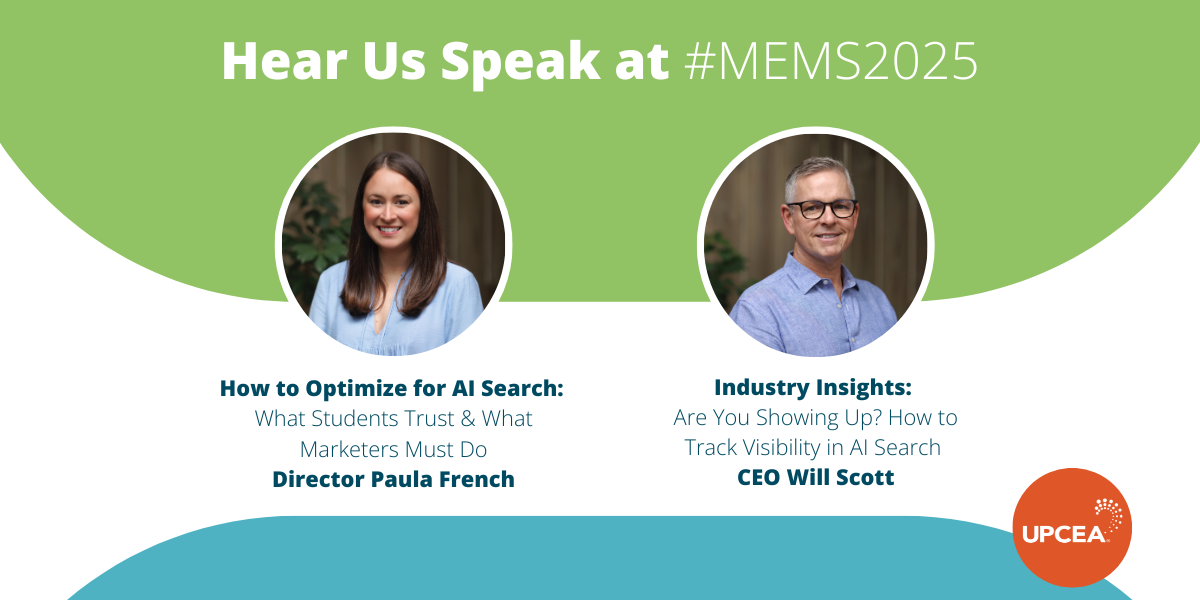
    MEMS2025 speakers graphic

    “Are You Showing Up? How to Track Visibility in AI Search”

    Presenter: Will Scott, CEO and Co-Founder, Search Influence

    Time: Wednesday, December 3 – 10:00 a.m.

    AI search is no longer theoretical. It’s measurable. In this session, Will will show institutions how to connect generative search visibility to real data and use it to drive recruitment strategy.

    Session Highlights:

    • Learn how to measure your institution’s presence across AI platforms like ChatGPT, Gemini, and Perplexity.
    • Discover how to segment AI-driven traffic using Google Analytics 4 and Looker Studio.
    • Identify metrics and tools that help you evaluate AI visibility and performance.

    “How to Optimize for AI Search: What Students Trust & What Marketers Must Do”

    Presenter: Paula French, Director of Sales and Marketing, Search Influence

    Co-Presenter: Emily West, Senior Market Research Analyst, UPCEA

    Time: Wednesday, December 3 – 3:30 p.m.

    Nearly half of prospective students now use AI tools weekly, and 79% read AI-generated summaries. In their presentation, Paula and Emily will translate this data into concrete next steps for marketing teams ready to compete in generative search.

    Session Highlights:

    • Review new findings from the 2025 UPCEA + Search Influence study, AI Search in Higher Education: How Prospects Search in 2025.
    • Understand what prospective students trust in AI-generated results.
    • Learn a three-part framework for AI visibility: discoverability, credibility, and content optimization.

    “From Search to Success: Integrating SEO and Email Marketing to Drive Enrollment”

    Moderator: Jeanne Lobman, Director of Operations, Search Influence

    Panelists: Tim Grenda and Caitlin Dimalanta, San Diego State University

    Time: Tuesday, December 2 – 2:45 p.m.

    Students don’t stop searching once they find a program. They start evaluating how institutions communicate. This session will explore how connecting SEO insights with email marketing creates a continuous, student-centered experience that strengthens engagement and drives enrollment.

    Session Highlights:

    • Explore how integrated SEO and email strategies guide students from search discovery to enrollment.
    • Learn how coordinated messaging increases engagement and conversion.

    “Boosting SEO and Engagement Through Testimonial-Driven Web Content”

    Moderator: Paula French, Director of Sales and Marketing, Search Influence

    Panelists: Caitlin Wilson and Krysten Cole, Boston University Metropolitan College

    Time: Thursday, December 4 – 10:00 a.m.

    Authenticity has become one of higher education’s strongest differentiators. This session will examine how testimonial-driven storytelling can improve SEO performance, strengthen brand trust, and create more meaningful engagement with prospective students.

    Session Highlights:

    • Understand the importance of authentic student and alumni testimonials in building credibility and enhancing visibility.
    • Learn how to turn stories into measurable content assets that support recruitment goals.
    • Explore how to connect storytelling with keywords and SEO strategies for stronger search performance.

    About MEMS 

    Hosted by the Online and Professional Education Association (UPCEA), the MEMS Conference brings together enrollment and marketing professionals from across the country to share strategies that connect innovation with measurable results. 

    Now in its 34th year, the event will focus on emerging technology, shifting student expectations, and the evolving ways higher education institutions can reach, recruit, and retain learners.

    Throughout the conference, Search Influence will host a booth where attendees can learn how to assess their institution’s AI visibility, explore AI SEO tools, and request a complimentary AI Website Grader developed by Will. Our team will be available to discuss real-world applications of AI-driven marketing data and how colleges can start improving their presence across generative platforms.

    Continuing the Conversation

    As AI search evolves, understanding how visibility, trust, and data intersect has never been more important. 

    If your institution is ready to know where it stands in AI search, download AI Search in Higher Education: How Prospects Search in 2025, or meet our team in Boston to explore how strategy, credibility, and creativity can elevate your visibility.

  • 2024 Higher Education Marketing Benchmarks: Get Past Your Blindspot

    2024 Higher Education Marketing Benchmarks: Get Past Your Blindspot

    Key Insights

    • A shifting higher education playing field is causing universities to reevaluate their results and the costs associated with them.
    • Despite increased competition and an evolving modern learner, higher education marketing departments can still reach their enrollment goals by tracking the right metrics to inform future strategies.
    • New Search Influence and UPCEA research reveals a blind spot in higher education marketing tracking: cost per inquiry and cost per enrollment.
    • Cost per inquiry and cost per enrollment are compasses that help you determine your marketing budget’s efficiency and effectiveness. By tracking these key metrics, you can see what’s working and what’s not as part of the bigger picture.
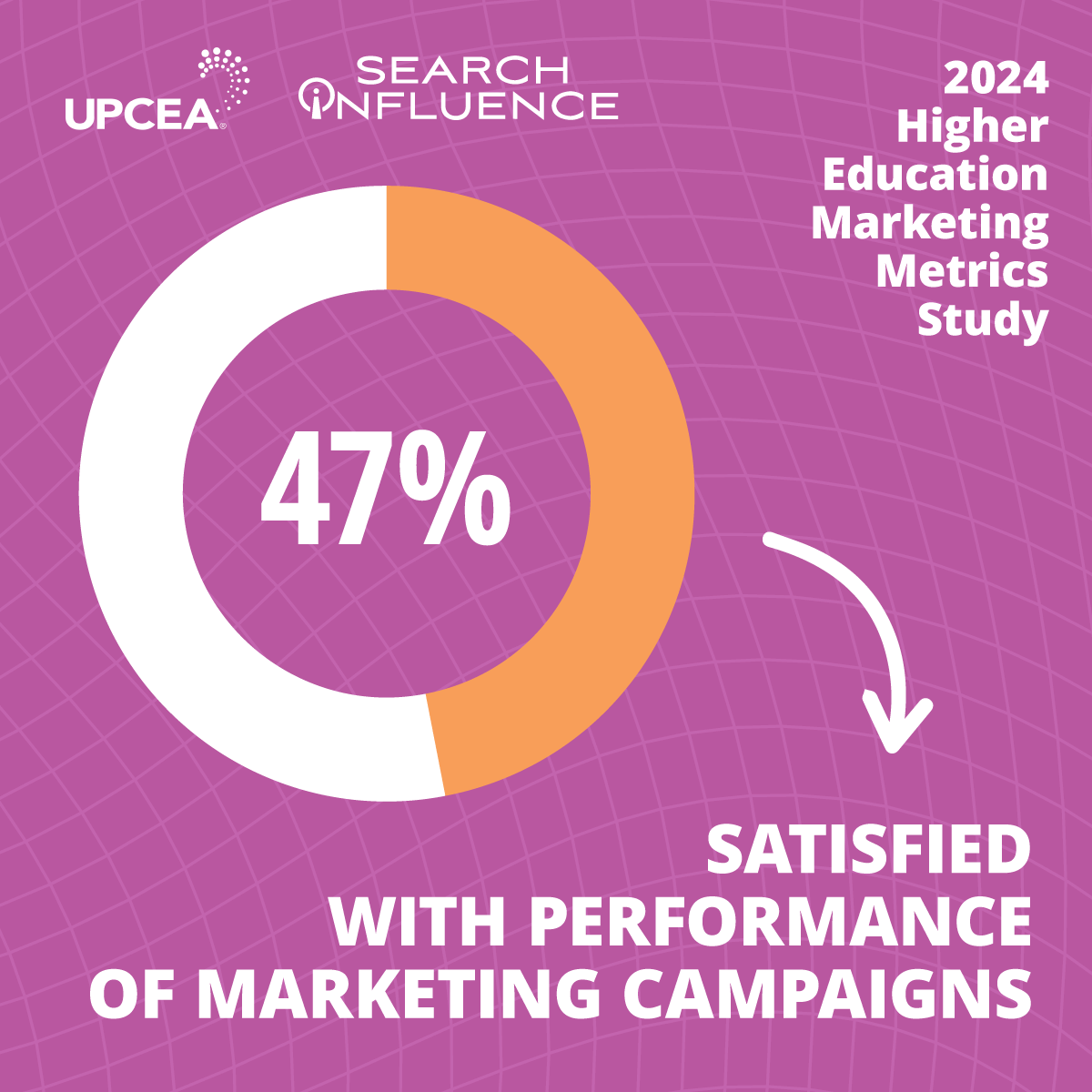
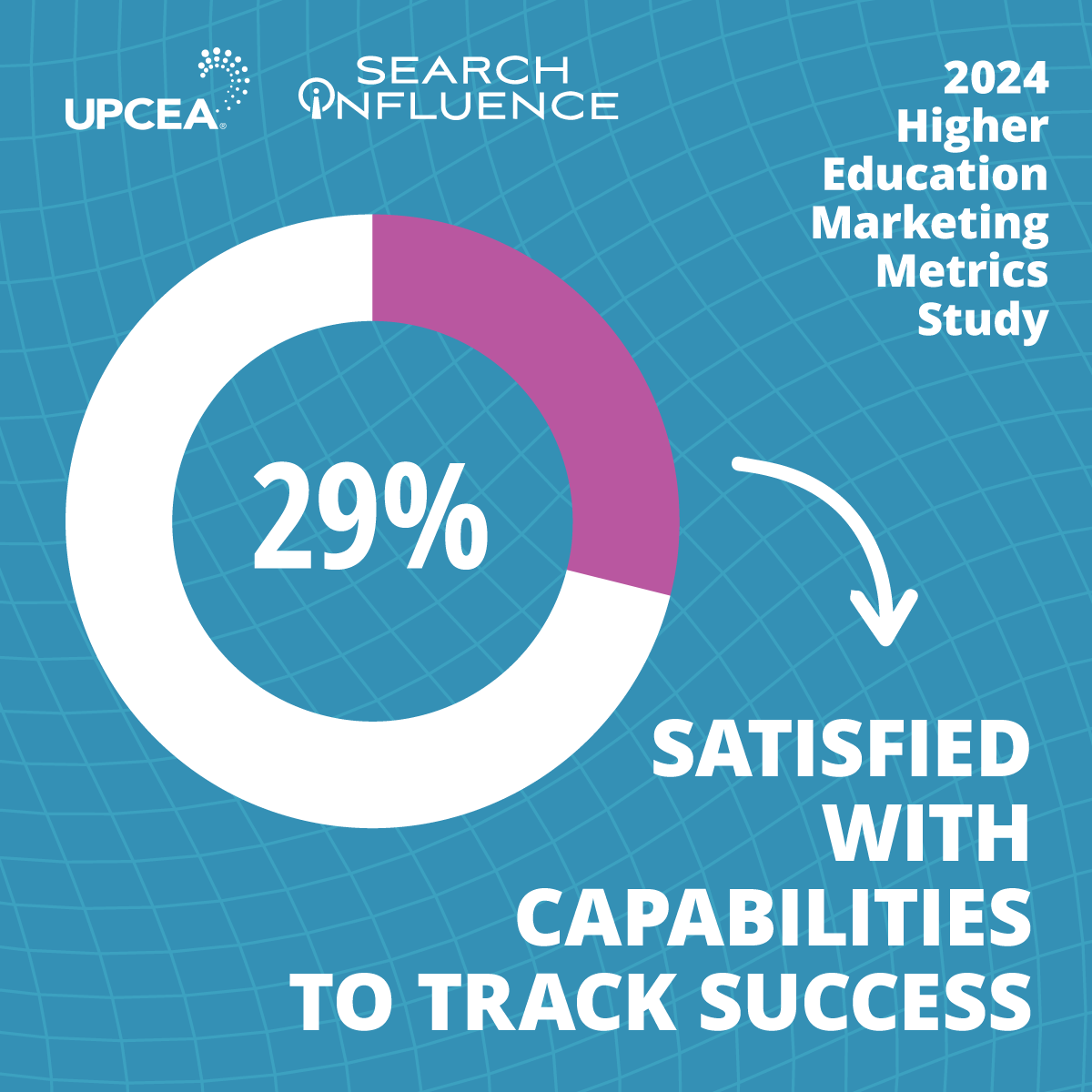
    • Marketers who keep a pulse on their campaigns via in-depth tracking are more satisfied with their overall marketing performance.

    Changing demographics, limited resources, and increased competition in higher education are making university leaders rethink their marketing strategies.

    Colleges and universities need to pinpoint where to invest their resources for the best return — and where to trim the fat.

    This starts with tracking the right higher education marketing metrics.

    While overall marketing metrics offer valuable insights, the ability to analyze the data at the program level will ultimately determine which institutions meet enrollment goals and which fall behind.

    In “What Gets Measured Gets Managed,” our 2024 higher education marketing benchmark research conducted in partnership with UPCEA, we analyzed whether professional, continuing, and online (PCO) units are tracking two key metrics that could inform critical outcomes: cost per inquiry (CPI) and cost per enrollment.

    See the state of tracking in higher education marketing and how your institution compares to others in the industry.

    Key Findings of the UPCEA Research Study

    The average annual digital ad spend on PCO units is nearly $900k

    The modern learner has gone digital, and the higher education marketing sector rightfully followed suit.

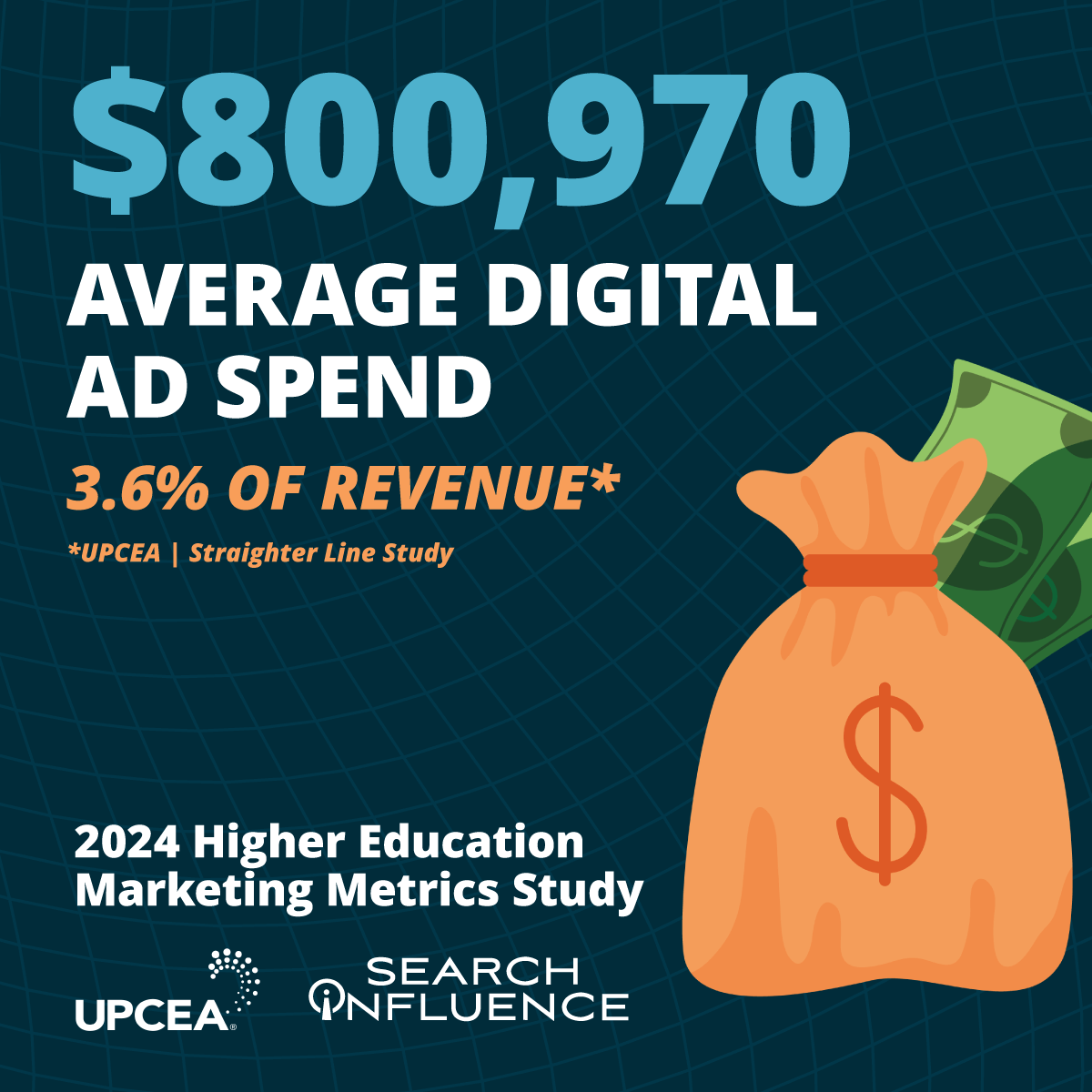
    Professional and online education units spend an average of $800,970 each year on digital advertising spend, including paid search, social advertising campaigns, and connected TV (CTV) streaming ads.

    Average digital ad spend was $800,970 - Search Influence Higher Education Marketing Benchmarks

    As the new learner searches for higher education programs online, digital advertisers must meet inquirers where they are in their enrollment journey.

    This involves continuous learning, adapting, testing, and re-testing — a process that starts with tracking the right campaign data, like cost per inquiry.

    Less than half of higher ed marketers track cost per inquiry

    Cost per inquiry is the most important metric to track to reduce the expenses of driving your prospects to take action. But if you aren’t tracking this key metric, the good news is you’re not alone.

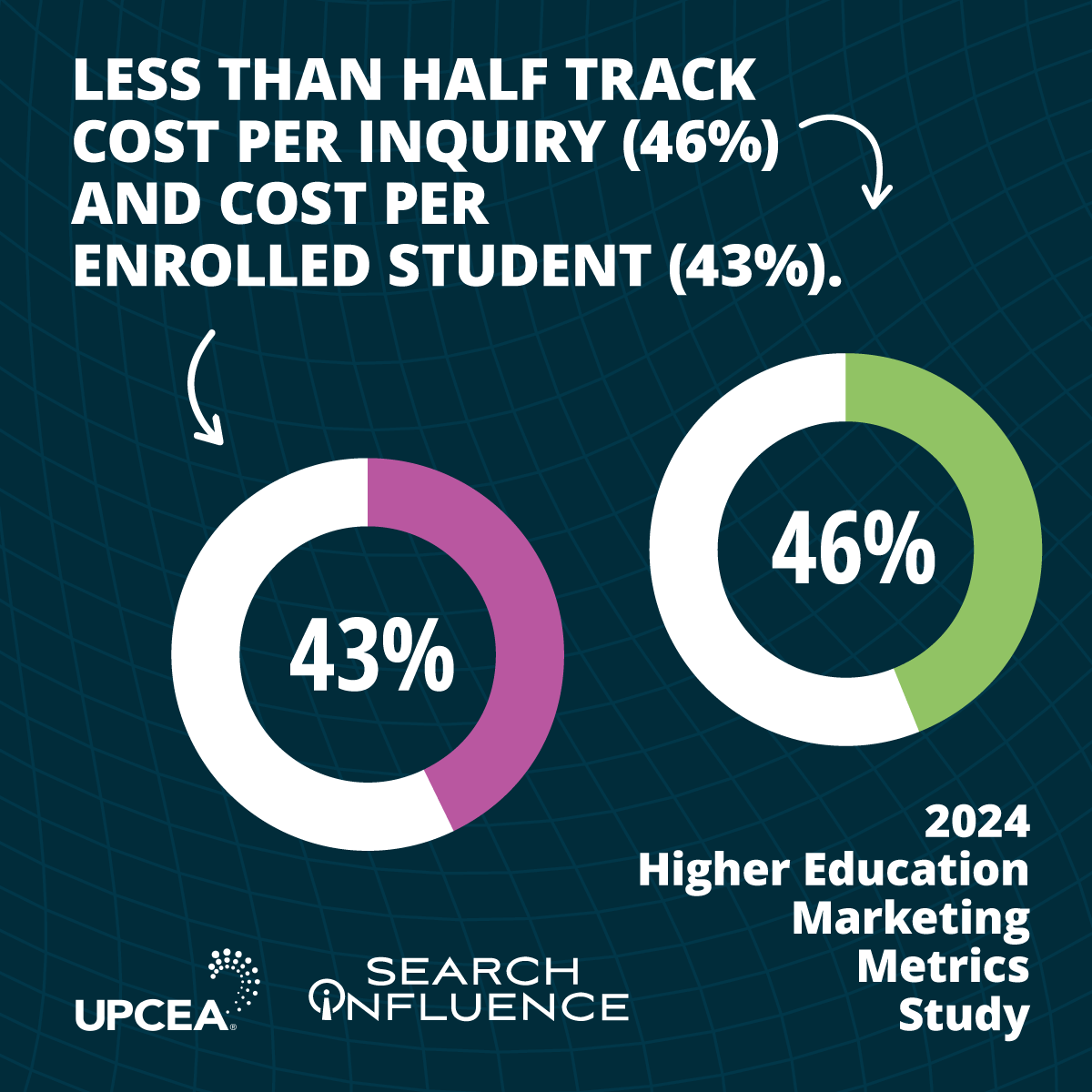
    Today, most higher education marketers have a fairly strong grasp of the source of their inquiries — not necessarily the costs associated with them. Nearly three-quarters (73%) of marketing units track inquiry sources for their PCO programs, while less than half track cost per inquiry (46%) or cost per enrolled student (43%).

    And, for nearly one out of five research survey respondents (17%), metric tracking isn’t even on their radar.

    Less than half track cost per inquiry and cost per enrolled student - Search Influence Higher Education Marketing Benchmarks

    The average cost per inquiry (CPI benchmark) for professional and online education is $140.

    Of the 46% of PCO units that track cost per inquiry, the average CPI for the 2022-2023 fiscal year was $140, with a median of $106. Roughly one-third (32%) of PCO units had a CPI between $50 and $100, 15% between $101 and $150, and 15% over $200.

    The expenses associated with this CPI benchmark for marketing varied but most often consisted of:

    • Media spend (88%)
    • All marketing expenses, excluding salaries (46%) and agency management fees (39%)

    Result satisfaction is fairly low, with 38% of survey respondents reporting they’re content with their school’s CPI, and 27% not sure.


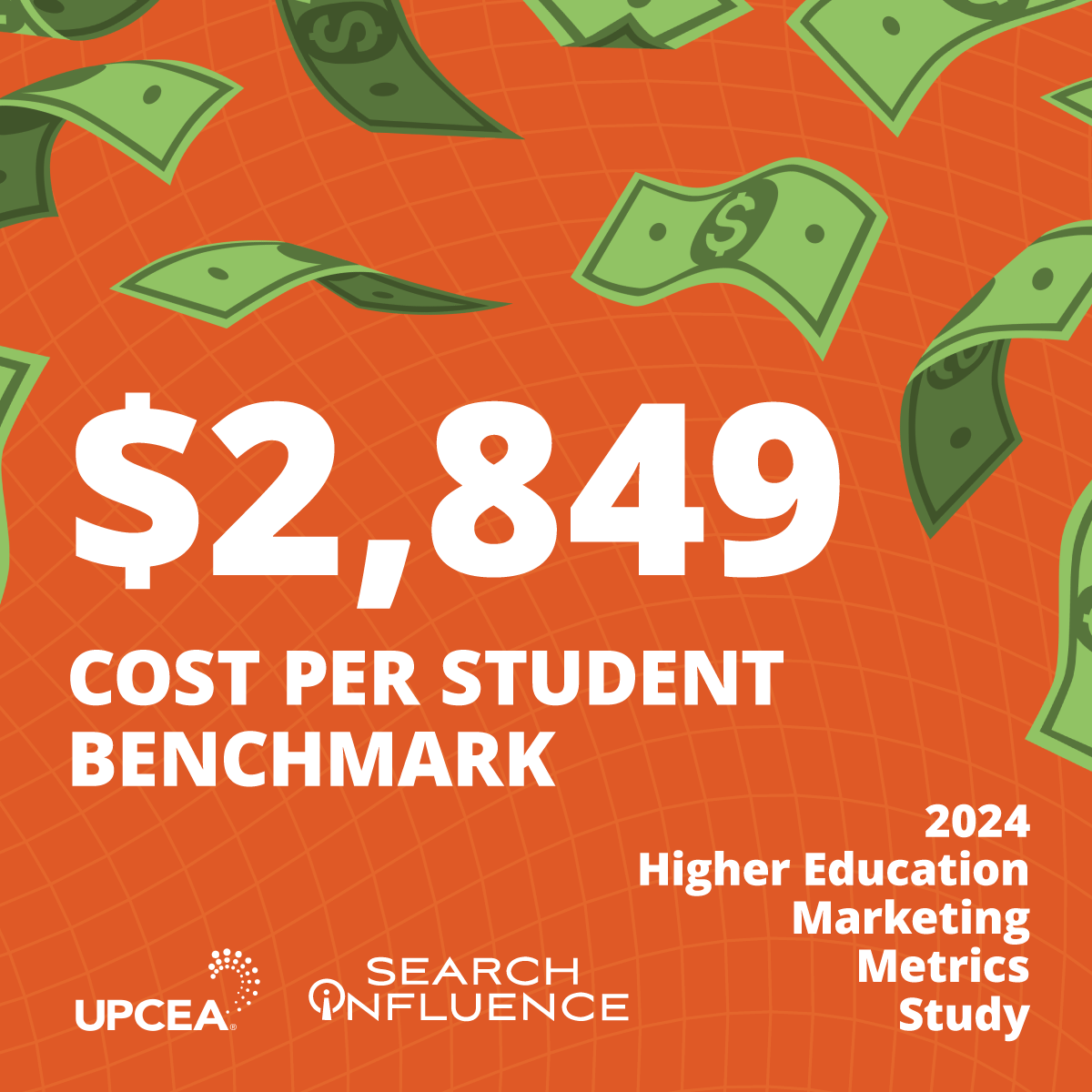
    The average professional and online education cost per enrolled student is $2,849.

    Of the 43% of PCO units that track cost per enrolled student (43%), the average cost per enrolled student for the 2022-2023 fiscal year was $2,849, with a median of $1,173. 27% of PCO units had a cost per enrolled student under $500, and an additional 27% had a cost per enrolled student of over $3,000.

    $2,849 cost per student benchmark - Search Influence Higher Education Marketing Benchmark

    Email marketing is most often managed in-house, while digital advertising is most often outsourced

    Nearly three-quarters (73%) of higher ed email marketing and half of search engine optimization (44%) efforts are entirely managed in-house. However, digital advertising remains an item ripe for outsourcing, with half of the survey respondents exclusively outsourcing their Google paid search campaigns to experienced agencies.

    Whether it’s due to budget constraints or simply just a preference to keep things internal, most PCO units mix and match what is outsourced and what is managed in-house. However, it’s important to note that managing any marketing campaigns in-house requires universities to have the time, skills, and resources to monitor campaigns and stay up to date on trends.

    If you’re unsure whether partnering with an agency is the best option for your university, start a conversation with us today.

    Marketers who track their campaigns are more happy with performance

    Tracking campaign performance has a direct link to overall marketing satisfaction.

    According to our research findings, those who are satisfied with their back-end campaign tracking capabilities are more likely to be satisfied with how those campaigns perform in the wild.

    Despite this, many marketers lack the know-how, resources, and time to keep a steady pulse on their campaigns, leaving key metrics to fall to the wayside — entirely overlooked. Fewer than half (46%) of survey respondents report satisfaction with their campaign’s performance, and only 29% are satisfied with their ability to track such success.

    This blind spot then creates a grueling cycle of campaign launch → result dissatisfaction → repeat, with no guide for improving results.

    29% of companies were satisfied with capabilities to track success - Search Influence Higher Education Marketing Benchmark

    How Higher Education Marketing Benchmarks Drive Marketing Outcomes

    There’s an old saying by British mathematician Lord Kelvin that goes, “To measure is to know.” 

    When thought of strategically, digital advertising is data for dollars. Within a single campaign, you can gain insights into its effectiveness, ranging from lead quality to cost per inquiry, without hours of tedious pen-to-paper calculations. And, with industry-wide higher education marketing benchmarks, you can compare how you’re doing with competitors and determine ways to refine your budget and outcomes.

    Going beyond basic metrics like cost-per-click and leveraging more granular metrics like cost per inquiry helps you:

    • Have more confidence in your inquiry quality and quantity
    • Know which campaigns are performing or underperforming, and which optimizations to make to improve results
    • Assess how adjustments like budget and targeting changes affect campaign results
    • Establish a starting point to dive deeper into metrics like conversion rates as prospective students move through the enrollment funnel

    Armed with a well-rounded understanding of each inquiry, you can drive home campaigns that resonate without wasted ad spend.

    How to utilize cost per inquiry

    Cost per inquiry isn’t a metric exclusive to higher education institutions. Healthcare, hospitality, and B2B marketers have long relied on this measurement to assess the state of their incoming inquiries.

    Why? Because CPI is a direct measurement of budget efficiency and effectiveness.

    Your institution’s CPI is calculated by dividing how much you’ve spent on marketing and advertising by the number of inquiries received. In higher education, inquiries commonly originate from emails and college websites, specifically:

    • Request for information forms
    • Brochure request forms
    • Request a visit forms

    Utilizing a CPI metric gives your marketing department valuable insights into your advertisements’ impact. It helps you examine your performance and provides guidance on budgeting and refining your marketing strategy.

    But, just like any marketing metric, CPI works best when it’s evaluated as part of the bigger picture. Building your data stack with additional key metrics, like cost per enrolled student, helps you visualize the cost of the entire conversion process, from the initial inquiry to final enrollment.

    How to utilize cost per enrolled student

    Cost per inquiry is a leading indicator of success.

    Cost per enrollment is the most definitive metric you can review to see how much you are spending to get a new student.

    This metric encompasses the total costs invested in securing a student’s enrollment, factoring in expenses from the initial marketing efforts and campaign launch all the way to the student’s matriculation. Most often, these include:

    • Media spend
    • Agency management fees
    • University marketing team salaries
    • All other marketing undertakings

    When analyzing cost per enrollment over time, or comparatively within your programs, you can get a sense of where you need to make the biggest changes – either budget, resource allocation, or overall strategy.

    Leveraging cost per inquiry and cost per enrollment in tandem can lead you down the right path to campaign effectiveness. Ideally, by adopting these metrics into your tracking tool kit, your higher education institution can prioritize the digital marketing campaigns that yield the most inquiries at the lowest costs.

    Not sure how to calculate your school’s cost per inquiry or cost per enrollment? See our new CPI Calculator or download our free worksheet for help getting started.

    Gain Insights Into Your Higher Ed Marketing Performance With Search Influence

    The bottom line: Tracking cost per inquiry and cost per enrollment is an untapped opportunity for many schools looking to maximize every marketing dollar invested. These often neglected, yet incredibly insightful, metrics help you understand what’s working, what isn’t, and how to allocate your budget accordingly for the best results.

    We hope that, with this new industry-wide benchmark, your college or university will better judge the performance of your professional and online program marketing.

    If you’re unsatisfied with your digital advertising performance, tracking these key performance metrics can get you past your blind spot. After all, you can’t improve what you don’t measure, and what gets measured gets managed.

    Download the full 2024 higher education marketing benchmark research study with UPCEA today.