Tag: Google Analytics 4

  • How to Set Up AI Traffic Tracking in GA4

    Key Insights

    • AI platforms are regularly sending real users to websites. This traffic exists today, even if it hasn’t been tracked or discussed widely yet.
    • GA4 doesn’t clearly identify AI-driven visits on its own. Without proper setup, those sessions get grouped with other referrals and are easy to overlook.
    • Visits from AI tools don’t behave the same way as traditional search traffic. They often come from users researching, comparing, or trying to solve a specific problem.
    • Channel-based tracking makes AI traffic easier to find and analyze. Custom channel groups help isolate these visits and keep reporting consistent as AI tools evolve.
    • AI measurement works best when you focus on trends, not perfection. Directional insight is enough to evaluate performance and make smarter decisions.

    Traffic from AI tools is already reaching your website. It’s happening now, and it’s measurable, even if it has never appeared clearly in your reporting. Google’s AI Overviews, ChatGPT, Perplexity, Claude (and so on) are sending users to third-party sites every day.

    The issue isn’t whether AI traffic exists. It’s whether you can see it at all. In Google Analytics 4 (GA4), AI-driven visits are typically classified as Referral traffic, which strips away context and minimizes impact.

    Seeing AI traffic clearly changes how performance is evaluated. Let’s break down how AI traffic shows up in GA4, how to surface it deliberately, and how Search Influence turns those signals into dashboard-level insights that teams can use to make confident decisions.

    What Counts as “AI Traffic” in GA4?

    Before you can track AI referral traffic, you need to be precise about what qualifies. AI traffic isn’t a vague concept or a future trend. It refers to a specific type of visit with a distinct source and intent.

    How AI traffic is defined

    AI traffic includes sessions that originate from AI-powered tools when those tools link users to third-party websites as part of an answer, recommendation, or explanation. These visits happen when a user chooses to leave an AI interface and click through for deeper context, validation, or next steps.
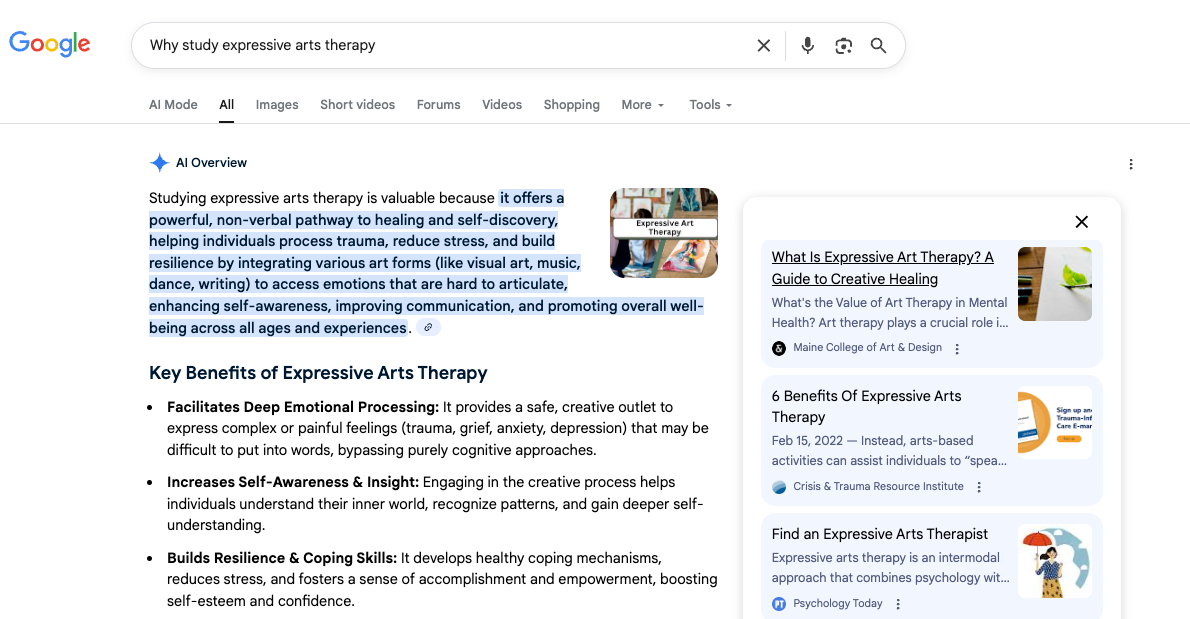
    Pictured: An AI Overview in Google Search showing cited sources alongside the generated response. When a user clicks one of these linked citations to learn more, that visit is sent from the AI interface to the publisher’s website. In GA4, that click-through is classified as AI traffic.

    This type of traffic is already present across many websites. In a 2025 Ahrefs analysis of 3,000 anonymized sites, 63% recorded at least one visit from an AI source.

    Common AI tools that send traffic today include:

    • Google’s AI Overviews
    • ChatGPT
    • Perplexity
    • Claude
    • Gemini
    • Copilot

    If a user clicks a link from one of these platforms and lands on your site, that session counts as AI traffic.

    What AI traffic is not

    AI traffic is often confused with other acquisition channels, which leads to inaccurate assumptions about its role.

    AI traffic is not:

    • Organic search traffic from Google or Bing
    • Paid search or display traffic
    • Standard referrals from publishers, directories, or partners

    Even when AI tools surface content that originally ranked in search, the visit itself does not come from a search engine. The source is the AI platform, not the SERP.

    Why AI-driven visits behave differently

    Users arriving from AI tools typically have a different mindset than traditional search users. In many cases, they are:

    • Researching a specific question or comparison
    • Looking to confirm information they’ve already seen
    • Narrowing options rather than browsing broadly

    As a result, AI-driven sessions often enter deeper into content, focus on fewer pages, and show engagement patterns that don’t always align neatly with organic search benchmarks.

    Why this definition matters

    Without a clear definition of AI traffic, reporting becomes inconsistent fast. Teams end up blending unlike sessions together, misreading intent, or minimizing AI’s contribution altogether.

    Agreeing on what counts as AI traffic makes it possible to:

    • Track it consistently over time
    • Compare it meaningfully against other channels
    • Analyze behavior without muddy attribution

    Once AI traffic is clearly defined, the next challenge becomes visibility (specifically, where this traffic actually shows up inside GA4).

    Where AI Traffic Lives in GA4 by Default

    When AI traffic reaches your site, GA4 has to decide where to put it. That decision happens automatically, based on how GA4 assigns sessions to its Default Channel Groupings.

    GA4 groups traffic by matching source and medium patterns. When a visit doesn’t meet the criteria for search, paid, social, or email, it’s typically assigned to the Referral channel. This is where most AI-driven visits end up.

    Why AI traffic gets classified as Referral

    AI tools send users to websites using standard web links. From GA4’s perspective, there’s nothing about these visits that signals a unique acquisition channel. As a result, traffic from AI platforms is treated the same way as any other external link click.

    That means AI traffic is not labeled, flagged, or separated by default. It’s folded into Referral alongside a wide range of unrelated sources.

    What this looks like in reporting

    In practice, AI traffic blends in with referral sources such as:

    • Software platforms
    • Documentation sites
    • Blogs and media outlets
    • Partner or vendor domains

    Without deliberate segmentation, there’s no clear way to distinguish an AI-driven session from any other referral visit.

    Why this makes AI traffic hard to analyze

    Referral traffic is often reviewed at a high level, if at all. It’s rarely trended with the same attention as organic or paid channels, which makes emerging patterns easy to miss.

    As a result:

    • AI traffic is difficult to isolate over time
    • Growth from AI platforms can go unnoticed
    • AI’s contribution to acquisition and engagement is underrepresented

    AI traffic isn’t invisible in GA4. It’s simply buried, and understanding where it lives by default is the first step toward surfacing it intentionally.

    How AI Traffic Tracking Works in GA4

    Once you know AI traffic is folded into Referral reports by default, the next question is how to surface it consistently. In GA4, that starts with custom AI traffic channel groups.

    Why channel groups work

    Channel groups operate at the acquisition layer in GA4. When AI traffic is defined as its own channel, it becomes visible across standard reports, comparisons, and dashboards without relying on one-off views or manual analysis.

    This approach:

    • Applies consistently to past and future data
    • Integrates cleanly into existing reporting workflows
    • Makes AI traffic comparable to other acquisition channels

    Why filters and ad hoc reports aren’t enough

    Temporary filters and explorations can surface AI traffic, but they don’t scale. They require constant upkeep, fragment reporting, and make trend analysis harder over time.

    Channel groups solve the problem structurally by establishing AI traffic as a distinct acquisition category.

    How AI traffic is identified

    AI traffic is grouped using session source values, not behavior or content signals. When a known AI platform appears as the source, GA4 can assign that session to the appropriate channel.

    This keeps attribution clean and allows rules to evolve as new AI tools emerge.

    A scalable, industry-aligned approach

    Custom channel groups are already a best practice for managing complex acquisition sources in GA4. Applying that same framework to AI traffic creates visibility without overengineering and keeps reporting aligned as AI-driven discovery continues to change.

    High-Level Steps: Setting Up an AI Traffic Channel in GA4

    AI traffic doesn’t need to be created or inferred. It already exists in GA4. The goal of setup is to surface it in a way that’s consistent, durable, and usable across reports.

    1. Create a custom channel group for acquisition analysis
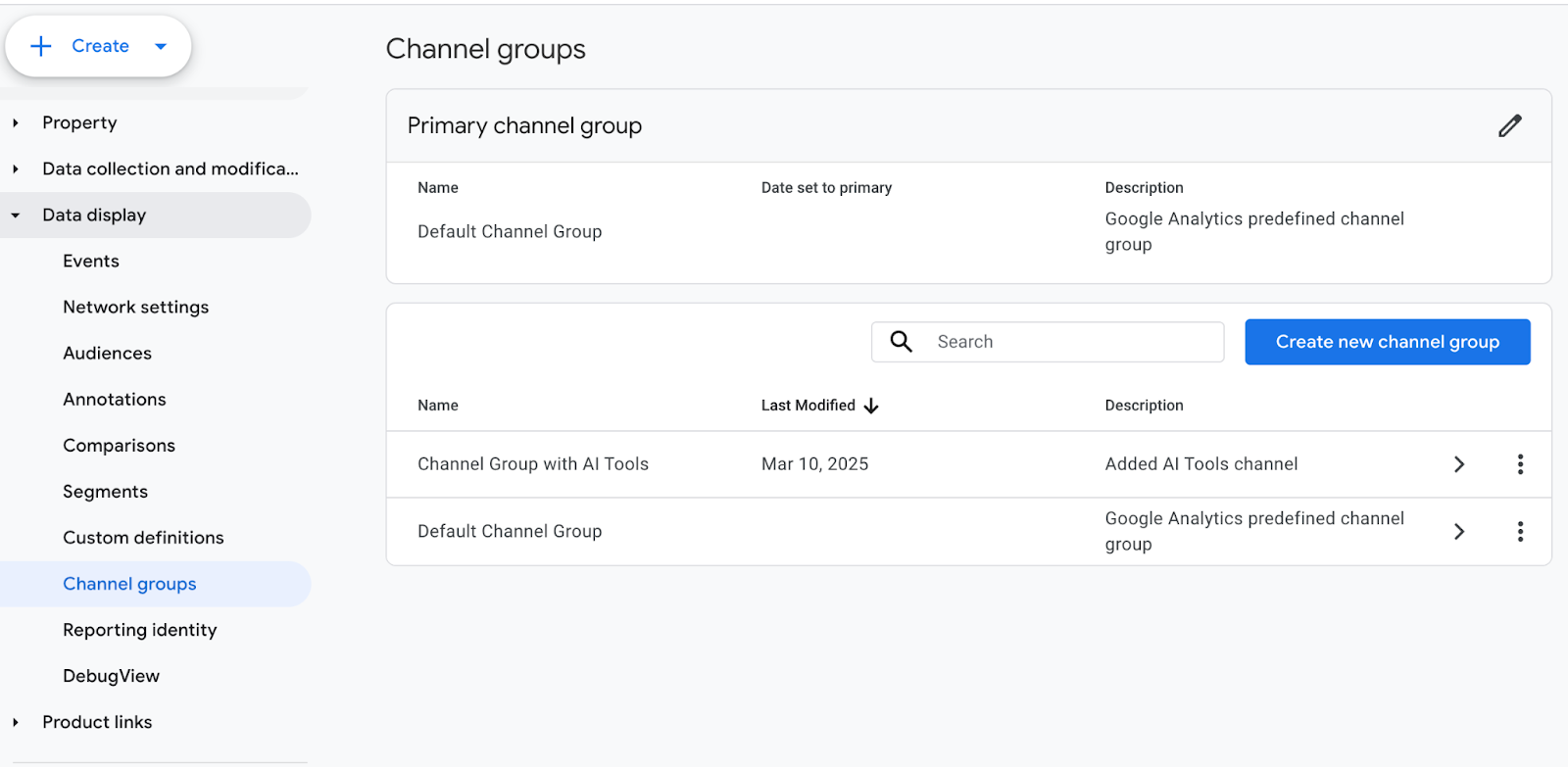
    AI traffic tracking starts with a custom channel group. Channel groups determine how sessions are categorized throughout GA4’s acquisition reporting, which makes them the right layer for isolating AI-driven visits.

    This establishes AI traffic as a first-class acquisition channel.

    2. Add a dedicated channel labeled “AI Tools”

    Within the new channel group, a dedicated channel is defined specifically for AI-driven sessions. A clear label like “AI Tools” keeps reporting readable and reduces ambiguity when data is shared across teams.

    At this stage, simplicity matters more than over-segmentation.

    3. Identify AI traffic using session source values

    As stated above, AI traffic is identified using session source values rather than behavioral or page-level signals. When a session originates from a known AI platform, GA4 can assign it to the AI Tools channel.

    This keeps attribution consistent and avoids guessing user intent.

    4. Apply regex logic to group known AI platforms under one channel

    Known AI platforms are grouped together using pattern-based logic. This allows multiple tools to roll up into a single channel while keeping the structure flexible as AI-driven discovery continues to evolve.

    As new AI tools are released or gain adoption, this regex can be updated to include additional referrers without changing the overall reporting framework. This keeps AI traffic consolidated, prevents fragmentation across referral sources, and ensures visibility keeps pace with the expanding AI ecosystem.

    The channel evolves through periodic refinement, not constant reconfiguration, which makes it sustainable over time.

    5. Reorder channels so AI traffic is evaluated before Referral

    Channel order determines how GA4 assigns sessions. Placing the AI Tools channel above Referral ensures AI-driven visits are captured intentionally rather than falling into the default referral bucket.

    This step prevents AI traffic from being hidden again.

    6. Validate AI traffic visibility in GA4 acquisition reports

    After setup, AI traffic should appear clearly across standard acquisition reports. At that point, teams can begin trending performance, comparing AI traffic against other channels, and incorporating it into regular reporting.
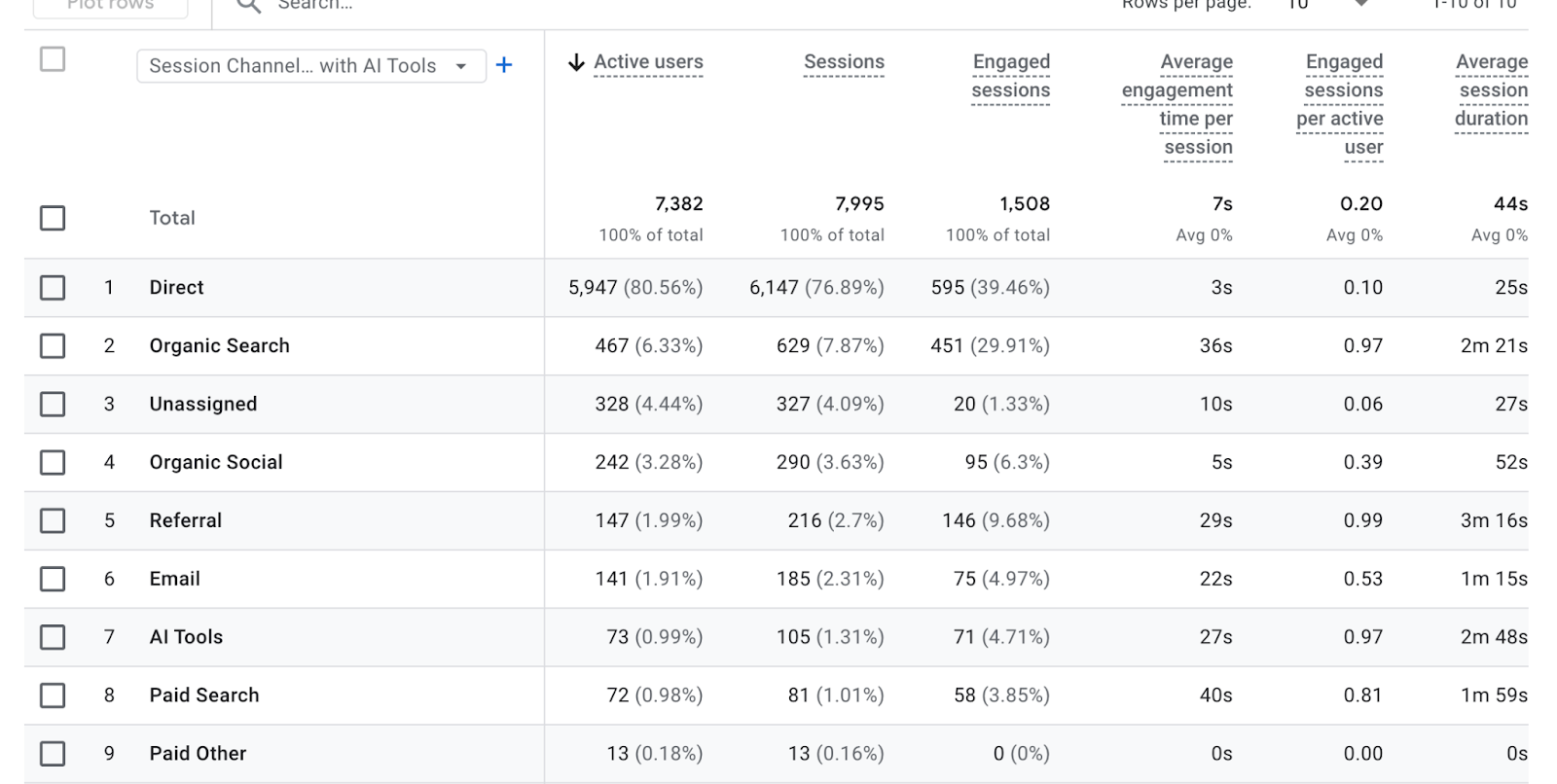
    This setup doesn’t change how GA4 captures data. It simply surfaces AI-driven sessions that were already there, pulling them out of the referral background and into a form that teams can actually use.

    For a more detailed, step-by-step walkthrough of this setup, see Dana DiTomaso’s “How to Track and Report on Traffic from AI Tools (ChatGPT, Perplexity) in GA4.”

    Separating ChatGPT From Other AI Tools

    After AI traffic is surfaced as a channel, some teams notice that one source tends to stand out. In many cases, that source is ChatGPT.

    Why ChatGPT often dominates AI traffic

    ChatGPT often represents a larger share of AI-driven sessions due to its broad adoption (it became the fastest-growing app in history, reaching 100 million active users within two months of launch) and frequent use for explanations, comparisons, and next steps. As a result, it’s often the first AI signal teams notice once tracking is in place.

    How ChatGPT traffic can behave differently

    Not all AI traffic behaves the same. ChatGPT-driven sessions may show different patterns than traffic from tools like Perplexity, Claude, or Gemini.

    Common differences include:

    • Deeper entry points into content
    • Longer engagement on explanatory pages
    • Strong alignment with informational or evaluative intent

    These differences reflect how users interact with various AI tools, rather than their performance quality.

    When separating ChatGPT adds value

    Separating ChatGPT into its own channel can improve clarity when it accounts for a meaningful share of AI traffic or when teams want platform-specific insight. In these cases, segmentation supports analysis rather than adding noise.

    When it’s better to keep AI traffic sources grouped

    For many teams, especially early on, grouping all AI tools under a single channel keeps reporting simpler and trends easier to interpret. Segmentation should be introduced only when it helps answer real questions.

    AI Tool Referrals vs AI-Generated Search Clicks

    AI tools vs AI search features

    AI-driven traffic doesn’t follow a single pattern. One of the most common points of confusion is the difference between AI tool referrals and AI-generated search features.

    AI tools send traffic directly from their own interfaces. When a user clicks a link inside a tool like ChatGPT or Perplexity, that visit arrives as a standard referral session.
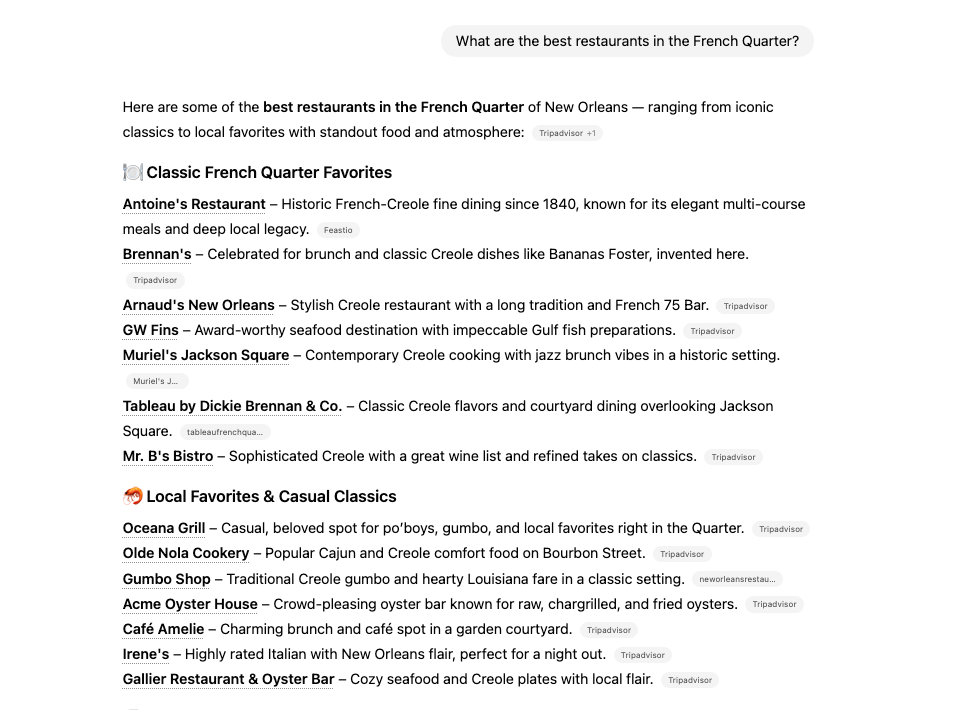
    Pictured: A recommendation list generated inside ChatGPT, where each item includes a clickable external source. When a user selects one of these links and lands on a website, the visit is recorded as a referral from ChatGPT, distinguishing it from clicks that originate within a search engine results page.

    AI-generated search features work differently. These include:

    • AI Overviews
    • Featured Snippets
    • People Also Ask

    In these cases, the user is still on a search engine results page. The click originates from a Google-owned surface, not from an external AI tool.

    Why this distinction matters in GA4

    Because AI tools and AI search features generate different types of URLs, they behave differently in analytics. Channel groups can reliably capture traffic from AI tools because those visits have identifiable external sources.

    AI-generated search clicks, however, often share source and medium values with traditional organic search. As a result, they can’t be isolated cleanly using channel group rules alone.

    Understanding this distinction prevents misreporting. AI tool referrals and AI-generated search features both influence discovery, but they require different tracking approaches inside GA4.

    When Event-Based Tracking Is Needed for AI-Generated Search Links

    Channel-based tracking captures traffic from AI tools, not from AI-generated search features.

    When discovery happens inside AI Overviews, Featured Snippets, or People Also Ask, a different measurement approach is required.

    How event-based tracking fills the gap

    Event-based tracking provides a way to measure clicks from AI-generated search features by identifying specific URL patterns and triggering custom events. This approach typically requires Google Tag Manager and a deeper understanding of how search feature URLs are structured.

    Rather than reclassifying traffic into a new channel, this method captures interactions as events that can be analyzed separately inside GA4.

    What to expect from this approach

    Event-based tracking adds useful context, but it comes with limitations. Teams should go into this with the right expectations:

    • Tracking is partial, not comprehensive
    • URL structures change, which can break rules over time
    • Visibility is directional, not exhaustive

    Because of that, event-based tracking works best as a complement to channel-based AI traffic reporting, not a replacement for it.

    When it’s worth implementing

    This approach is most useful for teams that:

    • Want deeper insight into AI Overviews and other SERP features
    • Have the technical resources to maintain tracking rules
    • Are already comfortable working beyond standard GA4 reports

    For teams looking to explore this layer in more detail, Dana DiTomaso offers a technical deep dive in “How to Track Traffic from AI Overviews, Featured Snippets, or People Also Ask Results in Google Analytics 4”.

    Using GA4 Audiences to Analyze AI Traffic

    Channels show where traffic comes from. Audiences show what users do after they arrive. Once AI traffic is visible as an acquisition channel, audiences become the primary way to understand its quality, intent, and impact.

    How audiences extend AI traffic analysis

    GA4 audiences enable teams to categorize users based on their entry points and subsequent actions. When AI-driven sessions are used as audience criteria, behavior can be analyzed across engagement, conversion, and retention metrics.

    This shifts AI reporting from volume-focused to outcome-focused.

    Common AI-focused audience examples

    Teams often create audiences such as:

    • Users who arrived via AI tools
    • Users who engaged after an AI-driven session
    • Users who converted following AI traffic
    • Returning users whose first session came from an AI source

    Each audience answers a different question about how AI-driven discovery influences performance.

    What audiences reveal that channels can’t

    Channels make AI traffic visible. Audiences make it interpretable.

    With AI-based audiences, teams can evaluate:

    • Engagement depth compared to organic or paid users
    • Conversion rates tied specifically to AI discovery
    • Whether AI traffic introduces net-new users or supports return behavior

    This helps separate curiosity clicks from meaningful acquisition.

    Using audiences to guide reporting and decisions

    AI audiences can be applied across standard GA4 reports, comparisons, and dashboards. Over time, they help teams identify patterns that inform content strategy, UX decisions, and measurement priorities.

    Rather than asking whether AI traffic exists, audiences help answer the more useful question: what that traffic actually contributes.

    What Search Influence Tracks for AI Traffic

    Surfacing AI traffic is only the first step. The real value comes from understanding how that traffic performs, how it changes over time, and how it contributes to broader acquisition and conversion goals.

    Search Influence focuses on a focused set of metrics that balance visibility, behavior, and impact.

    Core AI traffic metrics

    At the foundation, we track AI traffic volume and growth trends over time. This establishes whether AI-driven discovery is increasing, stabilizing, or declining.

    Key metrics include:

    • Total AI sessions and month-over-month change
    • AI traffic share relative to organic search
    • Engagement indicators, such as pages per session and engagement time
    • Conversion performance tied to AI-driven sessions

    These metrics provide directional clarity without overfitting analysis to short-term fluctuations.

    Understanding performance by AI tool

    Beyond aggregate volume, we break AI traffic down by platform to understand how different tools contribute to discovery and engagement.

    This includes:

    • Traffic distribution by AI channel
    • Engagement and conversion behavior by tool
    • Early identification of new or emerging AI referrers

    Comparing tools side by side helps teams spot meaningful differences without assuming all AI traffic behaves the same way.

    Visualizing AI Traffic With Custom Dashboards

    Why GA4 alone isn’t enough

    GA4 can store the data, but it’s not built for fast, repeatable AI reporting across a team. Most AI questions require clicking through multiple reports, changing dimensions, and rebuilding the same views every time.

    Common friction points include:

    • AI traffic gets buried unless you know exactly where to look
    • Views are hard to standardize across stakeholders
    • Trend checks take too long to repeat weekly or monthly
    • Non-analysts struggle to pull the same story consistently

    If AI visibility matters, reporting has to be easy to access, easy to trust, and easy to repeat.

    How Search Influence dashboards surface AI insights

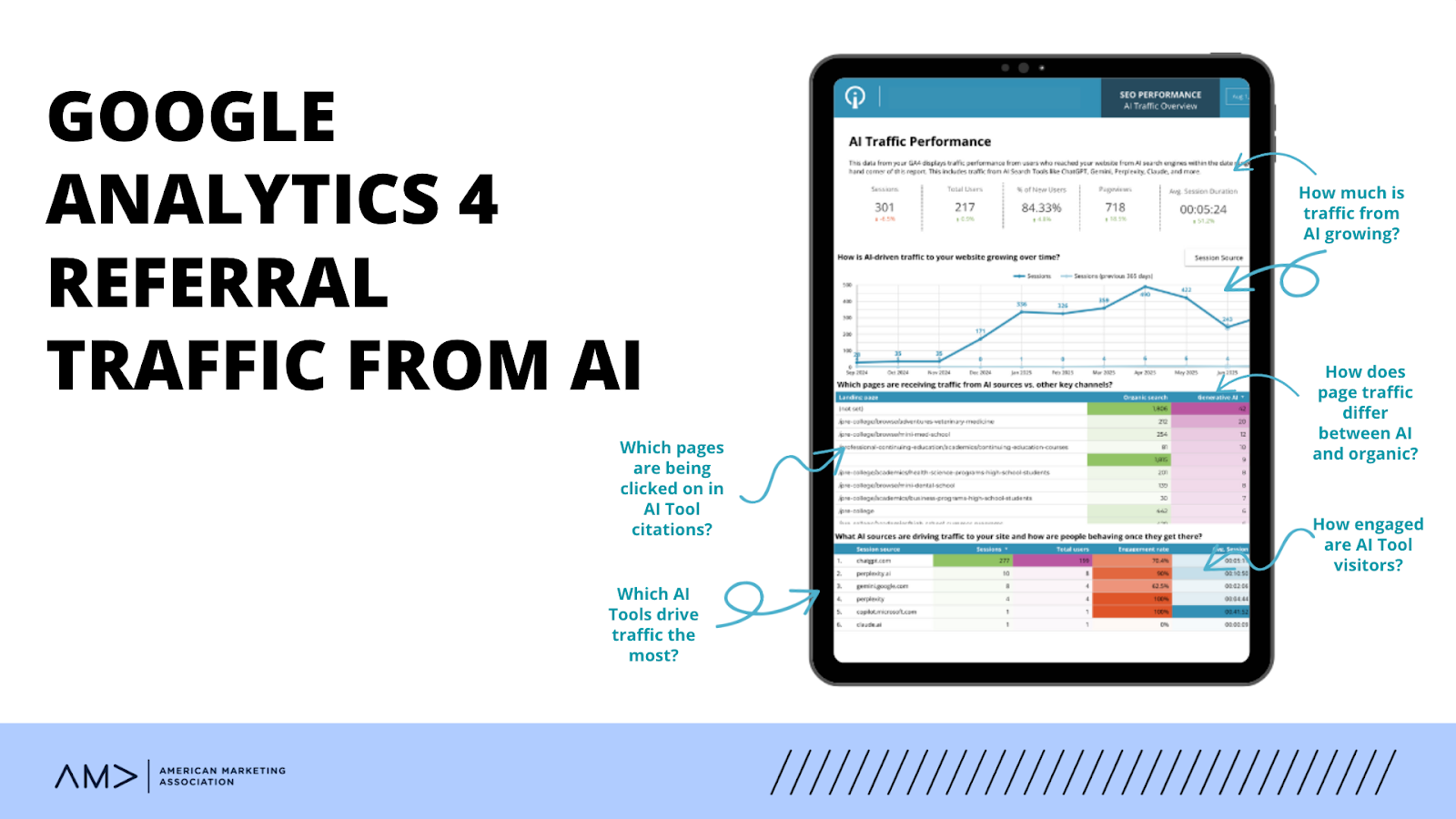
    Dashboards translate AI tracking into a shared, repeatable view that teams can rely on. Instead of rebuilding reports, AI performance is surfaced alongside organic and paid channels in a consistent format.

    Our custom-built dashboards typically show:

    • AI session volume and trend movement over time
    • AI traffic share relative to organic and paid
    • Engagement and conversion behavior from AI-driven sessions
    • Platform-level detail when it supports analysis (e.g., ChatGPT vs other tools)

    This shifts AI reporting from exploration to execution, making it part of an ongoing performance review rather than a one-off analysis.
    AI Tracking Tools Beyond GA4

    While GA4 remains the foundation for measuring what happens on your site, other platforms are beginning to surface how brands appear across AI-driven experiences.

    Today, these tools generally fall into three roles:

    • AI visibility tracking tools (such as Scrunch)
      Help teams understand where and how a brand shows up inside generative AI tools, including citation patterns and brand presence.
    • SEO platforms expanding into AI signals (including SEMrush and Ahrefs)
      Provide early indicators around AI citations, content reuse, and discovery, often alongside traditional search performance.
    • GA4 as the system of record
      Confirms what AI-driven discovery actually produces once users arrive, including engagement, conversion behavior, and downstream impact.

    Together, these tools answer different questions. Visibility platforms show where discovery happens. SEO tools reveal how content is reused or cited. GA4 validates what that traffic does next.

    The Reality of AI Traffic Tracking Today

    AI traffic tracking is not static. Referrers change, AI interfaces evolve, and attribution rules shift over time. Precision at the session level will never be perfect.

    What matters is consistency.

    When AI traffic is tracked the same way over time in GA4, patterns become visible. Teams can evaluate momentum, engagement quality, and contribution alongside other channels, even as the ecosystem changes.

    The goal is a usable signal, not a flawless measurement.

    FAQs

    1. Can GA4 automatically identify AI traffic without configuration?

    No. GA4 does not currently recognize AI-driven visits as a distinct channel on its own. By default, traffic from AI tools is classified as Referral, which makes it difficult to identify or analyze without additional setup. Custom channel groups are required to surface AI traffic consistently.

    2. Is AI traffic replacing or supplementing organic search traffic?

    At this stage, AI traffic is best understood as a supplement, not a replacement. Most AI-driven visits reflect users researching, validating, or comparing information before taking action. These behaviors often overlap with search intent, but they represent a different discovery path rather than a direct substitute for organic search.

    3. How accurate is AI traffic tracking in GA4 today?

    AI traffic tracking in GA4 is directional rather than exact. Known AI referrers can be reliably grouped using session source values, but attribution is not perfect and will evolve as AI tools change. The goal is consistent trend visibility over time, not precise session-level certainty.

    4. When should AI traffic be reported separately from organic traffic?

    AI traffic should be reported separately once it reaches a volume or strategic relevance that affects analysis or decision-making. Separating it too early can add noise, but grouping it indefinitely can hide meaningful patterns. The right timing depends on scale, stakeholder questions, and reporting needs.

    5. How often should AI tracking rules and definitions be reviewed?

    AI tracking rules should be reviewed periodically, typically quarterly or when major AI platforms introduce changes. New tools, referrer behaviors, and interface updates can affect how traffic appears in GA4. Regular review helps ensure definitions stay accurate without requiring constant adjustment.

    Turning AI Visibility Into Actionable Insight

    AI-driven discovery is already shaping how users find, evaluate, and engage with content. When tracked intentionally, it provides clear signals that strengthen SEO strategies, content decisions, and performance reporting.

    Search Influence brings structure to this complexity through proven tracking frameworks, executive-ready dashboards, and analytics that teams can act on with confidence.

    To gain clear visibility into how AI traffic is impacting your site, get in touch to explore our SEO, reporting, and analytics support.

    This post is informed by analytics frameworks and methodologies shared publicly by Dana DiTomaso. Our approach builds on those foundational concepts, adapted to how Search Influence configures reporting, analyzes performance, and delivers AI traffic insights through custom dashboards for our clients.


  • GA4 Guide: 13 Questions to Evaluate Your Agency’s Analytics Approach

    People working together on marketing and analytics sharing a group fist bump

    Key Insights

    • GA4 is a powerful tool for tracking user behavior and engagement metrics across devices, giving you a clearer picture of how visitors interact with your site.
    • Continuous GA4 tracking, reporting, and analysis enables you to accurately assess your marketing performance, identify trends, and adjust strategies based on real user data.
    • Working with a digital marketing agency simplifies actionable GA4 tracking and reporting, but only if the agency prioritizes aligning data with your specific goals.

    Google Analytics 4 (GA4) is the foundation of modern marketing analytics, helping websites track user behavior and performance like never before.

    Built for a privacy-first web, GA4 moves beyond its predecessor, Universal Analytics, with an event-driven model, cross-platform tracking, and machine learning-powered insights. When properly configured, it helps marketers understand the entire customer journey and optimize campaigns for success.

    However, simply enabling GA4 isn’t enough — its value depends on how well it’s set up, monitored, and analyzed.

    Many marketers turn to agencies to help make sense of GA4’s data, but not all agencies take the same approach. Some rely on default settings and basic reporting, while others customize GA4 to align with your objectives, ensuring accurate data collection and meaningful analysis. 

    If you’re considering partnering with an agency to streamline metric tracking, ask these questions to gauge their ability to turn data into impact.

    GA4 Guide: Top Questions to Ask Your Agency

    1. Which metrics should we prioritize in GA4?

    Before trusting your tracking and reporting to an agency, first verify that they monitor the GA4 metrics that drive results. GA4 tracks a ton of data, but only some metrics directly impact your specific goals. Misleading or irrelevant metrics can waste time and resources, and lead to ineffective business decisions.

    An experienced agency will know exactly which metrics to track based on your industry and conversion goals, and be able to explain the why behind them.

    Sessions, average engagement time, and key event counts are some of the most important GA4 metrics, though their relevance depends on your marketing objectives. 

    For example, an e-commerce brand may prioritize purchase events and checkout drop-off rates, while a lead generation site may focus on form submissions and engaged sessions. A higher education institution might stress metrics that reflect prospective student interest, such as application starts, request-for-information (RFI) submissions, and organic search traffic to program pages.

    2. Which key events and conversions are you tracking for us?

    When evaluating an agency, ask how they determine which key events to track and how they define conversions in GA4.

    Key events are specific actions you’ve identified as important, like button clicks or purchases. GA4 tracks these to reveal user behavior and engagement. Conversions, built from key event data, feed into Google Ads to improve bidding and campaign performance. Key events measure site success, while conversions turn that success into better advertising results. 

    The right agency will track the key events or conversions that match your marketing goals, while also reviewing and adjusting tracking as your strategy evolves. Be wary of agencies that just rely on default settings — these often overlook more nuanced metrics that directly influence your marketing outcomes.

    3. What insights can you provide about our site/business performance?

    Your agency should go beyond just providing basic reports that don’t tell the full story. A good marketing partner will also translate this data into clear recommendations, whether that’s refining content, improving conversion paths, or implementing new marketing efforts to drive stronger results.

    They should also evaluate site engagement and business growth by identifying trends in your GA4 performance tracking. Be sure to verify that your agency provides:

    • Site performance insights, such as user behavior, page-level interactions, and other engagement metrics, to understand how well your website captures interest and where visitors may be dropping off.  
    • Business performance insights, such as the traffic sources and content types driving conversions, to assess what works and identify strategies for ongoing growth.

    4. How do you ensure GA4 is both set up according to best practices and tracking accurately?

    A proper GA4 setup is the backbone of accurate tracking. 

    Misconfigurations lead to reporting gaps and unreliable data, making it harder to measure performance effectively. Your agency should configure properties, data streams, and event tracking correctly from the start, ensuring enhanced measurement settings are enabled and privacy compliance is in place. 

    But accurate setup is only half the battle. 

    Ask your agency how often they’ll audit your setup. GA4 tracking requires ongoing adjustments to stay up-to-date as your website and strategy evolve. The ideal agency will regularly review tracking, refine configurations, and proactively adapt to changes. 

    5. How do you compare performance over time using GA4?

    An all-star marketing agency is proficient in comparing historical and real-time data in GA4 to measure your marketing progress and analyze this data to recommend optimizations for better long-term results.

    Ask your agency how they track user engagement, conversion rates, and traffic sources over time to determine what’s improving and what needs attention. Year-over-year and quarter-over-quarter analyses should highlight shifts in customer behavior, marketing effectiveness, and site performance. 

    Your agency should also factor in seasonality, campaign changes, and market conditions to understand and provide insight into fluctuations. 

    Make sure they provide clear takeaways on what’s driving performance and offer specific recommendations based on historical trends.

    6. What first-party data strategies are you implementing with GA4?

    In a privacy-conscious world where third-party cookies are fading, you must ensure your agency prioritizes first-party data strategies.

    GA4 enables marketers to track and analyze user behavior without relying on third-party cookies, instead leveraging data from sources like CRM systems, email marketing, and customer interactions. Ask how your agency uses this consented first-party data to build detailed customer profiles while ensuring compliance with privacy laws. 

    A great agency will integrate first-party data with GA4 insights to refine targeting and improve campaign performance. Whether it’s segmenting high-value customers, personalizing ad strategies, or improving attribution modeling, they’ll have a set strategy in place that helps you make the most of your first-party data.

    7. How are you aligning GA4 data with our business goals?

    To maximize the value of GA4, your agency should link the data it collects directly to your business objectives, whether you’re focused on customer acquisition, retention, or driving revenue. 

    Ask how they customize dashboards to reflect the KPIs that matter most for your business. For example, if increasing revenue is your priority, they should focus on metrics like sales conversion rates and customer lifetime value. If retention is key, engagement and repeat visits will be top priorities.

    The right agency will go beyond standard reporting, integrating GA4 data into your broader marketing strategy. They will help you understand how tracking specific actions — like the right customer engagement metrics or the proper attribution models — aligns with and accelerates your growth goals.

    8. How do you approach reporting to ensure it’s actionable?

    Data without context is just noise. While visually appealing dashboards and charts are helpful for spotting trends, they don’t provide the insights needed to drive meaningful action. 

    Effective reporting goes further by interpreting the data, identifying key takeaways, and outlining specific recommendations. Your agency should be able to explain what’s working, what’s not, and what adjustments will improve performance.

    Ask for examples of how they’ve used analytics to refine strategies for other clients. Clear, data-driven recommendations should be a core part of their reporting approach, not an afterthought.

    9. How do you ensure reporting balances automation with human expertise?

    Automated GA4 reports streamline data collection and reporting, saving time on routine tasks like traffic tracking and goal completion. 

    However, without human analysis, they lack context, actionable strategies, and clarity on how to boost campaign performance.

    Ask how your agency decides what aspects of reporting to automate and which require a human touch. For example, automated reports might track page views or bounce rates, but a human team analyzes shifts in user behavior, identifies patterns, and recommends adjustments to your strategy.

    10. My data in GA4 doesn’t match Meta, Google Ads, my backend website data, etc. Why?

    Differences between your GA4 data and platforms like Meta, Google Ads, or your backend website are often due to how each system tracks and reports data. These platforms use distinct tracking methods, attribution models, and reporting windows, which can lead to discrepancies.

    For instance, GA4 and Google Ads might attribute conversions differently, and Meta may have its own tracking system, leading to varied numbers for the same event. On top of that, backend website data tends to show all activity, while GA4 might sample or filter out some data to simplify reporting.

    A great agency will help you navigate these differences, explain where the discrepancies come from and why they happen, and ensure you make decisions based on the most accurate, relevant insights.

    11. Why can’t we track everything?

    Digital marketing tools like GA4 offer great potential, but privacy restrictions and technical hurdles limit the data available to track. Some of the most disruptive limitations come from:

    • Privacy technologies: Tools like Intelligent Tracking Prevention (ITP) and ad blockers limit data collection. ITP blocks third-party cookies, preventing tracking across sites, while ad blockers stop tracking scripts from loading, which reduces the data available for analysis.
    • Cross-device and multi-session tracking: Without user login data, it’s difficult to connect interactions across different devices or sessions. This makes it hard to track a complete user journey when someone switches from mobile to desktop or returns to your site after some time.
    • UTM parameters: These parameters, used for tracking campaign performance, can be impacted by browser settings or device restrictions. Some browsers automatically strip UTM parameters from URLs, causing data loss, and switching devices or browsers may break the connection between sessions.

    Despite these limitations, a skilled agency will help you make the most of the data you can track, ensuring you still gather valuable learnings to shape your strategy.

    12. Is GA4 tracking 100% accurate?

    As much as we’d like it to be, no tracking tool, including GA4, is perfect. 

    While GA4 offers advanced features, it’s important to understand that it has shortcomings and is not 100% accurate. Your agency should be transparent about these challenges and explain how they mitigate inaccuracies.

    The right agency will focus on trends and directional insights, using data to estimate what’s working and what isn’t, even when it’s not perfectly precise. They will help you understand the broader picture and guide you in making informed decisions based on overarching trends. 

    13. How do you stay updated on GA4 changes and best practices?

    GA4 is always evolving, and marketers need to stay on top of the latest updates to ensure accurate tracking and data-driven insights. 

    Ask your agency how they keep up with new GA4 changes and best practices. Do they attend industry conferences or webinars, follow thought leaders and key blogs in analytics, or engage with Google’s product updates and announcements? Agencies serious about GA4 will also beta-test new features or use Google’s official training resources to remain ahead of the curve.

    If they show how they’re using the latest and greatest GA4 features for current clients, that’s typically a good sign.

    A laptop with marketing analytics displayed on the screen

    Get More From Your Google Analytics Data With Search Influence

    Your brand deserves an agency that truly understands GA4 and knows how to turn data into results. At Search Influence, we take an expert approach to advanced, strategic tracking and reporting.

    Our experienced team dives deep into user behavior across devices and platforms, uncovering trends that drive smarter, data-backed decisions. We focus on the metrics that matter most to you, aligning GA4 insights directly with your marketing goals to ensure you’re always measuring what counts. Our GA4 dashboards are customized to streamline reporting while providing clear, actionable insights that help you optimize performance.

    Ready to maximize the impact of your GA4 data? Get in touch with us today, and let us refine your tracking strategy to fuel long-term growth.

    Images:

    1. Pexels
    2. Pexels
  • No. Don’t “Upgrade” to Google Analytics 4 (GA4). Instead, install it and run it in Parallel.

    Don’t “Upgrade” To Google Analytics 4 (GA4) Just Yet

    Google has been urging Analytics users  – mostly by email – to “Upgrade” to Google Analytics 4 (GA4).

    At Search Influence, we are installing GA4 but not “upgrading” just yet.

    No doubt, GA4 will be a great improvement, but there are a few really compelling reasons not to go all in just yet.

    A while back, David, our senior web developer, wrote a pretty comprehensive blog post about switching to Google Analytics 4, which you should check out. Below, I’ll reiterate a couple of his points, plus a few more.

    Google Analytics 4 user interface - Should you upgrade to GA4?

    Google Analytics And The Cookie-less Future

    In short, a big reason for this change is to accommodate a cookie-less world. As users can now opt out of tracking, it may be more difficult to gather user experience data if cookies are the way you get that done.

    Google Analytics 4 is not yet a fully baked product. Google tends to take an agile development approach and test new products and features with users.

    Even though it is Cookie-based, Universal Analytics – the current version – is a stable product.

    Do You Even Track Metrics, Bro?

    Google Analytics is great, but there are things it doesn’t do well. Some of the tools that you use to supplement Google Analytics may be negatively impacted if you make the switch too early.

    Some examples:

    In short, just because the Google Analytics team is ready for you to switch doesn’t mean everybody else is. Third parties and even some Google Properties development teams have to catch up to the GA4 APIs and interface changes.

    Third-party tool providers need a chance to get caught up with the new Google Analytics.

    Search Influence And GA4 For Clients

    Google plans to deprecate Universal Analytics as of July 1, 2023.

    In the next few weeks, we will be installing the GA4 tracking code on our client sites (again, alongside Universal Analytics) or recommending their developers do if we don’t have access.

    This way, we will have a full year’s worth of data when Universal Analytics sunsets.

    We’re not making a wholesale switch right now for the reasons above, but we feel it’s important to start collecting data in the new tool to enable good historical reporting in future years.

    We use CallRail and Google Data Studio for most of our client reporting and some internal dashboards, too. We are not willing to risk the integrity of that data for decision-making and reporting to move the newest, coolest Google toy.

    Again, David’s post goes into much more detail about switching to GA4, but I hope this gives a high-level view of the Search Influence approach to integrating this new platform.

    And, of course, if you need help setting up Analytics, Tracking, and Reporting for your organization, please get in touch. We’d love to help.

  • Read This Before You Switch to Google Analytics 4

    Read This Before You Switch to Google Analytics 4

    Key Insights

    • A new version of Google Analytics is available and comes with some major changes.
    • The Google Analytics 4 release is the largest update in the last decade or more to Google Analytics. It impacts the way users are tracked and the way their behavior is reported to us as marketers.
    • Google hopes to future proof and improve user analytics by updating to tracking technology that doesn’t rely on browser cookies.
    • Google Analytics 4 includes changes to both reporting and measurement – which are currently still a work-in-progress, by our assessment.

    Google Analytics data being displayed on a tablet

    There’s no doubt 2020 was a whirlwind for many reasons. Adding to the chaos for digital marketers everywhere, Google snuck in a major update for Google Analytics, with the official rollout of Google Analytics 4 (GA4) in late 2020.

    Chances are, you probably depend on Google Analytics to understand your website traffic and user experience, track your digital campaigns and make decisions. W3 Techs reports that Google Analytics is used by “86.1% of all the websites whose traffic analysis tool we know.” So, major updates to Google Analytics naturally have sweeping impacts for marketers. Adapting (or not) to the new technology could impact your long-term ability to analyze the success of your marketing.

    Google rolls out updates and changes to Google Analytics over time, and in some cases, users continue to track their data with past versions. The GA4 release is the largest update in the last decade or more to Google Analytics. It impacts the way users are tracked and the way their behavior is reported to us as marketers.

    We expect websites will be forced into switching at some point. That said, there are considerations to adopting early. On one hand, it’s recommended to begin collecting data via the new technology so that when you are required to switch, your historical data is built out. On the other hand, you don’t want to solely rely on GA4 just yet. This post will review what makes GA4 notable and provide some guidance (in layman’s terms) on whether or not you need to consider switching.

    If you’re a developer or looking for a more in-depth technical perspective, check out “Should You Switch To Google Analytics 4” by my colleague David, our resident conversion tracking authority.

    What is Google Analytics 4?

    Google Analytics 4 is effectively an entirely new form of Google Analytics which makes “App + Web” configuration standard for all online properties. The foundational metric of reporting has changed from Pageviews within a Session to Events. This means it’s better designed for those who have both an app and website and who want to more seamlessly track and understand individual behavior across those platforms.

    How is Google Analytics 4 different from Universal Analytics? What are the key reporting differences?

    Usually, Google Analytics updates are just code updates in the background and no change to the reporting user interface. But this update is significantly different.

    There are some benefits to the reporting changes, but since GA4 is still a work-in-progress, there are some significant differences that may present challenges to the typical Universal Analytics user. Bounteous covers them in-depth here. Here are a few key points:

    • Reporting dashboard differences
      • No e-commerce reports
      • No available cost data from ads
      • Marketing channels are associated with conversion events rather than visitor sessions
    • Currently, there are very few pre-built reports, filters, and views. For example, you cannot exclude internal traffic.

    Should I switch to Google Analytics 4?

    The short answer to “Should I switch to Google Analytics 4?” is… maybe. The answer depends largely on what type of web/app properties you have and want to track, among other considerations. Keep in mind that the analytics community as a whole expects there could be significant progress and updates to GA4 as time goes on. GA4 will eventually replace Universal Analytics as the standard, so it is appropriate to be paying attention and considering how you may transition.

    So what are the considerations for switching to GA4 now? Here are the things you should consider:

    • Do you have a website and an app?
    • How dependent are you on your current Analytics reporting metrics and data?
    • Do you have the bandwidth to manage the switch, learn and understand the differences in reporting metrics and rework existing reports?
    • Do you work with an outside agency or other third parties on marketing efforts? What do they recommend?
    • Do you use any other application to tie into Google Analytics (like Google Data Studio or a custom reporting dashboard)? If yes, are you prepared to update those connections?

    Our recommendations for switching to GA4 now:

    • If you only need to track behavior on a website (not an app), the short-term benefits of transitioning to GA seem insignificant and will likely demand a lot of resources to adjust to the new configurations, reporting, etc.
    • If you want to unify reporting and improve tracking across apps and websites you manage, some of the immediate benefits may make the transition worth your while.

    Regardless of which boat you are in, we recommend to track Universal Analytics properties and GA4 properties concurrently for now.

    Using a tablet to evaluate Google Analytics data

    Can I use both Google Analytics 4 and Universal Analytics?

    Yes, you can use both Google Analytics 4 and Universal Analytics at the same time, and we recommend it as the immediate option to set you up for a long-term successful transition.

    If it excites you to adopt “the new thing” but want to play things safe, you can install both tracking codes and check out the differences yourself. Since these are separate properties, they don’t interfere with one another, and per our testing, we can set up both to work simultaneously without any conflicts.

    An important note is that historical data from Universal Analytics will not be available in Google Analytics 4, so you might consider installing it alongside Universal Analytics to begin to collect data in the new landscape.

    For more information about running GA4 and Universal Analytics parallel, check out this blog written by our CEO Will Scott

    Do I Have to Switch Now?

    If you walk away with nothing else, here’s what I hope you gained from reading this post:

    • It’s new, it’s developing, and we’ll be watching along the way. It’s generally expected that Google will continue to iterate and improve on GA4 in the upcoming year.
    • If your goal is to track both an app and website, an early adoption plan for GA4 is a good idea to explore.
    • You don’t have to switch yet! There’s no risk in setting up GA4 to work concurrently with Universal Analytics and begin collecting data so that you are ready in the future for a transition. In fact, we recommend it.

    Do you want advice specific to your situation on Google Analytics 4 or any other tracking and analytics challenges? Reach out to our expert team at Search Influence through our site form and let’s discuss how we can help you begin tracking your website performance accurately!

  • Should You Switch to Google Analytics 4?

    Key Insights:

    • A new version of Analytics is available and comes with some major changes.
    • Google Analytics 4 (GA4) is more beneficial to those with both website and app properties to track together than for website-only users.
    • We recommend setting up both old (Universal) and new (GA4) properties to run concurrently and change over fully only when that seems comfortable for the user and situation.

    In October 2020, Google officially launched its new form of Google Analytics properties known as GA4. GA4 originates from the integrated “App + Web” properties, which Google rolled out as an option for Universal Analytics properties years ago, but GA4 makes App + Web configuration the standard for all online properties. If the prior iterations of Google Analytics were variations on a theme, then GA4 is a completely different song.

    Since many businesses depend on Google Analytics data to assess their success and address the user experience of their online properties, any major change to the platform will have a significant impact. In this post, we’ll look at the details behind some of those changes and help you determine if the transition to GA4 is immediately beneficial to you.

    A person typing on the computer

    What Makes GA4 Such a Major Change?

    The major, fundamental difference between GA4 and prior Google Analytics versions comes down to reporting mechanisms.

    Prior versions of Google Analytics treated Pageviews as the primary metric for web property activity reporting, with a Session as the primary identifier for an individual user’s path. This measurement and reporting was based entirely on data stored in browser cookies. There are many, many resources for a thorough technical breakdown of how Universal Analytics and prior Analytics versions define and utilize Sessions and Pageviews and how they used cookies to collect that data.

    For our purposes here, we need to know that Google defined Sessions as an activity reported via a browser cookie from one browser (interpreted as a “user”) before either removal of the Analytics tracking cookie or 30 minutes of inactivity on the reporting website. Within that basic Session framework, the reporting on that user’s activity centered on Pageviews, with user-defined Events as an auxiliary means to target and measure specific user actions. You could find plenty of data about your users’ paths to and across your web properties without using Event measurement at all.

    The key conceptual change with GA4 is that Google made Events the foundational metric of reporting, with a Pageview treated as a specific type of Event rather than a separate entity. While GA4 still measures Sessions (and still utilizes browser cookies to do so), the identification of distinct users and their activity is no longer as dependent on cookies or Sessions to organize web activity. Instead, GA4 primarily uses data pulled from device identifiers and contextual Event analysis to identify distinct users and align them with their measured activity on a website or app.

    If you are using Analytics for reporting on a single website with no connected applications or alternate platforms, this change is likely only relevant to your developers. But if you are using Analytics to track app activity, you’ll have cleaner data that’s more representative of how users interact with applications without that data tracking being reverse engineered to fit the way users interact with a standard website in a browser.

    There are many other changes to reporting and measurement, and the most significant changes are broken down thoroughly by Bounteous. Likewise, the structure and nature of Event and Conversion reporting have changed a great deal, which earned the full Simo Ahava treatment shortly after launch last year.

    Why Make This Major Change Now?

    The biggest reason for these changes is to unify and consolidate Analytics tracking across multiple distinct web properties. The most obvious and direct use case is the fact that GA4 was directly born out of the App + Web property versions.

    Important background for the GA4 changes from the website tracking perspective goes back to the ongoing browser wars against cookies and cross-site tracking. Browsers’ evolving approaches toward user privacy and cookie policies constitute an entirely separate can of worms, but relying less on browser cookies is definitely a solid future-facing plan given the way browsers, internet software, and devices have trended toward greater privacy considerations. We have gone into great depth previously about how changing cookie and privacy policies impact cookie-based Google Analytics tracking.

    Google’s continued use of cookies for Analytics tracking in GA4—combined with the fact that, in most cases, the Google Analytics cookie is not being set as a dreaded third-party cookie—means that the actual difference in tracking capabilities for traditional websites is insignificant.

    Concepts like Sessions and Pageviews don’t apply to apps the same way they do to websites because of how these online properties are built and used. GA4’s biggest and most impactful immediate step forward is establishing a unified measurement system across these contrasting user platforms.

    While we’re still learning the capabilities and possibilities with the new GA4 properties, it’s difficult to point to any clear advantage of using the new GA4 properties for website-only organizations at this stage.

    Change Is Good Though, Right?

    There are a few specific changes that are causing significant adjustments for working with our clients’ tracking and reporting at Search Influence so far:

    User Explorer takes a full 24 hours to populate with user data.

    User Explorer has been a huge piece of our testing and QA process for our clients when testing ad campaigns, especially E-commerce Tracking. It lists site users by an anonymized identifier known as a “client ID,” showing the full activity history of each user, including:

    • Session breaks
    • Goal completions
    • E-commerce transactions via E-commerce Tracking

    There’s no way to identify a specific user just by looking at the client ID in your reports. But if you are the user and note your own client ID as you’re using the website, you can see what Google sees, which is extremely helpful in ensuring Goals and transactions are reporting properly.

    In the past, this User Explorer data was usually available to view within 10-20 minutes of performing the activity. If we had to test E-commerce Tracking reporting for a test purchase on a client’s website, we could complete the transaction and expect to see whether or not it tracked correctly pretty quickly. If it did, great! If it didn’t, we could investigate, adjust, and try again almost immediately.

    Currently, in GA4, it takes a full 24 hours for User Explorer data to populate. The results of this can dramatically slow down the process of setting up complex tracking configurations. With GA4, we cannot verify if anything is working until a full day after our tests. If something is not reporting as expected, the best-case scenario is making quick updates and performing another test…and then waiting another 24 hours to see if our adjustments solved the problem. What previously could have been 30 minutes to an hour of work now is spread across at least two full days.

    Many previously standard dashboard reporting sections need to be manually configured.

    For detailed breakdowns of specific dashboard and reporting changes in GA4 vs. Universal Analytics, Krista Seiden has already broken it down more thoroughly than I could. A general takeaway from what we’ve experienced so far is that many reports and metrics combinations that were accessible options straight from the dashboard menu now need to be set up directly by the user. I think in the long term, this will end up being a good thing since the Universal Analytics dashboard had gotten a bit bloated and overwhelming. But we could access several important reports for client reporting purposes “out of the box” that now need to be “manually” generated by modifying options and dimensions for other more general reports.

    Eventually, this will be beneficial, as it’ll allow users to have more control over what they can see and help them understand what data they see.

    A screen showing the pages views of a site

    So, Should I Use GA4 or Not?

    The short answer here is a clear and resounding, “Probably, but don’t completely flip out about it just yet.” There is little doubt that GA4 will eventually replace Universal Analytics as the standard, and as such, it’s appropriate to start considering a transition to the new property type. For organizations trying to unify reporting across websites and apps, some immediate benefits might accelerate the payoff of using the newer version.

    But for website-only businesses and content creators, the immediate benefits of transitioning to the new properties seem pretty marginal, with a lot of organizational strain engrained in adjusting to the new configurations and reporting structure. All Analytics users were forcibly transitioned from Classic Analytics to Universal Analytics in 2016, but as of now, Classic Analytics tracking code and syntax still fundamentally work and report effectively. The situations are not directly analogous, but it’s highly unlikely that Universal Analytics will be deprecated to any meaningful extent any time soon.

    In my opinion, the better immediate option (and what we’re beginning to employ for new clients and strategize for existing clients at Search Influence) is to track Universal Analytics properties and GA4 properties concurrently.

    One of the benefits of GA4 and Universal Analytics being entirely separate properties that don’t acknowledge or interfere with each other is that we can set up both to report simultaneously without any conflicts. This allows us to monitor and learn about the differences between the properties without any major irreversible overhaul to what we already have set up for our clients.

    Once we’re confident that we’re getting everything we need from GA4 so that Universal Analytics is truly redundant, we can then pull the trigger on switching fully. By that point, we’ll already have accumulated some reporting data to avoid any unfillable gaps in comparative historical data.

    To see our most recent thoughts on how to handle the release of GA4, check out this blog post written by our CEO Will Scott.

    Whether you’re trying to decide if your business should make the move to GA4 or want to brush up on your analytics and lead tracking, Search Influence is ready to help! Reach out to one of our digital marketing consultants for a free strategy session.

    Image Sources:

    Person on a laptop

    Computer screen