Tag: education marketing

  • New From Search Influence – AI Search in Higher Education: How Prospects Search in 2025

    AI Search in Higher Education: How Prospects Search in 2025 image on a tablet

    Artificial intelligence isn’t on the horizon for higher ed — it’s here. Half of prospective students already use AI tools weekly to search for information in the same way they use Google.

    To help institutions adapt, the Online and Professional Education Association (UPCEA), in partnership with Search Influence, has released the 2025 AI Search in Higher Education Research Study. This research sheds light on how prospective adult learners use AI, search engines, university websites, and other platforms to explore, trust, and select programs.

    Download the full AI Search in Higher Education Research Study

    About the AI Search in Higher Education Research Study

    The AI Search in Higher Education report surveyed 760 qualified adult learners between 18 and 60, all interested in advancing their skills or knowledge through online and continuing education. These respondents represent today’s prospective adult learners, a growth market for universities and an early indicator of broader enrollment trends.

    UPCEA led the research, bringing its deep expertise in online and continuing education, while Search Influence shaped the study with insights from our nearly 20 years as an SEO and AI search optimization agency.

    Together, we uncovered how AI, traditional search, and institutional websites are reshaping the way prospective students find, trust, and ultimately choose programs.

    Key Findings: How Prospects Search in 2025

    The results illustrate a rapidly diversifying student journey. Here are the top takeaways:

    • AI tools are an integral part of the enrollment funnel. 50% of prospective learners use AI platforms weekly, making them a standard part of the search process.
    • University websites anchor trust. 77% of respondents rated institutional websites as their most reliable source when exploring programs.
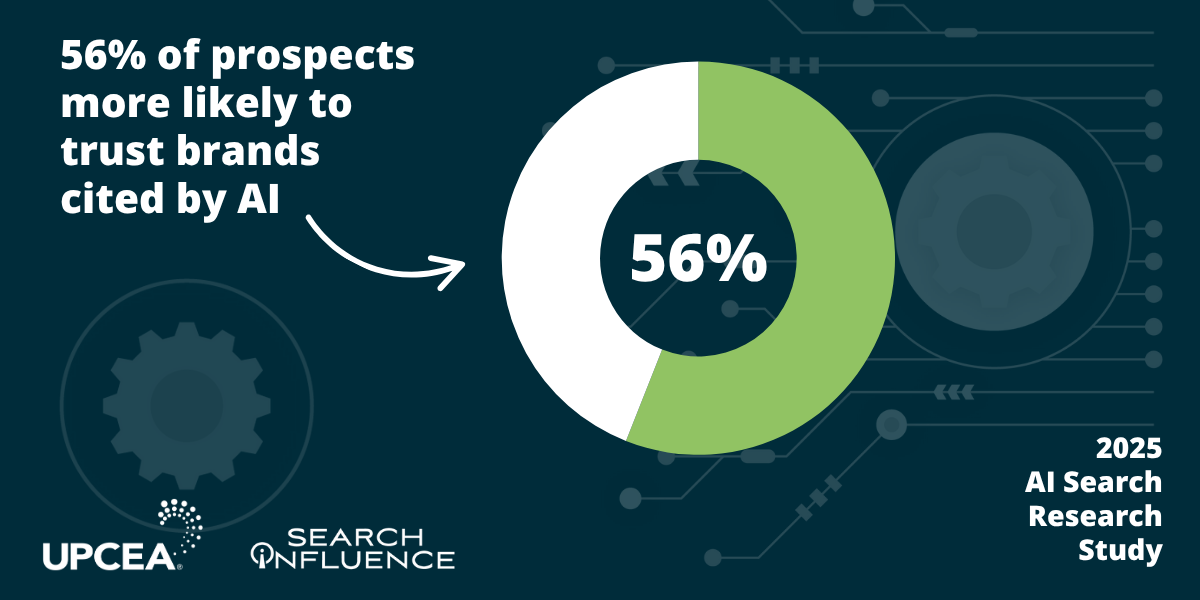
    • AI citations influence credibility. 79% of prospects read Google’s AI-generated overviews, and 56% say they are more likely to trust schools cited within them.
    • Search visibility drives consideration. 82% of students report they are more likely to consider programs that appear on the first page of search results.
    • Discovery spans multiple platforms. 84% of prospects use search engines, 61% use YouTube as a search engine, and 50% rely on AI tools in the same way they use Google.

    These findings confirm that students are moving fluidly between AI platforms, search engines, and video-based resources. Institutions cannot rely on a single channel. They must create content that performs across all of them.

    50% of prospects use AI tools at least weekly

    Why Online and Continuing Education Students?

    Online and continuing education students are often early adopters of new search behaviors, and their choices ripple outward to the broader higher ed market. They are career-focused, typically employed full-time, and actively researching programs that fit their personal and professional goals.

    By focusing this study on online and continuing education prospects, we’re able to capture a forward-looking snapshot of how AI search in higher education is shaping program discovery, trust, and enrollment decisions.

    What This Means for Higher Ed Marketers

    For higher ed leaders and enrollment teams, the implications are clear:

    • Multi-channel visibility is non-negotiable. Students expect to find you on Google, university websites, AI-generated responses, and video platforms like YouTube.
    • SEO is the connective tissue. Strong, authoritative SEO is the foundation that fuels visibility across both traditional and AI search engines. Without it, your programs won’t appear in the places students are looking.
    • Early movers will win. Many institutions have not yet adapted their strategies for AI search. Schools that act now will gain a competitive advantage in enrollment visibility and trust.

    Measuring Success in AI Search

    Success in AI search isn’t just about rankings. Institutions should track citations in AI Overviews, visibility across AI platforms, and engagement from AI-driven traffic, alongside traditional metrics like cost per inquiry (CPI) and ROI. By adding these benchmarks, schools can better understand how AI contributes to the enrollment funnel and make smarter investments in visibility and trust.


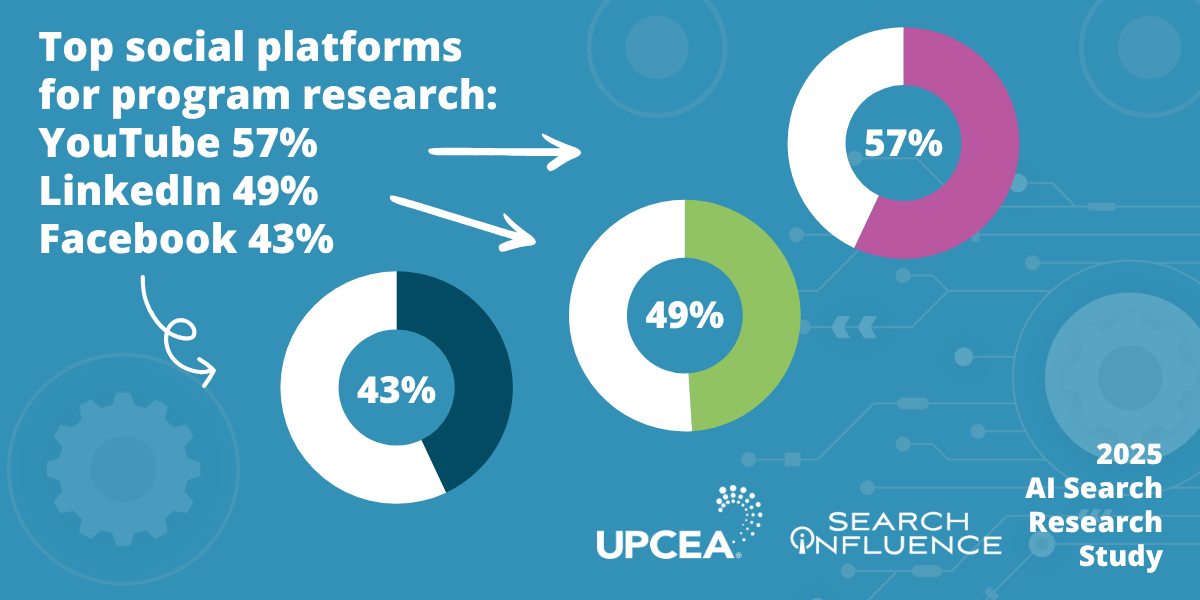
    top social platforms graphics

    Take Action: Be Visible in AI Search

    AI search is a core part of how students find and evaluate higher ed programs.

    The 2025 AI Search in Higher Education Research Study confirms what many institutions are beginning to notice: if you’re not visible in AI search, you’re not in the consideration set.

    The good news? Acting now puts you ahead.

    Download the full 2025 AI Search in Higher Education Research Study to explore the data and recommendations.

  • UPCEA Publishes Blog Post by Search Influence’s Alison Zeringue

    SEO and digital advertising is jet fueld for your higher education marketing strategy

    On October 28, 2022, UPCEA (the leading association for professional, continuing, and online education) published the blog post “SEO & Digital Advertising: Jet Fuel for Your Higher Education Marketing Strategy,” by Search Influence Director of Account Management Alison Zeringue.

    For over 100 years, UPCEA has served public and private colleges and universities across North America with a focus on:

    • Professional and continuing education
    • Alternative and non-degree credentials
    • Marketing and enrollment management
    • And most recently, online leadership and administration

    Alison Zeringue’s UPCEA Blog Post

    In her blog, Alison discusses how the demographics of Professional, Continuing and Online education units’ students have evolved along with the demand for online education options — creating a new challenge for high ed marketers.

    She discusses how expertly crafted SEO and digital advertising can give higher education marketers a leg up in a constantly changing field.

    “In my tenure as a marketer, there is a theme that rings true: Search engine optimization (SEO) and digital advertising — both paid search and digital display — work in tandem to deliver consistent, qualified inquiries to fuel your pipeline,” Zeringue said in the post.

    UPCEA and Search Influence’s Partnership

    In 2022, ROI-focused digital marketing agency Search Influence became a Platinum Partner of UPCEA.

    Through this partnership, Search Influence shares how higher education marketing institutions can optimize, measure, and track their search engine optimization and paid ad strategies to drive more qualified prospects to their marketing channels.

    Learn More From the Higher Education Marketing Experts at Search Influence

    Since 2006, Search Influence has been crafting digital marketing campaigns for higher ed institutions that show proven results.

    Contact us today to learn more about our digital marketing services.

  • Search Influence to Present at the 2022 University Professional and Continuing Education Association (UPCEA) South Region Conference

    Search Influence will co-present “The Devil’s in the Details: Using Technical SEO to Solve Your Website Woes” at the 2022 University Professional and Continuing Education Association (UPCEA) South Region Conference, along with fellow higher education marketing specialist, Alicia Jasmin, the Director of Marketing & Communications for the Tulane School of Professional Advancement (SoPA).

    2022 UPCEA South Region Conference graphic

    Since 1915, UPCEA has been a leader in the continuing education space, working with private and public universities across North America. Now based in Washington, D.C., UPCEA continues to be the leading association for professional, continuing, and online education.

    At the 2022 UPCEA South Region Conference, marketing professionals will get the opportunity to learn about the latest trends in higher education marketing.

    Higher Ed Marketing Session Description

    According to The Evolllution, the student experience starts with a university’s website — making the need for concise and user-friendly web pages more important than ever before.

    Higher education institutions put their search visibility and website traffic at risk when big, and even sometimes nominal, changes are made to their websites.

    In Search Influence and Tulane SoPA’s UPCEA session, “The Devil’s in the Details: Using Technical SEO to Solve Your Website Woes,” higher-ed marketers will learn how to avoid costly mistakes that may unknowingly impact search ranking and traffic by gaining an understanding of technical SEO.

    “Technical SEO helps Google better process your site,” said Search Influence’s Director of Sales and Marketing Paula French. “We want higher education marketers to understand its importance, so they don’t risk their search rankings and traffic when they make site updates.”

    Join Search Influence and the Tulane School of Professional Advancement to learn:

    • How website structure can hurt or help rankings
    • The impact of subdomains and microsites
    • How to pull off a seamless website migration

    Higher Education Digital Marketing Speakers

    Director of Marketing & Communications for the Tulane School of Professional Advancement (SoPA), Alicia Jasmin

    Alicia Jasmin is a native of New Orleans with expertise in higher education, strategic communications, and community relations.

    From 2007-2019, Alicia held several roles in the Tulane University Office of Marketing and Communications, where she helped shape the university brand and promote positive university messaging. In her last position at Tulane as the Assistant Director for News, she played a major role in upholding the university’s reputation through the daily management of external university news.

    Prior to rejoining Tulane as the Director of Marketing and Communications for the School of Professional Advancement, Alicia led community relations efforts at the University of Texas MD Anderson Cancer Center in Houston, the largest cancer center in the United States.

    Search Influence Director of Sales & Marketing, Paula French

    Paula French has developed strategic digital marketing solutions for clients since 2009 when she joined Search Influence — then a 9-person team.

    Paula contributed to the company’s rapid growth by building and training effective account and sales strategists. She has led strategy on SEO & digital marketing projects for hundreds of businesses across the country.

    Today, Paula plays online marketing matchmaker by identifying the right marketing solutions to match business goals and help companies in almost any industry optimize their potential, with an emphasis on education, healthcare, and tourism.

    Paula speaks about digital marketing in her hometown of New Orleans and on the road, including past panels at MozCon Local in Seattle, Pubcon Las Vegas, and Engage in Portland.

  • Gen Z is the Next Non Traditional Student: Move Them Down the Funnel with These 2 Tactics

    Key Insights

    • Since Generation Z (Gen Z) is the next generation of non-traditional learners, it’s essential to provide accessible and relevant information to this new generation of life-long learners.
    • Two tactics in higher education marketing—Facebook/Instagram Lead Generation and Email Nurture campaigns—can help move prospective students through the funnel and one step closer to applying and registering.
    • Facebook/Instagram Lead Generation creates a friction-less conversion point for users at the consideration stage of the funnel.
    • Email Nurture campaigns allow you to send personalized, targeted messages to prospects in the consideration and decision phase of the funnel, addressing key decision points in their journey.

    Woman working at a laptop in front of a window

    Higher education marketing isn’t an easy A—it’s always evolving because the upcoming generation heavily influences the industry. As Gen Z is added to the typical prospective non-traditional student pool, marketing strategies must also change to appeal to prospective students in a relevant and engaging way.

    One of the most prominent characteristics of Gen Z is their tech savvy. This generation was born into the interconnected world of the internet, smartphones, tablets, and other smart devices. Digital marketers targeting Gen Z must provide easily accessible information at their fingertips and across social media platforms to compete for their attention.

    When first targeting prospective students, universities need to clearly display the attributes that make them different. Once the intended audience recognizes an institution’s brand and starts engaging with their social media and web content, it’s time to shift the strategy from brand awareness to the next phase in the marketing funnel: consideration, and ultimately through to decision (applying) and to registration.

    During the consideration phase, the prospective student is more familiar with a school. They may schedule a virtual tour or download a brochure. Students may even start imagining themselves attending—but they aren’t quite ready to commit. Prospective students are likely still researching other schools and weighing their options. During this stage, universities need to provide the information prospective students are looking for. Universities can use first-party data, like past inquiries, to directly target and speak to prospective students in this stage of the funnel.

    Facebook/Instagram Lead Generation Ads and Email Nurture campaigns can engage digitally savvy prospective students and move them through the marketing funnel to take the next desired action.

    Facebook/Instagram Lead Generation Ads

    What is a Facebook/Instagram Lead Generation Ad?

    During setup, Facebook gives marketers the option to create campaigns based on objectives (i.e., goals). All campaigns can also be converted to Instagram (73% of Gen Zers actively use Instagram, while only 40% use Facebook).

    Universities can select a Traffic campaign if the goal is to send their target audience from Facebook/Instagram to an external URL, like a blog page. This campaign would be most applicable at the top of the funnel.

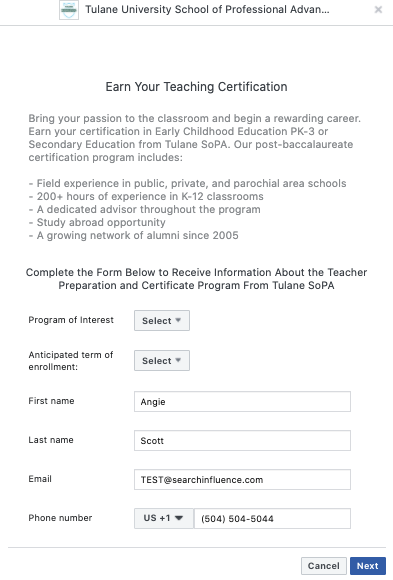
    In the consideration phase of the funnel, Lead Generation campaigns can be a convenient way to convert prospective students. Ads in Lead Generation campaigns look similar to other campaign ads, but instead of linking to a website outside of Facebook, Lead Generation ads send the user to an “Instant Form” directly in the Facebook (or Instagram) platform. Here, the user is prompted to fill out basic contact information.

    Then, in the decision stage, when it’s time to focus on driving potential students to fill out applications, marketers can show ads just to people who have completed that lead generation form. It’s best practice to run this campaign with a Conversion objective to optimize for users to take specific action on their site, such as an application.

    Why are Facebook/Instagram Lead Generation campaigns relevant?

    These campaigns are very user-friendly because the form fills are pre-populated with the user’s Facebook contact information, a feature many Gen Zers have come to expect. In a few seconds, the user can click the ad, retrieve the relevant information, and send over contact information that creates a new qualified lead. It’s that simple. (With some custom configurations, that conversion can automatically input into an enrollment management system like Slate!)

    Screenshot of Facebook ads campaign for higher education client

    Facebook/Instagram Lead Generation campaigns can also help universities gain more qualified prospects. Users don’t want to give their contact information to just anyone—if they’re submitting their contact information, they probably trust the business.

    It’s critical to target a lower-funnel audience to be most effective with this type of ad. Users who are already somewhat familiar with a university’s brand are more likely to be comfortable providing their information if they’re interested in learning more.

    How do Facebook/Instagram Lead Generation campaigns produce high-quality leads?

    When starting a new campaign, it’s common to feel like many of the prospects that come in aren’t high-quality leads. At first, it will take Facebook and Instagram’s machine learning some time to analyze and make changes to optimize a campaign to attract leads that fit neatly into a target demographic. Don’t be discouraged!

    If lead quality is still an issue after a few months, adding the “high intent” feature to forms can help. This feature adds a review screen for users to confirm before submitting a form. Adding this step helps ensure the user is consciously aware that they’re submitting their information. But note, this “high intent” feature is only available for users on mobile devices, so it will limit placements. Before turning this feature on, assess what percentage of impressions and past form submissions are coming from mobile devices.

    Email Nurture Campaigns

    The second critical tactic to move prospects further down the funnel is an Email Nurture campaign.

    What is an Email Nurture Campaign?

    In a previous blog post about engaging prospective college students, we define an Email Nurture campaign as “an intentional and strategic set of messages sent to a prospect over a period of time to guide them through the decision-making process to an ultimate desired action.”

    These email campaign strategies are built with conversion in mind and are sent to individual prospects directly, not to a bulk list at one time. The prospect’s action will trigger the type of email messaging sent to them. Each action the user takes will determine the next email they receive.

    Graphic showing higher education marketing funnel

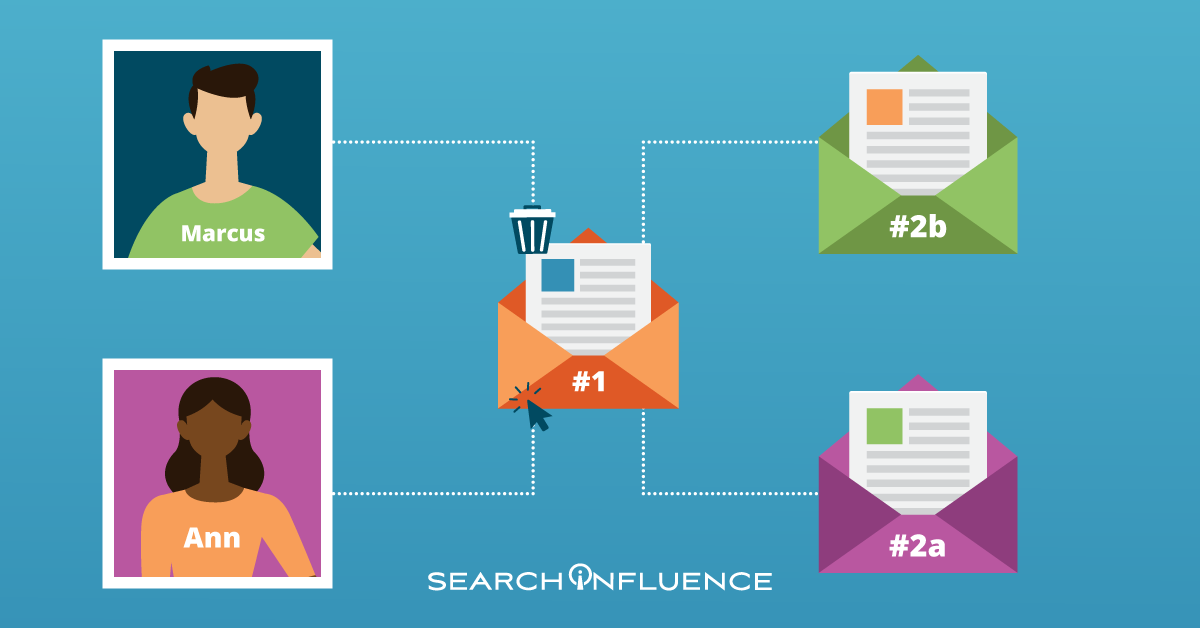
    For example, let’s say Ann (Lead A) and Marcus (Lead B) are both interested in studying urban planning and have submitted an online form on a university’s program page to receive more information.

    From that form submission, both Ann and Marcus will receive Email #1. Ann opens the email immediately and clicks through some of the included links. Based on her actions in that email, she might receive Email #2a one week later, which gives details about next steps and applying.

    Marcus, however, did not interact with Email #1 like Ann did. He deleted it after opening it. Marcus might then receive Email #2b, which contains different content focused on re-engaging him.

    Why are Email Nurture campaigns relevant?

    According to Statista, 90% of U.S. internet users used email each month in 2019.

    As a reminder, the prospective student is already aware of several universities and weighing their options at this point in the marketing journey. Targeted email allows a university to provide interested students with the answers they are looking for before they even search for them.

    In a webinar, Blackboard reported that prospective students have new concerns and questions related to the pandemic, including potential economic fallout, changes to the campus environment, and job prospects after college. Prospective students have stated they would like to hear from admissions counselors at least once a week via email.

    To address this, higher education institutions can implement an Email Nurture campaign to ensure prospective students are getting relevant information based on where they stand in their journey, in addition to personalized outreach from admissions counselors.

    Facebook/Instagram Lead Generation campaigns and Email Nurture campaigns are excellent tactics for engaging with prospective students and providing them with the information they’re looking for, pushing them one step closer to applying to your institution.

    Ready to start building a marketing campaign tailored to your ideal prospective students? Search Influence has helped local and national higher education clients create effective campaigns to target prospective students at all stages of the marketing funnel. Contact one of our experts to learn how you can enhance your current marketing strategies.

    Images

    Laptop

  • Stairway to Higher Ed Website Heaven: Seven Steps to Engage Prospects and Students

    This post was updated by Ariel Tusa on September 24, 2020 to reflect recent trends and refreshed statistics. It was originally published on May 2nd, 2019.

    Key Insights

      • Make sure your website is an easily accessible tool that prospective students can use to find information.
      • Cater to mobile users by having a mobile-friendly site that loads quickly.
      • Maximize your public relations staff and media contacts for mentions and high-quality backlinks.

    Universities have a leg up in search rankings, thanks to the authority of “.edu” domains and brand recognition. However, many university websites aren’t set up to make the most of these advantages, and the added uncertainty of COVID-19 has put a strain on the marketing budgets of organizations around the world. So, what’s an educational institution to do? Maximize the potential of your university’s brand with our seven tactics to improve your search visibility among prospective students!


    A stairwell covered and surrounded by clouds leading into a blue sky

    To market effectively, it’s important to understand the buyer’s journey—or in the case of higher education—the student journey. Online searches are a critical part of the student journey that help people decide where they will apply.

    According to a study by Google, 58% of students use search engines to begin their research for higher education.

    With that in mind, let’s dive into our seven steps! We’ll take a look at some examples from one of our education clients, Tulane School of Professional Advancement.

    1. Mobile Experience: Mobile Experience Must Be on Par With (or Better Than) Desktop

    Beginning in the summer of 2018, Google rolled out their “mobile first” algorithm, making your mobile site more important than ever. Sometimes, developers edit websites on a computer without testing them on both a desktop and a mobile device. However, most prospective students will only visit your site on a mobile device. For Tulane SoPA, mobile traffic has increased from just under 43% in 2016 to nearly 75% in 2020.
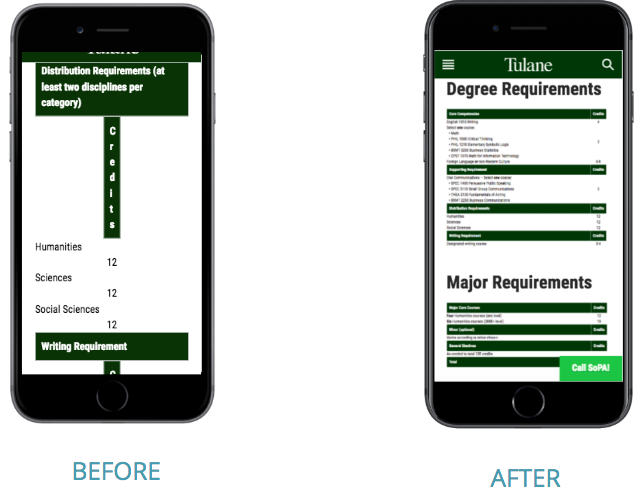
    Before and After of Tulane School of Professional Advancement's mobile website

    Many websites end up with a user experience that looks like the “before” image when their design focuses on desktops. When you set your sights on improving the mobile version of your site, you’ll end up with something that’s more like the “after” image. Providing a high-quality experience to mobile users can improve your conversion rates and boost your search rankings.

    PRO TIP: Google offers a free Mobile-Friendly Test that reviews the size of graphics and technical elements to assess the user experience on mobile devices. The test’s assessment generates feedback you can pass on to your web development team to review and update your website.

    2. Site Speed: Your Site Should Load Quickly

    Keep more of your visitors on your site by solving the most common speed issues for websites. Google wants to provide a seamless experience and answer a user’s query as quickly as possible, meaning that site speed is becoming a more important factor for keyword rankings.

    This chart illustrates how important your site’s speed is to users. A study by Google equated the cognitive load of waiting for a slow mobile website to be on par with solving a math problem and watching a horror movie… and worse than standing on the edge of a cliff!
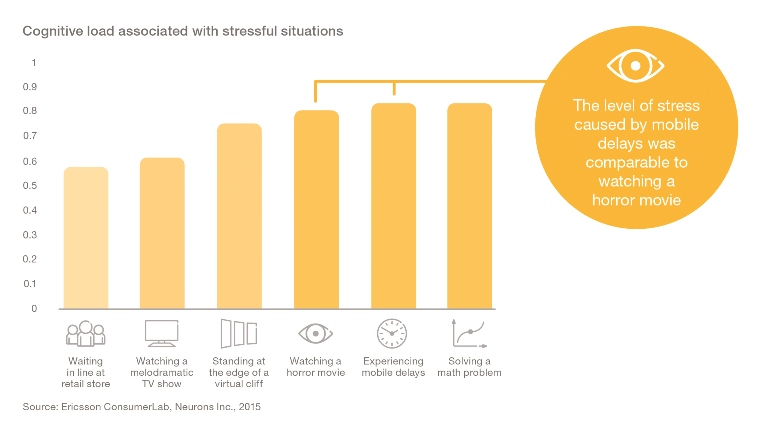
    A bar chart showing cognitive load associations with stressful situations

    On a more positive note, sites with load times under 3 seconds garner the most sessions and peak conversion rates, showing that load time has a real impact on user experience and, therefore, conversion. The ideal load time is 3 seconds or less. Even just improving load time from 3.3 seconds to 2.4 seconds, you can increase your conversion rate by 27%.
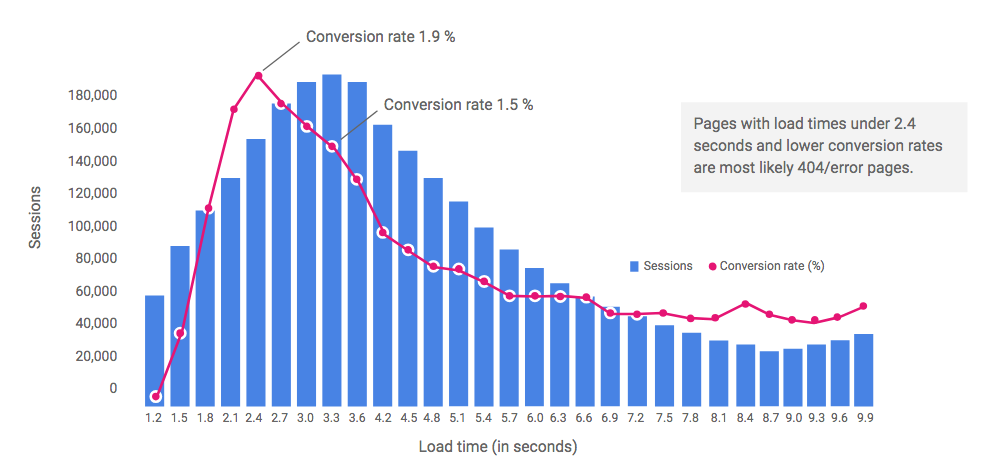
    Correlation chart between sessions and load times

    Google free Mobile Site Speed Test tool can demonstrate how your site compares to those of other universities. The report generated by the Mobile Site Speed Test estimates how much you’ll speed up your load time by implementing its recommended changes.

    3. Content: Should Provide Helpful Information to Prospects (and Search Engines)

    Universities often think of their websites as tools for current students and less about prospects. When creating your content strategy, think about where users may be in the student journey—their decision making process—and speak to them at all levels:

        • Some are just starting to search for answers to everyday problems
        • Some might be further along in their journey, researching options at your school
        • Some may be even further in their journey and are ready to take action and need to find a way to contact you QUICKLY!

    Many universities lack specific content for their programs, degrees, and courses, requiring prospects to speak to an advisor to get details. Instead, break down barriers for prospects by assuring this info is easily accessible on the site. As you begin identifying ideal content for a page, whether it’s a homepage or internal page, think about the different ways people consume content:

        • Skimmers read the headings, bullets, and key stats to quickly make a decision on how to move forward.
        • Swimmers may read some of the sub-content, watch a video, and click onto a deeper page.
        • Divers will read all of the content on the page, watch a video, and most certainly would go to other pages on the site.

    Having a dedicated page for a topic also makes it more accessible to search engines, which helps prospects find the information more easily. When building content for your university’s website, use this content checklist:

    ✓ Does your site have dedicated pages for each program/degree?
    ✓ Is content crafted to speak to “skimmers, swimmers, and divers” (a mix of bullets, infographics/media, and paragraphs with details)?
    ✓ Are online and on-campus options clearly stated?
    ✓ Do you have one-pager downloads that require visitors to input their email address to build a prospect pool for email marketing?
    ✓ What are the top five questions your front desk and advisors are asked?

    4. Optimize for Branded Searches

    Branded searches describe searches conducted by prospects that include your school’s name in the query. They may search by name only or with a combination of your name and a degree, major, or academic program. Optimizing for branded search supports prospects who are in the consideration and decision phase of their journey—they’re already familiar with your school and searching for it by name.

    Help prospects and students find information more easily when searching for specifics like “Tulane SoPA Tuition” or “Parking on Smith campus” by optimizing for branded searches.
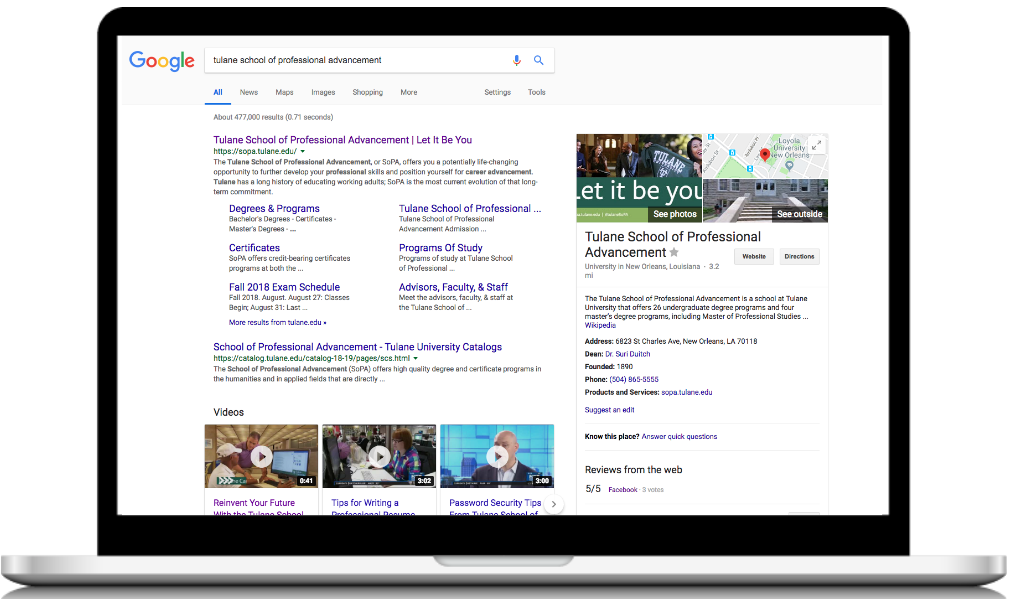
    A laptop showing a google search for tulane school of professional advancement

    When performing a branded search for your own university, you should see your website. If your site is established, you’re also likely to see “sitelinks,” which are Google’s top suggested pages for users. The Knowledge Panel on the right offers location information from Google My Business, Wikipedia, and reviews from around the web. Of the many parts of the SERP (search engine result page), there are pieces you can and cannot control.

    What you can control:

          • Your website
          • Info on Google My Business (photos, accurate location data, posts)
          • Content you’ve posted on other websites (YouTube videos)
          • First-party reviews

    What you can’t completely control, but can work on:

          • Third-party reviews, including Google
          • Third-party mentions
          • Wikipedia (more on this later)

    5. Earn Backlinks That Are Relevant to Your Target Audience

    Links to your website from other sites are like positive reviews to search engines. Building links supports your university’s website ranking by building authority and relevance. Google uses backlinks to judge if you are a trustworthy and relevant source for a topic. Which websites link to your site is more important than how many. Backlinks from authoritative national sites, like The New York Times or Wall Street Journal, give you national authority in Google’s eyes. Earning backlinks can be a challenge, but approach this tactic with a quality-over-quantity mindset. A strong PR strategy is critical to earn genuine, valuable links.

    Any accredited university should also pass the “notability” test and be listed on Wikipedia. If you are established, you likely already have a Wikipedia page. Wikipedia pages can be edited for accuracy and provide links to your website. However, the language should be strictly factual and have a neutral tone.

    When authoritative local sites, like a local news outlet, link back to your site, this adds to your local authority.

    Sites that are both relevant and authoritative, like a list of the Top 10 humanities programs on USnews.com, support both your relevance and authority even when you are simply on the list and don’t get a backlink! Some lists require payment for inclusion. Here are the key questions we ask when considering paying for placement:

    ✓ Is it a reputable website?
    ✓ Does it rank well on Google compared to competitors within its industry?
    ✓ Does the feature include a link back to your website? (Remember, if not, that’s okay)
    ✓ Do you get to approve the content that will be listed about your school or program?

    6. The Press and Media Are Highly Effective Tools

    Media mentions are one the best sources of links and branding. Your university may receive some attention from the media, but you can’t sustain or control this without a PR strategy. Local media sources are often excellent contacts to work with.

    The key is finding a strong PR partner—someone who already has relationships in the industry—and a process. Most colleges and universities have enough going on to produce newsworthy stories consistently. With a dedicated PR effort for Tulane SoPA, they are earning an average of five to six media appearances per month. To be successful, you need to frequently communicate with your PR team, as well as ensure that your staff is available for interviews, providing quotes, and more.

    Here’s a checklist your marketing team can use for quality backlinks and media mentions:

    ✓ Wikipedia
    ✓ Top lists
    ✓ Partner community colleges, universities, and high schools
    ✓ Scholarship search websites
    ✓ Scholarship partners
    ✓ Local directories
    ✓ Local media outlets
    ✓ National media outlets

    PRO TIP: When responding to requests for quotes, be sure to include which specific page should be linked to (don’t always choose your homepage).

    7. Technical Elements Support Search Success

    Key technical settings on your site can help Google understand and process the info on your webpages, which leads to a stronger search presence. Master these four elements:

          1. Your site runs HTTPS and you have purchased and properly installed an ”SSL certificate.” This tells Google and users that any information a user inputs on your site (such as their name, email, or phone number) is being transmitted securely. Google’s most recent version of Chrome calls out non-secure sites more strongly by making the text red, instead of a subtle gray warning.
          2. The robots.txt file is the first file that Google crawlers read when they visit your website. It provides a directory that tells crawlers which pages you want to appear in search results and which you do not. If configured improperly, prospective students may see this in search results. There’s a technical check your web developer can do to assure this setting is accurate.
          3. An updated sitemap hands your list of URLs to Google on a silver platter. HTML sitemaps are good for users and search engines. XML sitemaps are more technical and exist primarily for search engines. While this may sound redundant, you want to take advantage of all of these elements to make it as easy as possible for search engines to index all of your important website pages. Your developer can list your sitemaps within your robots.txt file, which, again, gives Google what it needs to know.
          4. Schema is a technical tactic for labeling your data on the backend of your website to help Google better understand the content. Google can usually understand and parse content easily, but this helps avoid any ambiguity. The simplest example of schema is labeling your address and phone number data. On the front end, it looks the same to the user. On the backend, you’re saying “Hey, Google. I have three distinct locations. This is location one, and this is the address and phone number.” Things get really interesting when you start to mark up more niche types of content on your website, like your course information. Schema.org is your source for the details you need to do this. This can improve your rankings for niche keyword searches because Google can then understand very specific details about your offerings. Leveraging schema markup language can also help you achieve “rich answer snippets,” which is when Google serves up the answer directly to the user in the search result, citing your website as the source.
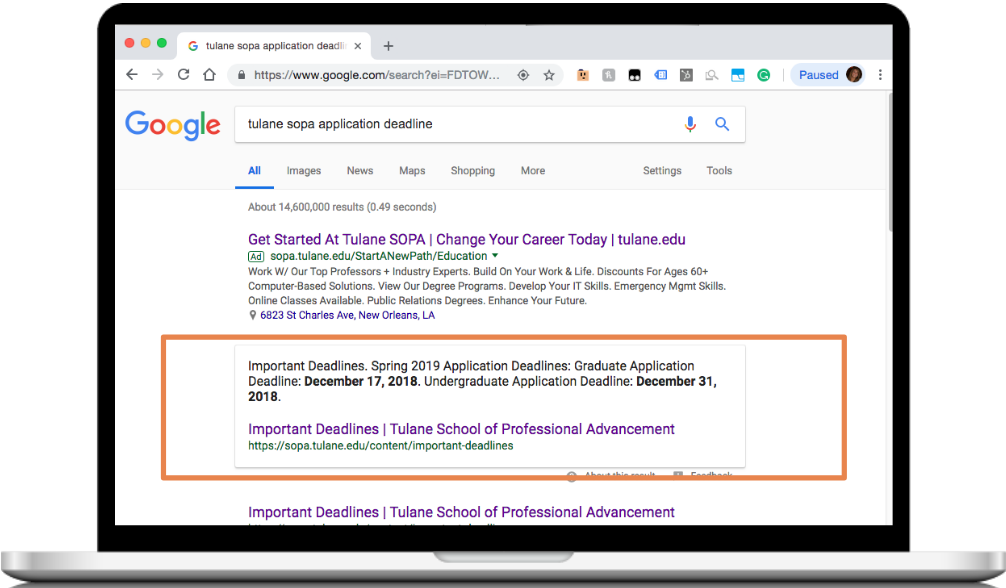
    A laptop showing a google search for tulane's application deadline

    Here is an example of a very specific search, for which a “rich answer” comes up—this is also often referred to as “Position Zero.” Google is beginning to show more and more of these “rich answers.” Schema markup is the first step to earning them.

    PRO TIP: Once you’ve worked on these four technical elements, create a custom 404 Page for your university’s site. When a user lands on a page that no longer exists, they’ll then be taken to a page on your site that can help them find the information they were looking for initially.
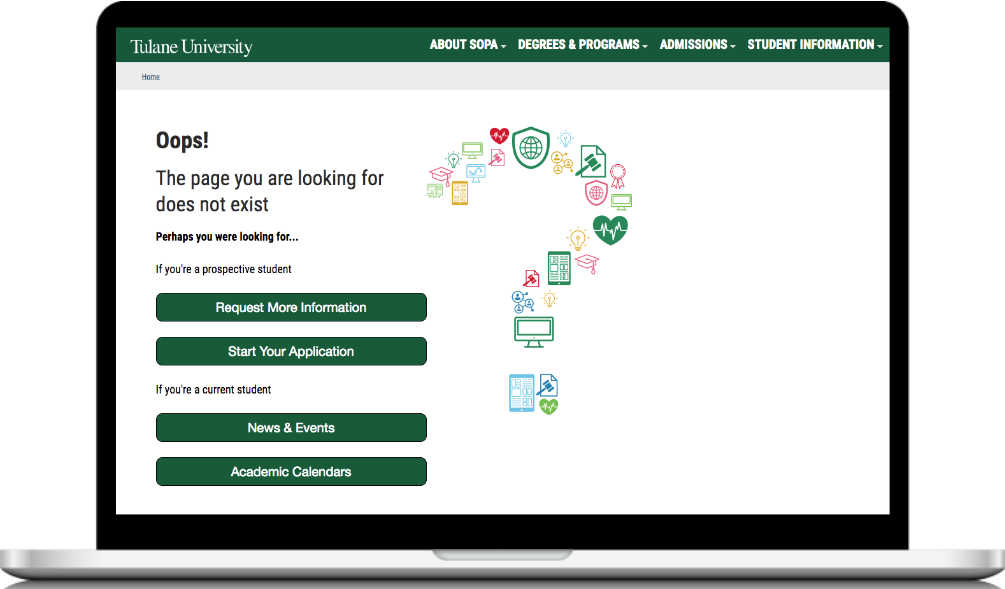
    Tulane University's 404 page

    Congratulations! With our seven key steps to search success, you’ve officially graduated! Wondering how to take your learnings and apply them to your institution’s website? Download our self-assessment to score your marketing strategies and uncover the opportunities you have to drive leads into and down the funnel!
  • Don’t Miss Out on the Recession Boom in Graduate School Applications

    Research by The New York Times, Stanford, and other sources suggests that interest in graduate school will hit new highs in the coming months and years due to the global recession. Instead of looking at how your organization can cut costs by reducing its marketing budget, you should make the most of this opportunity by allocating marketing dollars to get in front of audiences receptive to your messaging.

    Graduate student smiling wearing a cap and gown at graduation

    Now is the time to make a push to drive more applications to your programs. You need to ramp up your efforts to ensure that your advertisements are being seen by prospective students who are wondering if they should apply to business school, law school, or another graduate program.

    Increased Online Activity Enhances Targeting Efforts

    Online activity has surged in the past few months due to stay-at-home orders. With more active users browsing online, it’s clear that budget allocations and targeting should shift to align with this change. Advertisers can adjust their marketing strategies and find more cost-effective ways to use their marketing dollars.

    Now is the perfect time to push your messaging on Facebook because costs have dropped. Like any marketplace, supply and demand drives Facebook ad pricing. As the platform’s ad inventory has increased due to more activity, the amount it can charge advertisers has decreased. Facebook saw a 50% surge in the use of their messaging apps, as well as a similar increase in the time people spend on Facebook and Instagram.

    Right now, it costs a lot less to reach potential students on social media and on mobile apps. From March 1 to May 20, 2019 it cost an average of $3 for 1,000 impressions (CPM) on Facebook and Instagram. Due to increased online activity in 2020, the CPM fell to an average of $1.22. The first three months of 2020 also saw unprecedented spending ($23.4 billion) and activity (a 20% increase year-over-year) on mobile apps, which grad schools can take advantage of by running ads on Google’s Display Network.

    Graduate student sitting at a desk working on a laptop

    How to Market Your Graduate School Programs: Proven Industry Results

    Our higher education clients have seen a sharp increase in inquiries during the past few months. Several factors drove this spike, including a 20% surge in searches for online degree programs and an increased appetite for applying to grad school. However, increased consumer interest doesn’t mean much if you can’t capitalize on it.

    In March, most states issued shelter-in-place orders. Data from one of our clients, a professional and continuing education school at a private university, shows a record-breaking number of inquiries since this time. Although this organization has a competitive advantage because they already offered many of their programs online, online programs will increasingly become the industry standard.

    Here’s a checklist of tactics our clients utilized to pivot their strategies, which you can use to benefit your institution:

    • Make every course available online
    • Emphasize messaging that provides details about policies regarding transfers, financial aid, and credit for life/work experiences
    • Maintain a digital advertising budget
    • Leverage Facebook Live to increase awareness
    • Shift blog post topics to address the current climate

    Implementing these adjustments yielded significant improvements in digital campaign performance: In March, one higher education client received more Facebook inquiries than they have in any other month since we began working with them. During Q1 2020, they achieved 47% of the total inquiries that they received during all of 2019.

    Marketing Strategy Changes For Your Institution: What You Need to Do Right Now

    The cost of advertising on Google, Facebook, and other platforms are lower than they have been for years; now is the perfect time to get in front of new audiences and build a student pipeline for upcoming semesters.

    Take the next steps:

    • Adjust your marketing budget to accommodate the surge in online activity
    • Leverage video content and mobile platforms
    • Update your messaging to communicate any changes to your services relevant to the current climate

    Millions of Adults Will Consider Graduate School

    In times of a strong economy, individuals interested in graduate school have to balance the
    the impact of two or more years away from their full-time jobs to attend graduate school with the potential of career advancement (or a career change) a graduate degree provides.

    • Loss of full-time salary
    • Forgoing chance of promotion
    • Taking on tuition debt

    Wondering how to ensure your website reaches these expanding audiences? Download our self-assessment to score your marketing strategies and uncover the opportunities you have to drive leads into and down the funnel!