Tag: digital marketing strategy

  • How Marketing Supports SEO and Helps You Score Big With AI Search

    How Marketing Supports SEO and Helps You Score Big With AI Search

    How Marketing Supports SEO and Helps You Score Big With AI Search

    Key Insights

    • AI search engines reward brands that align SEO with all marketing channels, including social, PR, paid, and email.
    • Social media content marketing reinforces SEO performance by increasing entity signals and driving engagement.
    • Earned media and PR build domain authority and citations that support higher search engine rankings.
    • Email and paid campaigns indirectly boost SEO by influencing user behavior signals like CTR and repeat visits.
    • AI SEO tracking tools and Google Search Console help track how your marketing efforts affect AI search visibility.

    AI-generated search has changed what a winning digital marketing strategy looks like.

    To stay competitive in search, you need more than keywords, high-quality backlinks, and old-school content marketing.

    You need a coordinated offense.

    If AI-powered search is your end zone, then SEO is your quarterback, calling the plays.

    And your other marketing channels (social media, earned media, email, and paid campaigns) are the wide receivers, running backs, and tight ends moving the ball downfield.

    When they work together, you don’t just show up in search —  you win the search results.

    Search rankings success now hinges on how well your entire marketing strategy supports visibility in Google’s AI Overviews and tools like ChatGPT and Perplexity.

    Learn how content marketing, social media, PR, paid ads, and email all reinforce your search engine optimization efforts and help your brand dominate the AI-driven digital playing field.

    How Marketing Supports SEO and Helps You Score Big With AI Search

    Why SEO Needs a Team Effort in the Age of AI Search

    AI search engines reward brands that align SEO and other forms of marketing for maximum authority.

    Search engines like Google Search no longer rely solely on keywords and link building to decide what ranks. AI-powered search pulls from trusted sources, structured content, and recognizable entities.

    Brands that show up consistently across the web, in blog posts, press releases, social profiles, and paid placements, are more likely to be recognized and cited in search engine results pages, including AI Overviews.

    That consistency helps solidify your brand across the three key AI SEO pillars: entity recognition, semantic relevance, and authoritative citations. When your content, PR, and paid efforts echo the same message, it signals trust to both users and search engines.

    Building SEO Momentum Across Your Marketing Channels

    Social media: the unsung SEO MVP

    Social media posts amplify your SEO by reinforcing entities and driving engagement signals.

    Platforms like TikTok, Instagram, and LinkedIn are now part of the search journey. With social content appearing in search results, these channels are critical for reinforcing relevance, brand awareness, and your online presence.

    Best practices for social search optimization include:

    • Using keywords in bios and captions/text posts to reflect your brand and services.
    • Linking consistently to your core SEO pages.
    • Repurposing high-quality content into bite-sized posts to boost visibility.
    • Using hashtags strategically to build topical associations and reach your target audience.

    Even more importantly, optimized social profiles with consistent NAP (name, address, phone number) data contribute to local SEO and entity alignment.

    By driving traffic and user engagement, social also sends quality signals that search engines interpret as ranking factors. This not only improves on-page SEO but also strengthens your presence in organic search results and social search algorithms.

    PR & earned media: link-building powerhouse

    Earned media strengthens SEO by building authoritative citations and backlinks.

    A press hit or podcast appearance isn’t just good publicity; it’s an SEO asset. Media mentions and thought leadership build domain authority and keyword associations that help you rank higher in organic search.

    Ways to reinforce SEO in PR efforts:

    • Include locked-in phrases (your preferred product or service descriptions) in boilerplate bios and releases.
    • Syndicate press releases via newswire services to generate multiple backlinks and citations.
    • Contribute guest posts to relevant industry blogs with links to cornerstone content.
    • Promote media wins on social channels and your website to extend reach and reinforce relevance.

    These earned links and mentions feed directly into Google’s understanding of your authority.

    They can also boost brand awareness and credibility, which in turn fuels more engagement, links, and overall SEO success. In AI search results, those citations often become the deciding factor in whether your content gets featured.

    Paid advertising & email campaigns: driving SEO clickstream data

    Paid campaigns and email traffic support SEO by sending quality signals to key pages.

    While paid search/PPC, digital ads, and email don’t directly influence search rankings, they impact user behavior metrics like pageviews, bounce rate, and time on page, all of which contribute to overall SEO performance.

    Use paid advertising (paid search/PPC and digital ads) and email to:

    • Drive targeted traffic to SEO-priority pages.
    • Retarget users to increase return visits and page engagement.
    • Feature blogs or cornerstone content in newsletters to boost visibility.

    When users consistently visit and engage with your site after a paid ad or email click, analytics and tools like Google Analytics pick up on those signals.

    They show that your content meets user intent and delivers value. In AI search engines, where quality content and user signals are ranking factors, this kind of reinforcement is critical.

    Tracking Your SEO Wins in AI Search
    How Marketing Supports SEO and Helps You Score Big With AI Search

    Tracking tools reveal how your marketing impacts SEO visibility in AI-powered search.

    You can’t improve what you can’t measure. Fortunately, new tools make it easier to track your AI search website traffic.

    Here’s what to monitor:

    • Referral traffic from generative AI sources
    • Presence in AI Overviews or AI-generated responses.
    • Entity recognition for your brand and key pages in tools like Scrunch AI.
    • Search engine rankings and keyword rankings in traditional search. You should still care about organic search rankings because they are still used by most audiences, and they influence AI search results.

    Despite popular belief, AI SEO isn’t a black box.

    At Search Influence, we recommend AI SEO tracking tools for clients who want visibility into how their content is retrieved and referenced in tools like Google’s AI Overviews or ChatGPT.

    Tools like Scrunch AI, Semrush, and Advanced Web Ranking are rolling out new features to help track keyword visibility and AI answer inclusion across different search results.

    The ability to measure these AI SEO metrics gives your team the confidence to double down on what’s working and identify new content marketing opportunities that align with search intent and digital marketing best practices.

    Higher Ed Example: When Marketing Plays as a Team

    An integrated marketing strategy helps universities dominate AI search with consistent brand signals.

    Let’s take higher education as a case study. Universities have complex websites with multiple departments, programs, and voices. When every touchpoint supports a unified SEO strategy, it makes a measurable difference in organic traffic, visibility, and user experience.

    Despite this, 51% of higher ed marketing departments lack an SEO plan.

    That’s like getting ready to snap the ball without having a play drawn up.

    Here’s what it looks like when all higher ed digital marketing channels play like a team to support SEO:

    • Press mentions are strategically related to, and link to, key website pages.
    • Faculty speaking engagements are published on YouTube and social media.
    • Social media posts present the same info as your blogs in a format designed specifically for that platform.
    • Faculty bios link to relevant departments, publications, and press mentions.
    • PR campaigns and social posts highlight research topics tied to search intent.
    • Paid ad teams run ads to SEO-targeted website pages and blogs.
    • Podcast appearances link to and mention key degrees and programs alongside your brand name.

    At Search Influence, we’ve helped higher ed clients align SEO strategy with marketing efforts by identifying opportunities to promote targeted programs and degrees through traditional methods that support SEO, and by republishing assets online in a way that is best found and leveraged by search engines and AI models.

    When SEO, PR, social, paid, and content marketing teams share data and strategy, the result is a powerful flywheel that delivers relevant content, builds domain authority, and earns organic traffic.

    Bringing It All Together: Your Winning SEO Playbook

    To win in the AI search era, you need every part of your digital marketing team working toward one goal: SEO success.

    Here’s how your marketing supports the core principles of AI-driven SEO:

    • Entities: Use structured content and consistent messaging to help search engines understand your brand and offerings.
    • Semantic relevance: Align content across platforms to reinforce semantic relevance and meet user intent.
    • Citations: Earn trust and build authority through strategic outreach, earned media, and consistent engagement.

    A data-driven, coordinated approach ensures you’re not just showing up, but standing out.

    FAQ: Marketing, AI SEO, and Brand Authority

    How does social media help SEO rankings?

    Social media boosts SEO by increasing entity mentions and driving engagement signals.

    Search engines and users alike take note of your brand’s presence across platforms. Social profiles with complete business info, regular content posts, and linked landing pages help clarify who you are and what you do. When your content is widely shared, it gains visibility and relevance in the eyes of search engines.

    How does earned media drive SEO success?

    Earned media strengthens SEO with backlinks and authoritative citations.

    Publications, podcast appearances, and industry blogs serve as third-party validators. These citations build trust and domain authority, two key elements in both traditional SEO and AI-driven rankings.

    What’s the relationship between PPC and SEO?

    Paid search (PPC) supports SEO by driving traffic and reinforcing branded search terms.

    Paid search helps fill gaps while organic SEO takes time to build. When users see both your ad and your organic listing in the search engine results pages, they’re more likely to click. That overlap improves brand recognition, click-through rate, and long-term search performance.

    How do you track AI search visibility?

    AI SEO tools measure your brand’s presence in AI Overviews and conversational search.

    Emerging platforms like Scrunch AI are designed specifically to track AI search visibility. They track how often your content appears in Google’s AI Overviews, ChatGPT citations, and other AI-driven results. Pair that with traditional metrics in Google Analytics and Google Search Console for a complete view of performance.

    Why is branding important for AI search visibility?

    Strong branding improves AI search visibility by helping engines recognize and prioritize your brand as a trusted entity.

    When your name, offerings, and messaging are consistent across the web, from your website and social channels to business directories and review platforms, you build trust. That clarity and consistency make it easier for AI to pull accurate information about your brand and include it in AI-generated responses.

    Ready to Win With SEO? Let’s Talk.

    Want your marketing efforts to work harder for SEO and get results in AI search?

    At Search Influence, we help brands align every part of their marketing strategy to drive visibility, authority, and engagement where it matters most. Our experts bring together quality content, technical SEO, paid media, and brand strategy to help you rank in search engine results and show up in AI-generated answers.

    We specialize in working with higher education, healthcare, and hospitality brands that need long-term, scalable SEO strategies rooted in best practices.

    Contact us today to learn how we can help you create a winning SEO strategy tailored to your goals.
    Images:
    Unsplash
    Unsplash

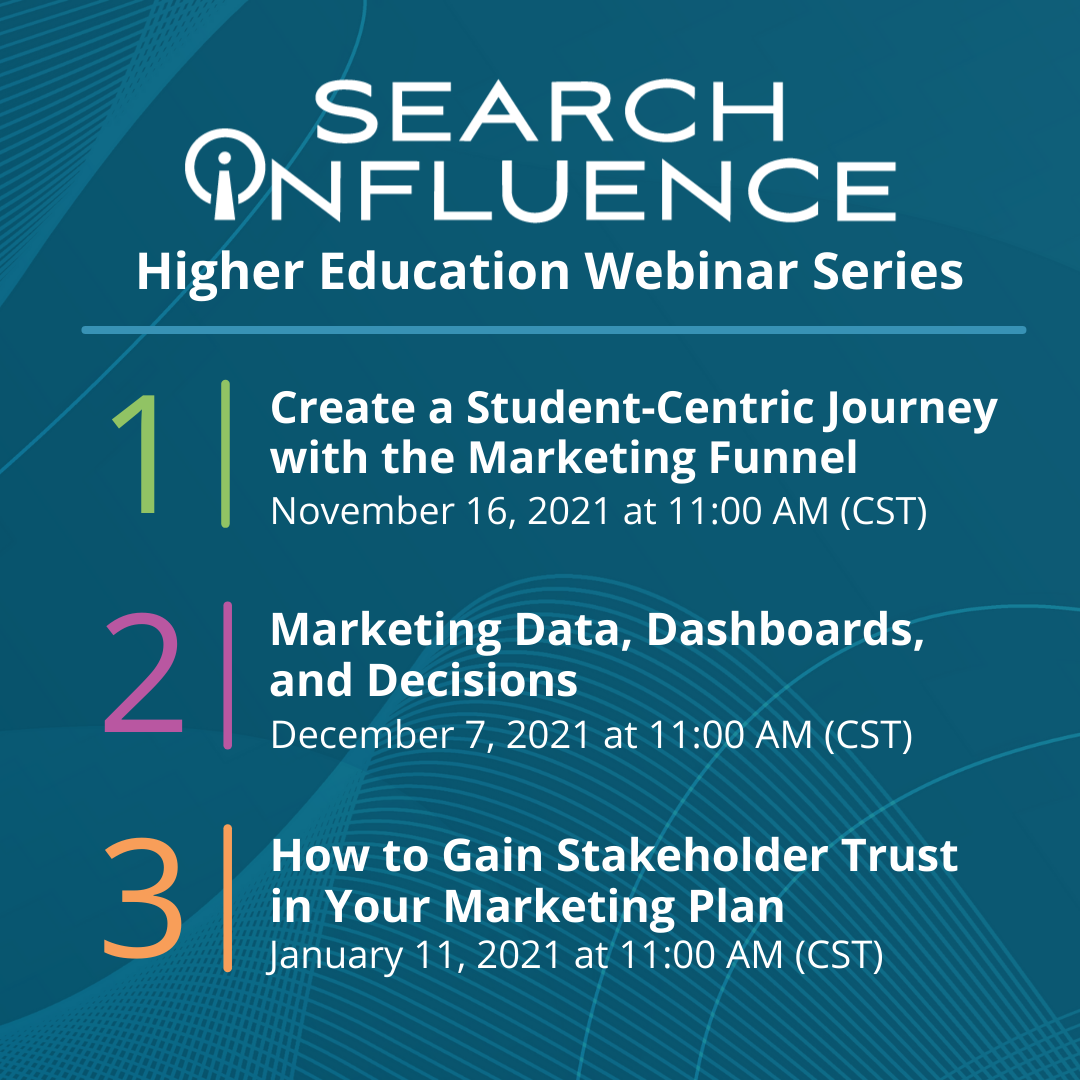
  • Search Influence Hosts Higher Education Marketing Series, “Plan, Track, and Earn Buy-In for Your Higher Education Marketing Strategy”

    Search Influence will host Plan, Track, and Earn Buy-In for Your Higher Education Marketing Strategy, a free, three-part training series. The series is designed to help higher education marketers create a strategic and measurable marketing plan and build excitement for the plan among stakeholders.

    Watch all three recordings here.

    Dates for Search Influence's 3-part higher education marketing webinar

    Session 1: Create a Student-Centric Journey with the Marketing Funnel

    Tuesday, Nov 16 | 12PM ET/11AM CT
    Watch the recording here.

    In this Higher Education Strategy Session, Search Influence will walk you through how to nurture prospects with tactics that align to the marketing funnel and student journey.

    Learning objectives:

    • How to look at the marketing funnel from the student’s perspective.
    • The ideal formula and structure for content that converts on your program and degree page.
    • Opportunities to create innovative conversion website points that help you qualify leads.

    Upcoming Sessions

    Session 2: Marketing Data, Dashboards, and Decisions

    Tuesday, Dec 7 | 12PM ET/11AM CT
    Watch the recording here.

    Discover how to unlock powerful insights by using quantitative data to tell a story about the performance of your institution’s recruitment and marketing strategies.

    Learning objectives:

    • Suggestions for tools and high-level processes to use when integrating disparate data into a dashboard.
    • How an integrated reporting dashboard can improve efficiency.
    • Methods to tie marketing and enrollment data together to communicate your work to non-marketing people.

    Session 3: How to Gain Stakeholder Trust in Your Marketing Plan

    Tuesday, Jan 11, 2022 | 12PM ET/11AM CT
    Watch the recording here.

    As an education marketer, it’s your job to help deans, admissions, and other stakeholders understand how new marketing strategies fuel student growth.

    Search Influence will guide you through how to build a case for new marketing efforts, including ways to demonstrate how your strategies impact your institution.

    Learning objectives:

    • How to use quantitative goals to plan and pitch marketing strategies.
    • Tactics to demonstrate how a given strategy will help you reach a specific target audience.
    • Guidance to tailor your discussion based on personality styles and role.
  • Graphics Checklist: High-Quality Assets You Need to Promote Your Business

    Key Insights

    • Businesses need current and high-quality location, team, event, product, and service photographs and logos to establish trust and authority on their websites and across digital and print campaigns.
    • With a well-thought-out plan of action, building out a high-quality asset library does not have to be expensive, time consuming, or intimidating.
    • You cannot use low-resolution photos across all platforms. Marketers need original, high-quality photo, video, and logo files.

    Person behind a video camera gathering assets for a business

    One of the biggest challenges businesses face when developing marketing campaigns is not having enough high-quality photography and video assets for the products, services, or events they want to promote.

    It might be tempting for a company to use whatever photos or videos they have on hand, but low-quality assets are unlikely to attract a steady stream of qualified leads. Using consistent, quality visual assets across all platforms and social channels communicates authority, trust, and professionalism to customers and prospects.

    This post will help businesses understand what visual elements are required in order to create an effective online presence, and how to use those assets effectively in a variety of campaigns. Use our checklist to audit your visual library and understand where and how to make improvements.

    What Are the Minimum Requirements for High-Quality Assets?

    Businesses should use their logos, videos, and photos throughout their websites and across all digital and print campaigns. This includes social media profiles, directories, and ads.

    As a general rule of thumb, it’s always better to have images and videos that are as large and high-resolution as possible! Assets can always be scaled down, but enlarging a photo or video that’s too small isn’t possible without pixelation or distortion. Contrary to popular procedural dramas, if a photo is low-resolution, there is no way to magically “enhance” this photo and render it usable across all platforms.

    1. For any digital campaigns, photos, and videos should be at least 1,080X1,080 px (pixel) with a 72 ppi (pixels per inch) resolution.

    • We recommend 1,080 pixels since we often run Facebook ads, and this size aligns with their minimum image size requirements.
    • Facebook ads have the largest minimum size requirements of any ad platform. By meeting these minimum requirements, businesses can cover their bases everywhere.

    2. Your website should have a hero image—a large visual element (either photography or video) that a visitor sees on your homepage. It should represent the site’s most important content.

    • The hero image can be static or dynamic, such a set of rotating images.
    • Your website’s video or photo hero image should be a minimum width of 1,600 pixels, but ideally 2,000+.

    3. For print assets, photos need to be 300 dpi (dots per inch).

    • Since images displayed on the web are 72 ppi, the only way to print them at full resolution is to print them very small.
    • A 600×300 px image from the web at 72 ppi, for example, can only be printed at 2×1 inches.

    4. Logos are an exception to the rules above.

    • The largest that a logo will appear in a campaign is 1200×1200 px, so we recommend a logo that will be easily viewed at this size without having to scale it up to avoid distortion.
    • Logos with transparent backgrounds are more versatile; plus, Google Responsive Display Ads specifically recommend logos in this format.
    • GIF, PNG, and SVG file formats support transparency.

    What Makes an Asset Relevant for Your Business?

    1. Photos should cater to a business’s target audience. Photos of products on plain backgrounds are great for an online shop, but photos and videos of people actually using the promoted products or services make for much better ads.

    2. Interior and exterior shots of the business’s physical location are ideal for search engine listings, directories, ads, and websites.

    • These photos can also help users find a storefront while using Google Maps, especially if the default street view is somehow obstructed or inaccurate.
    • 360 photos allow potential customers to interact with Google Maps listings, and they can be taken professionally or with a special camera.

    3. Having photos of the current staff as a group and individually with the same background is necessary for “About Me” pages and helps potential customers connect with your business on a more personal level.

    Keep in mind that most campaigns will need fresh images rotated over time, so depending on the goals of the campaign and what’s being promoted, more photos or videos may be needed every three to six months.

    Cartoon of person checking off giant list with a giant pencil

    Checklist

    Determine the assets needed by campaign:

    1. All campaigns need a logo file.

    • Ideal file formats are AI, EPS, SVG, PSD.
    • A PNG with transparent background is acceptable, and JPG/JPEG files are OK.
    • The minimum size should be 1,200 x 1,200 pixels.

    2. SEO campaigns require external and internal photos/videos of your location(s), as well as photos of your team.

    • The minimum size required in an SEO campaign will vary, but the bigger, the better!

    3. Facebook Display, Google Display, social media management, email, and blog campaigns require photos/videos related to the products, services, or events being promoted and photos/videos that are applicable to the audience being targeted.

    • Product photos are best when taken on a plain background at the same angle.
    • Team photos are best when taken with the same background.
    • Larger photos are always preferred, and these campaigns typically require a minimum size of 1,080 by 1,080 pixels.

    4. Print campaigns require any relevant product, location, event, service, or team photos with at least 300 dpi resolution.

    Gather existing assets:

    1. Have you worked with a photographer or videographer in the past? Make sure all of these assets are easily accessible and organized.

    2. What types of assets do you have?

    • Take inventory of your assets by organizing them into categories.

    Make arrangements to acquire additional assets if your current assets do not meet the above criteria:

    1. Logo files can usually be recreated in a more scalable or higher resolution file format, but this is harder with more complex logos.

    2. Thumbtack is a great resource for affordable professional portrait, location, 360, event, and product photography.

    3. If professional photography is still not within scope, head to free stock photography sites like Pixabay or Pexels.

    High-quality visual assets elevate not only your digital and traditional marketing campaigns, but also your overall online presence. You can easily arrange for professional photography and videography, or contact Search Influence to discuss asset creation and developing your asset library.

    Images

    Camera

  • Search Influence to Host Healthcare Marketing Webinar, “4 Ways Digital Marketing is Evolving”

    Take advantage of the changes in digital marketing to reach prospective patients!

    Search Influence has teamed with the Louisiana Hospital Association to bring you a webinar all about change! We’ve all been through so much this year, and change is something to which the digital marketing industry is incredibly accustomed.

    Join Search Influence Director of Sales and Marketing, Paula French, and Account Supervisor, Jordan Polhemus, for the free webinar, 4 Ways Digital Marketing is Evolving.

    Paula and Jordan will share knowledge from real-world examples and first-hand experiences to demonstrate you can leverage changes in the digital landscape to attract more patients. The webinar will also include dedicated time to address your questions.

    You will learn:

    • Tactics to adjust your medical marketing strategy in light of COVID-19 user behavior
    • Opportunities to reach your patients despite changes to Facebook Advertising Targeting
    • How to adapt to updates in Google’s Algorithm
    • Methods to capitalize on the shift to mobile devices

    *Note: Due to hurricane preparation, Search Influence and the Louisiana Hospital Association have rescheduled the webinar from its original August 25 date.

    If registered before this reschedule, your registration will automatically carry over to this new date. You do not need to re-register. You will receive a personalized link to join the day before the webinar.

    Louisiana Hospital Association logo

  • #ShowYourPride: Engaging the LGBTQ+ Community Online

    This post was updated by Crysten Price on June 30, 2020. It was originally written by a Search Influence alumnus on June 16, 2016.

    The LGBTQ+ community is a tech-savvy group with a proclivity towards online shopping. This community is a great audience to consider for ad spend targeting. They have always been early adopters of technology and online trends, with the internet functioning as a safe place to form communities and access resources that might not have been easily or readily available.

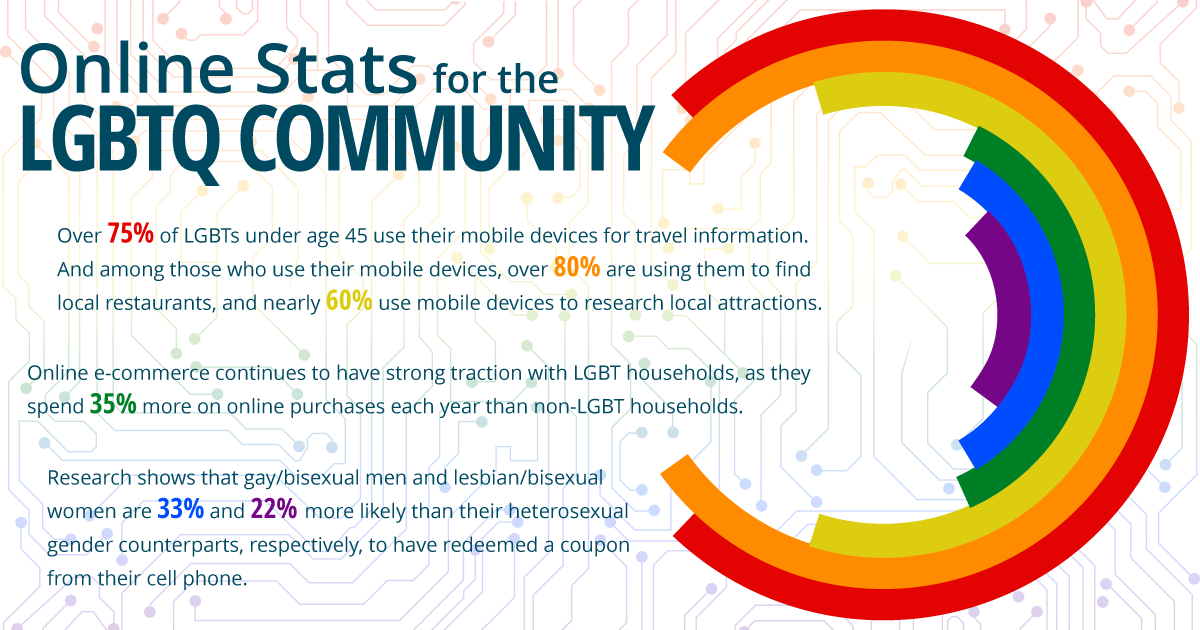
    Online Engagement LGBTQ Statistics Mini Infographic - Search Influence

    How to Make Your Biz LGBTQ+ Friendly with GMB

    Google My Business (GMB) listings offer business owners a free platform to engage with their customers. Your business profile is easily accessible to users on Google Search and Maps. Join over 190,000 other businesses across the globe that enabled the LGBTQ-friendly attributes to their listing by following Google’s quick and easy instructions.

    Keep in mind, to manage your business information in Search, Maps, and other Google properties, you must first verify your business listing. After your GMB listing is set up, you can explore other ways to welcome prospective LGBTQ+ customers:

    • Request/encourage patrons to leave Google reviews highlighting your business as a LGBTQ+ friendly space.
    • Add images of LGBTQ+ customers and travelers to your GMB profile.
    • Use Google Q&A and Posts to let travelers know your business is inclusive.

    If you’re new to GMB, use the following guide to claim your business online:

    • Add or claim your business online or via the GMB app
    • Verify your listing with the following:
      • Requesting a postcard (most common)
      • By phone call or text
      • Email
      • Instant verification (rare)
    • After Google verifies your listing, your business information will be eligible to appear live in Search, Maps, and other Google services

    LGBTQ+ Community and Social Media Platforms

    When it comes to outreach, you can’t rely on a single, catch-all approach. Tailor your campaigns and messaging to subcommunities and audiences across different social media platforms to garner better reach and impressions. To be more specific, Black Twitter is an online subcommunity of Black users on Twitter focused on issues of interest to the their community. As you craft messaging to subcommunities, keep their online subculture in mind.

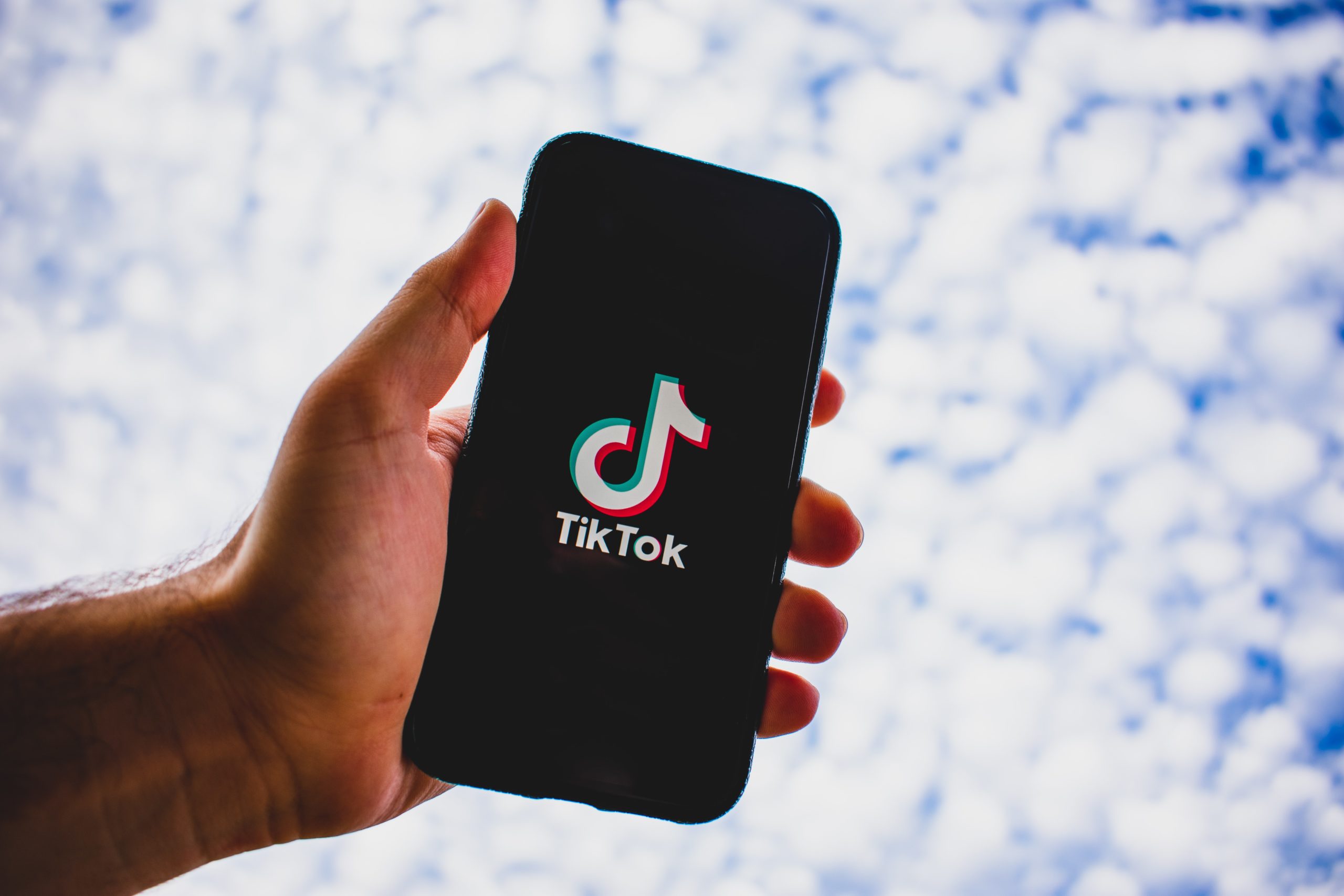
    Similarly, on TikTok—a social platform widely known for viral dances—content is algorithmically recommended based on user preferences. “Gay TikTok,” or “Alt TikTok” is a subset of content geared toward LGBTQ+ users and their favorite queer culture trends and aesthetics.

    Person holding phone cell phone in the sky with TikTok load screen visible

    Interacting with these users requires taking a step back from the mainstream. References to Gay TikTok culture can help you create more relevant, exciting content, that users will want to engage with.

    Ensuring Authenticity Within LGBTQ+ Targeted Content

    When posting to social media, consider whether your content fits within the interests of the LGBTQ+ community. If it does, use relevant hashtags or try engaging with influencers in the community. However, do your research to ensure that your messaging isn’t missing the mark or reads as inauthentic.

    Users can quickly pick up on Pride-themed content that seems like a marketing gimmick. A 2019 eMarketer survey revealed that gay and lesbian respondents were more likely to patronize a company known for its LGBTQ+ friendliness; however, although subgroups of the LGBTQ+ community expressed that they were more willing to support businesses that promote inclusive ad content, roughly half of the respondents reported that they were “much more” likely to support these businesses. This could be attributed to the fact that ads featuring same-sex couples and relationships are sometimes perceived as marketing ploys rather than a genuine commitment to inclusivity.

    When creating content, consider the aforementioned subcommunities and how to connect with them organically with authentic messaging that is inviting and kind.

    LGBTQ+ Community and Mobile Usage

    Members of the LGBTQ+ community are said to be mobile leaders, and when compared with their heterosexual counterparts, they are more likely to be considered technology “wizards.” Wizards are the consumers Experian Marketing Services has identified as those for whom technology is central to their way of life. This consumer segment, with high mobile technology adoption and usage rates, is an important target for mobile campaigns.

    • Over 75% of the LGBTQ+ community under age 45 use their mobile devices for travel information.
    • Among those who use their mobile devices, over 80% use their devices to find local restaurants, and nearly 60% use mobile devices to research local attractions.
    • Online e-commerce continues to have strong traction with LGBTQ+ households, as they spend 35% more on online purchases each year than non-LGBTQ+ households.
    • Research shows that gay/bisexual men and lesbian/bisexual women are 33% and 22% more likely than their heterosexual gender counterparts, respectively, to have redeemed a coupon on their cell phone.

    Laptop in front of window on desk with love in rainbow color

    Get Digital Marketing Help from the Experts

    Identifying and targeting user groups of interest involves a robust digital marketing strategy, but you don’t have to start from square one all on your own. The experts at Search Influence can help you craft inclusive messaging that resonates with various target audiences so you’ll get the most out of any campaign. Schedule a free consulting session to learn how you can enhance your online marketing efforts with our recommendations.

    Source Content:
    https://www.experian.com/assets/simmons-research/white-papers/2013-lgbt-demographic-report.pdf http://communitymarketinginc.com/year-end-research-report-top-ten-2013-trends-seen-in-lgbt-travel/
    http://www.nielsen.com/us/en/insights/news/2015/us-lgbt-shoppers-make-more-trips-spend-more-than-average.html

    Images

    LOVE

  • Digital Marketing vs. Traditional Marketing

    If you’re having trouble deciding where you should spend your marketing dollars in 2020, then you’ve come to the right place. As the world becomes more digital, the way we market will continue to evolve. While traditional marketing has its successes, digital marketing is changing the way businesses are marketing to their consumers. Continue reading to find out the top four reasons you should be taking advantage of the benefits of a digital marketing strategy.

    Tina Fey in 30 Rock saying lets do this

    What Is Digital Marketing?

    Digital marketing helps you promote your brand online, increase website traffic, and deliver high-quality leads through a holistic marketing approach. The average person spends 24 hours a week on the Internet, which tells you it’s likely that the internet is where the majority of your potential consumers are spending most of their time. If you want to market your company’s brand in the right place at the right time, then it’s important you are being found online.

    The top four reasons your business should be taking advantage of the benefits of digital marketing are:

    1. Target ideal buyers
    2. Trackable and measurable results
    3. Communication and engagement
    4. Cost-effective

    1. Target Ideal Buyers

    When you market to your potential customers, you want to make sure you’re marketing to the right person at the right time. Digital marketing consists of different tactics that work together to get your brand in front of your ideal buyer. One tactic, Search Engine Optimization, will help to ensure your business is seen when a person is searching for a product or service applicable to your company. Other tactics like Google and Facebook Display, Paid Search, and Social Media Advertising will allow you to market to people who are likely to be intrigued by what your business offers. Though traditional marketing can be successful and does allow you to reach certain audiences, it certainly does not have the advanced targeting proficiencies of digital marketing.

    Keith Urban saying that was a bullseye man

    2. Trackable and Measurable Results

    The only way to know if a marketing campaign is successful is to measure its success over time. Tracking the results of a traditional marketing campaign can be extremely challenging, and, at times, impossible, while every tactic used in a digital marketing campaign can be measured. Susan Bogle, the Associate Vice President of Product Marketing at Southern New Hampshire University writes, “Today, analytics allow marketers to track user behavior at a highly detailed level: how many times they click on a link, how much time they spend on a web page, how often they open emails, and much more.” Being able to track results in a digital marketing campaign gives you the opportunity to see which tactics are performing well and which tactics could be altered for better success.

    3. Communication and Engagement

    According to a Hubspot blog written by Kayla Carmichael, “recently, 50% of marketers said they believe digital marketing has an edge over traditional because of the interaction digital marketing opens with customers.” Digital marketing allows for continuous engagement with your audience through different digital media channels. You are able to interact with your customers to ensure you have met all of their desired needs. A marketing team is able to create, support, and withstand a two-way conversation with its customers in a digital marketing campaign, while traditional marketing has little to no interaction with consumers.

    4. Cost-Effective

    Using digital marketing tactics is one of the most profitable ways to market your business. Investing a large amount of dollars in marketing and advertising can be a financial burden that many businesses have to deal with. Traditional marketing makes it almost impossible for smaller companies to compete with larger companies for advertising space. In contrast, digital marketing allows businesses both big and small to market on the same platforms and get more for their marketing expend. According to LyfeMarketing, “Social media is cheaper than any form of advertising available today. Unlike traditional, digital marketing is one of the only forms of media that can expose your business to over 1,000 people for less than $3.”

    Little pageant girl counting lots of money

    Traditional Marketing Is Good, But Digital Marketing Is Better

    Traditional marketing has been an exceptional form of advertising over the years, but the world has become more digital, so it’s important for your business to do the same. There is a time and place for both marketing strategies, but if you’re looking for tactics that will allow you to target your ideal buyers, track results, and communicate with your customers all at a reasonable price, then it’s time to invest in digital marketing.

    Are you looking to get into the digital marketing landscape? Don’t worry, the experts at Search Influence can handle all of your company’s digital advertising needs. Request a digital marketing analysis today—it’s our gift to you.

    A person grabbing a present through a cardboard computer screen

    Images:

    Tina Fey

    Keith Urban

    Pageant Girl

    A Gift for You