Key Insights
- Not all inquiries are equal. Tracking lead quality ensures your budget supports those most likely to enroll.
- Lowering cost per inquiry only works if you maintain your focus on lead quality.
- When your targeting, messaging, and landing pages work together, you eliminate waste that inflates CPI.
- Setting clear conversion goals and refining keyword strategies helps ad platforms deliver stronger leads at lower costs.
- With a higher education marketing agency, you gain the strategic support needed to reduce CPI without compromising results.
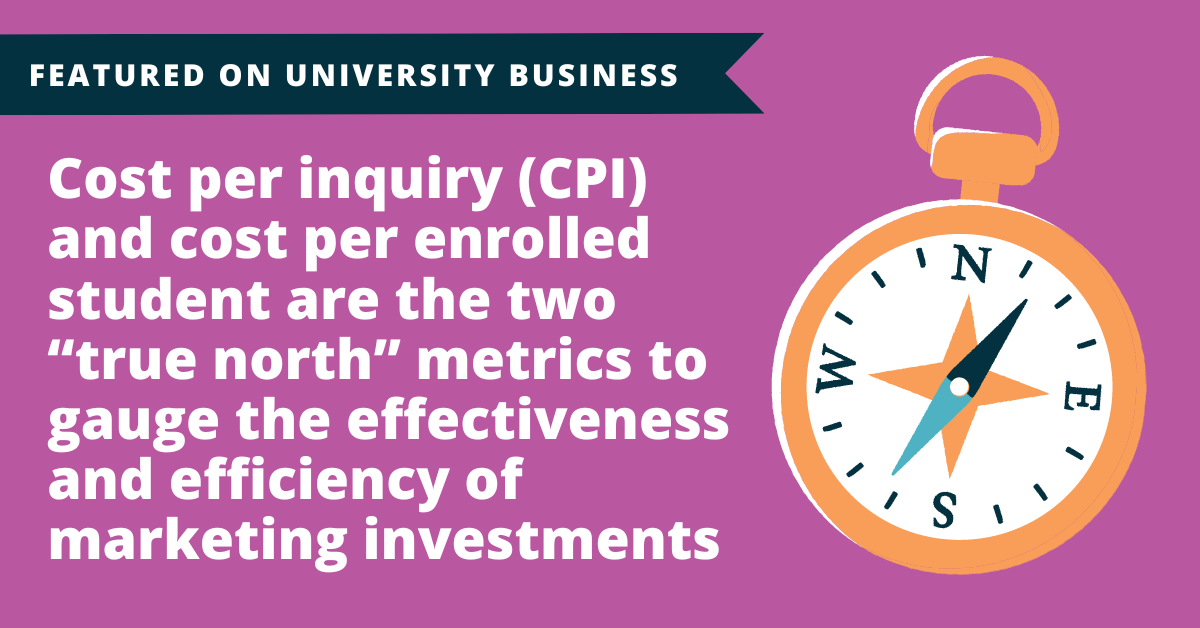
If you’re a higher education marketer already tracking and measuring cost per inquiry (CPI), you know the goal isn’t just spending less. It’s making every dollar count toward the right prospective students.
However, the challenge is lowering CPI without losing the quality leads that fuel your enrollment pipeline. That means looking beyond quick fixes and closely examining lead quality, campaign performance, audience targeting, landing page experience, and how well your marketing efforts are aligned with student intent.
Here’s how to reduce CPI with intention, while keeping your pipeline strong and your recruitment goals on track.
The State of Higher Ed Cost Per Inquiry
Driving down CPI starts with context. Without a clear understanding of where your institution stands, it’s impossible to know whether you’re optimizing effectively — or leaving budget on the table.
Do your campaigns match student intent? Are your landing pages converting efficiently? Are you capturing qualified leads, or just cheaper ones?
Search Influence and UPCEA’s 2024 Higher Ed Marketing Metrics Research Report: What Gets Measured Gets Managed offers valuable insight into typical performance across program types.
According to the report, professional and online education programs spend an average of $800,970 annually on digital advertising, representing about 3.6% of total revenue. The average CPI varies by program:
- $140 for online and professional education
- $128 for undergraduate programs
- $157 for graduate programs
- $51 for noncredit programs
These benchmarks give higher education institutions a practical frame of reference. If your CPI is significantly above these figures, it’s worth digging deeper.
Once you have a clear baseline, the next step is knowing where to focus. Below, we break down how to reduce CPI without sacrificing the quality of your inquiries.
How to Reduce CPI at Your University

Refine your conversion goals to capture more leads
Defining success from the start helps your campaigns target the right audiences, improve efficiency, and generate quality leads that convert — setting the stage for a lower, more effective CPI. Ad platforms work best when they know exactly which action to optimize for, so setting the right conversion goals is essential.
If your campaigns aren’t clearly aligned with inquiries, applications, or enrollments, you risk wasting spend on leads that look good on paper but don’t move the needle.
Tips for refining your conversion goals
Align internally and with your agency on primary KPIs
Start by building alignment across internal teams and agency partners on the key performance indicators (KPIs) that matter most in your current campaigns. Whether you’re focused on inquiries, applications, or enrollments, having shared goals ensures everyone is working toward the same outcomes. This clarity sets the foundation for smarter decision-making, more focused reporting, and campaigns that support institutional priorities.
Define what counts as a true lead for your institution
Once your KPIs are established, determine which actions reflect meaningful progress in your enrollment funnel. Brochure downloads, event registrations, contact forms, and applications each signal different levels of intent. While all have value, not all carry the same weight when it comes to lead quality. By identifying which actions qualify as a true lead, you can set smarter conversion goals and ensure your campaigns focus on attracting the prospects most likely to take the next step.
Set and map conversion goals across the funnel
With lead definitions in place, assign clear conversion objectives that align with each campaign’s role in the funnel. Awareness-stage campaigns might focus on brochure downloads or event sign-ups, while decision-stage efforts should optimize for inquiries or applications. Matching your goals to user intent gives ad platforms better direction and allows you to measure ROI more accurately across each stage of the enrollment journey.
Help platforms optimize with consistent signals
Focus on a small set of high-value conversion actions to give ad platforms the data they need to optimize effectively. When too many different actions (like clicks, page views, or form fills) are tracked as conversions, platforms like Google and Meta struggle to prioritize what matters the most. Their machine learning systems rely on clear, consistent signals to identify patterns, refine targeting, and improve delivery over time. The more reliable the inputs, the stronger your marketing performance and the more optimized your ad spend.
Restructure campaigns to support focused goals
As your conversion goals and targeting strategies evolve, make sure your campaign structure reflects those priorities. Grouping campaigns by funnel stage, audience segment, or program type gives platforms cleaner signals and helps you more easily evaluate performance. Taking the time to restructure upfront creates a more efficient optimization process and a clearer path to lowering costs without compromising lead quality.
Track lead quality to reach the right students
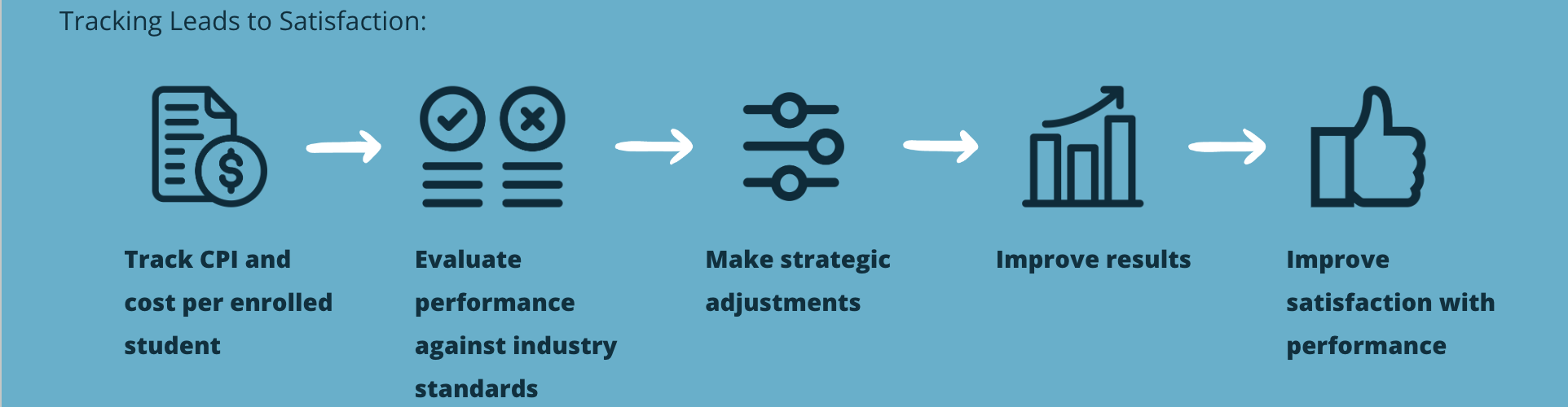
Tracking and acting on lead quality ensures your marketing budget is spent generating meaningful conversions, not just a higher volume of them. Fine-tuning your conversion objectives can increase volume, but without insight into lead quality, you risk filling the funnel with prospects who are unlikely to enroll.
When you monitor how inquiries perform beyond the first click, you can make data-driven decisions about targeting, messaging, and spending, ultimately improving efficiency and enrollment outcomes.
Tips for tracking and leveraging qualified leads
Start with a manual lead review
Begin by manually reviewing individual lead submissions to evaluate quality up close. Ask yourself, “Is this the type of prospective student we want more of?” This quick exercise helps you spot patterns in form fills, like missing information, off-target program interest, or low engagement signals. It also gives you immediate feedback to refine targeting, messaging, or creative in real time, long before more complex attribution models kick in.
Measure lead quality by campaign or platform
Once you understand what makes a lead valuable, evaluate how each campaign or platform contributes. Go beyond volume and calculate the percentage of leads from each source that meet your quality criteria. Comparing cost per qualified lead (CPQL) gives you a more accurate picture of performance and helps you identify which channels drive meaningful inquiries — and which may inflate your numbers without adding enrollment value.
Monitor enrollment outcomes, not just form fills
An inquiry is only part of the story. To truly evaluate performance, track how leads progress through key stages like application submission and enrollment. This helps separate campaigns that generate lasting impact from those that attract surface-level interest. By focusing on outcomes that reflect your enrolled student goals, you can make more informed decisions about where to invest and where to pull back.
Score and automate lead qualification in your CRM
Manage, score, and qualify leads directly in your CRM software to make lead quality measurable. Start by assigning values based on criteria like program interest, verified contact details, or secondary engagement. This will help your team prioritize follow-up and identify which inquiries are most likely to convert.
Whenever possible, automate this process. Set up rules that flag high-quality leads in real time, reduce manual review, and ensure your best prospects don’t fall through the cracks. A smart qualification system speeds up decision-making and gives you a consistent framework for evaluating performance across campaigns.
Use CRM insights to guide optimization
After your leads have been scored and stored in your CRM, use that data to inform campaign decisions. Look for patterns among your most qualified inquiries. Where did they come from? What messaging resonated? Which programs attracted the strongest potential students? These insights allow you to refine your targeting and creative strategies with a focus on what’s working, not just what’s getting clicks.
Feed qualified lead data back into ad platforms
Take your insights one step further by feeding qualified lead data back into platforms like Google and Meta. By sharing first-party CRM data through tools like Google Offline Conversions or Meta Conversions API, you give platforms the signals they need to optimize for leads that match your enrollment goals, instead of just low-cost conversions. This can significantly improve targeting and reduce wasted spend.
Build a closed-loop optimization system
Integrate your CRM, lead scoring, and ad platforms to build a feedback loop that improves campaign performance over time. When qualified lead data flows both ways — from your campaigns into the CRM, and the CRM back into platforms like Google and Meta — you enable smarter targeting, faster optimization, and better use of your budget.
This closed-loop system requires effort to set up, but it’s one of the most effective ways to consistently lower CPI while improving lead quality.
Identify where your Google Ads spend is going to waste
Refining your keyword strategy avoids wasted spend in Google Search campaigns. Even well-targeted ads can lose efficiency if they’re triggered by irrelevant or low-intent queries. Fortunately, Google Ads shows you the exact terms users searched before clicking, giving you the insight needed to spot misalignment and adjust your targeting before your budget goes off track.
Tips for finding and fixing wasted Google Ads spend
Review the Search Terms Report regularly
Take time to review the search terms triggering your ads to ensure your spend is aligned with your goals. The Search Terms Report reveals what users are typing, not just the keywords you’ve selected, making it easier to catch off-topic or low-intent traffic early. Regular checks help you identify patterns, remove distractions, and keep your campaigns focused on reaching the right target audiences.
Spot irrelevant search matches
Not every click is a good one. Look for queries that fall outside the scope of your programs or audience, especially those that suggest confusion about your offerings. For example, if you’re promoting a “sports management degree” and your ad shows for “sports chiropractic school,” that’s a mismatch worth correcting. Flag these terms and add them as negative keywords to prevent further waste.
Watch for keyword match type issues
Your keyword match types directly influence how precisely your ads are served. Broad match keywords can open the door to a wide range of loosely related queries, some of which may not reflect your intent. If you’re seeing too many irrelevant impressions or clicks, consider tightening your targeting with phrase or exact match. This change gives you more control over how and when your ads appear.
Refine your keyword targeting
Use performance data to expand and adjust your keyword list based on what’s working. Test new terms that better reflect how your prospective students search and remove those that consistently underperform. This kind of proactive refinement helps you reach more qualified users and improves the efficiency of your marketing campaigns over time.
Double down on high-performing terms
When certain keywords consistently drive qualified inquiries, treat them as strategic assets. Increase budget allocation, build dedicated ad groups, and explore related variations to expand your reach. Prioritizing high-performing terms helps you scale what’s working and maximize impact without adding unnecessary spend.
Prune your campaigns consistently
Keyword lists can grow stale or bloated over time, pulling your campaigns away from their original focus. Set aside time for regular cleanup — removing underperformers, eliminating overlap, and tightening targeting to stay efficient. Campaign pruning helps you avoid wasted impressions, reduce spend on low-value clicks, and keep your strategy aligned with enrollment goals.
Optimize and test landing pages to boost performance
Testing and refining your landing pages allows you to pinpoint what drives action, whether you’re using existing site content or building standalone pages tailored to campaign goals. A well-placed ad is only effective if the landing experience meets the user’s expectations.
If the page doesn’t match the intent behind the click, whether in content, clarity, or design, you risk losing prospective student engagement and driving up your CPI.
Tips for optimizing and testing landing pages
Match message and intent across ads and landing pages
Landing pages should deliver exactly what your ad promised. When the headline, tone, and call to action on the page reflect the user’s expectations, you’re more likely to keep them engaged and guide them toward conversion. This landing page best practice doesn’t just improve performance. It can also boost your Google Ads Quality Score, helping your campaigns become more cost-effective over time.
Focus on a single, clear conversion goal
Each landing page should revolve around one primary action. Make the path obvious, whether you want users to schedule a tour, download a brochure, or start an application. Avoid cluttering the page with competing links or mixed messages that can distract from your main objective. A clear, focused call to action (CTA) keeps users moving in the right direction and increases your chances of conversion.
Limit form fields to essentials only
Asking for too much information too early can discourage prospective students from completing your form. Stick to the essentials — only ask for what’s needed to qualify the lead or move them forward in the funnel. In a study of over 40,000 landing pages, HubSpot found that the use of complex form fields like drop-downs and multi-line text areas significantly decreased performance. To keep conversions high, simplify your forms and save additional questions for later.
Incorporate social proof and trust signals
Confidence plays a major role in whether users take action. Reinforce your message by adding elements like student testimonials, graduation rates, job placement stats, or recognizable affiliations. These trust signals help validate your offering and reassure prospective students that your programs deliver real value.
Tailor the experience to the campaign type
Not all campaigns serve the same purpose, and your landing page should reflect that. For Google Search, ensure the page aligns with the keyword’s intent and delivers immediate relevance. For Display campaigns, match the tone and content to the audience’s funnel stage, offering helpful next steps rather than a hard sell. Aligning page content with campaign context improves user experience and overall campaign performance.
Consider creating dedicated landing pages when possible
If your institutional website is difficult to update or shared across departments, standalone landing pages can give you the control and flexibility needed for campaign success. Dedicated pages make it easier to test messaging, customize layout, and iterate quickly, all without disrupting other parts of your site. When built with purpose, these pages can dramatically improve engagement and conversion rates.
Audit and update regularly
Even well-built landing pages need regular attention. Over time, content can become outdated, or changes made by other teams can unintentionally affect page performance. Set a schedule to revisit your campaign landing pages to check for accuracy, brand alignment, and effectiveness. Ongoing audits ensure your pages stay relevant, consistent, and ready to convert.
Dedicated landing page success story
At Search Influence, we’ve seen the impact that dedicated landing pages have on campaign performance metrics.
With our support, one client, leveraging HubSpot, implemented ad-specific landing pages designed to align closely with each campaign’s messaging and intent. Within just over two weeks, they generated 56 qualified submissions and saw their CPI decrease by nearly 50% compared to similar campaigns using standard website pages.
The ability to tailor content, streamline the user experience, and iterate quickly played a key role in achieving these results.
Why Should You Hire an Advertising Agency to Help Reduce Your CPI?


Reducing CPI is a complex process that requires a coordinated effort across campaign structure, targeting, tracking, and landing page performance. Even with the best intentions, it’s easy to get bogged down in the details, especially without dedicated resources or specialized expertise.
Our Marketing Metrics Report shows that only 47% of higher ed marketers in online and professional education are satisfied with campaign performance.
Just 29% are confident in their ability to track results.
The link between the two is clear: 92% of those who are satisfied with tracking also report satisfaction with performance.
If your internal team is stretched thin or struggling to connect strategy with outcomes, a higher ed-focused advertising agency can help fill the gap. With access to advanced tools, deep platform knowledge, and the capacity to focus solely on improving results, the right partner can bring clarity and control to complex campaigns and help you lower your marketing expenses with precision.
Let’s Make Your Higher Education Marketing Dollars Work Smarter
At Search Influence, we’ve spent nearly two decades helping colleges and universities improve campaign performance while optimizing their marketing budget.
Our team has actively shaped how the higher education sector defines and measures cost per inquiry. From benchmarking results to uncovering inefficiencies and implementing data-backed digital marketing strategies, we work alongside educational institutions to lower CPI without sacrificing lead quality.
Ready to see where your campaigns stand?
Download our free CPI Worksheet to calculate your current CPI, evaluate your ROI, and pinpoint where your resources will go furthest. This resource offers actionable instructions for calculating your CPI for all your programs, by program type, and even assessing your cost per enrolled student.
With the right insights, you won’t just spend smarter — you’ll recruit smarter.