Tag: COVID-19

  • Should You Advertise During COVID-19? Here’s What the Experts Are Saying

    Should You Advertise During COVID-19? Here’s What the Experts Are Saying

    The dramatic increase in media consumption due to global stay-at-home orders has led to changes in consumer behavior. The data from Facebook, Instagram, and streaming services for television gives us insights as to how we can adapt digital marketing to align with these consumer shifts.

    A phone, person, and dollar sign icon

    Before this time, video was producing the highest engagement rates and often the best advertising results. Now, Nielson predicts homebound consumers could account for an almost 60% increase in the amount of global time spent watching video.

    People are also spending significantly more time on social media. While people use social media to catch up on current events, it’s clear they’re also spending time there for entertainment as a break from the barrage of virus-specific news.

    In a public Facebook report, the company openly discussed massive increases in traffic, messaging, and bandwidth usage. They have seen a 50% increase in messaging across their platforms.

    More than ever, people are also spending time on apps and downloading. This is noteworthy from a digital marketing perspective because display network advertising can reach potential customers while they use apps.

    • On average, consumers around the world spent 20% more time playing games and using apps each week in Q1 2020 than they did in Q1 2019.
    • In Q1 2020, consumers spent over $23.4 billion in app store purchases, the largest quarter ever in terms of consumer spending.
    • There were over 31 billion new app downloads, a 15% increase from Q4 2019.

    Kantar Media, a global data consulting company, surveyed more than 35,000 consumers globally and found that only 8% of people think companies shouldn’t stop advertising due to the pandemic.
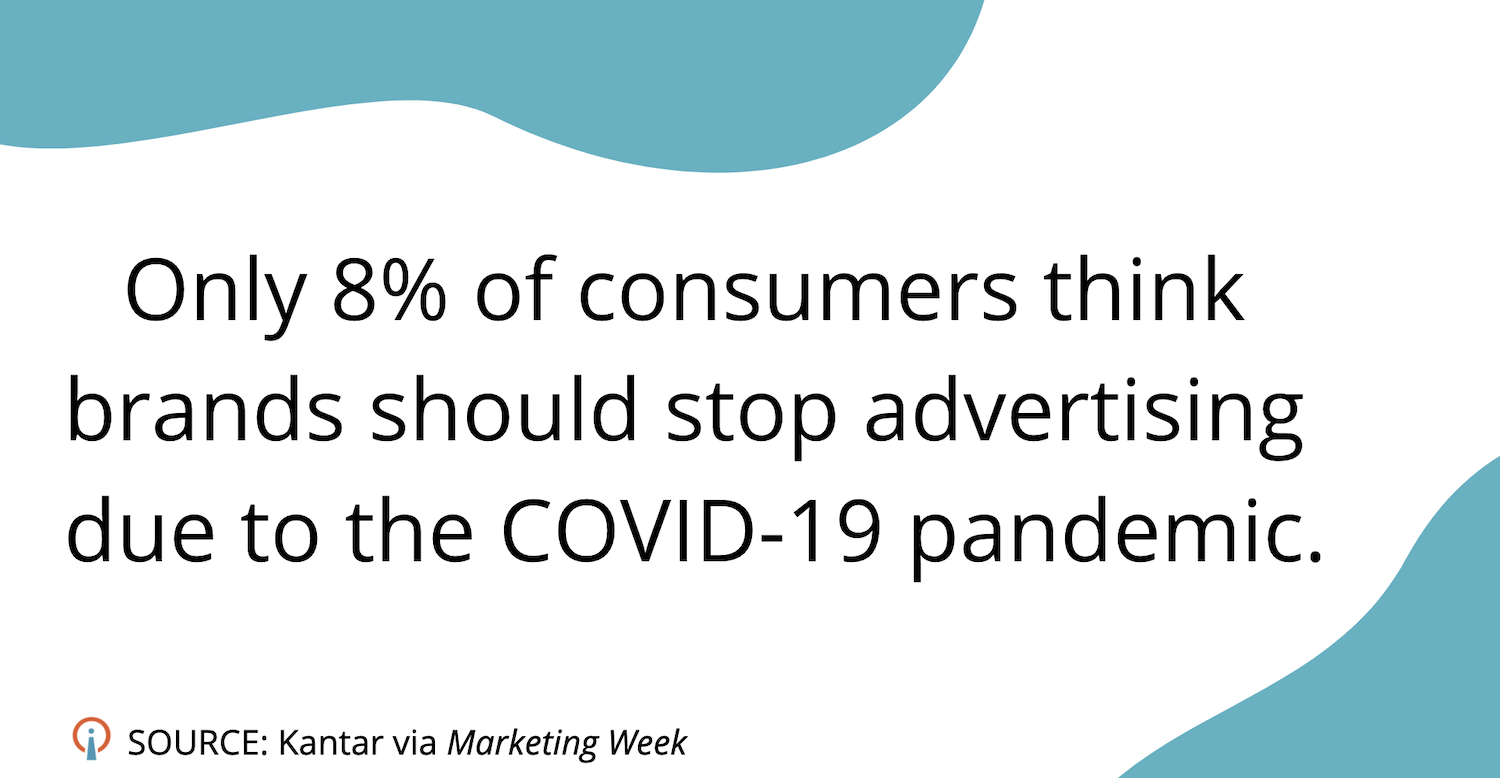
    8% of people think companies shouldn’t stop advertising due to the pandemic graphic

    88% of the U.S. population uses a computer or mobile device while watching either digital video or traditional TV, and this number is likely to be even higher during social distancing.

    In the week of March 9, Nielsen tracked a 10% increase in viewership of local news in the 25 to 54-year-old demographic. These viewers are probably browsing Facebook, Twitter, or Instagram on their phone while the news is on in the background.

    Current Increases:

    • The local CBS affiliate in New Orleans, WWL-TV, has seen its viewership quadruple.
    • Medical, legal, and home improvement industries have increased their advertising.
    • Feel-good advertising has become more common, including large organizations sending out “thank you” messages to their staff and front-line workers.

    Facebook Advertising

    With people consuming digital media at such a high rate, there are more opportunities to show ads to potential customers. That, coupled with the fact that many advertisers have reduced their budgets, means there is less competition for each impression, which lowers the cost and increases the effectiveness of your ads.

    In the US, the average cost per thousand impressions (CPM) for Facebook ads fell below $3 for the first time in two years on March 22. The average CPM has remained close to this $3 average for about two months. For comparison, the average CPM in the US from March 2018 to February 2020 was $4.67.

    The Costs to (Dis)Engage

    Kantar conducted an experiment to see how a popular beer company’s sales and market share would be affected if it cut its ad spend. Their research found that if the beer company paused all of its marketing campaigns, it would see a 13% decrease in sales and struggle to recover that lost market share.

    Kantar’s global head of media, Jane Ostler, shared an impactful insight, “Brand health becomes vulnerable when companies stop advertising…If they do this for longer than six months, it destroys both short- and long-term health.”

    Studies have also shown that during the Great Recession, brands that continued advertising recovered 9x faster than those who didn’t. All of the data from 2008 and the models for the current situation point in the same direction: not advertising for six months or more will have drastic effects.

    Lessons From the Great Recession

    While “unprecedented” may be the word of the year, we do have the examples from the Great Recession from 2007-2009 to draw upon for insights when it comes to the economic impact of a recession.

    During the Great Recession, two primary changes emerged in the packaged goods industry: shifting channel preference and reduced brand loyalty.

    • By channel, consumers were more likely to shop through dollar and value stores. They weren’t as concerned about shopping at their usual grocery and big box stores.
    • Reduced brand loyalty meant shoppers were more likely to choose cheaper, private-label items, such as Walmart’s Great Value brand, over big-brand favorites like Dawn and Bounty.

    This created a huge opportunity for brands to sell products to consumers who would otherwise not have made the switch. This also meant established brands needed to protect their relationships with customers by keeping them engaged.

    Ten years later, we predict that these trends in consumer behavior will return, except this time the shift in preference is to online shopping.

    For your business to be competitive online, consumers need to know that you exist, what you’re offering, and how to initiate a transaction with you online—whether that is through submitting an inquiry, a virtual consultation, or actually purchasing something.

    The Path Forward

    There’s a natural instinct to cut back on advertising to reduce expenses. Instead, you should focus on how to improve the efficiency of your marketing.

    There are more and more business transactions happening online. Properly set up analytics will allow you to track your leads to give you a better idea of which marketing efforts are driving your leads and sales.
    Industry-wide, there’s no question that digital advertising is the most cost-effective option for advertisers because of the surge in digital media usage and reduced competition. The low CPMs and lack of competition will not last forever.

    With the right team of experts, you can help secure the health of your company. At Search Influence, we provide businesses with an array of digital marketing services to help them reach customers online. Contact us to chat with an expert on our team.
  • Business Continuity Messaging During COVID-19: What You Need to Do Right Now

    Business Continuity Messaging During COVID-19: What You Need to Do Right Now

    Now more than ever, the internet is the first and primary source of information about local businesses. The messaging (or lack thereof) that companies disseminate may affect the quality and quantity of their customers when the economy begins to open back up. 

    We’ve seen far too many businesses fail to communicate their situation, regardless of whether they are open at this time. You already have the tools to communicate to your customers: 

    • Your website
    • Social media
    • Your CRM or customer email list
    • Google My Business

    Ensure that you’re poised for recovery by addressing your messaging strategy now. Create a plan to keep or build your audience’s trust. 

    To remain top-of-mind, you must cultivate customer intent. It will be more competitive when the economy opens back up, so you want potential customers to be further down the sales funnel at that point. Many people want and intend to spend their money with local businesses or on causes impacting their communities. 

    Messaging Guidelines

    Prior to the pandemic, Millennials (in 2020, this includes people who are 24-39 years old) were projected to represent $1.4 trillion in buying power this year. They now make up the largest segment of the workforce, are the most common users of social media and most likely to buy online. 

    Millennials spend their money in alignment with their values and often spend more on a product if the brand contributes to charitable causes. In March 2020, Millennials indicated they expect brands to step up their communication during this crisis:

    • One-third of respondents said that brands should communicate more than normal.
    • Half of the respondents thought that brands should continue their marketing efforts during this time.
    • One in four of those surveyed also said that they believed brands have the power to be “as impactful as the government” during this crisis. 

    Ensure Clarity in Your Messaging

    Marketing messaging now needs to focus on making positive brand impressions. Whenever possible, demonstrate social responsibility and clarify to your current and prospective customers how your business is operating during this period. 

    If your business is operating: 

    • Which steps do customers need to take to get in touch?
    • What is your plan for the short and long term?
    • How are you ensuring customer and employee safety?
    • Is your business supporting the community with donations, fundraisers, etc.? 
      • If so, how are you doing this?
      • How can your audience help?

    If you are unable to do business as usual:

    • How has this situation impacted the business and your employees? 
      • How can your audience help?
    • Is your business supporting the community (i.e., donations, fundraisers, etc.)?
      • If so, how are you doing this? 
      • How can your audience help?

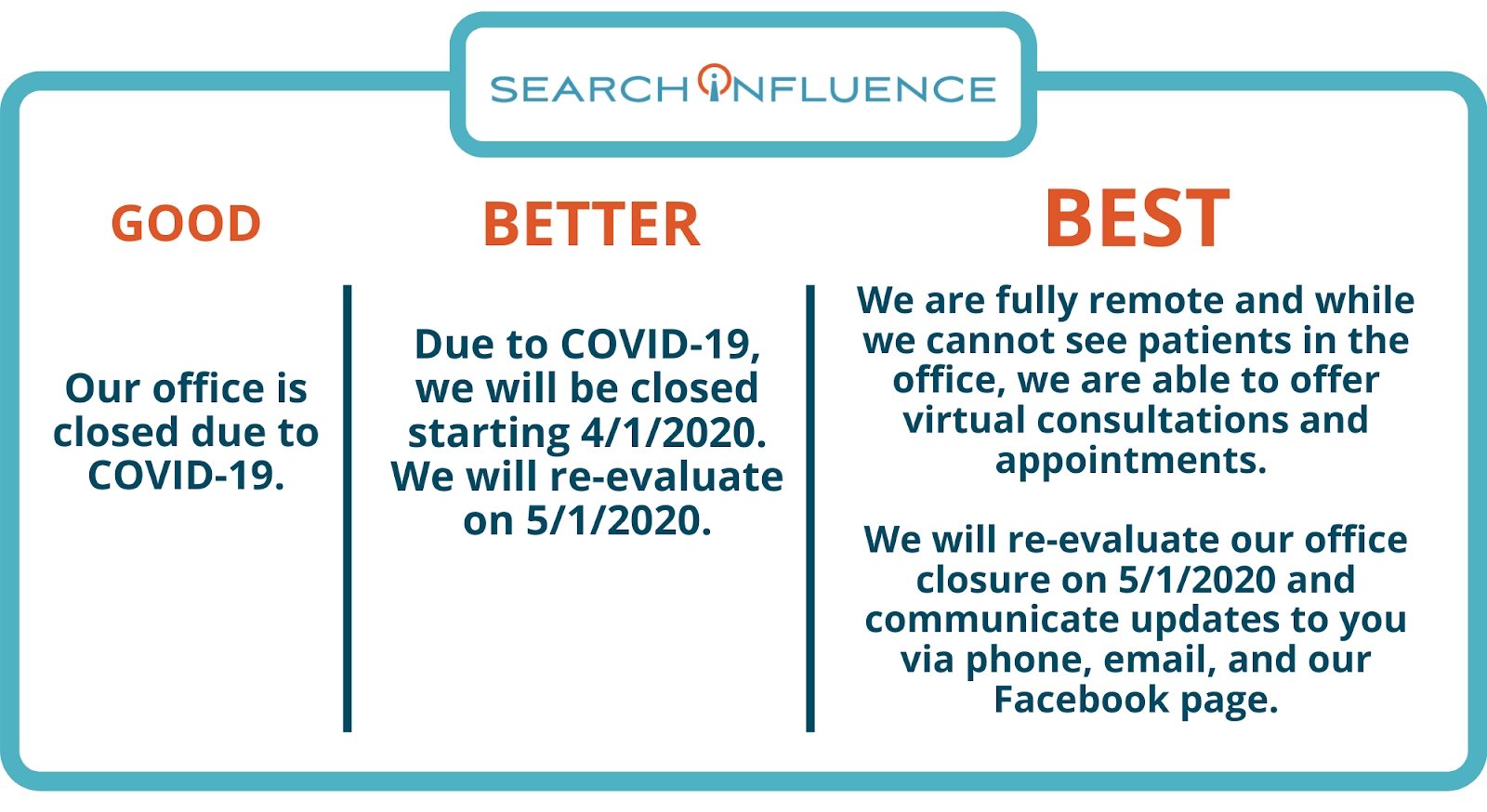
    Good Better Best messaging by Search Influence for COVID-19 Marketing

    Don’t Add to the Noise: Make Relevant and Meaningful Updates

    If you’re in a community with stay-at-home orders or one that has been hit particularly hard, it’s important to keep your audience up-to-date. An update of “No change in business at this time. We will keep you updated,” is better than radio silence.

    Savvy consumers understand the dynamic nature of doing business today and are more tolerant than normal about changes. Don’t withhold an update because you fear things may change. Even if you’re a small business that has relied on in-store sales and light social media posting to drive business, there are opportunities to be agile. 

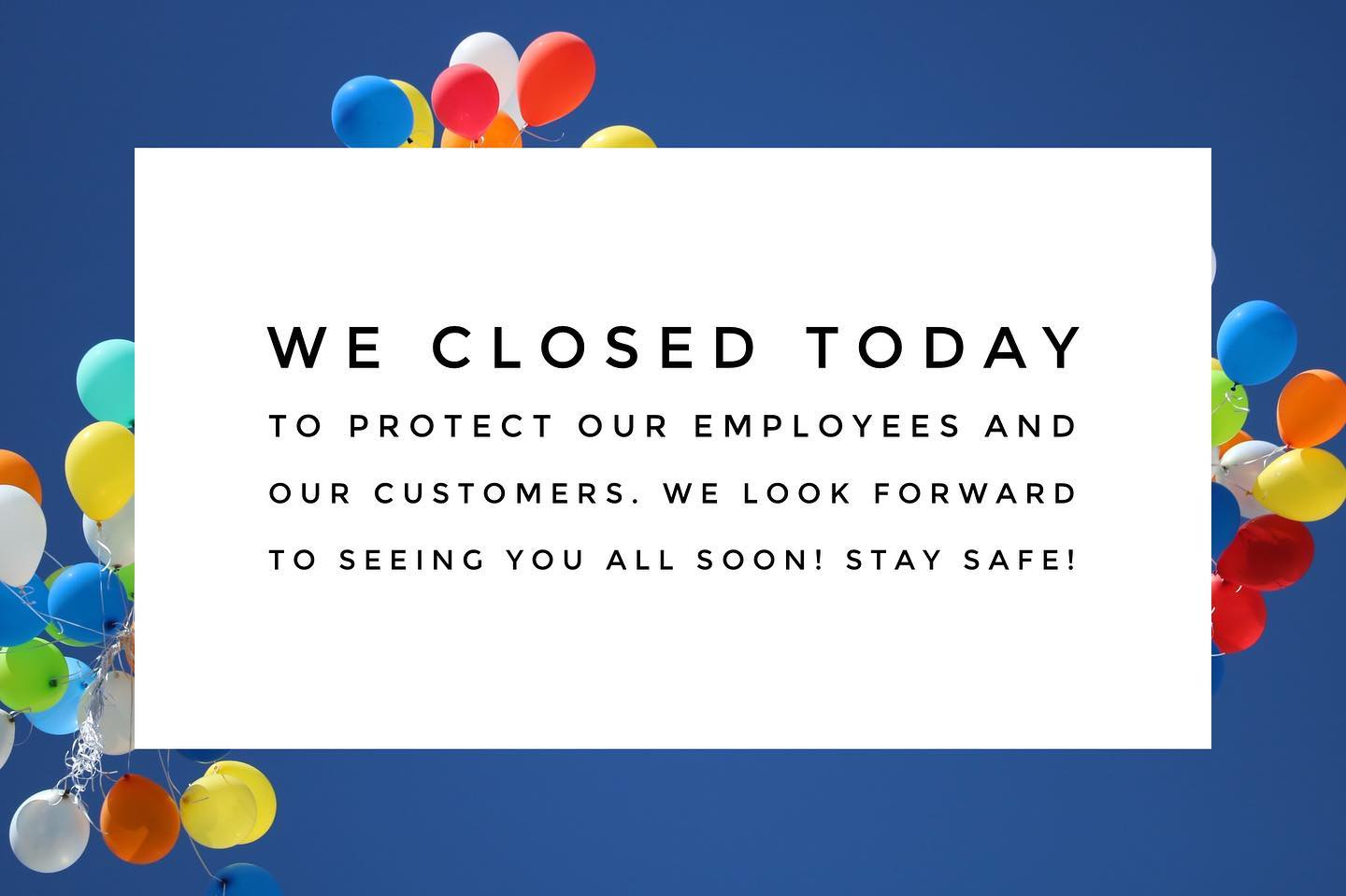
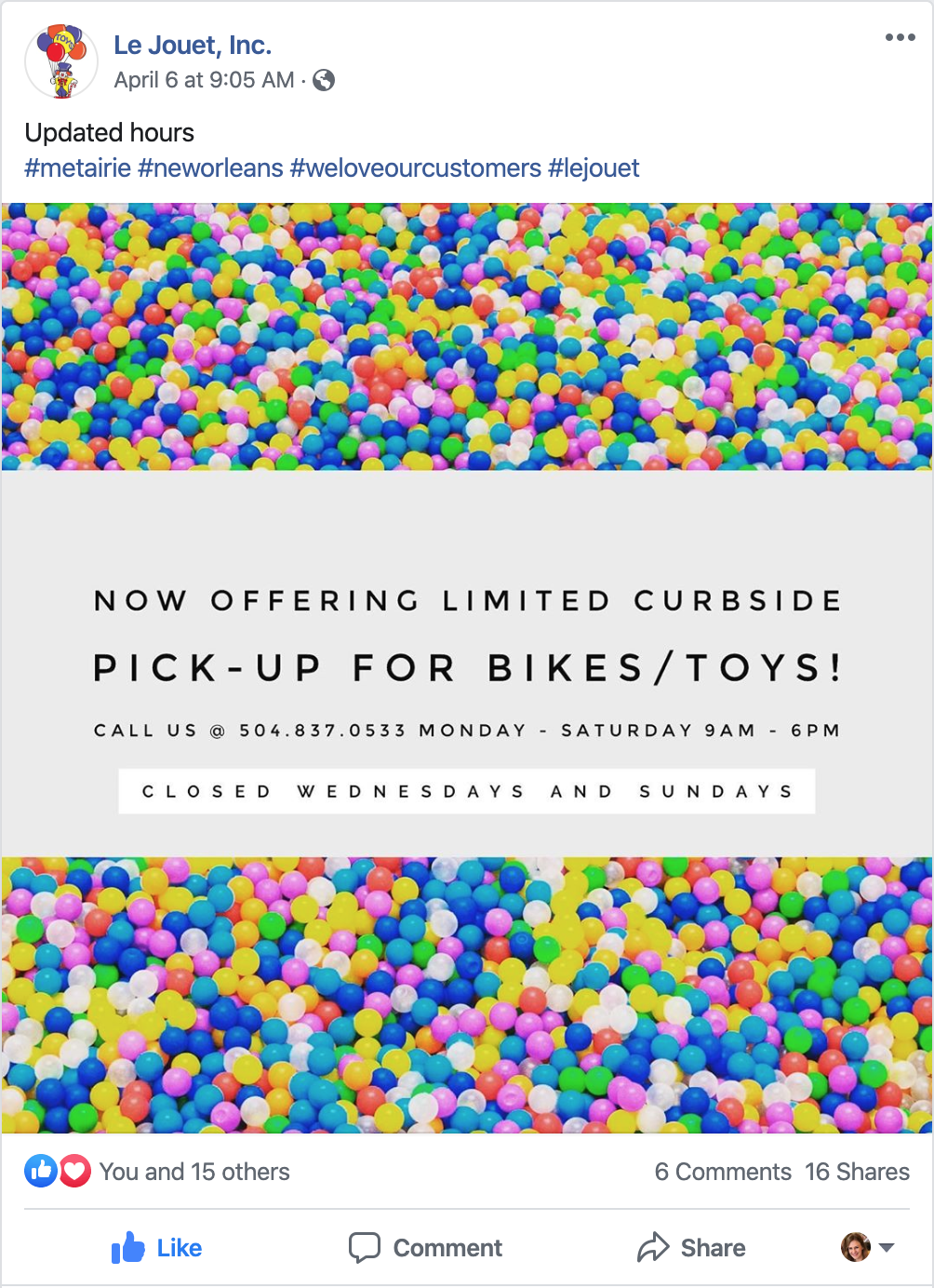
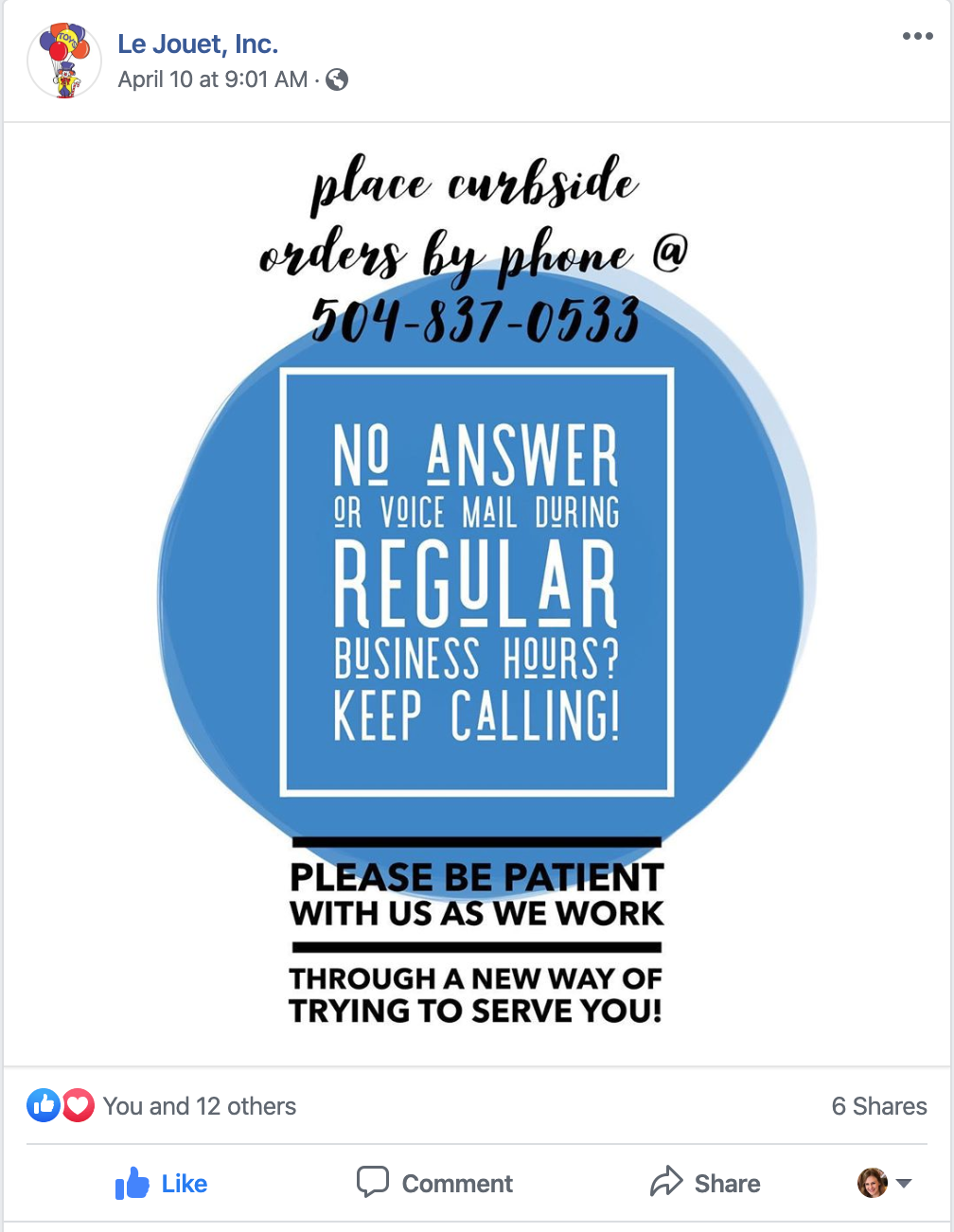
    For example, an iconic New Orleans toy store initially closed to comply with stay-at-home orders. As they realized they could keep people safe and still move inventory by offering personal shopping and curbside pickup services, they made adjustments and kept their customers informed.

    Do Good. Get Good: Earned Media for Those Who Communicate

    A strong communication plan helps earn customer loyalty and saves a deferred investment due to lost customers. In the short term, you may even get some added exposure by earning media mentions and placements because of the good you are doing. 

    One of our clients, Audubon Nature Institute, allowed an African penguin to tour the empty Aquarium of the Americas and used the hashtag #ClosedButStillCaring. The public loved it and demanded more, so Audubon produced a video of the penguins roaming the Aquarium. Local media outlets always look for feel-good stories and they picked up this one!

    Messaging Tactics

    Ensure this information is accessible to anyone who needs it.

    Audit All Messaging

    Audit and create a list of all customer / prospect touchpoints. Look at everything, from the obvious (social media and website content) to the less obvious (your voicemail recording when someone calls). 

    Examples of communications to audit: 

    • Your voicemail recording
    • Any automated responses someone might receive if they fill out an inquiry on your website. 
      • Online appointment confirmation emails
      • Online order confirmation emails
    • If someone on your Houzz.com profile (or any other 3rd party website), do they receive a different automatic email? If you have the ability to update the content, make sure you include this in your audit. 

    Google My Business COVID-19 Considerations

    Website traffic data indicates people are more likely to Google you first, even loyal customers. With Google presenting more and more information in the search results, people will often read the information in Google’s knowledge panel without making it to your website. 

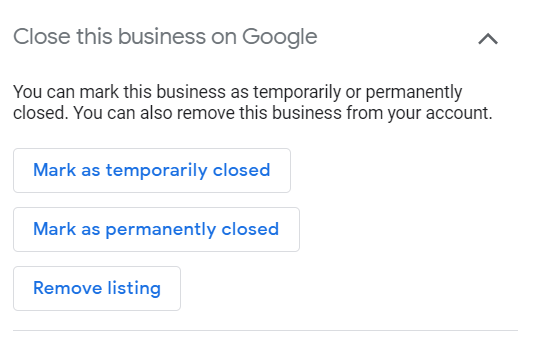
    Update your Google My Business by using these features:

    Write a COVID-19 Business Statement

    Now that many states and communities are on the cusp of re-opening some businesses, it’s critical to communicate clearly and effectively with customers and employees about what is and isn’t expected at your establishment. 

    Make a specific page on your website dedicated to your COVID-19 statement and updates. We recommend that you also add a sticky banner or pop-up that links to this page site-wide. This should be obvious because it’s the first info people are looking for when they visit your site right now. 

    There is a free WordPress plugin for this feature, and tools like Unbounce can also accomplish this. Here are some examples from our clients: 

    In our next post, we’ll dive deeper into what the experts say about marketing during the COVID-19 outbreak, including how you can make messaging effective if you do continue advertising. Stay tuned for more COVID-19 marketing content from the team at Search Influence!

  • 4 Campaign Strategy Changes During COVID-19

    MacBook Pro, white ceramic mug,and black smartphone on table photo

    COVID-19 has impacted every person and business across the globe, and the environment changes daily. Updating your marketing and advertising strategies during this time can be overwhelming.

    We can help you figure out where to start and what to change! This guide covers four campaign strategy changes to help navigate your business through COVID-19:

    1. Adjust advertising spend
    2. Evaluate targeting
    3. Tailor offerings and messaging
    4. Employ machine learning

    Before making any drastic adjustments, look at the data. Be aware that traffic and behavior on your site is likely impacted by the move to remote work.

    • For example, you may observe an influx of traffic but a decrease in conversion rates. Many businesses filter out internal traffic via IP address and this can be extremely difficult as your team has begun working from home.
    • First, ask your team to filter out traffic per device using the Google Analytics Opt-out Browser Add-on.

    4 Campaign Strategy Changes During COVID-19

    1. Adjust Advertising Spend

    You may initially consider stopping or reducing your ad spend. Based on your customers’ behavior, your industry, and your offerings, a reduction may make sense.

    If your business offers an essential need (food, medical, etc) or a product or service with a longer buyer’s journey (education, legal, cosmetic surgery) you may want to consider increasing your paid advertising. Especially for those industries with a longer buyer’s journey you need to keep feeding your marketing funnel to ensure you’re able to push prospects to convert when we all get back to (the new) normal—an empty funnel now means no business later.

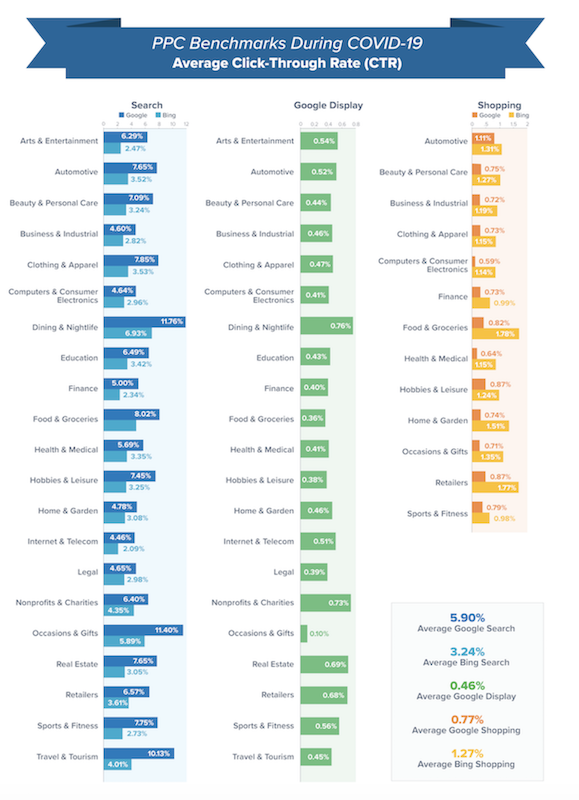
    We also see that CPMs, CPCs, and conversion rates are in flux. With fewer businesses competing in ad auctions, it is cheaper to compete. According to Wordstream, pay-per-click campaigns during COVID-19 are seeing both positive and negative impacts.

    • Pros: CPCs and CTRs are up.
    • Cons: many businesses are struggling with Conversion Rate.
    • Your advertising platforms can inform your decision to pause, reduce, maintain, or increase your advertising investment at this time.

    PPC Benchmarks during COVID-19 Average Click-through rate

    2. Evaluate Your Targeting

    Keep a pulse on the performance of your targeting methods (geographic, demographic, interest-based, custom audiences, etc) and their segments.

    • If your business has moved entirely online and thus is available to a wider audience (for example, a neighborhood gym that has moved to livestreams), you way consider expanding your geographic targeting.
    • A restaurant that typically caters to tourists and now offers pickup and delivery may narrow their targeting to hone in on the local market.

    3. Tailor Your Offerings and Messaging

    Consumer behavior is changing rapidly in response to the constant change in our environment. How can we, as business and marketing professionals, be more helpful to our customers in these fluctuating moments? The answer—tailor your offerings to the environment and consumers needs. Google’s data on online behavior and search trends can give us insight into those changing needs and how we can best serve others.

    Across markets, Google searches fall into 5 behaviors:

    • Assembling critical information
    • Discovering new connections
    • Adjusting to changes in their routines
    • Praising everyday heroes
    • Self care

    Tailor your offerings and messaging to complement these 5 consumer behaviors:

    • Provide clear, regular updates about your businesses operations. These should appear on your website, social platforms, and business listings. Highlight local delivery/pickup, online, and virtual options in your ad copy and creative.
    • Create new relationships with customers and other businesses. Connect with your audience, your larger community, and look for opportunities to work together with other partners (local, regional, etc.)
    • Adapt to changing needs and routines. Consider your target audience, and ask yourself what else they might need at this time. People are turning to at-home hobbies such as cooking, dancing, exercising, and crafts. How can you educate or serve these new interests? More parents than ever are juggling childcare and working from home. Use your ad copy and creative to highlight how you can support them during this time.
    • Celebrate heroes across your community, employees, and customers. Healthcare workers and others providing essential needs and services put their lives on the line to take care of us. Share genuine praise and support for our everyday heroes.
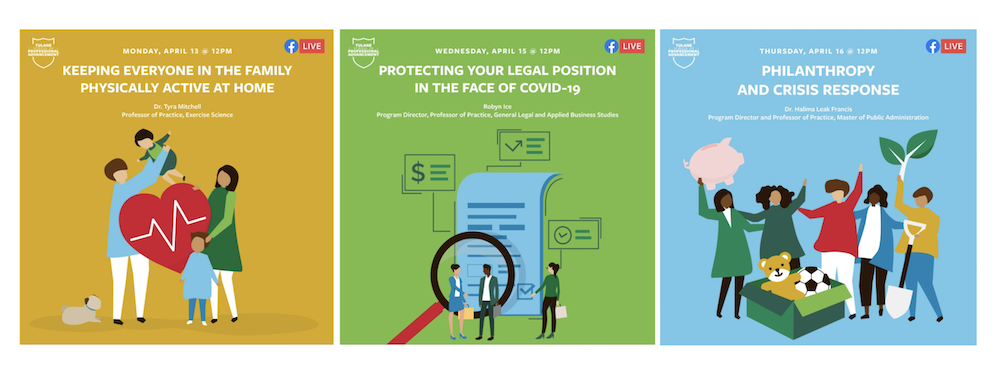
    • Find ways to add value. Host Q&A sessions, webinars, or provide free services when possible. For example, the Tulane School of Professional Advancement hosted a series of free, public Facebook Live events addressing COVID-19 topics.

    Tulane SoPA free, public Facebook Live event flyers

    “Eighty-four percent of U.S. consumers surveyed say that how companies or brands act during the current market is important to their loyalty moving forward.” – Google

    4. Employ Machine Learning

    Machine learning allows ad platforms, like Google or Facebook, to take informed actions based on the ever-changing data it analyzes in real-time. Smart bidding, automated targeting, and dynamic creative are just some of the ways you can take the guesswork out of your advertising campaigns.

    In this ever-changing environment and time of such great uncertainty, now more than ever we should take advantage of machine learning in our paid advertising. For example, Google recommends that retailers “enable automatic item updates in the Google Merchant Center to keep your product data up to date, especially for price and availability.”

    If you have the means, use this time to test and hone your advertising efforts; act lean and be critical of your digital campaigns. Set your businesses up for success, both now and post-pandemic, by remaining active in the advertising sphere. Stay home, stay safe, and optimize your business’s potential during COVID-19 with these campaign strategy changes.

    Need advice on how to best utilize Google credits or Facebook grant money? Contact one of our strategists today.

    Images:

    Laptop
    PPC Benchmarks

  • Google and Facebook’s Small Business Grants: What You Need to Know

    This post was updated in May 2020 to include additional qualification guidelines provided by Google. 

    So far 2020 has proven to be quite the year. The news of COVID-19 and the restrictions placed on businesses came with the looming sense of “What’s going to happen next?” Thankfully, you won’t have to look much further than Google and Facebook for your answers. Although they are the biggest search engine and social network in the world, they too are human. Nobody could have seen this sudden and unforeseen halt of usual business and many companies feel a big strain. Google and Facebook hope to take the weight off of small businesses with the roll out of special grants programs. 

    Dwight Schrute Thank You gif

    Google’s Small Business Grant Program 

    Google unveiled an $800 million plan to help support small businesses affected by the economic disruption caused by COVID-19. The company allocated $340 million of this money for Google Ads credits to small businesses so these businesses can stay in touch with their customer base.

    Some may be thinking, “Why the big handout?” Well, during this decline in business advertising, the search engine that helps us get recognized every day could also be in danger. Google hopes that by providing small businesses with ad credits, those companies will invest that money back into Google’s  advertising efforts. During a time like, this having a “you scratch my back and i’ll scratch yours” relationship is priceless and appreciated. 

    Qualifying for Google’s Small Business Grant 

    The million dollar question: how does it all work? The good news is that you don’t have to do anything to apply! Is it just me or do you hear the hallelujah chorus, too?

    • In order to qualify to receive credits, your business must have been an active user of Google Ads directly or through a partner in 10 out of 12 months in 2019 and in either January and/or February of 2020.
    • There is no process in reaching out to obtain your credits, just watch your account. Credits will roll out in phases, beginning in late May. 
    • Businesses can redeem these credits until the end of 2020
    • The credits can be used across throughout 2020 on all Google platforms including Search, Display, and even Youtube, and for any campaign type. 
    • Each customer is eligible to receive one credit, even if you run ads in multiple accounts or multiple campaign types. 
    • The size of the ad credit will depend on past ad spend and the location of the account. 

    Their Googliness...is truly off the charts gif

    Facebook’s Small Business Grants Program

    Facebook is offering $100 million in cash cash grants and ad credits to help during this challenging time. The company wants to help small businesses support their workforce, assist with rent, connect with more customers or cover operational costs. 

    Eligibility for Facebook’s Small Business Grant

    Although the grants are available in more than 30 countries, they have limited the number of U.S. cities to those near a location where Facebook operates. Qualifications: 

    • Check the available locations to see if your business is eligible. There is also a roll out process for application availability, starting in New York City and San Francisco, then the San Francisco Bay area, then to all other eligible cities. 
    • Your company must have between 2 and 50 employees and have been in business for over a year. 
    • You must be a for-profit company who has experienced challenges from COVID-19

    Recommendations for Google Ad and Facebook Spend During the COVID-19 Crisis

    In this time of economic uncertainty, you may wonder if anyone would convert or even be receptive to your marketing messages. The answer is yes! 

    Google Ads are producing results for some industries. 

    • Less people are searching Google at this time, but that means your brand has the possibility to occupy a larger share of voice. 
    • Due to decreased competition in March 2020, a Search Influence medical practice client showed up in 27% more searches, resulting in the campaign’s lowest cost per lead since 2017. 

    Search Influence has also seen combined success of Facebook and Google paid search for a continuing education school at a large private university. 

    • To this point in 2020, the client earned 47% of the inquiries they received in 2019, spending just 29% of their annual budget to this point. 
    • To tie this back to a key search trend, education is an area where one study noted very little decrease in traffic and conversions. 

    If your business is not open, you are not able to move your services online, or you do not want to drive traffic to your website, now is a good time to plan for the future

    • Update your website and optimize your Google Ads strategy so you know how you want to allocate your Google Ads grant money and your website looks its best when you drive traffic there. 
    • Need advice on how to best utilize Google credits or Facebook grant money? Contact one of our strategists today.

    Images

    Google

    Dwight

  • Top 6 Marketing Planning Activities During COVID-19

    During this time of crisis, many businesses may find themselves with extra time on their hands, but limited money to spend on marketing. While it can be hard to think about the future, this is the perfect opportunity to do just that and take a deep dive into your marketing plan. Luckily, we’re here to help.

    We’ve laid out the top 6 marketing planning activities to ensure your business is ready to hit the ground running, once you’re able to resume business as normal.

    Person using highlighter on business documents on desk

    1. Reconsider Your Marketing Efforts

    Collect all your marketing efforts into a master list and determine their relevance. Your list may include:

    • Website
    • Digital paid advertising (Facebook, Google, LinkedIn, etc.)
    • Google My Business listing
    • Review channels (Yelp, TripAdvisor, etc.)
    • Social media pages
    • Other listings or directories

    Do these tactics still make sense? For example, is your business listed in a directory that is no longer relevant to the services you provide?

    2. Optimize All Current Marketing Strategies

    Audit each tactic and ensure it is optimized. A basic checklist for various platforms:

    • Website
      • Is your site structure intuitive? Do you have a clear navigation?
      • Does each page contain a call-to-action?
      • When was the last time you wrote content?
      • Do you have metadata for each page?
      • Is your website mobile friendly?
    • Listings/Directories
      • Is all information up-to-date?
      • Ensure your name, address, phone number, and website URL are consistent across all listings/directories.
      • Add any additional information you can to flesh out your listing in order to increase organic rankings.
    • Review channels
      • Evaluate both the quality and quantity of reviews on all channels, paying special attention to Google, Facebook, and Yelp.
      • Are you utilizing reviews/testimonials on your website?
      • How are you soliciting reviews? Can this process be improved?
      • How often are you responding to reviews, both positive and negative?
    • Social media pages
      • Do all of your social media channels accurately reflect up-to-date business information and brand?
      • How often do you post on social media channels?
      • Is your tone, voice, and messaging consistent across platforms?
      • Are you utilizing all relevant platforms?
    • Digital paid advertising
      • Are you consistently monitoring all forms of digital paid advertising?
      • Look at the data. What trends are you seeing? Verify if you’re getting an adequate return or results. How has this changed over the years? Is there a better allocation for these dollars?
      • Do you need support? Speak to a digital paid advertising specialist.

    3. Perform Competitive Research

    Evaluate how your current strategies stack up to your competitors by performing competitive research and analysis.

    • Identify your competitors or similar businesses.
    • Perform a SWOT analysis on your business’ and your competitors’ websites, social media, content marketing, and digital paid advertising.
    • Pro tip: an easy way to see your competitors overall web presence is to simply Google keywords relevant to the business or industry.
    • Take a look at what your competitors are doing in areas they excel in. Can you implement any of these strategies into your marketing plan?

    4. Develop Marketing Materials

    Quality marketing materials are imperative to a successful marketing strategy but can be extremely time consuming to produce. Time is on our side right now, and the creation and curation of marketing materials can be done at little to no cost!

    Restaurant owner taking photographer of their menu items for marketing use

    An easy place to start developing marketing materials is taking photos. Pick up your smart phone and start snapping away. A few tips for success:

    • Use the photography composition rule of two-thirds, which suggests how you arrange subjects in your frame. Most digital cameras have an option to add the rule of two-thirds grid onto the screen.
    • Focus on one subject. When appropriate, stage people in your scenes – grab your roommate, significant other, or a family member. (Of course, follow appropriate social distancing guidelines!)
    • Lighting is key! Ensure you have great—ideally natural—lighting, and that your space is not backlit (meaning the light source comes from behind the subject.)

    According to Wordstream, “marketers who use video grow revenue 49% faster than non-video users.” The same tips for above apply here, plus a few others:

    • Use a tripod for a steady video. If you don’t have a tripod, get creative—stack books on a table or chair.
    • Film horizontal versus vertical.
    • Have a clear objective or call-to-action.

    Remember that great idea you had for a blog post 6-months ago, but didn’t have the time to write it? Let those creative juices flow and begin building up or revamping your content materials.

    Once you’ve made your way through optimizing your website content, it’s time to start looking at other strategies. Here are different content formats to add to your arsenal:

    • Blog posts
    • EBooks
    • Whitepapers
    • Infographics
    • Case studies
    • Podcasts
    • Templates, worksheets, and checklists

    5. Set Concrete Marketing Goals

    Many businesses will need to rethink and reforecast business and marketing goals as a result of COVID-19. To formulate new goals, consider the analysis, research, and asset creation you’ve done, and how the crisis is affecting your business. Think about what you would like to accomplish once we are able to return to business as normal and develop a plan surrounding it.

    Utilize SMART Goals to create your plan. SMART goal setting is a simple, trackable method that allows you to create clear and achievable business and marketing objectives, instead of vague resolutions. It is one of the most effective tools for achieving goals in the corporate world due to its scalability, ease of use, transparency, and proven success. A SMART goal is:

    • Specific
      • What do you want to accomplish?
      • How will you accomplish it?
      • When will it be accomplished?
      • With whom will it be done?
      • Why do you want to do this?
    • Measurable:
      • How can you measure progress and know if you’ve successfully met your goal?
      • What metric will you use to know the goal has been reached?
      • What precise amounts can you include?
    • Achievable:
      • Review your specific and measurable goal to ensure it seems reasonable with a little bit of stretch.
      • Are you confident this goal is achievable and sets realistic expectations?
      • Do you have enough time to reach your goal?
      • Do the involved parties have the tools and skills they need to accomplish it?
      • What obstacles would prevent me from reaching this goal?
    • Relevant:
      • Why am I setting this goal now?
      • What is the business’ overall objective?
      • How is this goal aligned with the overall objectives?
    • Time-bound:
      • Do I need additional milestones to keep this goal on track?
      • Do I have enough time to accomplish it in the given time frame?

    Be agile with your goals. Plan specific dates to review your progress and check/adjust when necessary, at least once a month.

    6. Maintain Audience Engagement

    According to Forbes, it costs 5 times more to attract customers than to retain existing ones. The most important thing to do during this time is to keep your audience engaged. Take advantage of any no-cost marketing, such as organic social media posts, blogging, and SEO. If possible, keep paid advertising running. If you are unable to service your customers or consumers remotely, run brand-awareness campaigns. Consumers are spending up to 30% more time online during social distancing. Make sure your brand is front and center so consumers choose your business once doors open again!

    Unsure where to begin? Contact one of our strategists today!

  • 6 Messaging Adjustments to Remain Relevant During COVID-19

    As digital marketers, a global crisis like COVID-19 (also known as the coronavirus) can affect all aspects of your digital campaigns, from advertising spend to messaging. The faster you can pivot, the better for your business and for your consumer.

    Although there isn’t a one-size-fits-all approach to handling each campaign or client, here are six key ground rules to follow to stay relevant in the midst of any crisis.

    Graphic showing growing cases of COVID-19

    Align with Local and Federal Agencies and Authorities

    Ensure your marketing aligns with federal and local mandates and encourages safe and approved behavior. Marketing messages out-of-step with government recommendations may come off as insensitive or even be interpreted as malicious.

    • Verify that your marketing campaigns do not call for behavior that puts your clients or potential customers at legal risk or in danger. If so, put a pause on that campaign until the crisis is over.
    • Sign up for alerts to stay up-to-date on all federal and local decisions, since circumstances change daily (and even hourly.) This will allow you to update your marketing to keep them timely.
    • Use local and federal officials as your guide as to when you can resume paused marketing efforts.

    Update Messaging for Closures

    During a crisis, it’s likely that some businesses will have to shut down or limit their operations.

    • Pause marketing that encourages any immediate action that they cannot task. For example, if you work in the museum, zoo, or tourism industries, preserve resources by pausing any marketing that encourages visits to your attractions.
    • If customers already purchased tickets to your attractions for specific dates, provide messaging about how you will honor those existing tickets on future dates.
    • Promote opening dates only when you have a clear picture of when your attractions can reopen.

    Review All Creative

    While maintaining business and bringing in revenue is important during difficult and uncertain times, make sure your marketing is in tune with the current climate.

    • Review all of your copy to ensure the tone reflects current sensitivities and realities.
    • Consider local context when rewriting copy. Are customers and audiences in your market more or less sensitive to the portrayal of a particular issue?
    • Scrutinize your visuals to ensure they reflect current sensitivities. As governments have instituted social distancing guidelines, pay careful attention to creative that depicts interactions such as hand shakes, hugs, and close groups.
    • Constantly reassess campaigns. What felt comfortable to say or portray two weeks ago may no longer feel appropriate.

    Promote Digital Consultations

    If you are a doctor, lawyer or in another progressional service, your customers may still need your expertise during COVID-19 and other crises, even if your offices remain closed to the public. If you are able to make the switch to digital consultations, focus your marketing on promoting these services.

    • Shift all marketing calls-to-action from “Schedule a Consultation” to “Schedule a Virtual Consultation.” Not only does this set the expectation of how and where you will fulfill your services, but it also indicates that you are abiding by all local and federal mandates.

    Maintain Awareness Through Virtual Content

    Stay engaged with your audience and maintain brand awareness by offering fun and/or useful online content. Your audience, especially caregivers of young children, are looking for ways to keep their children entertaining while still being safe.

    • Consider virtual tours If you are in the museum, zoo, or tourism industries.
    • Offer downloadable entertainment, such as coloring sheets, crossword puzzles, or at-home scavenger hunts.

    Consider Optics When It’s Time to Transition

    There will eventually be a light at the end of the tunnel. Make a plan to slowly transition back to your campaigns that were running before the crisis hit.

      • Review all of your campaigns before relaunching and be sure to add in any new, relevant information that might have to come to light during the crisis.
      • Refresh your creative messages to articulate the mood of the current climate, post crisis.

    Unsure where to begin? Take advantage of a free consulting session with one of our strategists today!

    Images

    Emergency pull

    COVID-19 Map