Tag: Chatbots

  • AI for Digital Marketing With Will Scott at DFWSEM State of Search

    Key Insights

    • AI-powered tools offer numerous opportunities for digital marketers, from generating content ideas to researching keywords and programming code efficiently.
    • While AI can produce impressive content, human intervention remains crucial. Relying solely on AI for content creation can lead to subpar results and may not align with Google’s E-E-A-T requirements.
    • Marketers should view AI as a valuable assistant rather than a sole content creator, harnessing its potential while upholding campaign integrity and customer satisfaction.

    Image of a robot, showcasing Will Scott of Search Influence in New Orleans' AI for digital marketing presentation.

    Search Influence Co-founder and CEO Will Scott presented “Robots, Revolution, and the Death of ChatGPT” at the 2023 State of Search Conference in Dallas, Texas.

    In Will’s artificial intelligence marketing strategy presentation, the SEO veteran discussed his vision of what incorporating AI into the content creation process will look like and how marketing teams can use AI technology responsibly.

    In this blog post, we’ll dive deep into Will’s thoughts on AI in digital marketing and provide AI-powered tools and content creation techniques to bring your processes into the robotic age.

    What Is the State of Search Conference?

    The State of Search Conference is an annual digital marketing event produced by DFWSEM (the Dallas, Fort Worth Search Engine Marketing Association) that brings together industry experts, seasoned practitioners, and marketing enthusiasts.

    One of the standout features of this conference is the expertise it brings under one roof. Digital marketers who attend this conference learn about the latest and greatest search marketing trends and gain valuable insights from experienced practitioners.

    The digital advertising landscape is in a constant state of flux. From social media dynamics and Google’s ever-evolving algorithms to the intricacies of effective content marketing, staying ahead of the curve is essential. This conference is meticulously designed to equip attendees with practical tips and tricks to master these facets.

    As the topics at the State of Search Conference are always on the cutting edge of marketing, it is no surprise that the main topic of this past year’s conference was AI in digital marketing.

    A long-time resident of the digital marketing world, Will Scott was interested in how artificial intelligence might change the neighborhood. Read on for his thoughts about AI marketing strategies.

    Lessons From “Robots, Revolution, And The Death Of ChatGPT”
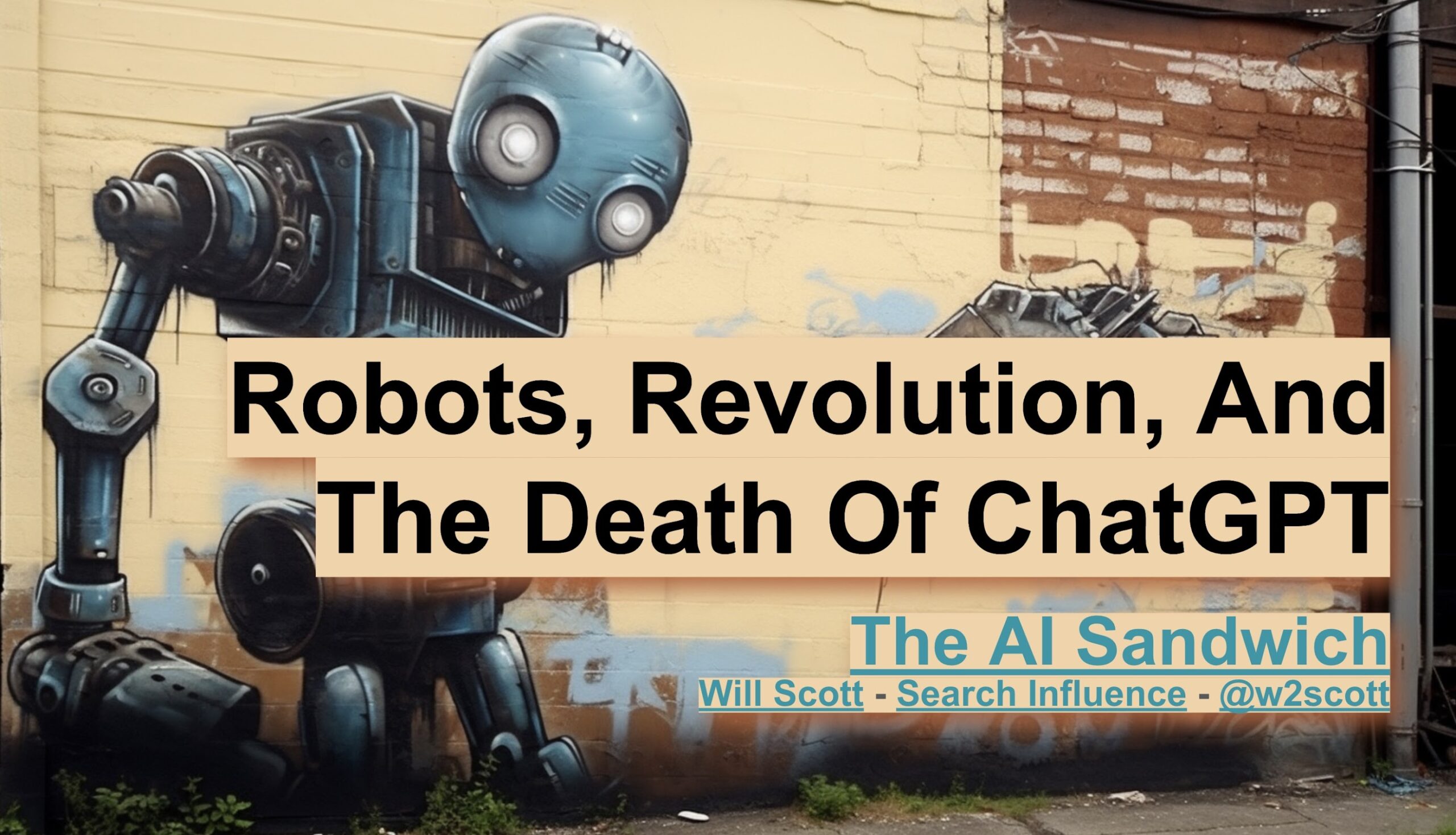
    2023 State of Search Conference presentation on AI for digital marketing with Will Scott of Search Influence

    In the late months of 2022, Will began obsessively learning and experimenting with digital marketing AI tools. And while his first thoughts on AI might have brought him to the robot apocalypse — much to the fault of movies like The Terminator, The Matrix, and Blade Runner — he quickly recalculated and began creating practical use cases for AI in digital marketing.

    Everything you need to know about the AI sandwich

    The AI sandwich, coined by Will Scott of Search Influence in New Orleans

    In the ever-evolving content marketing landscape, the AI sandwich has emerged as a game-changing approach to crafting engaging and relevant content. This innovative content creation workflow combines the power of AI-driven tools with human creativity to produce high-quality content across various platforms, from social media posts to blog articles and ad copy.

    Let’s dive into the intricacies of the AI sandwich and explore how it can revolutionize your marketing campaigns.

    The AI Sandwich unwrapped

    At its core, the AI sandwich is a strategic content creation process that integrates the capabilities of AI-powered tools with human expertise. The workflow typically follows a three-step pattern:

    1. Human-Powered Prompts: The journey begins with a human writer who lays the foundation by creating thought-provoking prompts. These prompts serve as the guiding framework for the AI to work its magic.
    2. AI-Generated Content: Enter the AI marketing tool. This intelligent technology takes the provided prompts and crafts content that aligns with the desired objectives. It leverages machine learning algorithms to generate text that resonates with the target audience.
    3. Human Refinement: While AI can produce impressive content, human intervention remains crucial. Skilled editors review, refine, and enhance the AI-generated material. They ensure that the final output is grammatically correct and aligned with the brand’s voice and values.

    Elevating content quality

    The AI sandwich isn’t just about efficiency and cost savings; it’s a recipe for creating content that satisfies your audience’s cravings. By combining the strengths of AI and human oversight, you ensure your content meets the highest standards of relevance and quality.

    Meeting Google’s E-E-A-T requirements

    In today’s digital landscape, Google’s Search Quality Raters evaluate content based on criteria such as Experience, Expertise, Authoritativeness, and Trustworthiness (E-E-A-T). The AI sandwich is tailor-made to meet these standards.

    Beyond “empty calories”

    Think of content generated solely by AI as the equivalent of a quick solo meal — convenient but likely lacking substance. The AI sandwich, on the other hand, resembles a hearty home-cooked meal prepared with care. It’s nourishing content that informs, engages, and resonates with your audience.

    The path forward

    As AI marketing tools use continues to grow, we’re in the midst of an AI-generated content explosion. While some may use these tools for spammy purposes, legitimate content creators recognize the potential to enhance their work, develop creative ideas, and serve their organizations and clients more effectively.

    Embracing the AI opportunity

    For those of us rooted in the world of SEO and marketing, AI, including ChatGPT and its counterparts, offers a tremendous opportunity. It’s not just a means of automating tasks; it’s a tool for testing and refining strategies, optimizing marketing campaigns, and ultimately amplifying the impact for our clients.

    The AI sandwich emerges as a winning recipe in the journey to craft effective marketing campaigns and deliver relevant content. It combines the precision of AI-powered content generation with the finesse of human creativity, ensuring that your marketing efforts stand out in a crowded digital landscape.

    As we move forward, embracing AI as a valuable ally in the world of content marketing will lead to new heights of success and innovation.

    SEO and ChatGPT are alive and thriving together
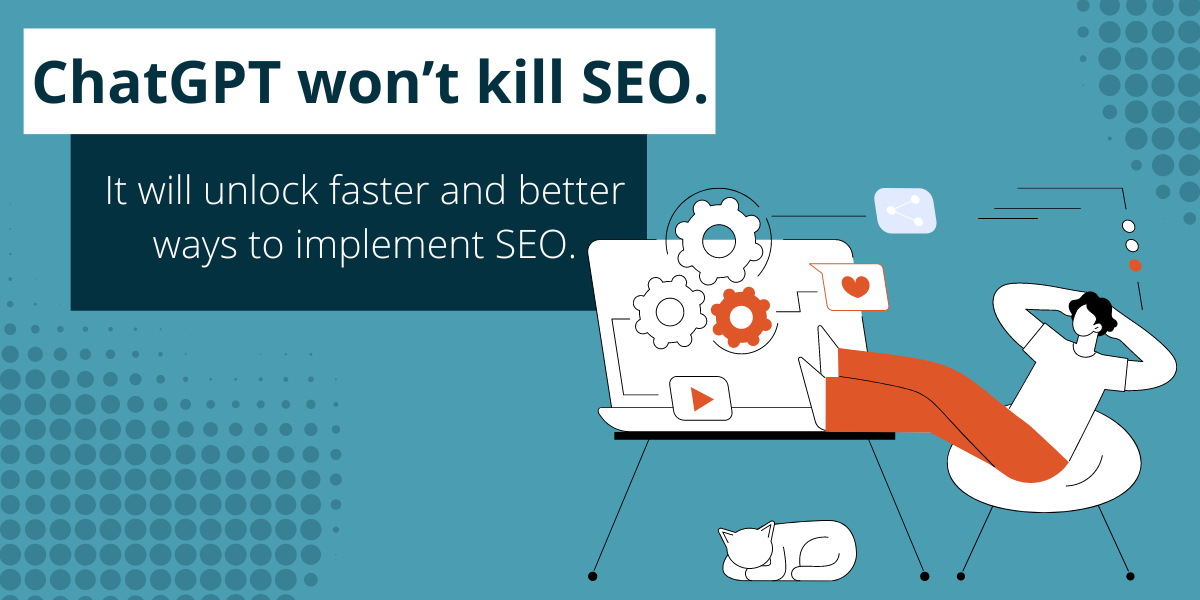
    Graphic depicting the future of ChatGPT and SEO

    SEO is not on life support — it’s adapting and thriving alongside AI advancements.

    ChatGPT and other artificial intelligence tools don’t spell doom for SEO; these machine-learning tools are catalysts for faster and more innovative SEO strategies. They empower SEO professionals to dive deeper into customer data and refine their advertising campaigns.

    Forward-thinking SEO experts should embrace AI tools as a means to enhance their skills. AI tools are becoming commonplace, but their true value lies in individuals who can wield them effectively.

    Content creation processes like the AI sandwich and the AIO method prove that machine learning tools still need a human touch to create content that improves customer experiences.

    Contrary to sensationalist headlines, ChatGPT is also far from death’s door. In fact, the screenshot below showing the last 12 months of Google Trends Data proves the AI-powered tool is quite young and spry.
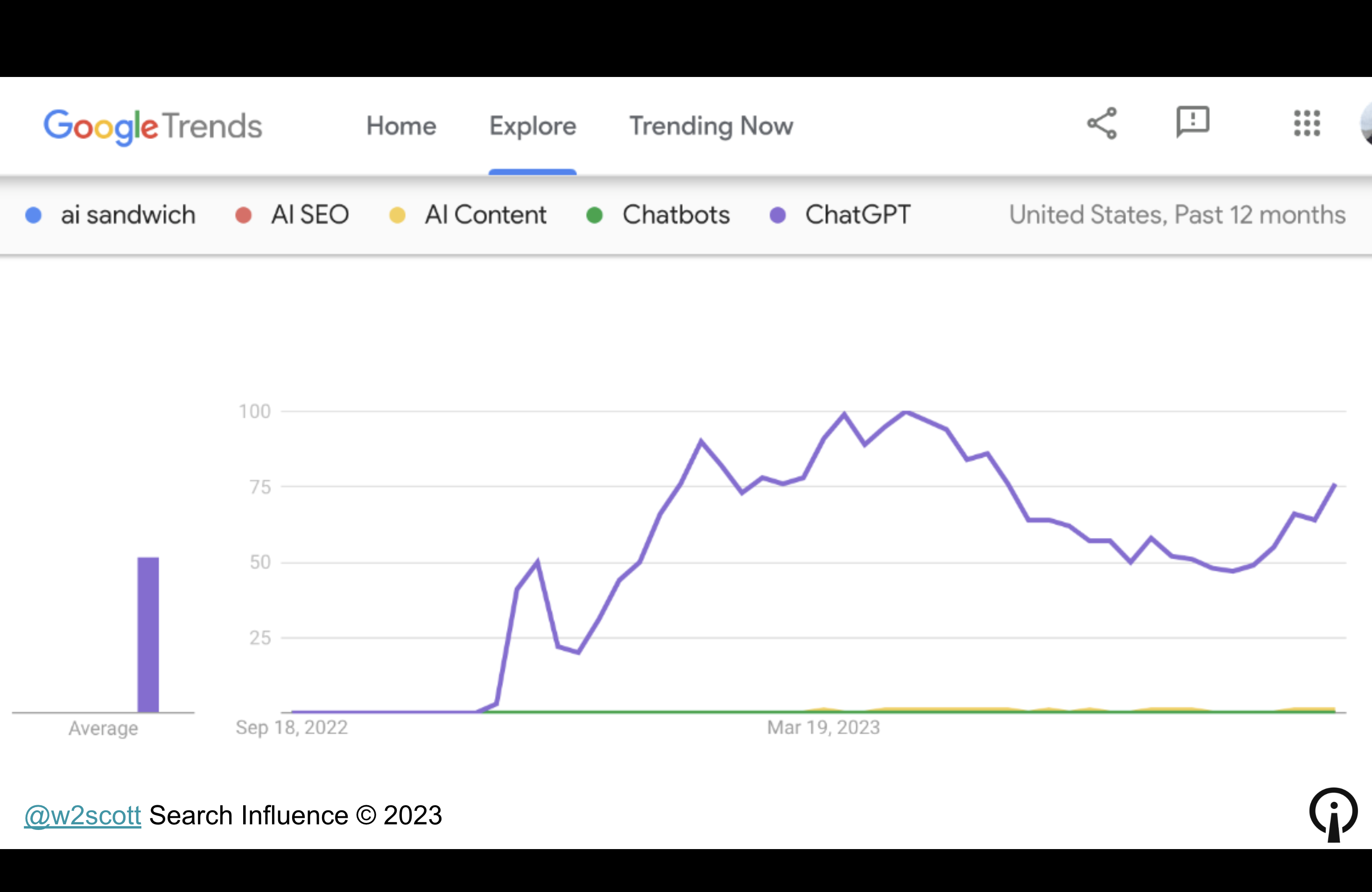
    Graph showing high usage rates of ChatGPT in 2023

    Artificial intelligence tools for digital marketing

    As is the Search Influence way, we’d like you to leave this blog post with some things you can use immediately to improve your marketing campaigns. Below are the marketing tools we have recently used to do everything from automating repetitive tasks to finding relevant keywords.

    Artificial intelligence content tools for crafting engaging content:

    • Machined.ai
    • ZimmWriter
    • Content at Scale
    • Surfer SEO AI Writer

    Artificial intelligence image creation tools:

    • Midjourney
    • Dall-E 2
    • Stable Diffusion

    Artificial intelligence SEO and keyword tools:

    • Frase
    • Surfer
    • PageOptimizer Pro

    Artificial intelligence video tools:

    • Steve.ai
    • Wave.video

    The SEO Skyscraper Method and ChatGPT data mining are a match made in heaven

    Image of a skyscraper, symbolizing the Skyscraper Technique

    Early in 2023, Will explored “ChatGPT: Data Mining and SEO With OpenAI and Bing.” Since then, the landscape of machine learning, AI, OpenAI, ChatGPT, and content has evolved significantly.

    With substantial updates to the core OpenAI GPT, both in technological advancements and content processing capabilities, we’ve entered an era where we can delve deep and wide into topics like never before.

    The integration of web search capabilities through plugins and expanded data exploration tools has transformed ChatGPT into a data mining powerhouse, allowing for the summarization and comprehension of extensive and complex subjects.

    Recent experiments have demonstrated the prowess of ChatGPT in summarizing top articles on a given topic while highlighting unique perspectives. Natural language processing and AI-driven content analyses have made ChatGPT a vital tool for tasks that rely on data collection and correlation analysis.

    Now, let’s bring in the Skyscraper Method.

    The SEO Skyscraper Method, popularized by Brian Dean at Backlinko, is a strategy that’s been imitated repeatedly.

    It’s actually quite simple:

    • Step 1: Find content on your given subject that is worth linking to.
    • Step 2: Write content that is even more informative than the content you found.
    • Step 3: Reach out to the right people who might be willing to link to the web page/content you wrote.

    Back in the initial development of the Skyscraper Method, the focus was on links as indicators of authority. However, Google’s evolution towards a semantic, entity-based web has expanded the playing field. Content and its relationship to recognized entities now share the spotlight with links in SEO success.

    By combining the Skyscraper Method with ChatGPT’s knack for data mining, you can unearth valuable insights with ease.

    Rather than merely one-upping competitors, this approach looks at all content receiving Google’s attention. It acknowledges and respects the competition by summarizing and linking to their work, thereby incorporating semantic entities and keywords.

    By leveraging ChatGPT for data mining, you can simplify the process. It starts with a Google search for your target keyword, leading to fresh ideas and a wealth of links. Then, ChatGPT can extract common elements, such as keywords and subjects covered from the content you choose to use.

    While AI technology is a potent and valuable tool, you’re still Batman, and it’s still Robin.

    Although ChatGPT’s utility for data mining has grown immensely in recent months, challenges persist, particularly in ensuring data accuracy and reliability. This is one of the many reasons you shouldn’t use AI blindly.

    ChatGPT and the SEO Skyscraper Method form a harmonious partnership for extracting valuable insights from web pages and creating worthwhile content. This dynamic duo empowers content creators and SEO professionals to identify patterns, understand market trends, and anticipate future behaviors. As AI tools continue to evolve, their role in providing valuable insights into customer behavior and market trends will expand, making them indispensable assets for data analysis.

    Next in AI marketing: opportunities, concerns, and more robots

    AI-powered natural language generation tools offer marketers valuable capabilities, such as generating content ideas, researching keywords, compiling facts, and even simplifying programming tasks. However, it’s essential to recognize that these tools aren’t flawless and may produce typos or require editing and fact-checking.

    One critical concern is the risk of overreliance on AI. Relying solely on AI for content creation can lead to subpar results and may not align with Google’s E-E-A-T requirements, potentially impacting user satisfaction and campaign effectiveness. Nobody likes a lazy SEO or spammers, especially Google.

    A balanced approach is critical to ensure quality writing that combines AI content creation with human editing — thorough fact-checking is a must.

    By using AI as a valuable assistant rather than a sole content creator, marketers can harness its potential while maintaining the integrity of their digital advertising campaigns and ensuring customer satisfaction.

    There are no doubt more robots to come — AI is a worthwhile technology in a free market, after all. With everyone from venture capitalists to garage start-ups looking to get a piece of the pie (or sandwich?), we must be responsible as we forge these lands.

    As modern-day explorers trekking across this new technological landscape, it’s our duty to avoid making the same mistakes as the navigators of years past.

    We are not here to divide and conquer; we are here to build and progress.

    Image of robots and humans coexisting peacefully

    What’s Next for AI Algorithms in the Digital Marketing Landscape

    From social media marketing to email marketing and collecting data, AI algorithms will reshape the landscape of digital advertising.

    But there’s no need to fear; Search Influence is here! (Underdog is still cool, right?)

    Search Influence will happily be your guide during the AI for digital marketing revolution. No matter your business’s needs, our extensive list of services can help you grow.

    Contact us today to learn how we use the latest digital technology to get our clients real-world results.

  • 10 Winning Higher Education Marketing Strategies

    10 Winning Higher Education Marketing Strategies

    [ez-toc]

    Research shows that 93% of Americans think they are better drivers than average, 90% of teachers think they are more skilled than their peers, and this overestimation is pervasive across many skills — including logic tests.

    For the typical higher education institution, effective marketing strategies are like that.

    Mathematically speaking, it’s not possible for a majority to be “above average.”

    We analyzed the top 10 results in Google for “Higher Education Marketing Strategies” and extracted some really useful learnings. First, I’ll share the most commonly cited strategies, and then give you a skimmable summary of each article.

    Top 10 Higher Education Marketing Strategies

    These strategies are the most frequently cited in the following articles, in order of prominence.

    • SEO (Search Engine Optimization): Emphasized across multiple articles. Ensuring high visibility on search engines is critical for Higher Education SEO.
    • Social Media Marketing: Highlighted in almost all articles for engaging authentically on each social media platform preferred by younger generations.
    • Email Marketing: A recurring theme emphasizing personalization, automation, and AI-powered programs.
    • Video Content: Both short-form and long-form videos, including live streaming and platforms like TikTok and YouTube, are great ways to educate prospective students.
    • Personalization: Tailoring content and communication to individual preferences, including personalized messaging and content.
    • PPC (Pay-Per-Click) and Digital Advertising: Discussed in multiple articles for targeted advertising on platforms like Facebook Ads and Google Ads.
    • Content Marketing: The importance of creating engaging and informative content, such as blogs, podcasts, and videos.
    • Branding: Consistent branding across all marketing channels, including a recognizable voice and image.
    • Chatbots and Conversational Marketing: Highlighted in several articles for real-time, one-to-one connections and instant answers.
    • Data-Driven Strategies: Using data to inform marketing decisions, track KPIs, and understand the audience.

    Digital Marketing and Marketing Strategy Opportunities

    What we learned in the UPCEA SEO research study was that there are some big gaps in the university marketing strategy and the typical higher education website for attracting prospective students.


    When we got deeper into the data, we saw that the higher education industry is overly reliant on certain digital marketing channels. A good marketing campaign addresses the full funnel. To attract students, you must increase search engine visibility, maintain a strong social media presence, and ensure you’re doing all you can to target prospective students.

    So, with all the great tactics and technologies to attract prospective students (virtual campus tours, student ambassadors, and taking advantage of digital technology to highlight student activities), one has to wonder why other higher ed institutions seem to be attracting more new students.

    As I’m sure you’re aware, Google and the other search engines know everything, right? So, I thought, why not let Google guide me? I wanted to see how other higher ed marketers were thinking about the strategy to build brand awareness and get in front of prospective students.

    I think it’s important to take content created by marketers talking about a marketing strategy with a grain of salt. We can, however, learn a lot when we analyze the frequency with which these articles cite specific tactics, platforms, or strategies to get in front of prospective students for educational institutions.

    Effective Higher Education Marketing Strategies

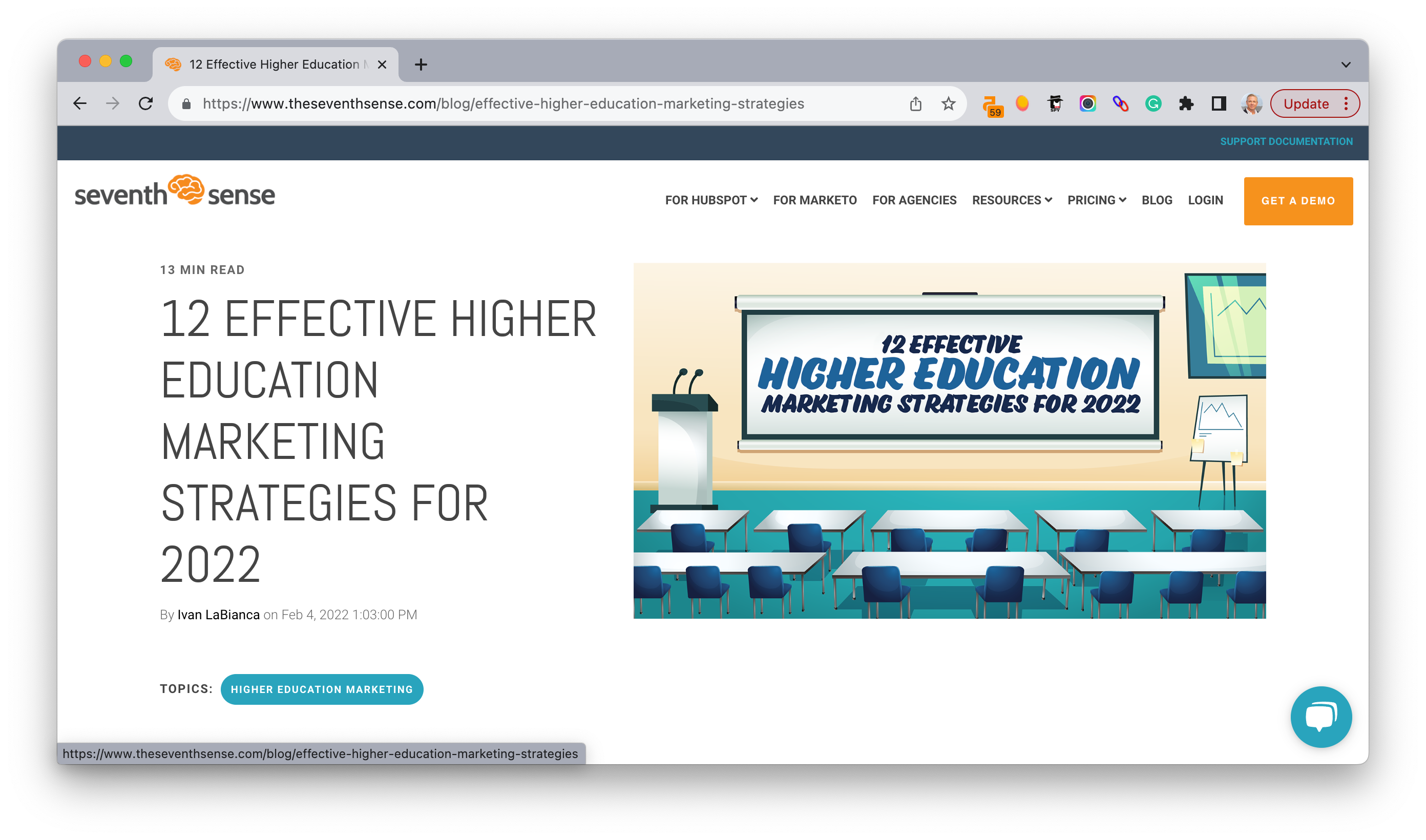
    Effective Higher Education Marketing Strategies -www.theseventhsense.com-blog-effective-higher-education-marketing-strategies

    https://www.theseventhsense.com/blog/effective-higher-education-marketing-strategies

    My perspective: It’s surprising to see this continued focus on the pandemic. From what we’ve seen, things are different — the pandemic is done in most people’s minds, and we’re now in the “new normal.”

    The article discusses the challenges faced by university marketers due to the pandemic and the downturn in undergraduate student enrollment. It provides 12 strategies for higher education marketing:

    1. Centralize Strategy and Reporting: Emphasizes the importance of centralizing marketing expenditures and standardizing KPIs.
    2. Track the Right KPIs: Highlights the importance of tracking call-to-action conversion rates, traffic sources, social media engagement, and cost of acquisition.
    3. Use Marketing Automation: Discusses the benefits of tracking digital interactions with prospective students.
    4. Optimize Your Email Program With AI: Offers email deliverability and engagement solutions.
    5. Improve SEO: Stresses the importance of using relevant keywords and answering prospective students’ queries.
    6. Build a Digital-Friendly Brand: Talks about updating branding to be more digital-friendly.
    7. Live Streaming: Suggests using live streams as an authentic way to connect with potential students.
    8. Personalized Communication: Emphasizes the importance of segmenting audiences and tailoring communication.
    9. Higher Education Marketing on Social Media: Provides various strategies to maximize social media efforts.
    10. Personalized Mobile-Friendly Website: Highlights the importance of a responsive and personalized website.
    11. Chatbots for Higher Education Marketing: Discusses the benefits of using chatbots for immediate responses.
    12. Don’t Forget Visuals and Aesthetics: Emphasizes the importance of appealing visuals for the Gen Z audience.

    Unique Positions:

    • The article emphasizes the importance of data-driven strategies, especially in the context of the challenges posed by the pandemic.
    • It highlights the significance of understanding and catering to the preferences of Gen Z, who are the next in line for higher education.

    Conclusion: The article concludes by emphasizing that marketing shouldn’t be stagnant but should evolve with the university’s overall goals.

    Higher Education Marketing: Strategies and Trends to Know

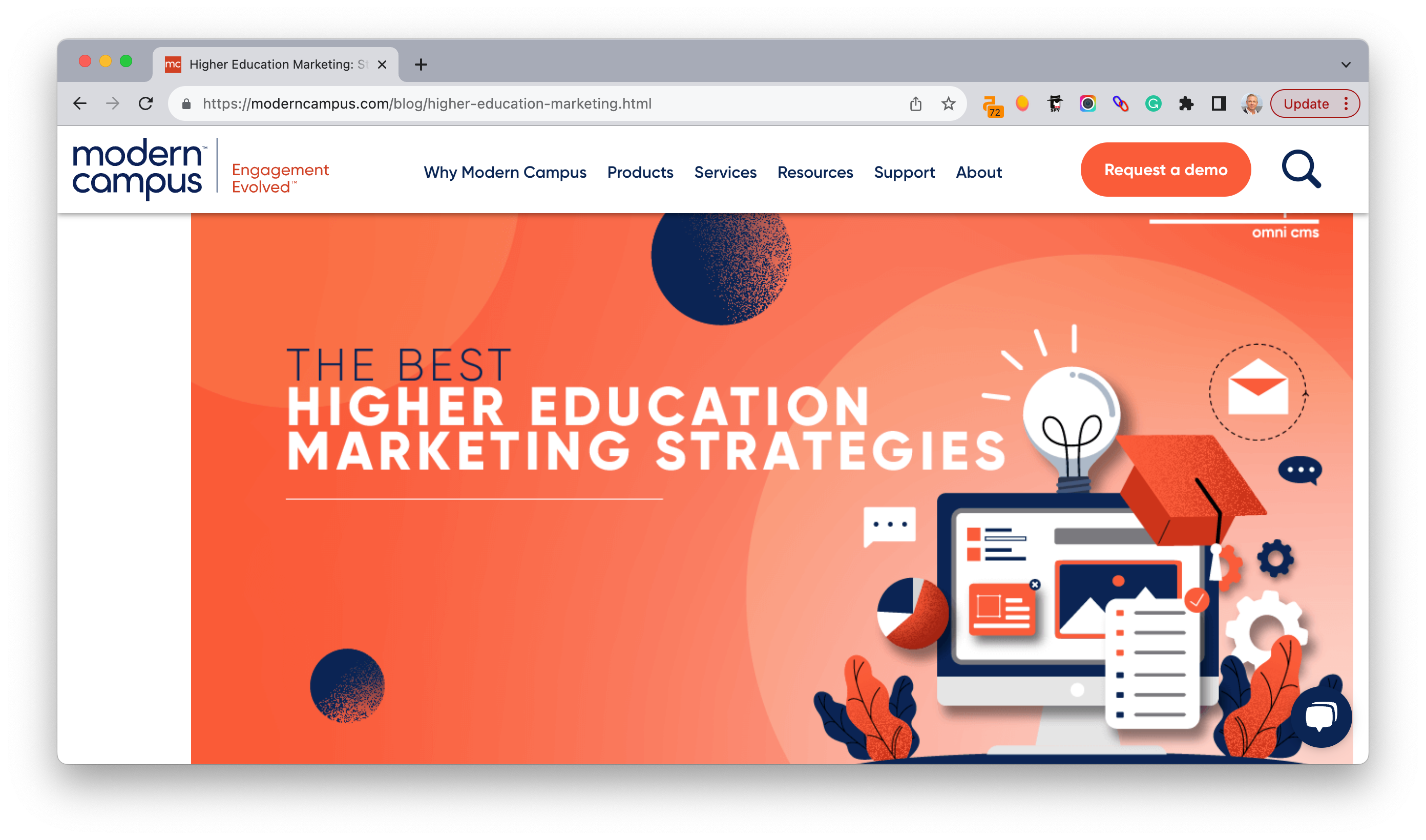
    Higher Education Marketing - Strategies and Trends to Know-moderncampus.com-blog-higher-education-marketing

    https://moderncampus.com/blog/higher-education-marketing.html

    My perspective: It’s interesting to see a focus on the rise of Instagram. TikTok is more timely and clearly the place where Gen Z and beyond are starting their product experiences.

    The article emphasizes the importance of refining marketing strategies for higher education institutions, especially in light of decreasing college enrollments.

    It provides insights into current higher ed trends and offers strategies to enhance student recruitment.

    Key Questions for Your Higher Education Marketing Plan:

    • Identifying target audience and personas.
    • Determining KPIs for engagement.
    • Establishing the cornerstone of the marketing plan.
    • Differentiating from other institutions.

    Platforms to Market Your Educational Offerings:

    • Text messages, especially during the student enrollment process.
    • Social media platforms like Twitter, Facebook, LinkedIn, Instagram, and Snapchat.
    • Email, direct mail, phone calls, and websites.

    Higher Education Marketing Strategies:

    1. Use a CMS Built for Higher Education: Implement a quality web content management system (CMS) tailored for educational institutions to address challenges like outdated content, complicated coding, inconsistent branding, and low search rankings.
    2. Get Current Students Involved: Engage existing students to provide authentic insights into campus life.
    3. Choose a CMS With an Email Module: Emphasizes personalized and targeted email marketing.
    4. Focus on Video Content: Highlights the importance of integrating video content into marketing strategies.
    5. Keep Track of Your Brand: Monitor the digital image and reputation of the institution.
    6. Use the Power of Social Media: Utilize a mix of social media platforms for effective messaging.
    7. Use Videos and Images on Social Media: Emphasizes the growing preference for visual content on platforms like Instagram, YouTube, and TikTok.
    8. Personalize at Scale: Deliver personalized content across various platforms.
    9. Include SEO and Conversion in Your Program Pages: Optimize program pages for search engines and conversions.
    10. Target Parents: Recognize the influential role of parents in students’ college decisions.

    Unique Positions:

    • The article underscores the importance of authenticity, especially when involving current students in marketing efforts.
    • It highlights the shift in the relevance of different social media platforms, noting the rise of Instagram and the decline of Facebook in the context of college planning.

    Conclusion: The article concludes by emphasizing the significance of a quality website and the potential of a CMS to fine-tune a college or university’s marketing strategy.


    Analyzing Effective Higher Education Marketing Strategies

    Analyzing Effective Higher Education Marketing Strategies-www.ama.org-analyzing-effective-higher-education-marketing-strategies

    https://www.ama.org/analyzing-effective-higher-education-marketing-strategies/

    My perspective: I wonder if the author’s suggestion of the value of traditional marketing is pandering to the old guard. Sure, brochures, commercials, etc., may appeal to the parents, but the students are on social media and search.

    The article delves into the unique challenges of marketing in the higher education sector, emphasizing the need for institutions to create a superior academic environment while facing intense competition.

    It underscores the importance of an effective marketing strategy blending traditional and digital methods to achieve institutional goals.

    Why Is it Important to Prioritize Marketing?

    • Higher education institutions need to maximize enrollment and diversify their student and faculty demographics.
    • They must cater to various stakeholders: students, parents, faculty, and donors.

    Traditional Marketing in Higher Education:

    • Print: Newspaper or magazine ads, billboards, and stationery.
    • Mail: Targeted ads, imagery, and product samples.
    • Radio: Over-the-air ads, jingles, and testimonials.
    • Television: Video ads, customer reviews, and product demonstrations.
    • Unique Assets: Campus tours and visits, research and development, arts, music, and sports.

    Digital Marketing Strategies:

    1. Email Marketing: Deliver branded messages, newsletters, and offers.
    2. Social Media Marketing (SMM): Disseminate content across channels and engage with influencers.
    3. Content Marketing: Use blogs, podcasts, videos, etc., to enhance branding.
    4. Search Engine Optimization (SEO): Enhance online presence and search engine ranking.
    5. Search Engine Marketing (SEM): Utilize paid placement and digital ads.
    6. Pay-Per-Click (PPC): Cost-effective advertising where payment is made only when the ad is clicked.

    Ideal Marketing Strategy for Higher Education:

    • Blend traditional and digital methods.
    • Maintain a dynamic website showcasing institutional value.
    • Engage in SEO and SEM efforts.
    • Execute a comprehensive digital advertising strategy.
    • Implement a multifaceted SSM plan.
    • Produce diverse content across various media.
    • Secure advertising spots in local, regional, and national media.
    • Leverage unique assets like research, campus visits, arts, music, and sports.
    • Highlight notable faculty and alumni.

    Unique Positions:

    • The article emphasizes the two-way nature of digital marketing, allowing institutions to have meaningful conversations with interested parties.
    • It suggests that, while traditional marketing methods remain relevant, digital marketing has taken precedence in the modern age.

    Conclusion: The article concludes by promoting the benefits of joining the American Marketing Association (AMA) for institutions looking to elevate their marketing strategies.


    The Ultimate Guide to Higher Education Marketing Strategies

    The Ultimate Guide to Higher Education Marketing Strategies-myemma.com-blog-the-ultimate-guide-to-higher-education-marketing-strategies

    https://myemma.com/blog/the-ultimate-guide-to-higher-education-marketing-strategies/

    My perspective: Ultimate is a bit of a stretch, but I do appreciate the view on good copy and the needs of various university stakeholders, like advancement, athletics, and current students.

    The article addresses the challenges higher education marketers face in today’s digital age. It emphasizes the shift from traditional mass marketing methods, like glossy brochures, to more personalized strategies that resonate with modern students.

    Defining the Goals of Your Higher Education Marketing Strategies:

    1. Marketing for Enrollment: With declining enrollments, targeting prospective students and their parents using digital channels is crucial. Strategies include:
      • Publishing informational blog posts and podcasts.
      • Engaging authentically on social media.
      • Collaborating with micro-influencers.
      • Creating video content, including live streams.
      • Adopting a mobile-first marketing approach.
    2. Marketing for Advancement: This focuses on building relationships with alumni and friends of the institution, often for fundraising purposes.
    3. Marketing for Athletics: Promoting athletic programs to boost interest, spirit, and revenue.
    4. Marketing for Student Involvement: Inform enrolled students about on-campus activities and opportunities.

    The Role of Email in Higher Education Marketing Strategies:

    • Email marketing offers a high return on investment (ROI) across various aspects of higher education marketing.
    • Effective email strategies include automation, mobile-friendliness, relevant content, inclusion of images and videos, and personalization.

    Using Segmentation and Personalization for Prospective Students:

    • Personalized email subject lines are more likely to be opened.
    • Segmentation ensures content relevance, further increasing open rates.

    Consistent Branding:

    • Emails should maintain consistent branding, using recognizable colors, fonts, and logos.

    Killer Subject Lines and Captivating Content:

    • Subject lines should be personable, actionable, and unique.
    • Content should be relevant and valuable to the reader.

    The Importance of Testing:

    • A/B testing or split testing is crucial to determine the effectiveness of email campaigns.
    • Testing provides data to refine campaigns for optimal results.

    Conclusion: Higher education marketing strategies are essential for institutions to overcome challenges and achieve their goals. Email marketing, in particular, is a powerful tool that can be tailored for various purposes, from boosting enrollment to promoting athletic programs. The article emphasizes the importance of personalization, segmentation, and consistent branding in email campaigns to engage and convert recipients effectively.


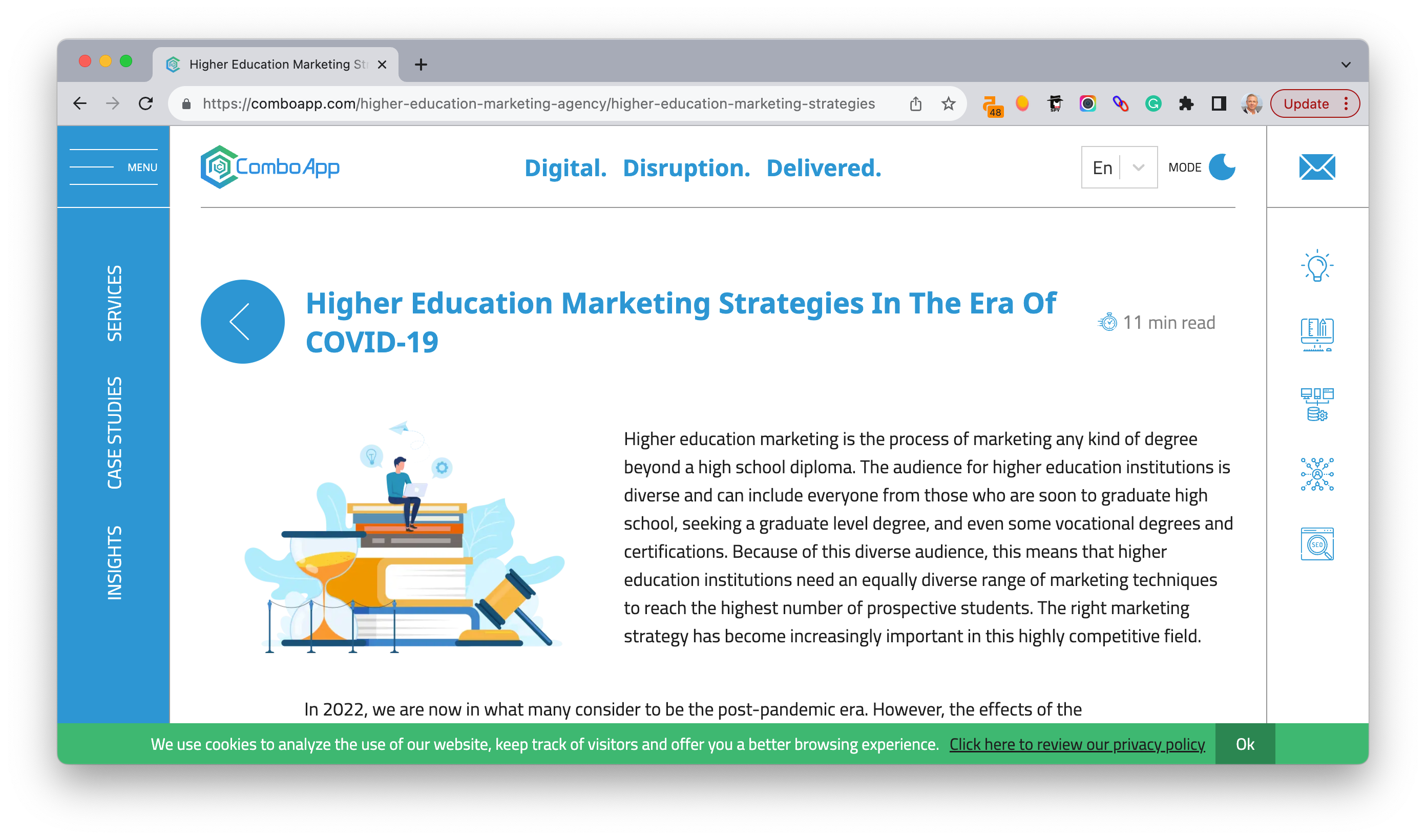
    12 Higher Education Marketing Strategies for 2022

    12 Higher Education Marketing Strategies for 2022-comboapp.com-higher-education-marketing-agency-higher-education-marketing-strategies

    https://comboapp.com/higher-education-marketing-agency/higher-education-marketing-strategies

    My perspective: I find the idea of marketing “Higher Education” as a concept compelling. I recently had a conversation with one of our summer interns in which he asked, “Do I even need a degree?”

    There are definitely fields, like computer science, for instance, where we’re learning that degrees don’t necessarily separate the wheat from the chaff.

    The article emphasizes the long-term changes in higher education institutions due to the pandemic, highlighting the importance of distance learning programs, local student outreach, and improved campus safety. It presents 12 techniques for an effective higher education marketing strategy:

    1. Branding: Focuses on crafting an identity that represents both the school and its student body. Authenticity is key.
    2. Search Engine Optimization (SEO): Highlights the importance of high rankings on search engines and lists several SEO techniques.
    3. A Great Website Experience: Stresses the importance of mobile-first design, speed, and ease of use.
    4. Social Media Marketing: Discusses the significance of authentic engagement on social media platforms, especially for Gen Z and millennials.
    5. Live Streaming: Emphasizes the use of platforms like Facebook Live, Instagram Live, and YouTube for events, Q&A sessions, and classes.
    6. Email Marketing: Highlights the preference of students for email communication and the importance of personalization and segmentation.
    7. Interactive Advertising: Describes the potential of interactive ads, such as games and story-based video ads.
    8. Leveraging Alumni and Students: Discusses the power of word-of-mouth marketing and the importance of reviews and testimonials from current and former students.
    9. Distance Learning: Highlights the increasing demand for distance learning options post-pandemic and the opportunities it presents for institutions.
    10. Pay Per Click Advertising: Discusses the benefits of targeted advertising on platforms like Facebook, Google Ads, and Bing Ads.
    11. Short-Form Video Content: Emphasizes the importance of platforms like TikTok, Instagram Reels, and YouTube Shorts in engaging potential students.
    12. Focus on Positive Career Outcomes: Addresses the ongoing discussions about the value of higher education and the importance of showcasing the tangible benefits of a college education, such as high-paying jobs after graduation.

    Unique Positions:

    • The article stresses the need for institutions to market themselves and the very idea of higher education in light of recent discussions questioning its value.
    • It highlights the blend of traditional and modern marketing strategies, emphasizing the importance of authenticity in all communications.

    Conclusion: The article concludes by promoting ComboApp as a full-cycle higher education marketing agency that can assist institutions in crafting a comprehensive digital marketing strategy.


    8 Higher Ed Digital Marketing Tactics & Trends for 2023

    8 Higher Ed Digital Marketing Tactics & Trends for 2023-www.oho.com-blog-8-higher-ed-digital-marketing-tactics-trends-2023

    https://www.oho.com/blog/8-higher-ed-digital-marketing-tactics-trends-2023

    My perspective: Social will continue to be a tremendous way to get in front of future university students. Even though we’re no longer talking about the “Zero moment of truth” (thank goodness), students will continue to be exposed to our schools and programs before they even know they’re looking.

    The article sheds light on the evolving landscape of higher education marketing in 2022, emphasizing the need for institutions to adapt to the digital age and the unique preferences of Gen Z.

    1. Understanding the Crowdsourcing Habits of Gen Z: Gen Z’s decision-making is described as “crowdsourcing,” where they seek opinions from peers, influencers, and reviewers. Institutions should involve them in conversations and connect with their sense of humor, especially on platforms like TikTok.
    2. Reaching Gen Z With Conversational Marketing: The trend of “conversational marketing” is growing, emphasizing real-time, one-to-one connections to answer questions and assist consumers. University websites should incorporate a human voice and chat opportunities.
    3. Data Insights Shedding More Light on Higher Ed Audiences: Research indicates that understanding the audience leads to better marketing outcomes. Universities are using CRM systems and other software to analyze the student journey and understand their motivations.
    4. Growing Emphasis on Personalized Messaging: Digital content engages young people, but they are wary of overt marketing. Personalized, targeted messaging helps universities connect with students and boost conversions.
    5. Growing Preferences for Short-Form Video: Universities should incorporate short-form videos (around 90 seconds) into their marketing strategies. Examples include video campus tours, answers to FAQs, and student-guided mini-tours.

    Unique Positions:

    • The article emphasizes the importance of understanding and connecting with Gen Z’s unique preferences, especially their reliance on crowdsourcing for decision-making.
    • It highlights the significance of conversational marketing and the need for human interaction, even in the digital age.

    Conclusion: The article concludes by promoting Unibuddy, a platform designed for students that offers tools to enhance higher education marketing strategies in line with current trends.

    15 Best Marketing Strategies for Universities

    15 Best Marketing Strategies for Universities- penji.co-marketing-strategies-for-universities

    https://penji.co/marketing-strategies-for-universities/

    My perspective: It’s not surprising Penji would focus on social and ad creative since they are a marketplace for creative work. I’m not familiar with Penji, but it looks like a new-style iteration of a “99 Designs” concept.

    The article underscores the importance of marketing in universities, especially given the competitive nature of higher education marketing. It provides a comprehensive list of strategies to enhance university branding and appeal to a younger audience.

    1. Social Media: Emphasizes the shift from traditional mail to social media platforms to engage with prospective students. Universities should be present where students are active and ensure their content aligns with the platform’s audience.
    2. User-Generated Posts: Encourages universities to monitor and engage with content created by students about the institution. This provides insights into the university’s perception and offers opportunities for authentic engagement.
    3. Define Your Brand Image: Universities should have a consistent voice and image across all marketing channels. This helps in creating a recognizable and trustworthy brand.
    4. Focus on the Students: Marketing strategies should prioritize the needs and interests of students, both current and prospective. This includes promoting events, assistance, and showcasing the university’s supportive environment.
    5. Video Marketing on All Platforms: Highlights the increasing importance of short-form video content on platforms like YouTube. Videos offer a dynamic way to showcase campus life, events, and more.
    6. Statistics: Using data to showcase the university’s achievements, such as high graduation rates, can be a compelling marketing tool.
    7. Promote Sitting in Classes Before Enrolling: Offering prospective students the chance to experience lectures can help in their decision-making process.
    8. SEO (Search Engine Optimization): Ensuring the university’s website ranks high on search engines is crucial for visibility.
    9. Showcase Success: Highlighting the achievements of alumni can serve as a testament to the quality of education provided.
    10. Embrace Diversity: Marketing campaigns should reflect the diverse student body and cater to non-traditional students as well.
    11. Use Infographics: Visual representations of data can be more engaging and easier to digest than text-heavy content.
    12. Paid Traffic: Utilizing paid ads, especially on platforms like Instagram, can help in reaching a wider audience.
    13. Interactive Webinars: Hosting webinars can provide valuable information to prospective students and give them a taste of the university’s teaching style.
    14. Downloadable Guides: Offering resources to help students prepare for college can be a valuable tool in the decision-making process.
    15. Email Marketing: Automated email series tailored to the student’s application process stage can provide personalized guidance.

    Unique Positions:

    • The article emphasizes the importance of understanding the younger generation’s preferences and adjusting marketing strategies accordingly.
    • It highlights graphic design’s role in enhancing marketing campaigns’ effectiveness.

    Conclusion: The article concludes by promoting Penji, a graphic design service, as a valuable tool for universities looking to enhance their marketing strategies with quality designs.

    16 Effective Digital Marketing Strategies for Higher Education in 2023

    https://www.thinkorion.com/blog/digital-marketing-for-universities

    My perspective: I appreciate the focus on real-time and alumni engagement. We’ve been spoiled by instant responses and always on media.
    And, students want to know what’s out there after attainment of that degree or certificate. Alumni can help tell this story much better than administrators or (gasp) marketers.

    The article delves into the competitive landscape of higher education marketing, emphasizing the importance of standing out to attract the best students. It provides a comprehensive list of strategies to enhance university visibility and appeal:

    1. Maximize Organic Traffic through Optimized SEO Techniques: Emphasizes the importance of SEO for attracting the right students. It covers aspects like keyword research, internal linking, backlinking, technical audits, and on-page optimization.
    2. Accelerate Your Sales With Proven PPC Techniques: Discusses the benefits of pay-per-click advertising for promoting university programs and increasing web traffic.
    3. Attract, Engage, and Retain Students With a Winning Content Marketing Strategy: Highlights the importance of creating engaging and informative content to resonate with potential students.
    4. Elevate Your Brand Visibility With Google Display Advertising: Discusses the effectiveness of digital display ads over traditional billboard ads, especially on Google’s Display Network.
    5. Unlock the Power of Social Media: Explores the role of social media platforms like Twitter, Instagram, LinkedIn, and Facebook in connecting with potential students.
    6. Use Exclusive Email Marketing Campaigns to Promote: Emphasizes the continued relevance of email marketing, stressing the importance of personalization and using AI-powered email programs.
    7. Make Informed Decisions With Advanced Analysis and Tracking: Discusses the importance of setting specific tracking goals beyond what Google Analytics provides.
    8. Utilize Video Marketing to its Fullest Potential: Highlights the engagement potential of video content, both in long and short formats.
    9. Inspire Student Success With Real-Life Stories: Advocates for sharing student success stories to showcase the value of the university’s programs.
    10. Maximize Your Reach With Influencer Marketing: Discusses the power of influencer marketing, especially leveraging successful alumni.
    11. Boost Engagement With Short and Snappy Video Content: Emphasizes the importance of short video content, especially in the wake of reduced on-campus visits due to COVID-19.
    12. Optimize for Featured Snippets: Discusses the importance of ranking in Google’s featured snippet for increased visibility.
    13. Reach Your Ideal Customers With Lookalike Audience Targeting: Highlights the benefits of using lookalike audience models to improve brand reach.
    14. Improve Customer Service With Chatbots Integration: Discusses the rise of conversational marketing and the effectiveness of chatbots in providing instant answers.
    15. Build Connections With Live Streaming: Emphasizes the engagement potential of live streaming over traditional content.
    16. Hire a Professional Higher Education Digital Marketing Agency: Advocates for seeking professional assistance if universities lack the resources or expertise for effective digital marketing.

    Unique Positions:

    • The article emphasizes the blend of traditional and modern marketing strategies, highlighting the importance of adapting to the evolving digital landscape.
    • It underscores the importance of personalization, real-time engagement, and leveraging alumni for effective marketing.

    Conclusion: The article concludes by emphasizing the importance of current marketing strategies for universities to attract future leaders. It also suggests hiring a higher-ed marketing agency for those lacking the time or resources to run effective campaigns.


    Effective Higher Education Marketing Strategies

    Effective Higher Education Marketing Strategies-shorthand.com-the-craft-effective-higher-education-marketing-index.html

    https://shorthand.com/the-craft/effective-higher-education-marketing/index.html

    My perspective: OK, I know it’s shallow, but I like the look and feel of this site. It’s got a very medium-esque vibe.

    On a more serious note, the authors point out one of my constant refrains: The decentralized nature of a higher education marketing strategy is costing universities dearly. Very few schools have central oversight and are therefore cannibalizing their own messaging and budgets.

    The article delves into the complexities of marketing in higher education, highlighting the unique challenges faced by universities. One of the primary challenges is the siloed nature of marketing in universities. While universities typically have a central marketing team focused on boosting student enrollment and driving donations, there are also numerous smaller teams across various academic departments and schools, each with slightly different target audiences.

    These smaller teams often work independently on their marketing strategies, employing a wide range of tactics such as social media, SEO, email marketing automation, PPC campaigns, live streaming video content, direct mail, in-person events, and even chatbot scripts. This decentralized approach can lead to several issues:

    • Dilution of the Brand: Inconsistent application of messaging and brand guidelines can weaken the overall brand identity.
    • Missed Opportunities: Due to weak communication channels, potential marketing opportunities might be overlooked or not fully capitalized upon.
    • Decreased Morale: Teams or individuals working in isolation can experience reduced morale.

    Despite these challenges, the article offers hope by suggesting nine strategies to promote more cohesive and effective higher education marketing. While the specific strategies aren’t detailed in the provided excerpt, the article emphasizes the importance of cohesive marketing efforts across the institution.

    Unique Positions:

    • The article highlights the unique challenges higher education institutions face due to the decentralized nature of their marketing efforts.
    • It underscores the importance of a unified approach to marketing to ensure consistent branding and messaging.

    Noteworthy Mentions:

    • The article references recent engagement examples related to the pandemic, suggesting that universities have proactively created content around COVID-19.
    • The University of Queensland is highlighted for its digital publication, “Contact,” which offers an engaging and interactive user experience while catering to those who prefer traditional print magazines.

    Final Thoughts

    As you can see, there are a number of ways to get in front of students for your school.

    The consensus seems to be that SEO, social media marketing and advertising, email, and PPC are great ways to invest your marketing dollars.

    It’s surprising to see how little attention is paid in the articles to analysis, tracking, and reporting, given how many of the UPCEA Higher Education SEO Study respondents indicate this is lacking.

    As management icon Peter Drucker is famously quoted, “What gets measured gets managed.” All the landing pages, tactics, and strategies in the world won’t make us successful if we don’t know what’s working.

    For more tips to create a winning higher education marketing strategy, check out our Higher Education Marketing Resources & Guides. For more information about higher education marketing – and to learn more about services like our SEO Roadmap for universities, contact our team at Search Influence today.


  • Chatbots – Are They Right for You?

    On the internet, there are two kinds of bots, those designed to deliver content or promote a cause and others designed to be a virtual sales assistant or customer service representative. The latter is commonly called a chatbot, and they are popping up all over the web. Facebook added chatbots to their business pages a couple of years ago to help businesses automatically respond to inquiries even if they couldn’t have a human watching their page 24/7. Google also has a bot for their business page managers that works similarly.

    While chatbots aren’t new, the last few years have seen a lot of hype about chatbots being the next big thing in online conversions, and we have seen an increase in the use of chatbots all over the web. But is using these autonomous bots helping or hurting when it comes to online conversions? Are they really right for your business? To find out, let’s dig into the pros and cons of chatbots:

    The Value Chatbots Add

    • Reduced labor costs: Having a chatbot working on your website 24/7 to receive customer service requests or sales inquiries means you don’t have to pay one (or more) human employee to do this work all day and night. This can be a huge labor cost reduction even after you factor in the cost for the bot to be developed and implemented.
    • Faster customer service: The response time of a chatbot is virtually instant, and they never get sick or take time off for holidays! Giving customers the answers to their questions quickly will help move them further down your conversion funnel.
    • Customer satisfaction: They can be programmed to give answers to common customer questions, which can lead to higher customer satisfaction on your website. This can help improve your bounce rate as well.
    • Serve multiple customers simultaneously: A human can only serve a few customer inquiries at a time. This problem does not exist with chatbots as they can manage many customer questions at the same time with no issues.

    A robot teacher surrounded by robot students

    The Cons of Chatbots

    • Chatbots are “dumb”: Customers often expect these chatbots to act similarly to their Google Home or Siri, which are packed full of advanced AI that has been developed over several years. That isn’t the case with the chatbots that the average business is using. These bots can get stuck, and complex queries from a customer may be answered incorrectly or not at all. Sometimes, even simple questions may not have been thought of during the development of the chatbot. These issues can lead to customer dissatisfaction and a reduction in brand loyalty.
    • High setup cost: While these chatbots can save you a lot in labor costs over time, the initial cost to implement them is typically very high. To be truly useful to your customers, each chatbot needs to be programmed to answer dozens of questions correctly, as well as variations of the same question, which increases development costs. And for the chatbot to continue to be useful, it will need to be updated as questions and answers change for your business, which can lead to hidden ongoing maintenance costs that you haven’t budgeted for.
    • Chatbots have no memory: This means repeat customers that have a different question are often forced to write the same thing over and over to get to the point at which their new question can be answered. Much like automated telephone systems, this can be very frustrating for your customers and can ultimately lead them to look elsewhere for the answers they seek.
    • Chatbots aren’t always the right fit: Many businesses are just too complex for chatbots to be a viable customer service solution. In some cases, using a chatbot will add unnecessary complications. Some businesses are better off adding a frequently asked questions (FAQ) page on their site, which will draw in additional traffic to their website.

    As you can see, there are some good reasons to use a chatbot on your business’s website, but using a chatbot can also backfire and hurt your conversion funnel. If you decide that a chatbot is appropriate for your company, it should be designed, developed, and implemented by professionals with your specific needs in mind.

    Before you build and install a chatbot on your website, take a step back and really think about whether the information the chatbot would provide could also be presented on your website on an FAQ page. At Search Influence, our digital strategists can provide you with consulting about decisions like adding a chatbot to your site and social media accounts. For insightful digital marketing advice, request a proposal today.

    Images: Robot teacher