Tag: Bing

  • Search Influence Team Becomes Bing Ads Certified

    As of September 28th, the Search Influence account management team has 12 Bing Ads accredited members on staff in addition to the 12 team members who received Google AdWords certification last spring. We are constantly striving to improve our training and credentials so that we can provide the highest level of knowledge and most value for our clients. With both Bing and Google ad-certified professionals, we are the most accredited Online Ad team on the entire Gulf Coast. You can see the full list of accredited SI employees in Bing’s Find a Pro Directory. We’re very excited about our expanded knowledge in the Bing Ads program, and loved the interaction we received from Bing about our enthusiasm for the program! Talk about great customer service.

    Congratulations to our Accounts team for this very cool achievement!

  • 5 for Friday – Links, Stories & Posts for Your Weekend

    • Google+: A Year of Missed Opportunities – Mashable.com

    Google+, the proposed “Facebook killer,” is turning out to be more Elmer Fudd than Brutus. Our blog noted the early successes of Google+ over a year ago, citing its sleek design and seamless integration of Google profiles and contacts. Yet Facebook’s de facto archenemy stumbled at the start gate, disallowing aliases and stalling for four months before allowing brands and news platforms to set up profiles. The numbers are startling: users spent an average of 3.3 minutes on G+ in January, compared to seven hours on Facebook. In the last year Facebook has grown from 700 million users to 900 million, a growth that exceeds the entirety of the G+ population. For small businesses interested in the clean, professional, design of G+, note that historically Google has added layers of complexity to augment their online platforms. With a growing sentiment that the Facebook juggernaut has shed its user-friendly coat, the question is: can Google take advantage of the sea change?

    Understanding Google Places & Local Search – Developing Knowledge about Local Search – Blumenthals.com

    On May 30th, Google Places was replaced with Google+ Local. With 97% of consumers searching for local businesses online, having a presence on Google Maps is a necessity — if you can figure it out. MapMaker effectively took the burden of mapping the world off the folks at Google and placed it on savvy cartographers and small business owners alike. With categories functioning like keywords, a business owner can enhance their presence on Maps and keep the information up to date—especially helpful for start-ups.

    Though with Google Mapmaker lacking a comprehensive set of categories, small business owners want to know: “What is the best practice for adding categories in MapMaker?” The short answer is that avoiding keyword spam, using five standard categories (like ‘Gas Station’ if you’re a gas station), and editing the categories directly on the Place page will help create more cohesion between the two pages. As Mike Blumenthal delves into detail about the ins and outs of categories, one begins to see why Google democratized the effort. A complex list of practices to set yourself apart from the competition—if you’re willing to learn.

    Facebook Email Fiasco: 900 Million+ Profile Updates Without Permission – SearchEngineJournal.com

    Can Facebook do anything right, or are we just too invested? While most Facebook users consider their inbox to be an extension of the chat feature, it’s actually a collection point for your Facebook email (yes, you have one): [email protected]. Check your company’s Facebook page. For if you wish to generate traffic to your business email from the email address displayed on your profile, note that the address displayed on your timeline is no longer your business email. This change has given ammunition to Facebook critics who note that changes made for “our privacy and security” seem to be made while violating privacy and security. To display your “real” email address again, navigate to your profile, click “Update Info,” then “Contact Info,” and “Edit,” then customize your email address options.

    Hitwise: Bing Has Chipped Away 5 Percent Of Google’s Search Share Over Past Year – SearchEngineLand.com

    Though “Bing it” is still an unlikely response to the big questions (Dude, what movie is that guy from?) of everyday life, don’t think Windows’ “decision engine” is down for the count. Launched in June 2009 as a competitor (or, depending on your point of view, goat in the T-Rex pen) to Google, Bing has not yet undertaken the search engine behemoth. In the last 12 months, though, Bing has taken 5% of Google’s market share. That’s news. A bigger story, perhaps, is that Google has declined by 5%. The “sick man” of search engines, Yahoo, has dropped for nine consecutive months. With rumors of internal struggle and the floundering of Google+, the question is: has Google stretched itself too thin?

    Google’s Developer Dilemma: Open Up Google+ Or Hold On To ‘Something Special’? – MarketingLand.com

    In related news, El Goog is displaying a stubborn side. During a “fireside” chat with developers at the 2012 Google I/O conference, several members of the Google+ team explained that their “tentative” approach to opening up Google+ to full read-write API is a result of “something special” and “magical” happening on Google+. As of yet, no news on what that means. Google’s desire to shelter their baby could pay off in the long run. After all, who got anywhere trying to satisfy everyone? The Google team reports that API access would result in spamming. If Google+ plans to remain inside the cocoon too long, though, developers and businesses alike may become frustrated. The conference was not all bad new for developers, however; Google hinted that big developments are in the team’s plans, such as adding Google+ comments to the API and making vanity URLs available to all users.


  • Can Bing Ever Compete with Google?

    If you keep up with what’s in the news in the world of search engines, you know that there’s been a bitter little rivalry between Bing and Google for some time. In early February, Bing accused Google of stealing their search results. It didn’t help Bing’s case that they didn’t deny the claim either, instead saying, “…we use multiple signals and approaches when we think about ranking, but like the rest of the players in this industry, we’re not going to go deep and detailed in how we do it.”

    Fast forward to now, where Microsoft was recently the topic of discussion in a lengthy article in the New York Times about Bing’s profitability — and how long it may take them before they have any chance of breaking even. Other reports claim that Microsoft has claimed 30% of the search market and that Google is “slowly sinking”, even though it still controls roughly 65% of the search market.

    Bing has made respectable strides since its launch two years ago, but even so, it hasn’t been able to match the brute force of Google, which was the leading search engine among ten competitors back in 2002, only two years after its launch.  Surely, Bing will continue to grow, but even if can find itself on equal footing with Google, can that be considered success?

    Microsoft’s Qi Lu says, “To break through, we have to change the game. But this is a long term journey.” He’s right … but how long will that journey be? Sources seem to think that Bing will need to demonstrate some sort of clear success before its tenth birthday to remain a contender.

    How can Microsoft accomplish this? Voices all over the web have tons of ideas, but several of the key ones seem to stick out. Some suggest that Bing work both ends of the user spectrum, finding a way to appeal to every age range (much like Nintendo did with the launch of their Wii videogame console). Since Google tends to appeal to a young, tech savvy audience, this could be a valid approach for Bing. Microsoft should also focus carefully on their acquisitions, and try to see what could work best for them (here’s a hint: buying Skype for $8.5 billion might not have been the best choice).

    Personally, I’m a fan of Google’s products, so until Bing can offer something better, I’m staying put. How do you feel about it?

  • The Bing and Yahoo alliance means the end of Yahoo Local, right?

    As we reported in an earlier post, there are things to consider now that the Bing and Yahoo alliance is coming so near. Starting sometime in August or September, Yahoo’s organic search results will be fully provided by Bing, which will increase their organic search market share from 11% to 27%. Wouldn’t it be great if this meant an end to Yahoo Local, leaving you with only Bing and Google local listings to worry about?

    Sadly, that is not going to happen. Yahoo plans to maintain control of the search experience, and it includes Yahoo Local as a part of that. As Yahoo quotes here, it will be “Providing you with rich results that display the most relevant information from Yahoo!’s rich content properties, as well as other great product, local, entertainment, reference, social and tech sites.”

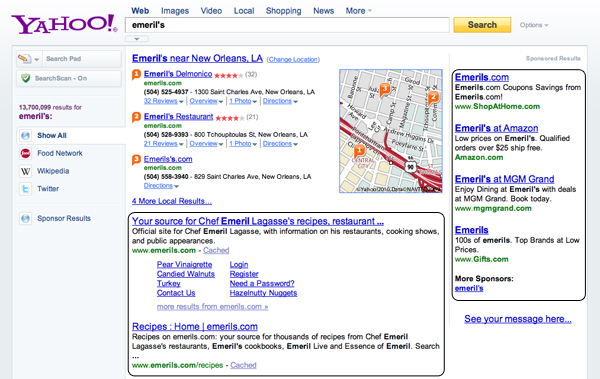
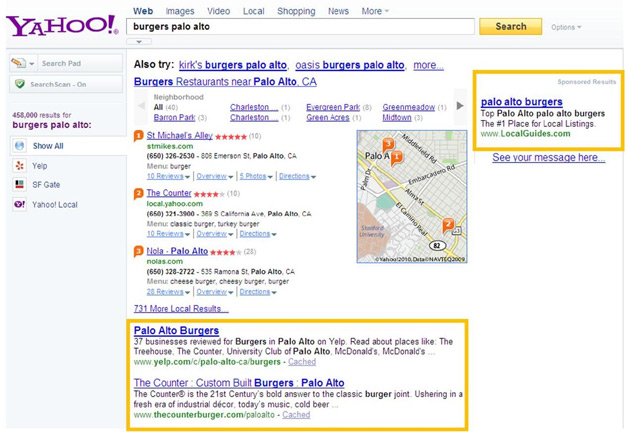
    Look at the picture above and you will see boxes around the organic and paid search results—these will be provided by Bing, the rest will be provided by Yahoo, including local listings.

    If you are a local business owner this might not mean much to you, but if you’re an SEO that cares about local listings you won’t get any of the relief you might have anticipated and will still need to claim your listings on all 3 search engines.

  • SEO Optimization Tips for the Yahoo-Bing Merge

    While Google has reigned supreme when it comes to optimization, now may be the time to reassess your Bing strategy. As we mentioned in an earlier post, Yahoo anticipates that their organic search results will be fully powered by Microsoft sometime in August or September. However, Yahoo has already begun testing Microsoft’s organic and paid listings. Up to 25% of their current organic search results come from Bing, while up to 3.5% of paid listings can be from their AdCenter.

    While the results may be coming from Microsoft, Yahoo assures that they will retain their familiar format. They offer up the following image, where the boxed areas are those that come from Microsoft:

    They also offer up the following tips for SEO:

    • Compare your organic search rankings on Yahoo! Search and Bing for the keywords that drive your business, to help determine any potential impact to your traffic and sales
    • Decide if you’d like to modify your paid search campaigns to compensate for any changes in organic referrals that you anticipate
    • Review the Bing webmaster tools and optimize your website for the Bing crawler, as Bing results will be displayed for approximately 30%* of overall search query market share after this change

    These tips- along with many more- can be found here. Not much work will have to come from you, but it’s best to familiarize yourself with the changes now in order to be better prepared.

  • Fall 2010 Yahoo Will Show Bing Organic Results

    Yahoo!Last week, Yahoo sent out emails explaining how the merger with MSN/Bing would effect paid search advertiser.  The most interesting piece of information the email provided was about the transition to Bing search algorithm in early Fall.

    Organic Search Transition
    To date, we’ve focused most of our communications to you on the paid search transition to adCenter. However, another key aspect of the Yahoo! and Microsoft Search Alliance is the transition of Yahoo! organic search results (those found on the main body of the page). Assuming our testing continues to yield high quality results, we anticipate that our organic search results will be powered by Bing beginning in the August/September timeframe.

    Frankly Yahoo’s effectiveness at generating leads has been on a slow decline for years.  I completely blame this fact on Yahoo’s refusal to evolve. They spent so many development hours creating Yahoo Messenger, Yahoo Games, and Yahoo Groups, they forgot to focus on the quality of their search results. While I’m not thrilled by the merger, I am excited that SEOs will have one less search engine to optimize.

  • Yahoo! is an Entertainment News Site…Wha?

    Yahoo Fails At Search, Tries Its Hand At Being A “Pretty Woman”

    "Your Yahoo! May Look Different Today!"

    It is a sad day when search engines are reduced to stalking celebrities to keep themselves relevant.

    That is the thought I had when I saw the latest Yahoo TV commercial. Since their merger with Microsoft was announced, Yahoo has been trying to carve out a niche for itself as a entertainment news site (seriously how many E!s, TMZs, OhNoTheyDidnts, and Superficials must we have! How are all the celebrity bloggers going to eat and stay in white MSpaint to draw on photos?). They are even going as far as to declared themselves THE NUMBER ONE visited site for such frivolous news  – when in all honesty, they are including Yahoo Search,Yahoo Mail, and Yahoo Games (noticed I didn’t include the “!” because there just isn’t anything exciting about Yahoo anymore) into this data.

    Is it misleading? Hell, yes.

    It would be like Kanye West running into a social media award ceremony and shouting  “Yo Facebook, I’m really happy for you…I’ll let you finish. But Google had the most users of all time!”

    For Yahoo to not only call it quits with search but to instantaneously declare themselves the number one at something is delusional. Yahoo has never been first at anything, not even being absorbed in a significantly more successful search engine *cough*…AOL…*cough*.

    Oh and speaking of Kanye West, what’s the deal with Yahoo using “Flash Lights” in the commercial? That song is about pure narcissism (which is such a stretch for Mr. West to rap about *eye roll*)!  What does Yahoo have to be narcissistic about? It certainly didn’t live up to the promise of all those awesome 00’s commercials with the cowboy cry “yahoo!” at the end. In fact the only thing Yahoo should be proud of is knowing how to make money even in rough times. Yahoo is like a 80’s film star that got downgraded to tv dad in the 90’s and is now doing guest spots as the murder victim on cop dramas between infomercial and night manager gigs. Yahoo is a shining example of just because you’re well known at something, doesn’t mean it will make you rich.

    Am I mad at Yahoo? No, but I am upset at internet companies allowing Google to swallow more and more of the search engine pie chart. This merger is not going to increase Yahoo/MSN slice of the pie, it’s just going to make search professionals realize we are practically on Google’s payroll.  :/

    Thanks to Thomas Hawk for the image!