Tag: barnacle seo

  • This National Small Business Week, Step up Your Online Marketing

    It’s National Small Business Week—time to celebrate the successes and the insane amount of work small business owners put in. The struggle is real.

    You know you’re a small business owner when…

    …Your nightmares are about getting bad Yelp reviews.

    …Your social media “strategy” consists of bribing your college-aged daughter to handle your Facebook and Twitter accounts.

    …Your holiday hours did not quite make it to the Internet, and customers actually showed up only to find your business closed.

    To cure these and other headaches, start with a little TLC for your website and your online marketing strategy—after all, both of these play a huge role in bringing you customers, but they may unfortunately also be keeping you up at night. Follow these top three online marketing tips for small businesses.

    If You Can’t Beat ‘Em, Join ‘Em

    It may sound upsetting that Yelp listings are front and center in a Google search for your business while your own website is far down the list of search results. But savvy small business owners know that Yelp and other large online directories can win over customers with minimal effort. So if you can’t beat the Yelps of the world, join ‘em!

    This strategy is also known as Barnacle SEO. Basically, your business needs to attach itself to large, fixed objects and then wait for customers to float by in the powerful current. Identify the large, high-ranking online directories that matter to you most, such as Yelp, and add your information there in the hopes of “borrowing” some of the page one rankings. There are many trusted online directories like Yelp out there you can barnacle up to: Angie’s List, Foursquare, Google+, Avvo (for lawyers), Healthgrades (for doctors), and even TripAdvisor.

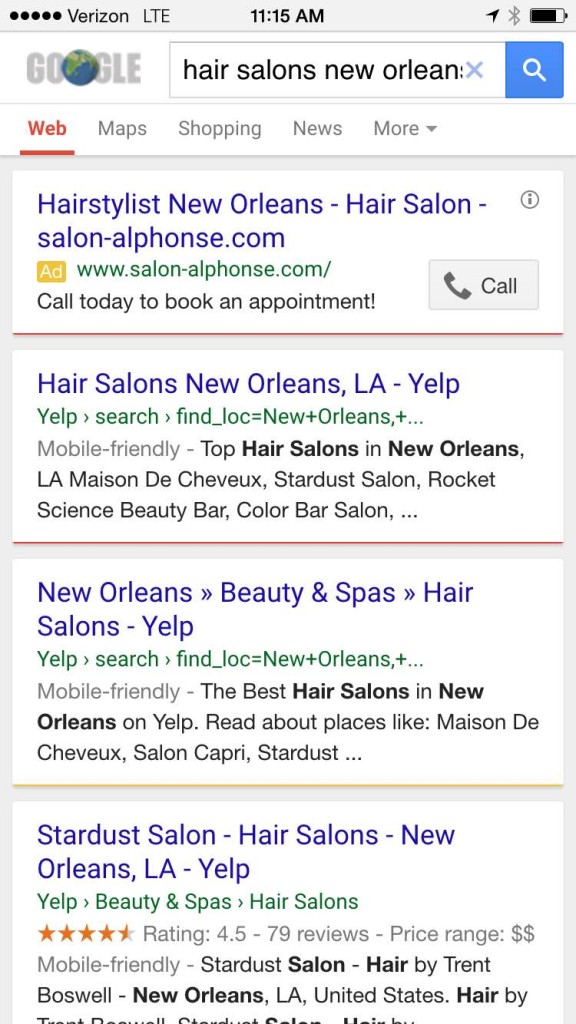
    And this tip comes with a bonus: this strategy also works well for customers searching on smartphones because these websites are optimized for the mobile experience—providing the targeted information that local customers searching on their smartphones really need. When you perform a Google search for “hair stylists New Orleans,” for example, the top results are mostly from Yelp:
    Yelp Mobile Screenshot Image - Search Influence

    Target Your Social Media Efforts

    Another thing that keeps you as a small business owner up at night? Social media—or more specifically, finding the time for it. For starters, why is social media worth your time? The latest statistics from the Pew Research Center paint a pretty compelling picture that customers are on social media: 74 percent of online adults use social networking sites.

    As a time-starved small business owner, you must get the most for your social media time. This requires targeting your social media efforts. Start by channeling your ideal customer. What is your typical customer’s age, marital status, and family status? Where is your customer physically located? Do your customers fall into a certain income bracket?

    Once you know who your target customer is, find the social media channel that appeals to them. For example, Facebook still skews significantly female and is the top-used social network for U.S. teens, making it ideal for fast-moving consumer goods, according to Business Insider. Instagram is also popular among females ages 18 to 44, so clothing, accessories, and those types of brands tend to perform well on this network. While LinkedIn is most popular for adults, Twitter is primarily a news source and attracts mostly male users. YouTube reaches more adults ages 18-34 than any single TV network. Pinterest is the place for food and drink-related information as well as parenting tips.

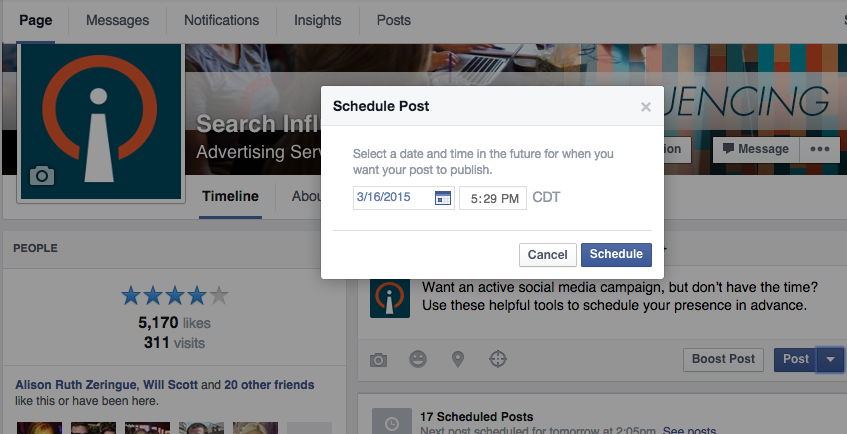
    But remember, whichever social networks you decide to focus on, automate your posts with these quick tips.
    Facebook Scheduled Post Image - Search Influence

    Avoid Customers Crying in Your Parking Lot

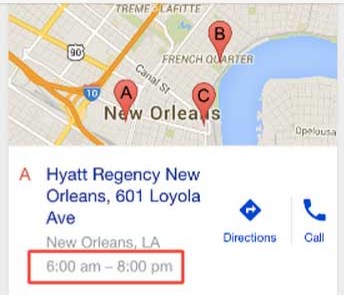
    If you’ve ever done a Google search for your business, you’ve likely seen this kind of result:
    MapsTimeViewImage

    But what happens when you have special holiday hours? Will customers see your normal hours in a Google search and show up in your parking lot over the holidays? Currently, Google My Business has not built out the functionality for saving holiday-specific hours ahead of time. As the profile setup currently stands, you’ll need to manually edit the hours of operation on a given day when your business is open (or closed) outside your standard hours of operation. See Google’s steps on how to update your business’ hours.

    Also, remember to let folks know when you are, in fact, open on the holidays. For instance, let everyone know your restaurant is open on Independence Day and post your holiday-specific menu for the day or highlight any patriotic specials. Is your medical practice open for limited hours on Memorial Day this year? Post a piece to your blog or social media profiles highlighting the top summertime health hazards from boating accidents to severe sunburns.

  • Survive Google’s ‘Mopocalypse’ with these Tips for Your Mobile Strategy

    Survive Google’s ‘Mopocalypse’ with these Tips for Your Mobile Strategy

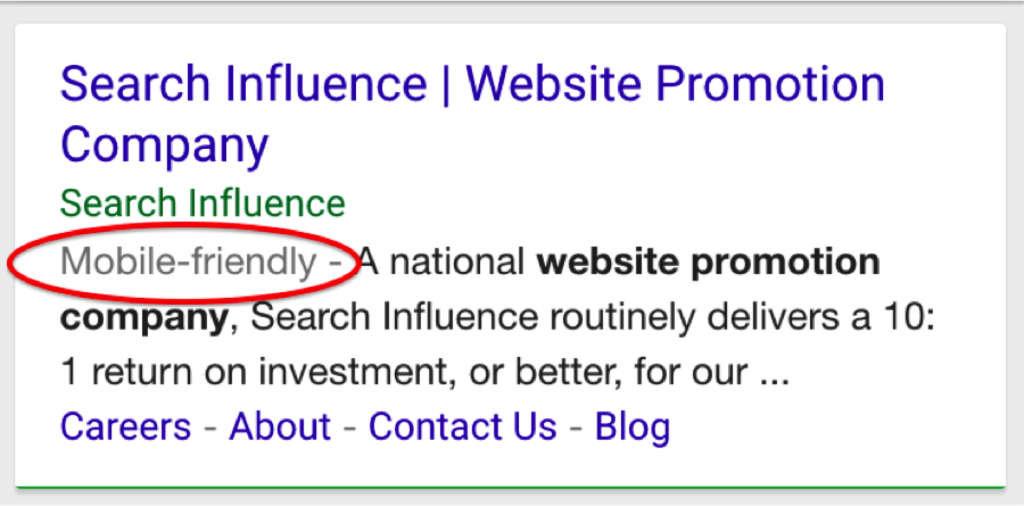
    Mobile Friendly Image Search Influence

    Google’s new mobile-friendly update, which I originally discussed in my Search Engine Land column, is rolling out this month, and it’s time to put the focus on mobile. But with all this buzz about mobile websites, you may be thinking, “My website looks fine on my smartphone when I pinch and zoom, so what’s the big deal?”

    Well, there’s much more to it than that.

    Step 1: Get a Mobile Website

    Just because your Web developer tells you your site is mobile doesn’t necessarily make it true. Make sure you’ve used Google’s handy mobile-friendly testing tool to check your website. In Google’s eyes, businesses have three main options for becoming mobile-friendly: responsive website design, dynamic serving, and separate URLs.

    So what option is right for your business? The bottom line is this: for businesses with growing mobile traffic that has not yet reached a critical percent of site traffic, a purely mobile version on a separate URL is a viable option. But for businesses with mobile website traffic pushing 50 percent or more of all site traffic, it is time to invest in a responsive website. While a responsive website typically requires a complete overhaul, your customers will probably thank you when your website can display differently based on the screen size.

    Step 2: Use ‘Barnacle SEO’

    Even before your mobile website is in action, your business needs to attach itself to large, fixed objects, and then wait for mobile customers to float by in the powerful current. I like to call this Barnacle SEO, also known as the “If you can’t beat ‘em, join ‘em” strategy. Basically, this means identifying large, high-ranking online directories such as Yelp, for example, and adding your information there in the hopes of “borrowing” some of their page one rankings. And there are many trusted online directories like Yelp out there you can barnacle up to: Angie’s List, Foursquare, Google+, Avvo (for lawyers), HealthGrades (for doctors), even TripAdvisor.

    This strategy works well in mobile because these websites are optimized for the mobile experience—providing the targeted information that local customers searching on their smartphones really need. When you perform a Google search for “hair stylists New Orleans,” for example, the top results are mostly from Yelp:

    Yelp Mobile Screenshot Image - Search Influence

    Step 3: Focus on Location, Location, Location

    Let’s face it: when mobile matters, location matters. Consider this: 50 percent of consumers who performed a local search on a smartphone visited a store within a day, according to a recent study from Google. So that’s good news for brick-and-mortar businesses with a mobile-friendly website. Those businesses will enjoy the additional ranking factors from the upcoming mobile-friendly algorithm, getting these small businesses in front of their target market at the time and place searchers are looking.

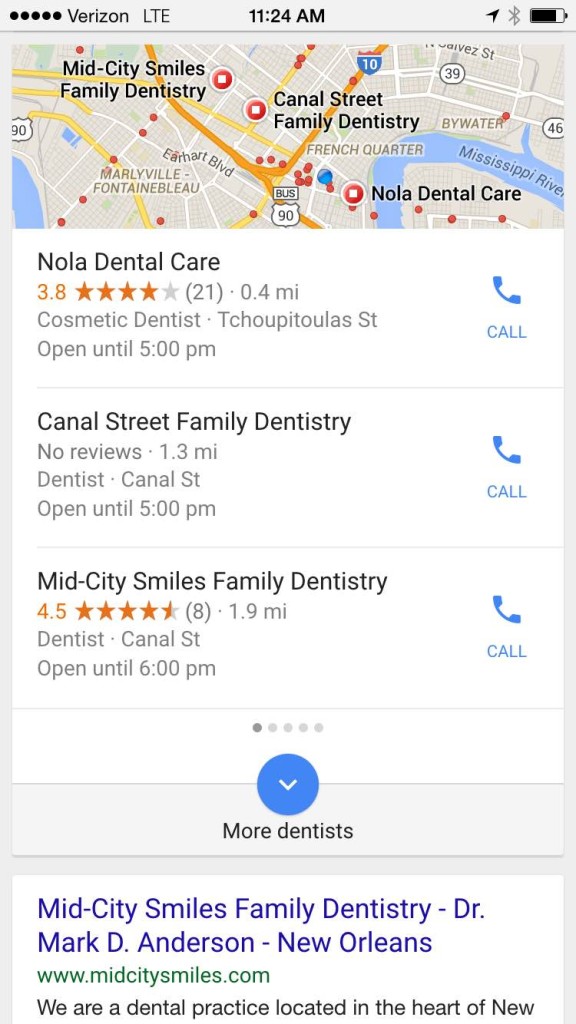
    The challenge? Local businesses must break into the top three local results—the ones typically seen on your smartphone. For example, if I search for “dentists,” Google is going to give me dentists near me … and I see only the first three results:

    Dentists Near Me Search Image - Search Influence

    To wrap it up, these are three steps you can get started on now. But remember, as with all Google algorithm updates, stay calm and give it time. April 21 was not the end-all-be-all date. This rollout will likely be a period of rollouts rather than a single-day launch. We usually recommend giving an update 60 days to see the full impact. And even then, there are revisions and updates and you just don’t know.

    So what’s your next move? Keep an eye on your website traffic to see if the update is impacting your mobile traffic. If you need help, give us a call at 504-208-3900. We’re here to help ease your “Mopocalypse” fears.

  • Takeaways From Pubcon New Orleans Day Two

    Last week I had the amazing opportunity to attend Pubcon New Orleans for the first time. It was one of the most fruitful learning and networking experiences I’ve had the chance to be a part of. I felt like I could spend forever just absorbing everything I could from everyone I met. One of the major themes that I got from all the speakers I saw at PubCon was the importance of good content. So, now I’m here to tell you about some of the main takeaways I got from the particular sessions I attended.

    IMG_52111-1024x368-1

    Peter Shankman: Keynote

    The keynote by Peter Shankman focused primarily on the power of good customer service. His four main points were Transparency, Relevancy, Brevity, and Top of Mind. He said you don’t have to go crazy with customer service, just be “one level above crap.” On this note he mentioned the Morton’s Steakhouse story where he jokingly tweeted at them about wanting a porterhouse steak upon landing in New Orleans from a flight. They then sent someone to meet him with a steak when he got off the plane. This simple gesture(although not scalable for every brand) led to a lot of great publicity for Morton’s. It’s all about making your customer feel special.

    An audience you are more transparent and honest with that feels invested in is 78% more likely to buy. Peter also said that when(not if) you screw up, own it. People are 44% more likely to stick with you if you own it. He mentioned the stark difference between how Eliot Spitzer handled his prostitution scandal by admitting the fault and resigning versus how Anthony Weiner handled his sexting scandal by saying he got hacked and not owning up to it.

    Peter mentioned the importance of being relevant and listening to your audience as well. He mentioned a non-profit that saw a 37% increase in donations just by being engaging and active with their audience online.

    The third important facet Peter Shankman mentioned was brevity. He particularly said that brevity is the future of social media and not just in the way we think of it through Twitter now. He said jokingly that we’ve all become the dog from the movie Up, because recent studies show that we have a 2.7 second attention span. Shankman said that mobile messaging is the future and Twitter is just the pipe, so we must learn to write well and concisely.

    Finally, Peter talked about the importance of being top of mind. You want to be the first person someone thinks to go to for whatever they need. He also mentioned the idea of having “zombie loyalists,” or people who have you at the top of their mind for recommendations.

    IMG_5231-768x1024

    Will Scott: Barnacle SEO

    Next I had the opportunity to sit in on Will Scott’s talk about Barnacle SEO(a term he coined in a Local Search News post back in 2008). Barnacle SEO is all about leveraging authority for local search. Specifically, the idea is to attach oneself to a “large fixed object” and wait for customers to “float by in the current.” It’s not as simple as using someone else’s authority, because Will says the most important thing in business is sincerity. “If you can fake that, you’ve got it made,” he says.

    He also mentioned that Google’s weakness is sites they consider super authoritative like YouTube, Yelp, Pinterest, Facebook, YP.com, and such. This is making Barnacle SEO have a huge comeback. YouTube for example dominates universal search and according to a MarketingLand infographic, 8 out of 10 video results are from YouTube.

    Although using backlinks from these authoritative sites and directories like YP.com for local SEO efforts is important, it’s also super important to “keep it clean-ish” by using tools like Whitespark.

    Greg Gifford: Local SEO- It’s No Laughing Matter

    After Will Scott, Greg Gifford, Director of Search and Social at AutoRevo, took to the stage with his presentation about the complications of local search. His awesome presentation featuring punny references to 142 movies and also contained precise, actionable tips. He mentioned the changes in local search like the maps pack finally stabilizing at seven listings and how optimized vertical and local directories now rank very well. A huge opportunity for small businesses to rank well lies in simply adding city and state to title tags.

    Greg also mentioned how the goal of Google Plus Local(aka Google Places) seems to be like a drive through, a place for people to get what they need by getting in and out quickly. He also brought up the Google email about “duplicate listings” that rolled out with Google finally merging the old dashboard to the new. If you want to know more about this email, check out my blog post here.

    His optimization tips for G+ included writing long, “awesome” descriptions using formatting and links, uploading lots of photos, using as close to the max 10 categories as possible while keeping them relevant, engaging in the fairly few number of users on G+, and circling users as a business. As far as reviews on G+ go, he mentioned that you have to earn them and ask for them, you need at least five reviews to see the star average, you should shoot for 10 then diversify, one to two reviews a month is normal, and having them come in consistently rather than in bursts is important.

    IMG_5215

    Casey Markee: The “Big Easy” Guide to Google-Friendly Link Earning

    Casey Markee started his presentation with a quote from Matt Cutts saying, “The objective is not to make your links appear natural, the objective is that your links are natural.” He mentioned that the “four tenants of Google-friendly links” are those that provide clear value for the user, are niche-relevant, get clicked to send some measurable form of trackable analytics traffic, and are “earned” freely versus being given.

    He listed nine link “earning” classes that Google still loves which included:

    1. Link Bait Type Content- Sharable and Buzz-Worthy
    2. Evergreen Content- No Expiration Date
    3. Local Link Earning- Publish Local Resources
    4. Scholarship Link “Earning”- Ex: SilverCross.com Ability Achievement Scholarship
    5. Beneficial Link “Earning”- Participate in Online Forums
    6. Sponsorship/ Partner Building- Support Causes
    7. Profile Links- Social Profile Building
    8. Selective Guest Blogging- Quality not Quantity
    9. Brand Mentions- Get Regular Mentions Turned Into Live Links

    He ended with saying that link earning is a marathon not a sprint, and that quality content is key!

    Mike Stewart: Building a Future Proof Plan for Organic Local Search Rankings

    The biggest takeaway I got from Mike Stewart’s presentation was to think beyond Google search and about other places where people often search like Siri, Amazon, Facebook, and Bing. He also explained the difference between some white hat and black hat SEO tactics, and the importance of doing it right. Mike took us back to basics explaining that “SEO is about creating, editing, organizing, and delivering content and metadata to increase relevance to specific keywords on the web.”

    Finally he gave us “Seven Simple Content Ideas That Drive Shareability” which are as follows:

    1. GIVE: Offers, discounts, deals, and contests that everyone can benefit from
    2. ADVISE: Tips, especially about problems that everyone encounters; how to do something
    3. WARN: Warnings about dangers that could affect anyone
    4. AMUSE: Funny pictures and quotes, as long as they’re not offensive to any group
    5. INSPIRE: Inspirational quotes
    6. AMAZE: Amazing pictures or facts
    7. UNITE: A post that acts as a flag to carry and a way to brag to others about your membership in a group

    This is just a very small portion of the many helpful tips and tools I learned at PubCon this year! Let me know what you think about all the tactics you’ve learned here today.