Tag: ai marketing

  • [WEBINAR] Make Your Existing Marketing Work Harder for AI Search Visibility

    [WEBINAR] Make Your Existing Marketing Work Harder for AI Search Visibility

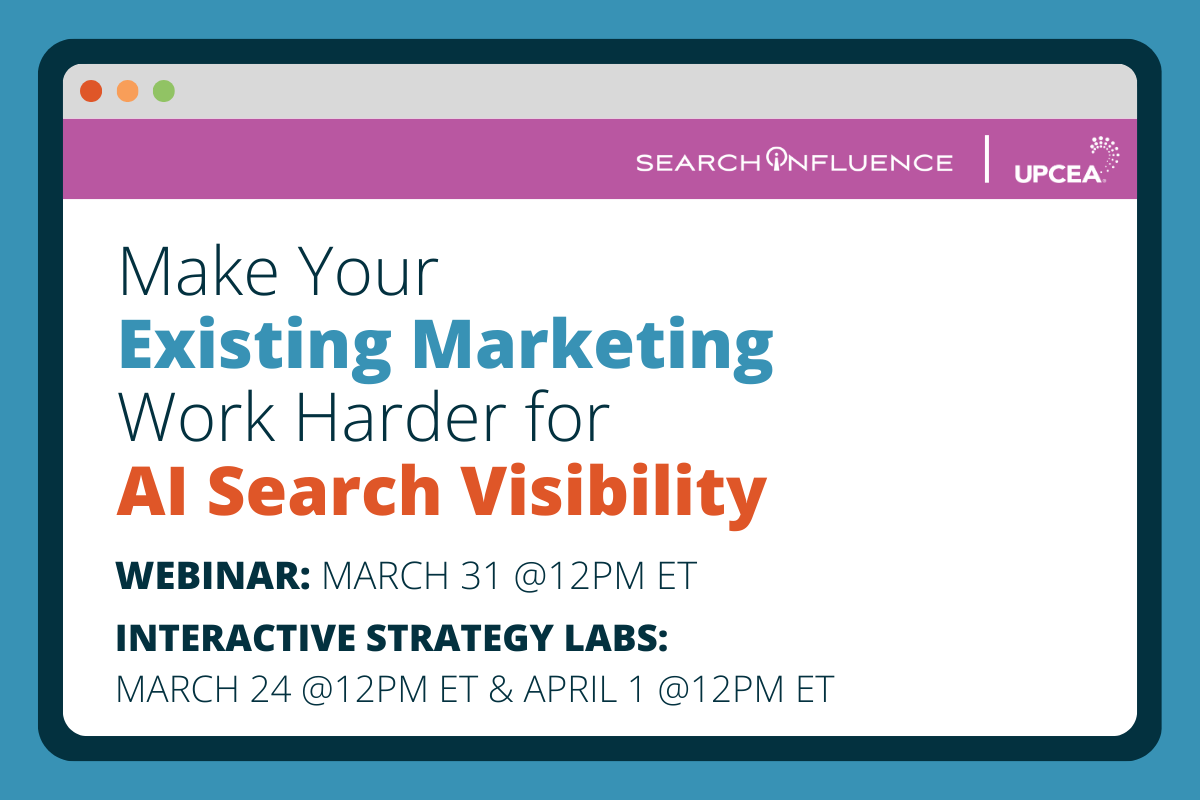
    Make Your Existing Marketing Work Harder for AI Search Visibility webinar graphic

    AI search is changing how prospective students discover programs. But building an entirely new marketing strategy from scratch isn’t realistic for most higher education teams.

    Budgets are tight, staff capacity is limited, and priorities compete for attention.

    That’s why we partnered with UPCEA for this spring’s live webinar:

    Make Your Existing Marketing Work Harder for AI Search Visibility
    Tuesday, March 24
    12 PM ET | 11 AM CT

    Your presenters: 

    • Paula French, Director of Sales and Marketing, Search Influence
    • Will Scott, CEO and Co-Founder, Search Influence
    • Emily West, Senior Market Research Analyst, UPCEA

    Why AI Search Visibility Matters for Higher Education

    AI-powered search tools are shaping discovery, oftentimes before a prospective student ever clicks your website. Platforms powered by LLMs evaluate your site, paid campaigns, PR coverage, and social media to determine what information to surface.

    When those channels operate in silos, AI tools may pull incomplete or inconsistent details. In some cases, your programs may not appear at all.

    For higher education marketers, the opportunity isn’t to rebuild everything. It’s to unify what already exists. When messaging aligns across channels, institutions increase relevance, strengthen credibility, and improve their presence in AI-driven results.

    What You’ll Learn in the Webinar

    This session is built for teams who want practical guidance they can apply immediately.

    In this live webinar, we’ll break down how to:

    • Create a consistent, credible presence across the marketing channels AI evaluates
    • Leverage existing assets to improve higher education AI search visibility
    • Strengthen trust signals so AI tools surface accurate program information
    • Reduce gaps that limit discoverability in AI-powered search

    You’ll walk away with clear steps to support your higher education AI search strategy without adding major lift to your team.

    If you’ve read our recent insights on how marketing supports SEO and AI search or explored our perspective on AI SEO for higher education, this webinar brings those concepts into focused, actionable execution.

    Save your seat now

    Go Deeper: Interactive AI Search Strategy Labs

    After the webinar, join one of our small-group Strategy Labs:

    Tuesday, March 31
    Wednesday, April 1
    12 PM ET | 11 AM CT

    Led by Will and Paula, these interactive sessions offer hands-on coaching. Bring your questions about specific programs, campaigns, or content gaps. We’ll workshop actionable recommendations to strengthen your AI search visibility and connect strategy to measurable outcomes.

    Save your seat now

    Build Visibility Without Building From Scratch

    AI search is evolving quickly. Visibility now depends on alignment across every channel AI evaluates.

    You don’t need to start over. You just need to coordinate the marketing ecosystem you already have.

    Register for the webinar and secure your place in a Strategy Lab today.

  • AI Search KPIs: Why Traffic No Longer Tells the Full Story

    AI Search KPIs: Why Traffic No Longer Tells the Full Story graphic

    Key Insights

    • Brand influence now happens before a website visit.
      Discovery and evaluation increasingly occur inside AI chat interfaces, not on your site or a traditional search engine results page.
    • Traffic reflects outcomes, not total visibility.
      Sessions show engagement, but they do not capture upstream exposure.
    • Presence and citations are leading indicators.
      Appearing in AI-generated answers and being cited as a source signal authority before traffic occurs.
    • Brand representation shapes decision-making.
      How AI systems describe your brand affects perception, trust, and competitive positioning.
    • Measurement must connect visibility to outcomes.
      AI tracking works when exposure signals and on-site performance live in the same reporting framework.

    For years, organic traffic was the clearest proof that SEO worked.

    More sessions meant more visibility. More visibility meant more opportunity. (Rank higher → earn clicks → measure results.)

    It was clean, predictable, and measurable. 

    Today, that proof is less complete.

    AI systems increasingly answer questions within their own interfaces. Users compare brands, evaluate options, and form opinions before ever visiting a website.

    Traffic still matters. But it no longer reflects the full scope of your visibility.

    This post explores:

    • Why traffic is now an incomplete KPI
    • What AI search changes about measurement
    • Which AI SEO KPIs provide clearer insight
    • How Search Influence’s dashboards report on visibility 

    TLDR: Traffic tells part of the story. The right AI search KPIs complete it.

    Traffic Used to Tell the Truth About SEO Performance

    Before generative search reshaped discovery, SEO measurement followed a straightforward assumption: visibility required a click.

    When rankings improved, traffic increased. When traffic increased, business outcomes often followed. Organic sessions became the clearest proxy for exposure and performance because users had to visit your site to consume your content.

    Why Traffic Worked as a Primary KPI

    Historically, traffic has served as a reliable stand-in for:

    • Search visibility
    • Content relevance
    • Audience demand
    • Business impact tied to on-site behavior

    Because outcomes happen on websites, traffic connected search performance to measurable results. That’s why most reporting frameworks still anchor on organic sessions and year-over-year growth.

    The structure of search has always supported that model.

    Today, however, the structure of search has changed.

    Graphical elements depicting data

    AI Search Changed the Journey Before Most Dashboards Changed

    The biggest shift isn’t that answers exist inside AI systems. It’s when influence happens.

    Consideration now starts earlier and often outside your analytics environment. By the time someone arrives on your website, they may already understand the category, recognize your brand, and have narrowed their options.

    That changes the role of the visit.

    Instead of initiating discovery, the session often confirms a decision that has already been shaped elsewhere. Users return through branded search, direct navigation, or assisted channels after AI-driven exposure has done part of the persuasion work.

    Most reporting systems still assume that influence begins when a session begins.

    Increasingly, it does not.

    The Visibility–Click Gap (And Why It’s Growing)

    The visibility–click gap is the space between being seen and being visited.

    Your brand can appear in search results, AI summaries, and comparisons, and still never generate a session. As zero-click behavior continues to rise (roughly 60% of U.S. searches end without a click), that space becomes more visible in your reporting.

    You’ve probably noticed the pattern. Impressions stay strong. Click-through rate dips. Traffic slides. Yet conversions hold steady, or even improve. Branded search volume climbs while non-branded sessions level off.

    At first, it feels like the data doesn’t line up. It does. Exposure and visits are just no longer moving in lockstep.

    Traffic Still Matters, But It’s Not the Lead KPI Anymore

    Let’s be clear: traffic didn’t stop being useful.

    Sessions still reflect real behavior. They show engagement, interest, and when someone cared enough to act.

    What changed is priority.

    Traffic used to be the headline metric. In the age of LLMs, it’s now one of several signals. It supports performance analysis, but it no longer defines search success on its own.

    What Traffic Still Measures Well

    Traffic remains strong at measuring:

    • Overall demand trends
    • Whether content resonates enough to earn a visit
    • Channel efficiency and cost performance
    • Relative performance across search, paid, referral, and direct channels

    If sessions rise, something is working. If they fall sharply, something deserves investigation.

    Traffic still provides directional insight. It just doesn’t capture the full environment where influence occurs.

    Where Traffic Under-Reports AI Search Impact

    Traffic struggles to reflect:

    • Zero-click discovery and brand exposure
    • Assisted conversions that begin outside your site pages
    • Trust-building moments that don’t register as sessions
    • How your brand appears inside AI-generated summaries

    In other words, traffic tells you who arrived.

    It doesn’t always tell you who was influenced.

    Why “Traffic Loss” Often Gets Misdiagnosed

    Today, traffic declines require context.

    Traffic can shift for several different reasons, and they don’t all point to the same problem. Before assuming visibility declined, look at the surrounding indicators:

    • Are impressions holding steady?
    • Have rankings materially changed?
    • Is branded search trending upward?
    • Are conversion rates stable or improving?

    If exposure remains strong while sessions dip, the issue may lie in how clicks are distributed rather than how often your brand appears.

    There are also cases where fewer visits align with stronger outcomes. A smaller audience arrives with clearer intent. Conversion rates improve. Revenue holds steady.

    In that scenario, traffic volume is like counting footsteps in a store. Fewer people may walk in, but if more of them buy, the business hasn’t weakened.

    Geographical shapes on a background with lights

    What AI Search Success Looks Like (If You’re Measuring It Correctly)

    AI search success expands beyond sessions and rankings.

    It reflects how often your brand appears in AI-driven answers, how accurately it’s represented, and how that exposure influences downstream behavior.

    To measure that shift, you need a broader set of KPIs alongside traditional SEO metrics.

    AI Search KPIs That Belong Next to Traffic in Your Reporting

    If traffic shows what happened after someone arrived, these KPIs help you understand what happened before that moment.

    They focus on presence, credibility, and influence inside AI-powered search and discovery environments. Instead of asking “How many people clicked?” they ask:

    • Are we showing up?
    • Are we being trusted?
    • Is that exposure shaping behavior?

    Here’s what that looks like in practice.

    AI Visibility

    Start with presence.

    When someone asks a category-level question, does your brand appear in the response at all? And does it appear consistently, or only occasionally?

    Track:

    • Frequency of brand mentions in AI-generated answers
    • Presence across platforms like Google’s AI Overviews, ChatGPT, Gemini, Perplexity
    • Visibility for high-intent, decision-stage queries
    • Trends over time, not one-off spot checks

    This metric answers a simple question: Are we part of the conversation when decisions are being shaped?

    Citation Performance

    Visibility tells you you’re included. Citation performance tells you whether your content is being relied on.

    In many AI outputs, sources are referenced directly or indirectly. When your domain is cited, linked, or clearly attributed, that signals authority.

    Track:

    • How often your domain is cited or referenced as a source
    • Whether you appear as a primary source or secondary mention
    • Competitive share of citations within the same answer set
    • Citation momentum over time

    Whereas visibility reflects participation, citation performance reflects influence.

    Brand Representation and Trust Signals

    Appearing in an answer is one thing. How your brand is described is another.

    AI systems summarize, compress, and reinterpret your content. That representation shapes perception before someone visits your site.

    Track:

    • Accuracy of brand descriptions in AI-generated responses
    • Alignment with your positioning and messaging
    • Framing and sentiment in summaries
    • Risk of misinformation or oversimplified claims

    This KPI focuses on quality, not quantity. It answers: When we show up, are we represented correctly?

    AI-Influenced Outcomes

    Exposure inside AI platforms does not always produce an immediate click. But it can influence later behavior.

    This is where visibility connects back to business impact.

    Track:

    • Engagement quality of AI-referred sessions (when they occur)
    • Assisted conversions tied to AI exposure
    • Lift in branded search following visibility spikes
    • Contribution to inquiries, leads, and pipeline movement

    This category links upstream visibility to downstream performance. Because ultimately, presence alone is not the goal. Influence is.

    Dive Deeper → How to Set Up AI Traffic Tracking in GA4

    Dive Deeper → AI SEO Tracking Tools 2026: Comparative Analysis of Over 15 Platforms

    Disclaimer: AI search measurement is evolving. AI platforms do not provide flawless attribution, and zero-click exposure often occurs outside traditional analytics reporting. The goal is not perfect precision at the interaction level. It’s consistent trend tracking across visibility and performance metrics to understand directional impact over time.

    Common Mistakes Teams Make Measuring AI Search

    Even with the right KPIs defined, measurement can still drift off course. AI search introduces new signals, but it also introduces new ways to misread performance.

    Before expanding marketing dashboards or shifting budgets, it helps to clarify what strong AI measurement actually requires. Here are some common mistakes and what to do instead.

    Mistake What to Do Instead
    Treating AI visibility like traditional rankings Track consistency of brand mentions across prompts and platforms over time.
    Over-reacting to prompt-level volatility1 Focus on directional trends, not single-answer fluctuations.
    Measuring visibility without outcomes Connect exposure to branded search lift, engagement quality, and conversions.
    Ignoring third-party and comparison ecosystems Monitor how your brand appears in listicles, directories, and cited sources.
    Making budget decisions based on traffic alone Evaluate visibility, citations, and influence alongside sessions.

    AI search performance requires a broader lens. When teams shift from ranking-based thinking to influence-based measurement, strategy becomes clearer, and decisions become more durable.

    ¹ Prompt-level volatility refers to natural variation in AI answers. Small shifts in phrasing, user context, model updates, or training data can change which brands appear in a single answer. That does not automatically signal a gain or loss in authority. Individual prompts are snapshots. Trend lines across many prompts and time periods provide a more reliable view of performance.

    How Search Influence Tracks AI Search Performance

    Impactful measurement works when visibility and outcomes are evaluated together. That requires more than a new metric. It requires a reporting structure that connects exposure inside AI systems to on-site user behavior in a consistent, repeatable way.

    Here’s how we approach it.

    AI Traffic Report (GA4)

    We begin with what is measurable inside analytics.

    AI platforms that link to external websites send referral traffic. In GA4, those sessions can be isolated and trended when configured intentionally. Our AI Traffic Report surfaces:

    • Sessions originating from known AI tools
    • Engagement quality, including time on site and pages viewed
    • Top landing pages receiving AI-driven visits
    • Conversions and downstream actions tied to AI-referred sessions

    This layer shows what AI discovery produces once a user leaves an AI interface and engages directly with your content.

    AI Visibility Tracker (Scrunch-Powered)

    Traffic tells you who arrived. Visibility tracking tells you whether your brand is part of the answer in the first place.

    Through our AI visibility tracking powered by Scrunch, we measure how AI platforms surface, cite, and describe your brand across relevant prompts. Scrunch is an enterprise AI visibility tracking platform built specifically to monitor brand presence inside generative search environments like AI Overviews, ChatGPT, Gemini, and Perplexity. It aggregates structured prompt-level data across models to deliver consistent reporting on brand presence, positioning, and competitive context over time.

    We use Scrunch to report on:

    • Prompt-level tracking across major AI platforms
    • Brand mentions and AI citation count
    • Sentiment and positioning analysis
    • Competitive share of voice
    • Content gaps and citation opportunities

    This layer captures exposure that occurs inside AI systems, including interactions that may never generate a direct session.

    Why This Lives Beside SEO Reporting

    AI visibility does not replace traditional SEO reporting. It extends it.

    By placing AI traffic data and AI visibility tracking inside the same dashboard environment, we create context:

    • Visibility trends can be evaluated alongside engagement trends
    • Citation shifts can be compared against branded search lift
    • Traffic patterns can be interpreted with upstream exposure in mind

    No single metric defines AI performance. The value comes from evaluating presence and outcomes together, consistently, over time.

    That is how AI search becomes measurable in a way that supports real strategy decisions rather than isolated data points.

    AI SEO KPI Frequently Asked Questions

    Is organic traffic still important for SEO?

    Yes. Organic traffic remains among the most important traditional SEO KPIs because it measures demand, engagement, and on-site performance. However, it no longer captures total visibility. Modern AI systems can influence awareness and decision-making before a visit occurs. Traffic should be evaluated alongside AI visibility, citations, and influence metrics for a complete view of SEO performance.

    How do AI Overviews affect click-through rates?

    AI Overviews can reduce click-through rates for some queries because they provide summarized answers directly in search results. When users receive sufficient information within the AI summary, fewer clicks may occur, even if impressions remain stable. The impact varies by query intent, industry, and whether a brand is prominently featured or cited.

    What are the most important AI search KPIs to track?

    The most important AI search KPIs measure presence, authority, and influence. These include how often a brand appears in AI-generated answers, how frequently it is cited as a source, how accurately it is represented, and whether exposure correlates with branded search lift, engagement quality, or conversion trends. Together, these metrics provide a broader view of performance than traffic alone.

    Can AI search influence conversions without sending traffic?

    Yes. AI search can influence awareness, preference, and comparison before a user visits a website. A user may encounter a brand in an AI response, then later return via branded search, direct navigation, or another channel. In this case, AI exposure contributed to the decision even though it did not generate a direct click.

    How do you measure brand visibility in AI-generated answers?

    Brand visibility in AI-generated answers is measured by tracking relevant prompts across AI models and monitoring how often the brand appears, how it is cited, and how it is described. Measurement focuses on trends over time and competitive context rather than individual responses. This approach provides directional insight into presence and authority within AI-driven search environments.

    The Bottom Line: Traffic Is a Signal, Not the Scoreboard

    Traffic still matters, and it always will.

    But in an AI search pipeline, influence often happens outside your website. Visibility, citations, and brand representation now shape decisions upstream.

    Traffic is the outcome. Visibility is the leading indicator.

    If your reporting only tracks sessions, you’re only seeing part of the picture. It’s time to measure what happens before the visit.

    Explore our analytics and tracking services, and see how we connect AI visibility and on-site performance in one reporting framework.


    Images:
    Unsplash
    Unsplash

  • Will Scott Returns to SMX Online With Generative Engine Optimization Master Class

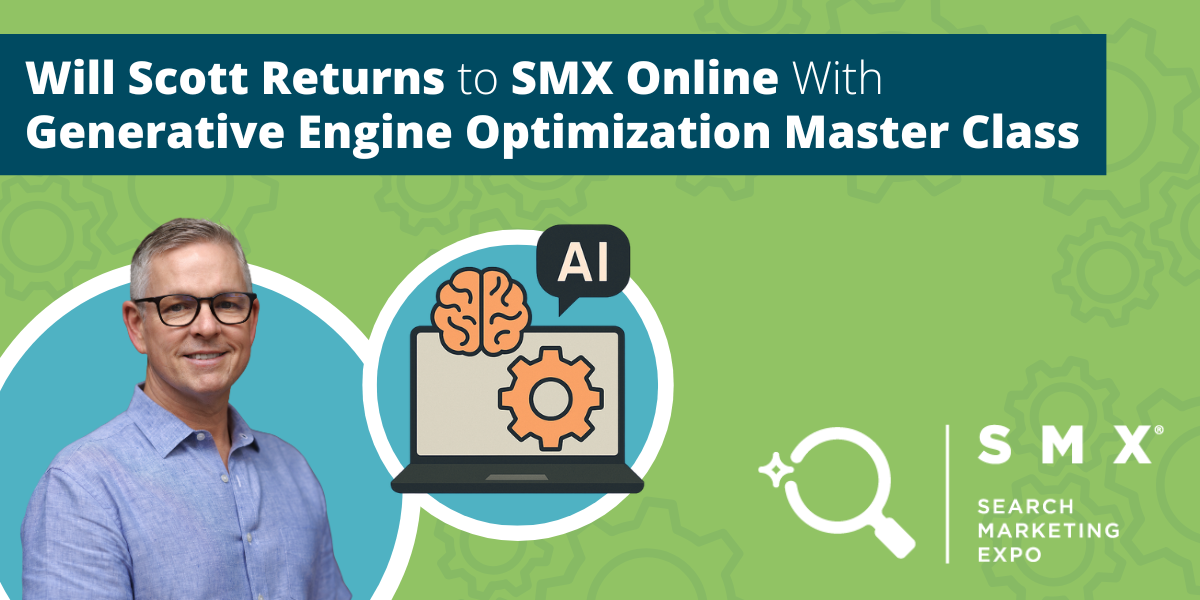
    On Tuesday, April 14, 2026, Will Scott, Co-Founder and CEO of Search Influence, returns to SMX Online to teach his Generative Engine Optimization (GEO) Master Class, the best-selling Master Class in SMX Online history.

    The live, online session runs from 11:00 a.m. to 4:45 p.m. ET and is available both live and on demand for $199.

    Designed for experienced marketers navigating AI-driven search, this intensive training delivers actionable, real-world strategies on how to stay visible as platforms like Google AI Overviews, ChatGPT, and Perplexity reshape how content is discovered.

    What You’ll Learn in the GEO Master Class

    This is not a theoretical overview of AI SEO. It’s a hands-on, tactical course that focuses on how generative engines actually retrieve, evaluate, and cite content today.

    Attendees will learn how AI platforms differ from traditional search engines and what that means for content structure, keyword strategy, and authority signals. The course dives into creating content that works for humans and machines alike, including entity optimization, formatting for AI extraction, and writing in a way that earns citations in AI-generated answers.

    Will also explores how keyword strategy has evolved in an AI-first world, shifting from static phrases to conversational, intent-driven language. Competitive analysis also plays a key role, with practical exercises that show how to evaluate which brands are winning AI visibility and why.

    Rounding out the day are sessions on measuring AI visibility, tracking performance across platforms, and future-proofing your content strategy as generative search continues to evolve.

    Who Should Attend

    The Generative Engine Optimization Master Class is built for SEO professionals, content strategists, and digital marketers with 2–5 years of experience who are ready to expand beyond traditional optimization. It’s especially valuable for agency marketers, in-house teams managing complex websites, and leaders responsible for long-term content strategy.

    If you’re already strong in SEO fundamentals but need clarity on how AI is changing rankings, visibility, and brand authority, this course is designed for you.

    Meet AI SEO Expert Will Scott

    Will Scott is a recognized authority in SEO and AI-driven content strategy and a longtime advocate for adapting marketing to how search actually works. He is widely known for coining the term “barnacle SEO” and has been a featured speaker at industry events, including PubCon, SMX, and Local U.

    Will leads the Search Influence team in delivering AI-enhanced, data-driven SEO strategies for industries such as higher education, healthcare, and hospitality. With a degree in architecture from Tulane University, he blends strategic systems thinking with practical execution, making complex concepts actionable for marketers.

    Save Your Seat

    Generative search is no longer optional knowledge. It’s the foundation of future visibility. If you want to understand how AI platforms select sources, summarize content, and decide which brands get cited, the GEO Master Class is built to give you that edge.

    Register now for the Generative Engine Optimization Master Class on April 14, 2026, and learn how to optimize for AI SEO performance.

    Get in touch for our super-secret 15% discount code.

  • Search Influence SEO: Powering Your Visibility in AI and Your Enrollment Growth

    Search Influence SEO: Powering Your Visibility in AI and Your Enrollment Growth

    Search Influence SEO Powering Your Visibility in AI and Your Enrollment Growth graphic

    Key Insights

    • Student discovery now happens across multiple channels and moments, not a single search engine. Prospects move fluidly between platforms, which means visibility must extend across every place they form early impressions.
    • AI summaries are becoming the new first impression for many learners. With 79% reading AI Overviews, institutions must ensure AI tools surface accurate, compelling information about their programs.
    • Most institutions recognize AI’s impact but lack the structure to act on it. Bandwidth, expertise, and unclear ownership are keeping teams from implementing consistent, repeatable AI search strategies.
    • Foundational SEO directly fuels AI visibility, accuracy, and trust. Structured content, semantic clarity, and authoritative signals shape how search engines and generative tools interpret and cite your institution.
    • Search Influence’s SEO framework is built for the intersection of rankings, AI summaries, and enrollment outcomes. Our approach unifies semantic SEO, AI visibility tracking, and full-funnel analytics to help institutions stay competitive across every modern discovery surface.

    Prospects aren’t following a straight line to your programs anymore. They’re bouncing between Google, AI, YouTube, and university websites depending on what they need in the moment.

    Some want quick clarity. 

    Some want more depth. 

    All expect quick answers to their questions, wherever they look.

    That’s why SEO now operates as the connective tissue across every discovery channel. It strengthens the signals that help Google rank you, AI tools describe you, and students recognize you early on.

    Search Influence’s SEO approach is built for this reality, where traditional search, AI-driven discovery, and enrollment outcomes converge. Here’s a closer look at the new search playing field, plus how our team keeps your programs at the forefront of the conversation.

    How Prospective Students Search Today

    After years of predictable search behavior (primarily with Google), student discovery has become far more multi-channel.

    To understand how prospects search today, UPCEA and Search Influence conducted AI Search in Higher Education: How Prospects Search in 2025, a study surveying 760 adults exploring professional and continuing education (PCE) programs. The responses provide a clear view of the platforms learners rely on as they compare options and develop early awareness.

    When searching specifically for information about programs and degrees:

    • 84% use search engines
    • 61% use YouTube
    • 50% use AI tools

    Instead of following one path, students build context from multiple places (i.e, search results, videos, AI answers, and university pages), depending on what helps them understand the basics, compare details, or evaluate a brand’s presence.

    AI search now shapes first impressions

    As prospects move between channels, AI often becomes the place where they check their understanding or look for a quick comparison. The AI Search Research Study found that:

    • 79% read Google’s AI Overviews
    • 56% trust the brands cited by AI

    Those two behaviors matter even more in the broader context of student decision-making. Industry research shows that 67% of learners start with a consideration set of three schools or fewer. That means most prospects narrow their options early, and AI-generated summaries increasingly influence who earns a spot in that small set.

    If AI tools cite your institution in response to user queries, you stay visible in those early moments of interest. If your presence is weak or inconsistent, competitors fill the gap, often before a prospect reaches your website.

    Most Institutions Have Opportunity With AI Search

    Even as AI becomes a bigger part of how prospects form early impressions, many colleges and universities are still figuring out how to respond. To understand where teams stand today, UPCEA conducted the AI Search Strategy in Higher Education Snap Poll in October 2025, surveying 30 members about their readiness and efforts.

    The results show a clear opportunity: Most institutions recognize the importance of AI search, but few have the structure or processes to act on it consistently.

    Awareness is high, execution is thin

    Across the surveyed members, interest in AI search was largely widespread, but most teams have not yet fully implemented it. Many are still figuring out how AI fits alongside SEO, online advertising, email marketing, analytics, and their broader digital marketing mix.

    According to the poll:

    • 60% are exploring AI search but haven’t implemented tactics
    • 30% have a formal AI search strategy
    • 10% haven’t begun planning or don’t believe AI will influence program discovery

    This gap between awareness and activation is where many institutions are feeling the pressure. AI is evolving quickly, but internal processes and resources haven’t caught up.

    The barriers are structural

    For the institutions that haven’t formalized an AI search strategy, the obstacles are operational. Surveyed members cited the following limitations:

    • Bandwidth: Competing priorities leave little time to evaluate AI search needs.
    • Expertise: Many teams aren’t yet confident in how AI intersects with SEO, content, or analytics.
    • Capacity: Even with interest, there often isn’t enough staff to take on new frameworks or governance models.
    • Uncertainty about ROI: Leaders want clearer evidence of impact before committing resources.

    The challenge isn’t a lack of intent. It’s the internal constraints that make it difficult to build something consistent, repeatable, and owned across teams.

    Many institutions don’t know if they show up in AI

    Another challenge highlighted in the poll is the uncertainty around AI visibility itself. Many teams simply aren’t sure how their institution appears (or if it appears) in AI-generated responses.

    When respondents were asked whether their institution shows up in AI answers:

    • 56.7% said yes
    • 26.7% said maybe
    • 13.3% were unsure

    Even among those who track their presence, only 64.29% use structured or formal methods. Most rely on manual spot checks or individual queries, which makes it difficult to understand accuracy, consistency, or how visibility changes over time.

    This ambiguity makes it harder to know whether AI tools are surfacing the right details about your programs, faculty, tuition, or modality.
    A white robot with a google logo

    Foundational SEO Fuels AI Visibility and Enrollment Growth

    With student discovery spreading across more surfaces, one truth becomes clear: Your programs can’t earn consideration if they aren’t visible when and where prospects look.

    This is where strong foundational SEO becomes your strategic advantage. It strengthens the signals that influence both your traditional rankings and your presence in AI-generated summaries, the same summaries prospects increasingly use to form their first impressions.

    Visibility won’t close an inquiry on its own, but it gives your programs a seat at the table.

    Traditional SEO + AI SEO work together

    A common misconception is that AI search exists outside the world of SEO. In reality, AI systems depend on the same structured, authoritative content that drives strong organic rankings.

    AI tools pull from the information available in the Google index and other trusted sources. If your pages lack clarity, structure, or credibility signals, AI systems have less to retrieve and summarize.

    • Weak SEO leads to missing citations, outdated or incomplete details, and entity signals that are too thin for AI tools to interpret confidently.
    • Strong SEO increases the likelihood that your programs appear accurately in both search results and AI-generated answers, which boosts trust early in a learner’s process.

    When marketers think about SEO and AI visibility as intertwined rather than separate tracks, the work becomes more streamlined and more impactful.

    The three forces that make or break AI visibility

    Our Co-Founder and CEO, Will Scott, often summarizes what AI-ready SEO requires with a simple, three-part framework:

    • Structure it.
    • Chunk it.
    • Distribute it.

    This framework is what turns your website into content AI can reliably read, segment, and reuse.

    Structure: Semantic SEO and the Knowledge Graph

    AI systems and search engines rely on semantic clarity to understand how your institution, programs, faculty, and credentials relate to one another. Structuring your content strengthens the signals that feed the Knowledge Graph, the database of entities and relationships that both Google and AI models use to interpret meaning.

    To structure your content, focus on:

    • Entity clarity: making program names, modalities, credentials, costs, and outcomes explicit and consistent across your site.
    • Schema markup: providing machine-readable context that reinforces those details and anchors them to recognized entity types.
    • Semantic triples: defining “who you are,” “what you offer,” and “who you serve” in a format AI systems can parse, store, and reuse.

    When your content is structured this way, AI tools are far better equipped to retrieve accurate information about your institution and surface it in Overviews, summaries, and comparison answers.

    Chunking: AI-readable content architecture

    AI models don’t scan a page top-to-bottom the way a human does. They break content into discrete “chunks,” or self-contained sections that they can classify, interpret, and reuse. The clearer those chunks are, the more reliably AI systems can surface accurate information about your programs.

    To chunk your content, focus on:

    • Short, intentional sections: focused paragraphs that keep each idea or task confined to one area.
    • Intent-aligned headers: descriptive headings that signal exactly what the section explains or answers.
    • FAQ-style responses: direct, self-contained answers to common queries that AI models can retrieve cleanly.
    • Scannable program pages: layouts that separate outcomes, costs, modality, and requirements into distinct, easy-to-parse segments.

    Done right, chunked content helps AI models lift and reuse the right information without guessing at context. It also improves the human experience, making pages easier to navigate, helping prospects stay longer, and supporting the engagement metrics that strengthen organic visibility.

    Distribution: Expanding your entity footprint across the web

    Even with strong on-page structure and clear content chunks, AI models still look for validation beyond your website. The more your institution appears across credible sources, the easier it is for AI systems to “trust” you and surface you in summaries and comparisons.

    To distribute your content, focus on:

    • Links: trusted sites pointing to your pages, strengthening authority signals that both search engines and AI models rely on.
    • Citations: brand mentions across third-party platforms (even without a link) that reinforce relevance within your field or topic area.
    • Barnacle SEO: placing your programs on high-authority sites that already rank for the terms your audience searches for. By “attaching” to these strong surfaces, you benefit from their visibility.
    • Faculty and program presence: profiles, publications, and features that broaden the network of entities connected to your institution.

    While university domains are generally strong, individual programs or schools often lack the external authority signals needed for AI visibility, which is why building these signals remains an essential part of the work.

    How Search Influence’s SEO Solves the AI Visibility Challenge

    Higher ed teams need visibility that performs across the full funnel: in rankings, AI summaries, paid surfaces, and every point where prospects compare programs.

    That’s the environment we build for.

    Search Influence combines long-standing SEO expertise with modern AI-driven search strategies, digital advertising, website optimization, and lead tracking. As a New Orleans–based digital marketing agency serving institutions nationwide, we focus on ROI-driven execution: reaching the right audience, developing strategies that scale, and using the right metrics to show what’s working.

    Recognized leaders in SEO, AI search, and higher education strategy

    We pair two decades of SEO leadership with a leading role in AI search innovation. As an UPCEA Platinum Partner and early mover in AI SEO/GEO (generative engine optimization), we help institutions stay visible as search behavior evolves.

    What differentiates our team:

    • Nearly 20 years of SEO success across higher education, healthcare, tourism, and beyond.
    • First-mover expertise in AI search, including entity optimization and AI-ready content modeling.
    • Industry research leadership, through the AI Search in Higher Education Study, Marketing Metrics Research Study, and the SEO Readiness Research Study.
    • National thought leadership, with frequent speaking roles on SEO, GEO, AI visibility, and enrollment strategy.
    • Deep technical and content strength, from semantic SEO to website optimization and competitive analysis.
    • A full-funnel, ROI-focused digital approach that integrates SEO, paid ads, analytics, and targeted advertising to support both discovery and conversion.

    This combination helps institutions strengthen their presence, outpace competitors, and achieve visibility where decisions begin.

    Full-service, hybrid, or consulting: three ways to work with us

    Every institution’s structure is different. Some need a full agency partnership. Others want a hybrid model that supports their in-house marketing team. Others prefer consulting to level up staff and refine direction.

    We offer all three:

    • Full-service visibility strategy: We manage SEO/AI SEO strategy, execution, and evaluation. That means we plan, write, and implement content on your site. We also identify and secure citations, and we write content for social media that supports your AI search visibility.
    • Hybrid execution: Our team collaborates with yours, sharing responsibilities while keeping strategy, priorities, and performance tightly aligned. We handle strategy and performance evaluation. The execution is shared between your team and ours, depending on your strengths and capacity. We hold you and your team accountable for the completion of SEO projects to deliver results.
    • SEO & marketing consulting: We deliver expert, actionable guidance for institutions that want a clear roadmap for what to do and how to do it. Your team receives training and coaching. You get a partner for questions to help your team execute and learn first-class AI SEO.

    Each model gives you flexibility, strategic alignment, and transparency around performance. And if you’re unsure which option fits your structure, our Higher Ed SEO In-House vs. Outsource Quiz helps you assess your needs and internal bandwidth.

    Comprehensive AI visibility tracking

    Most institutions don’t have a reliable way to measure how they appear in AI-generated answers or how that visibility affects traffic and inquiries. Our tracking framework closes that gap by giving teams a clear view of performance across AI search, Google, and the full enrollment funnel.

    • AI Traffic Report (GA4): Connects AI-influenced behavior to site traffic and engagement so you can see how visibility supports inquiry movement using the right metrics.
    • AI Visibility Tracker (Scrunch-powered): Monitors where and how your institution appears in AI summaries, citations, and comparisons.

    This gives higher ed marketers the clarity they need to understand how AI contributes to discovery and where opportunities exist to drive visibility across the funnel.

    A push pin getting put into a map

    Strengthen Your AI Search Visibility With Search Influence’s SEO Roadmap

    Institutions often know they need stronger visibility across Google and AI search, but they aren’t sure where to start, or how to make progress without adding new workload to an already stretched team. Our SEO Roadmap gives you a clear, actionable plan built for today’s discovery environment, one where rankings, AI summaries, and enrollment outcomes all influence one another.

    It’s a quick, low-risk way to evaluate your current position, identify the highest-impact opportunities, and show leadership what’s possible with the right strategy. (P.S. You can purchase through an online checkout – no contracts to run through legal!!)

    What the SEO Roadmap helps you uncover

    Keyword strategy

    A clear view of what prospects search, where you appear today, and the opportunities you’re missing.

    Content strategy

    Specific updates to strengthen existing pages, gaps to fill with new content, and formats that perform well in both rankings and AI-generated summaries.

    Technical SEO improvements

    Site limitations, experience blockers, and structural fixes that influence visibility, crawlability, and AI interpretation.

    Authority & link building

    The external signals that matter most: profiles, directories, citations, and placements across trusted surfaces that boost credibility with search engines and AI tools.

    When an SEO Roadmap is right for you

    • You’re concerned about how AI impacts visibility and early consideration.
    • Your team lacks bandwidth or dedicated SEO expertise.
    • New programs are launching and need fast, authoritative visibility.
    • Leadership wants clearer proof points before expanding investment.
    • Organic performance is stagnating or declining.
    • You’re paying for SEO tools but don’t have capacity to fully use them.

    The Roadmap is designed to give higher ed marketers clarity, direction, and momentum, especially when internal teams are balancing competing priorities and evolving expectations.

    Case Study: AI-First SEO Fuels Enrollment in a Crowded Market

    Maine College of Art & Design (MECA&D) came to us with a challenge many institutions recognize: launching new online programs in a competitive market where larger universities already dominate visibility. They needed search and AI recognition quickly, both to build awareness and to compete for early consideration.

    The strategy

    We focused on building the authority, clarity, and structure that AI tools and search engines rely on:

    Visibility & authority signals

    • Restructured academic content
    • Strengthened semantic and entity signals
    • Prepared high-value pages for AI citation

    Conversion & user pathway improvements

    • Updated on-page messaging
    • Added program videos
    • Improved research and navigation pathways

    Content development

    • Keyword-driven blogs
    • Instructor spotlights
    • High-salience academic pages

    Together, these updates created a strong ecosystem of signals that both humans and AI systems could interpret consistently.

    The results

    MECA&D saw rapid, measurable growth in visibility and enrollment outcomes:

    • 77% above enrollment goal
    • 3,894% increase in ranking keywords
    • 171% increase in website sessions
    • Programs now appearing in AI search
    • Named a US Agency Awards 2025 Finalist for Best SEO Campaign

    Frequently Asked Questions

    What makes Search Influence’s SEO effective in AI search?

    Search Influence’s SEO is effective in AI search because it is grounded in continuous testing, applied expertise, and real performance data across evolving AI systems.

    Rather than chasing isolated tactics, we study how large language models and generative search engines interpret, summarize, and cite institutional content. Our team validates SEO decisions through structured experimentation, longitudinal analysis, and AI visibility tracking, allowing us to refine strategies based on what consistently improves authority, clarity, and citation likelihood.

    The result is SEO built on evidence, not assumptions, that helps institutions earn stronger visibility in rankings, AI summaries, and early-stage discovery.

    How does AI SEO differ from traditional SEO for higher education?

    AI SEO builds on the foundation of traditional SEO by optimizing your content for how generative tools interpret, segment, and reuse information.

    Traditional SEO focuses on rankings, keywords, backlinks, and on-page experience. AI SEO adds layers of semantic clarity, entity relationships, structured data, and chunked content that allow AI tools to retrieve accurate details about your programs. Institutions that strengthen both are better positioned across the full discovery journey.

    Can generative AI tools replace SEO work?

    Generative AI tools like ChatGPT, Claude, and Gemini can support tasks such as keyword research, content ideation, and early drafting, but they cannot replace the strategic work of an SEO specialist.

    SEO requires technical expertise, structured content planning, competitive analysis, governance, and ongoing optimization, all areas where AI still cannot make informed decisions or evaluate impact. AI accelerates parts of the workflow, but the strategy, accuracy, and prioritization must come from an experienced SEO team.

    How does Search Influence track visibility across AI platforms?

    Search Influence tracks AI visibility using a combination of GA4-based traffic analysis and Scrunch-powered citation monitoring to capture how your institution appears in summaries, answers, and comparisons.

    We measure prompt-level behavior, accuracy of surfaced program details, competitive presence, and shifts over time. Together, these tools demonstrate how AI impacts discovery, how students encounter your information, and where further optimization can enhance your visibility.

    Why does SEO directly impact enrollment growth in an AI-driven search journey?

    Search behavior has changed. Prospective students increasingly rely on search engines, AI summaries, and comparison tools to shape their first impressions, and institutions that are not visible in these environments are simply excluded from consideration.

    SEO directly impacts enrollment growth because it determines whether your programs appear during these early decision moments. When your information is structured, authoritative, and accessible to AI systems, you enter the consideration set sooner. Strong SEO strengthens visibility, reinforces credibility signals, attracts qualified prospects, and supports the full enrollment funnel from discovery through inquiry.

    Secure Your Competitive Edge Across Search and AI

    Visibility gaps in search and AI don’t fix themselves. They widen over time, especially as students rely more heavily on AI summaries and comparison tools.

    Our SEO Roadmap shows you how to close those gaps with targeted updates to content, structure, authority, and tracking. It’s built for teams who need clarity, quick wins, and a strategy that leadership can confidently support.

    Take the next step toward stronger rankings, stronger AI performance, and stronger enrollment outcomes. Reserve your SEO Roadmap today.


    Images:

    Unsplash
    Unsplash

  • UPCEA MEMS 2025 Recap: 11 Higher Ed Marketing Presentations That Show Where We’re Heading

    This review was created with AI assistance and human guidance from Will Scott, AI SEO Expert and CEO of Search Influence.

    TL;DR: The UPCEA MEMS 2025 conference made one thing clear: AI isn’t coming to higher education marketing. It’s here. And institutions that aren’t actively optimizing for AI search, building integrated marketing systems, and using data to drive decisions are already falling behind.

    Here’s what we learned from 11 presentations that are reshaping how institutions connect with students.

    The Big Picture

    So, we just got back from MEMS 2025, UPCEA’s Marketing and Enrollment Management Summit, and the theme was impossible to miss.

    AI is fundamentally changing how students discover and evaluate educational programs.

    Not “might change.” Not “will change eventually.”

    It’s happening now.

    The conference brought together marketing and enrollment professionals from institutions across higher education, and what struck us was how many presenters were sharing real implementations, not theoretical frameworks. We’re past the “what if” stage. We’re in the “here’s what works” stage.

    Throughout 11 presentations, three themes kept coming up:

    1. AI search visibility is the new SEO — and most institutions are missing it
    2. Integration beats silos — successful strategies span channels and touchpoints
    3. Data only matters if it drives action — too many institutions collect without implementing

    Let’s break down what we learned from each session.

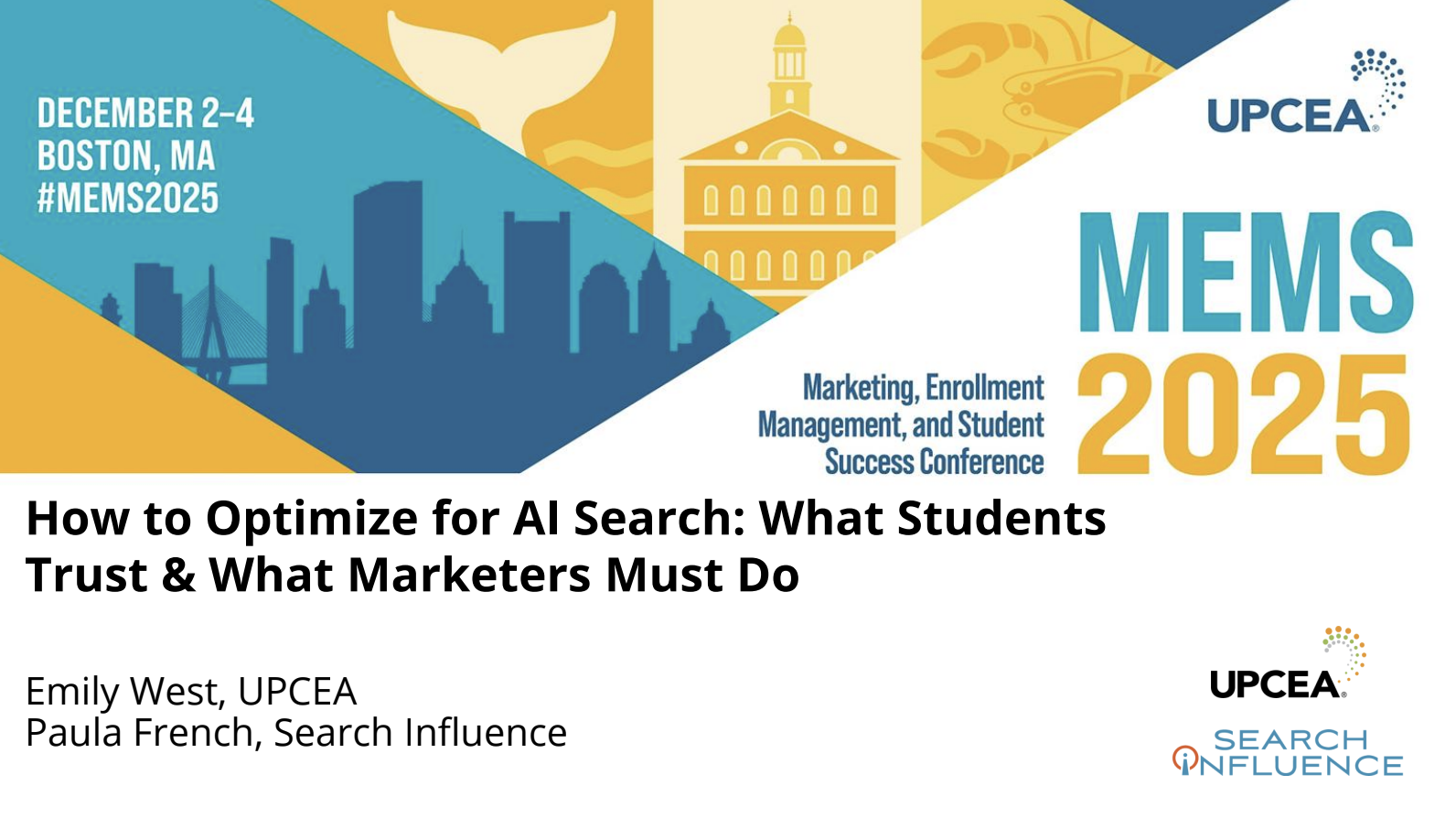
    1. How to Optimize for AI Search: What Students Trust & What Marketers Must Do

    Presenters:

    Emily West and Paula French opened with research that cuts through the speculation.

    The Data:

    • 1,061 individuals surveyed
    • 760 met the qualification criteria
    • One of the largest datasets on student search behavior in the AI era

    What This Means:

    The presentation revealed which search platforms students actually trust and how they perceive AI-driven results. The answer isn’t what most institutions assume.

    The Finding That Stopped Everyone:

    During the Insights & Innovation session (UPCEA’s industry insights presentation), a statistic was mentioned that should prompt every higher education marketer to pause: University websites appear in only 3% of AI Overviews.

    Let that sink in.

    Students are using AI search. AI is generating answers. And institutional websites are barely showing up.

    Students use different platforms for different purposes. They place varying levels of trust in AI-generated results versus traditional search. And they’re developing new research patterns that institutions need to understand.

    The Actionable Part:

    West and French didn’t just present data. They shared strategies for:

    • Creating content that AI systems actually cite
    • Building authority that makes AI search engines trust your institution
    • Understanding the nuanced ways students use AI tools, search engines, and university websites

    The Bottom Line:

    If you’re not thinking about AI search visibility, you’re already behind. The opportunity gap is massive, and it’s only getting wider.

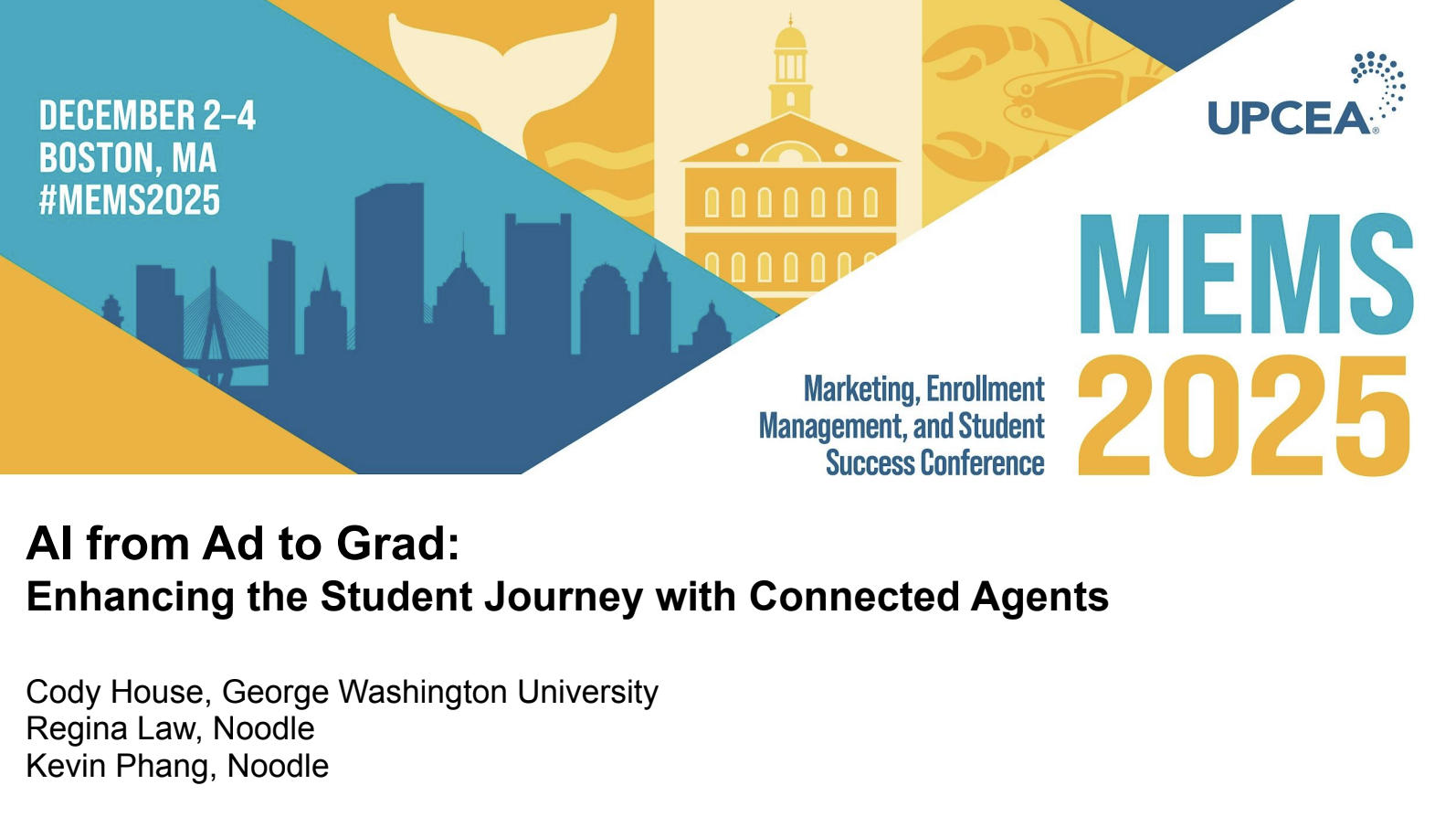
    2. AI from Ad to Grad: Enhancing the Student Journey with Connected Agents

    Presenters:

    This session changed how we think about AI in higher education.

    Most institutions treat AI as a point solution — maybe for chatbots, maybe for content generation. But GWU and Noodle showed something different.

    The Concept: Connected Agents

    Rather than isolated AI tools, they’re building AI systems that work together across the entire student journey, from first advertisement to graduation.

    Consider this: An AI agent that assists with initial inquiries shares context with the enrollment agent, which in turn shares context with the student success agent. Each interaction builds on the last.

    Why This Matters:

    The session’s title, “AI from Ad to Grad,” captures the scope. This isn’t about optimizing one touchpoint. It’s about creating a seamless, intelligent experience that follows students throughout their entire journey.

    The Practical Applications:

    The presentation explored how institutions can:

    • Create AI systems that anticipate student needs rather than just respond
    • Build integrated ecosystems instead of point solutions
    • Develop partnerships that enable comprehensive AI implementation

    The Takeaway:

    AI works better when it’s connected. Isolated tools create isolated experiences. Connected agents create momentum.

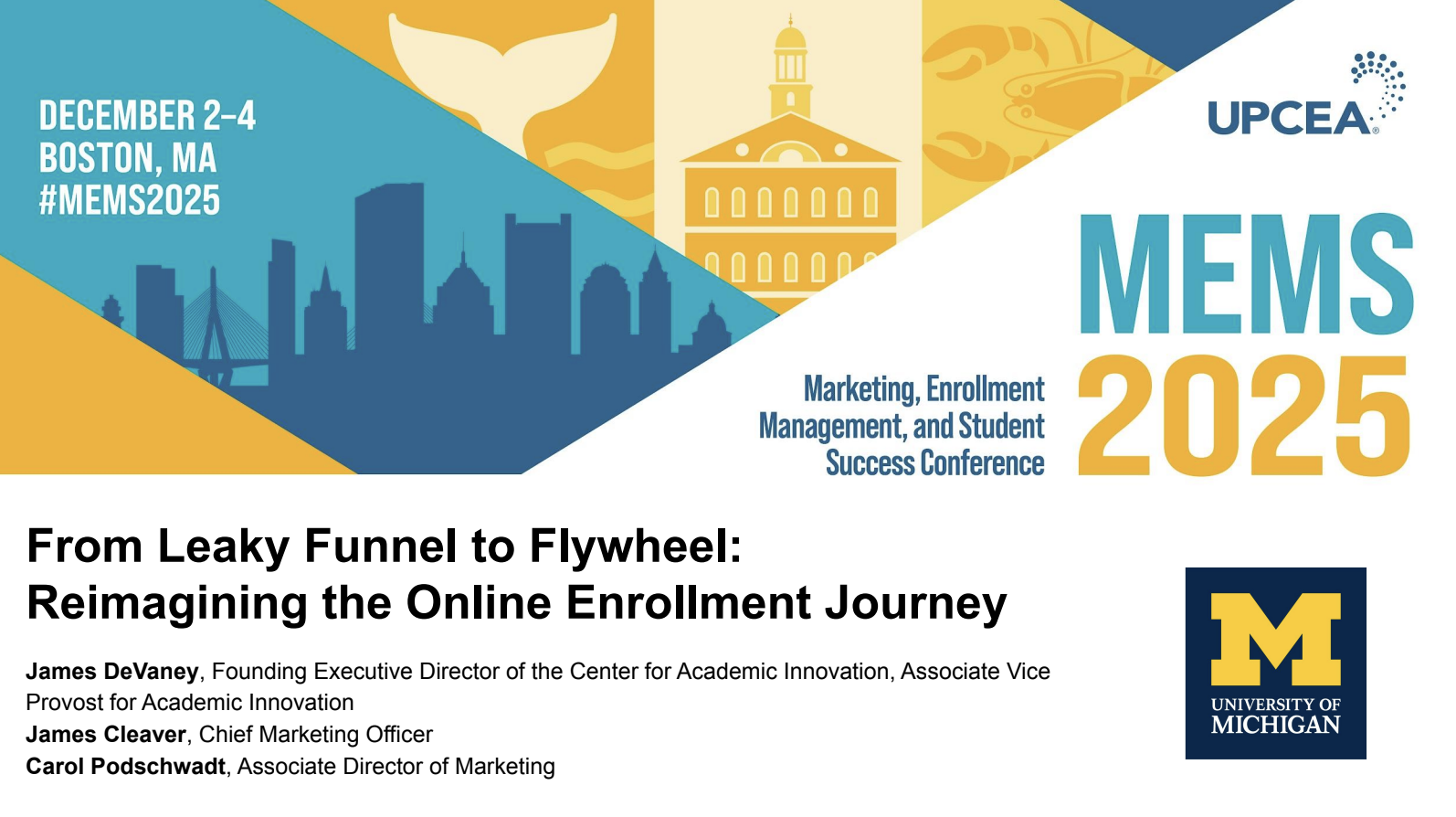
    3. From Leaky Funnel to Flywheel: Reimagining the Online Enrollment Journey

    Presenters:

    This might have been the most conceptually transformative session of the conference.

    The Problem With Funnels:

    The University of Michigan team made a compelling case: The traditional funnel model is fundamentally flawed for modern enrollment.

    Funnels are leaky. They’re one-way. They require constant input of new marketing dollars.

    The Flywheel Alternative:

    Instead, they proposed a self-reinforcing system:

    • Satisfied students create success stories
    • Success stories attract more students
    • More students create more success stories
    • The momentum builds on itself

    This isn’t semantics. It’s a complete reimagining of how institutions approach enrollment.

    The Real-World Proof:

    What made this session powerful: U-M has actually implemented this. They shared real examples of how the flywheel model works in practice.

    The Framework:

    1. Build systems where student success creates marketing momentum
    2. Reduce dependency on constant new marketing spend
    3. Create self-sustaining enrollment cycles

    Why It Works:

    Instead of constantly chasing new prospects, institutions can build systems that naturally attract and convert students while improving the experience for current students.

    The flywheel compounds. The funnel just leaks.

    4. DIY Digital: In-House Strategies That Scale — From Startup to Powerhouse

    Presenters:

    One of the most practical sessions came from two powerhouse institutions sharing their journeys.

    The Question Every Institution Faces:

    When do you outsource marketing? When do you build in-house?

    Purdue and Florida provided frameworks for making that decision, and more importantly, guidance on transitioning between models.

    The Honest Assessment:

    Both teams spoke from experience about the benefits of in-house operations. But they were refreshingly honest about the challenges and trade-offs.

    This wasn’t a sales pitch. It was a balanced exploration of how to scale from startup-level operations to powerhouse marketing teams.

    The Decision Framework:

    1. Assess your institutional needs
    2. Evaluate vendor vs. in-house capabilities
    3. Plan transitions that don’t disrupt operations
    4. Build internal capabilities while maintaining quality

    The Key Insight:

    There’s no one-size-fits-all answer. However, there are frameworks available to help you make the right choice for your institution’s unique situation.

    5. From Click-Chasing to Trust-Building: The AI Marketing Shift

    Presenters:

    This session addressed one of the most fundamental shifts in marketing today.

    The Old Playbook:

    Optimize for clicks. Maximize conversions. Track immediate ROI.

    The New Reality:

    In an AI-driven landscape, that playbook doesn’t work the same way.

    AI systems prioritize authoritative, trustworthy content. They recognize long-term value over quick conversions. They build on relationships, not transactions.

    The Shift:

    The title says it all: “From Click-Chasing to Trust-Building.”

    Success isn’t measured just in clicks and conversions. It’s measured in how institutions are perceived by:

    • AI systems
    • Search engines
    • Prospective students (who are increasingly sophisticated about evaluating marketing messages)

    The Strategy:

    Build long-term trust, authority, and value. Create content that AI systems recognize as reliable. Focus on relationships that extend beyond the initial inquiry.

    The Bottom Line:

    Click-chasing is a short-term game. Trust-building is how you win in the AI era.

    6. Insights & Innovation: Strategic Perspectives from UPCEA’s Trusted Corporate Partners

    Presenters:

    • Will Scott, Search Influence
    • Tracy Kreikemeier
    • Shauna Cox
    • Jennifer Blassingame

    (Full disclosure: This is our group session, so we’re recapping what we presented.)

    Session Focus: Are You Showing Up? How to Track Visibility in AI Search

    The Problem:

    Most institutions have a critical gap in their analytics: Traditional SEO tracking doesn’t capture AI Overviews, AI-generated answers, or how institutions appear in AI-powered search experiences.

    The Question:

    How do you know if your institution is actually appearing in AI search results?

    The Challenge:

    You can’t optimize for what you can’t measure. And traditional analytics tools weren’t built for the AI search landscape.

    The Solution:

    We shared tools and strategies specifically designed for monitoring AI search presence. The goal isn’t just knowing whether you’re showing up — it’s understanding how you’re appearing and in what contexts.

    The Framework:

    1. Track visibility in AI search results (tools that traditional analytics miss)
    2. Understand AI Overviews and their impact
    3. Monitor AI search presence across platforms
    4. Position your institution to appear in AI-generated results

    The Actionable Part:

    This isn’t just about SEO in the traditional sense. It’s about understanding how AI systems evaluate and surface content, and how institutions can position themselves to be included.

    The Tools:

    Several AI SEO tracking platforms are available now. The tracking piece is becoming a commodity — the value is in what platforms do with that data.

    The Takeaway:

    If you’re not tracking AI search visibility, you’re flying blind. And you can’t optimize what you can’t see.

    7. Designing with Data: Using Surveys and Stories to Shape Online UX + ROI

    Presenters:

    • Auris Calvino, Associate Director of Online Marketing and Communications
    • Lindi Ragsdale, Associate Director of Online Data, Technology, and Operations

    This session addressed one of the most common problems in higher ed marketing.

    The Gap:

    Institutions collect student feedback. But do they actually act on it?

    The session opened with a provocative question: “How confident are you that your institution is acting on student feedback and not just collecting it?”

    The Problem:

    Survey fatigue. Data that sits unused. Feedback that doesn’t drive change.

    The Solution:

    Combine quantitative survey data with qualitative stories. Use data to inform UX decisions that actually improve outcomes.

    The Framework:

    1. Collect both quantitative and qualitative data
    2. Bridge the gap between collection and implementation
    3. Create systems where feedback drives continuous improvement
    4. Measure ROI through data-driven design

    The Key Insight:

    Measuring and improving ROI requires both:

    • Quantitative rigor (Ragsdale’s data and technology background)
    • Qualitative insights (Calvino’s marketing and communications role)

    The Takeaway:

    Data is only valuable if it drives action. Too many institutions collect without implementing.

    8. In Marketing, Evolution isn’t Optional: Getting Ahead in an AI-driven World

    Presenters:

    West and Gonzalez presented findings from their 2025 research study.

    The Data:

    • 99 marketing and enrollment professionals surveyed
    • 62 met the qualification criteria
    • Insights into how institutions are responding to the AI revolution

    The Finding:

    61% of respondents say their institution is receptive to emerging technologies.

    That’s up from just 40% in 2024.

    What This Tells Us:

    Institutions are recognizing the need to evolve. The question is whether they’re actually implementing change or just acknowledging the need.

    The Trends:

    The research revealed emerging trends in higher education marketing and enrollment management, showing how institutions are adapting (or struggling to adapt) to new technologies.

    The Gap:

    There’s a difference between recognizing the need to evolve and actually implementing change. The study explored that gap.

    The Actionable Insights:

    The presentation translated findings into actionable insights for institutions looking to get ahead rather than just keep up.

    The Bottom Line:

    Evolution isn’t optional. But recognition without implementation doesn’t count.

    9. From Search to Success: Integrating SEO and Email Marketing to Drive Enrollment

    Presenters:

    • Tim Grenda, SEO and Content Manager
    • Caitlin Dimalanta, Marketing Communications Specialist

    This session addressed one of the most common problems in digital marketing: silos.

    The Problem:

    SEO and email marketing are often managed separately. They operate in isolation. They don’t work together.

    The Solution:

    Integrate SEO and email marketing strategies into cohesive campaigns.

    The Framework:

    1. Break down channel silos
    2. Create campaigns that span search and email
    3. Repurpose search-optimized content through email
    4. Use email engagement data to inform SEO strategy

    The Synergy:

    Content optimized for search can be extended through email. Email engagement data can inform SEO strategy. The channels work better together than apart.

    The Takeaway:

    Integration beats isolation. Every time.

    10. Boosting SEO & Engagement Through Testimonial-Driven Web Content

    Presenters:

    This session addressed one of the most effective but underutilized content strategies.

    The Strategy:

    Leverage student and alumni testimonials for both SEO and engagement.

    The Balance:

    Many institutions struggle with this: How do you optimize for search while maintaining authenticity?

    The Answer:

    Authenticity and search optimization aren’t mutually exclusive. In fact, authentic student stories often perform better because they naturally include the language and questions that prospective students are searching for.

    The Multi-Purpose Approach:

    Testimonials can serve multiple purposes:

    • Improve SEO through natural language and long-tail keywords
    • Build trust with prospective students through authentic voices
    • Create engaging content that keeps visitors on site longer

    The Framework:

    1. Collect testimonials strategically
    2. Optimize for search while maintaining authenticity
    3. Deploy across multiple touchpoints
    4. Measure impact on both SEO and engagement

    The Takeaway:

    Maximize content value. One piece of content can serve multiple purposes if you think strategically.

    11. Education is a Business: Using ROI Data to Have Hard Conversations

    Presenters:

    This might have been the most candid session of the conference.

    The Reality:

    Institutions need to make data-driven decisions about where to invest marketing dollars. Those conversations aren’t always easy.

    The Challenge:

    Using ROI data to make strategic decisions isn’t just about numbers. It’s about:

    • Having the right data
    • Presenting it effectively
    • Navigating the political and cultural challenges that come with data-driven decision-making in higher education

    The Framework:

    1. Measure ROI accurately
    2. Communicate insights clearly
    3. Navigate institutional politics
    4. Make decisions that balance educational mission with financial reality

    The Honesty:

    The presenters were refreshingly honest about what works, what doesn’t, and how to handle difficult situations when data suggests changes that institutions may be reluctant to make.

    The Takeaway:

    Hard conversations are easier when you have the right data, presented the right way, with the right frameworks.

    Common Themes: What This All Means

    So, what do these 11 presentations tell us about where higher education marketing is heading?

    Three themes kept coming up:

    1. AI Search Visibility Is the New SEO

    Multiple presentations highlighted the critical need for institutions to adapt to AI-driven search environments.

    The reality: AI isn’t just another tool. It’s fundamentally changing how students discover, evaluate, and engage with institutions.

    The challenge: Success in AI search requires a different approach than traditional SEO. It’s about building authority, creating content that AI systems trust and cite, and understanding how AI Overviews are reshaping the discovery process.

    The opportunity: Institutions that aren’t thinking about AI search visibility are already falling behind. The gap will only widen.

    2. Integration Beats Silos

    Many sessions focused on integrating marketing channels and strategies rather than operating in isolation.

    The reality: Isolated tactics don’t work in the modern marketing landscape.

    The solution: Successful institutions think holistically about the student experience, creating integrated systems where different channels and touchpoints work together.

    The framework: Think systems, not silos.

    3. Data Only Matters If It Drives Action

    Several presentations addressed the gap between collecting data and actually using it.

    The problem: Too many institutions collect data that sits unused.

    The solution: Institutions need frameworks for interpreting data, communicating insights, and using information to drive decisions.

    The framework: Data → Interpretation → Communication → Action

    The Bottom Line: What Institutions Need to Do Now

    Based on what we learned at MEMS 2025, here’s what institutions should prioritize:

    1. Start Tracking AI Search Visibility

    If you’re not measuring how you appear in AI Overviews and AI-generated answers, you’re flying blind. Traditional SEO analytics don’t capture this.

    2. Build Integrated Systems

    Stop thinking in silos. Start thinking about how channels work together. Whether it’s SEO and email, or AI agents throughout the student journey, integration beats isolation.

    3. Close the Data-to-Action Gap

    Collecting data isn’t enough. You need frameworks for interpreting, communicating, and acting on insights.

    4. Focus on Trust and Authority

    In an AI-driven landscape, trust and authority matter more than clicks. Build long-term value, not short-term conversions.

    5. Think Flywheel, Not Funnel

    Build systems that create momentum. Student success should attract more students. That’s how you reduce dependency on constant new marketing spend.

    Resources and Next Steps

    Presentation Slides: Links to presentation slides will be made available through UPCEA’s member portal and conference resources.

    Presenter Contact Information: Many presenters are available for follow-up questions. Contact information can be found through UPCEA’s member directory or through the presenters’ institutions.

    Tools and Frameworks: Several sessions mentioned specific tools, frameworks, and resources. We’ll be sharing more on these in upcoming posts.

    The Conversation Continues:

    The question isn’t whether higher education marketing will continue to evolve. It’s whether individual institutions will evolve with it.

    What strategies are you implementing? What questions do you have? Let’s keep the conversation going.

    This recap is based on presentations from MEMS 2025, UPCEA’s Marketing and Enrollment Management Summit. For questions or to share your own insights, connect with us on LinkedIn or reach out through Search Influence.

    This recap reflects what we heard on stage.

    To understand how these trends are already showing up in real student behavior, explore Search Influence’s AI Search in Higher Education: How Prospects Search in 2025 research, conducted in partnership with UPCEA.

    The study reveals how prospective students utilize AI tools, search engines, and university websites in conjunction and what higher education marketers need to do now to remain visible in AI-driven enrollment decisions.

  • Search Influence to Share AI Search Strategies for Higher Education at MEMS 2025

    Search Influence to Share AI Search Strategies for Higher Education at MEMS 2025

    As AI continues to redefine how students search for and engage with academic programs, marketers are rethinking how they track, measure, and optimize online visibility. 

    This December, Search Influence will share actionable AI search strategies for higher education at the 2025 UPCEA Marketing, Enrollment Management, and Student Success (MEMS) Conference, held December 2–4 in Boston, Massachusetts.

    Three members of the Search Influence leadership team (Will Scott, Paula French, and Jeanne Lobman) will present and moderate sessions on how institutions can:

    • Adapt to generative AI search
    • Integrate data-driven marketing channels
    • Create more credible, student-focused content

    Together, these sessions will help higher ed marketers translate data into decisions and strengthen visibility in the age of AI search.

    Search Influence Sessions at MEMS 2025

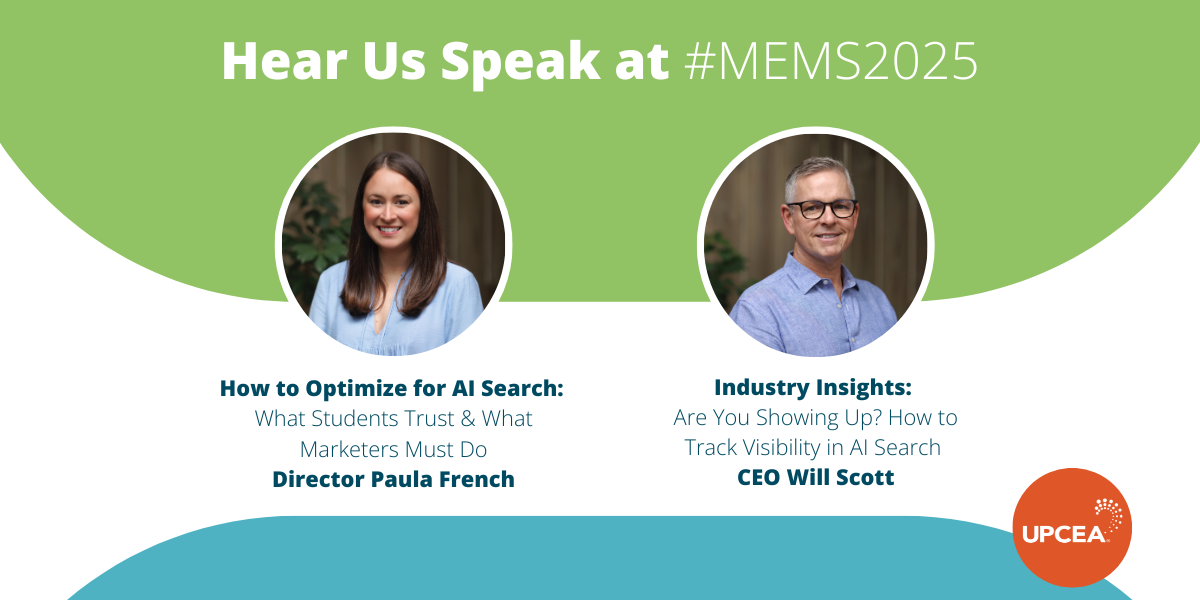
    MEMS2025 speakers graphic

    “Are You Showing Up? How to Track Visibility in AI Search”

    Presenter: Will Scott, CEO and Co-Founder, Search Influence

    Time: Wednesday, December 3 – 10:00 a.m.

    AI search is no longer theoretical. It’s measurable. In this session, Will will show institutions how to connect generative search visibility to real data and use it to drive recruitment strategy.

    Session Highlights:

    • Learn how to measure your institution’s presence across AI platforms like ChatGPT, Gemini, and Perplexity.
    • Discover how to segment AI-driven traffic using Google Analytics 4 and Looker Studio.
    • Identify metrics and tools that help you evaluate AI visibility and performance.

    “How to Optimize for AI Search: What Students Trust & What Marketers Must Do”

    Presenter: Paula French, Director of Sales and Marketing, Search Influence

    Co-Presenter: Emily West, Senior Market Research Analyst, UPCEA

    Time: Wednesday, December 3 – 3:30 p.m.

    Nearly half of prospective students now use AI tools weekly, and 79% read AI-generated summaries. In their presentation, Paula and Emily will translate this data into concrete next steps for marketing teams ready to compete in generative search.

    Session Highlights:

    • Review new findings from the 2025 UPCEA + Search Influence study, AI Search in Higher Education: How Prospects Search in 2025.
    • Understand what prospective students trust in AI-generated results.
    • Learn a three-part framework for AI visibility: discoverability, credibility, and content optimization.

    “From Search to Success: Integrating SEO and Email Marketing to Drive Enrollment”

    Moderator: Jeanne Lobman, Director of Operations, Search Influence

    Panelists: Tim Grenda and Caitlin Dimalanta, San Diego State University

    Time: Tuesday, December 2 – 2:45 p.m.

    Students don’t stop searching once they find a program. They start evaluating how institutions communicate. This session will explore how connecting SEO insights with email marketing creates a continuous, student-centered experience that strengthens engagement and drives enrollment.

    Session Highlights:

    • Explore how integrated SEO and email strategies guide students from search discovery to enrollment.
    • Learn how coordinated messaging increases engagement and conversion.

    “Boosting SEO and Engagement Through Testimonial-Driven Web Content”

    Moderator: Paula French, Director of Sales and Marketing, Search Influence

    Panelists: Caitlin Wilson and Krysten Cole, Boston University Metropolitan College

    Time: Thursday, December 4 – 10:00 a.m.

    Authenticity has become one of higher education’s strongest differentiators. This session will examine how testimonial-driven storytelling can improve SEO performance, strengthen brand trust, and create more meaningful engagement with prospective students.

    Session Highlights:

    • Understand the importance of authentic student and alumni testimonials in building credibility and enhancing visibility.
    • Learn how to turn stories into measurable content assets that support recruitment goals.
    • Explore how to connect storytelling with keywords and SEO strategies for stronger search performance.

    About MEMS 

    Hosted by the Online and Professional Education Association (UPCEA), the MEMS Conference brings together enrollment and marketing professionals from across the country to share strategies that connect innovation with measurable results. 

    Now in its 34th year, the event will focus on emerging technology, shifting student expectations, and the evolving ways higher education institutions can reach, recruit, and retain learners.

    Throughout the conference, Search Influence will host a booth where attendees can learn how to assess their institution’s AI visibility, explore AI SEO tools, and request a complimentary AI Website Grader developed by Will. Our team will be available to discuss real-world applications of AI-driven marketing data and how colleges can start improving their presence across generative platforms.

    Continuing the Conversation

    As AI search evolves, understanding how visibility, trust, and data intersect has never been more important. 

    If your institution is ready to know where it stands in AI search, download AI Search in Higher Education: How Prospects Search in 2025, or meet our team in Boston to explore how strategy, credibility, and creativity can elevate your visibility.

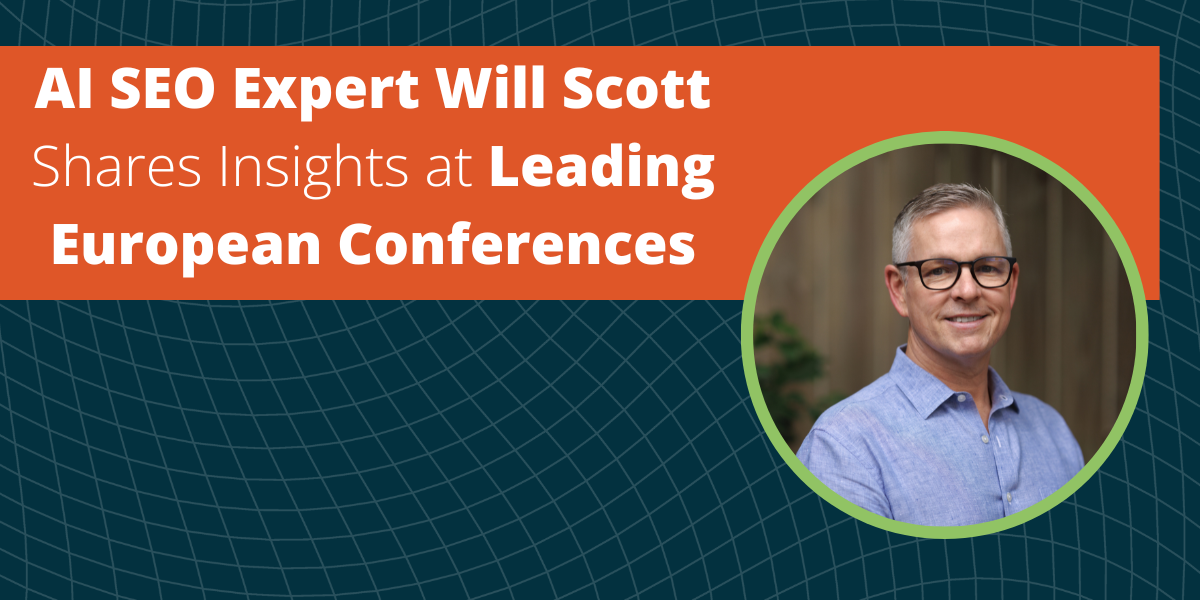
  • AI SEO Expert Will Scott Shares Insights at Leading European Conferences

    Search Influence continues to advance the conversation around AI SEO on a global scale.

    This fall, CEO and Co-Founder Will Scott represented the agency at two of Europe’s most respected industry events, SEOktoberfest G50 Summit in Austria and SMX Advanced Europe in Berlin, sharing insights on how artificial intelligence is reshaping search, content, and visibility.

    Bringing AI SEO Expertise to the Global Stage

    At SEOktoberfest, an invite-only event limited to just 50 of the top SEO professionals globally, Will joined peers from leading organizations, including Google, Yoast, and Faber Company, to explore the next generation of AI search and generative engine optimization (GEO).

    The gathering fosters open discussion among industry pioneers, offering a rare opportunity to exchange forward-thinking strategies about how artificial intelligence is redefining visibility and authority in search.

    Will’s participation highlights Search Influence’s position among agencies advancing the real-world application of AI SEO — ensuring clients benefit from strategies informed by direct collaboration with the industry’s brightest minds.

    Advancing AI SEO Strategy at SMX Advanced Europe

    Following SEOktoberfest, Will spoke at SMX Advanced Europe 2025 in Berlin, delivering the session “AI Tools for Creation, Deployment & Tracking.” The two-day event is known for fast-paced, expert-level presentations designed for experienced search professionals who want to deepen their technical and strategic knowledge.

    In his session, Will shared actionable approaches for integrating AI SEO tools into marketing workflows. His presentation emphasized how agencies and in-house teams can harness AI to enhance creativity, streamline execution, and measure success more effectively.

    These insights are part of Search Influence’s ongoing commitment to helping brands adapt to a rapidly changing search environment — where visibility depends on mastering traditional SEO fundamentals and emerging AI search capabilities.

    Continuing the Conversation on AI Search

    Will’s European appearances build on a growing list of speaking engagements, including SMX Advanced Boston, SMX Online Masterclasses, Local U, and Pubcon, where he has helped marketers understand and apply AI SEO. His expertise continues to position Search Influence at the intersection of AI innovation and strategic SEO, helping clients thrive in a marketplace transformed by generative search.

    Maximize Your Success With Proven Industry Experts

    At Search Influence, we don’t just talk about online growth. We engineer it.

    Our team combines deep industry knowledge with cutting-edge AI SEO strategies to help clients in higher education, healthcare, hospitality, and more rise above the competition.

    Every strategy we craft is backed by data, driven by results, and designed to unlock your full potential.

    Contact the AI SEO experts at Search Influence and transform your digital presence into a sustainable engine for visibility, authority, and measurable growth.

  • The April Influencer: AI, Oh My – Insights Marketers Can’t Afford to Miss

    Stay ahead in digital marketing with The Influencer, Search Influence’s monthly newsletter covering SEO, digital advertising, and content strategy. Get top tips to fuel your online growth, expert insights from the Search Influence team, and our latest company news. Don’t miss out!

    The Future of Search: SEO and AI Impacts Explained

    The Future of Search: SEO and AI Impacts Explained

    MICHELLE NEUHOFF BOYD | 13-MINUTE READ

    Learn how AI is impacting your search visibility and essential tactics to optimize your SEO strategy.

    Read More


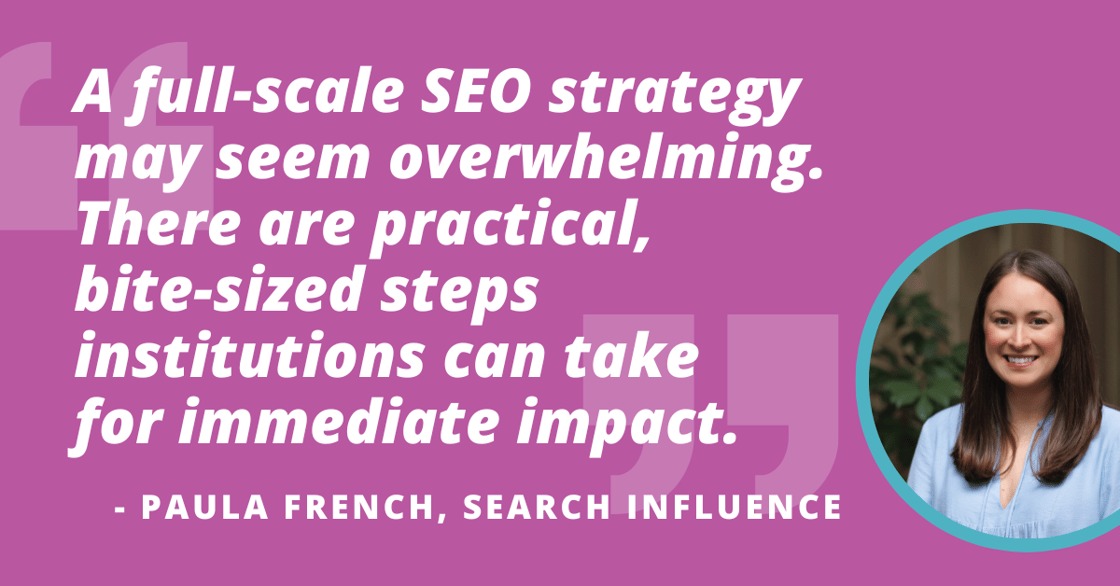
    A quote about SEO Strategy from Search Influence

    Director Paula French for UPCEA’s Industry Insights Blog

    Higher Ed SEO Trends to Stay Competitive

    PAULA FRENCH | 10-MINUTE READ

    Find out how to conquer key higher ed SEO trends to ensure you continue to reach and engage prospective students effectively.

    Read More


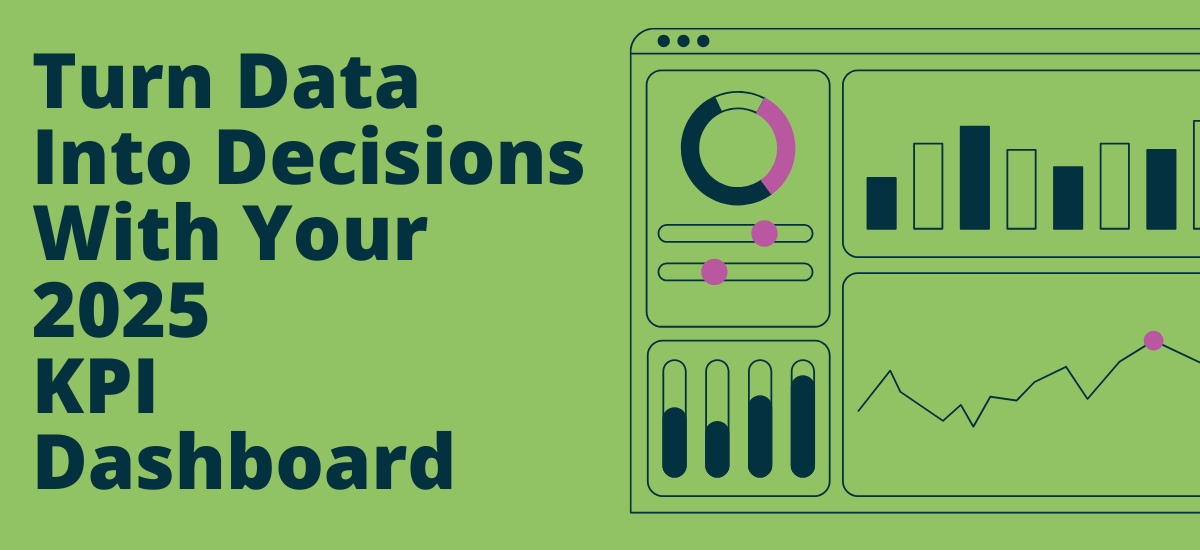
    Turn Data Into Decisions With Your 2025 KPI Dashboard blog by Search Influence

    Turn Data Into Decisions With Your 2025 KPI Dashboard

    JENNA MOVAHED | 7-MINUTE READ

    Discover how our KPI dashboards simplify data, enhance collaboration, and optimize performance for smarter, data-driven decisions.

    Read More


    Improve Page Rankings for Your University with a Hybrid SEO Team

    Improve Page Rankings for Your University With a Hybrid SEO Team

    MICHELLE NEUHOFF BOYD | 9-MINUTE READ

    Learn how a hybrid SEO team combines your in-house expertise with an agency’s support to improve your university’s page rankings.

    Read More


    SEO for AI Search: Protect Your Student Enrollment Pipeline Webinar announcement graphic

    Search Influence and UPCEA to Host Live Webinar

    SEO for AI Search: Protect Your Student Enrollment Pipeline

    Sign up for our webinar to learn a new framework to integrate SEO into your existing marketing and attract more students in AI-driven search.

    Sign Up