Category: Higher Education Marketing

  • AI Search Optimization for Graduate Education Marketing in 2026

    What 2025 Research Tells Us About AI Visibility, Zero-Click Search, and Enrollment Strategy

    Executive Summary

    Here’s the reality: the way prospective graduate students find and evaluate programs has changed faster than most of us anticipated. Research from across 2025 — including original survey data from UPCEA and Search Influence (n=705) — shows that half of all prospects now use AI tools weekly, while 82% are more likely to consider programs appearing on page one of search results. Zero-click searches have climbed to 69% of all Google queries. AI Overviews now appear on nearly half of search results.

    And this is just where we are today. The trajectory for 2026 is clear.
    Key Findings at a Glance

    Metric 2025 Finding Implication for 2026 Source
    AI tool usage (weekly+) 50% of prospects Expect 60%+ as tools improve UPCEA/Search Influence
    Page one consideration 82% more likely AI citations become equally critical UPCEA/Search Influence
    Zero-click searches 69% of queries Will exceed 75% for informational Similarweb/SparkToro
    AI Overview reach 1.5B monthly users Expanding to 80%+ of queries Google Q1 2025
    ChatGPT weekly users 800 million Continued exponential growth OpenAI September 2025
    AI in college search 23% (6x from 2023) 35-40% projected Carnegie 2025

    So what does this mean for 2026? Traditional higher education SEO and paid search remain foundational—that hasn’t changed. But they’re no longer sufficient on their own. Institutions that fail to invest in AI search optimization and AI visibility strategy risk disappearing from the consideration set entirely, before prospects ever visit a website.

    The institutions that act now on GEO for higher education will have a 12-month head start on those still debating whether this matters.

    The State of AI Search: Where We Are and Where We’re Headed

    The Adoption Curve Has Been Steeper Than Anyone Expected

    I’ll be honest: when we started tracking AI adoption in college search two years ago, I didn’t expect to see numbers like these so quickly.

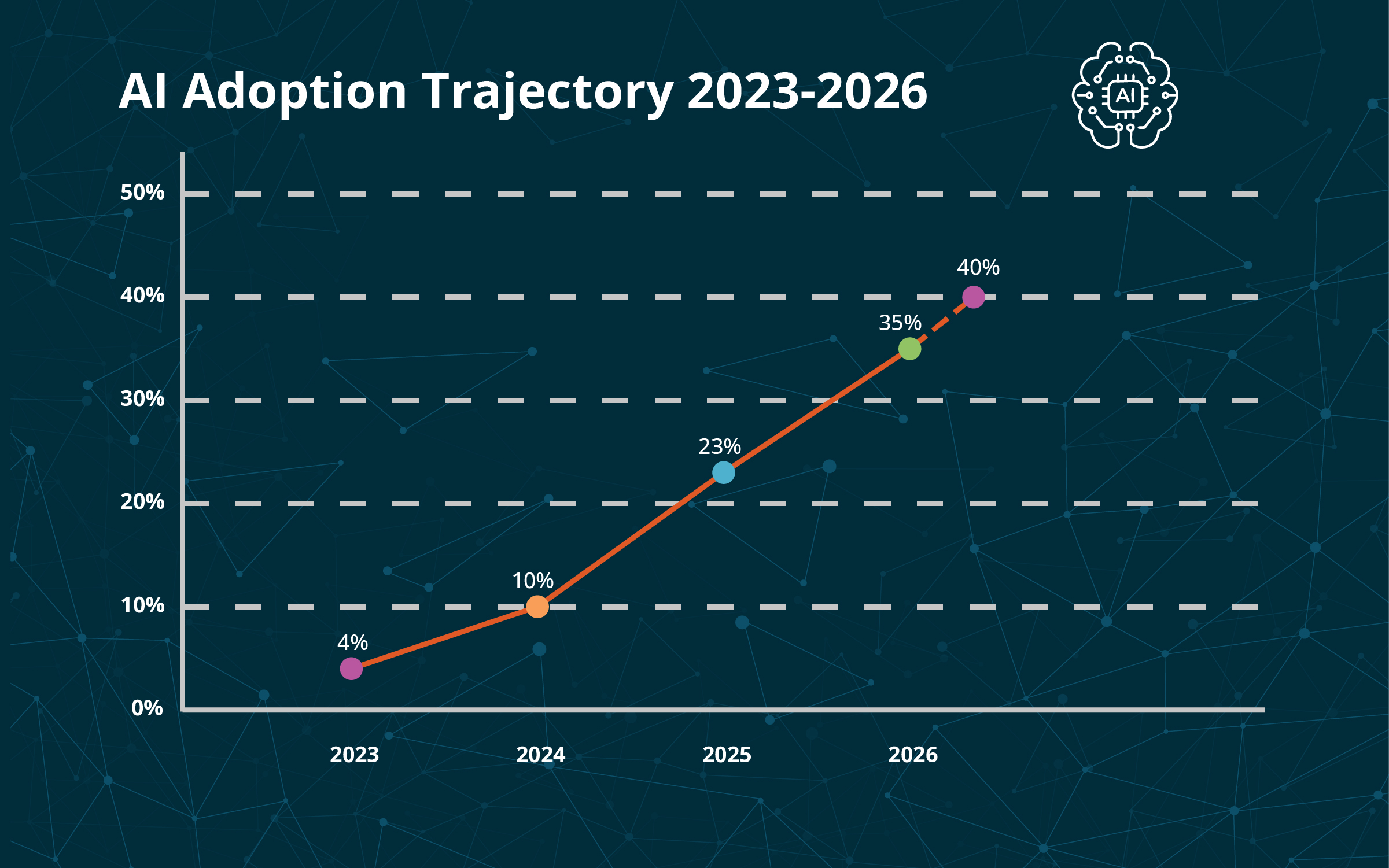
    According to Carnegie’s 2025 Summer Research Series, AI usage in the college search process jumped from 4% in 2023 to 10% in 2024 to 23% in 2025—nearly 6x in two years. Rising students show even higher adoption at 25%, while parents trail slightly at 21%.

    If this trajectory holds—and there’s no indication it won’t—we’re looking at 35-40% AI usage in college search by the end of 2026. For graduate and professional programs, where prospects skew older and more research-oriented, adoption may be even higher.
    The UPCEA/Search Influence study of 705 qualified respondents (March 2025) digs deeper into professional and continuing education prospects specifically:

    • 24% use AI-powered tools daily
    • 26% use them weekly
    • 18% use them a few times per month
    • 17% never use AI tools for search

    Younger prospects show higher daily and weekly usage, which isn’t surprising. But here’s what caught my attention: even among older demographics, the “never use” category is a minority. This isn’t a Gen Z phenomenon anymore. By 2026, the “never use” segment will likely shrink to single digits.

    Search Engines Still Dominate—But the Picture Is Getting More Complicated

    When researching professional and continuing education programs, prospects use multiple platforms, often in the same search session:

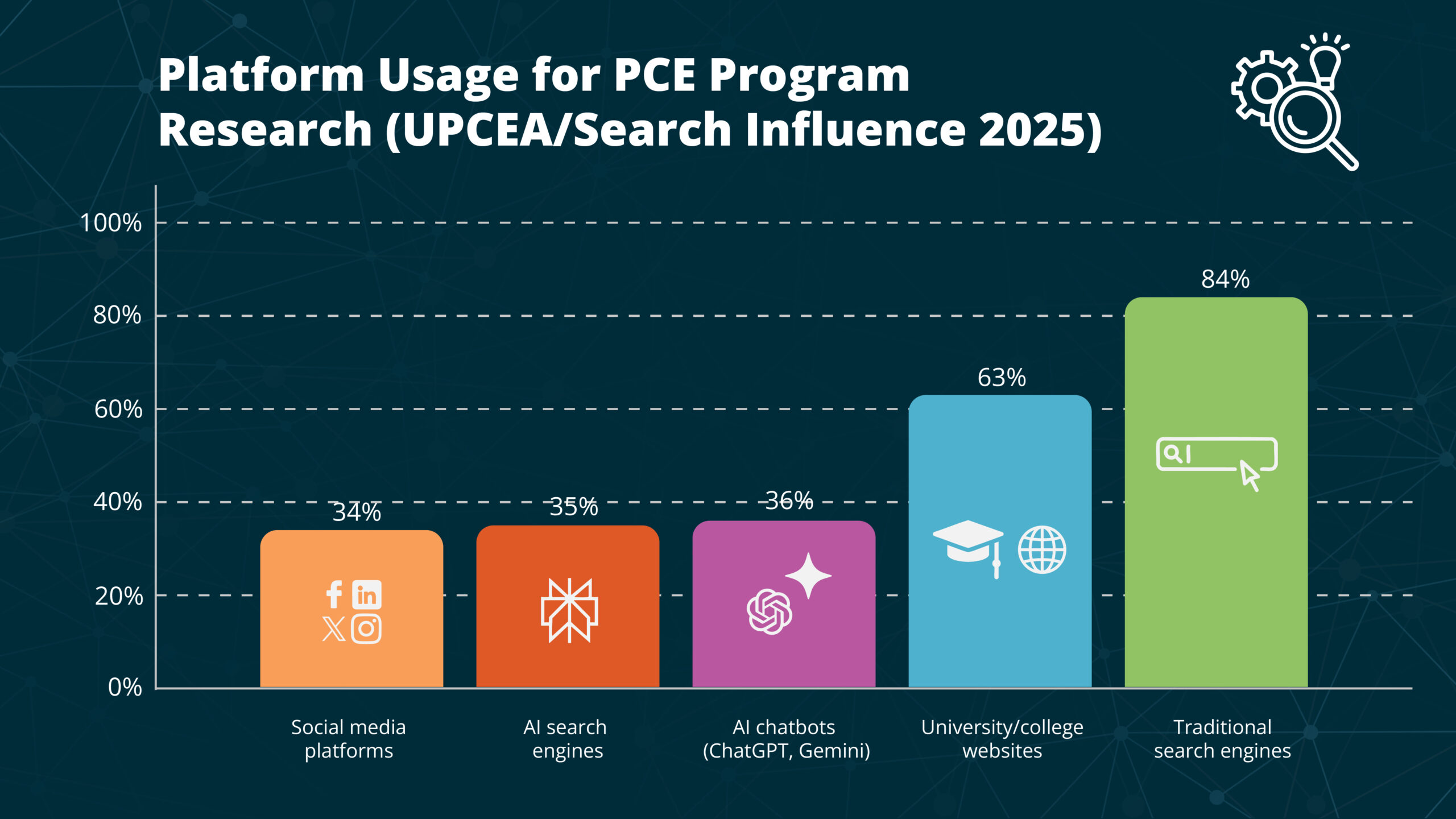
    Platform Usage for PCE Program Research (UPCEA/Search Influence 2025)

    Platform Extremely/Very Likely to Use
    Traditional search engines 84%
    University/college websites 63%
    AI chatbots (ChatGPT, Gemini) 36%
    AI search engines 35%
    Social media platforms 34%

    Here’s the number that should get your attention: AI-assisted tools now warrant the same strategic investment as social media, where institutions spend an average of $166,303 annually on advertising, according to UPCEA’s 2024 Marketing Survey. Are you spending proportionally on AI visibility for your university? Most graduate enrollment marketing teams aren’t—yet. By 2026, that gap will separate the visible from the invisible.

    The Lines Between “Search” and “Browse” Have Blurred Permanently

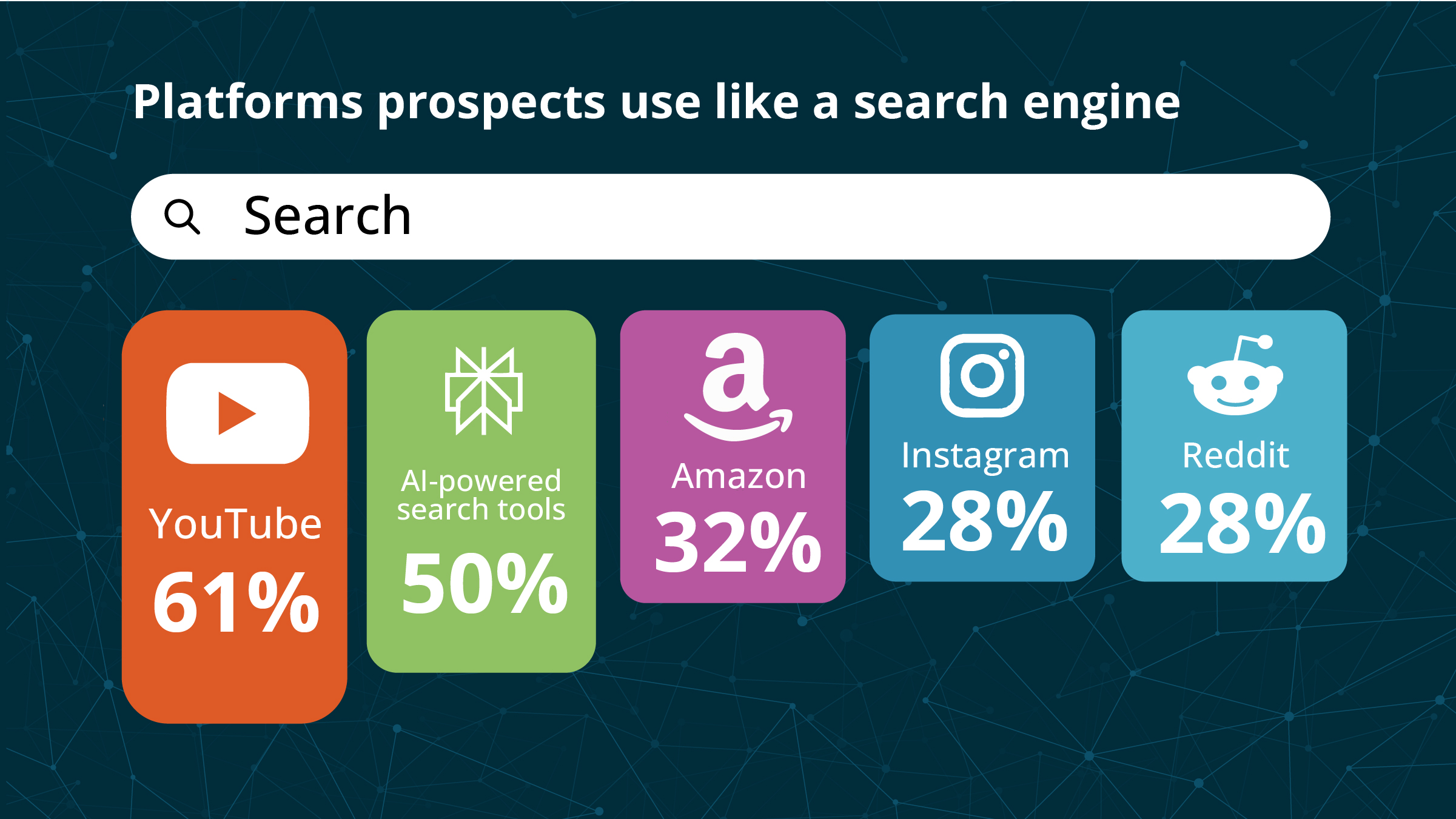
    We asked respondents which platforms they use “in a way similar to how you would use a traditional search engine.” The results tell us something important about how prospects actually behave:

    • YouTube: 61%
    • AI-powered search tools: 50%
    • Amazon: 32%
    • Instagram: 28%
    • Reddit: 28%

    Prospects don’t distinguish between “search” and “browsing” the way we do in marketing meetings. YouTube is a search engine to them. ChatGPT is a search engine. Instagram is a search engine. Your content has to work across all of them, or you’re only reaching part of your audience.

    For 2026 planning, this means content strategy can’t be siloed by platform. The same information needs to exist in formats optimized for each discovery channel.

    The Zero-Click Search Reality: Planning for a Post-Click World

    Most Searches Don’t Result in Clicks Anymore

    Zero-click searches—queries where users get answers directly from search results without visiting a website—have reached a tipping point:

    • 69% of Google searches ended without a click (May 2025), up from 56% in May 2024
    • 60-63% of all Google searches result in zero clicks according to SparkToro/Similarweb
    • 70-90% click-through rate decline when AI Overviews appear
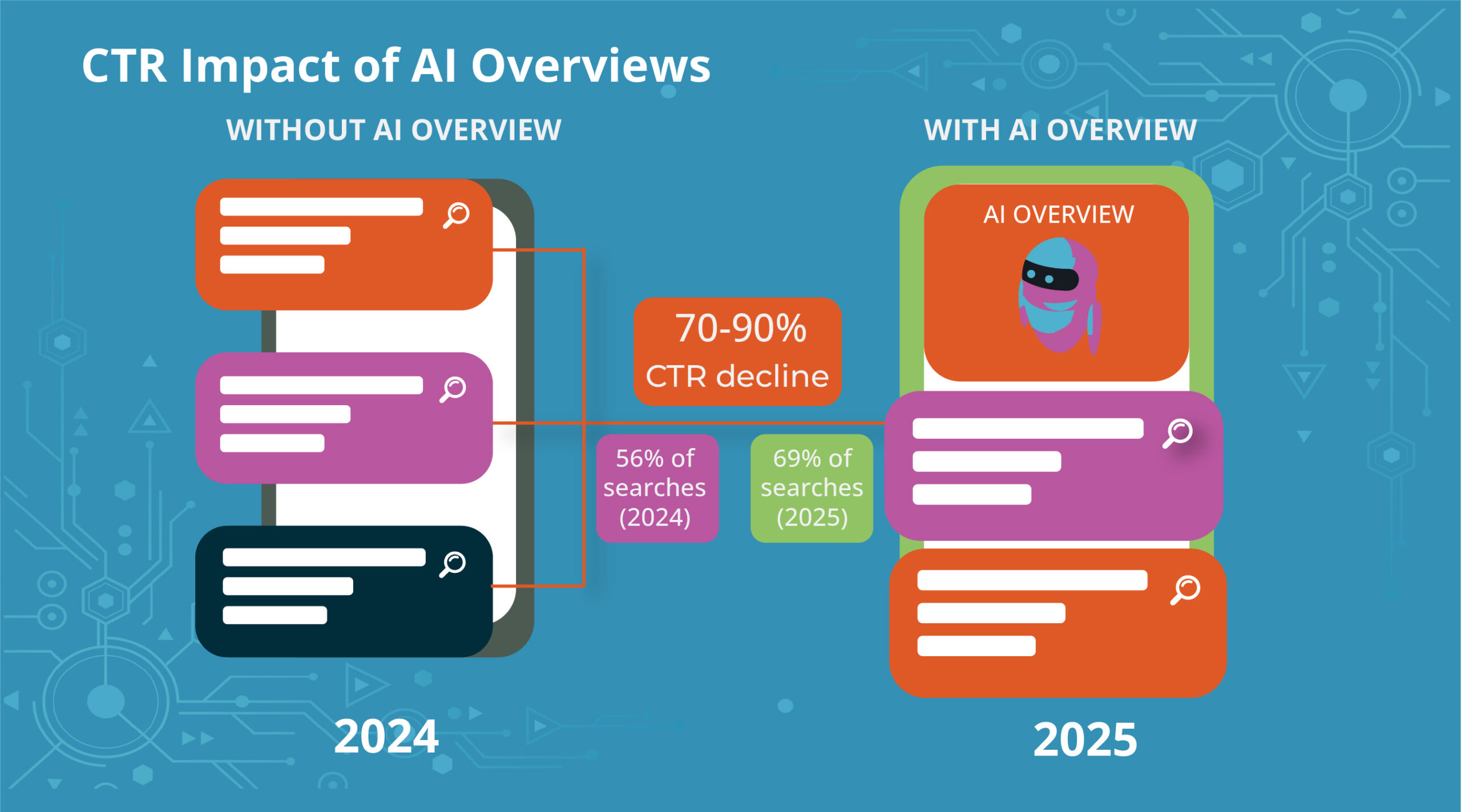
    Google’s AI Overviews now reach 1.5 billion monthly users as of Q1 2025. The feature appears on 47% of searches today, with Google’s internal testing suggesting this will exceed 80% for informational queries in the near future.

    For 2026 planning: Assume zero-click will exceed 75% for the informational queries that drive graduate program research. Questions like “What are the admission requirements for [Program X]?” or “How much does an MBA cost?”—exactly the queries your prospects are typing—will increasingly be answered without a click.

    What Zero-Click Search Means for 2026 Graduate Enrollment Marketing

    The implications for university marketing teams are significant, and I don’t think we should sugarcoat them:

    1. Traditional funnel metrics are becoming less reliable.

    If prospects get answers about tuition, deadlines, and program details from AI summaries, they may form opinions about your institution without ever reaching your website. Your analytics won’t capture that interaction. You’ll have incomplete data on what’s actually influencing enrollment decisions.

    2026 action: Build brand visibility metrics alongside click metrics. Track AI citations, brand mentions, and sentiment—not just traffic. This requires a different approach to higher education analytics.

    1. You’re paying more for declining performance.

    Everspring reports that the average cost-per-click for higher education terms has increased 45% year-over-year, while performance has declined. That’s a rough combination that will only intensify.

    2026 action: Rebalance paid media budgets. The ROI calculus on traditional higher education PPC is shifting. Organic AI visibility may deliver better long-term value.

    1. This is already disrupting adjacent industries.

    Learning platform Chegg reported a 49% decline in non-subscriber traffic between January 2024 and January 2025, coinciding with AI Overviews answering homework and study questions that previously drove site visits. Graduate enrollment marketing isn’t immune to the same dynamics.

    2026 action: Don’t wait for disruption to hit your specific program category. Invest in zero-click search strategy now.

    The Trust Signal Hidden in AI Overviews

    Here’s where the data gets interesting. The UPCEA/Search Influence study shows how prospects actually interact with AI Overviews:

    • 79% read the AI-generated overview when it appears
    • 51% click on sources most of the time or always
    • 43% click occasionally
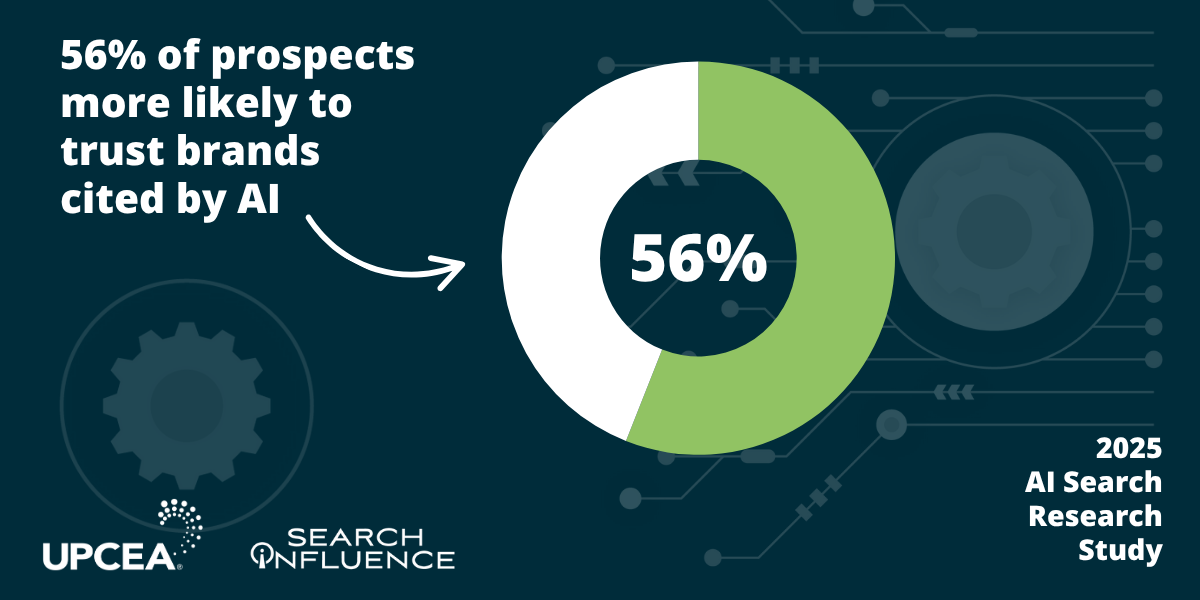
    • 56% are more likely to trust brands/websites cited in AI Overviews

    That last number matters enormously for 2026 strategy. Being cited in AI Overviews isn’t just about visibility—it’s a credibility signal. When prospects see your institution referenced in AI-generated content, they’re more likely to view you as trustworthy. Absence from those results may communicate the opposite.

    Rethinking Optimization: From Higher Education SEO to GEO

    SEO vs. GEO for Universities: A Different Kind of Target

    Here’s a useful way to think about the shift we’re navigating:

    Traditional SEO feels like optimizing for an algorithm—a system that scores and ranks based on signals (keywords, links, technical factors). It’s mechanical, pattern-matching. You’re essentially optimizing for a librarian: cataloging, indexing, and retrieval.

    GEO (Generative Engine Optimization) feels fundamentally different. It feels like optimizing for a reader who happens to have perfect memory and infinite patience—an entity that’s actually trying to understand what you do, synthesize it, and explain it to someone else. You’re optimizing for a research assistant: understanding, synthesizing, recommending.

    Put more directly: with GEO, you’re writing content that helps an AI form an accurate opinion about your institution—because that’s what it’s going to share with prospects.

    The practical difference:

    • SEO rewards structure and signals
    • GEO rewards clarity, accuracy, and citable claims

    You’re not just trying to rank anymore. You’re trying to be the source an AI would quote if it were writing an article about your program category.

    What This Means for University Content Strategy in 2026

    For 2026, your higher education content strategy needs to serve two masters simultaneously:

    1. Traditional search engines that still drive significant traffic and still reward keyword optimization, technical SEO, and backlink profiles
    2. AI systems that are reading your content to form an understanding of who you are, what you offer, and whether you’re worth recommending

    The good news: these aren’t entirely at odds. Clear, factual, well-structured content performs well for both. But the emphasis shifts. AI systems don’t care about keyword density—they care about whether they can extract accurate, citable information. This is the core of AI-ready website optimization for higher education.

    What Prospects Trust—and Don’t Trust

    The Trust Hierarchy Is Clear (and Stable)

    When searching for professional and continuing education programs, prospect trust varies dramatically by source:

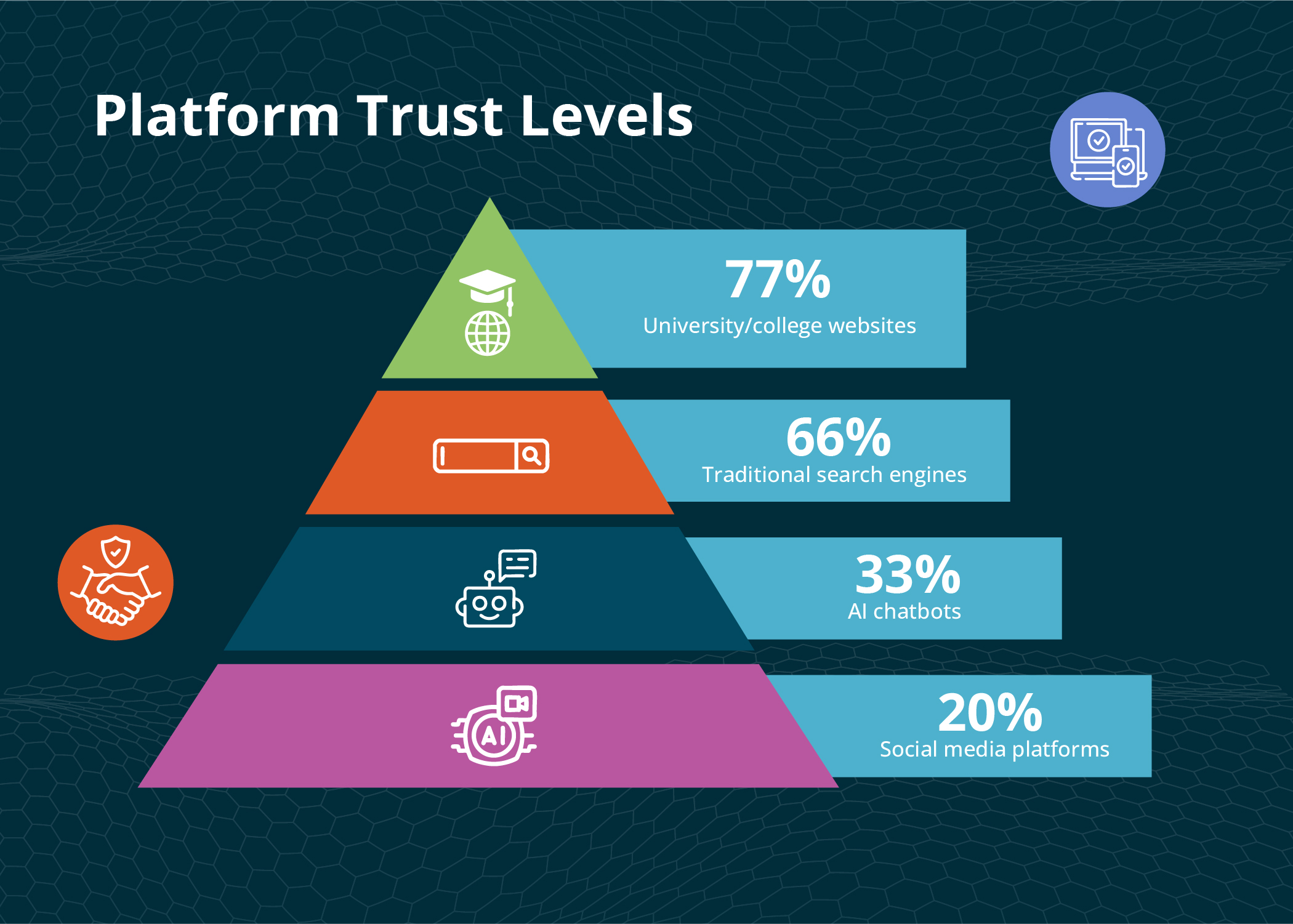
    Trust Levels by Platform (UPCEA/Search Influence 2025)

    Source Extremely/Very Trustworthy
    University/college websites 77%
    Traditional search engines 66%
    AI chatbots 33%
    Social media platforms 20%

    University websites are still the most trusted source by a wide margin. That’s actually good news for 2026. While AI tools are gaining usage, the destination of trust remains institutional websites. The challenge is making sure AI tools surface and cite your content accurately—so prospects who trust AI still end up trusting you.

    Think of it this way: AI is becoming the intermediary, but your website is still the authority. You need AI to accurately represent what’s on your site.

    Not Everyone Is Worried About AI Accuracy

    This surprised me a bit: nearly a third (32%) of respondents have no concerns whatsoever about using AI search tools for researching professional and continuing education programs.

    Among those who do have concerns:

    • 28% worry about validity, reliability, or accuracy
    • 7% cite privacy or security concerns
    • The remainder mention environmental impact, bias, and relevance

    So while accuracy concerns exist, a substantial portion of your prospect pool is comfortable taking AI recommendations at face value. That makes your AI presence even more critical—if AI gets your information wrong, a third of prospects won’t question it.

    What Would Build More Trust?

    When asked what features would be most valuable in AI-generated search results:

    1. Transparent sources for AI-generated recommendations: 51%
    2. AI-generated side-by-side comparisons of programs: 50%
    3. Emphasis on accredited institutions: 39%
    4. AI personalization based on interests: (favored by younger prospects)

    Prospects want AI to show its work. Transparent sourcing and comparison tools matter more than fancy personalization for most age groups.

    2026 implication: Structure your content with clear, citable claims. Include specific data points, credentials, and outcomes that AI can reference. Make it easy for AI to cite you accurately.

    Search Query Patterns: How Behavior Differs by Platform

    People Talk to AI Differently Than They Talk to Google

    This is one of the more actionable findings from the research. The UPCEA/Search Influence study asked respondents what they would type when searching for an MBA program across different platforms. The patterns are distinct:

    Query Type by Platform

    Query Type Traditional Search AI Search Engine AI Chatbot Social Media
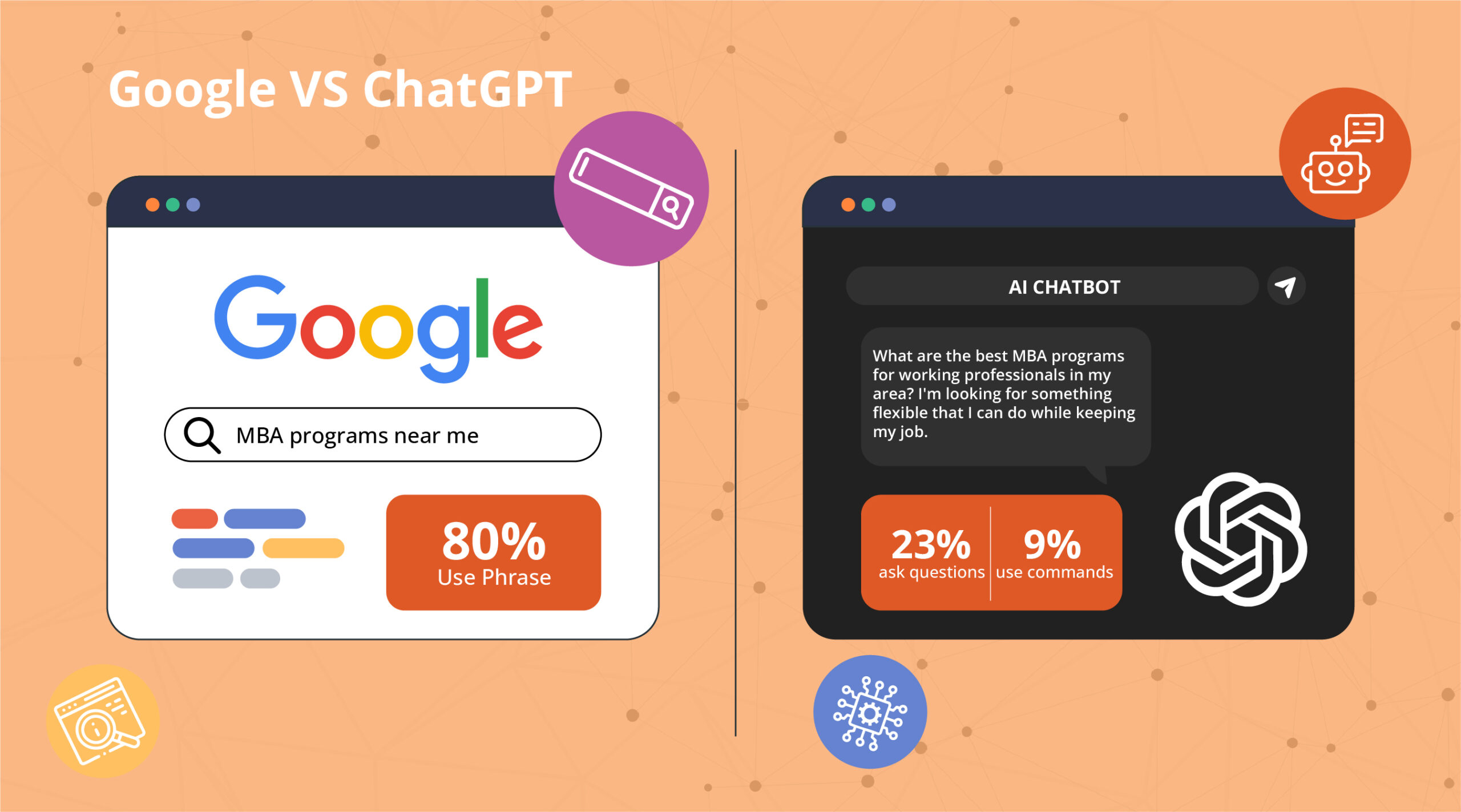
    Phrase 80% 64% 55% 71%
    Question 12% 16% 23% 8%
    Command 1% 8% 9% 2%
    One-word 6% 6% 7% 9%
    Wouldn’t use 1% 5% 6% 10%

    On traditional search, 80% of prospects type phrases like “MBA programs near me.” On AI chatbots, that drops to 55%, while questions jump to 23% and commands to 9%.

    What this means for 2026 content: If you’re only optimizing for keyword phrases, you’re missing the conversational queries that dominate AI interactions. Content that answers questions directly—”What is the best MBA program for working professionals?” “Compare online vs. in-person MBA programs”—will perform better in AI contexts.

    The Core Keywords Still Matter

    Across all platforms, the most common search approaches for MBA programs included:

    • “MBA programs/degrees/courses/education” (27-31%)
    • “Best MBA programs/schools” (8-11%)
    • “MBA programs near me” (8-12%)

    The consistency across platforms tells us that core keyword targeting still matters. People are looking for the same information—they’re just asking for it differently depending on where they’re searching. Your content needs to address both the keyword and the question.

    Platform-Specific Behaviors: What to Prioritize for 2026

    ChatGPT Is the Default, But Don’t Ignore the Others

    Among prospects likely to use AI platforms for program research:

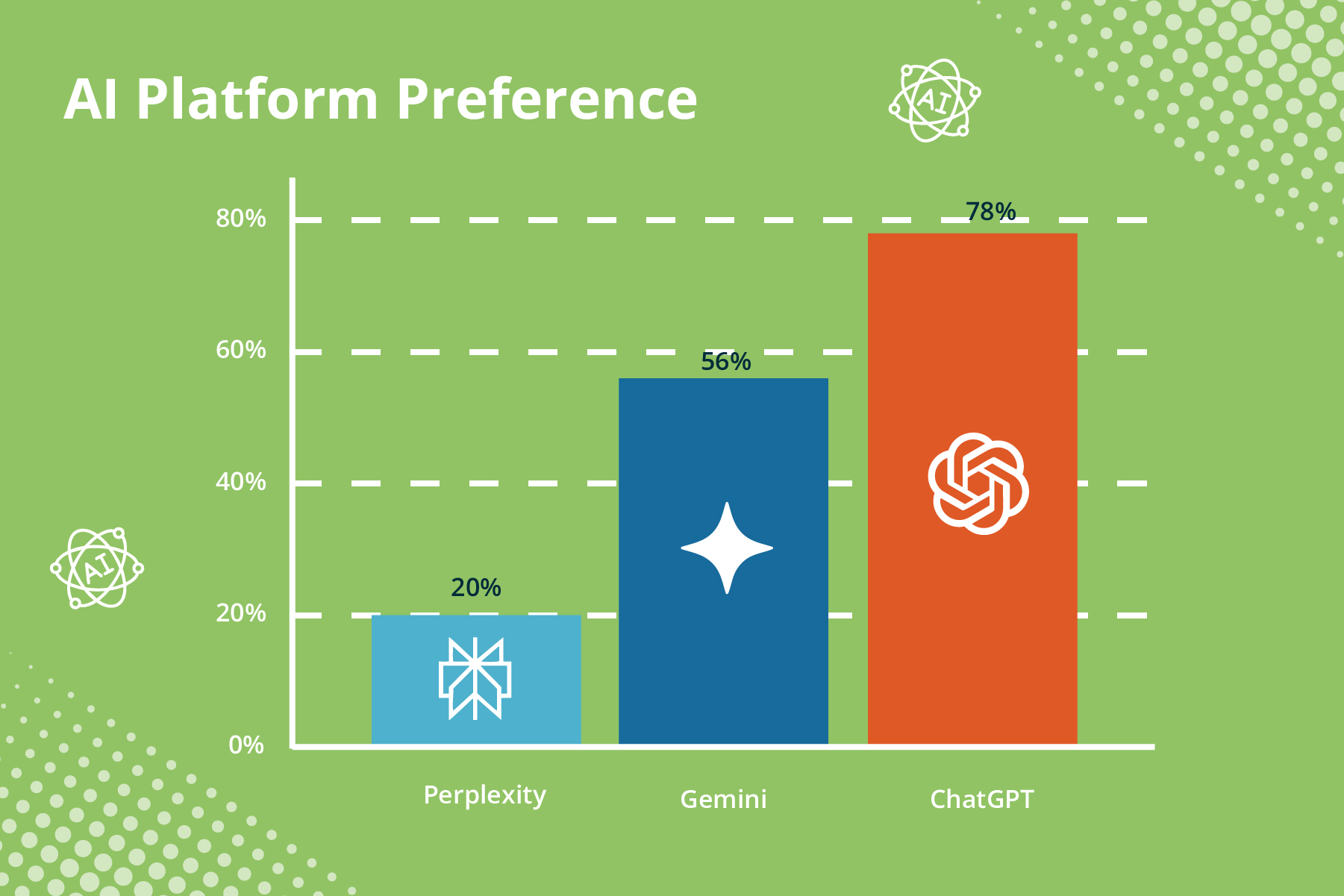
    AI Platform Would Use
    ChatGPT 78%
    Gemini 56%
    Perplexity 20%

    Here’s an interesting wrinkle: older age groups were more likely to use Gemini and Perplexity than younger prospects. My guess is this reflects different adoption pathways—Gemini through the Google ecosystem that older users are more embedded in, Perplexity through professional and research applications.

    2026 consideration: Your AI visibility strategy can’t focus on ChatGPT alone. Gemini is integrated into Google’s ecosystem (where 84% of your prospects still search), and Perplexity is growing fast among research-oriented users—exactly your graduate prospect demographic.

    The Scale of ChatGPT Is Hard to Overstate

    As of late 2025, ChatGPT’s numbers are staggering:

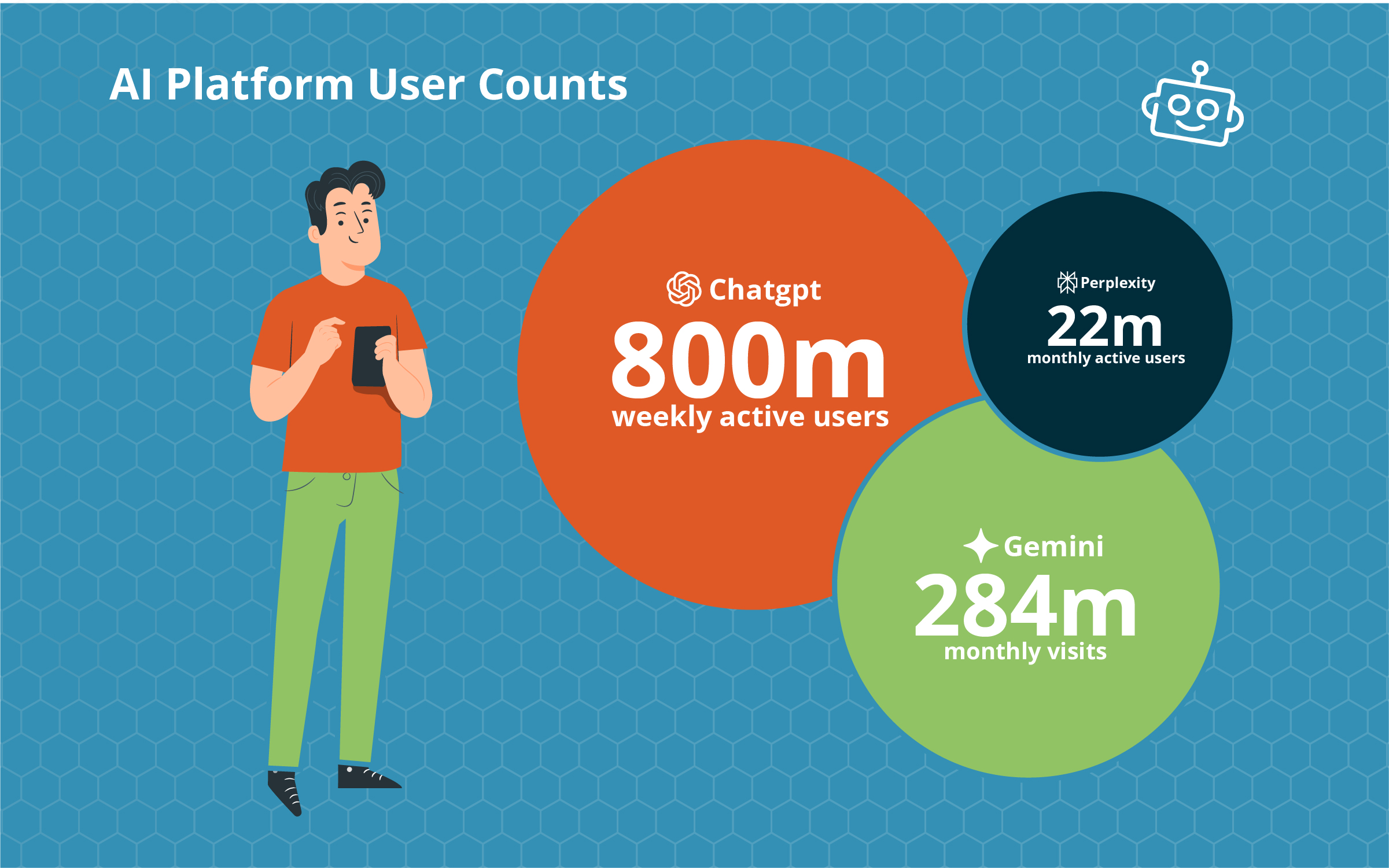
    • 800 million weekly active users (September 2025)
    • 190 million daily active users
    • 5.72 billion monthly visits
    • 77.2 million monthly active users in the US alone
    • 46.7% of users are aged 18-24

    For context, Perplexity AI processes 780 million monthly queries with 22 million monthly active users—substantial and growing fast, but still an order of magnitude smaller than ChatGPT.
    Social Media Platform Preferences Vary by Age

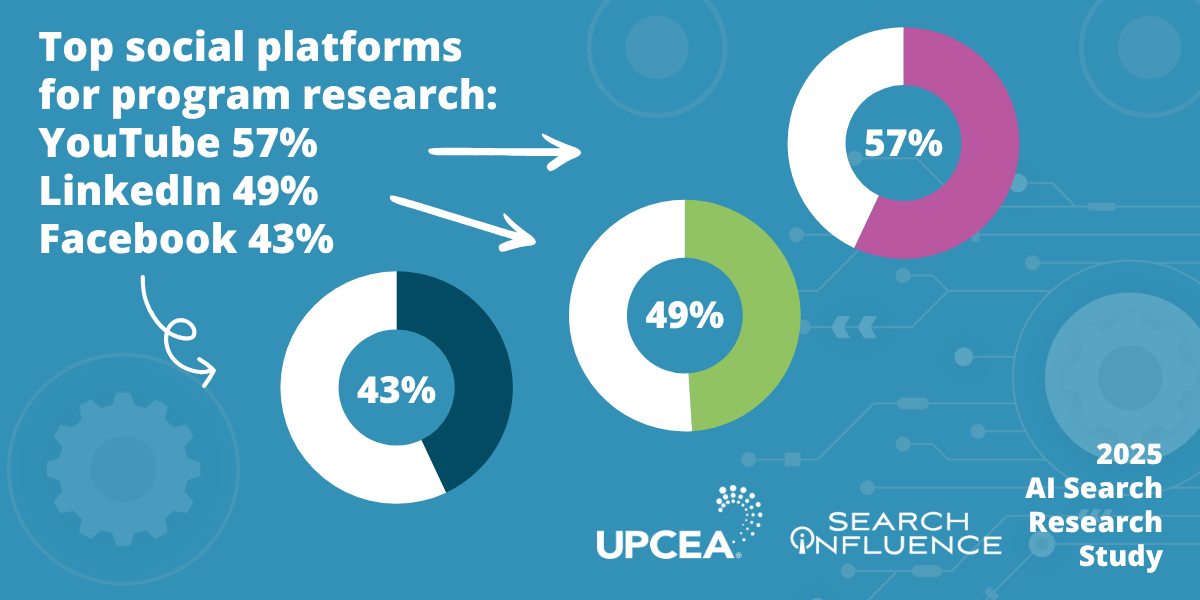
    Among prospects likely to use social media for program research:

    Platform Would Use
    YouTube 57%
    LinkedIn 49%
    Facebook 43%
    Instagram 35%
    Reddit 31%

    The age patterns are predictable:

    • YouTube, Instagram, TikTok: Skew younger
    • LinkedIn, Facebook: Skew older
    • Reddit: Relatively consistent across age groups

    What Actually Works on Social

    When using social media to research programs, prospects find these content types most helpful:

    1. Program summaries or descriptions: 65%
    2. Career advice related to education choices: 54%
    3. Student testimonials: 50%

    One exception worth noting: for 18-22-year-olds, university/college advertisements ranked as the most helpful content type. Traditional advertising still resonates with the youngest prospects in ways it doesn’t with older demographics.

    The AI Tools Landscape: A Quick Reference

    Major AI Platforms by the Numbers (Late 2025)

    Platform Monthly Active Users Monthly Queries Key Demographics
    ChatGPT 800M weekly / 190M daily 5.72B visits 46.7% aged 18-24
    Google Gemini 284M monthly visits 18% education sector
    Perplexity AI 22M MAU 780M queries 57% aged 18-34
    Claude ~3.2% US market share Professional/technical skew

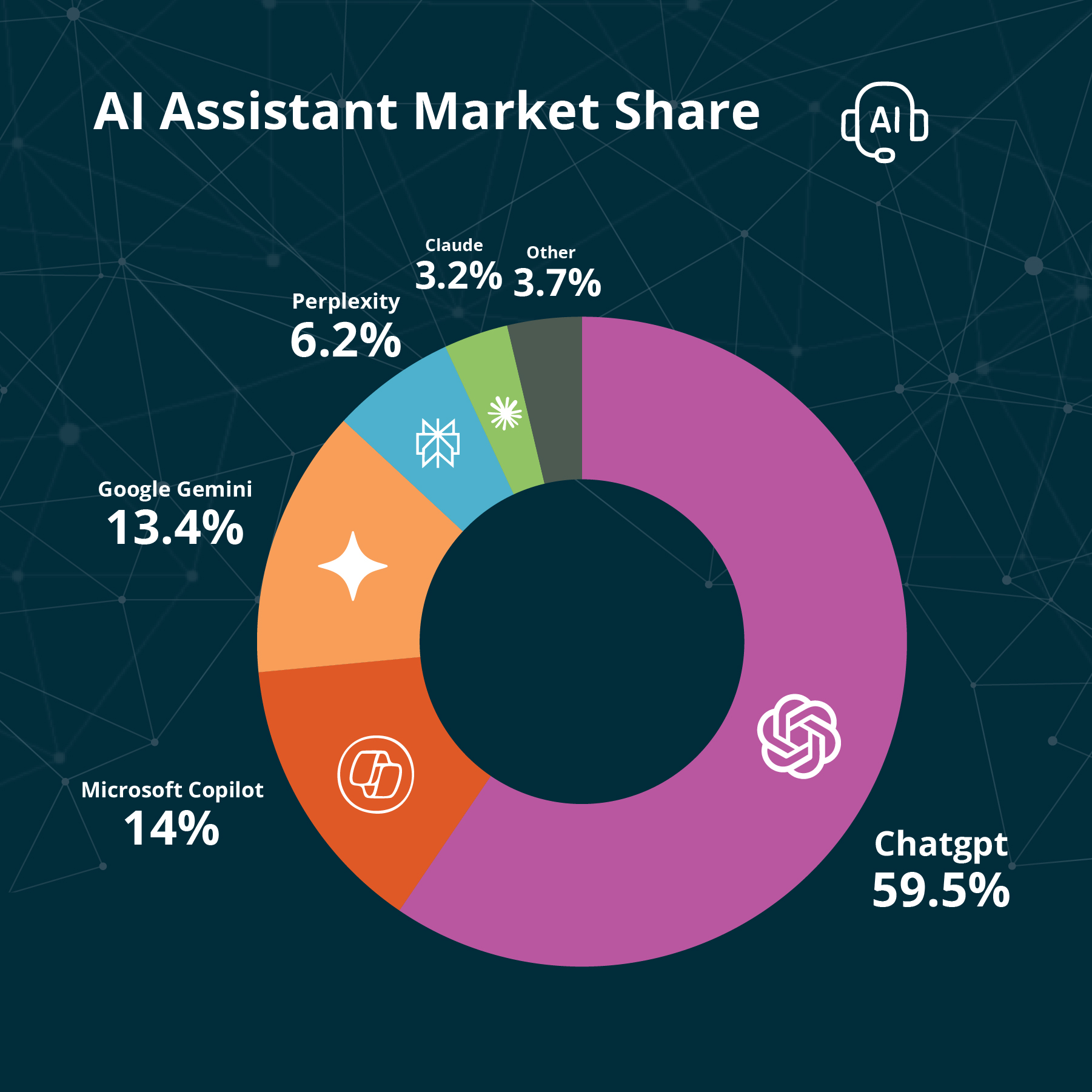
    US Market Share Context

    • ChatGPT: 59.5%
    • Microsoft Copilot: 14%
    • Google Gemini: 13.4%
    • Perplexity: 6.2%
    • Claude: 3.2%

    Strategic Roadmap: AI Search Optimization for Higher Education in 2026

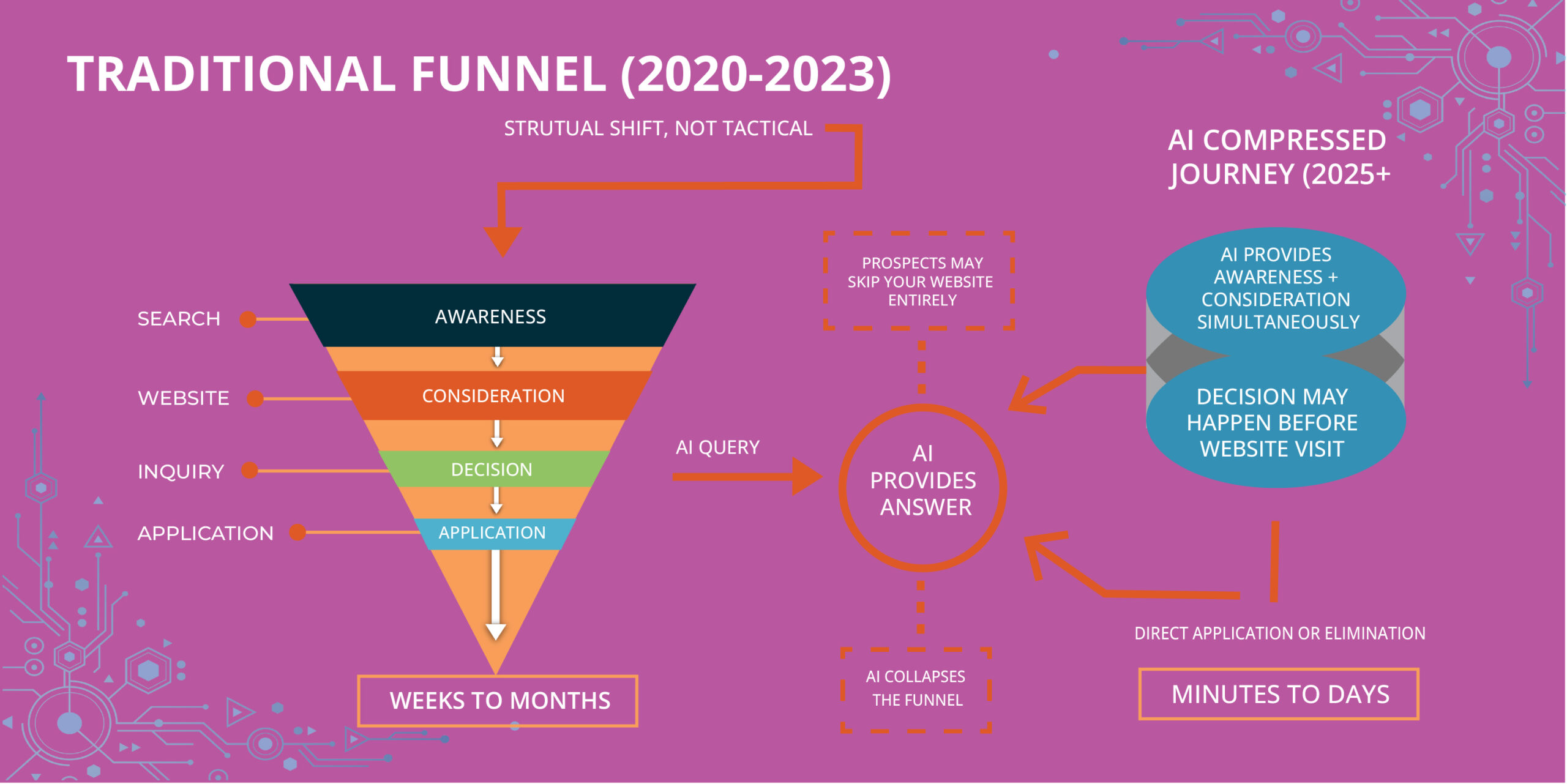
    The Shift Is Structural, Not Tactical

    Let me be direct about what the data is telling us about graduate enrollment marketing:

    1. Search behavior has diversified permanently.

    Prospects use 5+ platforms interchangeably for program research. If you’re only optimizing for Google, you’re reaching a shrinking portion of your audience. Single-platform strategies are increasingly risky.

    1. AI is compressing your funnel.

    Generative AI tools deliver answers about your institution—and your competitors—before prospects visit any website. The traditional “awareness → consideration → decision” funnel is collapsing. Prospects may move from “never heard of you” to “crossed you off the list” without a single website visit.

    1. Citation is the new ranking.

    Being referenced in AI Overviews and AI tool responses builds credibility. Absence from these results may signal irrelevance. For a generation that trusts AI to give them straight answers, not appearing in those answers is a problem.

    1. Your metrics are incomplete.

    Website traffic and click-through rates don’t capture AI-mediated discovery. Brand visibility and AI citation frequency matter, but most institutions aren’t tracking them yet.
    Your 2026 Action Plan for Graduate Enrollment Marketing

    Q1 2026: Foundation—AI Visibility Audit and Technical SEO

    1. Conduct an AI visibility audit. Query ChatGPT, Perplexity, and Google AI Overviews with the exact phrases your prospects use. Screenshot what appears. Document what’s missing or inaccurate. This is your baseline for AI search optimization.
    2. Review your website’s structure for AI readiness. AI tools favor content with clear headings, factual statements, and authoritative data that they can easily extract and cite. Does your program content deliver that, or is it buried in marketing language? An AI-ready website audit should be your first step.
    3. Check your technical SEO fundamentals. Crawlability and site speed matter more than ever for higher education SEO. AI engines are less patient than traditional crawlers. If they can’t see your content, they can’t cite it.

    Q2 2026: Content Development—GEO and Multi-Platform Strategy

    1. Develop a YouTube strategy if you don’t have one. 61% of prospects use YouTube like a search engine. Program overviews, student testimonials, and career outcome videos aren’t optional anymore for graduate enrollment marketing.
    2. Create content in multiple formats for AI optimization. AI chatbots favor Q&A formats. Traditional search favors keyword phrases. Social favors summaries and testimonials. The same information needs to exist in multiple expressions optimized for each platform.
    3. Build FAQ and comparison content. These formats are highly citable by AI systems and directly address how prospects query AI tools. This is core GEO for universities.

    Q3-Q4 2026: Infrastructure and Measurement Evolution

    1. Implement structured data and schema markup. Help AI tools understand your programs, faculty, outcomes, and accreditations through proper technical implementation. This is table stakes for AI visibility in higher education.
    2. Distribute content through authoritative channels. AI tools favor citations from recognized sources. Publishing through professional associations, research outlets, and established media increases the likelihood of AI citation—a key component of any higher education SEO strategy.
    3. Evolve your measurement approach. Start tracking brand mentions, AI citations, and sentiment alongside traditional metrics. The full picture of enrollment marketing visibility now extends well beyond clickable results.

    Methodology

    UPCEA/Search Influence Study (2025)

    Survey period: March 11-13, 2025

    Sample:

    • Total participants: 1,061 individuals
    • Qualified respondents: 760 (met all criteria)
    • Completed surveys: 705

    Qualification criteria:

    • Adults aged 18-60
    • Minimum high school diploma
    • Not currently enrolled in a PCE program
    • Interested in advancing skills through professional/continuing education

    Respondent demographics:

    • 55% female, 45% male
    • 68% employed full-time
    • Education: 32% bachelor’s degree, 19% some college, 18% master’s degree
    • Age: 25% ages 46-54, 19% ages 55-60, 17% ages 35-40

    Distribution: Internet panel

    Conducted by: UPCEA and Search Influence

    Carnegie Summer Research Series (2025)

    Sample: 3,400+ prospective students and parents

    Focus: College choice trends, AI usage in admissions, personality-driven communication

    Key longitudinal finding: AI usage in college search: 4% (2023) → 10% (2024) → 23% (2025)

    Additional Data Sources

    Platform statistics compiled from company announcements, third-party tracking services (Similarweb, SparkToro, Semrush), and industry research reports. All figures represent the most recent publicly available data as of November 2025.

    Glossary of Key Terms

    AI Overview: Google Search feature providing an AI-generated summary at the top of results, synthesizing information from multiple sources. Previously called Search Generative Experience (SGE).

    Zero-click search: A query where users find their answer directly in search results (featured snippets, AI Overviews, knowledge panels) without clicking to any website.

    Generative Engine Optimization (GEO): Optimizing content and digital presence to appear in AI-generated responses from tools like ChatGPT, Perplexity, and Google’s AI Overviews. Unlike traditional SEO (optimizing for algorithms), GEO focuses on helping AI systems accurately understand and represent your institution.

    Professional and Continuing Education (PCE): Post-secondary programs for working adults seeking to advance skills, change careers, or earn credentials—including graduate degrees, certificates, professional development, and continuing education.

    AI chatbot: Conversational AI interface (ChatGPT, Gemini) responding to queries in natural language, often synthesizing information from training data and/or real-time web search.

    AI search engine: Search tool (Perplexity, SearchGPT) providing direct answers by searching the web and synthesizing results, rather than returning a list of links.

    Frequently Asked Questions

    How are prospective students using AI tools in their program search?

    Half of prospects (50%) use AI-powered tools at least weekly for general information search. For program research specifically, 36% are extremely or very likely to use AI chatbots, and 35% likely to use AI search engines. ChatGPT dominates (78% of AI users would use it), followed by Gemini (56%) and Perplexity (20%).

    Do prospects trust AI-generated information about educational programs?

    It’s complicated. Only 33% rate AI chatbots as extremely or very trustworthy for program research, compared to 77% for university websites. But 32% have no concerns whatsoever about using AI for this purpose, and 56% say they’re more likely to trust brands cited in Google’s AI Overviews. Trust in AI is lower than traditional sources, but AI citations boost trust in the sources cited.

    What percentage of searches result in zero clicks?

    As of May 2025, roughly 69% of Google searches end without a click to any website, up from 56% a year earlier. When AI Overviews appear, click-through rates to top-ranking websites decline by 70-90%.

    Which platforms do prospects use to research graduate programs?

    Search engines dominate (84% extremely/very likely), followed by university websites (63%), AI chatbots (36%), AI search engines (35%), and social media (34%). But 61% also use YouTube “like a search engine,” and 50% use AI tools the same way. Platform diversification is the new normal.

    How do search queries differ between traditional search and AI tools?

    On traditional search, 80% use phrase-based queries. On AI chatbots, only 55% use phrases while 23% ask questions and 9% use commands. AI-optimized content should address conversational queries and direct questions—not just keyword phrases.

    What content types work best on social media for program discovery?

    Program summaries and descriptions (65%), career advice (54%), and student testimonials (50%) rate highest. Exception: for 18-22 year-olds, university advertisements were actually rated most helpful.

    What’s the difference between SEO and GEO?

    Traditional SEO optimizes for search algorithms—systems that score and rank based on signals like keywords and links. GEO (Generative Engine Optimization) optimizes for AI understanding—helping AI systems accurately comprehend and represent your institution so they can recommend you to prospects. SEO is like optimizing for a librarian; GEO is like optimizing for a research assistant who needs to explain you to someone else.

    About This Report

    This analysis synthesizes original research from the UPCEA/Search Influence study with data from Carnegie Higher Education, Everspring, EAB, and platform-specific metrics to provide a forward-looking view of how AI search optimization is reshaping program discovery in graduate education.

    The report is designed to help enrollment marketing leaders, higher education SEO professionals, and university marketing teams understand the AI visibility landscape and develop effective GEO strategies for 2026.

    Primary research sponsor: Search Influence

    Research partner: UPCEA (University Professional and Continuing Education Association)

    Report date: November 2025
    Sources and Citations

    Primary Research

    1. UPCEA and Search Influence. “AI Search in Higher Education: How Prospects Search in 2025.” Survey conducted March 11-13, 2025. n=705 qualified respondents.
    1. Carnegie Higher Education. “2025 Summer Research Series: AI Use in the College Search.” Survey of 3,400+ prospective students and parents.

    Industry Reports

    1. Everspring. “AI and the Collapse of Student Search: 2025 Higher Ed Trend Report.” May 2025.
    1. EAB. “Is Your College Website AI-Ready and Built to Drive Enrollment?” July 2025.
    1. EAB. “How Graduate Enrollment Leaders—and Prospective Students—Are Using AI.”
    1. Semrush. “AI Overviews Study: What 2025 SEO Data Tells Us About Google’s Search Shift.” May 2025.
    1. SparkToro and Similarweb. Zero-click search analysis, May 2025.
    2. EducationDynamics. “Engaging the Modern Learner: 2025 Report on the Preferences & Behaviors Shaping Higher Ed.”

    Platform Statistics

    1. OpenAI. ChatGPT usage statistics, August-September 2025.
    1. DemandSage. “ChatGPT Statistics” (November 2025).
    1. DemandSage. “Perplexity AI Statistics” (November 2025).
    1. Business of Apps. “ChatGPT Revenue and Usage Statistics” (2025).
    1. Business of Apps. “Perplexity Revenue and Usage Statistics” (2025).

    Additional Sources

    1. ICEF Monitor. “Students are switching to AI for search. Are you ready?” August 2025.
    1. EdTech Innovation Hub. “Universities face digital visibility crisis as students shift to AI search tools.”
    1. Search Engine Journal. “Google AI Overviews Impact On Publishers & How To Adapt Into 2026.”
    1. Bruce Clay. “How Google’s AI Overviews Are Changing Click Behavior and SEO Metrics.”
    1. Pew Research Center. AI usage survey, 2024-2025.
    1. McKinsey & Company. “The State of AI.”
    1. UPCEA. “2024 Marketing Survey Results.” (Social media advertising spend data—available to UPCEA members)
    2. Statista. “Share of Adults Who Would Switch to an AI-Powered Search Engine by Generation.”

    The landscape described here is evolving quickly. The 2025 data establishes clear trajectories, and the institutions that invest in AI search optimization and GEO for higher education now will have a meaningful advantage heading into 2026. AI-mediated discovery is becoming the norm, not the exception. The question for graduate enrollment marketing isn’t whether to adapt—it’s how quickly you can move.
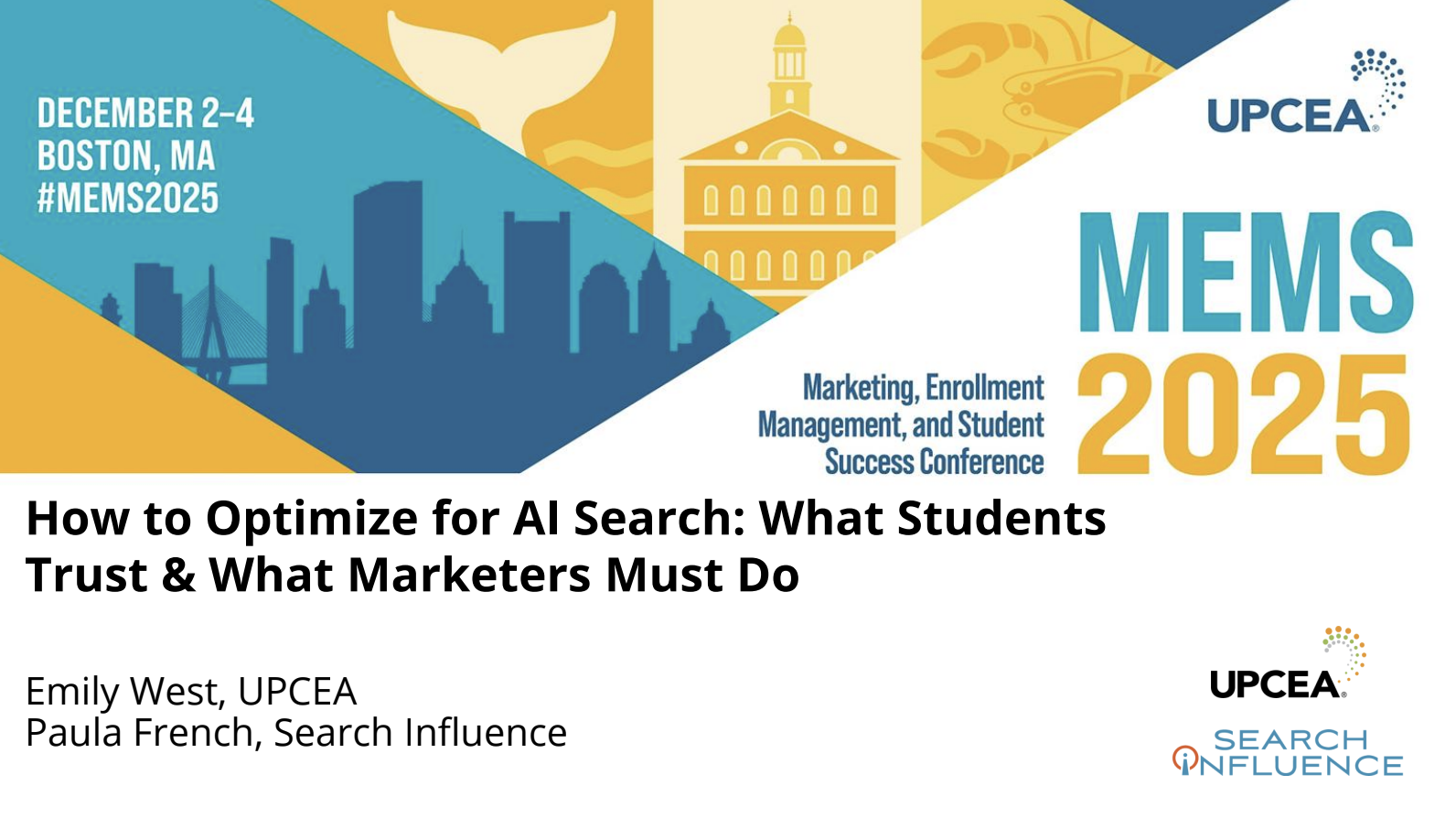
  • UPCEA MEMS 2025 Recap: 11 Higher Ed Marketing Presentations That Show Where We’re Heading

    This review was created with AI assistance and human guidance from Will Scott, AI SEO Expert and CEO of Search Influence.

    TL;DR: The UPCEA MEMS 2025 conference made one thing clear: AI isn’t coming to higher education marketing. It’s here. And institutions that aren’t actively optimizing for AI search, building integrated marketing systems, and using data to drive decisions are already falling behind.

    Here’s what we learned from 11 presentations that are reshaping how institutions connect with students.

    The Big Picture

    So, we just got back from MEMS 2025, UPCEA’s Marketing and Enrollment Management Summit, and the theme was impossible to miss.

    AI is fundamentally changing how students discover and evaluate educational programs.

    Not “might change.” Not “will change eventually.”

    It’s happening now.

    The conference brought together marketing and enrollment professionals from institutions across higher education, and what struck us was how many presenters were sharing real implementations, not theoretical frameworks. We’re past the “what if” stage. We’re in the “here’s what works” stage.

    Throughout 11 presentations, three themes kept coming up:

    1. AI search visibility is the new SEO — and most institutions are missing it
    2. Integration beats silos — successful strategies span channels and touchpoints
    3. Data only matters if it drives action — too many institutions collect without implementing

    Let’s break down what we learned from each session.

    1. How to Optimize for AI Search: What Students Trust & What Marketers Must Do

    Presenters:

    Emily West and Paula French opened with research that cuts through the speculation.

    The Data:

    • 1,061 individuals surveyed
    • 760 met the qualification criteria
    • One of the largest datasets on student search behavior in the AI era

    What This Means:

    The presentation revealed which search platforms students actually trust and how they perceive AI-driven results. The answer isn’t what most institutions assume.

    The Finding That Stopped Everyone:

    During the Insights & Innovation session (UPCEA’s industry insights presentation), a statistic was mentioned that should prompt every higher education marketer to pause: University websites appear in only 3% of AI Overviews.

    Let that sink in.

    Students are using AI search. AI is generating answers. And institutional websites are barely showing up.

    Students use different platforms for different purposes. They place varying levels of trust in AI-generated results versus traditional search. And they’re developing new research patterns that institutions need to understand.

    The Actionable Part:

    West and French didn’t just present data. They shared strategies for:

    • Creating content that AI systems actually cite
    • Building authority that makes AI search engines trust your institution
    • Understanding the nuanced ways students use AI tools, search engines, and university websites

    The Bottom Line:

    If you’re not thinking about AI search visibility, you’re already behind. The opportunity gap is massive, and it’s only getting wider.

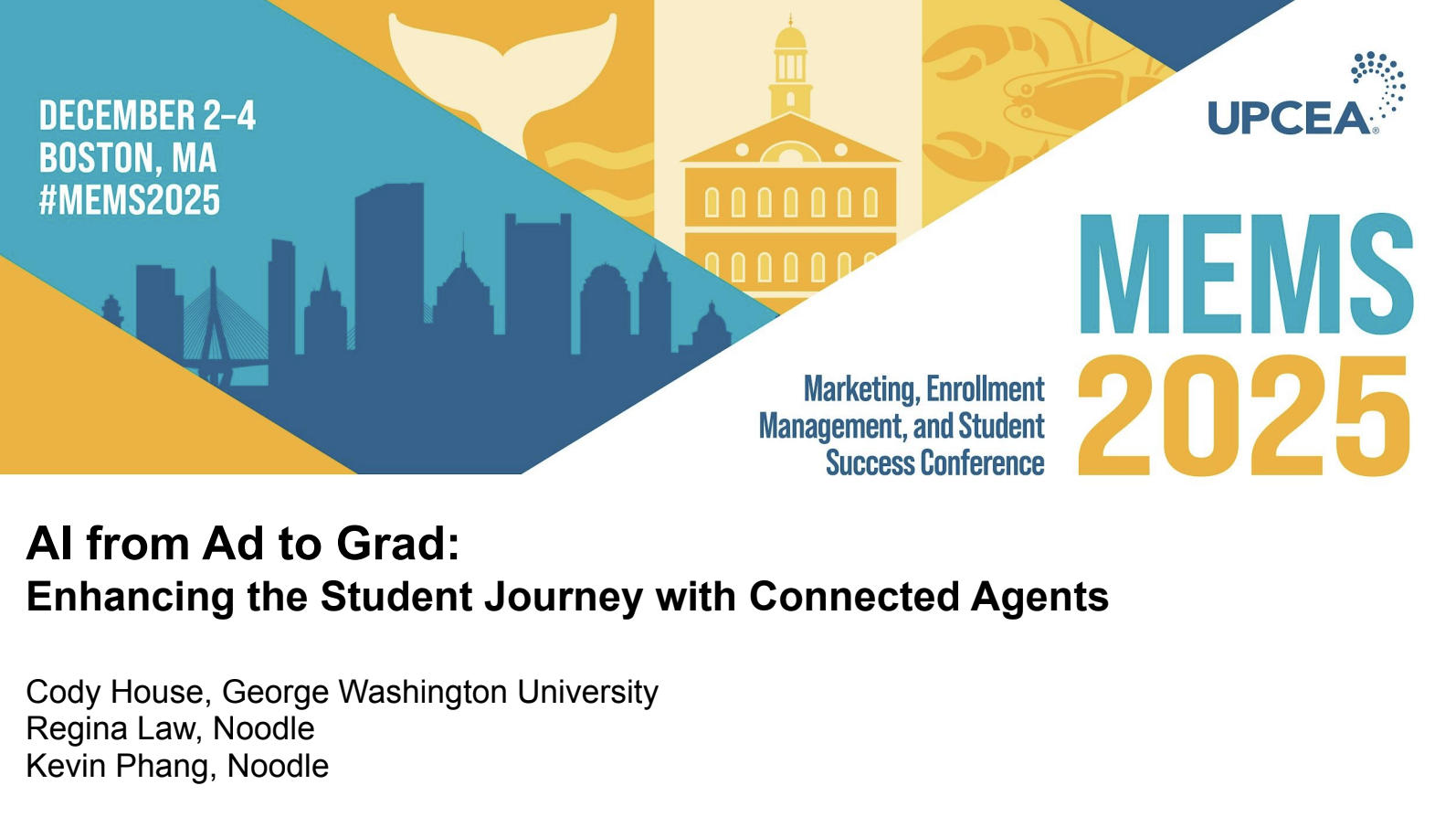
    2. AI from Ad to Grad: Enhancing the Student Journey with Connected Agents

    Presenters:

    This session changed how we think about AI in higher education.

    Most institutions treat AI as a point solution — maybe for chatbots, maybe for content generation. But GWU and Noodle showed something different.

    The Concept: Connected Agents

    Rather than isolated AI tools, they’re building AI systems that work together across the entire student journey, from first advertisement to graduation.

    Consider this: An AI agent that assists with initial inquiries shares context with the enrollment agent, which in turn shares context with the student success agent. Each interaction builds on the last.

    Why This Matters:

    The session’s title, “AI from Ad to Grad,” captures the scope. This isn’t about optimizing one touchpoint. It’s about creating a seamless, intelligent experience that follows students throughout their entire journey.

    The Practical Applications:

    The presentation explored how institutions can:

    • Create AI systems that anticipate student needs rather than just respond
    • Build integrated ecosystems instead of point solutions
    • Develop partnerships that enable comprehensive AI implementation

    The Takeaway:

    AI works better when it’s connected. Isolated tools create isolated experiences. Connected agents create momentum.

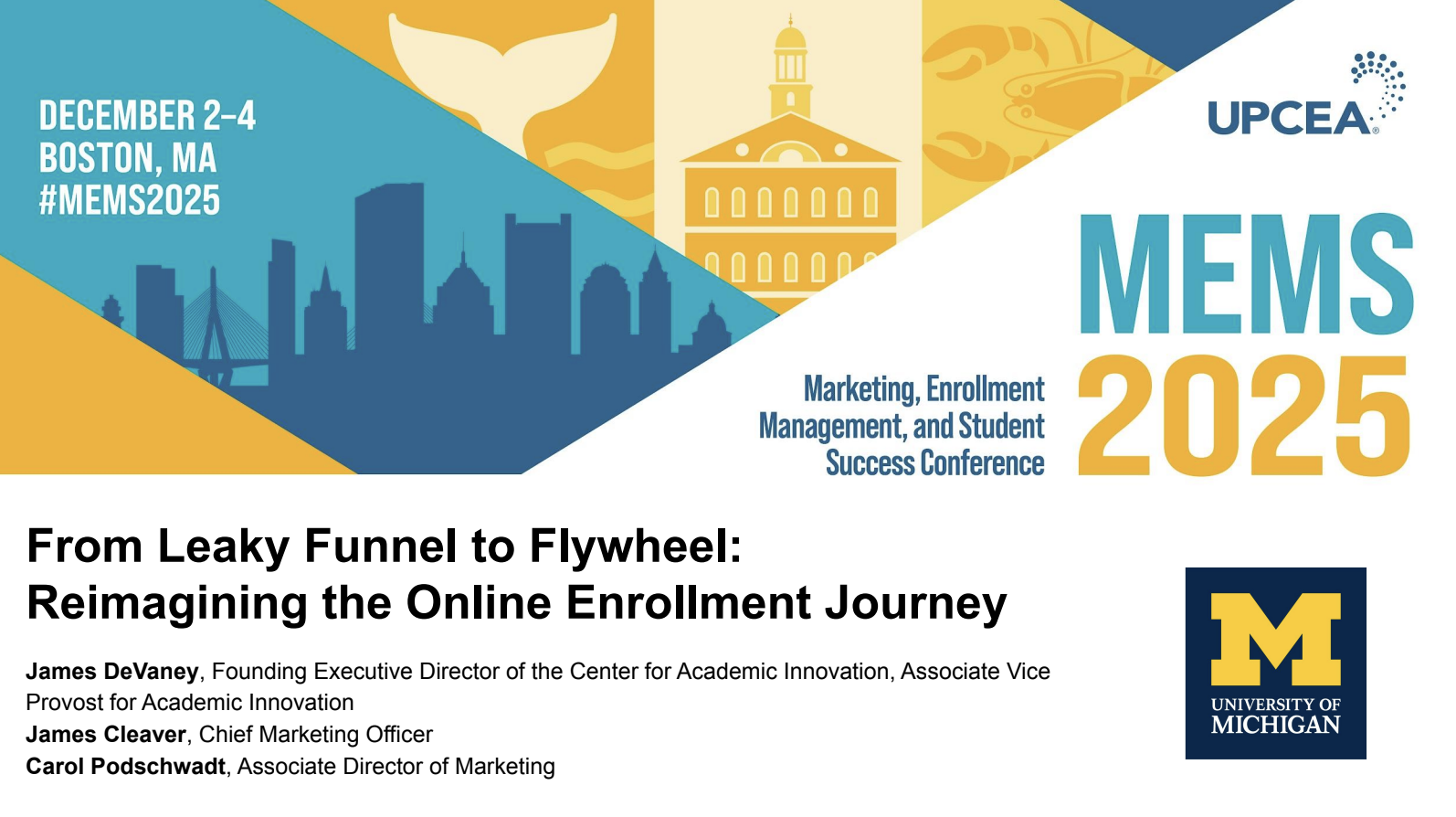
    3. From Leaky Funnel to Flywheel: Reimagining the Online Enrollment Journey

    Presenters:

    This might have been the most conceptually transformative session of the conference.

    The Problem With Funnels:

    The University of Michigan team made a compelling case: The traditional funnel model is fundamentally flawed for modern enrollment.

    Funnels are leaky. They’re one-way. They require constant input of new marketing dollars.

    The Flywheel Alternative:

    Instead, they proposed a self-reinforcing system:

    • Satisfied students create success stories
    • Success stories attract more students
    • More students create more success stories
    • The momentum builds on itself

    This isn’t semantics. It’s a complete reimagining of how institutions approach enrollment.

    The Real-World Proof:

    What made this session powerful: U-M has actually implemented this. They shared real examples of how the flywheel model works in practice.

    The Framework:

    1. Build systems where student success creates marketing momentum
    2. Reduce dependency on constant new marketing spend
    3. Create self-sustaining enrollment cycles

    Why It Works:

    Instead of constantly chasing new prospects, institutions can build systems that naturally attract and convert students while improving the experience for current students.

    The flywheel compounds. The funnel just leaks.

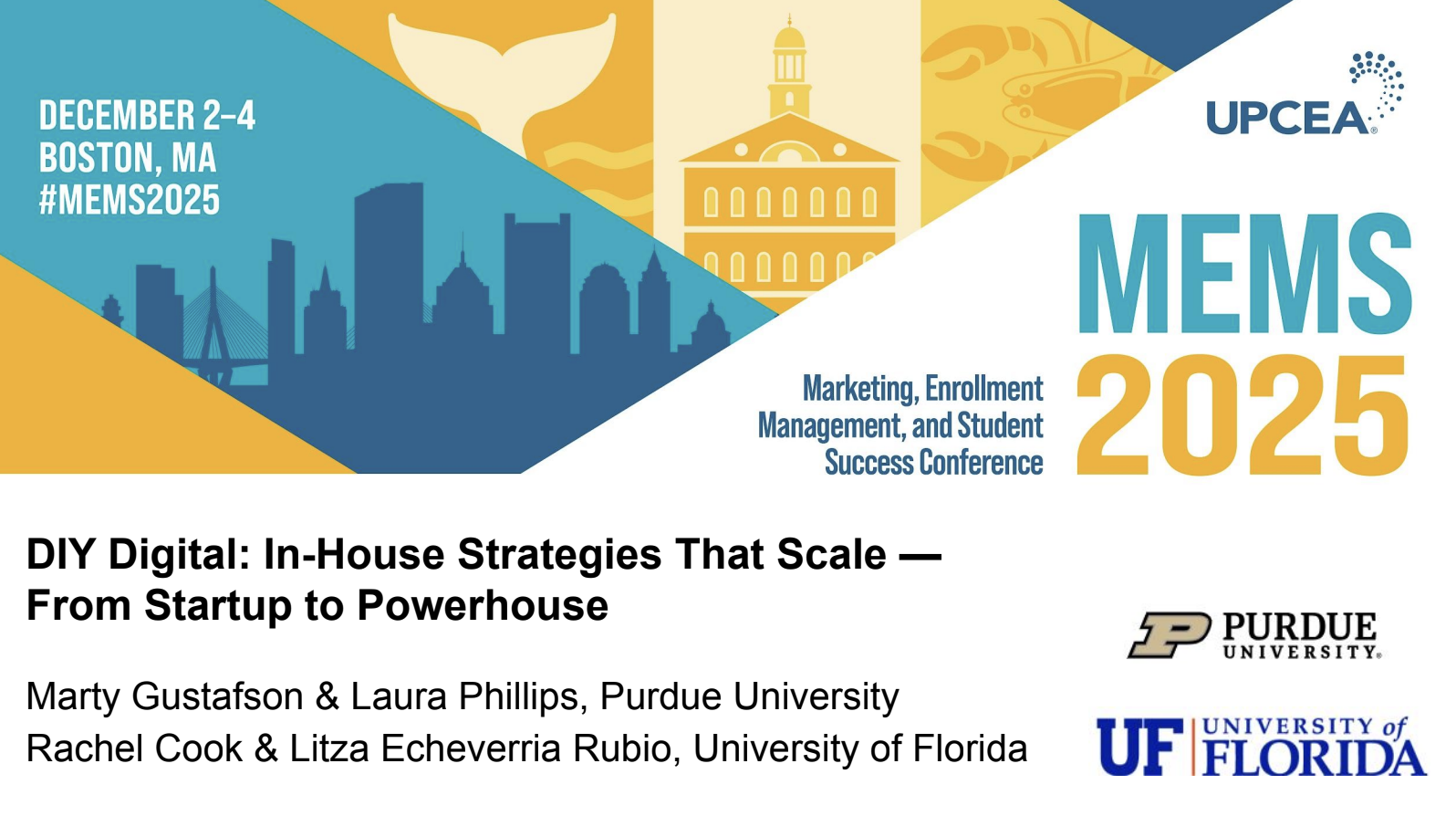
    4. DIY Digital: In-House Strategies That Scale — From Startup to Powerhouse

    Presenters:

    One of the most practical sessions came from two powerhouse institutions sharing their journeys.

    The Question Every Institution Faces:

    When do you outsource marketing? When do you build in-house?

    Purdue and Florida provided frameworks for making that decision, and more importantly, guidance on transitioning between models.

    The Honest Assessment:

    Both teams spoke from experience about the benefits of in-house operations. But they were refreshingly honest about the challenges and trade-offs.

    This wasn’t a sales pitch. It was a balanced exploration of how to scale from startup-level operations to powerhouse marketing teams.

    The Decision Framework:

    1. Assess your institutional needs
    2. Evaluate vendor vs. in-house capabilities
    3. Plan transitions that don’t disrupt operations
    4. Build internal capabilities while maintaining quality

    The Key Insight:

    There’s no one-size-fits-all answer. However, there are frameworks available to help you make the right choice for your institution’s unique situation.

    5. From Click-Chasing to Trust-Building: The AI Marketing Shift

    Presenters:

    This session addressed one of the most fundamental shifts in marketing today.

    The Old Playbook:

    Optimize for clicks. Maximize conversions. Track immediate ROI.

    The New Reality:

    In an AI-driven landscape, that playbook doesn’t work the same way.

    AI systems prioritize authoritative, trustworthy content. They recognize long-term value over quick conversions. They build on relationships, not transactions.

    The Shift:

    The title says it all: “From Click-Chasing to Trust-Building.”

    Success isn’t measured just in clicks and conversions. It’s measured in how institutions are perceived by:

    • AI systems
    • Search engines
    • Prospective students (who are increasingly sophisticated about evaluating marketing messages)

    The Strategy:

    Build long-term trust, authority, and value. Create content that AI systems recognize as reliable. Focus on relationships that extend beyond the initial inquiry.

    The Bottom Line:

    Click-chasing is a short-term game. Trust-building is how you win in the AI era.

    6. Insights & Innovation: Strategic Perspectives from UPCEA’s Trusted Corporate Partners

    Presenters:

    • Will Scott, Search Influence
    • Tracy Kreikemeier
    • Shauna Cox
    • Jennifer Blassingame

    (Full disclosure: This is our group session, so we’re recapping what we presented.)

    Session Focus: Are You Showing Up? How to Track Visibility in AI Search

    The Problem:

    Most institutions have a critical gap in their analytics: Traditional SEO tracking doesn’t capture AI Overviews, AI-generated answers, or how institutions appear in AI-powered search experiences.

    The Question:

    How do you know if your institution is actually appearing in AI search results?

    The Challenge:

    You can’t optimize for what you can’t measure. And traditional analytics tools weren’t built for the AI search landscape.

    The Solution:

    We shared tools and strategies specifically designed for monitoring AI search presence. The goal isn’t just knowing whether you’re showing up — it’s understanding how you’re appearing and in what contexts.

    The Framework:

    1. Track visibility in AI search results (tools that traditional analytics miss)
    2. Understand AI Overviews and their impact
    3. Monitor AI search presence across platforms
    4. Position your institution to appear in AI-generated results

    The Actionable Part:

    This isn’t just about SEO in the traditional sense. It’s about understanding how AI systems evaluate and surface content, and how institutions can position themselves to be included.

    The Tools:

    Several AI SEO tracking platforms are available now. The tracking piece is becoming a commodity — the value is in what platforms do with that data.

    The Takeaway:

    If you’re not tracking AI search visibility, you’re flying blind. And you can’t optimize what you can’t see.

    7. Designing with Data: Using Surveys and Stories to Shape Online UX + ROI

    Presenters:

    • Auris Calvino, Associate Director of Online Marketing and Communications
    • Lindi Ragsdale, Associate Director of Online Data, Technology, and Operations

    This session addressed one of the most common problems in higher ed marketing.

    The Gap:

    Institutions collect student feedback. But do they actually act on it?

    The session opened with a provocative question: “How confident are you that your institution is acting on student feedback and not just collecting it?”

    The Problem:

    Survey fatigue. Data that sits unused. Feedback that doesn’t drive change.

    The Solution:

    Combine quantitative survey data with qualitative stories. Use data to inform UX decisions that actually improve outcomes.

    The Framework:

    1. Collect both quantitative and qualitative data
    2. Bridge the gap between collection and implementation
    3. Create systems where feedback drives continuous improvement
    4. Measure ROI through data-driven design

    The Key Insight:

    Measuring and improving ROI requires both:

    • Quantitative rigor (Ragsdale’s data and technology background)
    • Qualitative insights (Calvino’s marketing and communications role)

    The Takeaway:

    Data is only valuable if it drives action. Too many institutions collect without implementing.

    8. In Marketing, Evolution isn’t Optional: Getting Ahead in an AI-driven World

    Presenters:

    West and Gonzalez presented findings from their 2025 research study.

    The Data:

    • 99 marketing and enrollment professionals surveyed
    • 62 met the qualification criteria
    • Insights into how institutions are responding to the AI revolution

    The Finding:

    61% of respondents say their institution is receptive to emerging technologies.

    That’s up from just 40% in 2024.

    What This Tells Us:

    Institutions are recognizing the need to evolve. The question is whether they’re actually implementing change or just acknowledging the need.

    The Trends:

    The research revealed emerging trends in higher education marketing and enrollment management, showing how institutions are adapting (or struggling to adapt) to new technologies.

    The Gap:

    There’s a difference between recognizing the need to evolve and actually implementing change. The study explored that gap.

    The Actionable Insights:

    The presentation translated findings into actionable insights for institutions looking to get ahead rather than just keep up.

    The Bottom Line:

    Evolution isn’t optional. But recognition without implementation doesn’t count.

    9. From Search to Success: Integrating SEO and Email Marketing to Drive Enrollment

    Presenters:

    • Tim Grenda, SEO and Content Manager
    • Caitlin Dimalanta, Marketing Communications Specialist

    This session addressed one of the most common problems in digital marketing: silos.

    The Problem:

    SEO and email marketing are often managed separately. They operate in isolation. They don’t work together.

    The Solution:

    Integrate SEO and email marketing strategies into cohesive campaigns.

    The Framework:

    1. Break down channel silos
    2. Create campaigns that span search and email
    3. Repurpose search-optimized content through email
    4. Use email engagement data to inform SEO strategy

    The Synergy:

    Content optimized for search can be extended through email. Email engagement data can inform SEO strategy. The channels work better together than apart.

    The Takeaway:

    Integration beats isolation. Every time.

    10. Boosting SEO & Engagement Through Testimonial-Driven Web Content

    Presenters:

    This session addressed one of the most effective but underutilized content strategies.

    The Strategy:

    Leverage student and alumni testimonials for both SEO and engagement.

    The Balance:

    Many institutions struggle with this: How do you optimize for search while maintaining authenticity?

    The Answer:

    Authenticity and search optimization aren’t mutually exclusive. In fact, authentic student stories often perform better because they naturally include the language and questions that prospective students are searching for.

    The Multi-Purpose Approach:

    Testimonials can serve multiple purposes:

    • Improve SEO through natural language and long-tail keywords
    • Build trust with prospective students through authentic voices
    • Create engaging content that keeps visitors on site longer

    The Framework:

    1. Collect testimonials strategically
    2. Optimize for search while maintaining authenticity
    3. Deploy across multiple touchpoints
    4. Measure impact on both SEO and engagement

    The Takeaway:

    Maximize content value. One piece of content can serve multiple purposes if you think strategically.

    11. Education is a Business: Using ROI Data to Have Hard Conversations

    Presenters:

    This might have been the most candid session of the conference.

    The Reality:

    Institutions need to make data-driven decisions about where to invest marketing dollars. Those conversations aren’t always easy.

    The Challenge:

    Using ROI data to make strategic decisions isn’t just about numbers. It’s about:

    • Having the right data
    • Presenting it effectively
    • Navigating the political and cultural challenges that come with data-driven decision-making in higher education

    The Framework:

    1. Measure ROI accurately
    2. Communicate insights clearly
    3. Navigate institutional politics
    4. Make decisions that balance educational mission with financial reality

    The Honesty:

    The presenters were refreshingly honest about what works, what doesn’t, and how to handle difficult situations when data suggests changes that institutions may be reluctant to make.

    The Takeaway:

    Hard conversations are easier when you have the right data, presented the right way, with the right frameworks.

    Common Themes: What This All Means

    So, what do these 11 presentations tell us about where higher education marketing is heading?

    Three themes kept coming up:

    1. AI Search Visibility Is the New SEO

    Multiple presentations highlighted the critical need for institutions to adapt to AI-driven search environments.

    The reality: AI isn’t just another tool. It’s fundamentally changing how students discover, evaluate, and engage with institutions.

    The challenge: Success in AI search requires a different approach than traditional SEO. It’s about building authority, creating content that AI systems trust and cite, and understanding how AI Overviews are reshaping the discovery process.

    The opportunity: Institutions that aren’t thinking about AI search visibility are already falling behind. The gap will only widen.

    2. Integration Beats Silos

    Many sessions focused on integrating marketing channels and strategies rather than operating in isolation.

    The reality: Isolated tactics don’t work in the modern marketing landscape.

    The solution: Successful institutions think holistically about the student experience, creating integrated systems where different channels and touchpoints work together.

    The framework: Think systems, not silos.

    3. Data Only Matters If It Drives Action

    Several presentations addressed the gap between collecting data and actually using it.

    The problem: Too many institutions collect data that sits unused.

    The solution: Institutions need frameworks for interpreting data, communicating insights, and using information to drive decisions.

    The framework: Data → Interpretation → Communication → Action

    The Bottom Line: What Institutions Need to Do Now

    Based on what we learned at MEMS 2025, here’s what institutions should prioritize:

    1. Start Tracking AI Search Visibility

    If you’re not measuring how you appear in AI Overviews and AI-generated answers, you’re flying blind. Traditional SEO analytics don’t capture this.

    2. Build Integrated Systems

    Stop thinking in silos. Start thinking about how channels work together. Whether it’s SEO and email, or AI agents throughout the student journey, integration beats isolation.

    3. Close the Data-to-Action Gap

    Collecting data isn’t enough. You need frameworks for interpreting, communicating, and acting on insights.

    4. Focus on Trust and Authority

    In an AI-driven landscape, trust and authority matter more than clicks. Build long-term value, not short-term conversions.

    5. Think Flywheel, Not Funnel

    Build systems that create momentum. Student success should attract more students. That’s how you reduce dependency on constant new marketing spend.

    Resources and Next Steps

    Presentation Slides: Links to presentation slides will be made available through UPCEA’s member portal and conference resources.

    Presenter Contact Information: Many presenters are available for follow-up questions. Contact information can be found through UPCEA’s member directory or through the presenters’ institutions.

    Tools and Frameworks: Several sessions mentioned specific tools, frameworks, and resources. We’ll be sharing more on these in upcoming posts.

    The Conversation Continues:

    The question isn’t whether higher education marketing will continue to evolve. It’s whether individual institutions will evolve with it.

    What strategies are you implementing? What questions do you have? Let’s keep the conversation going.

    This recap is based on presentations from MEMS 2025, UPCEA’s Marketing and Enrollment Management Summit. For questions or to share your own insights, connect with us on LinkedIn or reach out through Search Influence.

    This recap reflects what we heard on stage.

    To understand how these trends are already showing up in real student behavior, explore Search Influence’s AI Search in Higher Education: How Prospects Search in 2025 research, conducted in partnership with UPCEA.

    The study reveals how prospective students utilize AI tools, search engines, and university websites in conjunction and what higher education marketers need to do now to remain visible in AI-driven enrollment decisions.

  • Search Influence Named a Finalist for Best SEO Campaign at the 2025 US Agency Awards

    Search Influence Named a Finalist for Best SEO Campaign at the 2025 US Agency Awards graphic

    We’re excited to share that Search Influence has been named a Finalist in the Best SEO Campaign category at the 2025 US Agency Awards for our AI-driven campaign, The Art of AI SEO, created in partnership with Maine College of Art & Design (MECA&D).

    This recognition marks our second consecutive year of being shortlisted for this category, following our Silver win in 2023 for Best Integrated Campaign, a testament to our continued excellence in SEO, technical strategy, and AI search innovation.

    The Nominated Campaign: The Art of AI SEO

    MECA&D launched three new online graduate certificate programs into a highly competitive market. To stand out against major universities, the institution needed to increase visibility across both traditional search engines and emerging AI-powered platforms.

    Our solution was an AI SEO strategy designed to boost discovery, strengthen authority, and drive enrollment.

    Our Strategy at a Glance

    AI Search Visibility

    We structured site content using semantic signals, schema markup, and clear topical architecture to ensure AI systems could retrieve and cite MECA&D pages.

    Conversion-Focused Program Pages

    We added video content, clarified messaging, and strengthened user pathways to support prospective students at every decision point.

    Content Development

    We produced keyword-driven blogs, instructor spotlights, and high-salience pages that positioned MECA&D as an authoritative voice.

    The Results

    Our AI-optimized SEO strategy fueled exceptional performance:

    • 77% above enrollment goals
    • 171% increase in website sessions
    • 3,894% growth in ranking keywords

    Today, MECA&D’s Arts Education, Expressive Arts Therapy, and Arts Leadership programs all appear in AI search engines, a major competitive advantage as generative results reshape student search behaviors.

    As MECA&D’s Associate Dean of Online Learning, Heather Holland, shared:

    “Our online programs exceeded enrollment targets by 65% in less than a year.”

    Leading AI SEO for Higher Education

    As a higher education digital marketing agency, Search Influence is at the forefront of AI search strategy. Our team combines decades of higher ed SEO experience with deep expertise in AI content structuring, generative search visibility, and technical optimization.

    Our CEO and Co-Founder, Will Scott, is a national thought leader in AI SEO and the instructor of an SMX Master Class on Generative Engine Optimization. Our approach has been grounded in semantic SEO and structured data since the earliest days of the Knowledge Graph, long before AI Overviews made structured content essential.

    We help higher education institutions:

    • Build full-funnel SEO strategies tied to enrollment goals
    • Improve program visibility in AI and organic search
    • Develop content ecosystems designed for both humans and AI systems
    • Strengthen authority through structured data, internal linking, and topic clusters

    2025 AI Search in Higher Education Research Study

    This announcement follows the release of our 2025 AI Search in Higher Education Study, which uncovers how prospective students use AI tools to research programs, evaluate institutions, and form their initial consideration sets.

    Higher ed marketers can access the full report to understand:

    • Which AI tools prospects use most
    • How AI citations influence credibility
    • What strategies institutions need to stay visible

    Looking Ahead

    We’re honored to be recognized by the US Agency Awards and grateful to MECA&D for their partnership. As AI search reshapes visibility, Search Influence remains committed to helping colleges and universities compete and win in this new era of search.

    If you’re ready to strengthen your AI SEO strategy, our team is here to help you lead. Contact us today to learn more.

  • Higher Education AI Search Strategy: What Students Expect vs. How Institutions Must Adapt

    Higher Education AI Search Strategy: What Students Expect vs. How Institutions Must Adapt graphic

    Key Insights

    • Students have shifted how they search.
      Prospective learners now use AI tools alongside traditional search, making structured, consistent program information essential for visibility.
    • Institutional readiness lags student behavior.
      Many colleges recognize the influence of AI search but still lack the systems and processes to monitor and improve their presence in generative results.
    • An AI search strategy requires core operational alignment.
      Institutions must unify program data, structure pages for AI readability, reinforce entity signals, and maintain ongoing data hygiene to stay competitive.

    Half of prospective students use AI tools weekly. Nearly 80% read Google’s AI Overviews before clicking a single search result. 

    For most higher education institutions, that means students are forming opinions about your programs before they ever reach your website. If your information isn’t structured for AI retrieval, you’re invisible during the moment that matters most.

    The UPCEA x Search Influence AI Search in Higher Education Research Study tracked how students search for programs in 2025. A parallel Snap Poll of 30 UPCEA members measured institutional readiness. Together, they reveal a sector-wide gap: students have moved to AI-assisted search faster than colleges have adapted their content strategies.

    This guide breaks down how students search today and outlines the four operational components institutions need to compete for visibility in AI search.

    The New Student Discovery Model and Its Impact on AI Search Visibility

    Higher ed has spent decades optimizing solely for traditional search engines. The challenge now is optimizing for how students actually gather information. That behavior looks much different today than it did even two years ago.

    Students want direct answers, quick comparisons, and credible signals, and they toggle between tools to get them. Generative AI fits naturally into that pattern because it delivers instant interpretation without requiring students to click through multiple pages or sift through fluffy marketing copy.

    AI tools have become routine

    What once felt like experimental search is now embedded in the routine research process.

    • 50% of prospective students use AI tools weekly
    • 79% read AI Overviews before clicking a single blue link

    AI compresses the “orientation” phase of search, the stage where students try to understand what a program involves and which institutions align with their goals. Historically, that moment used to happen on your website. Now it happens in a summary box before a student decides whether your program is worth investigating further.

    If that summary box is inconsistent or simply missing your institution entirely, you’ve lost visibility at a moment that shapes early impressions.

    Students layer Google, YouTube, & AI together

    Even with all the AI buzz, students aren’t abandoning traditional search engines in their search for professional and continuing education (PCE) programs. They’re simply supplementing them.

    • 84% still use traditional search for core information
    • 61% use YouTube to explore programs visually
    • 50% use AI tools for context and comparison

    This creates a layered research journey where each channel serves a specific function:

    1. AI platforms provide the first pass of understanding — condensing program details and requirements, and fitting them into digestible summaries
    2. Google (and other search engines) expand the options — surfacing alternative programs, comparison articles, and third-party reviews
    3. YouTube shapes expectations and emotional resonance — showing campus life, faculty interviews, and student testimonials
    4. Institution websites verify credibility — confirming details, checking accreditation, and exploring outcomes data

    Consistency in presence and messaging across each channel is the new baseline for visibility.

    Universities still hold trust, but AI sets the stage

    Despite the rise of new tools, institutions remain the source students trust most. 77% rely on university websites to verify program information.

    But in many cases, students don’t start with you. They end with you.

    A very typical sequence now looks like this:

    1. AI-generated overview or citation → Initial understanding and shortlist formation
    2. Verification on .edu pages → Credibility check and detail confirmation
    3. Shortlist decisions → Final comparison and enrollment consideration

    AI shapes the expectation. Your website proves (or disproves) the details. Accuracy and clarity must exist in both places for a student to move forward. (Example: If the AI search results say your MBA is 18 months and your program page says 24 months, the friction kills momentum.)

    This reversed discovery model has profound implications for content strategy. You can no longer afford to treat your website as the sole first impression. It’s now the verification step. And if AI has already set the wrong expectation, your website becomes a correction tool instead of a conversion tool.

    Source: UPCEA x Search Influence — AI Search in Higher Education: How Prospects Search in 2025

    Institutional Readiness: Where Colleges Stand in 2025

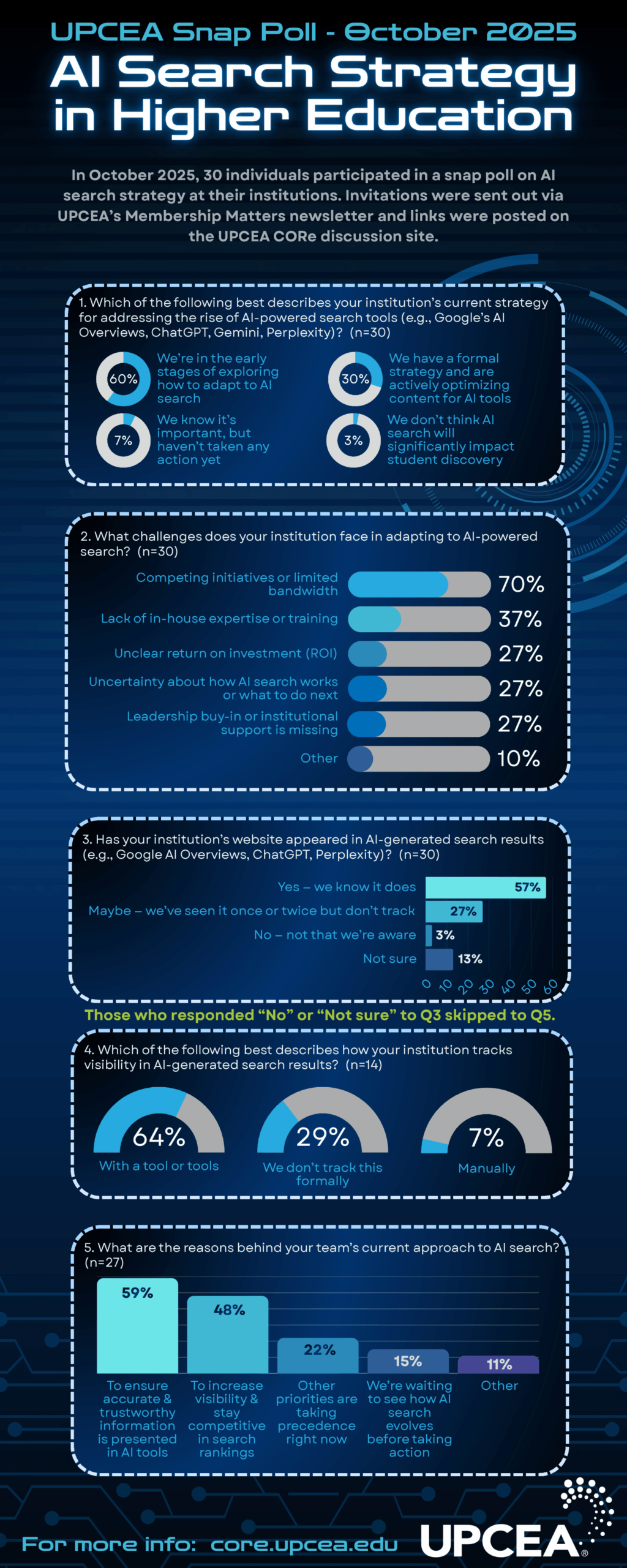
    If student search trends are moving quickly, institutional readiness is moving much slower. Conducted with 30 UPCEA members, the UPCEA x Search Influence Snap Poll reveals a sector that understands the importance of AI search but lacks operational capacity to support it.

    Most institutions know AI matters. The question is whether they have the bandwidth, expertise, and internal alignment to respond.

    Awareness is high, execution is thin

    The majority of institutions recognize that AI is reshaping the discovery process. But knowing and acting are two very different things.

    • 60% are in the early stages of “exploring” AI search
    • 30% have a formal AI search strategy
    • 10% haven’t started or don’t believe AI will impact program discovery

    “Exploring” signals curiosity, but not implementation. A formal strategy requires solid infrastructure (ownership, processes, consistency), and that’s where many institutions are falling behind.

    Without clear ownership, AI search becomes everyone’s concern and no one’s responsibility. Marketing assumes IT will handle technical implementation. IT assumes marketing will define content standards. Enrollment assumes someone else is tracking whether programs appear accurately in AI summaries. Meanwhile, competitor institutions with defined workflows are reinforcing their visibility signals daily.

    The barriers are structural, not philosophical

    No one is debating whether AI-driven search matters. The bottlenecks are operational:

    • 70% cite limited bandwidth or competing priorities
    • 36.67% cite lack of in-house expertise or training
    • 26.67% cite unclear ROI or uncertainty about AI mechanics

    AI systems evolve monthly. Waiting six months to decide “what to do” means falling behind institutions that have already begun reinforcing their information. Every month your program data remains inconsistent is another month AI models learn to trust competitor sources instead of yours.

    Visibility tracking is still inconsistent

    When asked whether their institution appears in AI-generated answers:

    • 56.7% said “yes”
    • 26.7% said “maybe”
    • 13.3% said “uncertain”

    Only 64.29% of those tracking use structured methods, like formal AI SEO tracking tools.

    If institutions don’t know when or how they’re appearing, they also can’t know:

    • Whether AI summaries are accurate
    • Whether competitors appear more frequently
    • Whether certain programs are misrepresented

    Guessing is not a visibility strategy. Without structured monitoring, institutions can’t identify which programs underperform in AI search, can’t track whether content updates improve citation frequency, and can’t benchmark their visibility against regional competitors.

    Early movers are motivated by accuracy & competition

    Among the institutions already adopting an AI search strategy:

    • 59.26% want to ensure the accuracy of AI-generated information
    • 48.15% are focused on visibility and competitive positioning

    Meanwhile:

    • 22.22% say other priorities rank higher
    • 14.81% are “waiting to see what happens”

    The difference between these groups is trajectory. Early adopters move ahead while others accumulate visibility debt, the long-term disadvantage that forms when AI systems learn from competitors instead of from you.

    Institutions waiting for clearer ROI data or more mature tracking tools are making a strategic bet that the cost of delay is lower than the cost of early action. For some, that bet may prove correct. For most, it won’t.

    Source: AI Search Strategy in Higher Education — Snap Poll, October 2025

    AI Search in Higher Ed infographic

    Core Components of a Modern Higher Education AI Search Strategy

    Generative search engines don’t reward creativity. They reward clarity. Winning page one and the AI Overview depends on whether a program’s information is consistent, structured, and reinforced everywhere a student or AI tool might encounter it.

    1. Establish program data consistency as the institutional source of truth

    AI models may “misstep” when foundational information is inconsistent. If your academic catalog lists a different cost than the program page, or if PDFs still reference old admissions cycles, AI defaults to whichever source appears most stable, and that isn’t always your institution.

    Your information cleanup has to start with the facts:

    • Cost — tuition, fees, financial aid opportunities, and total program investment
    • Duration — credit hours, typical completion time, and pace options
    • Modality — online, hybrid, in-person, or flexible formats
    • Requirements — prerequisites, application materials, and admission standards
    • Outcomes — employment rates, salary data, and career paths

    When these details are aligned across catalogs, PDFs, program pages, and third-party listings, AI no longer has to choose between conflicting answers. Consistent facts increase trust, and trust improves visibility.

    Program pages can’t be accurate until the underlying data is

    Data consistency isn’t a content problem. It’s a governance problem. Most institutions store program information in multiple systems: student information systems, content management systems, PDF repositories, third-party directories, and marketing automation platforms. Each system may reflect different update cycles, approval processes, and data owners.

    The solution isn’t consolidating all systems into one platform. It’s establishing a single source of truth for core program attributes and building workflows that propagate updates across all systems simultaneously. When tuition changes, that change should flow to every digital property within hours, not weeks.

    2. Build an AI-readable content architecture on program pages

    Even perfectly aligned information can underperform if the page structure makes it hard for AI to interpret. Generative tools scan for clarity, hierarchy, and explicit answers to common user queries.

    Pages are strongest when the essentials sit in predictable, machine-readable patterns:

    • Clean headings that signal structure and topic boundaries
    • Modular sections focused on single topics without mixing concerns
    • Concise explanations that answer specific questions directly
    • Scannable details formatted for quick extraction (tables, lists, definition blocks)

    Students prefer this structure, too. Clear sections for cost, schedule, outcomes, and requirements shorten the time between interest and understanding. AI prefers the same format because it speaks its “language” and reduces ambiguity.

    When program pages feel like reference material rather than brochure copy, visibility improves

    AI-readable architecture doesn’t mean stripping personality from your content. It means organizing information so both humans and machines can extract what they need quickly. You can still include testimonials, brand messaging, and storytelling, but those elements should supplement structured information, not replace it.

    Consider how AI extracts content. It doesn’t read your page top to bottom like a human. It scans for semantic patterns, identifies chunks that answer specific queries, and evaluates whether those chunks are self-contained and coherent. A program page that buries cost information in the middle of a narrative paragraph underperforms compared to one that lists cost in a clearly labeled section with supporting context.

    3. Strengthen program entities through cross-site signals

    AI search isn’t keyword-based. It’s entity-based.

    Models build their understanding of a program by connecting signals across your entire ecosystem. If terminology shifts from page to page, if key details appear in one place but not another, or if older content contradicts newer versions, entity confidence drops.

    Cross-site reinforcement matters:

    • Consistent terminology across all digital properties
    • Internal linking that clarifies relationships between programs, departments, and requirements
    • Schema markup that defines program attributes in a machine-readable format
    • Repetition of essential facts across relevant pages to reinforce entity stability

    The more stable and coherent the entity, the more likely AI is to cite it.

    This is how institutions move from “we sometimes appear” to “AI consistently references us”

    When a student asks an AI tool, “What are the prerequisites for the MBA program at [your institution]?”, the AI doesn’t just check your MBA page. It checks every page where those prerequisites might be mentioned: department pages, catalog entries, PDF documents, and FAQ sections. If those sources conflict, AI either omits your institution or presents the information with lower confidence.

    Schema markup amplifies entity strength by explicitly defining relationships. When you mark up your MBA program with structured data that identifies its parent department, associated faculty, duration, and cost, you help AI understand not just what the program is but how it fits into your institutional structure.

    4. Implement ongoing AI visibility monitoring & data hygiene

    AI visibility is not a one-time project. Models update frequently, and each update reshapes which programs they surface, how they phrase details, and which institutions they trust.

    Monitoring needs to be ongoing and structured around:

    • Citation frequency — how often your programs appear in AI responses
    • Accuracy of summaries — whether AI-generated descriptions match your current information
    • Sentiment and positioning — how your programs are characterized relative to competitors
    • Competitor visibility — which institutions are appearing when yours aren’t

    This level of tracking enables institutions to identify patterns early, correct inaccuracies quickly, and establish authority over time. 

    About Search Influence’s support with AI visibility tracking

    Unsure where to start? Our team provides structured AI traffic reporting that shows how your programs appear across generative platforms and where inconsistencies may be affecting trust. As your tracking partner, we can help your institution gain clear visibility into patterns, changes, and gaps, helping you prioritize the data and content updates that strengthen your position in AI search engines.

    Get the research shaping modern AI search. → 

    FAQs About Higher Education AI Search Strategy

    How does AI decide which programs to cite?

    AI looks for information that is consistent, structured, and verifiable across multiple pages and sources. Programs with aligned facts and clear architecture are more likely to appear.

    How can leadership be convinced to prioritize AI search visibility?

    Show the connection between visibility and enrollment. Students are forming opinions before they reach institutional websites, and institutions that don’t appear in AI-generated search results lose those early moments of influence.

    How often should institutions audit program pages for AI readiness?

    Quarterly, if not more. AI models update rapidly, and audits ensure that key information remains up to date, content structure remains clean, and external listings don’t drift out of alignment.

    What KPIs indicate improvement in AI discoverability or trust?

    Citation frequency, accuracy, sentiment, and competitor comparisons. These KPIs signal whether AI considers your institution a stable source of truth.

    Students Have Shifted Their Discovery Habits. Your AI Search Strategy Must Catch Up.

    AI isn’t a future threat. It’s an active influence in how prospective students search for programs and decide which institutions to trust. 

    Your student search guide

    Based on survey data from 760 prospective adult learners, the UPCEA x Search Influence AI Search in Higher Education Study offers the most comprehensive view of how prospects utilize AI for program research.

    Use the data to:

    • Align leadership around AI search priorities
    • Identify priority programs for content optimization
    • Plan FY26 content investments with confidence
    • Benchmark readiness against peer institutions
    • Strengthen your visibility signals across search engines and AI tools

    AI search is already shaping enrollment. Institutions that build their strategy now will lead the next phase of visibility.

    Download the full study to get the complete data set and a clearer view of how to modernize your AI search strategy.

  • Search Influence to Share AI Search Strategies for Higher Education at MEMS 2025

    Search Influence to Share AI Search Strategies for Higher Education at MEMS 2025

    As AI continues to redefine how students search for and engage with academic programs, marketers are rethinking how they track, measure, and optimize online visibility. 

    This December, Search Influence will share actionable AI search strategies for higher education at the 2025 UPCEA Marketing, Enrollment Management, and Student Success (MEMS) Conference, held December 2–4 in Boston, Massachusetts.

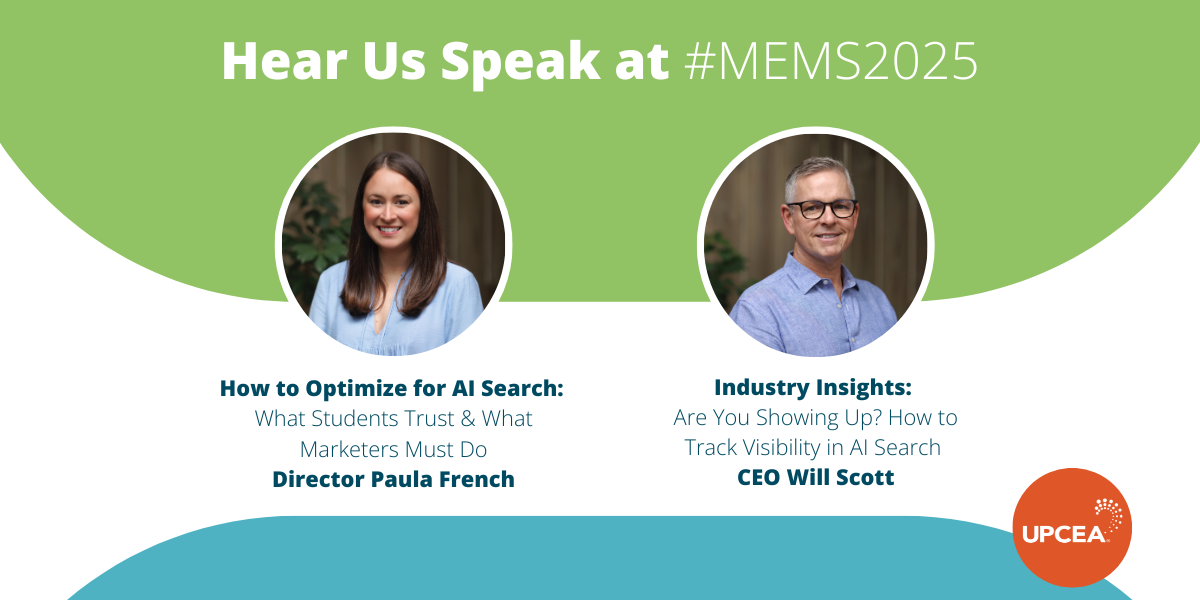
    Three members of the Search Influence leadership team (Will Scott, Paula French, and Jeanne Lobman) will present and moderate sessions on how institutions can:

    • Adapt to generative AI search
    • Integrate data-driven marketing channels
    • Create more credible, student-focused content

    Together, these sessions will help higher ed marketers translate data into decisions and strengthen visibility in the age of AI search.

    Search Influence Sessions at MEMS 2025

    MEMS2025 speakers graphic

    “Are You Showing Up? How to Track Visibility in AI Search”

    Presenter: Will Scott, CEO and Co-Founder, Search Influence

    Time: Wednesday, December 3 – 10:00 a.m.

    AI search is no longer theoretical. It’s measurable. In this session, Will will show institutions how to connect generative search visibility to real data and use it to drive recruitment strategy.

    Session Highlights:

    • Learn how to measure your institution’s presence across AI platforms like ChatGPT, Gemini, and Perplexity.
    • Discover how to segment AI-driven traffic using Google Analytics 4 and Looker Studio.
    • Identify metrics and tools that help you evaluate AI visibility and performance.

    “How to Optimize for AI Search: What Students Trust & What Marketers Must Do”

    Presenter: Paula French, Director of Sales and Marketing, Search Influence

    Co-Presenter: Emily West, Senior Market Research Analyst, UPCEA

    Time: Wednesday, December 3 – 3:30 p.m.

    Nearly half of prospective students now use AI tools weekly, and 79% read AI-generated summaries. In their presentation, Paula and Emily will translate this data into concrete next steps for marketing teams ready to compete in generative search.

    Session Highlights:

    • Review new findings from the 2025 UPCEA + Search Influence study, AI Search in Higher Education: How Prospects Search in 2025.
    • Understand what prospective students trust in AI-generated results.
    • Learn a three-part framework for AI visibility: discoverability, credibility, and content optimization.

    “From Search to Success: Integrating SEO and Email Marketing to Drive Enrollment”

    Moderator: Jeanne Lobman, Director of Operations, Search Influence

    Panelists: Tim Grenda and Caitlin Dimalanta, San Diego State University

    Time: Tuesday, December 2 – 2:45 p.m.

    Students don’t stop searching once they find a program. They start evaluating how institutions communicate. This session will explore how connecting SEO insights with email marketing creates a continuous, student-centered experience that strengthens engagement and drives enrollment.

    Session Highlights:

    • Explore how integrated SEO and email strategies guide students from search discovery to enrollment.
    • Learn how coordinated messaging increases engagement and conversion.

    “Boosting SEO and Engagement Through Testimonial-Driven Web Content”

    Moderator: Paula French, Director of Sales and Marketing, Search Influence

    Panelists: Caitlin Wilson and Krysten Cole, Boston University Metropolitan College

    Time: Thursday, December 4 – 10:00 a.m.

    Authenticity has become one of higher education’s strongest differentiators. This session will examine how testimonial-driven storytelling can improve SEO performance, strengthen brand trust, and create more meaningful engagement with prospective students.

    Session Highlights:

    • Understand the importance of authentic student and alumni testimonials in building credibility and enhancing visibility.
    • Learn how to turn stories into measurable content assets that support recruitment goals.
    • Explore how to connect storytelling with keywords and SEO strategies for stronger search performance.

    About MEMS 

    Hosted by the Online and Professional Education Association (UPCEA), the MEMS Conference brings together enrollment and marketing professionals from across the country to share strategies that connect innovation with measurable results. 

    Now in its 34th year, the event will focus on emerging technology, shifting student expectations, and the evolving ways higher education institutions can reach, recruit, and retain learners.

    Throughout the conference, Search Influence will host a booth where attendees can learn how to assess their institution’s AI visibility, explore AI SEO tools, and request a complimentary AI Website Grader developed by Will. Our team will be available to discuss real-world applications of AI-driven marketing data and how colleges can start improving their presence across generative platforms.

    Continuing the Conversation

    As AI search evolves, understanding how visibility, trust, and data intersect has never been more important. 

    If your institution is ready to know where it stands in AI search, download AI Search in Higher Education: How Prospects Search in 2025, or meet our team in Boston to explore how strategy, credibility, and creativity can elevate your visibility.

  • UPCEA Guest Blog: Paula French on AI Search Trends in Higher Education

    AI Search in Higher Education

    When prospective students begin researching programs, their first stop may no longer be your website…. or even Google

    Many now use generative AI platforms like ChatGPT, Gemini, and Perplexity to ask questions, compare options, and find fast answers. These tools influence what students see, what they trust, and which institutions they choose to explore further.

    In her latest guest blog for UPCEA, “AI Search in Higher Education: The Student Search Trends You Can’t Ignore,” Director Paula French breaks down what this shift means for enrollment marketers. 

    Drawing on insights from the new UPCEA x Search Influence research study, AI Search in Higher Education: How Prospects Search in 2025, Paula shares a data-backed look at how students search today — and what your team can do to improve visibility across every touchpoint.

    Top AI Search Trends in Higher Education 

    The study surveyed 760 adult learners aged 18–60 who are actively exploring educational opportunities. Their responses point to a growing reliance on digital tools that extend far beyond search engines.

    • 50% of students use AI tools weekly
    • 79% read Google’s AI Overviews
    • 56% are more likely to trust institutions cited in those Overviews
    • 61% use YouTube like a search engine
    • 77% consider university websites to be highly trustworthy

    Together, these numbers reflect a major shift in how trust is built and how options are evaluated during the early stages of the enrollment process.

    How to Improve Visibility Where It Counts

    Paula’s guest blog offers clear, actionable strategies for improving performance in AI and traditional search, including:

    • Structuring content with clarity using headings, bullet points, and schema markup
    • Including factual, up-to-date program details that AI tools prefer to cite
    • Publishing trust-building content like faculty bios, accreditation info, and student outcomes
    • Monitoring your presence in AI tools like ChatGPT, Gemini, and Perplexity to see what students are seeing
    • Auditing your site’s search performance to make sure you’re showing up where students begin their research

    Students are forming impressions earlier in the decision-making process, and they’re doing it in spaces many institutions aren’t actively monitoring. That’s a missed opportunity, and one that’s becoming harder to ignore.

    For a closer look at the data (plus tips on how your institution can adapt), read Paula’s full guest post.

    See Paula and the Team at MEMS 2025

    Attending UPCEA’s 34th Annual MEMS: Marketing, Enrollment Management, and Student Success Conference in Boston this December? Stop by the Search Influence booth to connect with Paula French, Jeanne Lobman, and Will Scott.

    Paula will also co-present with Emily West of UPCEA in a featured session titled:
    “How to Optimize for AI Search: What Students Trust & What Marketers Must Do” on Wednesday, December 3rd at 3:30 PM.

    The discussion will dive deep into student behavior and outline a strategic approach to visibility built around the pillars of AI SEO.

    View session details →

  • Search Influence to Present on AI Search in Higher Education at AMA Symposium 2025

    Search Influence to Present on AI Search in Higher Education at AMA Symposium graphic

    AI-driven discovery is rewriting the rules of visibility for universities. As prospective students increasingly rely on tools like Google’s AI Overviews, ChatGPT, and Perplexity, the traditional SEO playbook is no longer enough. 

    The next era of visibility requires a strategy built for recognition and trust within AI ecosystems, not just rankings on search results pages.

    Presentation Slides

    At the 2025 AMA Symposium for the Marketing of Higher Education, Paula French, director at Search Influence, and Tara Pope, director of marketing at Tufts University College, will explain how institutions can thrive in this new environment. 

    Their presentation, “How to Win AI Search: Three Pillars for Success,” will be held on Tuesday, November 11, from 2:50 to 3:40 p.m. in National Harbor, Maryland.

    The Evolving World of AI Search in Higher Education

    Recent findings from the new UPCEA + Search Influence research study, AI Search in Higher Education: How Prospects Search in 2025, reveal that generative AI is transforming how students find and evaluate programs:

    • 50% of prospective students use AI tools weekly.
    • 79% read AI-generated summaries when available.
    • 56% are more likely to trust a site featured in an AI Overview.

    These numbers highlight a pivotal shift. Visibility in AI search is now visibility with students. 

    Institutions that fail to appear in AI-generated answers risk being overlooked entirely, even before a prospective student reaches a search results page.

    Inside the Framework: Three Pillars of AI SEO

    In their AMA Higher Ed session, French and Pope will introduce a practical framework that helps institutions strengthen their visibility and authority within AI-generated environments.

    1. Entities

    AI systems interpret structured data and networked entity relationships. By using schema markup, entity-rich language, and consistent identifiers, institutions can help AI better recognize programs, faculty, and departments.

    2. Semantic relevance

    AI favors content that mirrors how people naturally ask questions. Structuring content in concise Q&A form, using natural language headings, and speaking clearly to student intents makes it easier for AI to parse and surface your content.

    3. Citations

    Trust is a currency in AI. When content is cited or linked from reputable sources (media, academic directories, “best of” lists), AI is more likely to elevate it. PR and content teams should actively integrate link building and authoritative mentions into the SEO strategy.

    Together, these three pillars form the foundation of a sustainable AI SEO strategy that builds visibility across traditional and generative search experiences alike.

    About the Speakers

    Tara Pope serves as director of marketing at Tufts University College, where she oversees marketing and communications for a diverse portfolio of programs, including Pre-College, Professional Education, and the Osher Lifelong Learning Institute. With more than 25 years in digital marketing and communications, her career spans technology, e-commerce, and higher education.

    Paula French, director at Search Influence, is a digital marketing leader with 15 years of experience helping higher education institutions enhance their online visibility and enrollment outcomes. She frequently contributes insights on SEO, analytics, and strategy to national audiences and industry publications.

    About the 2025 AMA Symposium for the Marketing of Higher Education

    The AMA Symposium for the Marketing of Higher Education brings together higher ed marketers and communicators from across the country to exchange insights and shape the future of education marketing.

    For more than 30 years, the Symposium has served as one of the field’s leading events, offering peer-reviewed sessions that inspire collaboration, innovation, and actionable learning. The 2025 Symposium will take place November 9–12, 2025, in National Harbor, Maryland, helping institutions refine their strategies, strengthen their reputations, and drive meaningful impact.

    Why This Conversation Matters

    As generative AI continues to influence how students research, compare, and decide on programs, institutions must adapt their content strategies accordingly. Optimizing for AI search in higher education means focusing on recognition, structure, and authority, not just visibility.

    Paula French and Tara Pope’s framework offers higher ed marketers a clear path forward: one grounded in data, built on collaboration, and ready for the AI-driven future of discovery.

    Learn More About the Research

    Want to explore the trends shaping student search behavior in the age of AI? 

    The new UPCEA + Search Influence research study, AI Search in Higher Education: How Prospects Search in 2025, reveals how students use AI, search engines, and university websites to make enrollment decisions.

    Download the study today to learn how your institution can adapt.

  • Higher Education SEO Checklist for Nontraditional Programs

    Higher Education SEO Checklist for Nontraditional Programs graphic

    Key Insights

    • Nontraditional programs are driving enrollment growth. These offerings now provide working adults and lifelong learners with accessible routes to advance their skills and careers.
    • Your real competition isn’t just other universities. Private bootcamps, online platforms, and credentialing providers are dominating search results and targeting the same students you are.
    • High-intent traffic requires high-intent content. Prospective students aren’t always searching for institutions. They’re searching for outcomes, credentials, and career alignment. Your web pages must reflect those priorities to convert.
    • Visibility in search starts with proper SEO. Content must be structured, helpful, and authoritative to appear in traditional search engines, Google’s AI Overviews, ChatGPT, and other generative tools.

    The future of higher education isn’t confined to traditional four-year degrees. Certificates, bootcamps, and microcredentials have increasingly become pathways for career switchers, adult learners, and professionals who need quick, targeted upskilling.

    But high demand alone doesn’t guarantee enrollment.

    Universities now compete not just with peers but with corporate training providers, digital learning platforms, and alternative credentialing organizations. And with AI-driven search like Google’s AI Overviews and ChatGPT shaping how people find information online, visibility determines who wins attention and who gets overlooked.

    Prioritizing search engine optimization (SEO) ensures your programs surface in traditional search results and AI-generated answers, giving your institution the edge it needs.

    Not sure where to start? This higher education SEO checklist outlines essential steps to capture visibility and convert interest into enrollment.

    Why Nontraditional Programs Are Surging

    More adults are returning to education

    A growing number of learners today are 25 and older, many of them balancing work, family, and other responsibilities. To them, educational convenience is non-negotiable. These students are drawn to programs that offer flexibility, affordability, and credentials that directly support career advancement.

    That’s why online, hybrid, and evening/weekend formats continue to gain traction. These formats allow adult learners to continue working and managing daily responsibilities while investing in their future, without the need to pause their lives.

    Employers need rapid reskilling

    Workforce disruptions and rapid technological change are creating urgent skill gaps across nearly every industry. In response, employers are embracing skills-based hiring, prioritizing specific competencies over traditional degrees.

    This shift has elevated the credibility of certificates, microcredentials, and bootcamps. Programs that align with industry-recognized certifications (ex: project management, cloud computing, continuing education in healthcare) help learners meet employer expectations and compete in fast-moving job markets.

    Learners want faster ROI

    Many students today are motivated by outcomes they can act on quickly — a promotion, a licensure renewal, or a career pivot. Nontraditional programs offer a shorter, more focused timeline that aligns with these goals.

    Most last weeks or months rather than years, and they clearly map to real-world results. For busy professionals weighing the cost of time and tuition, programs with defined outcomes and immediate career relevance offer a much stronger return on investment than traditional long-term degree tracks.

    Why SEO Matters for Nontraditional Programs

    Different search behavior requires different SEO

    Prospective students for nontraditional programs often search differently than traditional undergrads. Their queries focus on outcomes, credentials, and convenience, not necessarily institutions.

    Terms like “online certificate in digital marketing”, “CEU courses for teachers in Florida”, or “best coding boot camps near me” reflect a clear intent to act.

    If your program pages aren’t built to match these kinds of searches, you’ll miss the opportunity to connect with the very students your programs are built for. SEO makes those connections possible by aligning your content with how and what people are actually searching for.

    Competition extends beyond universities

    More and more top-ranking results for nontraditional programs don’t come from universities. Instead, they come from private bootcamps, online platforms, and credentialing providers that build SEO directly into their business models. Companies like Coursera and Udemy publish detailed, optimized pages for nearly every course and often outrank universities on the same terms.

    These providers are targeting the same prospective students, using content that speaks directly to their goals and matches exactly how they search. Without a focused SEO strategy, even the strongest university programs can be overlooked.

    Search is evolving with AI

    Prospective students no longer look for answers solely on search engine results pages. AI-driven tools like Google’s AI Overviews, ChatGPT, Gemini, and Perplexity reshape how information surfaces and which sources get visibility.

    These platforms favor content that’s clearly structured, built around recognizable entities, and written with authority. Pages that anticipate common questions and offer well-organized details are far more likely to be referenced or cited in AI-generated responses.

    To compete in this environment, nontraditional program content must be optimized for traditional rankings and conversational discovery. That means thinking beyond just keywords and writing for how both humans and machines understand relevance.

    Higher Education SEO Checklist for Nontraditional Programs

    A journal with plan written on the front

    Step 1: Understand the nontraditional searcher

    Before shaping any SEO strategy, start by understanding who you’re targeting. Nontraditional students often have very different motivations and decision-making processes than traditional undergrads, and those differences shape how they search.

    Most are working adults with specific goals in mind. They’re focused on outcomes, timelines, and credentials, not student life or campus culture. Your content and keyword strategy should reflect that.

    Keep these traits in mind as you develop your SEO approach:

    • They want programs that support career advancement, a pivot into a new field, or the renewal of a professional license.
    • They tend to move quickly with shorter enrollment cycles and a strong need for fast, measurable ROI.
    • They prioritize flexibility, often searching for online, part-time, or evening/weekend options that fit into full schedules.
    • They search with intent, using job titles, certifications, or credential-specific queries.

    When you build content that speaks directly to these priorities, search engines understand the relevance, and potential students see the value immediately.

    Step 2: Target high-intent keywords and long-tail queries

    To attract qualified leads, your keyword strategy must reflect how prospective students search. Generic degree terms like “business program” or “computer science major” won’t surface certificate or bootcamp content, and they can cannibalize SEO for your other academic programs.

    Instead, build keyword sets around:

    • Program type + skill + career outcome (e.g., “online UX certificate for working adults”)
    • Credential-based terms (e.g., “PMP certification training,” “teacher CEUs online”)
    • Conversational queries aligned with voice search and AI (e.g., fastest cybersecurity certificate with job placement)

    Be sure to group keywords by intent (exploratory vs. ready-to-enroll) and format (certificate, bootcamp, CEU, etc.). Then map those keywords to optimized landing pages that speak directly to each audience segment. You can use Google Search Console and other free keyword research tools to track performance and identify gaps in your content strategy.

    Step 3: Optimize dedicated program pages

    Every nontraditional program should live on its own page, not be buried under a general “Continuing Education” tab or lumped into a degree overview. When each certificate, bootcamp, or CEU has a dedicated, well-structured page, users, search engines, and AI platforms can find what they’re looking for faster.

    Strong program pages answer real questions and guide prospective students toward the next step. They should include:

    • A clear program overview, including what it is and who it’s for
    • Timeline and start dates
    • Admission criteria, tuition, and any financial aid details
    • A list of courses or skills taught
    • The outcome: what students can do or qualify for after completion

    Make sure the page is easy to scan. Use clear headings, bullet points, and internal links that help users move between related content.

    And yes, it should load fast, work on mobile, and follow accessibility best practices. Search engines notice when a page respects users’ time.

    Step 4: Build a content cluster for each program

    Your program page shouldn’t stand alone. Develop a content cluster around each nontraditional program to build authority and improve search visibility. This strategy helps search engines understand the depth and relevance of your content and gives prospective students multiple entry points to engage.

    Start with the program page as your pillar. Then support it with content that speaks to different aspects of the student decision-making process, like:

    • Blog posts answering common questions (e.g., “How long does it take to complete a UX certificate?”)
    • Faculty perspectives on industry trends and credential relevance
    • Alumni success stories highlighting real-world impact
    • Employer endorsements or partnerships

    Interlink this content back to the pillar page to establish topical authority. A well-structured cluster signals relevance to search engines and helps students explore without hitting dead ends.

    Step 5: Build enrollment-stage resources that support decision-making

    Beyond discoverability, prospective students need tools to evaluate your programs and decide whether to apply. These enrollment-stage resources address common concerns, support advisor conversations, and give learners the confidence to move forward.

    Create assets like:

    • Downloadable program guides with curriculum, cost, timelines, and FAQs
    • Credential comparisons (certificate vs. degree, CEU vs. bootcamp, etc.)
    • Career outlook PDFs mapping skills to job titles and salary ranges
    • Webinar slides or follow-up one-pagers for info sessions

    Once created, make these resources easy to find and repurpose:

    1. Feature them on LinkedIn and program pages
    2. Share via email campaigns and lead nurture flows
    3. Use them in admissions conversations and webinars

    These tools help students compare options and understand outcomes, and they provide additional SEO value when hosted and linked properly.

    Step 6: Use strategic calls to action (CTAs)

    Once your program pages and supporting content are optimized, guide visitors toward the next step with CTAs that reflect their stage in the decision-making process. A generic “Learn More” or “Apply Now” won’t always cut it, especially for prospective students browsing during a break between shifts or researching late at night after putting kids to bed.

    Your CTAs should match the user’s intent and readiness:

    • Early-stage learners are gathering information. Use CTAs like:
      “Download the Certificate Guide,” “Explore the Curriculum,” or “What Can I Do With This Credential?”
    • Mid-funnel users are comparing programs. Guide them to:
      “Sign Up for a Live Info Session,” “See Career Outcomes,” or “Compare Certificate and Degree Options.”
    • High-intent students are ready to take action. Prioritize:
      “Register for the Next Session,” “Start Your Application,” or “Speak With an Enrollment Coach.”

    Make each CTA specific and time-sensitive. Embed them in multiple places: the top of the program page, within FAQ sections, after testimonials, and in blog content.

    Step 7: Leverage multimedia for SEO impact

    Multimedia isn’t just decorative. It’s a core part of your higher education SEO and conversion strategy. Videos, audio snippets, and visuals like infographics give prospective students more ways to connect with your program, and they can also be featured in AI-generated responses (especially YouTube videos).

    Start with the program page. Add:

    • Faculty introductions explaining course content or how the program connects to industry needs
    • Alumni testimonials sharing what they gained, where they work now, and how quickly they saw a return on their investment
    • Short videos explaining the format (e.g., how a weekend-only bootcamp works) or answering FAQs

    Upload any videos to YouTube with optimized titles, descriptions, and tags. Then, organize them into playlists grouped by category, like “Healthcare Certificates,” “Business Microcredentials,” or “IT Bootcamps.” These playlists become assets you can embed across pages, emails, and social posts.

    Always include captions and transcripts for accessibility and indexing. Pages with embedded, captioned video can help with higher time-on-page and reduced bounce rates.

    Step 8: Prioritize technical SEO and user experience

    You can have the most relevant content on the web, but if your site is slow, confusing, or inaccessible, it won’t matter. Technical SEO ensures your content performs well across devices and platforms, while a thoughtful user experience keeps prospective students engaged.

    Start with a mobile-first design. Nontraditional learners often research on the go — between meetings, during commutes, or late at night on their phones. Make sure all program pages are responsive, load fast, and avoid unnecessary pop-ups or clutter.

    Run regular audits to assess:

    • Page speed using Core Web Vitals (especially Largest Contentful Paint and Cumulative Layout Shift)
    • Broken links and redirect loops
    • Schema markup to support AI and rich results
    • Navigation clarity, especially for programs not housed under “Degrees”

    Adhere to accessibility best practices like alt text for images, proper heading structure, keyboard navigation, and ARIA labels. This benefits all users while improving search engine visibility.

    Step 9: Track the right KPIs with UTMs and event tracking

    For fast-moving programs like bootcamps and CEUs, you can’t wait six months to evaluate performance. Use an analytics infrastructure that tracks behavior in real time and ties specific campaigns to measurable outcomes.

    Start by defining clear KPIs that go beyond keyword rankings, such as:

    • Program brochure downloads
    • Webinar registrations
    • Inquiry form submissions
    • Applications/registrations started or completed

    Set up UTM parameters on every paid, organic, and email campaign. These tags help you segment traffic by source and determine what’s actually driving engagement in your SEO efforts.

    Use event tracking (via Google Tag Manager or another tool) to monitor:

    • Clicks on CTAs
    • Video views
    • Form submissions and dropdown interactions
    • Time on page for high-converting content

    With a consistent and comprehensive approach to analytics tracking, you’ll quickly see which programs have strong momentum and which need refinement.

    Step 10: Build authority and citations

    Search engines have long used backlinks to evaluate trust, but AI platforms are increasingly relying on citations (mentions of your institution in trusted spaces) to determine authority. While links still carry weight, visibility in Google’s AI Overviews, ChatGPT, and Perplexity often depends more on who references you, not just where you’re linked.

    To build citation-worthy authority:

    • Publish faculty insights in trade publications, industry blogs, or local news outlets
    • Collaborate with employers or associations to be named in workforce training directories
    • Secure alumni coverage in media stories, awards lists, or “Where Are They Now?” features
    • Submit your programs to credible rankings or curated resource lists (e.g., “Best Data Analytics Bootcamps”)
    • Strengthen internal linking between programs and thought-leadership pages to reinforce topical relevance

    Each citation builds trust, not just with humans, but with AI engines scanning the web for reliable answers to user queries.

    A person working on a laptop in an office

    Nontraditional Program SEO Checklist FAQs


    Is SEO still relevant today?

    Yes. SEO is essential for online visibility, especially in higher education, where competition is growing. Even as AI tools reshape search behavior, traditional search engines remain a major discovery channel for prospective students. SEO ensures your programs rank for relevant keywords, appear in AI-generated results, and meet the expectations of search engines and users alike.

    How does AI search change SEO for higher education?

    AI search favors structured, authoritative content that directly answers questions. Platforms like AI Overviews and ChatGPT look for well-organized pages, strong citations, and recognizable entities to inform their responses. This means the most effective SEO strategy must go beyond keywords, prioritizing AI SEO fundamentals like semantic relevance, entity-rich content, and citation-building to stay visible in both AI and traditional search.

    How is SEO different for nontraditional programs?

    Nontraditional students search with different goals and intent, so SEO must reflect that. They often use career- or credential-focused queries like “online project management certificate” instead of institutional brand names. Optimizing for these long-tail, high-intent searches and providing fast, mobile-friendly, easy-to-navigate pages helps you reach this audience effectively.

    Does page speed affect SEO?

    Yes. Slow loading times negatively impact search rankings and user experience. Google’s Core Web Vitals prioritize fast, stable performance across devices, especially mobile. For higher ed sites serving adult learners on the go, optimizing load speed and reducing layout shift can improve both visibility and conversion.

    What content works best for nontraditional program SEO?

    Detailed, outcome-driven content performs best for nontraditional programs. Pages should clearly explain the program’s purpose, who it’s for, what it costs, and what students can do after completing it. Supporting assets like alumni stories, FAQs, and videos boost engagement and help your pages surface in AI-generated answers.

    How do I measure SEO success?

    Measure SEO success by tracking both visibility and conversions. Look at keyword rankings, organic traffic, and AI citations, but also monitor form fills, brochure downloads, and webinar signups. Tools like Google Search Console, Google Analytics (with UTM tags and event tracking), and Scrunch AI offer the full picture of what’s working and what needs refinement.

    Build Smarter SEO Strategies for Nontraditional Programs

    Search is the front door to your programs, and today, that door opens in more places than ever. From Google’s AI Overviews to voice assistants and generative platforms, visibility depends on how well your content performs across both traditional and AI-powered search.

    SEO isn’t just a checkbox. It’s your edge in a competitive market.

    The higher education SEO checklist above gives you the foundation. The next step? Putting it into action.

    Download our free SEO Workbook for Higher Education Websites to:

    • Focus on the SEO strategies that move the needle for nontraditional programs
    • Assess your current visibility in both search engines and AI-generated responses
    • Build a practical, three-month roadmap to boost traffic, engagement, and conversions

    The future of enrollment starts with being seen. Put your revamped SEO strategy in motion today.

    Images:
    Unsplash
    Unsplash

  • New From Search Influence – AI Search in Higher Education: How Prospects Search in 2025

    AI Search in Higher Education: How Prospects Search in 2025 image on a tablet

    Artificial intelligence isn’t on the horizon for higher ed — it’s here. Half of prospective students already use AI tools weekly to search for information in the same way they use Google.

    To help institutions adapt, the Online and Professional Education Association (UPCEA), in partnership with Search Influence, has released the 2025 AI Search in Higher Education Research Study. This research sheds light on how prospective adult learners use AI, search engines, university websites, and other platforms to explore, trust, and select programs.

    Download the full AI Search in Higher Education Research Study

    About the AI Search in Higher Education Research Study

    The AI Search in Higher Education report surveyed 760 qualified adult learners between 18 and 60, all interested in advancing their skills or knowledge through online and continuing education. These respondents represent today’s prospective adult learners, a growth market for universities and an early indicator of broader enrollment trends.

    UPCEA led the research, bringing its deep expertise in online and continuing education, while Search Influence shaped the study with insights from our nearly 20 years as an SEO and AI search optimization agency.

    Together, we uncovered how AI, traditional search, and institutional websites are reshaping the way prospective students find, trust, and ultimately choose programs.

    Key Findings: How Prospects Search in 2025

    The results illustrate a rapidly diversifying student journey. Here are the top takeaways:

    • AI tools are an integral part of the enrollment funnel. 50% of prospective learners use AI platforms weekly, making them a standard part of the search process.
    • University websites anchor trust. 77% of respondents rated institutional websites as their most reliable source when exploring programs.
    • AI citations influence credibility. 79% of prospects read Google’s AI-generated overviews, and 56% say they are more likely to trust schools cited within them.
    • Search visibility drives consideration. 82% of students report they are more likely to consider programs that appear on the first page of search results.
    • Discovery spans multiple platforms. 84% of prospects use search engines, 61% use YouTube as a search engine, and 50% rely on AI tools in the same way they use Google.

    These findings confirm that students are moving fluidly between AI platforms, search engines, and video-based resources. Institutions cannot rely on a single channel. They must create content that performs across all of them.

    50% of prospects use AI tools at least weekly

    Why Online and Continuing Education Students?

    Online and continuing education students are often early adopters of new search behaviors, and their choices ripple outward to the broader higher ed market. They are career-focused, typically employed full-time, and actively researching programs that fit their personal and professional goals.

    By focusing this study on online and continuing education prospects, we’re able to capture a forward-looking snapshot of how AI search in higher education is shaping program discovery, trust, and enrollment decisions.

    What This Means for Higher Ed Marketers

    For higher ed leaders and enrollment teams, the implications are clear:

    • Multi-channel visibility is non-negotiable. Students expect to find you on Google, university websites, AI-generated responses, and video platforms like YouTube.
    • SEO is the connective tissue. Strong, authoritative SEO is the foundation that fuels visibility across both traditional and AI search engines. Without it, your programs won’t appear in the places students are looking.
    • Early movers will win. Many institutions have not yet adapted their strategies for AI search. Schools that act now will gain a competitive advantage in enrollment visibility and trust.

    Measuring Success in AI Search

    Success in AI search isn’t just about rankings. Institutions should track citations in AI Overviews, visibility across AI platforms, and engagement from AI-driven traffic, alongside traditional metrics like cost per inquiry (CPI) and ROI. By adding these benchmarks, schools can better understand how AI contributes to the enrollment funnel and make smarter investments in visibility and trust.


    top social platforms graphics

    Take Action: Be Visible in AI Search

    AI search is a core part of how students find and evaluate higher ed programs.

    The 2025 AI Search in Higher Education Research Study confirms what many institutions are beginning to notice: if you’re not visible in AI search, you’re not in the consideration set.

    The good news? Acting now puts you ahead.

    Download the full 2025 AI Search in Higher Education Research Study to explore the data and recommendations.

  • Higher Education Advertising Strategies for Centralized vs. Decentralized Teams

    Higher Education Advertising Strategies for Centralized vs. Decentralized Teams

    Key Insights

    • Team structure drives advertising performance. A centralized marketing team delivers efficiency and consistency, while decentralized teams excel in agility and program-level targeting.
    • Most universities operate in hybrid models. Few are purely centralized or decentralized. Hub-and-spoke and collaborative networks are common, and each impacts paid advertising differently.
    • Aligning strategy with structure prevents wasted spend. The right setup helps higher education marketers avoid overlapping ads, mixed messages, and underperforming budgets.
    • Paid advertising success comes from clarity. Institutions that match their organizational model to their media strategy see stronger ROI, better audience targeting, and more meaningful enrollment outcomes.

    If you’re responsible for higher education advertising at an institution, you already know the challenge.

    Every school, program, and department wants visibility, and they all want it yesterday.

    Meanwhile, leadership expects a unified brand that builds credibility and delivers enrollment results.

    That tension comes to a head in paid campaigns, where budgets are closely watched and wasted spend is difficult to justify.

    Should all campaigns be managed by one centralized marketing team to ensure control and consistency? Or should departments run their own ads to tailor messages for specific programs and audiences?

    Most institutions operate somewhere in between. Knowing where your structure falls (e.g, centralized, decentralized, or hybrid) is the first step toward building a digital advertising strategy that makes every dollar work harder.

    Variations in Centralized and Decentralized Higher Education Advertising

    Not all universities fit neatly into “fully centralized” or “fully decentralized.” Recognizing your model is key to avoiding wasted budget and reaching the right students.

    Centralized Variations

    Centralized structures are common when leadership wants control, efficiency, and a unified voice. Within this approach, there are two main models institutions typically follow:

    Fully centralized

    In this model, one marketing office controls all budgets, creative, targeting, and reporting. Paid campaigns for undergraduate admissions, graduate programs, and brand-building all flow through the same team. This creates consistency and accountability, but campaigns often move more slowly, and programs with niche audiences may feel underserved.

    Hub-and-spoke

    With a “hub-and-spoke” setup, the central office sets strategy and creative standards, and likely also provides already-approved ad templates. The departments then execute campaigns within those guidelines.

    For example, a nursing school might adapt central paid search templates to highlight clinical outcomes, while the business school uses the same framework to promote MBA career paths. This model gives programs flexibility without losing alignment, but it requires clear governance to work well.

    Decentralized Variations

    Decentralized structures give schools more autonomy and agility. Instead of waiting for central approval, departments can quickly tailor campaigns to their audiences. Two common models fall under this approach:

    Fully independent

    In a fully independent model, each school or department manages its own advertising, from budgets to creative to targeting. For example, the business school might run a Meta campaign to boost MBA enrollment, while engineering launches LinkedIn ads for prospective undergraduates.

    This setup gives programs agility and control over their own messaging, but it often leads to inconsistent brand voice, overlapping campaigns, and higher costs when departments compete for the same prospective students.

    Collaborative network

    In a collaborative network, departments run their own campaigns but share certain resources, such as analytics platforms, vendor contracts, or a CRM. For example, multiple schools may use a shared DSP to buy media while still creating their own ads.

    This structure lowers costs and improves visibility across programs, but it depends on adoption. Without consistent use of shared tools, you can still end up with inefficiencies and fragmented audience targeting.

    Pros and Cons of Each Structure

    Centralized Structure

    A centralized marketing team shines when leadership prioritizes consistency and efficiency. But in practice, it can also create friction when programs need specialized campaigns.

    Pros

    • Cohesive brand identity: Every ad, across search, social media, and display, reinforces a unified message for prospective students.
    • Economies of scale: Media dollars go further when a centralized marketing team buys in bulk, lowering CPCs and CPMs.
    • Clear reporting: Centralized audience data makes it easier to connect campaigns to enrollment outcomes.
    • Policy alignment: There’s easier institute-wide compliance with accessibility, privacy, and government regulations.

    Cons

    • Slower response times: Campaigns for specific academic programs or niche demographics may lag.
    • Creative bottlenecks: One team reviewing all assets can delay launches.
    • Departmental disconnect: Faculty and program chairs may feel their priorities aren’t represented.

    Decentralized Structure

    Decentralized models work best when agility matters most, but that same autonomy often leads to inefficiency and fragmentation in higher education campaigns.

    Pros

    • Agility: Departments can launch or pivot enrollment marketing campaigns quickly.
    • Tailored messaging: Schools can highlight unique career outcomes, campus life, and student success stories.
    • Encourages innovation: Independent teams are often able to test new tools, channels, or creative approaches.

    Cons

    • Brand inconsistency: Prospective students may see conflicting messages across multiple channels.
    • Budget inefficiency: Overlapping campaigns may compete for the same target audience.
    • Limited ROI visibility: Multiple CRMs or landing pages can make performance tracking difficult.

    Paid Ad Strategies for Each Structure in Higher Education

    Understanding your structure is only useful if it translates into smarter campaigns. Each model requires a different approach to ensure your ad dollars are invested wisely and drive enrollment.

    For Fully Centralized Teams

    When one marketing office owns all advertising, scale and consistency are your biggest advantages. The challenge is making sure campaigns still connect with prospective students across different programs.

    • Plan around the calendar: Create a campaign roadmap that aligns with enrollment cycles, campus events, and application deadlines. This ensures steady awareness throughout the year.
    • Leverage remarketing: Use centralized retargeting to reach visitors across all university web pages, reinforcing brand visibility and creating a unified experience for potential students.
    • Allocate budgets strategically: Prioritize spend where it aligns with enrollment goals, career outcomes, and high-demand academic programs, not just where the loudest requests come from.

    For Hub-and-Spoke Models

    This hybrid structure allows departments to highlight their strengths while the central office maintains control of strategy. It works best when there’s clear communication and shared insights.

    • Distribute audience research: Share data on audience behaviors and search insights to help schools tailor campaigns to the right demographics.
    • Provide creative frameworks: Branded ad templates and pre-approved copy blocks let departments develop authentic content that still feels consistent.
    • Centralize reporting: A shared dashboard helps leaders and departments monitor engagement, compare performance, and refine higher education marketing strategies.

    For Fully Independent Departments

    When every college runs its own campaigns, speed and specialization come naturally. The risk to avoid, however, is waste, including duplicate targeting, inconsistent messaging, and missed opportunities for collaboration.

    • Hold quarterly ad reviews: Bring departments together to compare results, share key strategies, and reduce overlap.
    • Encourage light-touch brand guidelines: Even voluntary frameworks help create a more unified experience for prospective students.
    • Pool funds for high-cost media: Channels like YouTube, CTV, or sponsored content often deliver deeper connections with specific demographics but may be out of reach for one department’s budget alone.

    For Collaborative Networks

    A collaborative network provides autonomy but relies on shared resources to cut costs and increase efficiency. The success of this model depends on adoption across departments.

    • Invest in shared platforms: A common CRM or analytics system makes it easier to track engagement and communications across the institution.
    • Coordinate retargeting pixels: Prevent schools from competing for the same audiences online by unifying tracking.
    • Offer training: Equip decentralized teams with the skills to interpret insights and use digital marketing tools effectively.

    How to Decide Which Model Works for Your Institution

    Choosing between centralized vs decentralized marketing structures isn’t about which one is “better.” It’s about which one matches your institution’s size, resources, and enrollment goals.

    A small liberal arts college with a handful of academic programs may thrive under a centralized marketing team, while a large research university with multiple colleges often needs hybrid structures to balance control and autonomy.

    Key factors to consider include:

    • Number of schools and programs: The more academic programs you offer, the harder it becomes for one office to manage every campaign.
    • Central marketing staff size: If your team is lean, decentralized departments may need more responsibility.
    • Technology and infrastructure: Institutions with robust CRMs, shared analytics, and advanced digital marketing tools can unify campaigns more easily.
    • Leadership priorities: Some universities value a unified experience and brand voice above all. Others prefer program-level autonomy to reach specific demographics.
    • Hybrid effectiveness: Many higher education institutions succeed with hub-and-spoke or collaborative models, where central offices provide guidance and resources while departments tailor ads for their own prospective students.

    The right fit comes down to aligning your organizational design with your advertising goals.

    Common Challenges in Higher Ed Paid Ad Management

    Even with a well-chosen model, challenges are inevitable. Higher education advertising is complex, with multiple audiences, competing priorities, and budget pressures. Some of the most common issues include:

    • Budget allocation disputes: Programs often compete for limited funds, leading to tension over who gets priority.
    • Duplicated targeting: Without coordination, two departments may spend against the same prospective student audience in major search engines or social media platforms.
    • Fragmented tracking: Multiple CRMs, landing pages, or disconnected web pages make it difficult to attribute campaigns back to enrollment outcomes.
    • Compliance requirements: Accessibility standards, privacy regulations, and institutional diversity goals must all be reflected in campaigns.
    • Balancing consistency with flexibility: Universities need cohesive brand visibility, but also space for departments to highlight authentic content such as student success stories, career outcomes, and campus life.

    Addressing these challenges requires more than good intentions. It takes shared governance, modern tools, and clear reporting structures.

    How an Advertising Agency Can Bridge the Gap

    Many institutions find that bringing in an external partner helps them balance competing needs. An experienced higher education advertising agency acts as both strategist and coordinator, offering:

    • Cross-department coordination: Ensuring enrollment marketing campaigns complement, rather than compete with, each other.
    • Centralized analytics: A unified view of performance across digital marketing channels, from paid search to sponsored content.
    • Audience research: Fresh insights into audience behaviors, college options, and what drives potential students to engage.
    • Budget optimization: Redirecting spend toward the channels and creative that attract more students and deliver ROI.
    • Neutral facilitation: Acting as a “traffic controller” to balance requests from different colleges and departments.

    The right partner doesn’t take control away from internal teams. It creates alignment, so every program benefits from a smarter strategy and cleaner execution.

    FAQs About Centralized vs. Decentralized Marketing Strategies

    How does team structure impact higher education advertising strategies?

    Structure determines who controls budgets, creative, and targeting. Centralized teams create consistent messaging, while decentralized teams allow program-level customization. Hybrid structures aim to capture the benefits of both.

    What KPIs should universities prioritize in paid ad campaigns, regardless of structure?

    Metrics like cost per inquiry, cost per enrollment, website engagement, and conversion rates from landing pages tie directly to marketing goals. These help link advertising dollars to measurable enrollment outcomes.

    How do you measure ROI across multiple departments?

    Shared CRMs, attribution models, and centralized dashboards allow institutions to consolidate insights. Without these, it’s nearly impossible to connect spending with results across multiple academic programs.

    How can universities prevent brand inconsistency in decentralized campaigns?

    Use creative frameworks like branded templates, approved copy blocks, and optional reviews. This allows departments to create authentic content while maintaining a consistent look and feel.

    Is it better to manage university paid media internally or with an external agency?

    It depends on your resources. Internal teams know the culture and campus life deeply, while agencies bring advanced tools, digital marketing expertise, and broader insights. Many educational institutions benefit from a hybrid approach (internal vision with external execution support).

    Digital Advertising for Higher Education: Smarter Ad Spending Starts With Structure

    The structure of your marketing team is one of the biggest factors in the success of your higher education advertising.

    No model is “right” or “wrong” on its own. The key is aligning your digital advertising strategy with how your institution actually operates. When structure and strategy match, you avoid wasted budget, reduce audience overlap, and deliver a unified experience for prospective students.

    Download the ROI White Paper

    At Search Influence, we’ve seen firsthand how much team structure impacts campaign performance. That’s why we developed “3 ROI Models to Prove the Value of Your Education Marketing,” a practical guide to help higher education institutions measure and improve the impact of their digital advertising.

    In the white paper, we share:

    • Three proven models for evaluating higher education marketing campaigns
    • How to turn data and insights into smarter, faster decision-making
    • Tips for preparing confident conversations with leadership and stakeholders
    • Strategies to refine campaigns in real time to attract more students and strengthen ROI

    Don’t wait until the next enrollment cycle to maximize your ad spend. Download our ROI white paper today and start building a more measurable, effective advertising strategy tailored to your institution.

    Images:
    Unsplash
    Unsplash